
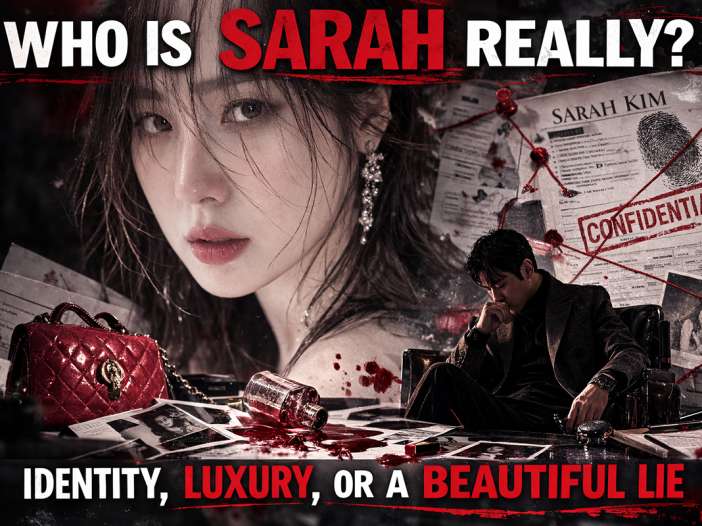
|
Getting your Trinity Audio player ready...
|
What if the most dangerous lie is the one society secretly wants to believe?
Introduction by Park Mu-gyeong
Good evening.
We began this inquiry thinking it was about a death. Then it became an inquiry into fraud. Then identity. Then class. Then desire. Then truth itself. By the time we reached this table, the name Sarah Kim no longer felt like a simple name. It felt like a pressure point — a place where a whole society’s hidden beliefs had been exposed.
What is a person, once the record splits from the body, the body splits from the story, and the story begins to outshine the life that produced it? Is she still one self? Or has she become a sequence of answers to humiliation? Mok Ga-hui. Kim Eun-jae. Sarah Kim. Different names, different rooms, different forms of survival. Yet beneath those names was one relentless struggle: not merely to escape poverty, but to escape insignificance. Not merely to rise, but to rise in such a way that the world would have to revise its judgment.
That is why this conversation cannot be treated as a private moral puzzle alone. Sarah did not appear from nowhere. She emerged from a culture that ranks people long before it knows them. A culture that teaches, in subtle and brutal ways, that polish is safer than truth, that scarcity can look like holiness, that value clings more easily to symbols than to labor, and that a well-performed self can travel farther than an honest wounded one.
Around this table sit people who knew Sarah from different distances. Some stood near her radiance. Some worked inside the machinery that held it up. Some were drawn by it. Some were diminished by it. Some saw in her a promise. Some saw a warning. Together, they carry fragments of the same central question: when a human being is denied dignity long enough, what form does the fight for dignity begin to take?
Across these five topics, we will not ask only whether Sarah lied, manipulated, harmed, or reinvented. Those matters are real, and they will not be softened here. Yet a narrower moral judgment is too easy. The harder task is to ask what her life revealed about the rest of us. About the worship of status. About the seduction of luxury. About the afterlife of humiliation. About how fragile truth becomes when people find comfort in performance. About why creations often survive more easily than persons do.
I confess something before we begin. As a detective, I was trained to trust evidence over atmosphere, names over impressions, sequence over spectacle. This case taught me that a human being can learn to live inside atmosphere so completely that fact itself begins to feel late. It taught me that identity can be used like architecture. It taught me that a beautiful image does not merely hide truth — it can recruit defenders, buyers, imitators, and believers. It can become a small social order of its own.
So tonight I do not ask you to decide too quickly whether Sarah was victim or villain, genius or fraud, survivor or destroyer. Those words each catch something, yet none can hold the whole. I ask for something harder: that we remain inside the contradiction long enough to hear what it says. A woman was humiliated and became dangerous. A creation was built and human beings disappeared inside it. A detective pursued truth and found that truth alone was never the only thing at stake. A society condemned deception yet kept desiring the very glow deception produced.
That is where we begin.
Not with innocence. Not with easy blame. Not with the comfort of imagining that Sarah was unlike us in every important way.
We begin with the possibility that her life was not an exception, but an exposure.
Let us enter the first question.
(Note: This is an imaginary conversation, a creative exploration of an idea, and not a real speech or event.)
Topic 1: Can a person invent a new self and still remain morally human?
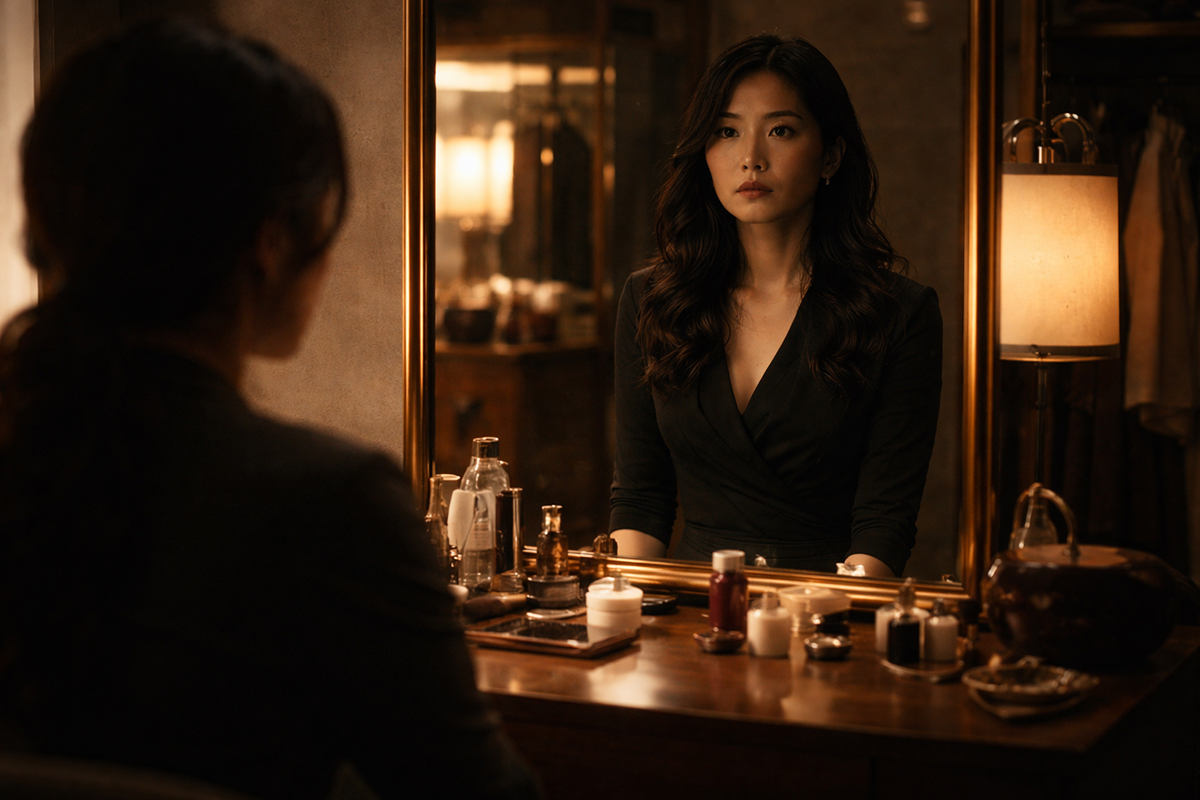
Park Mu-gyeong:
Let me begin with the question beneath all the others. We often speak of identity as though it were something natural — a name, a face, a history, a set of records, a childhood carried forward into adulthood. Yet some lives do not move in such a straight line. Some lives break. Some are cornered. Some are shamed so deeply that the original self no longer feels like a home, but like a wound. And then a person does something both frightening and fascinating: they begin again.
Sarah, you did not merely change your circumstances. You altered your name, your story, your posture, your language, even the atmosphere around you. You did not ask the world to recognize you. You forced it to. So here is my question. When a person creates a new self out of pain, ambition, and refusal, is that an act of freedom? Or is it the moment moral gravity begins to fail?
Sarah Kim:
That question is already tilted against me. It assumes there was some stable moral ground I stepped off from. But tell me, Detective — where exactly was that ground? In debt? In ridicule? In being watched with contempt by people who had never once feared eviction, hunger, or humiliation? People speak beautifully about moral continuity when life has never demanded that they shed their skin to survive.
You ask whether I remained morally human. I would ask something else: why is the burden always on the wounded person to remain pure? Why are those who create the conditions of desperation granted the luxury of appearing civilized, yet the person who adapts is examined like a stain?
I did not invent myself for sport. I invented myself because the world had already made its decision about the worth of the woman I had been. It had looked at her and found her forgettable. Poor. Replaceable. Beneath notice. You speak of identity as though it were sacred. I learned early that society does not treat identity as sacred. It treats it as ranked.
Woo Hyo-eun:
I can accept the pain in what you are saying without accepting what you became. That is where I struggle with you. There are many people who are humiliated. Many people who feel unseen. Many people who must put on a stronger face just to get through a day. That part I understand. What I cannot accept is the point where reinvention begins feeding on other people.
At Boudoir, your new self did not only protect you. It demanded that everyone around you orbit it. Workers had to disappear into the image. Doubts had to disappear into the image. Even facts had to disappear into the image. That is the part that troubles me. At first you may have built a self to escape shame. But later it felt as though you needed your creation to stand above others, not merely beside them.
So I want to ask you plainly: when did your new self stop being shelter and start becoming appetite?
Sarah Kim:
When I realized that shelter is never enough. Shelter keeps you alive. It does not restore dignity. It does not erase the memory of being looked through as though you were glass. You speak as though survival should have made me humble. Why? Why should surviving humiliation produce modesty? Sometimes it produces hunger. Sometimes it produces precision. Sometimes it produces the refusal ever to kneel again.
And let me say something harsher. People admire reinvention when the person does it beautifully enough. They condemn it only when they discover what it cost. Had I remained elegant, untouchable, and slightly mysterious, many of the same people now speaking of morality would still have called me brilliant.
Jeong Yeo-jin:
That is what makes you so hard to dismiss. You are not wrong about the hypocrisy. I moved in circles where reinvention was praised all the time, provided it looked expensive. People changed accents, manners, lovers, political opinions, even entire personalities to match the room. They called it sophistication. They called it growth. They called it knowing how to move.
So part of me hears you and thinks: yes, you simply learned faster than the rest of us how identity works in a status-driven world.
But another part of me cannot let you off that easily. There is a difference between refinement and self-erasure. There is a difference between adaptation and scorning the person you once were. Sometimes when I listened to you, I had the feeling that you were not only escaping your past. You were punishing it. You were treating your former self as something shameful that deserved burial.
And that frightens me, because once a person decides the earlier self deserves no mercy, why would anyone else deserve any?
Choi Chae-u:
That is the line that interests me. People romanticize self-creation. They speak of it as courage, as will, as talent rising against limitation. But self-creation often contains contempt — contempt for weakness, for dependence, for need, for every visible trace of vulnerability. What is called reinvention can hide a private civil war.
Sarah, I do not find you mysterious. I find you legible. You wanted entrance into a world that had denied you, yes. Yet once inside, you did not seek correction. You sought superiority. You did not wish to belong among the powerful. You wanted to stand above them by proving that you could fabricate what they inherited.
That is why I reject the sentimental reading of your life. The issue is not whether you had reasons. Of course you had reasons. Almost everyone does. The issue is what you came to worship. You came to worship invulnerability. And once invulnerability becomes sacred, morality becomes ornamental.
Kim Mi-jeong:
I want to stay with that word — worship. Because that is what I felt around Sarah. Not merely ambition. Not merely fear. Worship. She did not just build a new self. She built an altar around it, and everyone near her had to decide whether to bow, resist, or be crushed beneath it.
What troubled me was not that she changed. Anyone can understand wanting to change. What troubled me was that her new self seemed to require witnesses. It was not enough for her to survive privately. The world had to certify her transformation. The world had to admire it. The world had to forget the old humiliations and replace them with awe.
I ask myself this often: if no one had seen you, Sarah, would you still have become who you became? Or was recognition the real fuel? Was the new self a home — or a performance that only existed when reflected in other people’s envy?
Sarah Kim:
That question assumes a false distinction. What is a self that is never recognized? A fantasy? A private rehearsal? Identity lives in the gaze of others whether we admit it or not. A title means nothing if no one honors it. Elegance means nothing if no one registers it. Even humiliation requires witnesses. Why should reinvention be any different?
You all want me to confess vanity, as though that would settle it. Fine. Recognition mattered. Of course it mattered. I wanted the world that dismissed me to choke on its own misjudgment. I wanted those who would never have welcomed the woman I had been to court the woman I became. That was pleasure, yes. But it was also justice of a kind.
Park Mu-gyeong:
Justice? That is the word you choose?
Sarah Kim:
A crude kind of justice, perhaps. But do not pretend that polite society offers a cleaner one. The world wounds people through hierarchy every day, then becomes morally delicate when the wounded answer in a language it cannot control.
Woo Hyo-eun:
But your answer did not only strike the powerful. That is what you keep sliding past. The harm did not travel upward alone. It moved downward too. Workers paid for your image. Smaller people paid for your refusal to be small again. If your transformation had only embarrassed the rich, I might hear your defense with more sympathy. But it did not stop there.
This is what I want to know: did you ever grieve the human cost? Not in strategy, not in rhetoric — truly grieve it?
Sarah Kim:
Grief is dangerous when you are building. Too much grief and the structure shakes.
Jeong Yeo-jin:
That may be the truest thing you have said tonight.
Because perhaps that is the real price of inventing a new self. It is not just lying to others. It is narrowing what one can afford to feel. There are emotions that threaten architecture. Shame. Pity. Grief. Tenderness toward former weakness. If the new identity is fragile, those feelings become enemies.
So maybe the question is not merely whether one can invent a new self and remain morally human. Maybe the question is whether one can do it without amputating the softer parts of being human.
Choi Chae-u:
Softness is expensive. That is another truth polite people dislike. The higher one climbs, the more softness is punished. Sarah did not invent that rule. She learned it.
Yet learning a rule and worshipping it are different things. That is where responsibility returns. She may have entered a cruel game, but she did not remain a mere piece on the board. She became inventive inside it. Effective inside it. Proud inside it.
And there is one more thing. People often say that society leaves the poor with no choice. That is morally dramatic, but rarely exact. The poor usually have choices — terrible choices, degrading choices, dangerous choices. What enrages them is that none of the available choices preserve dignity. Sarah chose the path that promised the sensation of superiority. That is not the same as necessity.
Kim Mi-jeong:
Yes. And this is where I cannot separate her from myself. I understand the temptation. When a person has been unseen long enough, being visible can feel like oxygen. Being desired can feel like revenge. Being admired can feel like proof that the old humiliations were lies.
But there is poison hidden there. Once the self is built from the need to never be disregarded again, it becomes merciless. Every room becomes a test. Every face becomes a mirror. Every slight becomes a threat. The new self must keep winning, because one crack in the image risks the return of the buried person underneath.
Sarah, I wonder whether you were ever truly free after your transformation. Or whether you became servant to the very identity you thought would save you.
Sarah Kim:
Freedom is romanticized by people who have not had to purchase it at ruinous cost. Did my identity demand maintenance? Yes. Did it imprison me in certain ways? Yes. But the earlier self was a prison too — only a humiliating one, a powerless one, a voiceless one. You speak as though there was some gentle path I ignored. There was not.
I chose the prison with better lighting.
Park Mu-gyeong:
That line cuts close to the center.
Perhaps that is what unsettles this question so deeply. We like to speak in opposites: true self and false self, innocence and corruption, survival and ambition, victim and perpetrator. Yet human beings rarely fall so neatly into one column. A person may flee degradation and become cruel in the fleeing. A person may create a stronger self and lose moral depth in the construction. A person may gain dignity in public and lose intimacy with conscience in private.
Sarah, listening to you, I do not doubt that the old life wounded you. I do not doubt that this society sorted you before you ever spoke. I do not doubt that class contempt can deform the soul long before any crime appears. But I also cannot ignore what Hyo-eun and Mi-jeong are pressing toward: the new self did not remain a shield. It became a hierarchy of its own. It demanded offerings. It turned living people into supporting material.
So maybe the issue is not whether a person may invent a new self. Human beings do that all the time. Through grief, migration, ambition, love, loss, faith, ruin — we remake ourselves again and again. The harder issue is this: what is the new self built to protect? A conscience? A wound? A hunger? A vanity? A terror of being ordinary? The answer to that question may decide whether reinvention becomes liberation or moral collapse.
And here is the thought I cannot shake. The most dangerous transformations may not happen when people begin lying about who they are. They may happen when people decide that the earlier self — the ashamed self, the needy self, the vulnerable self — deserves no compassion at all. Once that inner mercy dies, outer mercy rarely survives it for long.
That, I think, is where the real danger begins.
Topic 2: Why do people worship luxury when they know it is built on illusion?
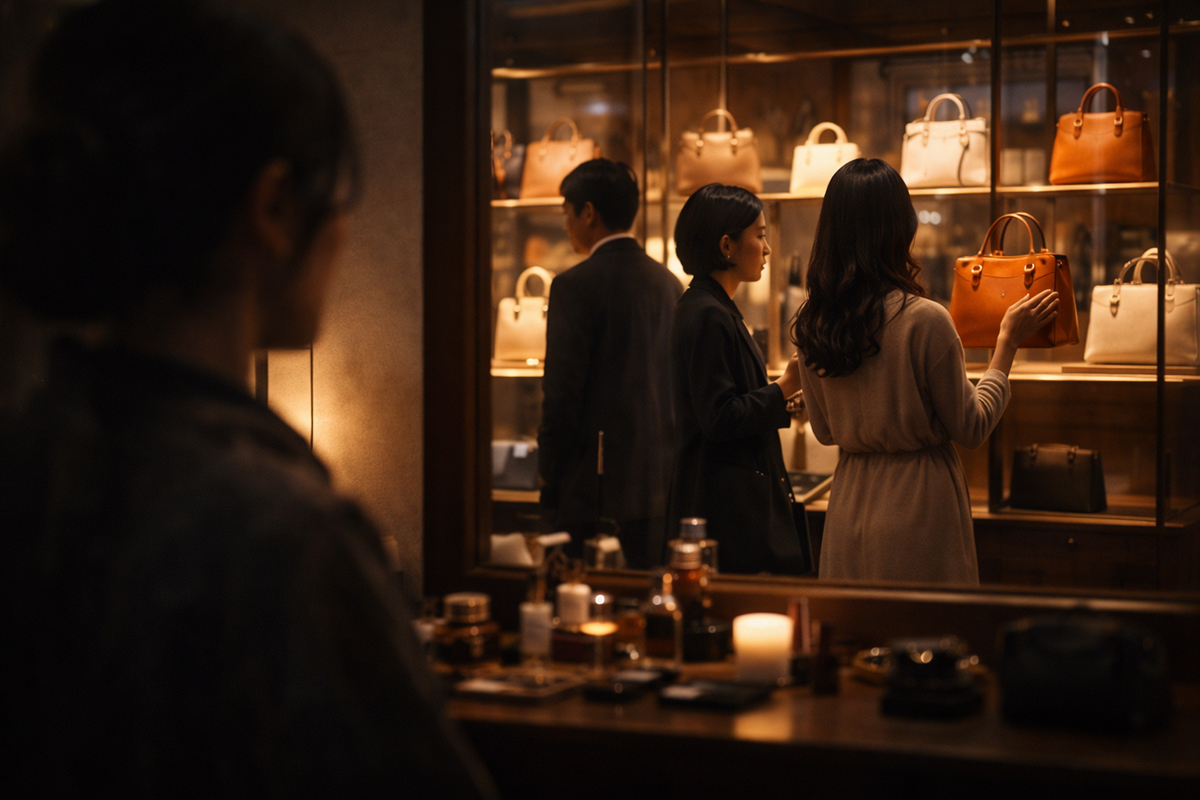
Park Mu-gyeong:
Let us move from identity to desire. A person can change a name, a life, a face presented to the world. But no transformation happens in empty air. It needs a stage, a market, a set of collective longings waiting to be used. In this case, that stage was luxury.
What interests me is that luxury rarely depends on deception in the simplest sense. Most buyers are not fools. They know a handbag is still a handbag. They know fabric is fabric, leather is leather, a logo is ink and metal and stitching. And yet something happens the moment an object enters the sacred zone of status. It stops being measured by use. It begins to carry fantasy, distance, belonging, class, and almost something like moral permission. People do not simply buy the thing. They buy what the thing promises to say about them.
So here is my question for all of you: why do people worship luxury even when they know it is woven from performance, exclusion, and carefully managed illusion? What exactly are they kneeling to?
Choi Chae-u:
They are kneeling to hierarchy. Everything else is decoration.
People speak sentimentally about craftsmanship, heritage, taste, the romance of old ateliers and inherited excellence. Those stories matter, yes, but only because they help make rank feel beautiful. Luxury is the social art of making inequality look desirable. It teaches people to long for distance from the ordinary, then persuades them that this distance can be purchased and displayed.
That is why luxury is never only about objects. It is about access. About entering a room through symbols before one has entered through bloodline or history. About saying, without speaking, “I belong near what is scarce.”
What Sarah understood — perhaps too well — was that the object itself is never the whole transaction. A luxury brand sells insulation from humiliation. It sells the fantasy that one can put one’s hand on a surface and feel, for a moment, untouchable.
Sarah Kim:
Yes. Which is why I always found moral outrage around luxury a little theatrical. People denounce illusion, then line up for better lighting. They pretend they are purchasing excellence when they are often purchasing relief — relief from smallness, doubt, invisibility, the fear that one’s life carries no aura.
Luxury is not powerful because people are stupid. It is powerful because people are wounded. That is what polite society hates admitting. The buyer standing in a boutique is often not chasing beauty alone. The buyer is trying to negotiate with shame. Trying to quiet some ancient anxiety by wrapping it in something expensive.
And why should I be condemned for seeing clearly what everyone else preferred to hide? Boudoir did not invent hunger. It gave hunger a language people already understood.
Woo Hyo-eun:
That is precisely where your honesty becomes dangerous.
You speak as though recognizing insecurity gives you the right to monetize it without limit. But the fact that people are wounded does not clear the one who turns the wound into business. What I saw inside Boudoir was not just insight into desire. I saw contempt for it. You knew people wanted transformation, and you fed that want in a way that made everyone beneath the image easier to erase.
The object became sacred. The worker became invisible. That was the real trick.
When stock remained unsold, it could be destroyed to preserve exclusivity. When questions arose about quality or origin, they were treated as threats to the myth. When labor became inconvenient to the fantasy, labor disappeared from the story. So I want to say this plainly: luxury is not only illusion. It is organized forgetting. The buyer forgets the maker. The brand forgets the hand. The polished surface asks everyone to forget what and who had to vanish for it to shine.
Kim Mi-jeong:
I want to stay there.
People praise luxury craftsmanship all the time, yet the craftsperson almost never becomes the face of value. That should tell us something. The hand is admired in theory but hidden in practice. What people worship is not skill by itself. It is skill once it has been purified of sweat, repetition, and the ordinary body.
I made things meant to be touched, desired, envied. I knew what precision cost — the hours, the strain, the eye for detail, the discipline of repeating perfection until the body aches. Yet none of that was what the room celebrated. What the room celebrated was atmosphere. Signature. Scarcity. The story floating around the object like perfume.
And that leaves a bitter taste. Because the maker lives nearest to reality. The maker knows where the seams are, where the shortcuts were taken, where the glamour depends on silence. The buyer stands farthest from reality, yet is the one treated as keeper of taste. That reversal tells you everything. Luxury is not a tribute to truth. It is a tribute to successful distance from truth.
Jeong Yeo-jin:
Still, it would be too easy to speak about buyers as though they were only shallow. I moved in those circles. I know the vanity, the performance, the hunger to be seen near what is costly. All of that is real. But another thing is real too: the object can become a vessel for longing much older than status.
A woman may buy something expensive and tell herself it is about beauty, but perhaps what she wants is evidence that her life has finally crossed some invisible border — that she is no longer the girl who was dismissed, no longer the daughter of scarcity, no longer someone who must apologize for wanting beautiful things. Sometimes luxury gets tangled up with memory. With childhood lack. With the dream that one day the world will stop speaking to you in a patronizing tone.
That is why I cannot laugh off luxury entirely. It carries vanity, yes. It also carries biography. It can become a private ceremony of self-repair.
But that is where Sarah fascinates and disturbs me. She knew how intimate that desire was. She did not sell only objects. She sold emotional revision. She sold the promise that a person could feel rewritten.
Sarah Kim:
Exactly. And people came willingly.
Why should we act scandalized by that? Every culture creates rituals through which people try to revise themselves. Clothing. Titles. Homes. Schools. Accent. Marriage. Travel. Even manners. Luxury only makes the ritual visible by condensing it into objects.
People like to pretend that ordinary life is honest and luxury is false. I do not believe that. Most social life is costume with better excuses. Luxury merely refuses modesty about it. It says openly: yes, meaning can be attached. Yes, aura can be staged. Yes, price can shape perception. The rest of society does similar things and hides behind words like tradition, merit, breeding, refinement, professionalism.
At least luxury is candid in its vanity.
Choi Chae-u:
No, not candid. Stylized.
Luxury never says, “We exist to make you fear exclusion.” It says, “We exist to celebrate excellence.” It wraps coercion in beauty. That is its genius. It does not sell hierarchy as humiliation. It sells hierarchy as aspiration.
And Sarah, that is where you were both gifted and crude. Gifted, because you recognized the mechanism instantly. Crude, because you believed exposure of the mechanism made you superior to it. It did not. You became one of its most fervent priests.
There is always a moment when the outsider who learns the code becomes stricter than those born into it. That is what I saw in you. The convert’s intensity. The zeal of someone who wants no trace of doubt left in the room.
Sarah Kim:
Of course. People born inside systems can afford casualness. Outsiders cannot. Casualness is inherited ease. Those who arrive late must perform mastery more sharply.
You call that zeal. Fine. But do not mistake the source. When someone has once been judged unworthy of entry, she learns that elegance must be exact, posture exact, tone exact, every symbol carefully handled. The born insider can be sloppy. The outsider must be immaculate.
So yes, I was strict. The world had been strict with me first.
Park Mu-gyeong:
That may explain the intensity. It does not settle the deeper question.
I keep coming back to the odd spiritual quality of luxury. Not religion in a formal sense, but ritual, taboo, belief, relic, pilgrimage. People stand before certain objects with a reverence out of proportion to utility. They wait, save, compare, dream, display, protect. A handbag may become less a possession than a testimony. A watch becomes a sacrament of arrival. A label becomes proof that one’s life has crossed from the ordinary into the blessed.
So what is happening there? Why does material scarcity speak so strongly to inner worth?
Woo Hyo-eun:
Because people are tired of being ordinary in a culture that treats ordinary as failure.
That is what I came to believe. Luxury feeds on exhaustion with the common self. It whispers, “You do not have to remain one among many. You can be marked. Elevated. Chosen.” In that sense it is never only about beauty. It is about rescue from interchangeability.
And once that promise is believed, the object becomes too emotionally charged to evaluate sanely. A buyer may know, intellectually, that the markup is absurd, that the branding is manipulative, that scarcity is engineered. But emotionally none of that matters, because the object has already attached itself to a deeper fear: the fear of being forgettable.
That is where the illusion becomes difficult to resist. It is not fighting reason alone. It is fighting loneliness.
Kim Mi-jeong:
Yes, loneliness. And envy.
Luxury gathers people into a cruel triangle: the one who displays, the one who desires, the one who makes. The display creates envy. The envy creates longing. The maker remains outside the emotional drama, though the maker made it possible. That exclusion is painful to witness.
Sometimes I thought the real product was not the object at all. It was the social wound that the object could trigger in other people. The gaze of others completed the sale. A beautiful bag unwatched is only partially alive in the luxury world. It must be seen. Registered. Interpreted. Resented. Desired. Only then does it bloom fully into status.
Which means luxury depends on other people’s insecurity almost as much as the buyer’s.
Jeong Yeo-jin:
That is painfully true.
I have worn expensive things and felt the strange split they create. Part of you enjoys them privately — the shape, the texture, the pleasure of selecting something beautiful. Another part is acutely aware of the social theater around them. You know others are reading. You know you are being placed in a story. You know some will admire, some will judge, some will compare. The object enters the room before your words do.
That can feel intoxicating. It can also feel hollow.
And maybe that is why luxury never stays satisfied. The object gives a momentary high, then the old uncertainty returns. So another purchase follows, another threshold, another version of arrival. The ritual repeats because the wound beneath it was never really healed. It was only dressed.
Sarah Kim:
Why is that treated as a special failure of luxury? All human desire repeats. Love repeats. Achievement repeats. Reinvention repeats. No one reaches a final state of completion and peacefully stops wanting to be seen, valued, envied, secured. Luxury is only one of the cleaner mirrors reflecting that endless motion.
The real hypocrisy is that people condemn the mirror more than the face inside it.
I knew buyers would return. Of course they would. The object was never the endpoint. It was a temporary negotiation with dissatisfaction. That is most consumption, if we are being honest.
Choi Chae-u:
But luxury sharpens the negotiation by tying it to rank. That is the difference. Ordinary consumption may soothe want. Luxury organizes want into visible social order. It says: there are levels, and you can approach them, though never all the way, through purchasing symbols of nearness.
That is what keeps the machine alive. Total arrival would kill the market. So desire must be fed and frustrated at once. Enough access to intoxicate, enough distance to preserve ache.
In that sense, luxury is not simply selling beauty. It is selling beautifully rationed insufficiency.
Park Mu-gyeong:
Beautifully rationed insufficiency. That is hard to improve upon.
Yet I want to bring us back to Boudoir, because what made Sarah’s enterprise so explosive was that it exposed how thin the line can be between accepted myth and condemned myth. If a heritage house tells a story about lineage, place, hand-finished excellence, people call it aura. If Boudoir manipulates perception, people call it fraud. Sometimes the difference is real. Sometimes the difference is pedigree protecting its own methods.
So here is the uncomfortable question: where exactly does illusion become crime? Is it the lie about origin? The lie about scarcity? The lie about who made the object? Or is the whole field already built on such layers of story that outrage appears only when the wrong person is caught telling them?
Woo Hyo-eun:
That matters. It matters a lot. Still, I do not want the moral blur to become an excuse.
Yes, luxury houses tell stories. Yes, buyers collude in fantasy. Yes, pedigree often gives old brands a pass. But there is still a line, and part of that line is human cost. Once people become disposable to protect the image, once truth must be buried to preserve the glow, once labor and harm are treated as acceptable fuel, then the illusion is no longer merely aesthetic. It becomes predatory.
A story can beautify. It can also consume.
Kim Mi-jeong:
And the maker knows when that shift happens first.
There is a point when the object stops carrying care and starts carrying appetite. You feel it in the speed, in the secrecy, in the pressure to maintain appearance no matter what. The craft remains, but something cold enters it. The object begins serving the myth more than the hand.
That is when it becomes painful to make beautiful things. Beauty starts feeling like a cover.
Sarah Kim:
And yet none of you have denied the central fact: people wanted what Boudoir gave them. They wanted the story, the edge, the transformation, the thrill of holding something that seemed to promise distance from ordinary life. They may condemn the machinery after the fact, but desire itself was present long before my name entered the room.
That is what gives me little patience for moral innocence. Society loves to consume its fantasies, then pretend surprise at the labor of fantasy-making.
Park Mu-gyeong:
No innocence, then. Perhaps that is the conclusion pressing itself on us.
Luxury is not just about objects. It is about converting insecurity into visible form. It offers people a way to wear distance from shame, distance from anonymity, distance from the fear that their lives do not register. It blesses hierarchy by coating it in beauty. It hides labor beneath aura. It turns longing into ritual and comparison into atmosphere.
And Boudoir did not stand outside that world. It exposed its nerve. That is why the reaction to Sarah was always double. She disgusted people, yes. She also revealed them.
Perhaps that is why luxury provokes such fierce devotion and such fierce resentment. It is one of the few places where society’s hidden theology becomes visible. What do we worship? Not usefulness. Not truth. Not labor. We worship distinction. We worship the fantasy that value can cling to a person like scent, like finish, like an expensive object carried through a room.
The danger begins when that fantasy stops being ornament and starts becoming moral measure. When who deserves attention, mercy, or dignity begins to follow the same logic as who deserves access.
Then luxury is no longer about taste. It becomes a quiet education in whom we are willing to treat as fully real.
And that, I think, is why this subject reaches far beyond handbags.
Topic 3: Does humiliation create crime, or only reveal character?
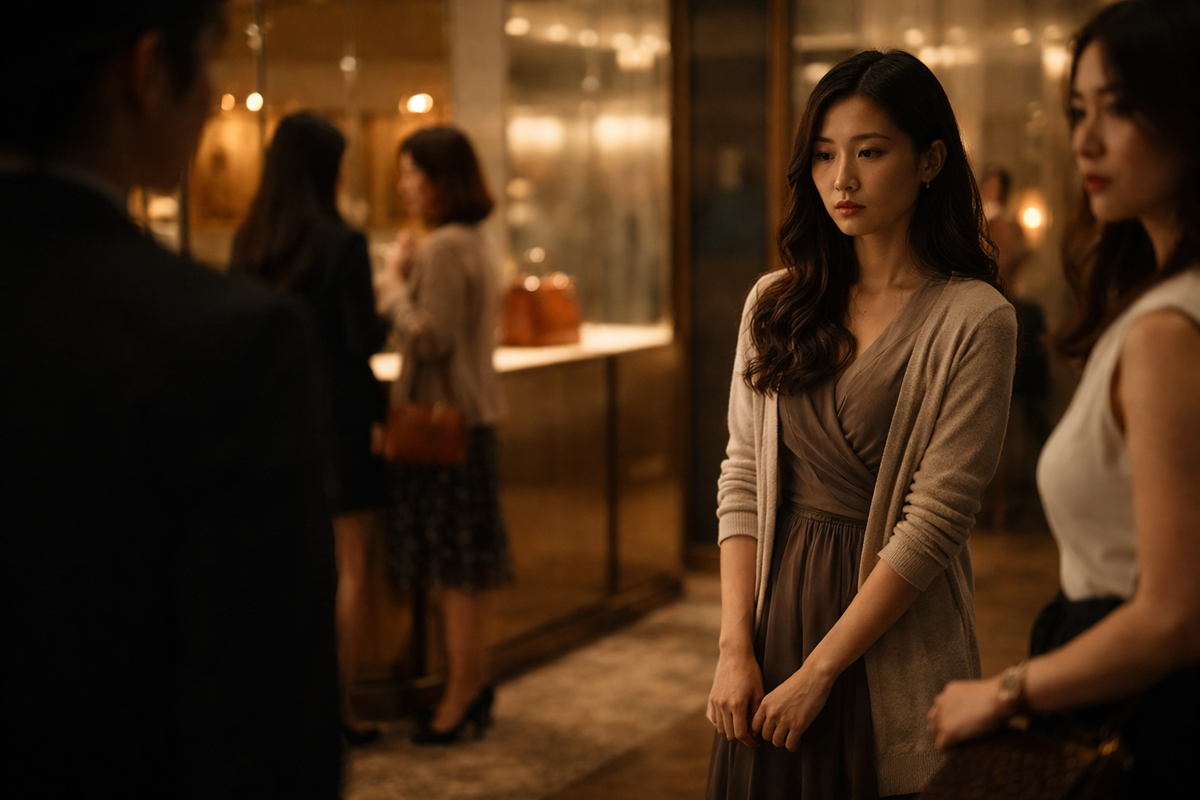
Park Mu-gyeong:
There is a dangerous sentence people like to use when trying to explain a life gone wrong: she had no choice. I have never trusted that sentence. Most people do have choices. What they often do not have are good choices, dignified choices, or choices that leave their inner life intact. Poverty, contempt, exclusion, and social humiliation do not erase freedom completely. They do something more difficult to judge. They bend freedom. They narrow it. They fill the imagination with harsher possibilities.
That is why I want us to stay with humiliation tonight. Hunger matters. Debt matters. Fear matters. Yet humiliation has its own violence. It enters a person differently. Hunger empties the stomach. Humiliation enters the mirror. It changes how one stands in a room, how one hears a laugh, how one interprets delay, how one remembers every slight long after others have forgotten it. It can become a second bloodstream.
So here is the question: when a humiliated person commits harm, are we witnessing crime born from injury? Or are we merely seeing character exposed under pressure? Put differently — does humiliation corrupt, or does it reveal what was waiting there all along?
Sarah Kim:
That question pleases the comfortable because it allows them to remain abstract. They can discuss “character” as though it floats above history, above class, above repeated contempt. But character does not grow in a vacuum. It forms in weather. It hardens under gaze. A person who has been treated as lesser for years does not emerge untouched and then suddenly choose in perfect neutrality between grace and ruin.
You ask whether humiliation creates crime. I would say humiliation creates a certain temperature of soul. It keeps old scenes alive. A look from a sales counter. A correction in someone’s tone. A moment when your presence lowers the warmth in the room. People who have never lived with that think pain is pain. It is not. Humiliation is pain mixed with witness. Someone saw you reduced. Someone saw you placed beneath.
That memory does not simply wound. It educates. It teaches a person where power lives. It teaches what the world respects. It teaches which voices matter and which can be cut off mid-sentence without consequence. After enough of that, some people still remain gentle. Good for them. Others begin to think: if dignity is denied to me in its honest form, perhaps I will take it in another form.
Do not call that mystery. Call it instruction.
Jeong Yeo-jin:
And yet I cannot follow you all the way there.
I agree that humiliation forms people. More than most polite conversations admit. It can sit inside ambition like a hidden engine. It can make success feel less like joy than like counterattack. But I still resist the move from this shaped me to therefore what followed was inevitable. That is where explanation starts becoming seduction.
What frightens me about humiliation is not only that it hurts. It is that it can become intoxicating later, in memory. A person can feed on the old insult, return to it, polish it, keep it alive because it justifies a harder and harder self. The wound becomes a treasury. One keeps drawing moral permission from it.
Sarah, sometimes when I listened to you, I had the sense that humiliation had ceased to be merely something that happened to you. It had become part of your private wealth. You carried it like proof that the world owed you something beyond fairness. Something grander. Something almost absolute.
So I want to ask: did humiliation ever stop being pain and start becoming entitlement?
Sarah Kim:
Of course it did. Pain that remains only pain crushes people. To survive, one must transmute it. Some turn it into humor. Some into prayer. Some into numbness. Some into discipline. I turned it into appetite.
Why does that offend people so much? Because appetite is inelegant? Because ambition is tolerated only when spoken in soft language? I will tell you what humiliation did. It stripped me of any sentimental faith that the world rewards goodness first. It taught me that social life is arranged through signals, strength, presentation, force, timing. Once one truly learns that, innocence becomes very difficult to maintain.
You want me to say that I should have remained morally luminous under contempt. Why? So that the people who benefited from the arrangement could continue calling themselves decent?
Woo Hyo-eun:
No. What I want is simpler and harsher.
I want the right to say that your humiliation was real and that the people beneath you still did not deserve what your answer became.
This is where these conversations often go wrong. Society wounds someone, and then the person who has been wounded starts wounding others. Then people rush to take sides: either the person is a monster and the social wound disappears, or the social wound explains everything and the later victims disappear. I reject both.
At Boudoir, I did not see only a woman protecting herself from shame. I saw a woman who had become exquisitely alert to where shame could be redirected. You knew how to keep it moving. Away from yourself, onto subordinates, onto doubters, onto whoever could be made small enough to carry it. That is what unsettled me most. Humiliation had not only injured you. It had taught you its grammar.
And once someone becomes fluent in the grammar of humiliation, they can hurt with terrifying efficiency.
Choi Chae-u:
That is well put.
Humiliation is often mistaken for a democratizing force, as though suffering should naturally make people compassionate. Sometimes it does. Often it does the opposite. It sharpens social perception. It makes rank visible in every gesture. It fills the person with painful clarity about who is above, who is below, who is safe to offend, who is dangerous to challenge. In that sense humiliation can become a brutal education in hierarchy.
That is why I dislike sentimental accounts of resentment. Resentment is not merely sadness with heat added. It is often intelligence without mercy. It remembers the architecture of insult. It studies power with obsessive attention. It waits.
Sarah did not rise only because she was humiliated. Many humiliated people collapse, withdraw, or remain inwardly broken. She rose because humiliation in her case met talent, nerve, and a refusal to remain legible to the system that had placed her.
Yet this is where responsibility returns. Injury may shape the field. It does not erase authorship. At some point a person stops being only the site of damage and becomes the arranger of damage.
Kim Mi-jeong:
I keep hearing one hidden assumption in this discussion: that humiliation belongs mostly to those at the bottom. It does not. It moves everywhere. It merely changes costume.
The poor are humiliated openly. The near-successful are humiliated through comparison. The talented hidden worker is humiliated by invisibility. The woman who makes the thing and watches another woman become the face of the thing — she too learns humiliation. Different room, different lighting, same fire.
That matters because humiliation does not create one single moral outcome. It creates pressure. One person breaks inward. Another burns outward. Another becomes addicted to recognition. Another wants substitution — if I cannot be seen as myself, then I will wear the shape of the one who is seen. I understand that temptation more than I wish to admit.
So I cannot answer the question by saying humiliation creates crime directly. That feels too mechanical. But I would say this: humiliation disturbs proportion. It makes ordinary slights feel immense. It makes delayed rewards feel like theft. It makes another person’s ease feel accusatory. Under those conditions, a person may commit acts that outwardly look calculated but inwardly feel like restoration.
The danger is that restoration and revenge often wear the same face.
Park Mu-gyeong:
That distinction matters. Restoration and revenge. One tries to rebuild a damaged self. The other tries to make the world pay interest on the damage.
Sarah, when you looked at people above you, what did you feel most strongly — longing, envy, hatred, fascination, or something else?
Sarah Kim:
Recognition.
That may sound strange, but it is true. I recognized that their poise was not natural holiness. It was protection. Their ease was not innocence. It was insulation. They moved through rooms as though entitled to margin, delay, forgiveness, second chances. Their mistakes looked expensive instead of shameful. Their roughness was called confidence. Their ignorance was called taste.
Once I saw that, something changed in me. I no longer felt only envy. I felt insulted by the fraudulence of social innocence. People who had inherited favorable conditions spoke as though their lives were proof of inner order. That offended me more than their wealth itself.
So yes, humiliation played a part. But what radicalized me was seeing how the fortunate narrate themselves. They call advantage character and then expect the rest of us to worship the story.
Jeong Yeo-jin:
There is truth in that, and still I do not trust where you take it.
You describe hypocrisy with frightening accuracy. Yet accuracy can become its own vanity. A person who sees through social lies may begin to believe that vision itself confers moral exemption. I understand the game, so I may play it coldly. I know the hidden mechanism, so I am less guilty than the naive. That is one of the oldest temptations of intelligence.
I think that is part of what happened to you. Humiliation made you perceptive, but perception hardened into superiority. You did not only want entrance or even justice. You wanted the pleasure of knowing that you were less deluded than everyone else.
That is where injury becomes style.
Sarah Kim:
And is that worse than injury becoming self-pity?
People love the wounded only when the wounded remain aesthetically acceptable — tender, articulate, morally humbled, still capable of admiring those above them. The moment the wounded become cold, strategic, or magnificent, sympathy retreats and moral language rushes in.
Perhaps that is fair. Perhaps it is not. But I have little patience for the demand that suffering produce sweetness. Sometimes suffering produces exactness. Sometimes it produces contempt. Sometimes it produces someone you would have preferred to keep powerless.
Woo Hyo-eun:
No one here is asking for sweetness.
I am asking whether humiliation gave you clarity or whether you began to cherish it because it made cruelty feel earned.
That is the part I cannot stop circling. If someone insults me and I go home wounded, that is one moral event. If I build an empire that quietly forces others to absorb my old degradation, that is another. Somewhere in between there is a decision, or a series of decisions. Maybe not one grand evil moment, but smaller permissions. A moment of numbness here. A rationalization there. A thought like: I cannot afford softness. Another like: They would do the same to me. Another like: This is only temporary. Before long the entire inner vocabulary changes.
Crime, in that sense, may be less a leap than a dialect acquired.
Choi Chae-u:
Yes. People want the dramatic version — the snap, the breaking point, the great humiliation that produces the great fall. Real corruption is often duller and more intimate. It enters through repeated consent to a harsher interpretation of necessity.
And humiliation aids that process by shrinking the field of moral concern. Once a person becomes obsessed with never being lowered again, almost everything gets judged according to one standard: does this protect me from return? If not, it becomes negotiable. Truth becomes negotiable. Loyalty becomes negotiable. Other people’s fragility becomes negotiable.
That is why humiliation is politically and morally potent. It does not merely hurt. It reorganizes scale.
Kim Mi-jeong:
And still, one part of me resists reducing the whole matter to moral failure.
There is a cruelty in social life that people with stable dignity underestimate. To be repeatedly unseen, or seen only as function, can produce a hunger so deep that ordinary ethical language sounds thin beside it. “Be patient.” “Remain decent.” “Do not let them change you.” These are expensive sentences. They cost less to those whose selves are affirmed every day by default.
I am not defending what follows from humiliation. I am trying to protect the truth that humiliation is not just a feeling. It is a condition of being placed. Some are placed low so often that upward motion itself begins to feel like moral emergency.
That does not excuse harm. But without grasping that emergency, one will judge too neatly.
Park Mu-gyeong:
Too neatly. Yes. That is the phrase I have been reaching for.
Law has to draw lines. It cannot function without them. Society also needs lines. Yet when I think about humiliation, I am reminded how poor our common language can be. We speak as though people either have character or lack it, as though pressure simply reveals what was hidden inside. There is some truth in that. Pressure does reveal. But it also shapes. It teaches. It distorts. It rewards certain adaptations and punishes others. In that sense, character is not only exposed by experience. It is edited by it.
So does humiliation create crime, or only reveal character? I no longer believe that is a clean either-or.
Humiliation can create the psychological climate in which cruelty feels like restoration. It can train the eye toward hierarchy, train memory toward insult, train desire toward forms of revenge so polished they no longer look like revenge at all. It can make domination feel like safety, visibility feel like oxygen, admiration feel like medicine. Under its pressure, character is both tested and rewritten.
But here is the part I cannot surrender: pain may explain the path into darkness, yet it does not sanctify what is done there. To say that humiliation shaped a person is truthful. To say it removed moral authorship is false. Between wound and act there remains a human being, altered and constrained, yes, but still terrible in one final way — still capable of consent.
And perhaps that is what makes humiliation such a grave subject. It is one of the few injuries that can turn the desire for dignity into a weapon against dignity itself. The humiliated person does not always seek to heal. Sometimes the humiliated person seeks never to kneel again, no matter who must kneel in return.
That is where sorrow darkens into danger.
Topic 4: Can truth win against someone who turns identity into performance?

Park Mu-gyeong:
A murder investigation teaches a person to respect stubborn things: time stamps, receipts, bodies, witness statements, patterns that recur when human beings think they are improvising. Facts are rarely elegant, but they are patient. They sit where they are left. They do not charm. They do not ask to be admired. They wait.
And yet this case forced me into a more unsettling question. What happens when a person does not merely lie, but lives in such a way that lying and being become difficult to separate? What happens when identity itself becomes staged, revised, exchanged, polished, rehearsed, and defended like a role? Then truth is no longer chasing a single false statement. It is chasing a moving architecture.
That is what I want to ask tonight. We like to believe that truth, given enough time, rises. But does it still rise when the person being pursued knows how badly the world wants a performance? When beauty, confidence, class signals, and timing can outpace evidence? When people do not merely get deceived, but willingly help sustain the mask because the mask pleases them?
Sarah, did you think truth could never catch you? Or did you simply trust that performance would keep arriving first?
Sarah Kim:
Truth is slower than desire. That was the first rule.
People talk as though truth enters a room like a judge. It does not. Usually it enters tired, late, after reputations have settled and impressions have hardened. By then the room has already chosen what it prefers to believe. That is why I never feared facts in the abstract. Facts alone rarely move people. They need shape, mood, hierarchy, presentation. They need a host body.
I understood something that polite people pretend not to know: most social life runs on legibility, not truth. If a woman appears composed, expensive, difficult to place, touched by scarcity but not degraded by it, people do half the lying for her. They fill gaps. They protect the story. They explain inconsistencies away because the image gives them something they wish to preserve.
So no, I did not believe truth was powerless. I believed it was negotiable in practice. Delayed. Interrupted. Reframed. Outdressed.
Jeong Yeo-jin:
That is what makes you so frightening. You are not describing deception as a trick. You are describing it as collaboration.
I keep returning to that word because it shifts blame in a painful way. It means the audience is never innocent. It means the elegant fraud survives partly because people want elegance more than correction. They want the emotional reward of believing in the figure they have already invested in. To stop believing would wound their own judgment, their own taste, their own place in the story.
I felt that around you. There were moments when I saw cracks, but the cracks themselves almost became part of your allure. Mystery protected you. Inconsistency protected you. It made you feel more rare, more cinematic, less reducible to ordinary scrutiny. That is embarrassing to admit, but I think it is true.
So maybe truth was never facing only you. It was facing everyone who had attached some private need to your image.
Woo Hyo-eun:
Yes. And that is why performance can be harder to break than a simple lie.
A lie can be disproved. A performance becomes an environment. People work inside it, earn from it, dream through it, compare themselves against it, organize their hopes around it. Once that happens, exposing the truth threatens more than the central figure. It threatens everyone who found meaning, money, or borrowed status in the illusion. Suddenly truth feels destructive, rude, almost immoral.
I saw that at Boudoir. It was never just that Sarah told a persuasive story. It was that the story created positions for other people. Investors could feel visionary. Buyers could feel elevated. staff could feel near a glowing center. Even those who resented it were still reacting to its gravity. The performance gave shape to the room.
That is why people inside a system of illusion often treat the truth-teller as the disturber, not the fraud as the disturber. By the time truth arrives, the performance has already built a little society.
Choi Chae-u:
And societies protect themselves.
That is why I distrust romantic notions of revelation. People speak of truth as though it possesses natural triumph. It does not. Truth has no innate advantage except persistence, and persistence is often weak against appetite. Institutions do not automatically align with truth. They align with stability, prestige, continuity, self-protection. If truth can be absorbed without damage, it is welcomed. If truth threatens the arrangement, it is called complicated, premature, unverified, tactless, even cruel.
Sarah succeeded because she understood a principle older than she is: the world rewards convincing form before it rewards exact content. A title, a tone, a room, a controlled surface — these things create presumption. Once presumption is granted, truth bears the burden of interruption.
That burden is heavier for outsiders and almost weightless for the well-positioned. A woman born inside pedigree can survive ambiguity as charm. A woman from below must turn ambiguity into artistry or die beneath suspicion. Sarah grasped that imbalance and used it with ruthless intelligence.
Kim Mi-jeong:
I want to say something from the side of the hidden person.
Performance does not only fool from above. It can also rearrange people beneath it. If one woman is seen as the face of value, others begin moving in relation to that face. Some become loyal. Some become resentful. Some become imitators. Some begin to wonder whether visibility itself is a kind of truth. If the world treats the image as real, then perhaps becoming the image feels more achievable than asking the world to see what is real.
That is where performance becomes dangerous in a deeper way. It does not merely conceal the truth. It starts breeding alternative truths inside the minds of those who live near it. They begin asking: maybe what matters is not who made, who suffered, who existed first. Maybe what matters is who can hold the room. Who can wear the aura convincingly enough to inherit reality.
When that thought takes root, truth loses ground before any investigation begins.
Park Mu-gyeong:
Then let me sharpen the question.
If performance can shape desire, grant positions, distort memory, recruit collaborators, and make exposure feel like violence, what exactly is truth supposed to do? Is it merely a matter of evidence? Or does it require a different kind of courage from those who receive it?
Because one thing I learned in this case is that facts do not interpret themselves. A timeline can be complete and still fail to move a person. A contradiction can be obvious and still be protected. Proof alone is not enough when people are emotionally invested in the mask. In those cases truth needs not just evidence but disillusionment — the painful willingness to lose a story one has used to stabilize the self.
That is a much harder demand.
Sarah Kim:
Exactly. Which is why I never placed much faith in the moral vanity of truth-seeking.
People say they want truth. Most want reassurance with a faint scent of truth around it. They want exposure that flatters their prior instincts, revelations that punish the already disfavored, honesty that does not force them to rethink their own complicity. Real truth is usually less welcome than they claim. Real truth stains.
And let me say something worse. Performance is not foreign to the people who condemn it. They perform class, restraint, innocence, competence, authenticity, even sorrow. They perform being above performance. That is one of society’s cleverest masks.
So when someone like me is accused of staging identity, I hear the accusation clearly. But I also hear its hypocrisy. I merely practiced without shame what others practice with better euphemisms.
Jeong Yeo-jin:
There is truth in that, and yet I still think you hide behind it.
Yes, everyone performs. Social life would be impossible without some degree of role, selection, editing. But there is still a difference between the ordinary shaping of self and the kind of performance that feeds on uncertainty, erases accountability, and converts other people into scenery. To say that everyone performs is accurate. To use that fact to flatten all moral distinctions is dangerous.
I think this is where many intelligent people go wrong. They discover that authenticity is never total, then conclude that sincerity is naïve. They discover that image matters, then conclude that image is all that matters. They discover that narratives shape institutions, then conclude that truth is just whichever narrative wins.
But if we accept that fully, then no one is responsible for anything except losing.
Woo Hyo-eun:
Yes. And that is exactly the world performance wants to create — a world where moral language starts sounding unsophisticated, where everything becomes presentation, leverage, framing, momentum. In that world, the harmed person is asked whether they can prove enough. The liar asks whether the lie was effective. The witness asks whether speaking will cost too much. Little by little, truth is not defeated in one dramatic blow. It is made exhausting.
That is what I felt around Sarah. Exhaustion. People around her grew tired of separating surface from substance because the surface was so controlled and the rewards of proximity were real. Under those conditions, truth begins losing not because it is weaker in essence, but because human beings tire. They get seduced, scared, compromised, dependent, flattered.
Performance counts on fatigue.
Choi Chae-u:
Fatigue, yes, and social cowardice.
Let us stop pretending that deception survives purely through brilliance. Much of it survives through the reluctance of onlookers to become inconvenient. If exposing the falsehood threatens one’s place, income, access, or image of one’s own discernment, many will quietly choose fog over clarity. Not out of monstrous intent. Out of ordinary self-protection. That is how whole systems of performance remain standing. They are not defended only by architects. They are defended by the small evasions of everyone nearby.
This is why I have always found truth less pure than its admirers claim. It arrives entangled with power relations. Who is allowed to speak it? Who can survive speaking it? Who will be believed? Who will be asked for impossible levels of proof? These questions decide far more than moral slogans do.
Kim Mi-jeong:
Then maybe the issue is not whether truth can win in some abstract sense. Maybe the issue is whether people can bear the social consequences of letting truth matter.
That is a different question. Much uglier. A person may privately know the truth and still help the performance stand because truth offers no shelter. No new identity. No beauty. No place to stand afterward. Performance often comes with a script, a role, a glow. Truth may come with emptiness. With loss. With the collapse of what one had hoped to become by staying near the image.
That is why I think performance can feel warmer than truth. False, yes — but warm. Truth can be cold. It strips. It returns borrowed light.
Park Mu-gyeong:
Warmth and coldness. That feels right.
When I pursued Sarah, I sometimes asked myself whether I was pursuing the truth or merely a documentable version of it. That distinction matters. Law needs names, dates, bodies, ownership, sequences. It cannot function on atmosphere. Yet human deception often lives precisely in atmosphere — in implications, borrowed credibility, controlled ambiguity, social magnetism, the practiced way a person enters a room and makes scrutiny feel indecent.
So can truth win against someone who turns identity into performance? I no longer believe victory looks clean.
Truth can expose. It can corner. It can outlast. It can gather fragments until the mask begins to tear under its own strain. But truth rarely wins by pure force of fact alone. It wins when enough people become willing to lose the performance. When witnesses risk discomfort. When institutions stop confusing elegance with legitimacy. When fatigue is resisted. When the seduction of the role no longer outweighs the cost of maintaining it.
That is a great deal to ask of human beings. Too much, perhaps, in many rooms.
Still, I cannot surrender the matter entirely to performance. If I did, then all justice would become theater with worse costumes. I have seen too much damage hidden under charm to accept that. Facts may be slow, but slowness is not nothing. Patience is not weakness. A false identity may move quickly through a culture hungry for image, but it often leaves traces exactly because it must keep managing itself. Every performance generates maintenance. Every mask requires labor. Every revision creates pressure points. That is where truth waits.
So no, truth does not rise automatically. It is not a mythic force. It has no halo. It needs people. It needs courage, memory, stamina, sometimes luck. It loses often. It arrives late almost always. Yet I would still say this: performance can capture a room, a season, even a life. But the more completely a person turns identity into theater, the more her existence depends on constant control. And control is fragile. It looks magnificent until one thing slips. Then another. Then another.
The lie does not collapse because truth is pure. It collapses because performance is hungry, and hunger eventually overreaches.
That is where truth, patient and unglamorous, begins its return.
Topic 5: What should survive in the end: the person, the truth, or the creation?
Park Mu-gyeong:
We have spoken about identity, luxury, humiliation, and truth. All of those questions now arrive at the final one, and perhaps the most severe. At the end of many human stories, something is left standing and something is lost. A name survives. Or a reputation. Or a work. Or a myth. Or a legal record. Or a scar in someone else’s life. Rarely does everything survive together.
This case forced that question on me with unusual sharpness. A woman moved through several selves. People were deceived, drawn in, wounded, discarded. A brand remained. A design language remained. A certain aura remained. Even after the center shook, the creation still seemed able to outlive the creator, perhaps by consuming her, perhaps by replacing her, perhaps by asking the world to remember the surface and forget the cost.
So I want us to face it directly. When all the layers have been stripped away, what should survive in the end: the person, the truth, or the creation? If only one can remain intact, which one deserves that privilege?
Sarah, let me begin with you. Why was Boudoir worth more to you than your own name?
Sarah Kim:
Because a name can be cornered. A name can be dragged backward. A name can be connected to debt, shame, ridicule, old streets, old rooms, old versions of the self one no longer wishes to inhabit. A name is vulnerable to memory.
A creation is different. A creation can detach. It can move beyond biography. It can enter other hands, other rooms, other imaginations. It can become something no one can fully reduce to the humiliations that preceded it.
That mattered to me. Perhaps more than anything.
You ask why Boudoir mattered more than my name. It is because Boudoir was the first thing I built that did not tremble under the weight of where I came from. My names were always threatened by exposure. Boudoir was threatened too, yes, but in a different way. It had acquired form. It had atmosphere. It could be desired by people who would never have desired the woman who made it. That is a kind of victory no honest autobiography could have given me.
So if something had to survive, I chose the thing that stood furthest from humiliation.
Kim Mi-jeong:
That is exactly what wounds me in your answer.
You speak of creation as though it floated above the bodies that made it, but it never did. Boudoir was not pure form. It was labor. Hands. Time. imitation refined into craft. Surfaces corrected again and again until they looked inevitable. It carried sweat you did not always have to show. It carried hidden people. It carried me.
So when you speak as though the creation deserved to live beyond the person, I hear another thing inside it: that the creation may live because certain persons can be sacrificed into it. The brand becomes sacred. The maker becomes optional. The hidden worker becomes dust inside the shine.
And then I have to ask: if the creation survives by erasing the human beings inside it, what exactly is surviving? Beauty? Or successful burial?
Sarah Kim:
You are asking a moral question as though creations have ever emerged cleanly.
Look around history. Great houses, great fortunes, great cities, great institutions, great works of style, even great ideals — almost all were built through unevenness, concealment, appetite, and forms of exploitation polite people later rename as necessity, ambition, or historical complexity. The world does not preserve only the innocent. In fact, innocence is rarely what leaves a mark.
Why should my creation be judged against a purity no one else was asked to meet?
Choi Chae-u:
That is a familiar defense, and an intelligent one, but it slips too quickly toward vanity.
It is true that legacies are rarely clean. Almost every enduring structure contains silences beneath it. Yet there is still a difference between observing that fact and kneeling before it. You speak as though survival itself grants legitimacy. It does not. Endurance proves force, not virtue.
Still, I admit something difficult. Institutions have always preferred the creation to the person. A founder is useful until she becomes embarrassing. After that, the institution keeps the signature and removes the body. The work remains, purified of troublesome biography. That is one reason brands outlive souls so easily. A brand can be curated. A human life cannot.
So in a cold sense, your instinct was entirely modern. You understood that if you could transfer meaning away from the unstable self and into the durable symbol, you might lose your freedom and still win the larger battle. Not a moral victory. A structural one.
Jeong Yeo-jin:
And yet that sounds so empty when spoken aloud.
I understand the seduction of wanting one’s creation to survive. I think almost anyone who has built anything understands it. There is terror in mortality, in being misread, in watching one’s own life seem smaller than the thing one hoped to leave behind. A creation can feel like the most faithful translation of one’s inner force. More faithful than family, more faithful than records, more faithful than any single biography.
But there is something chilling in the point where that devotion hardens into preference for the creation over the human beings around it, or even over the self that first dreamed it.
Sarah, what I still cannot tell is whether you loved Boudoir because it was your masterpiece, or because it was the only version of yourself you could bear to love. Those are not the same thing. One is artistic attachment. The other is spiritual exile.
And if the second is true, then the brand did not save you. It replaced you.
Woo Hyo-eun:
Yes. That is the ache at the center of it.
People speak of legacy as though it were noble by nature. But legacy can also be a way of escaping ordinary accountability. A person says, in effect: judge the work, not the life; admire the beauty, not the conditions; preserve the creation, let the human cost scatter into footnotes. That move happens all the time. It is one of culture’s favorite evasions.
What troubles me about Boudoir is not only that it survived scandal. It is that its survival seemed to confirm the very logic that created the harm. The image mattered more than the worker. The aura mattered more than the facts. The object mattered more than the people made small inside its rise. If that is what survives, then the wrong lesson survives with it.
So when you ask what should remain — the person, the truth, or the creation — my instinct is to say that truth must remain, or else creation becomes theft with a better publicist.
Park Mu-gyeong:
Truth must remain. That sounds morally right. Yet I want to trouble it for a moment.
Truth is not the same as memory. Truth may be established and still not dominate what culture cherishes. A fact can be known and still live weakly beside a stronger symbol. Many people know the conditions beneath a thing and still desire the thing. They separate admiration from moral accounting. Some call that realism. Some call it corruption. Either way, it happens.
So perhaps the issue is not only what should survive, but what kind of survival each thing is capable of. Persons survive in memory, and memory is unstable. Truth survives in records, testimony, evidence, interpretation — all necessary, all vulnerable to fatigue and rearrangement. Creations survive in markets, institutions, objects, and repetition. In some ways, creations have the strongest material body of all.
That imbalance may explain much of this tragedy. The human being remains fragile. The symbol keeps circulating.
Kim Mi-jeong:
Then perhaps the moral question becomes fiercer, not weaker.
If creations are naturally stronger than persons, then all the more reason to ask what they owe the lives inside them. A work that outlasts its makers has a kind of appetite built into it. It consumes time, identity, and often the visible share of credit. The more dazzling it becomes, the more easily it can rewrite the story of its own making.
I think that is what I cannot forgive. Not beauty itself. Not even ambition itself. But the way a creation can become an argument for forgetting. People say: look how beautiful, how desired, how enduring. As though those qualities answer the question of what was spent. As though radiance settles debt.
It does not.
A creation may be magnificent and still morally unfinished. It may deserve study and still not deserve reverence. It may survive and still stand accused.
Sarah Kim:
You all keep speaking as though I did not understand the accusation. I understood it perfectly.
Do you think I did not know the price? Do you think I mistook Boudoir for innocence? I did not. What I believed was harsher. I believed that innocence had already been denied relevance long before I arrived. The world did not reward clean souls. It rewarded finished surfaces, compelling signatures, disciplined myths. I did not invent that law. I submitted to it more consciously than most.
And yes, perhaps Boudoir became the self I could love because it was the self I could control. Is that so strange? A person’s inward life is full of fracture, shame, need, inconsistency. A creation can be edited. Clarified. refined. It can say, in one silhouette, what a life fails to say across decades. That is why people cling to their works. The work appears cleaner than the maker. It appears worthy where the maker feels compromised.
So if I chose the creation, it was not only vanity. It was relief.
Jeong Yeo-jin:
That may be the saddest thing you have said.
Because relief is smaller than triumph. Relief is the language of someone who has stopped expecting wholeness. It means the creation was not simply your monument. It was your refuge from self-knowledge.
And that changes the feeling of the ending for me. I had once thought of your final choice as grand, almost operatic — a woman sacrificing her name so her masterpiece could live. But now it feels colder and lonelier. As though the masterpiece lived because the person inside it had nowhere else to rest.
That is not greatness. It is a kind of exile made elegant.
Choi Chae-u:
Elegant exile. Yes.
Still, let us not sentimentalize too much. There was calculation here, and formidable calculation. Sarah saw that names are prosecutable, but symbols are distributable. A symbol can survive scandal if the culture still finds it useful. She gambled on that. She understood that markets and institutions have short moral memories when desire remains intact. She was right.
That is what disturbs many people most. Not merely that the creation survived, but that survival proved how often culture values continuity of desire above continuity of conscience. The object remains wanted, so the story is domesticated. The founder becomes rumor, the scandal becomes texture, the aura remains purchasable.
In that sense, the survival of Boudoir is not just about Sarah. It is an indictment of the audience.
Woo Hyo-eun:
Yes, and that is why I resist the language of destiny here.
People did not have to keep feeding the image. Buyers did not have to keep wanting the symbol. Investors did not have to keep believing that beauty cancels damage. Cultures are not abstract weather. They are habits of selection, repetition, reward. When a creation survives moral wreckage untouched, that is not fate. It is collective choice.
And that means the final question belongs to all of us. What do we keep alive through admiration? What do we protect through appetite? What do we help circulate because it lets us feel elevated, distracted, redeemed, important? Those are not passive matters. They shape what kinds of creators the world keeps producing.
If people learn that dazzling work can swallow truth and still be adored, then more and more people will be tempted to build that way.
Park Mu-gyeong:
That may be where the whole conversation has been moving.
At first glance the question seems personal: what did Sarah want to survive? But beneath that sits the larger social question: what kind of survival do we, as a culture, reward? The person with all her moral contradiction? Usually not. The truth in full proportion, including discomfort and complicity? Rarely. The creation, polished enough to detach from its origin and continue generating desire? Very often.
That is why this final topic is so severe. It exposes a hierarchy deeper than law. Persons die, weaken, are misremembered. Truth struggles, arrives late, demands courage, often goes partially honored. Creations move with astonishing independence once they enter institutions, markets, rituals of admiration. They can become immortal in a world where human beings remain painfully temporary.
So what should survive?
My instinct, as an investigator and as a man, is to say that truth should survive, because without truth creation becomes too easy to sanctify and persons become too easy to use. But truth alone is not enough if it survives only in archives no one lets disturb their desire. I would also say the person must survive — not as spotless legend, but as irreducible human cost, the face that refuses to vanish beneath the brand. Yet I know, looking at the world honestly, that creation often survives most powerfully of all.
Perhaps the best one can hope for is not that creation disappears, but that it loses the right to float above the lives inside it. That it be remembered with friction. That admiration never again become innocence. That the object carry its shadow with it.
Because once a creation is allowed to stand as pure glow, once it is freed from the people buried inside its ascent, the world learns the wrong lesson. It learns that radiance is enough. That form forgives. That anything can be redeemed by becoming desirable enough.
I cannot accept that.
If something must survive, let it be truth joined to memory: truth that does not flatter, memory that does not excuse. Let the creation survive only under that pressure, never outside it. Let it remain marked by the lives that made and paid for it. Let the person remain visible enough to trouble the symbol.
Otherwise, the final victory belongs to the mask.
And that would be too much of a triumph for this story to bear.
Final Thoughts by Park Mu-gyeong
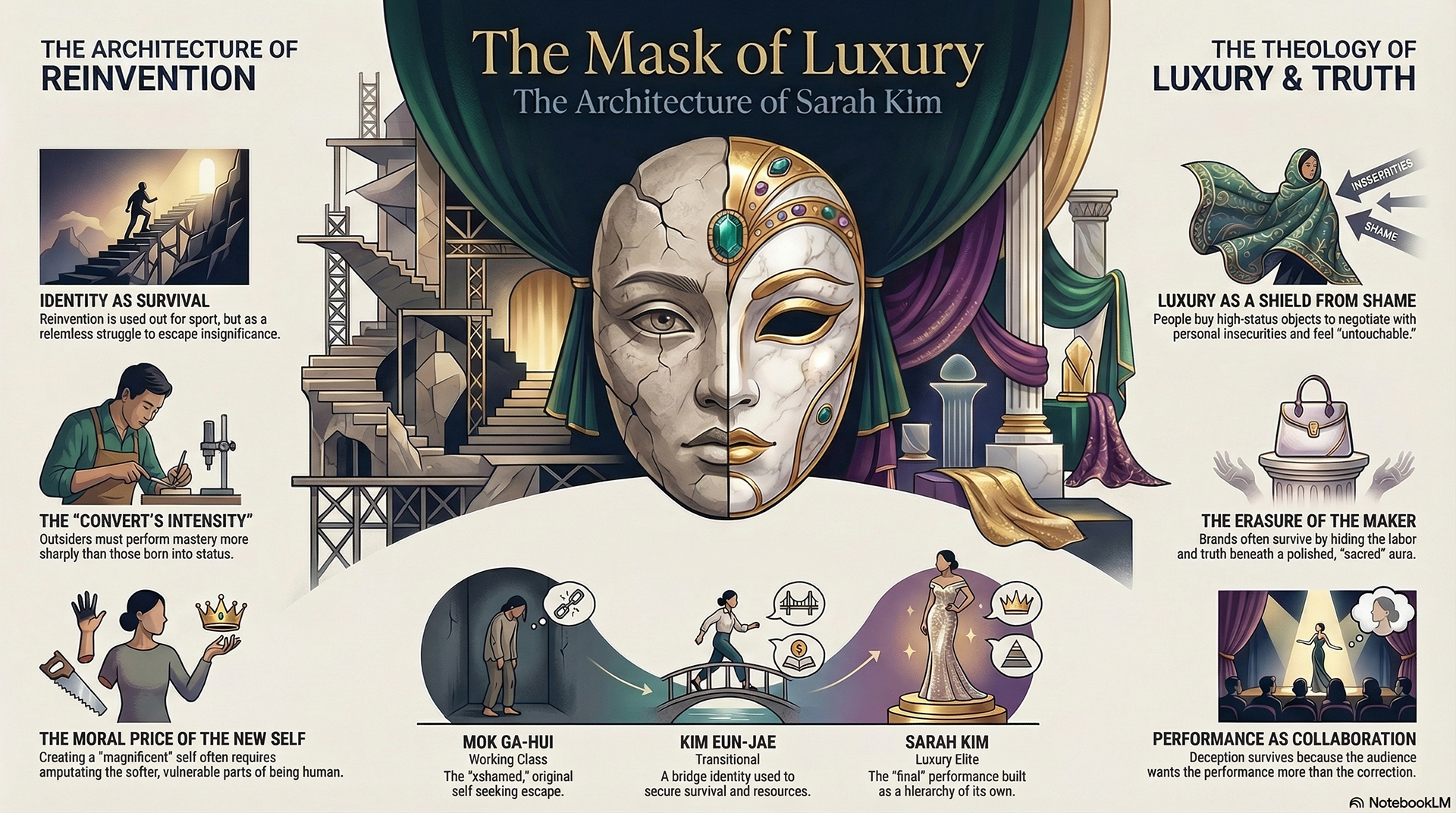
We have come to the end of this conversation, though not, I think, to the end of what it has opened.
When I first looked at this case, I believed my task was simple in principle, even if difficult in practice: find the truth, identify the dead, follow the contradictions, gather the evidence, separate the real from the performed. That was the work I knew. Yet this inquiry refused to remain inside those lines. Each answer widened the field. Each fact pointed beyond itself. Every time I thought I was tracing a crime, I found myself confronting a culture.
Tonight has confirmed something I suspected long before I was ready to say it plainly: Sarah cannot be understood through a single moral category. To call her only a criminal is too thin. To call her only a survivor is too generous. To call her only a victim ignores the cold intelligence with which she made use of others. To call her only a visionary flatters what should still trouble us. She was a human being shaped by humiliation, sharpened by observation, and drawn toward a form of self-creation so severe that it began devouring the softer parts of moral life.
Yet this conversation has also made another truth impossible to ignore. Sarah’s severity did not arise in empty space. She learned from the world that surface can outrun substance, that status can silence doubt, that labor can be hidden beneath aura, that injury can be made invisible if the packaging is strong enough, and that the people who condemn performance most loudly are often the ones most moved by it. She did not invent those lessons. She mastered them.
That is why I leave this table less interested in asking who Sarah really was than in asking what kind of society keeps making Sarah possible. A society that treats dignity as ranked. A society that confuses polish with worth. A society that lets humiliation educate the soul more deeply than compassion does. A society that says it wants truth, yet often wants the comfort of a compelling image more. A society willing to let creations circulate freely long after the human cost has been pushed out of sight.
We spoke tonight about reinvention, and I am left with this thought: reinvention is not evil in itself. Human beings remake themselves all the time. Through grief, migration, ambition, ruin, love, regret, and necessity, people change names inwardly and outwardly. That is part of being alive. The danger begins when the new self is built with no mercy for the old one, when vulnerability becomes something to bury rather than understand, when survival hardens into appetite, and when the fear of ever being lowered again turns other people into acceptable collateral.
We spoke about luxury, and I am left with this: people do not worship luxury only out of vanity. They worship it because they are afraid of being ordinary in a world that treats ordinary life as failure. Luxury offers visible distance from shame. That is why it seduces so deeply, and why it becomes morally dangerous when it starts teaching who deserves light and who can remain hidden beneath the object.
We spoke about humiliation, and I leave convinced that it is among the most formative injuries a person can suffer. It does not simply hurt. It teaches. It sharpens. It can make revenge feel like balance restored. Yet pain, no matter how real, does not become innocence merely by enduring. Between wound and act there remains a soul making permissions for itself, sometimes one small permission at a time, until the inner vocabulary has changed beyond recognition.
We spoke about truth, and I cannot pretend the lesson is comforting. Truth does not win on its own. It does not walk into a room and command obedience. It needs stamina, witnesses, memory, and the willingness of people to lose the performance they have become attached to. That is asking much of human beings. Still, I refuse to believe that performance is all. Facts may arrive late, but lateness is not the same as defeat. The mask strains under its own maintenance. Control overreaches. Contradiction leaves residue. Truth waits there, without charm, without glamour, but not without force.
And we spoke, at last, about what survives. That question may haunt me most. Persons are fragile. Truth is often partial and delayed. Creations can travel onward with frightening ease. A brand, an image, a symbol, a style — these things slip free from biography and begin to live lives of their own. That is why the moral task is not merely to expose wrongdoing once, then move on. It is to refuse the cleansing of memory. To refuse the temptation to admire a creation as pure glow after we have already seen what and who were buried beneath it.
So what do I carry from this night?
I carry the thought that Sarah was neither a pure aberration nor a figure we can safely pity from afar. She was a pattern sharpened into a person. She was what can happen when class contempt meets talent, when talent meets appetite, when appetite meets a culture addicted to appearance, and when appearance is rewarded often enough to begin feeling like destiny.
I carry the thought that people are most dangerous not when they begin lying to the world, but when they decide the abandoned self within deserves no tenderness at all.
I carry the thought that every society teaches its members what forms of disguise it will reward.
And I carry one final warning. If we continue to prize symbols more than souls, polish more than labor, performance more than truth, and radiance more than memory, then Sarah will never be only one woman from one story. She will return again and again, under new names, in new industries, with new admirers, and with the same old wound beneath the shine.
That is the truth I did not want when this case began.
It is the truth I cannot leave without now.
Short Bios:
Sarah Kim / Mok Ga-hui / Kim Eun-jae
A woman of shifting identities who rises from working-class humiliation into the rarefied world of luxury branding. Brilliant, controlled, and dangerous, she turns reinvention into both survival strategy and weapon.
Park Mu-gyeong
A homicide detective and violent-crimes team leader who investigates the death tied to Sarah Kim. Calm, persistent, and morally serious, he becomes the one person most determined to separate performance from truth.
Jeong Yeo-jin
The CEO of Nox and one of Sarah’s wealthy acquaintances and backers. Drawn to Sarah’s mystique yet wounded by her deception, she stands at the uneasy border between admiration, envy, and betrayal.
Woo Hyo-eun
A former salesperson recruited by Sarah who later becomes one of the clearest witnesses to the gap between Boudoir’s glamour and its human cost. She brings the voice of labor, damage, and hard-earned realism.
Kim Mi-jeong
A gifted illicit factory worker and the true craft force behind Boudoir’s products. Hidden behind the brand’s polished image, she becomes Sarah’s most haunting mirror: a maker, rival, and victim of the same hunger for transformation.
Choi Chae-u
The chairwoman of Samwol Department Store, representing inherited power, elite gatekeeping, and the cold intelligence of class hierarchy. She sees clearly how status works and how much people will sacrifice to enter its orbit.
Kang Ji-hwon
A young escort who meets Sarah during her Kim Eun-jae phase and falls genuinely in love with her. His closeness to that version of her makes him one of the key witnesses to the gap between her performed life and her hidden reality.
Hong Seong-shin
A powerful loan-shark businessman suffering from kidney failure, tied to Sarah through a sham marriage and transplant arrangement. He represents the brutal world of money, transaction, and survival that helped shape one of her later identities.
Leave a Reply