
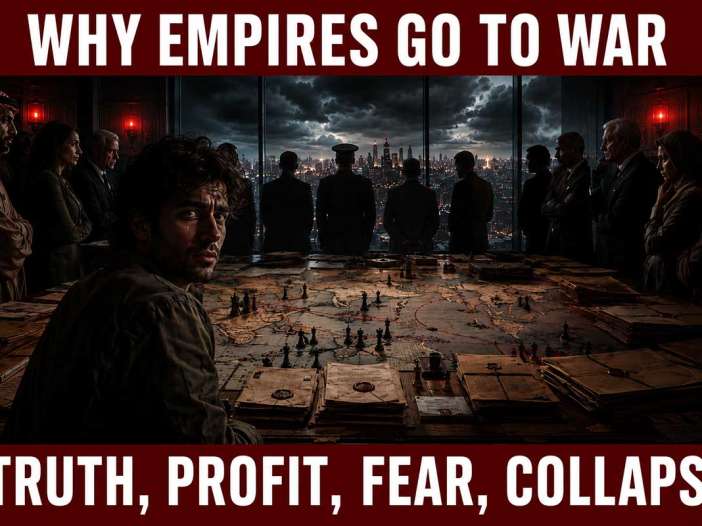
What if history’s sharpest minds uncovered why civilizations collapse from within before enemies arrive?
What if the greatest wars begin long before the first missile is fired?
Before the armies move, language changes. Leaders speak of security, freedom, justice, defense, destiny, and necessity. Citizens are asked to trust the official story. Enemies are named. Fear spreads. Money flows. Emergency powers expand. Strategy rooms fill with maps, charts, projections, and acceptable losses.
Yet somewhere beneath the public speeches, deeper forces may be at work: fear of decline, control of energy, defense of currency, preservation of empire, profit from weapons, and the refusal of powerful nations to admit their own vulnerability.
This imaginary conversation brings together historians, philosophers, generals, economists, theologians, writers, and spiritual witnesses to ask five urgent questions.
Can an empire tell the truth about why it goes to war?
Is peace possible when powerful nations profit from conflict?
Can democracy survive permanent emergency?
When does strategy become evil?
Do civilizations fall from invasion, or from inner emptiness?
These questions are not only about nations. They are about the human soul under pressure. They ask what happens when truth becomes inconvenient, when fear becomes policy, when money feeds conflict, when strategy forgets suffering, and when a civilization loses its inner reason to endure.
At the center of this discussion is a simple but unsettling possibility: perhaps the greatest danger is not only the enemy outside the border, but the lie inside the nation, the fear inside the citizen, and the emptiness inside the civilization.
This is not a conversation about predicting the next war. It is a conversation about recognizing the conditions that make war feel inevitable.
And perhaps, by recognizing them, we may recover the courage to choose something wiser.
(Note: This is an imaginary conversation, a creative exploration of an idea, and not a real speech or event.)
Topic 1: Can an Empire Tell the Truth About Why It Goes to War?
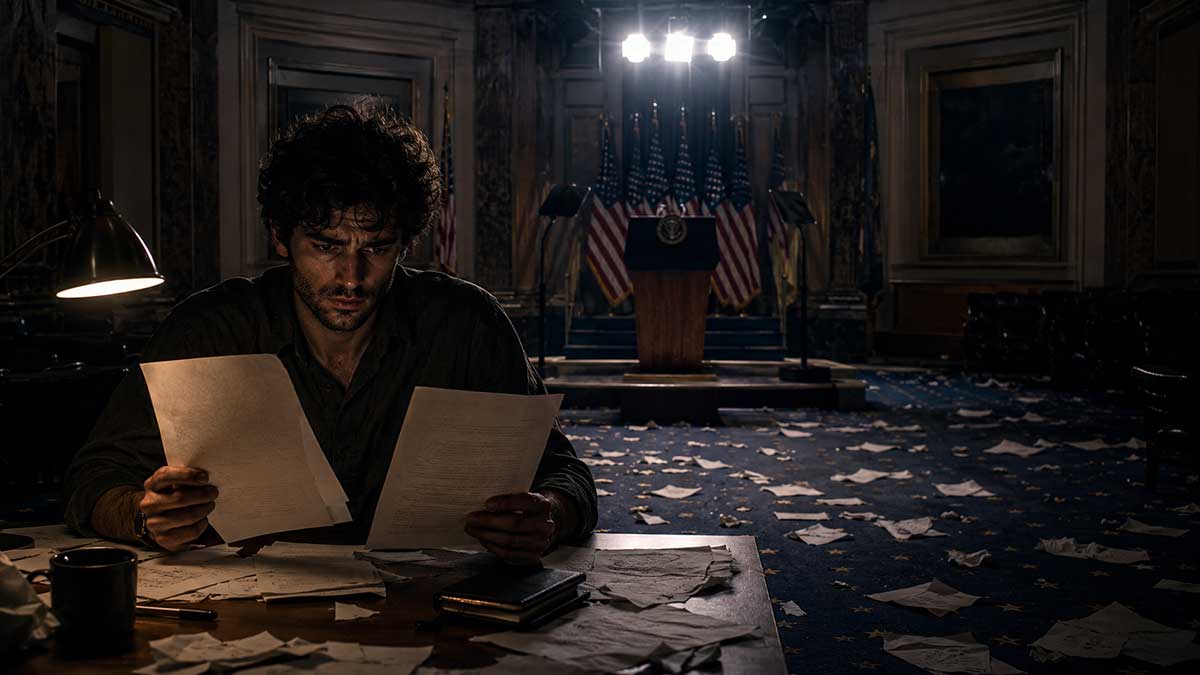
Nick Sasaki looked across the table at the four guests before him. The room was quiet, but the question carried the weight of every battlefield, every patriotic speech, every mother who watched a son leave home in uniform.
“War is almost never introduced as ambition,” Nick began. “It is introduced as defense, justice, freedom, order, or necessity. Yet behind those words, there may be fear, money, oil, trade routes, prestige, or the survival of an empire.”
He paused.
“So our first topic is this: Can an empire tell the truth about why it goes to war?”
Around him sat Thucydides, the ancient historian of Athens and Sparta; George Orwell, the writer who exposed political language; Hannah Arendt, the philosopher of totalitarianism and public responsibility; and Dwight D. Eisenhower, the general-president who warned America about the military-industrial complex.
Nick turned to the first question.
Question 1: What is the difference between the public reason for war and the real reason for war?
Thucydides:
The public reason for war is the story a city tells its citizens. The real reason is often the fear a city refuses to confess. In my history of Athens and Sparta, men spoke of honor, justice, alliance, and injury. Yet beneath those speeches stood fear. Sparta feared the rise of Athens. Athens feared losing its place. Power grew, fear answered, and war became almost unavoidable.
A city rarely says, “We are afraid of decline.” It says, “We are defending order.” It rarely says, “We want advantage.” It says, “We are protecting civilization.” This is not new. It belongs to human nature.
George Orwell:
The public reason is written in clean language. The real reason is usually buried under slogans. A government will not say, “We need this war to protect financial dominance,” or “We need this war to distract the public,” or “We need this war to preserve our ruling class.” It will say, “We are defending freedom.”
Political language exists to make certain actions sound less ugly than they are. Bombing becomes security. Occupation becomes stabilization. Civilian suffering becomes collateral damage. A phrase can be a mask, and sometimes the mask becomes more important than the face.
Dwight D. Eisenhower:
The public reason may contain truth. Nations do face threats. Aggression does happen. Evil exists. I commanded armies against a real tyranny. We should not become naive and assume every war is only greed.
Yet the real reason can become mixed with industry, bureaucracy, pride, and fear. Once a nation builds a vast permanent military system, war becomes easier to start and harder to stop. Factories depend on contracts. Politicians depend on strength. Generals prepare for scenarios. Citizens are told to support the mission. The machinery starts moving before wisdom catches up.
Hannah Arendt:
The public reason gives citizens a moral role. It allows them to believe they are participants in a noble undertaking. The real reason may be administrative, economic, imperial, or ideological. The danger comes when ordinary people stop asking whether the public reason and the real reason match.
A lie in politics does not succeed only through evil leaders. It succeeds through citizens who prefer not to know. They accept the language of necessity. They repeat official phrases. They allow conscience to sleep. In that way, a nation can become involved in great crimes with very ordinary obedience.
Nick Sasaki:
So the public reason is the moral speech, and the real reason may be fear, advantage, or survival. But if every empire hides behind noble words, is truth even possible in public life?
Question 2: Can a nation admit that fear of decline, money, energy, or control drives its foreign policy?
Eisenhower:
A mature republic should be able to admit it has interests. Energy matters. Trade matters. Sea lanes matter. Defense matters. No serious leader can pretend otherwise. The danger is not having interests. The danger is disguising every interest as virtue.
A nation can say, “We need energy security,” without pretending God commanded a war. It can say, “We fear losing influence,” without pretending every rival is pure evil. Honest language may not make policy easy, but it can keep citizens awake.
Orwell:
But honesty is dangerous to those in charge. If a leader says, “We are going to war to preserve our currency,” people may ask, “Why should my son die for that?” If he says, “We are going to war to protect freedom,” people stand, salute, and stop thinking.
The real language of empire would sound too naked. That is why official speech wraps itself in moral fog. The fog is useful. It prevents people from seeing the body on the ground.
Thucydides:
Nations can admit their motives only when they are strong enough to bear the shame of them. Athens once told the people of Melos that the strong do what they can and the weak suffer what they must. That was a terrible truth. It was honest, but not moral.
There are two kinds of danger. One is hypocrisy, where power pretends to be justice. The other is brutal honesty, where power no longer feels the need to pretend. The first corrupts language. The second corrupts the soul.
Arendt:
A nation must learn to distinguish explanation from justification. Fear of decline may explain a war, but it does not justify it. Energy need may explain aggression, but it does not make aggression innocent. Control may explain policy, but it cannot become a moral excuse.
Public truth requires citizens who can tolerate complexity without surrendering judgment. A people must be able to hear, “Our nation has interests,” and still ask, “Are those interests worth the suffering we will create?”
Nick Sasaki:
That seems like the hardest line to hold. If citizens hear only moral language, they may become manipulated. If they hear only power language, they may become cynical. So what kind of truth keeps a nation human?
Question 3: What happens to citizens when leaders hide strategic motives behind moral language?
Arendt:
Citizens become morally disoriented. They are asked to support actions without seeing their true nature. They may believe they are defending freedom when they are defending dominance. They may believe they are preventing evil when they are creating conditions for greater evil.
The greatest danger is not that every citizen becomes cruel. The greater danger is that citizens become thoughtless. They stop connecting words to consequences. They stop asking who suffers. They stop seeing distant people as real.
Orwell:
They lose the ability to speak plainly. Once language is corrupted, thought follows. If war is peace, if censorship is safety, if domination is liberation, then citizens no longer possess the tools to resist.
The first battlefield is not always land. It is vocabulary. Whoever controls the words can make people accept almost anything.
Eisenhower:
Citizens also lose trust. A republic cannot survive if its people come to believe every official statement is manipulation. Trust, once broken, is hard to rebuild. If leaders use noble language to cover strategic motives, they may win support for one war but weaken the nation for decades.
I warned against the military-industrial complex because I saw the danger of permanent war thinking. A free people must remain alert. They must respect real defense needs, but they must question those who profit from fear.
Thucydides:
When leaders hide motives, citizens become instruments. They are moved by speeches they do not fully understand. They sacrifice for causes that may not be what they seem. Over time, this creates bitterness. The city becomes divided between those who still believe the public story and those who see only deception.
Such division can be more dangerous than the foreign enemy. A city that cannot trust its own words cannot remain united.
Nick Sasaki:
Then the tragedy is not only war itself. The tragedy is what war does to truth.
A nation may begin by hiding one motive. Then it must hide the cost. Then it must hide failure. Then it must silence doubt. Soon the war outside becomes a war inside the national conscience.
He looked around the table.
“So maybe the answer is this: an empire can tell the truth about why it goes to war, but only if it is willing to become less imperial. Truth limits power. Truth slows ambition. Truth forces citizens to count the dead before they repeat the slogan.”
The room fell silent.
Nick closed the topic with one final thought.
“Perhaps the most dangerous empire is not the one that lies to others. It is the one that can no longer recognize when it is lying to itself.”
Topic 2: Is Peace Possible When Powerful Nations Profit From Conflict?
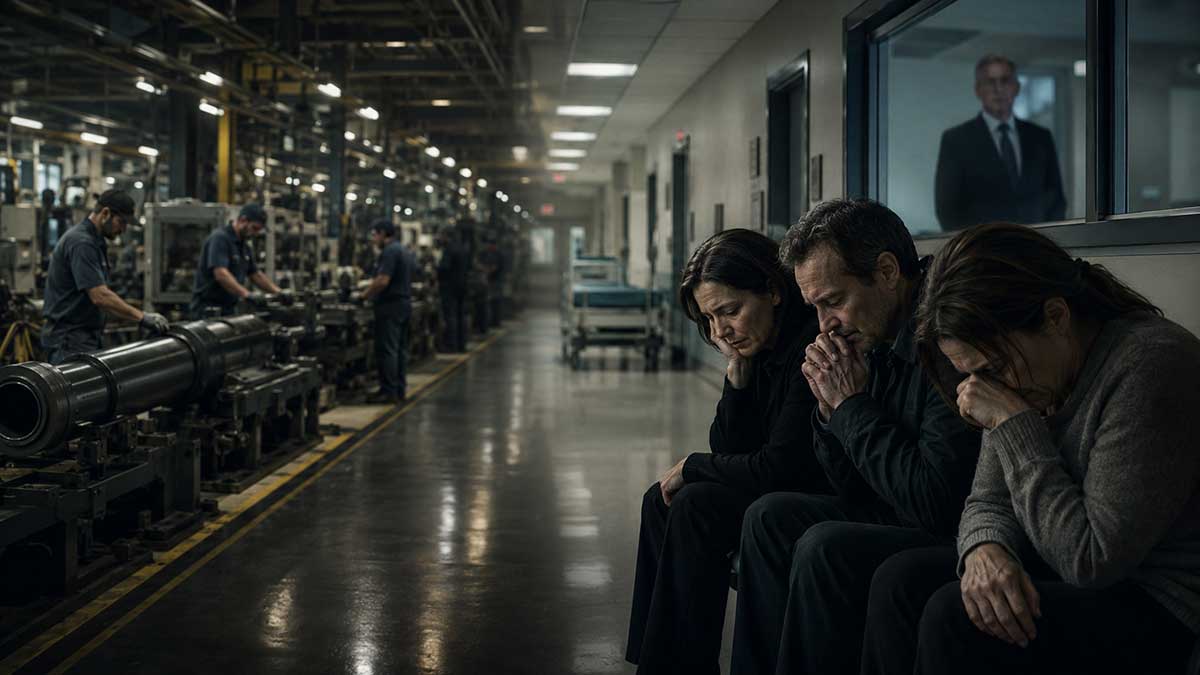
Nick Sasaki leaned forward.
“In the first topic, we asked whether an empire can tell the truth about why it goes to war. Now we face an even darker question.”
He looked at the four guests.
“What if war continues not only from hatred, fear, or ideology, but from profit? What if too many institutions quietly benefit from conflict: weapons companies, banks, media networks, political campaigns, intelligence agencies, reconstruction firms, and even universities funded by defense research?”
At the table sat Martin Luther King Jr., Smedley Butler, Simone Weil, and John Maynard Keynes.
Nick continued.
“Today’s question is this: Is peace possible when powerful nations profit from conflict?”
Question 1: Can peace survive when weapons, debt, media, and political careers benefit from crisis?
Smedley Butler:
Peace has a very hard time surviving when war is made profitable. I said long ago that war is a racket. I did not say that as a slogan. I said it from experience. I saw young men sent into danger, and I saw others grow rich far from the battlefield.
When war begins, the soldier pays with his body. The mother pays with her tears. The taxpayer pays with his wages. But someone else sells the rifles, ships, uniforms, oil, loans, and contracts.
If a nation builds too many fortunes around war, peace becomes bad business. That is the sickness.
John Maynard Keynes:
War reorganizes an economy. It creates urgency. It removes hesitation. Governments spend sums in wartime that they would never dare spend in peace. Factories expand. Workers are hired. Debt grows. Entire sectors begin to depend on the continuation of crisis.
The tragedy is that human intelligence can mobilize so quickly for destruction, yet moves so slowly for housing, education, health, or beauty. War proves that societies can act boldly. It also proves how poorly they choose their boldness.
Peace can survive only when it becomes economically serious. It must not be treated as a sentimental wish. Peace needs institutions, budgets, jobs, incentives, and public imagination equal to war.
Martin Luther King Jr.:
A nation that spends more on military force than on human uplift approaches spiritual death. The issue is not only economic. It is moral. When bombs become profitable, the poor are neglected. When fear becomes policy, compassion is mocked as weakness.
War steals from schools, hospitals, neighborhoods, and children not yet born. It teaches citizens to accept violence abroad and inequality at home. A nation cannot worship violence overseas and expect justice to flourish in its streets.
Peace can survive, but it must become a movement of conscience. It must awaken the people who are asked to pay for war with their taxes, their silence, and their sons.
Simone Weil:
War feeds on attention. It captures the mind. It makes people stare at maps, victories, defeats, enemies, flags. In that state, suffering becomes abstract. The person in the bombed city becomes a number. The soldier becomes a unit. The refugee becomes a problem.
Profit makes this worse. It turns suffering into a system. Those who profit do not need to hate the victims. They only need to stop seeing them.
Peace requires attention to the afflicted. Not pity from above, but attention so pure that the suffering person becomes fully real.
Nick Sasaki:
So war does not need everyone to be evil. It only needs enough people to benefit, enough people to obey, and enough people to look away.
Question 2: Who has the moral responsibility to stop a war when many institutions gain from continuing it?
Martin Luther King Jr.:
The responsibility belongs first to those who see. Silence becomes cooperation when the truth is clear. Clergy, teachers, journalists, artists, students, parents, workers, and political leaders must speak when war becomes immoral.
But I must say this plainly: those who suffer most often have the least power to stop it. The poor fight the wars. The poor lose public programs. The poor bury their children. Those with privilege have a special duty to resist the machinery of death.
A society must develop a dangerous unselfishness. It must ask not only, “What will happen to me if I speak?” but “What will happen to the innocent if I remain silent?”
Smedley Butler:
The people must stop it. Do not expect the profiteers to close their own cash registers. Do not expect politicians funded by war interests to suddenly discover moral courage.
Take the profit out of war. Make every executive, banker, and politician who supports war earn a soldier’s pay during wartime. Make them send their own sons first. Make war personal to those who declare it.
If war were paid for by those who benefit from it, there would be fewer speeches about glory.
Keynes:
Responsibility must become structural. Moral outrage is necessary, but outrage alone is unstable. A nation needs laws that limit war finance, public audits of contracts, strict conflict-of-interest rules, and institutions that make peace more rewarding than militarization.
The deeper issue is opportunity cost. Every dollar spent on unnecessary conflict is a dollar not spent on productive life. Citizens must demand a full accounting: not only what war costs in money, but what it prevents society from becoming.
Weil:
Responsibility begins with refusing false distance. Many people say, “This is complicated. I cannot know.” Sometimes that is honest. Often it is an escape.
The person crushed by war is not complicated. Hunger is not complicated. A child’s fear is not complicated. A burned home is not complicated.
Institutions gain from abstraction. Conscience begins when abstraction breaks.
Nick Sasaki:
It sounds as if responsibility has three layers: personal conscience, public resistance, and economic redesign. Without all three, war simply waits for the next excuse.
Question 3: Can ordinary people resist a war economy without becoming powerless spectators?
Smedley Butler:
Yes, but they must stop believing they are powerless. The war system depends on public obedience. It needs recruits. It needs taxes. It needs workers. It needs voters. It needs silence.
Ordinary people can ask hard questions: Who profits? Who pays? Who dies? What contracts were signed before the first shot? Which companies’ stocks rose? Which politicians received money?
A citizen who follows the money sees the war more clearly than one who follows the speeches.
King:
Ordinary people have changed history many times. They have marched, boycotted, organized, prayed, voted, taught, written, and refused cooperation with injustice. But they must avoid hatred. If they resist war with bitterness alone, they may become spiritually similar to what they oppose.
The goal is not to defeat one group and replace it with another group’s pride. The goal is beloved community. Peace is not passive. It is disciplined love acting against organized violence.
Keynes:
Citizens can resist by demanding a peace economy. This means jobs not tied to weapons, energy systems not tied to domination, trade not tied to coercion, and public investment that gives people a stake in stability.
One reason war economies endure is that many workers fear peace will destroy their livelihoods. That fear must be answered. A shipyard can build tools of life. Engineers can design infrastructure. Factories can serve public need. The transition must be planned, funded, and respected.
Weil:
Ordinary people resist first by seeing. The soul is damaged when it consents to lies. A person may not be able to stop a war today, but he can refuse to let his language be conquered. He can refuse contempt. He can refuse the pleasure of hating an enemy he has never met.
Real attention is a form of resistance. Prayer can be resistance. Refusing cruelty in conversation can be resistance. Feeding the suffering can be resistance. Truthfully naming pain can be resistance.
Nick Sasaki:
Then ordinary people are not powerless, but they are easily scattered. War concentrates money, authority, media, and fear. Peace must concentrate conscience.
He paused.
“The terrible truth is that war has a business model. Peace often has only a moral appeal. Until peace becomes organized, funded, taught, and defended with the same seriousness as war, conflict will keep winning the calendar.”
Nick looked at the guests one by one.
“Maybe peace is possible when powerful nations profit from conflict, but only when citizens become more profitable to their leaders alive, educated, healthy, and free than afraid, divided, indebted, and ready for war.”
The silence felt heavier than before.
“Perhaps the question is not whether peace is possible. Perhaps the question is whether we are willing to build a society where peace no longer looks like weakness, and war no longer looks like success.”
Topic 3: Can Democracy Survive Permanent Emergency?
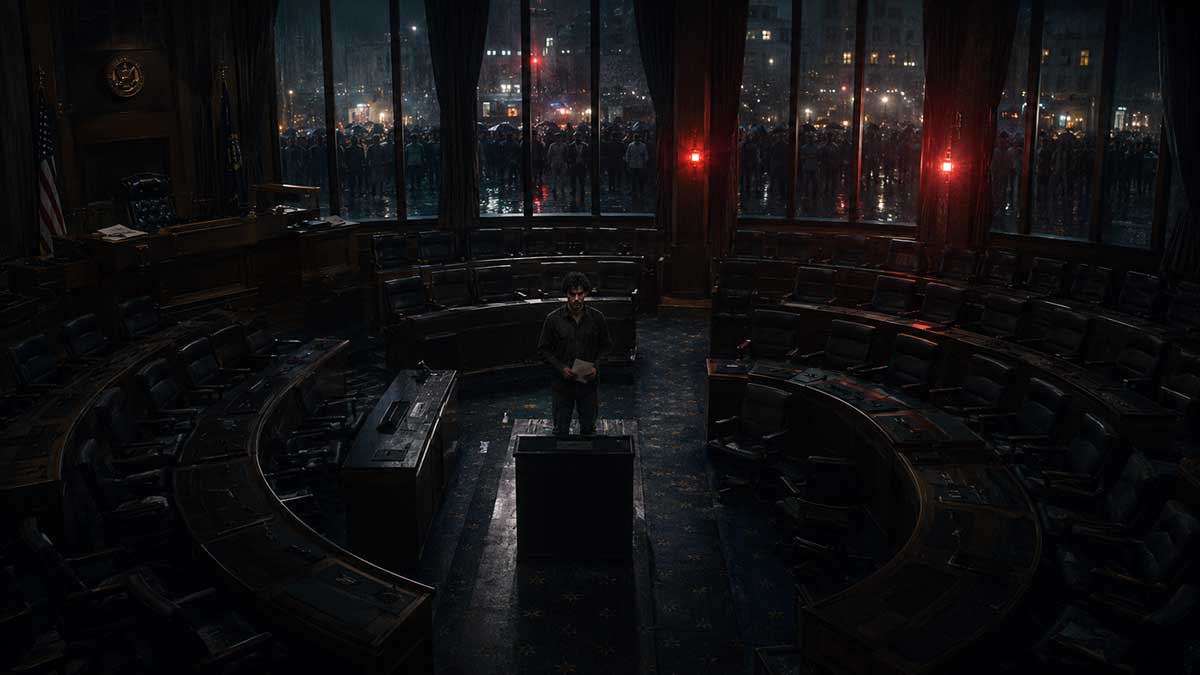
Nick Sasaki sat quietly for a moment before speaking.
“In the first topic, we asked whether an empire can tell the truth about why it goes to war. In the second, we asked whether peace can survive when conflict becomes profitable.”
He looked at the four guests.
“Now we ask what happens inside a nation when crisis never ends.”
At the table sat Alexis de Tocqueville, James Madison, Carl Schmitt, and Václav Havel.
Nick continued.
“A democracy is supposed to depend on law, consent, debate, accountability, and trust. But war changes the atmosphere. Leaders ask for emergency powers. Citizens are told to wait. Courts are told to defer. Journalists are told to be responsible. Dissenters are told they are helping the enemy.”
He paused.
“So today’s question is this: Can democracy survive permanent emergency?”
Question 1: When does a temporary emergency become a permanent form of government?
James Madison:
A temporary emergency becomes permanent when the people grow used to exceptions. Every republic must have means of defense. No constitution can survive if it cannot respond to danger. Yet the danger is clear: powers granted in fear are rarely surrendered with ease.
Ambition must be made to counteract ambition. That was one of the central principles of constitutional government. But in a permanent emergency, ambition finds a noble costume. It says, “Do not restrain me now. The danger is too great.” If the legislature obeys, if courts hesitate, if citizens surrender judgment, then the exception becomes the rule.
The test is not whether leaders ask for more authority. Leaders often do. The test is whether institutions have the courage to say, “No, not beyond this line.”
Carl Schmitt:
The sovereign is he who decides on the exception. That is the hidden truth of political order. In calm times, people speak of laws, procedures, constitutions, rights, and debates. But in the moment of danger, someone must decide. Someone must name the enemy. Someone must act before discussion consumes the state.
Liberal democracy imagines that law can contain every crisis. It cannot. The emergency reveals who truly governs. The constitution is not dead in such a moment; it is exposed. Behind every legal order stands a decision about survival.
If the emergency becomes permanent, it is because the political community has accepted that survival is more urgent than procedure.
Alexis de Tocqueville:
I fear not only the tyrant who seizes authority by force, but the soft habits by which citizens surrender freedom. A democratic people may grow tired of responsibility. They may prefer comfort, safety, and administration to the burden of self-government.
Emergency accelerates this weakness. Citizens say, “Let experts decide. Let agencies monitor. Let leaders act.” At first, this appears reasonable. Over time, the citizen becomes a child under a vast protective authority. He is not crushed; he is managed.
The emergency becomes permanent when citizens stop wanting the dignity of participation and accept the convenience of supervision.
Václav Havel:
A permanent emergency begins when public life becomes organized around fear and official language. The system says, “We are under threat.” Then it says, “Unity is required.” Then it says, “Those who question unity are dangerous.”
Many people do not fully believe the language. Yet they repeat it. They place the sign in the shop window. They attend the meeting. They remain silent in the office. This is how the lie spreads: not always through conviction, but through participation.
The emergency becomes permanent when people adjust their souls to live inside the lie.
Nick Sasaki:
So one danger comes from leaders who refuse limits. Another comes from citizens who no longer want the burden of freedom. And another comes from language that teaches people to obey before they think.
Question 2: Can citizens remain free when fear becomes the main tool of leadership?
Tocqueville:
Fear narrows the democratic spirit. A free citizen must be capable of judgment, association, disagreement, and moral courage. But fear isolates people. It teaches them to suspect neighbors, avoid controversy, and rely on central authority.
Democracy does not live by voting alone. It lives through habits: town meetings, voluntary associations, public argument, local responsibility, religious and moral communities, newspapers, families, friendships. Fear weakens these habits.
A people may still have elections and yet lose the deeper character of freedom. They may vote as anxious individuals rather than act as citizens.
Schmitt:
Fear is not merely a tool. Fear is the recognition of political reality. Every political order rests on the distinction between friend and enemy. A community that cannot identify threats cannot survive.
The liberal citizen imagines freedom as endless discussion. But if an enemy is real, discussion alone cannot protect the people. Fear may be abused, yes. But fear may also awaken the state to the seriousness of existence.
The question is not whether fear should exist. The question is who defines the threat.
Madison:
That is precisely why power must be divided. If one person or one faction alone defines the threat, liberty stands in danger. The people may be frightened into accepting measures they would reject in calmer times.
A republic must defend itself, but it must do so through constitutional forms. Emergency cannot become an excuse for indefinite concentration of authority. Freedom requires suspicion toward all power, including power exercised in the name of safety.
Citizens remain free only if they remain capable of asking: What evidence supports this fear? Who benefits from it? What rights are being limited? When will these powers end?
Havel:
Fear becomes most effective when it enters ordinary life. People begin to censor themselves before anyone orders them to. They avoid certain words. They stop asking certain questions. They laugh at jokes they do not find funny. They condemn people they privately agree with.
Freedom is lost first in the inner life. A person says, “I will remain silent just this once.” Then again. Then silence becomes personality.
To remain free, one must live in truth. This does not always mean heroic confrontation. Sometimes it begins with a small refusal: I will not repeat what I know is false.
Nick Sasaki:
Fear can protect a nation from danger, but it can also train citizens to become smaller. The difficult task is recognizing real threats without allowing fear to become the nation’s permanent language.
Question 3: How does democracy die slowly without people noticing?
Havel:
It dies through rituals of falsehood. People continue to vote, work, shop, attend ceremonies, read official statements, and repeat public phrases. On the surface, society appears normal. Beneath the surface, truth has been replaced by performance.
Democracy dies when citizens no longer believe public words, yet keep using them. It dies when everyone knows the speech is empty but applauds anyway. It dies when conscience becomes private and obedience becomes public.
A society can survive hardship. It cannot survive forever when its public life is built on lies.
Madison:
Democracy dies when constitutional boundaries are treated as obstacles rather than safeguards. It dies when faction becomes stronger than the common good. It dies when each party excuses abuses committed by its own side because it fears the other side more.
The republic is not destroyed only by foreign enemies. It can be destroyed by citizens who prize victory over liberty. If each faction seeks permanent domination, then republican government becomes warfare by other means.
The slow death begins when people ask, “Does this help my side?” before they ask, “Is this just?”
Tocqueville:
It dies through excessive centralization. Citizens may still feel free in private life. They may choose their entertainments, purchases, opinions, and pleasures. Yet the great public decisions drift upward into remote institutions.
A mild despotism may not terrify the people. It may comfort them. It may say, “Do not trouble yourselves. We will manage your risks, your speech, your disputes, your welfare, your safety.” The people remain busy, distracted, and grateful.
They notice too late that they have become spectators of their own government.
Schmitt:
Democracy dies when it refuses to defend itself. A political order that treats all enemies as misunderstandings may perish from its own indecision. The slow death can come not only from too much authority, but from the inability to decide.
If a people no longer knows what it stands for, if it cannot distinguish loyalty from hostility, if it cannot act in a crisis, then democracy becomes a debating club in a burning house.
Every order must have a final seriousness. Without it, the state dissolves.
Madison:
Yet the remedy for weakness must not become tyranny. A republic must be energetic enough to defend itself and restrained enough to remain free. That balance is difficult, but it is the purpose of constitutional design.
Havel:
And no design can save a people who no longer care about truth.
Tocqueville:
Nor can laws save citizens who no longer practice freedom.
Nick Sasaki:
Nick looked down at his notes, then back at the table.
“Perhaps democracy does not die only when tanks enter the capital. It may die when emergency becomes habit, when fear becomes identity, when citizens become audiences, and when truth becomes too inconvenient for public use.”
He paused.
“A permanent emergency asks citizens to trade freedom for safety. But the trade is never final. It returns again and again. Each crisis asks for a little more silence, a little more obedience, a little more trust in unseen hands.”
Nick’s voice softened.
“So maybe democracy survives permanent emergency only if citizens refuse to become permanent children. They must defend the nation, but still question the state. They must face danger, but not worship fear. They must respect law, but not hide behind procedure when conscience calls.”
He looked at Schmitt.
“And they must understand the seriousness of crisis.”
Then he looked at Havel.
“But they must also understand the greater seriousness of truth.”
The room grew still.
Nick closed the topic.
“Maybe the final test of democracy is not whether it can defeat its enemies. It is whether it can defeat its own temptation to become the thing it fears.”
Topic 4: When Does Strategy Become Evil?
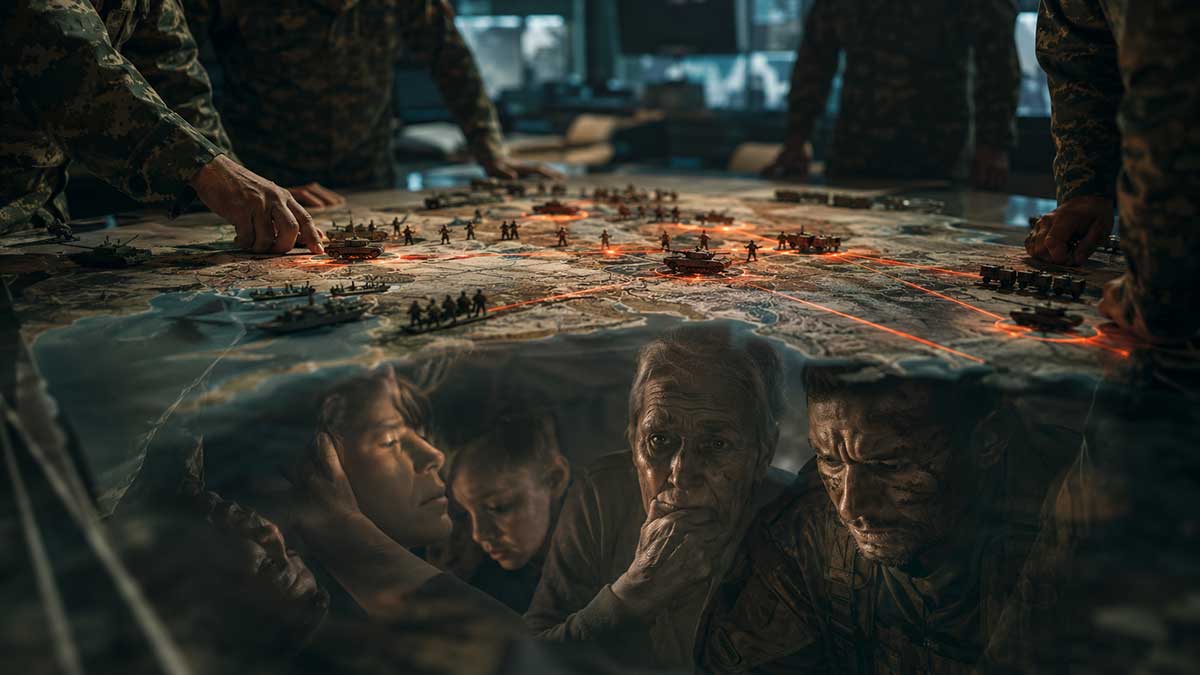
Nick Sasaki looked at the table with a heavier expression than before.
“In the first topic, we asked whether an empire can tell the truth about war. In the second, we asked whether peace can survive when conflict becomes profitable. In the third, we asked whether democracy can survive permanent emergency.”
He paused.
“Now we move from politics to conscience.”
At the table sat Sun Tzu, Leo Tolstoy, Reinhold Niebuhr, and Robert McNamara.
Nick continued.
“Strategy sounds intelligent. It speaks in maps, borders, resources, leverage, pressure points, alliances, deterrence, and acceptable losses. But the people who suffer from strategy do not live on maps. They live in homes, villages, apartments, hospitals, schools, and refugee camps.”
He looked at the guests.
“So today’s question is this: When does strategy become evil?”
Question 1: At what point does strategic thinking become morally blind?
Sun Tzu:
Strategy becomes blind when it forgets the purpose of victory. The highest form of war is not to destroy, but to win with the least destruction. A ruler who burns the land he wishes to govern is not wise. A general who wins battles but creates hatred for generations has not truly won.
The strategist must see beyond the battlefield. He must ask: What will remain after the victory? Will the enemy submit only for a season? Will the people remember humiliation more deeply than defeat? Will today’s triumph create tomorrow’s rebellion?
Cruelty is often confused with strength. But cruelty is frequently a sign of poor strategy.
Leo Tolstoy:
Strategy becomes morally blind the moment it treats human beings as material. The general says, “Move this division here.” The emperor says, “Pressure this region.” The minister says, “Absorb the loss.” But no mother says, “My son is an acceptable loss.”
Great men often believe they direct history. They speak as if nations move according to their will. Yet history is made of millions of lives, fears, prayers, accidents, hungers, confusions, and sorrows. Strategy becomes evil when it reduces this living reality to diagrams.
The map is flat. The human soul is not.
Robert McNamara:
I know what it means to think strategically and still fail morally. Numbers can become intoxicating. You measure tonnage dropped, targets hit, enemy capacity reduced, troop movements, casualty ratios, projected outcomes. The numbers create an illusion of control.
But numbers cannot tell you whether you are becoming unjust. They cannot tell you when fear has distorted judgment. They cannot tell you when persistence has become pride.
Strategic thinking becomes morally blind when measurement replaces wisdom.
Reinhold Niebuhr:
The human problem is that power always tempts us to self-deception. Nations rarely see themselves as wicked. They see themselves as necessary. They say, “We act for order. We act for peace. We act for civilization.”
Yet every nation has interests mixed with ideals. Strategy becomes evil when a nation refuses to admit this mixture. When it imagines itself innocent, it can commit great wrongs with a clean conscience.
The moral danger is not only cynicism. The moral danger is false innocence.
Nick Sasaki:
So strategy does not become evil only when it seeks destruction. It becomes evil when it stops seeing people, when numbers replace judgment, and when a nation’s self-image becomes too pure to question.
Question 2: Can leaders think in maps, resources, and pressure points without forgetting human suffering?
McNamara:
They can, but only through discipline, humility, and dissent. A leader must force himself to hear what the briefing room filters out. He must ask not only, “Will this work?” but “What will this do to civilians? What will this do to our soldiers? What hatred will this leave behind? What if our assumptions are wrong?”
One of the gravest mistakes leaders make is surrounding themselves with people who speak the same language of efficiency. War rooms need dissenting voices. They need moral witnesses. They need people who can say, “This plan may succeed militarily and still fail humanly.”
Sun Tzu:
A wise ruler thinks of the people first. Not from softness, but from clarity. War consumes treasure, food, morale, loyalty, and time. A nation exhausted by war becomes weak, even if it wins.
To remember suffering is not to abandon strategy. It is to make strategy sharper. A leader who understands suffering will avoid unnecessary conflict, choose timing carefully, preserve strength, and seek victory without endless bloodshed.
The strategist who ignores suffering misunderstands the cost of war.
Tolstoy:
I do not trust leaders who speak beautifully of suffering after they have caused it. They visit hospitals. They bow before graves. They write memoirs. But before the war, when the decision mattered, they spoke of necessity.
Can a ruler remember suffering? Perhaps. But power distances the ruler from the sufferer. The higher he rises, the more abstract the people become. That is why humility is rare in government.
The poor know war through hunger and death. The powerful know it through reports.
Niebuhr:
The answer must be realistic. Leaders cannot avoid all tragedy. A ruler may face choices where every path contains suffering. Pacifism may fail against aggression. Force may be needed to restrain greater evil.
But the use of force must be marked by repentance, not pride. A leader should never say, “Our hands are clean.” He should say, “We may have had to act, but we must answer morally for what our action has done.”
The just leader is not the one who feels no guilt. The just leader is the one who refuses to turn guilt into propaganda.
Nick Sasaki:
That may be the dividing line. Strategy needs intelligence, but it also needs grief. A leader who can no longer grieve what his strategy costs may already be dangerous.
Question 3: Is victory still victory when it destroys the soul of the nation that wins?
Tolstoy:
No. A nation may conquer territory and lose itself. It may defeat an enemy and become more violent, more proud, more dishonest, more cruel. Then the enemy has entered the nation’s soul without crossing the border.
Victory is not proved by flags raised over cities. It is proved by what happens to love, truth, mercy, and humility afterward. If victory makes a people worship force, despise weakness, and mock compassion, then victory has become defeat.
The greatest battlefield is the human heart.
Sun Tzu:
A victory that weakens the victor is poor strategy. If a war drains the treasury, divides the people, hardens the enemy, and destroys moral authority, then the victory is hollow.
The best victory leaves the nation stronger, the enemy contained, and the future more stable. A victory that creates endless revenge is not complete. It is only the beginning of another war.
The wise general wins in a way that does not poison tomorrow.
McNamara:
A nation can win every tactical calculation and still lose the larger moral and political struggle. I learned that tragedy too late. We believed we could manage war through force, technology, and analysis. We underestimated history, culture, nationalism, fear, and human dignity.
A nation destroys its soul when it cannot admit mistakes. The cover-up, the pride, the refusal to listen—these may damage the republic more deeply than the enemy ever could.
A real victory requires truth after the battle. Without truth, the wound remains infected.
Niebuhr:
Every nation must resist the temptation to identify itself with God’s will. When victory becomes sacred proof of righteousness, the soul is in danger. Success can become a theological drug. It tells the victor, “You were chosen. You were pure. You were justified.”
But human beings remain sinful in victory. Nations remain morally mixed in victory. The victor needs self-examination most precisely when it feels most triumphant.
A victory that destroys humility is a spiritual defeat.
Nick Sasaki:
Nick let the silence remain for a moment.
“Maybe strategy becomes evil when it asks only one question: How do we win?”
He looked around the table.
“A wiser strategy asks harder questions. What kind of people will we become if we win this way? What will our children inherit from this victory? What lies will we have to tell afterward? What grief will we refuse to count?”
He paused.
“War can be planned in rooms where no one hears crying. That is why moral imagination matters. Somewhere beyond every arrow on a map is a child who did not choose the conflict. Somewhere behind every statistic is a face. Somewhere under every phrase like ‘pressure point’ is a human body that can break.”
Nick looked at Sun Tzu.
“Strategy without restraint becomes waste.”
He looked at Tolstoy.
“Strategy without love becomes murder with grammar.”
He looked at McNamara.
“Strategy without humility becomes machinery.”
He looked at Niebuhr.
“And strategy without repentance becomes idolatry.”
Nick closed the topic quietly.
“Perhaps victory is not enough. Perhaps the real question is whether a nation can win without losing the part of itself that made victory worth having.”
Topic 5: Do Civilizations Fall From Invasion, or From Inner Emptiness?
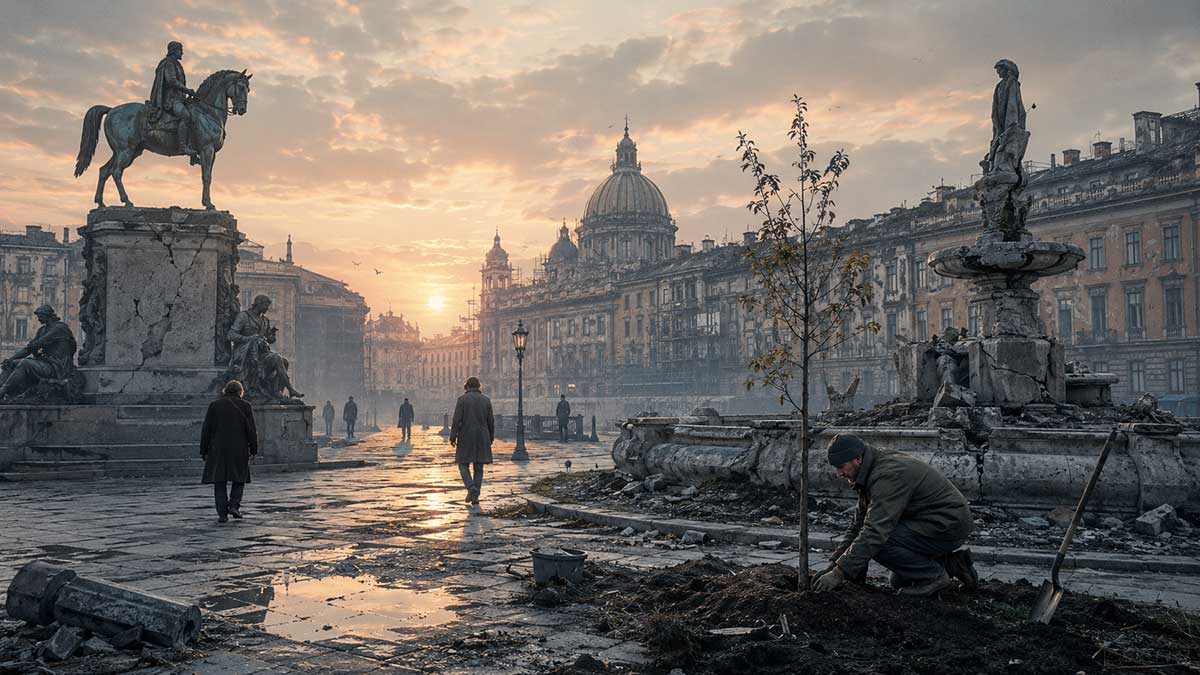
Nick Sasaki looked at the final table with a different kind of sadness.
“In the first topic, we asked whether an empire can tell the truth about why it goes to war. In the second, we asked whether peace can survive when conflict becomes profitable. In the third, we asked whether democracy can survive permanent emergency. In the fourth, we asked when strategy becomes evil.”
He paused.
“Now we come to the deepest question.”
At the table sat Ibn Khaldun, Arnold Toynbee, Aleksandr Solzhenitsyn, and Carl Jung.
Nick continued.
“Civilizations often fear enemies at the gate. They fear foreign armies, rival empires, economic competitors, religious enemies, or technological challengers. But perhaps the deeper danger begins inside: loss of meaning, loss of shared purpose, loss of moral courage, loss of trust, loss of family, loss of spiritual seriousness.”
He looked at each guest.
“So today’s question is this: Do civilizations fall from invasion, or from inner emptiness?”
Question 1: Is the greatest threat to a civilization outside its borders or inside its spirit?
Ibn Khaldun:
A civilization may be attacked from outside, but it first weakens from within. In my study of dynasties, I saw that peoples rise through strong social cohesion. They are bound by loyalty, sacrifice, discipline, and shared hardship. I called this asabiyyah.
In the early stage, people endure together. They build. They fight. They trust one another. But success brings luxury. Luxury weakens discipline. Comfort weakens courage. Rulers grow distant from the people. Taxes rise. The powerful seek pleasure more than duty.
Then the outsider appears. He seems to destroy the civilization, but often he only finishes what inner decay began.
Arnold Toynbee:
Civilizations are not murdered so easily. They decline when they fail to answer a challenge creatively. Every civilization faces pressure: war, scarcity, moral crisis, class division, religious crisis, technological change. The question is not whether the challenge exists. The question is whether the civilization can respond with imagination and renewal.
A society collapses when its creative minority becomes a dominant minority. At first, leaders inspire. Later, they merely command. They no longer offer vision. They demand obedience.
The outer enemy becomes dangerous when the inner leadership has lost its creative soul.
Aleksandr Solzhenitsyn:
The greatest threat is spiritual falsehood. A civilization can endure poverty, war, and suffering if it remains truthful before God and conscience. But when lies become the normal air people breathe, the soul of a nation begins to rot.
A society may still have armies, factories, universities, newspapers, courts, and elections. Yet if people no longer believe in truth, if they speak what they do not believe, if they trade conscience for comfort, then collapse has already begun.
External force can break walls. Inner falsehood breaks people.
Carl Jung:
Civilizations fall when they lose contact with the deeper life of the psyche. A people may become technically brilliant and spiritually primitive at the same time. They may conquer nature and remain strangers to themselves.
The shadow does not disappear when ignored. It grows. A nation that refuses to face its greed, violence, resentment, and fear will project them onto enemies. It will say, “They are evil,” without seeing its own darkness.
The outer enemy often becomes the mirror of the inner wound.
Nick Sasaki:
So the enemy outside may be real, but the deeper danger is the weakness inside that makes the enemy decisive. A civilization falls when it has lost the inner strength to meet the crisis with truth, courage, and renewal.
Question 2: What role do debt, loneliness, polarization, and loss of shared purpose play in collapse?
Toynbee:
Debt is more than financial. It can become a sign that a civilization is borrowing from the future to avoid reform in the present. Loneliness shows the collapse of belonging. Polarization shows the breakdown of shared meaning. Loss of purpose shows that society no longer knows what its sacrifices are for.
When a civilization no longer believes in a common task, it becomes a crowd of private anxieties. Each group defends itself. Each class suspects the other. Each generation feels betrayed by the previous one.
At that point, the civilization may still be wealthy, but its spirit has become fragmented.
Ibn Khaldun:
Debt weakens the ruler and burdens the people. When rulers live beyond the productive strength of society, they tax more heavily. People lose incentive. Commerce weakens. Trust fades. Then the ruler relies more on force and less on loyalty.
Loneliness and polarization mean that asabiyyah has declined. People no longer feel they belong to one body. The wealthy protect wealth. The poor lose hope. The young no longer honor the old. The old no longer sacrifice for the young.
A civilization without solidarity becomes easy to govern badly and hard to defend well.
Solzhenitsyn:
Debt may be economic, but it is often rooted in moral disorder. A people wants comfort without sacrifice, rights without duty, wealth without restraint, freedom without truth. Such a people becomes vulnerable to every manipulation.
Loneliness is not only social isolation. It is the isolation of the soul from meaning. A person may be surrounded by crowds and still feel abandoned. A nation may be full of noise and still have no real conversation.
When people lose shared purpose, they become easier to control through fear, pleasure, and resentment.
Jung:
Polarization is the collective shadow in political form. Each side carries what the other refuses to see. One side may project cruelty; the other may project corruption. One side may project chaos; the other may project tyranny. The more unconscious the society becomes, the more its politics becomes possession.
Loneliness deepens this. A lonely person seeks identity in mass emotion. He may find belonging in rage. He may prefer a tribe that hates with him over a community that asks him to grow.
Debt, loneliness, and polarization are symptoms of psychic imbalance. The civilization has lost its center.
Nick Sasaki:
That means collapse is not only about armies, inflation, borders, or elections. It is also about whether people still feel bound to one another, whether they still believe sacrifice has meaning, and whether they still know how to tell the truth together.
Question 3: Can a civilization recover once it loses trust in its leaders, institutions, and future?
Solzhenitsyn:
Yes, but recovery begins with truth. Not slogans. Not official optimism. Not managed language. Truth.
A person must stop participating in lies. A family must stop organizing itself around lies. A school, a church, a newspaper, a court, a government—each must recover the courage to speak plainly.
A civilization cannot be healed by public relations. It must repent. It must admit what it has done, what it has worshiped, what it has ignored, and whom it has sacrificed.
The line between good and evil runs through every human heart. Recovery begins when people stop placing that line only between nations, parties, races, or classes.
Toynbee:
Recovery requires a new creative minority. Not merely new rulers, but people capable of giving a society a higher response to its crisis. They may be spiritual leaders, artists, reformers, builders, teachers, entrepreneurs, parents, or thinkers.
The old institutions may be tired, but renewal can begin from small centers of life. A monastery, a school, a neighborhood, a movement, a family, a circle of truth-tellers—such places may carry the seed of the future.
Civilizations recover when they find a reason to live beyond survival.
Ibn Khaldun:
Recovery requires restored cohesion. The ruler must regain trust through justice. The wealthy must regain honor through service. The people must regain strength through discipline. A society cannot rebuild if every group seeks only its own advantage.
Luxury must be restrained. Corruption must be punished. Public burdens must be made fair. The young must see that effort leads to dignity. The old must teach more than complaint.
A civilization returns to life when shared hardship becomes shared renewal rather than shared resentment.
Jung:
Recovery requires integration. A civilization must face its shadow without being destroyed by it. It must admit its violence, greed, fear, arrogance, and emptiness. But it must not drown in guilt. It must bring unconscious forces into consciousness and then transform them.
Modern people often think renewal is political first. It is psychological and spiritual first. If the inner person remains fragmented, institutions will reflect that fragmentation.
A civilization heals when enough individuals begin the work of becoming whole.
Nick Sasaki:
Nick sat back and let the words settle.
“Maybe civilizations do not fall only when enemies cross the border. They fall when citizens no longer believe the civilization is worth saving. They fall when comfort replaces courage, when consumption replaces meaning, when propaganda replaces truth, when debt replaces sacrifice, and when loneliness replaces belonging.”
He looked at Ibn Khaldun.
“A civilization needs cohesion.”
He looked at Toynbee.
“It needs creative renewal.”
He looked at Solzhenitsyn.
“It needs truth and repentance.”
He looked at Jung.
“And it needs the courage to face its own shadow.”
Nick paused.
“If war is the outer crisis, emptiness is the inner crisis. A civilization may survive the first and still die from the second.”
The room became still.
“Perhaps the final question is not whether we can defeat our enemies. Perhaps it is whether we can become the kind of people who no longer need enemies to feel alive.”
Nick closed the final topic quietly.
“A civilization is not saved by weapons alone, nor by wealth alone, nor by slogans alone. It is saved when enough people recover the will to live truthfully, love deeply, sacrifice wisely, and build something their children can trust.”
Final Thoughts
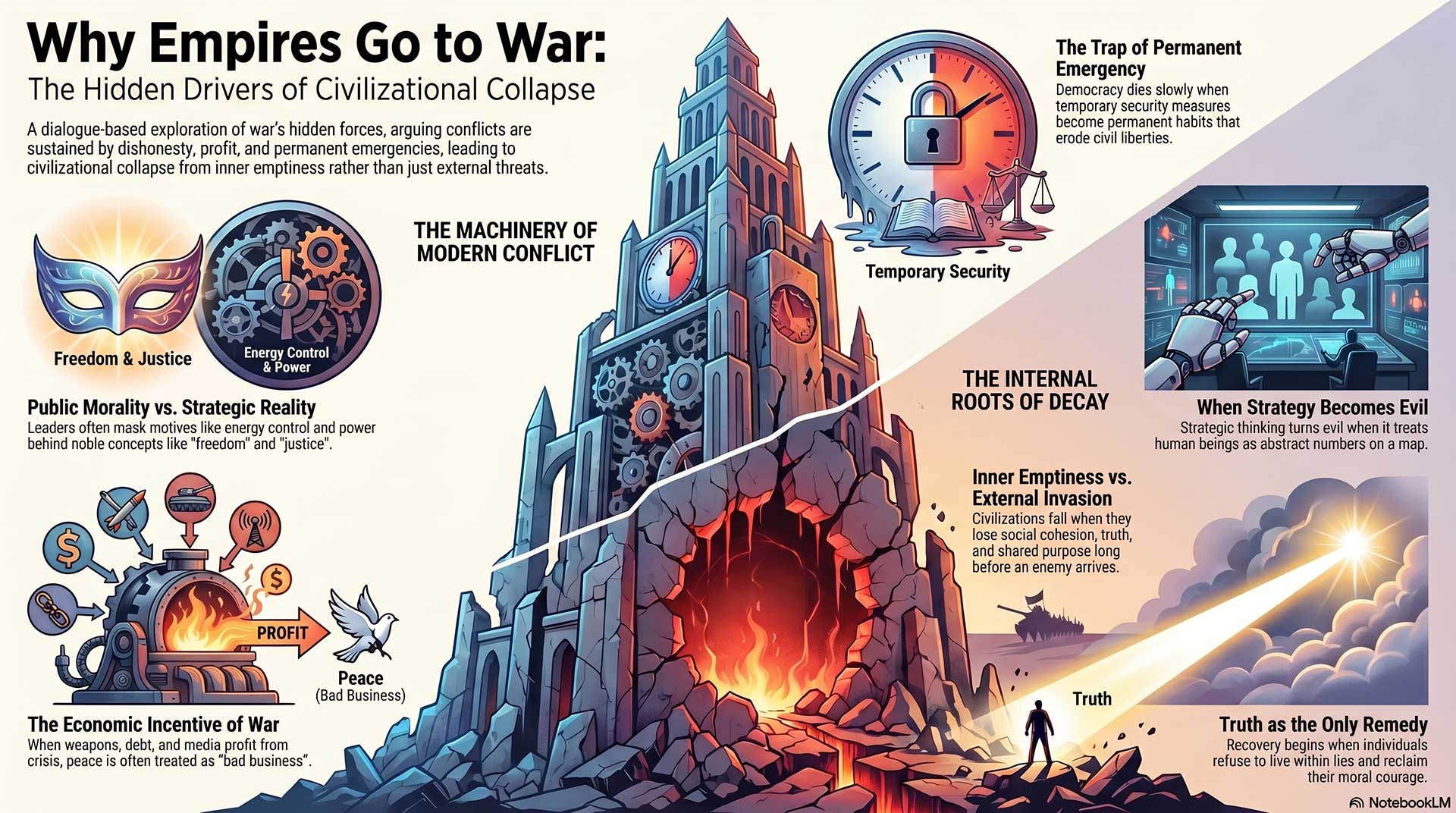
War often begins with a story.
A nation says it is defending peace. A leader says there is no other choice. A strategist says the cost is acceptable. A banker says the system must be protected. A citizen says, “I do not know enough to object.”
Then the machine begins to move.
What this conversation revealed is that war is rarely one thing. It is never only a battlefield. It is language, money, fear, memory, geography, religion, technology, debt, and pride. It is the public reason and the hidden reason. It is the noble slogan and the quiet contract. It is the map in the strategy room and the child in the darkened apartment.
The first danger is dishonest language. When leaders hide ambition behind virtue, citizens lose their ability to judge. Words like freedom, security, order, and peace can become masks. A nation that cannot speak honestly about its motives cannot remain morally awake.
The second danger is profit. When too many people benefit from conflict, peace becomes structurally weak. Weapons, loans, contracts, media attention, and political power can all feed on crisis. A society that funds war more seriously than healing should not be surprised when war keeps returning.
The third danger is permanent emergency. A democracy can survive danger, but it cannot survive forever if fear becomes its main language. Emergency powers may begin as temporary tools. Over time, they can become habits. Citizens may still vote, shop, speak, and work, yet slowly lose the deeper practice of freedom.
The fourth danger is strategy without conscience. Maps are useful, but they are morally dangerous when they erase human faces. Numbers can guide decisions, but they cannot measure grief. A victory that destroys truth, humility, mercy, and trust may not be victory at all.
The fifth danger is inner emptiness. Civilizations fear invasion, but invasion often succeeds only after inner strength has faded. Debt, loneliness, polarization, cynicism, and loss of shared purpose weaken a people from within. A civilization dies when its people no longer believe it is worth saving.
Yet this conversation is not hopeless.
It suggests that recovery begins with truth. Not slogans. Not fear. Not blind loyalty. Truth.
A citizen can refuse false language. A leader can admit mixed motives. A nation can question who profits from conflict. A democracy can defend itself without worshiping emergency. A strategist can remember suffering. A civilization can rebuild trust through service, sacrifice, and shared purpose.
Peace is not weakness. Peace is disciplined moral strength.
Truth is not disloyalty. Truth is the first duty of a free people.
And perhaps the deepest lesson is this: a nation does not prove its greatness by how many enemies it can defeat. It proves its greatness by whether it can resist becoming what it fears.
Short Bios:
Thucydides — Ancient Greek historian of the Peloponnesian War, known for his clear-eyed analysis of power, fear, ambition, and the tragic logic of empire.
George Orwell — British writer and critic of political manipulation, famous for exposing how language can be used to hide violence, control thought, and weaken truth.
Hannah Arendt — Political philosopher who studied totalitarianism, responsibility, public truth, and the danger of ordinary people surrendering judgment.
Dwight D. Eisenhower — U.S. general and president who led Allied forces in World War II and later warned about the influence of the military-industrial complex.
Martin Luther King Jr. — Civil rights leader and moral voice against racism, poverty, militarism, and spiritual decline in public life.
Smedley Butler — Decorated U.S. Marine Corps general who later became a fierce critic of war profiteering and famously described war as a racket.
Simone Weil — French philosopher and mystic who wrote deeply about suffering, attention, justice, war, and the moral responsibility to see the afflicted.
John Maynard Keynes — British economist whose work shaped modern economic policy and whose ideas help examine war finance, public spending, and peace economies.
Alexis de Tocqueville — French political thinker best known for analyzing democracy, civic habits, individualism, centralization, and the quiet dangers facing free societies.
James Madison — American founder and constitutional thinker who argued for divided powers, checks and balances, and safeguards against faction and tyranny.
Carl Schmitt — German political theorist known for his controversial ideas about sovereignty, emergency, and the distinction between friend and enemy.
Václav Havel — Czech playwright, dissident, and president who wrote about living in truth under systems built on fear, conformity, and official lies.
Sun Tzu — Ancient Chinese strategist whose teachings focus on restraint, wisdom, timing, deception, and winning with minimal destruction.
Leo Tolstoy — Russian novelist and moral thinker who questioned violence, power, historical greatness, and the illusion that leaders fully control events.
Reinhold Niebuhr — American theologian and public thinker who explored moral realism, power, pride, sin, justice, and the danger of national self-righteousness.
Robert McNamara — Former U.S. secretary of defense whose later reflections on the Vietnam War raised hard questions about numbers, judgment, humility, and moral failure.
Ibn Khaldun — North African historian and social thinker known for his theory of social cohesion, dynastic rise and decline, luxury, taxation, and civilizational decay.
Arnold Toynbee — British historian who studied the rise and fall of civilizations through the lens of challenge, response, creativity, and spiritual renewal.
Aleksandr Solzhenitsyn — Russian writer and dissident who exposed Soviet oppression and argued that societies collapse when they live by lies.
Carl Jung — Swiss psychiatrist who explored the unconscious, the shadow, archetypes, and the psychological forces that shape individuals and civilizations.
Nick Sasaki — Creator of Imaginary Talks, where historical, spiritual, and cultural voices meet in thought-provoking imaginary conversations about war, peace, faith, civilization, and the human future.
Leave a Reply