
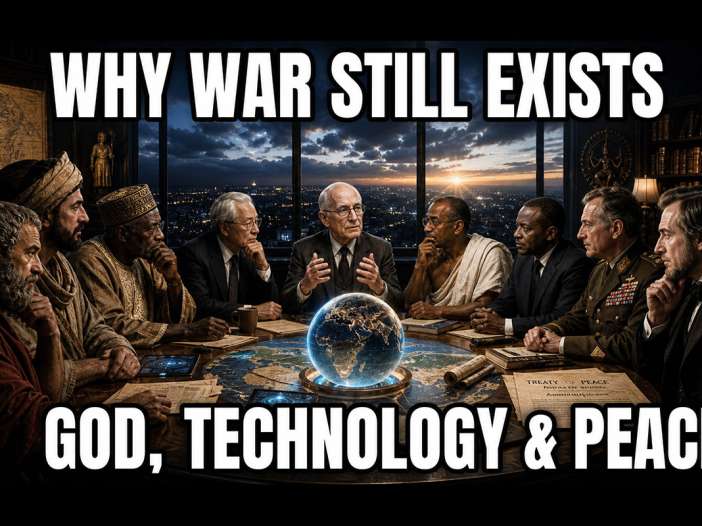
What if Buckminster Fuller and today’s top thinkers confronted why war still exists in 2026?
Introduction by Buckminster Fuller
Today is 2026, and humanity still has war.
This fact should disturb us.
We have satellites circling the Earth. We have artificial intelligence answering questions in seconds. We have medical science, global communication, space exploration, nuclear memory, peace treaties, religious teachings, and countless stories from survivors who have warned us what war does to the human soul.
Yet war continues.
This means war is not only a failure of knowledge.
It is a failure of design.
Humanity has built systems that still reward fear, competition, domination, revenge, and suspicion. Nations prepare for enemies before they learn how to build trust. Economies profit from conflict before they invest fully in peace. Leaders use fear to gather support. Media systems often spread outrage faster than wisdom. Technology gives old hatred new speed. Religion, which should bring human beings closer to God, compassion, humility, and truth, can be twisted into a weapon.
Nick’s starting question is honest and painful:
If God is love, why do human beings so often use God’s name to justify war?
That question cannot be avoided.
The teachings of Jesus have been used by some to bless domination, even though Jesus taught love of enemy. Muslim faith has been misused by some for political control or violence, even though Islam at its deepest calls people before God in justice and mercy. Every sacred tradition carries this danger when ego, tribe, ambition, and fear take hold of it.
So this conversation is not an attack on God.
It is a defense of what is sacred.
We must ask whether religion needs reform, return, or renewal. We must ask whether technology can help end war or make it more dangerous. We must ask whether peace begins in the human heart, in better systems, in wiser leadership, in purified religion, or in all of them together.
The central question before us is this:
What must humanity redesign so war becomes not only immoral, but unnecessary?
(Note: This is an imaginary conversation, a creative exploration of an idea, and not a real speech or event.)
Topic 1 — Why War Still Exists in 2026
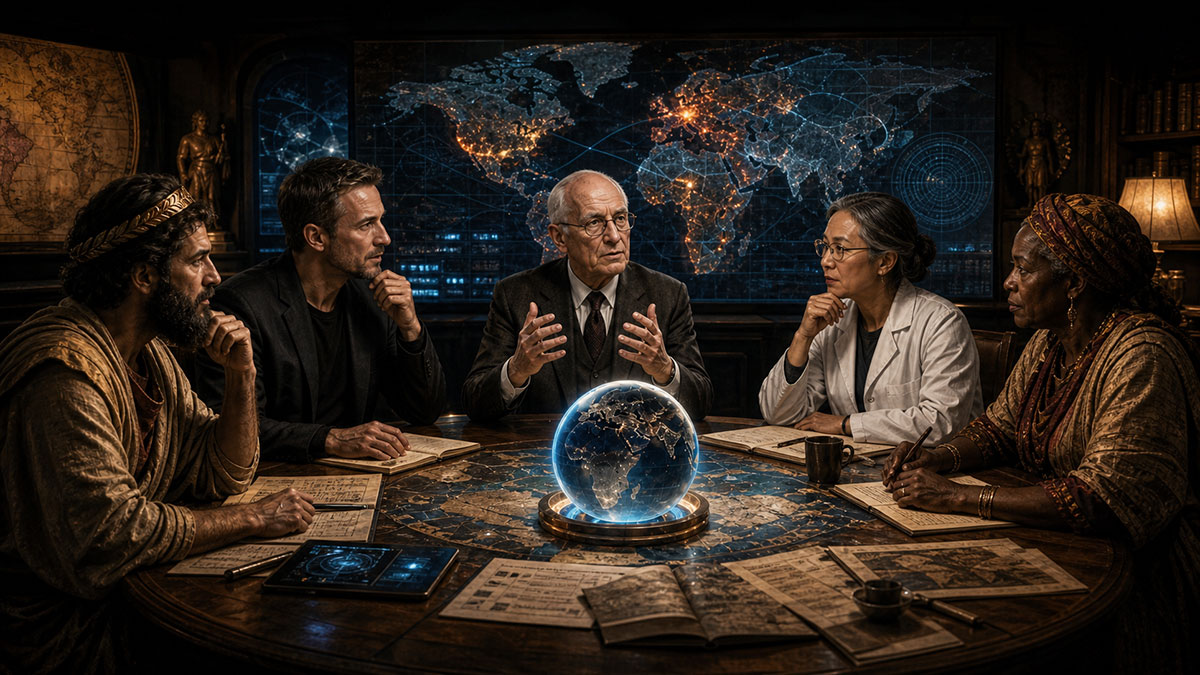
Opening — Buckminster Fuller
We begin with the most uncomfortable fact.
It is 2026, and humanity still has war.
We have crossed oceans, reached space, split the atom, built global communication, mapped the human genome, and created artificial intelligence. Yet we have not learned how to stop killing one another.
This tells us something severe.
War is not caused only by lack of knowledge. Humanity already knows war destroys families, children, cities, trust, and the future. We know this. We have monuments, museums, photographs, survivor testimonies, graveyards, and history books.
Yet war returns.
So the question before us is not simple.
Are human beings violent by nature?
Are nations trapped in systems of fear?
Are leaders rewarded for creating enemies?
Are economies quietly dependent on conflict?
Or have we failed to design a world where peace is more practical than war?
Let us begin with the first question.
Question 1 — If humanity already knows war causes suffering, why do nations still choose it?
Sun Tzu
Nations do not choose war only from anger.
They choose war when leaders believe the cost of peace is greater than the cost of violence.
Sometimes the fear of appearing weak becomes stronger than the fear of death. A ruler may know war brings suffering, yet still believe retreat brings humiliation, rebellion, or loss of authority.
War often begins before the first soldier moves. It begins when a leader convinces himself that the enemy will not stop unless forced. It begins when each side believes delay is dangerous.
A wise ruler avoids war when possible. But foolish rulers confuse caution with cowardice and pride with strength.
The tragedy is this: people who suffer most in war are rarely the ones who decide it.
Albert Einstein
Humanity has knowledge, but knowledge alone does not make people wise.
The scientific mind can measure destruction. It can calculate energy, blast radius, logistics, and probability. But moral courage cannot be produced by calculation.
War continues because human beings often obey institutions more easily than conscience. A person may feel something is wrong, yet still participate because the state commands it, the crowd supports it, or fear silences resistance.
The danger is not ignorance alone. The danger is organized obedience without moral reflection.
The atomic age should have awakened humanity. It showed that intelligence without conscience can become suicide.
Yet nations still act as though survival can be secured by threatening destruction.
Nelson Mandela
I learned that people can know suffering deeply and still become trapped by it.
Oppressed people may carry wounds. Powerful people may carry fear. Both can become prisoners.
War continues because human beings remember humiliation, land, blood, betrayal, and insult. Nations teach these memories to children. Then each generation receives not only history, but injury.
Peace requires more than telling people to stop fighting. You must give them a path where dignity is not lost.
A leader who wants peace must help people believe that reconciliation is not surrender.
That is difficult. Hatred is simple. Revenge gives quick emotional satisfaction. Peace demands patience, humility, and courage.
Elon Musk
Part of the problem is incentive structure.
If leaders, media systems, weapons companies, political movements, and military bureaucracies all gain something from conflict, then war keeps finding ways to justify itself.
People talk about peace, but the systems around them may be optimized for escalation.
Technology makes this more dangerous. Information spreads fast. Outrage spreads faster. Drones lower the cost of attack. AI can increase propaganda, targeting, cyberwar, and confusion.
The strange thing is that we have enough intelligence to build systems that reduce conflict, but we don’t organize civilization around that goal.
We optimize for market share, elections, territory, influence, and military advantage.
If we optimized for reducing human conflict, the world would look very different.
Buckminster Fuller
War continues because humanity is still operating on obsolete design assumptions.
We teach nations to behave like separate survival machines. Each believes it must secure itself against all others. That creates permanent fear.
The world has enough resources, intelligence, and technical capability to support life much better than we do. Yet our institutions are built around scarcity, borders, rivalry, and historical suspicion.
War is often treated as a moral failure, and it is. But it is a systems failure.
If a house keeps burning down, we should not only blame the fire. We should ask who designed the wiring.
Humanity has built civilization in such a way that war still appears useful.
That is the design error.
Question 2 — Is war caused more by human nature, broken systems, bad leadership, or fear of losing control?
Nelson Mandela
These cannot be separated.
Human nature contains fear, anger, pride, and the desire to protect one’s own people. But it also contains compassion, forgiveness, sacrifice, and courage.
Systems can bring out the worst or the best.
Prison taught me this. Some men entered prison filled with rage. Some left with deeper hatred. Others discovered discipline. The environment mattered, but so did the choice of the person.
Bad leadership turns pain into revenge. Good leadership turns pain into responsibility.
Fear of losing control may be one of the deepest causes of war. Leaders fear losing land, status, legitimacy, or authority. People fear being erased.
Peace begins when people can picture security without domination.
Sun Tzu
War is caused by misjudgment.
A leader misjudges the enemy, the terrain, the people, the cost, the length of conflict, or his own strength.
Human nature creates ambition. Broken systems create pressure. Bad leadership gives the order. Fear makes the order seem reasonable.
But the wise strategist sees that war is often the result of poor calculation.
To fight ten battles and win ten battles is not supreme excellence.
The greatest victory is to make battle unnecessary.
A nation that relies only on force has already admitted weakness in wisdom.
Elon Musk
I would say systems matter a lot.
Human beings have always had aggression, but modern war depends on industrial systems, supply chains, financing, media narratives, satellite networks, energy flows, cyber infrastructure, and political incentives.
One person’s anger does not create modern war by itself. It needs machinery around it.
Bad leaders are dangerous, but bad systems can produce bad leaders or reward them.
You want to reduce war? Change the operating system.
Make transparency stronger. Make corruption harder. Make energy abundance more real. Make communication harder to manipulate. Make economic cooperation more valuable than conquest.
Human nature will not become perfect. So we need systems that do not require perfection.
Albert Einstein
Human nature is capable of both brutality and beauty.
That is why the question of systems is so serious.
A person may be gentle in private life and still support public violence when absorbed into nationalism. Group identity can numb conscience.
War is often made possible by abstraction. The enemy becomes a category, not a person. A nation, not a mother. A uniform, not a son.
Once human beings stop seeing individuals, they can tolerate immense cruelty.
Leadership then gives moral permission.
The task of civilization is to keep conscience alive inside systems that try to silence it.
Buckminster Fuller
The answer is: yes.
Human nature, systems, leadership, and fear are all interacting variables.
But I resist the idea that war is inevitable because of human nature. That is a dangerous excuse. It allows civilization to avoid redesign.
Human beings cooperate, too. A city is cooperation. A hospital is cooperation. A spacecraft is cooperation. A family is cooperation.
We have already proven we can coordinate life.
The problem is that our global systems still reward separation and competition at the highest levels.
We must design structures where cooperation is more profitable, more honorable, more secure, and more practical than conflict.
Question 3 — What would have to change so war becomes not only immoral, but unnecessary?
Buckminster Fuller
Humanity must redesign its basic assumptions.
First, we must stop treating scarcity as permanent destiny. Much conflict grows from the belief that there is not enough: not enough land, energy, food, status, dignity, or future.
Second, we must build systems that make cooperation visible and beneficial.
Third, we must educate every child to see Earth as one shared home, not a battlefield of competing tribes.
Peace cannot only be preached. It must be engineered into reality.
If war remains profitable, honorable, and politically useful, it will return.
Make war obsolete by making peace work better.
Elon Musk
Energy abundance would help. Better communication would help. AI systems that detect escalation early could help. Satellite internet can keep truth flowing when governments try to control narratives.
But technology alone will not solve this.
We need civilization-level goals.
A species with no shared mission fights internally. A species with a bigger mission has a chance to coordinate.
Space exploration can help shift identity from nation-first to humanity-first. Not perfectly, but it changes the frame.
We need to think bigger than borders.
If humans see themselves as one fragile civilization, war starts to look like self-harm.
Sun Tzu
War becomes unnecessary when leaders no longer gain from it.
Create conditions where the ruler loses more from conflict than from restraint.
Make truth faster than rumor. Make alliances stronger than fear. Make food, water, and trade secure. Make humiliation unnecessary in negotiation.
A defeated enemy who is left with no dignity may rise again.
A wise peace leaves room for the other side to live.
The best strategist does not ask, “How do I crush my enemy?”
He asks, “How do I remove the reason for conflict?”
Albert Einstein
War will become unnecessary only when humanity develops institutions equal to its weapons.
The destructive capacity of modern civilization is too great for old thinking.
National sovereignty cannot remain absolute when weapons threaten the survival of all.
There must be moral education, yes. But there must be legal and political structures capable of preventing catastrophe.
Science has made humanity one community of risk.
Now morality must catch up.
The choice is no longer between victory and defeat. The choice is between shared survival and shared ruin.
Nelson Mandela
War becomes unnecessary when people trust that justice can be achieved without violence.
This is the heart of it.
If people believe peaceful methods will never protect them, they eventually turn to force.
So peace must be linked to justice.
Not empty speeches. Not ceremonies. Not polite words covering pain.
Real justice.
People need dignity, security, representation, food, land, memory, forgiveness, and a future.
Peace is not the silence after gunfire.
Peace is when a child no longer inherits hatred as a duty.
Closing — Buckminster Fuller
We have heard five answers, yet they point in one direction.
War remains because humanity has not redesigned the conditions that make war seem necessary.
Sun Tzu reminds us that war begins in misjudgment and pride.
Einstein warns us that intelligence without conscience becomes dangerous.
Mandela teaches that peace without dignity cannot last.
Elon Musk challenges us to rethink the systems, technologies, and incentives shaping civilization.
And I return to design.
Humanity must stop asking only, “How do we stop the next war?”
We must ask:
“What kind of world keeps producing war?”
Then we must redesign that world.
Not someday.
Not in theory.
In education, energy, economics, diplomacy, media, religion, technology, and leadership.
The most dangerous belief is that war is normal.
The most hopeful truth is that what humans design, humans can redesign.
Peace is not merely the absence of war.
Peace is the presence of a better system for being human together.
Topic 2 — When Religion Becomes a Weapon
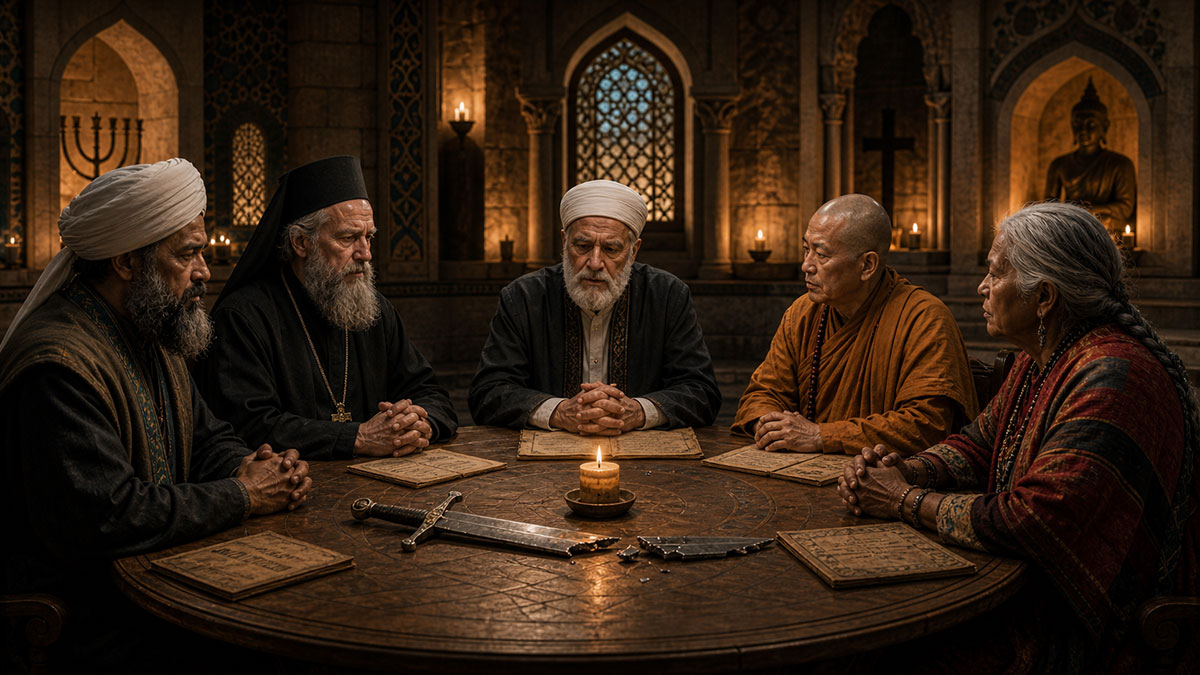
Opening — Buckminster Fuller
We now come to a more painful question.
War is already terrible when justified by land, politics, revenge, or national fear.
But it becomes even more tragic when people claim God is on their side.
Nick began with a very honest concern. He loves God. The idea of God is deeply meaningful to him. Yet he sees people using the teachings of Jesus, the faith of Muslims, and other sacred traditions for personal gain, political control, tribal hatred, and the sacrifice of innocent people.
This is not a small problem.
It is one of humanity’s greatest spiritual design failures.
Religion can awaken compassion. It can teach humility. It can help human beings face suffering, forgive enemies, serve the poor, and restrain ego.
But religion can be captured.
A sacred word can become a banner for war.
A holy book can be quoted without love.
A leader can use divine language to demand obedience.
A community can confuse loyalty to God with hatred of another people.
So we must ask:
When religion becomes a weapon, what has truly happened?
Has faith failed?
Have institutions failed?
Have leaders corrupted the sacred?
Or has the human heart used God’s name to hide its own ambition?
Let us begin.
Question 1 — If God is love, why do human beings so often use God’s name to justify violence?
Jesus
When human beings use God’s name to justify hatred, they are not serving God.
They are serving fear.
Many will speak of righteousness, but their hearts may be full of anger, pride, or the desire to control. They may say they defend truth, yet they refuse mercy. They may say they honor God, yet they cannot see God’s image in their enemy.
The command to love your neighbor is not difficult to understand. The command to love your enemy is far more difficult to obey.
That is where many turn away.
They keep religion’s language but abandon its spirit.
God’s name becomes dangerous in the mouth of someone who has not surrendered ego.
Prophet Muhammad
Faith is not meant to be a cloak for oppression.
To invoke God while committing injustice is a grave corruption of the soul.
The human being may desire authority, victory, revenge, or status. Then he searches for holy words to protect his desire from criticism. This is not submission to God. This is submission to the self.
True faith requires restraint. It requires accountability before God. It requires care for the weak, the orphan, the poor, the stranger, and the innocent.
When people use religion to excuse cruelty, they have placed themselves above God’s command.
They do not make God greater.
They make their own ego untouchable.
Mahatma Gandhi
I have seen religion used both as medicine and poison.
The difference lies in truth.
A person may fast, pray, quote scripture, and attend worship, yet remain violent in thought. Then religion becomes decoration on an unchanged life.
The tragedy is that religion gives people moral confidence. If that confidence is joined to love, it can become a force for liberation. If joined to pride, it becomes fanaticism.
No religion is safe from this danger.
The cure is not hatred of religion.
The cure is truthfulness before God.
If I cannot see God in the one I oppose, then my religion is incomplete.
Martin Luther King Jr.
The misuse of religion often begins when people separate worship from justice.
They want God’s blessing without God’s demand.
They want comfort without repentance.
They want divine approval for human prejudice.
In my time, many people quoted the Bible to defend segregation. They prayed on Sunday and denied dignity on Monday.
So the problem was not absence of religion. It was religion divorced from love.
A faith that does not challenge injustice becomes a servant of the status quo.
A faith that blesses violence against innocent people has lost contact with the God it claims to serve.
Rumi
God is not a sword in the hand of the ego.
God is the fire that burns the ego away.
People use God’s name for violence because they are afraid to meet God without armor. They prefer a God who agrees with their tribe, their anger, their wound, their pride.
But the Beloved is larger than the tribe.
The heart that has tasted divine love cannot easily hate.
It may resist evil. It may protect the weak. But it does not become drunk on cruelty.
When religion becomes a weapon, the soul has mistaken the shell for the pearl.
Question 2 — What is the difference between true faith and religious identity used for power?
Martin Luther King Jr.
True faith creates moral courage.
Religious identity used for power creates moral permission.
That difference is severe.
True faith asks, “Am I loving? Am I just? Am I faithful to God’s will?”
Religious identity used for power asks, “Who belongs to my group? Who threatens us? Who can we condemn?”
True faith makes a person more humble.
Weaponized identity makes a person more certain, more defensive, more willing to harm others in the name of protection.
A living faith must always measure itself by love and justice.
If it does not produce these fruits, then something has gone wrong.
Prophet Muhammad
True faith begins with surrender to God.
Power religion begins with surrendering God’s name to human ambition.
The faithful person asks, “What does God require of me?”
The ambitious person asks, “How can religion strengthen my position?”
This difference may be hidden from others, but not from God.
A community must guard itself from leaders who use sacred language to avoid accountability. No leader should be above justice. No group should be permitted to oppress another and call it piety.
Faith without justice is a body without a soul.
Jesus
You will know the tree by its fruit.
If religious identity produces contempt, cruelty, greed, and fear, then the fruit reveals the root.
True faith produces mercy, forgiveness, courage, repentance, and love.
Many people want the authority of religion without the sacrifice of love. They want to be chosen without serving. They want to be righteous without becoming humble.
But the kingdom of God is not built by domination.
The greatest among you must become servant.
Where religion seeks authority over others, it has forgotten the path of the cross.
Mahatma Gandhi
True religion makes a person smaller before truth.
False religion makes a person larger before others.
That is the test.
If my religion allows me to avoid self-criticism, it is not serving truth. If my religion allows me to hate my neighbor with a clean conscience, it is not serving God.
Religious identity is often inherited. True faith must be practiced.
It is not enough to claim a tradition. One must live it in food, speech, economics, politics, family, and treatment of enemies.
A religion that cannot make us truthful in daily life cannot make peace between nations.
Rumi
Religious identity says, “I am this, and you are that.”
True faith says, “There is one breath moving through us.”
Identity builds walls when love has not awakened.
Faith opens windows.
The lover of God does not lose his tradition. He deepens it so much that he discovers the ocean beneath the name.
There are lamps of many shapes. The light is not divided by the lamp.
When people fight over the lamp and forget the light, religion has become possession, not devotion.
Question 3 — Can religion become a force for peace again without losing its spiritual depth?
Mahatma Gandhi
Yes, but only if religion becomes disciplined by truth and nonviolence.
Peace is not weakness. Peace requires greater courage than war.
Religious people must refuse to cooperate with hatred, even when hatred is dressed as patriotism or loyalty. They must resist injustice without becoming cruel. They must suffer for truth rather than make others suffer for identity.
Religion should not become shallow harmony.
It must become deeper obedience to conscience.
A faith that avoids conflict with injustice is not peace.
It is cowardice.
Jesus
Religion becomes a force for peace when it returns to love of God and love of neighbor.
Not love in words only.
Love that feeds the hungry.
Love that forgives.
Love that tells the truth.
Love that protects the vulnerable.
Love that refuses revenge.
Love that sees even the enemy as someone God desires to redeem.
This does not remove spiritual depth.
It restores it.
The deepest faith is not the loudest claim. It is the life poured out for others.
Prophet Muhammad
Religion can serve peace when believers remember accountability before God.
No community should think it owns God.
No leader should use faith to escape justice.
No anger should be allowed to erase mercy.
Peace requires moral law, not sentiment alone. It requires protection of the innocent, fairness in judgment, dignity for neighbors, and restraint in conflict.
A shallow peace ignores wrongdoing.
A faithful peace seeks justice without hatred.
Religion must teach people to fear injustice more than they fear losing authority.
Martin Luther King Jr.
Religion can become a force for peace when it refuses to be neutral in the face of suffering.
True peace is not the absence of tension.
It is the presence of justice.
Faith communities must become places where enemies can be humanized, where truth can be spoken, where repentance is possible, where the poor are heard, and where violence is never romanticized.
This requires deep spirituality.
Marching for justice, praying for enemies, forgiving attackers, confronting unjust laws—these are not shallow religious acts.
They are costly discipleship.
Rumi
Religion becomes peace when it becomes love again.
Not soft love.
Burning love.
Love that melts arrogance.
Love that makes the proud weep.
Love that opens the hand that was closed around a weapon.
The soul does not need less depth.
It needs to fall deeper into God.
At the surface, people argue over names.
In the depth, they discover the Friend.
When the heart becomes wide enough, it cannot carry both God and hatred for long.
Closing — Buckminster Fuller
This conversation has revealed something essential.
Religion does not become a weapon by itself.
It is weaponized when ego, fear, tribe, politics, and ambition seize the sacred.
Jesus has told us that faith without love becomes false.
Prophet Muhammad has reminded us that God’s name cannot excuse injustice.
Gandhi has shown that religion must be tested through truth and nonviolence.
King has warned that worship separated from justice becomes dangerous.
Rumi has opened the deeper wound: many people defend religion without surrendering the ego that corrupts it.
So the question is not whether God is the problem.
The question is whether human beings can stop using God to protect what is least godly in themselves.
A world seeking peace cannot abandon spiritual depth.
But it must redesign religious life so that sacred traditions cannot so easily be captured by violence.
Faith must become accountable.
Leadership must become humble.
Scripture must be read through compassion, justice, and self-examination.
Communities must teach children that God is never honored by cruelty to another child of God.
Religion can still be one of humanity’s greatest peace-building forces.
But only if it becomes courageous enough to purify itself.
Topic 3 — Does Religion Need Reform, Return, or Renewal?
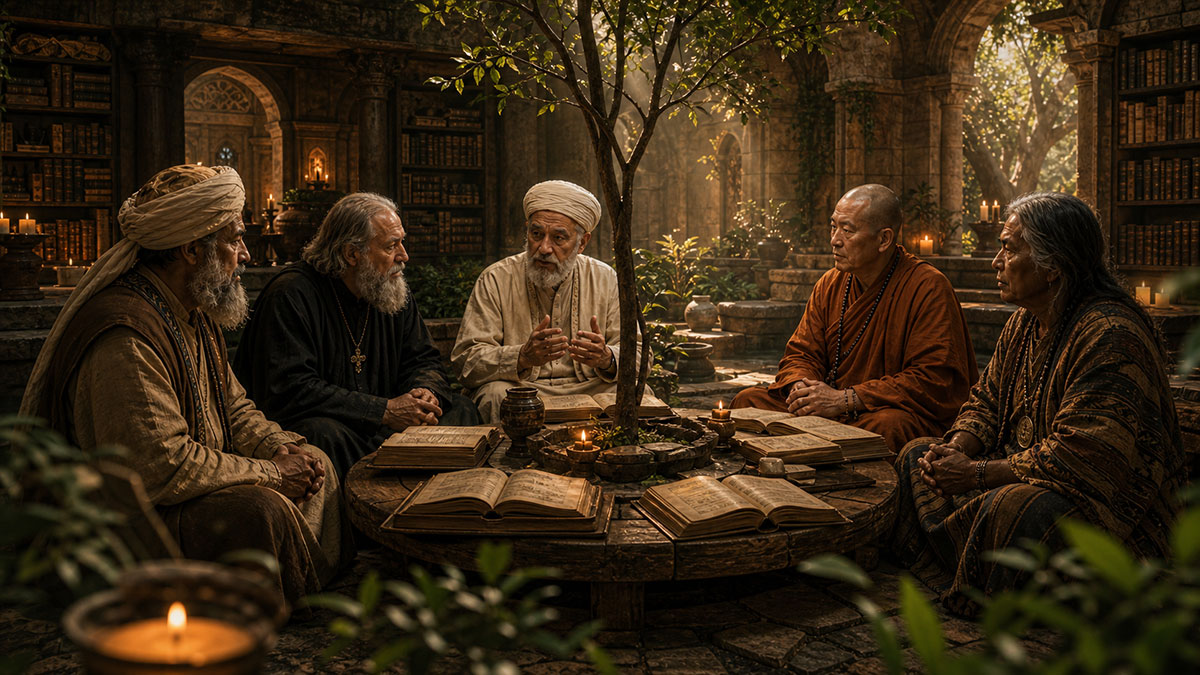
Opening — Buckminster Fuller
We have asked why religion can become a weapon.
Now we must ask a deeper question:
Does religion itself need to change?
Some people say religion must reform. They believe old interpretations, old institutions, old hierarchies, and old tribal boundaries have made faith too easy to misuse.
Others say religion does not need to change. They say the original truth was already pure, but human beings drifted away from it.
A third view says something more subtle:
Religion may not need to be replaced, but it may need renewal.
Not a shallow update.
Not a marketing adjustment.
Not a softer public image.
A deep spiritual renewal.
A renewal that asks whether religion is still producing humility, compassion, truth, courage, and love.
A renewal that asks whether institutions are protecting God’s truth, or protecting themselves.
A renewal that asks whether believers are becoming more peaceful, or merely more certain.
So let us ask:
If religion has been used for war, oppression, control, and fear, what must change?
The doctrine?
The institution?
The interpretation?
The leaders?
Or the human heart that touches religion and turns it into a mirror of itself?
Question 1 — Does religion need to be changed, or does humanity need to return to the deepest truth inside religion?
Buddha
Human beings suffer because they cling.
They cling to identity, opinion, authority, fear, and the desire to be right.
Religion can become one more thing to cling to.
A person may cling to a sacred text. A ritual. A name. A robe. A nation. A teacher. Then what began as a path to awakening becomes another chain.
The deepest truth is not owned. It is realized.
So I would not ask only whether religion must change.
I would ask:
Does religion still help the mind become free from hatred, greed, and delusion?
If it does, it is alive.
If it does not, it has become another attachment.
Lao Tzu
When people lose the Way, they speak more about virtue.
When they lose virtue, they speak more about rules.
When they lose rules, they speak more about punishment.
Religion becomes heavy when it forgets the quiet source.
The Way does not need noise. It does not need pride. It does not need conquest.
A river does not argue with stones. It flows around them.
Religion does not need to become louder. It needs to become empty of force.
Return is not going backward.
Return is finding the root.
A tree does not become strong by painting its leaves.
It becomes strong by deepening its roots.
Moses
A people need law.
Without law, the strong devour the weak.
Without covenant, freedom becomes wandering.
But law itself can become an idol.
A commandment given for life can be used for control. A sacred boundary can become pride. A chosen people can forget why they were chosen.
The purpose of covenant is not superiority.
It is responsibility.
Religion must return to the God who hears the cry of the oppressed.
If religion does not defend the widow, the orphan, the stranger, and the poor, then its altar has become empty.
So yes, return.
But return must be real.
Not return to nostalgia.
Return to justice.
Ibn Khaldun
Religious truth enters history through communities.
That is where difficulty begins.
A teaching may begin in purity, but societies organize around it. Then leadership, law, territory, wealth, inheritance, and group loyalty appear.
The force that binds a people together can defend civilization. It can also become tribal pride.
Reform is often needed because institutions decay.
Return is needed because founding principles are forgotten.
Renewal is needed because every generation faces new conditions.
The error is to choose only one.
A civilization survives when it can renew its soul without losing its root.
Simone Weil
Religion must become attentive again.
To pay attention is a form of love.
Much religion becomes false because it stops paying attention to suffering. It explains suffering. It uses suffering. It gives speeches about suffering. But it does not truly see the person who suffers.
A religious institution can become more interested in preserving itself than receiving truth.
That is where renewal must begin.
Not with slogans.
With attention.
Can religion look at the victim without defending itself?
Can religion listen to the wounded without explaining them away?
Can religion love truth more than its own image?
If not, then change is needed.
Question 2 — How can religion protect people from ego when religious institutions themselves can become proud?
Moses
The leader must remember he is not God.
The priest must remember he is not God.
The nation must remember it is not God.
This is why idolatry is such a severe danger.
An idol is not only a statue.
An idol is anything human beings make absolute.
A nation can become an idol.
A leader can become an idol.
A religious institution can become an idol.
Even a sacred mission can become an idol if it excuses cruelty.
Religion protects people from ego by placing every person, every ruler, every law, and every community under judgment.
No one stands above God.
Buddha
Ego can wear religious clothing.
It can speak softly.
It can quote wisdom.
It can appear disciplined.
But if the mind still clings to superiority, it is not free.
A community must learn to watch the mind.
Not only the mind of outsiders.
Its own mind.
Religious institutions become proud when they stop practicing self-examination.
A person who says, “I am humble,” may already be trapped.
A religion that says, “We cannot be corrupted,” has already opened the door to corruption.
The medicine is awareness.
Moment by moment.
Lao Tzu
The more a leader claims holiness, the more carefully one must listen.
True greatness does not need to announce itself.
The sage does not stand above the people.
He serves without possessing.
He guides without controlling.
He acts without making himself the center.
Religious institutions become proud when they become too full of themselves.
Too full of certainty.
Too full of rank.
Too full of victory.
The vessel must be empty to be useful.
Religion must empty itself again.
Ibn Khaldun
Institutions decay when authority becomes inherited, wealth becomes protected, and criticism becomes dangerous.
Religious institutions are no exception.
At first, spiritual energy may bind a community. Later, the institution may focus on preserving rank and privilege.
Then religion becomes formal, defensive, and political.
To protect against ego, a religious community must build accountability into its structure.
Leaders must be questioned.
Wealth must be transparent.
Authority must serve public good.
A community that cannot criticize itself cannot renew itself.
Simone Weil
Pride enters religion when belonging becomes more precious than truth.
A person says, “My group is good,” and then stops seeing the harm caused by that group.
This is one of the great dangers of collective life.
Institutions ask for loyalty.
Truth asks for attention.
When loyalty becomes stronger than attention, victims disappear.
Religion can protect people from ego only by teaching them to love truth more than belonging.
That is painful.
It may require one to criticize one’s own community.
But without that pain, religion becomes self-worship.
Question 3 — What kind of spiritual renewal could make religion harder to misuse?
Simone Weil
Religion must train people to see suffering without turning away.
That is the beginning.
Before doctrine becomes argument, before ritual becomes identity, before community becomes pride, there must be attention.
A child should learn:
When someone suffers, do not first ask, “Are they one of us?”
Ask, “What is being done to them?”
If religion taught this deeply, cruelty would become harder to bless.
A renewed religion must become less eager to defend itself and more willing to stand near the afflicted.
It must make compassion more sacred than reputation.
Ibn Khaldun
Religious renewal must include social renewal.
A faith community cannot speak of peace and ignore poverty, humiliation, corruption, and exclusion.
These forces create anger. Anger creates division. Division becomes conflict. Conflict then seeks sacred justification.
A renewed religion must strengthen justice inside society.
It must reduce corruption.
It must teach shared responsibility.
It must resist rulers who exploit faith for legitimacy.
If religion serves only the palace, it loses the street.
If it serves only the tribe, it loses humanity.
Lao Tzu
Make religion simple again.
Less domination.
Less spectacle.
Less craving to win.
More silence.
More service.
More humility.
More closeness to the source.
When people are quiet enough, they can hear what anger hides.
When religion becomes too forceful, it loses the Way.
The strongest tree is not the stiffest.
The soft survives what the hard cannot.
Spiritual renewal begins when religion stops trying to conquer and begins to heal.
Moses
Teach the people again that covenant means responsibility.
Do not use God’s name for falsehood.
Do not murder.
Do not steal.
Do not bear false witness.
Honor the sacredness of life.
Care for the stranger, for you know what it means to be strangers.
These are not decorations around faith.
They are the bones of faith.
Religion becomes harder to misuse when its people are trained to recognize injustice, even when injustice comes from their own side.
A holy people must not excuse unholy behavior.
Buddha
Renewal begins in the mind.
If hatred remains, no reform will be enough.
If greed remains, no institution will be safe.
If delusion remains, sacred words will be misunderstood.
Teach people to observe anger before acting from it.
Teach them to see fear before obeying it.
Teach them to let go of the need to defeat.
A peaceful religion must produce peaceful minds.
Not passive minds.
Clear minds.
Compassionate minds.
Minds that can resist harm without becoming hatred.
Closing — Buckminster Fuller
This discussion has shown us that the question is not simple.
Religion may need reform.
Religion may need return.
Religion may need renewal.
And perhaps it needs all three.
Buddha has reminded us that religion itself can become an attachment.
Lao Tzu has shown that religion loses life when it becomes too forceful, too proud, too far from the root.
Moses has warned that law, covenant, and sacred mission must never become idols.
Ibn Khaldun has shown how spiritual communities become historical institutions, and how institutions decay.
Simone Weil has brought us back to the suffering person—the one religion often talks about, but does not always truly see.
So what must change?
Religion must recover humility.
It must become brave enough to examine itself.
It must teach believers to love truth more than identity.
It must protect the vulnerable before protecting reputation.
It must make cruelty spiritually impossible to excuse.
Religion does not need to become weak.
It needs to become pure enough that ego cannot easily wear its clothing.
The world does not need less spiritual depth.
It needs religion deep enough to survive contact with authority, tribe, fear, and pride without becoming their servant.
Peace will not come only from changing institutions.
Peace will not come only from returning to old words.
Peace will come when sacred traditions renew the human being from the inside, and redesign their communities from the outside.
That is the work before us.
Topic 4 — Can Technology Help End War, or Make It Worse?
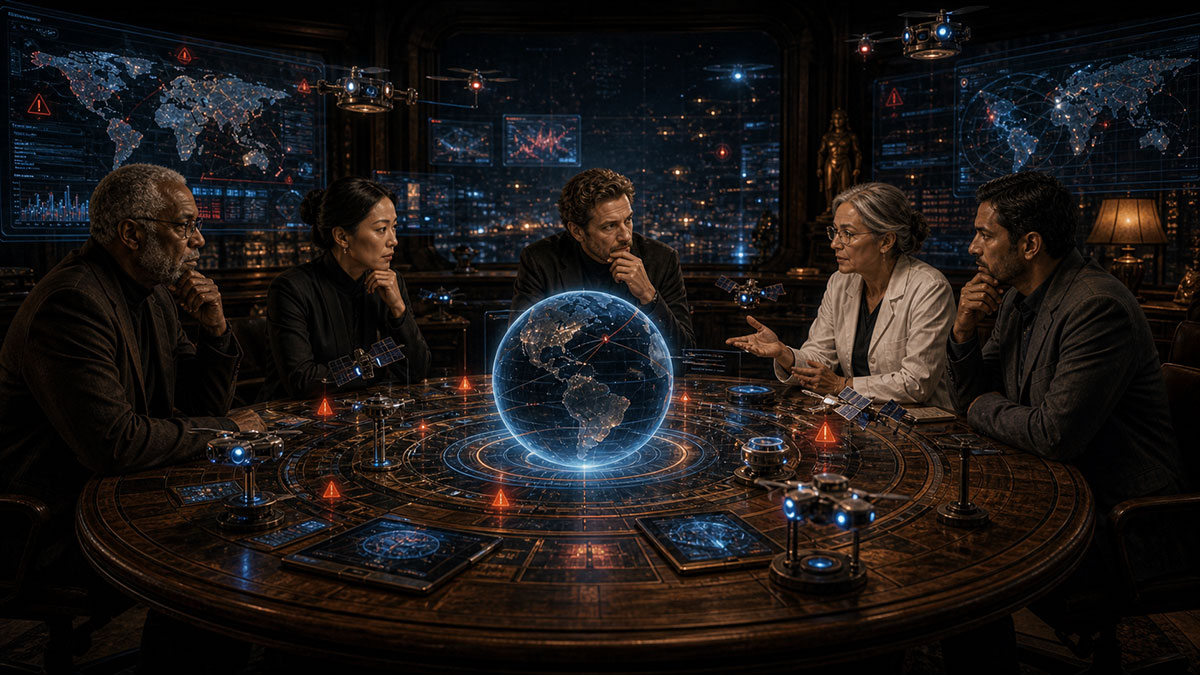
Opening — Buckminster Fuller
We now turn from religion to technology.
Humanity has always invented tools.
A stone became a blade.
A blade became a sword.
A sword became a missile.
A missile became a nuclear weapon.
Now intelligence itself is being placed into machines.
Technology carries a paradox. It can feed people, heal disease, connect strangers, translate languages, expose corruption, predict famine, and warn humanity before disaster spreads.
But the same human creativity can build drones, cyberweapons, surveillance states, propaganda engines, autonomous weapons, and machines that separate killing from conscience.
This is why technology cannot be judged by brilliance alone.
A brilliant tool in an immature civilization can multiply danger.
Nick began with a question about war, God, and peace. Now we must ask another:
Can technology help humanity outgrow war?
Or will it give old hatred new speed?
If religion can be weaponized by ego, technology can be weaponized by fear.
So let us begin.
Question 1 — Can technology make war obsolete, or will it make war faster, cheaper, and harder to control?
Elon Musk
Technology can do both.
That is the problem.
The same satellite network that keeps people connected during crisis can become part of military strategy. The same AI that detects threats can be used to generate propaganda. The same robotics that help factories can become drone swarms.
So the real question is not whether technology is good or bad.
The real question is: what incentives govern its use?
If civilization is still organized around fear, competition, secrecy, and dominance, technology will amplify those things.
But technology can reduce some root causes of war.
Energy abundance matters. Communication matters. Space-based infrastructure matters. Transparency matters. AI early-warning systems could detect escalation patterns before leaders make catastrophic moves.
Technology can make war less necessary.
But it cannot make peace automatic.
Nikola Tesla
Humanity has not yet understood the spiritual meaning of invention.
A true invention should reduce human suffering.
Electricity should bring light, not terror.
Energy should be shared, not hoarded.
Communication should make humanity feel less divided, not more manipulated.
The tragedy is that many discoveries are captured by those who seek advantage over others.
The inventor dreams of harmony.
The empire asks, “Can this be used for war?”
Technology will make war worse if it remains controlled by fear and profit.
It can help end war only when invention is guided by a higher moral purpose.
Alan Turing
Machines follow rules.
But human beings choose the rules, the goals, and the data.
That is where danger enters.
A machine can process information at a scale no person can match. It can break codes, model conflict, identify targets, simulate outcomes, and accelerate decisions.
This may reduce uncertainty.
It may also reduce hesitation.
War has always contained delay: distance, confusion, human doubt. Automated systems may remove those delays. That can be useful for defense, but frightening when linked to weapons and political panic.
The risk is not only machines becoming intelligent.
It is humans giving machines authority before humans have become wise enough to set proper limits.
J. Robert Oppenheimer
Scientists once believed that knowledge could liberate humanity from superstition and fear.
Then we built weapons capable of destroying civilization.
That does not mean science is evil.
It means knowledge without moral governance becomes unbearable.
Technology can make war obsolete only if its destructive potential becomes so great that humanity finally accepts restraint.
But this is a dangerous hope.
Nuclear weapons created fear of total destruction. They may have prevented some wars, yet they placed humanity under permanent shadow.
A peace maintained only by terror is not peace in the highest sense.
It is a suspended catastrophe.
Yuval Noah Harari
Technology changes war by changing information.
Human beings fight not only over land or resources, but over stories: nation, tribe, religion, honor, destiny, victimhood.
AI can manufacture stories at enormous scale.
Deepfakes, personalized propaganda, automated persuasion, information bubbles—these can make societies unable to agree on reality.
If people cannot share reality, peace becomes very difficult.
War may not begin with tanks. It may begin with millions of minds being shaped by invisible systems.
So yes, technology could help end war by increasing transparency and cooperation.
But it could make war more permanent by turning human attention into a battlefield.
Question 2 — Who should decide how dangerous technologies are used: governments, inventors, companies, citizens, or global institutions?
J. Robert Oppenheimer
No single group can be trusted alone.
Scientists understand the tool, but they may not understand politics.
Governments understand authority, but they may be driven by fear.
Companies understand deployment, but profit can distort judgment.
Citizens deserve accountability, but may not have access to the knowledge needed to judge technical risks.
Global institutions are needed, yet they are often weak.
This is the tragedy of modern technology: responsibility is distributed, but consequences are shared.
The creation of powerful tools must be matched by institutions capable of restraint.
Otherwise invention outruns wisdom.
Elon Musk
You need multiple checks.
Governments alone are too slow or too political. Companies alone can be too competitive. Inventors alone can be too optimistic. Public opinion can be manipulated.
For AI and advanced military technology, we need transparency, audits, safety testing, and international coordination.
The tricky part is that if one country slows down and another does not, everyone feels forced to race.
That is the arms-race problem.
The best path is probably a mix: open safety standards, strong verification, independent oversight, and serious penalties for dangerous deployment.
You cannot just rely on good intentions.
Systems need guardrails.
Alan Turing
A decision about dangerous technology is not merely technical.
It is logical, ethical, and political.
If a system can act faster than humans can understand, then its use must be limited by design.
One should ask before deployment:
Can it be audited?
Can it be stopped?
Can responsibility be assigned?
Can mistakes be corrected?
Can the system explain its reasoning in a way humans can contest?
If not, it should not be given authority over life and death.
The right to question a machine may become one of the most serious rights of modern civilization.
Nikola Tesla
Inventors should not wash their hands after discovery.
But inventors alone cannot protect humanity.
A discovery enters a world of money, ambition, armies, and fear.
So the inventor must speak.
The citizen must awaken.
The government must be restrained.
The company must be accountable.
The world must learn that invention belongs to humanity, not merely to those who can purchase it.
A dangerous invention should be surrounded by conscience.
Without conscience, genius becomes a servant of destruction.
Yuval Noah Harari
The greatest danger is that decision-making becomes hidden.
Modern technology often works through opaque systems: classified programs, proprietary algorithms, secret data, security agencies, private platforms.
When authority becomes invisible, democracy weakens.
Citizens do not need to understand every technical detail.
But they must know who holds authority, what rules apply, what rights exist, and how abuses can be challenged.
Global institutions are necessary, especially for AI, cyberwar, biotech, and autonomous weapons.
But they must have enforcement mechanisms.
A treaty without verification is only a story powerful people can ignore.
Question 3 — Can humanity become morally mature fast enough to handle the tools it is creating?
Yuval Noah Harari
This may be the central question of the twenty-first century.
Humanity has always been better at creating force than creating wisdom.
We learned how to split the atom before learning how to end hatred.
We learned how to connect billions of people before learning how to protect attention from manipulation.
Now we may create artificial intelligence before learning how to govern desire, fear, and greed.
Moral maturity means recognizing that our stories are not absolute.
Nations are stories.
Markets are stories.
Religions are interpreted through stories.
If we cannot examine the stories that move us, technology will serve myths we do not control.
Elon Musk
We have to try.
There is no other option.
The future will not pause until humanity becomes wise.
So we need practical risk reduction: AI alignment, transparency, decentralized resilience, energy abundance, education, and backup plans for civilization.
I think becoming multiplanetary matters, but not as an escape from Earth.
It changes the scale of thinking.
If humanity sees itself as one civilization with a fragile future, maybe we become less trapped in local conflicts.
But moral maturity is not guaranteed.
We need to build systems that make catastrophic mistakes less likely.
J. Robert Oppenheimer
After the bomb, many scientists hoped humanity would awaken.
Some did.
Many did not.
Moral maturity often comes after tragedy, and that is a terrible method of education.
The task is to learn before catastrophe.
This requires humility from those who create powerful tools. It requires honesty from governments. It requires courage from citizens.
A civilization that worships force will eventually be judged by the forces it unleashes.
The question is not only whether we can control technology.
It is whether we can control ourselves.
Alan Turing
Maturity requires recognizing limits.
A machine can extend the mind, but it cannot replace moral responsibility.
When people hide behind systems, responsibility becomes blurred.
“The model decided.”
“The algorithm selected.”
“The chain of command approved.”
“The data required it.”
These phrases can become modern forms of evasion.
A moral society must refuse to let machines become scapegoats.
If a human creates, deploys, funds, or authorizes a system, a human remains responsible.
Nikola Tesla
Humanity can mature if it recovers wonder.
A person filled with wonder does not easily destroy.
The problem is that invention has been separated from reverence.
We study nature to control it, not to belong to it.
We use energy to dominate, not to illuminate.
A higher civilization would teach every inventor that genius is a sacred trust.
The lightning in the sky and the light in the home come from the same mystery.
If technology is joined again to reverence for life, it may help bring peace.
If not, it will magnify the old darkness.
Closing — Buckminster Fuller
Technology is not destiny.
It is a tool placed inside a system.
If the system is fear, technology accelerates fear.
If the system is profit without conscience, technology scales exploitation.
If the system is domination, technology gives domination longer arms.
But if the system is cooperation, technology can reduce suffering.
If the system is transparency, technology can expose lies.
If the system is abundance, technology can weaken scarcity.
If the system is shared responsibility, technology can help humanity survive itself.
Elon Musk has reminded us that technology can reduce war’s practical causes, but cannot create peace by itself.
Tesla has asked invention to recover moral purpose.
Turing has warned that machines must never erase human responsibility.
Oppenheimer has shown us the unbearable burden of knowledge without restraint.
Harari has warned that the battlefield may now be information, attention, and reality itself.
So the future question is not simply:
Can technology end war?
The real question is:
Can humanity redesign the systems around technology before technology magnifies everything broken within us?
Peace will not come from smarter machines alone.
Peace requires wiser humans, better incentives, accountable institutions, and a sacred respect for life.
If we fail, technology will make war faster.
If we succeed, technology may help make war obsolete.
Topic 5 — What Must Change First: Systems, Leaders, Religion, or the Human Heart?
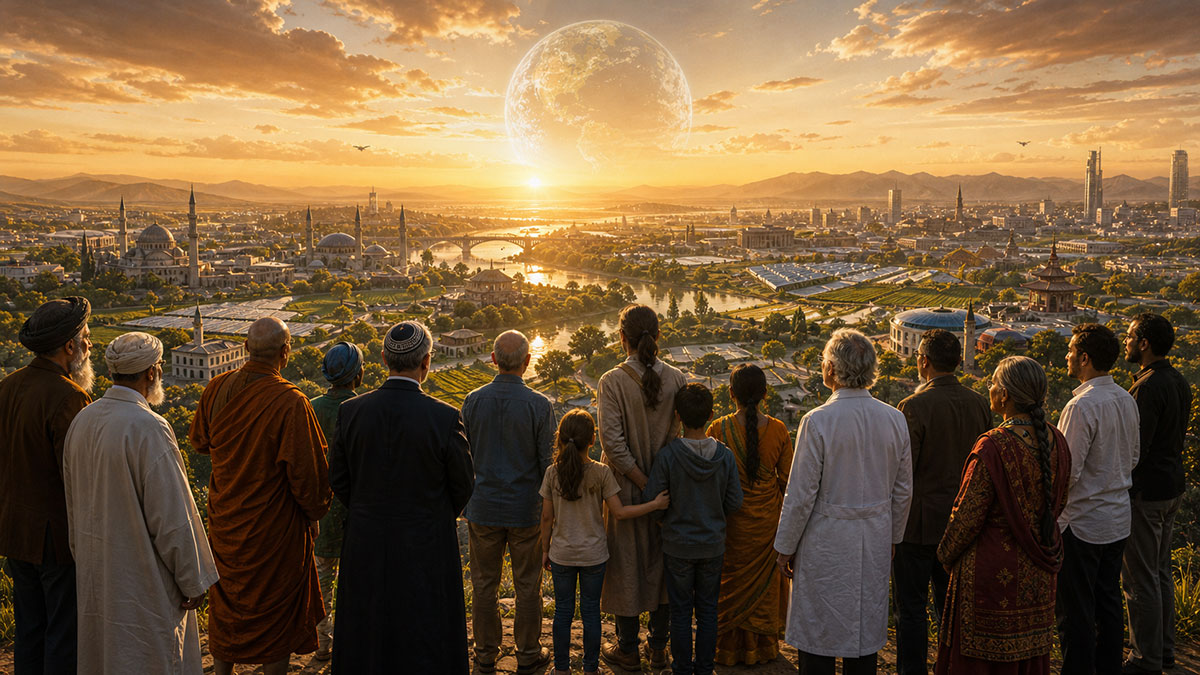
Opening — Buckminster Fuller
We have examined war.
We have examined religion when it becomes a weapon.
We have examined whether religion needs reform, return, or renewal.
We have examined technology and whether it can help end war or make it worse.
Now we arrive at the deepest question:
What must change first?
Some people say systems must change. Redesign economics, education, diplomacy, technology, media, and law, and human behavior will change with them.
Some say leaders must change. Give the world wiser, humbler, less selfish leaders, and nations may choose peace over pride.
Some say religion must change. Faith must become harder to misuse, less tribal, more accountable, and more deeply rooted in love.
Some say the human heart must change. Without inner transformation, every outer reform will eventually be captured by ego again.
Perhaps the answer is not one path.
Perhaps peace requires a new human design at every level:
heart, family, faith, school, nation, technology, economics, and civilization.
So I ask our final panel:
If humanity truly wants war to end, what must change first?
Question 1 — Can peace be built from outside through systems, or must it begin inside the human heart?
Jesus
Peace begins in the heart, but it cannot remain hidden there.
A heart that loves God must become visible through mercy, forgiveness, courage, and care for the suffering.
If the heart does not change, systems become masks. Laws may speak of justice, yet people will still seek advantage. Institutions may claim peace, yet leaders will still hunger for domination.
But if the heart changes and systems remain unjust, the innocent will still suffer.
So do not separate them.
The kingdom of God begins within, but it must touch the world.
A peaceful heart must become peaceful action.
Buckminster Fuller
The inner and outer cannot be divided.
A human being grows inside an environment. If the environment rewards fear, competition, and hoarding, then noble teaching has to fight uphill every day.
But systems are not self-created.
They come from human assumptions.
Change the assumptions, and you can change the design.
Change the design, and you can change behavior.
So peace begins as a change in consciousness, then becomes architecture, economics, education, energy, media, and governance.
If we only preach peace, we leave war’s machinery intact.
If we only redesign systems without changing consciousness, ego will redesign them back into conflict.
Mahatma Gandhi
Peace must begin inside, but it is proven outside.
Many people speak beautifully of peace while living comfortably with injustice.
That is not peace.
A person must first become truthful. Then that truth must enter daily life: food, money, politics, speech, family, work, and resistance to injustice.
Nonviolence is not merely refusing to strike.
It is refusing to cooperate with falsehood.
Systems matter deeply. But no system can save people who are unwilling to discipline desire, anger, greed, and fear.
The human heart is the first battlefield.
Nelson Mandela
I entered prison angry.
I had reason to be angry.
But if I had allowed anger to rule me, I would have left prison still imprisoned.
The heart must change because hatred can survive inside any political system.
But systems must change because people cannot be asked to forgive while injustice continues unchallenged.
Peace requires dignity.
You cannot preach forgiveness to people whose children are still hungry, whose land is still taken, whose voice is still ignored.
Inner change and outer justice must walk together.
One without the other becomes incomplete.
Elon Musk
Systems shape behavior at scale.
Most people are not saints, and civilization should not depend on everyone becoming saints.
You need systems where doing the right thing is easier, more efficient, and more rewarded than doing the destructive thing.
But the people building those systems need values.
AI, energy, finance, media, governance—these are tools. They reflect the goals we give them.
So I would say: heart sets direction, systems create scale.
A peaceful heart without systems stays local.
Peace systems without heart become bureaucracy.
You need both.
Question 2 — What would a world look like where enemies are no longer useful?
Buckminster Fuller
A world where enemies are no longer useful would be a world where cooperation has become structurally superior to conflict.
No leader could gain popularity by inventing an enemy.
No economy would depend on war production for prosperity.
No education system would teach children that their nation is sacred and others are disposable.
No media system would profit more from outrage than understanding.
No energy system would force nations into desperation.
The enemy would lose its function.
Humanity would not become identical.
There would still be disagreement, culture, argument, and difference.
But difference would not need to become destruction.
Jesus
In such a world, the stranger would be seen as neighbor.
The enemy would not be denied wrongdoing, but would not be denied humanity.
People would still need justice. They would still need truth. They would still need repentance.
But revenge would lose its throne.
A person would ask, “How can this one be restored?”
A nation would ask, “How can peace be made without humiliation?”
The child of the enemy would be seen as a child of God.
When people remember that every soul belongs to God, hatred loses its final authority.
Nelson Mandela
A world without useful enemies would be a world where leaders cannot rule through fear.
In South Africa, we had to learn that if one side destroyed the other, the country itself would be destroyed.
The future required former enemies to sit at the same table.
That does not mean forgetting.
It means building a future stronger than revenge.
Such a world would need truth-telling.
It would need accountability.
It would need shared institutions.
It would need symbols that bring former enemies into one story.
Peace is not pretending the wound did not happen.
Peace is refusing to let the wound decide everything forever.
Mahatma Gandhi
A world where enemies are no longer useful would be a world where courage has changed form.
Today, courage is often pictured as defeating someone.
In a higher world, courage would mean refusing hatred, even when hatred is popular.
It would mean telling one’s own people uncomfortable truth.
It would mean accepting suffering rather than passing suffering to another.
The enemy is useful to the ego because the enemy allows us to avoid self-examination.
Take away the enemy, and we must face ourselves.
That is why peace is frightening.
Elon Musk
From a systems perspective, enemies are useful when they help organize groups.
They create identity, urgency, loyalty, funding, and political support.
So a world without useful enemies needs stronger positive organizing principles.
Shared missions.
Solving poverty.
Clean energy.
Space exploration.
Disease prevention.
Education.
Planetary risk reduction.
If humanity does not have big constructive goals, destructive conflict fills the vacuum.
We need civilization-level projects that make cooperation exciting, visible, and meaningful.
People need something bigger than fear to rally around.
Question 3 — If humanity had one century to end war, what should we build, teach, reform, and protect first?
Elon Musk
Build resilient infrastructure.
Energy abundance. Secure communication. AI safety. Decentralized systems that do not collapse under attack. Transparent information networks. Early-warning systems for conflict. Better education in science and critical thinking.
Teach people how systems work.
Most people see events, not incentives.
They see conflict, not feedback loops.
They see propaganda, not the machinery behind it.
Reform institutions so corruption is harder and accountability is real.
Protect free speech, human rights, and the ability to coordinate across borders.
And keep humanity future-oriented.
A species focused only on grievance will keep repeating history.
Jesus
Teach love of God and love of neighbor.
Teach children that no person is beyond the reach of mercy.
Teach them to see the hungry, the prisoner, the stranger, the wounded, and the enemy’s child.
Build communities where forgiveness is practiced, not only admired.
Reform religion so it cannot bless cruelty.
Protect the poor, the humble, the persecuted, and those who tell the truth when authority does not want to hear it.
If humanity wants peace, it must learn that life is sacred before it learns strategy.
Without love, every reform becomes fragile.
Mahatma Gandhi
Teach truth.
Teach self-discipline.
Teach nonviolence as strength.
Teach people how to resist injustice without becoming what they oppose.
Build local communities capable of dignity and self-reliance.
Reform economics so greed does not become civilization’s hidden religion.
Protect conscience.
A society that silences conscience prepares itself for violence.
If one century remains, begin with the child.
A child trained in truth, simplicity, courage, and compassion may become the adult who refuses to inherit hatred.
Nelson Mandela
Build justice.
Not symbolic justice.
Real justice.
Schools, courts, food security, fair representation, land dignity, honest memory, and institutions people can trust.
Teach history in a way that tells the truth without trapping children in revenge.
Reform prisons, policing, political systems, and negotiation structures.
Protect human dignity, especially after conflict.
A humiliated people will not build lasting peace.
A forgotten people will not trust speeches about unity.
If you want to end war, make peace believable to those who have suffered most.
Buckminster Fuller
Build a world that works for all humanity.
That phrase may sound too large, but anything smaller will fail.
Teach comprehensive thinking: how energy, food, economics, media, religion, technology, ecology, and governance interact.
Reform education away from isolated facts and into whole-system responsibility.
Protect the Earth, because ecological collapse will create new wars.
Protect truth, because false information can make enemies overnight.
Protect imagination, because humanity cannot build what it cannot picture.
If humanity has a century, the assignment is not merely to oppose war.
The assignment is to make war obsolete.
Closing — Buckminster Fuller
We have reached the final edge of this conversation.
War does not end through one reform.
It does not end through technology alone.
It does not end through religion alone.
It does not end through leadership alone.
It does not end through private goodness alone.
War ends when humanity redesigns the conditions that keep producing it.
Jesus has taken us to the heart: love, mercy, forgiveness, and the sacredness of every life.
Gandhi has taken us to disciplined truth: peace that refuses to cooperate with injustice.
Mandela has taken us to dignity: reconciliation that does not erase pain.
Elon Musk has taken us to future systems: infrastructure, AI, energy, resilience, and shared missions.
And I return us to design.
Peace must be designed into civilization.
It must be taught in childhood.
It must be protected by institutions.
It must be reinforced by economics.
It must be purified in religion.
It must be supported by technology.
It must be practiced in the heart.
The enemy is not only the other nation.
The enemy is the obsolete pattern inside humanity: fear seeking control, ego seeking holiness, authority seeking obedience, pain seeking revenge.
A century may sound long.
History tells us it is very short.
So let the work begin with a better question:
Not, “How do we defeat our enemies?”
But:
How do we build a world where enemies are no longer needed?
Final Thoughts by Buckminster Fuller
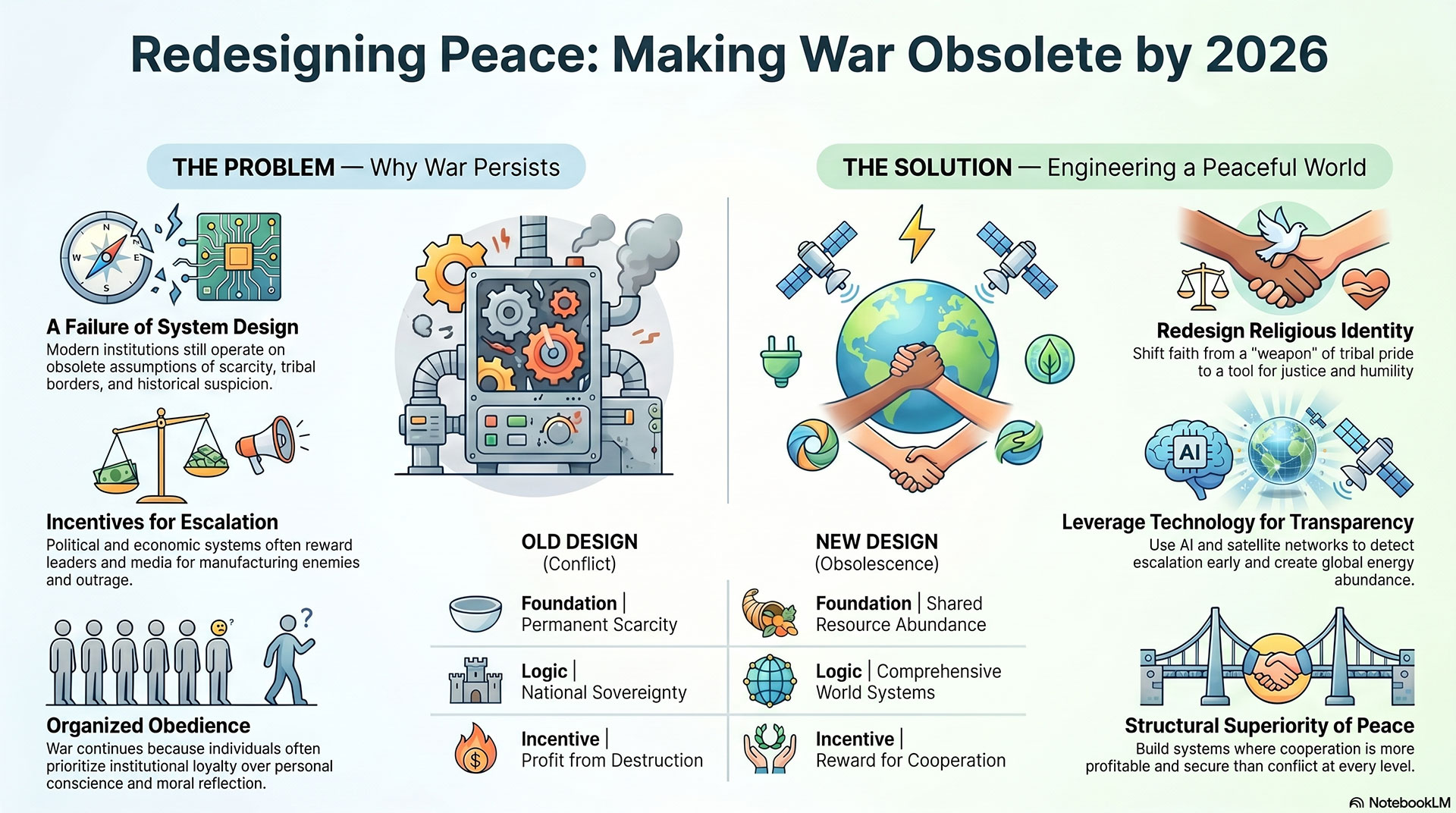
War is not inevitable.
It is a recurring result of systems humanity has not yet had the courage to redesign.
If war keeps returning, then we must stop asking only who started the latest conflict. We must ask what kind of world keeps producing conditions where war becomes thinkable, useful, profitable, honorable, or spiritually excusable.
Religion must become humble enough to examine itself.
Technology must become accountable enough to serve life.
Politics must stop depending on enemies.
Economics must stop rewarding destruction.
Education must teach children to see Earth as one shared home.
Leadership must become service, not ego with authority.
The human heart must learn that peace is not weakness. It is the highest form of courage.
God’s name should never be used to erase the humanity of another child of God. No nation, no institution, no religious group, no ideology, and no technology should be allowed to hide from that truth.
Peace will not come from sentiment alone.
It must be built.
It must be taught.
It must be designed into food systems, energy systems, media systems, religious communities, schools, courts, international law, artificial intelligence, and everyday human relationships.
The old question was:
How do we defeat our enemies?
The new question must be:
How do we build a world where enemies are no longer needed?
That is the work of the next century.
That is the spiritual work.
That is the technological work.
That is the political work.
That is the human work.
Short Bios:
Buckminster Fuller — Inventor, architect, futurist, and systems thinker who believed humanity could redesign society so scarcity, conflict, and war become unnecessary.
Elon Musk — Entrepreneur and technology builder known for Tesla, SpaceX, Starlink, Neuralink, and bold thinking about AI, energy, space, and civilization’s future.
Sun Tzu — Ancient Chinese strategist whose The Art of War taught that the highest victory is not endless battle, but winning without fighting.
Albert Einstein — Physicist whose work changed science and whose later life carried deep concern about nuclear weapons, conscience, and humanity’s survival.
Nelson Mandela — South African leader who moved from resistance to reconciliation and helped show how dignity, justice, and forgiveness can rebuild a wounded nation.
Jesus — Central figure of Christianity whose teachings on love, forgiveness, mercy, humility, enemy-love, and the Kingdom of God shaped world history.
Prophet Muhammad — Founder of Islam, remembered by Muslims as a prophet of God, with teachings centered on surrender to God, justice, mercy, community, and moral responsibility.
Mahatma Gandhi — Leader of India’s nonviolent independence movement who showed how truth, sacrifice, and disciplined nonviolence could challenge empire.
Martin Luther King Jr. — Christian minister and civil rights leader who joined faith, justice, nonviolence, and moral courage against racial oppression.
Rumi — Persian poet and Sufi mystic whose writings point beyond religious pride toward divine love, inner surrender, and unity of the heart.
Buddha — Spiritual teacher who taught that suffering grows from craving, attachment, ignorance, and ego, and that peace begins with awakening.
Lao Tzu — Ancient Chinese sage associated with the Tao Te Ching, known for teachings on humility, non-force, simplicity, and harmony with the Way.
Moses — Foundational prophet in Judaism, Christianity, and Islam, associated with covenant, law, liberation, moral responsibility, and justice for the vulnerable.
Ibn Khaldun — Historian and philosopher who studied civilization, tribal loyalty, social cohesion, power, decline, and the rise and fall of societies.
Simone Weil — Philosopher and spiritual writer known for her deep reflections on suffering, attention, justice, affliction, and the danger of institutions replacing truth.
Nikola Tesla — Inventor and visionary whose work with electricity and wireless communication reflected a dream of technology serving all humanity.
Alan Turing — Mathematician and computing pioneer whose work helped shape modern computation and raised deep questions about machines, logic, secrecy, and responsibility.
J. Robert Oppenheimer — Physicist who led the Manhattan Project and became a symbol of scientific genius facing the moral burden of destructive invention.
Yuval Noah Harari — Historian and public thinker known for examining humanity’s shared stories, technology, artificial intelligence, power, and the future of civilization.
Leave a Reply