
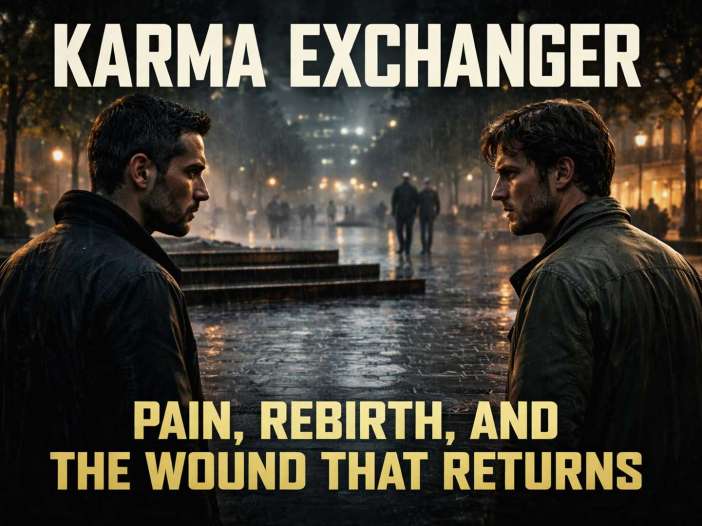

Prologue — Before the Return
The crowd had come for words.
That was the first lie.
Not because they knew it was a lie. Because people rarely know what else they have come for until the room changes shape around them. They had come for argument, for conviction, for the temporary relief of hearing one man stand where many could not and say something that might make the age feel less shapeless. They had come for witness, perhaps. Or for the flattering hope that being present at a serious event made them, too, more serious.
Words, yes.
But also the old human hunger to gather around a voice and borrow a little form from it.
The day was bright enough to feel innocent.
Open sky. Thin cloud. The kind of civic plaza that exists in many American cities and belongs fully to none of them—stone paving, a low public platform, planters, benches, a line of office buildings giving the whole scene more glass than grace. People moved in currents around the edges. Students. Retirees. Donors. Volunteers with clipboards and coffee cups. A woman adjusting the microphone stand with the harried patience of someone who believes events are held together mostly by tape and timing. A father carrying a little girl on one shoulder until she wriggled down and ran toward the pigeons before being called back.
Nothing in the air warned properly.
That, too, was part of the structure.
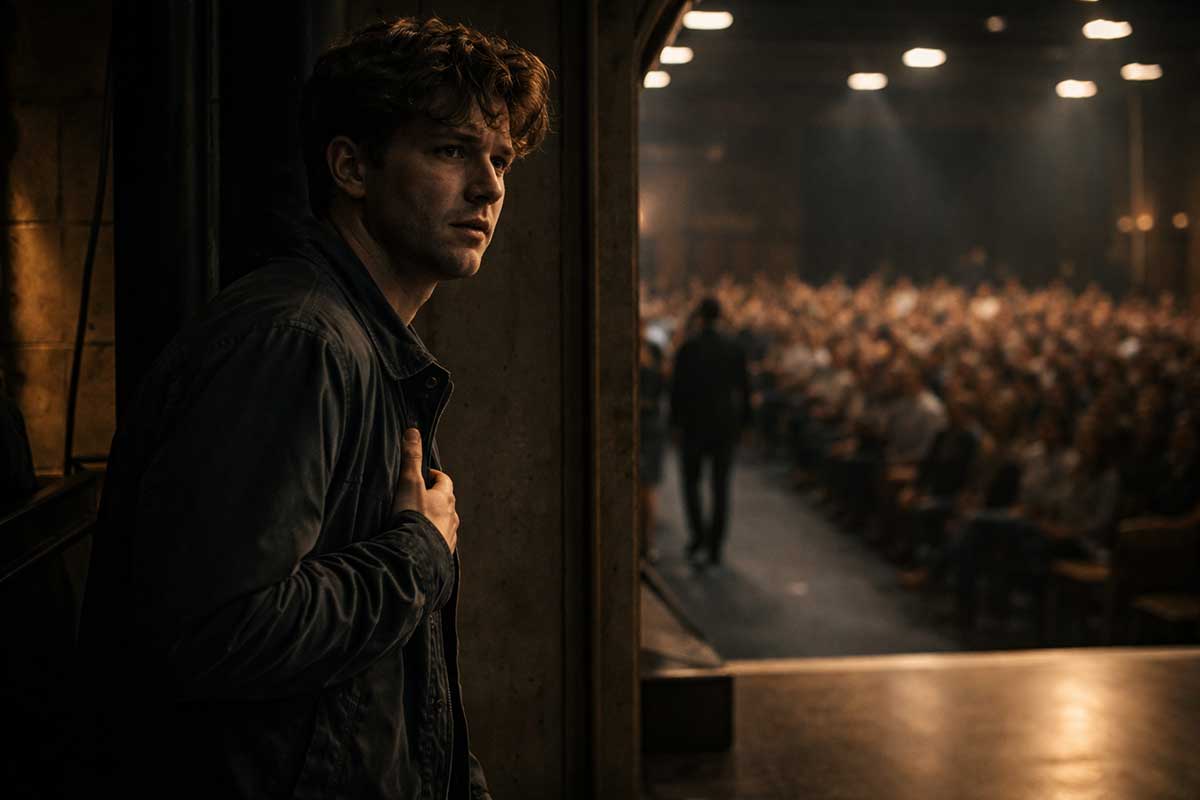
The man who would soon stand at the center of the plaza waited just inside the side entrance of the civic building, one hand at his chest, breathing carefully enough that it almost looked calm. He was in his thirties, perhaps, dressed without extravagance, serious-faced in the way public moral men often are before a room has given them permission to become larger than themselves. The talk he was about to give concerned responsibility, loneliness, and the corrosion of public life. He had revised the opening line twice that morning and still disliked it. He had not slept well. He had told no one. He had been afraid of rooms like this in ways he could never explain without sounding unreasonable, and still he kept entering them as if duty were stronger than comprehension.
A volunteer asked, “You ready?”
He said yes.
That was the second lie.
Across the plaza, in the moving public, another man had already entered the narrowing.
He was younger. Not by much. Young enough still to be carrying the last injuries of early life like weapons he had not fully admitted were weapons. He moved through the crowd with the terrible simplification of someone whose grief had finally found direction and mistaken direction for truth. The faces around him had already begun losing detail. The ordinary city sounds had gone thin and far away. What remained was line, target, pressure, the unbearable relief of no longer being merely outside the room but moving toward the place where the room would have to reckon with him.
He did not feel hatred cleanly.
That would have been simpler.
Inside the narrowing was grief so compressed it had become hard enough to act with. Grief at being outside, beneath, unheard, made secondary to the kind of visible life that gets to stand in public and interpret the age. Grief at theft so old it no longer had a current name. Grief looking for one body large enough to bear all its accusations and foolish enough to stand in open air and speak of damaged souls.
He had told himself many stories already.
That the man on the platform represented the lie.
That one act would reveal hidden violence in the order everyone else still called normal.
That forcing the room to turn was justice.
That public speech itself was theft if spoken from the wrong body.
That he was not merely angry but chosen by pain to interrupt a fraud.
The stories helped.
Until they didn’t.
The speaker stepped out.
Applause began.
The sound struck the standing man like a bodily blow.
His face did not show it.
He crossed the low platform and moved toward the microphone, carrying that old unreasonable terror in his chest like a private disease. The crowd settled. The volunteer stepped back. The father lifted his daughter down to the paving. A camera phone rose from the third row. The speaker looked out at the faces and felt, as he always did, the open-air sickness of being seen before being safe.
Then the movement at the edge.
A shoulder turning.
A figure advancing too directly through public space.
The tiny wrongness the body catches before the mind earns it.
The speaker’s left shoulder began to turn.
Not enough.
The younger man crossed the final distance not with triumph but with the deadly concentration of one who has spent too long imagining the room after the act and not long enough imagining the body inside it.
For one second, perhaps less, each man truly saw the other.
Not symbol.
Not role.
Not the public fraud and the righteous interruption.
Only body.
Then impact.
The world broke along sound.
The crowd did not become panic at once. It became disbelief first. The horrible lag in which reality outruns comprehension and the human mind still insists on ordinary categories a heartbeat too long. Someone screamed. Someone ducked. Someone stood frozen with both hands over their mouth. The little girl began crying because adults had changed shape and she could hear it before knowing why. The phone camera fell. A volunteer shouted for everyone to get back and no one knew how to obey because back had ceased being a location and become a moral impossibility.
The man on the platform felt the blow before he understood it.
Not pain first. Shock. Then the obscene intimacy of pain entering after. His breath failed him. The microphone stand tilted. The open sky above the plaza seemed suddenly too large, too public, too indifferent. He tried, absurdly, to remain upright. There was still a second in him that believed dignity might be preserved if the body could hold itself together in witness.
Then he fell.
Pavement.
Hardness.
The room becoming scene.
And the younger man above him, the one who had come carrying grief like a blade, looked down and felt the self-story die.
That was the true break.
Not the act.
The end of the lie that had made the act possible.
Because now there was no platform figure, no public fraud, no representative of all thefts and exclusions. There was only a man on stone trying to remain a person while public air and blood and witness stripped abstraction from the event. The body on the ground had weight, breath, face, unfinished life. It was too human. Far too human to continue bearing the meanings that had propelled violence toward it.
Horror entered the younger man so completely that for one impossible instant it displaced everything else.
Not remorse yet. Remorse belongs to time. This was more primitive.
Recognition.
Too late.
Too real.
Too human.
He dropped toward the fallen body, hands shaking, not in rescue exactly and not in attack anymore, but in the broken reflex of someone trying to call reality backward one second, just one, to the place before symbolic righteousness met flesh.
Voices came nearer.
Someone shouting for help.
Someone crying openly.
A woman kneeling and being pulled back.
The father grabbing his little girl and turning her face into his coat.
Shoes scraping.
Air splintering.
The man on the ground looked up.
The younger man looked down.
And in that terrible mutual second, something older than explanation passed between them—not forgiveness, not understanding, not peace, but the first raw bond of a wound that would not end in that plaza simply because blood had made it history.
Then the crowd closed in.
Then the sirens came.
Then the story, as public life always insists, began turning immediately into narrative before either soul had finished being body.
But the real event had already happened.
Not only the violence.
The lie had broken.
And what breaks in blood without being understood does not always stay in the past.
Chapter 1 — Two Births
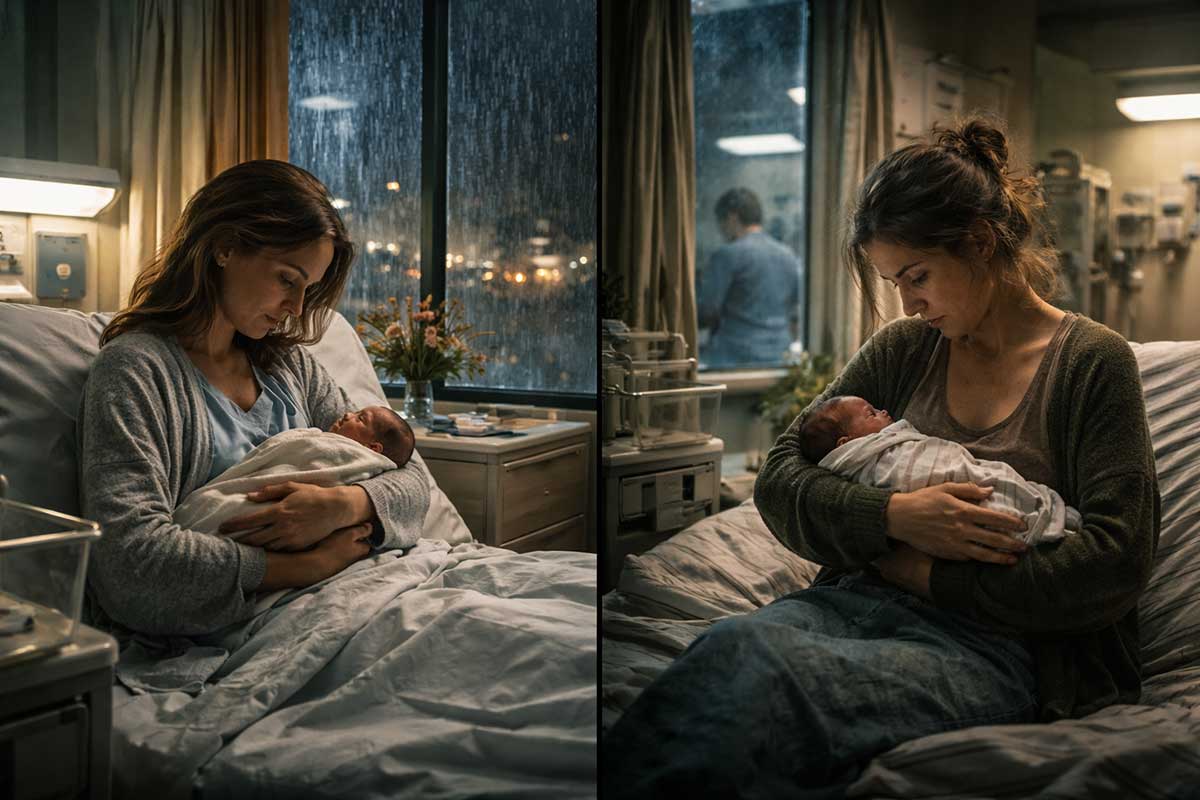
The storm entered the first city just before midnight.
It came low and hard over the suburbs, dragging rain across dark roofs and bare trees, flattening the last weak lights in office windows, shaking road signs loose enough to rattle. By the time the first contraction turned serious, the sky had already become a single living sheet of black cloud cut through at intervals by white veins of lightning.
Evelyn Cross gripped the side of the car door as her husband pulled into the hospital entrance.
“I’m fine,” she said through clenched teeth.
“You are very clearly not fine,” Thomas said, trying and failing to sound calm.
She gave him a look that might have been affectionate under other conditions. Then the pain seized her again, and the world narrowed to breath, pressure, and the steady conviction that the child inside her had chosen a dramatic night to arrive.
Orderlies came with a wheelchair. Rain hammered the awning overhead. Somewhere beyond the automatic doors the storm muttered like an enormous thing turning in sleep.
Inside, the hospital smelled of disinfectant, warm plastic, wet coats, coffee that had sat too long on a burner. Light gleamed off the polished floor. The night staff moved with that strange blend of quiet and urgency that belonged only to hospitals after dark.
Thomas checked them in, signed forms, answered questions he barely heard. Evelyn was taken down a corridor whose lights seemed too bright and too even for what her body was doing. She focused on the ceiling tiles moving above her and tried not to think in words.
Yet words came anyway.
Not fear exactly. Not even pain. Something stranger.
A feeling that the child was not entering the world cleanly.
She hated the thought as soon as it arrived. It felt unfair, almost disloyal. She pressed it away. Women had strange instincts under strain; that was all. Hormones, exhaustion, old shadows with nowhere sensible to go.
Still, the feeling lingered.
Not that something was wrong with the child.
That he had been frightened before he arrived.
A nurse with kind eyes introduced herself as Renee and helped settle her into the labor room. Monitors were attached. Questions were asked. Thomas tried to be useful and mostly succeeded in looking helpless. Evelyn labored through the first hour with more dignity than she later thought possible, and then with less. The storm leaned on the windows. Rain hissed across the glass.
Between contractions she drifted.
At one point she heard a burst of laughter from far down the hall—staff at some desk, maybe, or a family celebrating another birth—and the sound cut through her with sudden, irrational sharpness. Her whole body tensed.
Renee noticed at once. “You okay?”
Evelyn nodded, though she was not sure why that little flare of noise had felt so wrong.
“It’s loud tonight,” the nurse said. “Storm brings everybody in at once.”
Another contraction rose, and the thought dissolved.
Hours later, when the child came at last, he arrived with a shock of dark hair plastered to his head and a silence that lasted just long enough to freeze every adult in the room.
Then he cried.
The sound broke everything open.
Evelyn wept first from relief, then from love so immediate it felt like recognition of something older than herself. Thomas made a sound halfway between laughter and sobbing. The baby’s fists were tightly closed, his face reddened with outrage at light, cold, and breath itself.
“Healthy boy,” Renee said, smiling as she worked. “Very healthy.”
They laid him on Evelyn’s chest.
For one perfect moment he settled.
His crying weakened. His small body, still slick with the first evidence of life, pressed against her as if he had always known the exact shape of where to rest. She looked down at him, stunned by the ordinary miracle of features already becoming themselves—brow, nose, mouth, the tiny crease at one cheek.
Thomas touched the boy’s shoulder with one finger, almost reverently.
“Hello there,” he whispered.
The storm gave a low growl beyond the windows.
The baby slept for perhaps ten minutes.
Renee took him to weigh him, wrap him, examine the practical details of his beginning. Evelyn, half spent and half floating, watched with heavy-lidded attention. Thomas moved beside the bassinet, proud and awkward, asking questions the nurse had answered a thousand times for a thousand fathers.
Then, from the corridor outside, a metal cart struck a doorframe with a sudden sharp crack.
It was a small sound. Barely anything.
Yet the baby jerked so violently that the blanket shifted loose around his shoulders.
His arms flew outward. His mouth opened, but no sound came for a second. His whole body seemed to seize around some invisible memory of danger.
Then he screamed.
Renee lifted him at once. “Easy, easy, easy.”
Thomas looked startled. “Was that normal?”
“Newborns startle,” she said, already soothing him with practiced rhythm. “Happens all the time.”
She rocked him, adjusted the blanket, gave him back to Evelyn. He quieted eventually, though not fully. His eyelids fluttered in sleep the way frightened animals twitch even after the threat is gone.
Evelyn felt the earlier feeling return, softer now but deeper.
He was here. He was safe. She knew this with her mind, with her hands, with the tired ache in her bones.
Yet some hidden part of him did not know it.
She brushed one finger over his forehead.
“It’s all right,” she murmured.
The words were for both of them.
Across the state, under the same advancing storm, another woman was also trying to breathe through pain.
Her name was Lena Reed, and by the time she reached St. Agnes the rain had turned the streets into blurred ribbons of reflected light. Her labor had begun in the cramped apartment she rented above a laundromat, where the pipes knocked in winter and the windows let in drafts and the upstairs hallway always smelled faintly of grease and bleach. The father of her child had driven her to the hospital in strained silence, one hand hard on the wheel, as if the weather had personally insulted him.
By the time they entered the maternity floor, he was already on edge.
“Can somebody tell us how long this is going to take?” he asked no one in particular.
A nurse with a pinched smile said, “No.”
Lena would later remember almost nothing of the next few hours in order. Pain tore time into strips. She remembered the pressure in her spine. She remembered the room being too hot, then too cold. She remembered wishing, at one irrational point, that everyone would stop speaking English and switch to some older language made for what a body knew when it opened.
Mostly she remembered trying not to feel alone.
The father drifted in and out of usefulness. Sometimes he held her hand. Sometimes he stood by the window with the look of a man who considered himself trapped inside a night that should have belonged to someone else. Once he snapped at a nurse. Once he apologized. Once he vanished for twenty minutes and came back smelling faintly of cigarette smoke.
Lena stopped looking for steadiness in him.
She put everything she had into the work of bringing the child through.
Near the end, when the pain had become so complete it no longer seemed attached to any single part of her body, thunder cracked directly overhead. The room flashed white. The monitors beeped harder. Someone said, “There we go,” and a nurse drew the blinds partway as if that could soften what was happening outside.
Lena gave one long broken cry she did not recognize as her own.
The child was born moments later.
He came into the world furious.
No silence first. No pause. He arrived crying as if protesting the terms of existence from the first instant, his voice sharp and raw and unexpectedly powerful. Lena laughed through tears when she heard it. That laugh became a sob, and then she was simply crying, emptied of every defense.
They placed him against her.
He was warm. He was real. He was astonishing.
“Oh, sweetheart,” she whispered, though she had not planned to call him that. “Oh, there you are.”
His crying quieted under her hand.
She stared at him with the fierce, almost animal love that belongs to mothers who know too much already about the world’s indifference. She did not see purity in him, exactly. She saw need. Need so total that it made love feel less like an emotion than a commandment.
The father came near enough to look down.
“Micah,” he said.
Lena lifted her eyes. They had talked about names, argued over them, abandoned the subject, returned to it. The name had sat for weeks in the uncertain air between them.
“Micah?” she repeated.
He shrugged. “You said you liked it.”
She had. Months ago. Before money trouble worsened, before the apartment felt too small even for silence, before his tempers began arriving ahead of him in a room.
She looked back at the child.
“Micah,” she said.
It fit immediately, as some names do.
The nurse smiled and wrote it down.
A little later, when the room had grown quieter and the storm was moving east, Micah was taken to the nursery area for checks. Lena lay half asleep, one arm flung over her eyes, the edges of the room softening under exhaustion. The father sat in a chair with his head tipped back, not sleeping so much as refusing to be fully awake.
In the hall, a television somewhere was playing with the sound turned low. A rolling cart squeaked. An intercom crackled. Ordinary hospital noises layered themselves into a thin restless music.
Then one of the overhead fluorescent bulbs in the nursery flickered, buzzed, and snapped fully on with a hard electric flare.
Micah recoiled.
The nurse nearest him blinked. “Well. You don’t like that, do you?”
It was more than dislike.
His small body curled in on itself with startling force. One hand pressed toward the center of his chest, fingers opening and closing against the blanket as if reaching for something he could not yet name. His crying changed. It lost its outrage and sharpened into distress.
The nurse lifted him. “Okay, okay.”
He did not settle at once.
Another nurse turned the offending light off and muttered something about maintenance. The softer lamp at the far end of the room was switched on instead, bathing the bassinets in weaker gold. Micah kept crying, his face twisted not only with discomfort but with something that looked, absurdly, like resistance.
As if he had come unwillingly.
Lena, waking to the sound from down the hall, pushed herself up too quickly and winced.
“Is he all right?”
The first nurse appeared in the doorway with Micah already bundled again. “He’s fine. Just startled.”
Lena held out her arms. He came to her, rigid at first, then slowly eased under her touch. His breathing hitched. His tiny brow remained furrowed long after the crying stopped.
She kissed his head.
Outside, the storm moved over the city and away.
She could feel the room settling behind it, the building returning to its ordinary midnight hush. Yet she had the strange conviction that something in the child had not settled with it. That he had entered carrying some tension the birth itself did not explain.
Not guilt. She would never have used such a word for a newborn.
Only strain.
As though the world had already asked too much of him.
She looked down at his face and felt a rush of protectiveness so strong it frightened her.
No, she thought.
Not this one. Not if I can help it.
The thought was fierce enough to feel like a promise, though she did not know to whom it had been made.
Near dawn, both hospitals entered the quiet hour.
Machines hummed. Shoes whispered along waxed floors. Nurses charted under soft desk lamps. Rainwater dripped from roof edges into dark parking lots now emptying under the last of the weather. In one room, Julian Cross slept in a clear bassinet beside his mother’s bed, his fists finally unclenched, one cheek turned toward the wall. In another, Micah Reed slept against Lena’s chest because she could not bear to put him down yet, his mouth slightly open, his brow still faintly drawn even in rest.
Neither mother slept deeply.
Evelyn woke once to a burst of laughter from the corridor and looked at the bassinet at once, afraid without knowing why that the sound would hurt him. He only stirred.
Lena woke to silence itself, convinced for one terrible second that she had lost something before she checked and felt Micah’s warm breath against her skin.
Both women placed a hand over the child nearest them.
Both closed their eyes.
In the pale hour before sunrise, when the storm had passed and the sky over both cities began to lighten from black to ash, the two boys slept under different roofs and carried forward what neither body nor soul could yet understand.
One had been born into order, affection, language, and the burden of being seen.
One had been born into strain, watchfulness, fracture, and the hunger not to disappear.
Between them lay no visible thread. No nurse could have charted it. No parent could have named it. No photograph taken that night would have shown anything more unusual than two newborns beginning ordinary lives in ordinary hospitals under the same storm.
Yet something had crossed with them.
Not memory, not in any shape the mind could hold.
Something lower. Deeper. Older.
A fear without story.
A wound without image.
A knowledge waiting for years, perhaps decades, before it could bear its own name.
At 5:17 in the morning, a nurse in the first hospital leaned over Julian’s bassinet and wrote sleeping comfortably on his chart.
At 5:19, a nurse in the second hospital wrote settled in mother’s arms on Micah’s.
Both entries were true.
Neither came close.
The storm entered the first city just before midnight.
It came low and hard over the suburbs, dragging rain across dark roofs and bare trees, flattening the last weak lights in office windows, shaking road signs loose enough to rattle. By the time the first contraction turned serious, the sky had already become a single living sheet of black cloud cut through at intervals by white veins of lightning.
Evelyn Cross gripped the side of the car door as her husband pulled into the hospital entrance.
“I’m fine,” she said through clenched teeth.
“You are very clearly not fine,” Thomas said, trying and failing to sound calm.
She gave him a look that might have been affectionate under other conditions. Then the pain seized her again, and the world narrowed to breath, pressure, and the steady conviction that the child inside her had chosen a dramatic night to arrive.
Orderlies came with a wheelchair. Rain hammered the awning overhead. Somewhere beyond the automatic doors the storm muttered like an enormous thing turning in sleep.
Inside, the hospital smelled of disinfectant, warm plastic, wet coats, coffee that had sat too long on a burner. Light gleamed off the polished floor. The night staff moved with that strange blend of quiet and urgency that belonged only to hospitals after dark.
Thomas checked them in, signed forms, answered questions he barely heard. Evelyn was taken down a corridor whose lights seemed too bright and too even for what her body was doing. She focused on the ceiling tiles moving above her and tried not to think in words.
Yet words came anyway.
Not fear exactly. Not even pain. Something stranger.
A feeling that the child was not entering the world cleanly.
She hated the thought as soon as it arrived. It felt unfair, almost disloyal. She pressed it away. Women had strange instincts under strain; that was all. Hormones, exhaustion, old shadows with nowhere sensible to go.
Still, the feeling lingered.
Not that something was wrong with the child.
That he had been frightened before he arrived.
A nurse with kind eyes introduced herself as Renee and helped settle her into the labor room. Monitors were attached. Questions were asked. Thomas tried to be useful and mostly succeeded in looking helpless. Evelyn labored through the first hour with more dignity than she later thought possible, and then with less. The storm leaned on the windows. Rain hissed across the glass.
Between contractions she drifted.
At one point she heard a burst of laughter from far down the hall—staff at some desk, maybe, or a family celebrating another birth—and the sound cut through her with sudden, irrational sharpness. Her whole body tensed.
Renee noticed at once. “You okay?”
Evelyn nodded, though she was not sure why that little flare of noise had felt so wrong.
“It’s loud tonight,” the nurse said. “Storm brings everybody in at once.”
Another contraction rose, and the thought dissolved.
Hours later, when the child came at last, he arrived with a shock of dark hair plastered to his head and a silence that lasted just long enough to freeze every adult in the room.
Then he cried.
The sound broke everything open.
Evelyn wept first from relief, then from love so immediate it felt like recognition of something older than herself. Thomas made a sound halfway between laughter and sobbing. The baby’s fists were tightly closed, his face reddened with outrage at light, cold, and breath itself.
“Healthy boy,” Renee said, smiling as she worked. “Very healthy.”
They laid him on Evelyn’s chest.
For one perfect moment he settled.
His crying weakened. His small body, still slick with the first evidence of life, pressed against her as if he had always known the exact shape of where to rest. She looked down at him, stunned by the ordinary miracle of features already becoming themselves—brow, nose, mouth, the tiny crease at one cheek.
Thomas touched the boy’s shoulder with one finger, almost reverently.
“Hello there,” he whispered.
The storm gave a low growl beyond the windows.
The baby slept for perhaps ten minutes.
Renee took him to weigh him, wrap him, examine the practical details of his beginning. Evelyn, half spent and half floating, watched with heavy-lidded attention. Thomas moved beside the bassinet, proud and awkward, asking questions the nurse had answered a thousand times for a thousand fathers.
Then, from the corridor outside, a metal cart struck a doorframe with a sudden sharp crack.
It was a small sound. Barely anything.
Yet the baby jerked so violently that the blanket shifted loose around his shoulders.
His arms flew outward. His mouth opened, but no sound came for a second. His whole body seemed to seize around some invisible memory of danger.
Then he screamed.
Renee lifted him at once. “Easy, easy, easy.”
Thomas looked startled. “Was that normal?”
“Newborns startle,” she said, already soothing him with practiced rhythm. “Happens all the time.”
She rocked him, adjusted the blanket, gave him back to Evelyn. He quieted eventually, though not fully. His eyelids fluttered in sleep the way frightened animals twitch even after the threat is gone.
Evelyn felt the earlier feeling return, softer now but deeper.
He was here. He was safe. She knew this with her mind, with her hands, with the tired ache in her bones.
Yet some hidden part of him did not know it.
She brushed one finger over his forehead.
“It’s all right,” she murmured.
The words were for both of them.
Across the state, under the same advancing storm, another woman was also trying to breathe through pain.
Her name was Lena Reed, and by the time she reached St. Agnes the rain had turned the streets into blurred ribbons of reflected light. Her labor had begun in the cramped apartment she rented above a laundromat, where the pipes knocked in winter and the windows let in drafts and the upstairs hallway always smelled faintly of grease and bleach. The father of her child had driven her to the hospital in strained silence, one hand hard on the wheel, as if the weather had personally insulted him.
By the time they entered the maternity floor, he was already on edge.
“Can somebody tell us how long this is going to take?” he asked no one in particular.
A nurse with a pinched smile said, “No.”
Lena would later remember almost nothing of the next few hours in order. Pain tore time into strips. She remembered the pressure in her spine. She remembered the room being too hot, then too cold. She remembered wishing, at one irrational point, that everyone would stop speaking English and switch to some older language made for what a body knew when it opened.
Mostly she remembered trying not to feel alone.
The father drifted in and out of usefulness. Sometimes he held her hand. Sometimes he stood by the window with the look of a man who considered himself trapped inside a night that should have belonged to someone else. Once he snapped at a nurse. Once he apologized. Once he vanished for twenty minutes and came back smelling faintly of cigarette smoke.
Lena stopped looking for steadiness in him.
She put everything she had into the work of bringing the child through.
Near the end, when the pain had become so complete it no longer seemed attached to any single part of her body, thunder cracked directly overhead. The room flashed white. The monitors beeped harder. Someone said, “There we go,” and a nurse drew the blinds partway as if that could soften what was happening outside.
Lena gave one long broken cry she did not recognize as her own.
The child was born moments later.
He came into the world furious.
No silence first. No pause. He arrived crying as if protesting the terms of existence from the first instant, his voice sharp and raw and unexpectedly powerful. Lena laughed through tears when she heard it. That laugh became a sob, and then she was simply crying, emptied of every defense.
They placed him against her.
He was warm. He was real. He was astonishing.
“Oh, sweetheart,” she whispered, though she had not planned to call him that. “Oh, there you are.”
His crying quieted under her hand.
She stared at him with the fierce, almost animal love that belongs to mothers who know too much already about the world’s indifference. She did not see purity in him, exactly. She saw need. Need so total that it made love feel less like an emotion than a commandment.
The father came near enough to look down.
“Micah,” he said.
Lena lifted her eyes. They had talked about names, argued over them, abandoned the subject, returned to it. The name had sat for weeks in the uncertain air between them.
“Micah?” she repeated.
He shrugged. “You said you liked it.”
She had. Months ago. Before money trouble worsened, before the apartment felt too small even for silence, before his tempers began arriving ahead of him in a room.
She looked back at the child.
“Micah,” she said.
It fit immediately, as some names do.
The nurse smiled and wrote it down.
A little later, when the room had grown quieter and the storm was moving east, Micah was taken to the nursery area for checks. Lena lay half asleep, one arm flung over her eyes, the edges of the room softening under exhaustion. The father sat in a chair with his head tipped back, not sleeping so much as refusing to be fully awake.
In the hall, a television somewhere was playing with the sound turned low. A rolling cart squeaked. An intercom crackled. Ordinary hospital noises layered themselves into a thin restless music.
Then one of the overhead fluorescent bulbs in the nursery flickered, buzzed, and snapped fully on with a hard electric flare.
Micah recoiled.
The nurse nearest him blinked. “Well. You don’t like that, do you?”
It was more than dislike.
His small body curled in on itself with startling force. One hand pressed toward the center of his chest, fingers opening and closing against the blanket as if reaching for something he could not yet name. His crying changed. It lost its outrage and sharpened into distress.
The nurse lifted him. “Okay, okay.”
He did not settle at once.
Another nurse turned the offending light off and muttered something about maintenance. The softer lamp at the far end of the room was switched on instead, bathing the bassinets in weaker gold. Micah kept crying, his face twisted not only with discomfort but with something that looked, absurdly, like resistance.
As if he had come unwillingly.
Lena, waking to the sound from down the hall, pushed herself up too quickly and winced.
“Is he all right?”
The first nurse appeared in the doorway with Micah already bundled again. “He’s fine. Just startled.”
Lena held out her arms. He came to her, rigid at first, then slowly eased under her touch. His breathing hitched. His tiny brow remained furrowed long after the crying stopped.
She kissed his head.
Outside, the storm moved over the city and away.
She could feel the room settling behind it, the building returning to its ordinary midnight hush. Yet she had the strange conviction that something in the child had not settled with it. That he had entered carrying some tension the birth itself did not explain.
Not guilt. She would never have used such a word for a newborn.
Only strain.
As though the world had already asked too much of him.
She looked down at his face and felt a rush of protectiveness so strong it frightened her.
No, she thought.
Not this one. Not if I can help it.
The thought was fierce enough to feel like a promise, though she did not know to whom it had been made.
Near dawn, both hospitals entered the quiet hour.
Machines hummed. Shoes whispered along waxed floors. Nurses charted under soft desk lamps. Rainwater dripped from roof edges into dark parking lots now emptying under the last of the weather. In one room, Julian Cross slept in a clear bassinet beside his mother’s bed, his fists finally unclenched, one cheek turned toward the wall. In another, Micah Reed slept against Lena’s chest because she could not bear to put him down yet, his mouth slightly open, his brow still faintly drawn even in rest.
Neither mother slept deeply.
Evelyn woke once to a burst of laughter from the corridor and looked at the bassinet at once, afraid without knowing why that the sound would hurt him. He only stirred.
Lena woke to silence itself, convinced for one terrible second that she had lost something before she checked and felt Micah’s warm breath against her skin.
Both women placed a hand over the child nearest them.
Both closed their eyes.
In the pale hour before sunrise, when the storm had passed and the sky over both cities began to lighten from black to ash, the two boys slept under different roofs and carried forward what neither body nor soul could yet understand.
One had been born into order, affection, language, and the burden of being seen.
One had been born into strain, watchfulness, fracture, and the hunger not to disappear.
Between them lay no visible thread. No nurse could have charted it. No parent could have named it. No photograph taken that night would have shown anything more unusual than two newborns beginning ordinary lives in ordinary hospitals under the same storm.
Yet something had crossed with them.
Not memory, not in any shape the mind could hold.
Something lower. Deeper. Older.
A fear without story.
A wound without image.
A knowledge waiting for years, perhaps decades, before it could bear its own name.
At 5:17 in the morning, a nurse in the first hospital leaned over Julian’s bassinet and wrote sleeping comfortably on his chart.
At 5:19, a nurse in the second hospital wrote settled in mother’s arms on Micah’s.
Both entries were true.
Neither came close.
Chapter 2 — Julian’s House
By the time Julian was five, the fear had learned how to hide inside ordinary life.
Anyone standing outside the Cross house on a weekday evening would have seen what looked like a good and almost overly civilized family. The porch light came on at dusk whether anyone was expected or not. Books lived in every room in quantities slightly beyond reason. Shoes were lined near the door in pairs. Dinner happened at a table, not in drifting fragments across separate screens and moods. Thomas Cross liked order without being harsh about it. Evelyn liked warmth without letting the house dissolve into softness. Their daughter Anna, older than Julian by four years, moved through the rooms with the proprietary confidence of someone who believed the whole place had been built for her wit.
Julian, at five, already spoke in complete thoughts.
Not precocious in the showy way some children are. He did not perform adulthood. He simply seemed to hear shape in words earlier than most children did, and once he heard it, he wanted to place his own thoughts inside it. If he was sad, he would not only cry. He would try to say why. If he was curious, he did not stop at what. He asked what for. He listened to adults when they thought he was playing nearby, then returned later with questions that made them exchange looks over his head.
At breakfast he once asked Thomas, “Why do people say they’re fine when they aren’t?”
Thomas lowered the newspaper. “That is an advanced question for oatmeal.”
Julian considered this. “But they do.”
“They do,” Evelyn said.
“Why?”
Anna, who was eight and believed herself equipped to answer anything, said, “Because if everyone told the truth all the time, the grocery store would take forever.”
Julian accepted this for perhaps three seconds.
“That cannot be the whole reason,” he said.
Thomas laughed. “No. It cannot.”
That was the kind of child he was. Serious without being solemn, observant without knowing yet that observation could wound.
He also startled too hard at noises that did not deserve it.
A dropped spoon. A slammed car door from the street. A burst of laughter from another room. The pop of a balloon at someone else’s party. None of it happened every time. That was part of what made the pattern hard to name. It was not simple nervousness. It was as if certain sounds entered his body at the wrong depth. His shoulders would jump, his breath catch, his face go blank for a second, and then he would come back looking faintly embarrassed, though no one had accused him of anything.
“Sensitive,” Evelyn told relatives once, after Julian flinched so violently at a tray hitting a countertop that punch sloshed over the cups. She smiled as she said it, easy and gracious, saving him from attention.
Sensitive was kinder than frightened, and much kinder than haunted.
The first time Anna fully noticed it was at Julian’s fifth birthday.
Evelyn had planned the party with moderate ambition and moderate success. There were paper planets hanging from string in the dining room because Julian had gone through a brief and absolute fascination with the solar system. Thomas had inflated more balloons than he believed any family had a moral right to own at once. Three neighborhood children were coming, along with cousins and one boy from Julian’s preschool whose mother had warned, in the tone of someone presenting a weather report, that he did not share well.
The afternoon began well. Julian moved through it with careful happiness, almost as if he were trying not to crush the day by wanting it too much. He received gifts with grave gratitude. He tolerated noise better than usual. He let the other children pull him from toy to toy, game to game, room to room. Anna, seeing this, grew generous and allowed him brief access to her attention, which in her own system of value was a costly gift.
When cake time came, everyone gathered around the dining room table.
The cake was slightly lopsided. The blue frosting had smudged during transport from bakery box to table. Five candles stood at uncertain angles in a rough arc near the center. The adults formed a ring beyond the children, smiling in the indulgent way adults do when ritual matters more than art.
Julian stood in his chair because the cake would have been too low otherwise. Thomas steadied him with a hand near his back.
“All right,” Evelyn said. “Ready?”
The children began singing before she finished the word.
It was loud in the small room. Not wildly loud. Merely the ordinary concentrated volume of children and adults sharing one small song with enthusiasm greater than musical skill.
Julian smiled at first.
Then something in his face changed.
It was not dramatic enough for the others to stop. Anna, watching from the end of the table, saw it because she was closest in age and quickest at noticing weakness. His smile held, but only at the mouth. His eyes lost focus. His body stiffened with a stillness that did not belong at a birthday party. He looked not delighted, not shy, but trapped.
The song ended in cheers.
Thomas said, “Blow them out, buddy.”
Julian did not move.
Evelyn leaned forward a little. “Julian?”
He blinked once, as if waking in the middle of the room. Then he bent and blew the candles out in one hard breath so forceful it sprayed wax onto the icing.
Everyone laughed.
Julian climbed down from the chair, not waiting for the next instruction, and slipped past the adults before anyone thought to stop him. By the time Evelyn set down the cake knife, he was gone.
“Anna,” she said quietly.
Anna was already moving.
She found him in the upstairs bathroom with the door pushed nearly shut. He was not crying. That was the strange part. He was sitting on the closed toilet seat with his hands pressed flat between his knees and his shoulders pulled high, breathing through his mouth as if he had run a long distance.
Anna leaned against the doorframe. “That was rude,” she said automatically, then saw his face properly and changed tone. “What happened?”
Julian did not answer.
“You hate the cake?”
He shook his head.
“Did Peter pinch you?”
Another head shake.
Anna stepped inside and shut the door. The house sounds came through the wood in muffled pieces—adult voices, a laugh, a cabinet opening downstairs, the distant resumed life of the party going on without him.
Julian stared at the floor tiles.
“It was too much,” he said finally.
“What was?”
He swallowed.
“Everyone looking.”
Anna, who had expected some smaller complaint, frowned. “It’s your birthday. They’re supposed to look at you.”
“I know.”
“Then what’s the problem?”
Julian lifted his eyes to her, and for a second he looked much younger than five. Not childish. Unprotected.
“It felt bad,” he said. “Like something bad happens when everybody’s looking.”
Anna’s smart reply did not arrive. She stood with one hand still on the doorknob, staring at him.
“You mean you got scared?”
He nodded once, instantly ashamed of it.
Anna knew enough, even then, to understand that he was telling the truth in the only shape he had. Her instinct was still to tease, to turn the whole thing into something manageable. Yet something in his face kept her from it.
She sat on the edge of the bathtub.
“Well,” she said after a moment, “nobody’s going to murder you over cake.”
It was meant as a joke. A child’s dark little joke, half borrowed from overheard adult speech.
The effect on Julian was immediate and baffling. His whole body jerked, not outward but inward, as if the word had struck some hidden place.
Anna straightened. “I didn’t mean—”
“I know,” he said quickly.
But his breathing had worsened.
A minute later Evelyn knocked softly and came in without waiting. She took in the scene in one glance: Anna solemn for once, Julian pale, the party sounds beyond the door suddenly vulgar in their cheerfulness.
“Oh, sweetheart.”
She crouched in front of him.
“No more party?” she asked gently.
Julian shook his head.
“Too noisy?”
A nod.
“Too many people?”
Another nod, then a pause.
“Too many people looking,” he whispered.
Evelyn touched his cheek. “All right. Then we’re done.”
Julian looked up at her, uncertain. “But the party.”
“The party can survive disappointment.”
That almost made him smile.
Anna slipped past them and went downstairs to begin, in her own prickly way, managing the damage. She heard her mother behind her saying something low and soothing, the kind of thing that mattered more for tone than content.
Downstairs, Thomas was already slicing cake for children who had no idea anything unusual had happened.
“Where is he?” one cousin asked.
“Taking a birthday intermission,” Anna said.
“What does that mean?”
“It means he is a person of depth.”
Thomas looked at her over the cake knife, one eyebrow raised. Anna shrugged. He knew better than to question her when she had decided to become useful.
The rest of the party thinned and ended with less ceremony than planned. Parents collected children. Wrapping paper was gathered. Half-eaten slices of cake sat softening on plates. Balloons drifted against corners of the ceiling as evening moved in.
Julian came downstairs only after the last guest had gone.
He looked exhausted, as though joy itself had cost him more than the others knew. Thomas was washing forks at the sink. Evelyn was stacking plates. Anna sat cross-legged on the living room rug building a crooked ring of blocks around one of the unopened gifts.
Julian hovered in the doorway.
“All clear?” he asked.
Thomas turned and dried his hands. “Entirely. The nation has recovered.”
Julian absorbed this. “Were they mad?”
“Children are briefly mad about many things,” Evelyn said. “Then they want cookies.”
That satisfied him enough to enter the room.
Later that night, after baths and pajamas and the long process by which children are sent toward sleep but keep returning from it with new needs, Thomas sat on the edge of Julian’s bed and read from a book about planets. The storm of years before had long since passed from anyone’s mind, yet the room still carried some of that same held quiet. A lamp glowed amber on the dresser. Shadows from the tree outside moved slowly across the wall.
“Why is Saturn your favorite?” Thomas asked, closing the book when the chapter ended.
Julian lay on his back under the blanket, eyes open.
“Because it looks important,” he said.
Thomas smiled. “That is not scientific.”
“I know.”
After a pause Julian said, “Do important things have to be seen?”
Thomas thought about it. “Sometimes. Sometimes not.”
Julian turned his head on the pillow. “I don’t think I like being seen.”
“For speeches and birthdays?”
Julian nodded.
Thomas rested a hand lightly over the blanket on his son’s shin. “You don’t have to like it right now.”
“What if I never do?”
“Then you’ll still be all right.”
That answer seemed to calm him more than reassurance would have. Julian did not want false promises. He wanted room inside the truth.
Thomas stood, kissed his forehead, turned off the lamp, and left the door open a crack.
Across the hall, Anna was supposed to be asleep and was not.
She waited until she heard their father’s footsteps go downstairs, then padded quietly into Julian’s room and leaned against the open door.
“Are you dead?” she whispered.
“No.”
“Good.”
She came in and sat on the floor beside his bed, arms around her knees.
“You know what I think?” she said.
Julian, already sinking toward sleep, made a questioning sound.
“I think you’re weird.”
There was affection in it. He knew that.
“Thank you,” he murmured.
“I’m serious. Most people like birthday songs. You looked like they were sentencing you.”
Julian was silent long enough that Anna thought he had fallen asleep. Then he said, with dreamlike clarity, “It feels like something is coming.”
Anna’s skin prickled.
“What does?”
He did not answer.
She stood there in the dim room listening to his breathing even out, trying without success to place why the sentence unsettled her. Children said strange things all the time. Everyone knew that. A sentence spoken half asleep did not mean anything. Yet she carried it back to her own room and lay awake with it longer than she told anyone later.
In the months that followed, the pattern repeated in smaller ways.
At preschool Julian could stand before the class and explain, with surprising elegance, the difference between stars and planets if a teacher asked him directly from the safety of his chair. Yet when made to come to the front with all eyes on him, a pallor would pass through him first. His words, once natural, had to fight their way out. He never forgot them. That was another oddity. The fear did not cloud his mind. It struck his body.
At church he disliked standing at the end of the pew during songs. At a school pageant he knew his line perfectly and delivered it in a voice so faint the audience leaned forward. At home afterward he recited the same line with such crisp conviction that Thomas nearly laughed.
“See?” Evelyn said. “You can do it.”
Julian frowned. “That’s different.”
“How?”
“No one is waiting.”
That was as close as he could come.
By six, he had begun reading earlier than expected, and by seven he had become the sort of child teachers mention in conferences with careful pleasure. Gifted, thoughtful, unusually articulate, serious-minded. Yet attached to every such description there was always a gentler addendum. Sensitive. Easily overwhelmed. Intense in groups.
One afternoon at school, his second-grade teacher asked if he would read aloud from a short piece he had written about winter.
He shook his head.
“I think it’s beautiful,” she told him. “I’d love for the class to hear it.”
Julian looked down at the paper in his hands. He had spent twenty minutes placing those words exactly where they belonged. He wanted them heard. Wanting that and fearing it lived side by side in him now, each strengthening the other.
“I can do it from my desk,” he said.
The teacher hesitated. “Come stand beside me, and then everyone can hear better.”
The room turned toward him in mild expectation.
Julian stood because refusing would have felt worse. He walked to the front carrying the paper with both hands. Halfway there, someone in the back dropped a book. The flat crack of it hitting the floor echoed harder than it should have in the small room.
Julian stopped.
The teacher said something kind. He did not hear it. Heat went out of his face. The page in his hand trembled once.
Then, with visible effort, he reached the front, lifted the page, and read.
His voice was thin for the first two lines. By the third, shape took over. By the fourth, the room had gone very still. When he finished, the silence that followed was not awkward. It was attention at its cleanest. A real one. Earned.
The teacher smiled first. Then the class clapped.
Julian flinched as if someone had thrown something at him.
The class only saw shyness. The teacher perhaps saw more than that. She crouched and thanked him quietly instead of praising him in front of the others. When school ended, she mentioned the incident to Evelyn with care, adding that Julian was brilliant but seemed to experience attention as pressure.
Evelyn took that thought home and turned it over that evening while drying dishes.
Pressure.
It was a better word than sensitivity. Still not the whole thing.
Thomas was in the dining room helping Anna with math, which mostly meant admiring how confidently she was wrong before guiding her toward less creative answers. Julian sat at the far end of the table drawing rings around a planet so heavily penciled it nearly tore the paper.
Evelyn watched him for a moment.
“Julian,” she said.
He looked up.
“Would you come help me with something?”
He followed her into the kitchen. She handed him a dry spoon and a bowl, a task modest enough not to alarm.
“How was school?”
“Fine.”
“Only fine?”
He stirred the empty bowl obediently. “Good fine.”
She smiled. “Your teacher says you wrote something lovely.”
He shrugged, suspicious already.
“She says reading it aloud was hard.”
He kept stirring. “I did it.”
“You did.”
He looked at the spoon. “I don’t know why it feels like that.”
There it was. Plain, without defense.
Evelyn dried her hands and leaned one hip against the counter.
“Like what?”
He struggled. “Like… everybody is waiting for something bad.”
She did not answer at once.
Children borrowed fear from nowhere visible. Sometimes it came from temperament. Sometimes from overheard stories. Sometimes, if one was honest, it seemed to come from no source a parent could identify and fix. Evelyn had begun to understand that motherhood included encounters with what could not be managed by competence.
“No one there wanted something bad,” she said carefully.
“I know.”
“But it still feels that way.”
A nod.
She reached and smoothed his hair back from his forehead. “Then we’ll learn it slowly.”
“What if it doesn’t go away?”
The question was very like the one he had asked his father months before, yet heavier now because he had tested the fear against real rooms and found it unchanged.
Evelyn chose honesty over comfort.
“Then we’ll still learn it slowly.”
He seemed to consider this as an acceptable contract.
That night Anna came into the kitchen after he was asleep and found Evelyn standing alone with one hand on the back of a chair.
“What’s wrong with him?” Anna asked.
It was a blunt question, and from anyone else Evelyn might have corrected it. From Anna, it was grief looking for language.
“Nothing is wrong with him,” Evelyn said.
Anna crossed her arms. “Something is.”
Evelyn let out a breath.
“He feels things sharply.”
“So do I.”
“Yes,” Evelyn said, with a look that made Anna revise her self-estimate only slightly. “But this is different.”
Anna leaned against the opposite counter. “He told me once it feels like something is coming.”
Evelyn turned her head. “When?”
Anna suddenly regretted having said it. “A while ago.”
“What exactly did he say?”
Anna repeated the sentence.
The kitchen went quieter.
From the dining room came the faint clink of Thomas stacking the last glasses. Beyond the windows the neighborhood was still. Someone’s television flickered blue behind curtains across the street.
Evelyn said, “Children say strange things.”
Anna nodded, relieved by the answer and somehow dissatisfied with it at the same time.
When she had gone upstairs, Thomas came in and found Evelyn still standing there.
“What is it?” he asked.
She shook her head first, then changed her mind. “Do you ever feel as if he is afraid of something that hasn’t happened here?”
Thomas looked toward the hallway, toward the bedrooms where both children now slept.
He took a long moment before answering.
“Sometimes,” he said.
They did not say more. Not that night.
Years later neither could have recalled why that felt too close to speak plainly. Perhaps naming it would have made it harder to dismiss. Perhaps every family develops small silent borders around the things it cannot explain.
In the meantime, life kept moving in the form it always does. Homework. Grocery lists. Lost shoes. Library books returned late. Sickness that passed. Christmases. Church mornings. Summer evenings with the windows open. Julian grew taller, more verbal, more visibly himself. The fear did not vanish. It simply learned, alongside him, how to live under the surface until a room full of eyes or a burst of sound called it back.
And slowly, almost against his own wishes, another truth began to appear beside it.
He was good in front of people.
Not at ease. Never that. But good.
When his third-grade class was assigned a small presentation on a topic of choice, Julian chose the moons of Jupiter and prepared more than anyone had asked. He wrote note cards in careful block letters. He rehearsed alone in his room. He grew pale the morning of the presentation and almost asked to stay home. Evelyn saw it and said only, “One step at a time.”
At school he walked to the front carrying the cards with both hands.
His teacher smiled. The class waited.
Julian lifted his eyes, and for a second Anna’s old description would have fit him again: a child being sentenced. Then he began.
He spoke quietly, then clearly, then with gathering force as the structure of the thing took hold. Facts gave way to meaning. The room leaned in. Even the children who had started bored found themselves listening. Somewhere inside the fear there was another current, one that activated when thought met voice and found its mark.
When he finished, the class clapped.
He flinched again. Less than before, but enough for his teacher to notice.
Still, she was smiling. So were the children. Not mocking. Not impatient. Genuinely caught by what he had done.
Julian looked at them with a strange expression.
Not pride. Not relief exactly.
Something nearer confusion.
As if the room had given him proof of a future he did not want and could not escape.
That afternoon, when Evelyn asked how it went, he stood in the kitchen with his backpack still on and said, “I hated it.”
Then, after a pause:
“But I think I was good.”
Evelyn looked at him and felt one of those brief maternal chills that come when a child unknowingly announces part of his destiny.
“Yes,” she said softly. “I think you were.”
Chapter 3 — Micah’s House
Before Micah learned how to be angry, he learned how to listen.
Not the listening adults praised in children. Not patience, not obedience, not that bright-eyed waiting that earns a smile across a classroom. He learned a narrower kind. A watchful kind. The listening of a child who understands early that the air in a room changes before the people in it admit it has changed. The listening that measures footsteps, cupboard doors, the set of a voice on the far side of a wall.
By six, he could tell from the sound of his father climbing the stairs whether the evening would pass in rough peace or in tension thick enough to alter the taste of dinner.
The apartment above the laundromat held sound badly. Pipes knocked in the walls. The floorboards carried every shift of weight from room to room. Machines below sent up a constant low shudder, especially in winter, when the windows stayed shut and the whole place seemed to hum from under its own skin. Lena tried to make it homey. She put a blanket over the old sofa that almost hid the worn arms. She kept one plant alive on the sill longer than anyone expected. She taped Micah’s drawings to the refrigerator with more pride than the drawings perhaps deserved. She lit cheap candles sometimes in the evening, hoping vanilla or cinnamon could make the place feel less tired.
At moments it worked.
There were good evenings. Soup on the stove. A movie half watched. Lena laughing from somewhere real in herself. Micah leaning against her side with a blanket over both of them. Those hours mattered. They were not false. They were only fragile.
His father, Daniel Reed, had not begun as a hard man. Or if he had, Lena had not seen it clearly enough at first. Micah would come to understand him mostly in fragments—job troubles, private shame, the way some men carry failure as if the world itself had insulted them personally. None of that made him monstrous. It made him volatile. He had good days that arrived with humor and plans, bad days that arrived with silence, and worst days that arrived already looking for somewhere to land.
Children do not study this the way adults do. They absorb it.
One November evening, when Micah was six, rain tapped weakly against the windows and the kitchen light had begun flickering again. Lena was heating canned soup and trying to hide the fact that it was only soup. Daniel came home later than he said he would. The door opened hard enough to knock the loose chain against the wall.
Micah looked up from the floor where he had been building a lopsided fort from couch cushions and two dining chairs.
“Hey, Dad.”
Daniel answered with a sound that might have been hello if one were generous.
Lena turned from the stove. “You’re late.”
“Traffic.”
“There’s no traffic at eight-thirty.”
He dropped his keys into a bowl and missed. They hit the table, then the floor.
Micah froze.
Daniel bent, picked them up, and this small act seemed to make him angrier. “You want to do this the second I come in?”
“No one’s doing anything,” Lena said. “I just asked.”
Micah lowered himself behind the couch cushion wall without deciding to. He did not want to disappear completely. He wanted to remain near enough to hear the shape of things.
The soup smell thickened the room. The radiator hissed. Rain clicked at the glass.
Daniel pulled out a chair and sat without removing his coat. “I had a bad day.”
Lena set two bowls on the table. “You’ve had a bad month.”
That did it.
Not a shouted explosion at first. Something colder. His father’s face changed in the way Micah had already learned to fear, a flattening around the mouth, a stillness in the eyes that meant every word from this point on would carry damage.
“What’s that supposed to mean?”
“It means I’m tired, Dan.”
“You think I’m not tired?”
“I didn’t say that.”
“You didn’t have to.”
Micah stayed where he was, one hand on the carpet, the other gripping the fabric edge of the couch cushion. From that low angle he could see only the lower halves of them now—his mother’s legs near the stove, his father’s boots planted too firmly under the table.
“I’m doing what I can,” Daniel said.
Lena laughed once, quietly, with no joy in it. “Are you?”
The chair legs scraped back hard.
Micah shut his eyes.
The argument that followed rose and fell in currents. Money. Work. Promises. Blame. A bill not paid. A call not returned. Something about drinking. Something about pride. Micah did not understand every word, though he understood enough. Adult pain rarely stays in adult language for long. It becomes tone first. Then force. Then weather.
He slipped out from behind the couch and moved to the stairs leading to the small upper landing where his room sat under the slanted ceiling. Halfway up, he stopped and sat down.
This became, without anyone intending it, his place.
Not hidden, not present. Near enough to hear. Far enough to pretend he was elsewhere.
He sat there with his knees pulled up and listened to the argument travel through the apartment like a storm with nowhere to go.
At one point Lena said, very tired now, “Do you know what this is doing to him?”
There was a silence after that. Not peace. Only the kind of silence that follows a direct hit.
Daniel answered, “Don’t put this on me.”
Micah stared at the chipped paint on the stair rail.
He did not cry. That was another thing he had learned early. Crying made adults turn toward you, and being turned toward was not always safety. Sometimes it only widened the field of trouble.
He sat still until the voices lowered again and separated into different rooms.
Years later, he would remember that staircase more clearly than some birthdays.
The second strong memory came from school.
Mrs. Albright’s first-grade class had a reading circle every Thursday morning. The carpet smelled faintly of dust and pencil shavings. There were posters of weather systems, animals, and a paper calendar with dates crossed off in thick red marker. Micah liked reading more than he liked most children. Books stayed put. Books did not change mood halfway through a sentence.
He was not the best reader in the class, though he was good enough. His difficulty was not words. It was people. He entered group life with the same caution he brought to his apartment. He watched first. He guessed the danger level. He waited too long to join.
That morning the class had been divided into pairs to read aloud to each other. Micah was paired with a boy named Eric who had a blunt red face and the careless confidence of children already secure in the world’s welcome. Eric read quickly, badly, and with loud certainty. When it came time for Micah to read, he did so more carefully, sounding out one word he already knew because Eric’s eyes on him made the page blur.
“It’s not ‘ad-ven-ture,’” Eric said. “It’s adventure.”
Micah corrected himself and kept going.
Eric snorted. “That’s what I said.”
Mrs. Albright was helping another pair across the room. The other children around them were busy enough not to notice. Micah felt the heat rise into his face anyway.
“Read it right,” Eric said.
“I am.”
“No, you’re not.”
Micah looked up. “Yes, I am.”
Eric grinned then, small and mean in the casual way children often are before they know the scale of injury they can cause.
“You sound weird.”
Micah said nothing.
“You always talk like you swallowed a dictionary.”
The insult was beyond Eric’s actual vocabulary; he must have heard it somewhere. That made it worse. It had traveled to him from older mouths carrying older contempt.
Mrs. Albright glanced over. “Everything okay over there?”
Eric smiled instantly. “Yep.”
Micah looked at the page. The words were still there, arranged cleanly, waiting for him to enter them again, yet some inward ability had gone rigid. He read the rest in a flat voice and hated the sound of himself doing it.
At recess he stayed near the wall rather than the swings or the rough games by the fence. He watched the others run in loose packs and felt a sensation that would become familiar over the years: not merely loneliness, but a growing conviction that other people had been handed a map he had somehow missed.
When he got home, Lena was not yet back from work. A neighbor from downstairs let him in and told him to keep the chain on the door, then left him with a juice box and two cookies on a plate. The apartment was quiet in the way that never felt fully empty because the laundromat still moved underneath it, a dull metal life one floor below.
Micah set his backpack down and stood for a long moment in the kitchen.
The insult returned, stripped now of Eric’s voice and wearing Micah’s own.
You sound weird.
He went to the bathroom, climbed onto the closed toilet seat so he could see himself better in the mirror, and said one sentence aloud.
“I’m reading the story.”
He listened.
Nothing sounded wrong to him.
He said it again, changing his tone, then again, trying to sound less like himself and more like whatever shape he imagined other people found acceptable. On the fourth try he stopped.
The face in the mirror looked too serious for a six-year-old. Brow drawn. Mouth set. Eyes trying to solve something they should not yet have needed to solve.
By the time Lena came home he was in his room pretending to draw.
She found him quieter than usual. She noticed these things.
“What happened?” she asked from the doorway.
“Nothing.”
She sat on the bed beside him. “Micah.”
He kept his eyes on the paper.
“School?”
A shrug.
“You can tell me.”
He did not want to tell her. Telling would make it real in the air between them, and he had begun, even this young, to dislike becoming the site of concern. Yet she sat there long enough that the pressure of not speaking grew heavier than speech.
“Eric said I sound weird.”
Lena was silent for a second. “Eric is six.”
“That doesn’t mean he’s wrong.”
That made her turn fully toward him.
“Oh, baby.”
He hated the softness in her voice at once.
“Don’t.”
“Don’t what?”
“Don’t do that like I’m…” He could not finish.
“Like you’re hurt?”
“I’m not.”
Lena studied him with that hard maternal sadness children do not know how to receive. “People say stupid things when they want to feel bigger.”
He looked down at the paper. “Why do they want to?”
She gave a tired little smile with no amusement in it. “That’s a very big question.”
He wanted a better answer than that. He wanted the mechanism, the code, the hidden architecture. He wanted to know why one child could wound another over nothing and walk away lighter.
Lena touched his shoulder. “You don’t sound weird.”
He almost told her that this was beside the point. That the point was not whether her love could negate Eric’s sentence. The point was that the sentence had landed. The point was that he would remember it long after Eric forgot saying it.
He said nothing.
That silence, too, became part of him. The inward keeping of injury until it grew roots.
Daniel came home early that night in a mood bright enough to throw the whole household off balance. He brought a bag of takeout and talked too loudly and asked Micah about school with forced cheer. Lena, relieved and wary at once, played along. This happened sometimes. A bad week would break into one light evening, and all three of them would act as if they had been returned to safer ground.
Micah answered carefully.
At one point Daniel ruffled his hair and said, “You gotta toughen up, buddy.”
Micah stiffened, though he could not have said why.
“Toughen up for what?” Lena asked.
Daniel shrugged. “The world.”
Micah looked from one to the other.
“The world” entered him then as one more adult phrase offered without explanation, broad enough to contain anything, vague enough to cure nothing.
That winter a teacher sent home a note saying Micah was bright but withdrawn in groups. Lena read it at the kitchen table after dinner. Daniel looked at it and said, “He needs to get over that shy thing.”
Lena folded the paper once, carefully. “It isn’t a thing to get over.”
“Everything’s a thing to get over.”
“Not if no one helps you.”
Micah, on the floor nearby with plastic building pieces spread around him, understood without looking up that the note had become about more than school. The air in the room had shifted. He felt it in his back.
That was how it worked in their house. Little facts rarely stayed little. They attached themselves to older disappointments and became larger than their original size.
A week later Daniel lost his temper over a spilled glass of milk.
It was not really the milk. Micah knew that even at six. Children in unstable homes often become experts in false causes. The glass tipped. Milk ran across the table and onto Daniel’s sleeve. He stood so fast the chair hit the wall.
“Jesus Christ, Micah.”
The words struck harder than the volume.
“I’m sorry,” Micah said at once.
“Can you do one thing without making a mess?”
Lena moved for a dish towel. “Dan.”
But Daniel was already in motion, furious now at something much older than the wet table. “Every time. Every damn time.”
Micah had gone still in the chair.
Lena put the towel down with more force than necessary. “He spilled milk.”
Daniel pointed at Micah without looking at him. “And you make excuses.”
The room seemed to tilt.
Micah stared at the milk crawling toward the table edge. It broke over in one white line and dripped to the floor.
Lena’s voice sharpened. “Go cool off.”
Daniel laughed once, ugly and brief. “In my own apartment?”
“In front of your son.”
That sentence landed.
Daniel looked at Micah then, truly looked, and something like shame crossed his face so quickly it might have been missed. He swore under his breath, grabbed his coat from the chair back, and left.
The door slammed hard enough to shake the framed calendar on the wall.
Silence followed. Thick, stunned, total.
Micah had not moved.
Lena knelt beside him, both hands warm on his shoulders. “Look at me.”
He did.
“He was wrong.”
Micah nodded because she needed him to, though the fact of being wrong and the fact of being wounded were not the same thing.
“He was angry.”
Another nod.
“At the milk?”
This slipped out before he could stop it.
Lena closed her eyes for one second.
“No,” she said. “Not at the milk.”
He appreciated the truth, though it frightened him more than comfort would have.
She cleaned the table. He helped because helping sometimes made a room feel less broken. They did not speak for a while. The apartment hummed. Water ran in the sink. Downstairs, machines turned over someone else’s clothes, patient and impersonal.
When Daniel came back an hour later, he was quiet. He apologized to Lena first, then to Micah, though the second apology came in the awkward shape of a hand on the boy’s shoulder and the words, “Didn’t mean to bark at you.”
Micah said, “Okay.”
He even meant it, partly.
Children forgive because they must live on the ground they are given.
That night, after both parents thought him asleep, Micah sat up in bed and listened to them talking low in the kitchen. He could not catch every word. Only fragments.
…trying…
…can’t keep doing this…
…he hears everything…
…don’t make me the villain…
He lay back down and pulled the blanket up to his chin.
That sentence stayed with him too: he hears everything.
He did.
By seven, he had become excellent at carrying on as if nothing had lodged in him. Teachers called him quiet. Neighbors called him polite. Lena called him thoughtful when speaking to others, though when she said it to herself there was worry inside the word. He was not sullen by nature. That was part of the sorrow. He wanted closeness. He wanted ease. He wanted to move into a room without first scanning it for edges.
He simply had not been taught how.
One spring afternoon the class was sent outside for a group game. Teams were chosen in the usual crude child way, with captains picking one by one and everyone pretending not to notice the order in which value was assigned. Micah was chosen near the end.
Not last.
Sometimes near the end hurts more. Last at least has the dignity of being unmistakable.
He jogged to his side of the field and took his place. The game itself did not matter. What mattered was the old inward narrowing as he stood among children who seemed able to shout and shove and laugh without needing first to calculate the moral temperature of every face around them.
A boy on his team tossed him the ball too hard. It hit his hands and fell.
“Come on,” the boy said.
Micah picked it up and threw it back with enough force to surprise them both.
The boy blinked. “Okay, psycho.”
A few kids laughed.
Micah felt the laugh move through him like a blade with no visible wound. Not deep enough to stagger him. Deep enough to last.
On the walk home he kicked at stones and imagined, for the first time in a shape he could almost recognize, a future in which no one would laugh at him without cost.
It was not yet violence. Nothing near it.
Only a fantasy of reversal.
Of weight.
Of one day standing where the room would have to reckon with him.
When he opened the apartment door, Lena was at the table with bills spread in front of her, head bent, pencil in hand. She looked up and smiled at once, brave and tired.
“Hey.”
“Hey.”
“How was school?”
“Fine.”
She watched him for half a second longer than usual. “Only fine?”
He shrugged, already moving toward his room.
She let him go.
In his room, with the slanted ceiling pressing one side low and the late light turning the wall pale gold, he sat on the edge of the bed and looked at his hands.
Small hands still. Child hands.
Yet he had begun, without knowing the scale of it, to ask a question that would shape the years to come.
What makes one person count?
Love might have answered it one way. Home might have answered it another. School another still.
The world around him, piece by piece, was teaching harsher answers.
He lay back without taking off his shoes and listened to the apartment above the laundromat breathe around him. Pipes. Footsteps in the hall. The faint shudder below. Lena turning pages at the kitchen table. Somewhere far off, a siren moving through streets he did not know.
His chest felt tight for no reason he could name.
He pressed a hand there and waited for it to pass.
Chapter 4 — The First Dreams
The first dream came to Julian in late winter, on a night so still that the whole house seemed to be holding its breath.
He was seven then, old enough to sleep without the hallway light, old enough to read under his blanket with a flashlight when he thought no one knew, old enough to have begun making private agreements with his own fear. If he spoke first in class, the waiting was shorter. If he stood near the wall at church, fewer people turned toward him at once. If he looked at one face instead of all of them, he could sometimes stay inside his body.
These were not cures. Only arrangements.
That evening had been ordinary in the careful way family evenings often are before memory singles one out for permanent use. Dinner. Homework. Anna complaining about arithmetic as if numbers had insulted her personally. Thomas reading in his chair with one sock half off. Evelyn folding laundry and asking questions no one answered fully. Later, baths, books, bed.
Julian went to sleep listening to rain begin very lightly at the window.
In the dream he was older, though not in any exact way his sleeping mind could have measured. Older mostly in height and weight, in the sense of standing in a body expected to be steady. He was outside. Night or late afternoon, one of those uncertain public lights where everything is visible and slightly far away at the same time. There were people in front of him, though he could not see their faces clearly. He felt them before he saw them—their waiting, their attention, the directed pressure of many eyes.
He knew, within the dream, that he was meant to speak.
Not wanted to. Meant to.
Some shape stood before him that might have been a podium, a table, a barrier, some object between one human being and a crowd. Beyond it there was movement: shoulders, signs perhaps, cameras, hands lifting, mouths opening in response to things he had not yet said.
Then the feeling changed.
It happened all at once and from nowhere he could name. One second the dream was only exposure. The next, exposure had become danger.
Something was wrong in the crowd.
Not loud. Not visible. Wrong in the way weather turns before anyone says storm.
Julian’s chest seized.
Not pain exactly. More the knowledge of pain approaching at great speed.
He tried to turn. Tried to step back. Tried to call out to someone just beyond his sightline. The dream would not let him move. That was the worst of it. Not fear alone, but the stillness inside fear. The body fixed in place while the unseen thing came nearer.
Then he woke with both hands pressed flat over his sternum and the sound of his own breath tearing at the dark.
For a second the room did not return properly. The ceiling was there, the familiar faint rectangle of the window, the door cracked open to the hallway’s softer dark, yet the dream’s terror had come up with him and was still looking for a place to land.
He sat upright too fast and nearly tangled himself in the blanket.
Across the hall, a floorboard creaked. A door opened.
Evelyn appeared in his doorway with her robe pulled tight at the waist, hair loose from sleep.
“Julian?”
He could not answer at first.
She crossed the room at once and sat beside him on the bed, one hand on his back, one on his wrist. She had the calm habit of mothers who learn to keep their own alarm from reaching the child first.
“Bad dream?”
He nodded.
“Can you breathe slower for me?”
He tried. Managed only enough to show willingness.
She stayed with him until the faster rhythm eased. The rain at the window had thickened. Somewhere down the block a car door shut softly, then the night took it back.
“What was it?” she asked.
Julian looked toward the dark window as if the answer might be written there.
“I was outside.”
“Mm-hm.”
“And people were looking.”
That part, at least, fit a pattern she knew.
Then he touched his chest again. “Something was coming.”
Her hand paused very slightly at his back.
“What kind of something?”
He shook his head. His face had gone pale in the weak hallway spill of light.
“I don’t know. I just knew.”
She drew him against her side. He came without resistance, all his seven-year-old dignity gone for the moment.
“It was a dream,” she said, and immediately disliked the thinness of the sentence.
He knew it had been a dream. The problem was that his body did not.
She changed course.
“You’re here,” she said instead. “You’re in your room. It’s raining. Your father is snoring badly. Anna would deny it if I said she talks in her sleep, but she does. Everything ordinary is still ordinary.”
That helped a little.
Julian gave the kind of breath children give when they are deciding whether the world may be trusted again.
Evelyn lay down beside him for ten minutes, perhaps fifteen. He did not ask her to stay the whole night. He never asked for more comfort than he believed he had earned. When he was calm enough, she stood, tucked the blanket around him, and kissed his forehead.
At the door she turned back.
“Do you want me to leave the hall light on?”
He considered, then shook his head. “No.”
Bravery and exhaustion had always resembled each other in children.
The next morning he remembered the dream with unusual clarity.
Not every image. Only the feeling, which was worse. He could still sense the crowd’s attention, the fixedness in his own body, the certainty that harm had been moving toward him from within a place everyone else had mistaken for safety.
At breakfast Anna was talking about a classmate who cheated on a spelling quiz and then cried when caught, a sequence she considered philosophically interesting. Thomas was trying to butter toast one-handed while reading the front page. Evelyn poured oatmeal into bowls.
Julian said, with no lead-in, “I had a dream I was going to die.”
The spoon in Evelyn’s hand clicked once against the rim of his bowl.
Thomas lowered the paper.
Anna, who would have said almost anything at that age for the sake of reaction, said nothing for a whole second, which itself was a form of concern.
“What kind of dream?” Thomas asked.
Julian stirred the oatmeal he had not yet started eating.
“I was outside. People were looking at me. Then I knew something bad was about to happen.”
“Did it happen in the dream?” Evelyn asked quietly.
“No. I woke up first.”
Thomas folded the paper and set it beside his plate. “Dreams can take a fear you already have and dress it up.”
Julian glanced at him. “So it doesn’t mean anything?”
His father smiled without full ease. “It means you had a frightening dream.”
That answer seemed to disappoint him.
Children, especially children like Julian, do not ask what things mean because they enjoy vagueness. They ask because they are trying to make reality behave.
He ate a few spoonfuls, then asked, “Why would I dream about that if it never happened?”
Anna looked from one parent to the other, aware now that she was watching adults enter one of those zones where truth and usefulness do not always match.
“People dream strange things,” Evelyn said.
Anna seized on the opening. “I once dreamed my teacher was made entirely of raisins.”
Julian looked at her with irritation sharpened by lingering fear. “That’s different.”
“It was horrifying at the time.”
Thomas laughed, grateful for the lift, and the conversation moved on. Yet Julian carried the dream with him all day. It sat in the back of his mind during spelling. It accompanied him on the playground. It returned in full force during a fire drill, when the sudden alarm sent such a hard shock through his body that his teacher had to take his hand to guide him outside.
He was ashamed of this even before anyone commented.
“You okay, bud?” asked a classmate when they reached the blacktop.
Julian nodded too fast.
The class lined up by the fence under a flat gray sky. Teachers checked names. Children whispered, shuffled, made private jokes out of interruption. Julian stood with his hands tight at his sides and stared at the school entrance as if expecting a second danger to emerge now that the first had named itself. The dream’s feeling had returned so strongly that for a moment the blacktop, the teachers, the bare trees, the waiting line of children all took on the unreal edge of repetition.
He did not tell anyone that part.
That night he went to bed later than usual because he kept finding reasons to remain downstairs. One more glass of water. One more question about Saturn’s rings. One more trip back for a book he had forgotten. Evelyn saw through all of it and said nothing until the fourth delay.
“Are you trying not to sleep?”
Julian stood near the kitchen doorway in socks, holding a library book he had no intention of opening.
“I might dream it again.”
There was no use pretending she had not understood earlier.
“Come here,” she said.
He did.
The kitchen smelled faintly of dish soap and tea. Thomas was upstairs helping Anna locate a missing notebook she insisted had been stolen by incompetence. The house felt briefly suspended between one day and the next.
Evelyn crouched so their faces were level.
“If you dream it again, what do you think happens?”
He looked at the floor. “Maybe this time it doesn’t stop.”
She waited.
“Maybe this time I know what it is.”
That, she thought, was the true fear. Not the bad thing itself, but being forced to recognize it.
She touched his cheek. “Dreams get stronger when they think we’ll run from them.”
Julian frowned. “Dreams think?”
“You know what I mean.”
He did.
“So what do I do?”
“Sleep anyway.”
This answer irritated him, which was one reason she trusted it.
He went to bed. He did not dream the same dream that night.
Two towns over, though Micah dreamed for the first time as well.
His dream began not with waiting but with aftermath.
He was on the ground.
That was the first fact and the only clear one. Everything else came broken. Light above him. Wrong angle of sky. Noise all around yet somehow distant, as if the world had been pushed a few feet away from itself. Bodies moving near him, some toward, some back, one person shouting for space, another voice crying, “Oh God,” over and over until the phrase became only rhythm.
Micah did not know, in the dream, who he was.
He only knew humiliation and pain had fused. He was hurt, yes, but the hurt was public. Seen. Exposed under open air and stranger-eyes. The shame of that was almost equal to the bodily shock. He tried to rise and could not. He tried to draw breath fully and found some part of the breath missing.
What scared him most was the bewilderment.
The sense that one second ago life had still belonged to him and the next second it had turned into an event for other people.
A face leaned over him in the dream, but it blurred before he could place it. Hands touched him. The pavement beneath his back felt horribly hard and ordinary.
Then he woke with a cry so sharp Lena was in his doorway before he had fully surfaced.
“Micah?”
The apartment was dark except for the kitchen light she had left on. Its weak yellow glow reached only halfway down the hall. The old building hummed with its usual night sounds—pipes, distant machinery below, a television murmuring in someone else’s unit.
Micah sat upright in bed, eyes huge, mouth open, tears already on his face though he had not felt himself begin crying.
Lena crossed the room fast and gathered him before asking questions.
“What happened? Tell me.”
He clutched the front of her shirt.
“I fell.”
“In the dream?”
He nodded against her.
“Did you hit something?”
He could not explain. Falling was not right, though being down had been part of it. The sensation remained in his chest, in his throat, in the strange helplessness of having been looked at in pain by people who did not know him well enough to hold his life.
“There were people,” he said at last.
“Okay.”
“They were all around.”
“Was someone chasing you?”
A hard shake of the head.
He pulled back enough to look at her, furious suddenly that he did not have better words.
“It felt bad,” he said. “Like everybody saw.”
Lena’s face changed a little then, not in fear but in recognition of something too large for a child to carry neatly.
“All right,” she whispered.
Micah hated the tears on his own face. He wiped at them angrily.
“It was stupid.”
“No.”
“It was.”
“No.” She put a hand under his chin, steady but not forcing. “A bad dream isn’t stupid.”
He looked away.
Micah did not like being soothed any more than Julian liked being observed. Yet there are moments when the body accepts comfort ahead of the pride. He leaned against her shoulder again, listening to her heartbeat until his own slowed.
From the next room Daniel called, half awake and annoyed, “Everything okay?”
Lena answered, “Nightmare.”
A pause. Then, “He fine?”
Micah heard the missing word even at seven. Is he fine. Yet the sentence arrived clipped, impatient, dragged through sleep and distance.
Lena heard it too.
“He’s fine,” she said, but the hand on Micah’s back softened as she spoke.
After a while she lay beside him on top of the blanket, one arm around him, staring at the cracked line in the ceiling paint until his breathing lengthened and fell into sleep again.
In the morning he remembered the dream with the same stubborn clarity Julian had felt.
Not all of it. The ground. The sky. The people standing over him. The unbearable fact of being seen in pain.
At breakfast Daniel was in a hurry and therefore louder than necessary. Cabinet doors. Spoon against mug. Complaints about missing keys that were exactly where he had left them. Lena moved around him with that practiced economy of a woman trying to keep one person’s mood from becoming the day’s weather for everyone else.
Micah sat at the table staring at his cereal until it softened.
“You eating or baptizing it?” Daniel said.
Micah looked up.
Lena shot Daniel a look sharp enough to draw a little blood, if looks could. “He had a bad dream.”
“Everybody has bad dreams.”
Micah said, before he could stop himself, “I was dying.”
The room changed.
Daniel paused halfway through knotting his tie. “You were what?”
“In the dream.”
Daniel let out a breath through his nose. “Well. Good thing it was a dream.”
Micah looked back at the bowl.
Lena sat down across from him. “What do you remember?”
He did not want to say it in front of Daniel. The dream had already become something to fend off. Yet some pressure in him wanted witness.
“I was outside,” he said. “And people were there. And I was on the ground.”
Lena waited.
“It hurt?”
A nod.
“Anything else?”
He swallowed. “They were looking.”
Daniel gave a little shrug and reached for his coat. “That’s kids for you. He probably saw something on TV.”
Micah felt anger rise instantly at the ease with which adults threw away what had entered you.
“I didn’t.”
“All right.” Daniel opened the door. “Then you dreamed it.”
He left.
Lena stayed seated, one hand around her coffee mug, watching Micah with tired steadiness.
“You don’t have to make sense of it right now,” she said.
That sentence landed more kindly than the others had. Still, he wanted sense. He wanted the mechanism. Why would his sleeping mind invent pain that felt older than he was?
At school he was distracted enough that Mrs. Albright asked if he was feeling sick.
“No.”
“Too tired?”
He nearly said yes. Tired was a useful adult word, broad enough to hide under. Yet something in him wanted one person to know the truth precisely.
“I had a dream,” he said.
Mrs. Albright smiled a teacher’s smile. “A good one or a bad one?”
“A bad one.”
“Do you want to tell me about it?”
Not really. Not after all. He shook his head.
“All right,” she said, with no pressure. “Let me know if you change your mind.”
That small lack of insistence made him trust her more.
At recess he did not join the game near the swings. He stood by the fence and watched the blacktop. There was nothing unusual about it. Chalk marks half washed away. Leaves stuck against a drainage grate. The line where rainwater had dried and left a darker stain. Yet when he looked at the ground long enough, his chest tightened with the irrational conviction that something important had happened on some pavement somewhere and that his body had not forgotten it.
He crouched and pressed his palm against the cold black surface.
“What are you doing?” asked a girl from his class.
He stood at once. “Nothing.”
She shrugged and ran off.
Nothing. That became the answer he gave most often whenever the real answer was too large to survive daylight.
That afternoon, after school, Lena had not yet come home. Micah let himself in with the key on the string around his neck. He locked the door, slid the chain, and stood in the middle of the kitchen listening to the apartment.
The dream returned in pieces.
Ground. Sky. Hands. Voices. The shame of not being able to get up.
He walked to the small living room and lay down flat on the worn rug, staring at the ceiling. He wanted to know whether the feeling would return if he copied the position from the dream.
It did.
Not all at once. A creeping thing. His breath thinning. His chest growing tight. The room above him seeming too open though it was only the familiar ceiling with its stains and hairline cracks.
He sat up hard.
No, he thought.
He did not know to whom he said it. To the dream perhaps. To the feeling. To whatever part of the world had placed such an image inside him.
On the refrigerator was an old pad of paper from the laundromat downstairs, given away in stacks when the owner ordered too many. Micah took one sheet and a pencil and began drawing without planning to.
A figure on the ground. Lines for people around it. A space left blank where the face should be.
He stared at the page.
Then, with sudden anger, he drew over the face until the paper tore.
When Lena came home, she found him at the table with the ruined page turned upside down beneath his arms.
“What’s that?” she asked.
“Nothing.”
She set her purse down. “You had the dream again?”
“No.”
“Did you think about it again?”
He did not answer. She came near enough to see the torn edge of the paper sticking out.
“Micah.”
He blurted, “Why would I dream something like that if it never happened?”
Lena stopped moving.
The apartment window rattled once in a gust. From downstairs came the churning start of a wash cycle.
She pulled out the chair opposite him and sat.
“I don’t know,” she said.
He looked up, expecting a softer lie.
Her honesty unsettled him, yet he preferred it.
“Sometimes,” she said slowly, “our minds make pictures out of feelings we don’t understand yet.”
He frowned. “What feeling?”
There was the question.
She could have named many. Fear. Shame. Loneliness. Exposure. The experience of being looked at when what you want is safety. Yet none of those felt complete.
“I’m not sure,” she said.
That answer should have disappointed him. Instead it made the room feel, for a second, less false.
He pressed his thumb into the torn paper beneath his arm. “It felt like everyone saw me and no one knew me.”
Lena’s face changed in a way he would remember years later.
A small stillness. A sorrow too old for surprise.
She reached across the table and covered his hand with hers.
“That’s a hard feeling,” she said.
He swallowed.
For one instant he nearly told her everything: the ground, the sky, the sense of having lost his life publicly without warning. Yet the words gathered and would not pass. Some injuries begin as language and some begin below it. This one lived below.
So he only nodded.
That night he did not want the kitchen light off.
Daniel complained when he saw it still on from the hallway. “What is this, a motel?”
“Leave it,” Lena said.
He looked at Micah and then away again. “He too old for a night-light.”
“It’s the kitchen light.”
“It’s the same idea.”
Micah said nothing. He had already learned that adult debates about a child often become less about the child than about the adults standing on either side of him.
Lena said, “Leave it.”
Daniel muttered something and went to the bedroom.
Micah lay awake with the weak yellow glow stretching just far enough into the hall to mark the doorway. He listened to drawers opening and closing, water running in the bathroom sink, his parents speaking too quietly to make out. He thought of the dream’s open sky and preferred, for the first time he could remember, the small contained safety of walls.
The dream did not return that night.
Yet from then on both boys carried a new private knowledge.
Julian knew his fear now had image, even if incomplete. Crowd. Attention. Danger approaching.
Micah knew his pain had image too. Ground. Exposure. Witnesses without intimacy.
Neither could have said these things fully.
Neither knew that, in separate beds under separate roofs, they had dreamed different sides of the same wound.
But their bodies had begun to know.
And once the body knows, the rest of the life starts arranging itself around the knowledge, whether the mind agrees or not.
Chapter 5 — Words and Wounds
By eight, Julian had begun discovering that language could do two opposite things at once.
It could expose him.
It could save him from exposure.
This truth came to him slowly, in classrooms first, then at home, then in the private interior places where children begin making structures out of temperament before they know enough to call those structures a self.
His third-grade teacher, Mrs. Heller, believed in public participation with the cheerful severity of someone who considered silence a condition to be cured. She was not unkind. She was one of those teachers who carried belief in children like a lantern and held it up even when the child in question would have preferred dimmer light.
On the second Monday in October, she wrote a sentence on the board in blue marker:
Tell us about a place that matters to you.
The assignment, she explained, was to write a short paragraph and then read it aloud to the class.
A small groan moved through the room. Julian felt it differently from the others. Not annoyance. Not stage fright exactly. More the old bodily tightening, the sense that a harmless task had just opened a door onto a field his nerves already distrusted.
He looked down at his paper.
A place that matters to you.
The obvious choices were available. Home. Church. Grandma’s garden. The park near the library. Yet none of them felt correct, and he had begun, in his own childlike way, to care too much about correctness in language to tolerate the merely expected.
He wrote instead about the corner of the upstairs hallway outside his room.
Mrs. Heller walked the aisles while they worked. “That is not a place most people would choose,” she said when she reached his desk.
Julian kept writing. “It matters to me.”
She smiled. “Then make us understand why.”
That became the challenge.
By the time the paragraph was finished, he had written something small and plain and unexpectedly true. The hallway mattered because it was the point between rooms. It was where house sounds changed from near to far. It was where he could hear if someone was calling him but still remain partly alone. It was where the light from under other doors made him feel less shut away from the world and less trapped inside it.
He did not know, while writing, that he was also describing his nature.
He only knew that the words had settled into place with a clean inward click.
When Mrs. Heller called his name twenty minutes later, his mouth went dry. The room seemed to sharpen around the edges. He stood with the paper in both hands and walked to the front carrying not just a paragraph but the old familiar pressure of being made visible.
The class waited.
He looked at the page and began.
The first sentence came out thin. By the second, the words themselves had taken over enough to carry him. This was the strange part. Once language found shape, his body did not relax exactly, but it stopped being the only force in the room. Thought rose to meet it. Meaning entered. The fear was still present, yet no longer sovereign.
He read about the hallway and the in-between place and the comfort of hearing life without having to stand in the middle of it.
When he finished, there was a pause.
It was not a bad pause.
Mrs. Heller said, with an almost startled softness, “That is very observant.”
A few children clapped because clapping was what happened after a reading, though none of them knew quite why his small paragraph had quieted the room.
Julian flinched at the noise, just enough to feel heat rise under his skin.
Still, as he walked back to his seat, another feeling moved under the embarrassment.
Relief, yes.
Yet more than relief.
A kind of internal alignment.
He had said something true in public and survived it.
That mattered.
At home the same week, Thomas found him at the dining room table writing in a spiral notebook whose front cover had already begun to peel at the corners.
“What’s this?” Thomas asked.
Julian placed a hand over the page with reflexive speed.
Thomas raised both hands in surrender. “Classified?”
Julian considered, then turned the notebook around a few inches.
It contained not a diary exactly, though diary would have been the nearest adult word. What he had begun keeping was a collection of sentences, questions, phrases that had struck him, half-formed observations, scraps of things he did not want to lose. Some were practical. Some were odd. One page contained only three versions of the same line because he had not yet found the right balance in it.
Thomas read the top visible sentence:
Some places feel safe because you are not the center of them.
He looked at his son.
“That’s good.”
Julian’s face went guarded at once. Praise still made him uneasy, especially when it landed near something private.
“It’s not done.”
Thomas nodded toward the notebook. “That’s what notebooks are for.”
Julian traced the spiral edge with one finger. “Sometimes I know something better when I write it than when I just think it.”
Thomas sat down across from him. “That never really stops, by the way.”
Julian absorbed this as valuable adult intelligence.
On the next page, Thomas caught another line before Julian could cover it:
Why do people become louder when they are wrong?
Thomas laughed once, involuntarily.
“Because volume is easier than truth.”
Julian looked up sharply. “Can I write that?”
“You may improve it first.”
The notebook stayed.
Within a few months it had become more than an object. It was a place where Julian could take sensations too large or vague for conversation and force them through the narrower gate of words. Fear did not vanish there. Yet it often changed form. Once named, it became something he could stand beside instead of only inside.
Across town, though in a very different room, Micah was learning the opposite use of language.
He was nine when he first found the message board.
Not a dramatic place. Not the cinematic darkness adults imagine when they hear about children entering harmful corners of the internet. The family computer sat in the cramped living room on a desk too small for it, humming beside an old printer nobody trusted. The screen was dusty at the edges. The internet connection made its ordinary irritating sounds. The apartment still smelled faintly of detergent rising from the laundromat below.
Lena thought he was playing a geography game.
Daniel was at work, or said he was. Lena was in the kitchen balancing a checkbook and muttering to herself over numbers that refused to act like decent citizens. Micah clicked from one link to another mostly out of boredom at first. Articles. Comments. A page about school uniforms. Another about unfair rules. Then, through some unremarkable sequence of digital doors, he found a thread where people were angry in a way that felt instantly familiar.
Not childish anger. Not tantrum anger.
The colder thing.
People talking about humiliation as if it were proof of hidden truth. People taking their private injuries and fitting them into larger stories about what the world was really doing. Schools, culture, popular kids, stupid adults, fake smiles, public hypocrisy. The details varied. The emotional architecture did not.
Micah read without moving.
Some of the writing was ridiculous. Even he could tell that. Too dramatic. Too certain. Yet mixed in with the posturing were sentences that seemed to reach under his skin and touch unnamed bruises.
They laugh because they know you see through them.
People call you weird when they can’t control the room anymore.
The world is built for performers and liars.
That last sentence he copied onto a scrap of paper and shoved into his pocket before he had decided whether he believed it.
The appeal was not ideology. He was too young and too inwardly tangled for ideology in any coherent form.
The appeal was emotional translation.
Someone, somewhere, had taken feelings he knew too well—exclusion, exposure, simmering shame—and dressed them in language that made them feel less like weakness and more like evidence.
That was powerful.
Dangerous too, though he had no framework yet for that word.
At school, meanwhile, language was revealing its other social function: not only private shape, not only digital grievance, but rank.
During reading group one afternoon, Mrs. Heller asked the class to discuss a short story about a boy who lies to impress his friends. It was the kind of lesson designed to be obvious. Why was lying wrong? What should the boy have done instead? Most children offered the approved thoughts with varying degrees of sincerity.
Julian raised his hand.
Mrs. Heller, perhaps already expecting something from him, nodded.
“I don’t think he lied only to impress them,” Julian said. “I think he lied because he thought the truth would make him smaller.”
The room went still in that slight way rooms do when someone has stepped unexpectedly beyond the painted line of the lesson.
Mrs. Heller smiled slowly. “Say more.”
Julian, who hated being asked to say more and loved saying more once the request had been made, did.
“Sometimes people don’t lie because they want attention. They lie because they think attention is already dangerous, and being ordinary inside it feels worse.”
Mrs. Heller stared at him for half a second, openly impressed.
A boy near the back said, “That doesn’t even make sense.”
A few children laughed.
Julian felt the laugh like a slap of cold water. Not catastrophic. Still enough to remind him that language, when used well, could set you apart from others in ways not always rewarded.
Mrs. Heller corrected the boy gently and moved on. Julian kept his face still, though inwardly he had withdrawn several feet.
After class, a girl named Rebecca came up to him while everyone packed their bags.
“I knew what you meant,” she said.
Julian looked at her.
“My cousin lies like that,” she added. “So people won’t think she’s boring.”
Then she walked away before the moment could become friendship or awkwardness.
He stood there holding his workbook and understood something new: the right sentence might isolate you from some people and find you to others. Words were doors. You never fully controlled who would walk through.
At dinner that evening Thomas asked, “What did you learn today?”
“Lying is about size,” Julian said.
Anna, now old enough to enjoy being contrary with purpose, put down her fork. “That sounds fake.”
“It isn’t.”
“How would you know?”
Julian hesitated. “People change the truth when they think the truth makes them smaller.”
Anna thought about this. “Or when they don’t want to get grounded.”
“That too,” Thomas said.
Evelyn smiled into her glass.
The Cross house had become the sort of place where a sentence like that could enter dinner and remain there, examined from several sides, not because anyone was especially grand but because words mattered enough to them to be handled.
Julian grew inside that atmosphere.
Not easily. Yet deeply.
Micah grew under different conditions, and the same gift—because he had it too, though no one named it yet—found different uses.
At school he had begun keeping things in his head the way other children kept marbles in a pocket.
Insults.
Teachers’ tones.
Who got picked first.
Who got forgiven more quickly.
Who could speak carelessly and still be loved.
He stored all of it, and language helped him preserve it with unnerving accuracy.
One Thursday after recess, a substitute teacher told him, “Micah, stop staring and get back to work.”
He had not realized he was staring. He was only listening to the room before reentering it.
That night he wrote the sentence in a notebook Lena had bought him for spelling practice.
Not because he cared about the substitute.
Because he cared that she had named him wrong.
Stop staring.
As if his watchfulness were disrespect instead of defense.
He did not yet write in full reflections the way Julian did. His early notebooks were fragmentary, full of copied phrases, half-begun replies to things no one had asked him directly, and lists that looked meaningless from the outside.
Things people say when they want to make you smaller.
Things adults pretend not to notice.
Times when everyone laughs at once.
He hid the notebook under the mattress.
One night Lena found him writing at the kitchen table after he was supposed to be asleep.
“What are you doing up?”
“Nothing.”
She came closer and saw the notebook before he closed it.
“Homework?”
He shook his head.
She held out a hand. “Can I?”
He hesitated long enough to show that the answer mattered.
Then he slid it toward her.
She read only the first page before looking up.
“You wrote all this?”
He shrugged.
The shrug meant yes, and also don’t make this into a scene.
Lena turned another page.
Some of it was childish, of course. Angry little declarations. A copied sentence from somewhere online. A complaint about a boy at school. Yet inside the fragments was real precision, the kind children are rarely taught and almost never congratulated for when mixed with sadness.
One line made her stop:
People decide who you are before you open your mouth, and then they act like you chose it.
She read it twice.
“Micah.”
He tensed.
“This is… you notice things.”
He hated, in that instant, how close her voice came to pity.
“It doesn’t matter.”
“It does.”
“No, it just means I’m sitting there like a creep writing stuff down.”
Lena closed the notebook gently. “No. It means you’re paying attention.”
He looked at the table.
“That can turn into something good,” she said.
He did not answer.
Children who grow up under unstable weather often distrust praise as much as criticism. Criticism at least confirms the world’s rough outline. Praise threatens to awaken want.
Lena seemed to know this instinctively. She slid the notebook back without asking to read more.
“Keep going,” she said.
That night, after he went back to bed, she sat alone at the kitchen table and thought about the sentence on the page. Paying attention. Yes. Yet there was an edge to his attention that frightened her slightly. Too much memory. Too little forgetting. The boy did not merely notice. He archived.
And what children archive, they often build themselves from.
By ten, both boys had entered a stage where adults began speaking about them in labeled ways.
Julian was called gifted, thoughtful, unusually articulate.
Micah was called intelligent but intense, quiet, hard to read.
Those labels were not false. They were only incomplete.
At a parent conference, Mrs. Heller told Evelyn and Thomas, “Julian has a gift for making connections beyond his age.”
Thomas smiled, pleased but cautious.
Evelyn asked, “And socially?”
Mrs. Heller tipped her head. “He does well. He’s liked. But he carries himself as if he’s always preparing for something.”
That phrase stayed with Evelyn all evening.
Preparing for something.
At another conference, a year later, Micah’s teacher told Lena, “He’s bright, but he can go cold in group settings. If he feels slighted, he remembers it.”
Lena almost said, So do adults. Instead she asked, “Does he cause trouble?”
“No,” the teacher said. “That’s part of why it’s hard to catch. He doesn’t act out. He withdraws and gets sharper.”
Sharper.
Words found the fault lines in both boys and deepened them.
For Julian, language became a structure strong enough to carry fear without removing it. He began reading above grade level, first because books soothed him, then because they offered something better than soothing: order, sequence, the old pleasure of watching thought move cleanly from one point to another. When he read speeches or essays, he felt a strange kinship with anyone who could stand before unseen others and turn inward conviction into shared form. That they must have done so publicly seemed less a miracle than a burden nobly endured.
For Micah, words became proof and weapon before they became bridge. He read too, though less systematically. He preferred fragments. Quotations. Sharp little statements detachable from context and easy to carry like blades. He began clipping phrases from magazines, copying lines from websites, scribbling down remarks from school. Language for him did not yet make a home. It made an armory.
Still, there were moments when another future nearly opened.
Once, in fifth grade, he wrote a paragraph in response to a prompt about fairness. Most children wrote about siblings getting bigger desserts or teachers giving extra credit too selectively. Micah wrote:
Fairness is when people don’t make the quiet kid pay for being quiet and then blame him for not joining in after they already decided he was strange.
The teacher circled the paragraph and wrote:
This is strong. You should write more.
Micah stared at the note for a long time.
He did not feel encouraged.
He felt seen in a place he had not intended to expose.
He tore the paper in half before taking the assignment home.
Julian, by contrast, began slowly discovering the strange intoxication of getting it right in public.
Not attention for its own sake. Never that.
The deeper thing.
The room leaning toward a sentence because the sentence had found the exact shape of something the room already half knew.
That happened one spring morning during a small assembly. Students had been asked to share short reflections on books they loved. Julian had dreaded the event for two weeks. He had revised his remarks so many times Thomas finally said, “At this point the book itself may want a chance to respond.”
Julian did not smile.
The gym smelled faintly of floor wax and old basketballs. Chairs scraped. Teachers whispered logistical things near the stage. Children shifted in rows by class, each group louder than intended. When Julian’s turn came, he walked to the microphone with his notes in hand and the old pale cast rising under his skin.
He spoke about a book on explorers.
At first he only reported: the plot, the scenes, the reasons it was interesting.
Then, midway through, he left his notes and said, “I think I like stories about explorers because they go toward things that frighten them and are still supposed to look calm.”
The gym went quieter.
Julian heard himself continue.
“People think courage is not being afraid, but that sounds made up to me. I think courage is being afraid and still having to stand where everyone can see you.”
He stopped there, suddenly aware of himself again.
The room held.
Then applause came, broader this time, and he flinched at the first burst just as always.
Yet beneath the flinch was another sensation, stronger than before.
Recognition.
Not from them only.
From himself.
As if some part of his future had spoken before the rest of him was ready.
Afterward, in the car, Evelyn said very little because she had seen the look on his face when he came off the stage. Not triumph. Not relief. Something more difficult. The expression of a child who has found the thing he may one day be asked to give the world and is already paying for it in his nerves.
At home, Thomas asked, “How did it go?”
Julian put his notes down on the kitchen table.
“I hated it,” he said.
Then, after a pause, “But when I knew what I meant, it got easier.”
Thomas nodded once. “That tends to matter.”
Micah, around that same season, was awake past midnight on the family computer reading things he should not have been reading alone.
Daniel had gone to bed angry after a fight about bills. Lena had fallen asleep on the sofa with the television muttering to itself. The apartment glowed blue in the dark. Micah sat close to the screen, one hand on the mouse, face lit from below.
He read post after post from strangers who turned every slight into structure, every embarrassment into evidence of mass fraud, every personal wound into accusation against the age. Most of it was overheated. Some of it was stupid. Yet mixed in with the excess were sentences so exact they frightened him.
Nobody notices pain until it changes shape and becomes visible.
He copied that one carefully into his notebook.
Then beneath it, in his own hand, he wrote:
Maybe that is the whole problem.
The room hummed. The laundromat machines below turned in their patient mechanical cycles. Lena stirred once in sleep and did not wake. The blue light from the monitor sharpened the bones of his face.
He sat there a long time without moving.
On the screen, words were giving him permission to reinterpret injury as destiny.
At the kitchen table upstairs in another part of the city, Julian was writing words that made fear bearable enough to stand inside.
That was the difference for now.
One boy was using language to hold himself together.
The other was beginning to use it to justify what might one day harden.
Chapter 6 — Strange Recognition
The first time Julian saw the image, it lasted less than three seconds.
That was all.
Three seconds inside a classroom on a Tuesday morning in November, with the heat clanking too hard through the radiators and Mrs. Heller trying to turn a unit on media into something broad enough for nine-year-olds and still respectable enough for parents who might hear about it later and object on principle.
On the white pull-down screen at the front of the room, a slideshow moved through examples of “how news tells a story.” There were weather maps, photographs of election lines, a grainy picture of a parade, a local sports team holding up a trophy, a wildfire taken from far away so the smoke looked almost pretty. Mrs. Heller stood beside the projector with a stack of note cards and the faintly strained expression teachers wear when hoping technology will not embarrass them in front of children.
“Every picture,” she said, “shows something and leaves something out.”
The class was only half listening.
A boy in the back was folding his worksheet into a shape that had no relation to education. Rebecca was twisting her pencil under her braid. Someone whispered. Someone else giggled for reasons the whisperer clearly thought sufficient. Julian sat upright, trying to follow. He liked the rule of the lesson even if the examples bored him. What a picture includes. What it leaves out. That sounded to him less like media studies than like a principle of nearly everything.
Mrs. Heller clicked to the next image.
It showed an outdoor event.
A stage or platform, though only part of it was visible. A wash of people. Open sky. Blurred movement at the edge of the frame. The quality was poor, almost smeared, as if taken by a hurried camera from too far away. There was nothing explicit in it. No visible wound. No central face clear enough to claim attention. Only the shape of public life interrupted.
Julian stopped breathing.
Not literally. Only enough that the body knows before the mind does.
The room did not vanish, yet it fell backward. The projector’s fan noise grew louder. The air on his hands turned cold. Somewhere behind his eyes, some old hidden chamber swung open and released the feeling from the dream—not the images, not yet, only the certainty that harm had once moved through a space like that and that his body had not forgotten standing near it.
Mrs. Heller was still talking.
“This one was used in two different papers,” she said. “One focused on the confusion, and one focused on the crowd—”
Julian stood up so suddenly his chair legs scraped hard across the floor.
Twenty children turned to look at him.
That should have made things worse. Instead it barely registered beside the violence happening farther in. He looked not at them but at the screen, face gone white, one hand pressed flat against the center of his chest.
“Julian?” Mrs. Heller said.
He swallowed.
“I need to go out.”
The class, thrilled by any break in rhythm, began immediately to stare with the healthy appetite of children sensing drama they do not yet understand.
Mrs. Heller put down her note cards. “Are you sick?”
“I don’t know.”
That answer, more than anything, made her move quickly. She crossed to him, one hand lightly at his elbow, and guided him into the hallway before the room could grow any louder with curiosity.
The door shut behind them.
The hallway was cool and smelled faintly of pencil shavings and floor cleaner. Student artwork lined the wall in crooked rows. Somewhere in another wing, a class was reciting multiplication tables in uneven unison. Ordinary school sounds. Not enough to counter what had surged through him.
Mrs. Heller steered him to a bench under the coat hooks.
“Sit down.”
He did.
She knelt in front of him, all the teacherly briskness gone now, replaced by that careful adult attention which children often find almost worse than neglect.
“What happened?”
Julian looked at the polished floor.
“I don’t know.”
“Did the picture upset you?”
He nodded once.
“Why?”
His throat worked.
“It felt…” He stopped.
Mrs. Heller waited.
“It felt like I knew it.”
The sentence hung there between them.
Children say strange things. Teachers hear stranger. Yet something in his face kept her from brushing this aside.
“Have you seen it before?”
He shook his head.
“But it felt familiar.”
A tiny nod.
Mrs. Heller sat back on her heels. “All right.”
He appreciated that answer more than reassurance. All right did not pretend to solve it. It only gave the feeling permission to exist without becoming spectacle.
After a minute she said, “Can you tell me what part of it bothered you?”
Julian tried to summon the image as an image and failed. What remained was the bodily fact of it. Open air. Publicness. The sense of attention on a scene after something had already gone wrong.
“The outside part,” he said at last.
Mrs. Heller looked at him with an expression halfway between concern and careful restraint.
“I’m going to get you some water,” she said. “Then maybe you can sit in the library for a little while.”
He nodded.
When she stood, she rested a hand briefly on his shoulder. “You did the right thing telling me.”
That, too, mattered. He had not run. He had named the limit before the room named it for him.
Still, as he sat alone on the bench waiting, he felt a deep inward embarrassment begin to rise around the edges of the panic. Not only because the class had looked at him. Because some part of him now knew that the fear did not belong only to imagined futures. It was attached to something. Something the body recognized before the mind could retrieve it.
That afternoon, Evelyn was called.
Mrs. Heller spoke carefully on the phone in the kitchen while Julian sat at the table drawing circles around one corner of a worksheet until the paper thinned.
“No, he wasn’t disruptive,” Mrs. Heller said. “He looked frightened… No, I don’t know why exactly… He said the image felt familiar.”
At the table, Julian kept his eyes on the pencil.
When the call ended, Evelyn stood still for a moment longer than usual with the receiver in her hand. Then she put it down and came to sit across from him.
“Do you want to tell me about it?”
He pressed the pencil harder.
“It was just a picture.”
“I know.”
“But it felt bad.”
“Because it was outside?” she asked, remembering his old dream.
He looked up, surprised and irritated that she remembered so much.
“And people were there,” he said.
Her face softened only slightly. “Did it feel like the dream?”
That landed in him. He hated how precisely she had found the connection.
“Yes.”
They sat in silence.
Outside, a delivery truck groaned down the street. Anna was upstairs talking to herself in the exaggerated tone she used when doing homework and wishing witnesses to her suffering. Thomas would not be home for another hour. The kitchen held that late-afternoon emptiness houses sometimes have, when everyone is elsewhere in their day and one difficult truth has room to echo.
Evelyn folded her hands.
“Do you want me to talk to Mrs. Heller about not showing images like that?”
He shook his head at once.
That was not it. He did not want protection by avoidance. He wanted comprehension. Or perhaps mastery. Or perhaps a world in which the inside and outside of things aligned more obediently.
“I just don’t want to feel stupid,” he said.
The sentence came out low enough that she almost missed it.
Her expression changed.
“Sweetheart,” she said, “being frightened is not stupid.”
“It is if it’s over nothing.”
She could have said it was not nothing. Yet she did not know what it was, and he would have heard any confident line there as a lie.
So she said, “It was something to you.”
He looked away.
That night Thomas found him rereading the same page of a book without turning it.
“What’s wrong?”
Julian hesitated, then asked, “Have you ever seen something for the first time and still known it?”
Thomas sat on the bed, elbows on knees.
“Yes,” he said after a moment. “Though not often.”
Julian frowned. “What does it mean?”
“It can mean a few things.”
“Like what?”
Thomas thought carefully. “Sometimes it means you’re noticing a pattern and your mind works faster than your explanation. Sometimes it means something reminds you of another thing and you don’t know it yet. Sometimes it means memory is weirder than we give it credit for.”
Julian accepted this in pieces.
“What if it means something bad happened?”
Thomas did not answer at once.
Then: “Did something bad happen?”
Julian stared at his book.
“I don’t know.”
Thomas put a hand on the back of his neck and squeezed gently. “Then you don’t have to decide tonight.”
That was not comfort, exactly. Yet it made room inside the fear.
Across the city, in a different room with older walls and thinner heat, Micah encountered the same image three days later.
No teacher introduced it. No adult supervised the moment. It came to him through accident in the way many of the things that shape a life first appear accidental only because no one has language yet for the pull.
Daniel had gone out after dinner saying he needed air, which meant, depending on the week, cigarettes, silence, drink, or escape. Lena was asleep on the couch under the old blanket she had mended twice already. The television was on with the sound turned low. Some local news station ran through late segments no one in the room was truly watching.
Micah sat at the family computer in the corner, following link after link through archived articles the way he had begun doing on restless nights. He no longer needed search prompts that made sense to adults. A phrase would catch his eye and lead to another. Public anger. Threats. Crowds. Harm. He did not think of himself as searching for anything. He only knew that certain words called to him more strongly than others.
A headline from years before opened into a grainy article about a disrupted outdoor event.
He might have passed it by. The writing was flat. The piece badly scanned. Yet halfway down the page there was an embedded still photograph.
Open air. Crowd. Sudden confusion.
Micah jerked back from the screen so sharply the chair wheels squealed.
His heart slammed once, hard enough to hurt.
The room did not change; he did. The blue light of the monitor turned hostile. The stale living-room air seemed suddenly too thin. Beneath it all, from some place he had no access to in waking life, came the exact sensation from the dream: pavement under the body, strangers closing in, the shame of being seen in damage.
He closed the browser window with clumsy force and stood up.
The television flickered uselessly behind him. Lena shifted in sleep but did not wake. The apartment hummed with the familiar mechanical undertone from the laundromat below. Every ordinary object remained in place. None of them mattered.
Micah put a hand on the desk to steady himself.
He hated, more than the fear itself, the feeling that the fear knew more than he did.
After a minute he opened the browser again.
That surprised him.
He was not brave. He was compelled.
The image reappeared.
This time he looked only at the edges. Not the center, which he still could not have said why he avoided. The edge of a platform. A blur of upturned faces. One arm lifted in motion. Empty sky above the scene, indifferent and huge.
His chest tightened.
He shut it again.
No, he thought.
Then, because thought was not enough, he yanked the monitor partly off with the power button so the screen dropped into darkness.
The room went almost silent at once except for the low television murmur and the building’s usual breathing.
“Micah?”
Lena’s voice, heavy with sleep, came from the couch.
He turned.
She pushed herself up on one elbow, hair flattened on one side, eyes barely open. “What are you doing?”
“Nothing.”
It was the wrong answer, which was one reason he gave it.
She squinted toward the dark monitor. “Did something happen?”
“No.”
She looked at him another second. In that second he knew she could see the whiteness around his mouth, the too-rigid way he was standing, the effort it took to make his face blank.
“Bad dream again?” she asked.
The accuracy of it made him angry.
“It wasn’t a dream.”
She sat up more fully. “Come here.”
He did not move.
“Micah.”
He took two steps and stopped, remaining just beyond the reach of easy comfort. That was his new habit with her when upset: close enough for witness, far enough to resist softness.
“There was a picture,” he said.
“What kind of picture?”
“I don’t know.”
This answer irritated both of them.
She rubbed her face, trying to wake properly. “Did it show something scary?”
He wanted to say no, because the visible content had not been the point. The point was the recognition, the body-surge, the deep inward certainty that he had once been near a scene like that in some unbearable way.
“It felt scary,” he said instead.
Lena was quiet.
Then she got up, crossed the room, and turned the monitor back on herself before he could stop her.
The browser window was gone. Only the desktop showed, icons scattered over the wallpaper Daniel had never changed from factory default. She looked from the screen to him.
“You don’t have to show me.”
He hated the relief that brought.
She touched his shoulder. He did not pull away, but the muscles there remained hard.
“What felt familiar?”
His eyes snapped to hers.
She had not said scary. She had said familiar.
“Why would you say that?”
“Because that’s your face when something feels familiar.”
The answer unsettled him more than any adult wisdom would have.
He looked down.
“It just did.”
She nodded once, not pressing for more.
“Okay.”
That word again. The same one Mrs. Heller had used with Julian, though neither mother nor teacher knew of the other moment. Simple permission. Room rather than explanation.
Micah sat on the arm of the chair, elbows on knees.
“Can I ask something?” he said.
“Always.”
“What if you know something and you don’t know how?”
Lena did not smile.
She was too tired and too honest for false brightness.
“I think that happens more than people admit,” she said.
He stared at the dark screen.
“What are you supposed to do?”
She thought about this.
“Wait. Pay attention. Don’t let it turn into a story too fast.”
He turned the sentence over. It was better than most adult replies because it did not force immediate interpretation. Yet the phrase at the end bothered him.
“What do you mean, a story?”
“Something that feels true because it matches the fear.”
He was silent.
That struck near enough to something already beginning in him that he nearly recoiled.
She squeezed his shoulder once, then went back to the couch without turning the television louder. He remained at the desk a long time after, not using the computer, only sitting in the blue-gray half-dark with the image absent and still somehow present.
The next day at school he could not focus.
The blacktop at recess pulled his eye again and again. When another child tripped and fell near the fence, Micah’s whole body went rigid before the boy even began to cry. The cry itself felt wrong in his ears—not because it was loud, but because it carried some faint tonal echo he could not place.
Mrs. Albright noticed his distraction during handwriting.
“Micah.”
He looked up.
“Where’d you go?”
Nowhere, he nearly said. Everywhere, some stranger truer part of him answered.
“Just tired.”
She nodded, though not fully convinced. “Stay with us.”
Stay with us.
The sentence followed him all afternoon.
Julian, meanwhile, had made a decision.
After school he asked Evelyn, “Do you still have the paper Mrs. Heller sent home about the media lesson?”
“In the pile somewhere, probably.”
“I want to know what the picture was from.”
Evelyn looked up from the counter.
“Why?”
He thought before answering. This time he wanted the truest version.
“Because I don’t want it to keep being bigger than it is.”
That answer startled her with its maturity and frightened her slightly with its necessity.
She found the handout after dinner in a folder of school papers waiting to be either treasured or discarded. The source list for the lesson was printed at the bottom in small type. The image had come from an older news archive, credited only as a wire-service photo from a public event years earlier.
Julian read the line twice.
It told him almost nothing.
Still, it gave the fear one small border. Not a curse. Not pure dream. An archive. A real image from a real day.
He did not ask to see it again.
Not yet.
Instead he copied the citation into his notebook beneath a sentence he had written that afternoon and revised three times before keeping:
Some things feel familiar before they become known.
He stared at the words until they stopped looking like words and became fact.
That same evening, in his own hidden notebook, Micah wrote:
I saw a picture and my body knew it before I did.
Then, after a long pause, he added:
I hate that.
Neither boy slept well that night.
Julian dreamed only fragments—air, movement, a white flash of fear before waking. Micah dreamed no scene at all, only the feeling of lying exposed under open sky while voices gathered beyond understanding.
Morning came anyway.
Breakfast. Backpacks. Missing shoes. Weather reports. Teachers taking attendance. The patient machinery of ordinary childhood moving forward as if nothing underneath it had shifted.
Yet something had.
For the first time, each boy had met a waking object from the buried wound and felt recognition strike.
Not enough to explain anything.
Enough to begin tightening the invisible line between them.
Chapter 7 — The Woman at the Hospice
Mara Ilyan had spent most of her life sitting near thresholds.
Not in any mystical sense that could be marketed on a poster or spoken about with easy grandeur. She disliked that kind of language on sight. She meant thresholds in the plain human way. The edge of death. The edge of confession. The edge of memory. The small invisible line between what a person can say about suffering and what a person can only circle until the right silence appears.
By sixty-two she had become, to those who knew her, the sort of woman people trusted before they knew why.
She was not striking in the usual ways. Medium height. Dark hair gone silver at the temples and then almost fully silver without her ever seeming to mind. A face marked less by beauty than by clear attention. She dressed simply, spoke carefully, and had a habit of letting a question rest long enough that the other person often answered more truthfully on the second attempt.
The hospice where she volunteered sat on the edge of town beside a line of thin winter trees and a parking lot too large for the building’s modest size. The place smelled of tea, linens, medication, old flowers, and the stubborn efforts of nurses to keep human decline from becoming merely institutional. Mara came four evenings a week. She did not perform miracles there. She changed water in vases, read aloud when asked, sat with the lonely, listened to family members who had exhausted everyone else with their fear, and sometimes stayed past her scheduled hours because a person should not have to die with only fluorescent light for company.
On a Thursday in February, she sat beside a man named Peter Lawson whose breathing had changed shape by late afternoon.
He had once been a school principal, then a widower, then a man who had become smaller than his own voice. His daughter had gone home to shower and promised to return before midnight. Nurses came and went with the soft authority of people who have learned the body’s last grammar. Rain tapped the window with no force behind it.
Mara sat in the chair angled beside the bed and read from a book of essays Peter liked, stopping now and then when she sensed he had drifted too far for the words to matter.
At one point he opened his eyes and said, very clearly for someone so diminished, “Do you think people come back?”
Mara closed the book over one finger to keep the page.
“Sometimes,” she said.
He looked at her with the dry amusement of a dying man who had no energy left for politeness. “That is not an answer.”
“It is the one I have.”
He breathed shallowly for a few seconds.
“I don’t mean garden variety religion,” he said. “I mean really. Come back.”
Mara considered him.
Outside the room, a cart rolled past. Somewhere farther down the hall, a family laughed too loudly at something not funny, the way families do when terror needs disguise.
“I think some things return,” she said. “People. Patterns. Wounds. Questions. Not always in a way we can chart.”
Peter’s mouth twitched.
“You always talk like there’s a second conversation happening under the first one.”
“There often is.”
He let the sentence sit.
Then he said, “I had a student once. Boy got into a fight. Terrible one. Hurt another kid badly. He cried afterward like he was the one who’d been struck.” Peter’s eyes were losing focus again, drifting in and out. “Couldn’t stop saying, ‘Now I know.’ Kept repeating it. Now I know. Never knew what he meant.”
Mara watched the rain gather and slide down the window.
“Maybe he met the thing he had done,” she said.
Peter’s breathing caught once.
“Mm.”
After a little while he slept again, or entered the kind of inward distance that resembles sleep closely enough to be granted the same privacy. Mara remained beside him until the nurse came with fresh linens and a look that meant the family should be called soon.
By then dusk had entered the building.
Mara walked the quiet hall to the small volunteer room, hung her cardigan on the back of a chair, and poured tea from a carafe whose contents had gone only marginally stale. Through the partly open door she could see the front desk and the umbrella stand near the entrance, two umbrellas already dripping onto the mat. A radio somewhere played low instrumental music that no one chose and no one objected to.
On the bulletin board above the desk in the volunteer room hung the usual notes—meal train sign-up sheets, reminders about hand sanitizer, a flyer for grief support. Tucked in one corner under a magnet shaped like a sunflower was a clipping Mara had placed there months ago and never removed. It was a short article about a little girl in another state who had recurring nightmares of a house she had never visited and later recognized its staircase in a family friend’s photo album from decades earlier. The article treated the matter as charmingly odd. Mara had cut it out because what newspapers called odd often turned out to be evidence buried under a poor headline.
She drank the tea standing up.
Then she drove home through light rain and streets nearly empty at that hour. She lived alone in a narrow brick townhouse with two bookshelves too many for the rooms and stacks of paper that would have looked disorderly to anyone not intimate with the arrangement. The front room held a worn green chair, a lamp with a crooked shade she kept meaning to replace, and three full cabinets of notes. The dining table had not served dinner in years. It held files.
She did not apologize for this to herself anymore.
A younger Mara had once thought she would publish her life’s work cleanly. A book, perhaps two. Something precise and unsensational on recurring moral memory, uncanny recognition, symbolic overlap across unrelated lives, patterns that suggested that human experience was less linear than official language allowed. She had spent years reading comparative religion, psychology, trauma theory, folklore, old case records, anthropological fragments, and interviews from families too embarrassed to tell anyone else what their children had said.
What she found did not fit inside any single tradition.
That pleased her.
Systems were often too eager to own mystery.
Her interest had not begun in scholarship, though scholarship gave it bones. It had begun when she was fourteen and her younger brother, Noah, nearly drowned in a quarry pond outside their town. He survived. Yet when he came home from the hospital, blue-shadowed and quiet, he would not stop saying that while he was under the water he knew exactly what it felt like to be the old man whose obituary their mother had been reading at breakfast that same week. Not saw. Knew. He spoke of fear in a narrow chest, of the old man’s regret over a daughter not called, of damp wool on winter skin. None of it belonged to a fourteen-year-old boy, much less to a near-drowning in July.
The family had let the comments fade. Teenager, shock, oxygen loss, the usual adult sweepings used to tidy the inexplicable back under the rug.
Mara had not let it fade.
Decades later, she still had the old notebook where she had written Noah’s exact words in pencil.
You do not spend a lifetime in such work unless something in you has already decided that official explanations are often only the first door.
She changed into softer clothes, reheated soup, ate it standing in the kitchen, and then went to the front room to work.
The case files were arranged in categories whose labels made sense mostly to her:
- early-life recognitions
- reciprocal fear patterns
- symbolic repetition at sites of death
- children with language beyond reference
- mirrored dreams in unrelated subjects
- moral reversals
- possible crossings
Possible crossings held the fewest files and demanded the most caution.
A crossing, in Mara’s private vocabulary, was not mere reincarnation. She did not use that word carelessly. Too many people heard it and rushed to fantasy, punishment schemes, or sentimental reunion stories that treated souls like actors re-cast for audience pleasure.
A crossing was something harsher.
Two lives, or the residues of two lives, knotted by unfinished contact strong enough to survive the ordinary erasures of birth.
Most files never became more than anomalies. Similar dreams. A child afraid of a place he had never seen. An old woman gripped by grief when hearing a name unconnected to her biography. Such things mattered, yet did not always point to one another.
A full crossing was rare.
A full crossing with moral reversal rarer still.
On the table before her lay two thin folders she had begun over the past several years, though only in the last month had she placed them side by side often enough to admit the possibility that the unease they gave her belonged to one pattern.
She opened the first.
Cross, Julian
Male. Born during severe March storm, 11:xx p.m.
Early startle response out of proportion to environmental cause.
Recurring dream material involving crowd attention, open public setting, impending harm, chest-centered panic.
Repeated verbalization in childhood: “something is coming,” “everyone looking feels bad,” “it feels fatal” in equivalent forms.
Strong verbal capacity. Public fear with unusually intact cognition under stress.
Recent episode triggered by archival public-event image. Subject reports image “felt familiar.”
She turned to the second.
Reed, Micah
Male. Born same storm, two cities away, approx. same hour range.
Marked infant recoil to sudden overhead light, hand moving to chest.
Recurring dream material involving pavement, exposure, public witness, pain, inability to rise, shame at being seen injured.
Child verbalization: “everyone saw,” “it felt familiar,” “I was dying” in dream description.
Persistent social injury tracking. Language developing around grievance and observation.
Recent episode triggered by archival public-event image. Subject reports body response prior to comprehension.
Mara sat back in her chair.
The lamp at her elbow cast a low amber circle over the papers. Rain tapped the front window. A car passed outside with the tires making that wet-road whisper she had always found sad.
She read both files again, slower.
The similarities alone were not enough. She had seen too many cases where a pattern almost formed and then dissolved under scrutiny into nothing more than resemblance plus projection. Similar symptoms can come from dissimilar wounds. Dreams borrow broadly. A frightened child does not require metaphysics to explain him.
But this was not only fear.
This was mirrored fear.
Julian’s panic clustered around being visible before many eyes, danger approaching through exposure, chest-centered dread before an act. Micah’s clustered around being down, seen in pain, encircled by unknown witnesses, the same bodily region carrying charge after waking. One feared the standing point. The other the fallen point. One anticipated harm. The other remembered aftermath.
Mara placed the archival image source note between them.
Same visual trigger.
Same bodily certainty preceding conscious interpretation.
That sharpened the matter.
She reached for a legal pad and wrote the date.
Then, beneath it:
Question: Independent sensitivities, or reciprocal residues from one event?
She disliked the phrase past life in private notes because it invited laziness. Residue was better. Less theatrical. Closer to what experience often felt like in the people she had studied.
She rose and went to the bookshelf near the lamp, pulling down a narrow volume of translated case materials from a monastery archive in Sri Lanka, another from a professor in Virginia who had collected child reports with more rigor than most clinicians, and her own binder of contemporary parallels. The books landed softly, one on another.
She did not search for proof.
She searched for standards.
A scholar’s conscience, once formed, should not be surrendered just because the material itself invites wonder.
She found the page she remembered in the second volume and underlined it again though it was already marked:
In rare paired cases, one child fears the scene of approach, another the scene of result. Each possesses affect without narrative.
Affect without narrative.
Yes.
That was exactly the phrase.
She copied it onto the pad.
Then another note from her own earlier work:
Moral linkage more likely where one residue contains anticipatory dread and the other contains witnessed injury.
She sat very still.
The silence in the room deepened. Somewhere upstairs a pipe clicked in the wall. The refrigerator motor started, hummed, stopped.
A full crossing, if that was what this was, meant more than private mystery. It meant these boys might not simply be carrying trauma. They might be approaching one another across it. Such cases, when they existed, rarely stayed static. Residues sought pattern, resolution, repetition, or interruption. The human mind did not need to know the underlying law for the law to continue acting through it.
That was what made her careful.
There was danger in naming a pattern too soon. People can build identities out of an explanation before the explanation has earned the right to shape a life. Yet there was danger too in waiting too long. If two lives were indeed moving toward a renewed contact, the window for understanding might matter.
She took a fresh sheet and wrote each boy’s age at the top of a column. Then, beneath Julian’s, the words:
- language as structure
- public fear without cognitive collapse
- intact conscience
- likely future: speech, thought, visible role
Under Micah’s:
- injury memory
- humiliation cataloguing
- grievance language
- likely future: inward hardening, symbolic fixation
She put the pencil down.
This was the part of the work she liked least and trusted most. Not mysticism. Pattern projection. The sober guess based on temperament plus wound. She had done enough of this to know its failures, yet often enough to know when one should not pretend not to see what was emerging.
She closed her eyes for a moment and let the room go dark behind the lids.
In that brief interior stillness, she saw again Peter Lawson in the hospice bed asking whether people come back.
Not garden variety religion.
Really.
She opened her eyes.
The boys were still children. Time existed. Years existed. Home, school, accident, friendship, kindness, neglect, all the ordinary sculptors of fate still had room to work. She was not watching a machine. She was watching a pattern in human lives, which meant that any forecast remained provisional and morally dangerous if spoken with too much certainty.
Still.
Still.
She opened a drawer and took out a manila folder not yet labeled. Into it she placed copies of the source note, the trigger image reference, and the latest behavior reports she had gathered through indirect channels—a guidance counselor she knew, a teacher who mentioned things over coffee, Lena Reed once speaking in a church basement support group about a son who “felt things through his skin,” Evelyn Cross at a community event describing Julian as “gifted and private and frightened by attention in ways I don’t fully understand.”
Mara had not stalked them. She refused that kind of curiosity. Yet information travels in human towns, and a person who listens for years hears more than people mean to tell.
On the folder tab she wrote, in small controlled print:
Possible Full Exchange
Then beneath it, after a second thought:
Proceed with caution.
The next afternoon at the hospice, her friend Ellen—nurse, widow, master of practical mercy—found Mara in the supply room restocking gloves.
“You have that face,” Ellen said.
Mara did not look up. “What face?”
“The one where you’re somewhere else and I resent not being invited.”
Mara smiled despite herself.
“I’m thinking about a case.”
“Living or dead?”
“Living.”
Ellen stacked a box of masks on the shelf above Mara’s head. “That usually means trouble.”
“Sometimes.”
Ellen leaned against the doorjamb. “Children?”
Mara glanced at her. “How did you know?”
“Because when it’s adults, you get irritated. When it’s children, you get quiet.”
Mara accepted this as a fair description.
“There are two of them,” she said.
Ellen waited.
“Same storm birth. Same age. Mirrored dream content. Shared physical reaction to the same public image.”
Ellen absorbed this without theatricality. One reason they had remained friends was that Ellen never rewarded mystery with nonsense.
“And what do you think it means?”
Mara set the gloves down.
“I think,” she said slowly, “that one may be carrying the dread of an act and the other the injury of it.”
Ellen’s face changed, only slightly.
“That’s ugly.”
“Yes.”
“Can you tell yet?”
“No.”
“Will you intervene?”
Mara slid the empty glove box into recycling. “Not unless I’m sure silence is more dangerous.”
Ellen nodded once.
That was the actual weight of the work. Not collecting marvels. Deciding when a pattern had moral claim enough to cross into a life.
That night Mara drove past the elementary school Julian attended on her way home from a lecture downtown and, without planning to, slowed at the red light long enough to watch children being picked up under a hard white sunset. Backpacks. Parent voices. A crossing guard with a stop sign. One boy laughing too loudly. Another dragging his feet as if headed toward prison rather than a car.
None of them, from the outside, bore their hidden burdens visibly. That was the law of childhood more often than adults cared to admit.
A week later she passed near Micah’s neighborhood and saw, through the laundromat window below his building, a row of shirts turning slowly in a dryer under fluorescent light. She pictured the apartment above it from the sparse descriptions she had gathered: narrow kitchen, old couch, tired mother, father weather system, child listening from the stairs.
She did not feel omniscient. Only responsible in the thin unsettling way that comes when knowledge begins asking more of a person than curiosity did.
On Friday evening she sat again at her front table and added a final note for the month:
Monitor for convergence signs. Do not force contact. Wait for the pattern to declare itself further.
Then, after a long pause, she wrote one sentence lower on the page, smaller than the rest:
If this is what I think it is, they are not merely remembering. They are being drawn.
She closed the file and turned off the lamp.
In the darkened room the window held only her reflection for a moment before the street outside became visible again beyond it. An old woman in a townhouse. Shelves. Papers. Rain starting once more. Nothing supernatural to anyone passing on the sidewalk.
Yet Mara stood there a little longer before bed, looking at her own faint image laid over the wet street, and felt that old difficult certainty return.
Some lives do not move forward cleanly.
Some lives bend back toward one another carrying unfinished knowledge, looking for a second chance or a second disaster.
And the hardest cases were always the ones where the difference between those two outcomes had not yet been decided.
Chapter 8 — Julian Ascends
By fourteen, Julian had learned how to stand in front of people without ever feeling safe there.
Adults called this growth.
Teachers called it confidence when they wanted to encourage him and poise when they wanted to praise him in front of others. Friends, to the extent he had friends in the ordinary easy sense, called it being good at this sort of thing. Anna, who had known the machinery underneath from the beginning, called it what it was.
“Terrible design,” she said once, watching him rehearse in the dining room. “You hate attention, but your brain keeps building things that need an audience.”
Julian did not look up from his note cards.
“That is not a design,” he said. “That is a problem.”
Anna, now eighteen and convinced the world improved in direct proportion to her commentary on it, leaned against the doorway and folded her arms.
“It might be both.”
He hated when she was right because she was often right with a tone that made gratitude difficult.
The dining room had become, over the years, the place where these rehearsals happened. The same table. The same lamp that cast yellow light downward in a serious pool. Bookshelves now fuller than before. Thomas’s old legal pad still appearing mysteriously in drawers whenever one was needed. Evelyn at the counter doing something practical with carrots or tea or folded mail, listening without seeming to listen. The whole house seemed to understand, better than Julian did some days, that his life kept backing him into rooms where words would have to carry more than fear.
This particular evening he was preparing for a regional student forum on civic speech, a title pompous enough to embarrass him and sincere enough that he had agreed to participate anyway. The event would bring together high school students from several districts for short remarks and a panel discussion on what public discourse owed the truth. Most of the others, as far as he could tell, were treating it as a résumé item. Julian had, to everyone’s mild alarm, taken it personally.
His cards lay in ordered stacks beside his water glass.
He spoke a sentence, crossed out a phrase, tried it again.
“The problem,” he said, mostly to the room and partly to himself, “is that people now use speech for display before they use it for meaning.”
Anna lifted an eyebrow. “That sounds exactly like something people say when they want to win a forum about civic speech.”
He exhaled through his nose.
“I am not trying to win.”
“No,” she said. “You are trying to rescue civilization before algebra homework is due.”
Evelyn hid a smile in the direction of the cutting board.
Julian set the card down. “Would you like to help?”
Anna considered. “No. I prefer this role.”
He went back to the sentence.
This was part of the change that had come over him in adolescence. The fear remained, not smaller exactly, but more deeply integrated into the work of living. He still felt the anticipatory tightening in his chest before assemblies, presentations, debates, chapel talks, committee speeches, any public threshold where many eyes might turn at once. Yet he had also discovered that ideas, once formed with enough clarity, exerted a counterforce. The body said danger. The mind, under the right pressure, answered purpose.
The conflict between the two had become his private weather.
It had also made him unusually good.
At school he now occupied that curious social category reserved for certain teenagers who are respected more than they are entirely understood. He was not a star in the obvious sense. He did not dominate hallways or move through the building with the bright physical ease of the truly popular. Yet teachers trusted him. Students listened when he chose to speak. He had a reputation for saying what he meant and meaning it at a level faintly inconvenient for everyone around him.
This earned admiration from some, irritation from others, and from more than a few a kind of wary fascination.
In class debates he had developed a style unlike the louder boys who mistook volume for force. Julian spoke quietly at first. That was part of why people leaned in. He built rather than bludgeoned. He cared about distinctions. He disliked slogans unless they could survive questioning. He was, to his own occasional discomfort, becoming the sort of person whose seriousness created a radius around him.
At fifteen he won the school speaking prize and nearly looked offended by the news.
“It’s because I had the best structure,” he told Thomas that night, as though structure were an antiseptic explanation that might remove any personal implication.
Thomas, reading in his chair, looked over the top of the book. “That tends to help.”
“It doesn’t mean I enjoyed it.”
“No one said it did.”
That was the family’s ongoing compromise with his nature. They had stopped trying to persuade him that fear would go away. They had settled instead on the stranger and perhaps truer fact that a person can dread the stage and still belong to it.
By sixteen, the first public traces of that belonging had begun extending beyond school.
A local paper quoted him after a youth panel. A minister asked him to speak briefly at a church event on service and truthfulness. A teachers’ association invited him to read an essay he had written on moral courage in ordinary life. Each opportunity carried the same emotional sequence: reluctance, preparation, bodily revolt, the hard crossing into speech, then afterward a recognition more exhausting than triumph.
He never emerged glowing. He emerged spent.
Yet people remembered him.
It was not charisma in the glossy sense. He lacked that kind of effortless shine. It was something more durable and less comfortable. Audiences sensed that he believed the things he said with costly seriousness, and costly seriousness is rarer than talent.
One spring evening after the teachers’ event, Julian stood alone in the corridor outside the hall with one hand braced against the cinderblock wall, waiting for his pulse to stop trying to fight its way out of his throat. Through the door behind him came the muffled wash of adult voices, chairs moving, the clink of coffee cups returning to saucers. He had done well. He knew this from the tone with which people had thanked him and from the particular stillness that had settled over the room midway through his remarks. Stillness had become, for him, a more trustworthy sign than applause. Applause struck the body as threat. Stillness meant they had actually entered the thought.
A shadow fell beside him.
He looked up to find Mr. Ellis, the history teacher who had first pushed him too hard and then, realizing what sort of student he was, learned to push with better timing.
“You all right?”
Julian nodded.
Mr. Ellis glanced at the closed hall doors. “You know they’re probably discussing your future in there.”
“That sounds ominous.”
“It usually is when adults start saying things like leadership potential.”
Julian looked back at the cinderblock wall.
Mr. Ellis leaned beside him, not crowding. “You have an interesting burden.”
Julian gave him a skeptical glance. “That sounds even more ominous.”
“You feel public attention like a threat,” Mr. Ellis said. “Yet your mind organizes itself toward public speech. Most people get one or the other.”
Julian said nothing.
“You ever think about why?”
Too often, he almost said.
Instead: “Not in a useful way.”
Mr. Ellis nodded, as if that answer confirmed more than a longer one might have.
“Just don’t confuse difficulty with prohibition,” he said.
Julian remembered that line for years.
At college the pattern intensified.
He chose political philosophy first, then ethics, then a strange broad intersection of the two with history and literature because he distrusted any field that believed human beings could be reduced to one system without moral damage. The campus, larger and noisier than anything he had yet inhabited, should have swallowed him. Instead it sharpened him.
He hated dorm chaos, loved seminar rooms, distrusted performative activism, disliked empty cynicism more, and wrote essays at two in the morning that professors returned marked with the sort of comments that alter a life if the student is susceptible enough to take them seriously.
This is the work of someone who thinks in public even when alone.
Too stern in places, but unusual depth.
You write as if you owe the reader precision. Keep that.
He kept those comments folded in a book for nearly a year.
He joined the debate society once and left after two meetings because he found it intolerable that cleverness could be rewarded equally whether it served truth or only advantage. Instead he gravitated toward speaking forums, ethics roundtables, the campus journal, and eventually a weekly discussion series run out of a chapel basement where undergraduates argued with surprising intensity about technology, loneliness, law, faith, and the moral vocabulary of late modern life.
The room held maybe thirty chairs, most of them mismatched.
That was where he first understood the scale of his own effect.
Not fame. Nothing crude enough for that. More the dawning realization that when he spoke from conviction and not from performance, people changed expression in a certain way. Not all people. Some rolled their eyes. Some disliked him on principle. Yet a certain kind of listener—the serious, the wounded, the searching, the secretly exhausted by public falseness—heard him as if he had articulated something they had long carried without form.
This drew them.
After one discussion on whether truth could still be spoken without becoming spectacle, a freshman named Peter stopped him in the hallway and said, “I don’t agree with everything you said.”
Julian, tired and half reaching for his coat, nodded. “That’s healthy.”
Peter almost smiled. “But I think I trusted that you meant it.”
The sentence landed harder than praise.
Julian walked back to his dorm in freezing wind and felt the old conflict return in a more adult shape. If the point was no longer merely to survive speaking but to carry meaning responsibly, then visibility was not only danger. It was obligation.
This frightened him more.
In private, his fear had also grown more sophisticated.
It no longer appeared only as stage panic or adolescent physical dread. It arrived as anticipatory imagery. A flash before major events of open space and exposed body. The recurrent chest-centered constriction, as if some older alarm still believed public witness was physically lethal. Sometimes, before a lecture or forum, he would have a brief impossible impression that if he kept walking toward the podium he was walking not into a room but into a repeat.
A repeat of what, he still could not have said.
He developed methods.
Arrive early and stand in the empty room until it felt inhabitable. Keep one hand on the lectern for the first ten seconds. Find one human face. Avoid looking at the doors until the body settled. Speak the opening line slowly enough that the mind could catch up with the nerves. None of this cured anything. It only gave the fear rails to run along.
He also became, to his increasing annoyance, physically recognizable.
A clip from a campus event circulated beyond campus. Then an essay in an online magazine. Then a panel appearance, then an interview. He graduated into a fellowship, then wrote, then spoke, then wrote more. The sequence was not planned as career strategy, which was one reason it worked. He had the unfashionable gift of sounding as if he believed ideas were worth more than branding, and in a period increasingly saturated with polished emptiness, that itself created an audience.
By twenty-five, he had become one of those young public thinkers journalists like to label too early.
The labels embarrassed him and followed anyway.
“Emerging moral voice.”
“A rising commentator on civic life.”
“A rare young speaker willing to challenge both tribalism and drift.”
Thomas mailed him one printed article with half the adjectives underlined and the margin note:
You will survive this with enough tea and resistance to vanity.
Anna texted a screenshot of another headline with the message:
You look like a man about to explain conscience to an airport.
Evelyn simply asked whether he was sleeping enough, which was the best question.
He was not.
The work had expanded beyond what his younger self could have imagined. Recorded conversations. Essays drawing more response than he knew how to metabolize. Invitations to speak in churches, universities, civic forums, donor events, student gatherings, policy retreats, private salons for rich people who wanted access to seriousness without always wanting to obey it. At every level he discovered the same social truth under different costumes: many people wanted truth as atmosphere more than as demand.
He tried not to become cruel about this.
Some days he succeeded.
The cost of visibility, which he had once perceived only as threat, now became concrete in practical ways. Security briefings before major events. Staff emails flagging hostile messages. Organizers casually saying things like “we’ve had a few concerning responses, nothing unusual,” in tones meant to reassure and accomplishing the opposite. The internet, which had once been mostly text and abstraction in his life, became a strange global room where affection, projection, contempt, gratitude, and fantasy all reached for him at once.
He disliked it instinctively.
Not all of it. Gratitude he could bear, if barely. What unsettled him most was being made symbolic for strangers. They wrote as if they knew him. They hated or praised not a man but a shape. He had feared public attention as bodily danger since childhood. Now he began to see another danger in it: abstraction. The human person turned into a screen for other people’s pain.
On a bright October afternoon, after speaking at a university event on moral seriousness in an age of distraction, Julian was ushered through a side hall toward the faculty reception he already knew he would try to escape. The corridor windows looked out over a lawn where students moved in clusters under orange trees. Somewhere ahead a woman with a name tag and determined shoes was explaining schedule adjustments into a headset. Julian, keeping pace and trying to look less tired than he was, felt the first tremor before the panic fully formed.
It always began in the chest.
Not pain.
Recognition of possible pain.
He slowed.
The woman in the headset turned. “You okay?”
“Yes.”
A lie too reflexive to count.
He kept walking. The corridor opened onto a larger foyer with glass doors, open staircases, and people waiting in small groups—faculty, students, guests, a man in a blazer already lifting his phone for a photo.
The open sightlines struck him hard.
For half a second the foyer became every dangerous public threshold his body had ever feared. Too much visible space. Too many entrances. Too many eyes capable of turning at once.
The air thinned.
He knew what to do. Breathe lower. Slow the steps. Find one fixed point. Yet the knowledge came with the old humiliating question still attached: Why this? Why every time? Why as if the body remembers something the man has never lived?
He made it through the reception anyway.
That was perhaps the defining fact of his twenties. Not ease. Passage.
He passed through.
He spoke. He answered questions. He smiled when required, shook hands without much warmth but with real presence, accepted gratitude, deflected flattery, and slipped out forty minutes later by a side door he had spotted upon entering because the fearful body, however inconvenient, is excellent at mapping escape.
Outside, alone at last beside the loading dock, he bent with both hands on his knees and let the event move through him in waves.
His phone buzzed.
A text from Anna:
How did the moral rescue mission go?
He stared at it and laughed once, breathlessly.
Then another message followed before he could answer:
Also, you sound tired in the clip they already posted. That means it went well.
He typed back:
I am standing behind a building having an existential episode.
Her reply came almost at once.
Good. Remain humble. Drink water.
He leaned against the brick wall and looked up at the wide afternoon sky.
Open sky still did this to him.
Sometimes after events, he would dream again.
Not always the same dream. Not even always vivid enough to narrate. Yet pieces returned often enough to mark their persistence: a crowd before him, some movement wrong at the edge, the sudden foreknowledge of harm, the body fixed between duty and danger. He no longer woke screaming, as children do. Adults are given subtler humiliations. He woke with his chest locked and his mind already reaching for language to tame what sleep had released.
He wrote more during these years than he ever had before.
Not only for publication.
Private notebooks multiplied. Sentences, arguments, moral fragments, unfinished outlines, observations from airports, anxieties in hotel rooms, drafts of talks that never made it to stage. Some entries were embarrassingly earnest, a fact he accepted because earnestness had become, in the culture around him, so rare that hiding it completely would have felt like surrender to irony.
One late night in a hotel room after a conference, he wrote:
Visibility is a test of whether you can remain human when others insist on turning you into a use.
He stared at the line for a long time.
Then, beneath it:
I fear the stage because some part of me still believes it ends in blood.
He put the pen down.
The sentence sat there like a trespass. Too direct. Too intimate. Too near a truth with no biography he could justify. Yet he did not cross it out.
Across those same years, his public voice grew.
That was what others saw. The essays. The lectures. The sharpened clarity with which he spoke about loneliness, technological derangement, civic shallowness, and the need for moral vocabulary strong enough to survive both sentimentality and rage. He was invited onto podcasts and panels because he could do something valuable: he could turn abstract concern into sentences that sounded lived rather than manufactured.
Not everyone liked him.
He was too severe for some, too religious for others, too intellectual for those who preferred slogans, too skeptical of slogans for those whose identities required them. Good. Dislike, he had come to understand, was often the tax seriousness paid to public life.
Admiration, though, was harder to resist.
A donor at a retreat told him, “You make one feel that truth is still possible.”
A student wrote, “You said things I thought but did not know how to hold.”
An older professor told him, after a lecture on moral courage, “You speak as if words have consequences.”
Julian thanked them all and carried each sentence like both gift and warning.
Because this, too, had become clear: once enough people hear you as significant, your own life begins to warp under their hearing. Every sentence can land farther than intended. Every emphasis can nourish or distort. He had not asked for that kind of reach. Yet now that it existed, he could no longer pretend innocence.
He returned home one December, exhausted from travel and thinner than Evelyn liked, to speak at a local church forum where the familiarity of the room should have comforted him and did not. The sanctuary, with its polished wood, red carpet, and stained-glass calm, held perhaps two hundred people. Not a large crowd by his newer standards. Yet as he waited behind the side door with a paper cup of water in his hand, the old bodily terror rose so suddenly he had to set the cup down before he spilled it.
Evelyn found him there.
She had aged gently, the way kind women sometimes do, by becoming more precisely themselves. She took one look at his face and shut the side door behind her.
“It’s bad?”
He nodded.
She did not ask him whether he wanted to cancel. Neither of them insulted the other that way now.
Instead she said, “What’s true right this second?”
He closed his eyes briefly.
“My chest is tight.”
“What else?”
“The room is still only a room.”
“What else?”
He opened his eyes.
“I know what I mean.”
That was the line.
She smiled, not brightly, only with recognition. “Then begin there.”
A volunteer knocked a minute later to say they were ready.
Julian walked out.
The first ten seconds were awful.
The next twenty required obedience.
Then the thought itself took hold, and the room followed.
Afterward, in the receiving line, an older man with watery eyes gripped his hand too long and said, “You have no idea how many people need this.”
Julian smiled because that was the social requirement.
Inside, the sentence landed as weight.
Outside later, under the church awning while winter rain started in thin cold lines, he stood alone waiting for Thomas to bring the car around and felt the familiar contradiction press down with renewed force.
The larger the audience grew, the more visible his gift became.
The more visible the gift became, the more the old dread insisted on treating visibility as mortal terrain.
He looked out at the wet parking lot where headlights streaked the black surface and thought, with sudden clarity, that ascent was not a ladder at all. It was exposure by degrees.
And some ancient part of him, still wordless and unreasonable, feared exactly where such exposure led.
Chapter 9 — Micah Drifts
By nineteen, Micah had become difficult to describe to people who loved him.
Not because he was mysterious in any glamorous sense. He was not. He did not cultivate opacity as style or wear his distance like intelligence. The difficulty was simpler and sadder. He had developed unevenly. Parts of him were still sharp and boyish—his quickness with certain jokes, his private tenderness toward animals, the way he could become wholly absorbed in a piece of music or a paragraph that struck him as true. Other parts had hardened early and badly. He could go cold in a room without warning. He could hear insult where there was only clumsiness. He could carry a slight so long that it outlived the person who gave it.
Lena, when asked how he was doing, would often say, “He’s figuring things out.”
The phrase bought her a few seconds of social mercy before the other person nodded and changed the subject.
Micah himself did not think of it as figuring things out.
He thought of it as getting through.
The years after high school had not arranged themselves into any coherent upward line. He enrolled briefly in community college, then stopped going regularly after a semester and a half because classrooms filled him with two opposite humiliations at once: shame that he did not belong there and shame that he might. He worked at a warehouse for six months, then a shipping counter, then in the stockroom of a discount store, then on and off doing delivery work for a cousin who trusted him just enough to keep calling when no one else was available. None of it was ruin. None of it was life, either. He moved from one near-beginning to another, as if beginnings themselves had become a place to hide from judgment.
He rented a basement room behind a duplex owned by a man who called himself easygoing because he preferred not to repair things. The room had one narrow window near the ceiling, old carpeting that remembered previous tenants too clearly, and a heater with a metallic click before it started each time. The bathroom sink ran brown for a second in winter. There was a hotplate on a counter pretending to be a kitchen. A mattress on a frame. A desk salvaged from somewhere. Three milk crates full of books, notebooks, and papers he refused to throw out.
He told himself the room was temporary.
Temporary stretched.
On weekday mornings he often woke with the same disorienting conviction that he had missed an appointment with a version of himself that no longer existed.
The warehouse was the worst of the jobs, though he stayed there longest. The fluorescent lights were too bright, the supervisors too casual with humiliation, the clocks too visible. Work came in repetitive units: lift, scan, move, stack, repeat, break, repeat again. Men shouted over conveyor belts. Radios bled bad pop songs into the steel rafters. The forklifts beeped like some parody of urgency. At first he tried to take pride in endurance. Then endurance itself began to feel like an accusation.
One Tuesday, near the end of a shift, a supervisor named Rick tossed a clipboard onto a pallet and said, “Micah, you gotta move faster or at least look more awake while moving slow.”
The others laughed.
Not cruelly, not even memorably. That was part of what made it sting. The laugh was cheap, ambient, socially inexpensive. No one meant to wound deeply. Yet Micah felt the old inner narrowing at once, that shift from embarrassment into private record.
He took the clipboard, signed where he was told, and said nothing.
Rick, already halfway turned away, added, “You hear me?”
Micah looked up. “I hear everything.”
A few of the men glanced over.
Rick blinked, unsure whether he had been insulted or merely answered.
“Good,” he said after a second. “Then hear this too.”
He went on talking.
Micah finished the shift with his jaw locked hard enough to ache.
What most people never understood about him was that humiliation did not stay in proportion after entering. It grew roots. It attached itself to older scenes, older tones, older faces. One supervisor’s throwaway remark did not remain one supervisor’s throwaway remark. It joined Eric in first grade, the substitute teacher who said stop staring, the team captain who picked him near last, his father’s voice over spilled milk, every room in which he had been quietly designated less real than the people doing the designating.
He did not experience insult cumulatively by choice.
His nervous system simply refused expiration dates.
Some evenings after work he would stop at a convenience store, buy cheap food, and stand too long in the fluorescent aisle looking at things he neither wanted nor could afford to want. Energy drinks, canned soup, frozen dinners, protein bars with slogans about performance he found insulting on sight. Back in the basement room he ate at the desk and watched videos until midnight, not because the videos soothed him but because they kept him from feeling the shape of the room too clearly.
The internet had changed with him.
What began years ago as accidental drift into grievance spaces had matured into a more deliberate pattern of consumption. He no longer wanted random anger. He wanted interpretation. He followed commentators, clipped threads, half-hidden channels, forums where resentment had become analysis, where disappointment in personal life could be retranslated into a diagnosis of the age. He preferred those who sounded almost thoughtful. Crudeness embarrassed him now. He wanted his bitterness with footnotes.
This made it easier to mistake what was happening for seriousness.
There were still moments when another life nearly presented itself.
A co-worker once asked him, on a smoke break though Micah did not smoke, “You ever think about writing?”
Micah looked over.
The man, Luis, shrugged. “You talk like you already wrote the conversation first.”
It was not meant as a profound observation, only a passing one.
Still, it landed.
Micah almost laughed it off. Instead he said, “What would I write?”
Luis flicked ash into the wet parking-lot gravel. “Whatever all this is in your head.”
Micah stared at the warehouse wall a long time after that.
For three nights he wrote in earnest again.
Not fragments this time. Actual pages. On power, humiliation, false ease, people who moved through life as if they’d been pre-approved. He wrote with more force than polish, but the force was real. The pages surprised him by clarifying things he had previously only endured.
Then, reading them back, he hated them.
Too exposed. Too raw. Too close to need.
He shoved the notebook into the bottom crate and didn’t open it for months.
Need was the one thing he would not permit himself to sound like.
Lena remained the only person who kept reaching without making a performance of reaching.
She had moved to a smaller apartment by then, one with decent light and cheaper rent but a longer drive to work. Daniel was mostly out of the picture now, appearing in unpredictable bursts—apology, advice, money once in a while, long absences explained by nothing clean enough to repeat. Lena no longer defended him. She no longer attacked him much either. She seemed to have entered that exhausted middle country where expectation dies before love quite does.
She invited Micah over every Sunday possible.
He came perhaps two out of three times.
Her apartment smelled of laundry soap, garlic, and the plant she still somehow kept alive. The furniture did not match. There was always too much food on the table because feeding him remained her clearest way to insist he existed in full measure.
On one Sunday in late March she made pot roast and asked him, too casually, whether he had thought any more about finishing school.
Micah cut into the carrots with unnecessary concentration.
“No.”
“You’re still young.”
He gave a short laugh. “That sounds like a line people say right before disappointment.”
Lena sighed. “I’m not disappointed in you.”
He looked up then because he needed to know whether she was lying.
Her face, as always, made lying difficult.
“Worried?” he asked.
“Yes.”
“That’s different?”
“It should be.”
He went back to his plate.
The kitchen light in her apartment was kinder than the old one had been. Softer, warmer, less accusing. He almost relaxed there sometimes, which was one reason he became sharp if she moved too close to the truth. Home, even repaired home, remained the place with the highest stakes.
She set down her fork.
“Micah.”
He kept eating.
“I know you’re angry.”
His laugh this time held no humor at all. “At what?”
She met his eyes. “That’s part of the problem.”
He felt the old reflex rise—deflect, harden, go abstract.
Instead he said, “It’s not one thing.”
“I know.”
“No, I mean it’s everything in pieces. It’s jobs where people talk to you like you’re furniture. It’s every room where the loudest person gets to define what’s normal. It’s…” He stopped.
Lena waited.
He hated waiting in other people. It always felt like being pushed toward an edge.
“It’s like,” he said finally, “the world belongs to people who never had to think about entering it.”
The sentence surprised them both.
Lena looked down for a moment, then back up.
“That’s a real feeling,” she said.
He nearly snapped at her for making it sound therapeutic. Yet she was not reducing it. She was receiving it whole.
“That doesn’t mean all your conclusions about it are true,” she added.
There was the turn.
Micah sat back.
“See, that’s what I mean. Everybody does that.”
“Does what?”
“Acts like if you’re hurt enough to see something clearly, then you must also be crazy.”
Lena rubbed the bridge of her nose.
“No. I act like pain can make some things clearer and some things worse at the same time.”
He stood too quickly, chair scraping.
“I knew this was where you were going.”
“Where?”
“Make it personal enough and then suddenly the whole thing’s just my fault.”
She stood too.
“I did not say that.”
“You don’t have to.”
For one charged second the old apartment seemed back in the room with them. Different walls, same voltage.
Lena’s face changed—not to anger, which he could have handled more easily, but to fatigue so deep it made him feel briefly ashamed.
“I am trying,” she said. “I am trying not to lose you to a story that makes your pain feel important by making everyone else false.”
The sentence struck cleanly enough that he had to look away.
He grabbed his jacket from the chair back.
“Micah.”
“I’ll call you.”
He did not.
Not for nine days.
Those nine days were not dramatic on the outside. Work. Sleep. Screens. A paycheck that was already mostly spent by the time it reached him. Yet inwardly something had shifted. Lena’s phrase stayed in him like a splinter.
A story that makes your pain feel important.
He hated it because it was partly true.
That was the danger of being loved by someone still willing to think clearly. The right sentence from such a person could expose the hidden emotional economy beneath your convictions.
He responded, as he often did when too near shame, by moving deeper into analysis.
He spent nights reading longer pieces now, not just posts. Essays on social collapse, masculinity, alienation, institutional fraud, mediated life, the disappearance of meaningful community, the spiritual emptiness of spectacle culture. Some of it was genuinely insightful. That made the rest more dangerous. He did not fall because he was stupid. He drifted because enough of what he found touched real fractures in the world, and then smuggled hatred through those fractures as if hatred were merely lucidity refusing sedation.
His notebooks changed again.
Less inventory now, more synthesis.
Not polished essays. Dense pages in cramped handwriting connecting personal humiliation to larger systems, trying to prove that he had not simply suffered but perceived. He was constructing a worldview strong enough to convert disappointment into vocation.
One page began:
People only start calling someone unstable when he stops cooperating with the lie that the system is neutral.
Another:
What gets called “overreaction” is often the first honest response in a room built on silent submission.
Then, lower on the same page, written after a long pause:
But how do you know when pain is telling the truth and when it is only making itself central?
He stared at that question for a long time.
Then he underlined central twice and closed the notebook.
There were women, briefly.
Or almost-women, which was the more accurate category for his life then: threads of connection that never survived his hunger and suspicion in equal measure. A co-worker named Jenna who laughed at his driest comments and once sat with him in a diner after a late shift talking about bad movies and fathers who should have learned silence earlier. For two weeks he felt almost ordinary around her. Then she canceled plans once, lightly, with a text that would not have wounded anyone else. Micah read in it dismissal, hierarchy, hidden mockery, perhaps relief. By the time she texted the next day, he had already written the story for both of them and could no longer answer simply.
A woman from an online literature forum met him once for coffee because they had spent months discussing novels in long messages. In person he was more intense than she expected, more abrupt in his judgments, quicker to speak from pain than from curiosity. He saw her drawing away before she did. Afterward he told himself she had wanted only charm and not seriousness.
Part of him knew this was not the whole truth.
Part of him no longer cared whether his interpretations were whole so long as they were protective.
The drift continued.
By twenty-two, he no longer spoke of the future in concrete nouns.
No school, no trade, no city, no apprenticeship, no partner, no degree, no craft with hours attached. He spoke in weather terms instead. Maybe after things settle. Once all this changes. When something breaks. After the next year.
What was all this? What needed to change? What something was he waiting to break?
He could not have said in a way another person could live inside.
That was what frightened Lena most. Not only that he was unhappy. That his unhappiness had become metaphysical.
On a humid July evening she came by unannounced to the basement room because he had ignored her calls for three days and she knew enough by then to listen to absences.
Micah opened the door in yesterday’s shirt.
The room behind him held the stale heat of closed blinds and too many hours spent inside one mind. A half-eaten sandwich on a plate. Books on the floor. Browser tabs sleeping blue on the computer screen. Laundry in a chair because chairs become that eventually when life narrows.
Lena took all this in with one glance and did him the grace of not showing it too visibly.
“Hi.”
He stepped back. “You could’ve called.”
“I did.”
He could not deny it.
She came in, set a grocery bag on the desk, and began taking things out with the quiet authority of mothers who know direct confrontation will only make their child vanish emotionally.
Fruit. Bread. Soup. Real coffee.
“I’m not starving.”
“I know.”
That answer disarmed him a little. She had not come to correct the drama of his life. She had come to enter it without permission and refuse exaggeration.
She stood in the middle of the room after unpacking, looking around once.
“Do you want help with any of this?”
“No.”
“Do you want me to leave?”
A longer pause.
“No.”
She sat on the edge of the bed. He remained by the desk, arms crossed, not hostile exactly, only arranged for impact.
After a minute she said, “This place is shrinking you.”
He almost answered with sarcasm, but the truth of it reached him first.
“It’s temporary.”
“You’ve been saying that.”
He looked toward the little high window, where only a stripe of late light showed.
“Maybe I just need time.”
“For what?”
He gave her a tired, furious look. “That’s the question, isn’t it?”
Lena folded her hands in her lap.
“No,” she said softly. “The question is whether you’re using time or hiding in it.”
That one hit hard enough to make the room feel smaller.
He turned away, picked up a pen, set it down again.
When he finally spoke, his voice had gone flatter.
“You ever feel like everyone else got released into the world and you got kept back in some hallway waiting for your name to be called?”
Lena said nothing for a moment.
Then: “Yes.”
He turned.
She was not looking dramatic. She was looking old, tired, honest.
“Not the same hallway,” she said. “But yes.”
He sat down then, suddenly, on the desk chair.
That was the closest thing to surrender he could usually manage in real time.
They talked for almost an hour.
Not a breakthrough. Not repair. Something narrower and perhaps more important. A shared refusal of false simplification. He spoke about work, about the men who moved through rooms like ownership was a native trait, about the insult of motivational language, about how every system seemed built to reward performance over substance. Lena listened. She did not dismiss him. She did not sanctify him either.
When he veered too far toward abstraction, she tugged gently back.
“And what happens in you when that occurs?”
He hated that question every time. It forced him under the analysis and into the weather itself.
“Rage,” he said once.
“Only rage?”
He hesitated.
“No.”
“What else?”
He looked at his hands.
“Smallness.”
The word came out nearly soundless.
Lena’s face tightened with grief.
“Thank you,” she said.
He almost laughed at that. Thank you made it sound like a gift and not an exposure. Yet he also felt, beneath the humiliation, a loosening. Smallness was closer to the core than any political sentence he had been using to keep himself from touching it.
After she left, he wrote for two straight hours.
Not online. Not for anyone. In the notebook.
He wrote about smallness as a furnace in which ideologies become excuses for self-worship. He wrote that injured pride loves theories that let it remain injured and righteous at the same time. He wrote that real seeing and grievance often begin in the same room and then diverge based on whether pain is allowed to become the center of meaning.
It was the clearest he had been in years.
Then, just before sleep, he opened his browser and watched three hours of commentary that fed the very impulses he had just exposed.
That, too, was part of the drift.
Insight did not save him.
Not yet.
By twenty-three, his jobs had changed again, his room had changed again, his justifications had grown more articulate, and his loneliness had become harder to separate from his identity. He no longer merely felt overlooked. He had begun to feel elected by neglect. As if exclusion itself had marked him for a truer seeing than the comfortable ever attained.
This was spiritually dangerous terrain.
He stood there often.
And all the while, without knowing it, his inward life was becoming tuned to visibility. To public figures. To voices that seemed to stand in the places he had never been allowed to stand. He hated such figures easily. Yet some part of him also watched them with the raw fascination of a man measuring the shape of the stage that had always frightened and attracted his deeper soul for reasons no current biography could explain.
The drift was not yet obsession.
But it had become direction.
Chapter 10 — The Shape of a Target
The first time Micah saw Julian Cross speak, he did not know the man’s name until halfway through the clip.
That mattered later.
At the time, the anonymity of the first few seconds made the reaction harder to defend against. If Julian had arrived already labeled in Micah’s mind—public thinker, campus favorite, rising speaker, one more polished man with a microphone and a clean collar—then the hatred might have followed familiar channels. Easy contempt. Instant classification. The usual private dismissal that protects the wounded from wanting anything from the visible.
Instead, the face appeared first.
A thumbnail in the sidebar of a long interview someone had linked in a thread about moral decline, elite hypocrisy, and the new class of young public commentators who sounded ancient at twenty-five. The still image showed a dark suit, direct eyes, one hand lifted mid-thought, a room of blurred listeners beyond the frame. The title was irritating enough to make Micah click almost out of spite.
He expected an hour of polished fraud.
The video opened on a close shot.
Julian sat in a plain chair on a small stage under warm lights, one leg crossed over the other, water glass untouched on the side table. Nothing flashy. No giant branding wall, no theatrical set, no smirk. Just a man speaking in measured sentences to an audience mostly unseen. The host asked some broad question about loneliness and civic fracture, and Julian answered without rushing, as if he still believed words should earn their place before occupying the air.
Micah leaned back in his chair with his arms folded.
At first what he noticed was the irritation.
The voice was too controlled. The tone too serious. The kind of seriousness people with institutional approval are always allowed to wear as depth. Julian spoke about a culture that had lost the grammar of obligation, about distraction as a moral condition, about how many people now lived in public performance because private conviction had become too weak to sustain a life. He was not exactly wrong. That was part of the problem. He said things Micah himself might have written, if he had trusted writing long enough to let it live.
But Julian said them standing inside a body and a life that seemed intact.
That was what turned the irritation.
Micah felt it happen in himself physically, a tightening not only of judgment but of some older, stranger current. He watched Julian’s face as he paused before answering a question, watched the audience lean in slightly, watched the speaker’s left hand close once against his knee before he made a point that seemed to cost him something.
A hot pulse of anger rose in Micah’s chest.
Not normal anger. Not even envy in the clean ugly sense.
Something knotted.
He sat up.
The host laughed at some small line. The audience followed. Julian smiled briefly and then, almost at once, lost the smile again, returning to thought as if he distrusted charm and used it only when necessary.
Micah hated him for that.
Or thought he did.
A sentence in the interview caught in him:
“We have confused being seen with being known, and the confusion is destroying people.”
Micah froze with one hand on the keyboard.
The room around him—small desk, bad lamp, unwashed mug, the weak metallic breathing of the heater—seemed to pull away a little. He felt, absurdly and at once, as if the man on the screen had stolen the sentence from somewhere inside him and as if the sentence had belonged to the speaker long before Micah ever formed it.
He replayed the line.
Again.
Julian’s face on the pause before the words irritated him more each time. Too certain. Too composed. Too able to carry the room.
Micah closed the browser window.
Then opened it again.
This time he watched not as a casual listener but as someone searching for a reason the bodily reaction made sense. He began taking notes with the aggression of a prosecutor building a case.
Too neat.
Uses pain as language capital.
Talks about loneliness from a stage.
Has clearly never had to—
He stopped.
The line would not finish honestly.
Because something in Julian’s face when the room laughed had not looked easy. Something in the speaker’s posture under attention had not looked like appetite. He looked, if Micah had been forced into accuracy, not hungry for the stage but bound to it. That detail made the anger deeper.
He preferred hypocrisy. Hypocrisy was manageable. One could despise it cleanly.
Complication was harder.
By the end of the hour Micah knew two things he did not want to know.
He knew Julian’s name.
He knew he would search for him again.
The next few days proved it.
He looked up more clips, then essays, then a podcast, then a panel discussion with two men who irritated him even more than Julian because they treated seriousness as a fashionable accessory. Julian did not do that. He stayed severe in a way Micah found infuriatingly difficult to dismiss. He spoke as if ideas could still wound and heal. He did not grin enough. He did not lubricate every difficult sentence with false friendliness. He sounded, worst of all, like a man who thought moral life demanded actual weight.
Micah should have admired him.
Some buried part of him may even have.
What reached the surface instead was grievance sharpened by grief.
He began talking about Julian in his notes as if they had a private history.
He did not mean to. The language simply started forming that way.
He writes as if he knows.
He stands where other people get erased.
He acts like he’s protecting something.
Who gave him the right?
Then, lower on the same page, in darker pressure:
Why does this feel personal?
He stared at that question for a long time, then shut the notebook and shoved it aside as if the paper had overstepped.
At work the next day he found himself replaying phrases from the interview during tasks that required no real thought. Lift, stack, scan, move. The body worked; the mind circled. One of Julian’s points about spectacle and hidden despair came back with enough accuracy that Micah could almost hear the cadence.
He hated that too.
“Earth to Micah.”
Luis, passing with a pallet jack, nodded toward the wrong bin he had nearly loaded.
Micah corrected it without comment.
“You good?”
“Fine.”
Luis shrugged and moved on.
Micah was not fine. He felt invaded.
That was the nearest truthful word.
Not persuaded. Not impressed. Invaded by the unnerving sense that someone he had never met had entered an interior room without permission and begun naming furniture.
That evening, instead of going straight home, he drove to a grocery store parking lot and sat with the engine off while rain dotted the windshield in irregular bursts. He told himself he was only tired. Yet what he was really doing was waiting to see if the feeling would settle when removed from the screen.
It did not.
His chest held that same difficult mix: contempt, agitation, recognition, loss.
Loss was the part he had no language for.
He saw the interview again in memory—Julian leaning forward slightly when speaking, the audience listening harder than they meant to, the unsettling line about being seen and known. Alongside anger came another sensation, one he could not bear long enough to study.
Abandonment.
As if the speaker belonged to some world Micah had once expected to enter and had instead been locked outside of.
He struck the steering wheel with the heel of his hand, once, not hard enough to injure anything but hard enough to break the stillness.
“Who are you,” he said aloud, and hated the sound of himself asking.
On Sunday Lena called.
He almost let it ring out.
Then he answered, partly because silence from her had begun to feel more dangerous than hearing concern in her voice.
“Hey.”
Her relief at hearing him was too quick, too naked, and therefore irritating.
“Hey. I was starting to think you’d moved to another country.”
“No such luck.”
“Do you want to come for dinner?”
He nearly said no from instinct. Instead he said, “Maybe.”
“You sound tired.”
“I am tired.”
A pause.
Then, carefully: “Anything else?”
He almost laughed. She still knew him too well to mistake fatigue for explanation.
“No.”
Another pause, longer this time.
“Micah.”
He leaned back in the chair and stared at the dark computer screen reflecting only the room behind him.
“There’s this guy,” he said before he could decide not to.
Lena, wisely, did not react too fast. “What guy?”
“Some speaker.”
“Do you know him?”
“No.”
“What about him?”
Micah’s mouth tightened.
He wanted to say everything and nothing. That the man was pretentious. That he sounded false. That he sounded true in ways Micah wanted to call false. That hearing him made old injuries rearrange themselves. That his face stirred a fury too intimate to be ideological.
Instead he said, “He acts like he knows what’s wrong with people.”
Lena let that sit.
“Do you think he does?”
The question annoyed him because it bypassed the easier layer of complaint.
“I think,” he said slowly, “people like him get to stand there and explain the world and then go home.”
“And that feels unfair.”
“Unfair?” He laughed, sharp now. “It feels like theft.”
Lena was quiet.
Then: “From you?”
He nearly ended the call.
The precision of the question felt indecent.
“I don’t know.”
“Okay.”
There was that word again. Her version of it. Not agreement. Space.
She did not push harder, which made him talk more.
“He says things about loneliness and about people not being known and all this—” He stopped, angry already at how close he had come to sounding affected by it.
“And?”
“And he gets to say it from the other side of the glass.”
Lena’s breath moved softly over the line. He could picture her standing at her kitchen counter, one hand on the edge, face tired and intent.
“Maybe,” she said, “you don’t actually know what side of the glass he’s on.”
Micah closed his eyes.
That answer bothered him enough to feel like insult.
After the call he searched Julian again.
This time he went past the performances into biography. Articles. Event pages. Academic affiliations. Essays. Interviews where others described him. He was trying, though he would not have admitted it even to himself, to find the fraud-lining. The family privilege that would reduce everything to resentment with a clean object. The hidden scandal. The soft upbringing that would invalidate public seriousness as inherited posture.
He found pieces, but none of them satisfied. Good schools. Thoughtful parents. Religious seriousness. Institutional access. Yes. Enough to irritate. Yet the available record did not show smugness. It showed effort. Discipline. Weight. Too much weight, perhaps. That made the whole thing worse.
One clip from a university event caught him unexpectedly. Julian was answering a student question and for one second before beginning, his face altered. It was small enough that most viewers would miss it. A flash of something like dread crossing the features before he stepped into speech again.
Micah replayed that second several times.
There.
A weakness. Or not weakness exactly. Fear.
Why would a man built for rooms look like that before speaking?
The question worked on him.
He began watching not only what Julian said but how his body carried public attention. The slight tightening before a room settled. The restraint in his shoulders. The way he never quite relaxed into applause. The visible seriousness after laughter. It gave Micah a sensation stranger than hatred.
Recognition without context.
One night, half asleep after too many hours online, he dreamed not a full dream but a fragment: bright open air, someone standing before many people, and inside himself a violent swing between wanting that figure struck down and wanting, impossibly, to reach him first.
He woke with his jaw aching from clenching.
The next day he called off work.
He told the supervisor he was sick.
That was not wholly false.
He spent the morning in the basement room with the blinds half shut, notebooks open, browser tabs multiplying. By noon he had built a folder on his desktop with Julian’s name. Interviews, clips, transcribed quotes, event schedules, articles, criticism, praise. The act of collecting steadied him in the short term. It turned emotional chaos into method.
He told himself he was documenting a phenomenon.
The lie worked just well enough to continue.
In the notebook he began a page headed only:
J.C.
Below it he wrote:
He speaks like someone trying to keep order at the edge of collapse.
He acts like words still matter.
People trust him.
Why?
Then:
What gives a person that standing?
Then, after several blank lines:
Why does it hurt to hear him?
He shut the notebook so hard the pen rolled off the desk.
Late that afternoon Luis texted to ask if he wanted to grab food. Micah stared at the message a long time before declining. Ordinary companionship felt impossible in the middle of whatever this was becoming. He could not have explained Julian Cross over fries and paper cups. He could barely explain him to himself.
As the weeks passed, the pattern deepened.
He began timing his evenings around posted appearances. He watched comment sections not only to see what people thought but to study who gathered around a figure like Julian and what kinds of need they carried into that gathering. He felt contempt for them. He felt drawn to the same center they were. He had entered the unstable territory where obsession feeds equally on disgust and attraction.
At work, in the middle of a shift, Rick the supervisor once found him staring at nothing with a loaded cart at his side.
“You waiting for spiritual instruction?”
Micah blinked.
“What?”
Rick jerked his chin at the unmoved cart. “Move.”
Micah obeyed.
Yet inside, the line had already attached itself to Julian. Spiritual instruction. Yes, he thought with sudden bitterness. That was the posture. The public conscience man. The one permitted to stand above confusion and interpret it back to the confused.
That evening he wrote:
He has what people like me are supposed to listen to.
Then crossed out like me and replaced it with:
people who are never in the room when decisions get made.
He stared at the new line and knew, somewhere under the anger, that this had gone beyond criticism. He was no longer reacting to a public figure. He was placing himself in relation to one.
Relation was dangerous.
Relation made symbolic violence possible long before literal violence entered a mind.
At the end of the month, Lena asked again whether he would come for dinner.
He said yes.
At the table she asked ordinary things first. Work. Sleep. Money. The practiced perimeter topics by which mothers try to circle a deeper injury without frightening it off. Micah answered enough to keep the meal moving.
Then, while clearing plates, Lena said lightly, “What’s the speaker’s name?”
His fork stopped halfway to the dish.
He looked up.
She kept her eyes on the sink, rinsing gravy from a plate.
“The one you mentioned before,” she said.
He felt instantly trapped, though the trap was only memory.
“Why?”
“Because you’ve been carrying him around the room for two weeks.”
He should have denied it.
Instead he said, “Julian Cross.”
Lena nodded once, as if she had expected something like it.
“What is it about him?”
Micah leaned back in the chair.
There was no safe answer now.
“He stands there like he knows what pain does to people.”
“And you think he doesn’t.”
“I think people like him use other people’s damage as content.”
Lena set the plate down and turned.
“Do you think that because it’s true,” she asked, “or because hearing him hurts?”
The room went very still.
Micah looked at her with a kind of fury that was partly defense and partly appeal not to go one step farther.
She did not.
She only held the silence.
At last he said, quietly enough to almost miss, “Both.”
Lena’s face changed.
No triumph. No correction. Just grief at the truth he had managed.
That was the evening he first admitted, even if only for a second, that Julian Cross had become more than a public annoyance.
He had become a wound-shaped figure.
A place onto which Micah’s anger could attach, yes.
Yet also a place where something older and harder to name had begun to gather: loss, accusation, longing, and the terrible suspicion that the man he wanted to despise stood much closer to him than any stranger should.
Chapter 11 — Anna Notices
Anna noticed the tremor long before anyone else would have called it one.
Not the large visible sort. Nothing dramatic enough to stop a room. Nothing a stranger would catch from ten feet away and think, there, something is wrong with that man. Julian had become too practiced for that. Too disciplined. He could walk onto a stage, greet a moderator, adjust the microphone, thank the host, and begin in a voice steady enough that most listeners would never guess the first minute cost him twice what it cost other speakers.
But Anna had known the old version.
The child hiding in the upstairs bathroom after the birthday song. The boy who went white at applause. The teenager who looked, in the instant before speaking, like someone reporting for a sentence already passed. She had spent enough years watching the fear put on better clothes that she now recognized its newer form at once.
It showed first in the hands.
That was what she saw after the lecture in Columbus, though anyone else in the greenroom would have said Julian seemed fine. The event had gone well in the external sense everyone always meant by that phrase. Full room. Attentive audience. Strong questions. A line afterward of people wanting books signed, photos, handshakes, a few extra words that would let them tell themselves they had been properly seen by someone whose seriousness they admired. Julian had done all of it. Calm. Focused. Courteous in his slightly austere way.
Then he stepped through the side door into the smaller reception room where coffee sat untouched in paper cups and event volunteers spoke in bright tired voices about turnout.
Anna, who had come mostly because she refused to let him keep building a public life on the assumption that family should stay politely at the edges of it, was leaning against the wall near the coat rack when he came in.
He smiled when he saw her.
The smile held.
The left hand did not.
It was only once. A brief flex and close, fingers folding hard against the palm as if trying to keep sensation from escaping through the skin. Then the hand relaxed and the face went on doing its social work.
Anna straightened.
“You good?” she asked.
Julian accepted a bottle of water from someone, thanked them, turned back to her, and said, “Of course.”
She took this as confirmation that he was not.
A retired pastor in a tan blazer began telling him, with solemn delight, how deeply the talk had affected his wife. A graduate student hovered nearby with a copy of one of Julian’s essays folded open and marked. Two women from the organizing committee were discussing dinner plans in tones that implied he might be expected to join, which Anna could already see he would try to escape without causing offense.
Julian nodded, listened, answered, smiled once more.
Then the retired pastor moved away, and Anna saw the second sign.
His breath.
Too measured. Too deliberate. He was not breathing naturally; he was managing breath the way people do when trying not to let the body make its own emergency public.
She waited until the room thinned slightly, then touched his elbow.
“Walk with me.”
He looked at her.
“Now,” she said.
Not unkindly. Only with the older-sister authority she still kept sharpened for rare use.
He let her guide him into the hall outside the reception room, then through a side stairwell where the cinderblock walls held the day’s cool and no one lingered unless they needed privacy or nicotine. They ended up on the half-landing between floors, alone except for the faint echo of voices one level up.
Julian sat down first.
That decided the matter.
He never sat on public building stairs unless something inside him had given way.
Anna sat two steps below, turned so she could see him without forcing his eyes to meet hers.
“How bad?”
He opened the water bottle and closed it again without drinking.
“Not bad.”
She gave him a look.
He let out one dry breath. “Bad enough.”
There.
Truth, in family doses.
His face had lost the event-expression now. Without the audience near, he looked pale under the fluorescent spill from the landing light. Not ill, exactly. Drained in a more specific way. As if some inner battery had been requisitioned by force.
Anna rested her elbows on her knees.
“Chest?”
He nodded.
“Before or after?”
“Before. During. A little now.”
“Dizziness?”
“A little.”
“That’s not a little.”
He almost smiled at that and failed.
For a moment neither spoke. The building around them carried its ordinary institutional noises—an elevator door, footsteps overhead, someone laughing too loudly near the foyer. Life continuing at a distance from the private struggle taking place on the stairs.
Then Julian said, with controlled annoyance directed mostly at himself, “I knew exactly what I wanted to say.”
“I’m sure that was a comfort to your nervous system.”
He looked at the bottle in his hands.
“It helps.”
“I know it helps. I’m asking whether it’s costing more now.”
He did not answer.
That was answer enough.
Anna had been watching this pattern for years, though perhaps not as closely as she should have. In childhood the fear had seemed bizarre but containable. In adolescence it had turned into one of Julian’s permanent contradictions: the person most disturbed by public attention was often the person the room trusted most once he began speaking. Then adulthood had arrived, and with it real audiences, real travel, real invitations, real strangers projecting need onto him, real consequences to what he said. The family had adapted in the way families do. Check in. Ask about flights. Tease vanity before vanity can form. Pretend the visible success and the invisible toll are both manageable because otherwise one must ask whether the whole arrangement is cruel.
Anna was beginning to suspect cruelty.
Not moral cruelty. Structural cruelty. Fate’s version.
She looked up the stairwell where a strip of lobby light cut across the top landing.
“You know what this reminds me of.”
Julian’s mouth tightened. “Please don’t say the birthday.”
“The birthday.”
“I hate you.”
“No, you don’t.”
He rubbed a hand once over his sternum, absent-mindedly, as if the body had reached for its oldest gesture without permission.
That caught her.
“You still do that.”
“What?”
“That.”
He looked down.
His hand dropped.
For a second he seemed younger than he was, not in face but in the nakedness of being observed by someone who remembered the original version.
“Sometimes,” he said.
Anna let the silence widen.
Then: “Julian.”
He looked at her.
“What do you actually think is happening?”
He smiled, but only at one corner of his mouth. A defense smile. Thin, almost private.
“You want the rational answer or the answer I write in notebooks and do not show physicians?”
“The second one.”
He leaned back against the stairwell wall and closed his eyes for one breath, two.
“When I’m about to step into a room,” he said, “sometimes it feels less like anxiety than… recognition.”
Anna did not interrupt.
He opened his eyes again.
“Not every time. But enough. As if some part of me has already learned that standing there, in front of people, ends badly.”
The stairwell went very quiet.
No one had ever heard him say it that plainly.
Anna felt a clean chill move through her arms.
“You mean badly socially?”
He gave her a look.
“No.”
She sat very still.
The fluorescent light buzzed softly above them. On the other side of the cinderblock wall, a door opened and shut, then the echo settled.
“You’ve felt that since you were little,” she said.
“Yes.”
“And it hasn’t changed.”
“It’s changed shape.” He glanced toward the upper landing. “It’s worse now in some ways.”
“Because the rooms are bigger?”
“Because the rooms matter more.”
That made sense. It did not reassure.
Anna picked at a rough bit of paint on the stair edge with one fingernail.
“I need to ask something, and I need you not to give me the public version.”
He sighed. “I already regret whatever this will be.”
“Have you ever thought about stopping?”
The question landed hard enough to show on his face before he managed it.
Stopping.
Not for a week, not after a tour, not after the next essay. Stopping the whole strange ascent by which he had become, without exactly consenting to it, someone other people sought out for moral speech.
He looked away first.
Then back.
“Yes,” he said.
“When?”
His laugh held no amusement.
“Usually ten minutes before every event.”
“That is not what I mean.”
He knew.
His gaze went down to the bottle again. The label had begun to peel under his thumb.
“In the serious sense?” he said quietly. “A few times.”
Anna waited.
“After some larger events. After a university talk last fall. After the conference in Boston. After that interview that circulated more than I wanted. It’s not…” He searched for the right edge of the thought. “It’s not that I think the work is false. It’s that sometimes I wonder whether a person can be built one way and called somewhere that requires the opposite.”
There was the sentence.
He had always been like this when nearest truth. Precise not by decoration but by need. If the thing mattered enough, he would search until language fit it closely enough to bear.
Anna said, “You mean built to fear visibility and called into it.”
He nodded.
“And you think duty outranks construction.”
His expression shifted, half pained, half grateful she understood without making him explain every brick.
“I think,” he said, “that meaning does.”
She sat back and looked at him properly then—her brother in a dark jacket on a concrete stairwell, already known by more strangers than made any emotional sense, still carrying in his chest some ancient alarm no success had negotiated away.
The love she felt in that moment was fierce enough to make anger possible.
Not at him.
At the whole pattern.
At the invisible thing that had placed such a burden inside someone whose best gift required exposure to the exact form of fear he could not metabolize.
“Has anyone else seen this?” she asked.
“People see that I get tired.”
“No. This.”
He thought.
“Not really.”
“Mother?”
“She sees more than she says.”
Anna nodded. Correct.
“And doctors?”
“Doctors hear chest tightness and ask about stress.”
“Reasonable.”
“Not useful.”
There was another pause.
Then Anna asked the question that had begun forming halfway through the lecture itself, when she watched him enter the room like a man stepping onto thin ice despite knowing the exact script he would speak once there.
“When you say recognition, what do you mean?”
Julian’s eyes lifted to hers.
It was the most dangerous question yet because it entered the territory where fear stops behaving like ordinary temperament and begins to suggest history.
He answered slowly.
“I mean sometimes it feels as if my body knows more than my biography.”
Anna stared at him.
Any lesser phrasing would have made the moment smaller. That one did the opposite. It opened the old childhood oddities, the fear of applause, the birthday, the words he had spoken half asleep, the recurrent dread before crowds, then drew a line straight through all of it into now.
“You think something happened.”
“No.” He shook his head once, frustrated. “That’s the problem. I don’t think anything happened in any recordable way. I only—” He stopped.
“You only what?”
He looked toward the upper landing again where the lobby light still cut across the wall.
“I only sometimes feel as if standing in front of people is not new.”
That unsettled her more than any theatrical claim would have.
Not new.
Not imagined.
Not proven.
The phrasing carried no grand theory. Only the pure discomfort of experience refusing available explanations.
Anna rose and climbed one step so they were nearly level.
“Listen to me.”
He did.
“You are not crazy.”
He let out a breath that might almost have been laughter under kinder conditions. “Thank you for the exact phrase every sane person longs to hear from his sister.”
“I’m serious.”
“So am I.”
“I know. That’s why I’m saying it.”
She sat again.
He was quiet a long time after that. The building noise came and went around them, never entering fully.
At last he said, “The strange part is that once I begin, once the thought takes hold, once the room settles and the argument has shape, I can do it.”
“You can do more than do it.”
He made a face.
“You know what I mean.”
He nodded reluctantly.
“That’s what confuses me most,” he said. “If this were only fear, I should be terrible at it.”
Anna did not answer at once.
Then: “Maybe the same thing that terrifies you is tied up with the thing that lets you carry the room.”
He frowned.
“That’s not comforting.”
“It wasn’t meant to be.”
A volunteer opened the stairwell door below them then, saw the two of them, murmured an apology, and kept going up. The interruption broke the intimacy of the landing just enough to make both siblings aware again of time.
“You need to drink the water,” Anna said.
He obeyed.
“Then you need to go home, and I need to decide whether to tell Mother.”
His head came up at once. “No.”
“That’s a no from dignity or a no from reason?”
“Both.”
“Unlikely.”
He leaned back against the wall again, more tired now than frightened.
“Please.”
Anna heard the old childhood note in that. Not weakness. Trust asking not to be handled clumsily.
“All right,” she said. “Not tonight.”
That concession relieved him visibly.
She filed the relief away.
Meaning: he was more alone in this than he should be.
When they finally went back down, the foyer had mostly emptied. Volunteers were stacking programs into boxes. A university staffer with event badges looped around one arm thanked Julian again and asked whether he’d be willing to return next year. He said he would think about it in the exact tone Anna had heard him use when declining impossible things without closing every door.
Outside, the cold had sharpened.
Their breath showed in pale bursts under the parking-lot lamps. Cars pulled away in wet arcs. A few students crossed the far side of the lot still arguing, by the look of them, over something from the event. Julian buttoned his coat and looked instinctively for exits, open sightlines, clusters of lingering people. The motion was so practiced now it almost read as ordinary caution.
Anna saw that too.
Thomas had not come; Julian had driven himself. The fact annoyed her now.
“You should not be alone after these things,” she said.
“I am perfectly capable of driving.”
“That is not what I said.”
He unlocked the car.
She stepped closer before he could get in.
“Promise me something.”
A tired look. “That depends.”
“When this gets worse, and I am saying when because I am no longer interested in pretending the trajectory is unclear, you tell me before it becomes a collapse in some airport or hotel lobby or side room where nobody knows what they’re looking at.”
He opened his mouth, perhaps to soften or deflect.
She cut him off.
“I mean it, Julian.”
He held her gaze.
This, more than almost anyone knew, was one of the reasons she had always been able to reach him. Anna did not flatter his intelligence or fear his seriousness. She simply met him at full height and refused the easier lie.
“All right,” he said.
“That sounded diplomatic.”
“It was as sincere as I could make it while standing in a parking lot freezing.”
“Good. Then we’re improving.”
He gave the smallest real smile of the evening.
She watched him drive away and stood under the lot light longer than the weather justified.
In the weeks that followed, she paid closer attention.
The thing about attention, once sharpened by love and fear together, is that it begins collecting evidence almost without instruction.
Julian texting at strange hours after events and saying only, Fine now.
A clipped tone on the phone the day after travel.
One canceled lunch he would not have canceled before.
A jacket pocket she saw him press once at the chest as if checking whether the body was still behaving.
Two interviews she watched online where his argument was sharp as ever but the seconds before each answer contained, if one knew the face well enough, a flash of bracing.
Bracing.
That was the word she wrote in her own notebook late one night after watching a university panel clip three times through.
Not speaking. Not thinking. Not even performing.
Bracing before entering visibility.
At first she meant to wait.
Then she stopped trusting waiting.
One Sunday afternoon she went to their parents’ house for lunch and found Evelyn in the kitchen slicing pears for a salad no one had requested but everyone would praise because Evelyn’s domestic grace had always lain partly in making care appear incidental.
Anna leaned against the counter and watched her for a minute.
“What do you know about Julian that you haven’t said out loud?”
Evelyn did not look up immediately. That, too, was answer.
Quite a lot, then.
She set the knife down.
“How direct of a Sunday are we having?”
“The honest kind.”
Evelyn gave her daughter a long look, then nodded toward the table. They sat.
Sunlight from the back window fell across the wood in pale winter bands. From the living room came the low sound of Thomas turning a newspaper page. Somewhere upstairs a pipe ticked in the wall. The house remained itself, calm enough to make difficult speech feel almost obscenely loud by contrast.
Anna said, “He’s getting worse after events.”
Evelyn folded her hands.
“I thought so.”
“You thought so.”
“I did not want to make him smaller by rushing in with concern every time he came home tired.”
Anna almost laughed from disbelief.
“Mother. This is not tired.”
“No.” Evelyn’s voice stayed level. “I know.”
Anna leaned back.
“When did you know?”
Evelyn turned her wedding ring once around her finger, an old habit from thinking years Anna had nearly forgotten.
“I knew it was not ordinary fear when he was little. I knew it had become something more adult in college. I knew it had become dangerous to ignore after Boston.”
Anna stilled.
“Boston.”
Evelyn met her eyes. “He did not tell you.”
“Tell me what?”
There was the faintest hesitation before Evelyn spoke. Not reluctance to share, exactly. More the care of someone deciding whether a piece of hidden family knowledge should change shape by entering another mind.
“He called me from the hotel after the conference,” she said. “Not because he wanted comfort. Because he wanted a witness. He said he’d finished the last talk, reached his room, and sat on the floor for ten minutes because his body was convinced that if he stood up again and went back downstairs, something would happen.”
Anna felt the room alter around her.
“What something?”
“He did not say.”
“Did you ask?”
“I did.”
“And?”
Evelyn’s face carried the same helplessness Anna had seen in Julian’s when questions reached the limit of available language.
“He said, ‘It feels physical, not symbolic.’”
Anna looked toward the doorway to the living room where Thomas remained only partly audible behind newspaper rustle, unaware or politely pretending to be unaware that the women at the table had moved into deeper water.
“And after that?”
“He slept. Flew home. Worked. Continued. Which is his usual answer to everything.”
Anna rubbed one hand over her forehead.
“That is insane.”
“Probably.”
“Why are we so calm?”
Evelyn smiled once, sadly. “We are not calm. We are practiced.”
That sentence landed.
Practiced.
Yes. The whole family had been practicing around Julian’s contradiction for years—respecting competence, not patronizing fear, trusting vocation, minimizing alarm so the alarm itself did not become another audience. Yet the balance had shifted. Anna could feel it now with painful clarity. What once looked like unusual temperament was becoming a pattern with stakes.
“What does Dad think?” she asked.
“That Julian drives himself too hard and should sleep more.”
Anna stared.
“That cannot be all.”
“It is not all.” Evelyn’s voice softened. “It is the amount he can bear at once.”
Fair. Infuriating, but fair.
Anna rose and crossed to the sink, then back, unable to stay still inside the realization now forming. This was no longer private sibling worry. It was a family condition edging toward crisis.
“We need help,” she said.
Evelyn said nothing.
Anna turned.
“What?”
Her mother looked toward the window, not evasive, only careful.
“I have wondered whether ordinary help names the right thing.”
There it was.
Not therapy versus no therapy, rest versus strain, medicine versus nerves. Something else. Something subtler and more difficult to say without sounding foolish.
Anna sat again slowly.
“You think it’s… what?”
Evelyn let out a breath.
“I think,” she said, “that some fears do not begin where the life around them suggests they should.”
The sentence held in the sunlit kitchen between pears, salad bowl, folded newspaper, and the whole respectable architecture of the Cross family. It sounded impossible there. That did not make it less true to experience.
Anna thought of the stairwell. Julian saying his body knew more than his biography. The childhood birthday. The fear of applause. The old dream fragments he had once half mentioned and everyone had let fade into the category of strange boyhood intensity.
“Have you ever said that to him?” Anna asked.
“No.”
“Why not?”
“Because if I were wrong, I would be giving language to a fear large enough already.”
That was exactly the kind of answer that made being Evelyn Cross’s daughter both stabilizing and exasperating.
Anna sat very still after that.
In the living room Thomas coughed, folded the newspaper again, turned another page. Outside, a dog barked twice and stopped. The ordinary world kept offering its indifferent accompaniment.
At last Anna said, “We can’t keep calling this temperament.”
“No,” Evelyn said. “I don’t think we can.”
When Julian arrived for lunch twenty minutes later, he walked in with his usual composed fatigue, kissed Evelyn’s cheek, nodded toward Thomas, and gave Anna a suspicious look that confirmed he already sensed something in the air.
“What happened here?”
Anna smiled too brightly. “Nothing ominous.”
He narrowed his eyes.
Then Thomas asked some question about flights, and Evelyn told him to wash his hands, and lunch began under the old family mercy by which difficult truths are sometimes delayed one hour longer to let everyone eat in peace.
But Anna watched him through the meal differently now.
The pauses before answering.
The effort it took him to relax when conversation turned toward upcoming travel.
The tiny reflexive pressure of two fingers once at the center of his chest when he thought no one was looking.
She was looking.
And for the first time in her life, what she saw in her brother was not only unusual fear, not only visible burden, but the outline of a mystery moving with him into adulthood, asking more of him each year, and refusing every ordinary explanation the family had tried to live inside.
By the end of that Sunday, Anna had made one inward decision.
She would no longer merely notice.
She would begin, quietly, to investigate.
Chapter 12 — Lena’s Plea
Lena chose Tuesday on purpose.
Sunday dinners still carried too much ritual. Too much hope laid out on plates before anyone said a word. On Sundays Micah could still become, for an hour or two, the version of himself she remembered easiest: dry-humored, observant, capable of sitting at a table and talking about a movie or a book or some absurd thing a customer had done at work as though life were still made mostly of manageable parts. The old rhythms softened him just enough to be misleading.
Tuesday had no such mercy.
Tuesday was workday fatigue, traffic, receipts in coat pockets, the plain shape of life as it was actually being lived. If she wanted the truth, or something nearer it, she needed to meet him there.
She called just after five.
He picked up on the fourth ring.
“Hey.”
His voice was flat in the way that meant he was not asleep but not fully present either.
“Hey. Have you eaten?”
A pause.
“Not yet.”
“Come over.”
“I’m tired.”
“I know.”
Another pause.
“Mom.”
It was one word, but the tone held everything: warning, guilt, reluctance, the desire not to be seen too clearly.
“I made chili,” she said. “And before you say that is emotional blackmail, I admit nothing.”
That got the smallest breath from him that might have become a laugh in kinder weather.
“I’m not up for a big conversation.”
“Then we’ll have a small one.”
That was as much promise as she could honestly make.
He arrived forty minutes later in the old gray hoodie she hated because it made him look both younger and more worn. His hair needed cutting. There was a drawn look around his mouth that had not been there at nineteen and now appeared almost every time he turned up after a difficult stretch. Not illness. Compression. As if life kept pressing him inward and calling it adulthood.
Lena let him in and did not comment on any of it.
The apartment smelled of cumin, onions, and tomato. The table was already set for two. Rain tapped lightly against the kitchen window. A radio played somewhere in the next building over, faint through the walls, some old song with too much echo and not enough melody. Her place was small, but it held warmth without strain. Good lamp light. A rug she had found cheap and been absurdly proud of. The plant by the sink still alive in stubborn green.
Micah hung his jacket on the chair back instead of dropping it, which she took as a hopeful sign.
He sat.
She served chili, set down bread, waited until he’d taken the first few bites before speaking about anything heavier than weather and work.
“How’s the warehouse?”
“It remains a shrine to human dignity.”
“Mm. So still bad.”
“It has evolved into bad with safety vests.”
She smiled. He did too, briefly. These first minutes mattered. Not because they solved anything, but because they reminded both of them that he was not only the sum of his worst inward weather.
They ate in relative quiet.
Then Lena said, “You look tired.”
He chewed, swallowed, reached for water.
“I am tired.”
“I know. You said that on the phone.”
He glanced up. “You’re going to say it’s not only that.”
“I am considering saying it.”
He put his spoon down.
“There it is.”
The old irritation was in him now. Not explosive. Alert. She could almost see the inward shutters beginning to move.
Lena folded her napkin once, carefully.
“Micah, I’m not trying to corner you.”
“That’s what people say right before they do.”
She let that pass.
“I’m trying to understand what kind of tired this is.”
He leaned back in the chair.
“The normal kind.”
“No.”
The word came out before she softened it. Clean. Certain.
His eyes narrowed.
“No?”
“No.”
Rain moved harder for a few seconds on the window and then eased again.
He looked away first, toward the sink, the plant, the ordinary room that had seen so many versions of him over the years and never found one simple enough to keep.
“What do you want me to say?” he asked.
The question hurt because it was sincere. He was not playing for effect. He genuinely wanted to know what configuration of truth would satisfy the person across from him without forcing him into the exposed center of his own life.
Lena answered carefully.
“I want you to say what it feels like when you wake up in that room.”
He stared at her.
Of all the questions he expected, that was not one.
His mouth tightened.
“It feels like morning.”
“Micah.”
He exhaled through his nose.
“It feels…” He stopped.
She waited.
He rubbed a hand once over his face, then dropped it to the table.
“It feels like I’m already late for a life I didn’t start.”
The sentence landed with such force she had to look down for a second before looking back up.
There he was.
The real one. The one beneath the sarcasm and the frames and the commentaries. The boy who still turned hurt into language only when exhaustion wore his defenses thin enough.
She said, very quietly, “That’s a hard way to wake up.”
He gave a short bitter laugh.
“Yeah.”
“And then?”
“Then I go to work.”
“And then?”
He shrugged.
“And then I come home and act like I’m not furious all the time.”
The word sat between them.
Furious.
Not frustrated. Not disappointed. Furious. She had known it, of course. Mothers know the weather before the storm names itself. Yet hearing him say it plain made the room feel sharper.
“At what?” she asked.
He looked at her with instant irritation, as though the question itself proved some failure in adult intelligence.
“At everything.”
“No.”
The second no was gentler.
“Not because that’s untrue,” she said. “Because everything isn’t useful. Try again.”
Micah leaned back farther, his chair making a small complaint against the floor.
He looked trapped now, but not by her. By the demand of accuracy.
“At people who talk like they own the room,” he said finally.
“Okay.”
“At jobs that make you grateful for being treated like machinery.”
She nodded.
“At every fake sentence anybody says with a straight face.”
“Yes.”
He gave her a hard look, waiting for the correction hidden in agreement.
She did not give it.
So he kept going.
“At people who get to be at ease without earning it. At guys who move through life like everything was built for them. At every person who says ‘that’s just how it works’ when what they mean is they’re comfortable with the arrangement.”
There was force in him now, but still thought as well. This was why the talks with him were so hard. He was not incoherent. He was not merely venting. He could name real corruptions. That was what made the turn into distortion difficult to catch in time.
Lena rested both hands around her mug, not drinking.
“And under that?” she asked.
His face changed.
There it was again, the point where anger threatened exposure and therefore turned mean if pushed too fast.
“I don’t know what you want from me.”
“I want the layer below the speech.”
His jaw set.
“It’s not a speech.”
“No,” she said. “It’s a structure. I’m asking what’s holding it up.”
He looked down at his bowl. The chili had gone mostly untouched in the last few minutes. The spoon lay across the rim, red streak drying on the metal.
For a long time he said nothing.
Then, in a voice flatter than before, “Humiliation.”
The room went very still.
Lena had expected pain, shame, maybe loneliness. Humiliation was more exact and more dangerous. Humiliation does not stay private the way sadness can. It seeks witness, reversal, repayment. It wants the hierarchy rewritten in visible ink.
She kept her own voice level.
“Humiliation from what?”
He laughed once with no joy.
“Do we have all night?”
“If we need it.”
He looked at her, and something in the look broke her heart because it held both age and childhood at once. The man in the chair. The boy on the stairs. The same eyes asking whether the world had any shape that would not reduce him.
“From being in rooms where other people decide who you are before you speak,” he said. “From having jobs where everybody knows exactly how replaceable you are. From every time somebody uses that tone like they’re granting you reality for thirty seconds and then taking it back.”
He stopped.
The rain kept at the window.
Lena said, “That’s real.”
He frowned, almost suspicious of receiving that without dispute.
“That doesn’t mean every conclusion built on it is real,” she added.
And there it was.
He pushed the bowl away.
“Of course.”
“Micah.”
“No, go ahead. That’s always the next part. Your feelings matter. Your conclusions, now those are a problem.”
Lena felt the old tiredness tug at her, not from him exactly, but from the pattern. He heard reduction in any distinction now. Nuance felt like betrayal because it interrupted the total moral authority of his hurt.
She chose the next words with care.
“Pain can reveal something true and still make a person read the rest of the world in its own image.”
He stood.
Not dramatically. Quietly, which was worse.
He crossed to the sink, then turned back, not looking at her but at some middle distance over her shoulder.
“You think I’m doing that.”
“Yes.”
The honesty hit him like a blow.
He looked at her then, full on.
“Wow.”
“I think you see some things clearly,” she said. “And I think you are also building a world in which your pain explains nearly everything because that keeps you from having to let it be small and personal.”
The sentence cost her. She knew it before she finished saying it. Knew the risk in each clause. Yet she had passed the point where soft language could still reach him intact.
Micah stood very still beside the sink.
When he spoke, his voice had gone low.
“You know what’s interesting?”
“What?”
“You’re the only person who can say something that cruel and make it sound loving.”
Lena flinched inwardly, though she kept her face steady.
“It isn’t cruel to ask whether your suffering has become a lens instead of a wound.”
His laugh now was sharp enough to cut.
“See? That. That exact thing. You get to sit there in your nice kitchen and psychologize it until the whole world becomes my inability to process disappointment.”
“That is not what I said.”
“It’s what it means.”
“No.”
He turned away, then back again at once, restless with the force moving through him.
“You have no idea what it’s like,” he said. “To walk into every room already lower in the order. To know within five seconds whether somebody’s going to dismiss you. To hear all the fake language everybody lives inside and realize if you point to it, suddenly you’re unstable.”
Lena rose too, though more slowly.
“I know what it is to be looked past,” she said.
“That is not the same.”
“No,” she said. “It isn’t.”
The answer stopped him for a second.
She stepped around the table, keeping distance enough not to crowd him.
“But Micah, hear me. I am not asking you to stop seeing what’s false. I am asking whether you know when seeing becomes feeding.”
He stared.
“Feeding what?”
She gave him the truth.
“The part of you that wants the hurt to be destiny.”
He looked as if she had struck him.
For a moment she thought he might leave immediately. His chest rose once, sharply. His right hand flexed at his side. The old signs. The body preparing to turn the room into distance.
Instead he said, almost inaudibly, “Maybe it is.”
There it was. The thing beneath so much of it. Not only grievance. Election. The fantasy that damage had not merely deformed him but chosen him for a deeper kind of truth than ordinary people could bear.
Lena felt fear then, cold and clean.
Not because he sounded insane. Because he sounded coherent enough to live inside it.
She moved one step closer.
“No,” she said. “Pain is pain. It is not a crown.”
His face tightened. Not anger first this time. Something nearer grief.
“Easy for you to say.”
“Is it?”
He looked at her, and she saw the child again under the man, furious that he still needed witness from the one person whose witness could still undo him.
“What do you want me to do?” he asked.
This time the question came stripped.
“I want you to get help,” she said.
He shut down at once. She saw it happen. Eyes cooling. Shoulders hardening. That word, help, too broad and too exposed and too full of every humiliation he already feared.
“No.”
“Yes.”
“No.”
She stood her ground.
“You cannot keep living in that room, in those thoughts, in that level of anger, and tell yourself it’s all insight.”
He reached for his jacket.
“It’s not all anger.”
“I know.”
He froze with one sleeve in his hand.
Lena said, more softly, “That’s why I’m still talking to the part of you that knows the difference.”
His throat moved.
He did not put the jacket on yet.
“What kind of help?”
The question was reluctant enough to be a miracle.
Lena kept her voice calm so as not to crush it with hope.
“Someone you can speak to who is not me. Someone who can help you sort what is real, what is injury, what is fear, what is story.”
He looked toward the window where the rain had slowed to thin reflective lines under the streetlight outside.
“You say story like it’s fake.”
“No,” she said. “I say story like it’s powerful. Powerful enough to keep a person alive. Powerful enough to ruin him.”
He stood there a long time.
Then the defenses returned in smaller pieces, not enough to hide the fact that something had landed but enough to keep full surrender away.
“I’ll think about it,” he said.
Lena did not press harder.
“Okay.”
He nodded once, curtly, and put the jacket on.
The talk was over in its first form. Anything further tonight would only push him back into armor.
She walked him to the door.
At the threshold he stopped, hand on the knob.
Without turning, he said, “That speaker I told you about.”
Lena waited.
“I watched him again.”
She felt the conversation re-enter by a side door she had not expected.
“And?”
Micah’s voice had changed. Less rage in it. More strain.
“It’s getting worse.”
“Meaning?”
He turned then.
The look in his face frightened her more than anger had. Anger she understood. This was something more bewildered.
“It feels like he’s saying things I should have gotten to say first.”
The sentence hung between them.
Possessive. Hurt. Unreasonable. Honest.
Lena did not move.
“Do you know him?” she asked.
“No.”
“Has he done anything to you?”
“No.”
“Then what is this?”
Micah’s mouth tightened.
“I don’t know.”
That, at least, was true.
She reached and touched his sleeve once, near the wrist.
“Then please don’t let not knowing turn into certainty.”
He looked at her hand, then at her face.
For one second he seemed near saying something larger. Something about grief, perhaps, or theft, or the strange sense that the public man on the screen stood not merely on the other side of the glass but somehow inside an older unfinished wound.
Instead he only nodded once and left.
After the door shut, Lena stood in the small foyer with her hand still half raised from touching him.
The apartment felt abruptly too quiet.
She went back to the kitchen, sat at the table, and looked at the half-finished bowls. His spoon. Her mug. The bread torn unevenly between them. Such small objects for a conversation that felt as if it had crossed a border.
She did not cry.
Not then.
She cleaned the table. Wrapped the leftovers. Ran water over dishes. Put each ordinary thing back where it belonged because the ritual of order was the only answer she had against helplessness in that hour.
Then she made tea and sat again, this time without moving.
The words came back in pieces.
Pain is pain. It is not a crown.
The part of you that wants the hurt to be destiny.
It feels like he’s saying things I should have gotten to say first.
Please don’t let not knowing turn into certainty.
By the time the tea had gone lukewarm, one fear had grown clearer than the rest.
Micah was no longer only drifting in anger.
He was attaching.
And once a wounded mind attaches itself to a public figure under the sign of theft, the distance between thought and danger can narrow faster than anyone standing outside it wants to admit.
Chapter 13 — Mara’s File
Mara did not like certainty in cases built from fragments.
People who sought her out often arrived craving exactly that. A clean pronouncement. A pattern named with satisfying force. A child said a strange thing—what does it mean? A dream repeated for years—what caused it? A person enters a room and feels ancient grief for no visible reason—who were they before? The hunger behind such questions was rarely trivial. It was grief, fear, moral confusion, love, guilt, the mind’s revolt against randomness. Still, Mara had learned over decades that mystery and vanity often wore similar coats.
So she built her work out of restraint.
Notes before claims. Dates before theory. Language before symbolism. Concrete detail before wonder.
Her front room reflected this discipline, though to outsiders it might have looked like clutter with a theological education. Folders rose in slanted stacks from the dining table. Index cards lived in long narrow boxes labeled by year and motif. Shelves held old ethnographies, psychiatric studies, folklore collections, field reports from scholars she trusted only in parts, and a row of plain binders containing the actual heart of her work: interviews, copied statements, school notes, parent letters, private journals offered for reading by desperate families, clippings from local papers that described uncanny cases in tones too cheerful for the pain involved.
On Wednesday night, after the talk with Ellen at hospice and the slow drive home through sleet that kept threatening to become snow, Mara unlocked the townhouse, set her bag by the chair, and went straight to the table without even taking off her coat.
The room was cold enough that her first breath showed faintly in the lamplight.
She turned on two lamps, not the overhead light. Overhead light made files look flatter and the work feel bureaucratic. Lamps gave edges. Depth. Shadow. Her mind did better under shadow.
She pulled Julian’s folder toward her first.
The file had thickened over the past year. Newspaper mentions clipped and tucked behind notes. A transcript from a student panel. A copy of a school anecdote preserved from years before by an unusually attentive teacher who had once, over coffee after a bereavement seminar, described “a boy who reacted to public imagery as if he’d lost blood in a former century.” Mara had not liked the woman’s theatrical phrasing, but the underlying incident mattered.
She opened to the front page.
Cross, Julian
Male, born March storm, 11:17 p.m., Riverside Medical.
Parents: stable home, high verbal atmosphere, sister older by four years.
Childhood traits: unusual startle response, intense distress under concentrated public attention, recurrent chest-centered fear before speaking situations, high verbal precision under duress.
Recurring phrases in childhood: “something is coming,” “everyone looking feels bad,” “it feels fatal,” in family paraphrase.
Mara tapped the page once with the back of her pen.
Fatal.
Children do not often choose that tone by accident unless they are repeating something they have heard. Yet the family record showed no household trauma dramatic enough to account for the phrase. No event at school, no assault, no public accident, no known injury linked to stage or crowd. Temperament alone could explain some things. The pattern’s shape remained wrong for temperament alone.
She turned the page.
Recent developments:
- larger speaking settings intensify symptoms
- physically steady after beginning, anticipatory phase worst
- reports body “knows more than biography”
- repeated post-event collapse into exhaustion rather than triumph
- triggered by archival public-event image before content consciously processed
That line again.
Before content consciously processed.
Affect first. Narrative later.
This was one of Mara’s oldest markers of serious cases. The body often reached recognition before the mind could invent it. That did not prove reincarnation, karmic residue, or anything grand enough for bookstore shelving. It proved only that what a person carried was not fully accessible to conscious origin-story. That fact alone was already large.
She set Julian’s folder aside and pulled Micah’s forward.
The paper itself felt rougher, though that was an illusion. Same supplier, same tab stock, same folder type. Yet each file gathered its own atmosphere after enough reading.
Reed, Micah
Male, born same March storm, 11:19 p.m., St. Agnes.
Parents: financially unstable home, paternal volatility, maternal loyalty, early relational insecurity.
Childhood traits: pain-shame dream content, social injury retention, observational intensity, strong inward cataloguing of humiliation.
Recurring phrases: “everyone saw,” “it felt familiar,” “I was dying” in dream description.
Recent developments: growing symbolic attachment to public figure, grievance language becoming interpretive framework, possible fixation.
She frowned at the word possible.
Possible was doing too much work there. A scholar’s hedge. Necessary, yes. Still evasive.
She took up a pencil and added beneath it:
Fixation likely forming.
Then, after a moment:
Attachment mediated through hurt and theft language.
That mattered.
Mara had seen many wounded young men mistake attention for moral standing. She had seen men become addicted to outrage because outrage lets pain dress itself as purpose. She had seen enough lonely people build elaborate philosophies that were, at base, only methods for not having to touch need directly. Those patterns were common. Nothing metaphysical required. What unsettled her about Micah was not simply grievance. It was the unusual emotional temperature around a particular figure. Not broad resentment. Narrowing. Selection. The old dangerous movement from abstraction toward target.
She reached for the legal pad where she had been building comparison columns and wrote the date at the top.
Then:
Question is no longer “Do the boys carry linked residues?”
Question is “How far has convergence already advanced?”
Rain tapped the window in a softer rhythm now. A truck moved down the street outside, then a burst of brightness crossed the curtains and was gone. Somewhere in the townhouse row a child laughed, was hushed, laughed again. The ordinary world continued with indecent innocence.
Mara flipped open one of her binders marked paired cases / moral reversal.
Most entries were not as clean as enthusiasts imagined. No perfect reborn generals recognizing former battlefields or toddlers announcing past names in neat documentary sequences. Real cases tended to come damaged, partial, mixed with projection, tangled in family need. A girl afraid of wells who later became obsessed with drought politics. A boy who wept at train stations and grew into a judge obsessed with industrial accident law. A widow whose recurring dreams of courtroom shame ended in her becoming a defense attorney no one had predicted.
Rarely, very rarely, two cases ran in parallel.
One fear at the point of action.
One fear at the point of receiving action.
One body anticipating public harm.
One body remembering public harm.
She found the page she wanted and read her own earlier note written years before in a smaller, angrier hand:
In linked reversals, destiny often arranges not equal suffering but reciprocal interior access.
Each carries what the other could not yet understand.
She underlined interior access once.
Yes.
That phrase remained right.
If Julian and Micah were a true pair, then each had been born not simply to suffer but to inhabit the inaccessible angle of the other’s former life. One raised into visibility, voice, burden, expectation, threat. One raised into humiliation, exclusion, inward hardening, the seductive glamour of grievance. Not symmetrical pain. Reciprocal moral education.
That was the harsh elegance of such cases.
It also meant danger. Because education is not the same as transformation. People can live the right lesson and still fail it.
She rose, at last taking off her coat, and went to the kitchen for tea. The kettle clicked on. She stood by the counter with one hand resting on the laminate and watched her reflection in the black window above the sink.
What, precisely, was her responsibility?
This was the question behind all the notes.
Not curiosity. Not interpretation. Responsibility.
She could wait. She had often waited in lesser cases until patterns cooled on their own or found ordinary explanations. Waiting had saved more than one family from making a shrine out of anomaly. Yet here the boys were no longer children talking in strange sleep-language. They had entered history. Their traits were acting in the world. Julian was becoming public. Micah was becoming attached to the public. Mara had heard this rhythm before. Not in identical form, but enough to distrust delay as a virtue in itself.
Still, intervention required form.
She carried the tea back and sat again.
The file on Micah included notes from Lena, indirect and careful, drawn over time from support-group conversations, chance remarks after church, one tearful call years ago from a mother who wanted to know whether recurrent dream imagery could “mean anything or whether I’m just making him into a story because I’m scared.” Mara had never answered questions like that with blunt theory. She had asked for examples, dates, exact phrases. Lena, bless her, had given exact phrases.
One note from three years earlier read:
He said the speaker on the screen was saying things he should have gotten to say first.
Mara circled it.
There. The theft language. Not ordinary political resentment. Not even mere envy. Pre-ownership. As if the younger man experienced the visible speaker’s moral standing as something stolen from an older inward claim.
That kind of reaction could come from narcissism.
It could also come from linked residue where the symbolic figure had once been part of an unfinished wound.
Mara disliked how easily either explanation fit alone. Life was rude that way. The deepest spiritual cases almost always passed near familiar pathology. One did not cancel the other.
She made another note.
Do not romanticize wounded male grievance.
Possible crossing does not reduce present danger.
Then she turned to Julian’s materials and found the transcript from the student panel where he had said, years before, “Courage is being afraid and still having to stand where everyone can see you.”
She smiled despite herself. Such a line would sound polished if spoken by a lesser person. With Julian, even in transcription, it carried strain. The line had come from lived contradiction.
She wrote:
Julian may interpret fear as vocation cost rather than warning sign.
That, too, was dangerous.
Good men often make altars out of burden because burden gives their suffering dignity. They would rather call pain duty than ask whether the form of the duty itself is re-opening an old wound.
By ten o’clock the legal pad held six pages of notes, arrows, parallels, and cautions. Mara spread the key sheets into a rough map:
Shared factors
- same storm birth
- nearly identical hour
- public-space trigger
- pre-cognitive bodily recognition
- chest locus in both
- mirrored dream fields
Julian
- anticipates harm
- physically threatened by attention
- drawn toward public moral speech anyway
- post-event depletion
- fear without contempt
Micah
- remembers aftermath/exposure
- social humiliation stores and compounds
- drawn toward grievance explanations
- symbolic theft dynamic toward public figure
- contempt hiding grief
Then, beneath all of it, she wrote one line and stared at it:
If linked, they are already moving toward each other through opposite vocations.
The tea had gone cold before she noticed.
She stood to stretch her back, crossed to the shelves, and took down a folder she had not opened in maybe seven years. On the tab, in faded marker:
Keller / Amin case
A paired study from her early forties. Not famous, not published, one of the cases she kept mostly to remind herself of two truths at once: that real crossings did occur, and that naming them badly could wound the living as much as hiding them.
In that case, a woman from Ohio had recurring drowning nightmares and an irrational hatred of a local politician she had never met. The politician, in turn, suffered inexplicable panic at riverside events and could not explain why the woman’s public accusations—wild and scattered though they were—felt to him like “being condemned by someone who already knew me.” Mara had spent eighteen months studying the pair before learning enough to conclude that a river accident decades before had likely linked their residues. By the time she understood it, the woman had already vandalized the politician’s office and been arrested.
Too late, then.
Not too late for truth. Too late for prevention.
She sat back down with that memory heavy in her bones.
Prevention required timing and humility. One could not walk into a life and say, I think your terror and your obsession belong to a soul-knot from before birth. That way lay delusion, dependence, spiritual vanity, and lawsuits. Yet one also could not pretend that all one had learned over forty years obliged silence in every case.
She reached for a fresh folder and copied only the essentials into a cleaner packet.
No grand language.
No claims beyond evidence.
Only what a wise observer could say aloud without violating reality.
The header she wrote was plain:
Cross / Reed working file
Under that:
Immediate concerns
- Public ascent of one subject may intensify residue in both.
- Private fixation of second subject may narrow from symbolic to personal.
- Maternal reports suggest reduced resilience in Reed, increased depletion in Cross.
- Shared archival trigger likely indicates latent event-memory structure.
- Further delay may reduce capacity for preventative contact.
Preventative contact.
The phrase made her uncomfortable. It sounded clinical in a way she distrusted. Yet the moral shape was right. Not intervention for spectacle, not spiritual disclosure for its own sake. Contact that might widen the frame before the pattern hardened into repetition.
She turned then to the practical problem.
Whom could she reach first?
Julian was visible, yes, but visibility made approach more delicate. Public people gather strange confidants quickly; one must not become another. Yet he was also, from everything she had read and heard, the more disciplined mind, the less likely to inflate suggestion into identity. He might hear a careful frame. He might, if approached with rigor, tell the truth about his fear before building mythology around it.
Micah, by contrast, needed help more urgently and was far more likely to weaponize explanation. If she went to him first and named too much, she might feed exactly the part of him already turning hurt into destiny.
Julian first, then.
Quietly. Indirectly. Not with conclusions. With patterns.
She wrote his name at the top of a card and tucked it into the front of the working file.
Then she wrote Lena’s beneath it.
Not Micah.
Not yet.
The clock on the mantel showed 10:43. She almost never worked past eleven anymore; hospice had taught her the value of limits. Still, she remained in the chair a little longer, turning over the risks.
If she was wrong, she might alarm a good man already carrying too much burden and overlook a troubled young man whose wound had nothing mystical about it. If she was right and did nothing, the pair might continue toward each other under the old law of incomplete knowledge, each mistaking deep recognition for contemporary meaning alone.
Neither option felt clean.
Good. Clean was often a sign of insufficient honesty.
At last she stood, carried the files into the cabinet, then stopped and returned for the working folder. That one she left on the dining table, weighted by the cold teacup.
Before turning off the lamp, she wrote one final note on a slip of paper and placed it on top:
Do not search for wonder. Search for where harm might repeat.
That was the rule.
In bed she slept lightly and dreamed, just before waking, of two doors at the end of a corridor. Behind one, a man was preparing to speak to a room already waiting for him. Behind the other, a younger man sat alone with the lights off, watching the same room on a screen. Mara stood between the doors holding nothing but a sheet of paper she could not read.
When she woke before dawn, the dream had left behind no symbolism she trusted, only urgency.
By nine the next morning she had made two phone calls.
The first was to an old contact at a university office that had once hosted Julian for a student forum. She did not ask for private information. She asked whether he would be giving any public lectures nearby in the coming months.
“He’s in town next Thursday for the ethics series,” the administrator said. “Open event.”
Mara wrote it down.
The second call was to Lena, under the entirely respectable pretext of checking on a grief-support volunteer matter from church. The conversation wandered, as such conversations do, from casseroles to parking to weather to tiredness to sons.
“How’s Micah?” Mara asked, as if the question had only just occurred to her.
Lena’s laugh carried no amusement.
“Intelligent and impossible.”
“Bad stretch?”
“Yes.”
There was a pause in which Mara could hear dishwater running in the background.
Then Lena said, “He’s gotten attached to some speaker he watches online. I can’t tell whether it’s hatred or hurt.”
Mara closed her eyes for one second.
“Those can stand very close together,” she said.
Lena was quiet.
“Yes,” she said softly. “That’s what I’m afraid of.”
When the call ended, Mara stood in her kitchen a long time with the phone still in her hand.
That was enough.
Not proof. Enough.
By noon she had chosen her clothes for Thursday’s lecture as carefully as if she were preparing to testify in court. Plain dark slacks. Gray sweater. No jewelry that jingled or flashed. The uniform of a woman who wanted no one’s attention except when asking for it directly.
Then she sat at the table, pulled Julian’s file toward her one more time, and began writing the first sentence she might speak to him if the chance came and the room around them allowed it.
Not explanation.
Not claim.
Only a key precise enough to test whether his fear would recognize the door.
She wrote three versions before stopping.
The first was too abstract.
The second too intimate.
The third she kept:
You do not seem frightened of speaking. You seem frightened of repetition.
She looked at the line for a long time.
Yes.
That might do.
Because if the case were real, the truth would not merely interest him.
It would strike.
Chapter 14 — The Boy on the Stairs
The memory returned on a Thursday evening in September, not with drama but with sound.
Micah was twenty-four, standing in the back room of a discount home-goods store where he had been working three months and already hated with mature precision. The place sold lamps, storage bins, throw blankets, kitchen gadgets packaged in optimism, and seasonal decorations that arrived earlier each year as if the calendar itself had entered marketing. He had taken the job because the warehouse had finally worn through whatever thread of endurance still connected him to that life, and because this new manager at least spoke in full sentences instead of barking inventory numbers like corrections to existence.
He worked receiving.
Boxes in. Boxes opened. Items counted, stickered, shelved. He spent most shifts under fluorescent light and the smell of cardboard dust, hearing the front-of-store music drift through the swinging doors in a thin, irritating wash. The work was less brutal than the warehouse and more humiliating in its own way. Customers asked him questions without looking fully at his face. Teenagers from local colleges bought decorative things for dorm rooms and talked around him as if the shirt with the store logo had dissolved whatever remained of personhood. The job was not tragic. That almost made it worse. It was just enough to live in and just little enough to rub the soul smooth in the wrong places.
He was breaking down a shipment of metal shelving units when the sound came.
Not loud. A simple domestic sound carried from the front through the half-open stockroom door: a woman’s voice, strained and low, saying, “I’m tired of talking like this,” followed by a man’s sharper reply too muffled to catch.
Then the woman again, this time with the exhausted edge that lands harder than shouting.
Something in Micah’s body went cold.
He stopped with the box cutter in his hand.
The store remained what it was. Cart wheels squeaking. Register beeps. A child asking for something sugar-colored near the seasonal display. A manager laughing too loudly at a supplier on speakerphone. Yet the one sentence had already opened a trapdoor under him.
I’m tired of talking like this.
He knew that sentence.
Not the exact words perhaps, though maybe those too. He knew the current beneath it, the fatigue of adults who had passed the point where anger still held heat and entered the flatter region where injury repeats because nothing in the house has changed shape enough to stop it.
He set down the cutter and leaned one hand on the box.
The front voices blurred.
The room around him thinned.
Then he was six again on the stairs.
Not metaphorically. Not in the reflective adult sense of recalling childhood from a safe distance. For a few seconds the memory did not feel like memory at all. It felt like being dropped bodily into a room one had never fully left.
He could smell the old apartment as clearly as if the stockroom had split open and the laundromat air were rising through it—detergent, radiator heat, damp wool, the faint greasy note from downstairs, his mother’s soup or chili or onions, some ordinary dinner smell turned tense by voices. He could see the chipped paint on the stair rail, the patch worn in the carpet halfway up, the yellow spill of kitchen light across the lower wall. Most of all he could feel the posture itself. Knees up. Back against the banister. Listening as if his life depended on sorting tone before content.
A co-worker pushed through the swinging door with a stack of towels and nearly collided with him.
“Hey, you good?”
Micah blinked.
The box. The stockroom. The fluorescent hum. The co-worker’s puzzled face.
“Yeah,” he said too quickly.
“You looked gone.”
“I’m fine.”
The lie came with professional ease. Not because he believed it. Because he had spent twenty years learning that the body can betray what the face must still deny.
The co-worker shrugged and moved on.
Micah stood there another minute before forcing his hands back into motion. The shelving units came out of the boxes in cold gray pieces, each one tagged and counted and slotted into the form required by the store. His body performed. His mind had already left for the past.
He made it through the shift by becoming mechanical.
That night, back in the basement room he still had not escaped, he did not open videos or search comment threads or watch Julian Cross clips the way he often did when agitation needed an object. He sat on the edge of the bed with the lights off and let the memory come.
The stairs.
He had thought of them before, of course. Anyone from such a house thinks of the listening places sooner or later. Yet until now the image had been mostly static: the child on the step, the voices below, the sense of not belonging to the level where decisions happened. What returned tonight was the emotional architecture around it.
He had not merely been afraid.
He had been initiated.
That was the harder truth.
The stairs had taught him where to live in the world.
Not in the room.
Not out of the house.
Near enough to hear power.
Far enough to know it was not his.
He got up, turned on the desk lamp, and pulled the old black notebook from the milk crate. Not the newer one, dense with analysis and underlined accusations. The older one. The one that still held fragments from years ago, before the current form of his mind had fully organized itself around grievance as method.
The spine was cracked. Several pages had come loose and been tucked back in carelessly. His handwriting from fifteen looked angrier even in silence, all pressure and slant.
He found the page where he had once written:
Things adults pretend not to notice.
Under it, in a younger hand:
The kid on the stairs hears it all and then has to act normal at dinner.
He stared at the line until the room went soft around the edges.
Yes.
There it was.
Not only the event, but the education.
Act normal at dinner.
He had been trained, quietly and thoroughly, to carry destabilization in private and then re-enter the room as if the room had not made him.
That was half his adult life in one sentence.
He opened to a fresh page.
For several minutes he only held the pen.
Then he wrote:
The stairs were my first school.
He sat back, dissatisfied, then leaned in again.
They taught me that the real thing is always happening below language.
Better.
Still not enough.
He wrote faster then, following the crack now that it had opened.
That what people say is never the whole event.
That tone decides more than content.
That safety can disappear before anybody admits it has.
That the person with the loudest claim to injury is not always the one carrying the most danger.
That if you want to survive, you listen first and enter later.
That being small in the house becomes being small in the world.
The last line stopped him.
He underlined small twice.
That was it again, the word Lena had forced him toward at the table weeks before. Smallness. He had wanted a grander center for his suffering. Exile, perhaps. Moral clarity rejected by the age. The burden of seeing through lies. Those were easier identities to live inside. Smallness was harder because it was both truer and less flattering.
Still, once written, it made other pieces shift.
He thought of work, of Rick at the warehouse, of customers talking around him, of every room where power had lived two steps below him or above him and required him to hear it before he could face it. He thought of Julian Cross on stages, in interviews, before microphones, speaking into rooms already arranged to listen.
An image rose in him then with such force he nearly shut the notebook.
Julian not as fraud, not as enemy, but as the opposite figure from the staircase.
The one in the room.
The one at the center of the voices.
The one who did not have to listen from the landing because the room itself turned toward him.
Micah’s chest tightened.
That interpretation was not fair. Some part of him knew it before the rest began building from it. Fairness, though, was no longer the governing force. Emotional logic was. Soul logic, perhaps, if he had allowed himself that phrase.
He wrote:
Maybe that is why I hate him.
Then below it:
He belongs to the room.
He stared.
No.
Too simple.
He crossed out belongs and replaced it with stands in.
That was closer.
Julian stood in the room.
Micah had been made by the stairs.
The contrast was intolerable not because it was sociologically true in some broad class-bound sense, but because it reached something older in him than economics or status or career.
The body knew hierarchy before the theory did.
He closed the notebook and stood up.
The basement room felt too low. The narrow window too high. The ceiling too close. He grabbed his jacket and went outside, not caring that it was after eleven and cold enough for breath to show.
He walked without aim through the side streets behind the duplexes, past dark hedges and blue television light in windows, past garages with tools hung in patient outlines on pegboard, past one house where a couple was laughing in the kitchen over something small and harmless enough to make him angry at them on principle. The anger passed quickly. What remained was the feeling from the stockroom, stretched now across the whole walk: that he had spent much of his life listening from thresholds and calling the habit intelligence.
Threshold life.
He turned the phrase over and hated how precise it felt.
At the end of one block, near a small playground closed for the night, he sat on a damp bench under a dead streetlamp and let memory move where it wanted.
Not one argument. Many.
His father’s chair scraping back.
Lena saying, “Do you know what this is doing to him?”
Silence after that.
The refrigerator hum.
Micah’s own breathing on the stairs, made shallow so as not to be heard.
The long walk back down once the voices had cooled enough that dinner could resume.
The face he wore then. Neutral. Useful. A child already learning to protect adults from the full cost of what they had made him feel.
He pressed both hands hard together.
No wonder humiliation had become such a primary weather in him. Humiliation begins, often, not when a person is directly attacked, but when he is required to witness the instability of the world while remaining too small to affect it and too loyal to collapse under it.
He did not have those words on the bench. He had only the truth under them.
I was there and nothing could move through me.
That was the sensation.
And from that sensation grew the fantasy that one day everything would have to move through him. That one day the room would be forced to reckon with his existence because he would no longer remain on the stairs, listening, waiting, acting normal after.
He stood abruptly.
The thought frightened him.
Not because it was theatrical. Because it explained too much.
He walked back faster, head down against the wind.
At home he wrote again, this time without stopping.
The child on the stairs does not hate noise.
He hates being powerless in relation to noise.
He does not hate the room.
He hates that the room decides him before he enters.
He learns that truth lives under speech.
He also learns that he is not allowed to bring truth back into the room without becoming the problem.
This is how grievance starts.
Not from ideas.
From position.
He stopped there.
The room was silent except for the baseboard heater clicking on. He looked at what he had written and felt both relief and dread. Relief because the pattern had sharpened. Dread because real patterns make real demands. Once one knows where a thing began, one can no longer pretend its later forms are random.
The next Sunday he went to Lena’s without being asked.
That alone told her something. She met him at the door with surprise she tried not to show too brightly.
“I was making soup.”
“I know.”
She gave him a look. “You are not a prophet. I make soup every Sunday.”
He almost smiled.
The kitchen was warm. Steam touched the windows. The plant near the sink had somehow put out a new leaf. He sat at the table before she told him to.
For several minutes they spoke only of ordinary things. A cousin’s divorce. A new supervisor at her office who used the phrase circle back too often. A leak under her bathroom sink. The weather threatening frost too early.
Then Micah said, without warning, “I remembered something.”
Lena set her spoon down.
“What?”
“The stairs.”
She did not pretend not to understand.
A shadow moved through her face, old and immediate.
“Oh.”
He looked at the table.
“Not just the image. The… structure of it.”
That was his word, not hers. She noticed and did not interrupt.
He kept his eyes on the wood grain.
“I think that’s where it started.”
“What?”
He laughed once under his breath, but there was no humor in it.
“All of it, maybe.”
Lena sat very still.
“The listening. The waiting. The thinking everything important happens in another room. The…” He searched. “The feeling that other people get to be in the place where the real thing is happening, and I get the edge of it. The consequences of it.”
Lena’s hands tightened once around her mug.
She had likely known something like this for years. Parents often know the shape before the child can say it. Yet hearing it from him mattered.
“I’m sorry,” she said quietly.
He looked up at once, almost angry.
“That’s not what I’m doing.”
“I know.”
“No, I mean it. I’m not trying to make you apologize for my personality.”
Her eyes filled just enough to deepen their color, not enough to spill.
“I know,” she said again.
He sat back.
The soup steamed between them.
Lena waited, the way she had learned to do when the right question would break the thing and silence might let it finish building itself in speech.
At last Micah said, “It felt like being born into damage already happening.”
Lena closed her eyes briefly.
When she opened them, there was no defense in her face. No parental revision. No quick softening lie.
“Yes,” she said. “I think that’s true.”
The room went very still.
Micah had not expected the agreement. Part of him had still been prepared to fight. To argue that she did not understand or would reduce it to stress or difficult years or people doing their best under pressure. Instead she gave him the thing itself.
Yes.
He felt both steadied and exposed.
“I used to sit there and listen,” he said. “Then come down and try to act like nothing happened.”
Lena looked toward the old invisible staircase, not here in this apartment, but in memory, where it seemed to exist now as fully as any piece of furniture.
“I know,” she said.
That startled him.
“You knew?”
“Not every time. Enough times.”
He stared at her.
“I thought you didn’t notice.”
A sad little breath moved through her.
“Parents notice more than children think. We just don’t always know how to stop what we notice.”
That sentence cut through him cleanly.
No excuse in it. No self-absolution. Only the blunt insufficiency of love against pattern.
He looked away.
After a minute he said, “I think that’s why the speaker bothers me.”
Lena did not ask which speaker. They were beyond such preambles now.
“Because he’s in the room,” she said.
Micah looked up sharply.
She held his gaze.
He almost smiled from the shock of being met exactly.
“Yes.”
The word came out harsher than intended, because precision often feels invasive when it comes from someone else.
Lena nodded once.
“And you feel what?”
He nearly gave her a cleaner word. Resentment. Anger. Contempt. They all had the advantage of dignity.
Instead he said, “Left out.”
There it was.
So simple it felt humiliating.
Left out.
Not morally excluded by the age. Not prophetically isolated by superior sight. Left out, like a boy at recess or on a staircase, hearing life happen at a distance of fifteen feet and one social world.
Lena reached across the table and covered his hand before he could decide whether to allow it.
“Thank you,” she said.
He wanted to pull away from both the touch and the gratitude. Yet he did not.
For several seconds they sat there in the warm kitchen, mother and son joined only by a hand and a truth stripped of theory.
Then Lena said the one thing that made him tense again.
“Being left out can explain the feeling.”
He looked at her.
“It does not tell you what to do with it.”
The hand under hers stiffened.
“I know.”
“Do you?”
He did not answer.
Because that was the question now.
Not origin.
Direction.
The boy on the stairs had returned. He had offered his testimony. He had shown where the line began. Yet injury revealed is not injury redeemed. A person can understand his wound and still build his life as its monument.
Micah knew this.
That was what made the rest so difficult.
After dinner he went home with two containers of soup and a heaviness that was not entirely despair. Something in him had been told the truth in plain language and survived it. The stairs existed. The damage was real. The position had shaped him.
None of that freed him.
Yet it removed one lie: that his life had formed in a vacuum of pure present-tense reaction. He had a beginning now, or at least a clearer one.
Later that night, alone at the desk, he wrote:
The fantasy of one decisive act begins when a person can no longer bear living on the landing.
He set down the pen and looked at the sentence until his stomach turned.
Then, very slowly, he crossed out decisive act.
He replaced it with:
gesture that forces the room to turn.
Better. Worse. Truer.
He shut the notebook hard and stood up again, suddenly unable to remain in the chair.
He had not yet done anything irreversible.
But for the first time, he understood in full that some part of him had already begun imagining life beyond the stairs not as healing, not as belonging, but as reversal through force.
That understanding should have saved him.
It did not.
Not yet.
Chapter 15 — The Burden of Influence
The controversy began, as such things often did, with a screenshot.
Not a full essay. Not a full talk. Not even a full minute of speech. A screenshot and a clipped quote, detached from the room that had held it and the argument that had given it shape. By the time it reached Julian on a gray Monday morning in February, it had already passed through three levels of distortion and acquired the thin electric charge that public language gains once strangers begin using it to hit one another.
He was in a hotel room in Pittsburgh, half dressed for a luncheon panel, when his phone lit with a message from Claire, the young program coordinator who had become, through some grim law of vocational necessity, one part assistant, one part scheduler, one part informal early-warning system for the weather around his name.
You need to see this before you walk into the day.
That sentence alone told him enough to put the coffee down untouched.
He opened the thread.
Someone had pulled a line from a campus talk he gave two weeks earlier:
A culture that worships appetite will eventually produce souls unable to govern themselves.
In the room, the sentence had been part of a broader argument about self-command, freedom, addiction, and the moral costs of endless stimulation. On the screen now, stripped of context and paired with his face caught in mid-syllable, it looked like contempt. Or worse, like a coded sneer from a polished young man toward the damaged and unstable.
Below it, comments had begun multiplying.
These guys always preach discipline at people they’ll never have to bury.
Easy to talk about “governing the soul” from a stage with security.
This rhetoric feeds unstable men and then pretends innocence.
He’s dressing cruelty up as moral seriousness.
Julian read the first dozen responses, then stopped.
Not because the criticism itself was new. Criticism had become part of the professional landscape long ago, and much of it could be sorted quickly into the familiar bins: shallow, fair, dishonest, thoughtful, performative, lazy, painful for reasons that had nothing to do with truth. What unsettled him here was the last line in the attached thread.
Someone—anonymous account, blank profile image, username built from numbers and abstract fury—had posted a paragraph that was less coherent than the others and far more disturbing.
Men like this talk as if they understand broken people but they only sharpen the knife and call it order. One day they should have to stand in the fallout they create.
Claire had sent a second message before he finished reading.
Security team at the venue has been told. I don’t know if it’s just noise. Please do not go downstairs alone.
Julian sat on the edge of the bed with the phone in one hand and felt the old bodily knowledge arrive before the mind could form anything useful around it.
Not surprise.
Recognition.
His chest tightened as if some interior witness had looked up from long sleep and said, yes, this is the shape again.
The hotel room remained politely ordinary. Beige walls. Art chosen by no one with conviction. A desk lamp too dim to read by and too bright to ignore. The sealed quiet of carpet and climate control. Yet the room’s neutrality only made the sensation inside him feel more obscene. A man nearly thirty, with a schedule, luggage, panel notes, a dry-cleaned jacket hanging in the closet, and his body reacting as if an old law had just been invoked.
His phone buzzed again.
This time Anna.
Call me before you decide to be noble and stupid.
He almost smiled.
He called.
She answered on the first ring.
“How bad?”
He looked at the hotel window, where morning had turned the skyline outside into a hard silver wash.
“Medium.”
“Define medium.”
“Enough that Claire told venue security not to let me wander around philosophically.”
“That sounds closer to bad than medium.”
He exhaled.
“I’m not in danger.”
Anna was silent long enough to make the silence itself corrective.
“You do not get to say that with confidence based only on preference.”
He rubbed a hand over his sternum, then let it fall.
“It’s one post.”
“It’s one post that landed.”
He hated the precision of that.
“Yes,” he said.
There was paper noise on her end, then the thud of what was probably her setting down a mug with more force than required.
“Tell me the rest.”
Julian did.
The screenshot. The clipped line. The accusation that speech like his could feed unstable men and call itself moral clarity. He read the threat-aligned comment aloud, hating as he did so the way the language reached so close to his own private fear that the distinction between actual danger and remembered danger began to blur.
Anna listened without interruption.
When he finished, she said, “Do you think they’re wrong?”
The question irritated him instantly.
“About the threat?”
“No. About the larger accusation.”
He stood and crossed to the desk because sitting still under such questions made him feel cornered in his own skin.
“I do not preach violence.”
“That is not what I asked.”
“No.” He stared at the hotel mirror without really seeing himself in it. “I don’t think they’re fully wrong.”
Anna let that sit.
He continued, more quietly, “I think some people hear public seriousness as judgment. I think some broken men especially do. I think words land inside damaged interiors in ways their speaker never controls.”
“And?”
“And I don’t know what to do with that without becoming dishonest.”
That was the heart of it.
He could soften everything. Make all speech therapeutic. Turn moral language into a padded room where nobody unstable would ever feel exposed. That would be false. He could refuse all responsibility beyond intention. That would also be false.
He was caught, as usual, in the region where truth demanded a harder shape than either tribe offered.
Anna said, “Maybe today is not the day to solve the whole ethics of influence.”
He nearly laughed.
“Convenient.”
“Practical.”
He sat down in the desk chair and looked at the notes for the luncheon panel. Half a page on civic memory. A few questions about institutional trust. Remarks he had written last night with care and now could barely enter.
“What does Claire want?” Anna asked.
“She wants me escorted to the venue, in the room until start time, out through the service entrance afterward.”
“Reasonable.”
“I hate this.”
“I know.”
He pressed the phone harder to his ear, not from hearing difficulty, but from the need for something grounded on the other end.
Anna said, more gently now, “Do you hate the precautions, or do you hate what the precautions mean?”
He closed his eyes.
“The second.”
There was no point lying to her.
He hated the practical theater of security, yes. The earpiece men trying to look invisible. The staff alerts. The careful routes through back halls and loading docks. Yet what he hated more was the confirmation hidden inside them. That public speech and threat belonged closer together than a sane civic culture should ever permit. That some wounded hearer might indeed take a line, a tone, a sentence, and make of it a private persecution.
He thought of the anonymous post again.
One day they should have to stand in the fallout they create.
The accusation reached under his ribs because it was not wholly alien. Some version of it had lived in him for years in reverse, as fear. Now it arrived from outside as indictment.
After the call, he showered, dressed, tied the tie twice because his hands were not steady enough the first time, and let Claire meet him in the lobby with the expression of a young woman trying to appear more unsurprised by public life than she felt.
“You okay?” she asked.
“No,” he said.
The honesty startled them both.
Then he added, “But functional.”
She nodded and did not pretend that was better than it was.
The venue was a foundation building downtown with glass walls, polished wood, and the faint smell of expensive coffee. The panel room held maybe two hundred people. Donors, students, a few civic leaders, one local columnist, at least three men whose neckties looked like private-school guilt translated into silk. Security had indeed been notified. Julian could tell from the slightly overcareful hospitality and from the fact that a man in a navy suit with the posture of off-duty military made a point of being present without seeming to hover.
Claire touched his arm before he went on.
“You can cut the Q&A short if needed.”
He looked at her.
“I’m not doing that because someone on the internet writes like a collapsing prophet.”
Claire’s mouth twitched despite herself.
“Good. I just needed to say I would support it if you did.”
He nodded.
The panel began.
As always, the first thirty seconds cost him more than anyone in the room knew. The old bodily seizure of possibility. The sense of stepping not into conversation but onto terrain already marked by some invisible prior event. Then the first answer found its form, and thought, as ever, became a kind of temporary rescue.
He spoke well.
That was part of the cruelty.
He spoke about public trust, about how institutions decay when they no longer ask for virtue from the people inside them, about the difference between compassion and moral flattery. He was sharper than usual, perhaps because fear often clarified him if it did not flatten him. The room followed closely. A silence entered after two of his answers that told him he had reached them at depth.
Then the student question came.
A young man in the third row, maybe twenty, with restless hands and a voice trying hard to sound more controlled than it was, stood and said, “What responsibility do public speakers have for the unstable people who hear them?”
The room changed.
It was subtle but total. You could feel attention pivot.
Julian held the arm of the chair once, then answered.
“All of it and not all of it,” he said.
A few uneasy laughs. He ignored them.
“I mean that a speaker is not morally innocent just because his intentions are clean. Language lands in souls, not in abstract rational units. Some people hear moral language as invitation, some as challenge, some as condemnation, some as rescue. A serious speaker should think carefully about tone, emphasis, and whether he is feeding vanity, despair, resentment, or responsibility. At the same time, one cannot tell the truth only in forms impossible to misuse. That would leave us with either slogans or sedation.”
The room stayed still.
The student remained standing.
“So if someone unstable takes your words the wrong way?”
Julian looked directly at him.
“Then tragedy may have entered the chain. But the chain did not begin at the sentence alone.”
The student sat.
The moderator moved on.
Outwardly, the panel continued. Inwardly, Julian knew the day had shifted. He had answered honestly, perhaps as honestly as he could, and the honesty itself had exposed how little control any public voice finally possesses once language enters a damaged listener.
Afterward, in the greenroom, Claire closed the door and said, “That question wasn’t random.”
“No,” Julian said.
The navy-suited security man stood near the coffee station pretending not to listen and failing politely.
“You handled it well,” Claire added.
Julian almost said, That may not be the point.
Instead he sat down and felt the aftershock begin in his hands.
He thought of the anonymous post. He thought of the student, who may have been merely sincere, or curious, or frightened, or all three. He thought of the long line of people over the years who had thanked him for speaking as if words still mattered, and of the quieter truth below their gratitude: if words mattered, then they could wound, distort, embolden, sharpen.
The burden of influence was not that one might be admired.
It was that admiration and injury sometimes came to the same mouth for water.
That evening he called Anna again from the airport.
The terminal was all glass, announcements, winter coats, rolling bags, and those airport restaurants where no one is ever really eating so much as waiting with food in front of them. He stood near a pillar by Gate B12 while boarding delays reshaped the room into little islands of irritation.
“You sound terrible,” Anna said after hello.
“Thank you.”
“How did the noble and stupid mission go?”
He told her about the panel. The student question. His answer.
When he finished she said, “Do you think he was unstable?”
“I think he was worried.”
“That is not the same thing.”
“No.”
A flight announcement cut through overhead, flattening half the conversation. Julian waited for it to finish.
“I keep thinking,” he said, “that maybe public influence is simply unclean. Not morally filthy. Structurally. You send language out, and it enters rooms you’ll never see.”
Anna’s answer came without delay.
“Yes.”
He laughed once, tiredly. “That was too fast.”
“You’re saying something obvious.”
“To whom?”
“To anyone not still in love with platforms.”
He leaned against the pillar.
“Then the question becomes whether the whole thing is worth it.”
There was a pause there, and he knew she was measuring him against the promise in the parking lot weeks before.
“Do you mean tonight,” she asked, “or in general?”
He looked through the tall terminal windows at the plane lights shifting over wet tarmac.
“In general.”
Honesty again. He seemed unable to stop choosing it with her and hating the relief afterward.
Anna said, “I think the work is worth it if you keep refusing the lies around it.”
“What lies?”
“That being heard means being understood. That influence means control. That public gratitude proves health. That speaking truth absolves you from thinking about who bleeds from it.”
He closed his eyes briefly.
The phrase who bleeds from it entered him with a force he could not fully explain. Not because it was melodramatic. Because some old hidden stratum in him heard it as near-literal.
When he hung up, he did not board immediately. He went instead to the men’s room, locked himself in the far stall, and sat with both elbows on his knees, head bowed, breathing through the sharp private wave that had begun building since the student’s question and now finally crested.
Not panic this time.
Grief.
He did not know for whom.
For the unstable hearer.
For the speaker who cannot keep language clean once released.
For the room itself.
For some future not yet visible but already exerting pressure.
He stayed there until the worst of it passed.
Then he washed his face, boarded, found his seat, and spent the flight half reading and half staring into the dark reflection of his own window image.
Back home, the controversy did what most controversies do.
It flared, spread, split into camps, produced three essays, two rebuttals, one opportunistic hit piece, a handful of sincere letters, and then thinned as the public mind moved on to fresher outrage. Some defended him too eagerly and turned him into a martyr, which he resented. Some condemned him too simplistically and turned a real ethical question into accusation theater, which he resented more. In quieter corners, a few serious people took up the actual issue and wrote thoughtfully about the moral responsibility of public speech in an age of psychic fracture.
Julian read too much of it all and slept badly for a week.
One afternoon, in the middle of this churn, he sat with Anna in a café halfway between her office and the train station, both of them ignoring the expensive pastries with the mutual discipline of siblings raised to distrust display.
He had a printout folded in his coat pocket.
“What is that?” Anna asked.
“A terrible idea.”
“Show me.”
He handed it over.
It was a draft of an essay he had started at two in the morning after the airport grief and the sleepless nights that followed. The title at the top read:
What Public Voices Owe the Wounded
Anna scanned the first page.
“You wrote this at night.”
“Yes.”
“I can tell because it’s trying to confess and legislate at once.”
He rubbed his eyes.
“Helpful.”
She kept reading.
The draft was rawer than his published work. Less armored. He had written that speakers often enjoy the clean side of moral language and do not account enough for how it lands in damaged hearers. He had written that seriousness without tenderness can become acid in a mind already predisposed to self-condemnation or rage. He had written, too, that a culture which abandons moral language for fear of misuse leaves the most broken to be formed by worse voices, cruder ones, those who offer grievance or appetite instead of responsibility.
At the bottom of the second page he had crossed out one sentence so hard the paper nearly tore:
Sometimes I think the body knows the cost of influence before the mind has accepted the vocation.
Anna looked up.
“You should not publish this yet.”
“Because it’s bad?”
“Because it’s true in the wrong way right now.”
He frowned.
She set the pages down between the coffee cups.
“You’re writing from the open wound instead of from the scar. That can produce good work later. Right now it will just let the wrong people smell blood.”
He stared at the table.
There it was again. Blood, fallout, damaged hearers, public speech, cost. The language around his life had begun clustering closer and closer to the old unspoken fear in ways he found hard to bear.
“I don’t know how to keep doing this cleanly,” he said.
Anna’s face softened.
“You probably can’t.”
He looked up.
“What?”
“I said you probably can’t.”
“That’s nihilistic.”
“No. It’s modest.” She took a sip of coffee, made a face because it was worse than the café believed. “You can do it honestly. You can do it with conscience. You can do it with less vanity than most. But cleanly? No. Public life is not clean.”
He knew that. The difficulty was that hearing it from her sounded less like abstraction and more like permission to stop pretending his vocation was innocent.
That night he did not write the essay.
Instead he opened the notebook he kept hidden behind more respectable books on the study shelf and wrote one line only:
The worst burden of influence is that it teaches you the truth can hurt someone before it ever helps him.
He stared at the sentence a long time.
Then, beneath it:
And yet leaving him unaddressed may hurt him more.
There was no answer beyond that.
Only the burden itself, settled now more heavily than before across his work, his fear, and whatever unseen line had long ago taught his body that public witness and danger were kin.
Chapter 16 — The Unnamed Grief
Micah cried in his car the third time he watched the interview, and that was when he knew the problem had crossed some inner line he could no longer reduce to irritation.
He had parked behind a strip mall on the edge of town after work, not for any noble reason, only because home felt too near and public space felt too exposed. The lot behind the loading docks stayed half empty after dark. A broken security light buzzed above the dumpsters. Beyond the rear fence, a drainage ditch caught the thin reflection of passing headlights and turned them briefly into trembling bands of silver. He sat with the engine off, coat still on, phone propped against the steering wheel, and watched Julian Cross speak into a room full of people who looked as if they had elected themselves worthy of difficult conversation.
It was a recent clip, posted that afternoon.
The host introduced Julian with the usual language that made Micah feel instantly violent in the abstract sense: moral seriousness, uncommon clarity, a voice for the disoriented age. Then Julian came in, sat down, crossed one leg over the other, accepted the applause he never seemed to enjoy, and began speaking in that dry, restrained cadence that somehow made listeners feel they were being asked for more than comfort and still wanted to stay.
Micah expected the usual reaction.
A tightening at the chest.
Immediate resistance.
Notes in the margin of the mind.
All the old accusations gathering themselves into formation.
The first minutes followed the pattern. Julian spoke about loneliness and performative identity, about a culture that made display easier than depth, about the way people now used public agreement as a substitute for private conviction. Micah thought, with familiar contempt, Of course you can say this there. Of course you get to be the one in the chair explaining fracture from the safe side of the fracture.
Then Julian said, very evenly, “A great many people are not asking to be seen. They are asking not to be abandoned inside visibility.”
The sentence entered like a knife slipped neatly between ribs.
Micah stopped breathing for a second.
Not because he had never heard anything like it. Because he had. Somewhere deeper than memory, deeper than language, in the old interior place where shame and exposure had long ago fused.
He replayed the line.
Again.
Julian’s face on the pause before the words now looked different to him. Not confident. Costly. As if speaking itself required him to move against a private resistance the room could not see.
Micah hated the thought the instant it formed.
Then, before he could harden properly against it, tears came.
No warning.
No build-up.
One second he was glaring at the phone. The next his face had folded inward and he was crying with the sound turned low, shoulders tight, fury and grief arriving together so violently he nearly knocked the device from the wheel.
He shut the video off.
The dark screen reflected him back at himself in the cramped cab of the car: a grown man in a parking lot behind stores no one loved, crying over another man’s sentence as if some private bereavement had just been reopened.
He wiped at his face with the heel of his hand and said aloud, “No.”
To what, exactly, he did not know.
No to the tears.
No to the recognition.
No to the humiliation of being moved by someone he wanted to despise.
No to whatever old wound kept using Julian’s voice as its instrument.
He sat there until the crying stopped, then started the car and drove home too fast.
Back in the basement room he tried to recover by doing the usual things. Cheap food. Bright screen. Tabs open. Other voices. Angrier voices. Cruder voices. Men who offered certainty instead of the unclean pain Julian kept drawing out of him. Yet none of it took. Every phrase from the safer angrier channels now sounded staged and undernourished. Their resentment came ready-made. Julian’s language, worse luck, kept reaching into the place where Micah’s own experience had never been fully named and turning on the light there.
That was what made it unbearable.
Not falsehood.
Accuracy from the wrong mouth.
He took out the notebook and wrote, in letters so pressed the paper nearly scored through:
WHY DOES HIS VOICE FEEL LIKE SOMETHING I LOST
He stared at the line.
Then, beneath it:
Or someone.
He shut the notebook hard and stood up, pacing the room in three-and-a-half available directions: bed to desk, desk to hotplate, hotplate to door, back again. The heater clicked on and off with insulting regularity. Pipes in the wall muttered to themselves. Somewhere upstairs someone dropped something metallic and swore faintly. Life in layers. Other rooms over his own. The old arrangement.
His grief did not leave.
That was what marked the change.
Anger used to clear him. Once he found a target for it, his inner weather at least took on purpose. Now anger and grief had braided. He could still accuse Julian, still tell himself the man had made a vocation out of naming pain from the stage, still call him a polished interpreter of damage who would never pay the same price as those he described. Yet the accusations now arrived with something softer and far more dangerous underneath them.
Longing.
Not for Julian exactly.
For whatever field of human seriousness Julian seemed to stand inside and speak from.
For the room that listened.
For the standing itself.
For the life not left on the stairs.
He went to bed after one and dreamed almost nothing in full. Only fragments. A bright open place. A body under sky. The sense of reaching toward a figure before he was lost. He woke just before dawn with tears already on his face and no story to go with them.
At work the next day he was slower than usual and nearly cut his thumb opening a box.
“Jesus, man,” said Derek from housewares, taking the cutter from him. “You trying to leave blood on the inventory?”
Micah jerked back harder than the joke deserved.
Derek frowned. “You okay?”
Micah nodded.
“You look like hell.”
“Thanks.”
“Seriously.”
Micah took the cutter back. “I’m fine.”
He was not.
The fluorescent aisles had begun acquiring the dream’s wrongness. Open stretches of polished floor where carts passed and customers drifted with decorative pillows and badly chosen lamps. Public space with no moral depth to it, yet his body kept responding as if the visible world held some buried stage on which pain might suddenly become collective.
At lunch he sat alone on an overturned milk crate in the receiving bay and watched Julian’s clip again.
No tears this time.
Only the same inward tearing.
He paused the video on Julian’s face just after the line about abandonment inside visibility. The expression there was subtle enough that most viewers would pass over it. Something restrained. A tension around the mouth, perhaps. Or fatigue. Or the private discipline of a man keeping himself inside the sentence long enough for the sentence to survive in public.
Micah hated the fact that he had learned to read this face.
He wrote in the notebook during lunch:
He is either lying better than anyone else
or
he knows something and I cannot bear that he knows it there
He crossed out lying better. Too weak. Too simple. The problem was no longer hypocrisy. Hypocrisy would have let him remain superior.
The problem was that Julian seemed to suffer the stage in some hidden way while still possessing it.
That made him both resented and intimate.
Later that week a new clip spread.
This one came from the controversy Claire had warned Julian about, though Micah knew nothing of Claire, only of the panel excerpt itself, passed around online by people furious at Julian’s line about appetite, moral self-command, and damaged souls. Micah clicked because anything drawing heat around Julian now felt relevant to the inner case he was building.
In the clip a student asks, “What responsibility do public speakers have for the unstable people who hear them?”
Micah sat very still.
Julian answered in that same measured way, refusing the easy exits. He said language lands in souls, not abstractions. He said moral speech can strike different hearers as challenge, rescue, accusation, invitation. He said tragedy can enter the chain without the chain beginning in the sentence alone.
By the end of the answer Micah’s throat hurt.
Because the man on the screen was talking, in some obscene way, about him.
Not directly. Not knowingly. But close enough that the room itself seemed to tilt.
The words unstable people should have made him shut the video off at once. Should have sent him into rage pure enough to clean the rest away. Instead he leaned closer.
Julian did not sound contemptuous. He sounded burdened.
That burden undid Micah more than contempt would have.
If Julian had despised the unstable, then Micah could have hated him cleanly. If Julian had flattered them, Micah could have despised him for cowardice. But here was a man standing inside visibility and admitting, publicly, that words enter wounded interiors beyond the speaker’s control and still refusing to abandon moral speech entirely.
Micah watched the clip three times.
On the fourth, he cried again.
This time the tears came with less shock and more fury, because he now knew they were possible.
“Why,” he said to the dark room after the clip ended.
No answer.
Only the little heater and the hum of the laptop and the high rectangular window turning evening blue at the edges.
That night he walked for almost two hours.
No destination. Just motion.
Past the high school field where chain-link rattled faintly in the wind. Past a church with its fellowship-hall lights still on. Past houses where ordinary dinners had already become television or sleep. He kept replaying Julian’s answer to the student and hearing inside it some accusation he could not sort from comfort.
Language lands in souls.
Yes, he thought.
And some souls are already too open.
The thought frightened him because it brought vulnerability too near the center. He wanted himself armored by grievance, not punctured by need.
He ended up on a pedestrian bridge over the highway, the kind of bridge no one stands on long unless they have lost their route or are looking for something not listed on maps. Beneath him traffic moved in white and red streams, all direction and no destination visible from above. He leaned on the metal rail and looked down too long.
Not with self-harm intent. That truth mattered.
With recognition.
Movement below. Distance above. The sensation, old as childhood, that real life was always flowing elsewhere in powerful channels while he remained suspended over it listening.
He thought suddenly of the dream from years ago, the one with open sky and being down on hard ground while voices gathered. He thought of the archival image that had knocked the breath from him. He thought of Julian before crowds. Of Lena at the kitchen table. Of the stairs. Of the sentence he still could not get past:
Why does his voice feel like something I lost?
The bridge shook lightly under a passing truck’s wake.
Micah went home.
At one in the morning he opened a document on the laptop instead of the notebook and began typing not fragments but a letter he did not intend to send.
He addressed it only:
You
Then:
You speak like someone standing on the far side of a wound and pretending the bridge is public property.
He stopped, deleted pretending.
You speak like someone standing on the far side of a wound and talking back across it as if you know the geography.
He kept going.
People listen to you because you sound serious.
I hate that I do too.
I hate that you say things I thought belonged to people who were never allowed the microphone.
I hate that your voice enters places in me I had already decided were mine to bury.
I hate that when you talk about being seen and not known, or loneliness and spectacle, or how damaged people hear moral language, it sounds less like theory than memory.
How do you know any of it?
His hands shook over the keyboard.
He did not send it because he had nowhere to send it, and because even imagining such contact felt like a contamination of private law. This was not correspondence. This was a bond he did not consent to and could not name.
He printed the letter anyway.
Then folded it into the notebook.
That was when the phrase unnamed grief came to him.
Not as diagnosis. As atmosphere.
He wrote it at the top of the next page and underlined it once.
Unnamed grief.
Yes.
Not only anger. Not even first anger.
Grief without proper object.
Grief that looked for object and kept finding Julian.
Grief that may have begun before Julian and only recognized itself in him.
Grief that felt less like political disagreement than bereavement misdirected into accusation.
Once named, it did not ease.
But it shifted the center.
He began seeing, with a clarity that did not yet save him, that his attachment to Julian was powered by loss more than ideology. Ideology gave it costume, rationale, structure, and public language. Loss gave it blood.
In the days after, he found himself writing lines he never would have permitted months before:
What if I am not only angry at him but grieving him.
He crossed that out at once.
Then, after a long pause, wrote below it:
No. Grieving through him.
Better.
Worse.
Closer.
At work, the world kept insulting him in ordinary increments. Customers snapping fingers. A manager asking whether he had “people face” available for twenty minutes near the registers. Derek making a joke about philosophers in retail. Small things. Enough to feed the old system. Yet now, under every fresh slight, the unnamed grief remained. It did not erase humiliation. It deepened it by opening some older chamber beneath the social one.
One Friday night, after a miserable shift and two hours lost online watching comment wars about Julian’s panel answer, Micah called Lena without deciding to.
She picked up half asleep.
“Micah?”
“I’m sorry.”
The words surprised them both.
“For what?” she asked, waking fast now.
“For being impossible.”
She sat up enough that he could hear the bed creak over the line.
“You are not impossible.”
“I’m pretty close.”
A pause.
Then, very gently, “What happened?”
He almost said nothing. The habit ran deep.
Instead he said, “I think I’m sadder than I’m angry.”
There was silence on her end. Not absence. Reception.
“About what?” she asked.
He looked around the room as if the answer might be posted somewhere visible now that he had breached the line of saying it aloud.
“I don’t know.”
“That’s all right.”
“No, it’s not.”
His voice sharpened, then broke.
“It’s not all right when you feel like something’s been taken and you can’t even tell what it was.”
That sentence stayed in the line between them.
Lena did not rush.
When she spoke, her voice had changed into the older, truer register she used only when she knew the thing before her was not argument but pain.
“Do you think the speaker is the thing that was taken?”
Micah closed his eyes.
“No.”
The answer came with immediate certainty.
“Do you think he reminds you of it?”
“Yes.”
There.
The first honest distinction.
Not enough to free him. Enough to make the prison visible.
Lena let out a breath he could almost hear settling.
“Then maybe,” she said, “you’re trying to force him to carry grief that belongs to something older.”
Micah sat on the edge of the bed in the blue dark and felt the sentence land without being able to reject it.
He said nothing.
Lena did not push.
At last she asked, “Do you want to come over tomorrow?”
He almost said no from reflex.
Then: “Yeah.”
After the call, he did not feel better.
But he felt named in one more place.
Not healed. Not corrected. Only named.
The unnamed grief now had at least a first border around it: it did not begin with Julian Cross, though Julian had become the figure on whom it collected.
That should have opened mercy.
Instead, for now, it opened obsession more fully.
Because if Julian was not merely the target of anger but the vessel through which an older grief became audible, then letting him go would mean losing access to the grief’s source. And Micah, however much he suffered under it, was not yet ready to lose the one figure who made the buried chamber answer back.
Chapter 17 — First Meeting With Mara
Julian met Mara Ilyan on a Thursday evening in March, after a lecture he nearly canceled twice in the same afternoon.
The venue was a small university auditorium with old wood seats and a stage that had been renovated only enough to keep donors from complaining. The series was on ethics and public life, which meant the audience would contain exactly the sort of people who asked good questions in tones that made exhaustion feel like duty. Professors with sharpened patience. Students trying on seriousness for size. Local clergy. Civic volunteers. A few retired men who arrived early to inhabit the front rows as if moral decline might be slowed by posture alone.
Julian had spent the train ride down revising the opening paragraph in his notebook and trying not to notice the familiar building in his chest.
Not panic exactly.
Expectation of panic.
That old premonitory tightening, as if the body still believed the danger lived not in what he would say but in the fact of standing to say it before many witnesses.
By the time he arrived through the side entrance, Claire had already arranged the room, checked the microphones, negotiated with the coordinator about timing, and placed a bottle of water at the lectern in the exact position she knew he preferred.
“You have twenty-two minutes,” she said. “Questions after.”
Julian took off his coat.
“That sentence sounds like a prison measurement.”
Claire ignored him, which was one reason he trusted her.
“Good turnout,” she said. “No weird messages today.”
“Comforting.”
“It should be.”
He glanced through the curtain gap toward the audience and regretted it at once.
Not because the room was hostile. Because it was open. Too visible. Too fully arranged to look back. He caught the edge of faces, notebooks, winter coats draped over laps, one latecomer moving down the aisle in apologetic half-crouch. The ordinary ritual of public attention. Harmless in itself. Still enough to call up that deep bodily refusal he had never managed to reason away.
Claire saw the glance.
“Don’t do that again,” she said.
He smiled with one corner of his mouth. “You sound maternal.”
“I sound correct.”
The host, a philosophy professor with silver hair and a voice like polished paper, entered backstage and gave him the usual warm, respectable, faintly ceremonial welcome. Julian answered as expected. Gratitude. Pleasure to be here. Looking forward to the discussion. None of it false, exactly. Merely social language pressed into service over more complicated weather.
When the host stepped back out to begin introductions, Julian stood alone for a few seconds in the narrow backstage corridor.
Cinderblock painted cream. Coiled cable. Folding chair against the wall. A fire extinguisher under a plastic sign. He had spent enough time in such spaces to know they all belonged to the same secret architecture of public life: the backstage thresholds where a person became visible by passing through one more ordinary door than fear could tolerate.
He put one hand flat against his sternum.
The old gesture.
He had long ago stopped pretending not to do it.
The host’s voice floated through the curtain now, naming him to the room in language he increasingly distrusted: serious thinker, moral clarity, unusual public voice. The audience applauded before he had even stepped out.
The applause struck his body first.
Then came the thought.
Begin anyway.
He walked on.
The lecture itself went well enough to make the afterward more difficult.
That was the pattern. He spoke best when forced past the point where hesitation could still protect him. Tonight he gave a talk on loneliness, conscience, and the temptation to confuse public affirmation with private meaning. Midway through, the room entered that deep listening silence he had come to trust more than praise. Students stopped shifting. The professor in the second row stopped making notes and only watched. A woman near the aisle put down her pen altogether and sat with both hands folded over it, as if the words required bare attention more than capture.
Julian felt, as he always did in those moments, the strange painful convergence that had built his adult life: fear still present, thought stronger for the fear, the room opening, language carrying farther than intention ever could.
When the Q&A began, the first two questions were intelligent in the expected ways. Institutional trust. Whether moral seriousness could survive irony culture. A third, from a graduate student with a green scarf and a face too earnest for strategic self-protection, asked whether public speaking itself corrupted conscience by making moral language part performance.
Julian answered as honestly as he could.
“It can,” he said. “That’s why a speaker should distrust the pleasure of being agreed with.”
A few people laughed softly.
He did not.
Then another hand rose near the back.
Not a student. Not faculty either. An older woman, maybe early sixties, silver hair pulled loosely back, gray sweater, no visible affiliation tag, no need in her face to be recognized by anyone around her. She waited until the microphone reached her and said, in a voice neither loud nor theatrical:
“Do you think some forms of fear are not about speaking at all, but about repetition?”
The room went still in a different way.
Julian did not move.
A person could have missed it from ten rows away. Only a slight pause before he answered. A subtle narrowing of the eyes, as if the question had arrived from inside the structure rather than from the audience.
He said, carefully, “I’m not sure I understand.”
The woman held his gaze.
“You do not seem frightened of speech,” she said. “You seem frightened of returning to something the body already knows.”
There was no audible reaction from the room, but he could feel the collective shift. Not comprehension. Instinct. Human beings know when a question has crossed from public topic into private chamber.
The host half leaned in, perhaps preparing to rescue the evening from strangeness.
Julian answered before he could.
“I think,” he said, choosing each word with nearly painful control, “the body often knows things before our explanations do.”
The woman nodded once, as if he had confirmed the real point already.
Then she sat down.
The host moved immediately to another question about educational institutions, too brightly. The audience complied. The room returned outwardly to its formal task. Yet for the rest of the event Julian felt the question inside him like a second pulse.
Not speaking. Repetition.
Returning to something the body already knows.
Afterward there were the usual handshakes, thanks, the line by the stage, the cluster of students who wanted to stretch one sentence into a conversation that might alter their decade. Julian stayed present through it all, though he could feel his mind sliding beneath the social surface, searching backward for the woman’s face, her tone, the utter absence of performance in the way she had asked.
She had not sounded speculative.
She had sounded precise.
By the time the last student left and the hall began thinning into janitorial reality, he had decided two things.
First, the question had not been random.
Second, if the woman remained anywhere in the building, he intended to find her.
Claire noticed the shift before he said anything.
“What?”
He glanced toward the aisle. “The woman in gray. During questions.”
“The unsettling one.”
He looked at her. “You thought so too.”
Claire picked up his notes from the lectern and stacked them with efficient disapproval. “She didn’t sound like a fan.”
“She didn’t sound like anything people usually sound like.”
“Not comforting.”
“No.”
The coordinator approached to thank them again and mention an envelope waiting at the front desk. Julian answered in the proper sequence. Claire managed the rest. Yet his attention kept moving through the room’s remaining bodies, looking for silver hair, gray sweater, clear face.
He found her in the lobby near the coat rack.
She was standing apart from the departing clusters, not skulking, not hovering, simply waiting in the way of someone who had chosen patience over intrusion long ago and trusted it more. Her coat was folded over one arm. One hand rested lightly on the strap of a worn leather bag. Nothing in her posture suggested the hungry energy of people who wanted a piece of him. Nothing in it suggested apology either.
Julian crossed the lobby before he had fully decided what he would say.
Up close, she looked older than he had first thought and stronger in the quiet way of people whose attention has survived many disappointments without becoming thin.
“You asked a difficult question,” he said.
She regarded him with no sign of surprise that he had come.
“Yes,” she said.
The answer made room and offered no shelter.
He waited.
“I’m Julian Cross.”
“I know.”
Not flattery. Fact.
That should not have unsettled him. It did.
He said, “May I ask your name?”
“Mara Ilyan.”
The name meant nothing to him. That helped a little.
“You seemed,” he began, then stopped because no version of the sentence sounded sane enough to survive direct speech. You seemed to know me. You seemed to speak into a place no stranger should have access to. You seemed less curious than diagnostic.
Mara saved him from choosing.
“I asked what I did,” she said, “because fear has texture. Yours does not resemble vanity, stage fright, or ordinary social dread.”
Julian’s mouth tightened.
“You gathered that from one lecture?”
“No.” A beat. “I gathered it from your body in one lecture. The rest I inferred with care.”
He looked at her, now fully alert.
“The rest?”
Mara tilted her head slightly toward a quieter corner of the lobby where a bench sat under a bulletin board plastered with student organizations, blood-drive notices, and three flyers for events already over.
“We should not do this in the center of the room,” she said.
He should have refused.
Any prudent modern adult, particularly one with enough public visibility to attract odd confidants, should have thanked her, nodded, and left with Claire through the side entrance. He knew that. Claire, watching from near the doors with narrowed eyes, clearly knew it too.
Yet the sentence from the Q&A had already done what it was going to do. It had found the nerve more exactly than years of physicians, hosts, interviewers, or protective family half-theories ever had.
Not speaking. Repetition.
He followed Mara to the bench.
Not because he trusted her.
Because he needed to know whether precision like that came from insight or from the ordinary predatory talent some people had for reading vulnerability and dressing it as wisdom.
She sat only after he did, leaving the width of a person between them.
Good, he thought. She understands space.
The lobby around them had nearly emptied now. A student worker locked the auditorium doors. Someone laughed near the outer entrance. The smell of wet wool and old heat settled over the building.
Mara placed her coat beside her and folded her hands once, not prayer-like, only still.
“I work in hospice,” she said.
Julian said nothing.
“I have spent a great deal of time around people whose bodies know truths their narratives cannot yet hold.”
His first instinct was irritation.
That sounded exactly like the sort of sentence that could mean everything and therefore nothing.
Perhaps she saw the reaction move through him.
“Let me be more concrete,” she said. “You anticipate public attention as if it contains physical threat. The anticipation is stronger than the event. Once you begin speaking, the fear does not vanish, but it loses authority. You have likely had this pattern since childhood. Applause may disturb you more than criticism. Open sightlines are harder than enclosed rooms. Your hand goes to your chest when the body expects impact.”
Julian felt the blood leave his face.
He did not speak.
Mara continued in the same tone, which somehow made the accuracy worse by refusing drama.
“You may have recurring dream material linked to exposure, crowds, the sense that something is coming, perhaps without image clear enough to narrate. The fear is not abstract. It has location.”
He looked at her fully now.
“Who have you spoken to?”
“No one who can explain you better than you can.”
“That is not an answer.”
“It is the honest one.”
The irritation sharpened.
“Have you spoken to my family?”
“No.”
He did not believe her.
Or rather, he believed she believed herself. Yet the degree of precision she had reached felt impossible without source.
Mara saw the distrust and did not recoil from it.
“You should distrust unusual accuracy from strangers,” she said. “That is healthy. I am not asking you to surrender that.”
“Then what are you asking?”
She considered him for a second, and in that second he had the absurd impression that she was weighing not whether he deserved the truth, but whether the truth in its current size would fit through his present defenses without breaking something necessary.
“I am asking,” she said at last, “whether you have ever considered that what you suffer before rooms is not fear of judgment but fear of recurrence.”
The word entered him like the turning of a key he had long ago decided belonged to no existing lock.
Recurrence.
Not merely memory. Not merely stage terror. Not anxiety in the medicalized bland sense. The return of something. The body bracing not for hypothetical humiliation but for an event it still believed belonged to the structure of visibility itself.
He stared at the floor between his shoes.
For a moment all the sounds in the lobby receded.
His answer, when it came, was lower than he intended.
“Yes.”
There.
The first plain admission to a stranger.
Mara did not move toward him emotionally. No sympathetic noise. No easy relief. Her restraint made the moment bearable.
“When?” she asked.
He almost laughed at the scale of that question.
“When have I thought it?”
“When did you first know the fear was shaped like that?”
Julian rubbed a hand once over his mouth.
“As a child, maybe. Not with that word. But…” He looked up. “I used to feel, before speaking, like the room was waiting for something bad. Not disapproval. Not failure. Something more physical.”
Mara nodded once.
“Yes.”
He hated the yes.
Not because it was wrong. Because it sounded like recognition from the outside.
“My dreams,” he said, before pride could stop him, “have always had that structure.”
“Crowd. Exposure. Approaching harm.”
Again the bloodless precision.
He looked away toward the dark glass of the outer doors.
“What do you think this is?”
Mara was silent long enough that he nearly turned back and dismissed her himself.
Then she said, “I think some forms of fear do not originate in the life visible around them.”
The sentence should have felt absurd. Instead it landed with the weight of something his body had been trying, unsuccessfully, to tell him for years.
He said, with more dryness than conviction, “That is a dramatic claim for a lobby bench.”
“It is a careful claim,” she said. “And I am not yet making it in full.”
The lobby doors opened, letting in a blast of wet March air and two students carrying backpacks and the tired exhilaration of being young in public at night. They passed through without noticing the pair on the bench.
Julian said, “In full.”
Mara looked at him.
“There are cases,” she said, “where fear survives before biography can house it. Cases where the body carries residue from a contact, an event, a moral wound, before the mind possesses language sufficient to explain why certain scenes feel like return.”
He could have stopped it there.
He almost did.
Yet the old lifelong frustration surged harder than caution.
“Are you talking about trauma?” he asked. “Repressed memory? Symbolic association? Some elaborate spiritual theory?”
“No.”
The answer was immediate.
“I am talking about none of those alone.”
That was, infuriatingly, not vague. It was more exact than most people managed.
He leaned back against the bench.
“What do you want from me?”
Mara’s face softened only in concentration, not in pity.
“At present? Another conversation. In a quieter place. With notes, not mysticism. I am not interested in recruiting you into wonder. I am interested in whether harm is repeating itself beneath the level at which your current language can stop it.”
The sentence cut through him.
Not because he fully understood it. Because part of him did.
Harm repeating itself.
Beneath language.
Stop it.
He heard Claire approaching before he saw her, heels making clipped contact with the lobby tile.
“Julian,” she said, not quite interrupting, not quite not. “Car’s out front.”
He turned.
Claire gave Mara a professional glance so cleanly neutral it was nearly hostile.
Mara stood, taking the arrival as boundary rather than challenge.
She reached into her bag and drew out a small card, plain white, name and number only.
“No obligation,” she said, holding it not toward him directly but on the bench between them. “But if I am right about the texture of what you suffer, delay may not be the same as caution.”
Then she picked up her coat.
Julian stood too, card untouched for a second.
“What exactly do you think you’re right about?” he asked.
Mara put on her coat slowly, one arm and then the other.
“That your fear is not only yours,” she said.
Then she left.
Not in a rush. Not theatrically. She simply crossed the lobby, nodded once to the student worker at the desk, and went out through the glass doors into the wet dark.
Julian stood with the card in his hand before he fully realized he had picked it up.
Claire looked from the doors to him and back.
“You are not calling a lobby oracle from a university event without discussing it with me first.”
Despite everything, he almost smiled.
“She is not an oracle.”
“What is she?”
He looked at the card.
MARA ILYAN
care studies / hospice / private consultation
number below
Private consultation sounded worse, somehow, than oracle.
“I don’t know,” he said.
Claire folded her arms.
“Did she upset you?”
He considered lying and found he did not have the energy.
“Yes.”
“Good upset or bad upset?”
“That is an evil question.”
She waited.
He exhaled.
“She asked the first question anyone has ever asked that actually fit the shape of it.”
Claire’s expression changed. Concern first, then caution, then the sharp focus of someone deciding whether this was a problem for travel logistics or for the deeper private system beneath all logistics.
“What shape?” she asked.
He looked at her and knew, even as he answered, that he was stepping over some line he had long kept intact in professional life.
“Repetition,” he said.
Claire was quiet.
Then, with unusual gentleness, “Do you want me to cancel dinner?”
He thought of the host waiting, the donors, the after-conversation he had no appetite for. He thought of Mara in the rain. He thought of the card in his hand feeling much too light for what it had just opened.
“Yes,” he said.
Back in the car, driving through wet streets toward the hotel, he sat in the rear seat with his coat still on and watched reflections break and reform on the window glass. Claire did not speak for the first ten minutes.
At last she said, “You know I have to ask whether this is dangerous.”
“Yes.”
“Is it?”
“I don’t know.”
He looked down at the card again.
What Mara had offered him was not explanation. Not yet. Worse than explanation. A frame more exact than any he had allowed himself to hold. One in which the lifelong fear before public witness might not be temperament alone, not even suffering alone, but a return-knowledge housed in the body before the mind could justify it.
He should have dismissed it.
He could not.
At the hotel he did not go down to the bar or answer the two texts from hosts asking whether he might join a smaller group for late conversation. He went to his room, took off his jacket, sat on the edge of the bed, and placed Mara’s card on the nightstand beside the lamp.
Then he looked at it for a long time without touching it again.
Outside, rain moved in soft diagonal lines past the eighth-floor window.
Inside, the old fear had changed shape.
It was no smaller.
But now it had an adversary more difficult than panic.
Possibility.
Chapter 18 — Micah and the Threshold
The first time Micah held the weapon in his hand, he was disappointed by how ordinary it felt.
That, later, was one of the memories he trusted most.
Not power. Not revelation. Not the dark cinematic certainty angry men sometimes imagine when violence begins moving from fantasy toward matter. Just weight. Metal. Mechanism. An object stupidly indifferent to the meanings being fastened onto it by the person touching it.
He stood in the cramped bedroom of a man named Carter who knew a cousin of Derek from the store and did side deals in the tone of someone discussing lawn equipment. The room smelled of stale smoke, laundry left too long damp, and the fried food someone downstairs had eaten hours earlier. The blinds were shut though it was midafternoon. A fan turned in one corner with a dry ticking sound. On the dresser sat a Bible under a cracked mirror and three unpaid bills folded into each other like bad news trying to hide.
Carter lifted the case onto the bed and clicked it open.
Micah had not come there because he knew exactly what he was doing.
He had come because not knowing had become intolerable.
For weeks the unnamed grief had tightened itself around Julian’s public appearances, interviews, fragments, photos, event notices. For weeks his mind had been moving in narrowing circles around one old impossible wish: that the room would turn, that the stage would break, that some force would interrupt the serene order in which one man stood at the center and spoke of damaged souls while others remained out in weather and consequence.
He had not yet told himself he meant to do anything.
He had only stopped being able to swear that he would not.
That distinction had carried him to Carter’s apartment.
Carter did not ask many questions. Men like Carter rarely do when money is possible and conscience has already adjusted itself into practical fragments.
“This one’s clean enough,” he said.
Micah looked at the object on the bedspread and felt, for an instant, nothing.
Then nausea.
It came from somewhere low and involuntary, not fear exactly, more the body’s refusal to let abstraction survive contact with means. Until now, the whole thing had lived partly in rhetoric, partly in image, partly in that vague inner grammar by which grievance tries to become destiny. Here was matter. Matter ruined mood. Matter exposed pretense. Matter asked the question fantasy keeps postponing: if this becomes real, what are you really making?
Carter mistook Micah’s silence for ignorance and began explaining ownership in loose practical phrases.
Micah barely heard him.
He was looking at his own hands.
They looked normal. Worker’s hands. Dry skin at the knuckles. One healing nick from opening a box wrong at the store. No sign in them that they were standing at a border many men imagine crossing with more drama than they actually feel.
“Hey.”
Carter tapped the case with one finger.
“You want it or not?”
Micah swallowed.
There should have been a clean answer. No. Yes. Leave. Stay. Instead there was only the thick inward confusion of someone who has walked so long beside the possibility of force that he no longer knows whether he is testing the edge or already leaning over it.
“How much,” he asked.
The fact of asking it changed the room.
Not in Carter. In himself.
A little later he left carrying the thing wrapped in an old duffel he had brought for that purpose and hated himself for having brought.
Outside, the day was painfully ordinary.
Clouds breaking. Thin sun. Wet pavement from morning rain. A dog barking behind a fence three houses down. Somewhere a mower starting up. The whole neighborhood continuing as if no inner law had just been revised in one man’s life.
He put the duffel in the trunk and sat behind the wheel without starting the engine.
His chest felt hollow.
Not triumphant. Not resolved. Hollow, as if one of the last membranes between thought and consequence had been punctured and all the old interior weather was now exposed directly to air.
He drove home by side streets and parked behind the duplex instead of out front.
In the basement room he slid the duffel under the bed and stood upright too fast, nearly hitting his head on the low ceiling beam near the door. The room had never felt smaller. Not even in the worst days after the warehouse, not even after the crying in the car, not even after the bridge and the line in the notebook about the decisive gesture. This was different. The room was no longer only where he thought dark things. It had become the place where means and thought now slept in the same square footage.
He sat on the bed and looked at the gap beneath it where the bag had vanished.
Then, after a minute, he laughed once under his breath.
The laugh was not joy.
It was disbelief at how little the object had solved.
He had expected, perhaps, some temporary clarity. At least the false relief of direction. Instead the same tangled currents remained, now with a third element added: disgust.
At himself.
At the path.
At the absurdity of a man so full of analysis and grief ending here, in a basement room with a hidden weapon and no language left that did not sound, in some inner chamber, like confession.
The disgust did not save him.
That was what frightened him most.
It only joined the system already in motion.
For the next several days he lived split.
At work he stocked kitchenware, carried lamp bases, nodded at customers, listened to Derek complain about college debt and sports betting, moved through fluorescent aisles with the usual dead-eyed patience of retail hours. No one looked at him and thought threshold. No one thought this man is standing in relation to a border. That was the banality of such descents. The outer life remains insultingly intact.
At home, the duffel under the bed altered the room’s moral pressure even when untouched.
He became aware of it from every angle. While making coffee. While changing shirts. While kneeling to plug in the heater. While half asleep in the night. The mind kept orienting to it the way the tongue finds the broken tooth without command.
On the third evening he pulled it out again.
Not to admire it. Not even to plan. Only because avoidance had become another form of obsession.
He set the case on the bed, opened it, and looked.
The metal caught the desk lamp coldly.
He thought of Julian’s hands at the lectern.
Of the line about abandonment inside visibility.
Of the student question at the panel.
Of the old dream where the body was down under open sky and strangers gathered in voices before they became faces.
Of the stairs.
Of Lena saying pain is pain, not a crown.
Of Mara—though he did not know her yet—waiting somewhere else in the city with files and patterns and more patience than the world deserved.
Of the old impossible inner claim that something had been taken and the speaker on the screen kept sounding like both the one who took it and the one who mourned it.
His hand hovered above the object and stopped.
In that second a new thought came, ugly and clean.
If you do this, you will not be interrupting abstraction. You will be making a body into the place where your pain finally gets to appear in public.
He sat down hard on the chair.
The sentence had not come from conscience in the sermon sense. It had come from plain accuracy. Accuracy could still wound him more deeply than morality if it was exact enough.
He put the case away again.
Then, furious at the relief he felt, paced the room until the heater clicked off and the silence seemed louder than sound.
That weekend he saw Julian in person for the first time.
The event was a civic forum at a hotel ballroom outside Columbus, one of those clean neutral spaces where chandeliers, folding walls, and coffee urns combine to produce a mood of temporary seriousness. Micah had found the listing online in a schedule posted under a local sponsor’s page. He told himself he was only going to see whether the man looked the same in a room as he did on screens. He told himself it was observational. The lie was thin, but it held long enough to get him to the parking lot.
He sat in the car for twelve full minutes before going inside.
The duffel was not with him.
That fact mattered.
He had not crossed that line yet.
Inside, the ballroom foyer hummed with coats, nametags, older donors, students with notebooks, and volunteers directing people toward registration tables. Micah kept to the wall by instinct, the old threshold position. Near enough to hear. Far enough to avoid becoming visible to anyone who still believed gatherings like this were for communal good.
Then Julian came through the side entrance with two organizers and a woman Micah recognized from clips only because she always seemed to be one step outside the camera’s edge arranging reality around him.
Claire.
Julian wore a dark jacket and looked, to Micah’s immediate shock, neither larger nor slicker in person. He looked thinner. More tired. More real in the worst way. There was no visible appetite for the room in him. No gleam of the public animal. He moved as if he had consented to appear and was already paying for the consent in the set of his shoulders.
Micah felt the old anger surge.
Then, disastrously, pity.
Not full pity. Only enough to destabilize hatred.
Julian stopped near the ballroom doors while one organizer spoke to him. Someone laughed. He nodded. Then his left hand, almost imperceptibly, touched the center of his chest and dropped again.
Micah’s own breath caught.
He knew that gesture.
Not because he had seen it often on screens. Because his own body used it when trying to locate pain before it arrived.
The foyer around him blurred for a second.
He stepped backward into the shadow near a potted plant and hated the feeling rising through him.
Recognition.
Not of the man exactly. Of the burden shape.
The room.
The turning faces.
The inward bracing.
The body acting as if visibility were impact waiting to happen.
This should have changed everything.
It changed almost nothing.
That was the cruelty of it.
For one minute, maybe two, Micah stood hidden in the foyer and watched Julian move toward the ballroom as if entering terrain not fully safe to him. Compassion flickered. Then shame answered it. Shame at having compassion. Shame at how much power the visible man still held by merely existing in full. Shame at the staircase inside him that still measured all rooms according to who got to stand where.
By the time Julian disappeared through the ballroom doors, the pity had become something darker.
Not hatred again exactly.
A sharpened need.
He left before the talk began.
Back in the car he gripped the steering wheel hard enough to ache and whispered, “You don’t get to suffer there and still have it.”
The sentence made little sense on first hearing. Yet within his own inner law it was exact. Julian could not be both burdened and central. Both wounded and listened to. Both fearful and permitted the microphone. The coexistence violated the whole grievance architecture on which Micah had built his emotional survival.
That night he pulled the duffel back out.
The border had moved.
Not because he wanted death in simple terms. Because the visible contradiction embodied by Julian had become intolerable enough that force began whispering itself as the only language capable of resolving it.
He sat with the case open and his notebook beside it.
On one page he wrote:
He stands in the room afraid and still the room belongs to him.
Then:
If he can do that, what does that make all the years on the stairs worth?
Then:
Maybe the room only turns if something breaks.
He put the pen down and pressed both hands against his eyes until sparks of light came.
No.
He knew the line.
He knew it and was still moving toward it.
On Monday Derek asked whether he wanted to come watch a game after shift.
“No.”
“You ever do anything?”
Micah almost said, I am doing something all the time. Instead he shrugged.
At lunch a child wandered with her mother into the receiving area by mistake. The girl was maybe four, holding a stuffed rabbit by one ear, blinking at the stacks of unopened boxes with solemn fascination. Her mother apologized and pulled her back at once.
Micah stood there after they were gone with a cardboard cutter in one hand and the old new revulsion moving through him.
A child.
A normal child in the wrong doorway.
That image followed him the rest of the day and reached all the way down to the duffel under the bed by evening. It did what arguments and self-analysis had failed to do. It placed innocent witness back into the moral frame.
Violence is never only target and actor. It enters bystanders, mothers, volunteers, children who take the wrong hallway, event staff carrying coffee, the anonymous crowd, the whole soft civilian tissue grievance always pretends it is not striking.
He sat on the bed and stared at the floor.
For one full hour he did nothing.
Then he opened his phone and searched Julian’s upcoming schedule again.
This was the true sign of how deep the threshold had become.
The child in the receiving doorway had not ended the movement.
It had only made the movement more conscious.
He found a public event next month. Then another. One at a university. One at a civic auditorium. One local enough to reach by car.
He copied the dates into the notebook.
Then, beside them, wrote a single word:
Pattern.
He hated the word and kept it.
Because that was what it felt like now. Not a plan exactly. Not yet. A pattern closing around him, drawing means, grief, humiliation, and public visibility into one narrowing corridor.
He slept badly and dreamed in fragments.
A stage from far away.
People turning.
Not the act itself, never fully that, but the point before the act, the held breath before the room discovers what shape the next second will take.
And beneath it all a deeper older voice, not heard but known:
You are here again.
When he woke before dawn, his hand was pressed over his sternum so hard it hurt.
He sat up and looked around the basement room in the weak blue light from the high window.
Threshold.
Yes.
He was no longer only thinking about violence.
He was living at the edge where violence asked to be translated from private fantasy into sequence.
He still had choices.
That was the final mercy in the chapter of his life he had entered.
He still had choices.
But for the first time, the choice not to act no longer felt like the default condition of decency.
It felt like a decision that would have to be made, consciously and perhaps repeatedly, against something in him that had begun to call force not evil, not glorious, but inevitable.
And once inevitability enters a wounded mind, every ordinary hour becomes far more dangerous than it looks from the outside.
Chapter 19 — The Shared Dream
The dream came to both of them on the same night, though neither would know that for a long time.
Rain had moved through Ohio all afternoon and left the evening scrubbed clean in that false peaceful way weather sometimes gives a city before darker things rise beneath ordinary quiet. Julian was in a hotel near Cincinnati after a university event. Micah was in the basement room with the blinds shut, the duffel under the bed, and his notebook open on the desk to a page he had not yet had the courage to read back.
Two men under different roofs.
Two bodies carrying different halves of one buried event.
And sometime after midnight, sleep loosened the walls enough for the old wound to move.
Julian’s dream began in motion.
Not his own motion at first. The motion of a crowd. Of bodies parting and tightening at once. Air charged with public attention. Open sky above, pale and wide in the wrong way, the kind of sky that makes exposure feel total. He was inside someone else’s forward momentum before he understood that he was inside anything at all.
This was new.
His older dreams had always placed him in the field of danger from the receiving side. Standing. Visible. Awaiting impact. The body braced for harm it could not name. This dream was different from the first instant. He was not waiting. He was moving through waiting. Cutting through it.
The sensation terrified him more than the old version had.
He felt purpose, but it was not his own. Or rather, it was his own in the dream in the way stolen actions become your own for the length of their doing. There was a narrowing of vision. A tightening of meaning. Everything beyond the line ahead had fallen away. The crowd was no longer made of people. It was made of obstruction, of witness, of a passage through which the body had already committed itself.
He could not see a face yet.
Only the platform ahead.
The microphone stand.
The upward turn of many heads.
The unbearable certainty that one act would force reality to admit what had been carried too long in silence.
Then came the feeling beneath the fury.
Grief.
Not after the act. Inside it.
A grief so compressed it had turned hard enough to move the body.
Julian, inside the dream, wanted to stop.
That was the horror. He was not merely watching another man’s momentum. He was trapped in it. He felt the righteousness, the contraction, the terrible simplification by which a soul reduces another human being to the shape required for violence. He also felt, underneath that simplification, a breaking sorrow so ancient and raw that for one instant the whole act seemed less like attack than like a cry made fatal by force.
The figure on the platform turned.
A face almost appeared.
Then the dream lurched.
Impact. Not fully shown, only known.
A rupture in the field.
Bodies shouting.
Sound becoming distance and then rushing back too loud.
The instant in which certainty died and the body performing the act realized it had not struck an idea but a man.
Julian woke with a sound in his throat that was not quite a cry and not quite a word.
The hotel room returned in layers.
Dark curtains. Digital clock. Air unit hum. A strip of city light under the drapes. His own hand gripping the sheet so hard the knuckles hurt. His chest not tight with expected impact this time, but hollowed by the hideous knowledge of momentum from the other side.
He sat upright too fast.
The room tilted, then steadied.
“No,” he whispered.
Not denial exactly.
Rejection.
He swung his legs off the bed and sat with both feet on the carpet, head bowed, breath trying to catch up with a body that had carried another moral weather through sleep.
He had dreamed fear before. Exposure. Approaching harm. The body as target. This was not that. This was the body as agent moving toward harm and discovering too late that the action contained grief and ruin in the same stroke.
He reached blindly for the notebook on the bedside table and turned on the lamp.
The light was cruel.
Still, he wrote.
Not waiting to become coherent, because he knew already from long experience that sleep-truth evaporates faster than daytime reason can reconstruct it.
He wrote:
I was not standing there.
I was moving toward the standing place.
He stopped and stared at the words.
Then, below them:
Narrowing.
Righteousness.
Not hatred alone. Grief inside it.
Then the certainty breaks when body becomes body.
He underlined the last phrase once.
Body becomes body.
Yes.
That was the point of collapse in the dream. The instant symbolic violence lost its false grandeur because flesh re-entered the scene. A target became a chest, a face, blood, breath, unfinished life.
Julian put down the pen and pressed both hands over his eyes.
His mind, waking now into its usual disciplined hunger for sequence, tried at once to explain.
Stress.
Controversy residue.
The student’s question at the panel.
Mara’s language about recurrence.
Too much travel.
Moral imagination overstrained by public life.
Each explanation touched some edge of truth. None reached the center.
Because the center of the dream was not symbolic. It was experiential in a way ordinary dreams rarely are. It had the moral temperature of memory without the narrative authority of actual remembered life.
He looked again at what he had written.
Moving toward the standing place.
Somewhere beyond explanation, the phrase felt like a trespass into his own history.
Across the state, Micah’s dream began on the ground.
That part did not change.
Yet everything around it grew clearer than it had ever been before.
He was outside. Daylight washed thin by cloud. Hard surface beneath his back. The open air too wide. Voices breaking apart around him in human panic. Not one voice. Many. Some near. Some already far. Some trying to help. Some unable to process quickly enough what had just become real in front of them.
His body hurt.
Not in the simple generalized way of older dreams. Now there was location. Chest. Heat. The strange draining weakness that follows bodily rupture before the mind has agreed to it. His breath came wrong. Each attempt to fill the lungs met resistance, confusion, then a thinner portion of air than he expected. He could feel fabric against skin. Weight under the shoulder. The utterly offensive hardness of pavement. The smell of outside after people have gathered too close.
And above all, exposure.
Not shame in the childish sense. Not embarrassment. The deeper violation of discovering that one’s pain has become a public event. That strangers now stand in relation to your body at the exact moment when body is least yours.
Micah tried to rise in the dream.
Could not.
Tried to speak.
Heard only some wet broken version of intent.
Then the face leaned over him.
This, too, had been blurred in former dreams.
Not now.
A man’s face above him, shock replacing conviction so quickly that both remained visible together. Horror arriving inside the remains of purpose. The one who had done it now seeing, too late, that the act had not resolved grief but multiplied it.
Micah knew him.
Not by current name. Not as Julian. Not even as a clear biographical person. He knew him in the older deeper way the body knows relation before language catches up. The one above him was not merely attacker. He was entangled. Bound. Already ruined by what he had done and still doing it.
The dream filled with sound.
Someone shouting for help.
Someone calling a name that vanished before Micah could keep it.
Feet. Air. Metal perhaps striking ground.
Then, stranger than all of it, a flash of pity from the body on the pavement toward the face above.
That was the point of unbearable knowledge.
Not only pain.
Not only harm.
Recognition of pain in the one who had caused it.
Micah woke with tears already on his face and his hand crushed against the center of his chest.
He sat bolt upright in the dark room, breath tearing, the heater silent for once, the old pipes holding their peace as if the building itself had stepped back from what sleep had just shown him.
For several seconds he did not know where he was.
Not dramatically. Only enough that the basement room felt like an insultingly small answer to the scale of the dream still burning through him.
He swung his feet to the floor.
The duffel under the bed seemed suddenly obscene.
He did not touch it.
Instead he crawled toward the desk in the near dark, found the lamp, turned it on, and blinked against the yellow light.
His notebook lay open to the old page with the copied event dates and the word pattern.
He dragged it closer and wrote with such pressure the page nearly tore.
I was there.
Then below it:
Not as watcher.
Then:
On the ground.
Chest.
Open sky.
He looked down after.
He stopped.
Looked down after.
That phrase had in it both accusation and impossible intimacy. The one above had not only attacked. He had looked. He had seen. He had broken at the sight.
Micah’s throat tightened.
Why should that matter? Why should the attacker’s horror alter anything in the victim’s pain?
Yet in the dream it had mattered profoundly, because it revealed that the line between them was not as clean as grievance wants it. The one who harms is not protected from the moral reality of the harmed body forever. There comes a second, if one is unlucky or chosen enough to live it, when violence collapses its own abstractions and the wound appears in human form before the one who made it.
Micah bent over the notebook and wrote one more line.
He knew me when it was too late.
He sat back.
The room was silent except for his own breathing.
He should have felt clarified. Instead he felt split open.
Because the dream had done two things at once. It had shown him the receiving side with greater concreteness than ever before, and it had bound that pain to the attacker’s collapse in a way his current anger toward Julian could not tolerate. If the figure above him in the dream carried grief and horror too, then the emotional architecture sustaining Micah’s present fixation had become more unstable than he wanted.
He stood and paced once from desk to bed and back.
Then, unable to bear the room, he went outside.
Julian, still in the hotel room, had not returned to bed.
He sat in the armchair by the window with the notebook open on one knee and the curtains drawn back just enough to let in the weak sodium wash from the parking lot below. At some point a freight train moved somewhere beyond the highway, its low call drifting through the glass like something from another life.
He reread what he had written and added, more slowly now:
The worst part was not the movement.
It was the instant afterward.
The self-story broke.
He let the pen rest.
Yes.
That was where the dream still burned. Not in the act’s approach alone but in the moral collapse after impact, when justification could no longer survive contact with actual consequence.
His phone sat dark on the side table.
For one wild second he considered calling Anna.
Three in the morning was too late even for them.
He considered Mara.
Worse.
He set the notebook aside and stood by the window, one hand against the glass.
What if the old fear had always been incomplete not because it was irrational, but because he had been carrying only half the wound?
The thought came uninvited and stayed.
Half the wound.
The anticipatory side.
The standing place.
The public exposure before the act.
Now, for the first time, the forward motion from the one who caused it.
He shut his eyes.
This was too much. Too close to the thing Mara had only gestured toward without naming fully. Too close to an arrangement of moral knowledge the current life could not reasonably contain.
Yet the dream had contained it.
Micah wandered the side street behind the duplex in sweatpants and a coat thrown over a T-shirt, the night air cold enough to sober the skin and useless against what sleep had stirred. He walked past the same trash bins, the same rear porches, the same dim alley light that usually made him feel like a witness outside other people’s better arrangements. Tonight the whole neighborhood seemed insubstantial, a set put back up too quickly after some deeper scene had finished shooting.
He knew one thing with total certainty.
The dream had not felt like invention.
He hated that sentence, hated everything that might follow from it, hated how easily wounded people inflate their dream-life into sacred script. Yet honesty required the admission. The emotional texture had the density of contact, not fantasy. Not because it was vivid. Vivid dreams are cheap. Because it contained moral information he had not wanted and could not fully use.
He reached the end of the block and stopped under a dead street tree.
I was there.
Yes.
But where, exactly, was there?
In pain?
In memory?
In some inherited chamber of the self the current life had not built?
Or in the deep invisible place where two entangled lives keep approaching each other under new names until one of them finally understands what the other carried?
He did not have that language yet.
He only had the feeling and the line in the notebook.
Back inside, he read the line again and nearly tore the page out.
He did not.
Instead he added:
I think he was there too.
The pronoun horrified him.
Not because it was unclear.
Because it wasn’t.
The morning after, both men moved through their days as if sleep had not shifted the architecture underneath them.
Julian showered, dressed, answered two emails about event logistics, and canceled breakfast with a local host by claiming a headache, which was close enough to truth to stand. On the train home he opened a book and did not process more than two pages at a time. Again and again his mind returned to the same impossible sequence: the forward momentum, the moral narrowing, the break after impact. He had spent years fearing public visibility as if his body knew danger from the stage. Now sleep had shown him danger moving toward the stage from the other side.
Micah called off work with the old reliable claim of stomach trouble and spent the first half of the morning at the desk, notebook open, trying and failing to fit the dream into any story that would leave his current mind in charge of it. He watched no Julian clips. That alone marked the seriousness of what had occurred. The usual compulsion now felt contaminated by too much directness. Instead he sat with the notebook and the line I think he was there too until the words blurred.
At 10:17 a.m., Julian texted Anna.
Need to talk later. Strange night.
She replied within a minute.
Define strange.
He looked at the screen and typed only:
Dream. Different than before.
Three dots appeared, vanished, reappeared.
Tonight. Call me. Don’t editorialize alone first.
He almost smiled.
At 10:31 a.m., Micah typed a message to Lena and deleted it three times before sending:
Can I come by tonight
She replied so fast it was almost frightening.
Yes. Any time.
Neither man yet knew the other had woken into the same fracture from opposite sides.
Neither knew that one had dreamed movement toward the wound and the other had dreamed the wound receiving that movement.
Neither knew the symmetry was now too exact to remain buried much longer.
What they knew was simpler and more dangerous.
Julian knew, now, that some part of his fear belonged to the one who approached.
Micah knew, now, that some part of his grief belonged to the one who was struck.
The old moral separation each had unconsciously relied upon had been breached in sleep.
And once sleep has done that work, waking life cannot fully repair the wall.
The dream came to both of them on the same night, though neither would know that for a long time.
Rain had moved through Ohio all afternoon and left the evening scrubbed clean in that false peaceful way weather sometimes gives a city before darker things rise beneath ordinary quiet. Julian was in a hotel near Cincinnati after a university event. Micah was in the basement room with the blinds shut, the duffel under the bed, and his notebook open on the desk to a page he had not yet had the courage to read back.
Two men under different roofs.
Two bodies carrying different halves of one buried event.
And sometime after midnight, sleep loosened the walls enough for the old wound to move.
Julian’s dream began in motion.
Not his own motion at first. The motion of a crowd. Of bodies parting and tightening at once. Air charged with public attention. Open sky above, pale and wide in the wrong way, the kind of sky that makes exposure feel total. He was inside someone else’s forward momentum before he understood that he was inside anything at all.
This was new.
His older dreams had always placed him in the field of danger from the receiving side. Standing. Visible. Awaiting impact. The body braced for harm it could not name. This dream was different from the first instant. He was not waiting. He was moving through waiting. Cutting through it.
The sensation terrified him more than the old version had.
He felt purpose, but it was not his own. Or rather, it was his own in the dream in the way stolen actions become your own for the length of their doing. There was a narrowing of vision. A tightening of meaning. Everything beyond the line ahead had fallen away. The crowd was no longer made of people. It was made of obstruction, of witness, of a passage through which the body had already committed itself.
He could not see a face yet.
Only the platform ahead.
The microphone stand.
The upward turn of many heads.
The unbearable certainty that one act would force reality to admit what had been carried too long in silence.
Then came the feeling beneath the fury.
Grief.
Not after the act. Inside it.
A grief so compressed it had turned hard enough to move the body.
Julian, inside the dream, wanted to stop.
That was the horror. He was not merely watching another man’s momentum. He was trapped in it. He felt the righteousness, the contraction, the terrible simplification by which a soul reduces another human being to the shape required for violence. He also felt, underneath that simplification, a breaking sorrow so ancient and raw that for one instant the whole act seemed less like attack than like a cry made fatal by force.
The figure on the platform turned.
A face almost appeared.
Then the dream lurched.
Impact. Not fully shown, only known.
A rupture in the field.
Bodies shouting.
Sound becoming distance and then rushing back too loud.
The instant in which certainty died and the body performing the act realized it had not struck an idea but a man.
Julian woke with a sound in his throat that was not quite a cry and not quite a word.
The hotel room returned in layers.
Dark curtains. Digital clock. Air unit hum. A strip of city light under the drapes. His own hand gripping the sheet so hard the knuckles hurt. His chest not tight with expected impact this time, but hollowed by the hideous knowledge of momentum from the other side.
He sat upright too fast.
The room tilted, then steadied.
“No,” he whispered.
Not denial exactly.
Rejection.
He swung his legs off the bed and sat with both feet on the carpet, head bowed, breath trying to catch up with a body that had carried another moral weather through sleep.
He had dreamed fear before. Exposure. Approaching harm. The body as target. This was not that. This was the body as agent moving toward harm and discovering too late that the action contained grief and ruin in the same stroke.
He reached blindly for the notebook on the bedside table and turned on the lamp.
The light was cruel.
Still, he wrote.
Not waiting to become coherent, because he knew already from long experience that sleep-truth evaporates faster than daytime reason can reconstruct it.
He wrote:
I was not standing there.
I was moving toward the standing place.
He stopped and stared at the words.
Then, below them:
Narrowing.
Righteousness.
Not hatred alone. Grief inside it.
Then the certainty breaks when body becomes body.
He underlined the last phrase once.
Body becomes body.
Yes.
That was the point of collapse in the dream. The instant symbolic violence lost its false grandeur because flesh re-entered the scene. A target became a chest, a face, blood, breath, unfinished life.
Julian put down the pen and pressed both hands over his eyes.
His mind, waking now into its usual disciplined hunger for sequence, tried at once to explain.
Stress.
Controversy residue.
The student’s question at the panel.
Mara’s language about recurrence.
Too much travel.
Moral imagination overstrained by public life.
Each explanation touched some edge of truth. None reached the center.
Because the center of the dream was not symbolic. It was experiential in a way ordinary dreams rarely are. It had the moral temperature of memory without the narrative authority of actual remembered life.
He looked again at what he had written.
Moving toward the standing place.
Somewhere beyond explanation, the phrase felt like a trespass into his own history.
Across the state, Micah’s dream began on the ground.
That part did not change.
Yet everything around it grew clearer than it had ever been before.
He was outside. Daylight washed thin by cloud. Hard surface beneath his back. The open air too wide. Voices breaking apart around him in human panic. Not one voice. Many. Some near. Some already far. Some trying to help. Some unable to process quickly enough what had just become real in front of them.
His body hurt.
Not in the simple generalized way of older dreams. Now there was location. Chest. Heat. The strange draining weakness that follows bodily rupture before the mind has agreed to it. His breath came wrong. Each attempt to fill the lungs met resistance, confusion, then a thinner portion of air than he expected. He could feel fabric against skin. Weight under the shoulder. The utterly offensive hardness of pavement. The smell of outside after people have gathered too close.
And above all, exposure.
Not shame in the childish sense. Not embarrassment. The deeper violation of discovering that one’s pain has become a public event. That strangers now stand in relation to your body at the exact moment when body is least yours.
Micah tried to rise in the dream.
Could not.
Tried to speak.
Heard only some wet broken version of intent.
Then the face leaned over him.
This, too, had been blurred in former dreams.
Not now.
A man’s face above him, shock replacing conviction so quickly that both remained visible together. Horror arriving inside the remains of purpose. The one who had done it now seeing, too late, that the act had not resolved grief but multiplied it.
Micah knew him.
Not by current name. Not as Julian. Not even as a clear biographical person. He knew him in the older deeper way the body knows relation before language catches up. The one above him was not merely attacker. He was entangled. Bound. Already ruined by what he had done and still doing it.
The dream filled with sound.
Someone shouting for help.
Someone calling a name that vanished before Micah could keep it.
Feet. Air. Metal perhaps striking ground.
Then, stranger than all of it, a flash of pity from the body on the pavement toward the face above.
That was the point of unbearable knowledge.
Not only pain.
Not only harm.
Recognition of pain in the one who had caused it.
Micah woke with tears already on his face and his hand crushed against the center of his chest.
He sat bolt upright in the dark room, breath tearing, the heater silent for once, the old pipes holding their peace as if the building itself had stepped back from what sleep had just shown him.
For several seconds he did not know where he was.
Not dramatically. Only enough that the basement room felt like an insultingly small answer to the scale of the dream still burning through him.
He swung his feet to the floor.
The duffel under the bed seemed suddenly obscene.
He did not touch it.
Instead he crawled toward the desk in the near dark, found the lamp, turned it on, and blinked against the yellow light.
His notebook lay open to the old page with the copied event dates and the word pattern.
He dragged it closer and wrote with such pressure the page nearly tore.
I was there.
Then below it:
Not as watcher.
Then:
On the ground.
Chest.
Open sky.
He looked down after.
He stopped.
Looked down after.
That phrase had in it both accusation and impossible intimacy. The one above had not only attacked. He had looked. He had seen. He had broken at the sight.
Micah’s throat tightened.
Why should that matter? Why should the attacker’s horror alter anything in the victim’s pain?
Yet in the dream it had mattered profoundly, because it revealed that the line between them was not as clean as grievance wants it. The one who harms is not protected from the moral reality of the harmed body forever. There comes a second, if one is unlucky or chosen enough to live it, when violence collapses its own abstractions and the wound appears in human form before the one who made it.
Micah bent over the notebook and wrote one more line.
He knew me when it was too late.
He sat back.
The room was silent except for his own breathing.
He should have felt clarified. Instead he felt split open.
Because the dream had done two things at once. It had shown him the receiving side with greater concreteness than ever before, and it had bound that pain to the attacker’s collapse in a way his current anger toward Julian could not tolerate. If the figure above him in the dream carried grief and horror too, then the emotional architecture sustaining Micah’s present fixation had become more unstable than he wanted.
He stood and paced once from desk to bed and back.
Then, unable to bear the room, he went outside.
Julian, still in the hotel room, had not returned to bed.
He sat in the armchair by the window with the notebook open on one knee and the curtains drawn back just enough to let in the weak sodium wash from the parking lot below. At some point a freight train moved somewhere beyond the highway, its low call drifting through the glass like something from another life.
He reread what he had written and added, more slowly now:
The worst part was not the movement.
It was the instant afterward.
The self-story broke.
He let the pen rest.
Yes.
That was where the dream still burned. Not in the act’s approach alone but in the moral collapse after impact, when justification could no longer survive contact with actual consequence.
His phone sat dark on the side table.
For one wild second he considered calling Anna.
Three in the morning was too late even for them.
He considered Mara.
Worse.
He set the notebook aside and stood by the window, one hand against the glass.
What if the old fear had always been incomplete not because it was irrational, but because he had been carrying only half the wound?
The thought came uninvited and stayed.
Half the wound.
The anticipatory side.
The standing place.
The public exposure before the act.
Now, for the first time, the forward motion from the one who caused it.
He shut his eyes.
This was too much. Too close to the thing Mara had only gestured toward without naming fully. Too close to an arrangement of moral knowledge the current life could not reasonably contain.
Yet the dream had contained it.
Micah wandered the side street behind the duplex in sweatpants and a coat thrown over a T-shirt, the night air cold enough to sober the skin and useless against what sleep had stirred. He walked past the same trash bins, the same rear porches, the same dim alley light that usually made him feel like a witness outside other people’s better arrangements. Tonight the whole neighborhood seemed insubstantial, a set put back up too quickly after some deeper scene had finished shooting.
He knew one thing with total certainty.
The dream had not felt like invention.
He hated that sentence, hated everything that might follow from it, hated how easily wounded people inflate their dream-life into sacred script. Yet honesty required the admission. The emotional texture had the density of contact, not fantasy. Not because it was vivid. Vivid dreams are cheap. Because it contained moral information he had not wanted and could not fully use.
He reached the end of the block and stopped under a dead street tree.
I was there.
Yes.
But where, exactly, was there?
In pain?
In memory?
In some inherited chamber of the self the current life had not built?
Or in the deep invisible place where two entangled lives keep approaching each other under new names until one of them finally understands what the other carried?
He did not have that language yet.
He only had the feeling and the line in the notebook.
Back inside, he read the line again and nearly tore the page out.
He did not.
Instead he added:
I think he was there too.
The pronoun horrified him.
Not because it was unclear.
Because it wasn’t.
The morning after, both men moved through their days as if sleep had not shifted the architecture underneath them.
Julian showered, dressed, answered two emails about event logistics, and canceled breakfast with a local host by claiming a headache, which was close enough to truth to stand. On the train home he opened a book and did not process more than two pages at a time. Again and again his mind returned to the same impossible sequence: the forward momentum, the moral narrowing, the break after impact. He had spent years fearing public visibility as if his body knew danger from the stage. Now sleep had shown him danger moving toward the stage from the other side.
Micah called off work with the old reliable claim of stomach trouble and spent the first half of the morning at the desk, notebook open, trying and failing to fit the dream into any story that would leave his current mind in charge of it. He watched no Julian clips. That alone marked the seriousness of what had occurred. The usual compulsion now felt contaminated by too much directness. Instead he sat with the notebook and the line I think he was there too until the words blurred.
At 10:17 a.m., Julian texted Anna.
Need to talk later. Strange night.
She replied within a minute.
Define strange.
He looked at the screen and typed only:
Dream. Different than before.
Three dots appeared, vanished, reappeared.
Tonight. Call me. Don’t editorialize alone first.
He almost smiled.
At 10:31 a.m., Micah typed a message to Lena and deleted it three times before sending:
Can I come by tonight
She replied so fast it was almost frightening.
Yes. Any time.
Neither man yet knew the other had woken into the same fracture from opposite sides.
Neither knew that one had dreamed movement toward the wound and the other had dreamed the wound receiving that movement.
Neither knew the symmetry was now too exact to remain buried much longer.
What they knew was simpler and more dangerous.
Julian knew, now, that some part of his fear belonged to the one who approached.
Micah knew, now, that some part of his grief belonged to the one who was struck.
The old moral separation each had unconsciously relied upon had been breached in sleep.
And once sleep has done that work, waking life cannot fully repair the wall.
Chapter 20 — Mara Explains the Crossing
Julian called Anna at 8:12 that evening and told her enough to alarm her without satisfying any part of what she needed to know.
They stayed on the phone forty-three minutes. He described the dream in guarded pieces, as if naming it too directly might give it more legal standing in his life than it had yet earned. The momentum. The crowd. The sickening knowledge of being inside the one moving toward harm. The collapse after impact. The body becoming body. He did not use the word attacker at first. Anna did for him halfway through, and the silence after she said it was long enough that she regretted saying it at all.
Then he said, very quietly, “Yes.”
She sat in her apartment on the edge of the sofa with a notebook open and wrote nothing down.
By the end of the call she had reached one conclusion he had not.
“You have to meet the woman again.”
Julian leaned against the hotel desk and stared at the dark window over the parking lot.
“That is a terrible idea.”
“Maybe. It is still the next idea.”
“She knows too much.”
“Then find out how.”
He should have resisted harder. Instead he found himself turning Mara’s card over between two fingers while Anna spoke. The plain white card had stayed in his coat pocket all day, warm from the body, which felt indecent in itself. A stranger’s name carried near the heart like a private permission slip to deeper ruin.
Anna said, “You do not have to believe her.”
“I’m aware.”
“You only have to see whether what she says has more shape than what you’ve already been telling yourself.”
That was the sentence that decided it.
Shape.
Not comfort. Not certainty. Shape.
Julian hung up, sat at the desk, and looked at the card for a long time before entering the number. When Mara answered, her voice carried no surprise.
“Yes.”
Not hello. Not some softened neutral opening. Yes, as if she had already been standing at the point in the conversation where the second meeting began.
“This is Julian Cross.”
“I know.”
He nearly laughed from nerves and irritation.
“I assume you do.”
A small silence.
“Would you like to come tomorrow afternoon?” she asked.
He glanced at his calendar. Train back by noon. No public events until evening. A lunch he could move. Time existed if he chose to let it exist.
“Yes,” he said.
She gave him the address, simple row-house street, three-thirty, and added, “Bring your skepticism. Leave spectacle elsewhere.”
The line irritated him enough to trust her slightly more.
By three-twenty the next day he was standing on her front step under a low gray sky with his hands colder than the weather justified.
The townhouse looked like every other brick narrow-front on the block except for the front window, where the curtains were drawn half open and the lamp light inside made the room feel inhabited in a way most city windows do not. A bicycle leaned against the neighbor’s rail. Someone was cooking garlic two doors down. A package sat on the wrong stoop. The whole street carried the humble dignity of places where lives proceed without brand strategy.
He almost turned back once before knocking.
The thought came fast and plain: this is how intelligent people wander into private cosmologies and lose their proportion.
Then the other thought answered just as fast: proportion has not explained your body for twenty years.
Mara opened the door before he could knock a second time.
She wore the same kind of gray as at the lecture, though not the same sweater. No attempt at atmosphere, no scented candles pretending to guard metaphysical thresholds, no decorative tokens meant to flatter the visitor into thinking he had entered sacred precinct. Only a woman in a narrow brick house whose attention felt more difficult than performance.
“Come in,” she said.
The front room held books, files, two chairs angled toward each other, and a dining table surrendered long ago to paper. A lamp stood near the window with a shade too warm to be fashionable. The place smelled faintly of tea, old paper, and rain drying in wool.
Julian took in the room with a relief he did not want to admit. Ordinary objects. Ordinary dust. Nothing cultic. Nothing curated to tilt his mind toward wonder by force.
Mara motioned toward the chair by the lamp.
“Tea?”
“No.”
She nodded as if that were wise.
He sat. She sat opposite, not too near, a legal pad on the table beside her untouched for the moment.
For a few seconds neither spoke.
Then Julian said, “You said at the university that some fears do not begin where the visible life suggests they should.”
“Yes.”
He leaned back.
“I had the dream again. Or not again. A different version.”
Mara did not move.
“Tell me.”
He did.
Not beautifully. Not in full sequence. More like testimony from a witness who mistrusts both language and his own motives for using it. He told her about the movement toward the standing place, the narrowing, the righteousness, the grief inside the movement, the impact, the collapse of the self-story after the body on the platform became undeniably human. As he spoke, the room did not rush to meet him with interpretation. Mara listened in the stripped way only some people can manage, without helping the story before it has finished becoming itself.
When he stopped, the silence after felt cleaner than silence usually does.
Mara said, “And before this, the fear was always from the other side.”
“Yes.”
“The standing side.”
“Yes.”
“The visible side.”
He looked at her sharply.
“Yes.”
She folded her hands once.
“That matters.”
He almost laughed.
“Everything matters. The problem is that too many things matter at once.”
“Then let us reduce the field.”
He waited.
Mara glanced toward the dining table where several folders lay stacked beneath a stone paperweight. Then she stood, crossed the room, and selected one folder from the middle, plain manila, no title on the outside visible from where he sat.
When she returned, she did not open it at once.
“I am going to say several things,” she said. “Some you will reject. Some you will want to reject and fail to. None require instant belief. Only exact hearing.”
Julian sat very still.
“All right.”
“The first is simple. Your fear pattern is not random temperament.”
He said nothing.
“The second: it is older than your conscious narrative and more structured than ordinary anxiety.”
He looked toward the lamp rather than at her.
“The third: in rare cases, a person carries into present life not a clean memory but moral residue from a contact event strong enough to survive the usual erasures. Fear, bodily expectation, dream fragments, symbolic recognitions, recurrent attraction or recoil around particular scenes. Not story first. Affect first.”
He had expected something like this and still felt the floor move under him when she said it plainly.
“Moral residue,” he repeated.
“Yes.”
“That is a very elegant phrase for an impossible claim.”
Mara accepted the sentence without flinching.
“It is a cautious phrase for observed patterns.”
“You think I’m carrying one.”
“Yes.”
The clean certainty in that yes angered him for a second.
“You barely know me.”
“Correct.”
“Then how can you possibly—”
“Because the pattern is not your personality,” she said. “It is the texture of certain responses in you. Texture can be read.”
He looked at her, furious not because she sounded mystical but because she sounded clinical in the worst possible region of life.
“What event?”
Mara opened the folder.
Inside were copied notes, printed references, a page in her own neat hand divided into columns. No dramatic photos laid out for shock. No attempt to crush him under prepared revelation. Just paper.
“I do not yet know the full event,” she said. “I know the shape.”
She turned the first page toward him.
On it, in clean print:
- anticipatory dread in public setting
- chest-centered fear before concentrated attention
- recurring dream field: platform, crowd, exposure, approaching harm
- recent inversion dream: movement toward platform, grief within aggression, collapse after impact
- affect prior to narrative
Julian stared at the page as if it might, by being reduced to bullets, either become manageable or intolerable beyond use.
Mara continued.
“In paired reversal cases, one life may carry the fear of approaching violence and another the fear of receiving it. Each is born into conditions that force interior access to what the other could not understand from within.”
He looked up slowly.
“Paired.”
“Yes.”
The word entered the room and altered everything.
He felt it at once, though he could not yet say why. Paired implied not only past event but relation. Not only residue but another body somewhere in the world carrying the other angle of the same buried wound.
“No,” he said, before thought had fully assembled.
Mara did not challenge the no.
She only asked, “Why no?”
Because it would be too much, he nearly said. Because the fear already strains the current life and I do not consent to some larger architecture behind it. Because relation is worse than trauma. Because if there is another person somewhere living the other side, then the whole arrangement ceases to be merely private suffering and becomes law.
Instead he said, “Because that sounds like a novel written by a damaged theologian.”
Mara almost smiled.
“Perhaps. It can still be true.”
He rubbed his thumb once along the edge of the page and felt paper against skin as if matter itself were the only thing keeping the conversation from floating off into nonsense.
“How many such cases?” he asked.
“Very few that survive scrutiny.”
“At least you admit that.”
“I insist on it.”
That steadied him, unwillingly.
Mara pulled another sheet from the folder and laid it beside the first.
This one held old references, not personal notes.
Child reports from Sri Lanka. A case from Virginia. A monastic archive line translated in flat prose. Her own note below them:
Affect without narrative often precedes recognition in strong residue cases.
Julian read it twice.
Affect without narrative.
That, at least, felt exact.
“What do you think the event was?” he asked.
“A public act of violence.”
The words landed with no ornament, which made them heavier.
He looked back at the first page.
Platform. Crowd. Exposure. Approaching harm. The body expecting impact. The inversion dream from the mover’s side.
A public act of violence.
Yes. Some hidden part of him had known that phrase years before the rest had language for it. Fatal. Something is coming. Rooms waiting for bad. The old impossible bodily insistence that public witness and physical danger belonged to the same design.
He looked up.
“And the pair?”
Mara hesitated then, not from uncertainty this time but from judgment.
“What?” he said.
“That is the part I have been most cautious with.”
“Say it anyway.”
She folded one hand over the other.
“I believe the other side of the event is already active in the present.”
He felt a shock so clean it almost passed for cold.
“Meaning?”
“Meaning the paired residue is not hypothetical or dormant. It is living somewhere now in a person whose development may be moving toward you.”
The room narrowed.
Julian stood up too fast and crossed to the window.
Outside, the street remained offensively normal. A woman walking a dog in a red scarf. A delivery van double-parked. Two boys kicking at a bottle cap on the sidewalk. The whole visible city refusing to rise to the level of what had just been said inside one townhouse.
He kept his back to Mara.
“This is insane.”
“Yes,” she said. “It is also possible.”
He turned.
“Possible is doing a lot of work in this room.”
“That is because certainty would be unethical.”
He laughed once, hard.
“You think ethics are still intact here?”
“More than ever.”
The answer stopped him.
He remained standing.
Mara did not rush to fill the silence. At last she said, “You are not obligated to believe me. You are, however, now in possession of a framework more exact than the one that has been failing your body for years.”
He looked at the folder, the notes, her face.
“What do you want me to do with it?”
“For now? Notice.”
He almost snapped at the smallness of the word.
“Notice what?”
“Your dreams. Your anticipations before rooms. Any sharpened sense of recognition toward figures, places, scenes that should not carry such charge. Any unexpected grief when public threat language appears around you. Any feeling not of stage fright but of return.”
Return.
Again that word-field. Repetition. Recurrence. Return. The vocabulary of things not safely contained in one current life.
“And if I notice all that?”
“Then we continue.”
He looked at her for a long moment.
“You still haven’t told me how you came to me.”
Mara nodded.
“No. I haven’t.”
He waited.
“I came to you because you are the one most likely to hear the pattern without turning it into a crown.”
The sentence unsettled him enough that it took a second to understand.
“A crown.”
“A grand explanation that flatters suffering instead of clarifying it.”
He almost asked what made her think he was so safe from that temptation. Then he realized the answer lay partly in the whole shape of his misery. He did not want grandeur. He wanted explanation strong enough to let him remain ordinary inside what he felt. Grand explanation would be its own humiliation.
“And the other person?” he asked before deciding whether he wanted to.
Mara’s expression changed almost imperceptibly.
“There is one,” she said.
Not a refusal. Worse.
A partial admission.
“You know who.”
“I know enough to be concerned.”
Julian felt the old instinct for control rise sharply.
“Tell me.”
“No.”
The word was simple and total.
He stared at her.
“You cannot introduce that information into your fear before I am sure you can hold it without building the wrong causality around it.”
He should have been angrier than he was. Instead he felt, to his own disgust, relief braided with outrage. Some part of him did not yet want the second name. Not because he preferred ignorance. Because relation at that scale might turn his inner life from question into plot too quickly.
He sat down again.
Mara closed the folder but left it on the table between them.
“For today,” she said, “one more thing matters.”
He looked up.
“What you fear is not punishment. It is contact.”
He frowned.
“I don’t understand.”
“Yes, you do. Your body does.”
She leaned back slightly, giving him room and still pressing the point.
“Punishment is abstract. Contact is exact. The collapse after impact in your dream came when the body on the platform stopped being symbolic. When you could no longer preserve the self-story that required distance. Your fear before rooms may be, in part, fear of the moment distance fails.”
The sentence reached so precisely into the recent dream that he felt his hands go cold.
He had not said enough for her to build that. Or had he? Perhaps he had. Perhaps the dream itself contained the whole structure if one knew how to hear it.
Either way, the fit was intolerable.
He looked down at his own hands.
“So what am I supposed to do,” he said quietly, “if the body is carrying a history I did not choose?”
Mara answered with no hesitation.
“Choose what history alone cannot.”
He looked at her.
“Which is?”
She held his gaze.
“Consciousness. Refusal. Mercy before compulsion. Truth before myth.”
The words were sober enough not to feel like performance. That saved them.
They spoke another hour after that, more practically. Sleep records. Old childhood phrases. The possibility of keeping a dream log without trying to force interpretation too fast. Public schedules and whether escalating visibility might intensify the residue. Mara refused melodrama at every turn. She gave him no prophecy, no spiritual rank, no soft lie that all such things always resolve through wisdom.
When at last he stood to leave, the sky outside had darkened fully.
At the door he turned back.
“If you’re wrong,” he said, “this could become a very elegant distortion.”
Mara nodded.
“Yes.”
“And if you’re right?”
She opened the door.
“Then distortion was already at work before we spoke. The question is whether consciousness arrives in time.”
On the walk back to the station, the city felt both too ordinary and newly dangerous.
Not dangerous in the immediate practical sense. Dangerous in the way all visible life becomes dangerous once one has been told the hidden architecture under it may involve recurrence, pairing, unfinished violence, and the possibility that another soul, somewhere, is moving through the world already tuned to your existence by a wound older than both your current names.
He should have felt enlightened.
He felt burdened.
At the station café he sat with untouched tea and opened the notebook.
For a long time he did not write.
Then, finally:
If she is right, fear is not a symptom but a relation.
He looked at the sentence.
Then, below it:
And relation means obligation.
The second line disturbed him more than the first.
Because if there was another person, if some paired residue truly existed, if the current life did not stand alone but inside an older moral knot, then his fear was no longer only a private problem to be managed with breathing, travel discipline, and the cost of vocation.
It was part of a live human equation.
And equations, unlike anxiety, ask to be answered.
Chapter 21 — Micah Comes to Her
Micah found Mara the way wounded people often find the next threshold in their lives: by following one sentence farther than was wise.
It happened on a Monday night after too much screen light and too little sleep. He had been circling discussion threads about Julian again, though the tone of his attention had changed since the shared dream. Not softened. Disturbed. The old hatred no longer held its shape cleanly. Each clip now carried two currents at once—anger at the visible man and that deeper unbearable pull of recognition, loss, and some older relation he still refused to name.
He was not looking for Mara.
He was looking, vaguely, for anyone else who had written about the way certain public figures seem to strike below ordinary politics. He wanted analysis. Pattern. Proof that fixation did not always begin in ideology alone. Somewhere under a comment chain attached to an old panel clip, someone linked a transcript from a small church support event on trauma and memory. The transcript itself was unspectacular. Most of it dealt in the soft broad language he usually distrusted.
Then one paragraph stopped him.
A speaker named Mara Ilyan had said, “Some people are not merely angry at the visible figure before them. They are grieving through him. When grief cannot find its true object, it attaches itself to the nearest living symbol with enough voltage to carry it.”
Micah read the lines three times.
Grieving through him.
He sat back from the screen so hard the desk chair creaked.
The room around him—lamp, crates, heater, narrow window gone black—felt suddenly too close. Not because the sentence was mystical. Because it was exact. Too exact. It named the thing he had only just begun admitting even to Lena: that his attachment to Julian was powered by loss older and less clear than public disagreement could explain.
He copied the name onto a torn receipt.
Then he hated himself for doing it.
By midnight he had found an old hospice page, a church volunteer listing, a public number, an address. None of it hidden. That made the whole thing worse. The world had simply left the door there, and now he was the kind of man considering whether to walk through it.
He slept badly.
Not dream-bad this time. Restless, shallow, defensive sleep. Enough to leave his mouth dry and his nerves stripped by morning.
At work he lasted four hours.
A customer asked whether a floor lamp came in a “less depressing finish,” and Derek laughed in a way that should have meant nothing. Micah nearly snapped back, then didn’t, then felt the whole old machinery of humiliation begin its spin. At lunch he sat in the receiving area with a sandwich going stale in his hand and stared at Mara’s name on the receipt folded in his wallet.
By 2:10 he had made up a lie about stomach trouble and left early.
He drove aimlessly for almost an hour first.
Not from uncertainty about the address. From the need to postpone becoming the kind of person who arrives uninvited at a stranger’s townhouse because a sentence in a transcript sounded like diagnosis from inside his own chest.
Still, by a little after three, he was parked two blocks away from Mara’s street and walking the rest with his hands in his pockets and his shoulders set too hard against the cold.
The neighborhood was older brick, narrow lots, bicycles chained to railings, one porch with wind chimes too cheerful for March. People like Mara, he thought bitterly, always seemed to live on streets where even the mailboxes implied moral complexity. He hated the thought as soon as he had it. It was childish. It was also the kind of thought he had trained himself on for years—small resentments guarding him from the larger exposure underneath.
Her house looked ordinary.
That unsettled him.
He had half expected something curated. Signs of spiritual seriousness arranged for visitors. Instead there was only a brass number beside the door, two dead winter plants in clay pots, and a front window with books visible through the curtain gap.
He stood on the step long enough that a neighbor across the street came out with recycling and gave him the kind of quick look city people give when deciding whether you belong to this block for at least another minute.
Then he knocked.
Mara opened the door as if she had been expecting a delivery and found weather instead.
For one second neither spoke.
He saw at once what made her difficult. She had the face of someone who did not rush to fill silence because she did not fear what might enter it. No smile offered too quickly. No suspicion either. Only attention, clear and stripped.
“Yes?” she said.
Micah nearly turned and left.
He had rehearsed nothing usable. Julian’s name in his throat felt absurd. His own fixation, spoken aloud, felt more absurd. He was suddenly aware of the cheap jacket, the bad sleep in his eyes, the humiliating fact that he had come here carrying so much unnamed weather and no valid social script for any of it.
Instead he said, “You said something in a transcript.”
The line sounded insane even to him.
Mara did not show it.
“What transcript?”
“A church thing. Trauma and memory. You said some people are grieving through somebody.”
Recognition moved through her face, not surprise exactly.
“Yes,” she said.
Micah swallowed.
“I think that might be happening.”
The sentence entered the space between them and stayed there without ornament.
Mara looked at him for a long moment.
“Come in,” she said.
The front room was warm and smelled faintly of tea and paper. He hated, at once, how easy it would be to tell a false story about a room like this. A serious woman with old books. The listening house. The place where broken people came to become more interesting than they really were. He had built contempt for such scenes many times in his head. Yet the room itself refused his prepared sneer by being too plain.
Mara motioned him toward the chair by the lamp.
“You can leave whenever you want,” she said. “You are not obliged to explain yourself faster than accuracy allows.”
He sat, which was already too much of an admission.
She remained in the other chair, leaving the same width of distance she had given Julian. A pattern in her, then. Enough space for truth not to feel cornered.
“What is your name?” she asked.
“Micah.”
She waited.
He gave the rest because withholding it now would only make him look theatrical.
“Micah Reed.”
A pause.
Then, very lightly, “All right.”
He caught it.
“What does that mean?”
“It means I know who you are.”
His chest tightened.
There it was. The hidden thing in the room. Not only a stranger’s transcript. Not only a desperate afternoon impulse. Relation already standing there before he arrived.
“You know me.”
“In part.”
“How?”
Mara folded her hands once.
“Your mother has spoken in support circles over the years. Not to betray you. To ask better questions about things that frightened her.”
He looked away instantly.
The shame of that hit harder than anything mystical would have. His mother carrying his childhood phrases into rooms of folding chairs and coffee urns because she had not known what else to do with the strange dream-boy she loved. He wanted to be angry with her and could not. The feeling underneath anger was too old and too naked.
“You should have said that at the door.”
“Probably.”
He nearly laughed at the bluntness of it and didn’t.
Mara said, “You may leave if that feels like a violation.”
Micah remained where he was.
That, too, was answer.
For a while he said nothing. She let the quiet stand.
Then, because the quiet itself began forcing truth out of him in the worst and best way, he said, “There’s a speaker.”
Mara did not move.
“He talks about loneliness and public life and damaged people and—” Micah stopped, hating how adolescent it sounded once spoken. “He says things that make me feel like something has been stolen.”
“From you.”
He looked up sharply.
“Yes.”
“Have you met him?”
“No.”
“Has he harmed you directly?”
“No.”
“Then what, exactly, has been stolen?”
He stared at her.
There was no accusation in the question. That made it harder, not easier.
“I don’t know.”
“Good,” she said.
He almost got up.
“Good?”
“Yes. ‘I don’t know’ is much safer than false certainty.”
He stood halfway, then sat again out of sheer exhausted confusion.
“You say that like I came here on the edge of doing something.”
Mara’s face did not change much. Only enough.
“Did you?”
The room went silent.
Micah looked at the rug near his boots.
There it was. The real threshold, named cleanly. Not by police language. Not by melodrama. By the one person in the room willing to ask the question at the depth where his own conscience had already been circling.
He should have lied.
Instead he said, “Maybe.”
Mara nodded once.
No flinch. No performance of alarm. No rescue voice. That steadiness got under him more deeply than panic would have.
“Do you currently have means?” she asked.
He looked up.
The legal plainness of the phrasing made refusal feel childish.
“Yes.”
“On you?”
“No.”
“Accessible?”
A long pause.
“Yes.”
Mara inhaled quietly, then let the breath out.
“Thank you.”
The gratitude nearly undid him.
Not because he deserved it. Because it meant she understood what kind of truth he had just given and how rare it was for a man like him to hand it over before force made the decision for everyone.
He looked away again and said, with bitterness aimed mostly inward, “You make this sound very clinical.”
“It is not clinical,” she said. “It is exact.”
He rubbed both palms hard against his jeans.
“This isn’t about wanting to hurt random people.”
“I know.”
“It’s not even—” He stopped.
“Not even what?”
He pressed his hand against the center of his chest as if the answer lived there physically.
“It’s not clean enough to call hatred.”
The sentence came out so low she nearly had to lean forward to hear it, though she didn’t.
“Yes,” she said.
That yes did it.
He had made it this far into the conversation held together by anger, caution, embarrassment, the old male habit of shaping distress into hostile competence. That one yes entered beneath all of it.
He bent forward with both elbows on his knees and stared at the floorboards.
“It feels like he says things I should have gotten to say first,” he said. “It feels like he’s standing in a room I was left out of and talking about wounds he shouldn’t know. And when he does, I don’t just get angry. I—”
His throat closed.
Mara waited.
The room held.
He forced the words through anyway.
“I grieve.”
There.
The plainest word.
Not the whole truth yet. The cleanest opening to it.
Mara said, “For what?”
That was too much.
The force in him broke not upward into rage but downward into tears.
He had cried in the car. In the room. In private darkness where no one watched and no one knew how the body had folded around Julian’s voice. This was different. This was crying in witness. A grown man in a stranger’s front room, face gone raw, shoulders pulled tight, grief finally refusing the indirect routes through which he had tried to smuggle it as analysis, contempt, schedule-monitoring, symbolic theft.
He covered his face with both hands.
“I don’t know,” he said into them. “I don’t know what I lost.”
Mara did not move toward him.
That, more than anything, let the crying continue instead of snap into shame and defense.
“You know enough to say it was a loss,” she said quietly.
He nodded against his own palms, furious now at the tears, at the room, at the old idiotic tenderness of being received instead of corrected.
“It feels like something was taken before I ever had words for it,” he said. “And he keeps—” His voice broke again. “He keeps sounding like the place where it went.”
The sentence entered the room and rearranged it.
Not because it was beautiful. Because it was exact in the only way that mattered. The speaker had become the vessel through which the buried chamber answered. Not the cause. The place where the old loss found echo.
Mara let the silence after it widen naturally.
Then she said, “This is not ordinary resentment.”
He laughed wetly, angrily.
“No.”
“It is not even ordinary obsession.”
“No.”
“It is grief attached to a living figure who has enough moral voltage to carry it.”
Micah dropped his hands and looked at her through the wreckage of his face.
“Moral voltage.”
“Yes.”
“That sounds made up.”
“All language is made up. The question is whether it fits.”
He nearly smiled through the tears and hated her for earning it.
She reached then for the legal pad on the table and turned it so he could not yet see what she wrote.
“I need to ask carefully,” she said. “Since the dream changed, has your relation to him changed?”
Micah swallowed.
He knew what dream she meant without her naming it.
“Yes.”
“How?”
“He’s…” The word caught. “Closer.”
“In what sense?”
“I don’t know.”
“Try.”
He looked at the lamp, the bookshelf, the rain beginning lightly against the front window. Anything but her face.
“In the dream I was on the ground,” he said. “And he was there too.”
Mara’s pen stopped moving.
“He.”
Micah nodded once.
“You saw his current face?”
“No.” The answer came fast. “Not exactly. But it was him. Or…” He dragged a hand through his hair. “Whatever in him is tied to this.”
Mara set down the pen.
“And did that increase your wish to harm him, or interrupt it?”
The question was terrible and necessary.
Micah looked back at the floor.
“Both.”
The honesty of that nearly split him again.
“Explain.”
He took a long breath and hated how thin it sounded.
“When I saw him there, above me, after—” He stopped. Could not yet say the full thing. “After it happened, he looked destroyed too. That should have stopped everything. Part of me thinks it did. Part of me…” His mouth twisted. “Part of me can’t bear that he gets to be wounded and central at the same time.”
There.
The line under the line. The humiliation structure beneath the moral one. The old staircase still active inside the dream. The visible man cannot be allowed both burden and center. That contradiction keeps the grievance system from preserving its world.
Mara nodded slowly.
“Your present pain is trying to solve two things with one target,” she said. “The older grief. And the current humiliation structure of your life.”
Micah stared at her.
“Structure.”
“Yes. The stairs. The rooms you were outside of. The practiced listening. The position.”
He shut his eyes.
So she knew that too. Lena. Of course. Lena had carried the story carefully somewhere it could be held. Shame rose and passed. There was no energy left to defend against it.
Mara said, “That makes you very dangerous right now.”
He opened his eyes.
No cruelty in her face. Only truth.
“Yes,” he said.
She gave him a full beat before asking, “Will you let me help you interrupt that?”
He should have refused on principle. Pride alone should have made him. The whole architecture of his anger depended on not becoming one more wounded man delivered into guidance and interpretation by people with shelves and language and patience.
Instead he said, after a long silence, “I don’t know how.”
“That is not the same as no.”
He looked at his hands.
“No.”
Mara nodded.
“Then here is the first task. Before anything else, the means must leave your room.”
His body went rigid at once.
The whole room felt the sentence.
“No.”
“Why?”
He laughed once, exhausted and bitter.
“Because you don’t understand what that feels like.”
“Then tell me.”
He looked at her with disbelief bordering on disgust.
“It feels like the only thing that has made the pattern real enough to respect.”
Mara took that in without visible reaction.
“Yes,” she said. “Exactly. Which is why it must leave now, before it becomes the pattern’s proof.”
He stared at her.
No argument in that tone. No pleading. Only the plain moral geometry of someone who had watched too many people cross lines by telling themselves the means existed only as seriousness, not as invitation.
He shook his head.
“I can’t.”
“You can.”
“No. I mean not yet.”
Mara looked at him for a long time then.
When she spoke again, her voice had changed, not softer, but more direct.
“If you leave here and the means remain where your grief can reach them, then this conversation becomes only witness, not interruption. I am not willing to be used that way.”
The sentence struck him almost physically.
Used that way.
Not as healer. Not as mystic. Not as rescuer. Not as someone who would bless the drama of his state by receiving it and then letting him return unchanged to the room that now contained means and pattern together.
He sat very still.
Rain tapped more steadily at the window now.
At last he said, “What would I even do?”
“Three options,” Mara said. “You take it to your car right now and drive it to a neutral storage place I choose. You call your mother and hand it to her. Or I call a crisis team and we stop pretending you are still only thinking.”
His head came up.
“You’d do that.”
“Yes.”
No emphasis. No threat voice. Only fact.
He believed her.
And because he believed her, something inside him, twisted as it was, felt the first edge of relief.
Not at being cornered.
At no longer being the only one in the room willing to admit what room he was in.
He bent forward again, hands locked together.
“I can’t call my mother.”
“Fine.”
“I don’t want police.”
“Then choose the first option.”
He sat there for a long time.
Then nodded once.
The nod looked like defeat. It was not. It was the first conscious refusal of inevitability.
Mara stood.
“I’ll get my coat.”
He stayed bent over with his hands together, tears drying cold on his face, grief still alive, humiliation still alive, the old dream-law still pressing inside him.
Nothing had been solved.
Nothing had been redeemed.
Julian Cross was still in the world. The staircase was still in him. The unnamed loss still had no true object he could hold.
Yet for the first time since the threshold had hardened into means, another human being had entered the pattern and refused to let his pain become public force simply because he could now make it so.
When Mara returned with her coat and keys, Micah was still in the chair.
He looked up at her and said, with the desolation of a man hearing his own life accurately for perhaps the first time, “I think I’ve been trying to turn grief into an event.”
Mara held his gaze.
“Yes,” she said. “And now you must not.”
He stood.
Chapter 22 — Fragments Surface
The first fragment came to Julian in a hotel bathroom mirror.
Not as vision. Not as full memory. More like a moral flash crossing the glass too quickly for image and too deeply for imagination.
He had returned from Mara’s house with the working file in his bag and a headache that no amount of train-window staring had softened. Back in his apartment, he had moved through the evening by force of structure rather than desire: shoes off, jacket hung, kettle on, unanswered messages triaged, notes for tomorrow’s panel pulled from the satchel and left untouched. At some point after midnight, unable to sleep and too tired to read, he stood in the bathroom with both hands on the sink and looked up just as the fluorescent light steadied into full brightness.
For half a second he was not looking at a nearly thirty-year-old man with tired eyes and a dark shirt creased from travel.
He was looking at someone who had once mistaken grievance for destiny.
The impression vanished before it could become a face.
Yet it left behind a complete emotional packet.
Narrowness.
Purpose sharpened by injury.
The intoxicating relief of no longer being outside the room but moving toward the center with one act that would force witness.
The secret self-glorification hidden inside moral outrage.
Julian recoiled from the sink as if the mirror had spoken.
“No,” he said aloud.
The bathroom returned at once. Toothbrush in the cup. Towel folded over the radiator. Crack in the lower left corner of the mirror where an earlier tenant had hit it with something careless and hard. Ordinary life, unbroken.
He sat on the closed toilet lid until the wave passed.
Mara’s file lay on the desk in the next room.
He hated that it now had access to him.
Not because he believed her in full. Because the framework had made room for the fragment to appear without being instantly buried under easier language. Stress. Symbolic empathy. Secondary trauma from public threat. Moral imagination. All the respectable explanations still existed. They now felt, for that moment, thinner than the thing itself.
He took out the notebook and wrote:
Not memory.
Recognition of capacity.
He stopped and crossed out capacity.
No. Too clean.
He replaced it with:
recognition of self-justifying harm
Then:
I knew, in the fragment, how a man makes the act feel necessary before the act destroys the necessity.
He sat with the sentence until the room grew colder around him.
The fragment frightened him more than the old fear ever had.
Fear could still be managed as burden, perhaps even as vocation’s cost. This new knowledge was morally dirtier. It suggested not only that he had once stood under threat, but that some residue in him knew from within the logic of the one moving toward threat. Not abstractly. Not as empathy exercise. From inside the deformation itself.
He thought of the dream: grief inside aggression. The self-story breaking only after the body on the platform became undeniably human.
Now, in the mirror-fragment, he had felt the self-story before impact.
That was the true horror.
Not violence. The part that makes violence feel righteous enough to proceed.
Across the city, Micah’s first fragment arrived in the produce aisle of a grocery store while he was reaching for oranges.
He had done what Mara demanded. Or almost done it. They had driven in silence to a storage garage owned by one of her hospice volunteers, an old man who rented secure lockers and asked no questions as long as rent arrived on time and nobody leaked oil onto his concrete. The case had gone into a locked metal cabinet there, the key sealed in an envelope Mara kept in her bag with all the ceremony of a bank teller handling a deposit she disapproved of morally but respected practically. Micah had driven home afterward feeling flayed, furious, lighter, and newly ashamed all at once.
Now, the next afternoon, he was trying to behave like someone who had merely had a difficult day rather than stepped back from a line he had been inching toward for weeks.
The grocery store was too bright. Fluorescent produce, children negotiating sugar with doomed parents, old people moving carts with the slow authority of those immune to hurry. Micah stood by the oranges and reached toward one that looked less bruised than the others.
His hand stopped inches above the pile.
The fragment entered through the body.
Not hand-to-fruit. Hand-to-microphone stand.
A pressure memory. Fingers curling around cold metal. Public air. The strange consciousness of being looked at by many and expected to continue breathing through what has just happened. The body trying to remain upright because collapse, in front of all those eyes, feels like one humiliation too many.
He snatched his hand back so fast an orange rolled loose and bumped the floor.
A woman beside him glanced over.
“You okay?”
Micah nodded too quickly and crouched to retrieve the orange.
The cool waxy skin in his palm now felt contaminated by the fragment. Not because the orange resembled anything. Because for one second his hand had belonged to a body under public pain rather than to the man standing in aisle seven trying not to tremble.
He left the cart near the bread and walked out with nothing.
In the parking lot he leaned against the side of his car and pressed the heel of his hand into his sternum.
Chest again.
Always chest.
He understood then, with a clarity that made him sick, that the recent dream had not exhausted the buried contact. It had loosened it. The wall between his present anger and some older layer of bodily knowledge had cracked. Ordinary objects could now carry through.
He sat in the car with the engine off and said aloud, “This is not mine.”
Then, after a minute:
Or not only mine.
The distinction felt both necessary and impossible.
That night Lena made soup because she did whenever she was scared and waiting.
Micah arrived without being asked now. Mara had insisted, in the practical aftermath of the storage-garage drive, that his evenings not be spent entirely alone while the pattern reorganized itself around the loss of means. Lena did not know every detail, only enough to hear in Mara’s voice over the phone that whatever had shifted was serious and active and should not be romanticized into private male endurance.
Micah sat at the kitchen table and stared at the steam rising from the bowl.
Lena waited him out.
At last he said, “I touched an orange and thought I was bleeding in public.”
She looked up slowly.
No startled performance. Only the maternal pain of hearing your son say a sentence that no physician would chart honestly enough and no sane person could file under ordinary tiredness.
“Mara said this might happen,” he added.
There was accusation hidden in that. Against Mara. Against the pattern. Against the whole humiliating fact that another woman now knew part of his interior before he had chosen full disclosure to his mother.
Lena let the accusation pass.
“What exactly happened?”
Micah told her.
Not poetically. Grocery aisle. Hand reaching. Cold metal feeling where no metal was. Publicness. The body trying not to collapse. The shame.
Lena listened with both hands around her mug.
When he finished, she said, “Do you think it was memory?”
He gave a dry laugh.
“I think that word is currently above my pay grade.”
That almost made her smile.
Almost.
“What do you think it was?”
He looked at the soup.
“A piece.”
The answer settled between them.
A piece.
Yes.
Not enough for story. Enough for structure.
Lena nodded.
“Of what?”
He rubbed his thumb against the edge of the spoon.
“I think…” He stopped, started again. “I think somebody was trying to stay standing after something had already happened.”
She stayed very still.
“Somebody.”
Not you. Not I. Somebody.
The pronoun choice mattered. It left room where certainty might have crushed him.
Micah looked up, eyes tired in a way that made him seem both younger and older than his years.
“Mara asked if the dream changed my relation to him.”
Julian did not need naming anymore in that room.
“And did it?”
“Yes.”
“How?”
Micah frowned at the bowl as if the answer might rise there in the steam.
“I can’t hate him as cleanly.”
Lena let out a breath that sounded almost like grief answered by grief.
That was not redemption. It was not safety. But it was a fracture in the simplicity required for violence.
Julian, meanwhile, avoided mirrors for the next day and a half and hated himself for noticing that he was doing so.
The next fragment came not from glass but from audience laughter.
At a panel in Cleveland on digital culture and responsibility, one of the other speakers—an economist too charming to trust fully—made a dry line about modern institutions being “bad at shame and worse at transcendence.” The room laughed. Not cruelly. Not even especially loudly.
Julian’s body reacted before thought.
For one vertiginous instant, the laughter was no longer ordinary response. It became the post-impact roar of a crowd still not understanding yet that a human event had replaced an intellectual one. The sound moved around him with horrible familiarity, and inside it came another shard:
the attacker’s horror at being seen by witnesses who no longer mattered because the body on the ground mattered more
Julian gripped the edge of the chair so hard his fingers hurt.
The economist went on speaking. The audience settled.
No one onstage seemed to notice that Julian had just traveled, in the span of one breath, through a moral recognition more violent than panic.
Afterward he locked himself in a side-room restroom and wrote on his phone because the notebook was out with his coat.
Laughter after can sound like ignorance until you realize it is only people not yet knowing the event has changed.
He stared at the sentence.
Then added:
I knew that from the inside of the one who had done it.
That line he did not save in notes. He copied it later by hand, then crossed out had done and replaced it with:
was doing
Present continuous. That was the unbearable part. In the fragment the moral collapse had not come after the act was safely in the past. It had come while the act was still entering reality. While it was still becoming irreversible.
He called Mara that evening.
She answered on the second ring.
“Yes.”
Again with the yes.
He sat on the bed in the hotel and said, “I’m getting fragments.”
“Good.”
He nearly barked a laugh.
“That cannot be your official response.”
“It is not approval,” she said. “It is confirmation that the wall is behaving as expected once breached.”
He looked at the carpet.
“That’s a monstrous sentence.”
“It is also accurate.”
He told her about the mirror. About the panel laughter. About the intolerable knowledge of self-justifying harm.
When he finished, Mara was quiet long enough that he wondered if the call had dropped.
Then she said, “You are meeting the moral interior, not yet the event itself.”
He frowned.
“What is the difference?”
“The event is history. The interior is how history became livable enough to commit.”
He shut his eyes.
Yes.
That was it.
Not body alone. Not scene alone. The inner architecture that had made the act feel necessary before the act shattered the self-story.
“That’s worse,” he said.
“Yes,” she answered.
No comfort.
He appreciated that.
“Do I tell Anna?”
“If she can hear without over-narrating, yes.”
He nearly said no one could hear this without over-narrating. Yet Anna had surprised him before.
Micah’s next fragment came in the shower.
Water on shoulders. Tile under feet. The ordinary cheap-rental setup of one hand on the wall while waiting for the hot water to decide whether the day deserved it. Then, out of nowhere, a flash not of body on pavement but of someone leaning over him saying words he could not fully hear because blood and panic had altered hearing into distance.
The fragment contained no full sentence.
Only urgency.
A voice trying to return him to himself.
Hands not cruel now, only helpless.
The unbearable intimacy of being touched by the one who had just destroyed the world’s prior arrangement.
Micah opened his eyes into water and tile and almost fell.
He turned the shower off at once and stood dripping, breath gone thin, the whole bathroom now carrying the emotional residue of hands he had never known in this life and could not dismiss as dream-material anymore.
He wrapped a towel around his waist and sat on the closed toilet seat, forehead on one palm.
The line came without permission:
He looked down after.
He knew me when it was too late.
Now he was trying to call me back.
Micah said aloud, “No.”
Not because it was false.
Because if it were true, then the emotional geometry of his current obsession with Julian had become unbearable in a new way. He was not merely attached to the visible man as symbolic thief of speech, center, moral standing. He may also have been attached as the old wound’s nearest living echo—victim, attacker, witness, mourner all tied in ways present politics could not contain.
He called Mara instead of Lena this time.
The choice itself told him something.
Mara heard the rawness at once.
“Tell me.”
He did.
Shower. Voice. Hands. The impossible intimacy. The sense that the one above him after the act had not only broken in horror but tried, pointlessly and desperately, to return him to the body already losing itself.
When he finished, Mara said, “And what does that do to the current hatred?”
Micah sat in damp silence for several seconds.
Then: “It poisons it.”
“That may save your life.”
He nearly laughed and nearly cried.
“Or ruin the only clean thing in it.”
“Hatred is not clean.”
“No,” he said. “But it’s simpler.”
There was a pause, then Mara said, “Simplicity is what violence buys before cost arrives.”
He wrote that down after the call.
Simplicity is what violence buys before cost arrives.
Julian told Anna on a walk.
He had asked her not to meet in his apartment because the walls there had become too aware of him, too saturated with notebooks, calls, files, unprocessed sleep. They met instead near the river path at dusk where dogs pulled their owners toward home and joggers performed health with noble misery. March had begun pretending toward spring, which meant the wind still had teeth.
He spoke as they walked.
Mirror. Righteousness. The one who justifies. The laughter fragment. The inside of the doer. Not in full detail, because some things still felt too morally filthy to place in shared air. Enough detail that Anna stopped walking once and stood looking at the river without seeing it.
“So now,” she said eventually, “you are not only carrying fear of the act. You are carrying the deformed conscience that made it possible.”
He winced.
“That is an unkindly efficient summary.”
“You’re welcome.”
They resumed walking.
After a while Anna said, “Does this make you feel more responsible or less?”
The question startled him.
“Responsible for what?”
“For whatever in this life answers to the old thing.”
He looked at her.
This was why he had told her. Because she was the only person who could take nightmare material and immediately ask the ethical question hidden inside it rather than merely the diagnostic one.
“More,” he said.
Anna nodded.
“Good.”
He almost stopped again.
“Good?”
“Yes. Less would be dangerous.”
Micah told no one but Mara about the shower fragment, yet it changed him in visible ways Lena could read anyway.
The old clean attack-language around Julian thinned. It did not vanish; that would have been too easy and too false. But now each time he began building the old case—the theft, the room, the centrality, the speaker who stood where he had been left out—another current intruded. The look down after. The attempted return. The possibility that the visible man was not only figure of grievance but echo of old horror and broken recognition.
This made Micah harsher in one register and quieter in another.
He argued less online.
He watched more clips in silence.
He wrote lines in the notebook he immediately wished he had not:
If he is tied to it, then hurting him now would not be justice. It would be repetition chosen consciously.
He stared at that one for ten minutes.
Then did not cross it out.
That was new too.
Not healing. Not absolution. Only the first true moral complication to enter with enough force to interfere with the fantasy of decisive interruption.
The fragments kept coming.
Not daily. Just enough to prevent either man from reestablishing the old wall.
A hallway at an event.
The smell of outside air mixed with crowd-sweat and metal barricade.
The scrape of shoes on pavement.
A mother’s intake of breath nearby.
The strange deep sorrow in the attacker after contact.
The stunned bodily dignity in the wounded man still trying to remain someone rather than event.
Each fragment by itself could still be dismissed by a determined skeptic.
Together, they began arranging the hidden architecture more clearly than either Julian or Micah wanted.
Not full memory.
Something worse, in a way.
Moral access.
Not enough to tell the whole story cleanly. Enough to know that the story, whatever else it had been, was not safe for simple categories anymore.
By the end of the week both men had written versions of the same thought in different language.
Julian:
The present self is being asked to answer for what the older self could not yet bear to know.
Micah:
This life is getting invaded by a wound that wants more than rage.
Neither yet knew the other had written anything like it.
But the crossing, whether metaphysical, psychological, karmic, or some terrible braided thing beyond any one vocabulary, had advanced.
The paired fragments were no longer only dream residue.
They were beginning to alter choice.
Chapter 23 — Simon’s Question
Simon Wren had the kind of face people trusted only after he had made them uncomfortable once.
Long, intelligent, slightly severe, with the tired elegance of a man who had learned to iron his shirts but not his judgments. He wrote for a journal that still pretended argument could be better than branding, and his reputation had settled into a shape Julian respected without enjoying: fair when fairness cost him something, suspicious of charisma in all forms, allergic to piety used as insulation.
They had crossed paths before.
Panels. Shared greenrooms. One dinner after a university conference where Simon had said, over fish no one really wanted, “Young moral voices always think the danger is compromise. Sometimes the danger is believing your own seriousness exempts you from distortion.”
Julian had disliked him on sight and later admitted, privately, that dislike had partly been fear of accuracy.
Now Simon wanted an interview.
Not a quick hit. Not a reactive piece. A long one.
Claire forwarded the request at 7:14 a.m. with the note:
He says he wants to talk about public language, damaged hearers, and the cost of moral tone. I assume this means your life will improve by exactly zero.
Julian read the email in his kitchen with coffee going cold beside him and the old residue from the fragments still active enough that every invitation now felt double-sided. Public work on the surface. Hidden law underneath.
He should have declined.
Simon’s timing was obvious. The controversy from the screenshot had not fully died. The student question at the panel had circulated. A few essays had already started orbiting the larger issue: what do public moral voices owe to unstable or wounded listeners who hear themselves judged by speech that was never addressed to them alone?
The whole field was now primed for overstatement.
That was one reason Simon wanted in.
The other reason, Julian suspected, was that Simon had caught the difference in him. Publicly, he had answered the student with unusual gravity. Not polished distance. Burden. A critic of Simon’s kind would smell that immediately.
Julian typed yes before he could talk himself into evasion.
The interview took place three days later in the journal’s office downtown, above a bookstore and next to a café whose grinders made every conversation sound slightly more urgent than it was. Simon had chosen a small conference room with glass walls that looked onto shelves of old issues bound in sober colors. Rain moved in thin lines down the windows. A recorder sat between them on the table like a third presence requiring obedience from both men.
Simon wore navy, no tie.
Julian had a notebook he did not intend to open.
No host. No audience. No panel choreography. Just two chairs, a legal pad on Simon’s side, and enough shared seriousness to make performance feel vulgar.
Simon checked the recorder and said, “For the record, you can stop at any point.”
Julian almost smiled.
“That already sounds adversarial.”
“It’s merciful.”
They sat with that for a second.
Then Simon began without warm-up.
“You have become, whether you wanted it or not, a person others hear as morally interpretive. Not merely intelligent. Not merely articulate. Interpretive. You tell them what their age means. Do you accept that description?”
Julian leaned back slightly.
“Reluctantly.”
“Reluctance is not an answer.”
“No,” Julian said. “I accept that some people hear me that way.”
Simon nodded and wrote something short.
“Do you hear yourself that way?”
The question was sharper.
Julian took a breath.
“On good days, I think I’m trying to describe structures honestly enough that people can stop lying to themselves about them.”
“And on bad days?”
The rain tapped harder at the window.
“On bad days, I think public speech is a contaminated medium and I’ve entered it anyway.”
Simon looked up.
“That is stronger than I expected.”
“It’s true.”
Simon wrote again.
Then he said, “Let’s move to the contamination.”
No mercy in the phrase. Good.
“The recent criticism of your line about appetite and self-government was unfair in some respects,” Simon said. “It was clipped, decontextualized, and instantly conscripted into familiar tribal games. Yet the deeper question remains. What responsibility does a public voice bear for the unstable people who hear him as accusation?”
Julian looked at the recorder for a second instead of at Simon.
Not fear this time. Concentration.
“That depends,” he said, “on whether you think language lands in audiences or in persons.”
Simon’s pen paused.
“Go on.”
“If it lands in audiences, then the speaker’s task is mostly rhetorical. Calibrate tone, frame the argument, anticipate reaction. If it lands in persons, then the task becomes morally heavier. Persons do not hear from neutral interiors. Some hear challenge as invitation. Some hear invitation as seduction. Some hear seriousness as rescue. Some hear the same seriousness as condemnation so total it confirms every private injury they already carry.”
Simon watched him closely now.
“And you think about that?”
“Yes.”
“Before speaking?”
“Yes.”
“Enough?”
Julian almost laughed.
“No.”
There was no defense in the answer.
Simon tapped the pen once against the pad.
“That is not the answer of most public figures.”
“Most public figures are not honest enough about how little control they retain once language leaves their mouths.”
“Or not honest enough about how much control they seek before it leaves,” Simon said.
Julian nodded once. Fair.
Simon turned a page on the pad.
“You speak often about responsibility, moral discipline, public shallowness, the falsehoods of display culture. Let’s say a damaged young man hears you. He is already carrying humiliation, grievance, maybe some loneliness he no longer knows how to name without turning it into blame. He hears your seriousness as one more man from the center explaining his damage back to him. What then?”
Julian’s body went still.
Not frozen. Gathered.
The question reached too close to the inward edge where his own recent fragments had been working. A damaged young man. Humiliation. Grievance. A visible voice heard as theft, accusation, trespass. Simon did not know how exact he had just become. Or perhaps he suspected more than Julian wanted to grant.
Julian chose his words with painful care.
“Then the speaker may have become part of a chain he did not intend and cannot fully govern.”
Simon leaned in slightly.
“That sounds like evasion.”
“No.”
Julian met his eyes.
“It sounds like limit.”
A pause.
Then Simon said, “Limit can become a clean refuge for conscience.”
“Yes,” Julian said. “Which is why one must keep asking harder questions than ‘Did I mean well?’”
Simon let that stand.
“What harder questions?”
Julian looked down once at his own hands on the table, then back up.
“What in me wanted the room’s agreement more than the hearer’s good. Whether my tone secretly flattered the stable and exposed the unstable. Whether I used moral clarity partly to enjoy my own distance from the kind of life I was describing. Whether I have mistaken naming a wound for carrying any responsibility toward those living inside it.”
The room grew quieter, if that was possible in a room already built on stillness.
Simon did not write this time. He only watched.
At length he said, “Have you made that mistake?”
The question landed with almost surgical force.
Julian answered before he had time to soften.
“Yes.”
Simon sat back.
“Recently?”
“Yes.”
“In what way?”
Julian looked toward the glass wall where the bound journals sat in mute, institutional rows. To anyone outside the room, if anyone bothered glancing in, they would have looked like two men having an unusually calm conversation. No one could have seen the interior pressure of it.
“In the way most speakers do,” Julian said at last. “You begin with the subject. You discover people are responding to the subject as if it names them. Then, if you are not careful, you start imagining that because you can describe a wound publicly, you have done something toward those who bleed from it privately.”
Simon’s expression changed very slightly.
“Bleed.”
Julian heard the word only after saying it.
It hung there.
He almost revised it. Did not.
Simon said, “That is a physical metaphor.”
“Yes.”
“You chose it quickly.”
Julian gave the smallest movement of the head that could count as acknowledgment.
Simon’s gaze sharpened.
“Do you experience your public work as physically costly?”
The question should have felt generic.
It did not.
“Yes,” Julian said.
“In what way?”
He could have answered safely. Travel. Fatigue. Adrenaline. The toll of scrutiny. All true. All partial. Instead the recent meetings with Mara, the fragments, the old fear now named more precisely than before, had made safe partial truth feel like its own form of falsification.
So he said, “My body has always treated public attention as if danger were built into it.”
Simon did not react outwardly.
“Always.”
“Yes.”
“From when?”
“Childhood.”
“Before you had any real public life.”
“Yes.”
Simon’s pen moved once, slowly.
“That is interesting,” he said.
“It is inconvenient.”
Simon ignored the line.
“You’re saying the stage fright precedes the stage.”
Julian almost smiled despite himself.
“That is one way to put it.”
“And your recent reflections on damaged hearers have intensified this rather than reduced it.”
It was not phrased as a question. Julian noticed.
“Yes.”
“Why?”
Julian sat with the question.
The honest answer was too strange.
Because some part of me now suspects my fear is tied not only to being seen, but to an older violence in which seeing and harming were linked, and because I may be speaking into rooms where the other side of that buried relation is already listening through damaged present lives.
Not sayable. Not here. Not yet.
So he answered with the part of the truth Simon had earned.
“Because once you realize language lands in wounded interiors, public speaking becomes morally dirtier than its admirers like to admit.”
Simon nodded.
“Dirtier.”
“Yes.”
“In what sense?”
“In that you can be right and still wound. You can be clarifying and still feed resentment in a hearer already near collapse. You can tell the truth in a tone that strengthens the strong and leaves the broken only more clearly judged. You can mistake seriousness for innocence.”
Simon wrote that down carefully.
Then he asked the question Julian had felt coming since the first two minutes of the interview.
“So what do public voices owe the unstable?”
There it was.
Not what do they owe the audience. Not what do they owe public life. Not what do they owe truth in the abstract. The unstable. The damaged hearer. The one whose relation to speech is already inflamed by wounds the speaker neither caused nor can safely ignore.
Julian’s answer took longer than any before it.
At last he said, “More than flattery. More than dismissal. Less than total control.”
Simon waited.
Julian continued.
“They owe exactness. They owe the refusal to treat wounded people as rhetorical scenery. They owe the discipline not to enjoy their own moral altitude. They owe tone serious enough not to lie and tender enough not to make needless enemies of the already fractured. They owe the humility to know that some hearers are not resisting the argument alone; they are resisting old humiliations, old exposures, old injuries the sentence has just walked into without permission.”
Simon’s eyes stayed on him.
“That sounds almost pastoral.”
“It is human,” Julian said.
“And what if the unstable hearer is dangerous?”
The room sharpened.
Julian felt it in his spine.
“Then the speaker owes two truths at once,” he said. “He must not sentimentalize the danger. And he must not pretend danger appeared from nowhere.”
Simon sat with that.
Rain on the windows. Grinder noise from the café wall beyond. A muffled laugh outside the conference room that belonged to another world entirely.
“What does that mean in practice?” Simon asked.
Julian leaned forward, elbows lightly on the table now, less guarded than before.
“It means the dangerous hearer is still a hearer. He did not materialize from myth. He was formed by some combination of wound, appetite, grievance, false permission, humiliation, private story, social neglect, spiritual rot, whatever mixture made the thing possible. None of that excuses harm. All of it matters if one wants to prevent more of it.”
Simon’s pen remained still.
“This is not how most of your critics would expect you to answer.”
“No.”
“Or many of your admirers.”
“No.”
A faint half-smile crossed Simon’s face and vanished.
“Good.”
They kept going for another hour.
Civic loneliness. The temptation to build public identity out of injury. Why institutions prefer management language to moral language. The difference between accountability and spectacle. Whether irony has become a refuge for people afraid that conviction demands too much.
Julian answered more openly than he intended. Simon pushed harder than politeness required and less hard than cruelty would have. By the end, the recorder held not a clean profile but something far better and more dangerous: a real document of a man in the middle of a moral complication he had not yet solved.
When the interview ended, Simon switched off the recorder and sat back.
“For what it’s worth,” he said, “I think you’re more burdened by the right questions than most public voices ever let themselves become.”
Julian stood, gathering nothing because he had barely touched the notebook.
“That sounds almost kind.”
“It’s not kind.” Simon capped the pen. “It’s a warning.”
Julian looked at him.
Simon said, “Do not let burden become part of the performance.”
The line hit hard enough to feel like the final question disguised as advice.
Julian nodded once.
“I won’t.”
Simon’s face held the slight expression of a man unconvinced by all promises, including his own.
“I believe you mean that,” he said. “Meaning it won’t be enough.”
When Julian left the office, the bookstore below had begun its late-afternoon hush. Customers moved between shelves with the reverence of people who still believed culture could save them by curation alone. Outside, the rain had stopped. The city wore that washed metallic light that comes after storms when every traffic signal seems more significant than it is.
He did not call Anna immediately.
He walked three blocks first, hands in his coat pockets, feeling the interview continue in him.
More than flattery. More than dismissal. Less than total control.
Danger did not appear from nowhere.
The unstable hearer is still a hearer.
Do not let burden become part of the performance.
By the time he reached the river path, the old fear had returned in a new form. Not chest-first this time. Conscience-first. The physical dread before rooms had once seemed the primary cost of his public life. Now another cost was rising alongside it: the possibility that one’s words might enter a damaged soul not as rescue or challenge but as one more turning in a chain already nearing violence.
He sat on a bench overlooking the dark water and finally called Anna.
“Well?” she said.
“You were right.”
A beat.
“I know many things. Narrow it.”
“I should have done the interview.”
“That was not a complete sentence.”
He looked out at the river.
“He asked the exact question.”
“What exact question?”
“What public voices owe the unstable.”
Anna was quiet.
Then: “And what did you say?”
Julian told her.
Not every line. The center of it. Exactness. Tenderness without flattery. No sentimentalizing danger. No pretending it begins in nowhere. The dangerous hearer still being a hearer.
When he finished, Anna said, “That’s good.”
He almost laughed.
“No, it isn’t.”
“It is good. It is not comforting. There’s a difference.”
He looked down at his hands.
“I think I’m getting closer to the truth and less able to bear it.”
“That sounds right.”
Another silence.
Then Anna asked, “Did Simon notice anything else?”
Julian leaned back against the bench.
“Yes.”
“What?”
“That the burden itself can become performance.”
Anna exhaled softly.
“Good.”
He turned his head toward the phone as if she were visible there.
“You keep saying that.”
“Yes.”
“Why?”
“Because the last thing you need is to become sincere in public about your own cost and then unconsciously start feeding on that sincerity.” Her voice sharpened slightly. “Pain does not sanctify anyone, Julian. Not you. Not your hearers. Not the dangerous ones. Not the admired ones.”
The sentence steadied him more than comfort would have.
“Yes,” he said.
They ended the call soon after.
Still, long into the evening, one part of the interview stayed with him more than the rest. Not Simon’s skepticism. Not the danger question. Not even the warning about performance. It was the simple structural fact the interview had forced him to say out loud:
The unstable hearer is still a hearer.
That sentence entered his notebooks that night in a slightly altered form.
The one most likely to wound you may also be the one who has heard you most literally.
He looked at the line until the room felt colder.
Then, beneath it:
And literal hearing in a damaged soul may be closer to destiny than argument.
He did not know yet how near that line had come to the living truth moving toward him already under another name.
Chapter 24 — The Mother and the Sister
Mara arranged the meeting on a Wednesday neither woman would have chosen for grief.
Wednesday was a workday, a midweek interruption, the sort of day that leaves little room for emotional theater because people still need to answer emails, return library books, pick up prescriptions, and decide what to do about dinner. That was one reason she chose it. If Anna Cross and Lena Reed were going to sit in the same room and speak from opposite edges of a wound neither had made and both had lived beside, the room needed ordinary time in it. Too much occasion would have made the truth either sentimental or unbearable.
She called Anna first.
“There is someone I think you should meet,” Mara said.
Anna, already suspicious of every sentence that sounded like an opening into a larger and less manageable chapter, asked, “Should or must?”
“For now, should.”
“That is not reassuring.”
“No.”
A small pause.
“Who?”
“A mother.”
Anna stood at her office window with one hand on the sill and looked down at pedestrians moving along the wet street below.
“A mother of whom.”
Mara let the question breathe long enough to tell the truth without performance.
“Of the other side.”
Anna closed her eyes.
The phrase should have sounded theatrical. It did not. Mara had earned a style of speech in which even strange things entered the air like facts too old to require decoration.
“When,” Anna asked.
That was answer enough.
Lena said yes more quickly, though her yes carried a different weight. Mara heard it at once over the phone, the way you hear exhaustion inside agreement when a mother has already begun preparing herself for whatever shape of sorrow comes next.
“She’s his sister?”
“Yes.”
Lena stood in her kitchen with the dish towel still over one shoulder from drying plates and looked at the rain line on the back window.
“Does she know?”
“In part.”
“Will she hate me?”
Mara did not answer too fast.
“No,” she said. “But she may come in armed with love, which can look similar for the first ten minutes.”
Lena laughed once at that, though nothing about the sound was easy.
They met in Mara’s front room just after four, when the city outside had begun turning the color of weak pewter and all the row-house windows seemed to gather lamp light earlier than they admitted to themselves they needed it.
Anna arrived first.
She wore black trousers, a dark coat, and the face she reserved for situations in which intelligence would be useful but not sufficient. She did not sit immediately. She stood by the bookshelf and looked at the room as if taking emotional measurements from furniture.
“You could still tell me this is a terrible idea,” she said.
Mara handed her tea.
“It may be.”
“That is not how I define support.”
“No,” Mara said. “But it is how I define respect.”
Anna took the tea and did not smile.
Three minutes later the bell rang again.
Lena entered with rain on her coat shoulders and apology already forming in her face before anyone had accused her of anything. She was smaller than Anna expected and older in the weary human way that comes not only from years but from carrying too much of someone else’s unfinished life without losing the habit of setting the table properly anyway.
For a second none of them moved.
Anna saw at once that this was not an enemy. That did not make the room easier. It made it worse.
Because hatred likes abstraction. Rooms like this remove it.
Mara performed the introductions simply.
“Anna Cross.”
“Lena Reed.”
No surnames would have changed anything.
The women shook hands.
Lena’s grip was warm and brief. Anna’s was steady and more formal than she intended. The whole contact lasted maybe a second and carried into it an impossible amount of displaced history.
“Please sit,” Mara said.
They did.
Anna on the chair nearest the window. Lena on the sofa edge, posture too careful, as if she still half expected to be told she had entered the wrong house for this kind of truth. Mara sat between them only in structure, not in space, in her usual chair by the lamp where she could see both without becoming the center.
For a while the conversation behaved itself.
Tea. Traffic. Weather. The old absurd social furniture laid down at the entrance to unspeakable rooms. Anna heard herself ask about parking. Lena heard herself answer about the one-way street outside. Both knew they were delaying and both accepted the delay as necessary.
At last Anna set the teacup down.
“My brother says public attention has always felt to him like danger,” she said.
Lena looked at her then, fully.
“My son says he feels left out of rooms before he even enters them.”
There.
No preamble left after that. No need.
Anna felt the sentence in her chest with a force she had not expected. Left out of rooms. Julian afraid of rooms turning toward him. Two men shaped by the same architecture from opposite positions. Standing place. Staircase. Witness and exclusion. Threat and longing.
She said, more softly now, “He told you that plainly?”
Lena nodded.
“Recently.”
Mara said nothing.
Anna looked at the rain moving down the window and asked the question that had lived in her all week.
“What was he like as a boy?”
The pronoun did not need clarifying.
Lena folded and unfolded her hands once.
“Watchful,” she said. “Too watchful. The sort of child who listened to the house instead of simply living in it.”
Anna felt a clean line of pain move through her.
Julian had once done that too in his own way, but from the opposite angle. Listening for rooms to turn. Listening for the point where visibility became threat. Yet the tone in Lena’s voice told a different history. Not the fear of being seen. The fear of what passed through walls before anyone admitted it.
“He sat on the stairs,” Lena said.
Anna looked up quickly.
Mara kept her face still.
Lena let out a breath.
“When his father and I fought. Or when there was money trouble. Or one of those nights when the whole apartment felt like it was waiting for something to break before it could settle down. He’d sit halfway up the stairs and listen. Then he’d come down and act like nothing had happened.”
The room went quiet in the exact way some truths deserve.
Anna thought of Julian on the bathroom floor after the birthday song. Of her own childhood joke about nobody murdering him over cake and the convulsive way the word had struck him. Of the years afterward in which he grew more articulate and not less physically disturbed by concentrated attention. Two boys. One learning the room as threat before he entered it. One learning the room as something powerful from which he was exiled even while it formed him.
“How old?” Anna asked.
“Six the first time I knew he was doing it.” Lena looked down at her tea. “Probably younger before I knew.”
Anna nodded once, though the gesture meant nothing like agreement.
“When Julian was six,” she said, “he hid upstairs during his own birthday because people were singing to him.”
Lena looked up.
Anna gave the smallest apology with one hand. “That sounds ridiculous next to what you just said.”
“No,” Lena answered. “It doesn’t.”
The certainty in her voice startled Anna.
Lena went on.
“It sounds like a child whose body knew something before anybody else did.”
There it was again, that terrible and stabilizing recognition from the far side. Anna had expected defensiveness perhaps, or self-consciousness, or some emotional balancing act where each mother protected her own child’s legitimacy by minimizing the other’s pain. Instead Lena had gone straight to body and knowledge and fear without trying to win.
Anna found herself saying more than she planned.
“He used to say everyone looking at him felt bad. Not embarrassing. Bad. Like the room was waiting.”
Lena’s eyes filled, though not enough to spill. “Micah used to say everybody had already decided who he was before he opened his mouth.”
Another line.
Another opposite symmetry.
For a few moments the women did not speak. The rain strengthened against the window. Somewhere outside a truck backed up with that ridiculous mechanical beeping that can make every city sound briefly like a warehouse of its own losses.
Anna looked at Lena and asked, because now she had to, “Did you know he was in trouble?”
Lena did not ask which he. She heard the whole thing in the singular and the doubled.
“Yes,” she said.
The honesty of it almost made Anna angry.
Not because it was insufficient. Because it was brave enough to remove easy blame.
“How much?”
Lena leaned back slightly, as if the answer required a little distance from her own body to survive in speech.
“I knew he was lonely in a way that had stopped being ordinary. I knew humiliation stayed in him too long. I knew he was reading and watching things that sharpened him in the wrong direction. I knew there was one public speaker who mattered too much to him.”
Julian, Anna thought, though again no name was needed.
“I did not know,” Lena said, “how close means had gotten to pattern.”
Anna’s head lifted.
Mara did not move.
Lena looked toward Mara once, got permission in the lack of interruption, and continued.
“There was a point,” she said carefully, “when the possibility stopped being theatrical and became practical. Mara helped me understand the difference.”
Anna felt the room contract around that sentence.
Not because she had not guessed danger. Because hearing a mother say practical about the possible harm her son had approached stripped away every last refuge of abstraction.
“I’m sorry,” Lena said suddenly.
The words were not polished. They arrived rough and direct and too large for the room.
“I am sorry for whatever he has become in relation to your brother. For the fear. For the weight. For all the parts of this that arrived in my son before I could stop them or even fully name them.”
Anna stared at her.
There it was, the thing she had not wanted and had perhaps secretly required: an apology from the side of danger that did not sound like legal posture or emotional bargaining. A plain human sorrow from a mother who knew that loving a damaged son does not exempt her from seeing what damage may become.
Anna said, before thinking whether it was wise, “He is not only what he may do.”
Lena’s face broke then, only slightly, enough for the years underneath to show.
“Thank you,” she said.
Anna hated that she had become the one comforting in the middle of her own alarm. She hated even more that it felt right.
Mara still said nothing.
The room had passed the point where guidance was useful. This was no longer a mediated conversation. It was two women discovering whether grief could recognize itself across difference before the men at the center of it did anything irreversible.
Anna asked, “What did Micah want?”
Lena looked at her as if deciding how plain she could bear.
“He wanted the room to turn.”
The sentence entered with almost physical force.
Anna looked down at her own hands.
Yes. Of course. Julian had feared the room turning toward him as danger. Micah had suffered being outside the room until the fantasy of one decisive event turning the room at last toward him began to feel like justice. Same architecture. Opposite position. Same public field. Opposite experience of it.
“He said that?” Anna asked.
“Not in those words at first. Mara helped get us there. But yes.” Lena took a breath. “He felt left on the landing while other people stood in the place where the real thing was happening.”
Anna thought of every foyer, panel, lecture hall, and side door she had watched Julian move through. Thought of him bracing before rooms that still received him once he began. Thought of the almost unspeakable burden of being centrally visible and physically afraid of central visibility at once.
“He isn’t easy to love right now,” Lena said.
Anna looked up.
Lena gave a sad, tired half-smile.
“That sounded wrong. He is easy to love. He is hard to reach.”
The distinction landed cleanly.
“Yes,” Anna said. “Julian is easy to admire. Hard to protect.”
The two sentences stayed there, a kind of accidental liturgy between them.
Easy to love. Hard to reach.
Easy to admire. Hard to protect.
Mara rose then, not to intervene, only to refill the teacups and alter the room’s physical rhythm enough that speech could continue without drowning in the same point. The kettle hissed in the small kitchen. Cup against spoon. Water. Such tiny domestic sounds. Anna realized, with a sharp almost absurd grief, that rooms like this—warm, lamp-lit, tea on a rainy day—are where history either gets interrupted by women telling the truth or leaves them behind and moves into headlines instead.
When Mara returned, Lena was speaking again, more quietly now.
“I think part of what terrified me,” she said, “was that his pain made him perceptive. Not always wrong. That’s what confuses everyone. The lonely don’t become harmless because they see clearly. The humiliated can become more exact than the comfortable. He saw falseness. He just kept feeding on what the seeing did to him.”
Anna nodded slowly.
“Yes,” she said. “Julian has the opposite problem.”
Lena waited.
“He sees so clearly he assumes the work of saying it will redeem the cost of saying it.” Anna looked at Mara briefly, then back to Lena. “He keeps walking into rooms as if meaning can outrank construction.”
Lena frowned a little, not from disagreement but from careful hearing.
“Construction.”
“How he’s built. What public attention does to him physically. What it always has done. Some part of him still acts as if being visible in a room ends in blood.”
The word left the air colder.
Lena did not recoil.
Instead she put her cup down with both hands, as though sudden care in handling porcelain might steady the rest of the sentence.
“Micah dreamed blood before he had words for politics,” she said.
Anna looked at her.
They both turned, almost involuntarily, toward Mara.
Mara remained still. Not withholding. Holding.
Anna said, “Do you think they would have become this anyway? Even without all the… whatever this older thing is?”
It was the first time she had admitted in the room that she now believed there was an older thing at all.
Mara answered only after giving Lena the chance to speak first.
“I think,” Lena said slowly, “my son would still have been lonely. Angry. Capable of building stories that protect pain and call it truth. I think your brother would still have been serious and driven and scared of some part of public life nobody else could fully see. But this shape?” She shook her head. “No. Not this exact shape.”
Anna listened to the rain.
Then Mara said, “Lives provide material. Crossings provide pressure.”
Anna looked at her with open irritation.
“That sounds like a sentence from one of your files.”
“It is.”
“At least you’re honest.”
Mara accepted that and went on.
“Temperament is real. Family structure is real. Fathers, rooms, poverty, books, schools, applause, all real. None should be discarded because another layer exists. But in some rare situations, those ordinary materials are bent around an older unfinished contact. The present life still matters fully. It simply does not stand alone.”
Lena stared into her cup.
Anna looked toward the window, where a bicycle rider in a hooded rain jacket flashed past the streetlamp and was gone.
At last Anna said, “Then what are we now?”
It was not a philosophical question. It was a family question.
What are we now, if our brothers and sons are inside something older than biography and more active than metaphor? Mothers? Sisters? Witnesses? Secondary casualties? The thin civilian ring around a larger law?
Lena answered first.
“We are the ones still in the room.”
That undid Anna more than anything else had.
Not because it was beautiful. Because it was practical and exact.
Yes. That was what remained. The men were moving through dreams, fear, grievance, fragments, public life, old wound-knowledge. Mara had the files and the pattern language and the calm terrible patience. But the women were the ones still in the room. Still answering calls. Still making soup. Still seeing hand-to-chest gestures and hearing the hidden sentence beneath a son’s tone. Still present enough that if interruption came at all, it might come through such ordinary nearness before any larger drama claimed it.
Anna laughed once, helplessly, and then, to her disgust, felt tears rise.
Lena saw it and did not pretend not to.
“Yeah,” Anna said. “I think that’s right.”
Mara handed her a napkin without comment.
After that the conversation shifted into smaller stories, and those, in some ways, mattered most.
Julian at seven standing in the kitchen saying he did not like being seen.
Micah at eight repeating an insult in the bathroom mirror to hear whether it was true.
Julian pressing his hand to his chest before school presentations.
Micah listening from the stairs and coming down neutral.
Julian writing sentences instead of sleeping.
Micah collecting phrases that made pain sound fated.
The way each boy as a child already seemed too aware of some weather no one else in the room could fully feel.
By the time the women stood to leave, it was almost dark.
Lena put on her coat slowly. Anna did the same. At the door there was the awkwardness of not knowing whether such a meeting deserves embrace or only continued witness. Lena solved it by stepping forward and touching Anna’s arm lightly, just above the elbow.
“I’m glad you came,” she said.
Anna looked at her.
“So am I,” she answered, and meant it.
Mara walked them both to the door.
Outside, the street shone under the lamps.
Lena went one way. Anna the other.
Neither woman felt better.
But something had changed.
The men at the center of the pattern were still moving toward revelation, choice, and whatever danger or mercy the older wound had yet to demand. Nothing in the front room had solved that.
Still, the room had done one necessary thing.
It had made the mothers’ and sisters’ grief visible to each other before the public world tried to translate it into simpler roles: victim’s family, dangerous mother, public brother, unstable son.
None of those would be enough.
In the car, before pulling away, Lena sat with both hands on the wheel and whispered, “Please don’t let him turn grief into history.”
Across town, Anna walked three blocks in the rain before realizing she had forgotten to open her umbrella.
She did not turn back.
The water on her face felt cleaner than tears, and for one brief fierce second she understood with perfect clarity that love was no refuge from this story.
Only the reason to keep standing near it.
Chapter 25 — The Site of Blood
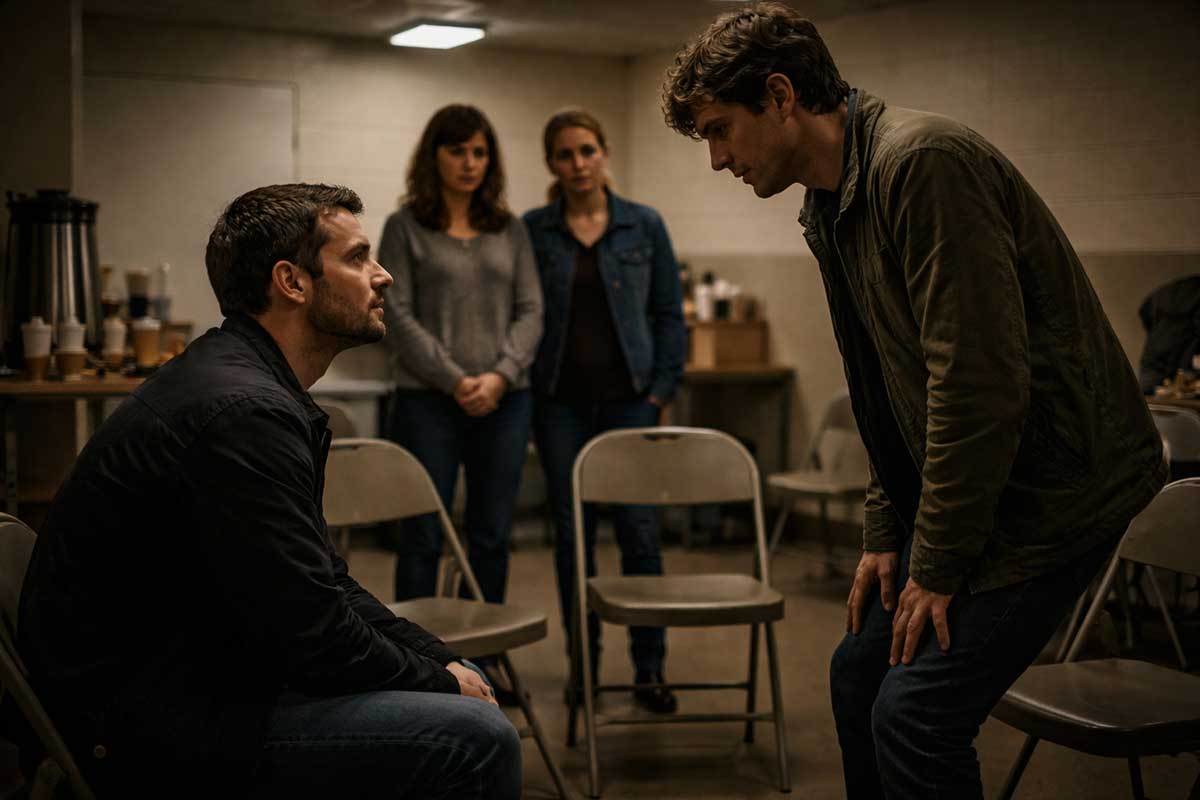
The place looked smaller than either of them had imagined.
That was Mara’s first warning when she arranged it separately, on two different days, with two different lies offered to the rest of the world to make room for what needed doing.
To Julian she said, “We are going to stand in an ordinary place and see what your body says before your mind tries to protect you.”
To Micah she said, “You need to know whether the ground itself answers back.”
Neither was told, at first, that the other would come on another day.
The site was no shrine.
That was part of the cruelty.
A public plaza on the edge of a civic center that had since been renovated badly enough to erase style but not structure. New pavers over old lines. Replanted trees. Steel benches where older wooden ones had been removed. A coffee kiosk added near the street to civilize the atmosphere. Office workers crossing through at lunch. Students cutting diagonally to save time. Delivery vans idling near the loading lane. City life continuing with the rude indifference that follows years after any event famous enough to make news and intimate enough to destroy lives.
History had left almost no visible mark.
That did not mean the place had forgotten.
Julian came first on a Tuesday just after eleven in the morning.
Mara chose the hour deliberately. Too late for commuter crush, too early for the full lunch crowd. Enough people to keep the site real, not enough to drown his reactions under spectacle. He met her at the corner by a newspaper box and the bronze civic plaque no one read anymore.
“You could still tell me where we’re going,” he said.
“I could,” Mara answered. “But your body would arrive before you did.”
He disliked how often her sentences irritated him by making sense.
The day had the strange washed brightness of early spring when the air looks softer than it feels. Wind moved the new leaves in the planters with more force than elegance. A city bus exhaled at the curb and moved on. Somewhere a jackhammer rattled faintly from another block.
Julian followed Mara across the plaza.
Ten steps in, the first change came.
Not panic. Orientation.
His body knew where to look before any conscious thought named why. Not at the kiosk. Not at the benches. Not at the office entrance where people streamed in and out with coffee and phones and the mild impatience of ordinary obligation. His gaze moved toward a section of open paving near the low raised platform where city talks, student rallies, and summer concerts now occasionally happened.
There.
The platform was small. Almost insultingly small. A rectangle of stone two shallow steps above the plaza, with no permanent lectern and no grandeur. On it today stood only a woman in a green coat reading from a folder while two men in safety vests listened with professional inattention.
Julian stopped walking.
Mara did not turn around at once. She had heard the stop in his silence.
“Well?” she said.
He looked at the platform and felt his chest go cold from the inside.
“Did you tell me there would be an event here?”
“No.”
“There is.”
“Yes.”
He hated the steadiness of her answer.
The woman on the platform laughed at something in her notes and stepped down. The safety-vested men moved away. The rectangle of stone stood empty again.
Julian’s hands had gone numb.
He flexed them once and kept looking.
“It’s there,” he said.
Mara came to stand beside him.
“What is?”
He almost said, The place where I die.
The sentence rose fully formed and frightened him enough that he swallowed it before sound.
Instead he said, “The standing place.”
Mara nodded once.
They walked closer.
Every ten feet the body answered more strongly. The shape of the paving. The relation of platform to open space. The line of sight from the sidewalk. The exposure to the street. Nothing in the visible scene proved anything. Yet his nervous system, stripped now of explanation’s delays, was behaving like an animal returned to a field where it had once been hunted.
He reached the edge of the platform and stopped.
For one second he thought he might climb the steps without difficulty.
Then his knees weakened so sharply he had to brace one hand against the stone.
Not from exertion.
From recognition.
A flash came, not full image, but enough.
Open sky.
Many faces lifted.
The left shoulder turning slightly because someone had moved at the edge of the crowd.
The body already trying to decide whether the movement mattered before it knew it mattered completely.
He gasped once and stepped backward.
Mara moved one pace nearer, not touching him.
“What?”
He stared at the platform.
“I knew where to turn,” he said. “Before I saw anything.”
“Yes.”
“There was… the sense of the shoulder.”
“Whose?”
He closed his eyes.
“My shoulder.”
The word came before he could debate it.
Mine.
Not symbolic. Not empathic. Not a generalized human shoulder under public pressure. Mine, said by a man who had no present-life record of standing at this plaza in mortal danger and yet had just felt the body preparing to turn toward impact from a direction the mind could not have inferred from the empty square.
His face had gone pale enough that Mara said, “Sit.”
He sat on the low wall near the planter and bent forward, forearms on knees, head down.
People passed without looking twice. That, too, was part of the ordeal. The city continued. An old man with a cane shuffled by humming under his breath. Two students in hoodies argued softly over a class reading. A courier on a bike swore at traffic. The whole visible world insisted on its present tense while some deeper tense had just broken open under his ribs.
After a minute Mara said, “Do you want to leave?”
Julian lifted his head.
“No.”
The word surprised him. It was raw and immediate and truer than comfort.
No. Not because he enjoyed any part of this. Because leaving now would return the place to abstraction, and abstraction had governed his fear too long already.
He stood.
This time he climbed the steps.
The stone under his shoes was dry despite the morning damp. The plaza opened around him. Street to the right. Trees ahead. Open civic space below. He stood where any speaker would stand for a harmless city announcement and felt his whole body become a tuning fork.
Then the fragment struck.
Not dream. Not imagination. Not thought.
A burst of body-knowledge so concentrated it had the force of impact without impact.
Sound breaking wrong.
A blow entering before interpretation.
The public air turning instantly from civic to mortal.
The obscene intimacy of falling in front of strangers.
And beneath all of it a shocked inward sentence not made of words but carrying one meaning with perfect clarity:
So this is how it happens.
Julian folded.
Not fully to the ground. Not dramatically. He sank to one knee on the platform with one hand flat against the stone and the other crushed over his sternum.
Mara was beside the steps now.
“Julian.”
He heard her as from another room.
His eyes were on the paving just below the platform edge. Not because anything visible was there. Because some layer beneath vision was locating the exact field where the body had once met ground and become event.
He whispered, “I fell here.”
No one nearby heard.
Mara did.
She did not correct the tense.
After a long minute he stood again by degrees and let her guide him down to the wall.
He sat shaking, not from fear now but from the collision between current body and older contact.
“What did you feel?” Mara asked quietly.
He looked at the stone rectangle as if it had become a witness unwilling to testify in language.
“Not the whole thing.”
“That is enough.”
He swallowed.
“The beginning of the after.”
Mara waited.
“The shock of it being physical. The room changing into a scene. The body trying to remain itself and not becoming… public property.”
His own phrase seemed to strike him after he spoke it.
Public property.
Yes.
That was the horror hidden under so much of his childhood fear. Not only being seen. Being turned, through violence, into something witnessed more than inhabited.
Mara said, “And the other side?”
He looked at her.
“The moving side.”
His face changed.
He understood the question at once and hated her for it a little.
“Not here,” he said. “Only the break after.”
She nodded.
That mattered too.
The site had given him the receiving field. The standing place. The bodily logic of public harm arriving through attention, shock, and collapse into witness.
When they left half an hour later, Julian looked normal enough that no one passing on the sidewalk would have guessed he had just stood inside an ordinary plaza and met a piece of an older death.
Micah came two days later, near dusk.
Mara did not tell him Julian had already been there. She only said, “There is a place I want your body to test.”
Micah almost refused the whole outing out of instinctive hatred for being guided into significance. Yet since the storage garage and the fragments, he had learned that refusal did not always preserve freedom. Sometimes it only preserved vagueness.
So he came.
They parked three blocks away because Mara said he needed to walk toward it without the false shelter of abrupt arrival.
The sky hung low and metallic. Office windows were beginning to glow. The after-work rush had not fully peaked, leaving the streets in that uncanny middle condition where public life feels half over and half waiting for its night self.
Micah recognized nothing at first.
That made him angry.
He had expected some immediate bodily certainty, perhaps to justify all the distress of the past weeks. Instead there was only the city. Crosswalk signal. Woman with a grocery bag. Teenagers on skateboards. A man talking too loudly into a headset as if volume could replace authority.
Then they stepped into the plaza.
Micah stopped so abruptly Mara turned.
The open space hit him like cold water.
Not the platform first. The ground.
The width of paving under the sky. The places where a body could be seen from too many angles. The impossible exposure built into the very geometry of civic openness.
His mouth went dry.
“There,” Mara said, not pointing.
He already knew.
Not the platform.
The space below it.
A section of pavement near the planter wall where people now passed without any sense that an invisible center of gravity still lived there.
Micah’s body moved before consent.
He walked toward the place in a straight line, hands hanging at his sides, face gone white.
Halfway there the first fragment rose.
Not the impact. Aftermath.
Hardness under his back.
The indignity of weak breath.
Noise above that would never understand quickly enough.
And one face leaning over him carrying horror too large for the body wearing it.
Micah’s knees nearly gave.
He sat down hard on the low wall instead and gripped the edge of it with both hands.
Mara stayed beside him without blocking his sight.
“What is it?”
He stared at the paving.
“That’s where I look from,” he said.
A strange sentence. True at once.
Not looked. Look. Present tense, because the body at the site had no interest in grammatical safety.
He pressed one hand to his chest.
The second fragment came faster now.
A voice above, broken and trying.
Hands not to attack but to gather.
The impossible humiliation of being touched by the same figure whose act had just made touch necessary.
The body wanting to refuse help and unable.
Micah doubled forward.
A woman walking a dog glanced over, saw only a young man overtaken by some ordinary city misery, and kept moving.
Good, Mara thought. Let the city stay ignorant five minutes more.
When Micah looked up again, his eyes had gone stunned and wet.
“He looked down,” he said.
“Yes.”
“He knew.”
“Yes.”
Micah shook his head sharply as if to clear it and failed.
“He knew me.”
The pronoun landed in Mara like a bell.
Not a victim. Not a stranger. Me. Relation entering speech before theory could restrain it.
She asked, “And what did that do to him?”
Micah looked at her with something close to terror.
“It broke him.”
There.
The other side.
Not redemption. Not moral equivalence. Not sentimental reconciliation through mutual pain. The simple devastating fact that the attacker’s inward structure had shattered the moment the wounded body re-entered reality as person rather than symbol.
Micah looked back at the paving.
“I hated him for that too.”
Mara did not speak.
“He gets…” Micah’s face twisted as he searched. “He gets to do it and then break. He gets the ruin and the center.”
The old present-life humiliation structure had entered the older wound again, exactly as expected. The staircase still attached itself to the plaza. The left-out boy still could not bear that the visible man occupied both suffering and centrality.
Yet even as Micah said it, the words sounded tired.
Too old. Too rehearsed. The site itself had begun eroding their force.
He stood abruptly and walked the last few steps to the paving.
Then he stopped above it, one foot almost entering the invisible field fully.
Mara watched without moving.
Micah looked down.
The stone held no stain. No marker. Nothing but weather, footsteps, and municipal neutrality.
Still, he whispered, “I was here.”
A bus sighed at the curb.
Somewhere behind them a bicycle bell rang.
The world stayed offensive in its ordinariness.
Micah crouched then, one hand touching the pavement lightly as if temperature could still reveal what history refused to display.
At contact another flash struck him.
Not enough to narrate. Enough to know the old body had wanted one impossible thing in the immediate aftermath:
Do not let me become a story before I have fully left being a man.
Micah snatched his hand back.
His throat worked.
“What?” Mara asked.
He could not say it immediately. The line felt too intimate, too impossible to own without collapsing.
At last he managed, “He was still trying to be himself.”
The sentence undid him more than blood or pain had. Because it showed, in one devastating fragment, the dignity inside the wounded figure on the pavement. Not abstract victimhood. Not spectacle. A person still resisting reduction even while the public scene swallowed him.
Micah stood again and backed away from the paving as if the knowledge itself required distance to survive.
When he looked at Mara now, the old hardness in his face had thinned into something sadder and more dangerous in a different way.
“If I ever do anything now,” he said, “I’ll know exactly what I’m repeating.”
Mara held his gaze.
“Yes.”
No comfort. Only law.
That answer mattered more than any speech she could have made. It did not glorify his new knowledge into moral advancement. It named responsibility.
Micah looked back at the platform, then at the paving, then up into the cold open sky above the square.
For the first time in months, perhaps years, the architecture inside him aligned plainly enough to see without disguise.
The stairs had formed the wound.
The public speaker had become the vessel of grief.
The means had made the pattern practical.
The dream had split the moral wall.
The site had now made repetition conscious.
Nothing was hidden enough anymore to preserve innocence.
He sat again, suddenly exhausted.
Mara joined him on the wall this time.
After several minutes he said, “Did he come here too?”
She did not answer at once.
“Yes.”
Micah nodded slowly, as if he had known before asking.
“And?”
“He recognized the standing place.”
Micah let out one long breath.
Of course.
The geometry of it. One body toward the platform, another body from the pavement below. The same plaza carrying opposite vectors of the same wound.
Neither spoke for a while.
Then Micah said, “I don’t know what to do with this.”
Mara looked at the now-empty platform.
“You stop pretending you have a right not to know.”
He almost laughed.
“That’s not very helpful.”
“It is exact.”
He pressed both hands between his knees and stared at the ground.
“Does he know it’s me?”
Mara turned toward him.
“No.”
The relief that crossed his face was immediate and complicated. Relief from being named. Relief from being seen in relation. Relief from losing, for a little longer, the pressure of that direct line. Beneath all of it, disappointment too.
Mara saw all three.
“Would you want him to?”
Micah thought about it.
No easy answer came.
At last he said, “I don’t know which would be worse.”
They left as the streetlights fully came on.
The plaza behind them resumed its public life of workers, students, cyclists, and people who would never know what sat under the paving unless they became unlucky enough to carry their own old wound there someday.
That night both men wrote.
Julian, in his apartment:
The site did not give memory. It gave location. The body knows where the standing becomes event.
Then, lower:
I fell there and remained human long enough to know the indignity of becoming witnessed.
Micah, in the basement room:
The ground answered.
Not because it remembered me. Because I remembered through it.
If I do harm now, it is not rage. It is consent to repeat what I already know from the body’s side.
He stared at the last sentence until the room darkened around the desk.
Then he underlined consent once and shut the notebook.
The site had done what Mara needed it to do.
It had removed the last refuge of vagueness.
Neither man now stood merely in dream, theory, grievance, or fear. Each had met the physical field where the old wound entered public space and turned private pain into history.
The next thing that came would not be innocence. It would be choice.
Chapter 26 — Naming the Exchange
Mara chose evening for the naming.
Not out of drama. Out of mercy.
Some truths should not be delivered at eleven in the morning between coffee and errands, not because daylight makes them less true, but because certain recognitions need the world outside to quiet down enough that the body can take the impact without being asked to smile at the grocery clerk an hour later. Evening gave them a border. A room. A lamp. A door that could be shut.
She called Julian first.
“There is a point,” she said, “at which fragments stop helping unless they are set in relation.”
He stood in his kitchen with one hand on the counter and looked at the darkening window over the sink.
“You mean you want to tell me the rest.”
“Yes.”
He did not ask what the rest meant. He knew.
Then she called Micah.
“We have reached the point where not naming will distort more than naming.”
He was sitting on the edge of the bed in the basement room, jacket still on from coming in, the notebook open to the line about consent and repetition. He stared at the page while she spoke.
“Do I need to be there with him?”
“Yes.”
The answer entered him like cold.
He wanted to refuse on instinct. Wanted to say that knowledge did not require proximity, that pattern could be named by separate witnesses and still remain real. Yet some part of him, the part now too exhausted for theatrical avoidance, knew she was right. Relation kept announcing itself. Naming without relation would only preserve one last illusion of separateness.
“What time,” he said.
At seven-fifteen Julian arrived.
At seven-twenty-one Micah stood outside Mara’s front door, hand lifted to knock, and nearly left before the knuckles touched wood.
Mara opened before he could change his mind.
“Come in.”
He stepped into the front room and saw Julian already there.
No television screen. No podium. No stage. No audience to distort the scale of either man into something larger or more public than their bodies could bear. Just a narrow room with books, papers, lamp light, and the visible fact of another life sitting six feet away in a dark sweater with one hand pressed too casually near the center of his chest.
Julian stood at once.
Micah stopped moving.
For several seconds neither spoke.
It was the first time they had occupied the same private air with full present-tense awareness. Not dream. Not archive. Not clip. Not public venue from opposite sides of a foyer. Here. Two men. One wound moving under both names.
Julian looked thinner than he did on camera. Micah had known that already from the hotel ballroom. He also looked more tired and less defended, which was new. The seriousness remained, but without the borrowed authority of a room turned toward him. His face carried the strain of someone who had begun losing certain simplifications and had not yet gained anything easier in return.
Micah knew, at once and against his own wishes, that he looked worse in the comparison. More frayed. More weathered by private life. More openly on the edge of something unfinished.
The old humiliation tried to rise.
Then the fragments came in its way.
The platform.
The paving.
The face above.
The looked-down-after.
The horror in the one who had done it.
The attempt to call the wounded body back into itself when there was no path left for that.
The humiliation did not vanish.
It ceased to be clean.
Mara spared them an immediate speech exchange.
“This is not for argument,” she said. “Sit.”
They obeyed, which itself told her how far the pattern had advanced.
Julian took the chair by the lamp. Micah the sofa edge. Mara remained in her usual chair opposite, the legal pad closed on the side table and the working folder in her lap.
Rain moved faintly against the window.
Someone outside walked past laughing, and the laugh receded down the block without ever knowing what room it had crossed.
Mara did not begin with theory.
She began with the ordinary truths already earned.
“You have both had the dreams,” she said.
Julian nodded once.
Micah looked at the floor and said, “Yes.”
“You have both had site recognition.”
“Yes,” Julian said.
Micah gave the same answer a moment later, quieter.
“You have both experienced bodily fragments in waking life linked to the same public event structure. Standing place. Paving. open air. chest wound. public witness. post-impact horror.”
Neither man spoke.
Mara let the points settle before going on.
“You have also each begun meeting the other side morally, not just physically. Julian, you have met the interior of the one moving toward harm. Micah, you have met the dignity and shock of the one receiving harm, and the collapse in the one above him after the act became real.”
Micah’s face changed at the phrase the one above him.
Julian’s changed at moving toward harm.
Good, Mara thought. Let the language still strike. It should.
Then she opened the folder.
“I am going to name the structure now,” she said. “You may reject the terms. You may distrust the framework. You may refuse my vocabulary entirely and still be unable to escape the relation it is trying to describe.”
Julian lifted his eyes.
Micah kept his on the rug.
Mara said, “This is a full reversal crossing.”
The phrase entered the room and did not help either man.
Micah almost smiled from sheer strain.
“That sounds fake.”
“Yes,” Mara said. “Many true things do when named badly. Listen past the label.”
He fell silent.
Mara continued.
“In some rare cases, a violent event binds two lives so forcefully that the next cycle does not merely distribute suffering. It reverses position. Not to equalize pain. To force interior access. One soul enters the conditions of the one it wounded. The other enters the conditions of the one who harmed it. Not perfectly. Not mathematically. But in enough moral shape that what was inaccessible before must now be lived.”
Julian said, “You think that’s us.”
Mara met his gaze.
“Yes.”
No softening. No maybe.
Micah looked up then, sudden anger giving him temporary spine.
“So what, I’m him and he’s me?”
Mara turned toward him.
“No. Current life remains current life. Your childhood is real. Your father is real. The stairs are real. His parents are real. His fear of visibility is real. Nothing in the present is erased because older law exists under it. But the present has been bent around an older wound.”
She looked between them.
“In the previous event, Julian’s soul moved toward public violence. Micah’s soul received it.”
The room went perfectly still.
Even the rain seemed to hold itself more quietly against the glass.
Julian did not move at all.
Micah’s hands closed over his knees.
Mara did not rush to continue.
The sentence needed space. If spoken into too much explanation at once, it would harden into ideology or break into absurdity before either could feel the actual weight of it.
At last Julian said, very low, “That’s why I dreamed the movement.”
“Yes.”
Micah asked, “And that’s why I was on the ground.”
“Yes.”
Mara let out one careful breath.
“In this life, the reversal has been structured through position. Julian was born into the standing place: language, visibility, moral interpretation, the burden of being seen, and the fear that public witness ends in physical ruin. Micah was born into the receiving structure: humiliation, exclusion, watchfulness, rooms that decided him before speech, the long formation of grievance, the pain of being left below the action and then blamed for hearing it too sharply.”
Micah felt anger return and thin out at once.
Not because the words were false.
Because they were too exact to resist without lying.
He said, “That still doesn’t tell me why him. Why now. Why my life gets invaded by some older thing I didn’t agree to.”
Mara nodded.
“No. It doesn’t tell you why in the sense people usually want. There may be no why clean enough for human satisfaction. It tells you only what kind of law you are standing in.”
Julian looked at Micah then.
The first direct look of the evening.
Not as speaker to audience. Not as public man to anonymous hostile figure. Not even as one current-life biography to another. As one body now told it once moved toward harm and one body now told it once received the same harm.
Micah looked back.
For a second both men seemed to register the same impossible fact at once.
The face fits neither memory nor dream.
The relation does.
Julian heard his own voice say, “I killed you.”
The sentence sounded obscene in the room.
Mara did not correct the bluntness of it.
Micah looked away first.
“No,” he said. “He did.”
He meant the previous self. The older actor. The one in the moral field below biography.
Julian heard the distinction and hated how little comfort it gave.
“Yes,” he said. “He did.”
Then, after a second:
“And I’m still carrying him.”
That was nearer the mark.
Micah’s mouth tightened.
“We both are.”
There it was. The first truth spoken directly between them that neither could have formed a month earlier.
Not accusation.
Not forgiveness.
Not equality.
Only the fact of carriage.
Mara let the silence deepen again.
Then she said the part she had postponed longest.
“The present danger is not that this happened once.”
Both men looked at her.
“The present danger is that both your current lives were approaching a repetition line from opposite sides. Julian through increasing visibility under fear he could not explain. Micah through grievance attaching to a public figure carrying the old charge and through making means practical. The site confirmed enough. The dreams confirmed enough. The fragments confirmed enough. We are now beyond symbolic reading.”
Micah’s face went flat at practical.
Julian heard means and understood, in one cold strike, that Mara was now saying out loud the thing she had shielded him from before.
He turned toward Micah.
“You had—”
Micah cut him off immediately, voice sharp from shame.
“Not now.”
Julian shut his mouth.
Mara said, “He no longer does.”
The room shifted around that sentence.
Julian looked at Mara, then back at Micah, and saw in the younger man’s face the exact misery of someone caught between exposure and thwarted momentum. Not a killer’s face. Not a penitent’s face. Not anything so simple. A face marked by grief made dangerous, then interrupted before the danger became history again.
Micah said, “Don’t look at me like that.”
Julian answered before he had time to make the sentence safer.
“Like what?”
“Like I’m the whole event.”
Julian stared at him.
Something opened there.
The stairs.
The room.
The left-out child.
The man who wanted the room to turn.
The dream-body on the ground still trying to remain a person and not become a story.
“No,” Julian said. “I’m looking at you like you were in the event long before this life knew what to call it.”
Micah looked down hard enough that the muscles in his jaw stood out.
The truth did not soothe him.
It prevented one false simplification, which was all truth often manages at first.
Mara closed the folder.
“The Exchange,” she said, “is not a machine and not a tribunal. It does not make men good by making them suffer. It gives access. What each life does with that access remains free. That is why we are still in danger and why we are still capable of interrupting the pattern.”
Julian leaned back and looked at the ceiling for one breath, then another.
“Interrupting,” he repeated.
“Yes.”
“How?”
Mara looked at Micah first.
“By refusing to let humiliation become destiny.”
Then at Julian.
“By refusing to let burden become innocence.”
The two sentences landed in different bodies with equal force.
Micah heard the old wound named again in its ugliest temptation. Humiliation not as pain alone, but as election, as the proof that one decisive act might finally make exclusion meaningful.
Julian heard his own more polished temptation named too. Burden not as suffering alone, but as proof of virtue, as if carrying fear and public cost excused him from facing what old violence still lived in him.
Neither man spoke.
Mara went on.
“Micah, pain did not choose you as prophet. Julian, fear did not choose you as martyr. Both of those are lies the crossing can feed if you cooperate with it blindly.”
Micah almost smiled from despair.
“You make it sound so simple.”
“It is not simple,” Mara said. “It is exact.”
Julian looked at her.
“What happens if we do interrupt it?”
The question seemed to startle Micah more than the naming itself had.
Not because it was naïve.
Because it was the first sentence in the room that pointed anywhere beyond analysis.
Mara sat with it.
“At minimum,” she said, “the old wound does not become new public blood. Beyond that, I do not know. Some crossings loosen when truth enters before repetition. Some remain active for years and ask more of the present life than one conversation can provide.”
Micah said, “So this is it? We know now and then what, we go home?”
Mara regarded him.
“No. Now you live differently.”
He let out a hard laugh.
“That’s not an answer.”
“It is the only one.”
She leaned forward slightly.
“You remove false privacy from the pattern. You stop pretending your lives are sealed off from each other morally just because biography is separate. You tell the truth to those who can bear it. You build practical barriers where danger likes vagueness. You refuse every glamorous interpretation. You let consciousness do what compulsion was counting on your not doing.”
The room felt smaller after that, not from claustrophobia, but from the way exact speech tightens moral space.
Julian asked, “Do our families know?”
Mara looked at him.
“In part.”
Then at Micah.
“Enough.”
Micah closed his eyes briefly.
Of course.
The mothers. The sister. The women in the room while the men lived out the larger weather and called it private because shame prefers to keep witness selective.
He said, “Lena knows more than I wanted.”
Julian said, at the same time, “Anna knows more than I told.”
Both men stopped.
Then, absurdly, Micah laughed once.
Not because anything was funny. Because the strange doubledness of the thing had finally become too obvious to ignore. The women had already seen more of the architecture than either man had wanted to admit.
Julian almost smiled too, tired and unwilling.
The smile died quickly.
He looked back at Micah.
“If I say I’m sorry,” he said, “it won’t mean enough.”
Micah’s face hardened, then failed to stay hard.
“No,” he said. “It won’t.”
Julian took that without defense.
Micah added, after a long pause, “And if I say I nearly did it again, that won’t mean enough either.”
The room held that sentence like live current.
Julian went very still.
Not because he had not guessed danger was near. Because hearing the almost spoken plainly from the other man’s mouth changed the moral scale of everything. This was no longer paired theory. No longer dream-law or hidden architecture. It was current life held within inches of repetition and stopped before history could re-enter the world with his own name attached to the receiving side.
He looked at Micah and saw, all at once, not a potential killer, not a political enemy, not a convenient embodiment of the dangerous hearer, but the present life of the one once struck and now formed by all the conditions most likely to drive a soul toward replay.
He said only, “Thank you for not.”
Micah stared at him.
The sentence should have been unbearable. It was. Yet it was also the only true one available in that second.
Not absolution.
Not resolution.
A fact of interruption.
Mara stood then, not to end the conversation but to alter its pressure before it crushed them into either false intimacy or recoil.
“I’ll make tea,” she said.
Neither objected.
In the kitchen the kettle began its low gathering hum.
In the front room, Julian and Micah sat in the same silence for the first time without Mara’s direct speech between them.
Rain on the window.
Pipe in the wall.
Distant siren far enough away not to matter and close enough to remind them the city kept producing danger without waiting for private revelations to finish.
Micah spoke first.
“When I watched you,” he said, still not looking up, “it felt like you were saying things I should have gotten to say first.”
Julian answered without trying to soften the strangeness.
“I know.”
Micah looked at him then.
“You know.”
“I know now.”
A pause.
Micah said, “That made me hate you.”
Julian nodded.
“I know.”
Then, after a second:
“I think being heard there may have been part of what was taken.”
The sentence entered Micah more deeply than sympathy could have.
Because it did not reduce him. It did not say you were lonely. you were left out. you wanted recognition. All true, all too small. It named standing in the room as theft. Moral speech, visibility, witness. The thing stolen was not merely comfort but position in relation to truth and audience.
Micah looked away again.
“That’s not all.”
“I know.”
When Mara returned with the tray, nothing had resolved.
Nothing could.
Yet something in the room had shifted from pure revelation into relation that could now speak a little without lying.
She set the cups down.
No one drank for a while.
At last Julian asked the question that had been waiting at the edge of him since the first full naming.
“What was the act?”
Mara sat.
“A public shooting at an outdoor event,” she said.
The words entered without decoration and did not need any.
Micah’s face emptied.
Julian felt the old childhood fear of rooms and applause and stages and open sky suddenly gather itself into one terrible parent sentence.
Of course.
Not vague violence. Not an accident. Not an invisible collapse. A public shooting. The body had known this long before the mind would say it. The standing place. The crowd. The impact. The pavement. The horror in the one above. The fear of laughter and applause and eyes turning. All of it.
He looked at the rain-dark window and said, almost to himself, “That’s why.”
Mara did not answer.
Micah did.
“Yeah.”
One syllable. No argument. No poetry. The other side of the same recognition.
And there, at last, the Exchange stood fully named in the room.
Not solved.
Not redeemed.
Only stripped of the last innocence that vague language had left it.
What came next would have to be lived, and living it would hurt.
But now the wound had a structure both men could no longer mistake for private weather alone.
Now, at least, they knew what law they were standing in when they chose.
Chapter 27 — The Refusal
After the naming, the room did not become holy.
Julian would later think that one of the few mercies of Mara’s front room was its resistance to false atmosphere. Nothing in it cooperated with climax. The lamp still leaned a little to one side. The teacups cooled untouched. Rain kept marking the window with the same thin patient taps as if old blood, future danger, and the hidden law of crossed lives were all no more urgent than weather crossing brick.
That helped.
If the room had turned reverent, either man might have fled into the wrong register at once. Confession. Spiritual theatre. The trembling intimacy people mistake for truth after revelation. Mara’s house denied them all of that.
What remained was harder.
The naming had given the wound language. It had not given either man peace.
Micah sat with both hands around the mug without drinking. Julian had leaned back in the chair and not moved for several minutes. Mara, having delivered the structure cleanly, said nothing more. She understood, better than either of them yet did, that the first real danger after truth is the rush to complete it emotionally before the soul can bear its actual implications.
It was Micah who broke the silence.
“This doesn’t fix anything.”
His voice sounded tired enough to be true.
“No,” Mara said.
Micah looked at Julian now, not with the old hot stare from clips and public distance, but with the strained directness of a man who can no longer fully hide behind abstraction.
“You being him before doesn’t make me feel better now.”
Julian nodded once.
“I know.”
“And me almost doing it now doesn’t somehow balance it.”
“I know.”
Micah’s mouth twisted.
“You keep saying that.”
Julian looked down at his own hands, then back up.
“It’s the only honest answer I have right now.”
Micah laughed once under his breath. Not amusement. More the body’s refusal to let pain remain stately too long.
Mara let them sit inside that.
It was tempting, in such rooms, to chase reconciliation prematurely. To ask what each had learned. To steer toward some shining sentence about mutual burden, grief, or mercy. Mara knew better. Cheap forgiveness would not only fail. It would become one more lie the crossing could feed on.
Julian said, after a while, “I do need to say something.”
Micah’s expression hardened on instinct.
Julian saw it and kept going anyway.
“Not apology first. I understand that. Something simpler.”
Micah gave the smallest movement of the head that meant proceed if you must.
Julian took one breath.
“I have been afraid of rooms my whole life without understanding why.” He looked at the teacup, then at Micah again. “That fear shaped me. It cost me things. It also gave me language and a kind of discipline I’ve mistaken, sometimes, for virtue. I can say all that and still know that none of it comes near what it means to have the body on the ground.”
Micah stared at him.
The sentence did not soothe him. It did something worse and better. It refused equivalence.
Good, Mara thought.
Micah said, “So don’t make them equivalent.”
“I’m not.”
“Good.”
Julian sat very still after that.
The refusal mattered. Not dramatic refusal. Moral refusal. The younger man would not let the older wound be turned into mutuality before truth had passed through difference.
Julian respected him more for that than for anything else said all evening.
Micah leaned back slightly, eyes on the rain-dark window now.
“When I watched you,” he said, “I used to think the whole thing was fake. Or not fake exactly. Worse. Real in a way that made me angrier.”
Julian waited.
“You sounded like somebody who had the right to talk about damage.”
The sentence stayed there, heavy and humiliating.
Micah went on.
“And I couldn’t bear it. Not just because you were visible. Because some part of me heard you and felt robbed.”
Julian said, “Yes.”
Micah looked at him sharply.
“Yes what.”
“Yes, I think that’s true.”
Micah’s eyes narrowed.
“You think.”
Julian did not retreat.
“I think what was taken had something to do with standing there. Speaking there. Being heard there.”
Micah looked away first.
His throat moved once.
“That’s not all.”
“No,” Julian said. “It isn’t.”
Silence again.
The room had passed into a different register now. Not revelation, not argument, not comfort. The plain labor of not lying once the deepest thing had finally been said aloud.
Mara rose then and crossed to the bookshelf, not because she needed anything from it, but because standing changed the pressure in the room enough to keep it from freezing. She looked at the titles without really seeing them.
From the sofa Micah said, to no one in particular, “I still don’t know what to do with hating you.”
Julian answered at once.
“You don’t have to stop tonight.”
Mara turned slightly at that.
Good again.
Not virtue. Accuracy.
Micah almost smiled, which frightened him more than anger had.
“You make that sound generous.”
“It isn’t. It’s descriptive.”
Julian folded his hands once and looked at him directly.
“If what Mara says is right, then your hatred did not begin in this life. It took shape in this life. It attached itself to current things. But it had older material to work with.”
Micah’s face changed at that. Not because he disagreed. Because the sentence threatened one of the last emotional shelters he had left: that at least his hatred was his own.
He said, “So now even that gets taken away.”
Julian heard the pain hidden inside the bitterness and answered carefully.
“No. Not taken away. Made less simple.”
Micah laughed again, harsher now.
“Everything in here gets less simple every five minutes.”
“Yes,” Mara said from the shelf. “That is what truth often feels like after grievance.”
Micah looked at her with brief fury.
“You say that like grievance is some cheap thing people choose for decoration.”
“No.” Mara turned fully now. “I say it like grievance is often real pain organized around the wrong center.”
The words struck and held.
Micah did not answer.
Julian thought, unexpectedly, of Simon Wren asking what public voices owed unstable hearers. He thought of the line he had spoken almost without knowing how far it would travel: the dangerous hearer is still a hearer. Sitting here now, across from Micah in the warm lamp-lit room with the rain outside and the tea cooling between them, the sentence felt less like theory than command.
He said, “You’re not wrong about the room.”
Micah looked up.
“The room?”
“The standing place. The being heard there. The way public life organizes around some people and leaves others to listen from farther off.”
Micah’s expression sharpened, suspicious of sympathy, perhaps more suspicious of understanding.
Julian went on before the suspicion could shut him down.
“You’re not wrong that there is theft in that. Not always personal theft. Structural theft. Historical theft. Emotional theft. Rooms formed by who gets presumed audible and who doesn’t.”
Micah stared at him.
Then: “So what.”
The phrase was small and loaded and perfectly fair.
Julian accepted it.
“So,” he said, “I don’t want to lie to you by calling your resentment groundless. But if it becomes permission, it will still ruin whoever you aim it through.”
There.
The line.
Not sentimental. Not condemnatory. Exact.
Micah looked down at his mug.
“I know that now.”
Julian heard the now and understood what it cost.
The site.
The means removed.
The dream.
The paving.
The face above the wounded body.
The whole old architecture no longer vague enough to protect him from responsibility.
Mara returned to her chair but did not sit at once.
“Say it more plainly,” she said to Micah.
He closed his eyes for one second.
Then opened them.
“If I do it now,” he said, “I’m choosing repetition.”
No one moved.
The sentence had the force of law because it came not from abstract morality but from the place where body, dream, shame, grievance, and current means had all finally converged.
Mara sat.
“Yes.”
Micah nodded once, almost angrily, as if even agreeing with truth now felt like surrender to a structure he had not chosen.
Julian said, very quietly, “Thank you for saying that.”
Micah looked at him and this time did not tell him not to.
That was new.
Not acceptance. Only the refusal to throw away the sentence because the wrong man had honored it.
After another long silence Micah asked, “What did you think when you saw me there?”
The pronouns were doing all the work now. No one needed to ask where there was.
Julian understood at once.
He did not answer immediately. Not to create drama. Because the truth was ugly and he would not soften it into something more bearable than it had been.
“At first,” he said, “nothing coherent. Shock. Body. The collapse of the story that had made the act possible.” He stopped. Started again. “Then horror that I had mistaken a person for a figure I could act through.”
Micah’s face stayed still.
Julian continued, more quietly.
“And grief. Not clean grief. Ruined grief. The kind that knows too late what it has done and can’t undo one inch of it.”
Micah listened without looking away.
When Julian finished, Micah said, “Good.”
The word came out hard.
Not because he wanted revenge in the simple sense. Because he needed the horror to have existed. Needed the attacker’s interior not to remain protected from consequence.
Julian nodded.
“Yes.”
Micah’s mouth tightened again, but the old bright edge of grievance had changed. The hatred now had too much information inside it to remain pure. That did not make it kinder. It made it heavier.
Mara said, “This is the refusal.”
Both men looked at her.
She folded her hands over one knee.
“The refusal is not forgiveness. It is not harmony. It is not saying the old violence has become meaningful enough to bless. It is refusing the lie that once full truth enters, either of you must pretend to feel peace.”
Micah let out a breath.
Julian leaned back again and looked, for the first time all evening, tired all the way through rather than merely burdened.
Mara went on.
“Julian, you do not get absolution because you now carry fear, burden, and fragments of the collapse. Micah, you do not get innocence because your current pain has real causes and because the old wound returned to you from the body’s side. Neither of you is clean. Neither of you is only guilty. That is why cheap resolution would fail.”
Rain moved harder across the window for a few seconds and then softened.
Julian said, “Then what is left.”
Mara answered him with something almost plain enough to hurt.
“Reality.”
Micah laughed once, the sound brief and dry.
“Great.”
“It is greater than performance,” Mara said.
That line settled over the room.
Julian looked at Micah again.
“I don’t know what relation between us looks like from here.”
Micah answered with immediate honesty.
“I don’t either.”
Then, after a second:
“And I don’t trust anything that sounds too wise right now.”
Julian almost smiled.
“That makes two of us.”
It was the first small almost-human rhythm to pass between them without cutting itself open on the way.
Mara noted it and did nothing.
To press that moment would ruin it.
Instead she said, “For tonight, I want one thing clear.”
Neither interrupted.
“You are not leaving this room under the fiction that knowledge alone has resolved danger.”
Micah sat up a little straighter.
“I know.”
“No,” Mara said. “Say it in the practical sense.”
Micah looked at the floor.
The practical sense.
Yes.
Not only moral complexity. Not only grief and old law and paired reversal. Means. Schedule. Visibility. The possibility of replay in the current world.
He said, “I do not go back to private access.”
Julian understood the sentence before Mara answered.
Good.
Mara said, “Correct.”
Micah went on, voice flatter now because practice made it harder than insight did.
“If I feel the pattern close again, I call you. Or my mother. Before I make a philosophy out of it.”
Mara gave one small nod.
Julian heard the phrase make a philosophy out of it and recognized in it a precision Simon would have admired and hated being beaten to.
Mara turned to Julian.
“And you.”
He already knew this was coming.
“You do not continue speaking publicly as if visibility is only burden and never live relation.”
He frowned.
“Meaning.”
“Meaning you do not use fear as an explanatory wall. You log the dreams. You track recognitions. You stop pretending your body is merely anxious. And you understand that the dangerous hearer is no longer hypothetical to you.”
Micah looked up at that.
The dangerous hearer.
There it was. Not as public category now. Personal relation.
Julian nodded once.
“Yes.”
Mara held his gaze a second longer.
“If you feel the pattern closing around an event, you do not walk into the room alone under the excuse of duty.”
He almost resisted.
Duty had been one of his last dignified shelters.
Then he thought of the plaza. The standing place. The body trying to remain itself under public witness. The paired life now sitting six feet away because duty alone had not been enough to interrupt anything.
“All right,” he said.
Micah looked at him.
“That’s not a real answer.”
Julian turned.
“No. It isn’t. The real answer is yes.”
Micah nodded once.
The room quieted again after that, though differently now.
Not frozen. Settled.
The refusal had happened.
Not forgiveness.
Not closure.
Only the refusal to lie about what remained unresolved.
A little later Mara stood and said the conversation was over for the night. Not because the truth had run out. Because the body can only metabolize so much naming before words become another form of violence.
Julian rose first.
Micah stood a moment later.
There was the awkwardness then of how men leave rooms that have changed them without giving them any script for what hands or eyes should do next.
Julian said, “Goodnight.”
The word sounded stupidly small.
Micah answered, “Yeah.”
He moved toward the door first, then stopped with his hand on the frame and turned back once.
“If I had done it,” he said, not looking at Julian directly, “this time I would have known.”
The sentence entered everyone.
Julian heard all of it at once.
Not only the threat averted.
Not only repetition.
Not only moral knowledge.
The added horror that current life would have contained conscious replay, not blind recurrence. A second public act with the old wound fully active and still chosen.
He answered with equal plainness.
“Yes.”
Micah nodded once and left.
The door shut.
Rain. Lamp. Tea gone cold.
Julian remained standing in the middle of the room for a few seconds longer than made social sense.
Then he sat down hard in the chair again and looked at Mara.
“That was not peace.”
“No,” she said. “It was truth without anesthesia.”
He let out a breath that was almost a laugh and almost grief.
In the hall outside, steps descended the stoop and moved away into the wet dark.
Mara said, “That is enough for one night.”
Julian looked at the closed door.
No.
Not enough in the large sense.
Never enough for blood, or near-blood, or the years that formed toward both. Yet enough in the only sense that mattered now.
Enough to keep the next chapter from beginning with the old lie that revelation automatically heals.
Sometimes revelation only removes your last honorable way to remain blind.
Tonight, that had been the gift.
And the wound.
Chapter 28 — The Last Rally
The event was scheduled for a Saturday in late April, and by Monday everyone around Julian had started pretending it was routine.
That was how public life protected itself from its own stakes. Not by denying risk outright, but by covering it in logistics until danger looked like scheduling. Claire confirmed flights. The host committee finalized the reception list. A local security contractor sent a reassuring email containing the phrase elevated awareness, which Julian disliked on sight because it sounded like someone had translated fear into invoice language. Anna asked whether he intended to honor the agreement made in Mara’s front room. Evelyn asked what time he would land. Thomas asked whether the auditorium had decent acoustics, as if sound quality still belonged to the innocent world.
Julian answered all of them.
He also knew, from the first glance at the event flyer, that this one mattered in the wrong way.
Not because it was the largest room he had addressed. It was not. Not because the audience would be hostile. The sponsor was a civic foundation, the venue a restored downtown theater used for lectures and award ceremonies, the kind of place where people came dressed in seriousness and left feeling they had participated in culture. Nothing on paper justified dread beyond the usual levels he had already learned to live with.
The wrongness lived lower.
Open access.
Civic stage.
Public foyer.
A line of sight from rear entrance to aisle.
The old architecture again.
Standing place and turning room.
He saw all that from the venue map before ever entering the building.
By Thursday his sleep had gone thin.
Not dramatic insomnia. Worse in some ways. Sleep that came, broke, returned, and left him in fragments of dream without enough continuity to make narrative from them. Open air. A turning shoulder. The pressure in the chest before public attention settles into form. Then, from the other side now too, motion through the crowd and grief like a blade held warm in the hand.
He kept the dream log as Mara required.
He hated the log.
On Friday night he wrote only:
The old field is near.
Nothing else.
Across the city, Micah had begun waking before dawn with the event date already in his mouth.
Not spoken. Present.
He had not looked it up again in days. That should have comforted him. It did not. Once a date enters a wounded structure deeply enough, the body keeps time without calendars. He knew, on Tuesday morning while staring at the coffeemaker and on Thursday during a shift stocking curtain rods, that the Saturday event existed as pressure approaching. He felt it in the same part of himself that had once treated school assemblies, online clips, and civic rooms as stations on a line no one else could see.
He no longer had the means. Mara had made certain of that.
Yet the removal had not erased the pattern. It had only forced the pattern to reveal more of its emotional machinery. Without access to violence, Micah was left with the naked rhythm underneath: anticipation, humiliation, grievance, attraction, grief, the old demand that the room turn. The dangerous fantasy had lost its object and therefore grown more visible as a structure.
He could still go.
That truth arrived on Wednesday and stayed.
No weapon. No plan worthy of the name. No practical line toward attack.
Still, he could go.
Sit in the back. Stand in the foyer. Watch the room turn toward Julian and test, one more time, whether knowledge now outweighed compulsion.
That possibility frightened him more than the old means had.
Means had at least made danger look external. Metal. Storage. Access. Removal. The new danger was more humiliating. A man walking voluntarily toward the old field because some hidden part of him still needed to know whether the room, the stage, the visible body, and the grief would line up the same way once he stood near enough again.
By Thursday evening he had not told Mara this.
That was how temptation worked in him now. Not through grand lies. Through omission. The old male fraud of leaving the most important sentence out and telling oneself one has still been honest in spirit.
Lena knew something was wrong before he did. Or perhaps before he admitted it.
She called on Friday while he was leaving work.
“You sound absent.”
He shut the car door and stared through the windshield at the employee lot, shopping carts nested crookedly under a light post, sky pale with that drained hour before full dark.
“I’m here.”
“No.”
Her certainty made lying feel childish.
He rubbed his thumb over the steering wheel seam.
“There’s an event tomorrow.”
The line was enough.
Lena was silent for a second.
Then, very carefully, “Do you plan to go.”
He could have answered no and bought himself an easier evening. The whole point of his recent life was that easy lies no longer stayed easy once spoken.
“Yes,” he said.
The word sat between them.
Lena did not raise her voice. That would have made him defensive and she knew it.
“Why.”
He looked at the lot again.
“I need to know if the pattern still owns me.”
It was the first true answer and therefore the worst one.
Lena exhaled softly through the phone.
“You cannot test a fire by stepping back into the house.”
“I’m not going to do anything.”
“That is not the only question.”
He knew that. The whole misery of it was that he knew it.
He said, “Mara will say no.”
“Yes.”
“That’s why I haven’t asked.”
Lena closed her eyes where she stood in her kitchen with groceries still in the bag and her hand white around the phone.
“Micah.”
He waited.
“This is the moment where honesty counts more than self-knowledge.”
He frowned.
“What does that even mean.”
“It means if you really want to know whether the pattern still owns you, you tell the people helping you before you walk toward it. Otherwise you’re already feeding the old structure.”
The sentence hit cleanly because it was true.
Micah leaned his forehead against the steering wheel.
He hated that she was right. Hated more that he still wanted to resist.
After a long silence he said, “I’ll call her.”
“Now.”
“Mom.”
“Now.”
He called Mara three minutes later from the parking lot.
She answered with her usual stripped-down yes.
“I was going to go tomorrow.”
No preamble. Better to hand the blade over by the handle.
A pause.
Then: “Were.”
“I haven’t yet.”
“Good. That leaves us room.”
He nearly laughed from nerves and shame.
“You say that like this is a scheduling conflict.”
“It is a moral one with practical hours.”
Rain began lightly on the windshield though the forecast had said clear.
Mara’s voice stayed level.
“Do you want to stand in the room because you believe you are free enough now to bear it, or because some part of you still thinks witness from the edge is the nearest thing to destiny.”
He stared at the first moving drops.
“The second.”
The answer came before self-respect could varnish it.
“Good,” Mara said again.
He almost snapped at the word. Did no human misery strike her first as anything but confirmation.
Then she said, “Come to my house tomorrow at six-thirty instead.”
“The event starts at seven.”
“Yes.”
He heard it then.
Not punishment. Interruption.
“You think I’d still go.”
“I think you are already halfway there in imagination.”
He shut his eyes.
“Yes.”
“Then we do not give the old pattern room to improvise.”
He said yes and hated how much relief entered with it.
Julian arrived at the theater at 6:08 p.m.
The building wore its civic dignity well. Stone front. Brass handles. Restored red carpet in the foyer. Old chandeliers modernized just enough not to offend safety codes. Staff with lanyards and the faintly frantic courtesy of people trying to make high-minded evenings appear effortless.
Claire met him inside the side entrance and took one look at his face.
“You should not be vertical.”
“That seems impractical for the program.”
She ignored him.
“Anna’s here.”
He looked up fast.
“What.”
“She came straight from Cleveland. Said the phrase family oversight and I didn’t have the moral strength to oppose her.”
Good, he thought at once.
Then, because pride is slower to die than wisdom, he added inwardly, irritating.
Anna appeared from the corridor carrying a coat over one arm and a look that made visible all her recent decisions about no longer merely noticing.
“You look terrible,” she said.
“So kind of you to travel.”
“You’re welcome.”
She touched his sleeve once, a small private contact that said two things at once: I am here and I know this is not social.
The theater manager approached, smiling in the practiced hopeful way of people who need visible men to make rooms feel worth having rented.
“Mr. Cross, delighted—”
Claire handled him.
Julian let the words move around him and kept his eyes on the hallway ahead. Not because he was rude. Because the foyer’s open sightlines had already begun working on him.
Public entrance.
Double doors to the hall.
Rear access from street.
Aisle descending toward stage.
Balcony above.
The old field again, translated into architecture.
He pressed his hand once, briefly, to his sternum.
Anna saw.
This time she said nothing.
Backstage, the curtain muffled the audience into one large breathing organism. Julian could feel rather than hear the arrivals, the coat-shifting, the seated restlessness, the little pre-event laughter people use to assure each other that whatever they are about to hear will remain bounded by civility and end in applause rather than life-alteration.
That last thought made his mouth go dry.
He had promised Mara no walking into rooms alone under the excuse of duty. Yet here he was, in the old apparatus again, trusting that knowledge, witness, family, logging, and the stripped relation established in Mara’s front room had changed enough under the surface that this night would not repeat the law from below.
He was not sure whether that trust was wisdom or need dressed decently.
Claire adjusted the microphone pack.
“You can still cut the opening remarks by five minutes.”
Anna, leaning against the wall near the fly-space rope, said, “He won’t.”
Julian gave her a look.
She held it.
“No,” he said.
The host’s introduction began.
Applause arrived through the curtain.
His body recoiled and stayed upright.
Good, he thought. Or perhaps not good. Only familiar.
At 6:31, Micah sat in Mara’s front room with untouched tea and felt the theater like a pressure event happening somewhere in his blood.
Mara had not put on soft music or attempted any mood. She gave him a legal pad and told him to write every image that rose instead of letting them remain atmospheric. The assignment humiliated him by being useful.
He wrote:
foyer
rear aisle
applause
his hand at chest
the room turning
Then, after a pause:
I want to be there because standing outside it still feels like my original house.
He looked at the sentence and almost crossed it out.
Mara, reading over nothing from her chair, said, “Keep the sentence that makes you want to lie next.”
He kept it.
Lena was there too, not because Micah needed maternal supervision like a child, but because refusing witness at this hour would have been vanity of the worst kind. She sat near the lamp with her purse still on her shoulder for the first fifteen minutes, as if some part of her still expected he might bolt and she would need to move quickly.
Micah watched the clock.
6:34. 6:41. 6:49.
Each passing minute tightened and altered him. He could almost feel the theater’s geography through absence. Not as clairvoyance. As pattern pressure. The old field had two poles now. One visible man in the standing place. One almost-dangerous hearer kept from the foyer by witness, law, and the humiliating gift of interruption.
At 6:53 he stood up.
Lena tensed.
Mara only said, “What.”
He looked toward the window.
“I hate him.”
The sentence sounded old even to him.
Mara said, “No.”
He turned.
“No?”
“No. Not primarily. Try again.”
He almost laughed from sheer strained fury.
“This is not a writing workshop.”
“Try again.”
He stood there breathing.
Then the truth came.
“I hate the room for choosing him.”
The sentence tore something open and made the room real again at once.
Lena’s eyes filled. Mara only nodded.
“Yes.”
Micah sat down hard.
There.
The cleaner layer under the speaker-fixation. The room choosing him. The old staircase logic translated upward. The public world turning toward the figure who carries language, burden, and witness. The left-out boy still accusing architecture rather than only the man inside it.
At 7:02 the applause in the theater stopped.
Julian stepped onto the stage.
The auditorium rose before him in dark red arcs and shadowed faces, the usual civic crowd softened by stage light into something both human and impersonal. He had learned to live in the first minute by attending to structure rather than audience. Podium. Water. Opening line. One face. Breath lower. Shoulders loose.
Tonight, though, another awareness entered with equal force.
Micah exists tonight in the world at the same time I stand here.
The thought did not come as fear of attack. Not exactly. It came as relation. The dangerous hearer no longer hypothetical. The old wound now current life. The room turned toward him not as abstract audience but as a field containing, somewhere outside its walls, the other side of the pattern held back from direct proximity by honesty, mothers, and Mara’s refusal to permit improvisation where history liked blood.
This made the stage both worse and cleaner.
Worse, because nothing about public speech could remain innocent now.
Cleaner, because he no longer stood there under the lie that his burden belonged to him alone.
He began.
The opening remarks were on civic loneliness and the need for forms of public truth that do not flatten damaged persons into either statistics or threats. He heard his own words as if spoken slightly below the level where the old self had once used speech for control. Tonight they felt less like assertion than trial. Each sentence had to pass not only the room but the invisible relation under it.
About ten minutes in, he said, “A society begins to fail when it cannot tell the difference between seeing a wound and feeding on it.”
The audience grew still.
Back in Mara’s front room, at 7:13, Micah wrote the same sentence from memory before it had even fully reached him by any obvious channel.
He stopped with the pen lifted and stared at the page.
“No,” he said softly.
Mara looked up.
He turned the pad toward her.
The sentence sat there in his cramped hand.
Lena looked between them and went pale.
Mara said only, “Continue.”
He obeyed because there was no dignity left in pretending this was normal.
At 7:21, during the Q&A, a young man in the fifth row at the theater rose and asked Julian whether public language can ever avoid becoming fuel for unstable hearers.
The room held its breath.
Claire, at the wing, went rigid.
Anna’s stomach dropped.
Julian looked at the man and then at the audience beyond him and felt the old and new lines meet again.
He answered, “No language is safe from misuse. The question is whether we speak as if damaged people are abstractions or as if they are souls whose hearing has already been altered by pain.”
The answer steadied the room.
It also sent another shock through Micah, sitting not in the dark rear of the theater but under Mara’s lamp with his mother ten feet away and the legal pad filling with lines he did not want to know he knew.
At 7:27 he said, “He’s going to finish without anything happening.”
The sentence sounded almost accusatory.
Mara answered, “Yes.”
Micah looked at the clock.
The old demand for rupture, for the room turning by force, had not vanished. It had, however, entered direct competition now with another feeling too strong to dismiss.
Relief.
He hated the relief at first because it made him feel weak in the old childish way. Then, slowly, he recognized it differently. Not weakness. The body learning that repetition had not occurred, and that some hidden part of him had wanted interruption more than climax all along.
At 7:36 the event ended.
Applause. Standing room in parts. The theater returning itself to social ritual.
Julian stayed through the first line of handshakes and then, exactly as promised to both Claire and Mara, left through the side corridor before the second wave could gather him into reception brightness. Anna met him there, face hard with relief she had not earned enough peace to soften yet.
“It’s done,” she said.
He nodded.
Not done in the large sense.
Tonight done.
That mattered.
He leaned one hand against the corridor wall and looked at the floor.
For several seconds neither spoke.
Then Julian said, “He wasn’t there.”
Anna understood at once.
“No.”
He gave one strained half-laugh.
“I know that from not being able to feel him there.”
She looked at him sharply.
“Feel him.”
He shook his head.
“Not now.”
Fair enough.
Back at Mara’s, Micah had not moved for ten full minutes after the hour shifted safely past the event’s end.
Not out of numbness. Out of recalibration.
The room had not turned.
The stage had not broken.
Julian had spoken.
Micah had not come.
Knowledge had not solved the wound.
It had prevented blood.
This was not transcendent. It was not luminous. It was not peace. It was, however, enough to alter the old fatalism.
At last he said, “I thought if I wasn’t there it would just move inside me and get worse.”
Mara waited.
“It didn’t.”
No one rushed to celebrate that.
Good.
Then Micah added, with a face emptied of all his usual performance of hardness, “I don’t know what to do with surviving the event.”
Lena put a hand over her mouth.
Mara answered with the only sentence possible.
“You survive the next one too.”
There.
The whole terrible modest moral project in one line.
No salvation speech. No huge metaphysical reward. No false ending. One event. Then the next. Then the next. History interrupted not by one cathartic insight but by repeated refusals carried out under witness while the old wound slowly loses its monopoly on action.
Micah looked down at the pad.
On the page nearest his hand he had written, at some point in the last half hour without fully noticing:
The room turned and I was not required to make it happen.
He stared at that sentence until tears rose again, this time not from longing or grief alone but from the collapse of one of the oldest lies in him.
That to matter, he must become the event.
At 8:12 p.m., Julian texted Mara.
Finished. No incident. Hard but clean.
A minute later she replied:
Good. Log everything. No mythology tonight.
At 8:14, Micah wrote in the notebook beneath the line about the room turning:
Maybe this is what refusal feels like when it doesn’t look heroic.
He underlined refusal once.
Then, after a long pause, added:
Ugly, tired, witnessed, and alive.
That was closer to truth than heroism ever would have been.
The last rally, as the old pattern might have named it, had passed without blood.
Not because destiny had softened.
Because consciousness, witness, and unglamorous interruption had arrived in time for one night.
That was enough to change the future.
Not enough yet to make the future easy.
Chapter 29 — The Choice Before the Shot
What changed after the theater was not peace.
It was sequence.
For weeks, months perhaps, Micah had lived under the private myth that if the old pattern truly pressed hard enough, one decisive hour would come and everything unclear in him would either harden into action or collapse into some final moral answer. The theater should have been that hour. The room was there. The stage was there. Julian was there. The old architecture had gathered itself into visible form. And yet nothing had happened except what now seemed, in a damaged life, almost scandalously modest:
he had stayed in another room, under witness, and the event had passed.
The old fantasy had depended on a more dramatic law.
One terrible threshold.
One final proof.
One breaking point.
Instead, the truth Mara had handed him was duller, crueler, and more demanding. There would not be one choice. There would be many. The pattern would not die simply because one night passed without blood. It would come back in smaller doors, slyer weather, subtler permissions. The real choice would happen again and again, often without audience and without the private grandeur grievance likes to borrow from tragedy.
He hated that.
It also saved him.
Two days after the theater, he woke with no revelation and a bad taste in his mouth.
The basement room looked the same. The heater ticked. The high window held a rectangle of pale gray morning. Laundry in the chair. Notebook on the desk. Cheap mug in the sink. Nothing in the visible world suggested that a history had almost repeated and then had not.
He lay still for a minute, waiting for the old pressure to return.
It did.
Not full force. Enough.
A low inward call toward the room, the stage, the visible body. Not even toward Julian alone now. Toward the structure itself. Toward the old need to become event instead of witness. Toward the line in him that still believed public force would cure private smallness if only the room could be compelled to turn hard enough.
He sat up before the thought could settle into shape.
That was the first repeated choice.
No speech. No analysis. No theories. Just getting the body vertical before the pattern could begin dressing itself in moral language.
At 7:12 he texted Mara:
Woke with the pull again. Not toward him exactly. Toward the old structure.
She answered three minutes later.
Good. Now you can separate target from mechanism. Write before work. No screens for one hour.
He hated the briskness and obeyed because obedience had become less humiliating than pretending private improvisation was still wisdom.
He sat at the desk and wrote:
The old lie says one great act changes the room.
The truer thing is that the room can pass and leave me alive without my becoming its center.
I still do not know how to live with that.
He stared at the last sentence.
There it was.
Not peace.
Not triumph.
An afterlife problem in the plainest modern form: how does a man built around grievance survive the loss of his catastrophe?
Across the city, Julian woke to a different residue.
Not the pull toward event.
Toward vigilance.
He had not slept well after the theater. Not badly enough to call it crisis. Only the familiar broken pattern: dreams too fragmented to narrate, body waking before the mind did, the old stage-fear now mixed with the newer knowledge that the dangerous hearer had once again remained outside the room and that this fact was both mercy and burden.
He stood in the kitchen with coffee going cold and looked at the event notes he had logged the night before.
No incident.
Bodily fear severe before entrance, lower after opening line.
Q&A sharpened relation.
No sense of active convergence in room.
Absence perceptible.
That last phrase stared back at him.
Absence perceptible.
He would never have written such a line six months earlier. It sounded deranged in isolation. It was also the nearest true record. The room had felt differently held because Micah was not there. Not because of clairvoyance, not because he had become spiritually theatrical, but because the old field no longer existed for him as public venue alone. Relation had entered it. The dangerous hearer was not concept anymore. The absence of the hearer now had weight.
He called Anna before nine.
“You sound less dead,” she said.
“High praise.”
“How bad now.”
He looked out the apartment window where a neighbor was dragging recycling bins back from the curb.
“Different bad.”
“That is one of your least useful categories.”
He smiled despite himself.
“I keep thinking the event passed and all that means is that now I’m responsible for not making it mythic.”
Anna was quiet for a second.
“Good.”
“You keep saying that too.”
“Yes.”
He heard her moving around her kitchen, the clink of something ceramic.
“Listen,” she said. “There are at least three traps waiting for you now.”
“Encouraging.”
“First, you turn the clean outcome into a private sign that your public life is now somehow spiritually authorized.” She paused. “That would be disgusting.”
He nodded though she could not see it.
“Yes.”
“Second, you become fascinated with the whole thing and start treating every event like a test of hidden convergence.”
“Yes.”
“Third, you make his restraint into your emotional burden and turn concern into self-punishment.”
Julian leaned one hand on the counter.
“Yes.”
There was the trouble.
All three traps felt available.
Anna said, “You don’t get to make his repeated refusal your self-destruction.”
He looked down at the cooling coffee.
“He nearly—”
“I know.”
Her voice sharpened.
“And you nearly keep turning every room into a private martyrdom. We are now well past the stage where either of you gets to be innocent. That does not mean either of you becomes sacrificial material for the other.”
The sentence steadied him more than gentleness would have.
“Yes,” he said again.
By evening, both men had reached the same practical conclusion from opposite interiors.
The theater had not been the last choice.
It had only revealed the shape of future choices more clearly.
Micah came to Mara’s that night without being asked.
He arrived carrying groceries Lena had made him take, an almost comic human detail that somehow made the whole situation more serious. A carton of eggs, bread, coffee, oranges, two cans of soup. A man on the edge of old karmic repetition walking into a row house with groceries from his mother.
Mara took the bag from him and said, “Good. Civilization.”
He nearly laughed.
The front room was warmer than outside. Lena was not there tonight. That mattered too. Not because he wanted less witness, but because different witness was needed now. The mother had stood in the prevention. The next part needed another kind of attention.
Mara handed him tea and said, “Tell me the worst thought since Saturday.”
He sat and answered with less delay than he would have a week ago.
“That now that nothing happened, some part of me wants another chance to prove the pattern wasn’t finished.”
Mara nodded as if he had told her the weather.
“Yes.”
He looked at her sharply.
“Yes?”
“Yes. Repetition resents interruption.”
He stared at the tea.
“That sounds too neat.”
“It is neat because old violence is often stupid in its needs.”
He almost smiled at that and hated how much the sentence relieved him.
Mara leaned back in the chair.
“Say more.”
Micah rubbed his thumb against the mug handle.
“It’s not even all about him now.” He looked up. “That’s worse, right?”
“It is more exact.”
“I wake up and it’s like the structure is still looking for a body. A room. A line of sight. A way to become history again.” His mouth tightened. “And then I know that if I’m honest, the body it wants first is mine.”
That sentence changed the room.
Not suicidal in the usual sense. Something more difficult. The recognition that the wound does not only want to pass through outward harm. It wants incarnation. Eventhood. The self made into public rupture rather than interior burden.
Mara heard all of that and chose the next question with care.
“And what do you want first.”
Micah sat very still.
No quick answer came.
At last he said, “Not to disappear into it.”
Mara nodded once.
“Good. That is the choice before every choice now.”
The phrase stayed with him long after he left.
Not to disappear into it.
Julian, on his side, began canceling things.
Not theatrically. Quietly. Two invitations declined. One panel deferred. One trip shortened. Claire noticed by the third email and called instead of writing.
“Are we in strategic retrenchment or personal collapse.”
He sat at his desk with the calendar open and Mara’s file beside it like an accusation against performance.
“Is there a charming third option.”
“No.”
He looked at the calendar.
“I think I need fewer rooms for a while.”
Claire did not answer at once.
Then: “Good.”
He leaned back.
“You too.”
“Yes. Annoying, isn’t it.”
He almost smiled.
“It is.”
Claire’s tone shifted a little, less managerial now.
“I know this is not only fatigue.”
He said nothing.
“I do not need the full account,” she said. “But I need to know whether your judgment is intact.”
That was one of the reasons he kept her. She did not ask whether he was okay. She asked whether judgment remained.
“Yes,” he said. “More intact than before, which is why I’m pulling back.”
“All right.”
A beat.
“And if you start drifting toward grand explanations, I reserve the right to insult you.”
He laughed once.
“Fair.”
After the call he wrote in the notebook:
Retreat is not always avoidance.
Sometimes it is refusing to feed the pattern fresh theater.
He underlined theater once.
That was what public life threatened to become now if he handled it badly. Not vocation. Theater for unresolved relation. Every stage a hidden test. Every event an old field. Every audience a possible site of karmic repetition or interruption. He saw the temptation clearly enough now to fear it in himself. Mara had been right: distortion had not been created by naming. Naming had only made the existing distortions easier to catch.
Three days after the theater, Simon Wren published the interview.
The piece was good enough to annoy Julian and accurate enough to matter.
Simon had shaped it around one question: What does public language owe the wounded hearer. He quoted Julian on dirty mediums, unstable souls, moral tone, the danger of mistaking seriousness for innocence. He left out almost everything melodramatic and preserved exactly the lines that would keep thinking people up a little later than they preferred.
One passage in particular began circulating:
The dangerous hearer is still a hearer. He did not materialize from myth. None of that excuses harm. All of it matters if one wants to prevent more of it.
Micah read it at 11:14 p.m. with the notebook open and no intention of sleeping soon.
He had almost not clicked the link when it appeared. Yet the old attachment remained. Changed, poisoned, complicated, no longer cleanly hateful, still magnetic. He read the full piece once, then the quoted section again.
The dangerous hearer is still a hearer.
The sentence struck him two ways at once.
First as humiliation. Julian, visible and articulate and still central, now speaking publicly in a language broad enough to include men like him without naming them. That old room-position wound still flared on contact.
Then, almost immediately, as command. Not from Julian alone. From reality. You do not get to become your own myth of monstrousness and call that honesty. You do not get to hide from relation by flattening yourself into danger. Hearer still remains. Soul still remains. Choice still remains.
He wrote beneath the published quote in the notebook:
I hate that he is right there.
I hate more that rightness now asks something of me.
Then, after a long pause:
If I am still a hearer, then I am not only the edge of violence.
That line frightened him.
Because it reopened personhood where grievance had long preferred function.
Lena, meanwhile, had begun keeping her own small notebook.
Not a therapy exercise. Not a profound maternal archive. Just a spiral pad beside the breadbox where she wrote down dates, phrases, moods, and the ordinary practical signs that matter when you are helping someone survive repeated moral weather.
Monday: called Mara on time.
Tuesday: ate dinner without drifting away mid-sentence.
Wednesday: said “I don’t trust the pull” instead of “it’s just one of those days.”
Thursday: laughed once, real.
Still sleeping badly.
She did this because mothers of endangered sons learn quickly that progress rarely announces itself in epiphany. It lives in tiny signs the wider world would dismiss as nothing. Timely phone calls. Soup eaten. The right sentence chosen over the easier one. A man confessing pull before making philosophy from it.
She also wrote one line for herself after the theater:
He survived the event without becoming it.
She looked at the sentence a long time before closing the notebook.
That, she thought, might be the whole work now.
Not healing first. Not purity. Not final understanding. Survival without becoming event. Repeated enough times that another way of living might slowly become thinkable.
At the end of the week, Mara called both men separately and gave the same instruction.
“You will each write one page,” she said, “on the next choice, not the last one.”
Micah frowned into the phone.
“What does that mean.”
“It means you stop staring reverently at the avoided catastrophe and begin preparing for the ordinary moment where the old structure asks for cooperation again.”
Julian understood faster and disliked it for that very reason.
No mythology tonight, she had said after the theater.
Now the extension came.
No mythology afterward either.
The next choice.
Micah wrote his page in a fury that had to be revised into honesty three times before it became useful.
The next choice is usually small.
Not the event. The omitted call. The private search. The drive past the venue “just to see.” The sentence I leave out when speaking to Mara. The hour alone with clips and no witness. The pleasure of saying maybe the pattern isn’t really dangerous now. The old lie that if means are removed the structure has gone.
He stopped there.
Then added:
The next choice is to believe interruption counts even when nothing dramatic happens.
That line exhausted him more than any violent fantasy had. Because it required a life built from repetition of modest refusals rather than one grand destiny-crime.
Julian wrote his page in the early morning before coffee, which made it harsher and probably truer.
The next choice is not whether I can still stand in rooms. It is whether I continue treating standing there as solitary burden rather than live relation. It is whether I let fear become identity, whether I let relation become fascination, whether I secretly need public work to keep confirming the old architecture because it gives my fear noble scale.
He paused.
Then:
The next choice is to speak from conscience without making the room a private altar for either terror or meaning.
He reread the line and almost crossed out altar. Kept it.
When they brought the pages to Mara on Sunday, she read both without commentary at first.
Then she set them side by side on the table and said, “Good.”
Micah groaned softly.
Julian almost smiled.
Mara looked at them both in turn.
“You are learning the same law from opposite positions. The pattern does not need catastrophe every day. It only needs enough cooperation to stay alive in private until another room arrives.”
She tapped the pages once.
“These are the places it asks.”
Small places.
Not dramatic.
Not noble.
The omitted call.
The unsupervised room.
The lie of singular burden.
The pleasure of grievance.
The making of altars.
The need to become event.
Micah looked at Julian then, not because he wanted connection, but because the sentence about opposite positions had become too exact not to recognize. Julian met the look without flinching.
No reconciliation there.
Something more durable and less satisfying.
Shared labor under a law neither had asked for.
The choice before the shot, as the old pattern would once have framed it, had passed at the theater.
What remained now was harder and, in a way, holier by its complete refusal of glamour:
the choice before the next thought, the next omission, the next room, the next private permission.
History likes the single dramatic second.
Conscience usually survives or fails much earlier, in places no camera would ever bother to turn.
Chapter 30 — The Embrace No One Understands
It happened three weeks later in a church basement, which was exactly the sort of place history avoids honoring because the furniture is too humble for legend.
No stage.
No auditorium.
No civic chandelier.
No cameras.
Only folding chairs, a dented coffee urn on a side table, fluorescent lights that flattened everyone equally, and a bulletin board with old flyers curling at the corners. The room smelled faintly of brewed coffee, paper cups, and the lemon cleaner volunteers use when trying to make ordinary pain look hospitable.
Mara had chosen it because neither man could mythologize it easily.
“Public reconciliation,” Anna had said when Julian told her where he was going, “would be morally obscene at this point.”
Julian had agreed.
“Private grandeur,” Mara said when Micah objected to the basement as insulting, “would be worse.”
So the basement it was.
They were not meeting to solve anything. That had been made plain in advance. No ritual, no spiritual climax, no fake summit between enemy souls under the sign of poetic closure. Mara’s language had been exact:
“You both now know enough that relation exists whether acknowledged or not. This meeting is only to determine whether relation can remain conscious without requiring force.”
Julian arrived first with Anna.
That, too, was deliberate. Not because he needed chaperoning in the childish sense, but because family witness had become one of the practical walls against both performance and self-deception. Anna came down the narrow basement stairs behind him with her coat still on, glanced around the room once, and said, “If anybody tries to light a candle, I’m leaving.”
Mara, already there arranging the chairs into a triangle no one would notice and everyone would feel, answered, “There will be no candles.”
Good, Anna thought.
Julian stood near the coffee urn and looked at the room.
The body reacted less violently here.
No platform, no rows, no open civic geometry, no public line of sight. The absence of those things lowered the old standing-place terror immediately. Yet something else moved up in its place.
Closeness.
No audience to protect him in abstraction now. No lecture notes. No microphone. No question period where thought could become temporary armor. Just the fact of another life walking toward the room with knowledge now too exact to remain symbolic.
Anna, seeing the change in him, touched his sleeve once.
“Different?”
He nodded.
“Better?”
“No.”
She almost smiled.
“Good. Means it’s real.”
Ten minutes later Lena brought Micah.
The two women did not greet each other with surprise; they had already passed that threshold in Mara’s front room. Lena carried herself the way mothers do when they know their child is entering something larger than argument and no longer trust themselves to improve it by speaking too soon. She looked at Julian once, directly, with sorrow and steadiness together, then at Anna, who gave back the smallest nod in the world and somehow managed to make it feel like alliance rather than ceremony.
Micah came down the stairs last.
He paused on the bottom step.
The room held.
Not in the theatrical way of movie silence. In the true way, where each body is registering scale. Folding chairs. Cinderblock wall painted pale beige. A stack of hymnals in the far corner. The stupid fluorescent buzz overhead. Julian standing by the coffee urn in a dark sweater, hands empty, eyes already on him. Anna near the wall, Lena beside the door, Mara in the center not as star but as gravity.
No one else.
No place to hide in public forms.
Micah hated, for one instant, how small the room made the whole thing look.
Then he realized that small was right. The old violence had begun in one man’s narrowed consciousness before it ever became public event. The interruption now would have to become human at that same scale or remain a concept forever.
He came the rest of the way in.
Mara closed the basement door.
No one sat immediately.
Julian and Micah stood facing each other across the small triangle of chairs, not close enough to touch and not far enough for abstraction to survive. Both had imagined this meeting badly in private, though neither would admit how much. Speech. Accusation. Apology. Collapse. Perhaps some wild involuntary recognition more dramatic than life deserved.
Instead what came first was ordinary human difficulty.
Neither knew where to put his hands.
Micah looked, for a second, at Julian’s face without filters. No screen mediation, no stage light, no audience gravity. Just the man. Tired eyes. Serious mouth. The faint set in the shoulders of someone who has learned to carry rooms and still not trust what rooms do to bodies.
Julian looked back and saw the same thing in reverse. Not monstrousness. Not dangerous charisma. A man younger than his fixation had made him seem online, worn by private weather, carrying his own face like something both defended and insufficient.
The old pattern wanted the room to become event.
It did not.
It became body.
That was harder.
At last Mara said, “Sit.”
They obeyed.
Anna and Lena remained standing by the walls, not intruding, not absent. Witness without center. The women in the room, as Lena had named them.
Julian sat first, then Micah opposite. Mara took the third chair but angled it slightly back, as if to say she would hold structure, not content.
For a while no one spoke.
Then Micah said, “I don’t know what this is for.”
The sentence came out flat, not hostile.
Mara answered, “To see whether consciousness can stay in the room without force.”
He nodded once, not because the answer satisfied him, but because it fit.
Julian looked at his hands and then up.
“I don’t know what words are least false.”
Micah almost smiled from the misery of it.
“Good.”
That was the beginning.
Not because it solved anything. Because both had now entered the only honest register available—less false, not final.
Julian said, “I’ve been trying not to turn any of this into absolution.”
Micah held his gaze.
“It wouldn’t work.”
“I know.”
Silence.
Then Micah said, “And I’ve been trying not to turn nearly repeating it into self-hatred dramatic enough to feel like moral progress.”
That line startled Anna. Good, she thought. The sentence has work in it, not performance.
Julian heard the labor too.
“I don’t think self-hatred helps either of us,” he said.
Micah’s jaw shifted.
“No. But it would be simpler.”
“Yes.”
Again the hateful little exactness between them.
Mara said nothing.
The room was beginning to do its work without her.
Julian looked up at last and said the sentence that had been forming in him ever since the site and the naming and the refusal.
“I keep thinking about the moment after.”
Micah did not ask which moment.
“Yeah,” he said.
Julian’s voice went lower.
“Not because it excuses anything. Because it’s where the lie died.”
Micah’s face changed a little.
The lie.
Yes. That was the right word for the self-story of necessary violence before body became body and witness became human horror rather than abstract victory.
Micah said, “I’ve been living in the before.”
The sentence struck everyone in the room.
Not only in relation to the old event. In relation to this life. The before of grievance. The before of means. The before of the room turning. The before of mythology and destiny and one decisive act that would finally convert exclusion into visibility.
Julian answered almost before thinking.
“And I’ve been living in the after before understanding the before.”
Micah looked at him sharply.
That was true too.
Julian had carried the bodily aftermath—fear of public attention, impact awaiting the standing place, the collapse of rooms into scenes—long before fragments of the aggressor’s narrowing conscience broke through. He had lived in consequence without cause. Micah had lived in cause-forming structures without fully knowing consequence from the body’s side until much later.
Opposite positions again.
Same wound.
Mara leaned forward slightly.
“Say it more simply.”
No one resented her this time.
Micah said, “I lived in grievance.”
Julian said, “I lived in fallout.”
The two sentences met in the air and stayed there.
Anna, against her own better instincts, felt tears rise. Not from sentiment. From the brutal plainness of it. Grievance and fallout. Cause and aftermath. The younger man built in structures most likely to organize pain into accusation. The older man built inside consequence and fear he could not explain because the old act’s bodily ruin had carried over before the old conscience did.
Lena closed her eyes for one second and then opened them again.
Still in the room.
Micah looked at Julian and asked, not kindly and not cruelly, “Do you think you were chosen to suffer it.”
Julian understood at once what was being asked beneath the phrasing.
Does burden make you special.
Does fear make you noble.
Has the old violence become your strange credential.
“No,” he said. “I think I was made to know it.”
Micah nodded once.
That was acceptable.
Then Julian asked, “Do you think your pain chose you.”
Micah gave the answer with a tired honesty that showed how much work had gone into being able to say it at all.
“No. I think I kept trying to make it choose me so I didn’t have to admit how ordinary some of it was.”
The sentence hit like a clean blade.
Ordinary some of it was.
Not ordinary in the minimizing sense. Ordinary in the terrible human sense. Family damage. Humiliation. Smallness. Being outside rooms. Work that erodes dignity. Men becoming dangerous through combinations of wound and vanity no ancient law needs to invent.
Mara said, “Good.”
No one objected.
Julian asked the question next without planning to.
“When you watched me, what did you want.”
Micah looked at him a long time before answering.
He could have said to stop you. To expose you. To break the room. To make the center answer to the edge. All true in partial ways. He had said versions of them already to himself and to Mara and to Lena.
But the room now required the thing under all those.
“I wanted,” he said slowly, “for the room to admit I was there.”
The sentence altered the basement.
No grand theory could survive its plainness.
Not to kill. Not to win. Not even first to punish. To be admitted into reality by force because ordinary life had taught him too early and too often that existence below the room’s chosen center did not count enough on its own.
Lena put a hand over her mouth.
Anna closed her eyes briefly.
Julian heard the sentence and, for the first time, understood not only the danger in Micah but the terrible smallness from which danger had drawn its false dignity.
He said, “I’m sorry the room taught you that.”
Micah’s face tightened immediately.
“Don’t.”
Julian stopped.
“Not because it’s false,” Micah said. “Because if you say sorry there, it starts sounding like you can take in what you didn’t build.”
There.
Another refusal of false moral possession.
Julian nodded.
“You’re right.”
Micah looked down at his hands.
“It’s not your room alone,” he said.
That was perhaps the nearest thing to mercy spoken in the room all evening.
Not forgiveness. An accurate release from total symbolic ownership.
Julian took it as such.
“Thank you,” he said quietly.
Micah did not tell him not to.
The room held another silence then, but this one felt less like suspended disaster and more like exhausted truth finding where it could rest for a minute.
At last Mara said, “There is one thing left tonight.”
Both men looked at her.
“You each need to say what repetition would be now.”
Micah frowned. “You already know.”
“I want you to know.”
The distinction mattered.
Julian went first.
“Repetition would be me continuing public life as if the dangerous hearer were a category I could think about rather than a relation I stand inside.” He took a breath. “It would be using burden to avoid responsibility. Or using fear as proof of innocence.”
Good, Mara thought again.
Micah said, after a longer pause, “Repetition would be me making any future pull feel fated enough that I stop naming it before it gets structure.” He looked at the floor. “Or deciding that because I didn’t do it once, I’m now safe from the pattern.”
“Yes,” Mara said.
Then Micah added, more quietly, “Or turning him back into only the room.”
Julian heard the line and felt something painful loosen.
Only the room.
Yes. That had been one of the deepest distortions. The visible man as architecture, not body. The center as symbol rather than person under burden. To reduce him back to only the room would be to restore the exact dehumanizing simplification the old act had once required.
Julian said, “Repetition would also be me turning you into only danger.”
Micah looked up.
There it was. The other side of the same law.
Danger is real.
Only danger is the lie.
The room had no applause for such sentences. Good. Applause would have ruined them.
Mara stood.
“This is enough.”
This time no one argued.
The basement had done what it could. Not healed. Not reconciled. Not produced a luminous ending fit for memoir or sermon. It had hosted the smaller harder thing: two lives bound by old violence remaining conscious in each other’s presence without needing force, myth, or premature grace to keep the room intact.
They stood awkwardly.
Anna moved first, taking one step toward Julian and no farther, giving him the choice of brotherly witness without crowding. Lena remained by the door, hand on the knob now as if she understood that exit, too, could become too charged if delayed.
Micah reached the bottom of the stairs first, then stopped with one foot on the first step and turned back.
Julian, still in the room below, looked up.
No one else moved.
Micah said, “I don’t forgive you.”
The sentence fell plain and exact.
Julian answered, “I know.”
Micah nodded once.
Then, after a second that seemed to cost him more, he added, “I don’t want to kill you either.”
The room went utterly still.
Not because the sentence was dramatic. Because it was the first positive form of the refusal either man had spoken to the other without metaphor between them.
Not forgiveness.
Not love.
Not peace.
A conscious non-choice of repetition stated in plain human language.
Julian looked at him and felt, in one impossible instant, every prior vocabulary fall short.
Thank you was too small.
I’m sorry was already insufficient.
Mercy was too adorned.
Interruption too clinical.
Grace too easy for what this had cost.
So he answered with the only true sentence left.
“I won’t let you become that.”
Micah stared.
The promise should have sounded grandiose. In another mouth it would have. Here it came out stripped, almost severe. Not as rescuer’s vow. As relation accepted. If future pattern, danger, shame, or public pressure tried again to flatten the younger man into only potential violence, Julian was now implicated in resisting that flattening, not as savior but as one body bound to the old wound and therefore unable to remain private anymore.
Micah gave one small incredulous laugh.
“You don’t control that.”
“No,” Julian said. “But I won’t cooperate with it.”
That was enough.
Micah nodded once and went up the stairs.
Lena followed him.
After the door shut behind them, the fluorescent hum seemed suddenly very loud.
Anna stood with tears she would later deny to any court.
Mara remained still by the chairs.
Julian looked at the closed basement door and then, without planning it, sat down again and bent forward with both hands over his face.
Not collapse. Not exactly.
The body acknowledging scale.
Anna came near and laid one hand between his shoulder blades.
No words.
They would have cheapened it.
Mara began stacking the paper cups though no one had used them.
The little domestic sound of cups touching became the room’s answer to grandeur.
The embrace no one understands, Julian would later think, had not happened through arms around bodies in some cinematic wave of reconciliation. It had happened more truly and more strangely through refusal, language, and witness.
A man on the stairs saying I don’t forgive you and I don’t want to kill you either.
Another man in the basement saying I won’t let you become that.
Mothers and sisters still in the room.
No applause.
No cameras.
No use for myth.
That was the embrace.
Not warmth.
Relation accepted without violence.
And because it was not understood by the public world, it had a chance of surviving it.
Epilogue — What Was Not Repeated
Mara died in October.
Not as punishment for wisdom, not as symbolic closure, not in any way the novel-minded part of the world would have found satisfying. She died the way many people who have spent a long time near thresholds die: after a short season of visible thinning, a few cancelled visits, one final month in which friends began speaking more gently without admitting to themselves why, and then a last quiet week in which the body simply ceased pretending it would remain forever equal to the soul’s unfinished work.
By then the leaves had begun turning in the city and the row-house street outside her window filled each afternoon with the dry papery skitter of things letting go in public.
She spent most of the final week in the green chair by the front window rather than in bed. From there she could still see the streetlamp come on at dusk, the schoolchildren cutting home too fast along the sidewalk, the neighbor across the way who watered dead summer plants for two weeks too long out of loyalty before finally admitting to season. Her files remained on the dining table in cleaner stacks than usual because Anna had begun helping organize them, which Mara tolerated with only mild irritation once she understood the work was not theft but stewardship.
Julian visited twice alone and once with Anna.
Micah came only once, at Mara’s insistence, and stood for a long minute in the front room looking older than his years and less defended than he would ever have permitted in health. Mara did not speak to him like a guru, a savior, or the final witness to his seriousness. She told him to keep his appointments, to eat actual food, to distrust grand moods, and to remember that interrupted violence does not become virtue automatically. Then she took his hand once and said, “Live as if repetition is not entitled to your body.”
He cried afterward in the hall and hated himself for the crying until Lena said, “No. Not this time.”
Mara’s final words to Julian were, “Do not build a theology of burden.”
Her final words to Anna were, “Keep the notes honest.”
Her final words to Lena, on the phone the night before she could no longer manage longer speech, were, “He is not beyond ordinary life. Fight for ordinary life.”
Then she slept, woke once long enough to look at the lamp, the files, and the women in the room, and died without pageantry.
The funeral was small.
Hospice nurses. A priest who knew better than to overstate her holiness. Ellen from the supply room. Two former colleagues from grief work. Anna. Lena. Julian. Micah, standing in the last row near the wall with the posture of a man still uncertain whether he had earned the right to stand inside such rooms without wrecking them.
No one gave a speech grand enough for Mara’s work, which was fitting. She had spent too many years stripping inflated language off pain to have wanted elegance laid over her coffin like a decorative cloth.
Afterward, back at the townhouse, Anna opened the dining-table drawers and found the envelopes Mara had labeled in her clean hand.
For the files
For the mothers
For the sons, if needed later
There was no envelope for the public.
Good.
Julian stepped back from the circuit first.
Not forever. That mattered. He was too honest by then to call retreat a total renunciation when what he meant was smaller and truer. He cancelled a lecture series, declined two major conferences, and accepted only one local event that winter on the condition that there be no reception and no line afterward. Claire took the news in the exact tone she took most things that mattered.
“You should have done this sooner.”
“Yes.”
“That is not an apology.”
“No.”
It did not need to be.
The months away from the larger rooms were stranger than he expected. He had imagined relief and found, instead, a more complicated weather. The old anticipatory fear lessened with the reduction of public thresholds, yes. Yet in the quieter days another task emerged: learning whether he existed outside the standing place at all.
For years, burden had organized him almost as much as vocation had. Travel, talks, essays, interviews, the severe little disciplines of being the sort of person others projected seriousness onto. Remove enough of that, and one discovers with some alarm how much identity has attached itself even to what one suffers under.
So Julian walked.
Morning walks along the river. Evening walks through neighborhoods where no one knew his name and all windows looked equally human in lamplight. He read more slowly. He wrote less and crossed out more. He kept the dream log, though the dreams themselves changed. Fewer public scenes. More fragments of weather, thresholds, unfinished corridors, and sometimes, just before waking, a sense not of danger but of distance no longer needing to collapse into event.
That was new enough that he mistrusted it at first.
He met Simon Wren twice for coffee and once for a long lunch neither man called friendship out loud. Simon listened to Julian’s shifting account of public speech, burden, and the dangerous hearer with the skeptical patience of someone who respected moral growth only when it refused branding.
“So,” Simon said over soup one December afternoon, “you now distrust the stage and yourself on it for slightly better reasons.”
Julian almost smiled.
“That’s one way to put it.”
“It’s a service.”
Julian looked out the café window at people passing under umbrellas.
“I think I spent years believing fear made me innocent.”
Simon nodded once.
“Yes. Many serious men do. Fear feels like moral evidence when one is young enough.”
“And now?”
Simon set down the spoon.
“Now you know fear can also be one part of relation, one residue of prior damage, one excuse, one warning, one vanity, and one truth. Which is inconvenient. It is also adult.”
Julian wrote that line down later and kept it.
When he returned to public speaking six months after Mara’s death, the change was visible only to those who had known the earlier version well. The content remained serious. The voice remained measured. He still refused slogans, still distrusted public softness that made no demands, still believed language should answer to reality rather than fashion.
But something in the tone had altered.
Less severity used as shield.
Less hidden pleasure in bearing burden well.
Less unconscious need to prove that fear, carried nobly, made him worth listening to.
More room in the sentences.
More attention to the hearer not as audience but as person.
Not softness. Never that. He was not transformed into a comforting man and would likely never become one. But he had crossed out of one false nobility and into a humbler one: truth spoken without the hidden need to be sanctified by its cost.
One evening after a lecture in Chicago, a young man waited until the room had mostly emptied and then said, “You talk like you know people can hear the same sentence very differently.”
Julian looked at him and thought of Simon, of Mara, of the plaza, of the basement, of all the old ruin and the newer refusals.
“Yes,” he said. “I do.”
Micah’s repair was uglier.
That, too, mattered.
Repair in actual lives rarely looks like meaning. It looks like scheduling, sleep, irritation, forms, showing up, hating that one must show up, and then returning anyway because the more dramatic options have stopped being available without lying to yourself.
He moved out of the basement room in November because Lena and Anna together, in one of the strangest alliances either had ever expected to live inside, made continuing there feel impossible. Anna found the listing. Lena helped with the deposit. Micah argued the whole time and moved anyway into a small second-floor apartment above a tailor’s shop where the windows were bigger, the ceiling higher, and the rooms had no staircase in them except the one leading up from the street.
That mattered more than he liked admitting.
He began therapy with a man Mara had written down in the envelope for the sons. Not because he wanted healing. He still distrusted healing as a word. He went because repetition had become too visible to him to preserve the old masculine glamour of figuring it out alone. The first four sessions felt like manual labor performed inside language. By the ninth, he had begun speaking in complete truths more often than in conceptual disguises. By the fifteenth, he had admitted that humiliation was not the only center. Under it sat grief. Under grief sat need. Under need sat the ancient childish and yet still mortal hunger to be admitted into reality without catastrophe.
He hated every layer.
Good, the therapist said. That means they’re real.
Work remained work. He left the discount store, not in triumph, just by attrition, and took a shipping job for a small regional print company where the owner spoke to employees as if speech were still related to respect. The hours were better. The warehouse smaller. The forklift noises still annoying, but human scale had entered where faceless system once had been. Some evenings he came home only tired instead of morally acid. He noticed the difference and distrusted it for three weeks before finally accepting that ordinary relief need not be another trap.
He stopped watching Julian’s clips in secret.
That change happened in stages.
First no late-night searches. Then no “just checking the schedule.” Then no comment threads at all. He told Mara’s empty room about this once, standing there with Lena after the estate sale and the sorting of files, and Lena said, “She’d call that civilization too.”
Sometimes he and Julian texted.
Not often. That mattered too. Too much contact would have turned relation back into theater. Too little would have let the old abstraction regrow.
The texts were mostly severe and practical.
Having a bad day. Naming before story.
Room tomorrow. Logging.
Dream fragment again. No event pull. Just aftermath.
Skipped an invitation because it felt like stage-need, not work.
No one else would have found these exchanges moving. That was precisely why they helped.
Once, six months after the basement meeting, Micah sent:
I wanted to look you up tonight just to feel the old structure. Didn’t.
Julian replied:
Good.
Micah stared at the screen and laughed aloud.
The infuriating minimalism of it.
Then he wrote back:
You’re becoming Mara.
Julian answered:
Terrible outcome.
That was the nearest they came to lightness for a long time.
Lena carried the slow work differently.
She kept cooking. Kept texting. Kept noticing whether his sink held dishes too long and whether his jokes had any oxygen in them. She did not make his survival into her new religion. That would have drowned him. She learned, painfully and imperfectly, to accompany without managing every weather front. Mothers of wounded sons must do this or become one more atmosphere the son has to regulate himself around.
Still, there were nights she sat at her kitchen table with the little spiral notebook open and wrote:
Today he said “I felt the old pull and I called anyway.”
Today he sounded angry, not possessed.
Today he admitted he was ashamed before he became cruel.
Today nothing happened, and that is not nothing.
Anna, for her part, became the steward of Mara’s notes and the enemy of all false narratives around the whole affair.
This role suited her exactly and cost her more than she admitted.
She spent winter evenings at the townhouse dining table sorting files by category, chronology, certainty, and usefulness. She created three boxes: case work, private family, and never public. The third box was largest. Also fitting.
Sometimes Julian came by and stood in the doorway while she worked.
“You’re cataloguing doom.”
“I’m preserving evidence.”
“That sounds more dignified.”
“It usually is.”
She looked up once from a stack of notes on “paired reversal / moral residue” and said, “Do you know the strange thing?”
“No.”
“The whole story would be less embarrassing if it were cleaner.”
Julian leaned against the frame.
“Yes.”
“But it isn’t. Which is how I know it’s real.”
He nodded.
That was Anna’s gift in all this. She did not require beauty from truth before accepting it. She preferred ugly truths to redemptive fictions and would probably have made a terrible saint for that reason and an excellent witness.
She wrote one private memo for herself at the end of the sorting process and folded it into Mara’s last binder:
Do not let either brother become symbol to the other again.
Do not let public interpretation overwrite private labor.
The event was interrupted repeatedly, not once. Remember the repetitions.
Years later she would still think that last line held the novel’s secret shape.
Not one great moral victory. Repetitions of interruption.
That was how the cycle broke, if break was even the right word. Perhaps loosened was truer. Or weakened. Or denied fresh blood often enough that the old law could no longer claim inevitability.
The final visible change came quietly one spring afternoon almost a year after the theater.
Julian had spoken at a small college chapel—no stage, barely a platform, sixty people at most. Afterward he walked outside through a side door and found Micah sitting on the low brick wall by the parking lot with a paper cup of coffee and a face that made clear he had not enjoyed the decision to be there.
Julian stopped.
Micah looked up.
“I told you I might come.”
“Yes.”
“I almost didn’t.”
“Yes.”
Micah took a sip of terrible coffee and made a face.
“That was boring.”
Julian nearly smiled.
“It was not a thrilling talk.”
“No. I mean this.” Micah gestured weakly between them, the building, the whole visible afternoon. “No pull. No drama. No sense of the room needing to turn into anything.”
Julian stood with his hands in his coat pockets and looked out over the damp lot where two students were arguing cheerfully about a paper deadline.
“That’s good,” he said.
Micah shook his head.
“It is. It’s just…”
“What.”
He stared at the coffee cup.
“I built so much of myself around the possibility that something terrible was the only thing big enough to count.”
The wind moved a little trash against the curb and then let it go.
Julian answered with the only sentence he had.
“It wasn’t.”
Micah nodded once.
No revelation passed between them. No final forgiveness. No embrace fit for retelling. Only the ordinary scandal of a spring afternoon in which two men once bound toward repetition stood near a chapel parking lot and discovered that nothing dramatic was required for reality to hold them.
That evening Lena received a text from Micah.
Talk was fine. Coffee awful. No pull.
She laughed and cried at once, which she considered an efficient use of emotion.
Julian, back home, opened the notebook and wrote the last line he ever placed under Mara’s section.
The wound remains.
It did not become blood again.
He sat with the sentence a long time.
Then, beneath it, one final thought:
Consciousness is not redemption.
It is what made refusal possible.
That was the end, or as close as this kind of story allows.
Not healed perfectly.
Not morally symmetrical.
Not clean.
The pain had traveled across lives. So had the chance not to repeat it. And in the end, what saved them was not revelation alone, not guilt, not pity, not suffering made meaningful by force.
It was the quieter, less marketable, more human thing:
that enough truth entered enough rooms in time for two men, and the women who refused to leave them alone with myth, to choose interruption over destiny.
Short Bios:
Julian Cross — A gifted public speaker whose lifelong fear of visibility hides an older wound tied to public violence, moral burden, and the cost of being heard.
Micah Reed — A wounded, intelligent young man shaped by humiliation, loneliness, and watchfulness, whose grief nearly hardens into repetition before truth interrupts it.
Mara Ilyan — A hospice volunteer and careful student of moral memory who recognizes the hidden crossing between Julian and Micah and helps name the law they are living inside.
Anna Cross — Julian’s sharp, unsentimental sister, whose love refuses false comfort and helps keep truth from turning into performance.
Lena Reed — Micah’s devoted mother, marked by exhaustion and fierce tenderness, who keeps fighting for ordinary life before grief becomes history again.
Simon Wren — A skeptical journalist and interviewer whose hard questions force Julian to face the moral burden of public speech and the wounded hearer.
Claire — Julian’s practical, loyal coordinator, who protects him from the machinery of public life without flattering his illusions about it.
Thomas Cross — Julian’s thoughtful father, steady and restrained, who offers grounded presence even when he cannot fully explain his son’s burden.
Evelyn Cross — Julian’s perceptive mother, who senses early that her son’s fear runs deeper than temperament and learns to witness without rushing to false answers.
Daniel Reed — Micah’s volatile father, whose instability and emotional force help shape the early atmosphere of fear, shame, and watchfulness in the apartment.
Ellen — Mara’s hospice friend, practical and compassionate, who helps anchor the story’s stranger truths in ordinary human care.
Luis — A co-worker who briefly sees Micah’s buried talent and offers one of the few early signs that another life might have been possible.
Leave a Reply