
|
Getting your Trinity Audio player ready...
|
What if history’s sharpest minds uncovered how empires break when promises fail?
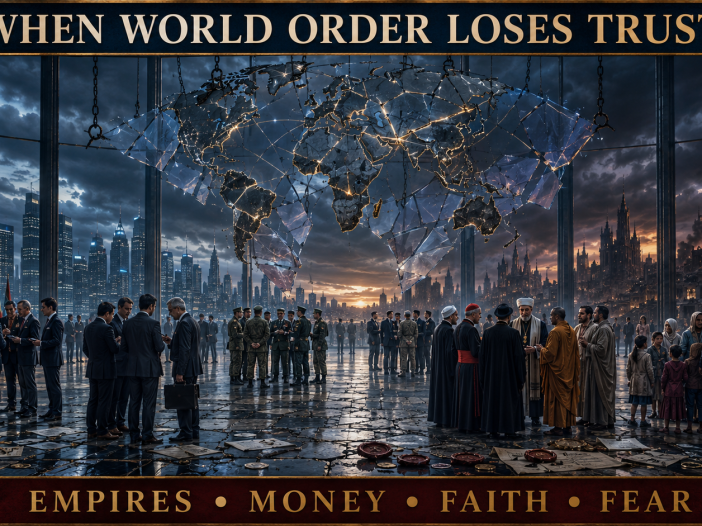
What happens when the world order loses trust?
A world order does not collapse only when armies cross borders. It begins to weaken when nations stop believing the rules are fair, when allies doubt the promises of powerful friends, when money becomes a weapon, when faith becomes attached to national ambition, and when geography reminds leaders that the earth still limits human plans.
Trust is the hidden architecture of civilization.
Nations trust alliances to protect them. Markets trust currencies to hold value. Citizens trust leaders to tell the truth. Religious communities trust sacred language to restrain pride. Small nations trust that they will not be treated as pieces on someone else’s map. Great powers trust that rivals will not mistake restraint for weakness.
But when trust breaks, every relationship becomes suspicious.
A rising empire asks whether the old order was built to keep it down. A declining empire asks whether history is slipping away. Small nations wonder whether alliances are shields or traps. Strategists rediscover mountains, oceans, choke points, railways, and ports. Religious language begins to shape political destiny. Money, once treated as neutral, becomes a battlefield of sanctions, debt, frozen assets, and fear.
This imaginary conversation brings together historians, diplomats, theologians, economists, strategists, and moral witnesses to ask five urgent questions.
What is more dangerous: a collapsing empire or a rising empire?
Are small nations protected by alliances, or sacrificed by them?
Is geography destiny?
What happens when religion and geopolitics merge?
What happens when money loses moral trust?
The deeper issue beneath all five is not only power. It is confidence. Can nations still believe one another? Can citizens still believe their institutions? Can markets still believe the rules? Can faith still judge empire instead of serving it?
Perhaps the future will not be decided only by who has the strongest army, largest economy, or most advanced technology.
Perhaps it will be decided by who can still be trusted.
(Note: This is an imaginary conversation, a creative exploration of an idea, and not a real speech or event.)
Topic 1: What Is More Dangerous — a Collapsing Empire or a Rising Empire?
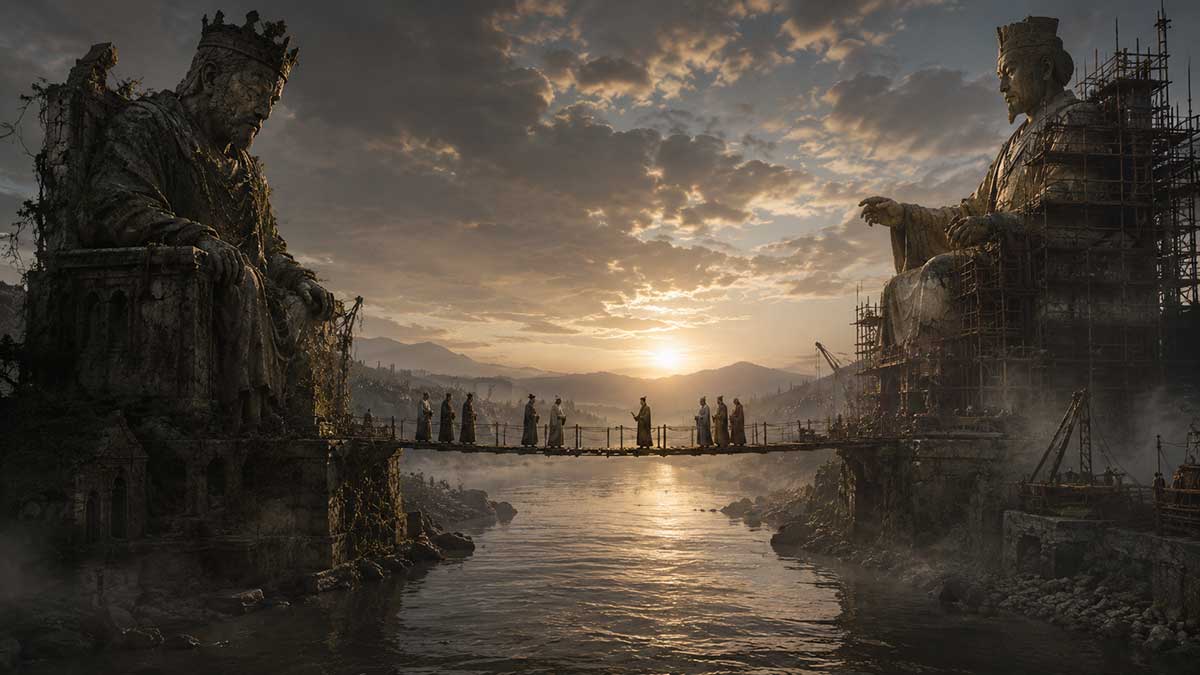
Nick Sasaki opened the conversation with a question that seemed to carry centuries inside it.
“History often warns us about rising powers,” he began. “A new empire grows stronger, demands respect, challenges old rules, and refuses to remain beneath another nation’s shadow. But there is another danger we talk about less: the declining empire that feels its authority slipping away.”
He looked around the table.
“A rising empire may be ambitious. But a collapsing empire may be desperate.”
At the table sat Thucydides, the ancient historian of Athens and Sparta; Paul Kennedy, the historian of imperial overreach; Henry Kissinger, the strategist of balance and diplomacy; and Ibn Khaldun, the great thinker of dynastic rise and decay.
Nick continued.
“Today’s question is this: What is more dangerous — a collapsing empire or a rising empire?”
Question 1: Does a declining empire become more dangerous when it feels history slipping away?
Thucydides:
Yes. Fear is often more dangerous than ambition. A rising power causes anxiety, but a declining power feels humiliation. It remembers when others obeyed, when allies trembled, when rivals hesitated. Then one day, obedience becomes negotiation. Negotiation becomes resistance. Resistance becomes insult.
That is when danger grows.
In my account of Athens and Sparta, the deepest cause of war was not a single insult or treaty violation. It was the growth of Athenian power and the fear this created in Sparta. The established power did not only see a rival. It saw the future escaping its control.
A declining empire may tell itself it is defending order. But often it is defending memory.
Paul Kennedy:
Declining empires become dangerous when military commitments exceed economic strength. This is the pattern of imperial overstretch. A great power expands its promises, bases, fleets, alliances, and wars. For a time, success hides the cost. Then the bills arrive.
The empire still thinks globally, but its economic foundation weakens. Its citizens become tired. Its industries lose capacity. Its debt rises. Yet its leaders keep speaking as if the old position remains natural and permanent.
That gap between self-image and reality is dangerous. The empire may take reckless action to prove it is still strong. It may choose confrontation because compromise feels like public admission of decline.
Henry Kissinger:
A declining power becomes dangerous when it loses the art of adjustment. Statesmanship requires recognizing shifts in power before they become catastrophic. No order lasts forever. The task of diplomacy is to revise the order without destroying it.
But declining powers often confuse adaptation with surrender. They see every concession as weakness and every rival gain as aggression. This produces rigidity.
The most dangerous moment comes when a power still has enough military capacity to cause immense damage, but not enough political imagination to create a new balance.
Ibn Khaldun:
A dynasty in decline becomes harsh because it no longer possesses inner strength. In its youth, it is held together by solidarity, sacrifice, discipline, and shared hardship. In its later stage, luxury weakens its people, rulers become remote, taxes grow, and trust fades.
Then the ruler relies more on force. Force replaces loyalty. Display replaces virtue. Fear replaces love.
A declining empire may appear mighty from outside, but inside it is anxious. It must shout because it no longer commands natural respect. This makes it dangerous, but also fragile.
Nick Sasaki:
So decline becomes dangerous when power loses humility. The empire cannot accept that history has moved. It would rather risk war than admit that the old arrangement is ending.
Question 2: Does a rising empire seek justice, recognition, revenge, or dominance?
Kissinger:
Usually, it seeks several things at once. A rising power often begins by seeking recognition. It wants the established order to acknowledge its weight, dignity, and interests. But if recognition is denied too long, frustration grows.
Then the rising power may reinterpret its ambition as justice. It may say, “The old order was unfair. We are restoring balance.” That claim may contain truth. Older orders often are built to favor older powers.
But justice and dominance can become difficult to separate. A rising power may begin by demanding equality and end by demanding deference.
Thucydides:
Power changes desire. At first, a city seeks safety. Then it seeks honor. Then it seeks advantage. Then it begins to believe that advantage is its right.
The rising power says, “We only ask what is fair.” But once it grows stronger, fairness may begin to mean obedience from others. This is why human nature must be studied together with power. Men do not remain the same when fortune lifts them.
A weak city speaks of law. A strong city discovers necessity.
Paul Kennedy:
Rising powers often carry historical grievances. They remember humiliation, exclusion, exploitation, or foreign domination. These memories can motivate national renewal. They can unify the people and justify enormous sacrifice.
But grievance can become fuel for expansion. The story becomes: “We were wronged, so now our rise is morally pure.” That is dangerous. A nation that sees itself only as victim may fail to notice when it becomes threatening to others.
Recognition is legitimate. Revenge is intoxicating. Dominance is the hidden temptation.
Ibn Khaldun:
The rising dynasty is usually hard, disciplined, and unified. Its people still possess strong solidarity. They believe in one another. They accept hardship. They honor courage. This gives them strength against an older empire softened by luxury.
But success changes them. After victory comes wealth. After wealth comes refinement. After refinement comes pride. Then the rising power begins the same cycle as the empire it replaced.
A rising empire may speak of justice in its youth, but it must guard against becoming the next oppressor.
Nick Sasaki:
That is the tragedy. A rising power may begin with a real wound. But if the wound becomes identity, it may seek not healing, but reversal. It may not want a fairer order. It may want its turn to command.
Question 3: Can two great powers share the future without one needing to defeat the other?
Kissinger:
They can, but only if both accept limits. Great powers must learn that security cannot mean total control. If one power defines its safety as the permanent weakness of the other, peace becomes impossible.
A stable order requires legitimacy. Each major power must feel that its core interests are recognized. This does not mean moral approval of every regime or policy. It means a diplomatic structure where survival does not require humiliation.
The future can be shared only through restraint. Restraint is not weakness. It is the discipline of power.
Paul Kennedy:
Sharing the future also requires economic realism. A power in decline must reduce commitments it can no longer afford. A rising power must avoid military expansion that drains the very economy that made it strong.
History shows that war often accelerates the decline it was meant to prevent. Leaders think conflict will restore authority. Instead, it exposes weakness, deepens debt, and damages legitimacy.
The wisest great power is the one that can distinguish essential interests from imperial habits.
Thucydides:
Peace between great powers is possible, but it is never secure if fear governs them. Each watches the other. Each interprets preparation as threat. Each alliance becomes a warning. Each insult becomes evidence.
To share the future, they must reduce fear. But fear is not easily reduced by speeches. It is reduced by conduct. Trust comes from repeated restraint.
If both desire honor without domination, there may be peace. But if either believes honor requires submission from the other, war approaches.
Ibn Khaldun:
The future can be shared only if the inner life of each civilization remains healthy. A strong society does not need constant enemies to hold itself together. A weak society often does.
When rulers lose trust at home, they seek glory abroad. When elites become corrupt, they speak more loudly of national destiny. When people are divided, leaders may search for external danger to restore unity.
Great powers can share the future only if they do not use foreign rivalry to hide domestic decay.
Nick Sasaki:
Nick leaned back, letting the answers settle.
“Maybe the danger is not simply the rising empire or the collapsing empire. Maybe the danger is the moment when both misunderstand each other.”
He looked first at Thucydides.
“The established power sees every rising movement as aggression.”
Then at Kennedy.
“The declining power refuses to match ambition with resources.”
Then at Kissinger.
“The diplomats fail to build a new balance before fear becomes policy.”
Then at Ibn Khaldun.
“And the inner decay of one civilization meets the wounded ambition of another.”
Nick paused.
“Perhaps the real question is not which empire is more dangerous. It is whether any empire can recognize the moment when its desire for security becomes another nation’s experience of threat.”
The room grew quiet.
“A rising empire becomes dangerous when justice turns into revenge. A declining empire becomes dangerous when memory turns into desperation. But the most dangerous situation is when both believe history itself is on their side.”
Nick closed the topic.
“Maybe peace begins when great powers stop asking, ‘How do we prevent them from rising?’ and begin asking, ‘How do we rise, decline, negotiate, and change without turning the future into a battlefield?’”
Topic 2: Are Small Nations Protected by Alliances, or Sacrificed by Them?
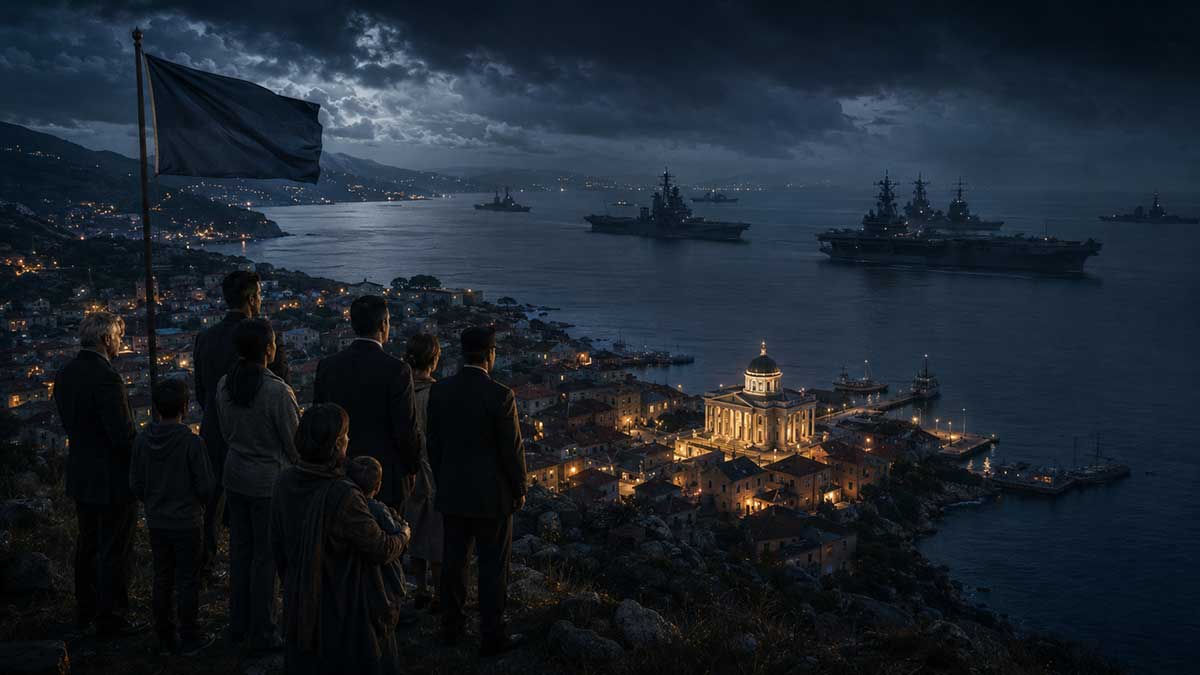
Nick Sasaki turned from the question of rising and declining empires to the countries caught between them.
“Great powers often speak as if history belongs to them,” he began. “They make maps, form alliances, draw red lines, promise protection, and define the rules of order. But between these powers live smaller nations with their own languages, memories, families, wounds, and hopes.”
He paused.
“A small nation may seek an alliance to survive. But the same alliance can make it a target.”
At the table sat Václav Havel, the Czech dissident and president; Lee Kuan Yew, the founding leader of modern Singapore; Empress Myeongseong, the Korean queen who understood the tragedy of being trapped between larger powers; and George Kennan, the American diplomat and architect of containment.
Nick continued.
“Today’s question is this: Are small nations protected by alliances, or sacrificed by them?”
Question 1: When does an alliance protect a small nation, and when does it turn that nation into a battlefield?
Václav Havel:
An alliance protects a small nation when it respects that nation’s dignity. Protection must not mean that the smaller country loses its voice. A small nation is not a military outpost. It is not a symbol for someone else’s ideology. It is a home.
I came from a part of Europe where people knew what it meant to live under pressure from an empire. We learned that freedom is not abstract. It is the right to speak truth, to remember honestly, to choose one’s future, and to refuse the lie that power is destiny.
An alliance becomes dangerous when it asks a small nation to carry risks that the stronger nation does not intend to share. Then protection becomes performance, and the small nation becomes exposed.
Lee Kuan Yew:
Small nations cannot live on sentiment. They must read power clearly. A small country survives by being useful, disciplined, credible, and careful. It must have friends, but it must never outsource its brain.
An alliance protects when it raises the cost of aggression. It becomes dangerous when it gives leaders the illusion that someone else will solve their problem.
For a small nation, the first duty is survival. That means strong institutions, social unity, economic value, and a clear sense of national interest. If you are small, you must make yourself too valuable to ignore and too costly to bully.
Empress Myeongseong:
A small nation becomes a battlefield when larger powers stop seeing its people and see only its position.
Korea knew this pain. We were between China, Japan, and Russia. Each power spoke of stability, reform, protection, or influence. But each also saw Korea as a door, a shield, a prize, or a path. When a nation’s geography becomes useful to others, its sovereignty becomes fragile.
An alliance protects only when the stronger power honors the life of the smaller nation. But too often, great powers say “friendship” while measuring railways, ports, armies, and borders.
George Kennan:
Alliances can deter aggression, but they can also create obligations that leaders do not fully understand at the time they make them. A promise made for credibility can later become a chain.
The difficulty is that commitments must be credible enough to deter enemies but limited enough to avoid reckless escalation. If a small nation believes it has unlimited backing, it may behave unwisely. If a great power gives vague promises, it may invite disaster.
An alliance protects when its purpose, limits, and risks are clear. It becomes a battlefield when clarity is replaced by slogans.
Nick Sasaki:
So the small nation must not be abandoned, but it must not be intoxicated by protection either. An alliance can be a shield, but it can also become a magnet for fire.
Question 2: Do powerful allies defend weaker nations for moral reasons, strategic reasons, or self-interest?
Kennan:
Usually, all three are mixed. Statesmen often speak in moral language, and sometimes they believe it. But great powers do not act from morality alone. They defend certain nations because those nations occupy strategic positions, influence regional balances, or represent credibility.
This does not make every alliance cynical. Strategy and morality can overlap. A free nation may deserve support, and supporting it may serve a larger balance of power.
The danger lies in pretending that self-interest is pure charity. Honest policy should admit the mixture. Citizens and smaller allies deserve that honesty.
Havel:
Moral language must not be dismissed too quickly. A small nation under pressure needs more than calculations. It needs solidarity. It needs other people to say, “Your freedom matters.”
But morality becomes false when it is selective. If a great power defends freedom in one place but ignores suffering in another, people notice. If human rights are invoked only when useful, they become tools, not principles.
The small nation needs solidarity, but it also needs truth. False idealism can be as dangerous as cold self-interest.
Lee Kuan Yew:
A small nation should assume that larger nations act mainly from interest. That is not an insult. It is how the world works. The mistake is expecting gratitude, loyalty, or moral consistency from countries whose leadership changes every few years.
A small country must ask: What does the great power need from us? What can we offer? What risk do we create for them? What risk do they create for us?
Moral friendship is welcome, but policy must be built on durable interest.
Empress Myeongseong:
When great powers speak of protecting a smaller nation, the smaller nation must listen carefully to what is not said.
Do they defend our people, or only our location? Do they honor our culture, or only our usefulness? Do they support our independence, or only our dependence on them?
A nation that cannot distinguish friendship from convenience may sign away its future without realizing it.
Nick Sasaki:
Then perhaps the truth is painful but necessary: powerful allies may defend weaker nations partly from principle, partly from strategy, and partly from self-interest. The moral task is not to deny self-interest. It is to prevent self-interest from consuming the people it claims to protect.
Question 3: Can small nations survive by choosing sides, or must they master balance between powers?
Lee Kuan Yew:
Small nations must master balance. Choosing sides may sometimes be necessary, but permanent dependence is dangerous. A small country must never become emotionally trapped by another power’s narrative.
Balance does not mean weakness. It means clarity. Trade widely. Build defense capacity. Keep society united. Avoid unnecessary provocation. Preserve maneuvering space.
A small nation must be like a skilled sailor. It cannot command the storm, but it can learn wind, current, timing, and direction.
Havel:
Balance is wise, but there are moments when neutrality becomes surrender. If a small nation faces domination, it may have to choose freedom even at great cost. The soul of a country cannot be preserved only through cleverness.
But courage must be joined with prudence. Moral witness without strategy can lead to martyrdom. Strategy without conscience can lead to submission.
A small nation survives when it keeps both: the courage to say no and the wisdom to remain alive.
Kennan:
Balance is often preferable, but geography and history may limit choice. Some countries sit in places where neutrality is not respected. Others belong to cultural or political communities that shape their natural alignment.
A wise small nation avoids maximal promises and maximal enemies. It should avoid becoming the forward edge of someone else’s grand design.
For great powers, the lesson is restraint. Do not turn every small nation into a test of credibility. Not every border dispute should become a world crisis.
Empress Myeongseong:
A small nation must balance, but balance requires inner unity. If factions inside the country each attach themselves to a different foreign patron, the nation becomes divided before the foreigners arrive.
Korea suffered from this. Some looked to one empire, some to another, some to reform, some to tradition. A divided court invites outside manipulation.
The first alliance of a small nation must be with itself. Its people, leaders, and institutions must agree that national survival is higher than faction.
Nick Sasaki:
Nick looked across the table with quiet concern.
“A small nation must be brave enough to seek help, wise enough not to be owned by help, and united enough not to be torn apart by the help it receives.”
He paused.
“Perhaps the tragedy of small nations is that they are told to choose between fear and dependence. Stand alone, and they may be swallowed. Trust an ally, and they may become useful more than loved.”
He turned to Havel.
“They need dignity.”
Then to Lee Kuan Yew.
“They need strategy.”
Then to Empress Myeongseong.
“They need unity.”
Then to Kennan.
“And they need limits clearly understood by all sides.”
Nick closed the topic.
“Maybe alliances protect small nations only when they defend more than territory. They must defend the small nation’s right to remain a subject of history, not an object on someone else’s map.”
Topic 3: Is Geography Destiny?
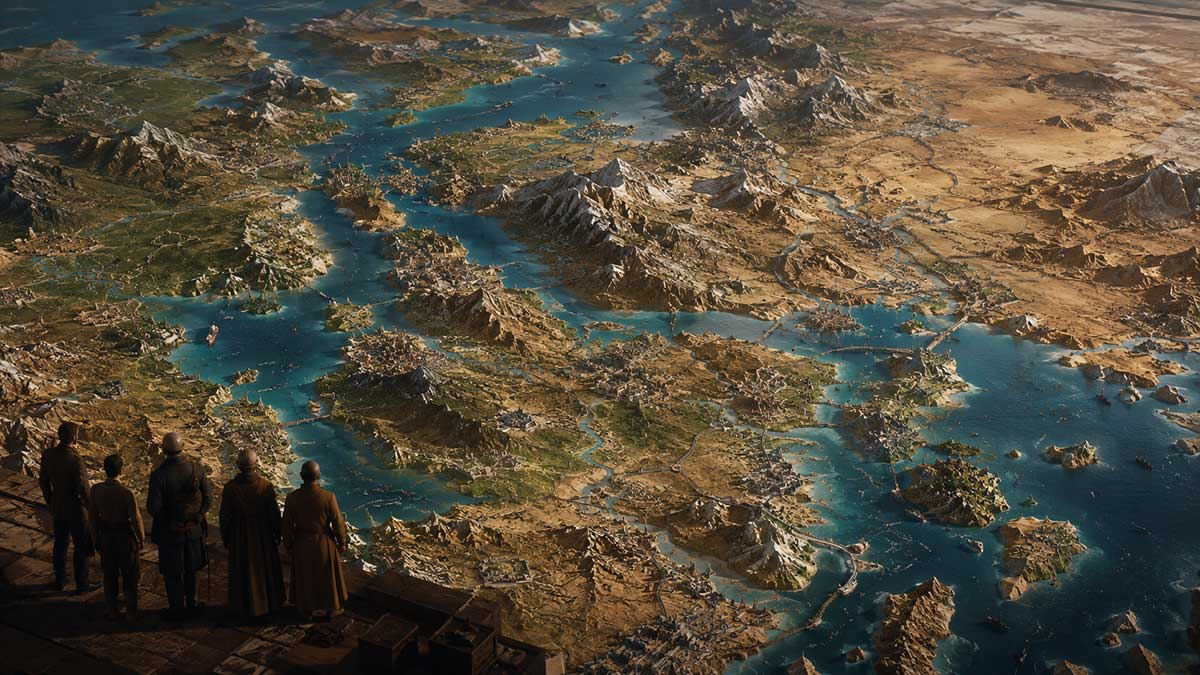
Nick Sasaki moved the conversation from alliances to the older force beneath every alliance: the map itself.
“Leaders speak of freedom, destiny, policy, and national choice,” Nick began. “But nations do not begin from a blank page. They begin with mountains, oceans, rivers, islands, deserts, ports, railways, oil routes, and vulnerable borders.”
He looked at the guests.
“Some nations are protected by oceans. Some are trapped by plains. Some live beside powerful neighbors. Some sit on narrow sea lanes that the whole world needs. So today’s question is this: Is geography destiny?”
At the table sat Halford Mackinder, the thinker of land power and the Eurasian heartland; Alfred Thayer Mahan, the great theorist of sea power; Sun Tzu, the ancient strategist of terrain, timing, and indirect victory; and Jared Diamond, the historian of geography, resources, and long-term civilizational patterns.
Question 1: Are nations truly free, or are they trapped by their maps?
Halford Mackinder:
Nations are not prisoners of geography, but they are never free from it. The map does not command every decision, yet it sets the stage on which decisions are made.
A power in the vast interior of Eurasia thinks differently from an island nation. A state surrounded by open plains fears invasion. A state protected by oceans thinks in fleets, trade routes, and distant bases. Geography gives each nation its anxieties.
The tragedy is that nations often call these anxieties principles. A country may say, “We seek security,” but what it means is, “Our map frightens us.” A country may say, “We defend freedom of trade,” but what it means is, “Our life depends on the sea.”
Alfred Thayer Mahan:
A nation with access to the sea receives both opportunity and temptation. The sea offers commerce, wealth, reach, and influence. But once a nation depends on sea trade, it must protect that trade. Ports require ships. Ships require bases. Bases require alliances. Alliances create obligations.
So the map does not trap a nation like a prison, but it creates chains of necessity. A maritime power becomes restless. It must look outward. Its prosperity is carried across water.
The same is true of land powers. They fear encirclement. They seek buffers. They want depth. The map whispers to them every day.
Sun Tzu:
A wise ruler studies terrain before acting. High ground, narrow passes, rivers, distance, supply lines, and weather shape victory and defeat. To ignore terrain is to waste soldiers.
But geography is not destiny for the wise. The skilled strategist uses terrain; the foolish one complains of it. Mountains can protect or isolate. Rivers can feed or divide. The sea can open wealth or expose weakness.
The map gives conditions. Wisdom decides how to move within them.
Jared Diamond:
Geography shapes possibilities over long periods. Crops, animals, climate, disease patterns, coastlines, rivers, and natural resources all affect how societies develop. Some regions allow dense farming early. Some encourage trade. Some isolate people. Some expose them to repeated conquest.
This does not mean geography removes human agency. It means agency is unevenly distributed. Human choices matter, but they are made inside ecological and geographic constraints.
A nation that forgets this may blame morality, culture, or race for outcomes that geography helped create.
Nick Sasaki:
“So perhaps nations are free, but not equally free. Some maps give room to breathe. Others make survival feel like strategy before breakfast.”
Question 2: Why do oceans protect some empires while mountains protect others?
Mahan:
Oceans protect only those who can command them. Water is not protection by itself. It becomes protection through ships, ports, sailors, logistics, and industrial capacity.
An island or ocean-protected power can avoid constant land invasion. That gives it space to build commerce, finance, and naval reach. But the ocean also teaches such a nation to think of the world as connected by routes. It sees chokepoints, harbors, canals, and distant markets.
Sea power is not merely military. It is commercial civilization guarded by naval force.
Mackinder:
Mountains protect differently. They do not create global reach, but they create resistance. A mountain nation can be hard to conquer, hard to occupy, and hard to govern from outside. Invaders may win cities but lose valleys. They may control roads but not loyalty.
Yet mountains can also limit integration. They make movement harder. They can divide communities. They can preserve independence, but also slow central authority.
Oceans protect by distance. Mountains protect by difficulty.
Sun Tzu:
Both can protect the wise and destroy the arrogant. A commander who crosses mountains without supply is defeated by hunger before the enemy. A commander who crosses seas without secure routes is defeated before battle.
Terrain rewards humility. It punishes pride. A ruler who says, “Our technology has conquered geography,” is already near error. Snow, mud, heat, distance, storms, narrow passages, and local knowledge remain powerful.
The old earth still teaches war to those who think themselves modern.
Diamond:
Oceans and mountains shape more than war. They shape culture, migration, trade, and disease. Islands may develop strong maritime identities. Mountain peoples may develop local independence and strong internal bonds. River valleys may create centralized states. Open plains may produce invasion routes and horse cultures.
The physical world becomes social memory. People do not just live on land; they inherit habits from it.
Nick Sasaki:
“Then geography is not only strategy. It becomes psychology. Oceans teach expansion. Mountains teach endurance. Plains teach fear. Islands teach both confidence and isolation.”
Question 3: Can technology overcome geography, or does geography always return?
Diamond:
Technology changes the meaning of geography, but rarely erases it. Railways changed continents. Steamships changed oceans. Airplanes changed distance. Satellites changed information. Digital networks changed markets.
Yet energy, water, food, minerals, ports, chips, cables, shipping lanes, and rare earths still exist in physical places. A digital economy still depends on mines, grids, factories, and undersea cables. Geography returns through supply chains.
The modern illusion is that the world became weightless. It did not. It became more dependent on hidden physical systems.
Mackinder:
Technology may change the contest between land and sea, but it does not remove the contest. Railways once threatened the supremacy of sea power by tying Eurasia together. Airpower changed military reach. Missiles changed deterrence. But the central question remains: who can move goods, armies, energy, and influence across space?
The world order always has a geographic skeleton. Statesmen may dress it in ideology, but the bones remain.
Mahan:
Sea power remains relevant precisely because the world still moves through water. Much of global trade still depends on ships. Energy, grain, manufactured goods, and raw materials pass through narrow maritime corridors. A blocked canal or strait can shake markets far from the battlefield.
Technology makes navies more complex, but it does not make sea lanes irrelevant. A country that cannot move goods cannot long sustain influence.
Sun Tzu:
The greatest technology is judgment. Weapons change. Terrain remains. A drone can see a valley, but it does not understand the people who live there. A missile can cross distance, but it cannot govern what it strikes. A satellite can watch a mountain, but not make soldiers willing to climb it.
Technology gives reach. Geography gives resistance. Human will decides the result.
Nick Sasaki:
Nick looked down at the map before him.
“Maybe geography never disappears. It only changes costume.”
He traced a finger across an imagined line.
“A sea lane becomes a trade route. A mountain becomes a fortress. A desert becomes a barrier. A port becomes a prize. A strait becomes a threat. A cable beneath the ocean becomes the nervous system of civilization.”
He looked toward Mackinder.
“The land still matters.”
Toward Mahan.
“The sea still matters.”
Toward Sun Tzu.
“The terrain still humbles pride.”
Toward Diamond.
“And the physical earth still shapes human possibility.”
Nick paused.
“Perhaps geography is not destiny in the sense that it forces one future. But it is destiny in the sense that every nation must answer the questions its map asks.”
He closed the topic.
“A wise nation does not worship geography. It does not pretend to escape it either. It learns the map deeply enough to choose peace where others see only pressure, and restraint where others see only opportunity.”
Topic 4: What Happens When Religion and Geopolitics Merge?
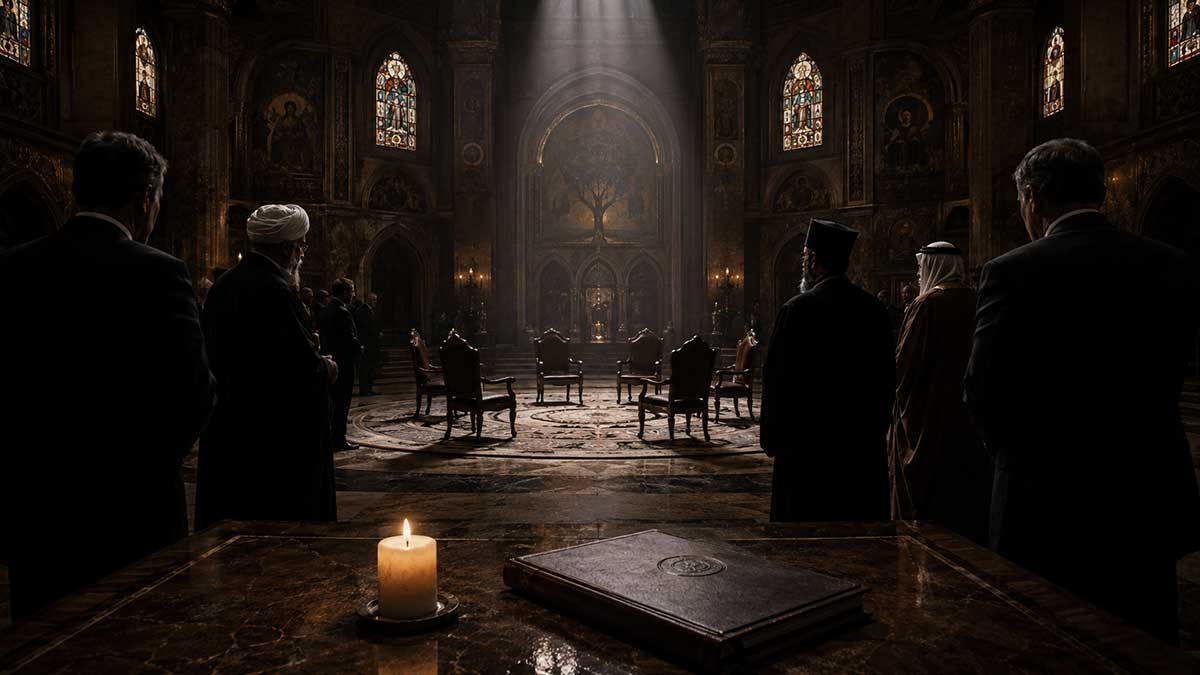
Nick Sasaki let the map fade from the center of the conversation.
“We have spoken about empires, alliances, and geography,” he began. “But nations are not moved by territory alone. They are moved by memory, humiliation, sacred stories, chosen identities, holy places, martyrs, prophets, scriptures, and visions of destiny.”
He looked across the table.
“Religion can humble power. It can remind rulers that they are not gods. It can call people to mercy, justice, repentance, and peace.”
He paused.
“But religion can also make politics absolute. If a nation believes God has blessed its strategy, compromise can feel like betrayal. War can become holy. The enemy can become evil itself.”
At the table sat Reinhold Niebuhr, theologian of moral realism; Abraham Joshua Heschel, prophet of justice and conscience; Al-Ghazali, the great Islamic thinker of spiritual purification; and Fyodor Dostoevsky, novelist of faith, suffering, nationalism, and the human soul.
Nick continued.
“Today’s question is this: What happens when religion and geopolitics merge?”
Question 1: Does religion restrain political power, or make political conflict absolute?
Reinhold Niebuhr:
Religion can restrain power when it teaches humility. A ruler who knows he is finite may hesitate before claiming righteousness for every policy. A nation that believes judgment belongs to God should be slower to worship its own flag.
But religion becomes dangerous when it sanctifies national pride. Every nation is tempted to identify its own interest with divine purpose. It says, “We are defending justice,” when it is defending privilege. It says, “God is with us,” when it means, “Our enemies must submit.”
Religion restrains power only when it judges the nation that claims it. When religion merely blesses the nation, it becomes another instrument of power.
Abraham Joshua Heschel:
True faith does not flatter kings. The prophet stands before power and says, “You are accountable.” The prophet does not ask whether policy is useful first. He asks whether widows, children, strangers, and the poor are being crushed beneath it.
Religion becomes holy only when it protects the human face from becoming invisible.
But when religion is joined to domination, the voice of God is replaced by the voice of the state. Then sacred language is used to defend cruelty. That is blasphemy in political clothing.
Faith must trouble power, not decorate it.
Al-Ghazali:
Religion restrains power when the heart is purified. The ruler must fear God more than he loves victory. The scholar must fear corruption more than he loves favor. The believer must fear pride more than he fears defeat.
But the lower self can wear religious garments. It can call ambition “mission.” It can call anger “zeal.” It can call revenge “justice.” The danger is not only false doctrine. The danger is the impure soul using true words for impure ends.
A war may be fought with prayers on the lips and arrogance in the heart.
Fyodor Dostoevsky:
Man cannot live without the sacred. If he rejects God, he often worships something else: nation, race, revolution, science, empire, progress, revenge. Politics then becomes religion without repentance.
Religion can soften the heart through suffering. It can teach forgiveness. It can reveal the image of God in the enemy. But when faith is fused with pride, it becomes terrible. A man who believes he kills for heaven may lose all fear of hell.
The question is not religion or politics. The question is whether the soul kneels before God, or makes God kneel before the nation.
Nick Sasaki:
“So religion can restrain power when it speaks as conscience. But when it becomes the chaplain of ambition, it can make conflict feel eternal.”
Question 2: What happens when nations believe their strategy has divine approval?
Heschel:
They stop listening to suffering. Once a nation believes its strategy has divine approval, the cries of the wounded become easier to dismiss. The refugee becomes unfortunate but necessary. The destroyed home becomes part of a plan. The dead child becomes a statistic beneath a sacred banner.
The prophets never allowed rulers to hide behind religious certainty. They spoke of justice in the gate, bread for the hungry, mercy for the stranger, and the holiness of human life.
A nation may pray loudly and still be deaf to God.
Niebuhr:
Divine approval is often the most dangerous claim in politics. It removes self-criticism. It turns prudence into weakness. It turns negotiation into betrayal. It turns enemies into embodiments of evil.
Nations must act in history. They must defend themselves. They may face real aggression. But every action remains morally mixed. No nation is innocent enough to claim pure divine endorsement for its grand strategy.
The most moral nation still needs repentance. The most threatened nation still needs restraint.
Dostoevsky:
When a nation believes God has signed its military plan, tragedy follows. Suffering becomes theatrical. Martyrdom becomes useful. Leaders speak of sacrifice, but they often sacrifice others.
There is a deep temptation in the human heart: to make one’s pain proof of one’s holiness. A wounded nation may say, “We suffered, so now we cannot sin.” But suffering does not make a soul pure. It may deepen compassion, or it may deepen resentment.
A nation that worships its wound becomes capable of wounding others without shame.
Al-Ghazali:
To claim divine approval for strategy is spiritually perilous. One may seek guidance. One may pray for justice. One may defend the oppressed. But to say, “God approves our plan,” demands fear and trembling.
God sees intentions hidden from men. He sees pride inside piety, greed inside defense, hatred inside righteousness. The ruler who invokes God must first ask whether he has conquered himself.
Without inner purification, sacred strategy becomes worldly desire with a holy mask.
Nick Sasaki:
“Then the danger is not only that religion enters politics. The danger is that politics enters religion and teaches it to speak the language of power.”
Question 3: Can faith become a bridge for peace when governments use it for war?
Al-Ghazali:
Yes, but only if faith returns to the heart. Peace cannot be built by slogans between religious leaders who seek cameras. It must begin with repentance, humility, and the discipline of seeing the other as a soul before God.
The one who prays must ask: Have I purified my anger? Have I confused justice with revenge? Have I listened to the pain of the other? Have I remembered that my enemy will stand before God, as I will?
Faith becomes a bridge when it lowers the ego.
Heschel:
Faith becomes a bridge when it recovers prophetic empathy. We must not ask only, “What does my group need?” We must ask, “What does God require of us when another human being suffers?”
Prayer is not escape. Prayer must become moral action. If faith does not move the feet toward justice, it becomes self-comfort.
Peace requires sacred imagination: the ability to see the enemy’s child as worthy of life, the enemy’s grief as real, the enemy’s fear as human.
Niebuhr:
Faith can help peace, but it must be honest about power. Sentimental religion will not prevent war. Appeals to love are not enough when nations fear annihilation or humiliation.
A serious faith must combine love with realism. It must tell nations: your fears may be real, but your pride is real too. Your enemies may be dangerous, but your self-deception is dangerous too.
Faith becomes useful for peace when it refuses both naivete and cynicism.
Dostoevsky:
Peace begins when a human being sees that he is guilty before all. This does not mean political guilt in every specific matter. It means spiritual responsibility. I cannot heal the world if I see only the evil of others and never the darkness in myself.
The proud man says, “They must repent first.” The humble man says, “Let me begin.”
If enough souls begin there, even nations may change. But if each nation waits for the other to kneel first, the graveyards will keep growing.
Nick Sasaki:
Nick folded his hands.
“Perhaps religion and geopolitics merge in two very different ways.”
He looked at Niebuhr.
“One way blesses national pride and calls it righteousness.”
He looked at Heschel.
“One way stands before power and demands justice.”
He looked at Al-Ghazali.
“One way purifies the heart before it speaks of God.”
He looked at Dostoevsky.
“One way sees the enemy not as a symbol, but as a soul.”
Nick paused.
“Faith becomes dangerous when it gives governments sacred permission to dominate. But faith becomes necessary when it gives people the courage to resist domination without becoming possessed by hatred.”
The room grew quiet.
“Maybe the deepest test is this: does religion make us more honest about our own sin, or more certain about the enemy’s sin?”
Nick closed the topic.
“When faith serves empire, war becomes holy. When faith judges empire, peace becomes possible.”
Topic 5: What Happens When Money Loses Moral Trust?
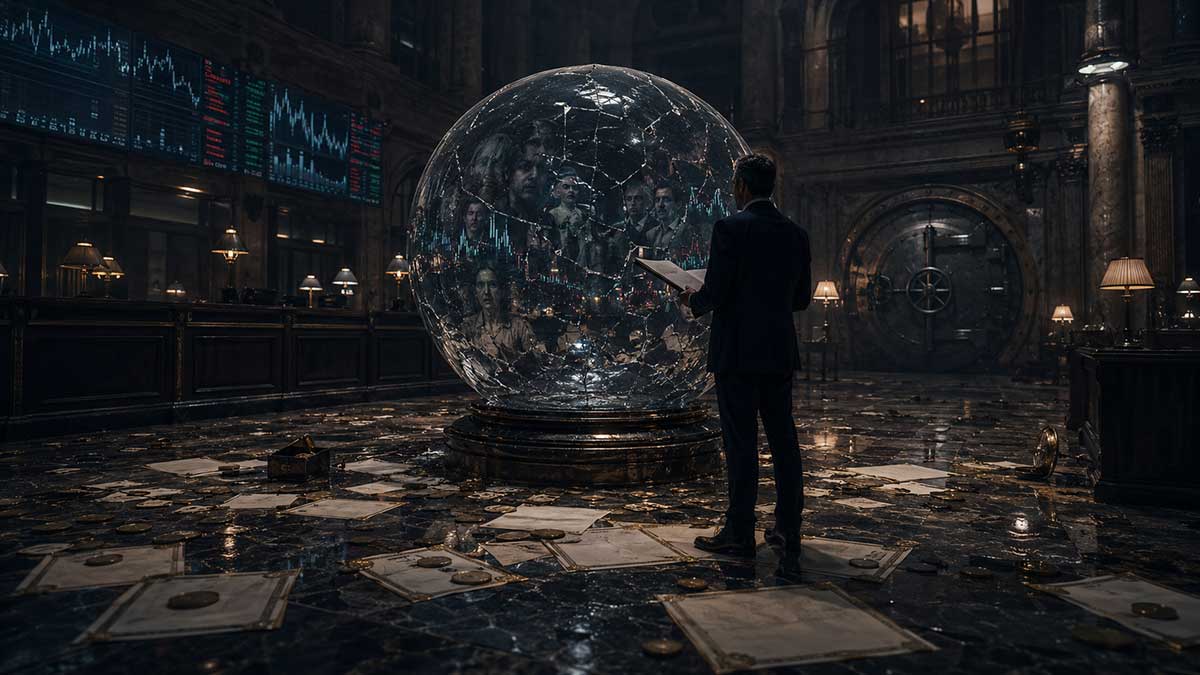
Nick Sasaki turned from sacred language to another force that silently governs the world: money.
“Money looks cold,” Nick began. “Numbers on screens. Bank accounts. Bonds. Debt. Currency reserves. Trade balances. Interest rates. Sanctions. Frozen assets. Payment systems.”
He paused.
“But money is never just money. It is trust made visible. It is a promise that tomorrow will honor what today has agreed upon.”
At the table sat John Maynard Keynes, the economist of global financial order; Adam Smith, the moral philosopher of markets and trust; Karl Polanyi, the critic of markets separated from society; and Satoshi Nakamoto, the mysterious symbolic voice of decentralized money.
Nick continued.
“Today’s question is this: What happens when money loses moral trust?”
Question 1: Is money only a financial tool, or is it a moral promise?
Adam Smith:
Money cannot survive without trust. Markets depend on more than price. They depend on honesty, reputation, fairness, and the expectation that agreements will be honored.
People often speak of markets as if they are machines. But markets are human institutions. They require sympathy, restraint, law, and moral habits. A merchant who cheats may gain for a day, but if cheating becomes normal, commerce itself decays.
Money is useful as a tool, but it rests upon moral expectation. When people no longer believe that others will keep promises, money becomes paper, metal, code, or numbers without confidence.
John Maynard Keynes:
Money is a bridge between the present and the future. When a person holds money, he believes it will carry value into tomorrow. When a nation holds another nation’s currency, it believes that currency will remain usable, stable, and respected.
So yes, money is a financial tool, but it is also a promise about order. It says: the system will still exist. Contracts will be honored. Debts will be managed. Trade will continue. Political panic will not destroy value overnight.
When that confidence breaks, people stop thinking long-term. They hoard. They flee. They speculate. They search for shelter. The economy becomes anxious.
Karl Polanyi:
Money is not merely a commodity. It is part of society’s fabric. To treat money as if it floats above human life is dangerous. When money becomes detached from work, land, family, law, and community, society becomes unstable.
A monetary system always reflects power. Who issues money? Who controls credit? Who absorbs loss? Who is rescued? Who is sacrificed?
The moral question is not only whether money keeps value. The moral question is whether the monetary system protects human life or subjects human life to financial discipline.
Satoshi Nakamoto:
Trust has long been delegated to institutions. Banks, central authorities, states, payment networks, and intermediaries say: “Trust us. We will record honestly. We will not debase. We will not censor. We will not seize without cause.”
But history shows that trusted third parties can fail. They can inflate, freeze, exclude, manipulate, or collapse.
A monetary system can be built to reduce dependence on institutional trust. Code, verification, scarcity, and open networks can shift trust from authority to protocol. But even code relies on human trust in rules, incentives, and participation.
Money is a promise. The question is: who makes the promise, who enforces it, and who can break it?
Nick Sasaki:
“So money is not only stored value. It stores belief. When people trust money, they trust tomorrow. When nations trust money, they trust the system. When that trust breaks, the future itself becomes suspicious.”
Question 2: What happens when nations fear their money can be frozen, weaponized, or controlled?
Keynes:
They seek insurance against the system. A reserve currency depends not only on economic strength, but on confidence that it will remain broadly usable. If nations fear that reserves can be frozen, payments blocked, or access denied, they will diversify.
They may buy gold. They may trade in local currencies. They may create new payment systems. They may build bilateral arrangements. None of this happens instantly. But confidence can erode gradually, then suddenly.
A system can remain dominant long after doubts begin. But once the habit of trust weakens, every crisis accelerates the search for substitutes.
Smith:
If money becomes a weapon, commerce becomes suspicion. Trade flourishes when merchants believe rules are stable. If every transaction becomes subject to political punishment, trust narrows.
Nations will still trade, but they will trade with caution. They will prefer partners they believe cannot easily harm them. They may accept inefficiency for safety. They may divide commerce into friendly and hostile blocs.
That is a loss for human prosperity. Trade, at its best, softens hostility by making people useful to one another. But when money is weaponized, trade becomes another battlefield.
Polanyi:
Weaponized money reveals what was hidden: markets are never separate from power. A global payment system is not neutral if one set of states can decide who participates and who is excluded.
When nations discover this, they do not simply make financial adjustments. They make political adjustments. They ask: whose rules are these? Whose justice is this? Who benefits from this system? Who can be punished by it?
The result may be fragmentation. The world may retreat from a single financial order into competing regional orders, each built around security rather than openness.
Satoshi Nakamoto:
Control creates demand for exit. If people or nations believe money can be censored, seized, inflated, or blocked, they seek alternatives that are harder to control.
This does not mean every alternative succeeds. Many fail. Some are speculative. Some are unstable. Some are captured by new gatekeepers.
But the desire remains: a form of value that can cross borders without permission, resist confiscation, and operate outside political dependency. The stronger the control, the stronger the search for escape.
Nick Sasaki:
“Then the weaponization of money may work in the immediate crisis, but it teaches the world a lesson: the system is not neutral. Once that lesson spreads, trust becomes harder to restore.”
Question 3: Can a world without financial trust avoid war?
Polanyi:
A world without financial trust becomes more vulnerable to conflict because economic life no longer binds societies together in a shared structure. When markets fragment, politics hardens. When trade becomes organized around fear, nations become less patient with one another.
But war is not inevitable. Societies can rebuild trust by embedding markets within moral and political limits. Money must serve life. Finance must be accountable to communities. International systems must be seen as legitimate, not merely efficient.
Peace requires economic arrangements that people and nations can experience as fair.
Keynes:
After great wars, statesmen must design systems that reduce panic, revenge, and instability. Financial peace is not automatic. It must be built.
If the world loses trust in one monetary order, the answer is not chaos. It may require a new settlement: clearer rules, fairer adjustment between creditor and debtor nations, less punitive use of finance, and institutions capable of preventing desperation.
War often follows when economic humiliation becomes political fuel. A wise order avoids humiliating the defeated, trapping the indebted, or frightening the rising.
Smith:
Trust can return when justice returns. A market society must reward honest work, fair exchange, and mutual benefit. When people believe the system is rigged, resentment grows. When nations believe the system exists only for the strong, they resist.
The cure is not only technical reform. It is moral reform. Promises must mean something. Rules must be applied with consistency. Power must be restrained by justice.
Without justice, finance becomes domination. With justice, commerce can become a school of peace.
Satoshi Nakamoto:
A world without institutional trust may seek mathematical trust. But no system can remove the human problem completely. Code can verify transactions. It cannot create mercy. It can limit debasement. It cannot guarantee wisdom. It can reduce censorship. It cannot produce justice by itself.
Financial trust needs transparency, predictability, and voluntary participation. But peace needs more. It needs restraint from those with power, and responsibility from those seeking freedom from power.
A new system may reduce certain risks. It cannot save humanity from greed, fear, or pride.
Nick Sasaki:
Nick sat quietly before speaking again.
“Maybe money loses moral trust when it stops feeling like a promise and starts feeling like a trap.”
He looked at Keynes.
“When nations fear the future, they stop cooperating.”
He looked at Smith.
“When markets lose fairness, trade loses its human meaning.”
He looked at Polanyi.
“When finance separates from society, society eventually rebels.”
He looked at Satoshi.
“And when institutions lose trust, people search for systems that do not need permission.”
Nick paused.
“A world without financial trust may not enter war immediately. But it becomes a world of suspicion. Every reserve becomes a vulnerability. Every payment rail becomes a pressure point. Every sanction becomes a warning. Every debt becomes a chain. Every currency becomes a flag.”
The room was silent.
“Perhaps peace depends on something deeper than armies and treaties. It depends on whether people believe promises will be honored.”
Nick closed the topic.
“When money loses moral trust, the world does not only lose a financial system. It loses one of the quiet agreements that keeps nations from reaching for weapons.”
Final Thoughts by Nick Sasaki
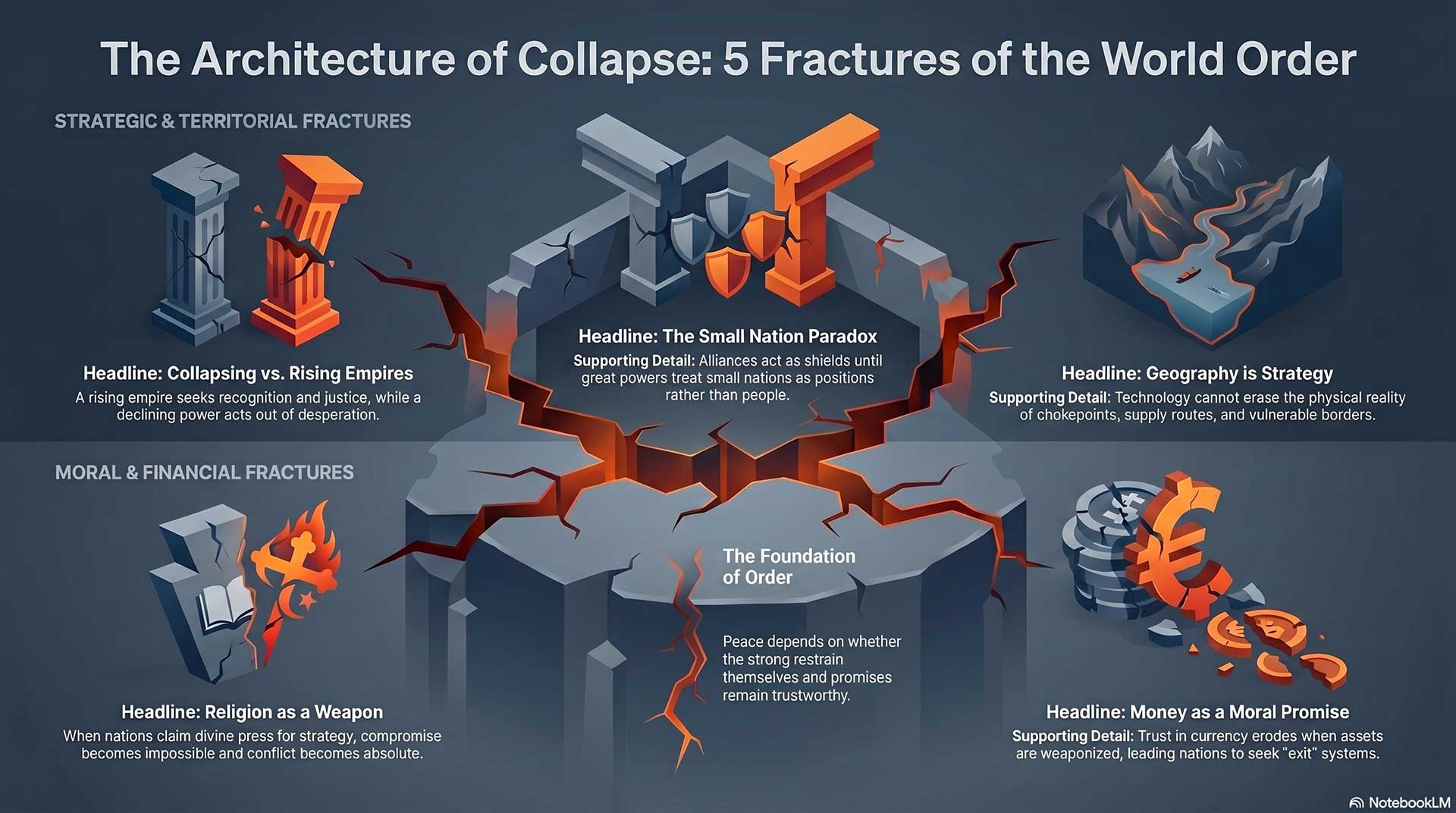
The old world order does not break in one moment.
It breaks when fear replaces confidence.
It breaks when a declining empire refuses to adapt and a rising empire mistakes recognition for revenge. It breaks when small nations become strategic locations before they are recognized as living communities. It breaks when geography, ignored during easy times, returns through sea lanes, borders, energy routes, and supply chains. It breaks when religion is used to bless national pride instead of judging it. It breaks when money, once treated as a promise, becomes a tool of punishment and control.
The first fracture is great-power mistrust. A rising power wants dignity. A declining power fears humiliation. If neither can imagine a shared future, every negotiation becomes a pause before conflict.
The second fracture is alliance mistrust. Smaller nations need protection, but they must ask whether their allies see them as people or positions. An alliance can defend sovereignty, but it can also turn a country into the front line of someone else’s ambition.
The third fracture is geographic mistrust. The modern world often pretends that technology has erased distance. Yet ships still pass through narrow waters. Energy still moves through routes. Nations still fear encirclement. Mountains, oceans, islands, ports, and borders still shape policy.
The fourth fracture is sacred mistrust. Faith can restrain rulers by reminding them that no nation is God. But faith can become dangerous when governments use it to make strategy feel holy. When nations believe heaven has endorsed their policy, compromise becomes almost impossible.
The fifth fracture is financial mistrust. Money depends on belief. When nations fear their reserves can be frozen, their payments blocked, or their currency access controlled, they search for escape. A system may remain powerful for a long time, but once trust weakens, every crisis speeds the search for another path.
Yet this conversation is not only about danger.
It suggests that trust can be rebuilt, but never through slogans alone.
Great powers must accept limits. Small nations must strengthen their inner unity. Strategists must respect the map without worshiping it. Religious voices must speak as conscience, not as servants of empire. Financial systems must recover fairness, restraint, and predictability.
Peace depends on more than treaties. It depends on whether promises still mean something.
A world order survives when the strong restrain themselves, the rising are given dignity, the small are treated as subjects of history, faith keeps power humble, and money remains a trustworthy bridge into the future.
Perhaps the deepest question is not, “Who will rule the next world order?”
Perhaps it is this:
Can any world order last when nobody believes the rules are honest?
Short Bios:
Thucydides — Ancient Greek historian of the Peloponnesian War, known for his analysis of fear, honor, interest, rising powers, and the tragic logic of great-power conflict.
Paul Kennedy — British historian best known for his work on imperial overstretch, great-power decline, economic strength, military burden, and the rise and fall of nations.
Henry Kissinger — Diplomat and strategist known for balance-of-power thinking, great-power diplomacy, realism, and the need for restraint in international order.
Ibn Khaldun — North African historian and social thinker known for his theory of social cohesion, dynastic rise and decay, luxury, taxation, and civilizational decline.
Václav Havel — Czech playwright, dissident, and president who defended moral courage, truth, human dignity, and the rights of small nations under imperial pressure.
Lee Kuan Yew — Founding leader of modern Singapore, known for small-state strategy, realism, national discipline, sovereignty, and survival between larger powers.
Empress Myeongseong — Korean queen whose life symbolizes the danger faced by small nations caught between rival empires and competing foreign pressures.
George Kennan — American diplomat and strategist known for containment, restraint, alliance strategy, and warnings against overextension in foreign policy.
Halford Mackinder — British geographer and geopolitical thinker known for the Heartland theory and the strategic importance of Eurasian land power.
Alfred Thayer Mahan — American naval historian and strategist known for his theory of sea power, naval strength, trade routes, and maritime influence.
Sun Tzu — Ancient Chinese strategist whose teachings focus on terrain, timing, restraint, deception, indirect victory, and winning with minimal waste.
Jared Diamond — Scholar and author known for studying how geography, environment, resources, disease, and agriculture shape long-term human history.
Reinhold Niebuhr — American theologian and public thinker known for moral realism, national pride, sin, justice, power, and the danger of self-righteous politics.
Abraham Joshua Heschel — Jewish theologian and moral witness known for prophetic conscience, justice, human dignity, prayer, and faith that challenges power.
Al-Ghazali — Islamic scholar, philosopher, and mystic known for spiritual purification, humility, ethics, and the danger of worldly ambition corrupting faith.
Fyodor Dostoevsky — Russian novelist and religious thinker known for exploring faith, suffering, guilt, nationalism, freedom, and the depths of the human soul.
John Maynard Keynes — British economist whose ideas shaped modern finance, postwar economic order, debt policy, and the relationship between money and stability.
Adam Smith — Scottish moral philosopher and economist known for markets, moral sentiment, trust, fair exchange, and the ethical foundations of commerce.
Karl Polanyi — Economic historian and social thinker known for arguing that markets must remain embedded in society, law, community, and human need.
Satoshi Nakamoto — Pseudonymous creator of Bitcoin, used here as a symbolic voice on decentralized money, institutional mistrust, financial sovereignty, and protocol-based trust.
Leave a Reply