


Introduction by S. Y. Agnon
What if S. Y. Agnon were alive in 2026 and wrote a novel about Israel now?
A man leaves one land and comes to another, and he says of himself that he has arrived. Yet arrival is a word that speaks too quickly.
For what is it to arrive in a land? Is it enough that the ship has docked, that the train has stopped, that the officer has stamped the paper, that the room has been rented, that the bread has been bought, that the street has begun to remember one’s footsteps? These things are not nothing. A man cannot live on yearning alone. He must have a roof, a table, a cup, a place for his coat, and some corner in which his thoughts may sit down at evening. Still, such things do not complete the matter.
A man may cross into a country and still remain outside it in his soul.
He may speak its language and still hear himself as a guest.
He may call it home and still not know whether the word is confession, desire, inheritance, or presumption.
In every generation there are those who come to the Land with old words in their mouths and new devices in their hands. Their fathers spoke of promise, their teachers of history, their newspapers of conflict, their enemies of power, their friends of longing, and their own hearts speak in several voices at once. Such men do not come empty. They come burdened. They bring memory they did not live, grief they inherited, arguments they did not begin, and hopes they do not know how to carry without being ashamed of them.
And the Land, for its part, does not receive anyone in simplicity.
It does not say to a man, Come, you are pure.
It does not say, Come, all your divisions will now be healed.
It does not say, Here at last your soul shall rest in one language.
The Land receives a man as life receives him: mixed.
One city pulls him toward motion, appetite, wit, fatigue, and survival.
Another city pulls him toward judgment, memory, God, stone, and inward reckoning.
Between them he goes back and forth, thinking at first that he is traveling between places, until he learns that he is traveling between conditions of his own being.
This book tells of such a man.
He is not the first to come with divided inheritance.
He is not the first to discover that a nation is made not only of ideals and songs, but of offices, delays, neighbors, broken sleep, market bread, public argument, children in shelter rooms, and words used by those who did not write them.
He is not the first to find that a man may seek belonging and meet instead instruction.
If there is sorrow here, it is not only the sorrow of politics or war, though those sorrows are present. It is the older sorrow of the human creature who wishes to stand somewhere without falsehood and cannot do so cheaply. He wishes to belong without pretending. He wishes to love without idolatry. He wishes to speak truth without becoming cruel, and to remain humane without becoming vague. Such wishes are heavy, and often they press hardest in lands where history has not yet finished speaking.
I have written before of men who came to the Land bearing dreams and found themselves met by dust, labor, prayer, contradiction, and the strange comedy by which the human soul is corrected. In this later age the garments have changed. The streets are louder, the messages fly faster than birds, the state is old enough to quarrel with itself in many voices, and every grief is quickly turned into language before the heart has fully borne it. Yet the central matter remains.
A man comes seeking home.
He finds not completion, but trial.
And if mercy is given, it is not the mercy of becoming simple.
It is the mercy of being permitted to remain present, even as a divided being, and not be wholly cast out.
If the reader finds in these pages not certainty but pressure, not a conclusion but a life still being learned, then the book has not failed its subject.
For there are stories that end by closing.
And there are stories that end by teaching a man how to remain open without being dissolved.
This is such a story.
(Note: This is an imaginary conversation, a creative exploration of an idea, and not a real speech or event.)
Chapter 1: Arrival

When he first arrived in the land, it was not dawn, as he had imagined so many times, but afternoon, and not the clean gold of afternoon from old paintings, but that pale white glare which flattens faces, runways, buildings, flags, and even hope itself. He had thought that his first step would carry some secret weight, that the ground would answer him, that some ancient chord, silent through the years of his life abroad, would sound beneath his foot. Yet the floor of the terminal answered him in the language of polished tile, rolling suitcases, security instructions, tired children, and men in uniform who had already seen too many arrivals to be moved by one more.
His name was Yonatan Koren. On his mother’s side there had been men who prayed with their whole bodies, swaying in narrow rooms before dawn. On his father’s side there had been men who read newspapers at breakfast and spoke of history as if history were a machine with a visible lever. Yonatan had inherited from both sides a certain impatience, and from neither side any peace.
He stood in line beneath signs written in Hebrew, Arabic, and English. The Hebrew moved before his eyes like something known long ago and half-forgotten in a fever. He could read it, yet his reading was slow enough to shame him. Each word seemed to pause before giving itself up. He had studied for years, in classrooms, on screens, in late-night lessons with podcasts playing into his ears. Still, the language spoken around him rushed forward with elbows. It did not wait for him. It did not bend in welcome.
A child passed him dragging a small blue suitcase with one broken wheel, the kind that chatters against the floor like false applause. Behind the child came a woman speaking into her phone with the stern calm of one who had long ago accepted interruption as the natural order of life. Near the passport booths a young soldier yawned, then checked himself and straightened. His rifle hung from him with the ease of a second limb. Yonatan looked at that rifle and thought first of news reports, then of Scripture, then of the old photographs in his grandfather’s study, young men in shorts and sandals standing in a field with impossible seriousness on their faces. He had always known that he was coming to a country where youth carried metal and memory together. Still, to see it in the flesh was another thing.
When his turn came, the officer took his passport, looked at it, looked at him, and asked him a question in Hebrew so quickly that he understood only the last word.
“Again?” Yonatan said, in Hebrew that sounded to his own ears like borrowed clothing.
The officer repeated the question, slower now, without warmth and without cruelty. Was he coming to study, to work, or to settle?
“To settle,” Yonatan said.
The officer glanced up, as if measuring the distance between the sentence and the man who had spoken it.
“For how long?”
Yonatan almost smiled at the strangeness of it. He wanted to say: for the rest of my life, if life permits it. He wanted to say: since before I was born. He wanted to say: as long as a place can keep a man who has arrived carrying too many stories about it. Yet he answered, “I’m making aliyah.”
The officer stamped something, typed something, handed back the passport, and nodded him through. That was all. No trumpet, no inward shudder in the walls of the building, no descent of meaning. He passed from one side of a glass partition to another and found, with mild surprise, that this was how one crossed from longing into fact.
Outside baggage claim, phones lit up in every hand. Screens flashed messages, maps, headlines, family chats, work requests, security updates. A man in sandals stood near an electrical outlet charging two devices at once, as if keeping them alive were equal to keeping his own blood in motion. An older couple argued beside a luggage cart over a missing bag, each blaming the other with the intimacy of long practice. A volunteer from the immigration office smiled at Yonatan and handed him a packet. Inside were forms, numbers, instructions, a transit card, welcome material, and other papers which would soon multiply in drawers, folders, and email inboxes until they formed around him the true architecture of modern belonging.
He wanted, at that moment, to be met by a prophet. Failing that, by an uncle with rough hands and kind eyes. Failing that, by at least a friend who could clap him on the shoulder and tell him that confusion was the first gate and that all who entered passed through it. Yet no prophet came, and no uncle, and no friend. He had told almost no one his exact arrival time. This had seemed noble when he planned it. He wanted to come as the early pioneers came, alone, carrying his own bag, owing his entrance to no committee of welcome. He had not considered the humiliations of solitary heroism: the dragging of suitcases that were too heavy, the search for coins and cards, the uncertainty over taxis, trains, apps, directions, the sudden wish, when no one is looking, to hear one’s name called in an airport by a familiar voice.
He took his luggage and went out into the light.
The heat struck him first. Then the sound. Then the smell, which was not one smell but ten layered over one another: hot pavement, machine oil, dust, coffee, sea air from far off, cigarette smoke, sunscreen, a sweetness from some unseen pastry stand, and the faint metallic edge that clings to places where many engines idle. He had thought the country would smell old. Instead it smelled fully awake.
A line of taxis waited. Beyond them buses came and went. Above the road a digital sign flashed warnings that he could not read at first glance. On another screen a news headline moved across in Hebrew too fast for him, and beneath it people kept walking, glancing up, glancing down again, trained already in the difficult art of living beside alarm without surrendering each hour to it.
Yonatan stood there longer than he meant to. The drivers watched him with that quick professional eye by which one recognizes a newcomer, a man who still thinks that standing still will somehow improve his choices.
At last one driver lifted two fingers and called, “Taxi?”
Yonatan nodded and approached.
“Where to?”
He gave the address in Tel Aviv, the small apartment he had rented from abroad after studying maps, neighborhoods, grocery access, bus lines, distance from the beach, distance from synagogues, distance from noise, distance from nightlife, distance from a version of himself he had not yet met.
The driver placed the luggage in the trunk with more force than needed, shut it, and slid behind the wheel. He was a man in late middle age, thick forearms, sun-darkened skin, a knitted kippah pushed back on his head, his expression arranged somewhere between indifference and readiness for dispute. No sooner had they started moving than his phone, mounted near the dashboard, chimed with a message. He ignored it. A second message came. He ignored that too. Then the radio began speaking. A woman’s voice read the news in a measured tone, the tone used in countries that have not yet decided whether calm speech can still command calm hearts.
“You’re new,” said the driver.
“Yes.”
“From America.”
“Yes.”
The driver made a sound which might have meant that this explained everything or nothing.
“First time?”
“No. I visited before.”
“Visit is visit,” the driver said. “Living is living.”
Yonatan, who had said almost the same thing to himself on three separate nights before departure, looked out the window and did not answer.
The road ran between fences, ramps, low industrial buildings, signs, overpasses, patches of scrub, billboards, and occasional palms which seemed to stand in the wrong place on purpose, as if to remind the concrete that it had not inherited the earth in full. Cars moved in dense streams. The driver drove with his whole torso. The phone chimed again. The radio moved from news to argument, from argument to advertisement, from advertisement back to news. A name of a town Yonatan recognized was spoken. Then another. Then a word for alert. Then another voice took over and said there was no change in instruction at this time. The driver snorted.
“No change,” he said. “Every day no change. Then one day everything changes.”
He said it with no drama at all, like a man commenting on traffic.
They passed apartment blocks with laundry hanging from balconies, towers of blue glass, old houses pressed stubbornly between new ones, graffiti under bridges, a row of orange trees behind a fence, then a military vehicle on another road moving in the same direction for a while before veering off. Yonatan kept waiting for the city to declare itself with one grand gesture. Yet it entered by fragments: a dog walker at a corner, a cyclist cursing, two girls in olive uniforms eating from a paper bag, an old man sitting outside a kiosk as if he had been placed there decades ago to witness all arrivals and departures and had never once abandoned his post.
The driver asked him what kind of work he would do.
“I’m not sure yet,” Yonatan said. “Writing. Translation. Maybe teaching.”
The driver glanced at him in the mirror.
“Writing what?”
“I don’t know yet.”
The driver laughed once, not unkindly.
“So you came to the country already like a local. Nobody knows what he is doing. Everybody has opinions.”
They drove on.
The apartment stood on a narrow street shaded by tired trees. The building was old enough to have survived several eras of optimism. Its front steps had been repaired many times, each repair visible, each one giving evidence that collapse had been postponed through argument rather than design. A woman from the rental agency had left the key in a lockbox. Yonatan entered a code from his phone, took the key, and carried his bags upstairs. There was no elevator.
Inside, the apartment was smaller than in the photographs. This did not surprise him. All promised lands become smaller at the moment one must sweep their floors. Still, the place had certain mercies: a narrow balcony, white walls, a table, two chairs, a bookshelf with nothing on it, a bed by a window, a fan, a kitchenette, a kettle. On the counter sat a loaf of bread, a jar of instant coffee, and a note from the landlord written in Hebrew and English: Welcome and good luck.
Good luck, he thought. A blessing fit for gamblers, soldiers, emigrants, and the newly married.
He opened the balcony door. The street below carried on without reference to him. A scooter passed. Someone laughed. From a nearby window came the sound of a television. From farther off came a siren, or perhaps only an ambulance. A cat moved along a wall with the solemnity of one inspecting property deeds. Over the roofs the sky had begun, at last, to soften.
He stood there with both hands on the railing and felt, in quick succession, pride, relief, embarrassment, fatigue, hunger, fear, gratitude, and a loneliness so precise that it seemed less an emotion than a location. He had reached the country. Yet arrival, he saw now, was only the removal of distance. It had not yet produced closeness.
His phone buzzed.
A message from his mother: Did you get there safe?
A message from his father: Call when you can.
A message from a friend in New York: So? How does it feel??
He looked at the screen for a long moment. He could not answer any of them. To his mother he would have to say yes, safe, which was true and untrue in ways too large for the small blue bubble of a message. To his father he would have to offer a first report, the sort fathers collect and file under practical matters. To his friend he would have to produce a feeling fit for export.
Instead he set the phone down on the table and listened to the room receiving evening.
There are cities that make a man feel he has entered the future, and cities that persuade him he has stumbled into the layered remains of the dead. This city offered him neither gift in pure form. It seemed, rather, to live in several times at once, refusing to dismiss any of them. In the street below, young people moved quickly with earbuds in, speaking into invisible company. Across from them an old man in a white undershirt watered plants on a balcony as if the century had not changed since his youth. Somewhere nearby a religious melody drifted from a window. Somewhere else music with a heavy electronic beat answered it. It was as if the city had decided that contradiction was no temporary condition but its daily bread.
Yonatan unpacked slowly. Books on one shelf. Shirts in a drawer. Papers in a stack. Prayer book on the nightstand. Laptop on the table. Passport in a dish near the door, where he could see it and know that his old citizenship, his new life, his permissions, his uncertainties, all still fit inside one blue cover.
When the room had been half-arranged into the fiction of home, he boiled water and made coffee that tasted faintly of cardboard and metal. He drank it anyway. Then he sat on the edge of the bed and looked at the wall.
He had expected his first evening to be occupied by exalted thoughts. He had imagined writing in a notebook some sentence fit to be remembered years later: On this day I returned. Or: At last the distance between promise and person has closed. Or some other line with enough dignity to excuse the cost of the ticket and the foolishness of hope. Yet all that came to him was this: I am here, and being here is not the same as being from here.
That sentence offended him, which was one sign of its truth.
From the street there rose, all at once, the sound of many voices. He went to the balcony again. A small group had gathered near the corner: three young men, two women, an older neighbor in slippers, and another man speaking with his hands as if the air were a witness who needed convincing. Someone held up a phone. Someone pointed south. Someone said a word Yonatan did not catch. Then the little gathering dissolved, each person returning to private business with the composure of those for whom interruption has become routine.
He remained at the railing a moment longer.
The evening wind moved lightly through the trees. It carried salt from the sea, though the sea itself was not visible from here. From another balcony came the smell of frying onions. In a nearby apartment someone began to sing under his breath, almost too softly to be called singing. Yonatan listened, yet could not tell whether the melody was prayer, folk song, or something made on the spot to keep loneliness from settling into the furniture.
Night was coming. His first night in the country was coming. The city had not embraced him. It had not rejected him. It had simply continued being itself in his presence, which perhaps was the stricter mercy.
He went back inside, left the balcony door open, and sat at the table with his phone before him, still unanswered.
After some time he wrote to his mother: Yes. I’m here.
Then he stopped.
The rest, he saw, would have to wait until he learned what “here” meant.
Chapter 2: First Morning in Tel Aviv

He woke before dawn, not from rest but from the failure of sleep to become deep enough to hold him. The room was still blue with the last hour of night. For a few seconds he did not know where he was. Then the shapes arranged themselves: the chair with his jacket over it, the half-open suitcase, the narrow bookshelf, the window with its metal frame, the unfamiliar ceiling with a water stain in one corner like a country on a map that no longer existed.
He lay still and listened.
Somewhere in the building a pipe groaned. A door clicked. Above him a chair scraped the floor. Then, faintly, from a distance too far to measure, came the first call of birds. It was followed by another sound, older than the city and younger than the hour: a man clearing his throat before prayer. After that came silence again, though not true silence. In a city, silence is only the moment when all human intention has lowered its voice without withdrawing.
Yonatan sat up. His neck hurt. His shirt from yesterday lay folded over the chair, holding in its cloth the smells of airport air, taxi vinyl, street dust, and his own nervous sweat. He washed his face in the small bathroom sink and watched himself in the mirror. Travel had not altered him in any noble fashion. He looked as he had looked three days before in New York, except more tired and less defended.
On the sink stood his shaving kit, his toothbrush, a bottle of soap bought in a pharmacy near JFK because he had forgotten to pack his old one. Beside these lay his grandfather’s siddur, which he had absurdly taken into the bathroom the night before when unpacking and had left there by mistake, as if holiness were merely another object to be placed wherever one found a surface. He lifted it with a small shame and set it outside by the bed.
The floor was cool. He opened the balcony door wider. Dawn had not yet declared itself, but the darkness had thinned. Across the street the old man with the plants was already awake. He stood in a sleeveless undershirt with a hose in one hand, watering each pot as if the plants were invalid relatives whose constitution depended on his punctual care. On the sidewalk below, two cats crossed paths without greeting. A delivery scooter passed with a box strapped to its back like a small second rider. The city, Yonatan saw, had no true threshold between night and morning. It simply rearranged its anxieties.
He dressed and went out to find coffee.
The stairwell smelled of damp stone, stale cooking oil, and the medicinal sharpness of cleaning fluid. On the landing below his, a child’s shoe lay on its side, ownerless and unconcerned by this separation. In the entry hall, notices had been taped to a wall in Hebrew. One had slipped loose at a corner and bent outward, exposing behind it older notices, paler and half-torn, like previous arguments no one had fully resolved. Yonatan paused to read. He caught words for maintenance, committee, shelter, fees, and Saturday. The sentences held together before him only imperfectly. He felt again that humiliating condition of partial literacy: enough understanding to know that one was failing to understand.
Outside, the air held a softness that would be burned away within an hour. The tired trees along the street had begun to move lightly, each leaf outlined against the growing light. A woman in running clothes stretched against a parked car with the severity of a person engaged in a private lawsuit against age. A man in a black hat hurried by with eyes lowered, his pace too purposeful to be called walking. From another corner came the smell of bread.
Yonatan followed it.
The bakery was small, narrow, and already full. Two young soldiers stood in line with their rifles hanging from their shoulders, each holding a paper cup of coffee and a pastry dusted with sugar. Near the window sat an elderly woman with hair dyed a red too fierce to be natural. She ate slowly and read from a folded newspaper with a look of seasoned disappointment. Behind the counter a girl with a silver ring in one eyebrow moved with the speed of one who had accepted before sunrise that the world would not organize itself on her behalf.
When it was Yonatan’s turn, she asked him something he did not catch.
“Sorry?” he said, in Hebrew.
She repeated it. Coffee here or to go?
“Here,” he answered.
“What kind?”
He hesitated. In America the question would have unfolded into an entire theology of milk, roast, origin, sweetness, foam, and guilt. Here her face suggested that there existed one right level of complication and that he was approaching it too slowly.
“Black,” he said.
She nodded, as if at last he had spoken with dignity.
“And?” she asked, pointing with the tongs.
He bought a round pastry filled with cheese and something green that might have been spinach or might have been another plant of equal seriousness. He stood aside with his tray until a place opened at the counter by the window.
He had just taken his first sip when one of the soldiers glanced over and asked him, in English, “You’re new, right?”
Yonatan looked up. The soldier was very young, perhaps twenty, with the unlined face of someone who had not yet had time to become the kind of man circumstances would require. His friend, shorter and broader, still chewing, looked from Yonatan to the suitcase-shaped uncertainty around him and grinned.
“Is it obvious?” Yonatan said.
The first soldier shrugged. “A little.”
“What gave me away?”
“The way you’re looking at everything,” said the second one. “Like it’s giving a speech.”
They laughed. Yonatan laughed too, though the remark touched him more nearly than he liked.
“You made aliyah?” asked the first soldier.
“Yesterday.”
“Welcome,” he said, and then, after a pause that made the word seem less ceremonial and more human, “Really.”
Yonatan thanked him.
“From where?”
“New York.”
“Ah,” said the second soldier. “So now you can suffer with better bagels in your memory.”
“Eitan,” said the first, half reproving him.
“What?” said Eitan. “It’s true. He should know from the start.”
Their coffee was finished. One checked his phone. Something in his face tightened, then relaxed. The motion was so practiced it seemed part of a larger national reflex.
“You’re living here?” the first soldier asked.
Yonatan gave the street name.
“Good area,” said Eitan. “Too expensive.”
“Everything is too expensive,” said the first one.
“True,” said Eitan. He stood, adjusted his rifle strap, and gave Yonatan a nod more fraternal than formal. “You’ll learn.”
The two of them left, carrying youth, fatigue, and weapons together into the brightening street. Yonatan watched them go and felt that peculiar shame of the civilian newcomer: admiration mixed with relief that another man had accepted for him a portion of reality from which he remained exempt.
He finished the coffee, which was stronger than he had expected and better than the instant powder in his apartment, though still somehow medicinal, as if brewed not merely to please but to prepare. When he rose to leave, the elderly woman with the red hair folded her newspaper and said, without looking at him, “You should never sit by the window your first week. You’ll only compare everything.”
Her English was precise and faintly old-fashioned.
Yonatan smiled. “To what?”
She turned a page she had already finished.
“To the country you came from. To the country you expected. To the person you imagined arriving.”
Then she looked up, and her eyes were clear and severe enough to have disqualified many lesser vanities over the years.
“You will lose each comparison,” she said.
Before he could reply, she returned to her reading, dismissing him with the confidence of a prophetess disguised as a pensioner. Yonatan stood there a second longer than was polite, then thanked her though he was not sure whether she had meant to be thanked.
Outside, the city had become fully morning.
He walked without aim, which in a new country passes briefly for method. Streets opened into other streets. Sidewalk cafés set out chairs. Cyclists came at him like arguments with wheels. Construction noise rose from behind blue temporary walls. A florist sprayed water onto buckets of tulips and lilies, making a small weather of her own. On one block stood an old Bauhaus building stained by years of salt air; beside it rose a tower of reflective glass so clean it seemed embarrassed by history. Laundry hung from balconies above high-end boutiques. A dog barked from behind a gate at a municipal sweeper. A man on a phone spoke with such intensity that Yonatan assumed he was either conducting business worth millions or explaining lunch to his mother.
At the corner of a small square he came upon a cluster of posters pasted to a wall. Faces looked out from them, some smiling in the captured innocence of family photographs, others formal, as if taken for documents. Under the faces were names, dates, words in Hebrew, bits of English, yellow ribbons fastened at the corners by hands that had meant their fastening to count for something. Some of the posters had weathered in the sun. Some had been torn and replaced. Nearby someone had left a candle, long melted into a thick white clot. The square itself continued around this wound without ceremony. A mother pushed a stroller past it. A delivery boy checked directions beside it. Two schoolchildren ate sesame bread and argued. The city, Yonatan saw, did not stop before grief. It built around it and carried it forward.
He stood reading what he could.
A man beside him, perhaps in his sixties, wearing a faded polo shirt and a hearing aid, said in Hebrew, “New?”
Yonatan turned. “Yes.”
The man switched at once to English. “You can tell from how long you stand. Later you will stand less. You will still feel, but you will stand less.”
Yonatan did not know whether this was comfort or warning.
“They were taken?” he asked, gesturing toward the posters.
“Taken, killed, missing, remembered,” said the man. “In this country the categories like to sit together.”
He looked at the wall a moment, then at Yonatan.
“You came alone?”
“Yes.”
The man nodded, as if confirming a suspicion about the species of trouble to which Yonatan belonged.
“When I came,” he said, “I also came alone. Soviet Union. Different century. Same foolishness.”
“You regretted it?”
The man smiled in a way that altered his whole face.
“Every year,” he said. “And never.”
He tapped one of the posters lightly, not touching the face, only the blank edge.
“This country is not a mother,” he said. “A mother forgives illusion. A country punishes it. Better you learn early.”
Then he walked off before Yonatan could ask his name.
By noon the heat had hardened. Yonatan bought groceries at a small market where everything required a decision he felt unqualified to make: which milk, which eggs, which bread, how much fruit, whether the tomatoes here were best bought firm or soft, whether the cashier’s question concerned bags, payment, loyalty cards, or his visible incompetence. He managed, through gestures and fragments, to leave with more cucumbers than he wanted and less change than he had expected.
Back at the apartment, he put the groceries away and sat at the table with the packet from the immigration office spread before him. Forms, appointment instructions, health insurance guidance, tax numbers, registration pages, government websites, passwords yet to be created. His new life, so long imagined in spiritual and historical terms, presented itself at last in the bureaucratic voice: upload, verify, schedule, appear, sign, wait.
He began filling out what he could. After fifteen minutes the internet failed. He reset the router once, then again. The lights blinked in a sequence too enigmatic to inspire trust. He laughed out loud, though there was no one to hear it.
“This,” he said to the empty room, “is the real covenant.”
The room gave no answer.
He left the forms unfinished and lay on the bed. Through the open balcony door came the sounds of afternoon: a truck backing up, someone hammering, a child singing off-key, the bark of a dog, the downward rush of a bus changing gears, a snippet of conversation, then silence, then another sound too brief to classify. He closed his eyes, intending only to rest for a moment, and slept.
When he woke, the light had changed. He had the sour taste of daytime sleep in his mouth, and for one disorienting second he thought he was a student again, oversleeping in a rented room in Brooklyn before some exam he had not prepared for. Then the city reassembled itself around him.
His phone showed three messages from his mother, one from his father, one from his friend Daniel in New York, and a new email from the bank requiring something he did not yet know how to provide.
Daniel’s message read: So? Still in love with the idea?
Yonatan stared at it.
He typed: The idea and the place have been introduced, but they’re not married yet.
He almost sent it. Then he deleted it and wrote: Still here. Day two. Ask me again in ten years.
Daniel replied almost at once: That bad?
Yonatan set the phone aside without answering.
Toward evening he decided to walk to the sea. He had chosen the apartment partly for that possibility, the promise that one might reach water on foot and let the horizon perform its ancient correction upon the city’s overcrowded sentences.
The streets grew busier as the heat receded. Cafés filled. Dogs multiplied. A man in cycling gear bought flowers with the expression of one trying to correct, through color, some offense already committed. Teenagers moved in packs whose laughter carried farther than their bodies. At a small intersection a group of protesters held signs written in Hebrew and English. A few drivers honked in support, others in irritation. No one seemed surprised that public life here included objection the way weather includes wind.
Then at last the sea appeared between buildings, a strip of brightness first, then widening, until the whole coast opened before him. The beach was scattered with people. Some swam, some ran, some sat in folding chairs facing the water as if attending a ceremony without liturgy. The horizon held its line with an authority no parliament could imitate.
Yonatan removed his shoes and stood where the wet sand began. The water came in shallow folds and withdrew. Children shrieked in joy or outrage. A woman floating on her back drifted in a composure he envied. Farther down, a man recited into his phone as though dictating terms to the ocean.
He walked north along the edge of the water until the city behind him became less distinct. Then he sat.
This, he had imagined, would be one of the pure moments: sea, homeland, evening, no mediator required. Yet what came to him was not purity but a complicated quiet. He felt the beauty of the coast, yes. He felt the strange privilege of being here, yes. He felt also the immense indifference of the water, which had received conquerors, prophets, merchants, refugees, tourists, lovers, fishermen, and fools without once altering its method of return.
Next to him, after some time, an older woman lowered herself carefully onto the sand with the determination of one who did not believe in being defeated by knees. She carried a bag containing a towel, a paperback book, and two peaches.
She nodded toward the sea. “It helps less than foreigners think,” she said in English.
Yonatan turned and smiled. “The sea?”
“Yes. The sea. Jerusalem hurts, so people come to Tel Aviv. Tel Aviv hurts, so people go into the sea. But people are waterproof only on the outside.”
She took out one of the peaches, examined it critically, and bit into it.
“Are all the wise people in this country assigned to speak to newcomers?” Yonatan asked.
She laughed. “No. Only the unemployed, the widowed, and the intrusive.” She wiped her hand on a napkin. “Which are you?”
“New,” he said.
“Ah. That is temporary.” She looked at him more closely. “Or permanent. Hard to know.”
They sat a while in silence.
At length she said, “You came with a story.”
It was not a question.
“Yes.”
“Good. Everyone comes with a story. The problem begins when the country answers with another one.”
She rose with effort, took her bag, and gave him the remaining peach.
“For your second day,” she said. “By the fifth, you’ll stop listening to strangers.”
“Should I?”
“No,” she said. “But you will.”
Then she left him with the fruit in his hand and the sunset laying a false peace over sea and city alike.
He remained there until the sky had darkened and the first lights came on behind him. When at last he walked back, carrying his shoes and the peach, he understood that the day had taught him almost nothing he could clearly state. Yet something in him had shifted.
The country had still not welcomed him in any ceremonial sense. It had done something more exacting. It had begun to correct him.
Back in the apartment, he placed the peach on the table beside his phone and his unopened paperwork. Through the window, the room received the city’s night noises: scooters, laughter, cutlery, a television, a sudden burst of song from somewhere below, then the descending quiet after it.
He took out his notebook at last and wrote one sentence:
A man may arrive in a land full of history and still spend his first days being instructed by bakers, pensioners, taxi drivers, posters, and the sea.
He read the line, crossed out instructed, and replaced it with humbled.
Then he sat with the pen in his hand, looking at the page, waiting to see whether the country would permit him another sentence.
Chapter 3: Shelter and Neighbors
On the third morning he woke to the sound of knocking.
It was not loud, yet it carried the authority of a sound repeated many times in many buildings by people who had learned that hesitation wastes daylight. Yonatan opened his eyes and lay still, hoping for a moment that the knocking belonged to another apartment, another floor, another man’s problem. Then it came again, three short blows, patient and unembarrassed.
He rose, crossed the room, and opened the door.
On the landing stood a woman of perhaps seventy, short, square-shouldered, with silver hair pinned back in a style that suggested she had once expected more from the century than it had delivered. She wore a dark skirt, flat sandals, and a blouse with tiny blue flowers on it. In one hand she held a plastic bucket filled with cleaning supplies. In the other she held a ring of keys large enough to imply either trust or surveillance.
She looked at him without surprise.
“You are the new one,” she said in Hebrew.
Yonatan, still half asleep, searched for the sentence among the ruins of his vocabulary.
“Yes,” he answered.
She shifted at once into English.
“I am Malka. Building committee.”
This was said with the plain force of a weather announcement.
Before he could invite her in or fail to invite her in, she stepped past him into the apartment, set down the bucket, and looked around as if checking for violations against nature, property, or common sense.
“The landlord told me you came yesterday.”
“The day before.”
She turned and gave him a dry glance.
“So already you are correcting old women. Good. You’ll survive.”
She inspected the balcony door, the kitchen counter, the bathroom, the windowsill, the small shelf near the bed. None of this inspection seemed to be driven by curiosity. She was like a customs officer sent by domestic order itself.
“You must not leave garbage bags in the hallway,” she said.
“I haven’t.”
“You must not put cardboard in the green bin.”
“I won’t.”
“On Friday they clean the stairwell. If you leave mud on the steps, they hate you.”
“I’ll remember.”
She nodded. “Good. Hate is already expensive here. Better not create more.”
She moved toward the balcony and stood there for a moment looking down at the street. Yonatan remained by the table, feeling less like a tenant than a child found reading in a room meant for adults.
“You came alone,” she said without turning.
“Yes.”
“Why?”
The question was asked in the manner of people who had lived long enough to know that all reasons are either too small or too grand.
“I wanted to live here.”
She made a quiet sound that might have signaled skepticism or mere continuation.
“Many people want things,” she said. “Then they live with them.”
She turned back into the room, saw his paperwork spread over the table, and pointed at it.
“Ah. Your first war.”
Yonatan smiled despite himself.
“It feels that way.”
“Of course.” She stepped nearer, put on a pair of reading glasses from some invisible pocket, and glanced over the forms. “Bank, health, ID, tax, internet, municipality. Good. You have started. Most new people spend two weeks walking with a folder and a hurt expression.”
She tapped a page.
“This one, you need the appointment first. This one, online lies. Better go in person. This one, bring copies. They always say copies are not needed. They are needed.”
Yonatan looked at her. “How do you know all this?”
“I have been old here for a long time,” she said. “It teaches.”
She removed the glasses and slipped them away.
“Tonight there is a meeting in the shelter room.”
“A meeting?”
“For the building. Water pressure, repairs, argument about parking, argument about the roof, argument about whose nephew left a bicycle chained to the front rail. You should come.”
“I don’t speak enough Hebrew.”
She gave him a look almost severe enough to count as tenderness.
“You will learn faster by being bored in Hebrew than comforted in English.”
With that she lifted the bucket and went toward the door. At the threshold she paused.
“If there is a siren, don’t stand on the balcony looking philosophical. Go downstairs.”
Then she left.
Yonatan stood for a moment in the empty doorway, listening to her sandals descend the stairs, each step firm, each one a remark on the weakness of younger people. When the sound was gone, he closed the door and leaned against it.
He laughed once, quietly.
In the country of prophets, exiles, generals, scholars, martyrs, and saints, his first genuine guide had turned out to be a woman with window cleaner and keys.
He dressed and sat again at the table.
The forms remained forms. Still, Malka’s visit had altered their shape. They no longer seemed merely obstacles. They belonged to an older pattern: one enters a land not by kissing its soil but by proving, repeatedly, that one can endure instructions.
He worked through the packet with stubbornness rather than confidence. He uploaded copies of his passport. He entered numbers. He created a password that the website rejected, then another that it rejected for a different reason, then a third which it accepted with the air of granting a favor. He printed a page at the copy shop down the street after misunderstanding the clerk twice and paying for three copies instead of one. He found the health office on a side street with a cracked awning and a waiting room full of plastic chairs.
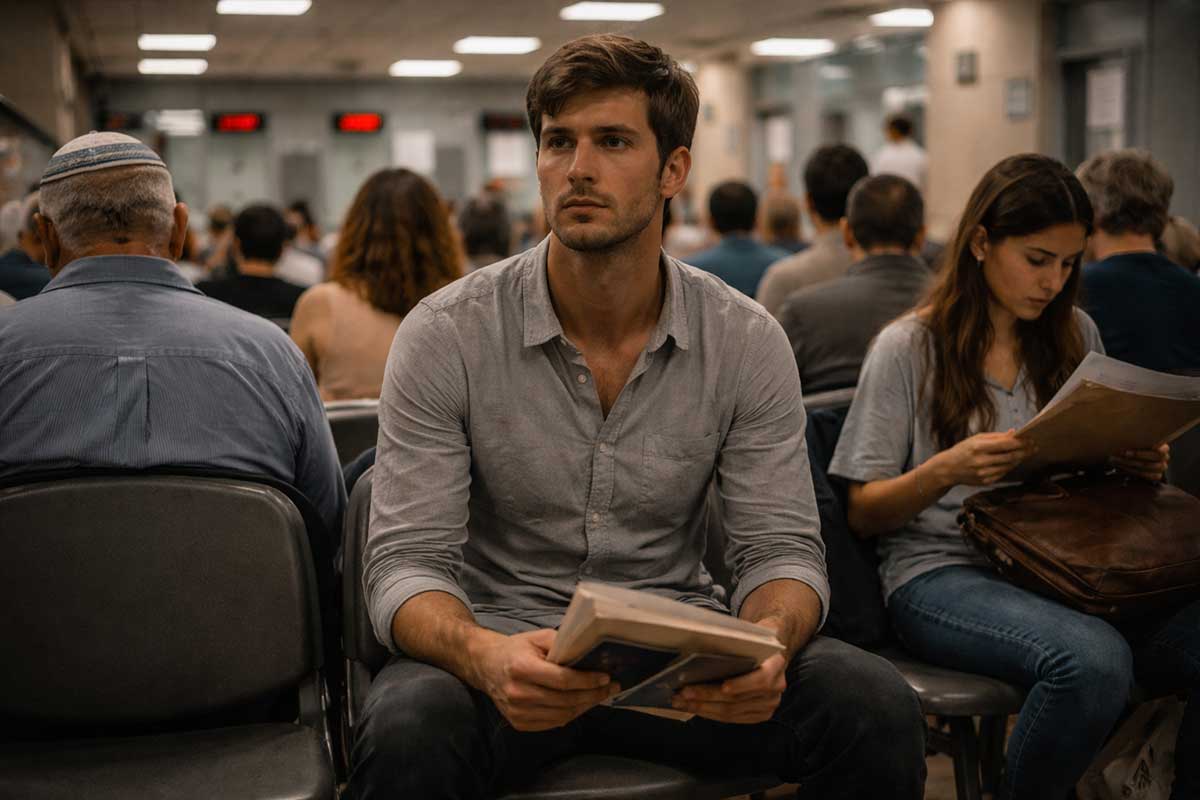
There he took a number and sat among the country in miniature.
A young couple with a baby. A religious man reading from a small book. A woman in gym clothes tapping furiously at her phone. An Ethiopian grandmother with regal posture and a shopping trolley at her side. Two men arguing in Russian. A teenager in headphones. A middle-aged clerk behind glass who called numbers with the tone of one summoning souls for measured judgment.
Yonatan watched the digital display advance with the slowness peculiar to institutions that hold all the required power and none of the required shame.
When his turn came, the clerk examined his papers, stamped one, rejected another, asked for proof of an address already printed on the form in front of her, and then, after a pause, switched to English.
“You’re new.”
“Yes.”
“You need this first,” she said, circling a section with her pen.
“I was told to bring this.”
“You were told wrong.”
“By the website?”
She looked up at him with flat, professional pity.
“By life,” she said.
He wanted to laugh, but her face forbade frivolity. She handed the papers back through the slot.
“Next.”
Back on the street, he stood in the noon heat with his folder under his arm and felt an exhaustion out of proportion to the task. Nothing terrible had happened. No catastrophe, no humiliation worthy of the name, no active cruelty. Yet the day had worn him down by small denials. Each office window had said the same thing in a different accent: you are here, but not yet within.
He walked without aim and came upon a small public garden squeezed between apartment buildings. There were benches under trees, a patch of dust pretending to be grass, a rusting swing, and a fountain that no longer functioned but still received wrappers, leaves, and the occasional coin from hopeful children or pious cynics.
He sat on a bench in the shade.
Across from him a father tried to persuade a little girl to eat slices of apple from a plastic container. She accepted one slice, rejected the next, and finally lay across the bench with the boneless despair available only to children and the defeated. A man in a delivery uniform slept sitting upright, his head tilted back against the tree trunk. At the far end of the garden an old woman fed crumbs to birds with such concentration that the act took on liturgical dignity.
Yonatan took out his phone and saw a missed call from his father.
He considered ignoring it. Then he called back.
His father answered at once.
“Well?”
Yonatan almost smiled. His father had always believed that one word, properly used, could carry the structure of a whole interrogation.
“I’m alive,” Yonatan said.
“I assumed that. Your mother has been panicking in shifts.”
“I texted her.”
“A text is not evidence to mothers.”
Yonatan looked down at the dust near his shoes.
“How is it?” his father asked.
There it was, the question no one could ask without damaging it.
Yonatan searched for something honest that would not become melodrama.
“It feels less like coming home,” he said, “than like being admitted into a house where everyone is busy and no one has time to explain where the glasses are kept.”
His father was silent for a moment. In the background Yonatan could hear the faint domestic sounds of the apartment in New York: a cabinet door, plumbing, perhaps his mother moving from one room to another in cultivated worry.
“That sounds about right,” his father said.
“You thought it would be?”
“I thought,” said his father, “that you were in love with an idea old enough to survive contact with reality. The trouble is never the first contact. The trouble is whether you can love what corrects you.”
Yonatan leaned back against the bench.
“You could have told me that before I left.”
“I did,” said his father. “You were too busy being sincere.”
Yonatan laughed, and the father, hearing the laugh, softened.
“Listen,” he said. “You don’t have to report anything noble. You can say the coffee is bad and the forms are worse. We’ll still believe you’re having a serious experience.”
“The coffee is good, actually.”
“Then the country really has changed.”
They spoke a few minutes more. Practical things. Sleep. Money. Whether the landlord seemed trustworthy. Whether the neighborhood was safe. Whether Yonatan had enough adapters for the outlets. It was the kind of conversation fathers prefer: care hidden inside logistics, love made bearable by function.
When the call ended, Yonatan remained on the bench with the phone in his hand.
The little girl had agreed at last to eat the apple slices. The sleeping delivery man still slept. A bird landed near his foot, watched him, then hopped twice and flew away.
By late afternoon he returned to the apartment with his folder no lighter than before, though now containing two new stamps and one new refusal. He made coffee, sat at the table, and tried to read through a Hebrew news article with a dictionary open beside him. He got no farther than the second paragraph before the effort began to feel like trying to catch rain in tweezers.
He closed the laptop.
The room held that suspended hour before evening when sunlight no longer enters like an argument but lingers as if hoping to be asked to stay. Through the balcony door came the sounds of children below, then a burst of laughter, then the scrape of someone dragging a chair. He thought of New York, of the evening there still a whole world away in time, and of his mother perhaps standing in the kitchen looking at the clock and estimating, with maternal superstition, what sort of loneliness he might be feeling.
He was still sitting there when the siren began.
At first he did not move. The sound did not resemble any one thing from his old life. It was too steady to be an alarm in a store, too large to belong to a single vehicle, too public to be accidental. It entered the room like a fact that had already passed through many walls before reaching him.
Then he remembered Malka: If there is a siren, don’t stand on the balcony looking philosophical. Go downstairs.
His body obeyed before his mind caught up. He grabbed his phone, his keys, and nothing else, then hurried into the hall. Doors were already opening. Feet were already on the stairs. Malka was there one landing below, not flustered, not calm, simply efficient, holding the rail with one hand and motioning downward with the other.
“Come,” she said.
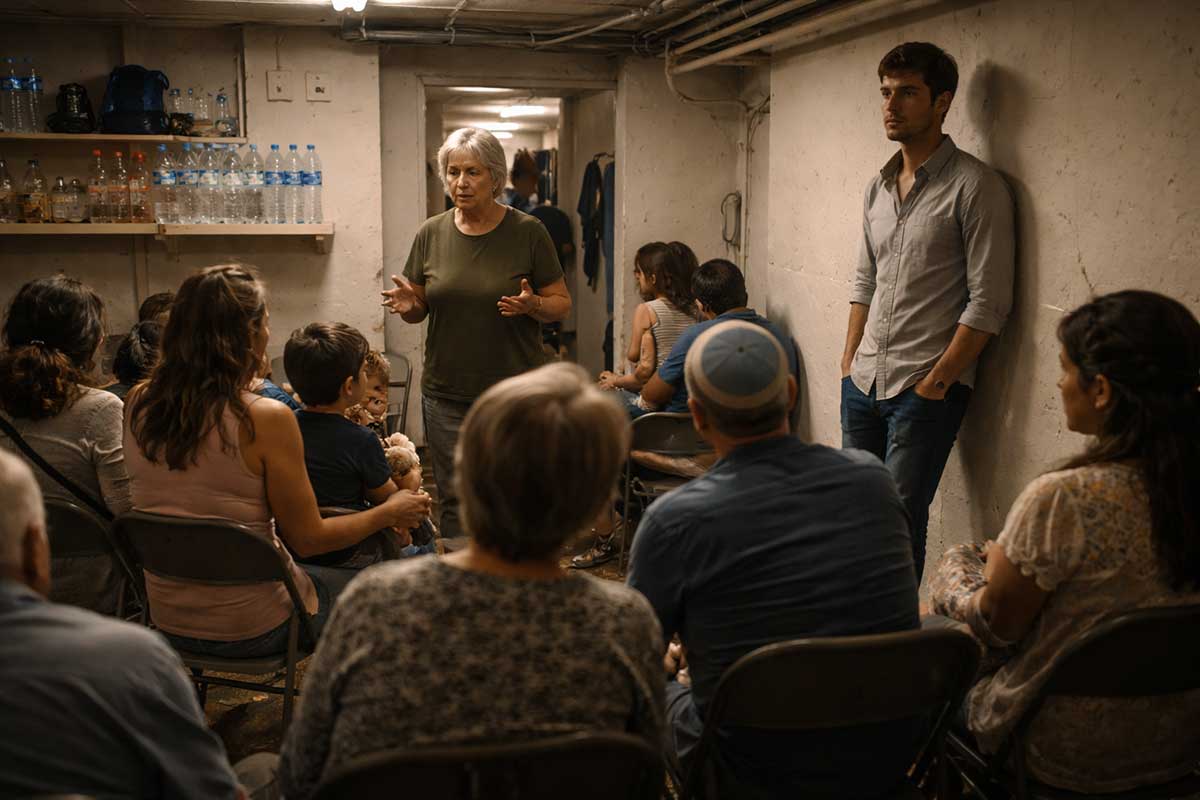
He followed the others into the shelter room at the bottom of the building. It was not large. Metal chairs, bottled water, a shelf with old board games, a bare bulb, a small vent high in the wall, paint the color of institutional patience. About a dozen people were there: the father from upstairs with his two children, a young man shirtless and annoyed, an elderly couple who seemed almost offended by interruption, a student with a laptop still open, Malka, and two women Yonatan had not yet seen.
No one screamed. No one prayed aloud. No one gave a speech. They took their places with the strained ordinariness of people repeating a chore they wished no longer to know.
Yonatan stood by the wall, breathing harder than the rest.
A little boy, perhaps six, looked up at him and asked in Hebrew, “First time?”
Malka answered for him. “Yes.”
The boy nodded, satisfied, as if this explained the bad breathing.
One of the women held her phone up for better reception. Another read from a neighborhood group chat and announced something too fast for Yonatan to follow. The shirtless man rolled his eyes. The student finally closed the laptop. The little girl from upstairs swung her legs under the chair and hummed to herself.
Yonatan felt, at that moment, less fear than strangeness. The room was real. The people were real. The siren outside was real. Yet his own presence among them seemed delayed, as though part of him had not yet reached the same floor.
He looked at Malka.
She caught the look and said, in English this time, “You see? The country introduces itself in chapters.”
“How long do we stay?” he asked.
“Until we are told. Or until everyone becomes impatient and invents courage.”
There was a murmur of laughter from the older man in the corner, who had clearly understood enough English to recognize truth in it.
Minutes passed. Then more minutes.
The room settled into that peculiar temporary fellowship born from shared uncertainty and poor ventilation. Someone offered candies to the children. Someone complained about the building committee not replacing the shelter light sooner. Malka answered this complaint with such force that the matter died on contact. The shirtless man checked updates every thirty seconds and gave the impression of personal betrayal by all public systems.
Yonatan’s phone buzzed.
His mother: Are you okay? I saw something on the news.
He stared at the message and felt, with almost comic precision, the split of his life into parallel theaters: one room here with bottled water and folding chairs, another room there with cable news and fear trying to imagine distance.
He wrote: I’m fine. In the shelter. Don’t worry.
He knew the second sentence was useless. It is the one message children send to parents in every age, and parents read it with the same helpless disbelief.
At last someone announced that the alert had ended.
The room rose not with relief but with the resignation of people returning to an interrupted activity whose value had not increased during the pause. Chairs scraped. Phones were checked. Children resumed ordinary complaints. The elderly couple climbed the stairs with the same offended dignity with which they had descended. Malka waited for Yonatan.
As they went up, she said, “Now you have your story for relatives.”
“I don’t think they wanted this kind.”
“No one wants the country in the form it gives itself.”
On his landing she stopped.
“Meeting is in twenty minutes,” she said.
He stared at her. “There’s still a meeting?”
“Of course. Water pressure did not solve itself.”
She went on upstairs.
Yonatan returned to his apartment and stood in the middle of the room. The coffee cup still sat on the table. The forms were where he had left them. The open dictionary lay on its face like a bird that had struck a window. Nothing had changed. Everything had.
He washed his face, changed his shirt, and went downstairs to the meeting.
The shelter room had been rearranged. Chairs in a circle now. Papers on a table. A plate of dry biscuits. Water bottles. The same neighbors who had shared alarm now prepared to share complaint, which perhaps was the stronger form of social glue.
The meeting unfolded in Hebrew too fast for him to follow in full, yet not so fast that he failed to feel its structure: accusation, interruption, defense, statistics of dampness, old promises, new suspicions, an appeal to fairness, an appeal to memory, the invocation of a contractor’s cousin, then laughter from somewhere, then a return to grievance. Malka presided with brisk fury. The father upstairs spoke gently and was ignored. The shirtless man, now properly dressed, fought as if the roof leakage were an assault on metaphysics.
At one point Malka turned to Yonatan and said in English, “You see? Now you belong. They are boring you in Hebrew.”
And strangely, she was right.
As the argument about bicycle storage swelled and bent into another tributary of collective life, Yonatan felt the first faint stirring of something that was not yet comfort and not yet home, but was no longer pure strangeness either. He did not understand all the words. He did not know the history of the grievances. He could not have explained the alliances, resentments, or roof politics to anyone outside the room.
Yet he was inside the room.
That night, after the meeting, after the last complaint had dried on the air and the neighbors had gone back to their apartments carrying equal portions of indignation and routine, Yonatan returned upstairs and sat at the table with his notebook.
He wrote:
A country is not entered only through border control. It is entered through waiting rooms, shelter rooms, and arguments about leaking roofs.
He paused, then added:
Fear may gather strangers, but inconvenience teaches them one another’s names.
He looked at the sentences, left them uncrossed, and listened.
From somewhere above came the sound of Malka moving furniture with the same moral force she brought to meetings. From the street below rose a scooter, then laughter, then silence again. The city, having interrupted him, now allowed him back into the evening as if nothing had happened.
He sat a long while before turning off the light.
In the darkness, one thought remained with him more than the siren, more than the shelter, more than the building quarrels. It was this:
The country had begun, at last, to include him in its inconveniences.
And for the first time since his arrival, that felt almost like an honor.
Chapter 4: Bureaucracy and First Guide
By the fourth day the city had begun to recognize him in the way cities do: not by affection, but by repetition. The grocer no longer looked surprised when he entered. The girl at the bakery did not switch to English until he failed twice. The bus driver waved him forward with the same weary contempt he offered everyone else. Even the cats on the wall below his balcony had stopped staring at him as though he were a temporary object left out by mistake.
This, Yonatan understood, was progress.
He had an appointment that morning at a government office whose purpose had been explained to him three times by three different people and still remained abstract in his mind. Something about registration, confirmation, identity, residence, numbers becoming other numbers. He had written down the address on paper, though it also lived in his phone, as if mistrust of technology were a habit he had inherited along with his grandfather’s prayer book.
The building stood on a wide street where heat gathered early and reflected upward from the pavement with an almost moral aggression. Its entrance was framed by tinted glass and metal detectors, which gave it the look of a place prepared equally for paperwork and siege. Outside, under a patch of weak shade, stood a line of people carrying folders, envelopes, plastic sleeves, passports, copies of copies, and the expression of those who have come to seek recognition from a system that believes itself already generous.
Yonatan joined the line.
Ahead of him was a young woman with a stroller and a folder thick enough to suggest either migration or divorce. Behind him stood a man in a linen shirt speaking into his phone in French, pausing now and then to sigh with theatrical precision. Two places ahead, an elderly religious man opened his briefcase and checked its contents every few minutes as though documents were a breed of nervous animal capable of escape. Near the entrance, a security guard with forearms like rolled carpets examined each bag with the calm of one who trusted nobody and was not paid to apologize for it.
The line moved, stopped, moved again.
By the time Yonatan reached the detector, he had already begun to feel that his existence had become conditional upon plastic bins. Keys, phone, wallet, folder, belt. He passed through the scanner, retrieved his things, and entered a waiting hall lit with the ruthless clarity of official interiors everywhere: no shadows in which dignity might recover itself.
A machine dispensed numbers.
He took one and looked up.
On the wall, digital screens displayed numbers being called, though the order seemed less numerical than theological. Whole stretches of possibility vanished without explanation. One did not progress toward one’s turn. One merely lived under the possibility of it.
He sat.
The chairs were connected in rows, a design based on the assumption that discomfort prevents disorder. A television mounted high in the corner played a morning talk show with subtitles and too much smiling. At the far end, behind glass partitions, clerks worked with the measured briskness of people who had seen every document and believed in none of them.
Yonatan placed his folder on his lap and looked around.
He had begun, over the last days, to notice how many languages moved inside the country at once. Here they were all present again: Hebrew at the loudest volume, Russian spoken in low clusters, French sharpened by irritation, English deployed for rescue or display, Arabic passing through the room like a quieter current beneath the rest. He had imagined that arrival in one country meant entering one speech. Instead it meant standing where many unfinished histories had agreed to file forms under the same roof.
The woman with the stroller sat two chairs away. The child, a boy of perhaps two, held a small plastic truck and struck it rhythmically against the metal armrest.
A man across from them leaned forward.
“He’ll break it,” he said in Hebrew.
Without looking up, the woman answered, “Then it will learn.”
There was a brief silence in which several people, Yonatan included, admired the sentence.
His number remained uncalled.
After half an hour he took out the booklet from the immigration office and pretended to read it. After forty minutes he watched the screens. After fifty he began to suspect that the system contained, hidden somewhere within it, a moral test unrelated to paperwork. At the hour mark he bought coffee from a machine that produced a liquid tasting of scorched patience.
At last his number appeared.
He crossed the hall and entered booth four, where a clerk in her thirties sat before two monitors. She wore her hair pulled back, no jewelry except a watch, and an expression neither hostile nor kind but trimmed to the exact shape of public service.
She held out her hand.
“Documents.”
He passed them over.
She looked through each page in silence, clicking with the mouse, typing, glancing from screen to passport to page and back again. Her Hebrew, when she spoke, was too quick for him. She saw his face and shifted into English with the smallest possible reduction in speed.
“You need proof of address.”
“I have the lease.”
“This is not enough.”
“What do you need?”
“Bank statement. Utility bill. Municipality letter.”
“I just arrived. I don’t have those yet.”
She nodded once, as if confirming not his hardship but the existence of sequence in the universe.
“So first you need bank.”
“The bank says I need this.”
She looked at him. It was not a cold look. It was worse. It was the look of someone who has long since accepted circularity as one of the country’s native geometries.
“Yes,” she said. “This happens.”
He almost laughed.
“What am I supposed to do?”
She tapped the desk with one finger, thinking. Then she took a form from a side tray, stamped it, signed it, and slid it toward him.
“Take this to the bank. Then come back.”
“Do I need another appointment?”
“Of course.”
“When?”
She pointed to a website printed at the bottom of the page. “Online.”
He looked at the paper, then back at her. “That site doesn’t work.”
A faint change passed over her face, the bureaucrat’s version of humor.
“Sometimes,” she said, “it works for the patient.”
He thanked her and left, carrying the stamped form as if it were an injured bird he had been told might yet sing.
Outside, the heat had matured into something nearly hostile. He crossed the street and stood for a while under a tree that gave little shade and less consolation.
The morning had yielded no victory in the old sense. Yet he was no longer wholly defeated by that. Already he could feel his expectations adjusting. He had come imagining revelation. The country was offering process. Perhaps process was its truer form of revelation.
He walked toward a small café he had passed on the way in. It was narrow, cool, and shadowed, with a counter of scratched wood and shelves lined with jars of tea, bottles of mineral water, and books left behind by customers who either hoped to civilize the place or had simply forgotten their possessions. Three ceiling fans turned overhead with the indifference of old governments.
At the far end sat a man in his late sixties reading a newspaper folded with unusual neatness. He wore a short-sleeved shirt buttoned to the neck and glasses with thick frames. A leather satchel rested at his feet. There was something composed about him that was neither academic nor military and perhaps slightly resembled both.
Yonatan ordered coffee and sat near the window.
A few minutes later the older man lowered the newspaper and said, without introduction, “You are carrying papers as if they have insulted your family.”
The English was elegant, the vowels marked faintly by some other place.
Yonatan smiled despite himself. “They may have.”
“Then you are becoming local very quickly.”
The man folded the paper. “You are new.”
This sentence was becoming less observation than category.
“Yes.”
“From where?”
“New York.”
“Ah.” The man nodded. “A city that believes confusion is sophistication.”
Yonatan laughed. “And this city?”
“This city believes confusion is governance.”
He extended his hand.
“Amos Lev.”
Yonatan gave his own name.
“Sit,” said Amos, gesturing to the chair opposite him. “No one should suffer administration alone on an empty stomach.”
Yonatan moved to the table with his coffee.
Amos looked at the stamped form protruding from the folder and said, “Interior Ministry?”
“Something connected to it.”
“Of course. In this country all roads lead either to prophecy or to a clerk.”
He spoke without bitterness. Rather with the practiced irony of someone who had made a long marriage with national contradiction.
“What did you do before?” Yonatan asked.
“Before what?”
“Retirement.”
Amos lifted one shoulder. “Many things. Army. University. Translation. Some years in government, which taught me that no state is as large as its paperwork suggests. Some years abroad, which taught me that exile is portable.”
He stirred his coffee though he had added nothing to it.
“And you? Why did you come?”
It was the question beneath all the others. Yonatan had answered it differently to officers, strangers, parents, and himself. Yet before Amos he found he did not wish to lie.
“I thought,” he said slowly, “that if I came here, some split in me might become simpler.”
Amos regarded him.
“And has it?”
“No.”
“Good,” said Amos.
Yonatan looked up. “Good?”
“Yes. Simplicity is usually purchased at the price of falsification.” He leaned back. “Young people come here for belonging, conviction, repair, romance, identity. Older people stay here from habit, loyalty, stubbornness, grief, family, debt, memory, and lack of better weather elsewhere. Between the two lies the actual country.”
Yonatan drank his coffee.
Amos went on. “Do not misunderstand me. I am not mocking your reasons. Without reasons that are too large, no one would come at all. But if you are wise, you will let the place reduce them.”
“Reduce them?”
“To human size.”
The sentence rested between them.
Outside the window a cyclist swerved around a delivery truck with theatrical outrage. Inside, someone dropped a spoon. The fans kept turning.
Amos unfolded the newspaper and tapped an article Yonatan could not read from where he sat.
“Everyone is arguing again,” he said. “Security, religion, courts, schools, budgets, borders, language, what kind of state this is, what kind of people we are, whether we are ending, whether we are beginning, whether either word means anything anymore. Every generation thinks it has discovered the crisis. It is very flattering to the generation.”
“You sound tired,” said Yonatan.
Amos smiled. “I am. But tiredness is not disbelief. It is only disbelief after surviving idealism.”
He folded the paper once more, exactly.
“You came here with books in your head,” he said. “That is clear.”
“Yes.”
“Good books?”
“I hope so.”
“Then keep them. But do not force the country to resemble them. It never will. It has read too much of itself already.”
They talked another half hour. About Hebrew. About neighborhoods. About the difference between reading history and living among those who quote it selectively. About translation, which Amos said was the most honest intellectual profession because it begins by admitting loss. When Yonatan mentioned his grandfather’s siddur, Amos nodded as though this completed a small map.
“Your generation,” he said, “inherits symbols in fragments. A prayer book, a family story, one holiday observed seriously, another ironically, a grandfather who believed, a father who historicized belief, a mother who preserved gesture without insisting on doctrine. Then one day the fragments begin making claims on you, and you mistake the claim for destination.”
“And it isn’t?”
“Sometimes it is. More often it is summons.”
“To what?”
Amos smiled slightly. “To the next confusion.”
When they parted, Amos took a card from his satchel and placed it on the table.
“If you ever wish to talk,” he said, “or to read something less incompetent than government websites, call me.”
The card was plain. No title, only a name, a phone number, and an email address.
Yonatan slipped it into his wallet.
Back on the street, the city seemed slightly altered, though he knew the change was in him. Nothing had become easier. The bank would still require the paper. The website would still misbehave. The forms would continue breeding in folders. Yet the day had yielded a first conversation that did not place him merely in the role of newcomer, applicant, son, or tenant. For an hour he had been addressed as a mind.
He walked to the bank.
There he waited again, though less angrily now, and at length sat before a young banker whose suit fit him too well for sincerity. The banker studied the stamped form, frowned, scanned it, requested a second form, then a passport, then proof of a phone number, then proof of an address, then, with a tiny flourish of magnanimity, accepted the lease after all.
“You see?” said the banker. “Possible.”
Yonatan almost told him what Amos had said about governments and paperwork. Instead he signed where indicated.
By late afternoon he emerged with an account number, a packet of terms no one had written for humans, and the feeling of having bartered part of his soul for the legal right to receive electricity bills.
He took the bus home.
At a red light the bus halted beside a row of apartment buildings whose balconies were cluttered with plants, bicycles, satellite dishes, air-conditioning units, children’s toys, laundry, folding chairs, and the visible evidence that life, when lived fully, exceeds architecture. On one balcony a young woman in exercise clothes watered basil. On another an old man sat shirtless reading a religious tract through a magnifying glass. On another a boy leaned over the railing and shouted to someone below with the urgency usually reserved for national emergencies.
The bus lurched on.
He got off near his street and stopped at the grocer’s. The owner, who had previously communicated with him through narrowed eyes and price totals, now said in Hebrew, “You need a bag?”
Yonatan answered, in Hebrew, “No, thank you.”
The owner grunted. It was, in context, nearly affectionate.
At the apartment building entrance Malka stood with two shopping bags and a look of irritation directed partly at the world and partly at gravity.
Without speaking, Yonatan took one of the bags from her.
She glanced at him. “Ah. Already useful.”
They climbed the stairs.
At the second landing she said, “You went to offices.”
“How do you know?”
“You are carrying the face.”
He laughed.
“Successful?”
He considered. “I have acquired a bank account.”
Malka nodded with stern approval. “Good. Money is easier to lose now.”
At her door she took the bag back.
“Tonight the water may be shut off for one hour,” she said. “Do not panic. The plumber is the cousin of the man from upstairs, which means either everything will be fine or the building will collapse.”
“Thank you.”
She looked at him a moment longer.
“You are less offended today,” she said.
“Am I?”
“Yes. This is also progress.”
She went inside.
In his own apartment, Yonatan set the groceries down and opened the balcony door. Evening was assembling itself. The trees moved slightly. Somewhere below, dishes were being washed. A radio played an old song he did not know. The air carried sea salt, hot stone, and cooking oil. The city had not become transparent. It remained layered, withholding, contradictory. Yet he no longer felt entirely outside its grammar.
He made coffee and sat at the table with the stamped form, the bank papers, Amos’s card, and his notebook.
For a long time he did not write.
Then, slowly, he put down:
A land first appears as promise, then as obstacle, then as argument. Only later, if one remains, does it begin to speak as companion.
He read the sentence twice.
Then, beneath it:
Today an old man told me not to force the country to resemble the books in my head. It was the first mercy that did not feel like comfort.
He closed the notebook.
Night settled. Lights came on across the street, each window its own arrangement of loneliness, habit, television glow, family noise, prayer, fatigue, appetite, and unfinished thought. He stood at the railing and watched them without envy.
The siren had not sounded that evening. No one argued downstairs. No clerk had stamped him into being. Yet something had shifted all the same.
For the first time since arriving, he did not feel that the country was refusing him.
It was reading him.
Chapter 5: Rain, Books, and Voices
On the fifth morning the city gave him rain.
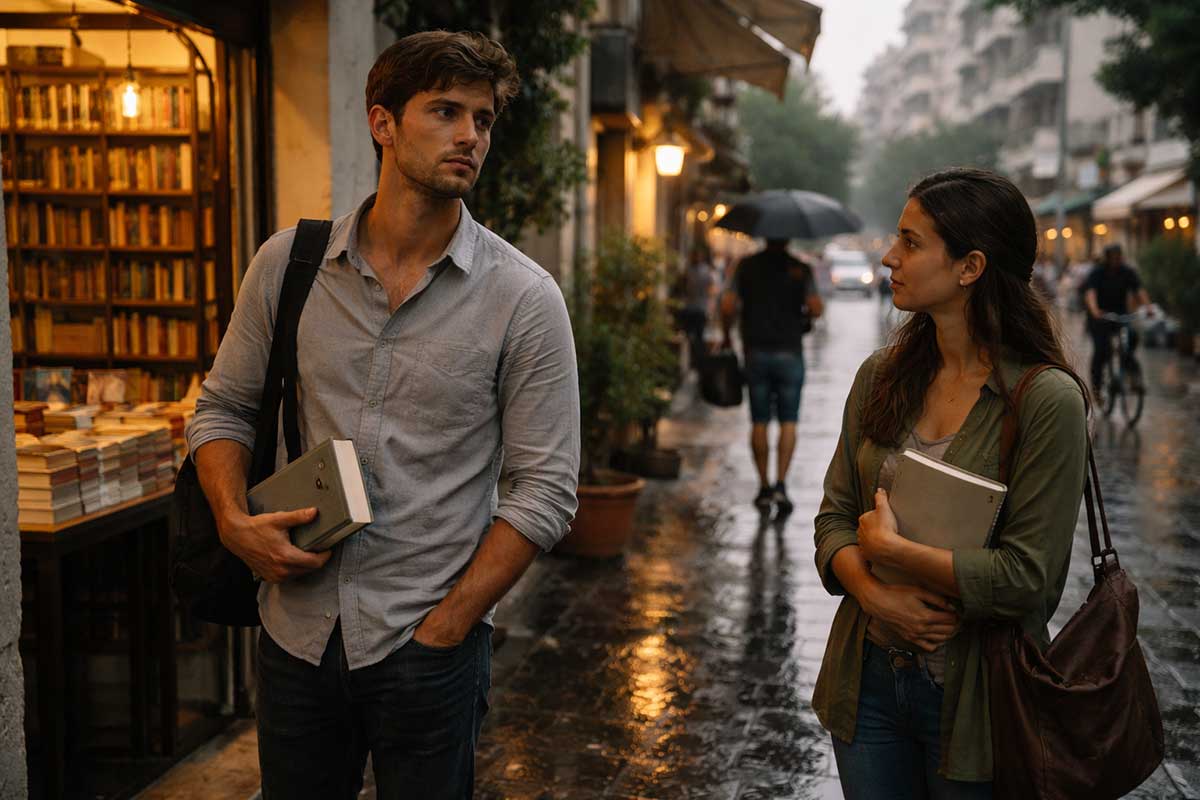
Not much. Not the full dark weather of northern countries, where the sky commits itself and the streets submit. This was a brief rain, uncertain and almost embarrassed by its own appearance, as if some cloud passing over the coast had changed its mind too late to withdraw. Yet the drops struck the balcony rail, the leaves of the tired trees, the hood of a parked scooter, and the cracked pavement below with a freshness that made everything seem, for ten minutes, newly pronounced.
Yonatan stood at the open door and watched.
Rain had always moved him more than it should. In New York it had meant weather, inconvenience, a different coat. In his grandfather’s stories it had meant blessing, providence, a season’s judgment. Here, on his fifth morning in the country, it seemed to mean neither and both. It was only water falling, yet it touched the city as if reminding it that dust was not its first condition.
The old man across the street, keeper of the plants, came out onto his balcony holding a towel over his shoulder. He looked upward with the expression of one asked to forgive a relative after a long quarrel. Then he began moving pots inward, muttering all the while. Yonatan could not hear the words, but the rhythm suggested complaint elevated to ritual.
He made coffee and drank it standing, his notebook still closed on the table.
He had an hour before his next appointment, this one at the bank again, where he was to present what the government office had required in order to later present to the government office what the bank had confirmed. He had stopped asking whether this circularity was accidental. A country, like a faith, often expresses itself best through forms no outsider would willingly invent.
The rain stopped almost as soon as he had accepted it. By the time he left the building, the street already carried the after-smell of wet concrete warming back into itself.
At the corner bakery, the girl with the silver ring handed him coffee before he finished ordering.
“Black,” she said.
“Yes.”
“And the cheese one.”
“Yes.”
She slid the pastry onto a plate. “You see? Now you exist.”
This, delivered without irony, pleased him more than it should have.
A man beside him in line turned and said, in English, “Careful. Soon they’ll ask your opinion.”
The man was in his forties, broad-shouldered, with close-cropped hair beginning to gray and the restless alertness of someone whose body had long ago learned to treat stillness as provisional. He wore jeans, a faded olive jacket, and a watch too durable to be decorative.
Yonatan smiled. “That would be premature.”
“In this country nothing is premature except peace.”
He held out a hand.
“Rafi.”
They carried their coffees outside and stood under the awning. The street shone in patches where the rain had passed over it and failed to linger.
“You’re new,” said Rafi.
“Yes.”
“Of course. No local stands under an awning admiring a five-minute rain.”
There was no insult in it. Only classification.
“What brought you?” Rafi asked.
Yonatan, by now practiced in the question, gave the shortened version.
“I wanted to live here.”
Rafi nodded as if hearing, behind the sentence, the unspoken layers.
“Good,” he said. “As long as you don’t expect the country to admire your reasons. It has too many of its own.”
He said it casually, then checked his phone. Something on the screen altered his face for an instant, tightening it from the inside, before he slipped the phone back into his pocket.
Yonatan had seen that expression now on many faces. It was not panic. Not even fear, strictly speaking. It was the body’s small acknowledgment that life here could tilt without warning and that one must continue standing through the tilt.
Rafi saw him notice.
“Reserve duty group chat,” he said. “Half the country is ruled by these now. The other half pretends not to be.”
“Are you in the reserves?”
Rafi gave a short laugh.
“I’m in everything I hoped to outgrow.”
They walked a little way together. Rafi worked, he said, in municipal logistics, which sounded dull until he described it and made it sound like the management of a nervous system. Traffic barriers, emergency supplies, shelter inventories, damaged roads, delivery coordination, repairs, shortages, all the hidden labor that keeps a city from confessing how fragile it is.
“We think history is made by speeches,” he said. “Mostly it’s made by the people who know which warehouse still has batteries.”
At the next corner he stopped.
“You’ll learn the country faster if you talk to workers,” he said. “Not only writers and professors.”
“Have I already given myself away as someone looking for writers and professors?”
“You are carrying a notebook in your coat pocket.”
Yonatan looked down. The outline was visible.
Rafi grinned. “Exactly.”
He walked off, lifting two fingers in farewell.
By the time Yonatan reached the bank, the street had dried completely.
The waiting area was full again, though the banker in the sharp suit recognized him with enough familiarity to make indifference seem personal.
“You came back,” said the banker.
“I was told to.”
“Yes,” said the banker. “This is a country of returns.”
The paperwork proceeded with fewer obstacles than before, which only made Yonatan suspicious. He signed, initialed, confirmed, accepted terms he could not possibly have loved, and received the statement required for the office he would visit tomorrow. He left almost disappointed, as if ease had deprived him of an anecdote.
Outside the bank he found himself unwilling to go straight home.
The city was warming toward noon. Light gathered on windows. Motorbikes threaded between cars with the confidence of creatures who believed traffic laws were interpretive rather than binding. A woman carrying flowers argued with someone through earbuds. Two construction workers shouted to each other from different levels of scaffolding. A schoolboy kicked at a bottle cap as if practicing for future disdain.
Yonatan turned inland, away from the sea, and let the streets grow narrower.
Here the city changed texture. Cafés gave way to workshops, small groceries, old stone houses cut up into apartments, synagogues tucked between storefronts, repair shops, pharmacies, shutters faded by decades of sun. Laundry hung above alleys no guidebook would praise. On one wall was a mural half-covered by newer posters and political stickers. On another, a mezuzah leaned slightly on a weathered doorframe, as if age itself had begun to bow.
He entered a used bookstore to escape the heat.
The place was long and dim, with shelves reaching nearly to the ceiling and a smell made of paper, glue, dust, and years. A fan turned slowly over the counter. Books lay not only on shelves but in stacks on the floor, on chairs, in milk crates, under tables, as if ordered storage had been attempted once and then surrendered to the livelier truth of accumulation.
Behind the counter sat a man with a beard gone mostly white and a sweater vest despite the weather. He wore half-moon glasses low on his nose and was reading a Hebrew book with one finger laid inside it to hold his place against interruption.
He looked up.
“English?” he asked.
“Yes.”
“Upstairs.”
“There’s an upstairs?”
The bookseller seemed to consider this a personal failure of architecture.
“Of course there is an upstairs.”
Yonatan smiled and climbed the narrow wooden steps.
The upper room held shelves of English, French, German, and Russian books, some new, many old, many carrying inscriptions from previous owners. He ran his hand along the spines. History, theology, novels, memoirs, philosophy, poetry, out-of-date travel books, dictionaries, Zionist pamphlets, obscure academic studies, yellowing paperbacks whose covers had once promised scandal and now promised only mildew.
He found a worn English edition of Agnon, then another, then Bialik, Amos Oz, Yehuda Amichai, Aharon Appelfeld. It struck him that a country could be entered through offices and buses and shelter rooms, yes, but also through the books by which it had argued with itself before one arrived.
At the back of the room, in a chair by a window, sat a young woman reading.
She looked up when he reached for a copy of Amichai on the shelf above her. She had dark curly hair tied back loosely, a pencil behind one ear, and the kind of attentive face that makes silence seem less empty than speech. On the chair beside her lay a tote bag full of books and a notebook already half-filled.
“Take it,” she said.
“Sorry?”
“The Amichai. You’re hovering politely.”
Her English was fluent, touched only lightly by Hebrew.
Yonatan took the book. “Thanks.”
“You’re not a tourist,” she said.
He laughed. “Do I look that uncertain?”
“You look too burdened for a tourist and too alert for a local.”
He accepted this.
“I’m Yonatan.”
“Noa.”
She closed her book but kept a finger marking the page.
“You’re new,” she said.
At this point the sentence had become almost sacramental.
“Yes.”
“You came upstairs first day?”
“No. Fifth.”
“Good. First day people come looking for meaning. Fifth day they come looking for air-conditioning and books. More reliable motives.”
He sat in the chair opposite her with the Amichai in hand.
“What are you reading?” he asked.
She turned the cover toward him. It was a collection of essays in Hebrew, heavily annotated.
“For work,” she said, with enough weariness to suggest that work and devotion were conducting an old struggle inside her.
“What kind of work?”
“Doctoral research.”
“In what?”
“Memory, language, postwar civic narratives, religion after national trauma.” She saw his expression and smiled slightly. “Which is a very expensive way of saying I read too much and earn too little.”
They talked.
Noa was studying at the university in Jerusalem but spending several days a week in Tel Aviv for archives, teaching, and escape, though she said escape in a tone implying it was never complete. Her father was secular, her mother from a religious family. She grew up translating between rooms even before she learned to translate between texts.
“This country makes interpreters of its children,” she said. “One relative speaks in history, another in grief, another in God, another in policy, another in accusation. At dinner you learn quick.”
Yonatan felt at once the pleasure and danger of the conversation. Pleasure, because her mind moved quickly without showing off. Danger, because he could already sense how easily one might begin speaking too earnestly to such a person and reveal more than one had intended to carry in public.
“You came for belonging,” she said after a while.
It was not a question.
“How do you all know that?”
“Because people rarely cross an ocean for convenience.” She leaned back. “Also, you’re holding Agnon and looking slightly wounded by the room.”
He looked at the book in his lap.
“I’ve been thinking about him,” he said.
“Dangerous.”
“Why?”
“People read Agnon when they want the country to become tragic, holy, ironic, and self-aware all at once. Sometimes the country is only tired.”
He laughed.
“That may be the best description I’ve heard.”
“Yes, well. Tiredness is one of our sacred texts.”
She rose and went to the shelf, pulling down another book.
“If you’re going to stay,” she said, handing it to him, “you should read diaries too. Not only novels. Novels can survive contradiction beautifully. Diaries show what it costs.”
He looked at the title: a translated selection of letters and journals from early immigrants.
“Thank you.”
She shrugged. “Consider it preventative medicine.”
When they went downstairs, the bookseller looked over his glasses at the two books in Yonatan’s hands and said, “Good. Serious confusion.”
Noa rolled her eyes with the familiarity of a regular.
Outside, they stood for a moment in the light.
“I’m taking the train later,” she said. “Back to Jerusalem.”
There it was, the name carrying more than geography.
He had not yet gone there since arriving. The city remained ahead of him like a text he was postponing not from indifference but from the sense that one does not begin with the most demanding scripture.
“Noa,” he said, “can I ask you something?”
“You can ask.”
“I don’t know yet if I deserve the answer.”
“That never stops anyone here.”
He smiled.
“Why does everyone speak as if the country were a person who keeps disappointing them and yet remains impossible to leave?”
Noa considered.
“Because for many people it is exactly that,” she said. “Not a person, of course. Worse. A collectivity carrying too many dead, too many hopes, too many arguments with God and history. You can’t simply enjoy it or resign from it. It enters your grammar.”
She adjusted the tote bag on her shoulder.
“And for newcomers like you?”
“For us?” Yonatan asked.
“For those who arrive with meanings already attached.” She looked at him with calm directness. “The first temptation is to romanticize. The second is to become disillusioned and call that wisdom. Better to pass through both and remain.”
Remain. The word stayed with him.
They parted at the corner.
He walked home with the books under his arm and the city moving around him in all its unfinished density. At a traffic light, a child in a school uniform licked melted ice cream from his wrist. At a bus stop, a woman argued into her phone in French while a soldier beside her slept standing up. A man on a ladder repaired an awning above a jewelry store. From an open window came the sound of someone practicing scales on a piano with relentless sincerity.
By evening he was back at the apartment, the books on the table, the notebook open, the balcony door ajar.
The old man across the street had returned his plants to their rightful places. The sky was fading from white into a pale, used gold. Someone downstairs was frying onions again. Someone else was singing. The city, for all its strain, still allowed itself these domestic acts, as if to say that endurance must put on ordinary clothes or it will fail entirely.
Yonatan opened the Amichai and read until the light thinned too far.
Then he turned to the notebook and wrote:
Today I met a man who said the country is made by warehouses and batteries, and a woman who said it enters your grammar. Between logistics and language, perhaps that is where a nation truly lives.
He paused, then wrote another line.
I came looking for belonging, but the place keeps offering instruction. Perhaps instruction is the first shape belonging takes.
He laid down the pen.
From somewhere beyond the buildings came the sea, invisible now but still present in the air. From somewhere inland, too far to see, lay Jerusalem, carrying its own weight of stone, prayer, memory, and pressure. Between them he sat in the small apartment, no longer entirely unreal to the city, and perhaps no longer entirely unreal to himself.
Night gathered slowly.
He turned off the light and remained for a while at the balcony, listening to the neighborhood settling into its uneven rest.
On the fifth day he had acquired little that could be displayed. A bank account. A statement. Two books. A few more Hebrew sentences. One conversation with a municipal worker, one with a scholar, one with a bookseller. Yet in another sense he had acquired much more than that.
The country had ceased to be only a destination.
It had become a series of voices.
Chapter 6: First Ascent to Jerusalem
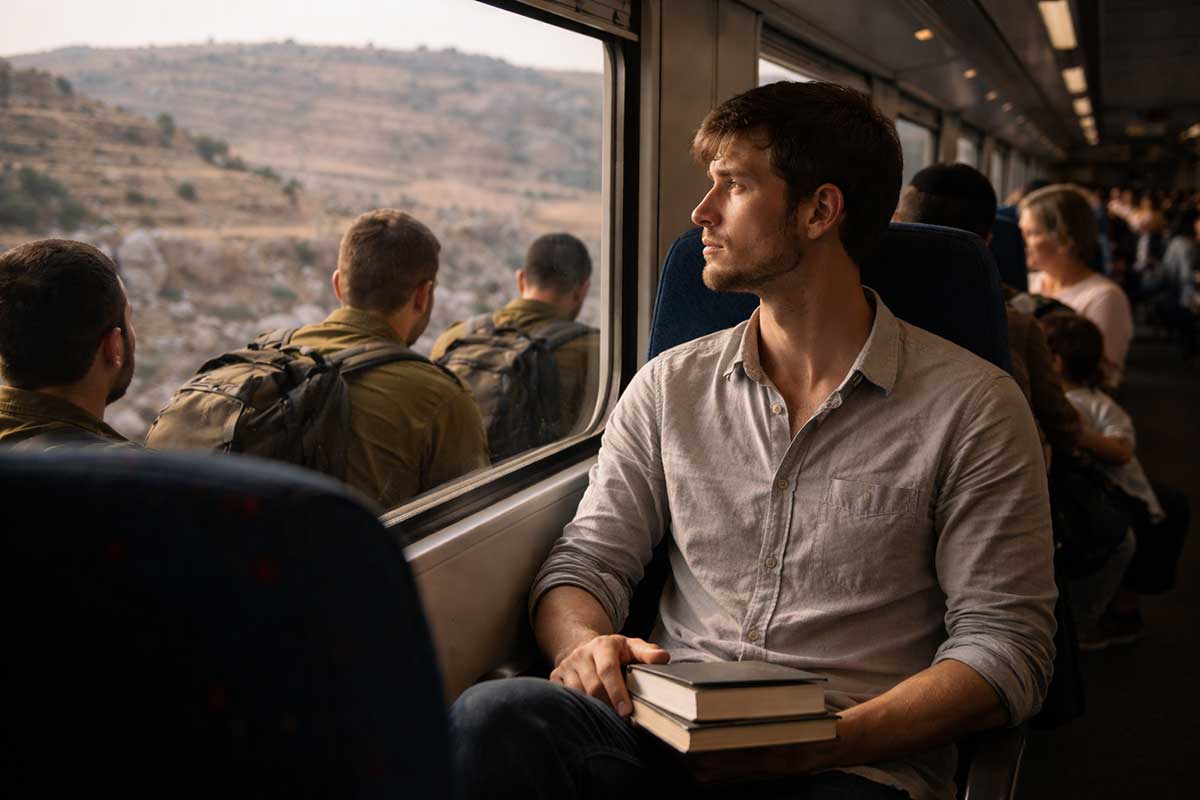
On the sixth day he went to Jerusalem.
He had delayed it, though he would not have admitted this to anyone and did not, at first, admit it even to himself. He had spoken of timing, errands, appointments, practical matters. The bank, the forms, the apartment, the neighborhood, the need to establish one shore before venturing toward the inland heights. Yet beneath these reasons lay another, less orderly one. Jerusalem had never been, in his imagination, merely a city. It had stood for too many things at once: faith, judgment, longing, inheritance, fracture, holiness, theater, grief. To arrive there too soon felt less like travel than like opening a letter one suspects may contain one’s sentence.
Still, the day came.
Noa had sent him a message the evening before.
If you’re serious about staying, you should stop postponing Jerusalem. Morning train is easiest. Don’t go with a guidebook face.
He had replied:
How do I avoid that?
Her answer came a minute later.
Look as if the place owes you nothing and may still wound you. That’s more accurate.
So he rose early, dressed simply, took his notebook but left one of the books behind, and walked to the station with the unease of a man going to meet a relative who has already shaped his life from a distance.
The platform was full but not crowded, a condition the country seemed to prefer in all things: enough bodies to prove urgency, not enough to make disaster inevitable. Around him stood commuters, students, soldiers, tourists pretending not to be tourists, religious families with bags and children and a portable weather of instruction around them, and a few solitary figures who looked as though they had traveled this line so many times that the journey itself had become a form of absence.
The train came clean and bright, its windows reflecting platform light and half-formed faces. Yonatan boarded and found a seat by the window. Across from him sat a young woman with a sleeping child draped over her shoulder, the child’s shoes untied and tapping softly against her coat each time the train shifted. Two rows ahead a pair of soldiers spoke in low Hebrew and then fell silent. Near the door an old man in a black coat read from a small book, moving his lips almost imperceptibly as the words passed through him.
The train pulled out.
At first the view gave him the familiar modern grammar of the coast: concrete, roads, overpasses, industrial lots, apartment blocks, fenced lots waiting for future ambition. Then, little by little, the landscape altered. The horizon lifted. The buildings loosened their grip. Dry hills began to appear, then deepen, then fold into one another with that ancient severity which seems less scenic than judicial.
He watched the land rise.
In New York, ascent belonged to towers. Here it belonged to earth.
He had read enough to know that people spoke of Jerusalem as if it were reached not only by road but by moral gradient. One went up to Jerusalem. The language itself had made elevation into theology. Sitting in the train, feeling the subtle climb under him, he understood for the first time why the phrase had survived. The city was not merely inland. It drew approach into symbolism whether one consented or not.
His phone buzzed.
Noa: When you get there, don’t start with the Old City. Let the place arrive in layers. Meet me near the station café.
He put the phone away and looked back at the hills.
They were not green in the generous way of wetter countries. Their beauty came from exposure, stone, scrub, terraces, old wounds held in sunlight. Here and there he saw roads cut into them, clusters of houses, retaining walls, cranes, settlements of the living set among landscapes already crowded with the dead. He thought of prophets, kings, exiles, pilgrims, bureaucrats, soldiers, archaeologists, widows, schoolchildren, vendors, rabbis, atheists, politicians, lovers, and all the other categories history forces into proximity in one overburdened place. By the time the train entered Jerusalem, he already felt as though he were arriving not in a city but in accumulated claim.
The station was newer than the city waiting beyond it. Its clean lines, escalators, signs, and polished surfaces seemed to declare with determined cheerfulness that one could still enter antiquity through steel and glass. Yonatan stepped onto the platform and followed the stream upward.
Noa was waiting near the café, holding two paper cups.
“You made it,” she said.
“I was told the city would notice if I kept avoiding it.”
“It notices everything,” she said. “That’s one of its defects.”
She handed him a coffee and began walking without asking whether he was ready. In Jerusalem, he would soon learn, readiness is a luxury claimed mostly by those who have misunderstood the place.
They took the light rail for two stops and then walked. At first what he saw was not holiness but the ordinary friction of urban life: traffic, buses, students, old men on benches, children in uniforms, municipal workers hosing down a sidewalk, a woman carrying groceries and talking into two phones with divided competence, a protest sign folded under someone’s arm, construction barriers, pigeons. The city did not present itself to him as a revelation. It began, insultingly almost, as a city.
“This disappoints many people,” said Noa, as if reading him.
“What does?”
“That Jerusalem is full of people trying to park.”
He smiled.
They turned onto a street lined with stone buildings, and there at last the visual grammar changed. Tel Aviv had been sun and improvisation, white walls, balconies, salt air, argument in motion. Jerusalem was stone, weight, slopes, facades bearing the dignity and fatigue of decades. The light itself seemed altered, harder and more inward, as if reflected not only by surfaces but by memory.
“Everything looks… already interpreted,” said Yonatan.
Noa glanced at him. “That’s good. Keep saying strange accurate things like that.”
They walked through neighborhoods whose names he knew from books but had never connected to actual sidewalks. Religious boys hurried past in black coats too heavy for the weather. Secular students with headphones and canvas bags sat outside cafés arguing over things that were either trivial or ultimate. Armenian clergy crossed a street with the sealed concentration of men who had practiced being out of time. A municipal truck backed up beneath laundry lines. Tourists appeared now and then, identifiable by shoes that suggested itinerary and the slight upward tilt of the face that meant they were already waiting to be impressed.
Noa took him first not to a holy site but to a small overlook where one could see stone roofs, church towers, cranes, trees, satellite dishes, and beyond them the layered spread of the city moving over hills.
“There,” she said. “That’s the first lesson.”
“What is?”
“That Jerusalem is never only one thing at once. Anyone who tells you otherwise is selling something.”
He stood beside her looking out.
The city did not resolve itself into beauty in the simple sense. It was too burdened, too interrupted, too conscious of being observed. Yet he felt drawn to it at once and in spite of himself. Tel Aviv had taken him in through daily repetition. Jerusalem offered no such ease. It stood at a distance even while one stood inside it.
“Do you love it?” he asked.
Noa took a moment before answering.
“Yes,” she said. “And no. And often unwillingly.”
They walked on.
She showed him the market first.
“This,” she said, “is also Jerusalem, and maybe a truer entry point than stones people are already prepared to worship.”
The market was loud, bright, crowded, aromatic, and gloriously uninterested in transcendence. Vendors shouted prices. Fruit shone in pyramids. Bread, spices, fish, halva, olives, pastries, knives, tea, nuts, coffee, detergent, cheap toys, kitchen tools, and arguments all occupied the same compressed universe. A butcher chopped with priestly seriousness. A boy ran with a bag of herbs. Two women leaned over a crate of tomatoes and debated as if national futures depended on firmness.
The smells came at him in layers: cumin, frying oil, mint, yeast, citrus peel, coffee, soap, raw meat, sun on stone, old wood, damp cardboard. He found himself smiling.
“Why are you smiling?” asked Noa.
“Because this feels less symbolic.”
“Good,” she said. “Symbolism is often where people become dishonest.”
They stopped for something fried and hot in paper, ate standing beside a spice stall, and then moved on. The market narrowed into alleys, then widened into streets again. Above one lane hung strings of lights not yet lit. Graffiti and ancient stone met without apology. A man with a white beard and a smartphone pressed to his ear stepped aside to let a teenage girl in army uniform pass. The city seemed to insist that contradiction was not a condition to be solved but a civic medium.
At last they approached the older parts.
Yonatan knew before Noa said anything that they were nearing the districts in which the city’s temperature altered without any help from weather. The air was the same, the streets still full, but attention thickened. He saw more police, more armed men, more pilgrims, more people walking not merely toward a destination but toward something they had already named inwardly as necessity.
“We don’t have to go in today,” said Noa.
He understood at once that she meant the Old City.
“Why not?”
“Because sometimes first entrances become theater. Better to know whether you’re entering for yourself or for the version of yourself watching.”
He let that sit.
“Would you recommend not going?”
“I would recommend honesty. Which is rarer.”
They stopped in the shade of a wall. Near them, tourists reorganized themselves around a guide holding a small flag. A priest led a group in murmured prayer. Two police officers stood talking with the relaxed vigilance of men who have learned to make unease look procedural.
Yonatan looked toward the gate and felt within himself a tightening he could not easily classify. Anticipation, yes. Fear, yes. Reverence, perhaps, though he distrusted the speed with which reverence can turn self-congratulatory in people who know they are having it.
“I think,” he said slowly, “if I go in now, I’ll be carrying too many witnesses inside myself.”
Noa nodded. “That’s already more wisdom than many pilgrims acquire in a lifetime.”
They did not enter.
Instead she led him around the perimeter, through quieter streets, past old stone houses with iron railings, small gardens, schools, plaques, courtyards glimpsed through gates, and then upward toward a neighborhood where the city opened again. They sat on a bench beneath a tree that had survived by means known only to old cities and stubborn roots.
For a while neither spoke.
Then Yonatan said, “Tel Aviv feels like a place where people keep trying to live forward. Jerusalem feels like a place where every step lands on someone else’s sentence.”
Noa laughed softly. “That’s close.”
He looked at her. “How do you live here?”
“I argue with it.”
“And it answers?”
“All the time. Usually in another language.”
He watched a group of schoolchildren pass with notebooks and backpacks, shepherded by a tired teacher whose face had already entered afternoon. One boy lagged behind reading while he walked, and the teacher, without turning, reached back and corrected his direction by the shoulder with the accuracy of long practice.
“It makes me feel judged,” said Yonatan.
“The city?”
“Yes.”
Noa considered.
“It judges everyone. The religious for their certainty, the secular for their evasions, the politicians for everything, the pilgrims for their fantasies, the locals for their fatigue, the newcomers for arriving with clean notebooks.”
He smiled.
“So there’s no right way to come here.”
“There may be no right way to come anywhere important.”
That sentence remained with him as they rose and walked again.
By late afternoon the light changed, becoming richer and more severe at once. Stone that had seemed flat now held warmth. Shadows sharpened. Bells sounded somewhere, then ceased. From another quarter came a distant call to prayer, and from somewhere else the faint rise of voices in study or devotion. The city did not blend these sounds. It laid them beside one another like adjacent truths unwilling to merge.
Noa took him to a small café on a side street where students and older men shared tables uneasily and the coffee came in cups too small for American expectation but exactly proportioned to Jerusalem’s lack of sentimentality.
“Tell me honestly,” she said. “What does it do to you?”
He looked out the window at the stone buildings opposite, each window holding its own fraction of the city’s long argument.
“It makes me understand why people become extreme here,” he said. “The place presses everything into ultimacy.”
Noa nodded.
“Yes. That’s one danger. Another is that people come here for ultimacy and then mistake their own intensity for truth.”
“And you?”
“I try,” she said, “to let the city expose me without letting it recruit me entirely.”
He laughed. “That sounds impossible.”
“It is. That’s why people stay.”
They spoke until the light had nearly gone.
When at last he boarded the evening train back to Tel Aviv, he carried no souvenir and had seen no final revelation. He had not entered the Old City. He had not touched any famous stone. He had not had the grand interior experience for which naïve visitors and older novels are always waiting.
Yet he felt altered.
The train descended through the darkening hills. Lights appeared in clusters, then vanished. The sleeping child in the seat ahead of him leaned against her mother’s shoulder in the old shape of trust. Two students argued quietly about politics. A religious man read. A soldier slept with his head against the window. The country moved with him in compartments, each life carrying some burden the train could not lighten.
He thought of Tel Aviv waiting by the sea, of Malka and the building, of Rafi and batteries, of Amos and reduction, of Noa and grammar. He thought too of Jerusalem, withheld and pressing, not yet entered at its center, already lodged in him.
Back at the apartment that night, he did not turn on the main light at once. He opened the balcony door and stood in the darkened room with the city’s softer coastal air around him.
Then he sat at the table and opened the notebook.
He wrote:
Today I went to Jerusalem and did not enter it. Perhaps that was the first honest thing I have done there.
He paused, then continued.
Tel Aviv asks whether you can live. Jerusalem asks what gives you the right. Between them, a person may begin to discover what he actually believes.
He stopped.
From below came a scooter, then laughter, then the closing of a car door. From far off came the sea, not visible but present. From farther still, beyond the night and the descending tracks, lay the city of stone and judgment, already waiting for his return.
He closed the notebook.
The sixth day had not solved him. It had done something more exact and more dangerous.
It had introduced him to elevation.
Chapter 7: Two Cities, Two Grammars

On the seventh day, Jerusalem followed him back.
Not in the grand way cities follow a man in novels, by means of visions, conclusions, or transformed resolve. It followed him in smaller and more faithful forms: in the altered weight of certain words, in the memory of stone under afternoon light, in the way Tel Aviv that morning seemed almost too quick to explain itself. The sea air still moved through the street below his balcony. The bakery still opened before the sky had fully chosen a color. Malka still argued with the plumbing as if moral pressure might improve water. Yet something in Yonatan’s hearing had changed. He now listened for inland gravity inside the coastal day.
He woke later than he intended. The train, the walking, the attention required by Jerusalem, all had left a fine weariness in him, not unpleasant, only exacting. He dressed and stood for a moment at the balcony door with coffee in hand.
Across the street, the old man with the plants was engaged in what appeared to be a private trial involving a hose that refused to cooperate. He looked up, saw Yonatan, and gave the hose a final irritated shake as if to say: witness this, the age in which even water must be argued into obedience.
Yonatan almost laughed aloud.
He had an appointment again at the office with the glass partitions and theological numbering system. This time he carried the bank statement, copies, passport, lease, stamped form, and one extra photocopy of each item, a precaution that felt less paranoid now than reverent. He had begun to accept that paper, once touched by enough hands, takes on in this country a ceremonial dignity denied to most persons.
At the bus stop, people stood in the loose formation cities call order. A student with earbuds and an unreadable expression. A mother with two children who already looked as though they had been negotiating since dawn. An older man in a knitted kippah holding a folded newspaper. A young woman in uniform drinking from a bottle of iced coffee and staring into the middle distance with the perfect stillness of temporary exhaustion.
The bus came full.
Yonatan boarded and stood gripping the overhead rail. At each stop the human arrangement shifted by inches, apologies, bags, elbows, public indifference, and the occasional act of spontaneous generosity performed so quickly it might have been denied by anyone who witnessed it. He found himself no longer observing all this as material. He was inside it enough now to be jostled without interpretation.
That too, he sensed, was progress.
At the office, the guard barely looked at him before waving him through. He was absurdly pleased. Recognition by authority, even in its most diluted form, exerts a humiliating pleasure on the soul.
His number was called faster this time. He took his place at booth four. The same clerk sat behind the glass.
She looked up, saw him, and said, “You came back.”
There was no warmth in it, yet no displeasure either. It was the voice one uses for a man who has not yet earned trust but has at least respected sequence.
“Yes.”
He handed over the papers.
She examined the bank statement, the lease, the stamped page, the passport, the copies. She typed, paused, typed again, frowned at the screen, then resumed typing. Yonatan stood still with the self-control of a defendant who has learned that innocence matters less than orderly presentation.
At last she printed something, stamped it twice, signed once, and slid the papers back.
“Next stage,” she said.
“Is this approved?”
“For now.”
He almost smiled. “That sounds unstable.”
“It is administrative,” she said, which here meant much the same thing.
Still, he left with a document he had not possessed an hour earlier, and therefore with one more degree of existence in the eyes of the state. Outside in the sunlight he stopped and looked at the paper. It was not beautiful. It contained no soaring language. It would not have interested any poet except a satirical one. Yet he felt in it a small, unadorned triumph.
He was still standing there when his phone buzzed.
A message from Noa:
How does citizenship-by-paper-cut feel?
He typed back:
Like being admitted into a school that refuses to say what it teaches.
Her answer came quickly.
That means you’re learning. I’m in Tel Aviv today. Late lunch?
They met in a café near the university district, a place full of students pretending to read and actually reading, professors pretending not to notice being noticed, and laptop workers inhabiting that newer class of urban person who appears to be employed entirely by light from a screen.
Noa was already there with books spread across half the table. Beside her coffee lay pages covered in annotations so dense they looked less written than cultivated.
“You look more official,” she said as he sat down.
“I have acquired a new paper.”
She nodded gravely. “Careful. One day you’ll wake up with folders.”
“I’m already afraid of that.”
“You should be.”
He told her about the office. She listened with the calm amusement of one who had survived enough systems to resist dramatic response.
“Jerusalem?” she asked.
“It stayed with me.”
“That’s its most manipulative habit.”
“I kept thinking about what you said. That it recruits intensity.”
“And?”
“And that I understood it too fast.”
She leaned back.
“Good. Quick recognition is less dangerous than slow seduction.”
He smiled. “Do you ever say anything simple?”
“Yes,” she said. “But only to cashiers.”
They ate. They talked first of small things, which in unfamiliar intimacy are often the larger mercy. Train stations. Coffee. Neighborhoods. The market in Jerusalem. The used bookstore. Her dissertation advisor, who, from her description, seemed to believe that clarity in prose was evidence of compromised thought. Yonatan described Rafi and Amos. Noa listened carefully when he spoke Amos’s name.
“You met Amos Lev?”
“You know him?”
“Know him? Not really. Know of him, yes. A great many people have been educated, corrected, or irritated by him.” She stirred her coffee. “He writes very little now, but when I was younger people still spoke of him as if essays could damage governments.”
“What was he?”
“A civil servant once. A public intellectual against his own instincts. A translator. A man who disappointed at least three ideological camps equally, which usually means there was something alive in him.”
Yonatan looked down at the table.
“He was kind.”
Noa gave him a quick, level look.
“Yes,” she said. “That’s rarer than brilliance, though the country often mistakes the order.”
After lunch they walked without a plan. In Tel Aviv, aimlessness quickly becomes method, the streets conspiring to carry a person somewhere social whether he intends it or not. They passed cafés, bookstores, bicycle repair shops, bars still asleep in the afternoon, playgrounds, Bauhaus facades, construction sites, dogs tied outside groceries with the solemn patience of citizens waiting for permits.
The city was bright, exposed, and restlessly secular in the surface sense, though Yonatan had already begun to suspect that secular life here carried its own liturgies, fears, inherited gestures, forbidden names, and private pieties.
At one corner they encountered a demonstration: not large, not small, the sort of gathering that in another country might count as an event and here seemed as common as weather. Signs in Hebrew and English. Police at a practiced distance. Passersby pausing, judging, joining, mocking, applauding, filming, refusing. The argument in the street had the feel of something both urgent and routine, like a recurring fever in a body still trying to work.
Noa stopped but did not go closer.
“Do you go to these?” Yonatan asked.
“Sometimes.”
“Why not now?”
She watched the signs for a moment.
“Because there are days when public conviction sharpens thought, and days when it merely organizes injury.”
“And today?”
“Today I’m not pure enough for slogans.”
They kept walking.
Her sentence stayed with him. He had heard many people in the country speak with force. Fewer seemed suspicious of the satisfactions that force provides.
By late afternoon they found themselves in a quieter part of the city, near older residential streets where balconies leaned over gardens and the air softened under trees. They sat on a bench. A child nearby was teaching another child a game whose rules changed each time losing threatened. Two old men argued under a fig tree with such concentration that they had clearly been carrying the argument for decades.
Noa took out a notebook, then put it away without writing.
“What?” asked Yonatan.
“I had a sentence and didn’t trust it.”
“About what?”
“About this place. About how people here inherit emergency as atmosphere and then wonder why tenderness arrives late.”
He did not answer at once.
At length he said, “Is that what you study? Or what you live?”
She smiled without looking at him.
“You’re new enough to still think those can be separated.”
There it was again, the sensation he had begun to feel with her: that conversation itself was a terrain on which one might advance too quickly and discover, only afterward, that what felt like intelligence was exposure.
He looked at the children instead.
In the pause that followed, something subtle changed. Not distance exactly. But a recognition that another register had opened between them, one that neither seemed eager to exploit and neither entirely wanted to close.
At last Noa said, lightly now, “Tell me something non-abstract. What does Malka think of you?”
Yonatan laughed, grateful.
“That I’m less offended than before.”
“Then she likes you.”
“She does?”
“Yes. In buildings like yours affection is distributed through complaint management.”
Toward evening they walked back toward the busier streets. At a crossing they stopped, waiting for the light. A religious family passed them, the father carrying groceries, the mother steering two children and a stroller through the stream of traffic with the concentrated authority of one who had long ago given up expecting the world to slow first. A shirtless cyclist shot through the intersection against the light, pursued by curses. A taxi driver leaned on the horn as if doctrine required it.
Noa looked at the scene and said, “There. The whole country in twelve seconds.”
When they parted, it was without arrangement. No explicit promise for tomorrow, no formal closure, only a shared sense that the conversation had not ended so much as paused within a larger movement still being discovered.
Yonatan walked home alone through the gold hour.
The city, after Jerusalem, no longer seemed light in the old way. It had its own burden now in his eyes. Not lesser, only different. Tel Aviv carried forward motion, improvisation, appetite, denial, repair. Jerusalem carried judgment, compression, inheritance, ultimacy. Between them he was beginning to see not two Israels, but two time signatures beating against the same life.
Back at the apartment, he found a note from Malka taped to his door.
Water returns at 7. If brown, wait. Not a disaster. Probably.
He stood holding the note, smiling in spite of himself.
Inside, he opened the tap. The water came clear.
He made coffee anyway.
As evening settled, he took Amos’s card from his wallet and turned it over. No message on the back, no hidden line, no aphorism worthy of older men and older stationery. Just a name and means of contact. He put it on the table beside the notebook.
Then he wrote:
Tel Aviv lets a person scatter. Jerusalem compels him to gather. Between the two, one may either come apart or begin to take shape.
He paused.
Then, after a while:
Today I understood that the country is not divided only by politics, religion, memory, and class. It is divided by tempos of soul. Some live as if everything must be decided now. Others live as if all decision has already been made long ago.
He read the lines and left them standing.
Night came on gently. From somewhere below rose the smell of frying garlic. Someone across the street laughed too loudly, then laughed again, this time from real pleasure. A television glowed in a neighboring window. Down the hall a door closed. The building resumed its modest human orchestra.
Yonatan stood at the balcony.
He could not yet say that he belonged. The word still seemed too final, too earned by people who had suffered more, known more, buried more, stayed longer. Yet he could no longer say that he was merely passing through. The country had begun to place claims on his attention that felt less like curiosity and more like obligation.
On the seventh day, he understood this much:
a person may cross into a land quickly, but he enters its inner divisions only by stages.
And those stages, once begun, do not easily release him.
Chapter 8: Language Becomes Work
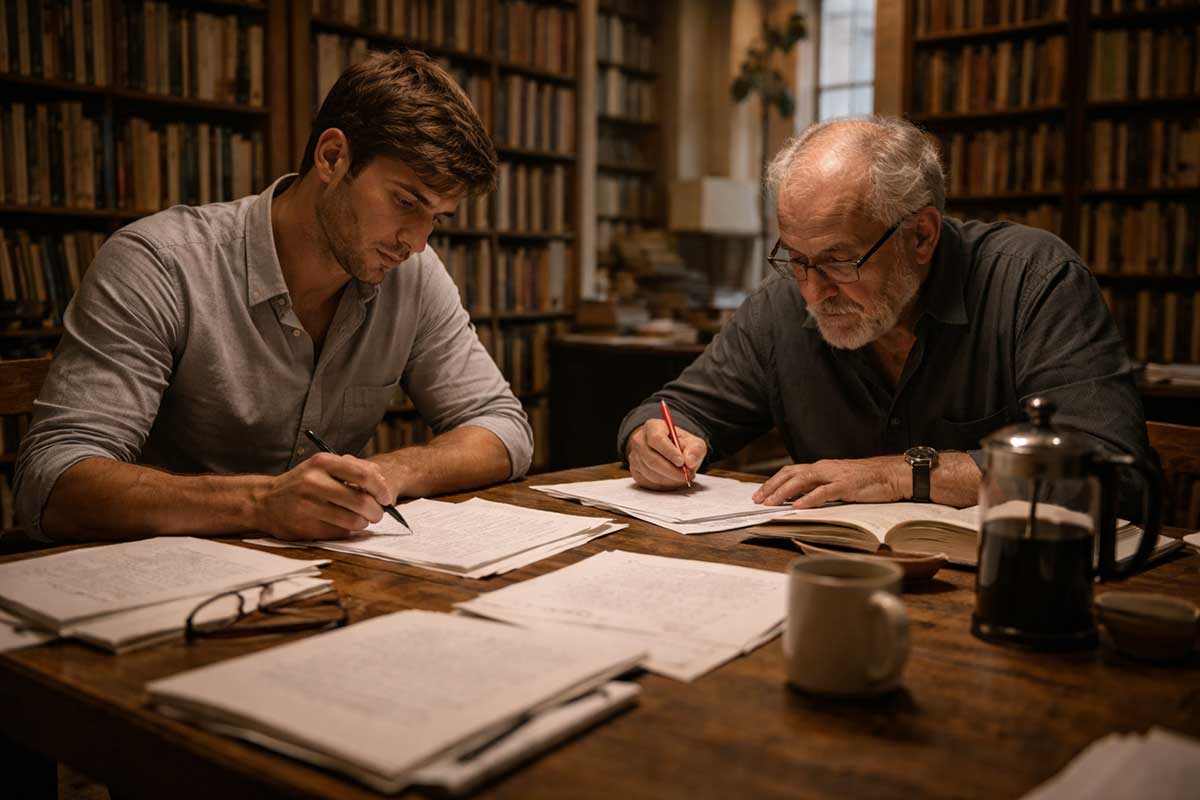
By the eighth day he had begun to look for work with a seriousness that no longer felt theatrical.
Until then, practical life had still borne for him some trace of prologue. Forms, offices, train rides, market purchases, the first names of neighbors, the sound of sirens, the inland gravity of Jerusalem, the voices gathering around him like a country teaching itself through interruption. All this had occupied him so fully that work remained suspended in a nobler fog than it deserved. He had spoken of writing, translation, teaching, as a man might speak of future furniture in a house whose walls were not yet trusted. But by the eighth morning the matter altered. Rent existed. Food existed. The city, for all its arguments, still demanded payment on ordinary terms.
He sat at the table with his laptop open and a notebook beside it.
The room was warm already. A scooter below started, failed, started again. Somewhere a radio presenter was speaking with false energy about something no listener could fully have wanted before coffee. The old man across the street was watering the plants with less irritation than usual, which suggested either improved mood or resignation.
Yonatan began with translation agencies, publishing contacts, language schools, university boards, nonprofit listings, remote freelance work, cultural centers, and the wide sea of half-serious opportunity that modern life places before the educated as a test of both pride and endurance. Each listing seemed to ask for a version of him more defined than the one currently available. Native Hebrew. Near-native Hebrew. Prior local experience. Familiarity with Israeli institutional culture. Confidence in fast-paced environments. Ability to move between languages, sectors, identities, deadlines, and crisis tones without loss of accuracy. Flexible, resilient, team-oriented, mission-driven. The country, he thought, wanted not a man but an adapter with emotions.
He closed one page and opened another.
By eleven he had sent three inquiries, revised his résumé twice, and grown ashamed of the phrase seeking to contribute meaningfully, which now seemed less a sentence than a supervised failure of nerve.
His phone buzzed.
A message from Amos.
If you are free this afternoon, come by. I have some books for you, and possibly a use for your English. 4 p.m.
Yonatan stared at the message with disproportionate gratitude. It was not employment. It was not even clearly an opportunity. Yet it was an opening, and in new countries openings often arrive dressed in ambiguity.
He answered that he would come.
The address Amos sent was in Jerusalem.
So once again, in the middle of coastal uncertainty, the inland city drew him upward.
He spent the remaining hours working in the café near the university district, less from productivity than from the desire to fail among others. Around him students typed, highlighted, scrolled, frowned, drank coffee, rearranged pages, and inhabited that democratic fellowship of the partially overwhelmed. Noa was not there. He felt the absence mildly and with enough awareness to distrust it.
At two he left for the station.
The train to Jerusalem felt less ceremonial this time, which in itself marked a change. He was not going to encounter a city of stone and pressure in the abstract. He was going to see Amos, perhaps to carry books, perhaps to be useful, perhaps to be corrected. These were more reliable motives.
The hills rose again. The land gathered itself into folds. The same old sensation returned, though quieter now: that one was not merely traveling but ascending into a stricter register of thought.
Amos lived in a modest apartment in an older neighborhood, on a street lined with stone buildings, potted herbs, and trees that looked as if they had survived several empires and trusted none of them. The building entryway smelled faintly of dust, lemon cleanser, and old paper. The stairs were narrow. On the landing stood a cracked ceramic planter holding a rosemary bush that had outlived beauty and entered character.
Amos opened the door before Yonatan knocked twice.
“You are punctual,” he said. “Very dangerous in this region. Come in.”
The apartment was lined with books in every room. Shelves covered walls. Books stood in stacks beside chairs, under tables, near windows, on the floor where any rational person would have declared storage impossible. Yet the place did not feel chaotic. It felt inhabited by order so intimate it had ceased to resemble tidiness.
A radio played softly in another room. On a side table stood two cups, a coffee pot, a bowl of apricots, and a pair of reading glasses folded atop a journal.
Amos motioned him to sit.
“I told you I had books,” he said, “which is true. But first I have a question.”
Yonatan waited.
“A colleague of mine runs a small translation and editing project. Reports, essays, institutional language, occasionally something with the misfortune to approach literature. They need someone with good English, patience, and tolerance for imperfect systems. Your Hebrew is not enough yet for everything, but perhaps for some things. Are you interested?”
Yonatan felt the speed with which hope can embarrass a face.
“Yes,” he said.
“Good. Interest is still free.”
Amos handed him a short printed passage in Hebrew and English.
“This is a sample. Read it.”
Yonatan read.
It was a translated policy brief of some kind, perhaps cultural, perhaps educational, perhaps designed in the usual institutional style whereby conviction is diluted into acceptable terminology. The English was competent and dead. Yonatan winced once, then again.
Amos saw.
“Good,” he said. “If bad prose causes no pain, one should not be allowed near language.”
He poured coffee.
“I don’t know if they will hire you,” he said. “But I know they need help, and I am tired of reading English in this country that sounds as if written by a committee educated by robots.”
Yonatan smiled.
“That’s kind of you.”
“No,” said Amos. “It is selfish. I want better sentences around me before I die.”
He gave Yonatan the name of the colleague, the organization, and an email address, then told him to send a short note that evening and mention his name only once.
“More than once sounds desperate,” Amos said. “Not mentioning it sounds arrogant. Balance is a civic virtue.”
They spent the next hour going through the passage line by line. Amos was not a soft teacher. He halted at vagueness, at inflated diction, at passive structures used to conceal agency, at nouns that should have remained verbs and verbs that should have been ashamed of themselves. Yet his severity did not humiliate. It clarified. Under his eye, language became less ornament than ethics.
“This sentence,” Amos said, tapping the page, “claims to support social resilience. What does it mean?”
“It means nothing yet,” Yonatan said.
“Excellent. You may survive.”
They revised.
By the end, the passage no longer sounded alive exactly, but it had at least re-entered the human range. Amos leaned back.
“You see,” he said, “translation is never only between languages. It is between moral temperatures.”
“Is that why you stayed in it?”
“I stayed in it because I distrusted purity. Translation punishes purity. It forces one to discover that every word arrives carrying weather from somewhere else.”
Yonatan wrote that down at once.
Amos noticed and gave him a look almost mocking.
“If you quote me later, improve it.”
From a room farther inside the apartment came the muffled sound of a door closing. Yonatan turned slightly.
“My daughter,” said Amos. “She is visiting and pretending not to hear old men instructing strangers.”
A moment later a woman appeared in the doorway carrying a plate. She looked to be in her late thirties, with tired kind eyes and the air of someone both busy and perceptive enough to resent being interrupted only by the unimportant. She set the plate of sliced apricots on the table.
“This is Maya,” said Amos. “My daughter. Maya, this is the new immigrant I am trying to save from administrative and stylistic ruin.”
Maya smiled.
“Impossible project,” she said. “But admirable.”
Her English was easy and warmer than her father’s. She wore hospital scrubs under a light sweater thrown over her shoulders.
“You work at the hospital?” Yonatan asked.
She nodded. “Pediatrics.”
“Then you see the country differently,” he said without thinking.
She looked at him with sudden interest.
“Yes,” she said. “From the side where ideology has to sit down and wait.”
Amos made a small approving sound, whether at the sentence or at the fact that it was not his own Yonatan could not tell.
Maya remained only a few minutes, yet in that time she altered the room. With her came another version of the country: not books, not theories, not offices, not slogans, but bodies, families, triage, fear stripped of rhetoric. Before leaving again she said to Yonatan, “If you’re new, sleep whenever you can. People think moving countries is spiritual. It’s mostly inflammation.”
When she had gone, Amos said, “You see? In this family even practical advice arrives with literary ambition.”
Near six, after coffee, revision, and a small meal Amos insisted on sharing, Yonatan prepared to leave.
“Take these,” said Amos, handing him three books and a folder of printed materials. “Read the essays. Ignore half of them. The other half will offend you into better thinking.”
At the door he added, more lightly, “And write that email tonight. Before courage becomes self-consciousness.”
Outside, Jerusalem was entering evening.
The stone held the last warmth of the day. Shadows deepened in narrow bands. People moved homeward with groceries, backpacks, prayer books, phones, and the thousand small items by which urban life proves itself repetitive even under pressure. Yonatan walked slowly toward the station, not ready yet to descend.
He took a side street instead and found himself in a quieter quarter where small cafes, bookstores, and apartment buildings faced one another with the modest dignity of places too accustomed to history to advertise themselves with confidence. In one window stood shelves of religious texts. In another, vinyl records. In another, children’s shoes.
At a corner he stopped for tea in a nearly empty café. The woman at the counter spoke to him in Hebrew. He answered in slower Hebrew. She did not switch to English. This, too, was progress.
He sat by the window and took out the folder Amos had given him.
Inside were essays, a sample report, contact details, and one printed article with lines underlined in pencil. The article concerned language in public life: how institutions use abstract terms to disguise human cost, how policy speech grows cleaner as reality grows harder, how nations construct emotional permission through syntax. Yonatan read and felt both sharpened and accused.
Outside, two boys ran past chasing one another with the solemn delight of children temporarily undefeated by inheritance. Behind them walked an old woman carrying bread and flowers in the same bag, which struck him as an entire theology in plastic form.
His phone buzzed again.
Noa: How goes the inland mission?
He answered:
Amos may have found me work or a more sophisticated form of inadequacy. Hard to tell.
Her reply:
That’s most good work, actually.
Then, after a pause:
Are you still in Jerusalem?
Yes. Tea near the station.
A minute later:
I’m nearby finishing something. Ten minutes?
He had begun to notice that in this country ten minutes means either seven or thirty, depending on history, personality, and traffic. Still, she arrived in something like twelve.
She entered with a tote bag full of papers and the expression of someone emerging from a room in which intelligence had been expensively spent.
“You look improved,” she said, sitting down.
“By tea?”
“By being occupied.”
He told her about Amos, the sample text, the possible editing work.
“That makes sense,” she said. “He likes people who are still porous enough to learn but old enough not to worship theory.”
“Is that what I am?”
“For now.”
They ordered more tea.
The café grew dimmer as evening thickened outside. A man at the next table was marking student papers with the cold concentration of a disappointed republic. Near the counter two teenage girls shared headphones and a pastry. Somewhere behind the kitchen door a stack of cups fell and did not break.
Noa listened more intently than before when Yonatan described the line-by-line revision with Amos. When he repeated the phrase about moral temperatures, she smiled.
“Yes,” she said. “That’s him.”
Then she asked, “And what about you?”
“What about me?”
“What are you finding difficult now that the first glamour of arrival is fading?”
The question was quiet and direct enough that evasion would have looked childish.
He considered.
“Work, yes. Hebrew, yes. Money, yes. But that’s not really it.” He looked out the window before continuing. “I think what’s difficult is that the country doesn’t let me remain theoretical. Everywhere I touch it, something concrete answers back.”
Noa watched him.
“That’s a good difficulty.”
“I’m not sure it feels good.”
“No,” she said. “But it’s honest.”
He turned the tea glass slowly between his hands.
“In America,” he said, “I could think about Jewish history, Israel, religion, belonging, memory, all of it, and still remain slightly abstract to myself. Here even grocery shopping feels implicated.”
She nodded.
“Yes. That’s one of the shocks. Daily life here has fewer innocent surfaces.”
They were silent a moment.
Then she said, “People abroad sometimes imagine that living here intensifies feeling. Sometimes it does. But more often it thickens consequence.”
He looked at her.
“Do you always carry sentences around like that?”
“Only when avoiding my real work.”
The line made him laugh, and the laugh relieved something between them that had been inching toward seriousness too quickly.
They left the café together and walked toward the station. The city at night was neither soft nor harsh but concentrated. Stone facades held shadows cleanly. Light from windows and streetlamps fell in warm planes across walls older than the arguments now passing under them. Somewhere nearby a group of yeshiva students sang as they walked, their voices slightly ragged but fully committed. From another street came the low bass of a car stereo. A cat sat on a stone ledge as if assigned there by municipal decree.
At the station entrance they stopped.
“You’ll write the email tonight,” said Noa.
“I’ve been instructed to.”
“Good. Obedience is underrated when chosen freely.”
“And you?”
“I’ll grade papers written by students who believe analysis means naming trauma three times and adding a citation.”
He smiled.
“Will I see you soon?”
She adjusted the strap of her bag.
“Yes,” she said. “But don’t make it into a scene.”
Then, before he could answer, she added, a shade more gently, “Good luck.”
It was the same phrase the landlord had written on the note in the apartment. Yet from her it carried less resignation and more recognition, as if luck were not a substitute for blessing but one of its modern disguises.
On the train back to Tel Aviv he did not read.
He watched the black outline of the hills, the scattered lights, the moving reflections in the window, and felt in himself a new tension beginning to form. It was not yet crisis. It was not even fully named. But he sensed the next stage approaching.
Arrival had given way to procedure. Procedure had given way to voices. Voices were now giving way to tasks. Work, language, relationship, consequence. The country was no longer only speaking to him. It was beginning to demand reply.
Back in the apartment he set the books on the table, opened the laptop, and wrote the email Amos had advised. He kept the message brief. Clear English. No self-display. One mention of Amos, no more. He attached the revised sample passage and pressed send before revising courage into delay.
Then he opened the notebook.
He wrote:
Today language became labor. Until now words have been my way of interpreting this place. Now they may become one of the ways I survive inside it.
He paused, then added:
There is a difference between admiring a country’s seriousness and being assigned a portion of it. I think that difference has begun.
He closed the notebook but did not yet go to bed.
From the balcony, the night air smelled faintly of sea salt and damp stone from someone washing a courtyard below. The old man’s plants across the street stood dark and orderly in their places. A television flickered blue in one apartment. In another, someone was still awake at the table, reading.
Yonatan stayed there a long time, feeling the coast around him and the hills still somehow in him, as if Tel Aviv and Jerusalem had begun their argument inside his own chest.
On the eighth day he understood this much:
a country first enters a man as atmosphere, then as inconvenience, then as speech.
After that, sooner or later, it enters as work.
And once it has done that, he can no longer pretend he is only listening.
Chapter 9: Affection Enters the Story
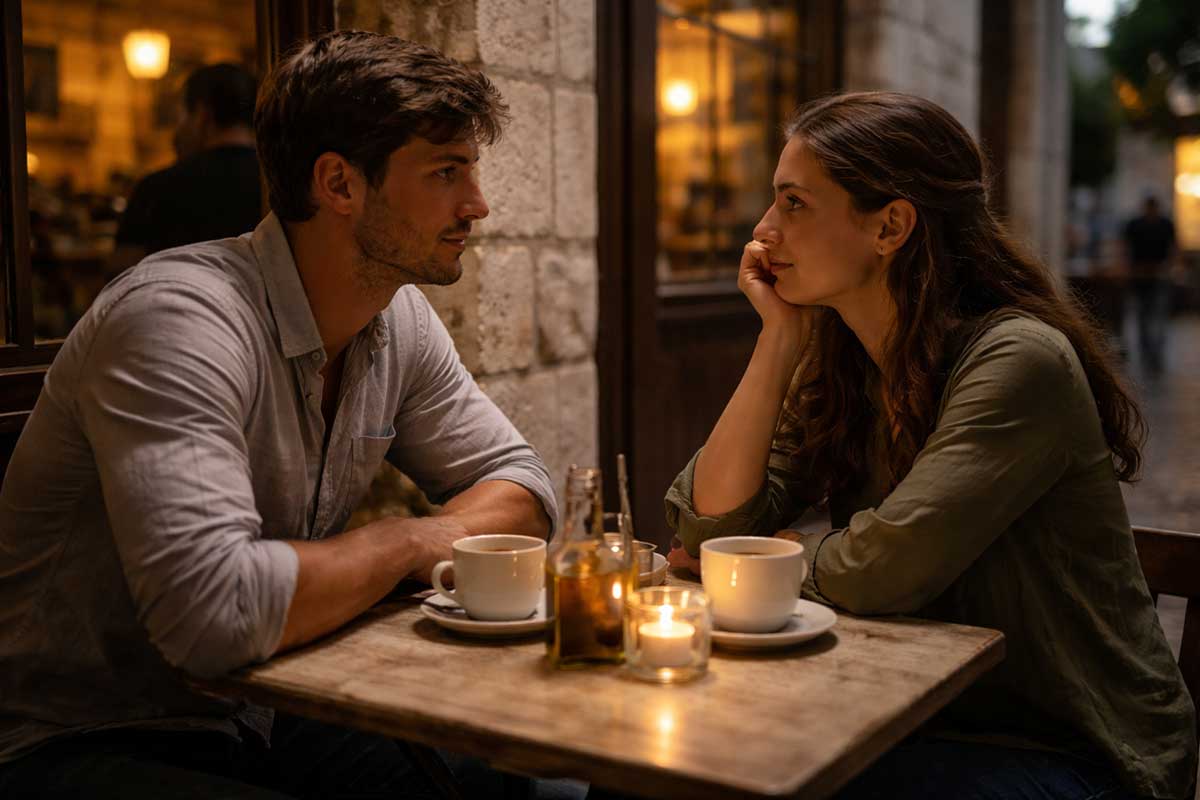
The answer to Amos’s email came the next morning at 7:12.
Yonatan was still in bed when he heard the phone buzz against the table, a small determined sound that entered his half-sleep with more authority than birds, plumbing, or conscience. He reached for it without opening his eyes fully and saw a message from an address he did not yet recognize.
Thank you. Can you come in tomorrow at 10:00 for a short meeting and editing test?
Below the sentence was a name: Leora Ben-Ami. Beneath that, the organization’s title, longer than any living person would ever say aloud. Cultural policy, civic research, language access, public communications. The sort of institution that could be trivial, essential, or both at once.
He sat up.
For a full minute he did nothing, only looked at the screen, as though by stillness he might prevent the sentence from changing. Then he wrote back too quickly, deleted it, rewrote more carefully, and sent a reply confirming the time.
The room looked different afterward.
Nothing had changed in it materially. The bookshelf remained half empty. The coffee on the counter still required making. The shirt over the chair still held yesterday’s shape. The ceiling stain still resembled a country whose borders had not survived diplomacy. Yet now the room contained the future in a more practical form than before. Not destiny. An appointment. Which is how destiny often first appears when it is too modest to announce itself.
He rose, opened the balcony door, and stood in the morning air.
Across the street, the old man with the plants was not yet visible. The leaves themselves looked slightly dusty. The street below held that brief soft interval before full traffic claimed it. A woman in running clothes crossed to the opposite sidewalk. A delivery scooter paused, idled, moved on. Somewhere nearby a radio spoke in quick Hebrew with the confidence of people paid to convert complexity into urgency.
Yonatan made coffee and sat at the table with the notebook open.
He wrote:
A country may take from a man his abstractions by giving him a calendar.
Then he stopped, stared at the line, and left it unjudged.
The rest of the morning he spent preparing for a meeting that might be nothing and felt, precisely for that reason, full of consequence. He reread the sample text. He revised his résumé again. He checked the address three times. He changed shirts twice and settled on one that made no strong claims. He tried working on Hebrew vocabulary and discovered that anticipation has poor grammar.
Near noon he walked to the bakery for food and encountered Malka on the stairs carrying a potted basil plant in one hand and a folded chair in the other.
“You look employed,” she said.
“Not yet.”
“But possible.”
He smiled. “Possible.”
She nodded once, approving of the category.
“Good. An idle man becomes philosophical. This building has enough of that from the divorced one on the third floor.”
She continued downward before he could ask which divorced one, implying either that there was only one worth mentioning or too many to clarify.
Outside, the sun had already hardened. At the bakery the girl with the eyebrow ring asked, “Black?” before he spoke.
“Yes.”
“And the cheese?”
“Yes.”
She handed both over and then said, with no apparent reason except truthfulness, “You’re less confused.”
“That may be the nicest thing anyone’s said to me here.”
She considered this.
“No,” she said. “If I said nicest, I’d have to mean it.”
He carried the coffee and pastry outside and stood beneath the awning. He found that he was smiling.
This, he thought, was one of the country’s oddest mercies. It reserved overt tenderness, yet distributed recognition in small unsentimental portions. A repeated order. A remembered face. A shortened silence. One survived on these.
In the afternoon he received a message from Noa.
I’m in archives all day. How goes your first possible entry into institutional life?
He answered:
Meeting tomorrow. I’m pretending composure.
A few minutes later:
Good. Composure is a respectable pre-interview fiction.
Then:
Don’t let them make you write dead English. If they insist, at least charge for the burial.
He laughed aloud at that, alone in the room.
It struck him that her messages had begun to arrive in the day with the ease of something no longer exceptional. This should have pleased him simply. Instead it introduced a more complicated awareness. Here was another form of entry the country was offering him, or perhaps testing him with. Not work exactly. Not friendship only. A conversation still in motion, and one that now touched him before he had fully chosen where to place it.
He put the phone down and looked at the notebook.
For a long while he did not write. Then at last:
There are people who arrive in a country and look first for work, for housing, for language, for law. Others begin by looking for the face in which the place becomes human.
He read the sentence once, then underlined nothing.
That evening, restless, he took the train to Jerusalem without having planned to.
He told himself he wanted to see the route again before the meeting the next day, to make sure he would not be late, to measure time correctly, to familiarize himself with the streets. All of this was partly true. Yet beneath these reasons lay another, which he did not dignify by naming at once.
He wanted to see Noa.
He did not tell her he was coming until the train was already halfway inland.
I’m on my way up. Don’t rearrange your life. I just needed to get out of the apartment.
Her answer came five minutes later.
That’s not a reassuring message. But I’m finishing near campus at 6. If you’re still here, walk with me.
By the time he reached Jerusalem, the light had begun to lower into that severe gold the city wears better than any other. The station, with its steel and glass, released him again into stone.
He walked without hurry toward the university district. Jerusalem in late afternoon felt different from Jerusalem under morning intention. It was less exposed, more inward, as if daylight itself had stopped trying to explain the place and left its surfaces to carry their own burden. Students passed in groups, speaking fast Hebrew, Arabic, English, Russian, and the hybrid languages of educated cities. A man in a dark suit sold coffee from a cart. Two young religious boys were arguing over something in a text, one tapping the page with such conviction that the paper itself seemed in danger of conversion.
Noa met him outside a building of old stone and newer glass, carrying a tote bag so full of photocopies it had acquired a posture of fatigue.
“You look like a man trying not to admit he was lonely,” she said.
“That obvious?”
“Yes.”
They began walking.
“Did you come for me,” she asked, “or for the city?”
He considered lying and found that the city itself forbade it.
“For the city through you,” he said.
She gave him a look half amused, half warning.
“That’s better written than safe.”
They walked downhill along a quieter street lined with trees. The leaves moved only slightly. From a nearby apartment came the smell of food beginning to cook. Somewhere a radio played an old Hebrew song with a tenderness he could not understand and did not need to in order to feel.
Noa spoke of the archives, of papers damaged by poor storage and better memory, of bureaucrats dead for decades whose handwriting still governed contemporary interpretation. Yonatan told her about the email, the meeting, his anxious preparations. She listened with the serious attention that always made him feel both sharpened and seen.
“What do you actually want?” she asked at last.
“From the job?”
“From any of it.”
He looked ahead at the descending street.
“To be useful without becoming flattened,” he said. “To live here without turning myself into a performance. To belong without lying.”
Noa nodded slowly.
“Yes,” she said. “That’s difficult enough to count as a vocation.”
They stopped at a small café near campus, crowded with students and two professors who looked as though they had been produced entirely by books and weather. They found a table by the window.
“What about you?” Yonatan asked. “What do you want?”
Noa wrapped both hands around the coffee cup before answering.
“Less purity,” she said. “More truth. Less theatrical despair. More forms of repair that don’t require self-deception. Work that matters without pretending to save history. Love, perhaps, without national allegory attached to it.”
She said the last phrase lightly, but he felt its weight.
Outside the window a boy on a bicycle coasted downhill with both hands off the handlebars, full of the temporary immortality granted to children and the unwatched.
Yonatan asked, “Is that possible here?”
Noa smiled.
“Probably not. But impossibility has never stopped anyone in this country from making demands.”
There was a pause.
The kind of pause in which two people become aware that the conversation could either retreat into intellect or move one step nearer risk.
It was Noa who turned it first.
“Tell me honestly,” she said. “Since you arrived, when have you felt most at home?”
He was not prepared for the question.
He looked at his hands, then at the cup, then finally out the window.
“In the shelter room, strangely enough,” he said. “Not because I liked it. But because no one there was performing. Everyone was just being claimed by the same sound.”
Noa’s face changed slightly, not with surprise exactly, but with a kind of recognition.
“That makes sense,” she said. “Shared vulnerability is one of the few honest passports.”
“And you?”
She took a moment.
“In libraries,” she said. “And hospitals. Places where people are forced to reveal what they serve.”
“That’s a severe standard.”
“Yes,” she said. “I’m trying to become less unfair.”
He wanted then to say something simpler and more personal, something about how quickly her presence had begun to alter his days. But he felt the city around them, and with it the danger of premature declaration. Jerusalem punishes sentimentality more efficiently than logic does.
So instead he said, “I’m glad I came.”
She met his eyes.
“Yes,” she said. “I know.”
They left the café at dusk.
The city was entering evening with that clean layered beauty it never fully trusts. Windows lit one by one. The air cooled. Bells sounded somewhere far off, answered not by harmony but by the separate endurance of other sounds: traffic, voices, a distant call to prayer, a bus braking, laughter from students gathered on steps, the slam of a door, footsteps on stone.
They walked without touching.
Yet the space between them had altered. Not closed. Defined.
At one point they passed a church courtyard where candles glowed behind ironwork. Farther on, they crossed a street where young secular Jerusalemites sat outside a bar drinking beer under strings of lights. Then, a block later, they passed a yeshiva building whose windows were full of men bent over books. The city kept juxtaposing worlds the way a difficult mind juxtaposes truths it refuses to reconcile.
“It’s exhausting,” said Yonatan quietly.
“Yes,” said Noa. “That’s one of the reasons people confuse intensity with depth here. They’re tired and call it revelation.”
They reached an overlook where the city opened briefly below them, roofs and trees and towers and slopes fading into evening. They stopped.
Neither spoke at first.
Then Noa said, “Tomorrow, if the meeting goes badly, you should still stay.”
He looked at her.
“Is that advice or command?”
“Advice pretending not to care too much how it sounds.”
He smiled.
“And if it goes well?”
“Then you should be suspicious for at least three days.”
He laughed, and she did too.
That laugh, in that place, felt more intimate than any declaration would have. It did not solve anything. It only made the world for a moment less defended.
When they parted at the station entrance, she did not say good night at once.
Instead: “Write to me after.”
“I will.”
“Even if it’s bad.”
“Especially if it’s bad?”
She nodded. “Especially.”
Then she turned and went back into the city, her figure absorbed not by darkness but by the layered life of the street, until he could no longer distinguish her from the movement around her.
On the train back to Tel Aviv, he sat by the window and watched his reflection pass over the black shapes of the hills.
He thought of work. Of the test tomorrow. Of language becoming labor. Of Amos and moral temperatures. Of Malka measuring progress in offense reduced. Of Noa speaking of love without national allegory attached to it. Of Jerusalem withholding and drawing near. Of Tel Aviv waiting by the sea with its quicker pulse and looser face.
By the time he reached the apartment, it was fully night.
He opened the balcony door. The old man’s plants were dark shapes now. A television flickered across the street. Someone below was washing dishes. Someone else was arguing softly enough to suggest long practice.
He sat at the table and wrote:
Today I understood that work is not the only threshold. There are people whose presence begins to make a country legible. This is a blessing, though perhaps a dangerous one.
He paused, then added:
I do not yet know whether I am entering this place through language, through labor, through fear, or through affection. Perhaps one never enters by only one gate.
He closed the notebook.
Tomorrow would ask for skill, composure, and the management of hope. Tonight asked only that he remain still long enough to feel the new tension gathering in him: not merely toward the country now, but toward one particular human being through whom the country had begun to answer back.
On the ninth day, he saw that belonging does not approach only as principle.
Sometimes it approaches as a voice one waits to hear from after dusk.
Chapter 10: First Real Work

The meeting took place the next morning in a low building on a side street in Jerusalem, the kind of building that appears to have been designed by people who trusted fluorescent light more than human morale. Its front entrance was modest, almost evasive, as if the institution inside preferred to influence public language without ever becoming memorable in public architecture.
Yonatan arrived twenty minutes early.
This gave him enough time to stand outside twice as long as dignity required, reviewing in his mind not the sample text, which he already knew, but the expression he meant to wear. Too eager would be juvenile. Too calm would be false. Thoughtful without visible hunger—that seemed best, though difficult, since hunger was the truer condition.
At last he went in.
Inside, a receptionist sat behind a desk with three trays of paper, two ringing phones, and the concentrated patience of a person who has already forgiven the day for being what it is. She asked his name in Hebrew. He answered in Hebrew. She nodded without praise, gave him a visitor badge, and pointed him toward a waiting area furnished with chairs too angular for comfort and journals too old for relevance.
On the wall hung framed posters about civic language access, cultural participation, educational outreach, public trust. The English on the posters was passable and lifeless. Yonatan felt a private twitch of alarm. If this was the public face, what lay inside?
A woman emerged from a hallway and called his name.
Leora Ben-Ami was in her forties, with dark hair cut at the jawline, alert eyes, and the practiced economy of someone who has spent years moving between meetings without ever surrendering entirely to their deadening grammar. She shook his hand firmly and led him to a glass-walled room containing a table, two chairs, a laptop, and a stack of printed pages.
“Thank you for coming,” she said. “Amos speaks well of you, which is helpful, though it raises the standard.”
There was no small talk after that. Yonatan liked her for it at once.
She asked about his background, his Hebrew, his translation experience, his writing, his reason for coming. He answered carefully, trying not to sound as though he had arrived either from a romance or from a wound, though in truth both lay somewhere behind him.
Then she slid a packet across the table.
“We do reports, public-facing summaries, policy briefs, donor communications, educational materials, occasional speeches, occasional statements written under unpleasant time pressure, and a constant stream of texts that are neither fully institutional nor fully human. The challenge is to make them more human without making them unserious. Can you do that?”
“I think so,” Yonatan said.
“Good. We’ll see.”
The packet contained a Hebrew source passage, an English draft, and a page of comments from someone who had apparently confused formal language with ceremonial suffocation. Yonatan read in silence. The English was not bad in the obvious way. It was worse. It was cautious, inert, padded, and technically competent enough to defend itself.
Leora watched him reading.
“At least you’re making the right face,” she said.
“What face is that?”
“The face that means the document has committed offenses.”
He smiled despite himself.
She left him for forty minutes with a laptop and the instruction to revise freely.
When the door closed, he exhaled and began.
At first his hands moved too fast. Then training, instinct, and something sharper took over. He cut abstraction. He restored verbs. He let subjects resume responsibility for actions that committees had buried. He changed language of “capacity-building outcomes” into language of actual people, actual access, actual barriers, actual decisions. He did not romanticize. He did not decorate. He only tried to let the English breathe without losing institutional precision.
He forgot, for stretches, that he was being evaluated.
He remembered only the sentence Amos had given him the day before: between moral temperatures.
When Leora returned, he was still revising the last paragraph.
“Done?”
“Nearly.”
“Nearly is usually where the real work starts.”
He saved the file and handed her the laptop. She read without expression, pausing now and then to make tiny sounds in her throat that could have meant approval, concern, or digestion.
Yonatan sat still.
At last she looked up.
“You cut a great deal.”
“Yes.”
“Good.”
She looked down again.
“This line was dead before. Now it is alive enough to be argued with. That’s improvement.”
She read another paragraph.
“You understand something that many people don’t,” she said. “English can be clear without becoming thin. Too many local writers think that if a sentence sounds human it must also sound unserious.”
Yonatan said nothing.
She closed the laptop.
“We may be able to use you.”
He felt, absurdly, that if he moved too quickly the sentence might break.
“For freelance work at first,” she said. “Possibly more later. Mixed tasks. Editing, translation support, some drafting. Payment is not glorious. Deadlines are sometimes rude. The mission statement is longer than anyone’s soul. Still, the work matters.”
“I’d like that,” he said.
“Good.” She tilted her head slightly. “You’re not celebrating.”
“I’m trying not to in the room.”
That made her laugh.
“Yes,” she said. “That’s the correct instinct. Celebrate outside. Institutions are suspicious of visible gratitude.”
She explained the next steps. Paperwork, of course. Samples. A trial assignment by Monday. A contract after that if all went well. She gave him one folder and emailed two more documents before he had even left the building. The country, he thought, wastes no time turning possibility into administration.
When he stepped back out onto the street, Jerusalem looked almost too bright.
He stood in the sun holding the folder and felt the odd emotional mixture the country kept training into him: satisfaction braided with caution, relief disciplined by sequence, hope already being asked for proof.
His phone buzzed at once, as if fate had stationed itself by the signal tower.
Noa: Well?
He wrote back:
I think I’ve been admitted into the lower levels of institutional life.
Her answer came in seconds:
That sounds almost triumphant by your standards.
He hesitated, then wrote:
Coffee later?
A pause. Then:
Yes. Near the old stone café. 5?
The day before, he would have called that good luck. Now it felt like another form of instruction.
With hours to spare before seeing her, he walked.
Jerusalem after successful uncertainty was a different city from Jerusalem before it. Its stones no longer seemed only judicial. They held, for the moment, a measure of permission. He passed a schoolyard where children were shouting in overlapping worlds of Hebrew and laughter. He passed a small religious bookstore where two men debated at the entrance with such devotion that they had clearly forgotten the actual purchase. He passed municipal workers repairing a section of pavement while a driver leaned out his window to offer unsolicited strategy. The city, in its usual way, took private feeling and submitted it at once to public texture.
He found himself near the edge of the older quarters and walked more slowly there. Tour groups moved like separate weather systems. Pilgrims held maps and inward narratives. Police watched everything with contained attention. A priest crossed a street carrying groceries. A woman in jeans and a linen jacket smoked in a stone doorway beside an ancient wall. A cat slept under a parked scooter as if history owed it shade.
The place still resisted simplification. That resistance now pleased him.
At one point he stopped before a wall plastered with memorial posters, notices, political stickers, and event announcements. Layers of loss, advocacy, warning, invitation. Some pages new, some faded, some torn, some replaced. The public surface looked less like communication than sediment.
He thought of Maya in scrubs. Of Rafi and warehouses. Of Amos and syntax. Of Leora and dead English. Of Noa saying the country enters your grammar. The phrase felt truer now than when he first heard it. Grammar was not only language. It was relation, sequence, pressure, what can follow what, what cannot be said without consequence.
At five he met Noa at the café.
She was already seated with a glass of water and a book she had clearly not been reading. When she saw him, her face changed by a degree only, but enough for him to feel it like warmth after wind.
“Well?” she said again.
He sat down.
“They’re giving me a trial assignment.”
She smiled, and this time there was no irony in it.
“That’s good.”
“Yes.”
“No elegant hesitation? No tragic qualification?”
“Some internally.”
“That’s acceptable.”
He told her about Leora, the editing test, the dead draft, the comments page, the phrase alive enough to be argued with. Noa listened with a satisfaction that did not feel borrowed.
“You see?” she said. “Now the country can start exploiting you properly.”
“That’s your congratulatory language?”
“It’s the honest register.”
They ordered coffee and something sweet neither of them really wanted but both accepted as the small tax levied by good news in public.
For a while they spoke lightly. About Leora’s office. About students. About the fact that every institution in the country appears to have been housed either in a former school, a former argument, or a building with ventilation issues. Yet underneath the lightness ran something else now, more settled and more dangerous. He had crossed a threshold that day. She knew it. He knew she knew it. This gave their conversation a new quietness at certain edges, as though each sentence now carried the possibility of becoming more personal than either was prepared to authorize in daylight.
At last Noa asked, “Does it make you feel more here?”
He answered carefully.
“Yes. Though not in the triumphant way I expected. More… implicated.”
She nodded.
“That’s closer to the truth.”
He stirred his coffee.
“I keep thinking the same thing,” he said. “That everything here becomes concrete too quickly. Ideas become errands. Convictions become systems. Identity becomes rent, paperwork, trains, alarms, timing, lunch, language choices.”
“And people,” she said.
He looked up.
“And people,” he repeated.
The pause that followed was not awkward. It was exact.
A server passed by. Cups clinked. Outside, footsteps moved over stone. Somewhere beyond the café windows the city continued doing what it always did: layering longing with traffic, prayer with administration, memory with appetite.
Noa broke the pause first.
“My father would say this is why the country exhausts foreigners,” she said. “They arrive wanting symbolic experiences, and the place hands them obligations.”
“What does your mother say?”
A faint smile touched her mouth.
“She says the symbolic experiences usually come disguised as obligations.”
“That sounds like something I should write down.”
“No. That sounds like something you should survive first.”
They left the café near dusk.
The sky over Jerusalem had entered that late hour in which gold begins surrendering to blue without fully admitting defeat. The stone seemed to gather the remaining light and hold it in reserve. They walked through streets that were neither crowded nor empty, only inhabited with the deep ordinary seriousness of evening.
At a small square they stopped to let a group of children pass, shepherded by two exhausted adults and one older sister who had already entered the age of reluctant competence. A young man on a bicycle swerved around them and apologized over his shoulder. A cat shot under a bench. Bells sounded somewhere. Then, from another direction, the start of song.
A group of yeshiva students were walking together a little way off, singing not beautifully, but fully. The sound came down the street with the confidence of repetition. Not performance. Habit transfigured by use.
Noa listened a moment.
“Do you envy that?” she asked.
“What?”
“The certainty.”
Yonatan considered.
“Sometimes,” he said. “But I also distrust it.”
“Good.”
“Do you?”
“Every day.”
He did not ask whether the distrust hurt her. He could hear already that it did.
They walked on.
Near the station entrance, they slowed. Again that small shared reluctance appeared, the one that had now begun to attend partings between them. Neither dramatized it. That restraint was itself beginning to feel intimate.
“So,” she said, “you have work.”
“Trial work.”
“Still work.”
“Yes.”
“And now?”
He looked at her, at the city behind her, at the light thinning above stone.
“Now,” he said, “I think I’m more afraid.”
She did not seem surprised.
“Of failing?”
“Partly. Of becoming something flatter than what brought me here. Of being absorbed into the language of systems. Of losing the inward reason inside the practical life.”
Noa was quiet for a moment.
Then she said, “That fear may protect you. Unless you turn it into identity.”
He smiled. “You really don’t waste reassurance.”
“No. I just try to give the useful kind.”
At the station doors she touched his sleeve once, very lightly, and said, “Write to me when you get back.”
Then she withdrew her hand, almost before the contact had fully registered.
He nodded.
On the train to Tel Aviv he sat with the folder on his lap and did not open it. The hills moved past in shadow. His own reflection hovered faintly over the window glass, superimposed on darkness and scattered lights.
That brief touch remained with him more powerfully than the meeting, the offer, the city’s severity, the entire day’s architecture of advancement. He did not yet know what to make of this, and so he did not make anything of it. He only let it remain.
Back at the apartment he opened the balcony door and stood in the coastal air.
Tel Aviv felt softer after Jerusalem, yet no longer simple. The sea wind entered the room carrying salt, distance, and the looser grammar of the coast. Somewhere below, someone was laughing through a phone call. Across the street the old man’s plants made dark shapes against a dim kitchen light. In another apartment a television flickered wordlessly.
Yonatan sat at the table and opened the notebook.
He wrote:
Today I was offered work, and instead of feeling enlarged I felt more answerable. Perhaps this is one sign that the place is beginning to enter me honestly.
He paused.
Then:
There are thresholds crossed by documents, others by labor, others by conversation, and others still by the slightest human gesture. One does not always know which crossing will prove deepest.
He closed the notebook, then opened it again and added one final line:
The country continues to refuse simplicity. This may be its harshest gift.
He set the pen down.
On the tenth day, nothing had resolved. Yet something unmistakable had begun. Work was no longer imagined. Affection was no longer only possibility. Fear was no longer abstract. The life he had crossed an ocean toward was starting to demand not admiration, but shape.
And shape, he was learning, always costs more than longing.
Chapter 11: Public Language Under Pressure

The trial assignment arrived on Sunday at 8:03 in the morning.
Yonatan was already awake, though not fully risen. Since coming to the country, sleep had become less a nightly descent than a negotiation conducted in several rounds. First the body lay down. Then the mind replayed forms, conversations, train schedules, words heard too quickly and understood too late. Then, if mercy intervened, an hour or two of true sleep. Then dawn, or plumbing, or sirens remembered in dreams, or some message from the world outside the room insisting again that life was not symbolic enough to wait for readiness.
When the email came, he was at the table with coffee and a notebook still closed.
Attached: draft statement and background materials. Please revise for public release by end of day. Audience: mixed. Tone: clear, responsible, human, not sentimental.
Leora’s note was brief. Beneath it sat three attachments.
He opened the first and felt at once that this was not only work.
The statement concerned a violent incident that had taken place two days earlier in the south. Civilians killed. Families displaced. Local institutions responding. Public support needed. Educational and cultural programs suspended, then partially reorganized. The organization wanted to publish a statement balancing grief, civic duty, institutional clarity, and accessible language for international readers.
The draft was not bad. It was frightened.
Not frightened emotionally, but rhetorically: full of padded abstractions, defensive qualifications, carefully arranged phrases that seemed designed to avoid offense by avoiding life. Yet beneath them lay actual pain, actual interruption, actual public need. Yonatan could feel at once the danger. Too much polish and the statement would sound dead. Too much feeling and it would sound exploitative. Too much certainty and it would become propaganda. Too much caution and it would insult the people it claimed to name.
He sat back from the screen.
The room had changed again. The old table, the coffee, the open balcony door, the plant-shadowed street below. All the same, and no longer the same. The country had now entered him through work exactly where work touched grief.
He spent the first hour reading the background materials.
Local updates. Quotes from municipal staff. Descriptions of school closures, emergency shelters, community gatherings, volunteer coordination. Numbers, names, places. Short accounts from families. Official phrasing. Private language breaking through official phrasing. A teacher saying children had begun asking whether “normal” still existed or was only something adults promised. A librarian describing moving story hour into a protected space. A community worker saying the hardest task was not food distribution but convincing elderly residents to come indoors. A municipal note requesting international partners to avoid dramatic language and share only verified information.
That line stayed with him.
Avoid dramatic language. Share only verified information.
He thought of Noa saying the country thickens consequence. He thought of Maya at the hospital, of ideology having to sit down and wait. He thought of Rafi saying history is made by people who know which warehouse still has batteries. He thought of Amos asking what a sentence actually means. He thought too of the memorial wall, of the shelter room, of the little boy asking if it was his first time.
He began to revise.
Line by line he cut away fear disguised as official voice. He left facts intact. He restored subjects. He changed “affected populations” to “families and communities.” He replaced “the current security reality” with concrete references to closures, displacement, interrupted schooling, emergency support. He refused both sentimentality and euphemism. When a phrase tried to generalize grief, he made it smaller and truer. When it tried to become too lyrical, he dragged it back toward public honesty.
By noon he had three versions: the formal one, the public one, and a shorter version for readers outside the country who would know little and assume much.
He sent all three to Leora with a note:
I’ve aimed for clarity without flattening. Happy to revise further.
Ten minutes later she wrote back:
Good. Strong instinct. Especially paragraph 3. One line in paragraph 5 slightly too literary. Pull back. Otherwise useable.
He revised paragraph 5 at once.
Then the day shifted.
His phone, face down beside the laptop, began to vibrate again and again. News alerts. Messages. Group notifications he had not known he had been added to. Someone in the building forwarding updates. A friend from New York asking if he was safe. His mother, of course. Daniel. One of the students from the café whose name he had forgotten but whose contact somehow now existed in his phone. Then a message from Noa.
Don’t spiral through headlines. Read only what you need. Are you okay?
He answered:
I’m okay. Working on something connected to it.
A minute later:
That’s a hard way to enter public life.
He looked at the sentence a long time before answering.
Yes.
Outside, the street had not stopped. It never stopped all at once. A scooter passed. A dog barked. Someone laughed too loudly on a balcony and then quieted, as if remembering the day. Yet the air had altered in that subtle collective way he was beginning to recognize. Public time and private time had fallen out of alignment. Ordinary acts continued, but under them ran another current, one tightening everyone’s attention toward elsewhere.
Near two in the afternoon there was a knock at the door.
Malka.
She entered before invitation could fully organize itself.
“You are home,” she said.
“Yes.”
“Good. Tonight maybe shelter, maybe not. Depends.”
“Depends on what?”
She gave him the look older people reserve for the young when the young accidentally ask the structure of uncertainty to disclose its method.
“On everything,” she said.
In one hand she carried a plastic bag. She set it on the table. Inside were tomatoes, cucumbers, bread, cheese, a jar of olives.
“I went to market,” she said. “You look like a man who forgets food when history happens.”
He almost protested. Then realized he had forgotten lunch entirely.
“Thank you.”
“Do not thank me too much. Tomorrow you will carry something upstairs for me.”
This seemed fair.
Malka moved to the balcony and stood looking down at the street.
“Everyone is watching phones,” she said. “This is no way to live, but now it is how people live.”
She turned back to him.
“You are working?”
“Yes.”
“Real work?”
“I think so.”
She nodded.
“Good. Better to be useful when people become dramatic.”
Then, after a pause:
“You have someone in Jerusalem?”
The question arrived with such directness that his face betrayed him before language could be arranged.
Malka saw everything.
“Ah,” she said. “Then eat. Waiting on an empty stomach makes people stupid.”
She left him there with the groceries and the exact degree of embarrassment required to prove the observation.
He made food and forced himself to eat slowly.
By late afternoon, Leora sent one more note asking for a shorter emergency summary in simpler English for partner organizations abroad. He wrote it quickly. Too quickly at first. Then again, slower. The challenge now was not only language but moral proportion. He found himself thinking of Amos’s phrase in reverse. Not merely moral temperatures between languages, but between distances. How much can a person abroad be told without turning another person’s living fear into consumable clarity?
At five his phone rang.
Noa.
He answered at once.
“Hello?”
“You sound tired.”
“I am.”
“Have you eaten?”
He laughed softly. “This country really has assigned itself to my nutrition.”
“No. Malka has. I’m only borrowing her jurisdiction.”
He leaned back in the chair.
“What’s it like there?” he asked.
“In Jerusalem?” she said. “The same and not the same. Cafés open. Buses running. Everyone reading. Everyone saying they’re not reading.” A pause. “I hate days like this. They make language either too large or too small.”
“I’m working exactly in that gap.”
“I know.”
He could hear street noise faint behind her. Voices. Traffic. A bus braking. The world continuing in divided rhythm.
“Come up tomorrow,” she said.
It was not dramatic. Not invitation disguised as theory. Simply said.
“I have work,” he answered.
“Then come after.”
He hesitated, and she heard the hesitation correctly.
“I’m not asking for a scene,” she said. “Just presence.”
There it was again, the country making things concrete too quickly.
“Yes,” he said. “I’ll come.”
“Good.”
Neither hung up immediately.
At length she said, more quietly, “You don’t have to become public before you’ve become steady.”
He knew she meant the work, the news, perhaps the whole country.
“Neither do you,” he said.
“No,” she answered. “But I’m less new at failing that.”
After the call ended, the room felt both less lonely and more exposed.
Toward evening the building became subtly communal again. Doors opening. Short exchanges on the stairs. The father upstairs carrying bottled water down for storage. Someone in the hall asking if others had heard any updates. Someone else saying not to rely on rumors. A child crying, then stopping. The small choreography of people who are not intimate and yet are claimed by the same uncertainty.
Yonatan stepped into the hallway once and found the shirtless neighbor from the shelter now fully dressed and carrying folding chairs.
“You want to help?” the man asked.
“Yes.”
“Good. Take these.”
No explanation followed. None was needed.
Together they moved chairs into the shelter room. Others brought water, snacks, a radio, an extension cord, children’s books, phone chargers. The room that had first seemed temporary now looked maintained by repetition. A place people disliked enough to keep ready.
Malka appeared carrying a flashlight and a deck of cards.
“For children,” she said, then added, “and for adults with weak character.”
The shirtless neighbor—whose name Yonatan finally learned was Ofer—snorted.
“Everyone has weak character by midnight.”
No one disagreed.
For an hour they waited without being told to gather. Then they were told, and gathered. The siren came later.
This time Yonatan’s body reacted before thought. Keys, phone, stairwell, shelter. No philosophical balcony. He noticed this and felt no pride in it. Only sequence learned.
Inside the room, the same people. More children this time. More phones lit. More practiced silence. Someone had brought a battery radio. Someone else was handing out crackers. A teenage girl sat with earbuds in but no music playing. Ofer checked updates and gave them in fragments. Malka ordered two men to move their knees so a stroller could fit. A boy played cards with the seriousness of a negotiator.
Yonatan stood near the wall and felt not fear exactly but the tightening together of several forms of reality he had so far kept partially separate: work, neighborhood, news, affection, public language, private waiting.
His phone buzzed.
Noa: Shelter?
He answered:
Yes.
She replied only:
I’m glad you’re not on the balcony being philosophical.
Despite the room, despite the siren, despite everything, he smiled.
The little boy beside him noticed.
“What?” the boy asked in Hebrew.
Yonatan answered, in Hebrew, slowly enough to be sure, “Nothing. Someone was right.”
The boy seemed to accept this as a category of adult suffering and returned to his cards.
They stayed nearly forty minutes.
When it ended and people began to rise, the room did not dissolve immediately. A few remained seated, as if standing too quickly would mean admitting how thoroughly interruption now governed the shape of evening. Malka passed crackers to a child who had not asked. Ofer stretched his back and muttered something about politicians not worth translating. The father upstairs was whispering to his daughter. The elderly couple remained offended by existence in general.
As they climbed the stairs, Ofer said, “You handled it better.”
“Better than what?”
“First time.”
Yonatan nodded.
“Yes.”
“That’s how it happens,” said Ofer. “You become local by increments no one wants.”
Upstairs, back in his room, he did not turn on the overhead light. He left the lamp off, the balcony door ajar, the city’s altered night entering in pieces.
He sat at the table and opened the notebook.
For a long time he wrote nothing.
Then at last:
Today I wrote public language about grief while waiting to be interrupted by it privately. I begin to understand why so much speech here either hardens into cliché or breaks under its own burden.
He paused.
Then:
One can enter a country through airports and train stations, but one enters its deeper truth through the rooms where people wait together without knowing how the evening will end.
He sat with the pen in his hand.
Then added one final line:
The most dangerous temptation may be to narrate too quickly what one has not yet endured enough to name honestly.
He closed the notebook.
Outside, the street had resumed. A car door slammed. A television glowed blue through curtains. The old man’s plants were invisible in the dark. Somewhere below, someone was washing dishes. Somewhere beyond the coast and the hills, beyond Tel Aviv and Jerusalem, beyond the neighborhoods and their shelter rooms, other people were living the same night with different nearness.
On the eleventh day, the pressure had turned outward and public.
And with that change came a new demand: not only to feel, not only to witness, not only to work, but to resist the hunger to make immediate meaning out of what was still unfolding.
He sensed, though dimly, that this discipline would matter.
Because the country was not yet done instructing him.
Chapter 12: The Wrong Reading

The first wrong reading reached him on Tuesday afternoon.
It came not as scandal, not yet, but as irritation shaped like surprise. Leora had sent him a revised version of the public statement with one of his paragraphs retained almost intact. The shorter international summary had been posted that morning by the organization, shared by partners, quoted in a newsletter, then excerpted again in a civic forum thread whose tone shifted every six comments from grief to accusation and back. This, Leora had warned him, was normal. Public language no longer traveled. It shed skin.
At 2:17 his phone buzzed with a message from Daniel in New York.
Did you write this thing people are arguing about?
Below it was a screenshot.
Yonatan opened it.
The quoted lines were his, though no longer fully. The forum post had lifted two sentences from the shorter version and placed them beside a comment accusing the organization of minimizing state failure while laundering moral seriousness through “soft international English.” Beneath that, others argued the opposite: that the statement was too bleak, too political, too civic, insufficiently patriotic, insufficiently universal, too local, too careful, not careful enough. Someone had copied one sentence without the one before it. Someone else had replied to a fragment of a summary of the excerpt and attached to it a certainty the original text had never held.
Yonatan stared at the thread and felt a small coldness under the breastbone.
He wrote to Daniel:
I worked on it, yes.
Daniel replied at once:
Then congratulations, you’ve entered Jewish public life.
The message was meant kindly, perhaps even admiringly. Yet it offered no comfort. Yonatan set the phone down and looked again at the screen on his laptop, where another document waited for revision as if language had not, minutes earlier, escaped his custody and entered the civic weather.
The office had warned him, of course. Not in these exact terms, but in spirit. Leora herself, in a note attached to the assignment, had written: Anything public will be read by people who require it to fail in one direction or another. Write for the truer reader, not the loudest one.
A sentence wise enough to be repeated, and not enough to soothe the body once the thing occurred.
He tried to return to work.
The new document was a donor-facing summary of educational disruptions and community responses. He cut two adjectives, changed a passive clause into an active one, then found his eyes pulling back toward the screenshot on the phone. The wrong reading had done something immediate and humiliating. It had made him want to explain.
He knew the danger of that at once. Explanation in public life is often only a more educated form of panic. Still, the desire rose. No, that line depends on the sentence before it. No, the point was not to distribute blame elegantly. No, human language is not propaganda just because it remains human. No, a statement can be restrained without being false. No, the issue is not whether grief sounds balanced in translation but whether it remains intelligible at distance without becoming consumable.
He did not write any of this.
Instead he stood up, went to the balcony, and found the street offensively normal.
A woman pushing a stroller with one hand and speaking into her phone with the other. The old man across the street adjusting the angle of a potted basil plant as if light itself required discipline. A delivery scooter passing with the confidence of small engines on errands history cannot delay. Two boys at the corner kicking a ball badly and with enormous faith.
He stood there long enough for the ordinary to begin working on him.
Then his phone rang.
Leora.
He answered immediately.
“I saw the thread,” she said without greeting.
“So did I.”
“Good. Then I don’t have to send it.”
He waited.
“This happens,” she said. “I’m not saying that to diminish it. I’m saying it so you don’t mistake your discomfort for disaster.”
“One of the lines is mine.”
“Yes. And now it belongs to the argument.”
He said nothing.
Leora continued. “Listen carefully. If you stay in this work, people will take what you wrote and use it as evidence for positions you neither hold nor respect. Some will do it lazily. Some maliciously. Some intelligently. You cannot spend your life running after context with a bucket.”
Yonatan sat back down at the table.
“So what do I do?”
“You revise what needs revising when it truly needs it. You learn from what was vulnerable. You don’t enter every thread like a wounded schoolmaster.”
That almost made him smile.
“You think I would?”
“I think you’re exactly the type who might, if you confuse accuracy with salvation.”
There was a short silence.
Then her voice softened by half a degree.
“You wrote well,” she said. “The problem is not that the language failed. The problem is that public life eats sequence. Welcome.”
After the call ended, he remained still a long moment.
Public life eats sequence.
Yes. That was it. It did not merely misread. It consumed order itself. One clause detached from another. A qualifier torn from the sentence that justified it. A tone lifted out of the conditions that kept it proportionate. The body of the thing stripped for parts.
He thought suddenly of the memorial wall in the square. Layers of posters, names, appeals, warnings, calls to action. Public language as sediment. Not clarity but accumulation.
His phone buzzed again.
Noa.
You’ve had your first civic mutilation, I hear.
He called her instead of answering by text.
She picked up on the second ring.
“Who told you?”
“Jerusalem is full of bored intelligent people and civic gossip. Also Amos sent me one line: ‘Your friend has discovered syntax is not sovereign.’”
Yonatan leaned back in his chair and covered his eyes with one hand.
“That sounds like him.”
“How bad is it?”
“Not catastrophic. Just…” He searched. “It’s ugly in a very flattening way.”
“Yes,” she said. “That’s the genre.”
He could hear papers moving on her end, a chair scraping, then footsteps as if she had left one room for another in order to speak more freely.
“Are you trying to answer them?” she asked.
“Internally, yes.”
“Externally?”
“No.”
“Good.”
“Only because Leora called before I could become heroic.”
“That is one of the uses of institutions,” Noa said. “They prevent private vanity from entering public circulation.”
He laughed once, despite himself.
Then he said, more quietly, “It feels strange how quickly it happened.”
Noa did not rush in.
“At first,” she said, “you think public misreading arrives after visibility. Often it arrives at the exact moment visibility begins. It’s part of the entrance fee.”
“That’s very comforting.”
“I know. I’m trying to be locally supportive.”
He let the phone rest against his ear and looked at the open laptop, the donor summary still waiting.
“What am I supposed to learn from it?” he asked.
She took a moment.
“That people won’t protect the relation between your intention and their use. That once words leave private moral weather, they enter systems of appetite, grievance, identity, and fear. That you can’t write safely, only honestly and with proportion.” A pause. “And maybe that if one thread unsettles you this much, there’s still something uncorrupted in your response.”
He sat with that.
Outside, someone below shouted up to a neighbor. A window closed. The old man’s hose coughed, then caught.
Noa said, “Come to Jerusalem tomorrow.”
“I have work.”
“Then come after work.”
He smiled faintly. “You say that as if geography were a mood adjustment.”
“For some people it is. For you, probably not. For you it will be confrontation with scenery.”
“That sounds expensive.”
“It usually is.”
After the call he forced himself back into the donor summary and finished it by late afternoon. The work was good, though he could not tell whether this was because he was steadier again or because pressure had narrowed him into usefulness. He sent the draft to Leora. She replied with one word.
Better.
It was enough.
Near evening he went downstairs to throw out trash and found Ofer in the building entryway smoking with the window open.
“You look serious,” Ofer said.
“I’ve been told that by people paid less than they should be.”
Ofer grunted.
“Work problem?”
“Language problem.”
“Same thing.”
Yonatan leaned against the wall.
“Do you ever get used to being misread here?”
Ofer took the cigarette from his mouth and considered him.
“Here?” he said. “Here? No. You just get less surprised by how fast it happens.”
He flicked ash into an empty can.
“In the army, in reserve duty, in neighborhood chats, with family, with government, with people abroad, with people next door. Everyone hears the sentence they were already waiting for.” He looked sideways at Yonatan. “Your mistake is thinking this is about meaning. It’s often about function.”
“Function?”
“People need your sentence to do something for them. Defend, accuse, excuse, simplify, inflame, reassure. Meaning is only one of the tools.”
Yonatan stood very still.
Ofer saw that something had landed.
“Yes,” he said. “Congratulations. Now you can smoke.”
“I don’t smoke.”
“Even better. Then you can suffer cleanly.”
That night Malka knocked once and entered carrying a bowl.
Soup. Lentils, onions, something green, something stern.
“You should eat this,” she said. “You have the face again.”
“What face?”
“The one that means words are making trouble.”
He accepted the bowl.
“Did Ofer tell you?”
“He talks. The walls talk. Buildings know.”
Malka moved to the balcony and looked out.
“People fight with words because they are cheaper than consequences,” she said. “Then later they meet consequences and become quieter.”
She turned.
“You are not from here, so maybe you still think being misunderstood is special. It is not special. It is daily bread. Special is staying decent after.”
Then, as if she had said nothing of note, she added, “Return the bowl tomorrow.”
After she left, Yonatan ate the soup slowly, standing at the counter.
He thought of Leora saying public life eats sequence. Of Noa saying public misreading is part of the entrance fee. Of Ofer saying people need your sentence to function. Of Malka saying misunderstanding is daily bread and decency the harder matter. The country, he thought, had assembled another chorus around him, this one less lyrical than corrective.
He checked the thread once more before bed and regretted it at once.
The argument had widened. Someone had attached the organization to a political tendency it did not have. Someone else had defended the statement with a self-righteousness that made the original look weaker by association. A third person had quoted one of the cleaner English lines as evidence that the piece was “crafted for Western donor sensibilities.” None of them, as far as he could tell, had read the full statement. All were using it. Ofer was right. Function before meaning.
He closed the app and opened the notebook.
He wrote:
Today I learned that a sentence in public life does not travel intact. It is stripped for use. People do not ask first what it means, but what they can make it do.
He paused, then added:
This is not only corruption. It is also the condition of wounded societies. Speech becomes instrument because everyone feels late to consequence.
He sat a long time before writing again.
At last:
The temptation now is either to harden or to explain endlessly. Both may be evasions. Perhaps the harder task is to remain answerable without becoming available to every distortion.
He closed the notebook and carried the empty soup bowl to the sink.
Out on the balcony the night had settled fully. Across the street the old man’s plants stood in shadow like small disciplined witnesses. A television pulsed blue behind curtains. Somewhere below, a child resisted bedtime with the full tragic conviction of the young. From farther off came a siren, not the kind that called people down, only the ordinary ambulance sound of cities continuing to break and mend.
Tomorrow he would go to Jerusalem after work.
He already knew that he would not go only for relief.
He would go because the wrong reading had shown him another threshold: the distance between language and control, between intention and use, between the sentence one writes and the public life into which it falls.
On the twelfth day, he had not yet been ruined by that distance.
But he had begun to feel how easily a person might be.
Chapter 13: No Safe Middle
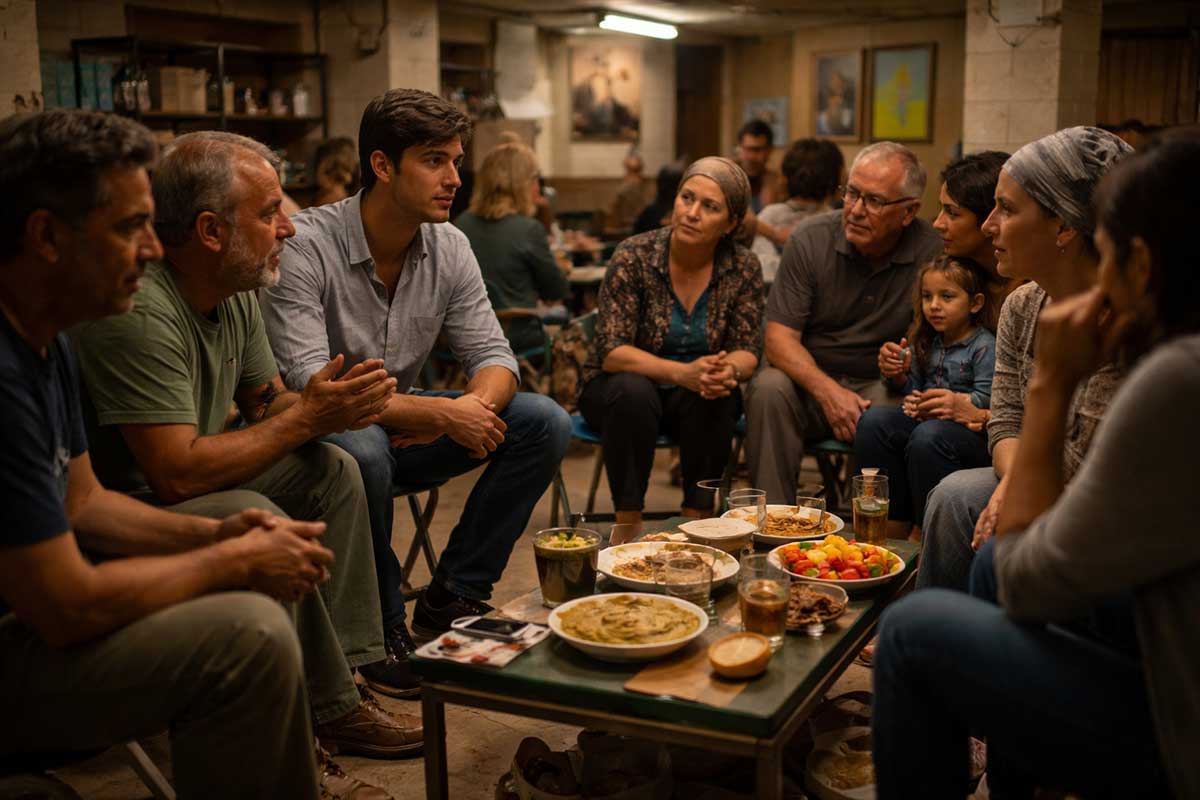
By Thursday the wrong reading had multiplied.
Not into one clear accusation, which might have been easier to answer or at least easier to hate, but into several competing versions of him, none of them fully absurd and none of them true. In one thread, the statement he had revised was cited as proof that civic language had become a polished substitute for moral courage. In another, the same paragraph was quoted as evidence of dangerous softness, the sort of English that invited foreign pity and weakened internal resolve. A third reader, more intelligent and in some ways more irritating than the first two, praised the statement’s restraint and used it to advance a position Yonatan did not hold at all.
That was the worst of it, he found.
Hostility can be dismissed as appetite. Intelligent misuse enters by another gate. It makes a home in the very part of you that still wishes to be understood.
Leora forwarded one of the cleaner critiques with a note.
Useful to read. Not because it is right, but because it reveals a vulnerability in paragraph 2. We were too abstract there. Learn from it, then move on.
Yonatan read the note twice.
Then the critique.
The writer, some academic or commentator with a fondness for cutting civic prose open and examining its organs, argued that the statement confused human clarity with moral evasion. It wished to sound responsible without assigning enough responsibility, humane without enough texture, public without enough risk. A fair portion of the piece was wrong. One section was entirely right. Yonatan could tell the difference at once, which only made the whole thing harder to dismiss.
He revised two upcoming documents with greater sharpness after that.
Still, the atmosphere around him had changed. He noticed it in small ways.
Daniel, in New York, sent him a link to an essay on “diaspora language and local pain,” asking whether this was “the sort of thing” he was now part of. A cousin he rarely spoke to wrote to say how proud it made him feel that Yonatan was “helping Israel tell its story right,” which was so far from how Yonatan himself understood the work that he did not know where to begin. An old acquaintance from college, who had not spoken to him in years, sent a message asking whether he had “gone nationalist now.” A local contact in Tel Aviv praised the statement and said the organization needed “more spine like that.” Another local contact said almost the opposite and congratulated the piece for “resisting patriotic simplification.”
It was as if each reader had taken a tool from the same drawer and claimed the drawer itself as proof of allegiance.
At first Yonatan tried answering carefully.
Then less carefully.
Then not at all.
He discovered, in those days, the strange fatigue of becoming a surface onto which others project coherence. It was not fame. It was not even visibility in any honorable sense. It was only that enough words now had his labor in them that people, seeing their own reflections distorted there, began attributing to him intentions larger and cleaner than any he possessed.
He worked longer hours.
Partly from need. Partly from gratitude that the work existed. Partly from a hope, childish perhaps, that better sentences might protect him from bad readings.
Leora cured him of that by Friday afternoon.
He had drafted a short summary for partner organizations abroad. She returned it with heavy edits.
Too much qualifying. You’re writing defensively now. Readers can smell retreat. Say the thing plainly, with proportion, then stop.
He stared at the page.
She called five minutes later.
“You’re letting the noise into the syntax,” she said.
“That obvious?”
“Yes.”
He rubbed his forehead.
“I keep thinking of the sentence before the sentence. The paragraph around the paragraph. What they’ll detach next.”
Leora made a small sound, neither sympathy nor impatience, but some efficient blend of both.
“That way lies paralysis,” she said. “You cannot write only against future mutilation. You’ll produce pre-damaged prose.”
The phrase hit him at once.
“What do I do, then?”
“You return to the truer reader. The one we talked about. Not the loudest one. Not the one sharpening knives. Not the one desperate for reassurance. The truer reader.”
“And who is that exactly?”
“The person still capable of sequence.”
She let that sit.
Then, more gently than usual: “If you stay in this work, you will lose the fantasy that being precise can save you from use. Precision still matters. It just doesn’t grant innocence.”
After the call, he went outside.
Not far. Only down to the street, then along two blocks of late afternoon Tel Aviv, where dogs tugged leashes, cyclists resented pedestrians, and café tables held the city in its usual half-serious sprawl. He needed bodies around him that were not speaking in footnotes.
At the corner near the bakery he saw Ofer leaning against a parked scooter, talking with a man in a municipal vest.
Ofer saw his face and ended the conversation with a nod.
“You look like someone put theory in your lunch,” he said.
“Public language,” said Yonatan. “Same family.”
Ofer lit a cigarette, then appeared to think better of offering one.
“So?”
“I think I’m being read by people who require me to be simpler than I am.”
Ofer blew smoke away from him and shrugged.
“Yes. That’s normal.”
“That doesn’t trouble you?”
“It troubles me all the time.” He flicked ash toward the curb. “Trouble is not the same as surprise.”
They stood in silence for a few moments, watching traffic pause and surge.
At length Ofer said, “You know what the problem is?”
“I assume you’re about to tell me.”
“You still think being in the middle means being between sides.” He looked at Yonatan. “A real middle is not between sides. It gets hit from both because it refuses their simplifications. That’s different.”
Yonatan stared at him.
Ofer saw the expression and smirked.
“Yes, yes. The idiot from the building said something quotable. Be humble.”
He crushed the cigarette under his shoe.
“Come tonight,” he said. “A few of us are sitting downstairs after dinner. Nothing dramatic. Just people being tired together.”
Yonatan almost refused from habit. Then didn’t.
That evening, after work, after two more revisions, after a brief message from Noa asking only How is your head? and receiving in return Crowded, he went downstairs.
The shelter room was open, though no siren had called them there. Someone had set out folding chairs in a loose circle. A tray of cut vegetables sat on a table next to crackers, hummus, bottled water, and a deck of cards. The room looked like what it was: a place built for interruption, borrowed now for endurance.
Malka was there, of course. Ofer. The father from upstairs, whose name turned out to be Eyal. His daughter, reading. Two women from the second floor, one knitting, one scrolling furiously through updates and pretending not to. An elderly man from the top floor who spoke rarely and only when irritated enough to become exact.
No one announced the purpose of the gathering. It emerged the way weather does.
They spoke first of practical things. Water pressure. Prices. A broken lock on the front gate. Whether the supermarket on the next street had become worse or had only revealed its true nature. Then, without transition, the conversation moved toward the week’s news. Not debate exactly. Not even opinion in the public sense. More the local exchange of burden. Who was called up. Who had family in the south. Which school had moved classes into protected rooms. Whether children should hear the news or only absorb it secondhand through adult silence.
Yonatan said little.
He listened.
The knitting woman, whose name was Dalia, said, “What I hate is not the sirens. It’s the day after, when everyone wants to tell you what it means.”
The elderly man grunted approval.
Eyal said, “My daughter asks if we’re safe. I tell her mostly. Then I hate the sentence all night.”
Malka, cutting cucumbers with more force than strictly needed, said, “People who want meaning too fast should be made to peel potatoes for large families.”
Ofer laughed.
“No,” he said. “They’d turn the potatoes into a manifesto.”
Even Yonatan laughed at that.
Then Dalia looked at him and said, “You work with words, yes?”
He hesitated. “Somewhat.”
“Then tell me,” she said. “How do you say what is happening without either lying or becoming unbearable?”
The room quieted.
He felt at once the temptation to answer beautifully and the certainty that beauty would be an offense.
So he said, “I don’t know yet. I think maybe you start smaller than people want. With what happened, to whom, what is needed, what remains true after anger and fear enlarge everything.”
Dalia nodded slowly.
“Yes,” she said. “Small enough to carry.”
Malka pointed the knife at him.
“That’s better than your face looked when you came in.”
The room resumed breathing.
Afterward, walking back upstairs, Yonatan felt something shift. No relief. The misreadings still existed. The outside world still wanted him flatter than he was. Yet the neighbors had restored a scale to the question. How do you speak without lying or becoming unbearable? That, at least, was a human question. Much better than the public one, which usually asks only how to win.
The next day he went to Jerusalem.
He had told Noa he would come after work. He nearly didn’t. The train felt too long, his mind too used, the week too crowded inside him. Still, by late afternoon he found himself climbing again through the hills, carrying not a folder this time but only his notebook and a fatigue that had begun to alter the way he sat inside his own body.
Noa met him near the station.
She took one look at him and said, “You’re more tired than your messages.”
“I thought I was hiding that.”
“You are. Badly.”
They walked without deciding where.
The city was entering evening. Jerusalem in that hour had the look of something both exposed and withheld, each stone holding the day’s last light as if reluctant to surrender evidence. Students moved past them in clusters. An old woman carried bread tucked under one arm and flowers in the other. A group of boys in white shirts and black trousers ran downhill with the wild speed of children not yet claimed by the full moral weather around them.
For a while they did not speak of the week.
They spoke of almost nothing, which was its own form of care. A professor Noa disliked. The ridiculous English on a museum sign. The fact that three cafés in Jerusalem seemed to have independently decided chairs should injure the spine. A cat asleep in a doorway as if assigned there by theology.
At last, on a quieter street, Noa said, “Tell me what has been worst.”
He did not answer immediately.
“The not-knowing,” he said at length. “Not the criticism. Not even the malice. The not-knowing of which reading will attach to you and begin walking around as if it were you.”
Noa nodded once.
“Yes.”
He kept going.
“I thought the danger would be being hated. I didn’t realize how much stranger it is to be partially understood in the wrong shape.”
“That is stranger,” she said. “Hatred is cleaner.”
They stopped at a low stone wall overlooking part of the city. The light was thinning. A bell sounded somewhere. From farther off came the layered hum of traffic, prayer, conversation, engines, doors, and all the other unromantic sounds by which Jerusalem protects itself from becoming merely symbolic.
Noa leaned against the wall.
“Do you want comfort,” she asked, “or accuracy?”
He almost smiled.
“Accuracy.”
“Good. Comfort is overrated in this city.”
She looked out over the roofs.
“This won’t stop,” she said. “Not if you keep writing publicly. Not if the work matters even a little. People need coherence from others because they can’t bear how mixed they are inside themselves. So they assign you a cleaner shape. Villain, coward, loyalist, traitor, realist, moralist, whatever fits.”
He listened.
“The only thing that protects a person,” she said, “is not being unreadable. That’s impossible. It’s staying answerable to a deeper order than the day’s reaction.”
He turned toward her.
“What does that mean in practice?”
“It means knowing who can actually correct you.” She met his eyes. “Not everyone who uses your name gets to enter your conscience.”
He stood very still.
Something in him had been waiting for that sentence.
Noa saw this and looked away first, back toward the city.
Below them, a bus moved along a road in clean lines of light. Somewhere nearby a child was crying. Somewhere else someone laughed, too loud and then truly.
Yonatan said quietly, “And who does get to enter?”
She took time before answering.
“The people who know the cost of reality. The people who don’t need you simpler than you are. The people who can tell the difference between your failures and their projections.”
He thought of Amos. Of Leora. Of Malka, Ofer, Dalia. Of Noa herself. A small circle, stern and odd and unwilling to flatter him.
“That’s not many people,” he said.
“No,” said Noa. “It never is.”
They walked again after that, slower now.
At one point they passed near the walls of the older city. He felt again the pressure of that center not yet fully entered. Not only geographically. Inwardly. The place where inherited words grow too heavy to be spoken casually. He glanced toward the gate.
Noa noticed.
“Not tonight,” she said.
“No.”
“You’re still carrying too many witnesses.”
“Yes.”
The phrase no longer embarrassed him. It felt exact.
They found a small café and sat near the back. Around them students, tourists, clergy, local couples, and solitary readers occupied separate worlds under the same dim lights. The city did this constantly, he noticed now: placed incompatible lives beside one another and called the arrangement ordinary.
Noa asked about the neighbors. He told her about the gathering downstairs. About Dalia’s question. About Malka threatening to assign potato duty to anyone demanding instant meaning.
For the first time that evening, Noa laughed fully.
“Yes,” she said. “That’s the correct political theory.”
He watched her laughing and felt, with no warning, a tenderness so clean it almost frightened him. Not because it was too much. Because it was so unspectacular. No drama attached. No grand declaration. Just the sense that in the week’s noise, this face had become one of the places where his mind stopped contorting itself.
He said nothing about this.
The city, he had learned, punishes premature naming.
When they parted, she touched his arm once and said, “You’re not required to occupy the readings others force on you.”
He nodded.
On the train back to Tel Aviv, he sat by the window and watched his own reflection move through darkness.
He thought of Ofer’s distinction. The middle not as compromise, but as a place struck from both sides because it refuses simplification. He thought of Noa’s sentence: not everyone who uses your name gets to enter your conscience. He thought of Dalia asking how to speak without lying or becoming unbearable. All week he had been trying to solve public distortion with better sentences. Perhaps the harder task was to decide who counted as a real reader at all.
Back at the apartment, he opened the notebook and wrote:
The danger is not only being hated or misunderstood. It is allowing every outside reading to apply inwardly. A person cannot live if everyone who names him gains authority over what he is.
He paused.
Then:
A true correction comes from those who know reality well enough not to simplify you for their comfort. The rest may still wound, but they do not get to govern the soul.
He set the pen down, then added one final line:
No safe middle exists in public life. There is only the harder place where one remains answerable without surrendering oneself to every demand for clarity.
He closed the notebook.
The thirteenth day had not resolved the week’s pressure. It had only clarified its terms.
He was still being read wrongly.
He was still vulnerable to it.
Yet now, for the first time, he sensed the beginning of an inner border.
And inner borders, once established, change the map of everything that follows.
Chapter 14: Return to Jerusalem and the Wall
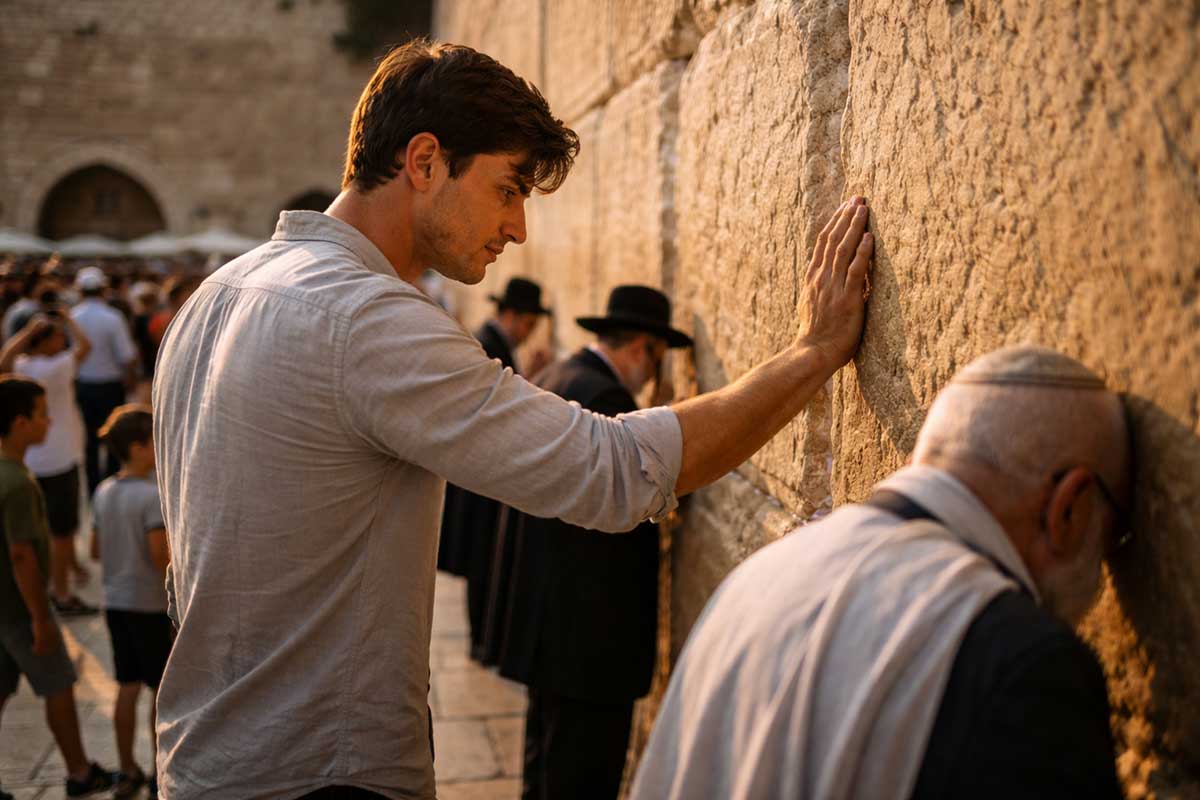
On the fourteenth day he returned to Jerusalem with less innocence than before and more need.
This time he did not go because the city called him in any noble sense, nor because Noa had advised it, nor because work required it, though work now gave him enough practical reason to justify nearly any journey inland. He went because something in him had grown noisy, and Tel Aviv, with all its movement and sunlit improvisation, no longer diffused that noise the way it had during his first week. The coast had taught him arrival, rhythm, neighborhood, repetition, utility. But once the week’s wrong readings and multiplied uses had begun to gather around him, the sea’s openness felt too available, too horizontal. He needed stone. He needed pressure. He needed a place severe enough not to flatter confusion into self-expression.
He took the morning train.
The car was half full. Students, soldiers, a woman with two children and a bag of oranges, an elderly man asleep upright with his hat tilted low, a young couple speaking French in the low urgent voice of travelers trying to remain private in public. Yonatan sat by the window and watched the land rise again. The hills seemed barer than before, though he knew they were not. He was bringing different weather into the looking.
He had written Noa only one line before leaving.
I’m coming up today. Not for rescue. Just because I think I need Jerusalem to be difficult.
Her reply came while the train was already climbing.
That’s the most accurate use of the city I’ve heard all month. I’m teaching until three. After that, I’m yours for a while. Don’t turn it into a pilgrimage before then.
He smiled despite himself and put the phone away.
Yet of course the city had already begun altering the day before he arrived. That was one of Jerusalem’s gifts and one of its manipulations. It made anticipation feel like participation. By the time the train entered the station, he already felt more judged.
He did not go to the university district first. He did not go for coffee. He did not seek out the familiar route that had begun to make Jerusalem survivable through repetition. Instead he walked toward the older parts of the city by himself, without haste and without the false steadiness of a man pretending he knows exactly what he seeks.
He passed through ordinary streets first, and was grateful for them. Buses, schoolchildren, municipal workers, a man carrying bread under one arm and talking into a phone with the other, an old woman in dark clothes scolding a boy who had not done anything visible enough to deserve such precision. Jerusalem protected itself, as always, by remaining a city before it became an emblem.
Yet as he drew nearer the older quarters, the pressure returned.
Police at corners. Pilgrims with inward faces. Vendors who had long ago learned how to address every form of longing without believing in any of them too much. Clergy moving in black, brown, white, and gray, each carrying a piece of another century inside the present one. Tourists dressed for revelation and heat in equal ignorance. Groups gathered around guides who spoke into small microphones, converting stone into narrative at industrial scale.
He reached one of the gates and stopped.
Until then he had managed Jerusalem by circling, delaying, entering its thought without entering its center. Now that delay had ended. The Old City lay before him, not theatrical from where he stood, not mystical, only old, burdened, inhabited, overread, oversold, undefeated. A gate. Stone. Movement. Security checks. Dust. Human voices. Nothing in itself transcendent. Which was perhaps why he knew he had finally come to the right threshold.
He went in.
The first sensation was narrowing.
Not spiritually. Physically. The streets folded inward. Stone pressed close. Shops, signs, doorways, steps, walls, hanging textiles, polished metal, scents of spice and coffee and incense and sweat and old wood and old prayer. The air carried less sky. The city inside the city rearranged movement into density. It was not possible here to remain general.
He walked slowly.
Tour groups passed him like moving doctrines. A priest leading pilgrims. Armenian clergy crossing a lane with grave contained speed. Religious Jews moving toward prayer with varying degrees of haste and inwardness. Muslim families navigating space with the practical authority of those for whom this was not symbol but terrain. Children running. Shopkeepers calling out. Security officers standing at points where history had become procedure.
He felt at once the temptation to interpret and the need to refuse it.
The place had been interpreted already beyond endurance.
So he did not take out the notebook. He did not try to name the arrangement of faiths, wounds, inheritance, contested belonging, layered devotion, occupation, longing, commerce, memory. He only walked and let the city narrow him.
At one turn he found himself in a quieter passage where the noise dropped enough for his own thoughts to rise too loudly. He leaned briefly against the wall and understood then that he had not come for beauty, nor for clarity, nor for the satisfaction of finally entering what he had delayed.
He had come to discover whether the inward pressure he had been carrying could survive meeting a place already dense with too much meaning.
A woman passed him holding the hand of a little girl. The child dragged her feet and asked something in Hebrew he did not fully catch. The mother answered with the tired patience of all mothers in cities full of sacred architecture and ordinary inconvenience. The exchange steadied him more than anything lofty would have.
He moved on.
At length he reached the Western Wall plaza.
He had seen images, of course. So many that he feared recognition might ruin the place before he arrived. But images had lied by simplification. In person the plaza was both barer and more charged. Open stone. Light. Security. Men and women moving toward their separate sections. Tourists pausing before deciding whether reverence required posture. Boys running where they should not. Old men standing in prayer as if their bodies had been arranged for that one task decades ago and not yet released.
Yonatan did not go forward at once.
He stood at a distance long enough to feel the old divided impulse rising in him: sincerity and suspicion together. He distrusted easy religious emotion, especially in himself. He distrusted too the more modern vanity of performing resistance to such emotion. Between those two refusals stood a man who had brought his grandfather’s siddur across an ocean and had not yet decided whether that act belonged to continuity, longing, guilt, or some blend of all three.
At last he went closer.
He did not hurry. He did not imitate the postures around him. He did not put on borrowed solemnity. He only moved through the section for men until the wall stood before him, close enough that stone became surface and not symbol.
He placed one hand against it.
The stone was warm.
That was the first truth. Not eternity. Not revelation. Warmth from the day.
He kept his hand there and closed his eyes for a moment, not in transport, only to shut out the visible arrangements of other people’s devotion and make a smaller room inside himself.
No prayer came.
At least, not one he could organize into language.
What came instead was a series of fragments too human to dignify at first: fatigue, fear of becoming false, fear of becoming useful in the wrong ways, gratitude for work, confusion about Noa, shame at how quickly public misreading had entered his nerves, memory of his grandfather swaying in dawn light, memory of his father historicizing everything until even faith became argument, his mother’s messages asking whether he had eaten, Malka’s soup, Ofer’s cigarette, Dalia asking how to speak without lying or becoming unbearable, Maya saying ideology must sit down and wait, Amos talking about moral temperatures.
He stood there, hand against warm stone, and understood that if there was prayer here for him, it would not come as purity.
It would come mixed.
That recognition undid him more than any grand sentence could have.
He did not weep. He was not made suddenly devout. He did not hear inward instruction. But something in him ceased demanding the cleaner version of himself. For one minute, perhaps less, perhaps more, he stood before the wall as a man whose inheritance, intellect, fatigue, irony, longing, confusion, and need had all arrived together and had not been refused entry.
When he stepped back, the plaza looked the same.
Which was right.
He found a bench along the edge and sat there in the sun. Nearby, a teenage boy was helping an older man fold a prayer shawl. A child dropped a small book and began to cry until it was retrieved. Tourists took photos with expressions that ranged from earnest to acquisitive. A group of boys in white shirts moved through the space with the unearned physical confidence of youth. The whole scene was part prayer, part nation, part family pattern, part public theater, part civic repetition. Jerusalem, as always, refused the single register.
Noa found him there nearly an hour later.
He had messaged her only:
I’m at the Wall. On a bench. Not transformed.
She arrived in a linen shirt, dark skirt, and the expression she wore when both concerned and unwilling to sentimentalize concern.
“You went in alone,” she said.
“Yes.”
“And?”
He looked up at her.
“I think that was the point.”
She sat beside him.
For a while neither spoke.
Then Noa said, “You don’t look broken.”
“No.”
“Good. I hate when the city gets to pretend it did something final.”
He turned slightly toward her.
“It wasn’t final.”
“No?”
“No.” He looked back at the wall. “It was more like… I stopped requiring myself to come here in a clean state.”
Noa was quiet.
Then: “That’s more serious than many conversions.”
He laughed softly.
“I didn’t convert.”
“I know. That’s why I said serious.”
They remained there another few minutes, then rose and walked away through the narrower streets. The Old City in the afternoon had grown denser, the traffic of bodies more complex, devotion and commerce more tightly braided. Noa moved through it with none of the self-consciousness of a guide and none of the romanticism of a pilgrim. She did not narrate for him. That restraint felt like kindness.
At one point, passing a small shaded corner where two old men sat drinking tea in complete indifference to history, she said, “This is what I mean. The place survives partly because not everyone inside it is trying to mean something all the time.”
He smiled.
“That may be true of countries and people.”
“Yes,” she said. “Especially people.”
They emerged from the gate into broader light.
The relief of space came with its own sadness. Inside the walls, pressure had narrowed him enough to quiet some of the noise. Outside, the city widened again, and with that widening his own complexity returned in full. Yet it no longer felt like failure.
They walked uphill in silence until they reached a quieter street lined with stone buildings and low garden walls. There Noa finally asked, “What happened at the wall?”
He answered slowly.
“Nothing dramatic. Which is probably why it mattered.” He searched for the right language. “I kept waiting to discover whether I belonged there. Instead it felt more like I was allowed to arrive without deciding that first.”
Noa considered.
“Yes,” she said. “That sounds right.”
They stopped at a café near one of the older neighborhoods, less crowded than the places near campus, quieter, more given to reading than display. A fan moved overhead. The coffee was strong and unsentimental. Two old women at the next table were discussing medical care with such detail and severity that their conversation took on the grandeur of policy.
Yonatan told Noa then, more fully than before, what the week had done to him. The multiplied readings. The way outside voices had begun trying to claim inward authority. The shame of how quickly he had wanted to explain himself. The fear of flattening under usefulness. The strange new fact that her voice had become one of the places where he stopped bracing.
He did not plan to say that last part.
It came because the city had narrowed him first.
Noa heard it without altering her face too quickly.
“That’s dangerous,” she said.
“Yes.”
“And true?”
“Yes.”
She looked down at her cup for a moment.
Then she said, “Good.”
The word was so small it nearly vanished.
He waited, not trusting himself to enlarge it.
At length she went on. “Dangerous and good are not opposites. People here confuse danger with prohibition because the stakes are always crowded.” She met his eyes again. “I’m glad my voice is one of those places.”
There was no declaration after that. None was needed. The sentence itself was enough to change the room.
They did not touch. They did not step into the exaggerated clarity lesser novels would demand. Instead they sat in the Jerusalem café while late light moved across stone outside and the old women beside them continued discussing blood pressure and grandchildren as if the world’s truer theology were embedded there.
When they left, the city had entered evening.
Noa walked with him only partway toward the station.
At a corner where one street descended and another rose, she stopped.
“You look steadier,” she said.
“I’m not sure I am.”
“No. But you’re carrying yourself less like a man trying to solve what should first be endured.”
He smiled.
“That sounds like a local compliment.”
“It is.”
She adjusted the strap of her bag.
“Come back this weekend,” she said. “No agenda. Just stay longer.”
He nodded.
“I will.”
Then, after a small pause: “Thank you for not turning today into a spiritual assessment.”
She almost laughed.
“Jerusalem already has enough of those.”
When they parted, he did not feel abandoned to the city as before. Nor rescued from it. Only accompanied through one section of its pressure.
On the train back to Tel Aviv, the hills descended into darkness outside the window. His reflection floated over them faintly, less accusing than in previous journeys. He thought of the warm stone. Of mixed prayer. Of Noa saying good. Of the possibility that belonging might begin not in clean conviction but in permitted complexity.
Back at the apartment, he did not go straight to the notebook.
He stood first at the balcony, letting the softer coastal air meet what Jerusalem had pressed tighter in him. Across the street the old man’s plants were dark shapes against a lit kitchen. Somewhere below, dishes clinked. Someone laughed, then coughed, then laughed again. Tel Aviv resumed him not by absolving the day, but by placing it inside ordinary noise.
At last he sat and wrote:
Today I entered the Old City and found no purity there, only pressure, warmth, commerce, devotion, fatigue, inheritance, dust, family patterns, and stone that did not ask me to simplify myself before touching it.
He paused.
Then:
Perhaps belonging begins when one is no longer ashamed to arrive mixed.
He sat with that a long while.
Then added one final line:
Jerusalem did not clarify me. It narrowed me enough to hear what remained when performance fell quiet.
He closed the notebook.
The fourteenth day had not healed him. It had not resolved the public noise or the inward strain. But it had changed the terms of his return.
He had entered the city’s center and not been purified.
Only made more honest.
And that, he sensed, would be needed for what was coming next.
Chapter 15: Collapse and Care
The collapse did not come in public.
That, later, would matter to him. He had feared something visible: a sentence spoken too sharply in the wrong room, a silence at the wrong moment, a humiliating loss of proportion at work, some outward failure dramatic enough to justify all the inward strain gathering over the past two weeks. Instead the breaking came in a form much less theatrical and much more exact. His body withdrew its cooperation.
It began on Monday afternoon in Tel Aviv, three days after the return from the Wall.
The trial work had become regular enough to resemble a pattern. Leora sent him drafts. He revised them. She returned them with lean comments that never wasted praise and never withheld it when earned. One piece concerned emergency educational continuity. Another, a donor letter. Another, a public-facing summary of community support for displaced families. The work mattered. That was one of its dignities and one of its costs. Nothing he touched remained abstract for long. Behind every sentence lay a person, or a room, or a need, or a fear someone had tried to flatten into institutional prose. He kept trying to let the language breathe without letting it become indulgent. Most days he succeeded enough to continue.
Yet under the work lay other things.
The public misuse of his words had not stopped, only moved on to new fragments. The noise around the statement had thinned, then attached itself to later phrases in smaller circles. It was no longer the center of his attention. That was worse in some ways. Acute pain instructs cleanly. Residual pressure enters the joints.
His feelings for Noa had grown less ignorable. Not into romance of the kind cities and novels like to decorate, but into a steadier and more demanding fact: her voice had become one of the few places where his mind stopped defending itself with commentary. This was not simple comfort. It was a form of risk. The country had already entered him through language, work, public strain, neighborhood ritual, shared waiting. Now it had begun entering him through attachment. He knew enough to fear the multiplication of stakes.
Then there was sleep.
Or rather, the narrowing of sleep into intervals not long enough to do their work. A late message from Leora. Another from Daniel. A news alert. His mother asking whether he was eating. A dream with sirens in it. A night with no sirens and the body still preparing for them. Thoughts that refused order and only became louder when ordered to quiet themselves. He was not unaware of this. He saw it. He named it. Naming, as usual, proved insufficient.
On Monday afternoon, around four, he was revising a summary for international partners. A clean job, on the surface. Trimmed paragraphs. Clear sequence. Fewer emotional tripwires than usual. He had just changed “ongoing civic resilience efforts” into “daily work by schools, local staff, and volunteers trying to hold ordinary life together” when the words on the screen lost depth.
Not blur exactly. Not dizziness in any cinematic sense. Rather the sudden sensation that the space between his eyes and the laptop had become unreliable. His heart kicked hard once, then harder again. The room tilted not physically but morally, as if gravity had shifted from outside him to within. He sat still, hands on the table, waiting for the moment to pass.
It did not pass.
His breathing shortened. That frightened him. Then the fear itself entered the body and made the breathing shorter still. He knew what this was and did not know what it was. Panic, perhaps. Exhaustion, perhaps. A body objecting after too much inward compression, perhaps. None of these names made the experience less animal.
He stood up too fast.
The room lurched properly then.
He caught the edge of the table, sat down again, and stared at the wall, trying to find one fixed ordinary thing inside it. Paint. Water stain. Shelf. Coffee mug. Notebook. The room remained the same room and had become, for several minutes, uninhabitable.
His phone buzzed.
The sound was intolerable.
He turned it face down and closed his eyes.
A thought arrived with cold precision: If the siren comes now, I won’t be able to move properly.
That thought broke the remaining discipline in him.
By instinct more than judgment, he called the one number nearest to usefulness.
Maya answered on the third ring.
“Yonatan?”
He had forgotten he had her number.
“Yes.”
“Are you all right?”
“No,” he said, and then, honest at last, “I don’t think so.”
Her voice changed at once. No alarm. No softness either. Only medical authority narrowing into practical care.
“Tell me exactly.”
He tried. Breathing. Heart. Lightheaded. Couldn’t settle it. No pain like a knife. No collapse. No real sentence holding.
“Good,” she said after hearing him through. “Now listen. Sit on the floor if the chair feels unstable. Put your back against something. Do not argue with the body in big philosophical language. Stay small. Breathe with me.”
He obeyed.
The floor was cooler than he expected. He sat with his back against the bed and followed her count. In for four. Hold. Out for six. Again. Again.
“This may be panic,” she said, “or a body using panic’s doorway. It may also be exhaustion. Have you eaten?”
He almost laughed. It came out as a rough half breath.
“Not really.”
“Of course.”
She stayed with him.
Five minutes. Then ten. The heart slowed enough to be felt again as his and not as a mechanical rebellion. The room regained distance. His hands stopped tingling. Sweat cooled on the back of his neck.
“Can you stand?” Maya asked.
“Maybe.”
“Don’t yet. Drink water first.”
He did.
When at last he stood, the apartment remained uncertain but possible.
“I think I’m okay,” he said.
“No,” said Maya. “You are improved. That is not the same statement.”
He leaned one hand on the counter.
“What do I do now?”
“You go nowhere alone this evening. I’m finishing at the hospital in an hour. I’ll come by.”
“That’s not necessary.”
“It wasn’t a question.”
The line was delivered in the same family tone Amos used when language had begun misbehaving.
He could not argue.
After the call, he texted Leora only: I need to stop for today. Sudden physical issue. I’ll return to the draft tomorrow morning.
She replied almost at once.
Stop now. Return tomorrow only if you’ve slept. No heroics.
Then his phone buzzed again.
Noa.
He stared at the screen a long moment before answering.
Can’t talk yet. Body rebelled. Maya coming by.
Her reply came in seconds.
I’m getting on the train. Don’t argue.
He sat down at the table and laughed once, weakly, at the terrible efficiency of women who had decided he was not to be trusted with his own condition.
Maya arrived first.
Still in scrubs, sweater over her shoulders, hospital fatigue around her eyes, hands already moving toward assessment. She checked pulse, asked questions, made him sit, made him drink more water, made him eat bread and cheese from Malka’s emergency influence, looked at his pupils, frowned at his answers, and finally sat opposite him with the calm of someone who had seen much worse and therefore did not need to dramatize lesser things.
“You’re not dying,” she said.
“Good.”
“But you are depleted enough that your body just sent a memorandum.”
He smiled faintly.
“That sounds like your father.”
“Yes,” she said. “Which is tragic, as I’ve spent years resisting his syntax.”
She looked around the apartment. Laptop open. Notes everywhere. Cold coffee. Not enough food visible. Curtains half open as though the room itself could not settle on a position.
“How long have you been doing this?” she asked.
“This?”
“Running on civic adrenaline and undernourished intellect.”
He did not answer.
She nodded. “Exactly.”
There was a knock at the door.
Noa.
When she entered and saw Maya, they greeted each other with the quick familiarity of people from adjacent Jerusalem worlds who had crossed before in university, hospital, archive, or family orbit.
“I’m not taking over,” said Noa.
“You can help by being one more adult,” said Maya.
“I’ve always wanted the title.”
Together they altered the apartment’s atmosphere so thoroughly that Yonatan hardly recognized it. Windows adjusted. Water boiled. Tea made. Laptop closed. Phone turned face down by unanimous decree. Food arranged. The room no longer resembled the cell of a man trying to out-think his own strain. It resembled, awkwardly and almost tenderly, the place of a person being returned to scale.
For a while they did not ask him to explain anything.
That was perhaps the deepest kindness.
Maya sat in the chair near the table, scrolling through a hospital portal with one eye and watching him with the other. Noa stood at the counter slicing fruit and speaking only when speech improved the air. Outside, the street continued as ever. A scooter. A dog. Dishes somewhere. The old man across the street adjusting plants at dusk. The city indifferent and sustaining at once.
At length Noa said, “Tell us what happened.”
He told them.
Not only the physical episode. The week before it. The public flattening. The multiplied readings. Work entering grief. The fear of becoming flatter than what brought him there. The strain of usefulness. The inward noise. The Wall. The sense that he had become answerable in too many directions at once. He told it less elegantly than he had ever written anything. By then elegance felt immoral.
Maya listened like a doctor. Noa listened like a scholar who had decided, for once, not to interpret too soon.
When he was done, Maya said, “This is not mysterious. You have a body.”
Noa added, “Which in this country is already a demanding philosophical position.”
Maya shot her a glance. “Helpful.”
“I’m trying to meet the local standard.”
Then she turned back to Yonatan.
“You are new here,” she said. “You’re working in language under pressure, sleeping badly, attaching meaning to every public misuse, caring too much about sequence in a society that eats it, commuting between cities that magnify different fractures in you, and falling in love with a place that doesn’t reward gentleness with predictability.”
The word love entered the room and remained there.
Yonatan did not look up.
Maya did not rescue him from it.
“None of that is discreditable,” she said. “But your nervous system is not a commentary platform. It has limits.”
Noa set the fruit down and sat across from him.
“She’s right,” she said. “You keep trying to meet the country at the level of totality. No one survives that. Not even people born into it.”
He rubbed his face with both hands.
“I thought if I stayed honest enough, maybe I could hold the pieces together.”
Noa was quiet for a moment.
Then: “Honesty is not the same as capacity.”
That landed more cleanly than comfort would have.
For a long time none of them spoke.
The tea cooled. Evening thickened. Somewhere below, a child resisted sleep in escalating tones. From another apartment came television laughter so badly timed it sounded almost cruel. A bus sighed at the corner. The room held all this and did not break.
At last Maya rose.
“I want you to sleep tonight,” she said. “Not read, not revise, not interpret your collapse into a moral event.”
“It feels like one.”
“Yes,” she said. “That’s one of the symptoms.”
She wrote something on a scrap of paper: water, food, no screens for one hour, message her if symptoms returned, urgent care only if chest pain or collapse or new symptoms, breathe before naming.
“Breathe before naming?” Yonatan asked.
Maya shrugged. “Medical advice improved by literature.”
When she left, she did so with hospital firmness and daughterly fatigue in equal measure.
At the door she said to Noa, “Make sure he doesn’t start explaining himself to his own pulse.”
Noa nodded. “I’ll sit on him if needed.”
“That seems academic.”
“It is interdisciplinary.”
After Maya had gone, the room grew quieter.
Noa remained.
She did not move closer immediately. That restraint mattered to him.
Instead she sat at the table with her hands around a cooling cup and said, “Do you want me to stay?”
He answered with more truth than style.
“Yes.”
So she stayed.
They did not use the time for declaration. The collapse had stripped away any appetite for scenes. Instead they talked in small true pieces. Her father once collapsing in a supermarket line after a year of pretending work and history and family were all mutually sustainable at full force. Her own season in graduate school when she began crying in archives for no visible reason and had to be instructed by a librarian to go outside and eat an orange. Amos translating government text through two wars and three private griefs and one day forgetting entirely how to turn on the stove. The city’s mythology of toughness. The body’s indifference to mythology.
At one point, long after dark, Yonatan said, “I’m sorry you had to come down because of this.”
Noa looked at him with that level directness he had grown to trust.
“No,” she said. “This is one of the real ways people come to each other here.”
The sentence entered him very quietly.
He lay down later, not fully asleep, only horizontal at last. Noa sat in the chair near the window with a book she was not reading much. The room held its dim coastal night. The balcony door was cracked open. Across the street, one light remained on in the old man’s kitchen, then went out. Somewhere down the hall Malka coughed once, as if monitoring life by sound.
Before sleep finally took him, Yonatan understood that the collapse had done something he would not have chosen and could not now deny.
It had removed the last vanity of interpretation.
He was not standing above the country, arranging its meanings with sufficient honesty. He was inside it. Subject to it. Limited under it. Cared for within it by actual people and not by the abstract nobility of endurance.
When he woke near dawn, Noa was asleep in the chair, her head tilted to one side, the book open and fallen across her lap.
He looked at her and felt something in him settle.
Not resolved. Not healed. Only settled enough to continue truthfully.
He reached for the notebook on the table and wrote, in the dim light, carefully enough not to wake her:
Yesterday my body refused the arrangement my mind had been trying to enforce. This was not failure of thought but correction of scale.
He paused, listening to the breathing in the room, hers and his.
Then wrote again:
Language can carry grief, duty, argument, affection, and public strain only up to the point the body allows. After that, any further effort becomes pride wearing moral clothes.
He looked at the line and did not change it.
One final sentence came, small and unadorned:
To be cared for without performance may be one of the rarest forms of grace in this country.
He closed the notebook.
The fifteenth day had brought no revelation worth quoting in public. No ideological conclusion. No spiritual victory. Only collapse, care, food, sleep, and the humiliating restoration of limits.
Which was, perhaps, the most serious kind of reckoning yet.
Chapter 16: Quiet Light

The next morning began without revelation.
No golden inward sentence. No sudden strength. No transformed relation to the country, to work, to Jerusalem, to public language, or to love. Only a room in weak early light, the sea air entering through the barely open balcony door, and Noa asleep in the chair by the window with her book fallen open across her lap like an abandoned argument.
Yonatan lay still and watched the room assemble itself around that fact.
The chair. The table. The cooling teacup. The fruit half-covered in a bowl. The closed laptop, which for once did not seem to accuse him. The notebook lying where he had left it after writing before dawn. Noa’s shoes near the chair. Her bag on the floor beside her, one corner of a folder peeking out. The apartment held no grandeur. Yet for the first time since his arrival, it did not feel provisional. Not because it had become home in any grand sense, but because weakness had occurred there and not been hidden.
He sat up carefully.
Noa stirred but did not wake. Her face in sleep looked younger and less armored, though even then there was something in it that suggested attention held in reserve. He rose, moved quietly, boiled water, and made coffee and tea with the solemn incompetence of a man trying to perform gratitude in domestic form without theatricality.
The kettle clicked.
Noa opened her eyes.
For one second she looked not confused, only suspended between worlds. Then the room returned to her and with it the previous night.
“How do you feel?” she asked.
He considered before answering.
“Less dramatic.”
“Good. That usually means more accurate.”
She stretched, winced at the chair, and stood.
“No heroic language before breakfast,” she said. “I’m setting the rules.”
He smiled.
They drank in the small kitchen area, standing at first, then sitting when the cups proved too warm for haste. Outside, the street had begun again. A scooter starting badly. A woman calling to someone from below. The old man across the street tending his plants with the same serious futility as always. The city resumed without comment on private collapses. That, too, was a kind of mercy.
Noa left by late morning.
Not abruptly. Not with overcare either. She wrote her number more clearly on the scrap Maya had used for instructions, though they both already had it. She touched his hand once, briefly, in the doorway and said, “Eat today. Then work only if the sentences stay human.”
He wanted to say something larger.
Instead he said, “Thank you.”
She nodded as if that were the correct size of sentence for the hour.
When she had gone, the room remained altered by her absence in a way he did not yet know how to inhabit. He did not turn that into a conclusion. He only cleaned the cups, opened the windows wider, and made breakfast slowly enough to count as obedience.
Leora’s message came near noon.
How are you? No assignments today unless you ask for one. Sleep counts as work this week.
He stared at the note longer than it deserved by length. Then he answered:
Improved. Grateful for the pause. I’ll read, but not revise.
Her reply:
Acceptable. Read something with nouns.
That made him laugh aloud.
He spent the afternoon doing almost nothing that could be defended in ambitious terms.
He walked to the grocer’s. Bought eggs, bread, tomatoes, yogurt, too many apricots. The owner grunted at him with familiar indifference. At the bakery, the girl with the silver ring asked, “Black?” and handed him coffee before he finished nodding. On the street, heat gathered and dispersed along white walls and parked cars. Children shouted in the ordinary grammar of neighborhood afternoons. A dog slept under a bench with more conviction than most philosophers.
None of this was redemptive.
That was the point.
By four he took the train to Jerusalem, not from need this time, nor from collapse, nor from work, but because he had said he would come back and stay longer.
The hills rose under a clearer sky than the previous week. He sat by the window and watched them without assigning too much. They did not need his inward weather each time. That was another thing the body’s refusal had taught him: the world does not deepen because one is exhausted.
Noa met him near the station. She was wearing the same linen shirt from before, sleeves rolled, books in her bag, an expression that carried tiredness honestly and therefore lightly.
“You look less translucent,” she said.
“That sounds almost complimentary.”
“It is. Don’t waste it.”
They walked.
No destination announced itself. They moved through Jerusalem as if neither trying to conquer nor decode it. Through streets of stone and bus stops and schoolchildren and men arguing over parking with the gravity of treaty language. Past students leaning against walls reading. Past women carrying shopping bags and speaking in quick Hebrew, Arabic, English, Russian. Past religious boys hurrying with books under their arms and secular teenagers occupying benches with the studied boredom of the young.
They stopped first at a small café, then later at a used bookstore, then on to a neighborhood overlook where roofs, trees, walls, church spires, cranes, and balconies all lay under the slanting light of late afternoon.
“Do you still feel judged here?” Noa asked.
He thought about it.
“Yes,” he said. “But less as accusation. More as proportion.”
She considered that and nodded.
“That’s progress.”
“And Tel Aviv?”
“It feels less like escape now,” he said. “More like another grammar.”
Noa smiled faintly.
“There. You’ve learned the local disease. Turning cities into moral syntax.”
He laughed.
“Yes. I think Amos infected me.”
They sat on the low wall overlooking the city. Below them, traffic moved in interrupted silver lines. Somewhere nearby, a radio was playing a song too old for the speaker’s age. A child cried and was soothed. A bell sounded once. The city continued refusing a single register.
After a while, Noa said, “What changed at your place wasn’t only the collapse.”
He knew what she meant.
“No,” he said.
“Do you want to talk about that?”
He looked out over the roofs before answering.
“Yes. But maybe without making it a verdict.”
“Good,” she said. “Verdicts are bad for developing realities.”
He turned to her.
“I think I’ve been afraid of making you carry too much meaning. For the country. For me. For some kind of answer.”
She listened without interrupting.
“And I don’t want to do that,” he said. “What happened at the apartment matters to me. You matter to me. But I don’t want to turn that into one more totalizing sentence.”
Noa’s face changed only slightly, but enough.
“Yes,” she said quietly. “That matters to me too.”
The wind moved lightly through the trees behind them.
He waited.
Then she added, “I don’t need you simple. That’s part of why I’m here.”
The sentence entered him with none of the violence of revelation and all the depth of truth that has already been waiting.
He did not answer at once.
At last: “I think I’m learning how rare that is.”
“Yes,” she said. “And how expensive.”
They remained on the wall until the light began to thin. Then they walked downhill toward the older parts of the city. Not into the Old City this time. Only near it. Close enough that its pressure was felt, not entered. The walls held the evening light with their usual impassive authority. Tourists thinned. Locals thickened. A family carrying food moved quickly toward home. A priest crossed a lane with a loaf of bread under one arm. Two teenage girls argued over a phone. A cat slipped under a stone bench like a line of thought withdrawing from speech.
They found dinner in a small place near one of the quieter streets. Soup, bread, olives, cheese, grilled vegetables, tea. Food that neither advertised itself nor apologized. Around them sat students, an old couple, two municipal workers, and a man reading alone with his glasses low on his nose. Nothing in the room sought to symbolize a nation. This made it, somehow, more trustworthy.
“Will you stay in the work?” Noa asked.
“I think so,” he said. “But differently.”
“What does that mean?”
He tore bread and considered.
“It means I can’t keep treating every sentence as if it carries my whole moral identity. Or every misreading as if it can define me. I have to stay answerable, but not available to everything.”
She nodded.
“That sounds closer to survival than purity.”
“I’m no longer sure purity was ever the goal.”
“No,” said Noa. “Only the temptation.”
Later, after dinner, they walked again.
At some point her hand brushed his and remained there.
It was not dramatic. No pause in the city’s breathing. No rearrangement of history around the gesture. Only two people in Jerusalem at evening, walking beside stone and traffic and old arguments and children and prayer and buses and ordinary fatigue, while one human fact quietly changed shape.
He looked at their hands only once.
Noa did not.
That, too, felt right.
When they reached the station, they stopped under the artificial light and steel of the newer world built to move people toward ancient burden more efficiently.
“I don’t want to overname this,” he said.
“No,” she answered. “Let’s not.”
“But I also don’t want to pretend it’s nothing.”
“It isn’t.”
They stood there a moment longer, then she leaned in and kissed him once, lightly, with the same exactness she brought to thought.
When she stepped back, the city remained where it was. The station announcements continued. A child nearby complained about going home. A man dragged a suitcase badly designed for old stone. Nothing had become larger than itself.
“Go,” she said. “Before you turn this into a page.”
He smiled.
“Too late.”
“Yes,” she said. “But maybe not tonight.”
On the train back to Tel Aviv, he sat by the window and watched his own reflection move over the darkness of the hills. The country no longer appeared to him as a single difficult beloved, nor as a field of symbols awaiting honest interpretation, nor even as a moral test arranged for his education. It had become denser and less available than that. A place of overlapping grammars. Labor. fear. appetite. memory. public use. private care. sea air and stone pressure. bureaucracy and prayer. soup in a hallway. folded chairs in a shelter. a paragraph cut down to honesty. a hand on warm stone. another hand taking his and not requiring simplification.
Back at the apartment, the coastal air felt almost soft.
He opened the balcony door and stood there a long while. Across the street, the old man’s plants formed dark patient shapes against the lit kitchen window. Somewhere below, someone laughed over a phone. A television glowed in blue pulses. The building breathed in small human sounds: a chair moved, plumbing, a cough, a closing drawer. He was inside this now. Not fully, not triumphantly, not beyond contradiction. But inside.
At the table he opened the notebook.
He wrote slowly:
I thought belonging would arrive as conviction, perhaps even as some earned clarity. Instead it has come in smaller forms: repetition, correction, work, shared waiting, meals, public misuse survived without surrender, the refusal of certain people to simplify me, and the permission to remain mixed without being refused.
He stopped and read the line.
Then wrote:
The country did not become less difficult. I became less committed to meeting it with false totality.
He sat for a while before the final sentence came.
At last he wrote:
To remain present without falsifying what the place asks—perhaps that is all the belonging one is ever granted, and perhaps it is enough.
He closed the notebook.
The sixteenth day did not end the argument between Tel Aviv and Jerusalem, between coast and stone, public life and inward life, language and use, fear and affection, inheritance and chosen presence. It did not solve work. It did not secure love. It did not purify motive.
It left him in something better than resolution.
A truer scale.
And in that scale, for the first time, the future did not feel like a verdict waiting to be issued.
It felt like a life.
Final Thoughts by S. Y. Agnon

When a story ends, the reader often wishes to know what has been decided.
Did the man remain?
Did he leave?
Did he believe?
Did he love?
Did the country accept him?
Did he become worthy of the burden he desired?
Such questions are natural. Yet life is less obedient than the reader’s wish, and the Land least obedient of all.
This man, Yonatan, did not arrive at certainty. That would have been too easy, and also false. He did not become pure in motive, secure in belonging, or immune to the uses of other people’s words. He did not solve the quarrel between the coast and the hills, between movement and memory, between public duty and private truth, between inheritance and chosen presence. He did not free himself from confusion. He learned, rather, what kind of confusion may be borne honestly.
At first he thought belonging might come as conviction.
Then he thought it might come as labor.
Then as language.
Then as moral accuracy.
Then as surviving public misuse without surrendering inward truth.
Then, perhaps, as the nearness of another person whose voice made the country less abstract and more exact.
Each of these was partly true. None of them alone was enough.
For belonging is not a possession placed in the hand once and for all. It is a manner of remaining. It is a discipline of presence. It is the refusal to flee either into slogans or into distance. A man belongs, if he belongs at all, not when he has solved the Land, but when he has ceased demanding that the Land solve him.
This is a hard lesson, and one many would rather exchange for a cleaner doctrine.
Yet what is the human soul, if not a vessel too mixed for easy victories?
What is the Land, if not a place where mixtures are pressed until they either lie or become honest?
What is love, if not one of the few mercies by which a person is seen in his complexity and not cast aside for it?
Yonatan was granted no triumphant end. I do not regret this. Triumph belongs to other genres and to younger hearts. He was granted something smaller and more durable: proportion. He began to learn the measure of his body, the measure of his words, the measure of his obligations, the measure of those readers who may truly correct him, and the measure of an affection that does not demand simplification before drawing near.
This is no small gift.
The country remained difficult.
The cities remained themselves.
The public world continued to misread, to consume, to use.
History did not grow lighter.
The future did not promise fairness.
Yet within all this, a life became possible.
Not an innocent life.
Not an unbroken life.
Not a life beyond contradiction.
A human life.
If there is grace in this book, it is not the grace of rescue from reality. It is the grace of being held within reality by things modest enough to be overlooked: a neighbor’s soup, a corrected sentence, a shared shelter, a hand on warm stone, a woman who stays through the night, a morning in which nothing is solved and still one rises.
Readers often ask whether such things are enough.
I answer: for grand desire, no.
For fantasy, no.
For pride, certainly not.
For life, perhaps yes.
And perhaps that is why stories must be written.
Not to make the world simpler than it is.
Not to flatter the reader with noble conclusions.
But to show that even in pressure, mixture, fatigue, and unfinishedness, the human being may still be given a truthful way to remain.
Short Bios:
S. Y. Agnon
Nobel Prize–winning Hebrew writer whose fiction explored exile, faith, memory, irony, and the difficult search for belonging in Jewish life.
Yonatan Koren
A thoughtful young immigrant who comes to Israel in 2026 hoping to find belonging, only to discover that language, work, public life, and love test him more deeply than ideology does.
Noa
A sharp, emotionally disciplined doctoral researcher in Jerusalem whose mind moves between memory, language, trauma, and civic life, and whose presence becomes one of Yonatan’s few places of honesty.
Amos Lev
An older Jerusalem intellectual, translator, and former public servant who distrusts slogans, values exact language, and teaches Yonatan that words carry moral weight.
Maya Lev
Amos’s daughter, a pediatric medical professional whose practical clarity cuts through abstraction and reminds others that bodies and limits are as real as ideas.
Leora Ben-Ami
A serious editor and institutional writer who brings Yonatan into public language work and trains him to write with precision, proportion, and restraint.
Malka
A blunt, strong-willed apartment-building elder in Tel Aviv who governs daily life through realism, sharp humor, and acts of care disguised as instruction.
Ofer
A weary but perceptive neighbor who understands that public life often uses language for function more than meaning and helps Yonatan see the cost of living in the middle.
Dalia
A thoughtful neighbor whose quiet seriousness turns everyday conversation toward truth, burden, and the challenge of speaking without lying or becoming unbearable.
Eyal
A gentle father in the building whose concern for his daughter reveals the ordinary moral strain of raising children under public uncertainty.
Leave a Reply