
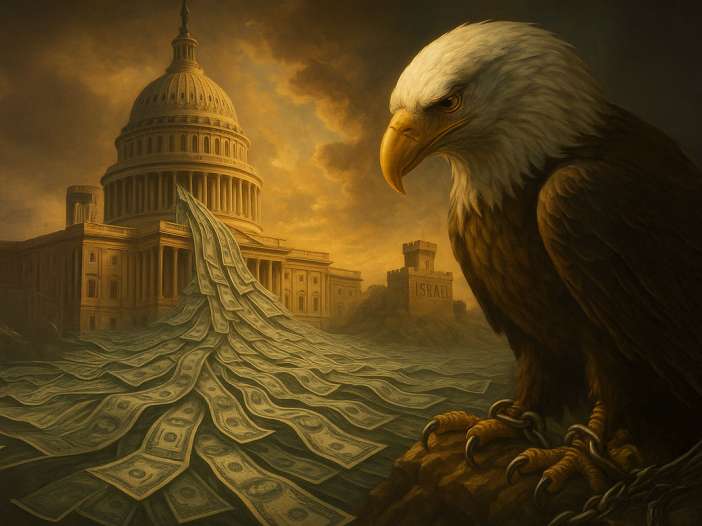

Introduction by Tucker Carlson
For years, Americans have been told that our relationship with Israel is essential, almost sacred, and beyond question. But I believe the opposite: this alliance has been destructive to our dignity, corrosive to our democracy, and costly to our people. Israel is a small country with its own interests — interests that do not always align with ours. Yet our leaders act as though we are dependent on them, when the truth is exactly the reverse: Israel relies on America for survival, for resources, for political protection.
In this series of conversations, I want to strip away the myths and expose the hard realities. Why do we accept humiliation in foreign policy? Why do we subsidize another nation while our own citizens go without? Why do we tolerate interference from a foreign leader in our domestic politics? And most importantly, how can we reclaim the self-respect of a sovereign nation?
(Note: This is an imaginary conversation, a creative exploration of an idea, and not a real speech or event)

Topic 1: Destructive & Humiliating Alliance

Moderator
- John Mearsheimer (co-author of The Israel Lobby) — he’ll steer the questions.
Participants
- Tucker Carlson (political commentator)
- Stephen Walt (realist scholar, Mearsheimer’s co-author)
- Andrew Bacevich (historian, critic of U.S. foreign policy overreach)
- Chas Freeman (former U.S. diplomat)
- Glenn Greenwald (journalist, critic of American subservience in foreign policy)
John Mearsheimer:
When we speak of humiliation in international politics, we’re not simply talking about bruised egos — we’re talking about a great power losing autonomy to a smaller ally. My first question, then, is: why do you believe the U.S.–Israel relationship has become destructive to America’s self-respect, and what form does that humiliation take?
Glenn Greenwald:
It’s not just that America supports Israel — it’s that we do so unconditionally, regardless of whether it undermines our own interests. That’s humiliating. Imagine subsidizing policies that harm your own reputation globally. When Washington bends over backward to excuse Israeli actions that violate human rights, it signals to the world that U.S. principles are for sale. That’s not alliance; that’s subordination.
Tucker Carlson:
Exactly. Israel is a tiny nation. On its own, it has limited resources, limited leverage. Yet it commands an outsize hold on U.S. foreign policy. That’s humiliating because it shows we’ve allowed ourselves to be manipulated. Leaders in Washington act like junior partners in this relationship. Our citizens watch our politicians fly to Jerusalem to seek approval, while Americans struggle with their own problems at home.
Andrew Bacevich:
From my historian’s lens, this humiliation mirrors what happens to empires in decline: they mistake client relationships for strength. The Romans did it. The British did it. When the U.S. makes Israel’s priorities our own, regardless of cost, we signal dependency. That’s destructive to our republic’s dignity, and it’s corrosive to the idea that the U.S. acts first in its own interest.
Chas Freeman:
Diplomatically, it’s clear: every time we veto a U.N. resolution condemning Israeli excesses, we humiliate ourselves. The world sees it. We destroy our credibility on human rights. It makes us look hypocritical, and hypocrisy is the deepest wound to diplomacy.
Stephen Walt:
I’d add that humiliation also comes in the form of captured policymaking. When lobbying groups effectively dictate U.S. positions, we’re no longer sovereign in those decisions. That’s not an alliance of equals. That’s capture — and it undermines respect, both at home and abroad.
John Mearsheimer:
We’ve identified humiliation. Let me ask the second question: if this relationship is destructive, what keeps it in place? Why does the United States tolerate this dynamic despite the costs?
Andrew Bacevich:
Because inertia governs Washington. Foreign policy elites are wedded to past paradigms. Supporting Israel became an unchallengeable orthodoxy during the Cold War, and it persists now even when strategic logic has shifted. It’s easier to continue a dysfunctional habit than to confront entrenched interests.
Stephen Walt:
The Israel lobby plays an enormous role here. We laid this out in our book: it’s not a conspiracy; it’s interest-group politics. Pro-Israel organizations are highly organized and effective. There is no counter-lobby of comparable scale. So policymakers face asymmetric political pressure: reward for compliance, punishment for dissent.
Tucker Carlson:
And let’s be honest — cowardice is part of it. Many U.S. politicians fear being called antisemitic if they question aid to Israel. That fear silences debate. It’s a kind of political extortion. And so the relationship stays in place not because it serves America, but because it serves the careers of those unwilling to challenge orthodoxy.
Glenn Greenwald:
The media contributes too. Most mainstream outlets treat criticism of Israel as taboo, reinforcing the idea that even rational critique is forbidden. That censorship of debate sustains a dynamic where leaders can ignore public opinion. Remember: polls show Americans are increasingly skeptical of unconditional support. But that skepticism rarely translates into policy.
Chas Freeman:
At the diplomatic level, habit and symbolism also play a role. Israel is seen as the “special ally” in the Middle East. That myth has become sacrosanct. It takes courage to puncture myths. And our political class has little appetite for courage.
John Mearsheimer:
So the relationship endures through fear, inertia, and lobbying. My final question is this: if America were to reclaim its self-respect, what practical steps should it take to reset this alliance on healthier terms?
Chas Freeman:
The first step is simple: treat Israel like any other country. No more special exemptions. If they violate international law, we acknowledge it. If they ask for aid, we weigh it against our interests. Reciprocity, not subservience.
Tucker Carlson:
Cut the aid, or at the very least condition it. Stop sending billions in military assistance that allows Israel to act with impunity. That alone would restore dignity. No self-respecting nation bankrolls another while being told what to think.
Glenn Greenwald:
Transparency is another step. Americans deserve to know exactly how much money, how many weapons, and how much diplomatic capital are being spent on Israel. When the costs are visible, accountability follows.
Andrew Bacevich:
We must also revive a tradition of restraint. That means rebalancing foreign policy to focus on actual U.S. interests: securing our borders, restoring our economy, repairing our democracy. Clientelism abroad is incompatible with republican health at home.
Stephen Walt:
And finally, we need political courage. Leaders must risk being criticized in order to tell the truth: Israel is not America. Its interests are not always ours. Recognizing that — and acting on it — is the only way to restore a relationship based on equality rather than humiliation.
John Mearsheimer (closing):
What I hear is a shared insistence that dignity in foreign policy requires clarity, courage, and reciprocity. If America wishes to remain a great power, it cannot continue to be seen as subordinate to a client. The question that remains is whether our leaders — and our citizens — are ready to face that truth.
Topic 2: Dependency Reversed: Israel Needs U.S. More

Moderator
- Norman Finkelstein (political scientist, author of The Holocaust Industry)
Participants
- Tucker Carlson (political commentator)
- Noam Chomsky (linguist, political dissident)
- Andrew Sullivan (writer, cultural critic)
- Ali Abunimah (Palestinian-American journalist, founder of Electronic Intifada)
- Lawrence Wilkerson (Colonel, former Chief of Staff to Colin Powell)
Norman Finkelstein:
The public narrative often suggests the U.S. leans on Israel for stability, intelligence, or moral guidance. But the reality, as many of us here have argued, is the reverse: Israel leans far more on the United States. Let me begin with this: how do you see the asymmetry in this relationship, and why is it Israel, not the U.S., that depends most on the alliance?
Tucker Carlson:
Israel would not survive in its current form without U.S. aid. That’s the hard truth. Billions flow every year in military and economic support. Our weapons, our diplomatic protection — it’s what allows them to function with such boldness. Without it, they’d have to make compromises. That asymmetry is obvious: Israel gets survival; America gets headaches.
Andrew Sullivan:
I’ve often said the myth of equal partnership is just that — a myth. Israel is a small nation. America is a continent-spanning superpower. The dependency flows one way. Israel needs U.S. vetoes at the U.N. They need our advanced weaponry. They need our political shield. Meanwhile, if Israel vanished tomorrow, America would remain the same global power. The relationship is, frankly, lopsided.
Ali Abunimah:
Let’s be blunt: Israel’s existence as an occupying power is only sustainable because of U.S. backing. Without U.S. military aid, they couldn’t maintain the blockade on Gaza or the settlements in the West Bank. Without U.S. diplomatic cover, they’d face sanctions like South Africa once did. Israel knows this. Their survival strategy is not self-reliance — it’s constant lobbying for U.S. indulgence.
Lawrence Wilkerson:
From my years inside the Pentagon, I saw firsthand: the flow of aid, the policy deference. It’s one-way. Israel receives, America dispenses. The asymmetry is institutionalized. We write blank checks, and they cash them. No serious strategist can argue the U.S. “needs” Israel the way Israel needs us. That narrative is propaganda, not reality.
Noam Chomsky:
And we must remember the moral asymmetry. The U.S. provides resources that Israel uses in violation of international law. That creates dependence of a peculiar kind: Israel depends on America to shield it from the consequences of its actions. Without us, they’d face the world’s judgment. That’s dependency — and it’s profound.
Norman Finkelstein:
So we agree Israel leans heavily on America. But here’s the harder question: why, then, does the myth persist that the U.S. somehow “needs” Israel? What sustains that illusion?
Ali Abunimah:
Because it flatters both parties. Israeli leaders love portraying themselves as indispensable — the “little Sparta” defending the West. American leaders love pretending they’re gaining a loyal ally in a tough neighborhood. It’s political theater, and it plays well with audiences who don’t know the actual costs.
Noam Chomsky:
And let’s not underestimate the propaganda system. The narrative of Israel as a plucky democracy surrounded by hostile neighbors is constantly reinforced in U.S. media and political discourse. That imagery creates a false sense of dependency: that we, the giant, need the small ally to remind us of courage and morality. It’s mythology masquerading as strategy.
Andrew Sullivan:
I’d add that religion plays a role. For many American Christians, Israel is not just an ally but a fulfillment of prophecy. That belief cements the illusion that America needs Israel spiritually, even if not strategically. It’s theology shaping geopolitics.
Lawrence Wilkerson:
Inside Washington, it’s also about bureaucratic self-interest. Defense contractors benefit enormously from the aid packages, which circle back into U.S. weapons sales. So the illusion persists because money flows. The myth has sponsors, and those sponsors profit from keeping it alive.
Tucker Carlson:
Yes — and politicians benefit, too. Telling voters that Israel keeps us safe from terrorism or shares intelligence makes it easier to justify billions in aid. It’s a talking point, not a reality. But in politics, talking points become policy.
Norman Finkelstein:
Then let’s imagine a different path. If Israel’s survival depends so deeply on America, what practical steps could the U.S. take to shift this dynamic, to move from enabler to equal partner — or even to wean Israel off this dependency?
Noam Chomsky:
The obvious first step is conditionality. Aid should be tied to compliance with international law. That would immediately alter the dynamic. If Israel knew aid could stop tomorrow, their calculus would change. Dependency becomes leverage when used wisely.
Andrew Sullivan:
We could also normalize the relationship. Treat Israel like any other ally — no more, no less. We don’t give Canada blank checks. We don’t give Britain unconditional vetoes. Israel should be brought down to the level of a normal partner, not exalted above them.
Lawrence Wilkerson:
From the military perspective, we can phase out the guarantees. Reduce arms packages over a ten-year period. Force Israel to budget responsibly, rather than assume endless U.S. largesse. Dependency shrinks when indulgence shrinks.
Ali Abunimah:
But let’s be honest: dependency isn’t just about aid. It’s about impunity. To reset the relationship, the U.S. must stop shielding Israel diplomatically. Stop vetoing at the U.N., stop blocking international investigations. That would expose Israel to the same accountability as any other state.
Tucker Carlson:
And above all, we need courage at home. Politicians must be willing to say: Israel needs America; America doesn’t need Israel. Once that truth is spoken openly, policy can change. Until then, the myth will keep us in chains.
Norman Finkelstein (closing):
What emerges here is a portrait of dependency masked as alliance. Israel’s survival strategy rests on U.S. indulgence, while America gains little in return. To acknowledge that fact — and act on it — is to take the first step toward dignity, equality, and honesty in foreign policy.
Topic 3: Resource Allocation: U.S. Foots the Bill

Moderator
- Rand Paul (U.S. Senator, longtime critic of foreign aid, including to Israel)
Participants
- Tucker Carlson (political commentator)
- Pat Buchanan (paleoconservative author and commentator)
- Philip Giraldi (former CIA officer, critic of U.S. foreign aid to Israel)
- Chris Hedges (journalist, moral critic of empire)
- Medea Benjamin (activist, co-founder of Code Pink)
Rand Paul:
Billions of dollars flow from American taxpayers to Israel every year, largely in military assistance. Many Americans don’t even realize how much this costs them. My first question is this: what do you see as the consequences of this enormous financial commitment, both for U.S. resources and for the broader moral fabric of our country?
Tucker Carlson:
The cost is not just financial, though that’s staggering. It’s moral and political. We spend billions on Israel while our own borders remain porous, our infrastructure crumbles, and our people suffer. Every dollar sent abroad is a dollar not spent at home. And what’s worse, we’re not just subsidizing an ally — we’re subsidizing policies that make America hated in much of the world.
Chris Hedges:
Indeed, this is the price of empire: feeding others while neglecting your own. But here it’s even more grotesque, because Israel is not impoverished. It is a technologically advanced, wealthy society. To fund Israel while American cities rot is a moral obscenity. It reveals that our political system serves lobbies, not citizens.
Pat Buchanan:
For decades I’ve argued that foreign aid to Israel represents tribute, not alliance. It’s protection money. And the cost isn’t just in dollars — it’s in credibility. We bankrupt ourselves financially, and we bankrupt our claim to independence. America becomes a cash machine for a foreign state. That’s humiliation masquerading as generosity.
Medea Benjamin:
And think of opportunity costs: what if those billions went to education, healthcare, renewable energy? Every time we send aid to Israel, we say “no” to investments that could lift our own people. The moral consequence is abandonment of the vulnerable here, in favor of a militarized project there.
Philip Giraldi:
I’ll add the intelligence dimension. Billions in aid give Israel access to weapons and technologies they sometimes resell or use independently of our consent. So U.S. taxpayers not only foot the bill — they underwrite actions that may actually harm U.S. interests. That’s betrayal, hidden beneath the language of “support.”
Rand Paul:
So the cost is both financial and moral. But then why, if it drains us so deeply, does Congress continue to write these checks? What sustains the willingness of America’s leaders to prioritize Israel’s needs over America’s budgetary reality?
Medea Benjamin:
Because the system is captured. The lobby ensures that questioning aid is political suicide. That makes Congress less a deliberative body and more a conveyor belt for policy crafted elsewhere. It persists because leaders benefit more from pleasing powerful donors than from serving ordinary citizens.
Pat Buchanan:
And because of political cowardice. I’ve seen it my whole life. Few dare to question the orthodoxy of “aid to Israel is sacred.” Those who do are branded anti-American or antisemitic. So the checks keep flowing, not because it’s good policy, but because it’s the path of least resistance.
Philip Giraldi:
Add to that the revolving door. Former officials go to work for defense contractors who profit from arms deals with Israel. Aid to Israel is effectively a subsidy to our own military-industrial complex. It’s not just about Israel; it’s about a corrupt feedback loop in Washington.
Tucker Carlson:
And there’s the narrative, endlessly repeated, that Israel is “our greatest ally.” Once you accept that premise, aid becomes unquestionable. It’s not debated like other spending. It’s sacrosanct. And politicians exploit that narrative to shield themselves from accountability.
Chris Hedges:
But let’s not overlook complicity of the media. Journalists rarely report the raw numbers, rarely connect the aid to domestic shortfalls. The American public is kept in ignorance. If they knew the true scale — billions annually, automatic transfers — the outrage would be enormous. That ignorance sustains the racket.
Rand Paul:
That leads to my last question: if America wanted to stop footing the bill, what steps could be taken to realign this relationship so it reflects genuine national interest rather than subsidy?
Chris Hedges:
The first step is honesty. Speak the truth to the American people: our tax dollars are underwriting occupation and apartheid. Once citizens understand, they will demand change. Awareness is the seed of reform.
Pat Buchanan:
Then we cut the checks. End foreign aid. America should not be in the business of subsidizing wealthy nations. If Israel wants security, it should pay for it. No other advanced economy gets billions in automatic aid from us. The precedent is insane.
Medea Benjamin:
Conditionality is also possible. Tie every dollar to human rights benchmarks. If Israel builds settlements, aid stops. If Israel violates international law, aid stops. That would either force change or reveal the absurdity of unconditional aid.
Philip Giraldi:
We also need enforcement. Congress should pass legislation requiring audits of all foreign aid, including Israel’s. Right now, oversight is practically nonexistent. Transparency is the enemy of corruption — and corruption is what sustains these subsidies.
Tucker Carlson:
And above all, courage. Politicians must risk the labels, risk the smears, and put America first. We don’t owe Israel endless money. We owe our citizens responsible governance. Ending aid to Israel isn’t radical. It’s rational.
Rand Paul (closing):
What I hear tonight is clarity: America is footing a bill it cannot afford and should not pay. Aid to Israel is not a necessity but a choice, one made out of fear and habit. To restore fiscal sanity and national dignity, that choice must be reversed.
Topic 4: Political Interference by Netanyahu

Moderator
Thomas Friedman (NYT columnist, longtime commentator on U.S.–Israel relations, has criticized Netanyahu’s direct involvement in U.S. politics)
Participants
Tucker Carlson (political commentator)
Peter Beinart (liberal Zionist critic of Israeli policies)
Jeremy Scahill (investigative journalist, The Intercept)
Zbigniew Brzezinski (late National Security Advisor, here imagined in dialogue for historical insight)
Robert Malley (former U.S. diplomat, negotiator, critical of Israeli lobbying influence)
Thomas Friedman:
We’ve all watched Israeli Prime Minister Benjamin Netanyahu involve himself in U.S. politics, from speeches to Congress to lobbying against policies he dislikes. Let’s start here: what is the real danger of a foreign leader — particularly Netanyahu — interfering so directly in American political life?
Jeremy Scahill:
The danger is sovereignty itself. When Netanyahu lobbies Congress to oppose a sitting U.S. president, as he did over the Iran deal, he isn’t acting as an ally — he’s acting as a power broker inside our own system. That undermines democratic accountability. Americans didn’t elect Netanyahu, yet his influence shapes our laws. That’s interference, plain and simple.
Peter Beinart:
As a Jew and a Zionist, I find it deeply troubling. Netanyahu believes his political survival depends on cultivating partisan loyalty in America, particularly with Republicans. That strategy drags the U.S.–Israel relationship into our domestic partisan wars. It erodes bipartisan support and breeds resentment. That’s not only bad for America, it’s dangerous for Israel, too.
Tucker Carlson:
I’ll put it bluntly: no self-respecting nation lets a foreign leader tell it how to spend its money or conduct its diplomacy. When Netanyahu pressures our politicians, it’s humiliating. We look like a client, not a sovereign nation. And our leaders go along because they fear the political fallout. That’s weakness.
Robert Malley:
Diplomatically, the risk is even broader. Netanyahu often pits U.S. administrations against each other, betting on one faction to advance his agenda. That makes the U.S. look divided and manipulable. Allies and adversaries alike notice when a small state can bend a superpower. It reduces American credibility on the global stage.
Zbigniew Brzezinski:
From the historical perspective, it’s extraordinary. No other ally has so consistently inserted itself into U.S. domestic debates. This is not what alliances are for. It transforms partnership into dependency. And once that dependency is visible, rivals exploit it. That is the true strategic danger.
Thomas Friedman:
We see the risks clearly. But then why does Netanyahu get away with it? What forces in American politics allow an Israeli prime minister to wield this kind of influence without pushback?
Tucker Carlson:
Because our leaders allow it. They invite him to speak in Congress. They treat him as if he were an American senator rather than a foreign leader. That’s cowardice dressed up as friendship. Netanyahu exploits it because he knows he can.
Peter Beinart:
The answer is the pro-Israel lobby, which rewards politicians who echo Netanyahu’s line and punishes those who resist. That makes it politically profitable to defer to him. Netanyahu understands this system better than most American leaders do. He knows how to play it.
Jeremy Scahill:
And the media reinforces it. Every Netanyahu speech to Congress gets treated like an epochal event. Dissenters are marginalized. That makes his interference look normal, even patriotic. In reality, it’s manipulation. But if the media sanctifies it, most citizens never see the distortion.
Robert Malley:
I’d also add fear. Politicians know that criticizing Netanyahu invites accusations of being “anti-Israel” or worse. That fear silences critique, even when everyone knows the interference is happening. The silence sustains the power imbalance.
Zbigniew Brzezinski:
During the Cold War, we tolerated many distortions in the name of strategy. But the Cold War is over. The persistence of this dynamic now is inertia, combined with fear. Netanyahu has mastered the art of exploiting both.
Thomas Friedman:
If that’s the problem, then here’s the final question: how should America respond? What steps could restore the balance so that foreign leaders — Netanyahu included — no longer dictate terms inside our democracy?
Robert Malley:
The answer is simple but difficult: treat interference as interference. When Netanyahu pressures Congress, call it out. Say publicly: this is a foreign leader lobbying against American interests. Sunlight is the first step toward balance.
Jeremy Scahill:
We also need campaign finance reform. As long as politicians are dependent on donors tied to specific lobbies, foreign leaders will have indirect leverage. Cut that pipeline, and Netanyahu’s influence shrinks overnight.
Tucker Carlson:
And we must end the habit of giving Netanyahu a stage in American politics. No more joint sessions of Congress. No more free passes. If he wants to speak, let him speak in Jerusalem, not Washington. That alone would restore dignity.
Peter Beinart:
I’d argue for honesty from American Jews, too. Many of us don’t support Netanyahu’s politics. If we say so openly, it will weaken the false perception that he speaks for all Jews or for all Americans who care about Israel. That distinction is crucial.
Zbigniew Brzezinski:
Finally, policy must reflect independence. If America takes a position on Iran, on settlements, or on aid, it must be clear: this decision was made in Washington, not Tel Aviv. That clarity will restore respect — both at home and abroad.
Thomas Friedman (closing):
What I hear tonight is that Netanyahu’s interference isn’t just an irritant; it’s a test of America’s sovereignty. To pass that test, we must shed fear, shed illusions, and act with the confidence of a great power, not the deference of a client state.
Topic 5: America Must Regain Self-Respect

Moderator
Jeffrey Sachs (economist, outspoken on U.S. foreign entanglements and dignity in policy)
Participants
Tucker Carlson (political commentator)
Ron Paul (former congressman, libertarian voice for non-intervention)
Dennis Kucinich (former congressman, progressive critic of U.S. foreign policy)
Cornel West (philosopher, moral critic of U.S. deference to Israel)
Roger Waters (musician and activist, outspoken about Israel/Palestine issues)
Jeffrey Sachs:
We’ve examined humiliation, dependency, financial burden, and interference. All of these point to one deeper wound: America’s loss of self-respect in foreign policy. My first question is this: what does “self-respect” mean in the context of the U.S.–Israel relationship, and how do we know it’s been lost?
Cornel West:
Self-respect, brother, means telling the truth even when it’s costly. When we cover up Israel’s occupation, when we justify violence against Palestinians, we betray our moral compass. That betrayal corrodes the soul of America. We know self-respect is gone when we silence the prophets and amplify the lobbyists.
Tucker Carlson:
It’s humiliating when the most powerful nation on Earth acts like it needs permission from a client state. Self-respect means independence — the ability to say “no.” We’ve lost that. Every time Congress writes another check without debate, we see the loss. Every time Netanyahu dictates terms, we see the loss.
Ron Paul:
I’ve long argued that a republic cannot remain free if it’s entangled in endless foreign commitments. Self-respect means sovereignty — our Constitution, our people, our priorities. But we’ve handed that away in exchange for lobbyist money and foreign approval. That’s a betrayal of the Founders’ vision.
Roger Waters:
You see it in culture, too. Musicians, activists, ordinary citizens who criticize Israel are blacklisted. That’s not the behavior of a self-respecting democracy. That’s submission. We’ve lost our voice, and losing your voice is the surest sign you’ve lost your dignity.
Dennis Kucinich:
Politically, we’ve lost self-respect because we treat Israel not as an ally but as a master. Our leaders compete to prove loyalty, not to America, but to Tel Aviv. That inversion of priorities shows the depth of the problem.
Jeffrey Sachs:
So, loss of self-respect is clear. But here’s my second question: why do you think America has allowed this to happen? What inner weakness in our political culture makes us so deferential to a much smaller nation?
Ron Paul:
It’s fear, plain and simple. Politicians fear losing elections if they oppose the lobby. That fear trumps principle. A nation governed by fear cannot be self-respecting. We have surrendered courage for political survival.
Tucker Carlson:
Yes — fear and laziness. Our leaders prefer to recite talking points rather than think independently. It’s easier to submit than to challenge orthodoxy. And so America projects weakness abroad while pretending it’s strength.
Dennis Kucinich:
And let’s not forget greed. Campaign donations flow to those who comply. Defense contractors profit. Aid to Israel isn’t charity — it’s a business model. Our loss of self-respect is tied to the corruption of our democracy.
Cornel West:
Spiritually, we’ve confused might with right. We mistake domination for leadership. That’s a spiritual weakness. Israel exploits it, but the deeper cause is our own moral decay. We cannot blame them entirely; we must face our own complicity.
Roger Waters:
And culturally, we’ve allowed narratives to replace facts. The story that Israel is always righteous, always endangered, becomes unquestionable. A self-respecting nation would challenge myths. Instead, we’ve swallowed them. That’s weakness of imagination, weakness of will.
Jeffrey Sachs:
Then let’s imagine the alternative. If America were to reclaim its self-respect, what concrete steps would that look like — politically, morally, and strategically?
Tucker Carlson:
It starts with saying “no.” No to unconditional aid. No to foreign interference. No to sacrificing American interests for another nation’s priorities. That simple word would change everything.
Ron Paul:
We need to end foreign aid altogether — not just to Israel, but across the board. Charity begins at home. A self-respecting republic minds its own business. That’s the path back to dignity.
Cornel West:
And we must recover the moral dimension. Speak truth about occupation. Stand with the oppressed. A self-respecting nation doesn’t enable injustice. It challenges it, even when it’s inconvenient.
Roger Waters:
Artists and citizens must be free to speak without fear. When dissent is no longer punished, democracy breathes again. Reclaiming self-respect means reclaiming freedom of expression.
Dennis Kucinich:
Finally, reform our politics. Take money out of campaigns. End the revolving door with defense contractors. Rebuild democracy so that leaders answer to citizens, not to foreign lobbies. That would restore our independence — and our pride.
Jeffrey Sachs (closing):
What I hear tonight is not only critique but vision. Self-respect means independence, honesty, courage, and care for one’s own people. If America finds that courage, our alliance with Israel could be recalibrated — not as humiliation, but as a relationship between equals. The choice is ours.
Final Thoughts by Tucker Carlson
After these discussions, one point is clear: America’s relationship with Israel, as it currently stands, is not an alliance between equals. It is a dependency — and it is America that plays the subordinate role. We fund, we defend, we excuse, and in return, we sacrifice our independence and credibility.
Regaining self-respect means telling the truth, even when it’s unpopular. It means putting the interests of our citizens ahead of foreign lobbies. It means ending unconditional aid and demanding reciprocity. If we fail to do this, we remain a client state, a hollow giant. But if we choose courage, America can once again act like the great power it is — independent, honest, and sovereign.
Short Bios:
Tucker Carlson
American political commentator and journalist, former Fox News host, known for his populist conservative perspectives and critiques of U.S. foreign policy.
John Mearsheimer
Political scientist and co-author of The Israel Lobby, a realist scholar who argues U.S. foreign policy has been distorted by pro-Israel influence.
Stephen Walt
Harvard professor of international relations and co-author of The Israel Lobby, a leading realist thinker on U.S. foreign entanglements.
Andrew Bacevich
Historian and retired U.S. Army colonel, critic of American militarism and foreign policy overreach.
Chas Freeman
Former U.S. diplomat and defense official, outspoken on the disproportionate role of Israel in U.S. foreign policy.
Glenn Greenwald
Investigative journalist and co-founder of The Intercept, critic of U.S. surveillance and foreign policy subservience.
Norman Finkelstein
Political scientist and author of The Holocaust Industry, known for his critiques of Israeli policies and U.S. support for them.
Noam Chomsky
Linguist, philosopher, and political dissident, long-time critic of U.S. foreign policy and Israel’s reliance on American aid.
Andrew Sullivan
Writer and commentator, known for independent political analysis, has criticized the asymmetry of U.S.–Israel relations.
Ali Abunimah
Palestinian-American journalist and founder of Electronic Intifada, a leading voice on Palestinian rights and U.S. complicity.
Lawrence Wilkerson
Retired U.S. Army colonel and former Chief of Staff to Colin Powell, critic of U.S. military aid and Middle East policy.
Pat Buchanan
Conservative political commentator and author, critic of U.S. foreign aid and interventionism, especially regarding Israel.
Philip Giraldi
Former CIA officer, now outspoken critic of U.S. foreign aid and Israeli influence in Washington.
Chris Hedges
Pulitzer Prize–winning journalist and author, critic of U.S. empire and its moral compromises.
Medea Benjamin
Activist and co-founder of Code Pink, a leading critic of U.S. military aid and interventions abroad.
Thomas Friedman
New York Times columnist, has criticized Netanyahu’s interference in U.S. politics while supporting a two-state solution.
Peter Beinart
Author and commentator, liberal Zionist critic of Israeli occupation and Netanyahu’s influence on American politics.
Jeremy Scahill
Investigative journalist with The Intercept, known for exposing U.S. foreign policy abuses and Israeli lobbying.
Zbigniew Brzezinski
Former U.S. National Security Advisor, realist strategist critical of foreign entanglements (included here in historical perspective).
Robert Malley
Former U.S. diplomat and negotiator, critic of Israeli lobbying and advocate for balanced Middle East policy.
Jeffrey Sachs
Economist and professor, critic of U.S. foreign policy entanglements, calling for dignity and independence in global relations.
Ron Paul
Former U.S. congressman, libertarian leader, long-time opponent of foreign aid and interventionism.
Dennis Kucinich
Former U.S. congressman, progressive voice against war and foreign aid that undermines American democracy.
Cornel West
Philosopher, author, and activist, critiques U.S. foreign policy on moral and spiritual grounds, with focus on justice.
Roger Waters
Musician and activist, outspoken critic of U.S. support for Israel and advocate for Palestinian rights.
Leave a Reply