

What if one simple poem explained motherhood better than psychology books ever could?
Some poems become memorable because they are beautifully written.
Others stay with us because they tell a truth people recognize immediately.
“Before I Was a Mom” belongs to the second kind. It is not trying to make motherhood look perfect. It speaks from the middle of real life, where love is mixed with exhaustion, fear, mess, tenderness, and wonder.
Its power comes from one simple revelation:
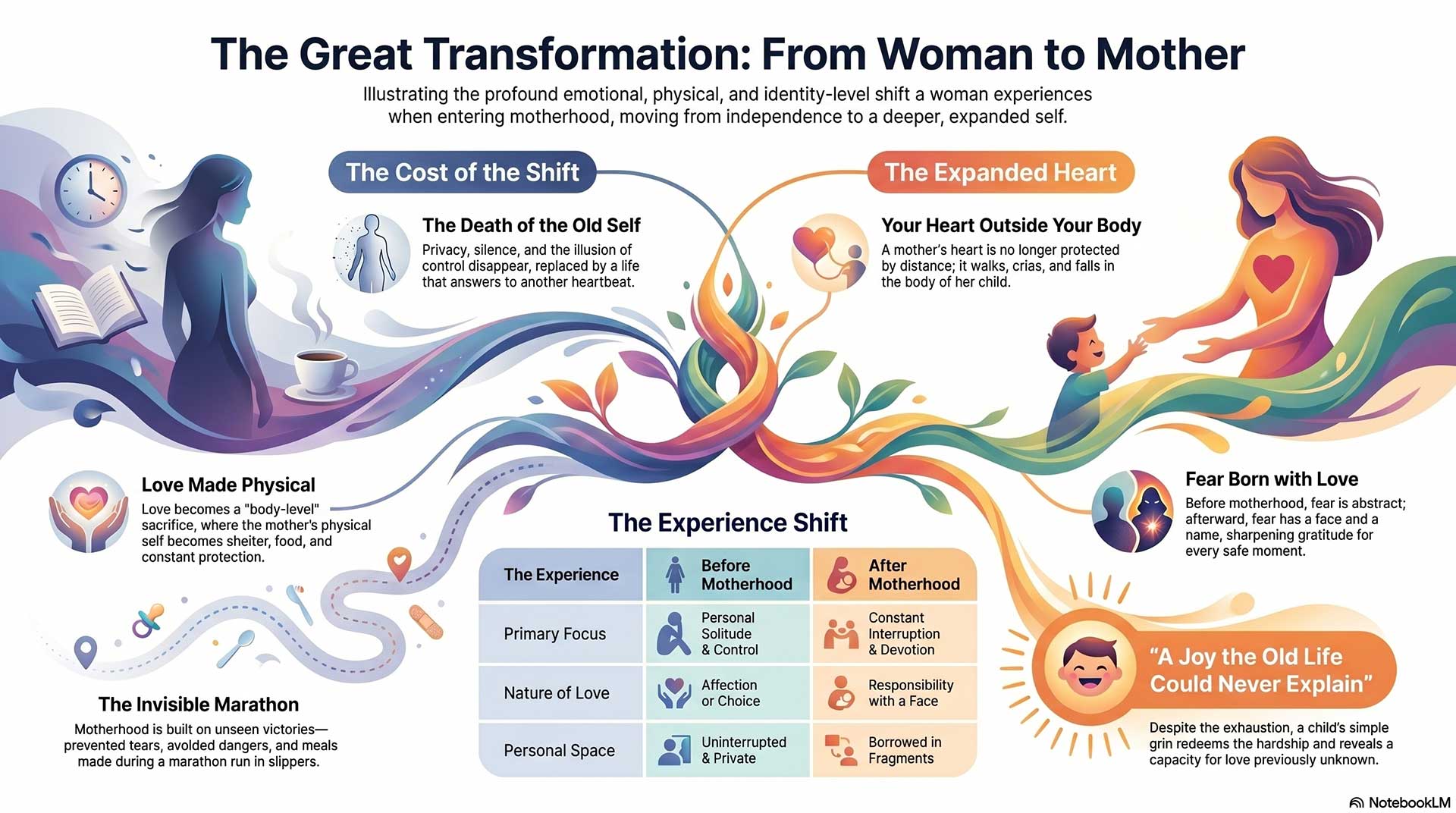
Motherhood does not merely add a child to a woman’s life. It changes the meaning of the woman’s life.
Before motherhood, love may feel like affection, romance, friendship, or choice. After motherhood, love becomes responsibility with a face. It becomes a life that depends on you, interrupts you, frightens you, softens you, and awakens parts of the heart that may have been sleeping.
This imaginary conversation explores that transformation.
Not motherhood as an ideal.
Motherhood as lived truth.
(Note: This is an imaginary conversation, a creative exploration of an idea, and not a real speech or event.)
Topic 1: The Life She Lost Before Becoming a Mom

Guests: Maya Angelou, Louisa May Alcott, Erma Bombeck, Jane Austen, Anne Morrow Lindbergh
Moderator: Nick Sasaki
Nick Sasaki:
The poem begins with small losses.
Toys on the floor. Forgotten lullabies. Poisonous plants. Immunizations. Sleep. Clean clothes. Control over one’s own thoughts.
At first, it sounds almost funny. Then we realize it is describing something sacred: the death of the old self, and the birth of a mother.
Before a woman becomes a mom, she may have a life that belongs mostly to herself. Afterward, even her thoughts are interrupted by love.
Question 1: What parts of a woman’s old life quietly disappear when she becomes a mother?
Erma Bombeck:
Clean floors disappear first.
Then hot coffee. Then the idea that a person can go to the bathroom alone. Then the fantasy that laundry has an ending.
But beneath the comedy is something tender. A mother loses the illusion that life can be controlled. She learns that love has sticky fingers, loud demands, and terrible timing.
Maya Angelou:
A woman may lose silence.
She may lose the luxury of thinking only of herself. Her body, her time, her rest, even her dreams begin to answer to another heartbeat.
But every loss carries a hidden question: who am I becoming now?
Motherhood takes the old mirror away and gives her a window.
Louisa May Alcott:
She loses the neatness of her plans.
A mother may plan a day, but a child rewrites it with fever, hunger, tears, or wonder. The home becomes less orderly, yet more alive.
There is a kind of beauty in that disorder. It is the beauty of a life no longer arranged for appearance, but for love.
Jane Austen:
She loses the polished version of herself.
Society often praises women for composure. Motherhood has little respect for composure. It brings stains, interruptions, worry, and sudden public embarrassments.
A mother may cease to appear elegant, but she may become far more real.
Anne Morrow Lindbergh:
She loses uninterrupted space.
Before motherhood, solitude may have been easy. After motherhood, even solitude must be borrowed in fragments.
Yet the soul learns a new rhythm. Not the rhythm of isolation, but of returning again and again to love.
Question 2: Why does the loss of sleep, privacy, and personal freedom often go unseen?
Louisa May Alcott:
Because home labor is often mistaken for nothing.
A mother may spend the whole day giving herself away, yet at night someone may ask, “What did you do today?”
They do not see the tears prevented, the dangers avoided, the meals made, the moods steadied, the tiny heart protected.
Erma Bombeck:
Because no one gives medals for finding a missing sock during a toddler crisis.
Motherhood is made of invisible victories. The baby slept. The child ate. Nobody swallowed a button. The house survived.
It does not look heroic from the outside. From the inside, it is a marathon run in slippers.
Maya Angelou:
Because sacrifice performed daily becomes invisible.
People notice grand gestures. They miss repetition. A mother’s love is repeated so often that the world begins to treat it as air.
But air is only invisible until we cannot breathe.
Jane Austen:
Freedom is often noticed only by the one who loses it.
The guest in the home sees the child. The mother feels the constant calculation: Is the baby safe? Is the food ready? Is the fever rising? Is there enough money? Is there enough patience left in me?
Her mind becomes a second nursery.
Anne Morrow Lindbergh:
The world sees the mother holding the child.
It does not see how the child also holds the mother’s thoughts.
Even when her hands are empty, part of her is listening.
Question 3: Can losing the old self become the beginning of a deeper self?
Anne Morrow Lindbergh:
Yes, but it is not simple.
A woman should not be asked to vanish and call it virtue. She needs room for her own soul, too.
Yet motherhood can deepen her. It can teach her that love is not the opposite of selfhood. It can become the place where the self grows wider.
Maya Angelou:
The old self is not destroyed.
She is buried like a seed.
Motherhood presses her into dark soil: fatigue, fear, tears, and labor. But from that place, another woman rises. Not less than before. More awake. More merciful. More fierce.
Louisa May Alcott:
The deeper self is often born in ordinary rooms.
Not in applause, not in public honor, but beside a cradle, a sickbed, a kitchen table, a child’s broken toy.
A mother discovers that greatness can live quietly.
Jane Austen:
A woman may lose vanity and gain discernment.
She learns what matters and what merely sparkles. The world may still praise charm, beauty, and cleverness, but motherhood teaches the value of steadiness.
That is a deeper education than society often admits.
Erma Bombeck:
Yes, and she may discover she is funnier than before.
When your shirt has baby spit-up, your hair is a mystery, and you’re singing a lullaby you forgot halfway through, you either cry or laugh.
Most mothers do both.
Nick Sasaki:
Maybe the poem begins with ordinary losses because motherhood often begins that way.
Not with a speech. Not with a ceremony.
With toys on the floor. A forgotten lullaby. A sleepless night. A small child who suddenly becomes the center of the universe.
Before she was a mom, her life may have belonged to her.
After she became a mom, her life became harder, messier, louder, and less controllable.
But it also became deeper.
And maybe that is the first truth of motherhood:
She lost the life she had, but found a love she never knew was possible.
Topic 2: The Body-Level Sacrifice of Motherhood

Guests: Sojourner Truth, Mother Teresa, Pearl S. Buck, Harriet Tubman, Florence Nightingale
Moderator: Nick Sasaki
Moderator: Nick Sasaki
Nick Sasaki:
One of the most striking parts of the poem is how physical motherhood becomes.
“Puked on.
Pooped on.
Chewed on.
Peed on.”
It almost sounds humorous until we realize something deeper is happening. Motherhood is not abstract love. It is love through exhaustion, through touch, through interrupted sleep, through the body itself.
The mother’s body becomes shelter, food, comfort, protection, and sometimes even battlefield.
Question 1: Why does motherhood ask for love through the body, not just the heart?
Pearl S. Buck:
Because children enter the world helpless.
A mother cannot love only in theory. The child needs milk, warmth, carrying, washing, holding, rocking. Love becomes physical before it becomes philosophical.
That is why motherhood humbles people. The body must serve before the mind can rest.
Sojourner Truth:
The body tells the truth.
A mother may be tired beyond words and still rise when the child cries. She may ache and still carry. History remembers speeches and wars, but many mothers fought daily battles with no witness except the child.
There is power in that unseen endurance.
Mother Teresa:
Love becomes real when it touches suffering.
To clean a child after sickness, to stay awake beside fever, to hold a crying baby when your own body longs for sleep — this is love made visible.
Small acts done with great love change the world quietly.
Florence Nightingale:
Caregiving has always required the body.
To nurse another human being means surrendering comfort repeatedly. A mother listens through the night for breathing changes, coughs, movement, silence.
The body becomes alert even in exhaustion.
Harriet Tubman:
A mother cannot clock out.
That is what many people fail to understand. Fear, protection, and responsibility follow her everywhere. Even when she rests, part of her remains awake inside.
Her body learns vigilance.
Question 2: What makes the messy, exhausting parts of motherhood strangely sacred?
Mother Teresa:
Sacredness is often hidden inside service.
The world expects holiness to appear grand and shining. But holiness may appear in stained clothing, trembling hands, and tired eyes.
A mother cleaning up after a sick child may be performing one of the purest forms of love.
Pearl S. Buck:
The mess proves intimacy.
Only someone who truly loves a child stays through every unpleasant moment. Feeding, cleaning, comforting, washing, carrying — these things form attachment.
The child experiences love first through care.
Florence Nightingale:
The exhausted mother reveals something important about humanity.
Civilization survives because someone is willing to care for the vulnerable when there is little reward for doing so.
Motherhood is one of the foundations upon which all societies quietly stand.
Harriet Tubman:
Struggle can make love visible.
When sacrifice costs something, its meaning deepens. Mothers continue through pain because the child matters more than comfort.
That kind of devotion shapes history even when history never writes her name down.
Sojourner Truth:
People often admire strength in soldiers and leaders.
But there is another strength: the woman who keeps giving when nobody applauds, nobody notices, and nobody asks if she is tired.
That strength deserves honor too.
Question 3: Why do mothers keep giving even when they are physically worn down?
Harriet Tubman:
Because love changes the meaning of endurance.
A mother may think she has nothing left, then hear her child cry and somehow rise again. Love stretches human limits.
That does not mean mothers should carry everything alone. But it explains why they often do.
Florence Nightingale:
The body adapts to responsibility.
Many mothers live in a constant state of interrupted rest, emotional alertness, and physical demand. Yet they continue because another life depends on them.
Responsibility reorganizes human energy.
Pearl S. Buck:
A mother begins to measure life differently.
Before children, exhaustion may signal stopping. After children, exhaustion becomes part of continuing.
She discovers reserves of patience and labor she did not know existed.
Mother Teresa:
Love multiplies strength quietly.
Not perfectly. Not endlessly. Mothers break down too. Mothers cry too. But love gives meaning to sacrifice, and meaning helps people carry heavy things.
Sojourner Truth:
A mother gives because she sees tomorrow inside the child.
Even when she is tired, she is feeding a future she may never fully see herself.
That hope can keep a woman moving through astonishing hardship.
Nick Sasaki:
The poem speaks honestly about motherhood.
Not idealized motherhood. Not polished motherhood.
Real motherhood.
The sleeplessness. The stains. The fear. The physical exhaustion. The constant interruption.
Yet somehow, hidden inside those ordinary struggles, mothers often discover something sacred:
That the human body can become an instrument of love.
And perhaps that is why so many mothers read this poem and cry.
Not because it exaggerates motherhood.
But because it finally tells the truth about it.
Topic 3: The Fear No One Warns You About
Guests: Mary, Mother of Jesus, Jochebed, Rachel, Elisabeth Kübler-Ross, Corrie ten Boom
Moderator: Nick Sasaki
Nick Sasaki:
The poem moves from messiness into fear.
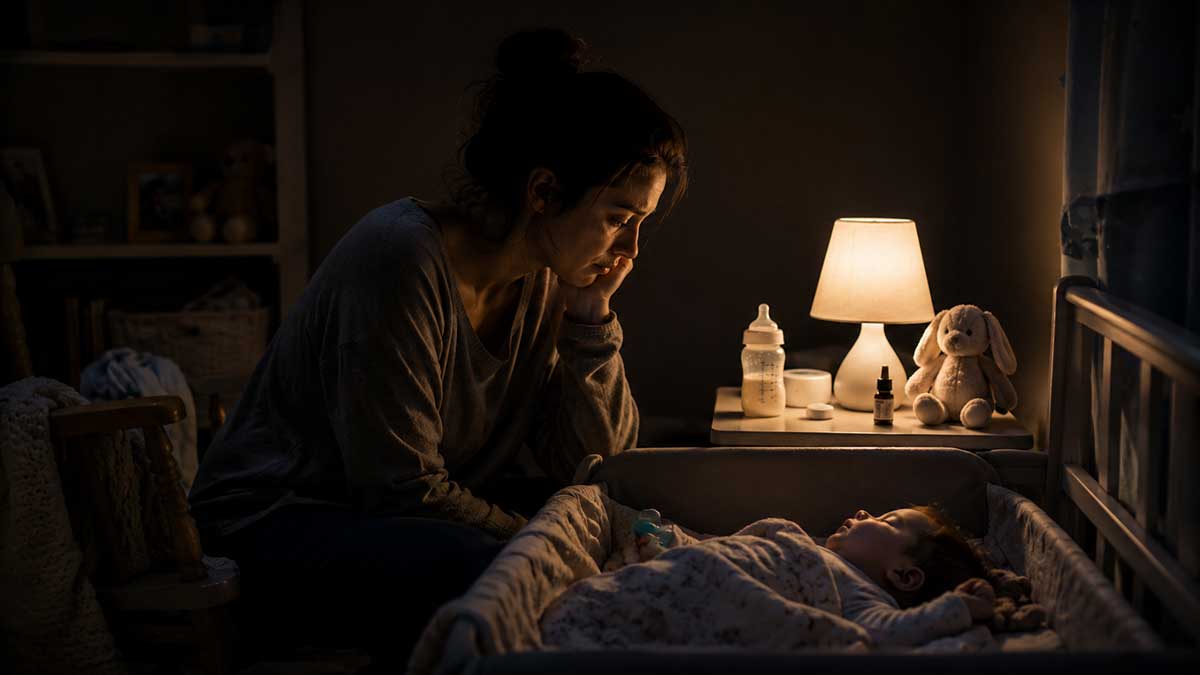
A mother holds down a screaming child so doctors can do tests. She watches teary eyes and cries with the child. She wakes in the night again and again just to make sure the baby is still okay.
Before motherhood, fear may come and go.
After motherhood, fear has a face.
Question 1: Why does a child’s pain feel almost unbearable to a mother?
Mary, Mother of Jesus:
A child’s pain enters the mother before it reaches the world.
She does not merely see the tears. She feels them as if they were placed inside her own chest. A mother’s love makes distance impossible.
When the child suffers, the mother suffers twice: once for the child, and once for being unable to take the pain away.
Jochebed:
A mother knows the fragility of life.
She remembers the first breath, the small hands, the helpless body placed into her care. So when pain comes, she feels how precious and breakable the child is.
Her fear is not weakness. It is love recognizing danger.
Rachel:
A mother’s heart does not count pain logically.
A small wound can feel enormous because it belongs to the one she loves. The child may forget the pain in an hour, but the mother remembers the cry for years.
Love gives memory a deeper wound.
Elisabeth Kübler-Ross:
The mother’s grief begins before loss.
When a child hurts, the mother touches the edge of mortality. She realizes that love cannot control life. That realization is terrifying.
The deeper the attachment, the deeper the vulnerability.
Corrie ten Boom:
A mother’s pain is unbearable because love makes another person’s suffering personal.
It is no longer “a child is hurting.” It is “my child is hurting.”
That one word — my — changes everything.
Question 2: What changes when a mother realizes she cannot protect her child from everything?
Elisabeth Kübler-Ross:
She enters a new stage of love.
At first, a mother may believe protection means preventing pain. Later, she learns that some pain cannot be prevented. Then love must become presence.
She cannot block every wound, but she can say, “You are not alone.”
Mary, Mother of Jesus:
A mother’s hands can hold, but they cannot control destiny.
This is one of the deepest sorrows of motherhood. The child belongs to God, to life, to a path beyond the mother’s reach.
So the mother learns surrender, not because she loves less, but because she loves with reverence.
Corrie ten Boom:
A mother who cannot protect everything may learn to trust more deeply.
Trust does not remove fear. It gives fear somewhere to kneel.
The child’s life is not fully in the mother’s hands, and that truth can break her heart. But it can also teach prayer.
Jochebed:
Sometimes protection means letting go.
I placed my child where my arms could not reach him. No mother wants that moment. But there are times when love must act with courage and then release the outcome.
The mother’s fear becomes faith in motion.
Rachel:
When a mother realizes she cannot protect everything, she grieves the dream of perfect safety.
Every mother wants a world where the child is never harmed. But such a world does not exist.
So she becomes watchful, tender, and wounded with wisdom.
Question 3: How does fear become part of love without destroying joy?
Corrie ten Boom:
Fear must be brought into the light.
When fear hides, it grows. When fear is placed before God, before truth, before love, it becomes smaller than the One who holds the child.
Joy survives when fear is not allowed to become the master.
Rachel:
Joy and fear often sit at the same table.
A mother may laugh at the child’s smile and worry about the child’s future in the same breath. That does not make the joy false.
It makes the joy precious.
Mary, Mother of Jesus:
A mother learns to treasure moments.
A sleeping child. A warm hand. A small voice calling her name. Joy becomes holy because the mother knows life is fragile.
Fear can sharpen gratitude when it does not harden the heart.
Elisabeth Kübler-Ross:
The key is acceptance.
Not passive acceptance, but honest acceptance: life contains risk, loss, illness, and uncertainty. Once a mother accepts that she cannot remove all pain, she can be present to the life in front of her.
Joy returns through presence.
Jochebed:
A mother must love the child before her, not only fear the dangers ahead.
If she looks only at danger, fear will steal the child from her while the child is still safe in her arms.
Love says, “I will protect you today, and I will cherish you today.”
Nick Sasaki:
This is where the poem becomes more than sweet nostalgia.
It tells the truth about fear.
Before she was a mom, she may not have known what it meant to wake again and again to check if everything was okay.
Before she was a mom, she may not have known that a baby’s pain could break her heart.
Before she was a mom, she may not have known that love and fear are born together.
But perhaps this is part of a mother’s greatness:
She fears because she loves.
She cries because she loves.
She watches through the night because she loves.
And somehow, even with all that fear, she still finds joy in one small sleeping face.
Topic 4: The Love That Breaks and Expands the Heart
Guests: Toni Morrison, Emily Dickinson, Helen Keller, Elizabeth Barrett Browning, Laura Ingalls Wilder
Moderator: Nick Sasaki
Nick Sasaki:
The poem says:
“I never felt my heart break into a million pieces
when I couldn’t stop the hurt.”
Then it says:
“I didn’t know the feeling of
having my heart outside my body.”
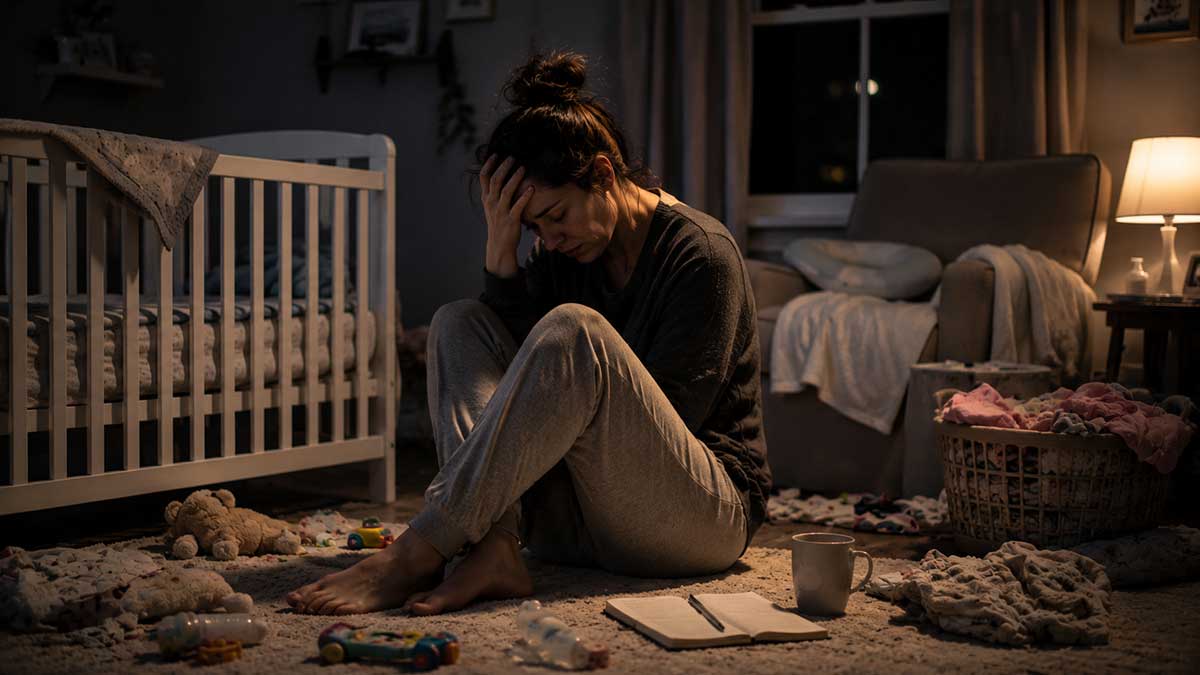
That may be one of the deepest descriptions of motherhood. A mother’s heart does not stay safely inside herself anymore. It walks, cries, falls, smiles, and suffers in the body of the child she loves.
Question 1: What does it mean for a mother to feel her heart living outside her body?
Toni Morrison:
It means the mother has crossed into a love that is no longer protected by distance.
The child is not merely someone she loves. The child becomes a part of her moving through the world, exposed to danger, misunderstanding, cruelty, wonder, and change.
That is why motherhood can feel both holy and terrifying.
Emily Dickinson:
The heart leaves its chamber.
It learns the weather of another breath.
A child smiles — and the day opens.
A child suffers — and the world narrows.
The mother becomes a house with windows everywhere.
Helen Keller:
A mother’s love reaches beyond sight, sound, and speech.
She senses the child in ways the world cannot measure. A small movement, a change in breathing, a quiet sadness — the mother feels it.
Her heart outside her body means she is never completely alone, and never completely untouched.
Elizabeth Barrett Browning:
Love expands by surrender.
The mother does not merely add a child to her life. She gives part of her inner life away. The child becomes both joy and vulnerability.
To love so deeply is to accept that happiness and pain may enter through the same door.
Laura Ingalls Wilder:
It means every ordinary day matters more.
A mother watches a child run across a yard and feels joy. Then the child falls, and her own body almost feels the impact.
The heart outside the body means life becomes smaller in detail, but larger in meaning.
Question 2: Why can a small child affect a mother’s whole life so completely?
Helen Keller:
Because love does not measure by size.
A baby may be small, but the meaning of that baby is immense. The child awakens senses of responsibility, tenderness, fear, and courage that were sleeping before.
The smallest life can open the largest room in the heart.
Toni Morrison:
A child changes a mother’s relationship to time.
The mother no longer thinks only of her own days. She thinks in generations. She wonders what kind of world her child will inherit. She carries both memory and future.
That is a great burden, and a great calling.
Laura Ingalls Wilder:
Children change the shape of home.
A house that once belonged to adults becomes full of small socks, small voices, small needs. But those small things become the center of everything.
A baby turns ordinary rooms into places of memory.
Elizabeth Barrett Browning:
The child affects the mother completely because love is not partial.
A mother cannot love with only one corner of the soul. Her love spreads through the whole being.
She discovers that the heart has depths she never entered before.
Emily Dickinson:
A child is small as a candle —
yet alters the room.
Small hands rearrange eternity.
A cradle can outweigh a kingdom.
The mother learns that size is not the measure of significance.
Question 3: How does motherhood reveal a capacity for love a woman never knew she had?
Elizabeth Barrett Browning:
Love reveals itself by being asked for more.
A mother may think she has reached her limit. Then the child cries, and she finds another tenderness. The child needs comfort, and she finds another strength.
Motherhood calls hidden chambers of the heart into speech.
Emily Dickinson:
The heart is larger than its owner knows.
Motherhood knocks on doors within the soul.
Some open with joy.
Some open through tears.
And behind each door, another room of love.
Toni Morrison:
Motherhood reveals love as fierce, complicated, and morally demanding.
It is not sentimental only. It protects. It worries. It remembers. It sometimes rages against a world that threatens the child.
A mother learns that love can be tenderness and fire in the same breath.
Helen Keller:
Many women discover that love is not limited by exhaustion, fear, or difficulty.
A mother may be tired, but still comfort. Afraid, but still stand near. Unsure, but still reach out.
That is how she learns her own depth.
Laura Ingalls Wilder:
A mother learns through daily life.
The baby sleeps in her arms, and she does not want to put him down. The child laughs, and the whole day feels different. The child hurts, and she would trade places instantly.
She did not study this love. She found it by living it.
Nick Sasaki:
This part of the poem may be why mothers cry when they read it.
It names something they felt but may never have explained.
Before she was a mom, she had a heart.
After she became a mom, that heart began walking outside her body.
That is why a child’s grin can fill her with glory.
That is why a child’s pain can break her into pieces.
That is why one small life can rearrange everything.
Motherhood expands the heart by making it vulnerable.
And somehow, through that vulnerability, love becomes greater than fear.
Topic 5: The Joy That Makes the Sacrifice Worth It

Guests: Mencius’s Mother, Maria Montessori, Beatrix Potter, L. M. Montgomery, Audrey Hepburn
Moderator: Nick Sasaki
Nick Sasaki:
The poem ends with wonder.
After the toys, the sleepless nights, the mess, the shots, the tears, and the fear, the mother says something surprising:
“I didn’t know I would love being a Mom.”
That is the mystery. Motherhood costs so much, yet it gives something impossible to measure.
Question 1: Why can a simple grin become one of the happiest moments of a mother’s life?
L. M. Montgomery:
Because a child’s smile has a way of making the whole room bloom.
A mother may be exhausted, discouraged, and half-forgotten by the world. Then the baby smiles, and suddenly the day is not wasted.
One small grin can redeem many hard hours.
Maria Montessori:
A child’s smile reveals development, trust, and connection.
The mother sees more than expression. She sees recognition. The child knows her. The child responds to her presence.
That moment tells her, “Your love is reaching me.”
Beatrix Potter:
Small things are never small to a mother.
A curled hand, a sleepy blink, a sudden giggle — these become treasures. The child teaches the mother to notice life at its tiniest scale.
Joy becomes delicate, but very real.
Audrey Hepburn:
A simple grin reminds a mother that love is returned.
Even when she gives through exhaustion, the child’s smile tells her she matters. It is not payment. It is grace.
A mother may live for those moments.
Mencius’s Mother:
A child’s smile is joy, but it is also promise.
The mother sees not only the child before her, but the person the child may become. The smile carries future hope.
That is why it touches her so deeply.
Question 2: What is the mystery of the bond between mother and child?
Maria Montessori:
The bond begins in dependence, but it must grow into trust.
The child first needs the mother for survival. Then, slowly, the mother becomes the child’s first world: safety, language, rhythm, order, warmth.
This bond shapes how the child meets life.
Mencius’s Mother:
The bond is responsibility joined with love.
A mother does not merely enjoy the child. She guides the child. She teaches what is right, what is harmful, what is worthy.
True love prepares the child to live well.
Audrey Hepburn:
The bond is tenderness that continues beyond childhood.
A mother’s love does not end when the child grows taller. It changes form. It becomes prayer, memory, concern, pride, and quiet hope.
The child may leave home, but not the mother’s heart.
Beatrix Potter:
There is wonder in how familiar a child becomes.
The mother knows the child’s sounds, moods, habits, fears, and comforts. She knows the difference between one cry and another.
Love becomes a language without words.
L. M. Montgomery:
The bond is made of ordinary days turned into memory.
Bedtime. Breakfast. Small walks. Stories. Tears. Laughter. The mother may not know at the time that she is building a lifelong home inside the child.
But she is.
Question 3: Why can mothers say, after everything, “I never knew I would love being a mom”?
Audrey Hepburn:
Because love can make hardship meaningful.
Motherhood does not remove exhaustion. It gives exhaustion a face worth serving. A mother looks at her child and realizes the difficulty was never empty.
It was filled with love.
Beatrix Potter:
Because children return wonder to the world.
A mother sees leaves, animals, clouds, and stories again through young eyes. The world becomes new because the child is new to it.
Motherhood gives back a kind of innocence.
Maria Montessori:
Because motherhood allows a woman to witness growth intimately.
She sees first movements, first words, first choices, first acts of independence. She watches a human being unfold.
That privilege can outweigh many sacrifices.
L. M. Montgomery:
Because the heart loves what it has poured itself into.
The nights, the meals, the lullabies, the worries, the small kindnesses — they all become part of the mother’s own soul.
She loves the child, and in a strange way, she loves the life that love created.
Mencius’s Mother:
Because motherhood is not only service. It is meaning.
A mother may suffer, labor, worry, and sacrifice. Yet she sees that her care helped shape a life.
There are few joys greater than seeing love become a person.
Nick Sasaki:
That may be the final gift of the poem.
It does not deny the cost.
It remembers the sleepless nights, the fear, the mess, the tears, the exhaustion, the body-level sacrifice.
But then it turns toward joy.
The grin.
The warmth.
The bond.
The wonder.
The satisfaction.
Before she was a mom, she did not know she was capable of feeling so much.
After she became a mom, she discovered that motherhood could break her heart, stretch her soul, and fill her life with a love she never expected.
That is why the poem still moves people.
It tells mothers:
You were changed.
You were tested.
You were exhausted.
But you were also given a joy the old life could never have explained.
Final Thoughts by Nick Sasaki
Perhaps the deepest truth of motherhood is that it changes a person without asking permission.
A woman does not simply become busier. She becomes divided and enlarged at the same time. Part of her remains herself, yet part of her now lives in another human being.
That is why motherhood is so difficult to explain from the outside.
It is not only care.
It is not only sacrifice.
It is not only tenderness.
It is not only fear.
It is the strange experience of becoming more vulnerable and more courageous in the same moment.
The poem matters because it gives language to that hidden transformation. It helps mothers feel seen. It helps children look back with softer eyes. It helps the rest of us recognize that behind many ordinary women stood an extraordinary form of love.
A mother may not always tell you what she gave up.
She may not list every night she worried, every tear she swallowed, every dream she postponed, every small comfort she quietly surrendered.
But love leaves evidence.
Sometimes it appears as a meal.
Sometimes as a hand on a forehead.
Sometimes as a tired voice still answering in the dark.
And sometimes, years later, it appears as a child finally realizing:
“She loved me more than I knew.”
Short Bios:
Maya Angelou — Poet and memoirist whose work explored resilience, dignity, motherhood, memory, and the human spirit.
Louisa May Alcott — Author of Little Women, known for portraying family, sacrifice, sisterhood, and moral growth.
Erma Bombeck — Humorist whose writing captured the comedy, chaos, exhaustion, and tenderness of family life.
Jane Austen — Novelist known for emotional insight, social observation, and the hidden pressures placed on women.
Anne Morrow Lindbergh — Writer who reflected deeply on solitude, marriage, womanhood, motherhood, and inner life.
Sojourner Truth — Abolitionist and women’s rights advocate whose life embodied courage, endurance, and maternal strength.
Mother Teresa — Humanitarian remembered for humble service, compassion, and love expressed through daily care.
Pearl S. Buck — Nobel Prize-winning novelist whose work often centered family, motherhood, duty, and cultural empathy.
Harriet Tubman — Freedom fighter remembered for courage, protection, sacrifice, and fierce devotion to others.
Florence Nightingale — Founder of modern nursing, remembered for caregiving, discipline, compassion, and service.
Mary, Mother of Jesus — Sacred maternal figure in Christianity, symbolizing faith, sorrow, surrender, and unconditional love.
Jochebed — Mother of Moses, remembered for courageous protection and trusting beyond fear.
Rachel — Biblical mother associated with longing, grief, maternal devotion, and remembrance.
Elisabeth Kübler-Ross — Psychiatrist whose work explored grief, loss, mortality, and emotional healing.
Corrie ten Boom — Christian writer and Holocaust survivor remembered for faith, courage, forgiveness, and hope.
Toni Morrison — Nobel Prize-winning novelist whose work explored motherhood, memory, trauma, identity, and fierce love.
Emily Dickinson — Poet known for compressed, profound reflections on love, death, solitude, and inner experience.
Helen Keller — Author and advocate whose life revealed resilience, empathy, and deep insight into human connection.
Elizabeth Barrett Browning — Poet celebrated for emotional intensity, devotion, love, and moral conviction.
Laura Ingalls Wilder — Writer whose stories preserved family life, hardship, resilience, and ordinary tenderness.
Mencius’s Mother — Revered figure in East Asian tradition, remembered as a model of wise, sacrificial parenting.
Maria Montessori — Physician and educator who transformed views of childhood, learning, independence, and nurturing care.
Beatrix Potter — Author and illustrator whose children’s stories preserved innocence, wonder, and tenderness.
L. M. Montgomery — Author of Anne of Green Gables, known for imagination, family warmth, longing, and emotional growth.
Audrey Hepburn — Actress and humanitarian remembered for grace, compassion, and devotion to children.
Leave a Reply