
What if most people are not failing from lack of effort, but from lack of clear focus?
Introduction by Jack Canfield
Welcome, everyone.
When we began this series, the starting point was simple: focus. Not just as a skill, not just as a productivity tool, but as one of the great turning points in a human life. Why do some people stay scattered for years, giving their energy to too many things, feeling busy but not fulfilled, worn out but not truly moving forward? And why do others begin to live with clarity, direction, and a deeper sense that their life is gathering into something meaningful?
That is the question behind this entire journey.
In these five conversations, we have explored focus from five connected angles. We began with The Power of Focus itself, asking what focus really is and why so many people lose it. From there, we moved into modern distraction, looking at the forces that fragment attention and weaken presence. Then we turned to life-changing habits, since focus is rarely sustained by inspiration alone. After that, we looked at time, energy, and attention, because a focused life needs rhythm, renewal, and wise structure. And finally, we arrived at the meaning of success, asking the deepest question of all: what is focus really for?
That question matters.
A person can become more efficient and still feel empty.
A person can become more disciplined and still move in the wrong direction.
A person can achieve more and still miss what matters most.
So this series is not only about getting more done. It is about building a life that is clearer, steadier, wiser, and more deeply aligned with what is truly worth giving yourself to.
Along the way, voices from personal growth, psychology, philosophy, productivity, and spiritual reflection have helped us see that focus is never only about attention. It is tied to values. It is tied to habits. It is tied to boundaries. It is tied to peace. It is tied to the kind of person we are becoming through the way we live.
That is why this series matters so much to me.
Because in the end, focus is not just about performance.
It is about direction.
It is about integrity.
It is about meaning.
It is about choosing what deserves your life.
So let’s gather the whole journey in view and ask, one more time, what becomes possible when a person learns to live with real focus.
(Note: This is an imaginary conversation, a creative exploration of an idea, and not a real speech or event.)
Topic 1: The Power of Focus

Moderator: Jack Canfield
Participants: James Clear, Greg McKeown, Cal Newport, BJ Fogg, Stephen R. Covey
Opening by Jack Canfield
Welcome, everyone. We are here to talk about something that sounds simple, yet seems harder than ever to live: focus. Many people are working hard, carrying long to-do lists, answering messages, solving problems, and trying to keep up. Yet at the end of the day, a lot of them still feel scattered, tired, and strangely unsatisfied. So today I want to ask a basic but life-shaping question: what is focus really, and how can a person recover it in a noisy world?
Question 1
Why do so many people work hard every day yet still feel they are not moving forward in a meaningful way?
James Clear
A lot of people have goals, but their daily systems are not pointing in the same direction. They want clarity, health, progress, stronger relationships, meaningful work, but their environment keeps pulling them toward distraction, convenience, and reaction. So they spend the day active, but not aligned. Motion is happening, but direction is weak.
Greg McKeown
I think many people have accepted a false assumption: that they must respond to everything. Once that becomes the pattern, life turns into a stream of other people’s priorities. The person is constantly active, but rarely essential. When effort is scattered across too many commitments, it becomes very hard to feel that your life is gathering into anything whole.
Cal Newport
There is also the issue of fragmented attention. A person may work all day, yet almost none of that time reaches real depth. It gets split into email, messages, quick checks, shallow tasks, and constant switching. That kind of labor creates fatigue without the satisfaction that comes from sustained concentration. The brain feels spent, but the important work remains untouched.
BJ Fogg
Many people are trying to live by willpower alone. They wake up with good intentions, but their day is not designed to support those intentions. Their habits, surroundings, timing, and cues are all working against them. So the day takes over before they have even chosen what matters. This is not mainly a character flaw. It is often a design problem.
Stephen R. Covey
I would say people are too often trapped by urgency. They answer what is loud rather than what is important. Yet the most meaningful things in life usually do not shout. Building trust, shaping character, thinking deeply, planning wisely, strengthening relationships, renewing the inner life — these require deliberate choice. When urgency rules the schedule, meaning slowly slips out of view.
Jack Canfield
That already gives us a strong picture. People are not mainly failing from lack of effort. They are being pulled by shallow systems, too many obligations, weak design, broken attention, and the pressure of urgency. So let us go deeper into what focus really means.
Question 2
What does true focus really mean beyond simply staying busy or concentrating harder?
Greg McKeown
True focus begins with the courage to choose. It is not merely staring harder at whatever is in front of you. It is deciding what deserves your full yes and being willing to give many other things a clear no. Focus is a disciplined narrowing. It protects the essential from being buried under the trivial.
Stephen R. Covey
I see focus as a moral act before it becomes a productivity act. It asks a person to live by principle, not pressure. A focused life is one in which values, roles, and priorities are consciously ordered. That creates peace because the person is no longer drifting. They are choosing from the inside rather than reacting from the outside.
BJ Fogg
From my side, focus becomes real when behavior becomes doable. A person may know what matters, but unless it fits into actual daily life, it stays abstract. So true focus is not only choosing the right thing. It is making the right thing easier to do. When the desired action becomes simple, specific, and connected to a stable cue, focus begins to take form.
Cal Newport
I would define focus as the ability to give sustained attention to something meaningful without surrendering that attention too easily. That is a trained capacity. It grows when you stop treating your mind like a public space open to interruption. A focused person is not one who is busy all day. It is one who can stay with what matters long enough for depth to emerge.
James Clear
I think focus also has an identity dimension. People often ask, “How can I force myself to focus?” A better question might be, “What would a focused person repeatedly do?” When you start seeing yourself as someone who protects your attention, shapes your environment, and returns to what matters, focus stops being a momentary push and starts becoming part of who you are.
Jack Canfield
So focus is not just concentration. It is choice, principle, design, sustained attention, and identity working together. That makes it much richer than the usual advice people hear. Now let’s bring it down to the level of daily life.
Question 3
What are the first practical changes a person should make to reclaim focus in daily life?
Cal Newport
The first change is to create protected blocks of uninterrupted time. Do not wait for free time to appear on its own. Put depth on the calendar. Turn off what fractures attention. Let your mind experience what it feels like to stay with one thing. Many people have forgotten that feeling, and recovering it is powerful.
BJ Fogg
Start smaller than you think you need to. Pick one habit that supports focus. After I sit at my desk, I will work on my top priority for two minutes before opening anything else. That tiny action matters because it is repeatable. Once the habit becomes stable, it can grow naturally.
Stephen R. Covey
I would advise people to begin each day with a quiet moment of renewal and planning before entering the noise. That may be prayer, reflection, journaling, reading, or simply reviewing what matters most. If you do not claim your mind early, the world usually will. A centered beginning changes the whole day.
James Clear
Make good behavior obvious and distraction inconvenient. Put the notebook where you can see it. Put the phone in another room. Remove apps from the home screen. Prepare the workspace the night before. The point is not to depend on heroic effort. The point is to make focused action the path of least resistance.
Greg McKeown
I would add a habit of pause before agreement. Many people lose focus in the moment they say yes too quickly. Before accepting a request, ask: is this essential, or is it merely immediate? One of the fastest ways to reclaim focus is to stop filling life with things that never belonged in the center.
Jack Canfield
That is wonderfully practical. Protect time. Start tiny. Begin the day with inner clarity. redesign the environment. Learn to pause before saying yes. These are not grand theories. They are things people can actually live.
Final Reflections
James Clear
A focused life is usually built through small repeated decisions, not one dramatic breakthrough. The daily vote matters.
Greg McKeown
When you remove the nonessential, you do not shrink your life. You make room for what matters most.
Cal Newport
Attention is becoming one of the most valuable things a person can protect. Depth is harder to find, which makes it more meaningful.
BJ Fogg
Change works better when it feels possible. The simpler the starting point, the more likely it is to last.
Stephen R. Covey
Real focus comes when a person aligns action with conscience and gives their best energy to what matters most.
Closing by Jack Canfield
What stands out to me is that focus is not a gift given to a lucky few. It is a way of living that can be built. It asks for honest choice, better design, stronger boundaries, and the humility to start small. Most people do not need more pressure. They need more clarity. And when clarity begins to shape daily action, progress starts to feel meaningful again.
Topic 2: The Power of Focus and Modern Distraction

Moderator: Jack Canfield
Participants: Tristan Harris, Nicholas Carr, Cal Newport, Sherry Turkle, Johann Hari
Opening by Jack Canfield
Welcome, everyone. The last time, we talked about focus itself. Today I want to look at what may be its greatest enemy in ordinary life: modern distraction. Many people feel their minds are being pulled apart. They are connected all day, yet often less present, less peaceful, and less able to stay with what matters. So let’s ask what this age of constant stimulation is really doing to us, and what can still be reclaimed.
Question 1
What is modern distraction doing to the human mind, relationships, and sense of purpose?
Tristan Harris
Modern distraction is not just interrupting people. It is competing for the steering wheel of human attention. Many digital systems are built to capture and keep us engaged, whether or not that serves our deeper interests. So the mind gets trained toward reactivity. Relationships get thinned into partial presence. Purpose gets crowded out by whatever is most clickable, urgent, or emotionally activating.
Nicholas Carr
I think the mind begins to adapt itself to the medium it uses most. When life is dominated by quick inputs, scrolling, and constant shifting, thought itself becomes more hurried and less contemplative. The problem is not only lost time. It is altered mental habit. People may still consume a great deal, yet struggle more to reflect, absorb, and connect ideas into something meaningful.
Cal Newport
I would say distraction reduces our capacity for depth. It weakens the ability to stay cognitively present with something demanding. That matters in work, of course, but it also matters in life. Deep conversations, serious reading, reflection, prayer, creative effort, long-form thinking — all of these require sustained attention. When distraction becomes normal, depth starts to feel unusual, sometimes almost uncomfortable.
Sherry Turkle
In relationships, distraction teaches people to be together without fully being together. You see it at tables, in homes, in conversations, in moments that should carry tenderness or seriousness. People keep one part of themselves turned toward the device, ready to leave the moment. That creates a subtle loneliness. We may be in contact more often, yet less known.
Johann Hari
There is also a wider human cost. Many people begin to feel that they are losing agency over their own minds. They want to read, think, rest, listen, create, or love well, but they keep being pulled away. That repeated fracture can lead to shame, frustration, and a feeling of inner weakness. So distraction does not only steal attention. It can slowly damage confidence in one’s own capacity to live well.
Jack Canfield
That paints a serious picture. Distraction is shaping the mind, weakening depth, thinning relationships, and making many people feel less at home in their own attention. So the next question becomes obvious.
Question 2
Why is constant stimulation so hard to resist, even when people know it is hurting their peace and productivity?
Nicholas Carr
Part of the answer is neurological habit. Fast-moving streams of novelty reward the brain in a way that slower, more demanding forms of attention often do not at first. Reading deeply, thinking carefully, or staying with silence may yield richer rewards, but those rewards come later. Constant stimulation offers immediate mental frictionlessness, and that is very difficult to compete with.
Sherry Turkle
Many people are not only seeking stimulation. They are seeking escape from vulnerability. Silence can bring up anxiety. Unstructured time can bring up loneliness. Face-to-face conversation can require patience, uncertainty, and emotional risk. Devices offer a way to manage those feelings quickly. So resistance is hard because distraction is serving emotional needs, not just entertainment.
Johann Hari
I agree. A lot of people are exhausted, stressed, and cut off from the conditions that support real attention. Poor sleep, pressure, noise, overwork, insecurity, and constant interruption all weaken the mind’s natural defenses. So when easy stimulation appears, people reach for it. It is not always a failure of character. Sometimes it is a symptom of a life arranged against attention.
Tristan Harris
There is another layer: people are often not facing these systems as isolated individuals making neutral choices. They are facing tools designed by teams that study behavior, test engagement patterns, and learn what keeps users coming back. That does not remove personal responsibility, but it does mean the struggle is asymmetrical. People are up against systems that know how to pull at human impulse.
Cal Newport
I would add that many people have stopped practicing boredom. The moment a gap appears, they fill it. Waiting in line, walking, sitting quietly, finishing one task before beginning another — these little spaces used to train patience. Now they are often flooded with input. When a person never rehearses being alone with their own thoughts, concentration becomes harder to recover.
Jack Canfield
So the pull of distraction comes from brain habit, emotional escape, exhausted living, persuasive design, and the loss of tolerance for quiet. That helps explain why simple advice often fails. People need more than guilt. They need a better way of living.
Question 3
How can a person protect attention in a world built to fragment it?
Cal Newport
The first step is to treat attention as something worth defending. Schedule periods of uninterrupted concentration. Remove optional digital noise from those blocks. Do not merely hope to focus when the moment arrives. Build conditions where focus can happen. That change alone can be dramatic.
Johann Hari
I would tell people to look at the whole ecology of their attention. Sleep matters. Stress matters. Time outdoors matters. Real conversation matters. Reading matters. The capacity to focus is supported by a healthier life, not just a stricter app setting. If the wider structure is broken, attention will remain fragile.
Tristan Harris
People should make conscious choices about what gets privileged access to their mind. Turn off nonessential notifications. Move distracting apps off the front path. Create device-free spaces and times. Ask not only, “How do I resist this?” but, “Why is this allowed to interrupt me at all?” That shift restores dignity to attention.
Sherry Turkle
I would urge people to protect sacred spaces for human presence. Meals without phones. Conversations without glancing away. Walks without checking. Family time without divided attention. These practices rebuild relationship at the same time they rebuild focus. Presence grows when people act as though the person in front of them matters more than the possibility of something elsewhere.
Nicholas Carr
It is also worth retraining the mind for slower forms of thought. Read longer things. Stay with one idea past the first wave of restlessness. Write by hand sometimes. Let the mind rediscover continuity. At first it may feel difficult, but that difficulty is often a sign that an older cognitive strength is being called back into use.
Jack Canfield
That is a powerful close. Protect time, repair the wider life, reduce digital intrusion, honor face-to-face presence, and retrain the mind for depth. Those are real practices, not slogans.
Final Reflections
Tristan Harris
When attention is taken from people carelessly, much more than productivity is lost. A piece of human sovereignty is lost with it.
Nicholas Carr
The tools we use do not only serve us. Over time, they teach us how to think.
Cal Newport
Depth still exists, but it usually has to be chosen against the grain of the surrounding culture.
Sherry Turkle
People are hungry for real presence. Many do not know how much they miss it until they taste it again.
Johann Hari
Attention can heal, but it usually heals inside a more humane pattern of living.
Closing by Jack Canfield
What I hear in this conversation is that distraction is not a small inconvenience. It is a force that can reshape thought, weaken relationships, and pull a person away from the life they most want to live. Yet the answer is not despair. The answer is to start honoring attention again — as something precious, limited, and deeply connected to love, work, peace, and purpose. When people begin to guard it, they are not merely becoming more productive. They are becoming more present to their own lives.
Topic 3: The Power of Focus and Life-Changing Habits

Moderator: Jack Canfield
Participants: Darren Hardy, BJ Fogg, Robin Sharma, Charles Duhigg, James Clear
Opening by Jack Canfield
Welcome, everyone. Focus is rarely sustained by inspiration alone. It usually lives or dies through habit. A person may have a clear goal, a strong desire, and a sincere promise to change, yet still fall back into the same old patterns. So today I want us to look closely at the habits that shape a life. How do they begin, why do they break down, and how can someone rebuild momentum when they feel stuck?
Question 1
Which small repeated habits create the biggest long-range change in a person’s life?
Darren Hardy
The habits that change life most are often so ordinary that people underestimate them. Waking when you said you would. Using the first part of the day with purpose instead of drift. Spending a little less than you earn. Following up one more time. Reading a few pages every day. Those acts seem small, yet life tends to move in the direction of repeated choices, not occasional intensity.
BJ Fogg
I always look for habits that are tiny enough to do without resistance. After I brush my teeth, I do two push-ups. After I sit down at my desk, I write one sentence. After lunch, I take a short walk. The habit should feel easy at the start. That matters because consistency comes before expansion. Once the action becomes natural, it can grow.
Robin Sharma
I would point to habits that build inner order. Rising with intention. Protecting the morning from noise. Reading words that strengthen the mind. Moving the body. Keeping promises to yourself in private. Those habits train self-respect. When self-respect grows, a person stops living as a victim of mood and starts living with greater command.
Charles Duhigg
Some habits matter more because they become what I would call keystone habits. Exercise is a strong example. People who begin exercising often begin sleeping better, eating more thoughtfully, and carrying themselves differently. Tracking spending can have a similar effect in finances. Certain habits create ripple effects far beyond the routine itself.
James Clear
A small habit becomes powerful when it casts a vote for the identity you want. Reading one page is a vote for being a reader. Writing one paragraph is a vote for being a writer. Preparing one healthy meal is a vote for being a healthy person. The real force of the habit is not just the action. It is the kind of person the action teaches you to become.
Jack Canfield
That is encouraging. The smallest habits are not small when they build identity, self-trust, and ripple effects across the rest of life. They may look humble, yet they quietly determine direction.
Question 2
Why do people fail so often when they try to build better habits and break old ones?
Charles Duhigg
A lot of people try to change a behavior without understanding the habit loop underneath it. There is often a cue, a routine, and a reward. If the cue keeps showing up and the reward keeps drawing the person back, then sheer intention usually will not be enough. The pattern has to be understood before it can be reshaped.
James Clear
People often rely too much on motivation and not enough on structure. They assume their future self will suddenly have more discipline than their present self. Then the environment pulls them off course. The phone is nearby. The good habit is inconvenient. The bad habit is easy. When the system favors distraction, intention gets outmatched.
Robin Sharma
I think some people are trying to change habits without changing standards. They still negotiate with the lower life. They still leave the door open to excuse, delay, and comfort. A habit grows stronger when the person becomes more serious about who they refuse to remain. Inner decision matters.
BJ Fogg
Many habits fail because they are too big at the beginning. People get inspired and try to redesign everything at once. That creates strain, then disappointment. They attach the new habit to shame or pressure, and the brain starts linking change with failure. A better path is to make the habit easy and emotionally positive from the start.
Darren Hardy
Another reason is that results are delayed. People want quick proof that the habit is paying off. But the rewards of good habits often show up slowly, just as the cost of bad habits often shows up slowly. That delay tests patience. Many people quit in the part of the process where consistency matters most.
Jack Canfield
That gives us a much clearer picture. People are not failing for one simple reason. They are dealing with hidden loops, poor design, weak standards, oversized plans, and the frustration of delayed results. That means the answer must be both practical and patient.
Question 3
How can someone rebuild discipline and momentum after years of inconsistency?
BJ Fogg
Start with something so small it feels almost impossible to fail. One stretch. One sentence. One glass of water. One minute of organizing. When confidence is low, tiny wins matter a lot. Success grows capability. People often try to feel confident first, but confidence usually grows after a small success.
James Clear
I would say return to identity one more time. Do not ask, “How do I completely fix my life this week?” Ask, “What would a disciplined person do today?” Then do one version of that. Keep the pattern alive. Also, never miss twice. A slip is part of being human. The key is to return quickly before one miss becomes a story about who you are.
Darren Hardy
Momentum returns when you begin keeping promises to yourself again. That may sound simple, but it is huge. Pick one promise that matters and keep it today. Then do it again tomorrow. Self-trust is one of the great engines of discipline. A person who trusts themselves moves very differently through life.
Charles Duhigg
I would encourage honest observation without self-hatred. Study the moments where you lose momentum. What time does it happen? What feeling comes first? What reward are you reaching for? Curiosity often works better than shame. Once you see the pattern more clearly, it becomes easier to change it intelligently.
Robin Sharma
Simplify your life for a season. Reduce noise. Reduce exposure to what weakens resolve. Protect the early hours. Spend time with voices that call you upward. Sometimes the return of discipline does not begin with trying harder inside the same cluttered life. It begins by creating more inner and outer space.
Jack Canfield
That is deeply hopeful. Start tiny. Return quickly. Keep promises. Study the pattern. Simplify the environment. None of that is glamorous, yet it is the kind of wisdom people can truly live by.
Final Reflections
Darren Hardy
Life changes less through dramatic moments than through daily choices repeated long enough to become destiny.
BJ Fogg
People succeed more when change feels doable. Help the person win early, and change has a place to grow.
Robin Sharma
Private discipline creates public transformation. The life the world sees is often built in rooms where no one is watching.
Charles Duhigg
Once a pattern becomes visible, it becomes more workable. Awareness is often the first real opening.
James Clear
Every repetition is teaching you something about yourself. Habits are one of the ways identity gets written.
Closing by Jack Canfield
What I hear in this conversation is that habits are not minor details around the edge of life. They are part of its structure. They shape identity, discipline, confidence, and direction. A person who feels stuck does not need to wait for a dramatic breakthrough. They can begin with one repeatable action, one honest adjustment, one kept promise. And over time, those small acts can gather into a very different life.
Topic 4: The Power of Focus and Mastering Time, Energy, and Attention

Moderator: Jack Canfield
Participants: Tony Schwartz, Laura Vanderkam, Tim Ferriss, Cal Newport, David Allen
Opening by Jack Canfield
Welcome, everyone. Many people say they need better time management, yet what they often describe is something wider: mental overload, low energy, scattered attention, and the feeling that life keeps slipping through their hands. So today I want us to look at these three together — time, energy, and attention — and ask what actually helps a person live with more clarity, steadiness, and meaningful progress.
Question 1
Is the real issue poor time management, or is it broken attention and depleted energy?
Tony Schwartz
I would begin with energy. A person can have a beautifully organized calendar and still do poor work if they are physically tired, emotionally strained, or mentally depleted. Human beings are not machines that can run at full output all day. When energy falls, attention weakens. When attention weakens, time gets wasted. So many people are trying to solve an energy problem with scheduling alone.
Cal Newport
Attention is central. Time may exist on the calendar, but if the mind keeps breaking into fragments, the value of that time collapses. A person may sit at a desk for three hours and still never reach the kind of concentration that produces meaningful progress. The deeper problem is often not lack of hours, but lack of sustained cognitive presence.
Laura Vanderkam
I think awareness matters too. A lot of people do not really know where their time is going. They feel overwhelmed, but they have never looked carefully at the actual shape of a week. Once they do, patterns become visible. Some of the problem is indeed broken attention and low energy, but some of it is living by default rather than by deliberate design.
David Allen
Mental clutter is a major factor. Many people are trying to keep too much in their heads at once: tasks, obligations, worries, ideas, unfinished decisions, vague intentions. That creates an internal hum of pressure. It feels like a time problem, but often it is the burden of too many open loops competing for psychic space.
Tim Ferriss
I would put a sharp edge on it: a lot of people are simply trying to do too many things that do not matter enough. They keep asking how to fit more in instead of asking what can be ignored, delegated, or removed. Broken attention and low energy are real, but overload is often self-inflicted by weak filtering.
Jack Canfield
That’s a strong start. So the issue is not just the clock. It is energy, fractured attention, weak awareness, mental clutter, and overloaded priorities. That helps explain why so many productivity fixes feel shallow.
Question 2
What drains people the most in daily life, and what restores their strength most effectively?
David Allen
One of the biggest drains is unfinished business living in the mind. Every unmade decision, every unclear commitment, every thing you are trying to remember keeps drawing a little bit of attention. One of the simplest restorations is to capture those things somewhere trusted, decide what they mean, and identify the next action. Clarity restores energy.
Tim Ferriss
Low-quality input is a huge drain. Too much random news, too much shallow scrolling, too much automatic availability, too many requests accepted out of reflex. People are burning attention on noise. One of the best ways to restore strength is to lower unnecessary input and become more selective about what earns access to your mind.
Laura Vanderkam
I think misalignment drains people deeply. When your week consistently neglects sleep, movement, relationships, quiet, or meaningful work, the whole structure begins to feel wrong. Restoration often begins when the calendar starts reflecting what actually matters. People feel stronger when their days resemble their values.
Tony Schwartz
Sustained output without renewal is one of the greatest drains in modern life. Many people push through fatigue, then wonder why they become irritable, dull, or unfocused. Renewal has to be treated as part of performance, not as its enemy. Sleep, movement, rest, emotional recovery, and honest connection all matter more than many people admit.
Cal Newport
Frequent context switching is another silent drain. Every time the mind is pulled from one thing to another, some residue remains. Over a day, that leaves a person cognitively thinned out. One of the best restorations is deeper continuity — staying with one thing long enough for the mind to settle instead of constantly restarting itself.
Jack Canfield
So people are being drained by open loops, bad inputs, value mismatch, nonstop output, and constant switching. Restoration comes through clarity, selectivity, renewal, alignment, and continuity. That already feels more humane than most advice people hear.
Question 3
What kind of weekly rhythm helps a person stay productive, peaceful, and steady over time?
Laura Vanderkam
A good weekly rhythm starts by planning the week as a whole. Put the important things in first: meaningful work, family time, rest, exercise, and the few responsibilities that truly matter in this season. When people plan only in daily fragments, the week gets captured by whatever feels urgent. Looking at the whole week creates coherence.
Tim Ferriss
Choose fewer real targets. Most people sabotage their week by pretending they can make serious progress in too many areas at once. A better rhythm comes from selecting the few things that matter most, protecting prime hours for them, and reducing or batching shallow work wherever possible.
Tony Schwartz
No weekly rhythm remains healthy without renewal built into it. People need cycles, not endless output. There should be sleep that is honored, movement that happens regularly, space for quiet, and some form of emotional replenishment. The stronger the demands of the week, the more deliberate renewal needs to be.
David Allen
A weekly review is essential. Gather notes, clear loose ends, revisit projects, and renegotiate what is unrealistic. Without that review, the mind starts carrying too much again. With it, the person can re-enter the week with greater clarity and less hidden pressure.
Cal Newport
I would add recurring blocks for deep work. Set aside defined periods for sustained concentration and treat them seriously. Do not leave depth to whatever scraps of time happen to remain. A steady life is often built by making sure the most meaningful effort has a protected place.
Jack Canfield
That gives us a strong weekly pattern: see the whole week, choose fewer priorities, build in renewal, review the open loops, and protect deep work. It sounds like rhythm, not scramble.
Final Reflections
Tony Schwartz
A person who ignores renewal will eventually pay for it in some form, whether in performance, peace, or relationships.
Laura Vanderkam
A better week usually begins when people stop treating time as something that happens to them and start shaping it on purpose.
Tim Ferriss
A lot of peace comes from removing what never deserved a place in the center.
Cal Newport
Depth has to be protected. It rarely survives in a life built entirely on reaction.
David Allen
When your mind trusts your system, it no longer has to grip every unfinished thing so tightly.
Closing by Jack Canfield
What stands out to me is that time, energy, and attention are deeply tied together. When one starts breaking down, the others usually follow. But the hopeful part is this: a person can begin to repair all three through better choices, stronger rhythms, and simpler systems. They do not need a superhuman life. They need a more honest and more intentional one. That is where steadiness begins.
Topic 5: The Power of Focus and the Meaning of Success

Moderator: Jack Canfield
Participants: Viktor Frankl, Wayne Dyer, Stephen R. Covey, Seneca, Jim Rohn
Opening by Jack Canfield
Welcome, everyone. We have talked about focus, distraction, habits, time, energy, and attention. Now we come to a deeper question beneath all of it: what is a focused life really aiming at? A person can be productive, admired, and outwardly successful, yet still feel empty, rushed, or off course. So today I want us to ask what success truly means, how focus can serve the right ends, and how a person can stay steady when life becomes painful or uncertain.
Question 1
How do we know whether we are focusing on what truly matters rather than chasing empty success?
Viktor Frankl
We begin to know it when our efforts are tied to meaning rather than vanity. A life ordered around display, applause, or comparison may look successful from a distance, yet it often leaves the soul hungry. The right focus is discovered when a person asks not merely, “What do I want from life?” but, “What is life asking of me now?” Responsibility reveals much.
Wayne Dyer
A simple sign is the inner feeling that comes with the goal. Some aims produce strain, proving, and restlessness. Others carry a sense of alignment, truth, and quiet rightness. A person may still work hard, yet the work no longer feels like a desperate attempt to become worthy. It feels like an expression of who they are.
Stephen R. Covey
I would test success by principle and relationship. If what you call success is weakening trust, harming family, eroding integrity, or pulling your life out of moral order, then something is wrong. Real success should strengthen the whole life, not fracture it. The right focus holds together what matters most.
Seneca
Ask whether the thing pursued can satisfy a reasonable soul or whether it merely feeds appetite. Many pursuits are admired by the crowd, yet leave the person inwardly enslaved. If your success depends on endless praise, endless gain, or endless increase, then you are serving a master that cannot be satisfied.
Jim Rohn
I like to bring the question down to plain living. What are you becoming on the way to what you want? Are you becoming wiser, steadier, kinder, more disciplined? Or are you just getting more skilled at the chase? A lot of people have a price for success that is too high. If it costs your character, it costs too much.
Jack Canfield
That is a strong beginning. Meaning, alignment, principle, inward freedom, and character all seem to be better measures than applause alone. So let us move from false success to true focus.
Question 2
What is the difference between a focused life and a merely driven life?
Stephen R. Covey
A driven life is often ruled by pressure, image, and urgency. A focused life is ordered by conscience and principle. One reacts. The other chooses. One may produce much and still leave damage behind. The other seeks effectiveness that deserves trust. That is a major difference.
Seneca
The driven person is pulled by desire and public opinion. The focused person governs the self. One is always in motion, yet never quite in command. The other understands that wise refusal is part of a good life. Speed by itself proves nothing. A person may hurry greatly and still be going nowhere worth going.
Jim Rohn
A driven life is usually crowded. A focused life is more deliberate. The driven person says yes too quickly, chases too many things, and confuses motion with progress. The focused person has decided what belongs in the center and what does not. That decision changes everything.
Viktor Frankl
A driven life often seeks escape from emptiness through activity. A focused life is guided by meaning. That does not remove effort or ambition. It gives them direction. The person is no longer pushed only by hunger. They are drawn by purpose.
Wayne Dyer
The driven life often says, “I will be at peace once I achieve enough.” The focused life is different. It can act with strength and dedication, yet it does not postpone its inner life until some future victory. It carries more stillness within action. That changes the emotional quality of the whole journey.
Jack Canfield
That makes the contrast very clear. A driven life seems pushed from the outside or from inner hunger. A focused life is steadier, more chosen, more principled, and more at peace in its own direction.
Question 3
How can a person stay inwardly steady when life becomes painful, uncertain, or chaotic?
Wayne Dyer
Steadiness begins when a person stops handing peace over to conditions. Life will change. People will disappoint you. plans will break. Pain will come. Yet there is still an inner place that can be returned to. Silence, prayer, reflection, and presence help a person remember that place.
Viktor Frankl
I would speak of meaning once more. Suffering becomes most destructive when it appears pointless. Yet even in pain, a person can still choose dignity, courage, and responsibility. We may not be free from every condition, but we are not emptied of freedom altogether. The posture we take toward suffering matters greatly.
Jim Rohn
Hard seasons are no time to abandon the basics. Guard your mind. Watch your influences. Keep learning. Keep your word. Do the next necessary thing. People often want a dramatic answer in painful seasons, yet simple disciplines carry a lot of strength.
Seneca
Train yourself to distinguish what lies within your power from what does not. Much misery grows from trying to command fortune itself. Better to govern the self, meet events with firmness, and refuse to rehearse future disasters in the imagination. Calm judgment is one of the soul’s great protections.
Stephen R. Covey
I would say that human freedom lives in the space between stimulus and response. In difficult moments, that space becomes precious. If a person can preserve it, they can remain guided by values instead of panic. That is one of the deepest forms of maturity.
Jack Canfield
That is deeply grounding. Inner return, meaning, basic discipline, calm judgment, and the freedom to choose a worthy response — these seem to form a strong foundation for hard seasons.
Final Reflections
Viktor Frankl
Success without meaning is thin. A worthy life asks more from us than achievement alone.
Wayne Dyer
Peace need not wait at the end of the road. It can become part of the way you walk it.
Stephen R. Covey
When principle governs focus, the whole life gains more coherence and trustworthiness.
Seneca
To live well is not to escape difficulty, but to meet it with self-command and sound judgment.
Jim Rohn
A good life is built from what you practice, what you permit, and what you become.
Closing by Jack Canfield
What stands out to me is that focus is too small a word if we reduce it to output alone. Real focus is about giving our lives shape around what is true, worthy, and lasting. It asks us to choose meaning over vanity, principle over pressure, and character over applause. And maybe that is one of the clearest marks of a life well lived: not just that we got things done, but that what we gave our energy to was truly worth our life.
Final Thoughts by Jack Canfield
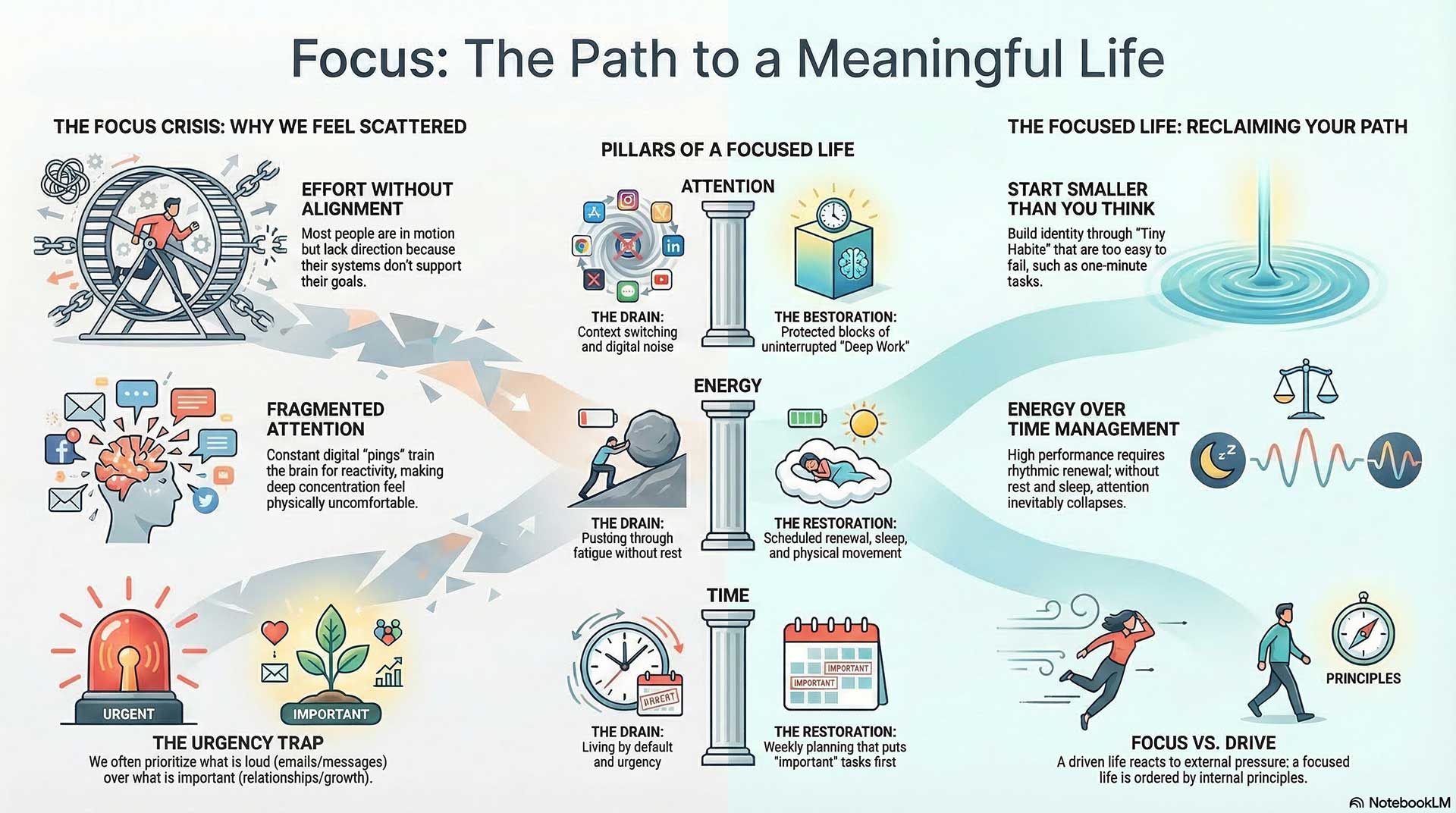
As we come to the end of this five-part journey, what stands out most to me is that focus is far bigger than most people think.
At first, many people hear the word and think of concentration, discipline, or productivity. They think of getting through a task, finishing a goal, or managing time more effectively. And yes, focus helps with all of that. But after walking through these five conversations, I think something much deeper becomes clear.
Focus is a way of living.
It is the ability to know what matters and keep returning to it.
It is the courage to say no to what keeps pulling you off course.
It is the wisdom to build habits that support the life you want.
It is the maturity to protect your energy and attention.
It is the honesty to ask whether your success is taking you where you really want to go.
That is a much bigger vision than mere efficiency.
What we have seen is that distraction is costly, not only because it wastes time, but because it can slowly scatter a life. Habits matter, not only because they make change easier, but because they shape identity. Time and energy matter, not only because they affect performance, but because they determine whether a life can be lived with steadiness and peace. And success matters, not only because people want to achieve, but because every human being eventually has to ask whether what they are chasing is truly worthy of them.
That may be the deepest lesson in this whole series.
Focus is powerful, but only when it is joined to the right things.
Clarity matters, but only when it serves what is true.
Discipline matters, but only when it helps build a life you can respect.
So in the end, the real power of focus is not just that it helps us do more.
It helps us choose better.
Better habits.
Better boundaries.
Better priorities.
Better uses of our attention.
Better definitions of success.
Better ways of living.
And maybe that is where the whole journey leads: to a quieter, stronger, more honest question.
Not just, “How can I be more successful?”
But, “What is truly worth focusing my life on?”
When a person begins living from that question, everything can start to change.
Short Bios:
Jack Canfield
Co-author of The Power of Focus and a major voice in personal growth, success training, and self-improvement.
James Clear
Author of Atomic Habits, known for showing how small repeated actions shape identity and long-term results.
Greg McKeown
Author of Essentialism, known for teaching the disciplined pursuit of less but better.
Cal Newport
Author of Deep Work, known for his ideas on concentration, meaningful productivity, and attention in a distracted culture.
BJ Fogg
Behavior scientist at Stanford and author of Tiny Habits, known for making behavior change simple and practical.
Stephen R. Covey
Author of The 7 Habits of Highly Effective People, known for principle-centered living, character, and wise priorities.
Tristan Harris
Technology critic and co-founder of the Center for Humane Technology, known for warning about the attention-shaping effects of digital platforms.
Nicholas Carr
Writer and author of The Shallows, known for examining how the internet affects reading, thinking, and concentration.
Sherry Turkle
MIT scholar and author known for her work on technology, relationships, identity, and human connection.
Johann Hari
Writer and author of Stolen Focus, known for exploring the personal and social causes of shrinking attention.
Darren Hardy
Author of The Compound Effect, known for teaching how small consistent choices create major life results over time.
Robin Sharma
Leadership writer and speaker known for discipline, daily practice, and personal mastery.
Charles Duhigg
Author of The Power of Habit, known for explaining habit loops and how routines can be changed.
Tony Schwartz
Author of The Power of Full Engagement, known for teaching that energy, not just time, shapes performance.
Laura Vanderkam
Writer on time use and productivity, known for studying how people actually spend their weeks and how to use time more intentionally.
Tim Ferriss
Author of The 4-Hour Workweek, known for experimentation, selective focus, and rethinking default ways of working.
David Allen
Creator of Getting Things Done, known for systems that reduce mental clutter and improve task management.
Viktor Frankl
Psychiatrist and author of Man’s Search for Meaning, known for his work on meaning, suffering, and human dignity.
Wayne Dyer
Spiritual teacher and author known for inner peace, intention, and living in harmony with deeper purpose.
Seneca
Roman Stoic philosopher known for writings on self-command, inner freedom, and wisdom under pressure.
Jim Rohn
Personal development teacher known for practical wisdom on discipline, values, and personal responsibility.
Leave a Reply