
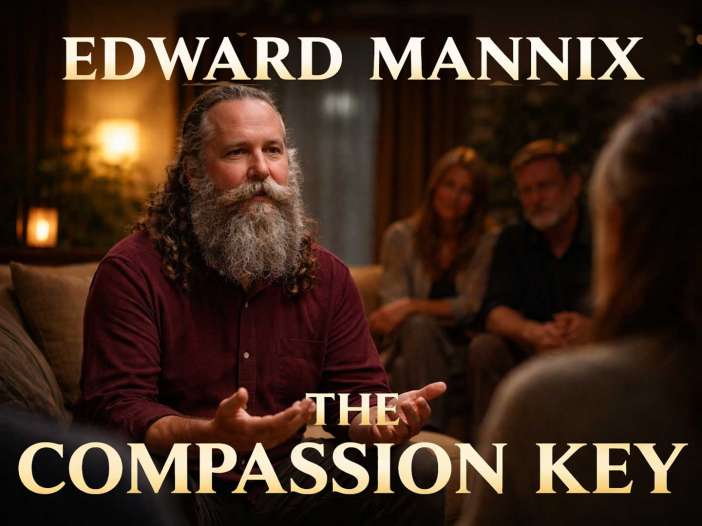
Introduction by Tara Brach
What if compassion is more than comfort and can reach the root of suffering?
What strikes me most in a conversation like this is that nearly all of us know suffering from the inside, yet so many of us still meet it as if it were an enemy.
We may speak of healing, growth, awakening, self-compassion, purpose, or service, but beneath those words there is often a more tender truth: something in us has been hurt, frightened, shamed, or exiled, and we do not always know how to turn toward it with mercy. We know how to analyze our pain. We know how to manage it. We know how to hide it, rise above it, spiritualize it, or try to outrun it. But to truly meet it with a loving presence that asks nothing from it except honesty—that is rarer, and it is one of the deepest movements of healing.
That is why the theme of compassion matters so much here.
Edward Mannix places compassion near the center of transformation, not as a soft sentiment, but as a force that can reach the deeper roots of suffering. Whether one speaks in the language of karma, trauma, shame, exile, nervous-system patterning, or false identity, the living question is much the same: what happens when the wounded life in us is no longer pushed away? What happens when the part of us that feels broken, unseen, afraid, or unworthy is finally met without judgment?
These five conversations move through that question from different angles. They ask whether compassion can do more than soothe. They ask why sincere spiritual effort so often fails to bring lasting freedom. They ask what the wounded self really is, why it gets rejected, and what kind of meeting begins to restore trust. They ask why purpose and visibility can feel so dangerous, and why receiving can stir shame as much as hope. Then they widen the lens and ask whether healing can remain private, or whether real compassion must flow outward into relationship, justice, forgiveness, and public life.
What I hope the reader feels in these dialogues is that compassion is not weakness. It is not passivity. It is not self-indulgence. Real compassion is brave. It stays. It listens. It tells the truth. It softens the trance of unworthiness. It makes room for grief, fear, and shame without letting those forces define who we are. It helps us discover that we can hold our pain in awareness without becoming imprisoned by it.
Healing does not happen just because we have insight. It does not happen just because we try hard. It begins to deepen when the life in us that has been abandoned is brought back into belonging.
That movement—out of exile and into presence, out of shame and into mercy, out of private pain and into a wider field of care—is the heart of what follows.
(Note: This is an imaginary conversation, a creative exploration of an idea, and not a real speech or event.)
Topic 1 — Can Compassion Reach the Root of Suffering?

The room is quiet, simple, and spacious. Nothing in it asks for performance. Five chairs form a circle. Edward Mannix sits with Eckhart Tolle, Thich Nhat Hanh, Tara Brach, and Kristin Neff. The subject before them is the heart of Edward’s teaching: whether compassion is merely soothing, or whether it can reach the deepest layer of suffering and change it at its source.
Question 1
Is compassion simply a gentler response to pain, or can it alter the structure of suffering itself?
Edward Mannix:
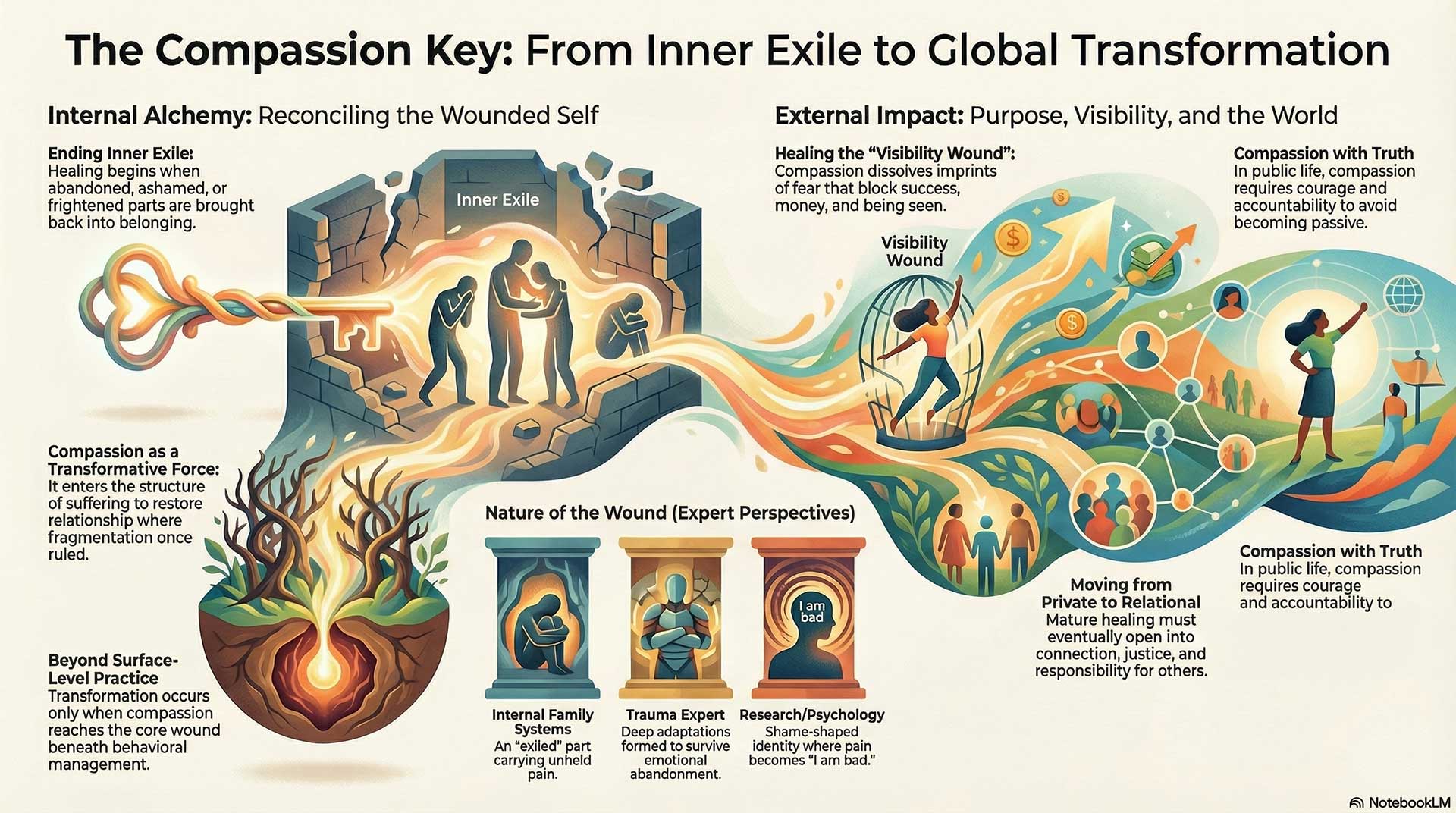
Compassion is not merely a softer feeling laid over pain. It is an active spiritual force that enters the architecture of suffering and begins to change it from within. Most people think suffering is caused only by outer events or surface beliefs, but much of it is sustained by deeper imprints—old wounds, emotional distortions, karmic patterns, and the internalized rejection of parts of ourselves. When compassion is real, it does not stay at the level of comfort. It meets the suffering at the place where separation was first formed. That is why I see compassion as transformative. It restores relationship where fragmentation once ruled. When that happens, the pattern beneath the pain begins to loosen.
Kristin Neff:
From the psychological side, compassion changes suffering by changing our relationship to it. When people meet pain with self-judgment, shame, or isolation, the suffering intensifies. When they meet it with warmth, common humanity, and mindful awareness, the nervous system settles and the mind becomes less entangled. That shift can be profound. I would be careful about claiming that compassion rewrites all suffering at its deepest metaphysical level, but I do think it can change the structure of suffering in a very real human sense. A painful event may remain painful, yet the added layer of self-attack begins to fall away. That alone can change a life.
Eckhart Tolle:
Compassion arises naturally when identification with the mind begins to weaken. The structure of suffering is the egoic self, the false identity built from thought, memory, and resistance to what is. As long as one is trapped in that structure, suffering renews itself. Compassion is powerful because it is rooted in presence. In presence, there is no enemy within. There is space. There is stillness. In that field, pain may still be felt, but it is no longer turned into a story of self. So yes, compassion can alter suffering, but only because it belongs to a deeper state of consciousness than the one that created the suffering.
Tara Brach:
I would say compassion has the power to touch the very roots of suffering because suffering is so often born from trance—from the feeling that something is wrong with me, that I am alone, that I am unworthy, that I must push away what hurts. Compassion interrupts that trance. When a frightened, ashamed, or wounded part of us is truly met with kindness, something basic begins to heal. We are no longer abandoning ourselves. We are no longer relating to pain as a problem that makes us bad. In that sense, compassion does not just comfort us. It changes the inner climate in which suffering lives.
Thich Nhat Hanh:
When compassion is present, suffering is already being transformed. A mother hearing her baby cry does not analyze first. She picks up the child with tenderness. In that tenderness, the child begins to calm. We must learn to do this with our own suffering. We breathe, we recognize the pain, and we hold it with mindfulness and compassion. This is not an idea. It is a practice. The suffering may still be there, but its nature changes when it is held in awareness. Like a seed in good soil, it can become insight. Compassion is the energy that makes this transformation possible.
Question 2
What heals more deeply: awareness, acceptance, forgiveness, or active compassion toward the wounded self?
Tara Brach:
I see these as deeply linked, but if I had to name the motion that brings the most healing, I would say loving presence. Awareness is needed, because without awareness we remain trapped in reactivity. Acceptance is needed, because what is pushed away stays in the shadows. Forgiveness can be an outgrowth of healing. But active compassion toward the wounded self is often what allows the whole process to become real. Many people are aware of their pain, yet they are aware in a cold way. They see the wound, but they still dislike it. Compassion softens that hardness. It invites the hurt part of us back into belonging.
Eckhart Tolle:
Awareness is primary. Without awareness, there is no true acceptance, no real forgiveness, and no authentic compassion. The wounded self cannot heal through more identification with itself. It heals in the light of presence. From that presence, compassion emerges naturally. Many people attempt compassion as a mental attitude, but if there is no presence, that compassion easily becomes another strategy of the mind. Deep healing happens when awareness dissolves the form of the suffering, and then what remains is peace, from which compassion flows.
Edward Mannix:
I would put it this way: awareness reveals, acceptance permits, forgiveness releases, but compassion heals. A person may become aware of a wound and still remain trapped in it. A person may accept pain and still not know how to transmute it. A person may try to forgive and still bypass the living emotional knot inside. Compassion reaches into the knot itself. It says to the wounded self, “You are no longer cast out. You are no longer unwanted.” That is why I place such emphasis on it. Compassion is not just noticing the wound. It is the reconciling force that can restore what was divided against itself.
Thich Nhat Hanh:
Awareness is the beginning. When you know, “Breathing in, I know there is suffering in me,” this is already a great step. Then acceptance is possible. Then compassion becomes possible. I do not separate them too sharply. They are like stages of the same flower opening. But compassion has warmth. Awareness without warmth can become too dry. Acceptance without tenderness can feel incomplete. So perhaps we can say awareness is the lamp, and compassion is the gentle hand. Both are needed.
Kristin Neff:
In my work, the missing piece for many people is compassion. They may be very self-aware, but their awareness sounds like inner criticism. They may say they accept themselves, but under pressure they fall back into shame. Forgiveness can help, but it usually comes later. What often changes the actual experience is learning to respond to pain as they would to a dear friend. That is where self-compassion becomes practical and measurable. It lowers emotional overwhelm, reduces self-judgment, and creates safety. Healing grows better in safety than in self-punishment.
Question 3
When people say they have done years of spiritual or emotional work and still repeat the same pain, what has usually been missed?
Kristin Neff:
A lot of people have practiced self-improvement without practicing self-kindness. They become very skilled at observing their flaws, their trauma, their patterns, their triggers. They can explain themselves beautifully. Yet in the moments that matter most, they still relate to themselves as a problem to fix. That means the old wound is still being activated inside the healing process itself. The person may have knowledge, insight, and language, but not enough inner warmth. Without that, change remains partial.
Edward Mannix:
Often what has been missed is the core wound beneath the pattern, and the deeper spiritual imprint beneath the wound. People work at the level of behavior, thought, or emotional management. That can help, but it does not always touch the hidden place where the original division occurred. The psyche learns to function around the wound rather than heal it. Then the same suffering returns in new forms. I would add that many people do spiritual work in a way that still rejects the broken parts of themselves. They seek light, peace, success, or awakening, but the unloved part remains in exile. That exile keeps generating repetition until compassion is brought there.
Thich Nhat Hanh:
What is often missed is patient return. We do not meet the suffering only once. We must come back again and again, with mindfulness, with breathing, with gentleness. Many people want a conclusion too soon. They want the pain to leave quickly, and so they become discouraged when it returns. But suffering is like a child who still needs attention. If you know how to return and hold it tenderly, the repetition itself becomes part of the path, not a sign of failure.
Eckhart Tolle:
What is missed is the identification with the one who suffers. The person may say, “I have worked on this for years,” yet there remains a subtle self-image that is invested in the story of being wounded, healing, searching, and becoming. The ego can use spiritual practice to strengthen itself. It can become the one who is always processing, always recovering, always moving toward completion. In that state, the pain-body continues to feed. What is needed is a deeper disidentification from the mental and emotional structure itself. Then repetition loses its fuel.
Tara Brach:
I think two things are often missed. One is that the hurting parts of us do not respond well to being managed. They respond to being truly met. The second is that many people have insight without intimate contact. They know what happened. They know why they react. They know the theory. But they have not paused long enough to place a hand on the heart, feel the living vulnerability underneath, and say, with sincerity, “I am here with you.” That kind of contact is not sentimental. It is brave. It asks us to stay present with the rawness we most want to flee. That is where the healing begins to deepen.
The room grows still again. No one rushes to close the question. There is a sense that the first door has opened, but only the first. They have begun to name the difference between insight and healing, between analysis and tenderness, between spiritual effort and the deeper reconciliation Edward calls compassion. The conversation is ready to move further inward.
Topic 2 — Why Do Healing and Manifestation So Often Fail?

The circle remains unbroken, but the atmosphere has shifted. The first topic opened the wound with care. This one asks a harder thing: why so many sincere seekers spend years reading, praying, visualizing, healing, affirming, journaling, meditating, and still remain caught in nearly the same pain. Edward Mannix now sits with Gabrielle Bernstein, Michael A. Singer, Gabor Maté, and Joe Dispenza. Each has spent years trying to understand why change stalls, why insight does not always become freedom, and why so much effort can leave the deepest pattern untouched.
Question 1
Why do people read the books, do the practices, repeat the affirmations, and still stay stuck?
Edward Mannix:
Many people work on the surface and hope the surface will heal the root. They learn better language, more uplifting beliefs, more refined practices, but the deeper wound remains unvisited. The system may become more spiritual, more informed, more hopeful, yet still be organized around the same hidden pain. A person can affirm abundance while carrying an ancient imprint of rejection, persecution, or unworthiness. That deeper pattern quietly overrules the newer thought. So the issue is not effort alone. It is where the effort is aimed. If compassion does not reach the buried place that still expects loss, punishment, or abandonment, the old reality keeps recreating itself.
Gabrielle Bernstein:
I’ve seen people use spiritual tools almost like armor. They say the right words, keep a high-vibe face, try to think positively, but underneath that there is fear they do not want to feel. Manifestation becomes exhausting when it is built on top of denial. Real change asks for a willingness to face the old story, the old wound, the old addiction to control. People stay stuck when they are trying to skip that part. The practice is not meant to help you pretend you are free. It is meant to help you become honest enough to receive freedom.
Gabor Maté:
People stay stuck because the body remembers what the mind would rather move past. Trauma is not just a bad event from the past. It is the lasting pattern that lives in the nervous system, in perception, in emotional expectation, in the sense of self. A person may truly want to change, yet the organism still organizes around protection. That is why willpower often fails. The person is not lazy or resistant in some moral sense. The person is structured by adaptation. Until that adaptation is met with deep compassion and truthful contact, the same pattern tends to repeat.
Joe Dispenza:
Most people are trying to create a new future with the same emotional signature from the past. They may think new thoughts for a few minutes a day, but they are still memorized by stress, by familiar identity, by the same chemical state. The body has become the mind of the past. So after the meditation or the affirmation, they return to the old self. That old self produces the old life. Change begins when thought, emotion, and action are aligned long enough for the body to stop living in survival and start accepting a different reality.
Michael A. Singer:
The human tendency is to use practice as a way of arranging experience rather than releasing attachment to experience. That is a subtle but serious mistake. A person meditates so they can feel better, affirm so they can get what they want, pray so life will become acceptable to the self-image. But the root suffering is the self-image itself and its constant demand that reality fit its preferences. As long as the inner seat of identity remains there, practice can become another servant of the same bondage. The way through is not to decorate the self. It is to let go of clinging to it.
Question 2
Is the real obstacle trauma, ego, nervous-system patterning, karmic imprint, false identity, or something harder to name?
Gabor Maté:
Trauma is central, but I do not use that word in a narrow way. I mean the deep adaptations formed when a person could not safely be fully themselves. Those adaptations affect the body, emotions, beliefs, relationships, and sense of worth. So if someone speaks of ego, false identity, or nervous-system conditioning, I do not hear these as separate worlds. I hear overlapping languages describing one fragmented human reality. We build protective identities because we were hurt. We stay trapped in patterns because the body learned them under stress. The obstacle is not one thing only. It is the whole structure of adaptation.
Michael A. Singer:
I would place the deepest obstacle in identification. Trauma may shape the content of the inner experience, but bondage persists because consciousness identifies with what it is experiencing. Thoughts arise, emotions arise, stored pain arises, and the self says, “This is me.” Then a lifetime of management begins. The false identity is the one who claims the passing inner experience and builds a world around it. That said, compassion is needed, because these patterns are not dissolved through violence against oneself. Still, liberation rests in seeing that the inner disturbances are objects in consciousness, not the seat of who you are.
Edward Mannix:
I would say all of these words point toward something real, but none of them alone completes the picture. Trauma matters. False identity matters. Nervous-system patterning matters. Yet there are cases where a person has worked through the psychological layers and still feels bound by something older, heavier, and more mysterious. That is where I use the language of karmic imprint. I do not use it to become vague. I use it to name a depth of inherited or soul-level patterning that seems to exceed one lifetime’s visible story. The obstacle is the whole knot of separation, and it can wear many faces.
Joe Dispenza:
From my lens, the obstacle is the memorized self. Trauma gives it content. Ego gives it continuity. Stress chemistry keeps it alive. Repetition wires it into the body and brain. That is why people feel they are the same person even when they want to be someone else. The system is rehearsed. So yes, the names can differ, but the practical question is this: can the person stop rehearsing the old identity and emotionally condition the body to a new future? Without that shift, insight stays theoretical.
Gabrielle Bernstein:
I hear truth in all of these. In lived spiritual practice, I often see one deeper issue beneath the labels: people do not yet feel safe letting go of the pattern that is hurting them. The identity may be painful, but it is familiar. The coping style may be exhausting, but it once protected them. So the obstacle is not just the wound. It is the loyalty to the wound. It is the fear that if this pattern falls, I will have no self, no defense, no control. That is why compassion matters so much. It gives people enough inner safety to release what they used to need.
Question 3
What is the difference between true transformation and temporary emotional relief?
Joe Dispenza:
Temporary relief changes state. Transformation changes identity. You can have a great meditation, cry, feel peace, even feel energy in the body, and still return to the same emotional baseline by the afternoon. That is relief. Transformation is when the old emotional set point no longer has the same authority. You think differently, choose differently, respond differently, and your body no longer pulls you back into the old self with the same force. That takes repetition, coherence, and embodiment.
Gabrielle Bernstein:
Relief says, “I feel better right now.” Transformation says, “I relate to myself and my life in a new way now.” Relief has value. It can be a doorway. But many people mistake a beautiful moment for a healed pattern. Real change usually shows itself later, in the ordinary trigger, the old argument, the fear of being seen, the habit of panic, the rush to control. When the trigger comes and you are not the same person inside it, that is when you know something deeper has shifted.
Edward Mannix:
Temporary relief quiets the symptom. Transformation reconciles the division beneath it. Relief may bring peace to the surface for a time. Transformation changes the relationship between the self and the exiled wound. In my view, a pattern is truly changing when compassion has reached the buried place that once generated the pain, shame, fear, or collapse. Then the person is not merely coping more gracefully. The source has begun to transmute. The same outer circumstance may arise, but it no longer finds the same fracture waiting inside.
Michael A. Singer:
Relief still belongs to the personal self. It says, “My experience is more comfortable now.” Transformation is the reduction of the self’s need to control experience. It is a release of attachment, a release of resistance, a release of the constant effort to make life fit the inner model. One may still feel joy or sorrow, expansion or contraction, but consciousness is less bound. There is more openness, more natural flow, more willingness to let life move. That is deeper than emotional management.
Gabor Maté:
I would add one very human measure: truth. Relief often comes from distancing, numbing, bypassing, or temporary soothing. Transformation allows a person to be more real. More present in the body. More able to feel pain without drowning in it. More able to set a boundary without guilt. More able to love without disappearing. If someone becomes gentler, truer, less defended, and less compelled by old survival reactions, then something genuine has happened. Healing is not performance. It is the gradual restoration of wholeness.
The circle becomes quiet again, but it is a denser quiet than before. Each voice has named a different trap: surface practice, spiritual armor, nervous-system memory, the memorized self, false identity, loyalty to old protection. No one has denied that spiritual work can help. But all of them have pressed the same question from different directions: what happens when practice never reaches the place where the old self first learned to survive? That unfinished question now pulls the conversation toward the next chamber—the wounded self itself, and how it should be met.
Topic 3 — What Is the Wounded Self, and How Should We Meet It?

The room feels more intimate now. The first two topics named the possibility of deep healing and the reasons healing often stalls. This one turns toward the being inside the pattern itself—the frightened, ashamed, defended, rejected, or abandoned self that keeps appearing beneath the surface. Edward Mannix now sits with Richard Schwartz, Brené Brown, Alice Miller, and Tara Brach. The question is no longer only how suffering works. It is who, within us, carries it—and what kind of meeting can truly begin to heal it.
Question 1
What exactly is the wounded self: a child part, a defensive pattern, a false identity, or a spiritual fracture?
Richard Schwartz:
From my perspective, what people call the wounded self is often an exiled part—usually young, burdened, and carrying pain that the system has not known how to hold. Around that exile, protective parts arise. Some manage by controlling, pleasing, achieving, or numbing. Others erupt in anger, panic, or collapse when the exile gets too close. So the wounded self is not one single thing. It includes the hurt part and the protective system built around it. The problem begins when the whole inner family loses trust that anyone inside can care for the pain safely.
Edward Mannix:
I would say the wounded self is often more than a psychological part. It is the place where the soul’s flow has been interrupted by pain, rejection, fear, or separation. That can show up as a child part, yes, and also as a defensive structure. But beneath both of those I often sense a deeper fracture—a place where love withdrew, or seemed to withdraw, and the person began organizing around that absence. That is why I do not see the wound as merely emotional. It can become spiritual in its consequences. The person forgets not only safety, but essence.
Alice Miller:
The wounded self begins in childhood where the child must adapt in order to survive emotionally. A child who cannot safely feel anger, grief, fear, need, or truth learns to bury the authentic self. In its place comes the false self, the adapted self, the self that performs what is required for attachment. So I would not romanticize the wound. It is often the result of real betrayal, real emotional abandonment, real pressure to become acceptable. The tragedy is that the living child remains hidden under the personality that gained approval.
Tara Brach:
I hear each of these as touching the same reality from different angles. The wounded self is the vulnerable life in us that felt unloved, unseen, unsafe, or unworthy. Then around that vulnerability comes the trance identity—the learned sense of “something is wrong with me,” or “I must become different to belong.” So yes, there is often a younger hurt part. Yes, there are defensive strategies. And yes, there can be a spiritual dimension, in the sense that the person loses touch with basic belonging. The wound is not just pain. It is disconnection.
Brené Brown:
I would put shame near the center. A wound becomes especially powerful when pain turns into identity—when hurt becomes “I am bad,” “I am too much,” “I am not enough,” “I am unlovable.” Then what follows is armor. Perfectionism, pleasing, performing, hiding, cynicism, overachievement, numbness—these are all ways of trying to avoid being hurt again. So the wounded self is both the hurt child and the shame-shaped identity that grew from that hurt. The danger comes when people mistake the armor for who they really are.
Question 2
Should the wounded self be healed, integrated, witnessed, retrained, or loved until it softens?
Tara Brach:
I would begin with loving presence. A wounded part cannot trust healing that arrives as another self-improvement project. It needs to be felt, witnessed, and held. That does not mean indulging every story forever. It means offering the kind of tenderness that allows the nervous system and heart to stop bracing. Once that happens, integration becomes possible. So yes, healing matters, and so does integration, but love is what makes those things real.
Richard Schwartz:
In Internal Family Systems, the first step is not to fix the part but to get into relationship with it. Exiles and protectors both need to be seen and trusted. When Self-energy is present—curious, calm, compassionate, clear—parts naturally begin to unburden. That includes witnessing, loving, and eventually healing. Retraining by itself can be too aggressive if the part feels blamed. Integration happens when the part no longer has to carry the old burden and can take on a healthier role in the system.
Edward Mannix:
I would say the wounded self must be compassionately loved in a way that allows transmutation. Merely witnessing may help, but sometimes it leaves the person standing just outside the wound, observing with intelligence but not entering with reconciling love. Retraining has its place, but it can become another effort to manage what has not yet been embraced. The real question is whether the injured place has been met with such sincerity that it no longer feels exiled from the self. When compassion reaches that point, softening begins, and healing becomes more than technique.
Brené Brown:
I get nervous when healing language sounds too polished, because many people still use healing as a way to avoid vulnerability. The wounded self needs truth, kindness, and permission to be imperfect. Shame loses strength when it is met with empathy. So yes, love matters deeply. Witnessing matters. Integration matters. But all of that has to include honesty. What are we protecting? What are we afraid will happen if we stop performing? Where did we learn that being human was dangerous? Without that honesty, love can turn sentimental.
Alice Miller:
Love is important, but I want to be careful. Many wounded children were told they were loved in homes where their real feelings were still unwelcome. So the healing must include truth. The person must be able to say: this hurt me, this silenced me, this shaped me, this was not my fault. The false self will not soften only through soothing words. It softens when the buried reality is permitted to come into consciousness without distortion. Then the authentic self can begin to return.
Question 3
Why do people so often judge, exile, or try to outgrow the very part of themselves that most needs care?
Brené Brown:
Because we are terrified of the feelings that part carries. Shame tells us that vulnerability is dangerous, weakness is contemptible, and need is humiliating. So we build identities that look strong, polished, independent, spiritual, successful, or unbothered. The wounded part threatens that image. It exposes the places we do not control. So we exile it. We call it pathetic, needy, dramatic, broken, immature. But what we are really saying is, “I am afraid of what happens if I let this pain be seen.”
Alice Miller:
People reject the wounded part because they learned early that their true feelings endangered attachment. The child had to suppress pain in order to preserve the bond with parents or caregivers. Later in life, that suppression becomes automatic. The person now participates in the original rejection. They become the one who silences the inner child. They believe that if they let the truth speak, they will lose love, order, belonging, or identity. That is why self-rejection can feel so natural. It is learned loyalty to early survival.
Richard Schwartz:
In parts language, protectors fear what would happen if the exile were fully felt. They believe the pain would overwhelm the whole system. So they judge, distract, numb, criticize, or shut down access. Those strategies may look harsh, but they usually began as attempts to help. The key is not to hate the protectors either. They are guarding a feared wound. Once they trust that Self can handle the pain, they begin to relax. Then the exile can receive the care it has been waiting for.
Edward Mannix:
I would add that many people have internalized a spiritual version of rejection. They think they must rise above pain, transcend it, outgrow it, become more evolved than it. The wounded part then becomes an embarrassment to the spiritual identity. Instead of being met with compassion, it is treated as evidence of failure. But the very part that disturbs the polished self is often the doorway to the deepest reconciliation. The exile keeps knocking because it has not yet been welcomed home.
Tara Brach:
Yes. We exile what we fear will define us. We fear that if we turn toward the shame, the grief, the fear, the unmet need, we will disappear into it. So we keep moving. We stay busy, self-improving, distracting, analyzing, fixing. But the deeper healing comes when we pause and discover that we can be with the wound without becoming the wound. That is where compassion changes everything. We stop abandoning the place inside that has carried our pain alone.
The silence that follows is tender, almost protective. This topic has not tried to solve the wounded self. It has given it contour, history, feeling, and voice. A child part. A shame-shaped identity. A hidden exile. A broken continuity of love. A defensive system built to survive. The circle has begun to show that healing is not only insight, and not only practice. It is a new relationship to the rejected life within. From here, the conversation is ready to move outward into one of the hardest questions of all: whether compassion can reach the places where calling, money, visibility, and service become tangled with fear.
Topic 4 — Can Compassion Heal Money, Purpose, and Visibility Wounds?

The room changes again. The earlier questions dealt with pain, healing, and the hidden self. This one moves into a charged territory where many spiritual people become uneasy: money, recognition, calling, service, receiving, public presence, and the fear of being fully seen. Edward Mannix now sits with Marianne Williamson, Gay Hendricks, Jen Sincero, and Lewis Howes. What lies beneath the surface is not just success. It is the mystery of why so many people who want to serve the world still hesitate at the threshold of visibility, compensation, and embodied purpose.
Question 1
Why do so many gifted people feel called to serve, yet feel blocked when it comes to being seen, paid, or received?
Edward Mannix:
Many people with a sincere call to serve still carry deep imprints around persecution, rejection, betrayal, or moral suspicion toward power and money. The soul may feel ready, yet another part of the being still expects danger. To be seen may feel like exposure. To be paid may feel like corruption. To receive may feel like guilt. So the person divides: one part wants to give, another part fears what giving will cost. This is why compassion is needed. Without it, the person keeps trying to force visibility from the surface while the buried wound quietly resists from below.
Marianne Williamson:
A great many people are less afraid of failure than they are of their own radiance. To be visible is to become accountable to one’s light. It asks a person to stop hiding in self-diminishment. Yet people often associate spiritual purity with self-erasure. They feel noble in serving, but uneasy in shining. They confuse humility with shrinking. They confuse love with self-denial. The truth is that service requires embodiment. If your gifts are meant to bless others, then allowing them to become visible is part of the offering.
Gay Hendricks:
This fits what I have called the upper-limit problem. People do well up to the point where success challenges an old internal setting. Past that point, they create trouble, pull back, delay, undercharge, hide, or start feeling strange discomfort. The problem is rarely talent. It is the inner thermostat. A person may say, “I want to be seen,” but another part says, “Not beyond this level. That feels unsafe.” Until the person becomes aware of that limit and learns to live above it, the block keeps recycling.
Jen Sincero:
A lot of people carry weird stories about money and visibility that they barely notice because those stories sound moral to them. They think charging well makes them selfish. They think wanting a bigger life makes them shallow. They think staying hidden keeps them pure. Then they wonder why they keep struggling. But if your work helps people, then getting paid for it and letting more people find it can be part of the good you do. The issue is not greed. The issue is the junk belief that service and abundance must be enemies.
Lewis Howes:
I’ve seen many people with real gifts struggle with worthiness. They can work hard, care deeply, and still feel uncomfortable receiving support, praise, attention, or money. They know how to pour out, but they do not know how to open up and receive back. That creates a ceiling. Your mission can only grow so far if every form of expansion triggers inner discomfort. At some point the work becomes about healing the relationship to receiving, not just getting better at serving.
Question 2
Are money struggles mostly practical, or do they often expose deeper wounds around value, permission, guilt, and fear?
Gay Hendricks:
Of course practical issues matter. People need skills, business clarity, structure, and follow-through. But I’ve found that many money struggles persist long after the person knows what to do. That tells you something deeper is active. Underneath the missed strategy, there may be guilt about surpassing family, fear of outgrowing an old identity, anxiety about visibility, or an unconscious loyalty to limitation. The practical and the emotional are usually intertwined.
Jen Sincero:
Yes, plenty of money issues are tactical. Charge better. Sell better. Stop hiding. Learn the basics. But past a certain point, the deeper stuff starts shouting. A person keeps sabotaging the obvious next move. They keep shrinking after momentum builds. They keep talking like they want change, but their body flinches at the idea of actually having it. That is rarely about spreadsheets. That is about value, shame, fear, family conditioning, and what they think money says about who they are.
Edward Mannix:
Money often reveals where compassion has not yet reached. It exposes hidden judgments about worth, hidden loyalties to suffering, hidden fears of power, and hidden spiritual fractures around deserving. Many people can discuss abundance in theory and still carry a wound that says, “It is safer to remain small,” or “Good people do not receive much,” or “If I become visible, I will be attacked.” The money issue may look practical on the outside, but inwardly it often touches ancient layers of identity, safety, and permission.
Lewis Howes:
I think people underestimate how much receiving is emotional. They treat money like a number problem only. But money can trigger every unresolved thing about self-worth. It can bring up comparison, shame, fear of judgment, and fear of responsibility. Someone can say they want more income, then sabotage the very opportunities that would create it because success feels heavier than struggle. Practical action matters, but sustainable growth usually asks for inner repair too.
Marianne Williamson:
Money in itself is not the enemy. Fear is the enemy. Shame is the enemy. The refusal to receive what one is meant to steward can become its own distortion. Many people were taught that love means depletion, holiness means smallness, and generosity means permanent self-neglect. But healthy receiving can make greater service possible. The deeper question is not merely, “How do I earn more?” It is, “Can I bless the world without apologizing for the fact that blessing may return to me in material form?”
Question 3
Can compassion actually dissolve the fear of visibility, rejection, and success, or does that require a different kind of inner work?
Marianne Williamson:
Compassion is necessary because fear of visibility is rarely just ambition gone wrong. It is often a tender wound around exposure, criticism, abandonment, or spiritual confusion. A person must be able to hold that wound with mercy. Yet compassion alone, if understood as a feeling, is not enough. The person must also choose. There comes a moment when one must stop negotiating with diminishment and say yes to expression. Love heals, but love must become courage in action.
Edward Mannix:
I would say true compassion already contains courage. It does not merely soothe the fearful self; it reconciles with it so deeply that the fear no longer governs in the same way. When the hidden part that expects attack or shame is met compassionately, the charge begins to dissolve. Then visibility is no longer approached as violence against oneself. It becomes an extension of inner reunion. There may still be trembling. But the person is no longer divided against their own emergence.
Lewis Howes:
I think compassion is the starting ground. If you keep shaming yourself for being afraid, you just make the whole thing tighter. But after that, you need practice. You need to let yourself be seen in real ways. Speak up. Share the message. Ask for the sale. Receive the praise. Set the price. A lot of healing happens through repeated safe exposure. You build the capacity to stay open in situations that used to trigger contraction.
Gay Hendricks:
Yes, compassion matters, and so does conscious expansion. A person may compassionately understand the upper limit and still keep living under it. The next movement is willingness. Can I remain present as more love, more success, more visibility, more creative energy moves through me? Can I stop manufacturing problems when things go well? Compassion gives the nervous system room. Conscious practice gives the person a new home above the old ceiling.
Jen Sincero:
I’d put it this way: compassion gets you out of self-war, and that matters a lot. But then you still have to stop obeying the old nonsense. You have to do the scary thing. Launch the offer. Raise the rate. Post the video. Say the message. Let people misunderstand you and live anyway. Sometimes the fear shrinks after the action, not before it. Compassion helps you stop making yourself wrong for being scared. Action proves you are no longer ruled by it.
The room falls quiet, but this silence carries heat. The discussion has exposed a raw tension many people live with for years: the wish to serve and the fear of emergence, the hunger to give and the shame around receiving, the longing to be used for something meaningful and the instinct to disappear when life opens. No one has reduced the issue to money tips or spiritual slogans. They have treated it as a meeting point of wound, worth, courage, and calling. The next movement now waits beyond the personal. What begins in inner healing must face a harder question still: whether compassion belongs only to the self, or whether it must widen into the healing of the world.
Topic 5 — Is Personal Healing Enough, or Is Compassion Part of Healing the Wider World?
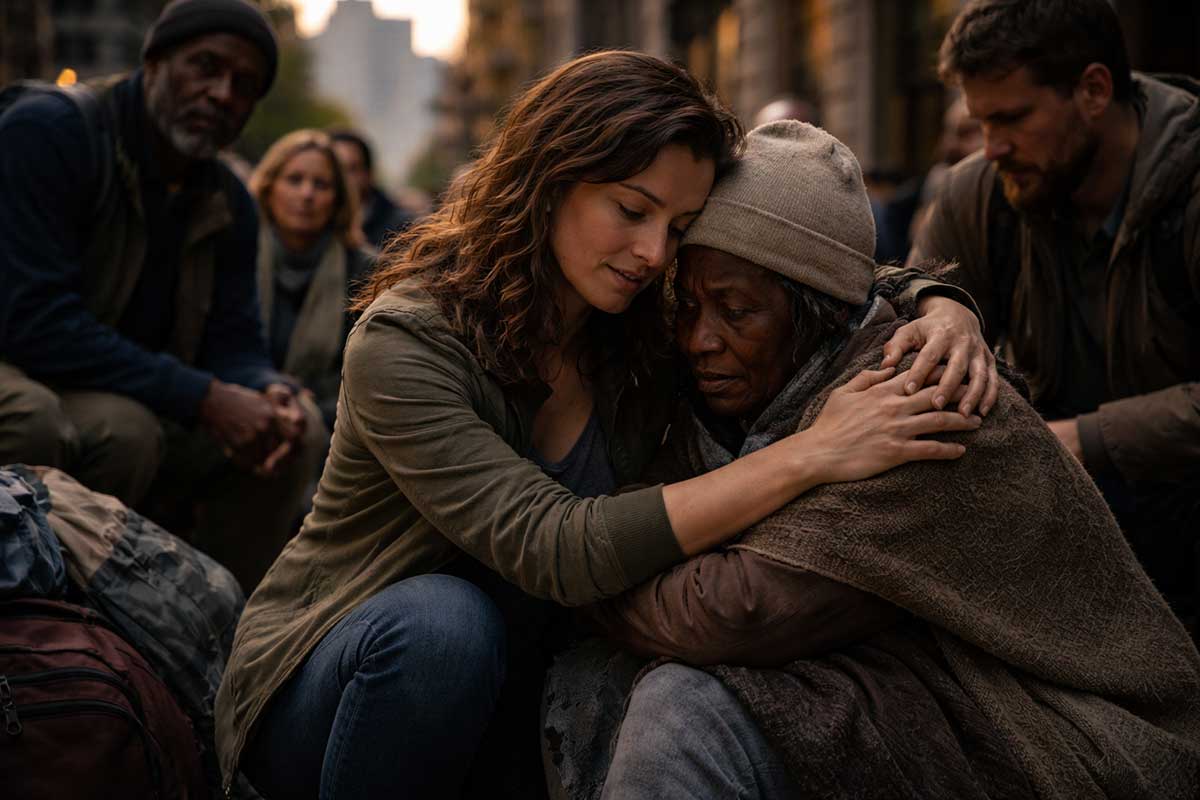
The circle has moved through suffering, failed change, the wounded self, and the tangled place where purpose, money, and visibility meet fear. Now the room opens outward. The final question is whether compassion ends with personal healing or whether it must take on a public life—through relationship, justice, forgiveness, leadership, and the care of a wounded world. Edward Mannix now sits with Pema Chödrön, bell hooks, Desmond Tutu, and Jon Kabat-Zinn. The atmosphere is steady and grave. The subject is no longer only how to heal, but what healing is for.
Question 1
Can a person be deeply healed in private and still remain disconnected from the suffering of the wider human world?
bell hooks:
A person may become more self-aware in private, yes, but healing that never opens into connection risks becoming self-absorption with better language. Love is relational. Compassion is relational. If a person says they are healed but cannot meet the pain of others, cannot participate in truth, cannot recognize domination, cruelty, loneliness, or exclusion, then something essential is missing. We do not heal only to feel better inside our own skin. We heal so that we can live differently with one another.
Pema Chödrön:
Private healing matters very much. We need silence. We need honesty. We need to sit with our own mind and heart. But when we stay there too long, we may quietly begin using the path to avoid the messiness of being human together. The work is not to become pure and untouched. The work is to become less afraid of pain—our own and others’. Then compassion can move. If your practice makes you more separate, something has gone off course.
Edward Mannix:
I agree. A healing path that remains self-enclosed can become distorted. Real compassion widens. When the inner divisions begin to reconcile, the person naturally becomes more available to the life around them. That does not mean everyone must enter public activism or visible leadership. But it does mean healing should soften the boundaries of the heart. If one becomes more peaceful inwardly yet remains indifferent to the suffering of others, then compassion has not fully matured.
Jon Kabat-Zinn:
The private and public dimensions are not truly separate. Mindfulness begins intimately, in the body, in breathing, in awareness, in one’s own patterns of reactivity. Yet what becomes visible there is the web of interdependence. We affect one another continually. Our fear, hurry, anger, and confusion spread. So can our steadiness, patience, and care. Deep healing makes us less automatic. That alone changes the field around us. The question is whether we are willing to let awareness extend into responsibility.
Desmond Tutu:
No one is healed alone. We are made for one another. If your healing leaves you untouched by injustice, untouched by human sorrow, untouched by the wounds of your neighbor, then it is not the fullness of healing. Compassion must have hands, voice, tears, patience, and courage. It must enter the places where people are broken and say, “Your suffering is not invisible to me.” This is not extra. This is part of what it means to become more fully human.
Question 2
What happens when compassion moves from self-healing into relationships, injustice, leadership, and public life?
Desmond Tutu:
When compassion enters public life, it does not become weak. It becomes brave. It can tell the truth without hatred. It can confront wrongdoing without denying the dignity of the wrongdoer. It can seek justice without surrendering to revenge. This is not easy. It asks much of the heart. But without compassion, justice can become cruel. Without justice, compassion can become sentiment. The two must meet.
bell hooks:
Compassion in public life becomes love with structure. It is no longer only about personal tenderness. It asks questions about power, exclusion, domination, and who gets left outside the circle of care. In relationship, compassion means truth-telling and accountability. In leadership, it means refusing to build systems on humiliation and fear. In public life, it means we do not get to call ourselves loving if our compassion never challenges what destroys people.
Jon Kabat-Zinn:
When compassion matures into public expression, it helps interrupt reactivity at scale. In relationships, it creates room for listening. In leadership, it reduces the reflex to dominate or defend. In institutions, it can help rehumanize environments that have become mechanical or punitive. That said, compassion is not a slogan. It needs embodiment, training, and discipline. Without grounding, people use the word and still reproduce harm.
Pema Chödrön:
It also becomes humbling. Once compassion leaves the private space, we discover how quickly we harden again. We meet people who trigger us, systems that frustrate us, injustice that enrages us, and suffering we cannot fix. Then the practice becomes less idealized. It is not about being the compassionate person. It is about staying open where we would usually close. Public compassion is messy. It asks us to keep our hearts available in difficult circumstances.
Edward Mannix:
I would add that compassion in public life must remain rooted inwardly or it easily turns brittle. A person may try to serve, lead, heal, or advocate while still carrying unhealed fractures that distort the work. That is why I do not separate the inner and outer too sharply. Compassion must keep purifying the vessel through which it moves. When it does, public action becomes less driven by compensation, self-importance, or unresolved pain, and more aligned with service.
Question 3
Where is the line between compassion that heals and compassion that becomes passivity, avoidance, or spiritual escape?
Pema Chödrön:
Compassion becomes avoidance when it refuses reality. If I call it compassion to stay soft and nice while I am actually afraid to speak, afraid to set a boundary, afraid to feel anger, then I am not practicing compassion. I am practicing fear with a spiritual face. Real compassion can sit with pain, but it can also say no. It can act. It can disappoint people. It can remain open without becoming weak.
bell hooks:
Yes. Compassion without truth becomes sentimental. Compassion without accountability becomes indulgence. Compassion without a willingness to confront harm becomes complicity. We must stop pretending that kindness and clarity are enemies. They belong together. The test is simple: does this compassion protect life, dignity, honesty, and freedom, or does it merely keep us comfortable?
Edward Mannix:
Compassion becomes distorted when it loses its relationship to truth. It is not meant to erase discernment. It is not meant to bless every behavior or excuse every wound forever. In its truest form, compassion helps us meet pain without hatred and meet distortion without exile. But where there is no movement toward truth, responsibility, or realignment, what remains may be pity, appeasement, or avoidance rather than compassion.
Jon Kabat-Zinn:
In mindfulness practice, one useful measure is whether compassion increases presence or decreases it. Escape moves away from contact. Genuine compassion increases our capacity to stay present with what is difficult. That includes grief, conflict, illness, injustice, and our own limits. Passivity often looks calm on the surface, but underneath it is disengagement. Compassion is engaged. It is awake.
Desmond Tutu:
I would say compassion must never be an excuse for abandoning courage. To forgive is not to pretend nothing happened. To love is not to call evil good. To care is not to surrender moral clarity. In South Africa we learned that healing required truth. Without truth, reconciliation would have been hollow. So the line is this: compassion that heals walks with truth. Compassion that avoids truth cannot heal what it refuses to face.
The room becomes very still. No one tries to make the ending neat. Too much has been named for that. Compassion has been spoken of as medicine, mirror, discipline, courage, reconciliation, responsibility, and widening love. It has moved from inner wound to public life, from the exiled self to justice, from private tenderness to moral clarity. Edward’s central idea has been tested from every side: not whether compassion feels good, but whether it can truly transform the fractures that shape a person and then widen into the healing of a shared human world.
The circle does not close with certainty. It closes with a more demanding hope—that compassion, if it is real enough, truthful enough, and brave enough, may reach farther than comfort, farther than method, and farther than self, into the unfinished work of becoming whole together.
Final Thoughts by Tara Brach
After listening across these five topics, I am left with the feeling that compassion is both more demanding and more beautiful than many of us first imagine.
It is easier to speak of compassion than to practice it where it matters most. It is easier to admire it in principle than to offer it to the parts of ourselves we most distrust. It is easier to bring compassion to pain that looks noble than to pain that feels messy, repetitive, ashamed, jealous, frightened, needy, or deeply confused. Yet that is often where the path opens. Not in the perfected self, but in the trembling places that still do not know they are safe.
Again and again in these conversations, one truth has appeared in different forms: suffering deepens when we abandon ourselves. Healing begins when we stop.
We stop turning the wound into an enemy. We stop treating fear as failure. We stop demanding that pain justify its existence before we offer it care. We stop believing that worthiness must be earned through performance, spiritual progress, usefulness, or control. And in that stopping, something quiet but profound begins to happen. The heart becomes more habitable. The inner life becomes less divided. The wounded self is no longer left alone in the dark.
What also feels clear is that compassion cannot remain sealed inside private life. When it ripens, it changes how we listen, how we speak, how we lead, how we receive, how we serve, how we face injustice, and how we stay human in the presence of suffering we cannot fully fix. Compassion does not solve everything. It does not erase grief or make life neat. But it does keep the heart from hardening. It keeps us available to truth. It keeps us from confusing numbness with wisdom.
I think that may be one of the deepest invitations in Edward’s central concern. Whatever language we use, the real question is whether we are willing to meet suffering in a way that restores relationship rather than deepens exile.
Can we be present with our own hurt without shame?
Can we receive our calling without retreating into smallness?
Can we serve without losing tenderness?
Can we bring truth and mercy into the same breath?
Can we allow healing to widen into a more courageous love for this world?
Those are not small questions. They are lifelong questions.
Perhaps that is why compassion matters so much. It is not only a response to suffering. It is a way of remaining awake within it, until something once divided begins, slowly and honestly, to come home.
Short Bios:
Edward Mannix
Spiritual teacher and author of Reinventing Truth and Impossible Compassion, known for The Compassion Key® and his focus on healing karmic and emotional patterns.
Eckhart Tolle
Author of The Power of Now, widely recognized for teaching presence, ego transcendence, and awakening beyond mental identification.
Thich Nhat Hanh
Vietnamese Zen master and peace activist who taught mindfulness, compassion, and engaged spirituality in everyday life.
Tara Brach
Psychologist and meditation teacher known for integrating mindfulness and compassion, especially through her work on radical acceptance and emotional healing.
Kristin Neff
Research psychologist and pioneer in self-compassion studies, helping bring compassion-based healing into mainstream psychology.
Gabrielle Bernstein
Spiritual teacher and author focused on manifestation, emotional healing, and aligning inner life with outer results.
Michael A. Singer
Author of The Untethered Soul, known for teachings on surrender, inner freedom, and observing consciousness beyond thought.
Gabor Maté
Physician and trauma expert whose work explores how childhood experiences shape addiction, illness, and emotional patterns.
Joe Dispenza
Author and lecturer blending neuroscience, meditation, and behavior change to help people rewire thought and emotional patterns.
Richard Schwartz
Psychologist and founder of Internal Family Systems (IFS), a model that works with inner parts to heal emotional wounds.
Brené Brown
Research professor and author focused on vulnerability, shame, courage, and human connection.
Alice Miller
Psychologist known for her work on childhood trauma and the impact of early emotional wounds on adult life.
Marianne Williamson
Author and speaker on spirituality, love, and purpose, emphasizing the role of inner transformation in public life.
Gay Hendricks
Author of The Big Leap, known for the concept of upper limits and expanding into greater success and creativity.
Jen Sincero
Self-development author focused on confidence, money mindset, and breaking limiting beliefs around success.
Lewis Howes
Entrepreneur and host of The School of Greatness, focused on mindset, purpose, and overcoming self-worth blocks.
Pema Chödrön
Buddhist teacher known for her teachings on compassion, fear, and staying open in the face of difficulty.
bell hooks
Cultural critic and author who explored love, justice, and the role of compassion in social transformation.
Desmond Tutu
South African archbishop and Nobel laureate known for his work in reconciliation, forgiveness, and moral leadership.
Jon Kabat-Zinn
Founder of Mindfulness-Based Stress Reduction (MBSR), bringing mindfulness into medicine and everyday life.
Leave a Reply