
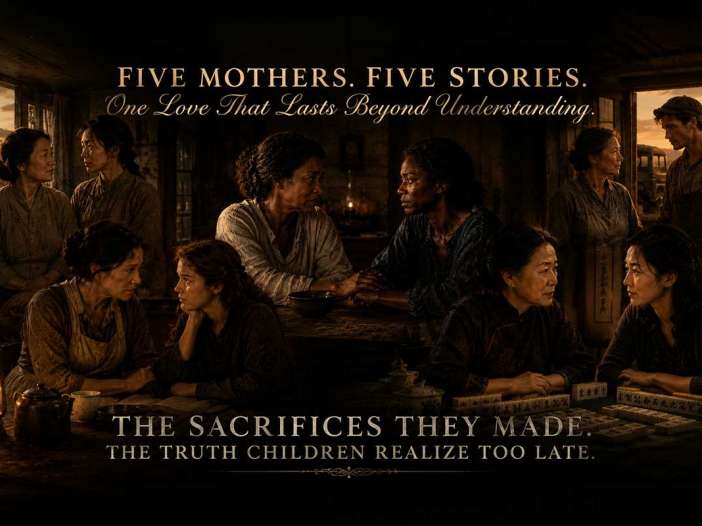
What if five great novels revealed what children understand too late about mothers?
There are mothers in literature who love loudly.
And there are mothers who carry entire families through suffering almost invisibly.
The mothers in these five novels belong to the second kind.
They survive war, slavery, poverty, migration, hunger, humiliation, and social collapse. They work while exhausted. Protect while frightened. Endure while unseen.
Their children often misunderstand them at first.
A strict mother feels cold.
A demanding mother feels controlling.
A silent mother feels distant.
A fearful mother feels overwhelming.
Only later do the children begin to understand:
The mother was carrying history.
Poverty.
Trauma.
Responsibility.
Survival itself.
In this imaginary conversation, five great literary mothers sit down with their children after the stories have ended.
Now there is finally time to ask:
What did your love cost?
What were you protecting us from?
Why did your love sometimes hurt?
And what truths about motherhood become visible only after adulthood, suffering, or loss?
Together, these conversations reveal motherhood not as perfection, but as endurance under impossible pressure.
(Note: This is an imaginary conversation, a creative exploration of an idea, and not a real speech or event.)
Topic 1 — O-Lan and Her Daughter from The Good Earth
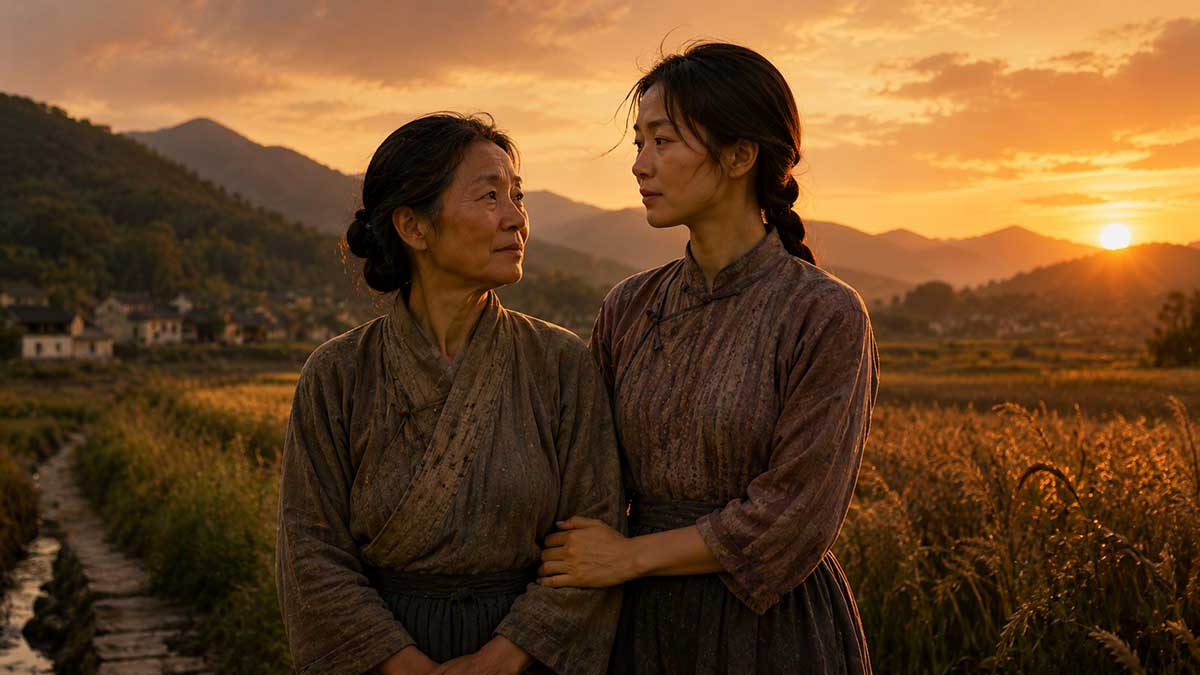
Silent Sacrifice and the Invisible Mother
The fields are quiet now.
No famine winds.
No heavy baskets carried across dry earth.
No servants calling orders from wealthy houses.
O-Lan sits across from her daughter with the same stillness she carried through most of her life.
Her daughter studies her carefully.
For the first time, perhaps truly seeing her.
Not simply as “Mother.”
But as a woman who suffered almost invisibly.
Question 1
Daughter, what did you fail to see about your mother’s suffering?
Daughter:
I thought silence meant strength.
You never complained.
Never demanded attention.
Never told stories about your pain.
As children, we thought that meant you did not need comfort.
Now I think it meant something else.
I think you had already learned long before us that nobody was coming to comfort you.
O-Lan:
That is how life was.
Daughter:
But it should not have been.
You worked in the fields pregnant.
You cooked.
You carried water.
You gave birth alone.
Alone.
When I think about that now, it feels unbearable.
Yet you returned to work almost immediately, as if your body belonged to survival before it belonged to yourself.
O-Lan:
There was work to do.
Hungry children do not wait for recovery.
Daughter:
That sentence explains your whole life.
You lived as if your suffering was less important than everyone else’s survival.
And we accepted it because you never asked us to look closer.
O-Lan:
In those days, a woman survived by enduring.
Not by speaking.
Question 2
O-Lan, why did you give so much without asking to be seen?
O-Lan:
Because being seen was dangerous once.
In the great house where I served, invisible women survived longer.
The noticed servant was often the humiliated servant.
So I learned silence.
I learned usefulness.
I learned to lower my eyes and continue.
Even after marriage, those habits remained inside me.
Daughter:
Did you ever want more?
O-Lan:
Wanting can become another hunger.
And hunger already filled our lives.
I wanted enough rice.
Enough land.
Enough safety so my children would not be sold, beaten, or starved.
Those were large enough dreams.
Daughter:
But Father did not always honor you.
O-Lan:
No.
Daughter:
Does that hurt you still?
O-Lan:
Less now.
But there was pain.
A woman may accept hardship more easily than disrespect.
I could carry heavy loads.
What became heavy was becoming unseen after building the very life others enjoyed.
Daughter:
You built the family quietly, and then the world praised louder people.
O-Lan:
That happens often to mothers.
Question 3
What does this story reveal about mothers whose greatness is hidden by silence?
Daughter:
I think children notice visible love first.
Warm words.
Affection.
Praise.
But there is another kind of love that works underneath life itself.
The food appearing.
The clothes repaired.
The money saved secretly.
The mother eating less so others can eat more.
As children, we often mistake quiet sacrifice for ordinary duty.
O-Lan:
Because quiet sacrifice tries not to burden the child.
Daughter:
Yes.
And perhaps that is the tragedy.
The mother hides the cost successfully.
So the child grows up never fully seeing it.
O-Lan:
A mother does not calculate love like a merchant.
She does what must be done.
Daughter:
Even when nobody thanks her?
O-Lan:
The child living is sometimes the thanks.
Daughter:
That sounds beautiful… and heartbreaking.
O-Lan:
Both can be true.
Daughter:
I think your greatness came from carrying suffering without turning bitter.
You were denied beauty, praise, softness, rest, and recognition.
Yet you still protected life.
You still planted hope into dry ground.
O-Lan:
Mothers are often like the earth itself.
Walked upon.
Used daily.
Rarely praised.
Yet everything grows because they remain.
Daughter:
And children understand too late that the quietest mothers may have carried the heaviest lives.
O-Lan:
Then perhaps the child must speak the gratitude the mother never asked for.
Daughter:
Then let me say it now.
We survived because you endured what nobody should have endured alone.
O-Lan:
That is enough.
More than enough.
Topic 2 — Sethe and Denver from Beloved
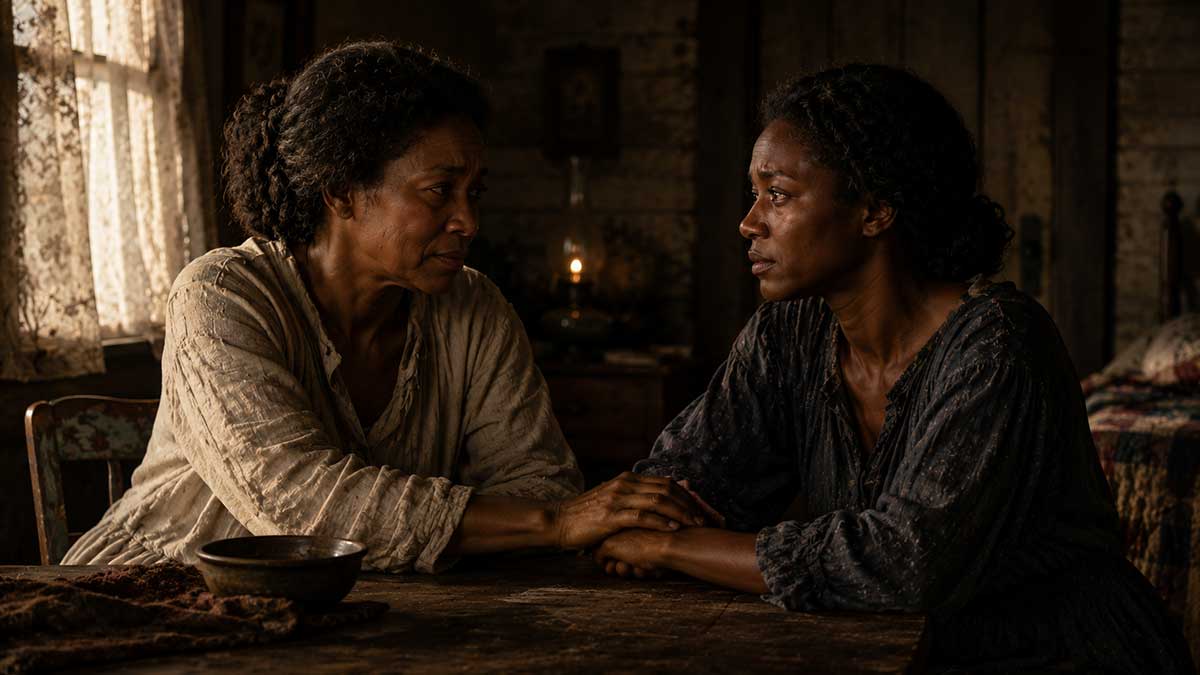
A Mother’s Protective Love Pushed to Its Breaking Point
The house is quiet now.
No footsteps from the past.
No voices pressing through the walls.
No ghostly grief demanding to be fed.
Denver sits across from Sethe, no longer the frightened child hiding inside her mother’s pain.
Sethe looks older than memory.
Not weak.
Just tired from carrying a love that was forced to become terrible.
Question 1
Denver, when did you begin to understand that your mother’s love was shaped by terror?
Denver:
For a long time, I thought your love was the whole house.
Heavy.
Closed.
Haunted.
I knew you loved me, but I also knew something in that love was afraid all the time.
As a child, I did not understand the fear.
I only felt its weight.
Sethe:
I never wanted that for you.
Denver:
I know that now.
But back then, your past lived with us like another person at the table.
Every silence had a memory inside it.
Every warning sounded larger than the moment.
You were not only raising me.
You were fighting what had already happened to you.
Sethe:
A mother who has seen her children treated like property does not love calmly after that.
Denver:
That is what I understand now.
Your love did not begin in peace.
It began in a world where a mother could lose her child to sale, violence, hunger, or law.
So your protection became fierce because danger had already proven itself real.
Question 2
Sethe, what happens to motherhood when the world makes protection almost impossible?
Sethe:
It becomes a storm inside the body.
A mother is meant to protect.
But what happens when the danger is everywhere?
When the law is danger?
When men with papers are danger?
When memory is danger?
When your own child’s future can be stolen before she has words?
Then love becomes desperate.
Not because the mother has no tenderness.
Because tenderness has been surrounded.
Denver:
Did you believe love could save us?
Sethe:
I believed love had to try.
That was all I had.
My hands.
My body.
My milk.
My memory.
My refusal.
A mother in such a world is asked to do the impossible:
Keep a child human when the world has declared otherwise.
Denver:
But love also wounded us.
Sethe:
Yes.
That is the truth I cannot escape.
Love twisted by terror can wound the child it wants to save.
That is the sorrow of it.
Question 3
What does this story reveal about love, trauma, guilt, and survival?
Denver:
It reveals that a mother’s love cannot be judged apart from the world that cornered it.
But it also shows that pain cannot be allowed to become the whole inheritance.
For a long time, I lived inside your trauma.
Then I had to step outside and ask for help.
I had to learn that survival is not betrayal.
Sethe:
You saved us by leaving the house.
Denver:
Maybe.
But you gave me something too.
You gave me the knowledge that I was loved with terrifying intensity.
I had to learn how to receive the love without being buried by the terror.
Sethe:
And I had to learn that my children were not only mine to protect.
They were their own lives.
Denver:
That may be the hardest truth for wounded mothers.
The child must be protected.
But the child must also be free from the mother’s wound.
Sethe:
Yes.
A mother’s greatness is not only in what she endures.
Sometimes it is in letting the child walk beyond what the mother survived.
Denver:
Then this story reveals motherhood as both love and warning.
It asks what happens when history attacks the family so deeply that even love comes out scarred.
Sethe:
And it asks whether love can still heal after it has frightened itself.
Denver:
Can it?
Sethe:
I do not know fully.
But I know this:
A mother’s love should never have been forced to choose between death and bondage.
No mother should have had to make love answer such a question.
Denver:
Then maybe the greatness here is not perfection.
It is the broken mother still trying to become human again.
And the child learning that love can be real, wounded, frightening, and unfinished — all at once.
Sethe:
Then may you carry the love forward without carrying all the terror.
Denver:
I will try.
Sethe:
That is enough.
Trying is sometimes the first free thing.
Topic 3 — Katie Nolan and Francie from A Tree Grows in Brooklyn
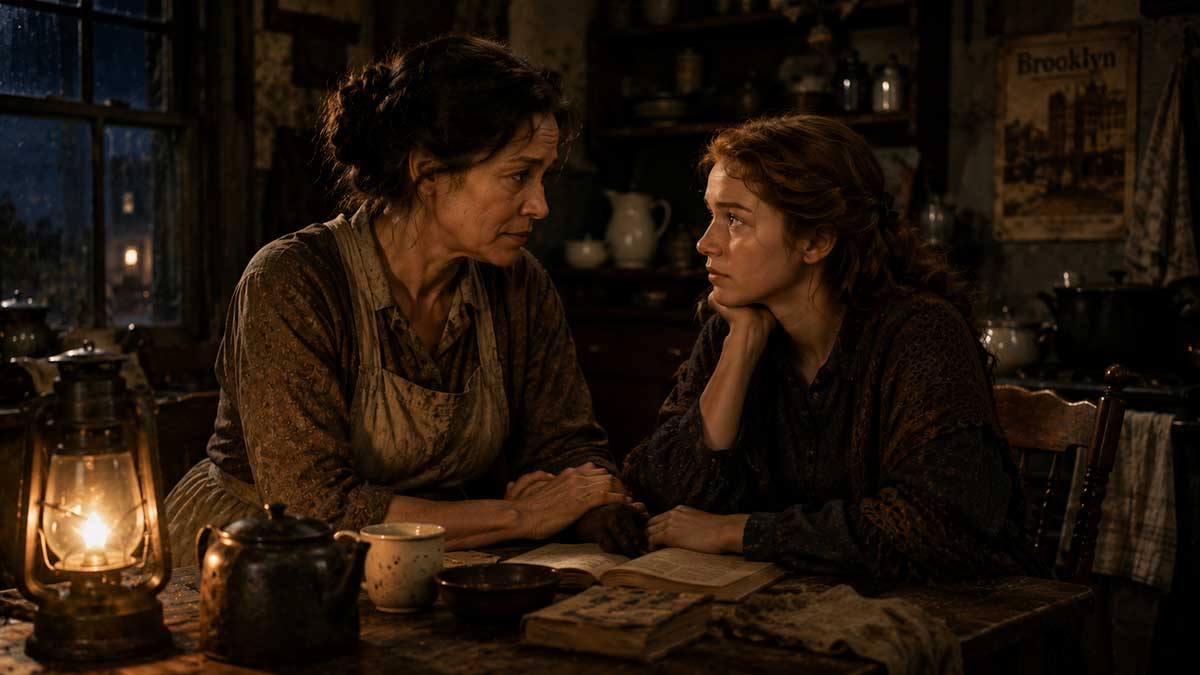
Hard Love, Discipline, Poverty, and Survival
The Brooklyn tenement is quiet now.
No coal stove.
No rent worries.
No children pretending hunger was normal.
No mother counting coins before dawn.
Francie sits across from Katie Nolan, older now, able to see what childhood could not.
Katie’s face is still practical.
Not cold.
Just shaped by years when softness alone would not keep children alive.
Question 1
Francie, what did you misunderstand about your mother’s toughness?
Francie:
I thought you loved Neeley more.
That was the wound I carried.
I watched your face soften for him in ways it did not soften for me.
I thought your discipline meant distance.
I thought your seriousness meant I was less cherished.
But now I understand something painful.
You saw more of yourself in me.
You knew I would survive, but you also knew survival would cost me.
Katie:
You were strong, Francie.
Francie:
Yes, but children do not always want to be seen as strong.
Sometimes they want to be protected from needing strength.
Katie:
I know.
But poverty does not ask what kind of childhood a child deserves.
It asks what the mother can prepare her child to endure.
Francie:
That is what I did not understand.
Your toughness was not lack of love.
It was training.
You were teaching me how to stand in a world that would not bend for us.
Question 2
Katie, why did love sometimes have to look like discipline instead of tenderness?
Katie:
Because tenderness without bread becomes helpless.
I wanted beauty for you.
Books.
School.
Clean clothes.
A better life than mine.
But wanting was not enough.
I had to work.
I had to plan.
I had to say no.
I had to teach you that dreams need backbone.
Francie:
Sometimes I wished you would simply comfort me.
Katie:
I should have done more of that.
A mother under pressure can confuse efficiency with care.
There were days I was so busy keeping us from falling that I forgot a child cannot live on survival alone.
Francie:
But you gave me education.
You gave me pride.
You gave me the idea that I was not trapped forever.
Katie:
That was my tenderness.
Maybe not warm enough.
But real.
I swept floors so you could read books.
I saved coins so you could attend school.
I hardened my face so the world would not see how afraid I was.
Francie:
So love was hidden in the labor.
Katie:
Yes.
That is where poor mothers often hide it.
Not because they want to.
Because work gets there first.
Question 3
What does this story reveal about mothers who prepare children for a hard world?
Francie:
It reveals that some mothers love by refusing to lie.
You did not pretend life was easy.
You did not tell me poverty was romantic.
You did not say talent alone would save me.
You taught me to read, work, endure, and keep dignity.
Katie:
A child must have hope.
But hope must be given shoes.
It must be taught how to walk.
Francie:
That sounds exactly like you.
Katie:
I wanted you to rise without becoming ashamed of where you came from.
That is difficult.
Poverty teaches children either to shrink or to become hard.
I wanted you to become neither.
I wanted you to become whole.
Francie:
I think children understand too late that a hard mother may be fighting a harder world.
They hear the sharp voice.
They miss the fear behind it.
They remember the rules.
They forget the rent.
They resent the discipline.
They do not see the mother lying awake, calculating whether there will be enough.
Katie:
A mother cannot always give the childhood she dreams of giving.
Sometimes she gives the tools.
Francie:
And those tools become love later.
That is the strange thing.
What felt strict then feels like protection now.
What felt cold then feels like courage now.
What felt unfair then feels like a mother standing between her child and defeat.
Katie:
Then perhaps you saw me after all.
Francie:
Not then.
But now.
And maybe that is why I can forgive the hardness.
Because I finally see the love inside it.
Topic 4 — Suyuan Woo and Jing-mei from The Joy Luck Club
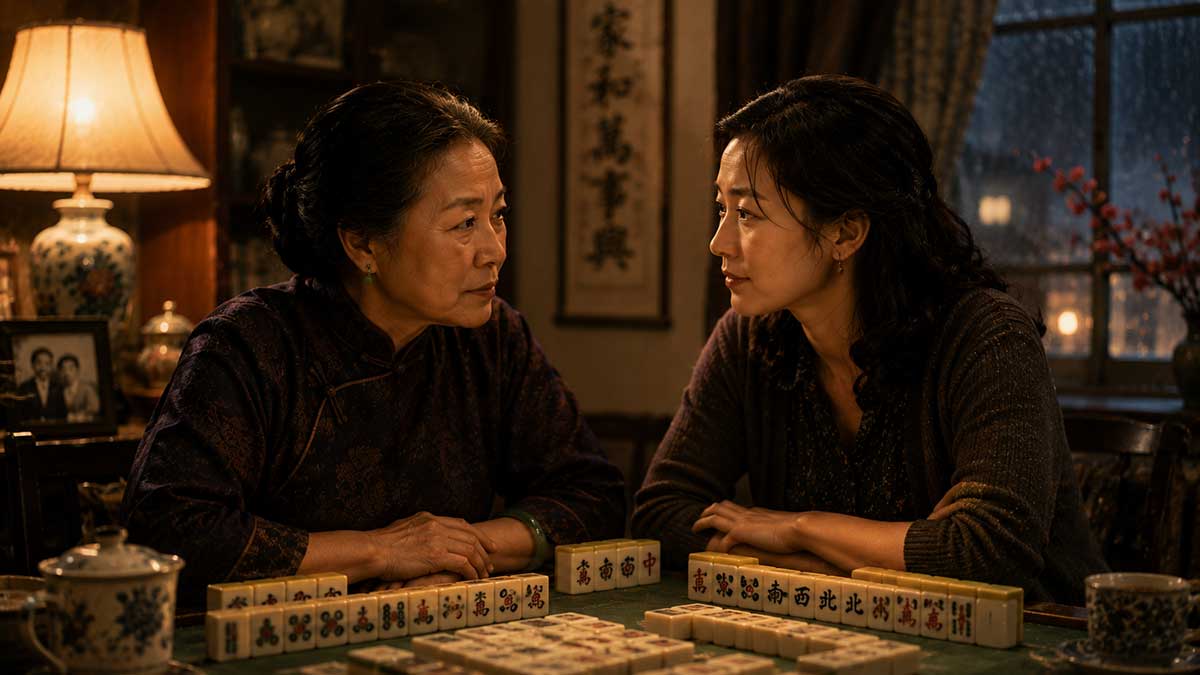
Immigration, Memory, Sacrifice, and Mother-Daughter Misunderstanding
The mahjong table is quiet now.
No sharp corrections.
No disappointed sighs.
No unfinished expectations hanging between mother and daughter like another language neither fully spoke.
Jing-mei sits across from Suyuan Woo, older now, carrying the weight of stories she once resisted hearing.
Suyuan watches her daughter with the same mixture of pride, grief, and hope she carried across an ocean.
Question 1
Jing-mei, what did you misunderstand about your mother’s hopes for you?
Jing-mei:
I thought you wanted me to become someone else.
A prodigy.
A perfect daughter.
Proof that your suffering had meaning.
Every lesson felt like criticism.
Every comparison felt like disappointment.
I thought your expectations meant I was never enough as I already was.
Suyuan:
No, daughter.
You were enough before you could play piano or succeed at anything.
But I had crossed too much pain to believe life should stop at survival.
Jing-mei:
I understand that now.
Back then, I only heard pressure.
I did not hear the fear underneath it.
The fear that your sacrifices would disappear if I wasted the opportunities you never had.
Suyuan:
A mother who loses one world often places her hope inside the child living in the next one.
You were carrying more than your own future.
You were carrying interrupted dreams.
Question 2
Suyuan, what memories and losses were hidden behind your expectations?
Suyuan:
China never fully left me.
Not the hunger.
Not the war.
Not the daughters I lost.
Not the roads I walked carrying grief heavier than my body.
When I looked at you, I saw America.
Safety.
Possibility.
Choice.
But I also saw how easily comfort can make memory disappear.
Jing-mei:
You wanted me to remember something I never lived.
Suyuan:
Yes.
That is one of the sadnesses between immigrant mothers and daughters.
The mother remembers too much.
The daughter remembers too little.
Jing-mei:
And neither knows how to explain it without hurting the other.
Suyuan:
I spoke through expectation because I did not know how to speak through vulnerability.
In my generation, mothers showed love by preparing the child for hardship.
We did not always know how to say:
“I am afraid.”
“I miss home.”
“I survived terrible things.”
“I need you to understand me.”
So instead we corrected.
We pushed.
We worried.
Jing-mei:
And daughters heard judgment instead of grief.
Suyuan:
Yes.
That is how love becomes mistranslated across generations.
Question 3
What does this story reveal about mothers who carry one country in their grief and another in their children?
Jing-mei:
It reveals that immigrant mothers are often carrying invisible history inside ordinary moments.
A mother insisting you practice piano may also be mourning war.
A mother criticizing waste may still remember hunger.
A mother pushing achievement may be trying to protect the child from humiliation she once survived herself.
As children, we only see the pressure.
Later, we begin to see the history inside it.
Suyuan:
A mother who crosses oceans wants the child to inherit possibility without losing memory.
That balance is difficult.
Too much past, and the child cannot breathe.
Too much forgetting, and the family story disappears.
Jing-mei:
I think children understand too late that some mothers are speaking from wounds they never fully healed.
The daughter thinks:
“Why are you so hard on me?”
The mother is secretly asking:
“Will everything I suffered disappear after me?”
Suyuan:
Exactly.
Jing-mei:
And maybe that is why understanding arrives late.
The child must become old enough to carry complexity.
To realize the mother was not simply controlling.
She was translating survival into hope.
Suyuan:
Even imperfectly.
Jing-mei:
Yes.
And perhaps motherhood here means carrying memory forward without letting grief become the child’s prison.
Suyuan:
That is wisdom.
Jing-mei:
I wish I had understood earlier.
Suyuan:
Children rarely do.
That is why mothers keep telling stories.
Even when daughters roll their eyes.
Even when language fails.
Even when love sounds like criticism.
We keep speaking because we are trying to hand the child something larger than ourselves.
Jing-mei:
And years later, the daughter finally realizes:
The mother was not trying to control her life.
She was trying to make sure suffering did not swallow another generation.
Topic 5 — Ma Joad and Tom from The Grapes of Wrath
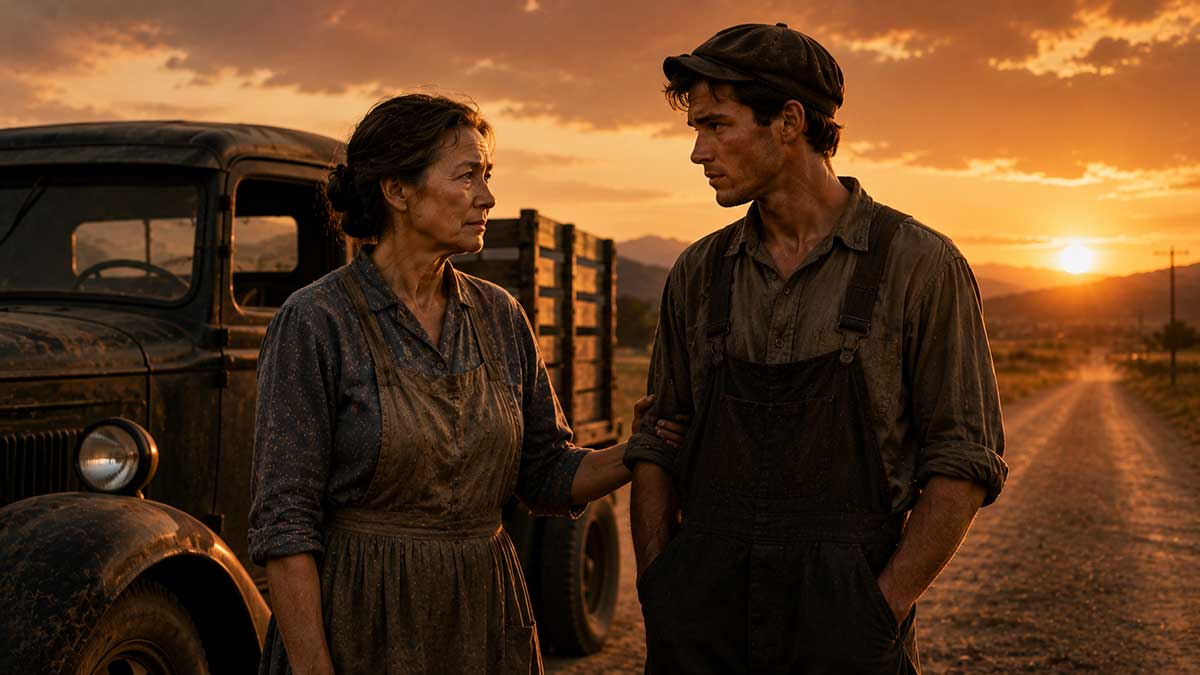
Holding the Family Together When the World Collapses
The road is quiet now.
No broken trucks.
No dust storms swallowing the horizon.
No hungry families sleeping beside the highway wondering where tomorrow will come from.
Tom sits across from Ma Joad, older now, carrying the memory of a country that failed people like them.
Ma’s hands still look like working hands.
Steady hands.
The kind that held families together when everything else came apart.
Question 1
Tom, what did you only understand later about your mother’s strength?
Tom:
I thought Pa was the head of the family.
That is what boys are taught to think.
The father speaks.
The father decides.
The father leads.
But on the road, I started seeing something different.
When fear spread through the family, everybody looked at you.
Not because you shouted.
Because you stayed steady.
Ma Joad:
Somebody had to.
Tom:
That is what I understand now.
Strength is not always the loudest person in the room.
Sometimes it is the person who keeps everyone human after humiliation begins.
You kept cooking when there was barely food.
You kept talking gentle when people turned desperate.
You kept us from becoming cruel.
Ma Joad:
Hard times tempt people to forget who they are.
A mother watches for that too.
Not just hunger.
The loss of decency.
Question 2
Ma Joad, how did you keep the family human when poverty tried to break it?
Ma Joad:
You keep moving.
Not only the body.
The spirit.
You make coffee even when hope is thin.
You share food even when there is little.
You remind children to wash their faces.
You keep small dignity alive because once people stop feeling human, despair takes the rest.
Tom:
Weren’t you afraid?
Ma Joad:
All the time.
A mother counts danger constantly.
The next meal.
The next job.
The next sickness.
The next place that might throw you out.
But fear cannot become the center of the family.
If children wake up and see only panic in the mother’s face, the whole house collapses.
Tom:
So you carried the fear privately.
Ma Joad:
Mostly.
Women in hard times often do.
Men sometimes break outward.
Women often break inward and continue working.
Tom:
That sentence sounds like the whole Depression.
Ma Joad:
Maybe it was.
Question 3
What does this story reveal about mothers as the last shelter during social collapse?
Tom:
It reveals that when systems fail, mothers often become the final structure holding life together.
Banks threw families away.
Employers exploited them.
The land stopped feeding them.
But somehow mothers still made children sleep, eat, hope, and wake up again.
Ma Joad:
A family cannot survive on anger alone.
Somebody must keep life going.
Tom:
You became the emotional center of the family.
Not through speeches.
Through constancy.
Ma Joad:
Mothers learn that survival is made from repeated ordinary acts.
Soup.
Blankets.
Touch.
Routine.
Refusing to let despair speak the loudest.
Tom:
I think children understand too late that mothers are often carrying civilization itself inside ordinary labor.
The world remembers politicians, businessmen, wars, and leaders.
But families survive because somebody kept tenderness alive during ugly times.
Ma Joad:
Tenderness is work too.
People forget that.
Tom:
And maybe your greatness came from refusing to let poverty decide what kind of people we would become.
Ma Joad:
That mattered more than money.
A poor family can still have dignity.
A suffering family can still protect one another.
A broken world does not get the final word unless people surrender their humanity.
Tom:
You taught us that.
Not by preaching.
By living it every day.
Ma Joad:
Children listen less to words than to atmosphere.
If the mother keeps kindness alive, the children remember kindness.
If the mother keeps courage alive, the children remember courage.
Tom:
And if the mother keeps hope alive?
Ma Joad:
Then maybe the family survives long enough to see another season.
Tom:
I think that is what children realize too late:
The mother was fighting collapse every day, often without recognition.
And many families survived history because one woman quietly refused to give up.
Ma Joad:
That is enough glory for any mother.
Final Thoughts
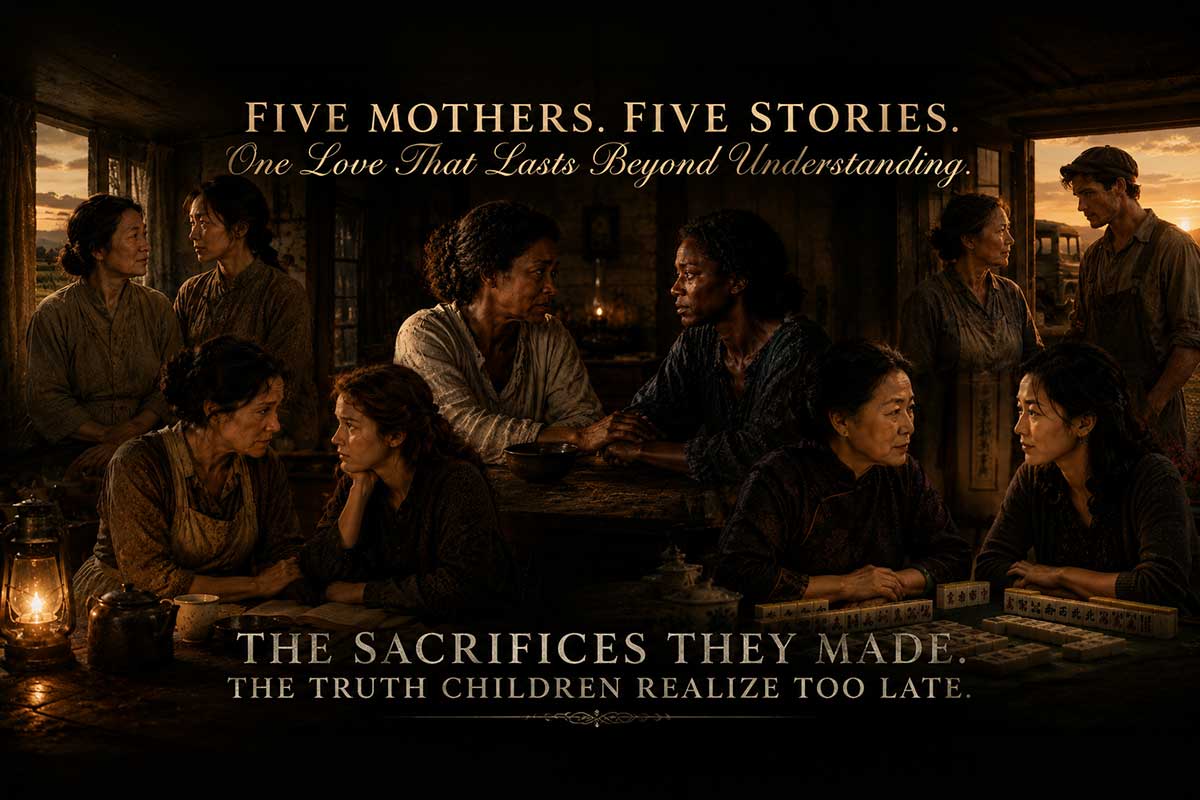
At the end of these five conversations, one truth becomes painfully clear:
Many mothers spend their entire lives carrying burdens their children cannot yet recognize.
Children see the mother standing in front of them.
They do not see:
- the world standing against her
- the fear hidden inside discipline
- the grief hidden inside expectation
- the exhaustion hidden inside routine
- the trauma hidden inside protection
O-Lan reveals the invisible mother whose sacrifice becomes so constant it disappears into daily life.
Sethe reveals what happens when love is forced to survive inside terror.
Katie Nolan shows how hard mothers prepare children for unforgiving worlds.
Suyuan Woo reveals immigrant motherhood: women carrying one country in memory while raising children in another.
Ma Joad shows motherhood as the final shelter during social collapse.
None of these mothers are idealized saints.
Some are emotionally distant.
Some are controlling.
Some wound while trying to protect.
That complexity is exactly what makes them unforgettable.
Because real motherhood is often conflicted.
Love arrives mixed with fear.
Protection arrives mixed with pressure.
Sacrifice arrives mixed with exhaustion.
And perhaps that is why understanding comes late.
Children usually measure mothers by comfort first.
Only adulthood teaches them to measure:
- responsibility
- endurance
- restraint
- emotional labor
- survival carried silently
These novels suggest that a mother’s greatness is often not dramatic.
It lives inside repetition:
working, feeding, waiting, worrying, enduring, continuing.
History often remembers leaders, wars, revolutions, and systems.
But families survive history because somewhere, quietly, a mother refused to give up.
And years later, the child finally understands:
The mother was carrying far more than the child ever saw.
Short Bios:
O-Lan
A quiet, resilient mother from The Good Earth who carries her family through poverty, famine, labor, and humiliation with almost invisible sacrifice and endurance.
Sethe
The deeply wounded mother at the center of Beloved. Her fierce love is shaped by slavery, trauma, terror, and the desperate need to protect her children from unimaginable suffering.
Katie Nolan
A practical, disciplined mother from A Tree Grows in Brooklyn who raises her children through poverty while teaching survival, dignity, education, and emotional resilience.
Francie Nolan
Katie’s thoughtful and observant daughter whose growth gradually reveals the hidden love and sacrifice beneath her mother’s toughness.
Suyuan Woo
An immigrant mother from The Joy Luck Club carrying memories of war, loss, migration, and interrupted dreams while trying to prepare her daughter for a safer future.
Jing-mei Woo
Suyuan’s American-born daughter who slowly realizes that her mother’s pressure and expectations were deeply connected to grief, sacrifice, and survival.
Ma Joad
The emotional center of The Grapes of Wrath. Strong, steady, and compassionate, she keeps her family human during economic collapse and displacement.
Tom Joad
Ma Joad’s son, whose growing awareness of injustice and human dignity is deeply shaped by his mother’s endurance and moral steadiness.
Leave a Reply