
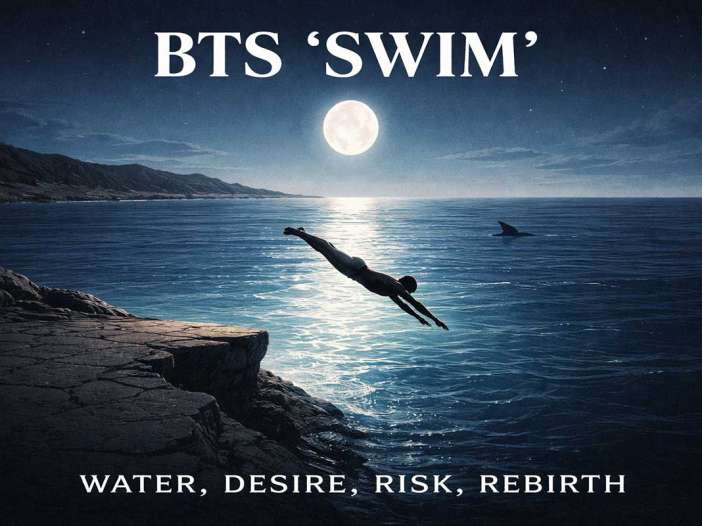
What if “Swim” is really about the soul, not just attraction?
Introduction by Nick Sasaki
What if a song about water is really a song about the soul?
At first glance, “Swim” may seem like a sensual, atmospheric track built around attraction, beauty, and the desire to let go. But the more I sat with its imagery, the more I felt that something deeper was moving beneath the surface. Water in this song is not background. It is not decoration. It is a symbolic world. It is where longing becomes visible, where fear and freedom meet, where sadness softens, and where a person stands on the edge of change.
That is why I wanted to gather this particular roundtable.
In these five conversations, we do not treat “Swim” as just a romantic song. We treat it as an entry point into some of the oldest human experiences: the pull of love, the exhaustion of modern life, the strange magnetism of danger, the terror of surrender, and the hope that beauty might help us live through sorrow without lying about it.
We begin with water itself — why it has carried the meanings of love, freedom, and rebirth across poetry, psychology, spirituality, and art. From there, we move into the hard emotional background behind the song: the “bad world” that makes intimacy feel like shelter, almost like breathing again. Then we face one of the song’s most haunting tensions: why desire so often grows sharper when beauty comes with risk, when moonlight and sharks occupy the same water. After that, we arrive at the line that gives the song its deepest motion: “I just wanna dive.” That is the moment of decision, the point where longing stops watching from the shore and finally enters the unknown. And at last, we ask whether love and beauty can truly heal sadness, not by erasing it, but by making life feel livable again.
What moved me most in building this conversation is that “Swim” never feels naïve. It does not describe love as safe. It does not describe freedom as easy. It does not describe healing as instant. Its emotional power comes from the fact that it keeps tenderness and danger close together. It knows that the world can be harsh. It knows that longing can be risky. It knows that desire can expose us. And still, it moves toward the water.
That movement is what makes this song worth exploring at depth.
In a time when many people feel overstimulated, emotionally tired, lonely, and cut off from their own inner life, a song like this touches something real. It speaks to the wish to stop performing for a moment. To stop explaining. To stop standing outside experience and measuring it. To enter something fully — love, beauty, risk, aliveness — and let it change you.
So this is not only a conversation about BTS or one song. It is a conversation about why human beings keep returning to the same images when they want to speak about the deepest parts of life. Water. Night. Skin. Breath. Fear. Surrender. Release.
We return to them because they still know us.
And perhaps that is what “Swim” understands so well: that beneath all the noise of the world, there remains an ancient human longing — not merely to survive, but to be immersed in something real enough to awaken us again.
(Note: This is an imaginary conversation, a creative exploration of an idea, and not a real speech or event.)
Topic 1: Why Does Water So Often Symbolize Love, Freedom, and Rebirth?
Moderator:
Nick Sasaki
Participants:
Carl Jung, Gaston Bachelard, Rumi, Rachel Carson, RM
Opening by Nick Sasaki
When I hear “Swim,” I do not hear water as scenery alone. I hear water as invitation. A place away from noise. A place where the body softens, where thought loosens, where emotion takes over. In this song, water feels sensual, but it also feels spiritual. It feels like release. It feels like beginning again.
That raises a deeper human question: why has water carried this power across poetry, religion, psychology, art, and song for so long? Why do we keep returning to rivers, rain, oceans, immersion, and the act of diving in whenever we want to speak about love, freedom, or rebirth?
So for this first conversation, I’d like us to stay with that image and ask what water means at the deepest level of the human soul.
Question 1: Why does water carry such unusual emotional and symbolic force in human life?
Rumi:
Water is never only water. To the thirsty, it is mercy. To the lover, it is union. To the lost, it is return. We are drawn to it because it resembles the soul before it hardens. Water receives every shape and yet remains itself. Love does the same. When human beings touch water in poetry, they are often touching the memory of something older than language: the wish to return to what is fluid, open, and alive. That is why people speak of love as drowning, floating, washing, crossing, or being carried away. Water is motion without argument. It does not lecture the heart. It enters it.
Carl Jung:
Water has this force because it belongs to the deepest symbolic layer of the psyche. Across civilizations, it is bound to the unconscious, to origin, to birth, to dissolution, to transformation. The surface mind seeks fixed definitions. Water does not permit that. It moves, conceals, reflects, swallows, reveals. In dreams, water often appears when a person is nearing some encounter with what has been buried or neglected within. That gives it emotional force. One does not stand before the sea as one stands before a wall. One senses depth, and depth awakens both wonder and fear. In symbolic life, whatever carries both attraction and fear has great power.
Rachel Carson:
I think part of the answer is biological before it becomes philosophical. Life emerged from the sea, and whether or not people consciously think of that, they sense that water precedes them. It is older than any city, older than any nation, older than memory. The sea gives a person scale. It reduces vanity. It quiets noise. It has rhythm beyond human control, and people often experience that as cleansing or release. Yet water is not sentimental. It is beautiful, yes, but it is also indifferent. That honesty is part of its force. It does not flatter us. It tells us that life is larger than our private unrest.
RM:
What strikes me is that water lets emotion be physical. A lot of feelings are hard to explain directly, especially in music, unless you find an image people can feel in the body. Water does that. It cools you, surrounds you, pulls you, reflects you, hides you. It can feel peaceful one moment and dangerous the next. That range makes it perfect for songs about longing or escape. In a hard world, water can feel like the one place where you stop performing. You do not have to stand upright and act fine. You can sink, float, drift, dive. That makes it emotionally honest.
Gaston Bachelard:
Water has symbolic force because it is matter that invites reverie. Fire confronts. Stone resists. Air lifts. Water gathers the dreamer. It draws thought into softness and continuity. When people gaze at water, they do not merely observe an object. They begin to imagine. And in imagination, water becomes intimate. A pool, a stream, rain on skin, a dark sea at night — each one stirs a different inner world. Water allows the human being to feel both held and undone. That double experience explains why it becomes one of poetry’s most faithful elements.
Question 2: Why is water so closely linked with love, longing, and surrender?
Rachel Carson:
The sea teaches human beings that closeness does not require control. You may enter the water, but you do not command it. That resembles love more than many modern ideas do. Love, at its best, is an entering into relationship with something living, changing, and partly beyond one’s mastery. That is why water imagery fits desire so well. The beloved is not a possession. The beloved is more like a tide, a presence, a field of movement. You feel drawn, altered, and humbled. Water lets writers and songwriters speak of intimacy without reducing it to ownership.
Gaston Bachelard:
Love seeks images that soften the border between self and other. Water is one of the purest of those images. In water, outlines blur. Reflection trembles. The body becomes less armored. Surrender enters the imagination through this loss of rigidity. That is why lovers so often appear near rivers, rain, baths, oceans, or tears. Water creates a poetics of nearness. It suggests, “Let form relax. Let separation loosen.” In that sense, water is the element of tender yielding.
RM:
In songs, love is often hard to describe unless you can show what it does to your sense of stability. Water is great for that. You lose footing. You stop pretending you’re in control. You feel the body reacting. In “Swim,” that matters a lot. The person isn’t just admiring somebody. He’s being pulled into a world. That’s what strong attraction feels like. It’s not just, “I like you.” It’s, “Something in me is ready to leave the shore.” That’s where surrender comes in. You know there’s risk, but you want to go anyway.
Carl Jung:
Love and longing are closely tied to water because they awaken psychic contents that exceed the ego’s command. The ego prefers firm ground, clear boundaries, manageable outcomes. Love disturbs all three. It brings to the surface projections, fantasies, wounds, hopes, ancient needs. Symbolically, that resembles immersion in the unconscious. Surrender, then, is not weakness in this context. It is the recognition that something larger than conscious will has been activated. Of course, one must distinguish between healthy surrender and destructive engulfment. Still, the symbolic link remains powerful: to love deeply is to enter waters where one cannot remain entirely self-contained.
Rumi:
Love asks for the death of the small self. People fear that, yet they hunger for it. Water is beloved in poetry because it enacts this mystery without violence. Put a drop into the ocean and the drop is not ruined. It becomes more fully itself by joining what is greater. So with love. The heart thinks it will be erased, but what it finds is expansion. Longing is the ache before that joining. Surrender is the courage to stop clinging to the shore of the old self.
Question 3: In a song like “Swim,” what does diving into water suggest about rebirth rather than escape alone?
Carl Jung:
Rebirth requires more than avoidance. If the water were only escape, the image would remain shallow. What gives it symbolic depth is the act of immersion. To immerse oneself is to submit to transformation. In many mythic and religious patterns, one enters water and emerges changed: baptized, cleansed, initiated, renewed. Psychologically, the same motif appears when a person dares to leave the brittle identity demanded by the outer world and descend into a more vital relation with the inner life. In such a song, diving suggests, “I will no longer remain divided between what I feel and what I perform.”
RM:
That feels very true to me. In a lot of modern life, people are overstimulated, watched, judged, and pushed to keep moving. So when a song says, “I just wanna dive,” it can sound like escape. But there’s another layer. Maybe the person is tired of being numb. Maybe he wants to feel again. Maybe he wants to return to something unedited. That makes the dive more like recovery than avoidance. Water becomes a place where a person meets himself in a less fake way.
Rumi:
Escape runs from life. Rebirth enters life more deeply. That is the difference. When the lover dives, he does not disappear into nothing. He passes through illusion. He leaves the dry marketplace of borrowed identities and enters the sea where truth touches him directly. The new life begins where pretense ends. So yes, the dive may begin in exhaustion, but it becomes renewal when the heart says, “I am ready to be remade.”
Rachel Carson:
There is another side too. Rebirth through water is believable because water itself is cyclical. Sea becomes cloud, cloud becomes rain, rain becomes river, river returns to sea. Water is never static and never finally lost. Human beings sense in that cycle a promise that endings may become beginnings. In the song, the dive can mean stepping out of one state of being and into another. It need not deny pain. It may simply place pain inside a larger motion.
Gaston Bachelard:
Poetically, rebirth happens when an image allows a person to inhabit time differently. Dry life is linear: tasks, deadlines, roles, names. Watery life is rhythmic: immersion, drift, resurfacing, return. A song like “Swim” touches rebirth when it lets the listener imagine a self that is no longer pinned to the old hard ground. The dive is the crossing. It is the moment when the rigid self gives way to the living self.
Closing reflection by Nick Sasaki
What I hear in all of you is that water speaks to us because it reaches the human being below explanation. It is older than theory and more intimate than argument. It touches memory, body, desire, fear, and hope all at once.
From Jung, we get water as the unconscious and as the place of transformation. From Bachelard, water as the element of reverie and tender yielding. From Rumi, water as love’s invitation to lose the smaller self and join something larger. From Rachel Carson, water as life’s ancient reality, beautiful and unsentimental. From RM, water as emotional honesty in a world that often demands performance.
That helps explain why “Swim” feels deeper than a simple sensual track. Its water is not decoration. It is a symbolic world. A place where love, freedom, and rebirth meet.
And once water becomes that kind of place, the next question feels unavoidable: when the outer world grows harsh and airless, why do people so often seek refuge in intimacy itself?
Topic 2: Why Do People Crave Escape from a “Bad World” into Intimacy?

Moderator:
Nick Sasaki
Participants:
Erich Fromm, Viktor Frankl, Byung-Chul Han, Brené Brown, SUGA
Opening by Nick Sasaki
One of the lines that gives “Swim” its weight is not in the chorus but in the emotional background behind it: the sense that the outer world has become harsh, noisy, and hard to breathe in. That changes the meaning of desire. Intimacy no longer feels like romance alone. It starts to feel like shelter. Relief. A place where a human being can come down from tension and stop carrying the whole world for a moment.
But that raises a serious question. Why do people so often turn toward intimacy when the world feels unbearable? Is that healthy refuge? Is it emotional survival? Or can it become a way of hiding from life rather than meeting it?
So for this conversation, I’d like us to look at the connection between social pressure and private longing. Why does a hard world make closeness feel almost lifesaving?
Question 1: Why does a harsh world so often make intimacy feel like refuge?
Erich Fromm:
The modern person is deeply lonely, though often surrounded by noise, work, images, and communication. Isolation is not removed by activity. It is removed by genuine relatedness. When the world feels cold, competitive, mechanical, or spiritually empty, the hunger for intimacy becomes sharper because the human being cannot live well in emotional separation. We seek refuge in closeness because closeness restores our sense that we are not merely units in a system. It reminds us that we are alive, felt, received. A harsh world drives people toward intimacy because intimacy answers the wound that harshness creates: the wound of disconnection.
Brené Brown:
When people live under pressure, they spend a lot of energy managing themselves. They monitor, brace, protect, perform, and hide. Intimacy feels like refuge because it offers the opposite experience. It says, “You do not have to armor up here.” That is powerful. A hard world creates shame very easily. It tells people they are behind, not enough, too much, too needy, too broken, too weak. Real connection interrupts that story. It gives people a place where they can be seen without being punished for being human. That is why closeness can feel like exhaling after holding your breath too long.
Byung-Chul Han:
The present age exhausts people through constant exposure, self-optimization, and the demand to produce a self that is always available. There is little silence. Little inwardness. Little time free from performance. In such a climate, intimacy appears as refuge because it promises a zone outside exposure. A “bad world” is not only violent or cruel. It can also be relentless in its positivity, its demand that one remain active, visible, capable, and responsive. Intimacy becomes attractive because it appears to suspend that pressure. One enters a space where one no longer has to market the self.
SUGA:
I think when the world hits you every day, you stop wanting big answers for a while. You just want one real place. One real person. One moment where you don’t have to explain why you’re tired. A lot of people carry stress quietly. They function, they work, they keep going, but inside they’re worn down. In that state, intimacy can feel huge. Not dramatic. Just human. Like finally being somewhere that doesn’t ask anything from you except honesty. That kind of refuge matters more than people admit.
Viktor Frankl:
Suffering intensifies the need for meaning, and intimacy can become one of its most immediate forms. To be loved, to love, to be held in another’s presence — these experiences can reawaken meaning when life feels empty or cruel. Yet I would add a distinction. Intimacy becomes true refuge when it helps us recover our humanity, not when it merely distracts us from our condition. Real refuge strengthens the person for life. False refuge weakens him by making him dependent on escape. So the longing itself is understandable and often noble, but its moral quality depends on what kind of intimacy is sought.
Question 2: When does intimacy become healing, and when does it become avoidance?
Byung-Chul Han:
It becomes avoidance when intimacy is consumed like anesthesia. Then the other person is reduced to a function: relief, comfort, stimulation, distraction. That does not honor otherness. Healing intimacy, by contrast, allows distance, mystery, and reciprocity. It does not erase reality but gives one strength to re-enter it without collapse. Many people today seek relief from exhaustion, and there is nothing trivial about that. Yet relief without inward transformation easily becomes another cycle of dependency. The question is whether intimacy opens a deeper relation to life or merely shields one from the emptiness one refuses to confront.
Viktor Frankl:
Healing intimacy helps a person rediscover responsibility, meaning, and dignity. Avoidant intimacy asks the other person to remove the burden of existence itself. No one can do that. Love can strengthen, encourage, illuminate, and redeem, but it cannot replace the task of becoming a person who says yes to life, including suffering. If I seek intimacy only to flee pain, I place too much weight on it. If I seek intimacy as part of a meaningful life, then it can be deeply healing. The distinction lies in whether love enlarges the soul or merely numbs it.
Brené Brown:
I would put it in the language of vulnerability. Healing intimacy lets you be honest. Avoidant intimacy lets you hide. Those can look similar at first. Both may feel comforting. But one asks, “Can I be real here?” and the other asks, “Can I disappear here?” That’s a big difference. If closeness helps you tell the truth about your fear, shame, loneliness, and hope, it’s healing. If it lets you keep those things buried under chemistry, fantasy, or dependency, it becomes escape. The hard part is that people often don’t know which one they’re doing until later.
Erich Fromm:
Love is an art, not a refuge from growth. Mature intimacy is an active power: care, responsibility, respect, and knowledge. It is healing because it joins two persons without abolishing either one. Avoidant intimacy seeks fusion without development. It says, “Let me hide inside you.” That is understandable in lonely people, but it is not yet love. It is a wish to escape separateness without learning the discipline of genuine union. Healing intimacy says, “I meet you as a full person, and in that meeting my life expands.” Avoidant intimacy says, “Protect me from being alone with myself.”
SUGA:
A lot of people know the difference in their gut. If you’re with someone and you feel more honest, more grounded, more able to face your life, that’s a good sign. If you feel good only when you’re inside that one bubble and worse everywhere else, then something’s off. I think songs often live in that border. They capture the moment when you want relief so badly that one person starts to feel like oxygen. That feeling is real. But whether it becomes healing or avoidance depends on what happens after the song moment. Can you come back stronger, or do you just keep running back?
Question 3: In a song like “Swim,” why does intimacy feel almost like breathing again?
Brené Brown:
Because emotional safety changes the body. People talk about connection as if it’s abstract, but it is deeply physical. When you feel judged, unseen, threatened, or overwhelmed, your body tightens. When you feel accepted and emotionally held, your nervous system can settle. That is why intimacy can feel like air returning. It is not only poetic language. It is embodied truth. In a song like this, the longing to dive into closeness may be the longing to leave survival mode.
SUGA:
Yes, that’s exactly it. Sometimes life gets so loud that even simple peace starts to feel rare. Then one moment with the right person can feel bigger than it should. Breathing slower. Thinking less. Feeling your body again. Not being hunted by everything in your head. In that sense, intimacy feels like breathing because pressure feels like drowning. The song flips that. Water usually sounds dangerous, but here the dive feels like relief from the real danger, which is the world outside and what it’s doing to you inside.
Erich Fromm:
Human beings do not breathe by biology alone. They also breathe through meaning, relation, and spiritual vitality. A life of pure productivity suffocates the soul. One can be materially active yet inwardly starved. Intimacy, when real, restores participation in being. One feels once more that existence is shared, that one is not exiled inside one’s own separateness. This is why songs of longing remain so powerful. They speak to a civilization that has mastered many techniques but has not solved loneliness.
Viktor Frankl:
Breath is a fitting image because meaning gives inward space. Despair constricts. Fear constricts. Meaning opens. Love often serves as one of the clearest ways a person rediscovers that opening. In the beloved, one sees a reason to remain awake to life. One is called out of despair into relation. So when intimacy feels like breathing, it may be because the person has found, however briefly, a reason to endure and to hope. That is no small thing.
Byung-Chul Han:
Our time suffers from a crisis of depth. Too much is immediate, exposed, and consumed. Breath requires pause. Intimacy requires pause. Both oppose the logic of acceleration. In that sense, breathing again is not only comfort. It is resistance. To dwell with another person without performance, without calculation, without speed — this is already a different mode of being. A song that expresses such longing is really expressing fatigue with a civilization that has forgotten repose.
Closing reflection by Nick Sasaki
What comes through here is that intimacy feels like refuge in a hard world because it answers something deeper than desire alone. It answers isolation. Exhaustion. Shame. Emotional overexposure. The feeling of being pushed to function without ever being received.
From Fromm, we hear that closeness heals the wound of disconnection. From Frankl, that intimacy becomes life-giving when it restores meaning rather than replacing it. From Byung-Chul Han, that a weary age makes private nearness feel like one of the last spaces free from performance. From Brené Brown, that true closeness lets the body and heart come out of defense. From SUGA, that in real life, people often do not need grand rescue — they need one honest place to stop pretending.
That helps explain why the emotional atmosphere behind “Swim” feels so strong. The water is not just attraction. It is relief. It is the fantasy, and maybe the hope, that somewhere in the middle of a harsh world, there is still a place where a person can finally breathe.
And once intimacy becomes that kind of refuge, the next question naturally follows: why does desire often become more intense when beauty and danger appear together?
Topic 3: Why Does Desire Often Grow Stronger When Danger Is Near?

Moderator:
Nick Sasaki
Participants:
Sigmund Freud, Esther Perel, Joseph Campbell, Anaïs Nin, Jimin
Opening by Nick Sasaki
One of the most striking images in “Swim” is the line about “the moon and the sharks.” It changes the emotional atmosphere right away. The song is no longer only about softness, attraction, or escape. It becomes charged. Beautiful, yes, but with teeth in the water. Calm on the surface, risk underneath.
That combination matters because human desire often seems to sharpen at the edge of danger. We do not always long most deeply for what is fully safe, fully known, or fully settled. Sometimes the heart wakes up most intensely when beauty arrives with uncertainty, mystery, or even threat.
So for this conversation, I’d like us to ask: why does danger so often intensify longing? What is it in human nature that makes the unknown feel magnetic? And when does that edge deepen love, and when does it distort it?
Question 1: Why does desire often become stronger when beauty and danger appear together?
Esther Perel:
Desire feeds on distance, uncertainty, and aliveness. Complete safety may be good for attachment, but desire often asks for something else too: a brush with the unknown. When beauty and danger appear together, the person before you is no longer fully predictable or fully possessed. They remain partly beyond you. That “beyond” is very important. It keeps longing alive. Desire needs some space to move in. It needs the feeling that something is still unfolding, still not entirely secured. Danger intensifies beauty by making it feel fleeting, charged, and alive in the body.
Sigmund Freud:
Desire is never cleanly separated from tension. The psyche is drawn toward what excites it, and excitation is often born from conflict, prohibition, or uncertainty. What is dangerous does not merely threaten; it arouses. This does not mean people rationally wish to be harmed. It means the instinctual life responds strongly to what disturbs equilibrium. Beauty attracts, danger heightens, and the combination produces psychic intensity. The forbidden, the unstable, the partly hidden — these conditions stir fantasy. Fantasy then magnifies desire far beyond what ordinary comfort usually evokes.
Anaïs Nin:
Beauty alone can be admired. Danger makes it felt. It moves beauty from the eye into the bloodstream. The beloved becomes more than lovely; they become destabilizing. You no longer stand outside the experience. You are inside it, trembling. That trembling is part of desire. We often speak as if the heart wants peace first. But there are moments when the heart wants to be awakened, pierced, undone. Beauty with danger carries that electric invitation. It says, “You may not remain unchanged.”
Joseph Campbell:
In myth, the treasure is rarely found in the village square. It lies across a boundary, in the forest, under the sea, near the dragon, beyond the place of safety. Human beings are shaped by this pattern. We associate transformation with risk. So when beauty and danger come together, the soul recognizes an ancient structure: here is something worth crossing toward, something that may wound you and remake you at once. Desire grows stronger there because longing is often tied to the hope of transformation, not pleasure alone.
Jimin:
I think people feel this very quickly, almost before they can explain it. Something is beautiful, but it’s not passive. It has tension in it. That tension makes you lean in. In music and performance, a soft moment can become much more powerful when there’s a shadow inside it. Not chaos, but edge. It creates vulnerability. In a song like “Swim,” the attraction feels stronger because it doesn’t sound completely safe. It sounds like a moment you could disappear into. That makes it more than pretty. It makes it unforgettable.
Question 2: What is the difference between healthy intensity and destructive attraction?
Sigmund Freud:
The distinction lies partly in whether the attraction permits psychic growth or compels repetition of injury. People are often drawn, without knowing it, to old wounds wearing new faces. Then intensity becomes a reenactment, not a discovery. A destructive attraction narrows the self. It enslaves thought, repeats suffering, and confuses agitation with vitality. Healthy intensity, by contrast, can unsettle the ego without annihilating it. It may provoke anxiety, but it also enlarges awareness. One leaves not merely consumed, but more conscious.
Jimin:
To me, healthy intensity still leaves room for care. There can be strong chemistry, mystery, tension, all of that, but you don’t lose your basic sense of humanity. You’re still being met. Destructive attraction feels different. It pulls you into confusion that keeps growing. You start mistaking pain for proof that something is deep. A lot of art touches that border because it’s emotionally powerful. But in real life, intensity should not keep erasing your peace and calling that passion.
Esther Perel:
That is exactly right. Intensity is not the same as intimacy. Many people confuse the rush of uncertainty with the depth of connection. Healthy intensity brings energy, curiosity, erotic charge, and emotional presence. Destructive attraction traps you in anxiety, obsession, and volatility. One makes you feel more alive. The other makes you feel less solid. It is very human to crave edge, but the edge must remain in conversation with respect, trust, and choice. Otherwise desire becomes a theater of compulsion.
Anaïs Nin:
There is a kind of danger that opens the self, and another that devours it. The first makes you more vivid. The second makes you disappear. We must be careful not to romanticize suffering simply because it burns brightly. Some passions are creative; they deepen perception and strip away numbness. Others feed on injury and call it depth. A person may feel intoxicated by both, but the aftermath tells the truth. Do you emerge expanded, or emptied?
Joseph Campbell:
In heroic stories, the true ordeal leads to transformation and return. The hero does not enter darkness merely to remain there. He brings something back: wisdom, strength, renewal, compassion. That pattern helps here. Healthy intensity leads somewhere. It has shape. It ripens the person. Destructive attraction circles endlessly around the wound and never crosses into meaning. So the test is not whether danger is present. The test is what kind of journey it creates.
Question 3: In “Swim,” what do “the moon and the sharks” suggest about the kind of desire this song is expressing?
Anaïs Nin:
It suggests desire touched by dream and threat at once. The moon is seduction, atmosphere, softness, silver light on the skin. The sharks are hunger, fear, the knowledge that something underneath the beauty can bite. Put together, the image becomes exquisitely human. It says: I want this, and I know it can undo me. That is not shallow attraction. That is longing with full awareness that desire is never perfectly safe.
Joseph Campbell:
I hear a threshold image. The moon calls the traveler onward. The sharks warn that entry has a price. This is classic initiation symbolism. The song is not merely saying, “I like what I see.” It is saying, “I stand at the border of a world that attracts me, and I know I must risk myself to enter it.” That is why the line carries mythic force. The beloved space is beautiful, but it is not domesticated.
Jimin:
For me, that line feels emotional before it feels symbolic. It creates a scene where you want to let go, but your body still knows there’s danger around you. That makes the feeling stronger. It’s almost like the song says, “I don’t need this to become safe first. I want to be here anyway.” There’s surrender in that, but not innocence. The person knows the atmosphere is risky. That gives the desire a kind of maturity.
Esther Perel:
Yes, and it preserves erotic tension beautifully. The moon gives enchantment. The sharks preserve otherness. They remind us that we are not in a fully controlled environment. Desire weakens when everything is flattened into comfort. Here, the song keeps a charge in the water. It leaves room for awe, fear, and surrender together. That’s why the line lingers. It does not resolve the tension; it lets tension become the energy of desire itself.
Sigmund Freud:
I would say the line externalizes inner conflict. One part of the psyche seeks pleasure, merger, release. Another registers danger, loss, devouring, vulnerability. The moon and the sharks are poetic figures for these simultaneous truths. Desire rarely arrives alone. It brings anxiety with it. In that sense, the image is psychologically accurate. The speaker does not wish for a world free of danger. He wishes to enter the desired world despite danger. That is a more honest representation of longing.
Closing reflection by Nick Sasaki
What stands out here is that desire grows stronger near danger because danger keeps beauty from becoming flat. It introduces uncertainty, distance, risk, and the possibility of transformation. That does not make danger good in itself. But it does explain why the heart often wakes up most intensely at the edge of the known.
From Freud, we hear that desire is sharpened by tension, conflict, and what unsettles the psyche. From Esther Perel, that longing needs some mystery and cannot live on safety alone. From Joseph Campbell, that risk often signals the threshold of transformation. From Anaïs Nin, that beauty becomes fully felt when it enters the bloodstream through vulnerability. From Jimin, that art becomes unforgettable when softness carries shadow inside it.
So in “Swim,” the presence of “the moon and the sharks” tells us that this is not simple comfort. It is attraction charged by risk, tenderness alive with edge, surrender chosen in full view of uncertainty.
And once desire reaches that threshold, the next question rises naturally: what happens when a person stops standing at the shore and finally decides to dive?
Topic 4: What Changes When a Person Stops Hesitating and Finally Dives?
Moderator:
Nick Sasaki
Participants:
Søren Kierkegaard, Pema Chödrön, Mihaly Csikszentmihalyi, Hermann Hesse, Jung Kook
Opening by Nick Sasaki
By the time we reach the line “I just wanna dive,” something important has shifted. The song is no longer circling the water from a distance. It is no longer only watching, longing, or imagining. It has arrived at a point of decision. The person at the edge is ready to stop negotiating with fear.
That moment matters far beyond romance. Human beings often live at the shoreline of many things: love, truth, grief, art, faith, calling, change. We hover, delay, calculate, and rehearse. Yet there are moments when standing at the edge becomes its own kind of suffering. Then the real question is no longer, “Is this safe?” but “What happens to me if I never enter?”
So for this conversation, I’d like us to explore what changes when hesitation breaks. What is the inner meaning of the dive? Why can it feel frightening and liberating at once? And what kind of self is born on the other side of that choice?
Question 1: Why do human beings hesitate so long at the edge of what they most want?
Søren Kierkegaard:
Because possibility is dizzying. A human being does not fear only loss; he also fears transformation. To step into what one most wants is to accept that one may no longer remain the same person who has safely imagined it from a distance. Hesitation is often the ego’s last defense against becoming real. At the edge, one sees that desire is no longer a dream but a demand. It asks for decision. It asks for selfhood. So people linger at the shore because fantasy is easier to preserve than actuality, and the possible self asks less of us than the chosen self.
Pema Chödrön:
People hesitate because the edge is tender. At the edge, all the old strategies come up: controlling, retreating, numbing, waiting for a guarantee. We want some promise that if we open, we will not be hurt. But life does not offer that kind of contract. So hesitation is often the attempt to avoid vulnerability. Still, the pain of never entering can become heavier than the fear itself. Then something soft but honest happens inside a person. They begin to see that not leaping is also a choice, and often a more painful one.
Mihaly Csikszentmihalyi:
There is a simpler psychological side too. At the edge, consciousness is split. One part wants immersion. Another remains busy with self-monitoring: What if I fail? What if I lose control? What if I look foolish? This divided attention keeps the person from entering a state of full engagement. Hesitation is what happens when self-consciousness stays louder than involvement. Many people remain on the shore of life because they are overoccupied with evaluating experience instead of participating in it.
Hermann Hesse:
We hesitate because every real crossing contains a death. Not the death of the body, but of an old arrangement of the self. The shore is identity, habit, name, role, memory, the life one has explained to oneself. The water is what cannot be controlled by that old arrangement. A person delays the crossing because he senses, rightly, that he cannot bring his former certainty with him. Yet the soul often suffers from staying too long where it has ceased to grow. Then the longing for wholeness becomes stronger than the loyalty to the former self.
Jung Kook:
I think a lot of hesitation comes from wanting the feeling without wanting the risk. You want the closeness, the freedom, the moment of release, but you still want to keep one foot on solid ground. That’s hard to do. In music, there’s a point where holding back weakens the whole emotion. You have to enter it. In life it feels similar. People stay at the edge because they want proof first. But some experiences only become real after you go in.
Question 2: What actually changes inside a person the moment they decide to dive?
Pema Chödrön:
The first change is that resistance loosens. Fear may still be there, but it is no longer in charge. That is a big shift. Courage is not the absence of fear. It is the willingness to move with an undefended heart. The moment a person dives, they stop bargaining with uncertainty and begin relating to it. That creates space. And in that space, there can be surprising relief. Not relief that everything is safe, but relief that one is no longer frozen.
Jung Kook:
Yes, that feeling of not being frozen anymore is huge. Sometimes the hardest part isn’t the experience itself. It’s the waiting, the overthinking, the almost. Once you decide, your energy changes. The body follows. Your voice changes. Your attention changes. In a song like “Swim,” the dive feels like a move from watching life happen to entering it. That’s why it feels emotional. It’s not just action. It’s release.
Søren Kierkegaard:
The decisive change is inward. Before the dive, the self is fragmented among options. After the dive, the self has chosen itself in action. One becomes actual. This is why decision has spiritual gravity. It gathers the personality. It converts abstraction into existence. Of course, the chosen path may still contain sorrow, error, or loss. But the individual has crossed from endless reflection into lived truth. That crossing is one of the deepest moments in human life.
Mihaly Csikszentmihalyi:
From the standpoint of experience, the change is a movement from self-consciousness into absorption. When a person commits fully, mental energy stops leaking into hesitation. Attention becomes organized. Action and awareness begin to merge. In that condition, life is felt more intensely and often more joyfully. The dive is powerful because it shifts the person from fragmented thought into total engagement. The moment of commitment is often the gateway to aliveness.
Hermann Hesse:
What changes is that the person stops asking life to remain interpretable before it is lived. He consents to experience. He accepts that truth may have to be entered before it can be understood. This gives birth to a more mature self, one less dependent on certainty and more capable of inward growth. The dive, then, is not only movement. It is surrender to becoming.
Question 3: In “Swim,” what does the dive suggest about freedom, love, and the self?
Mihaly Csikszentmihalyi:
It suggests that freedom is found in full participation, not in endless caution. Many people think freedom means preserving all options. But psychologically, that often creates paralysis. Real freedom can arise when a person commits attention so fully that dividedness falls away. In the song, the dive sounds like liberation from inner fragmentation. The self becomes unified by movement.
Hermann Hesse:
I hear in it the longing to leave behind the dry, overdefined self and enter a more fluid mode of being. Water symbolizes a life not trapped by rigid boundaries. So the dive suggests freedom from the hardened persona. In love, one often discovers that the self is less complete as a sealed structure than as a living relation. The song’s freedom is not isolation. It is a freer form of union.
Jung Kook:
For me, the dive feels like saying yes without needing everything to be settled first. There’s love in that, but there’s also trust. You trust the feeling enough to go toward it. You trust yourself enough to be changed by it. That’s what makes it feel freeing. You stop trying to manage every outcome. You just enter the moment fully.
Pema Chödrön:
I would say the dive suggests friendliness toward groundlessness. Love asks that of us. So does real freedom. The self usually wants fixed ground, but much of life has no fixed ground. In that sense, the song is beautiful because it does not wait for the waters to become solid. It enters them as water. That is a tender kind of bravery. The self becomes freer when it can remain open without demanding certainty.
Søren Kierkegaard:
Yes. The dive signifies the passage from possibility admired to possibility inhabited. In love, that means ceasing to stand outside one’s own longing. In freedom, it means choosing rather than drifting among options. In selfhood, it means becoming responsible for the truth one desires. The person who dives does not merely feel. He consents. And consent is the birthplace of a deeper self.
Closing reflection by Nick Sasaki
What emerges here is that the dive matters because it ends a divided state. Before the dive, a person is suspended between desire and fear, imagination and action, longing and self-protection. After the dive, something gathers. Energy gathers. Attention gathers. Identity gathers.
From Kierkegaard, we hear that hesitation often protects us from the cost of becoming real. From Pema Chödrön, that the edge is where vulnerability asks for an undefended heart. From Mihaly Csikszentmihalyi, that commitment frees attention from self-monitoring and opens the door to full absorption. From Hermann Hesse, that every real crossing asks for the old self to loosen its grip. From Jung Kook, that the greatest release may come not after the experience, but in finally ceasing to hold back from it.
So in “Swim,” the line “I just wanna dive” is much more than desire. It is decision. It is the moment the person stops living from the shore and enters the transforming waters for real.
And once that dive has happened, one final question remains: can beauty and love truly heal sadness, or do they simply give us a brief shelter from it?
Topic 5: Can Beauty and Love Heal Sadness Without Pretending Sadness Is Gone?
Moderator:
Nick Sasaki
Participants:
John O’Donohue, Thich Nhat Hanh, Rainer Maria Rilke, bell hooks, j-hope
Opening by Nick Sasaki
By the end of “Swim,” the mood has shifted. The song still holds longing and desire, but it also carries release. There is a sense that the person who enters the water is not only chasing pleasure. He is turning away from heaviness. He is trying to find a place where sadness no longer has total command.
That raises a question many people quietly live with: can beauty and love truly heal sorrow, or do they only give us a short break from it? When music, intimacy, tenderness, or a beautiful moment touches us, are we being changed, or merely comforted for a little while?
So for this final conversation, I’d like us to stay close to that tension. Can sadness be healed without being denied? Can beauty be medicine without becoming fantasy? And what kind of love actually helps a wounded person live more fully?
Question 1: Can beauty and love heal sadness without erasing it?
John O’Donohue:
Yes, but only when beauty is received as presence rather than decoration. Real beauty does not argue with sorrow. It does not say, “You should be over this by now.” It comes near the wound with a kind of quiet reverence. It gives the soul room to breathe inside what it carries. Love can do the same. Healing is not always the removal of pain. Often it is the transformation of the space around pain, so that the sorrow no longer sits in a barren field. Beauty puts light near it. Love puts warmth near it. Then grief is no longer abandoned.
Rainer Maria Rilke:
Sadness should not be treated as an intruder that must be driven out at once. Many sorrows are not enemies. They are changes that have not finished unfolding within us. Beauty does not cancel them. It teaches us to inhabit them more deeply and less fearfully. Love, too, can help, if it grants spaciousness rather than command. What heals is not denial, but ripening. The human being becomes larger, and sorrow, though still present, belongs to a wider life.
Thich Nhat Hanh:
A flower does not remove the compost, yet the flower comes from the compost. This is very important. Healing does not mean throwing away suffering. It means learning how to hold suffering so that it can nourish compassion, depth, and peace. Beauty can help us touch the present moment. Love can help us remember that we are not alone. These do not erase sadness, but they keep sadness from becoming the whole sky.
bell hooks:
Love heals when it is truthful. A lot of people use the language of love to avoid pain, but that is not healing. Healing love makes space for honesty, care, accountability, and tenderness. It does not demand that sorrow disappear to make the relationship easier. It says, “Bring your real self here.” Beauty can support that process by reminding us that life remains worthy of attention and devotion, even in hard seasons. But healing asks for practice, not mood alone.
j-hope:
I think beauty and love can shift the weight of sadness. Maybe not erase it, but change how it lives in you. Sometimes one song, one person, one honest moment can keep you from sinking deeper. That matters. People don’t always need life to become perfect. They need a real opening. Something that lets them move again. For me, healing often feels like rhythm returning. Light returning. Not fake happiness — just the sense that darkness is no longer the only thing speaking.
Question 2: What is the difference between true healing and temporary escape?
bell hooks:
Temporary escape asks, “How can I stop feeling this right now?” Healing asks, “What kind of care and truth will help me live through this in a better way?” That is a serious difference. Escape may soothe for a moment, but it often leaves the root untouched. Healing asks for relationship, reflection, honesty, and often community. It restores agency. It does not make pain glamorous, and it does not hide it under pleasure. It calls us back into meaningful life.
Thich Nhat Hanh:
Escape turns away. Healing turns toward, but with gentleness. If we run from suffering all the time, suffering follows us. If we know how to sit with it, breathe with it, and smile to it with compassion, then it begins to change. This is why mindfulness matters. It helps us recognize, “Hello, my sadness. I know you are there.” That recognition is already the start of healing. Escape wants to forget. Healing wants to understand.
j-hope:
You can feel it in the aftereffect. Escape gives relief for a little bit, then the sadness comes back heavier, sometimes with guilt or emptiness on top of it. Healing leaves something behind. Maybe not a full answer, but some strength, some clarity, some softness. You feel more able to face your life. In music, there are songs that let you hide and songs that help you survive. The second kind doesn’t deny pain. It carries you through it.
John O’Donohue:
Escape usually flattens the soul, because it asks us to leave ourselves behind. Healing deepens the soul, because it invites us into a more faithful friendship with our own life. A beautiful thing can become escape when it is used to distract us from our wound. Yet the same beautiful thing can become healing when it opens a chamber of reflection, tears, memory, or new tenderness. The distinction lies in whether the encounter makes us less present or more present.
Rainer Maria Rilke:
True healing leaves a person more inwardly spacious. Temporary escape leaves him dependent on repetition. Escape wants sensation again and again. Healing changes one’s relation to time. The person begins to trust that sorrow can move, ripen, and become part of a larger inward music. What matters is not whether one feels better instantly, but whether one becomes more able to remain alive to experience without hardening.
Question 3: In “Swim,” what does the movement toward water and release suggest about healing?
j-hope:
It suggests that healing can begin with permission. Permission to feel, to stop carrying everything so tightly, to let the body and heart move. In the song, the water feels like a place where sadness loosens its grip. Not because the person solved life, but because they found a moment real enough to enter completely. That kind of release can be the start of healing.
John O’Donohue:
Yes. The water in the song feels like a threshold where heaviness is met by another element. Water softens edges. It receives the tired body. It carries rather than demands. So the movement toward water suggests a longing to be held by something wider than one’s sadness. This is beautiful because it does not sound like triumph. It sounds like surrender into gentleness, which is often how real healing begins.
Thich Nhat Hanh:
I hear in it a return to immediacy. When we suffer, we are often trapped in stories, fears, and memories. Water brings attention back to the body, the breath, sensation, the present. This can be healing. The person is no longer only inside the mind. They are inside life again. To dive can mean to come home to the present moment.
Rainer Maria Rilke:
The release in the song does not sound shallow to me. It sounds like someone stepping out of inner dryness. There are times when sadness makes the world feel airless and fixed. Water answers that with movement. Reflection. Depth. The song’s gesture toward immersion suggests a wish to enter a more living condition of the soul, where one is no longer sealed off from feeling. That is already a form of renewal.
bell hooks:
I would add that the healing here becomes more believable because the song does not pretend danger and sadness never existed. The world remains harsh. The ache remains real. But love and beauty create another field inside that reality. That is important. Healing is not always a rescue from life. Sometimes it is the creation of a truthful refuge inside life, one that gives us enough strength to keep loving, choosing, and showing up.
Closing reflection by Nick Sasaki
What I hear in all of you is that beauty and love can heal sadness, but only in an honest way. They do not heal by pretending pain is gone. They heal by widening the inner world so pain is no longer the only thing there.
From John O’Donohue, we hear that beauty places light near sorrow and keeps it from becoming abandoned. From Thich Nhat Hanh, that healing comes from meeting suffering with presence rather than running from it. From Rilke, that sadness can become part of a larger ripening of the soul. From bell hooks, that love heals through truth, care, and real practice, not sentiment alone. From j-hope, that healing can begin with one real opening — a return of movement, rhythm, and light.
So in “Swim,” the water is not just desire and not just escape. It becomes a place where sadness loosens, where the self stops clenching, and where beauty and love offer something very human: not the denial of pain, but the chance to live more freely in its presence.
And that may be the final gift of the song. It does not promise a world without sorrow. It offers a moment where sorrow no longer has the last word.
Final Thoughts by Nick Sasaki
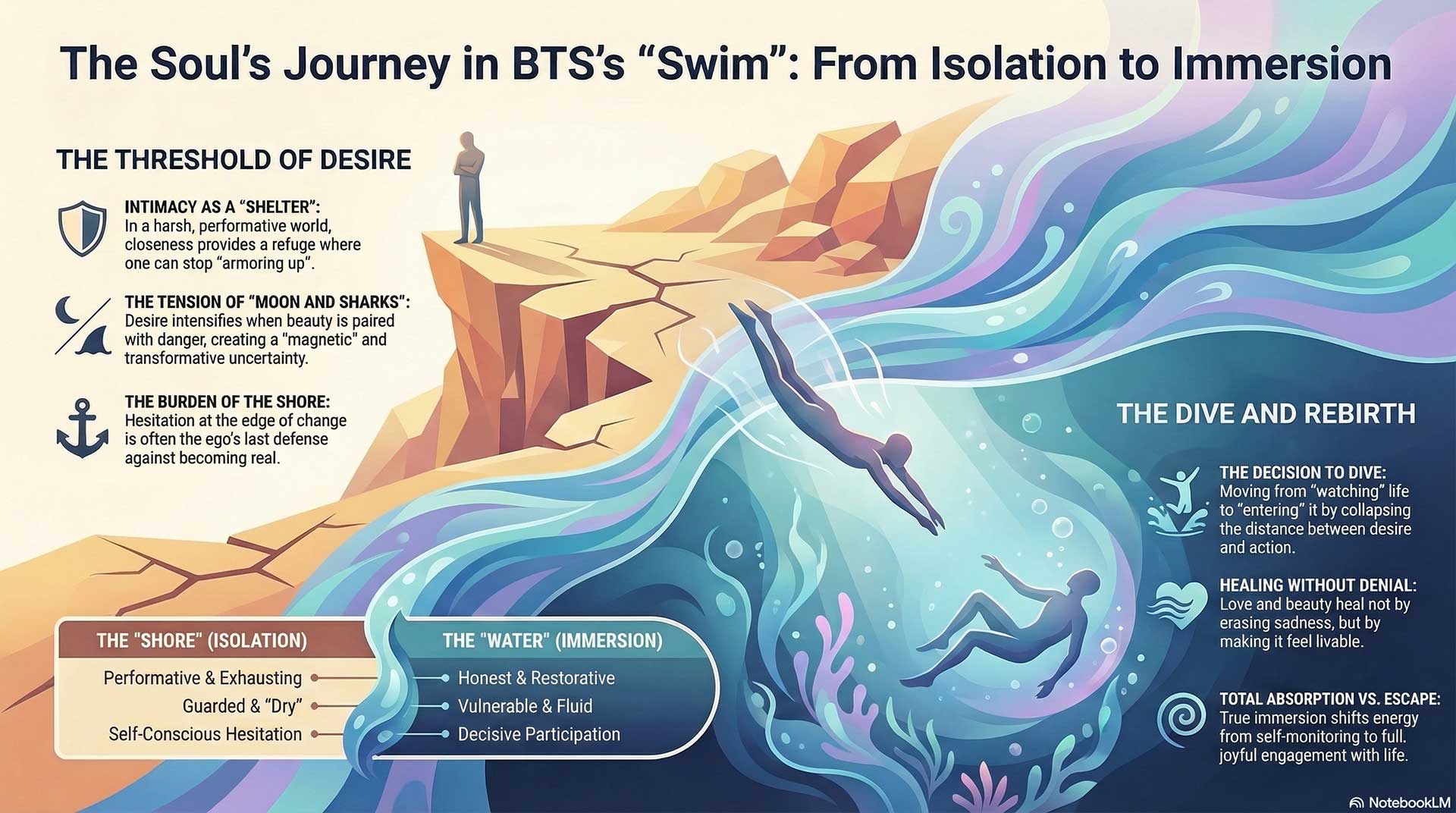
After listening to these five conversations unfold, I come away feeling that “Swim” is a song about much more than attraction. It is about the human desire to cross from one state of being into another.
It begins in weariness. A harsh world. A crowded mind. A life that feels difficult to breathe inside. From that place, the song turns toward intimacy, not as ornament, but as refuge. Then it moves into danger, into the knowledge that what draws us most strongly is often what unsettles us too. Beauty alone is not enough. The heart is often awakened by beauty with depth, beauty with edge, beauty that asks something of us. Then comes the turning point: the willingness to stop waiting at the shore. To dive. To consent to feeling, risk, vulnerability, and change. And finally, the song reaches toward healing, though not the shallow kind. Not the kind that pretends sorrow was never there. It reaches toward the kind of release that lets sadness loosen its grip and gives life back its motion.
That full movement matters.
It shows that water in “Swim” is never one thing. It is love, but not only love. It is freedom, but not easy freedom. It is danger, but not destruction alone. It is healing, but not denial. Most of all, it is transformation. Water is where the fixed self begins to soften. Where the overcontrolled self begins to yield. Where the lonely self risks contact. Where the tired self remembers another rhythm.
What I find beautiful about the song is that it does not solve the human condition. It does not offer some polished answer to loneliness, fear, or sadness. It simply offers a moment of truth: there are times when the deepest thing a person can say is not “I understand everything” but “I’m ready to enter.”
That is the power of the final impulse to dive.
Across this roundtable, each voice helped unfold a piece of that meaning. Water as archetype. Intimacy as refuge. Danger as intensifier. Surrender as decision. Beauty as a companion to sorrow rather than a lie about it. Put together, these ideas reveal a song that is emotionally wiser than it first appears. Beneath its sensual surface lies a serious question: what are we really looking for when we want to disappear into someone, into beauty, into water, into a moment?
Maybe we are looking for escape. But maybe, at a deeper level, we are looking for return.
Return to the body. Return to feeling. Return to vulnerability. Return to a self that has not been hardened beyond recognition by pressure and noise. Return to a kind of aliveness that cannot be reached by staying dry on the shore.
That is why this song lingers.
It understands that many people are not asking for perfection. They are asking for one real moment. One place where they can stop bracing. One experience strong enough to cut through numbness. One opening where desire, fear, tenderness, and release all meet.
And maybe that is the lasting image of “Swim.”
Not just a person entering water, but a person entering life again.
Short Bios:
Nick Sasaki — Writer, moderator, and creator of Imaginary Talks, known for exploring big human questions through imagined roundtable conversations.
Carl Jung — Swiss psychiatrist whose work on archetypes, symbols, and the unconscious shaped modern depth psychology.
Gaston Bachelard — French philosopher of imagination who wrote richly about water, dreams, and poetic experience.
Rumi — Persian poet and mystic whose writings center on longing, union, love, and spiritual transformation.
Rachel Carson — Marine biologist and writer whose work revealed the beauty, mystery, and moral weight of the natural world.
RM — BTS leader, rapper, and lyricist known for reflective writing, philosophical depth, and emotional honesty.
Erich Fromm — Social psychologist and humanistic thinker who explored love, loneliness, freedom, and the need for connection.
Viktor Frankl — Psychiatrist and Holocaust survivor who taught that meaning gives human beings strength in suffering.
Byung-Chul Han — Contemporary philosopher known for his critiques of burnout, overstimulation, and the pressures of modern life.
Brené Brown — Researcher and writer focused on vulnerability, shame, courage, and wholehearted connection.
SUGA — BTS rapper, songwriter, and producer known for direct emotional truth, inner conflict, and sharp self-awareness.
Sigmund Freud — Founder of psychoanalysis whose ideas on desire, repression, instinct, and fantasy transformed modern thought.
Esther Perel — Psychotherapist and writer known for her work on desire, intimacy, erotic tension, and modern relationships.
Joseph Campbell — Mythologist whose work traced recurring patterns of risk, transformation, and the hero’s journey across cultures.
Anaïs Nin — Writer whose journals and fiction explored sensuality, emotional complexity, and inner longing.
Jimin — BTS singer and performer known for emotional nuance, tenderness, intensity, and expressive stage presence.
Søren Kierkegaard — Danish philosopher who wrote about inward choice, anxiety, faith, and the leap into real commitment.
Pema Chödrön — Buddhist teacher known for her wisdom on uncertainty, fear, compassion, and staying open in difficulty.
Mihaly Csikszentmihalyi — Psychologist best known for the concept of flow and the study of deep human immersion.
Hermann Hesse — Novelist and spiritual writer whose works follow the search for wholeness, self-discovery, and inner transformation.
Jung Kook — BTS singer known for clarity, openness, emotional immediacy, and a voice that carries both vulnerability and strength.
John O’Donohue — Irish poet and philosopher who wrote about beauty, longing, soul, and the hidden grace within sorrow.
Thich Nhat Hanh — Zen teacher and peace writer who taught mindfulness, compassion, and the gentle holding of suffering.
Rainer Maria Rilke — Poet of solitude, beauty, sadness, and transformation, known for his deep inward spiritual vision.
bell hooks — Cultural critic and writer who saw love as an ethical force rooted in truth, care, and mutual growth.
j-hope — BTS rapper, dancer, and performer known for resilience, movement, light, and emotionally energizing presence.
Leave a Reply