
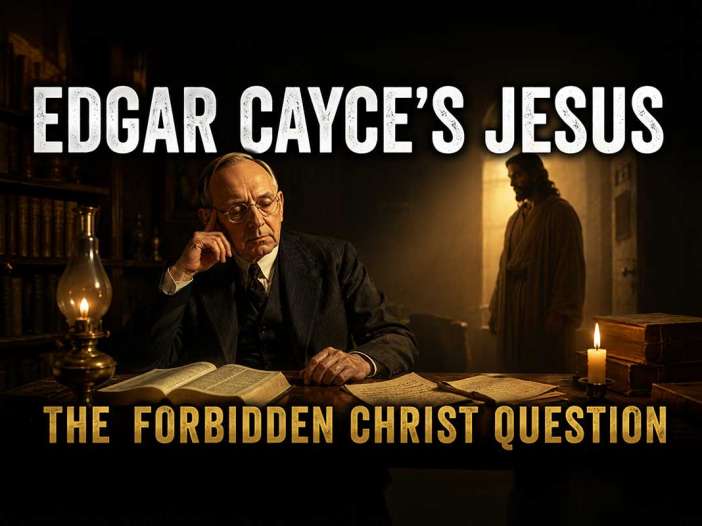
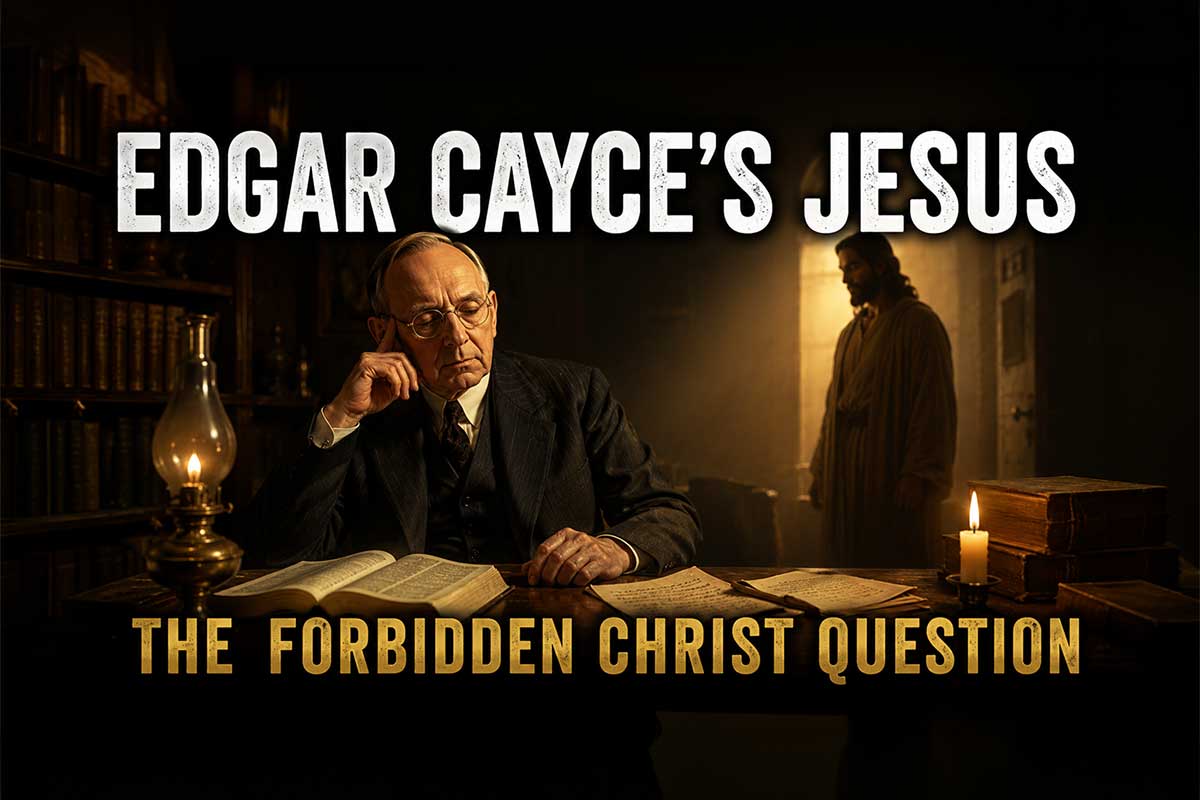
What if Edgar Cayce revealed a Jesus who came not only to be worshiped, but to show what the soul can become?
I did not seek to disturb the churches.
I did not seek to make men doubt the Master.
If anything, the readings made Jesus nearer, not farther away.
Many have placed Jesus so high above mankind that the ordinary soul looks at him and says, “I can worship him, but I can never follow him.”
Yet the Master did not say only, “Believe in me.”
He said, “Follow me.”
That word carries a weight many have forgotten.
For how can a soul follow a path that was never meant to be walked?
In the readings, I saw Jesus as the pattern of the soul’s return to God. I saw him not as a distant exception, but as the elder brother of mankind — the one who walked ahead, the one who showed what perfect obedience, perfect love, and perfect surrender look like when lived inside a human body.
Christ was not limited to flesh.
Christ was the divine pattern, the first expression of God’s mind, the light that has spoken through every age.
Jesus was the man who became so perfectly one with that light that the Christ was fully revealed through him.
This does not lessen Jesus.
It makes his victory greater.
He was hungry.
He was tempted.
He was misunderstood.
He was abandoned.
He suffered.
He forgave.
He surrendered.
And through all of it, he showed that the human soul, when fully aligned with God, can become a living doorway for divine love.
These conversations ask hard questions.
Was the soul’s journey longer than one lifetime?
Did early Christianity once hold mysteries later forgotten?
What happened in the silent years of the Master’s life?
Were there hidden communities preparing the way?
Is salvation only something granted from beyond us, or must it also awaken within us?
I do not ask these questions to replace faith.
I ask them so faith may become living.
For belief that does not change the soul remains asleep.
And the purpose of the Master was never to keep mankind asleep.
(Note: This is an imaginary conversation, a creative exploration of an idea, and not a real speech or event.)
Topic 1: Jesus the Man vs. Christ the Consciousness
Participants:
Nick Sasaki, Edgar Cayce, C.S. Lewis, Origen, Carl Jung, Meister Eckhart
Nick Sasaki — Opening
Welcome, everyone.
Today we begin with one of the most sensitive and fascinating questions in Christian history:
Was Jesus the only divine being humanity could ever know, or was he the first full revelation of what humanity itself is meant to become?
Edgar Cayce’s readings made a sharp distinction: Jesus was the man; Christ was the divine consciousness expressed through him. That claim has inspired many seekers, but it has also alarmed traditional Christians, since it seems to challenge core beliefs about Jesus, salvation, and the uniqueness of Christ.
So let’s begin carefully.
Q1. If Jesus was fully human, does that make his life less divine — or does it make his victory more meaningful for everyone else?
Edgar Cayce
If Jesus was not truly human, then his life becomes untouchable.
People may worship him, but they cannot follow him.
What I saw in the readings was not a distant figure pretending to suffer. I saw a soul who entered the same condition as humanity. Hunger, pain, fear, temptation, loneliness — these were not symbolic decorations around his life. They were real.
That is why his victory matters.
If Jesus overcame temptation as God wearing a mask, then mankind can admire him but cannot imitate him. But if Jesus overcame as a man perfectly aligned with the divine, then his life becomes the pattern for every soul.
The greatness of Jesus is not reduced by his humanity.
His humanity is the doorway through which his greatness reaches us.
C.S. Lewis
I must be careful here.
Christian faith has always insisted that Jesus is fully human and fully divine. Remove either side, and the whole structure weakens.
If we make Jesus merely a spiritual master, we lose the shock of Christianity. The claim of the New Testament is not simply that Jesus showed us a noble path. It is that God acted in him uniquely.
Yet I agree with one point: Jesus’ humanity must be real.
A Christ who never truly faced temptation cannot comfort tempted people. A Christ who never truly suffered cannot heal suffering people. A Christ who merely appeared human would not be the Christ of the Gospels.
So the question is not whether his humanity lowers him.
The question is whether we dare believe that God entered humanity fully.
That is not less divine.
That is more astonishing.
Origen
The soul grows by turning back to God.
Human beings often want divine truth to descend in a finished form, without struggle, without purification, without inward change. But the life of Jesus shows perfect obedience in human form.
For me, the mystery is not that Jesus was human.
The mystery is that humanity can become transparent to God.
A soul clouded by passion cannot reveal divine light. A soul purified by love, discipline, prayer, and obedience becomes like a clear vessel.
Jesus shows the soul’s complete return to God.
His humanity is not a weakness. It is the field where divine union becomes visible.
Carl Jung
Psychologically, the figure of Jesus has carried the image of the whole human being.
Human beings are divided. Conscious and unconscious. Spirit and instinct. Love and aggression. Persona and shadow.
Jesus appears in Christian imagination as one who has integrated what others cannot bear.
If Jesus is only placed in heaven, untouched by human contradiction, then he becomes less useful to the soul. He becomes an object of projection, not transformation.
But if Jesus enters the human condition, then he becomes an image of wholeness.
The divine does not destroy the human.
It completes it.
Meister Eckhart
The birth of Christ must happen in the soul.
If Christ was born once in Bethlehem but never born in me, what good is that birth to me?
People look outward and say, “There is Christ.” But the soul must become silent enough to know: the ground where God speaks is within.
Jesus showed a life emptied of self-will.
That is why God shone through him.
The more the soul lets go of the little self, the more the eternal Word is born within.
His humanity does not hide God.
His humanity reveals what happens when a person becomes poor in spirit, empty before God, and filled with divine life.
Nick Sasaki
So we already have a major tension.
C.S. Lewis wants to protect the uniqueness of Jesus.
Cayce and Eckhart are saying that Jesus becomes meaningful precisely since he reveals what can happen inside the human soul.
Let me ask this more directly.
If Jesus is too far above us, do we lose the courage to follow him?
C.S. Lewis
Yes, that danger exists.
But the opposite danger exists too.
If Jesus becomes too close to us, we may reduce him into a moral coach.
The Christian claim is more severe than that.
He does not merely say, “Try harder.”
He says, “Come to me.”
The human being does not climb to heaven by self-improvement alone. Grace is needed.
Edgar Cayce
Grace is real.
But grace is not opposed to growth.
Grace is the divine help that allows the soul to awaken, repent, correct itself, and return.
Jesus did not come to prove that no one else could reach God.
He came to show the way.
Q2. What changes if “Christ” is not only the name of one person, but a divine consciousness that Jesus fully awakened?
Nick Sasaki
Now we move into the most controversial part.
Cayce’s reading says, in essence, that Christ is not simply the human person Jesus, but a divine consciousness or pattern present through all ages. The transcript we translated frames this as one of Cayce’s most dangerous claims.
So what changes if Christ is not only a name, but a state of divine awareness?
Edgar Cayce
Everything changes.
Religion stops being only a system of belief and becomes a path of transformation.
If Christ is only outside you, then you may worship, obey, confess, and wait.
But if Christ is also a divine consciousness waiting within the soul, then you must awaken.
You must forgive.
You must serve.
You must purify desire.
You must become what you claim to believe.
Jesus was the complete expression of that consciousness. He was the first to fully show it in human life.
That does not make Jesus smaller.
It makes the meaning of Jesus larger.
C.S. Lewis
Here I must object, or at least draw a firm line.
Christianity does teach that believers are to become like Christ. Saint Paul says, “It is no longer I who live, but Christ lives in me.”
So the idea that Christ must live within the believer is not foreign to Christianity.
But Christianity does not say that Christ is merely a state of consciousness.
Christ is personal.
He is not an energy, not an abstraction, not an achievement of spiritual psychology.
He is Lord.
The danger is that people may replace obedience to Christ with admiration for their own inner experience.
Carl Jung
Mr. Lewis is right to warn against inflation.
When a person says, “Christ consciousness is within me,” the ego may secretly crown itself.
That is spiritually dangerous.
The ego loves divine language.
Yet there is a real psychological truth here. The Christ image represents a center beyond the ego. I called such a center the Self — not the ordinary self, but the deeper organizing center of the psyche.
When Christ is experienced inwardly, the person may be drawn toward wholeness, sacrifice, reconciliation, and moral seriousness.
But if the ego claims that center as its property, the result is not holiness.
It is spiritual pride.
Origen
The Word of God is eternal.
The Word is not limited by time, yet entered time.
The light shines into many souls, but in Jesus it shone without distortion.
One may say that Christ can be formed in the soul, if by that we mean participation in the divine life.
But one must never confuse participation with equality.
The soul receives light.
It does not become the source of light by its own nature.
Meister Eckhart
The eye with which I see God is the eye with which God sees me.
People fear such words since they think the creature is claiming to replace the Creator. That is not what I mean.
When the soul is emptied, God is born there.
The soul does not boast, “I am God.”
The soul disappears into God.
Christ consciousness, if we use that phrase, must mean the death of self-will.
If it becomes self-glorification, it is false.
Nick Sasaki
This is very helpful.
So maybe the key distinction is this:
If “Christ consciousness” means ego saying, “I am divine,” it becomes dangerous.
But if it means the soul surrendering until divine love can act through it, then it becomes closer to serious mysticism.
C.S. Lewis
That is much better.
But I would still say: the Christian does not awaken Christ as though Christ were sleeping inside him by nature alone.
The Christian receives Christ.
That difference matters.
Edgar Cayce
Receiving and awakening are not enemies.
The soul receives what God has already planted.
The seed is from God.
The growth requires response.
Q3. Did Jesus come to be worshiped from a distance, or to reveal what the human soul can become?
Nick Sasaki
This may be the emotional center of the whole topic.
Many people worship Jesus sincerely, yet feel they can never become anything like him.
So did Jesus come mainly to be adored as an unreachable savior?
Or did he come to reveal the destiny of the human soul?
Meister Eckhart
A distant Christ does not disturb the soul.
A Christ born within the soul changes everything.
People prefer distance. Distance allows admiration without surrender.
But the Gospel is not safe admiration.
It calls the soul to poverty, emptiness, mercy, and union with God.
If Christ is only on the altar, one may kneel and then leave unchanged.
If Christ is born in the soul, one cannot remain the same.
Edgar Cayce
Jesus came as the elder brother.
That phrase matters.
An elder brother is ahead of us, but not foreign to us.
He shows the path. He does not mock the younger ones for being behind.
He says, “Follow me.”
To follow means the path is real.
If no one can walk it, then the command would be cruel.
Jesus revealed what the soul can become when it chooses love over self, service over pride, and God’s will over personal desire.
C.S. Lewis
Again, I agree and disagree.
Jesus must not be worshiped from a distance in the sense of cold admiration. True worship transforms the worshiper.
But worship is still necessary.
The modern mind often says, “I do not want to worship. I want to become.”
That can sound noble, but it can hide rebellion.
The soul becomes itself by bending the knee before God.
Jesus does reveal what humanity is meant to become, yes. But he also reveals the God before whom humanity must kneel.
Carl Jung
The image of kneeling is psychologically significant.
The ego must bow to something higher.
Modern people dislike this. They want development without surrender.
But no deep transformation happens without the defeat of ego-centered life.
In that sense, worship may serve the psyche. It breaks ego-supremacy.
The danger is when worship becomes avoidance: “Christ is perfect, I am helpless, so I need not change.”
That is not faith.
That is fear disguised as reverence.
Origen
The human soul is called to likeness with God.
This does not mean the soul becomes God by nature. It means the soul is restored through purification, wisdom, love, and grace.
Jesus is both the teacher and the living image of the goal.
If one worships but does not imitate, one has not understood.
If one imitates but refuses worship, one has not understood either.
The two belong together.
Nick Sasaki
So perhaps the real answer is not worship or transformation.
It is worship that leads to transformation.
A person kneels before Christ, then rises with a new responsibility.
Edgar Cayce
Yes.
The danger is passive religion.
Belief without becoming.
Prayer without change.
Doctrine without compassion.
Jesus did not live, suffer, forgive, and rise so that humanity could remain spiritually asleep.
C.S. Lewis
And the danger on the other side is self-salvation.
Transformation without grace.
Mysticism without obedience.
Inner light without repentance.
Meister Eckhart
Then let the soul become empty.
The empty soul does not brag about its light.
It lets God shine.
Carl Jung
And the person must face the shadow.
No one becomes whole by speaking divine words alone.
The darker parts of the soul must be known, confessed, and transformed.
Origen
And the soul must return, again and again, to God.
Not in pride.
In longing.
Nick Sasaki — Closing Reflection for Topic 1
This first topic leaves us with a powerful tension.
If Jesus is only human, Christianity loses its central mystery.
If Jesus is only divine, humanity loses its path.
The deepest view may require both:
Jesus as the one who reveals God fully.
Jesus as the one who reveals humanity fully.
Cayce’s claim is controversial because it does not let us keep Christ safely far away. It asks whether the light seen in Jesus was meant to remain an exception — or become the destiny of every soul.
C.S. Lewis warns us not to reduce Christ into a vague inner experience.
Cayce reminds us not to reduce Jesus into someone we admire but never follow.
Jung warns that divine language can inflate the ego.
Eckhart insists that Christ must be born within.
Origen reminds us that the soul’s goal is likeness to God, not spiritual self-worship.
So the question remains:
Did Jesus come only to be worshiped, or did he come to awaken the divine image buried inside humanity?
Topic 2: Was Reincarnation Removed from Christianity?

Participants:
Nick Sasaki, Origen, Augustine, Emperor Justinian I, Elaine Pagels, Edgar Cayce
Nick Sasaki — Opening
Welcome back.
In Topic 1, we explored the difference between Jesus the man and Christ as divine consciousness.
Now we enter an even more explosive question:
Did early Christianity once leave room for reincarnation, soul preexistence, or spiritual growth across many lives — and was that idea later rejected or suppressed?
The transcript claims that Edgar Cayce’s reincarnation teachings were not entirely new, but echoed ideas once found inside early Christianity, especially around Origen and the preexistence of souls. It frames the year 553, during the Second Council of Constantinople, as a decisive moment when these ideas were pushed out.
Tonight, we ask carefully:
Was reincarnation removed from Christianity?
Or is that too simple?
Q1. If the soul existed before birth, how would that change the way Christianity explains sin, suffering, and spiritual growth?
Origen
The soul is older than the body.
This was not a casual idea for me. It came from trying to understand why souls enter life under such different conditions.
One child is born into peace.
Another is born into pain.
One person carries a strange longing for God from childhood.
Another turns away from the divine before understanding any doctrine.
If the soul begins only at birth, many mysteries become harder to bear.
But if the soul has a history before this life, suffering may not be random. It may belong to a longer education of the soul.
I do not say this to blame the sufferer.
That would be cruel.
I say it to protect meaning.
The soul may be learning across more than one visible lifetime.
Augustine
I must resist this.
The Christian explanation of sin does not require many lives.
Humanity is fallen in Adam. We inherit a wounded condition. We do not begin neutral. We are born into a broken human race.
The danger in preexistence is that it can turn grace into a school system.
If the soul is only being educated over many lives, then salvation may become gradual self-correction.
But Christianity says something stronger:
The human person needs grace.
We do not heal ourselves through memory, effort, or repeated experience.
God rescues.
The soul does not need many chances. It needs mercy.
Edgar Cayce
Grace and growth are not enemies.
A soul can receive mercy and still need to learn.
A child may be forgiven and still need to grow.
What I saw in the readings was not punishment traveling through lives. It was law, mercy, and growth working together.
People fear reincarnation because they think it removes the cross.
But I saw it differently.
The cross reveals the pattern of love.
Reincarnation reveals the patience of God.
The soul returns not to be trapped, but to awaken.
Elaine Pagels
Historically, we should slow down.
Early Christianity was not one single neat system. There were many communities, many interpretations, many debates.
Some Christians spoke of the soul’s ascent, descent, purification, or preexistence. Others rejected such ideas.
The question is not, “Did all early Christians believe in reincarnation?”
They did not.
The better question is:
How wide was early Christian imagination before later orthodoxy narrowed the boundaries?
When doctrine becomes official, some possibilities become heresy.
That process is historical, theological, and political at the same time.
Emperor Justinian I
An empire cannot be governed by endless speculation.
The church needed unity.
The people needed clear doctrine.
If every teacher invents a different journey of the soul, confusion spreads.
You call this narrowing.
I call it protection.
A faith that cannot define error cannot protect truth.
If the soul supposedly returns again and again, then moral urgency weakens.
People may delay repentance.
They may say, “Another life will come.”
The empire needed moral order.
The church needed doctrinal order.
I regret nothing.
Nick Sasaki
So the first question already divides the room.
Origen sees preexistence as a way to explain spiritual inequality and suffering.
Augustine insists that sin and grace do not need reincarnation.
Cayce sees many lives as divine patience.
Elaine Pagels reminds us that early Christianity was more varied than many people think.
Justinian speaks from order and control.
Let me push deeper.
If reincarnation were true, would it make Christianity more compassionate — or more dangerous?
Augustine
More dangerous.
It tempts the mind to look for hidden reasons behind every suffering.
A sick child, a poor family, a tragic death — one may begin asking what past-life mistake caused it.
That is spiritually poisonous.
The Gospel calls us to love the sufferer, not explain them away.
Edgar Cayce
Then the teaching must be held with compassion.
No soul should be blamed.
The purpose is healing, not judgment.
A reading that does not increase love is misunderstood.
Origen
Pain must never be simplified.
The mystery of the soul is not permission to accuse.
It is an invitation to reverence.
Q2. Was reincarnation rejected mainly as false doctrine, or did church and empire fear what it would do to religious authority?
Nick Sasaki
Now we come to the heart of the controversy.
The transcript argues that reincarnation was removed in part because it threatened church and imperial control. It says if people believed they had many lives, they might feel less pressure to obey in this life.
Is that fair?
Or does it turn a theological dispute into a conspiracy story?
Elaine Pagels
It is too simple to say, “The church removed reincarnation for control.”
But it is also too simple to say politics played no role.
Councils were not held in heaven.
They were held in cities, under emperors, with bishops, factions, pressures, alliances, and consequences.
Doctrine and authority grew together.
When certain beliefs were condemned, it was not only an abstract search for truth. It shaped who could teach, who could lead, who belonged, and who was outside.
The more official Christianity became, the more dangerous spiritual diversity became.
That does not prove reincarnation was original Christianity.
It does show that power shaped the boundaries.
Emperor Justinian I
Every civilization has boundaries.
Without them, it collapses.
You speak of diversity. I speak of fragmentation.
The empire had already seen division, heresy, rebellion, and endless quarrels over Christ.
Do you think ordinary believers were helped by endless metaphysical debates about preexistent souls?
No.
They needed a clear confession.
One God.
One Christ.
One church.
One life in which to repent.
That produces seriousness.
Origen
Yet truth is not protected by force.
If a doctrine must be buried under threat, one must ask what fear surrounds it.
The soul’s journey toward God is vast.
The human mind may not grasp all of it.
But I taught that God’s justice is medicinal, not merely punitive.
Punishment exists for healing.
Correction exists for restoration.
If empire turns doctrine into control, then the medicine becomes prison.
Augustine
Origen, your compassion is noble, but the danger remains.
If all souls are eventually educated back to God, if every failure becomes only one stage in a long process, then judgment loses its finality.
The human heart is already skilled at delay.
“Tomorrow I will repent.”
“Later I will change.”
“Another life will give me time.”
No.
Scripture says now is the day of salvation.
Grace must be received now.
Edgar Cayce
But many souls do not awaken in one life.
Look around.
A person may live seventy years and barely begin to understand love.
Does God discard such a soul?
Does one short life settle eternity?
The readings showed a universe more patient than human theology.
The soul learns, returns, serves, repairs, and rises.
That does not weaken responsibility.
It extends it.
You cannot escape yourself.
You meet again what you have not healed.
Nick Sasaki
This is where the tension becomes sharp.
Augustine says one life gives moral urgency.
Cayce says many lives create deeper accountability.
Justinian says unity required clear boundaries.
Pagels says doctrine and authority developed together.
Origen says divine justice heals rather than merely condemns.
Let me ask each of you directly:
Was reincarnation rejected because it was false, or because it was inconvenient?
Augustine
False.
The Gospel does not teach it.
The resurrection of the body is not the migration of the soul through many bodies.
Christian hope is not escape into another life.
It is resurrection, judgment, mercy, and new creation.
Emperor Justinian I
False and dangerous.
A false doctrine becomes more dangerous when it weakens public order.
Elaine Pagels
Historically disputed, later marginalized, and then treated as outside orthodoxy.
That is the careful answer.
Origen
Misunderstood, feared, and condemned in forms I myself might not have defended.
Edgar Cayce
Not removed from truth.
Removed from permission.
The idea survived underground, in mysticism, in fragments, in longing.
Q3. If early Christianity had kept the idea of many lives, would salvation feel more like instant rescue or long spiritual education?
Nick Sasaki
Now let’s move from history to meaning.
If Christianity had kept some form of soul preexistence or reincarnation, how would ordinary faith feel different?
Would salvation be less about being rescued from sin in one moment?
Would it become more like a long education of the soul?
Edgar Cayce
Salvation is awakening.
Not in one shallow moment, but through the soul’s return to divine purpose.
A person may have a conversion experience. That is real.
But the work after conversion is long.
The tongue must be healed.
The heart must be softened.
Desire must be purified.
Old debts of selfishness must be balanced through service.
The soul must become love.
Many lives do not remove salvation.
They show how deeply salvation must enter the soul.
Augustine
This makes salvation too gradual.
Yes, sanctification is a process.
But salvation begins with grace, not with a long spiritual curriculum.
The thief on the cross had no many-life education left.
He turned to Christ and received paradise.
That is the scandal of grace.
It offends those who want a system.
God saves freely.
Origen
Yet even the thief had a soul.
Who knows what unseen preparation led to that final turning?
A moment may reveal what ages prepared.
Grace may appear sudden to observers while answering a long hunger within the soul.
Spiritual education and grace need not be enemies.
Education prepares the vessel.
Grace fills it.
Elaine Pagels
If Christianity had kept a stronger idea of soul education, Western religion might have developed a different emotional tone.
Less final terror.
More spiritual development.
Less obsession with one correct belief before death.
More attention to transformation over time.
But there is risk too.
People might postpone moral seriousness.
Institutions might create new systems of spiritual ranking.
No doctrine is safe from misuse.
Emperor Justinian I
You admit the danger.
A religion of long education may comfort philosophers.
It does not govern nations.
People need clear stakes.
Life is short.
Judgment is real.
Repentance cannot wait.
A church that speaks too softly about eternity loses the people.
Nick Sasaki
But Emperor, could fear-based urgency also distort faith?
Could people obey outwardly while never transforming inwardly?
Emperor Justinian I
External order is not nothing.
A society of inward seekers with no shared law falls apart.
Meister Eckhart-like echo from Nick’s reflection?
No, let’s keep the table focused.
Edgar Cayce
Fear can begin a journey, but love must finish it.
A soul frightened into obedience has not yet awakened.
The purpose of salvation is not merely to escape punishment.
It is to become one with divine love.
Augustine
Love is central.
But love must be rightly ordered.
The soul cannot educate itself into God.
It must be converted.
Origen
Conversion may be the turning of a soul long lost.
One moment, yes.
But behind that moment may stand a history known only to God.
Elaine Pagels
This is where the historical question becomes a human question.
People are not only asking, “What did the early church teach?”
They are asking:
“Is my life a one-time test, or part of a longer mystery?”
That question has never disappeared.
It keeps returning because human suffering keeps returning.
Nick Sasaki
So if early Christianity had retained this idea, Christianity might have become a religion of long healing rather than one final deadline.
But that may also have created new problems: delay, speculation, spiritual pride, or blame toward suffering people.
It seems every answer carries danger.
Edgar Cayce
Truth always carries danger when used without love.
Augustine
And error often wears the face of compassion.
Origen
Then perhaps the soul must seek both: compassion and truth.
Elaine Pagels
And history must admit its own uncertainty.
Emperor Justinian I
And civilization must decide what it can permit.
Nick Sasaki — Closing Reflection for Topic 2
This conversation does not give us a simple answer.
It gives us a wound inside Christian history.
On one side, Augustine and Justinian insist that Christianity needs clarity:
One life.
One judgment.
One Savior.
One urgent call to repent.
On the other side, Origen and Cayce point to a wider mystery:
The soul may have depths that one lifetime cannot explain.
Divine justice may be more medicinal than punitive.
Salvation may be less like a courtroom verdict and more like the long healing of consciousness.
Elaine Pagels reminds us that early Christianity was never as simple as later summaries make it sound. It contained debates, rival interpretations, mystical ideas, and political pressures.
So was reincarnation removed from Christianity?
The careful answer may be:
A full doctrine of reincarnation was never the official center of Christianity, but ideas about the soul’s preexistence, purification, and long journey were present in early Christian thought — and later orthodoxy drew much harder boundaries around what Christians were allowed to believe.
That may be the most honest tension.
The deeper question remains:
Is the soul judged mainly by one lifetime, or educated by God across a mystery larger than memory?
Topic 3: The Missing Eighteen Years of Jesus

Participants:
Nick Sasaki, Edgar Cayce, Nicolas Notovitch, a Dead Sea Scrolls Scholar, a Buddhist Monk, a Jewish Historian
Nick Sasaki — Opening
Welcome back.
In Topic 2, we explored whether reincarnation was ever part of early Christian imagination, and whether later church authority narrowed what Christians were allowed to believe.
Now we come to one of the most mysterious silences in the life of Jesus:
What happened between age twelve and age thirty?
The Gospel of Luke shows Jesus at twelve years old, speaking with teachers in the Jerusalem temple. Then the public story seems to jump to his baptism around age thirty.
Eighteen years are almost completely silent.
Edgar Cayce claimed this silence was not empty. According to the transcript, Cayce said Jesus left Palestine and traveled through India, Persia, and Egypt, learning compassion, moral discernment, and the surrender of ego before beginning his public mission.
But is this spiritual imagination, lost history, or a dangerous myth?
Tonight, we ask:
Did Jesus simply live quietly in Nazareth, or did his hidden years contain a wider preparation than the Bible records?
Q1. Why does the Bible remain silent about Jesus from age twelve to thirty, and what kind of spiritual formation may have happened during that silence?
Jewish Historian
The silence is not as strange as modern readers think.
Ancient biographies were not modern biographies. They did not record every childhood stage, every private decision, every year of training.
The Gospel writers were not trying to satisfy curiosity. They were making theological claims.
They wanted to show who Jesus was in relation to Israel, prophecy, Torah, kingdom, death, and resurrection.
So when the text passes from age twelve to adulthood, that does not automatically mean a secret journey took place.
It may simply mean that the writers did not find those years central to their message.
Most likely, Jesus grew up within Jewish life in Galilee.
He learned Scripture.
He learned prayer.
He learned work.
He learned village life.
We should not underestimate Nazareth.
Hidden formation does not need foreign travel.
Edgar Cayce
I agree that silence alone proves nothing.
But the readings showed that the silence held preparation.
Jesus did not arrive at the Jordan River as an unformed man.
A soul ready to carry such a mission must pass through discipline.
In the readings, Jesus was connected to the Essenes, a community devoted to purity, prayer, preparation, and spiritual law. From there, his path widened.
The missing years were not empty.
They were years of inner shaping.
A public mission may begin suddenly, but the soul does not become ready suddenly.
Dead Sea Scrolls Scholar
The Essenes are historically fascinating, but we must separate evidence from speculation.
The Dead Sea Scrolls gave us real ancient texts from a Jewish sectarian community. They show strict discipline, purity practices, communal rules, expectation of divine judgment, and messianic hope.
So yes, a disciplined Jewish group existed.
Yes, the world around Jesus included groups beyond ordinary synagogue life.
But the scrolls do not say, “Jesus was trained here.”
They do not say, “Mary was prepared here.”
They do not give us a direct line from Qumran to Jesus.
The connection is possible as imaginative reconstruction, but not proven history.
Nicolas Notovitch
History often hides in places scholars refuse to search.
I claimed that records in the East preserved memories of Jesus traveling beyond Palestine.
I was mocked, investigated, and rejected.
Yet why is it impossible?
Trade routes existed.
Ideas traveled.
Religious seekers crossed borders.
India was not beyond imagination.
If Jesus’ teachings contain universal compassion, love for enemies, detachment from worldly ambition, and inward purity, why could he not have encountered wisdom beyond Judea?
The West often assumes truth moved only from Jerusalem outward.
Perhaps wisdom also came toward Jerusalem.
Buddhist Monk
Whether Jesus physically came to India is one question.
The deeper question is whether his heart carried the fragrance of universal compassion.
When Jesus says to love enemies, bless persecutors, forgive endlessly, and give without clinging, a Buddhist listener hears something familiar.
But similarity does not prove travel.
Great souls may discover similar truths from deep realization.
A mountain may have many paths.
Still, the idea of Jesus learning compassion in India is spiritually meaningful, even if historically uncertain.
It suggests that wisdom does not belong to one tribe alone.
Nick Sasaki
So we have three levels already.
The historian says silence does not prove travel.
The scrolls scholar says Essene influence is possible but unproven.
Cayce says the soul needed hidden preparation.
Notovitch says lost records may exist outside the West.
The Buddhist monk says similarity does not prove contact, but it can open spiritual imagination.
Let me ask this:
Do we sometimes want the missing years to be mysterious because an ordinary Jesus feels too small?
Jewish Historian
Yes.
Many people are uncomfortable with ordinary formation.
They want secret temples, lost scrolls, exotic journeys, hidden masters.
But Jewish village life was not spiritually small.
A boy formed by Torah, Sabbath, prayer, labor, family, synagogue, Roman pressure, poverty, and prophetic hope would already be deeply shaped.
A carpenter’s son in Galilee did not need India to learn suffering.
He did not need Egypt to learn empire.
He did not need Persia to learn good and evil.
Israel already contained all of that.
Edgar Cayce
Yet God can use Israel and the nations.
A wider preparation does not insult Judaism.
It may show that the soul of Jesus gathered wisdom from many streams, then fulfilled it in one life.
Dead Sea Scrolls Scholar
That is beautiful, but the historian must ask:
Where is the evidence?
Spiritual meaning is not the same as historical proof.
Q2. If Jesus learned from traditions beyond Palestine, would that weaken Christianity — or reveal a wider divine preparation?
Nick Sasaki
This question may be the emotional center of the topic.
Many Christians may feel threatened by the idea that Jesus learned from Buddhism, Hinduism, Zoroastrianism, or Egyptian mystery traditions.
They may ask:
“If Jesus needed other teachers, does that make him less unique?”
But others may say:
“If God prepared Jesus through many civilizations, does that make the story larger?”
Edgar, let’s begin with you.
Edgar Cayce
Truth is not weakened when more light enters the room.
If Jesus learned in India, Persia, and Egypt, that does not mean he became less Jewish, less holy, or less central.
It means the divine prepared him through many vessels.
India may have deepened compassion.
Persia may have sharpened moral discernment.
Egypt may have prepared him for surrender of self.
But Jesus did not merely repeat these traditions.
He fulfilled what was highest in them.
The Christ pattern gathers truth and gives it perfect expression.
Nicolas Notovitch
Exactly.
Why must Christianity fear contact?
If Jesus traveled, then Christianity becomes a bridge between civilizations.
It means the East and West were not enemies in spirit.
It means the Sermon on the Mount may stand inside a larger human search for holiness.
The fear comes from ownership.
People want Jesus to belong only to them.
But a teacher of the whole world may have walked through more than one world.
Jewish Historian
I must strongly respond.
The danger is not contact.
The danger is erasing Jesus’ Jewishness.
Many modern theories make Jesus more acceptable to their own spiritual taste by pulling him away from first-century Judaism.
Jesus spoke in Jewish categories.
Kingdom of God.
Torah.
Prophets.
Temple.
Sabbath.
Covenant.
Repentance.
Messiah.
His moral imagination was deeply Jewish.
If we make him a wandering universal mystic detached from Israel, we lose the real historical Jesus.
Buddhist Monk
This is a fair warning.
To honor Jesus, one must honor the soil from which he grew.
But contact with other wisdom does not require erasing his roots.
A tree may have one root system and still receive rain from many skies.
The question is not whether Jesus became Buddhist or Hindu.
That is too shallow.
The question is whether awakened compassion can recognize itself across traditions.
Dead Sea Scrolls Scholar
There is a historical issue here.
The more dramatic the claim, the more evidence we need.
For Jesus to have traveled to India, Persia, and Egypt, we would expect some stronger traces: early testimony, textual memory, community tradition, independent evidence.
The canonical Gospels do not mention it.
Early Christian writers do not clearly preserve it.
Eastern legends appear much later and are heavily disputed.
So as history, the claim is weak.
As comparative spirituality, it can inspire discussion.
Nick Sasaki
So maybe the clean distinction is:
As history, Jesus traveling widely is unproven.
As spiritual storytelling, it can ask a powerful question:
Could divine truth be wider than one religious boundary?
Jewish Historian
Yes, but the story must not pretend to be established fact.
Edgar Cayce
And established fact must not be treated as the only doorway to spiritual truth.
Nicolas Notovitch
Scholars often bury what does not fit.
Dead Sea Scrolls Scholar
Sometimes scholars reject claims because the evidence fails.
Those are not the same thing.
Buddhist Monk
The humble path is to hold both:
wonder and restraint.
Q3. Did Jesus become who he was mainly through divine nature, human training, hidden discipline, or all of them together?
Nick Sasaki
Now we come to the deepest question.
Was Jesus already fully formed because of divine nature?
Did he become ready through Jewish formation?
Was there hidden training among the Essenes?
Were Cayce’s India, Persia, and Egypt claims pointing to symbolic stages of spiritual growth?
Or was Jesus shaped by all of these at once?
Dead Sea Scrolls Scholar
From a historical angle, we can say this:
Jesus belonged to a world filled with intense religious expectation.
The Dead Sea Scrolls show that some Jewish groups were waiting for divine intervention, purification, judgment, messianic figures, and a renewed covenant.
Jesus did not appear in a vacuum.
His world was spiritually charged.
Even if he never joined the Essenes, he lived in an environment where people were asking:
Who is pure?
Who truly serves God?
When will the kingdom come?
How should Israel live under oppression?
That atmosphere shaped the questions Jesus answered.
Jewish Historian
Human training matters.
Jesus learned language, Scripture, prayer, work, and suffering in a real place.
He knew the poor because he lived near them.
He knew power because Rome was present.
He knew religious conflict because different Jewish groups argued over law, purity, temple, and kingdom.
His greatness did not require escaping this world.
It came through deep engagement with it.
The hidden years may have been hidden because true formation is often ordinary.
Edgar Cayce
Yet ordinary formation and hidden discipline can both be true.
The readings showed that Jesus’ soul had a long preparation.
Not only in one lifetime, but across many stages of growth.
In the missing years, the final refinement took place.
He had to become fully empty of self.
He had to bring body, mind, and spirit into perfect alignment.
When he came to John at the Jordan, it was not the beginning of his preparation.
It was the beginning of his public revelation.
Nicolas Notovitch
A great teacher does not appear from nowhere.
The silence itself invites searching.
If tradition leaves a gap, seekers will look for the missing pages.
Perhaps some searched wrongly.
Perhaps I did.
But the question remains alive because the gap remains real.
Buddhist Monk
A person becomes what he practices.
Compassion is not a feeling alone.
It is discipline.
Forgiveness is not a mood.
It is training.
Egolessness is not a concept.
It is death before death.
Whether Jesus learned this in Nazareth, among Essenes, in India, in desert silence, or directly through communion with God, the fruit is clear.
He became a person through whom love acted without hesitation.
That is the sign of complete formation.
Nick Sasaki
That phrase is powerful:
Love acted without hesitation.
Maybe that is what we are really trying to understand.
Not only where Jesus went.
But how a human being becomes so transparent that divine love can move through him without delay.
Jewish Historian
And I would say his Jewish context already gives us the foundation for that.
Edgar Cayce
And I would say the soul’s larger journey gives us the full depth of that.
Dead Sea Scrolls Scholar
And I would say we must not confuse interpretive depth with proof.
Nicolas Notovitch
And I would say history may still have unopened doors.
Buddhist Monk
And I would say the door that matters most may be inside the heart.
Nick Sasaki — Closing Reflection for Topic 3
The missing eighteen years of Jesus may remain missing forever.
That silence can be filled in many ways.
A historian may see Jesus growing quietly in Nazareth, shaped by Torah, village life, Roman occupation, Jewish hope, and ordinary labor.
Edgar Cayce sees a wider spiritual preparation: Essenes, India, Persia, Egypt, and the final surrender of ego.
A Dead Sea Scrolls scholar sees a real Jewish sectarian world, but not enough proof to connect Jesus directly to it.
Nicolas Notovitch sees the possibility of lost Eastern memory.
A Buddhist monk sees a universal question: how does a person become pure enough for compassion to act completely?
So perhaps this topic should not ask only:
Where did Jesus go?
It should ask:
What kind of hidden formation must happen before a soul can carry a public mission?
The missing years may be historically silent.
But spiritually, they ask every reader a personal question:
What is being formed in you during the years no one sees?
Topic 4: The Essenes and the Hidden Preparation of Jesus
Participants:
Nick Sasaki, Edgar Cayce, Josephus, Mary, John the Baptist, a Modern Archaeologist
Nick Sasaki — Opening
Welcome back.
In Topic 3, we explored the missing eighteen years of Jesus — the long silence between the boy in the temple and the man baptized at the Jordan River.
Now we focus on one group that sits quietly behind many alternative theories about Jesus:
The Essenes.
The transcript says Edgar Cayce described the Essenes as a hidden spiritual community preparing for the Messiah. It claims they trained Mary from childhood and helped prepare Jesus before his public ministry. It also connects this to the later discovery of the Dead Sea Scrolls.
Historically, the Essenes were a real Jewish movement from the Second Temple period. But whether they directly shaped Mary, Jesus, or John the Baptist remains debated.
Tonight, we ask:
Was Jesus formed only by family and synagogue, or could a disciplined spiritual community have prepared him before the world ever heard his name?
Q1. Could Jesus have been shaped by a hidden spiritual community before he appeared publicly as a teacher?
Edgar Cayce
Yes.
The readings showed that Jesus did not appear suddenly, as though heaven simply dropped him into public life without preparation.
There was preparation.
There was prayer.
There was discipline.
There were souls waiting for the one who could bear the Christ pattern fully.
The Essenes were not merely a sect hiding from society. They were guardians of spiritual readiness.
They understood purity not as pride, but as preparation.
The body had to be disciplined.
The mind had to be quieted.
The desires had to be purified.
The soul had to become a vessel.
Jesus’ public life began at the Jordan, but his preparation began long before that.
Josephus
I described the Essenes as a serious and disciplined group among the Jews.
They valued communal life, strict practice, simplicity, and devotion. They rejected luxury. They shared possessions. They took ritual purity seriously. They lived with remarkable restraint.
So yes, such a group existed.
Could Jesus have known of them?
Possible.
Could John the Baptist have shared some atmosphere with them?
Possible.
But I did not write that Jesus was trained by them.
I did not write that Mary was raised among them.
A historian must respect the difference between what is known and what is wished for.
Modern Archaeologist
That distinction matters.
The Dead Sea Scrolls gave us remarkable evidence of a Jewish community devoted to purity, scripture, apocalyptic expectation, communal order, and messianic hope.
The world of Jesus was full of such intensity.
But no scroll says, “Jesus studied here.”
No artifact says, “Mary belonged to this order.”
No inscription links the community directly to Jesus’ family.
There are parallels. There are suggestive echoes. There is no direct proof.
The Essenes help us understand the religious atmosphere of the time.
They do not prove Cayce’s specific claims.
Mary
You ask whether my son was shaped by a hidden community.
I will answer differently.
A child is shaped by many silences.
A mother’s prayer.
A father’s labor.
The songs of Israel.
The fear of empire.
The ache of the poor.
The stories of prophets.
The hope of deliverance.
Perhaps there were teachers you do not know.
Perhaps there were places history did not record.
But do not think hidden preparation must always mean secret rooms and guarded scrolls.
Sometimes the deepest preparation happens in ordinary obedience.
A child watches how bread is shared.
A child hears how God is spoken of at night.
A child learns whether mercy is real by seeing it in the home.
John the Baptist
Preparation is not soft.
People speak of hidden communities as though they were gentle schools of wisdom.
No.
Preparation burns.
The desert burns away illusion.
Fasting burns away comfort.
Repentance burns away excuses.
Whether among Essenes or in the wilderness, the soul must be stripped.
When Jesus came to the Jordan, I knew he was not like others.
Others came confessing sins.
He came bearing a silence deeper than confession.
He did not need my baptism as others needed it.
Yet he entered the water.
That was the sign.
The prepared one does not stand above the people.
He descends into the water with them.
Nick Sasaki
This is already more subtle than a simple yes or no.
Cayce says the Essenes were spiritual guardians.
Josephus says they were real, but the connection to Jesus is not recorded.
The archaeologist says the evidence shows a serious Jewish sectarian world, but not a direct Jesus link.
Mary reminds us that formation can happen through family, prayer, and ordinary life.
John says preparation is not information. It is purification.
So maybe the real question is this:
Are we looking for secret knowledge, or for the kind of discipline that makes a soul ready?
Edgar Cayce
Secret knowledge is not enough.
Knowledge without purification becomes vanity.
The Essenes mattered because they lived for readiness.
Modern Archaeologist
That part is historically plausible in a broad way.
Many Jewish groups of the period were asking how to prepare for God’s intervention.
The danger begins when broad plausibility becomes specific certainty.
Josephus
A wise reader may say, “This could fit the period.”
A careless reader says, “This must have happened.”
The two are not the same.
Q2. If Mary was spiritually prepared before Jesus’ birth, what does that suggest about destiny, motherhood, and divine timing?
Nick Sasaki
The transcript makes a striking claim from Cayce’s readings: that Mary was taken into an Essene temple at age four and trained as one of twelve maidens to become the mother of the Messiah.
That claim is not accepted as established history.
But as an imaginary conversation, it raises a deep spiritual question:
Can a mother be part of divine preparation long before the child is born?
Mary, let’s begin with you.
Mary
Every child arrives into a story already moving.
The mother does not create the soul of the child.
She receives.
She shelters.
She listens.
She suffers.
She releases.
Whether I was prepared in a temple or in the quiet rooms of my own childhood, I can say this:
To carry a holy life, one must be asked before one fully understands.
When I said yes, I did not see the whole road.
I did not see the manger and the exile, the crowds and the accusations, the hill and the cross.
A mother’s yes is rarely informed by full knowledge.
It is trust given before the cost is revealed.
Edgar Cayce
The readings showed that Mary was not chosen randomly.
Her body, mind, and soul had been prepared.
This does not make her less human.
It makes motherhood sacred in a deeper sense.
A child’s mission may require the mother’s preparation.
The vessel matters.
The environment matters.
The spiritual atmosphere around birth matters.
Mary’s purity was not a fragile moral label. It was alignment.
She was able to receive because she had been prepared to say yes.
Josephus
From the standpoint of public history, we must be cautious.
I cannot confirm such a childhood for Mary.
The records available to historians do not establish it.
Yet the idea that special births were surrounded by signs, vows, preparation, and divine calling was not foreign to Jewish imagination.
The Hebrew Scriptures contain mothers whose children carried destiny:
Sarah.
Rebekah.
Rachel.
Hannah.
The mother is often part of the story before the child acts.
Modern Archaeologist
Material evidence cannot reach Mary’s inner life.
Archaeology can uncover villages, burial sites, pottery, ritual baths, inscriptions, scroll fragments.
It cannot easily uncover prayer.
It cannot prove the hidden preparation of a mother.
That does not mean such preparation did not happen.
It means we must speak with humility.
A claim may be meaningful without being proven.
John the Baptist
My own mother knew something of this.
Elizabeth carried me in old age.
Before I spoke in the wilderness, I was already part of a promise.
Do not separate the prophet from the womb that carried him.
Do not separate the mission from the tears that prepared it.
The world sees the public voice.
God sees the hidden mother.
Nick Sasaki
This may be one of the most moving parts of the whole topic.
Maybe the claim about Mary’s Essene training is historically uncertain.
But the spiritual question is still powerful:
Before a great mission appears in public, who quietly paid the cost?
A mother.
A family.
A community.
A forgotten teacher.
A hidden life.
Mary
Yes.
People speak of destiny as though it shines.
Often, destiny first feels like interruption.
A life you did not plan.
A burden you did not seek.
A child you cannot fully protect.
A promise that will pierce you.
Edgar Cayce
And yet the soul agrees before the mind understands.
Modern Archaeologist
I would phrase that as faith, not history.
Josephus
And both must be named correctly.
Q3. Were the Essenes simply a historical Jewish sect, or could they represent the kind of disciplined community needed to prepare a prophet?
Nick Sasaki
For the final question, let’s move beyond the narrow historical claim.
Maybe the Essenes did not literally train Jesus.
Maybe they did.
But their image raises something larger:
Can a prophet appear without a community of preparation?
Do great spiritual figures need hidden schools, disciplined communities, and people who preserve sacred expectation?
John, please begin.
John the Baptist
A prophet does not come from comfort.
A prophet comes from fire.
A community may prepare the body.
The desert prepares the voice.
A community may teach purity.
The wilderness teaches dependence on God alone.
The prophet must learn to stand without applause.
To speak without permission.
To lose the need to be liked.
Whether Essene or not, every prophet must pass through separation.
The crowd cannot prepare the one who must confront the crowd.
Josephus
The Essenes showed that disciplined communities can preserve intensity.
Many people live religion as custom.
Groups like the Essenes lived it as total commitment.
They ordered meals, property, purity, speech, membership, daily rhythm.
Such discipline can shape strong souls.
But it can also create separation from ordinary people.
A prophet must eventually return to the people.
If discipline becomes isolation, it fails.
Modern Archaeologist
The Dead Sea community, if linked to the Essenes, preserved texts with great care.
They copied Scripture.
They interpreted prophecy.
They expected final conflict.
They saw themselves as a faithful remnant.
That kind of community shows how intense religious expectation could be in the first century.
Whether or not Jesus studied among them, he emerged in a world where people were waiting for God to act.
That atmosphere matters.
Edgar Cayce
A prophet needs both hidden preparation and public compassion.
The Essenes prepared for holiness.
Jesus fulfilled holiness by going to the sick, the poor, the sinner, the outsider.
If a community prepares a prophet only to remain separate, it has failed.
If it prepares the prophet to serve the broken world, then it has fulfilled its purpose.
The true test of preparation is love.
Mary
A community may prepare a prophet.
But love prepares him too.
The child who learns tenderness at home can carry tenderness into the world.
The child who sees prayer without performance can pray without pride.
The child who watches suffering without hatred can later forgive from the cross.
Do not overlook the hidden school of the family.
Nick Sasaki
That’s a powerful correction.
We often look for spiritual formation in dramatic places — deserts, monasteries, hidden orders, temples.
But maybe the first hidden order is the home.
The first discipline is how people speak to each other.
The first test is whether love survives ordinary disappointment.
John the Baptist
Yes, but the desert still waits.
No prophet remains only at home.
Sooner or later, the voice must be tested where no one comforts it.
Josephus
The pattern may be this:
Home gives roots.
Community gives discipline.
Solitude gives fire.
Public mission gives the test.
Modern Archaeologist
That is not archaeology, but it is a useful human pattern.
Edgar Cayce
And it fits the soul’s journey.
Mary
The world sees the teacher.
God sees the preparation.
Nick Sasaki — Closing Reflection for Topic 4
The Essenes remain a doorway between history and mystery.
Historically, they were a real Jewish movement marked by discipline, communal life, purity, Scripture, and expectation.
But the claim that they trained Mary, raised Jesus, or directly shaped his mission is not proven.
That matters.
Yet the deeper question still matters too:
Can a soul carry a public mission without hidden preparation?
Edgar Cayce says the Essenes were spiritual guardians preparing for the Christ.
Josephus says they were real, serious, and disciplined, but the record does not directly connect them to Jesus.
A modern archaeologist reminds us that evidence has limits.
Mary turns our attention from secret institutions to hidden motherhood.
John the Baptist reminds us that every prophet must pass through fire.
So maybe the Essenes represent more than one historical sect.
They represent a necessary truth:
Before a voice can speak to the world, something must prepare it in silence.
A mother.
A community.
A wilderness.
A discipline.
A wound.
A prayer.
A long obedience no one notices.
And perhaps this is the question for us:
What kind of hidden preparation would make a human being ready to carry divine love without turning it into pride?
Topic 5: Salvation from Outside vs. Awakening from Within
Participants:
Nick Sasaki, Paul the Apostle, Edgar Cayce, Thomas Merton, Rumi, Simone Weil
Nick Sasaki — Opening
Welcome back.
We have reached the final topic.
So far, we have explored Jesus as man and Christ as consciousness, reincarnation and early Christianity, the missing eighteen years, and the possible role of the Essenes.
Now we face the deepest spiritual question beneath all of them:
How is a human being saved?
The transcript presents Edgar Cayce’s most controversial claim: salvation is not only something given from outside through belief in Jesus’ sacrifice, but something awakened within the soul through what Cayce called Christ consciousness.
Traditional Christianity says humanity is saved through Christ.
Cayce’s vision asks whether Christ must also awaken inside humanity.
So tonight we ask:
Is salvation rescue, awakening, forgiveness, transformation — or all of them at once?
Q1. Is salvation something given to humanity from outside, or something awakened from within the soul?
Paul the Apostle
Salvation begins with grace.
No one saves himself.
The human heart does not climb its way into God by effort, wisdom, or hidden knowledge.
I persecuted the followers of Jesus. I was certain I served God. Then Christ met me on the road.
I did not awaken myself.
I was seized by mercy.
That is why I say: by grace you are saved through faith.
Yet grace does not leave a person unchanged.
Christ must be formed in you.
So I do not separate outer gift and inner transformation.
The gift comes from God.
The fruit appears in the soul.
Edgar Cayce
I agree that grace is real.
But the soul must respond.
The readings showed that every soul carries within itself the divine image, waiting to be awakened.
Salvation is not merely escaping punishment.
It is returning to what the soul was meant to be.
Jesus showed the pattern.
He lived in perfect unity with the Father.
The Christ was fully expressed through him.
Now every soul must awaken to that same divine purpose.
This is not self-salvation.
It is cooperation with God’s purpose planted within us.
Thomas Merton
The false self cannot be saved by becoming more religious.
It must die.
A person may speak of salvation, attend church, repeat prayers, defend doctrine, and still live from the false self — the anxious self, the ambitious self, the self that wants to be admired.
Grace comes from beyond us.
Yet it must reach the center of us.
The outer gift becomes real when it unmasks the inner illusion.
Salvation is not simply being told, “You are forgiven.”
It is being brought into truth.
The truth may be painful, since it reveals how much of our life has been built around illusion.
Rumi
The Beloved knocks from outside.
Then you discover the door was inside your chest.
Do not make a war between gift and awakening.
The sun rises without your permission.
But you must open the window.
Love comes from beyond you.
Then it burns within you.
The reed flute does not create the breath.
It becomes empty enough for the breath to sing through it.
Salvation is like that.
You are not the source.
But you must become hollow enough for love.
Simone Weil
Grace descends.
It is not produced by the will.
The will can prepare attention, but it cannot command God.
The soul must consent to be de-created.
That is, the self that wants to possess God must disappear.
Many people speak of inner awakening, but they mean spiritual possession.
They want light as property.
True salvation is the opposite.
It is consent to be emptied.
God enters where the self has stopped occupying all the space.
Nick Sasaki
So the answer may not be outside or inside.
Paul says grace comes from God, yet Christ must be formed in us.
Cayce says the divine image is already planted in the soul, but must awaken.
Merton says the false self must die.
Rumi says love comes from beyond us and burns within us.
Simone Weil says grace descends where the self has become empty.
Let me ask this more personally:
Why do people prefer salvation from outside only?
Thomas Merton
It can protect the ego.
A person can say, “I am saved,” yet avoid the painful work of truth.
A legal answer can be easier than transformation.
Paul the Apostle
That is a misuse of grace.
Grace is not permission to remain enslaved.
If anyone is in Christ, he is a new creation.
Edgar Cayce
Exactly.
Belief without awakening becomes sleep with religious language.
Q2. If Christ consciousness already exists within every person, what role does Jesus still play in human salvation?
Nick Sasaki
This question is sensitive.
For traditional Christians, Jesus is not one example among many. He is Savior.
But Cayce’s view says Christ consciousness exists in every soul and Jesus fully awakened it. The transcript presents this as a direct challenge to traditional doctrines about Jesus’ uniqueness and salvation.
So if Christ consciousness is already within people, do they still need Jesus?
Edgar Cayce
Yes.
They need Jesus as the pattern.
Without the pattern, the soul wanders in vague spirituality.
Jesus showed what Christ consciousness looks like in a human life.
Not theory.
Not philosophy.
A life.
He forgave enemies.
He healed the broken.
He served without self-glory.
He surrendered his will to the Father.
He loved until the end.
The Christ consciousness within humanity is potential.
Jesus is the completed example.
He is the elder brother who walked the path first.
Paul the Apostle
I must say more than example.
If Christ is only an example, then humanity remains under sin.
Christ crucified is not merely a lesson.
It is the act of God for humanity.
Through his death and resurrection, the old age is broken and new creation begins.
Yes, believers are called to become like Christ.
But likeness flows from union with him.
We do not save ourselves by imitating a hero.
We live because he lives in us.
Rumi
The candle in your heart needs flame.
Jesus is flame.
For some, he is the door.
For some, he is the mirror.
For some, he is the wound that opens into mercy.
Do not make him smaller by saying only example.
Do not make him distant by saying only throne.
The friend of God walks into the marketplace so that lost people can see the face of love.
Thomas Merton
Jesus saves by revealing both God and humanity.
In him, we see the end of the false self.
No domination.
No self-defense.
No hatred returned for hatred.
No possession of life.
Only surrender.
Yet this surrender is not defeat.
It is freedom.
The role of Jesus is not only to show us what to do.
It is to draw us into his own life.
Simone Weil
Christ is the affliction of God entering the world.
The cross is not an idea.
It is the place where divine love accepts abandonment without ceasing to love.
No inner illumination can replace that.
People often seek “Christ consciousness” because they want light without the cross.
But true Christ consciousness would mean consent to love without reward, to suffer without hatred, to serve without being seen.
Jesus remains necessary because he reveals the cost.
Nick Sasaki
That may be the key.
Without Jesus, “Christ consciousness” can become vague, soft, and self-flattering.
With Jesus, it becomes concrete:
forgiveness, service, surrender, cross, resurrection.
Edgar, would you agree that Christ consciousness without the example of Jesus can become spiritually dangerous?
Edgar Cayce
Yes.
A person may speak of light while avoiding love.
Jesus gives the measure.
Any claimed awakening that does not produce humility, service, mercy, and sacrifice is not the Christ pattern.
Paul the Apostle
Then we agree on the fruit.
But I still say the root is Christ himself, not human potential.
Rumi
Fruit and root belong to one tree.
The argument ends when the soul tastes love.
Q3. Does spiritual transformation happen through belief, suffering, moral effort, grace, or the surrender of ego?
Nick Sasaki
For our final question, let’s bring everything together.
People often ask, “What must I do?”
Believe?
Suffer?
Work morally?
Receive grace?
Surrender the ego?
How does real transformation happen?
Paul the Apostle
Begin with faith.
But faith is not mental agreement alone.
Faith is trust.
Faith joins the person to Christ.
From that union comes new life.
Suffering can refine.
Moral effort can train.
Surrender can open the heart.
But none of these replaces grace.
Without grace, effort becomes pride.
Without faith, suffering becomes despair.
Without love, morality becomes law.
The Spirit gives life.
Thomas Merton
Transformation happens when the false self is exposed and abandoned.
Belief can begin the journey.
Suffering often reveals the cracks.
Moral effort disciplines the scattered person.
Grace makes change possible.
Surrender allows it to become real.
But the ego tries to use all of these for itself.
It can turn belief into superiority.
Suffering into self-pity.
Morality into judgment.
Mysticism into self-importance.
So the deepest transformation is humility.
To stand before God without costume.
Simone Weil
Attention is the rarest form of generosity.
The soul must learn to look without grasping.
At suffering.
At beauty.
At another person.
At God.
Moral effort has value when it trains attention away from the self.
Suffering can either crush the soul or open it.
Grace alone makes suffering redemptive.
The surrender of ego is not a heroic achievement.
It is consent.
One says yes to being emptied.
Then God acts.
Rumi
The grape does not become wine by reading about wine.
It must be crushed.
But crushing alone is not enough.
There must be hidden sweetness inside.
The human being is crushed by longing, by loss, by love, by failure.
Then the Beloved pours fire into the cup.
Belief is the seed.
Suffering is the press.
Grace is the sun.
Surrender is the ripening.
Love is the wine.
Edgar Cayce
Transformation is law and grace working together.
Thoughts create patterns.
Choices create tendencies.
Actions shape the soul.
Service opens the heart.
Prayer aligns the will.
Grace lifts what effort alone cannot lift.
The soul must learn to choose God again and again.
Not only in church.
In speech.
In money.
In resentment.
In family.
In private motives.
Christ consciousness awakens through daily choices made in love.
Nick Sasaki
So real transformation is not one thing.
It is not belief alone if belief never becomes love.
It is not suffering alone if suffering makes us bitter.
It is not effort alone if effort becomes pride.
It is not grace alone if grace is received passively and never lived.
It is not surrender alone if surrender becomes an idea instead of a death of ego.
Maybe transformation is the meeting point:
Grace comes.
Faith receives.
Suffering opens.
Effort responds.
Ego surrenders.
Love becomes visible.
Paul the Apostle
And the greatest of these is love.
Simone Weil
But true love is impersonal in the highest sense.
It does not use the other person to feed the self.
Thomas Merton
It is the life of God in us.
Edgar Cayce
It is the Christ pattern awakening.
Rumi
It is the Beloved recognizing the Beloved.
Nick Sasaki — Closing Reflection for Topic 5
This final topic brings the whole conversation into one question:
Does salvation happen to us, or within us?
Paul insists salvation begins with grace, not self-improvement.
Edgar Cayce insists that grace must awaken the divine pattern already waiting in the soul.
Thomas Merton warns that religious language can hide the false self.
Rumi reminds us that love comes from beyond us and then burns within us.
Simone Weil says the self must become empty enough for grace to descend.
So maybe the deepest answer is not a choice between outside and inside.
Salvation comes from beyond the ego.
Then it transforms the soul from within.
Jesus remains central because he makes salvation visible in human form.
He is not only a doctrine.
He is the pattern of surrendered love.
He is not only the one people believe in.
He is the one who reveals what belief must become.
And perhaps that is the final challenge Edgar Cayce’s vision places before Christianity:
If Christ is only outside us, we may worship without changing.
If Christ is only inside us, we may mistake ego for God.
But if Christ comes from God, is revealed in Jesus, and is awakened in the soul through grace, surrender, and love —
then salvation is not merely escape.
It is the slow, painful, beautiful birth of divine life inside a human being.
Final Thoughts by Edgar Cayce
If any man hears these things and becomes proud, he has misunderstood them.
If any soul says, “I am Christ,” yet does not love, forgive, serve, and surrender, that soul has mistaken the voice of the ego for the voice of God.
The Christ consciousness is not self-glory.
It is selflessness.
It is not a crown placed upon the ego.
It is the death of the little self, so that God’s will may live through the soul.
This is why Jesus remains the pattern.
Many may speak of light.
Few will forgive from the cross.
Many may speak of awakening.
Few will wash the feet of those who do not understand them.
Many may speak of truth.
Few will give themselves for the healing of others.
The Master showed the way.
Not by doctrine alone.
Not by argument.
Not by hidden knowledge.
But by life.
A life poured out.
A life surrendered.
A life so transparent to God that love could pass through it without obstruction.
That is what mankind must remember.
Salvation is not escape from responsibility.
It is the awakening of the soul to its true purpose.
Grace is given.
But grace must be lived.
Faith is received.
But faith must become mercy.
Prayer is spoken.
But prayer must become action.
The Christ is not found by denying Jesus.
The Christ is revealed through Jesus.
And Jesus points the soul back to the Father.
So let no one use these teachings to make Jesus smaller.
Let them make the soul more accountable.
For if Jesus is the elder brother, then mankind has been shown the path.
If Christ is the divine pattern, then every soul is called to awaken.
And if God is love, then the measure of every doctrine is simple:
Does it make the soul more loving?
Does it make the life more humble?
Does it make the hands more willing to serve?
The question is not only what men believe about Jesus.
The question is what they become because of him.
That is the question I would leave with every seeker:
Did the Master come only to be worshiped from afar, or did he come to awaken in every soul the life God placed there from the beginning?
Short Bios:
Edgar Cayce — American mystic known as the “Sleeping Prophet,” famous for trance readings on healing, reincarnation, Jesus, dreams, Atlantis, and spiritual growth.
C.S. Lewis — Christian writer and scholar best known for Mere Christianity and The Chronicles of Narnia, who defended the uniqueness of Christ.
Origen — Early Christian theologian from Alexandria who explored Scripture, soul preexistence, purification, and the soul’s return to God.
Carl Jung — Swiss psychologist who studied archetypes, the shadow, religious symbolism, and the movement toward inner wholeness.
Meister Eckhart — Medieval Christian mystic who taught detachment, inner emptiness, and the birth of God within the soul.
Augustine — Major Christian theologian whose teachings on sin, grace, salvation, and human weakness deeply shaped Western Christianity.
Emperor Justinian I — Byzantine emperor who sought religious unity and played a major role in defining sixth-century Christian orthodoxy.
Elaine Pagels — Scholar of early Christianity and Gnostic texts, known for exploring the diversity of early Christian belief.
Nicolas Notovitch — Russian journalist who claimed Jesus traveled to India during his missing years, a claim widely rejected by scholars.
Dead Sea Scrolls Scholar — A representative academic voice focused on Qumran, Jewish sectarian communities, and the historical world around Jesus.
Buddhist Monk — A contemplative voice representing compassion, detachment, discipline, and wisdom across spiritual traditions.
Jewish Historian — A historical voice grounding Jesus in first-century Jewish life, Torah, synagogue, Roman rule, and Galilean culture.
Josephus — First-century Jewish historian who wrote about Jewish groups including the Pharisees, Sadducees, and Essenes.
Mary — Mother of Jesus, presented here as a voice of trust, hidden preparation, motherhood, surrender, and quiet sacrifice.
John the Baptist — Jewish prophet of repentance who baptized Jesus and called people into cleansing before the coming kingdom.
Modern Archaeologist — A research-based voice separating evidence from speculation about the Essenes, Jesus, and the Dead Sea Scrolls.
Paul the Apostle — Early Christian missionary and theologian who taught salvation by grace, life in Christ, and transformation through the Spirit.
Thomas Merton — Trappist monk and spiritual writer who explored contemplation, silence, the false self, and union with God.
Rumi — Persian Sufi poet whose writings express divine love, longing, surrender, and the soul’s return to the Beloved.
Simone Weil — French philosopher and mystic known for her writings on attention, affliction, grace, emptiness, and radical spiritual truth.
Leave a Reply