
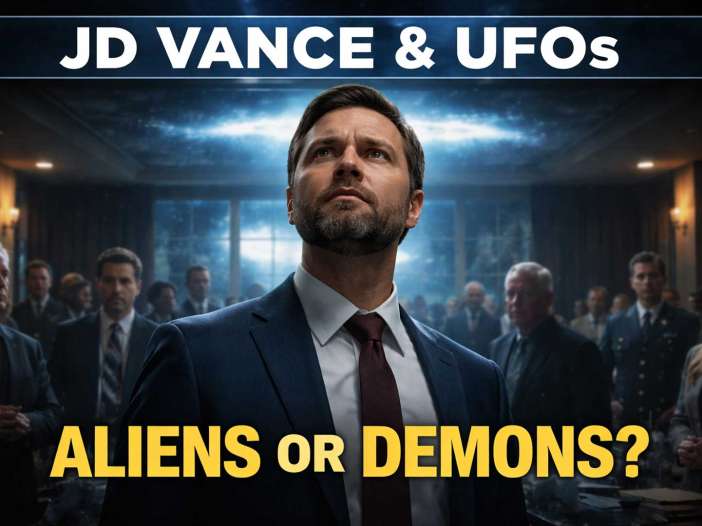
What if JD Vance looked at a UFO and saw Satan with better lighting?
Introduction by Conan O’Brien
Let me start with a confession.
When I first heard that the Vice President of the United States said UFOs might be demons, I thought, “Finally… something in politics I’m qualified to talk about.”
Not policy. Not economics. Demons.
Because once you cross that line—once unidentified flying objects become spiritual adversaries—you’re no longer just debating facts. You’re deciding what kind of reality we live in.
And that’s really what this entire conversation is about.
Across these five discussions, we’ve watched the same strange moment unfold from different angles. A political statement that could have been dismissed as fringe instead opened a much deeper question: when something appears in the sky that we don’t understand, who gets to name it?
Is it the scientist, measuring speed and trajectory?
Is it the theologian, reading patterns of deception and meaning?
Is it the government, deciding what counts as a threat?
Is it the media, shaping how the public reacts?
Or is it the comedian… pointing out that the whole thing sounds like a rejected cartoon episode?
And the uncomfortable answer is: it’s all of them. At the same time.
That’s what makes this moment different. We’re not arguing about evidence alone—we’re arguing about interpretation. About language. About authority. About whether the unknown should be explored… or explained away.
Because the moment you call something a “demon,” you’ve done more than describe it.
You’ve framed it.
You’ve moralized it.
You’ve told everyone how to feel about it.
And once that happens, the conversation changes. It’s no longer “What is this?” It becomes “Which side are you on?”
That shift—from curiosity to certainty—is where things start to get interesting… and a little dangerous.
So tonight, instead of asking whether UFOs are aliens or demons, we’ve been asking something quieter, but far more important:
What happens to a society when mystery becomes a weapon?
(Note: This is an imaginary conversation, a creative exploration of an idea, and not a real speech or event.)
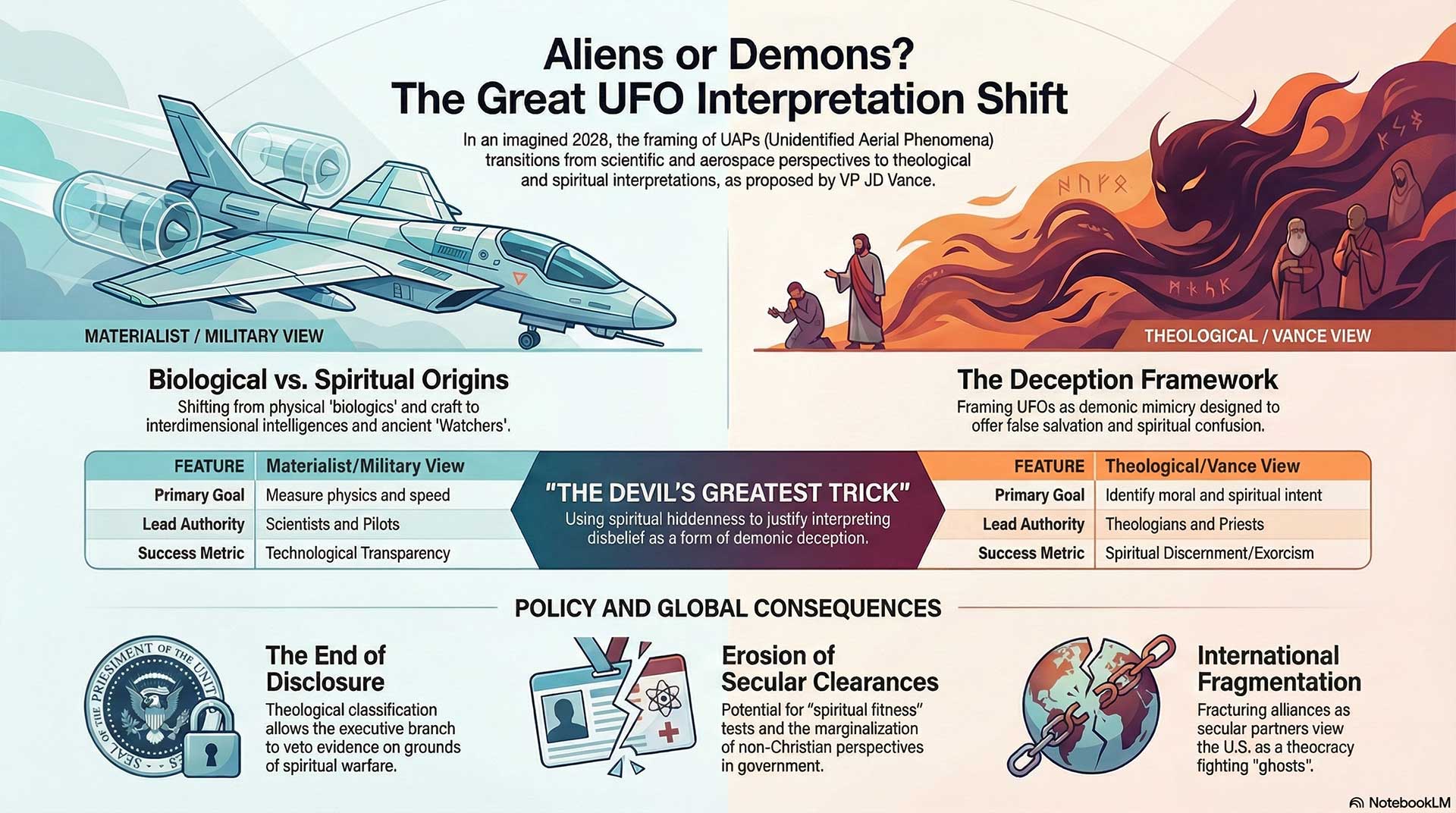
Topic 1: Aliens or Demons? The Theology Behind Vance’s UFO Claim
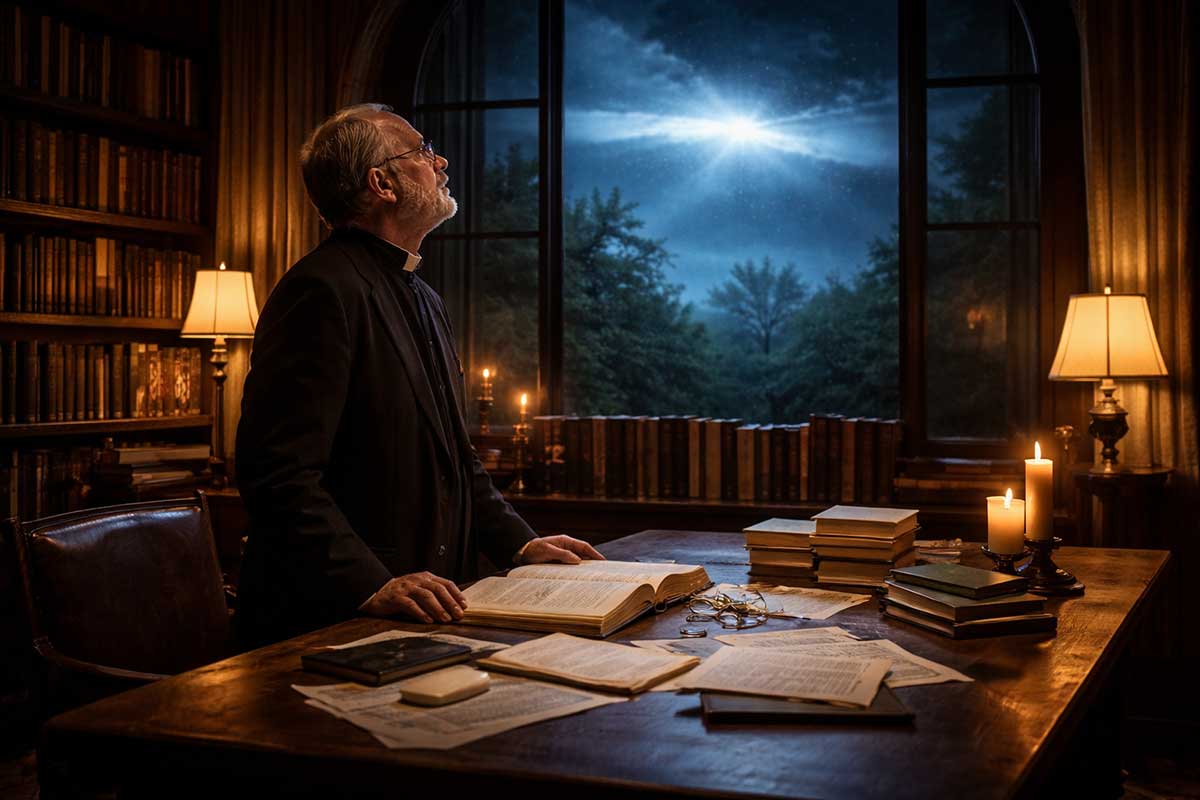
Moderator: Krista Tippett – Host of On Being, theologian, and master of deep, humane dialogue.
Guests: Robert P. George, David Grusch, Elaine Pagels, Michio Kaku, Russell Moore
Opening
Krista Tippett: Welcome. On March 27, 2026, Vice President JD Vance told podcaster Benny Johnson: “I don’t think they’re aliens. I think they’re demons.” He added that the devil’s greatest trick is convincing people he never existed. Tonight, we ask: Is this ancient theology speaking to a modern mystery, or a dangerous category error? Let’s begin.
Question 1: What biblical and theological precedents exist for interpreting “celestial beings” as demons rather than extraterrestrials?
Michio Kaku: Let me start as a physicist: the word “demon” is a placeholder for the unknown. But if we’re honest, the Bible never describes little green men. It describes watchers, sons of God, beings that descend from the heavens, interbreed, and vanish. Genesis 6, Ezekiel’s wheels, Paul’s “principalities and powers” in Ephesians—these aren’t aliens in the sci-fi sense. They’re interdimensional intelligences. Science doesn’t have a box for them yet, so theology calls them demons. That’s not superstition; it’s honesty about the limits of materialism.
Elaine Pagels: I need to push back gently. The “demons” you’re referencing were invented in a very specific political context. In the first three centuries of Christianity, “demons” weren’t just evil spirits—they were the gods of your neighbors, the spirits of the Roman Empire, the powers that demanded worship. Calling something a demon was a way of saying, “This power is not divine; it is deceptive.” So when Vance calls UFOs demons, he’s doing what early Christians did: naming a rival power as illegitimate. But here’s the danger: the Gnostics—my people—would say these “demons” might actually be messengers from a higher God that the church didn’t want you to meet. So the question isn’t “Are they demons?” It’s “Who gets to name them?”
Robert P. George: Elaine, with respect, the Christian tradition isn’t just political labeling. Aquinas, in the Summa Theologica, asks explicitly whether angels can assume bodies and appear to humans. His answer: yes, but they don’t become flesh; they manipulate matter to create apparitions. These are spiritual beings, not biological extraterrestrials. The UFO phenomenon—abductions, hybrid children, messages of universal salvation without Christ—fits the demonic pattern perfectly: mimicry of the divine, promise of secret knowledge (gnosis, interestingly), and denial of the Incarnation. Vance isn’t inventing this; he’s drawing on a metaphysical realism that says reality includes immaterial persons. To dismiss that as superstition is to assume materialism is true—a faith claim, not a scientific one.
Russell Moore: Robert, I’m a Christian, but I’m worried about what happens when we conflate classified military encounters with spiritual warfare. The New Testament warns us against giving the devil too much credit—he’s a deceiver, not an omnipresent bogeyman behind every strange light. When a Vice President says UFOs are demons, what happens to the Jewish, Muslim, Hindu, or atheist pilot who reports a UAP? Are they now a witness to demonic activity? Do we start requiring exorcists in the Pentagon? There’s a pastoral recklessness here. We’re taking a genuine mystery and closing the inquiry with a theological answer that serves a political tribe.
David Grusch: And as someone who’s seen the classified files, I have to say: this theological framing is not just reckless—it’s dangerous. I testified under oath about recovered non-human craft and “biologics.” These are physical objects with physical properties. They crash, they’re analyzed, they’re reverse-engineered. Calling them demons doesn’t make them go away; it just gives cover to those who want to keep the program secret forever. If the Pentagon is hiding technology, the answer isn’t an exorcism—it’s a FOIA request.
Question 2: How does this view reshape U.S. policy if UFOs are classified as spiritual threats instead of national security ones?
David Grusch: Let me be blunt: if UFOs are reclassified as “demonic,” the entire disclosure movement dies. Right now, we have bipartisan bills—UAP Disclosure Acts—demanding transparency on national security grounds. But if the Vice President declares these beings spiritual enemies, suddenly it’s not about technology or aerospace superiority; it’s about spiritual warfare. That moves jurisdiction from Defense to… what, the Department of Homeland Security’s faith-based office? It gives the executive branch a theological veto over evidence. And it terrifies whistleblowers, because now you’re not just leaking secrets; you’re “aiding demons.”
Russell Moore: Exactly. And let’s not forget the First Amendment nightmare. If the U.S. government officially adopts a Christian demonological framework for UAPs, what happens to the Muslim service member who thinks these are jinn? Or the Buddhist who sees them as devas? Or the atheist who sees them as interdimensional physics? We’ve just established a state theology. James Madison is spinning in his grave. The Founders were careful to keep the republic secular not because they hated faith, but because they knew mixing the two corrupts both.
Michio Kaku: Here’s the scientific policy angle: if we call them demons, we stop doing science. We don’t send probes; we send priests. We don’t measure radiation; we bless water. That’s not hyperbole—that’s what happened in the Dark Ages. The beauty of the UAP phenomenon is that it’s forcing us to expand physics. Maybe these beings are from a brane in string theory, maybe they’re post-biological AI, maybe they’re time travelers. But the moment you say “demon,” you’ve shut down inquiry. Policy should be: measure first, name later.
Elaine Pagels: And history shows us what happens when states name spiritual enemies. In the fourth century, when Constantine made Christianity the empire’s religion, “demons” became the gods of rival tribes. Temples were destroyed, philosophers were silenced, all in the name of casting out demons. If the U.S. declares UFOs demonic, what’s next? Are we going to bomb “demonic hotspots”? Are we going to require loyalty oaths to Christ for clearance? This isn’t theology; it’s imperialism with a cross.
Robert P. George: You’re all assuming the worst-case scenario. A policy could acknowledge the possibility of demonic deception without abandoning science or violating the First Amendment. The Pentagon could say: “We are investigating UAPs as physical phenomena. Simultaneously, we recognize that some citizens interpret these events through religious frameworks, and we will not dismiss those interpretations out of hand.” That’s not establishment; that’s pluralism. And it’s honest. If a pilot sees something that defies physics and feels an overwhelming sense of malevolence, that’s data. Ignore it at your peril.
Question 3: Does framing UFOs as demonic empower or endanger religious minorities and non-believers in government?
Russell Moore: It endangers them. Full stop. I’m an evangelical Christian, and I believe in demons. But I also believe in a republic where a Jewish general doesn’t have to wonder if his report of a UAP will be read as “evidence” or “heresy.” When the Vice President speaks, he speaks for 330 million people, not just his Catholic base. If he says UFOs are demons, he’s telling every non-Christian in the military that their worldview is secondary. That’s not empowerment; that’s spiritual coercion.
Robert P. George: Russell, I think you’re overstating the coercion. No one is being forced to exorcise a UFO. But let’s be honest: the secular assumption that religion is private and irrelevant is itself a form of coercion against believers. If a Catholic pilot thinks a UAP is demonic, why should he be told to silence that intuition? Pluralism means making space for religious interpretations, not banishing them to the private sphere. The danger isn’t in acknowledging demons; it’s in pretending that only materialist explanations are legitimate in public discourse.
Elaine Pagels: But Robert, power always decides which “demons” are real. In the second century, Christians were accused of summoning demons because they wouldn’t worship the emperor. Now, Christians are in power, and they’re naming other people’s experiences as demonic. That’s the cycle. If a Hindu soldier sees a UAP as Vishnu’s vehicle, or a Native American sees it as a spirit messenger, will their reports be treated equally? Or will only the Christian demonological frame count? History says the latter.
David Grusch: And meanwhile, the actual evidence—the metal alloys, the infrared tracks, the biological samples—gets buried under theological debate. I’ve talked to pilots who are terrified not because they think they saw Satan, but because they saw technology 50 years ahead of ours. By framing this as a spiritual war, we distract from the real scandal: that a black-budget program has been lying to Congress for 80 years. Whether it’s demons or aliens or interdimensional tourists, the American people deserve the truth. And theology is not a substitute for transparency.
Michio Kaku: Let me end with this: the universe is 13.8 billion years old. We are a young species on a tiny rock. To assume that any intelligence we meet will fit neatly into our medieval categories of “angel” or “demon” is breathtakingly arrogant. Maybe they’re neither. Maybe they’re something we don’t have words for yet. The best policy is humility: study the phenomenon, protect the witnesses, and keep theology as a personal interpretation, not a state doctrine. Otherwise, we’re not just endangering minorities—we’re endangering the future of human knowledge.
Closing
Krista Tippett: We began with a Vice President’s claim that UFOs are demons. We’ve heard that this is either ancient wisdom speaking truth to materialist arrogance, or a dangerous fusion of theology and state power that could silence dissent and bury evidence. Perhaps the real lesson is this: when the heavens speak, we must listen with both our instruments and our souls—but never confuse our names for the mystery with the mystery itself. Thank you.
Topic 2: The Devil’s Trick – Why Vance Says Satan Wants Us to Doubt Him

Moderator: Ezra Klein – New York Times columnist, podcaster, and master of dissecting the intersection of belief, politics, and psychology.
Guests: Benny Johnson, Reza Aslan, Katherine Stewart, Rod Dreher, Paul Bloom
Opening
Ezra Klein: Welcome. Vice President JD Vance didn’t just call UFOs demons. He added this: “One of the devil’s greatest tricks is convincing people he never existed.” That line sounds familiar—it’s often attributed to C.S. Lewis, though he never actually wrote it. Tonight, we ask: Where does this idea come from? Why does it resonate so powerfully in 2026? And what happens to democracy when leaders treat disbelief in Satan as itself a demonic deception? Let’s begin.
Question 1: Where does the idea that “the devil’s greatest trick is convincing people he doesn’t exist” come from—and is it actually in the Bible?
(Randomized Order: Reza Aslan → Paul Bloom → Benny Johnson → Rod Dreher → Katherine Stewart)
Reza Aslan: Let’s start with the quote itself: it’s not in the Bible. It’s not in C.S. Lewis. It first appears in the 1995 movie The Usual Suspects, spoken by Keyser Söze. Yet millions of Christians believe it’s Lewis or Scripture. That’s ironic, because the Bible’s Satan is not a hidden trickster; he’s a roaring lion, an accuser, a very present adversary. In Job, he’s in God’s court. In the Gospels, he tempts Jesus openly. The idea of a stealthy Satan who wins by making people doubt his existence is a modern invention—a Hollywood theology that’s now more influential than Aquinas.
Paul Bloom: And from a cognitive science perspective, that’s exactly why it stuck. Humans are hyper-active agency detectors. We evolved to assume that rustling grass is a predator, not the wind. Belief in invisible agents—gods, ghosts, demons—is the default setting of the human brain. So the idea of a hidden devil is actually more cognitively natural than an overt one. It fits our conspiracy-detection module perfectly: the real danger isn’t the monster you see; it’s the one pulling strings you can’t perceive. Vance’s line works because it hacks that intuition.
Benny Johnson: But Ezra, with respect to Professor Aslan, just because the exact quote isn’t in Lewis doesn’t mean the idea isn’t biblical. 2 Corinthians 4:4 says the “god of this world has blinded the minds of unbelievers.” Ephesians 6 talks about “spiritual forces of evil in the heavenly realms.” That’s deception. That’s hiddenness. JD isn’t quoting a movie; he’s naming a reality that secular elites have spent 200 years trying to erase. The devil doesn’t need horns and a pitchfork; he just needs you to think he’s a fairy tale so you lower your guard. That’s not Hollywood; that’s spiritual warfare 101.
Rod Dreher: And let’s not forget the philosophical lineage here. Even if the quote is apocryphal, the insight is deeply Christian. Augustine wrote about evil as a privatio boni—a privation of good, a absence that works by subtraction. Nietzsche said God is dead, but he meant that we killed Him by ignoring Him. The devil’s greatest victory isn’t a fiery apocalypse; it’s a slow secular drift where people forget that evil is a personal force, not just a sociological condition. Vance is pushing back against that amnesia. He’s saying: evil is real, it has a name, and it’s laughing at our disbelief.
Katherine Stewart: But Rod, that’s precisely the danger. When you say “evil has a name,” you get to decide who bears that name. In the 17th century, it was witches. In the 19th, it was Catholics or Jews. In the 20th, it was communists. Now, in Vance’s America, it’s anyone who denies his theological framework. This isn’t ancient wisdom; it’s a power move. The quote’s popularity isn’t about truth; it’s about utility. It’s a way of saying, “If you doubt me, you’re playing into Satan’s hands.” That’s not theology; that’s thought-stopping cliché.
Question 2: How has this belief shaped conservative Christian politics from Reagan to Trump to Vance?
(Randomized Order: Katherine Stewart → Rod Dreher → Reza Aslan → Paul Bloom → Benny Johnson)
Katherine Stewart: It’s been the engine of Christian nationalism for 40 years. Reagan didn’t talk much about demons, but he did call the Soviet Union an “evil empire”—a theological label, not a political one. That opened the door. Then the “spiritual mapping” movement in the 90s taught pastors to identify territorial demons over cities. Fast-forward to Trump: he didn’t know his Bible, but his advisers did. They framed his presidency as a battle against demonic forces—globalists, deep staters, Marxists. Now Vance completes the arc: the enemy isn’t just political; it’s literally satanic. This isn’t evolution; it’s escalation. Each generation raises the stakes because the previous one’s demons didn’t pan out.
Rod Dreher: Katherine, you’re describing abuse, not the belief itself. Yes, Christians have misused demon-talk for political gain. But the core insight—that secular liberalism is a spiritual deception—is correct. Reagan saw the USSR as evil not because he was power-hungry, but because he believed communism denied the soul. Trump’s supporters didn’t follow him because they thought he was holy; they followed him because he was a hammer against a system that mocked their faith. Vance is just more honest about the metaphysics: if you deny God, you open the door to something worse. That’s not nationalism; that’s orthodoxy.
Reza Aslan: But Rod, orthodoxy for whom? Reagan’s “evil empire” was a geopolitical rival. Trump’s “deep state” was a bureaucratic inconvenience. Vance’s “demons” are now a metaphysical category that includes UFOs. This is mission creep. In Islam, we have jinn—beings made of smokeless fire who can be good or evil. But even we don’t put the President in charge of identifying them. What’s happening in American Christianity is a fusion of apocalypticism and state power that would terrify the Founders. You’re not just voting for a candidate; you’re enlisting in a cosmic war. And in cosmic wars, there are no loyal oppositions—only heretics.
Paul Bloom: And psychologically, this is incredibly effective politics. If your opponent is not just wrong but demonic, then compromise is collaboration with evil. Negotiation is surrender. That’s why polarization is so intractable. It’s not that Americans can’t agree on tax policy; it’s that one side increasingly believes the other side is literally possessed. Vance’s UFO comment isn’t a gaffe; it’s a logical endpoint. Once you’ve called your political enemies demons, why not call actual unknown phenomena demons too? It’s all the same cognitive move: name the unknown as evil, and you justify any action against it.
Benny Johnson: But Paul, that’s the secular fear talking. If evil is real, then yes, some people are doing the devil’s work. Not because they’re possessed in a Exorcist sense, but because they’re promoting lies that destroy souls. Abortion, euthanasia, the erasure of biological sex—these aren’t policy disagreements; they’re demonic strongholds. JD isn’t inventing this; he’s channeling what millions of Christians feel in their bones. The difference is, he’s finally saying it out loud. And the backlash proves his point: the world wants to pretend the devil isn’t real because then they don’t have to fight him.
Question 3: What happens to democratic discourse when leaders treat political opponents as literally demonic?
(Randomized Order: Paul Bloom → Benny Johnson → Katherine Stewart → Reza Aslan → Rod Dreher)
Paul Bloom: You get a democracy that can’t function. Deliberation requires the assumption that your opponent is acting in good faith, even if misguided. If you believe they’re agents of Satan, then democracy is just war by other means. We’re already seeing this: January 6 wasn’t just an insurrection; it was an exorcism attempt in the minds of some participants. They weren’t storming the Capitol; they were storming Satan’s stronghold. When leaders like Vance validate that framework, they’re not just speaking theology; they’re loading a gun and handing it to people who think they’re doing God’s work.
Benny Johnson: That’s a grotesque caricature. No one is calling for violence against Democrats because they’re demons. What we’re saying is that the ideas are demonic—destructive, deceptive, soul-killing. There’s a difference between hating the sin and loving the sinner. JD loves his liberal neighbors; he just thinks their worldview is leading them to hell. That’s not undemocratic; that’s evangelism. If you can’t make moral judgments in politics, then what’s the point of voting? It’s just bean-counting.
Katherine Stewart: But Benny, when the Vice President says UFOs are demons, he’s not just making a moral judgment; he’s defining reality for 330 million people. And in that reality, anyone who disagrees is either deceived or deceiving. We’ve already seen the fruits: Christian nationalists in school boards calling transgender kids “demon-possessed.” Militia groups praying over ballot boxes. This isn’t hyperbole; it’s the logical outcome of demonizing discourse. You can’t have a pluralistic society when one side believes the other side is literally in league with Satan. Pluralism requires epistemic humility, and demon-talk is the opposite of humility.
Reza Aslan: And let’s be honest: this isn’t unique to Christianity. Every fundamentalist movement does this. In Iran, the U.S. is “Great Satan.” In ISIS theology, Shia Muslims are apostates possessed by jinn. The structure is identical: name your enemy as demonic, and violence becomes sacramental. America has been exceptional because we resisted this. The Founders knew that mixing theology and politics corrupts both. Now, with Vance, we’re normalizing what every theocracy does. The question isn’t whether demons exist; it’s whether a republic can survive when its second-highest officer believes political opposition is spiritual warfare.
Rod Dreher: But Ezra, Reza, Katherine—you’re assuming that secular liberalism is neutral. It’s not. It’s its own theology, with its own dogmas (autonomy, expressivism, materialism) and its own heresies (biological realism, religious exclusivism). When Christians call it demonic, they’re not being intolerant; they’re naming what they see as a rival gospel. Yes, this makes democracy harder. But democracy was never meant to be a suicide pact. If liberalism demands that Christians pretend evil isn’t real in order to keep the peace, then the peace isn’t worth keeping. Better a contentious republic than a complacent hell.
Closing
Ezra Klein: We began with a quote that isn’t in the Bible or C.S. Lewis, yet has become a cornerstone of Vice President Vance’s worldview. We’ve heard that this is either a necessary reminder that evil is personal and deceptive, or a dangerous rhetorical weapon that turns politics into holy war. Perhaps the real trick isn’t the devil’s—it’s ours. We convince ourselves that our names for evil are the same as evil itself, and in doing so, we become the deceivers we claim to fight. Thank you.
Topic 3: Area 51 to Exorcism – What If the Pentagon’s UFO Files Are Demon Files?
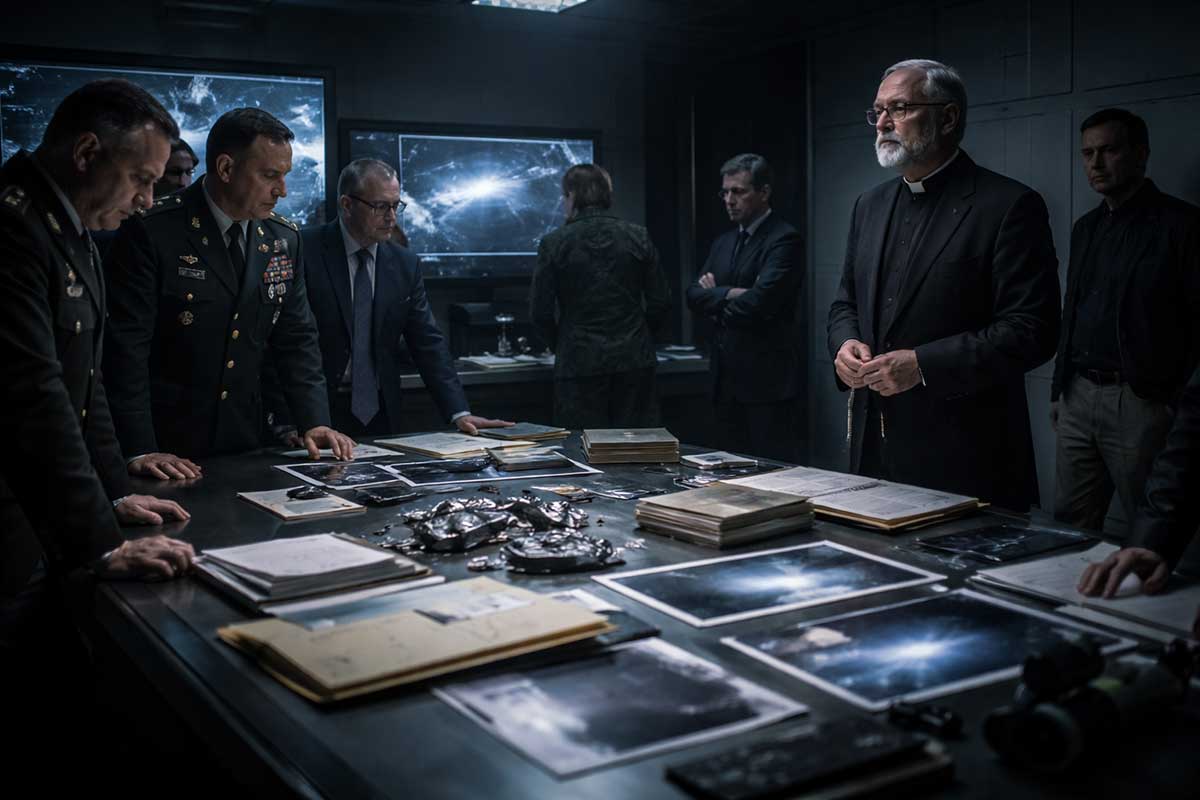
Moderator: Jane Mayer – New Yorker investigative journalist, author of Dark Money, and expert on the intersection of classified power and ideological belief.
Guests: Christopher Mellon, Father Gabriele Amorth (represented by Vatican scholar Dr. Sofia Bianchi), Elisabeth Bumgarten, Philip Almond, Tulsi Gabbard
Opening
Jane Mayer: Welcome. If Vice President JD Vance is right—that UFOs are demons—then the Pentagon’s UAP task force isn’t investigating aerospace anomalies; it’s cataloging demonic manifestations. The AATIP files, the 2017 Navy videos, David Grusch’s testimony about “biologics”—all of it would shift from national security to spiritual warfare. Tonight, we ask: What would that policy look like? Who would be in charge? And what happens to democracy when exorcists sit alongside generals? Let’s begin.
Question 1: What would a “demonic threat assessment” look like compared to a standard UAP investigation?
Philip Almond: Historically, a demonic threat assessment looks a lot like a witch trial. You start with a presumption of malevolence, then you look for signs: unusual behavior, physical marks, testimonies of witnesses who felt “oppression.” The difference with UFOs is that the “marks” are radiation burns, missing time, and hybrid children. But the logic is identical: an invisible intelligence is interfering with human beings, and the goal isn’t to understand it—it’s to expel it. A standard UAP investigation asks, “What is this?” A demonic assessment asks, “How do we make it leave?”
Christopher Mellon: And that’s precisely why this framing is so dangerous. As former Assistant Secretary of Defense for Intelligence, I can tell you: UAP task forces are built on empirical data—radar tracks, infrared signatures, pilot testimonies. We don’t care if it’s an alien, a drone, or a demon. We care if it can outfly an F-35 and penetrate our airspace. The moment you say “demon,” you’ve shifted from measurement to metaphysics. You’re no longer asking engineers to analyze alloys; you’re asking priests to bless water. That’s not a threat assessment; it’s a surrender of inquiry.
Dr. Sofia Bianchi: But Christopher, the Church has been doing “threat assessments” for 2,000 years, and they’re more rigorous than you think. The Vatican’s exorcism protocols require medical and psychological evaluation first—rule out natural causes, then proceed. A demonic UAP assessment would follow the same steps: Is there a physical craft? Yes. Does it defy known physics? Yes. Do witnesses report psychological oppression, dread, or spiritual messages contrary to Christ? Then it may be demonic. The difference is, the Church doesn’t try to reverse-engineer the demon. It tries to command it in the name of God. That’s not surrender; it’s a different epistemology.
Elisabeth Bumgarten: And yet, Sofia, the people I’ve interviewed at AATIP—pilots, intelligence officers—aren’t reporting spiritual oppression. They’re reporting frustration. Frustration that their sightings are classified, that their data is buried, that they’re called liars. If you tell a Navy pilot that the object he chased for 12 minutes is a demon, he’s not going to feel liberated; he’s going to feel silenced. Because now his testimony isn’t evidence; it’s a spiritual anecdote. And anecdotes don’t get funding. They get prayed over.
Tulsi Gabbard: But let’s not dismiss the spiritual dimension so quickly. As someone who served on the Intelligence Committee, I’ve seen classified briefings where the data was so anomalous that material explanations failed. If a craft can instantaneously accelerate to Mach 5 without a sonic boom, maybe it’s not bound by our physics. And if it’s not bound by physics, why assume it’s bound by our categories of “alien” vs. “demon”? A hybrid assessment would say: measure the craft, but also interview the witness about what they felt. Fear, dread, malevolence—those are data points too. Ignore them, and you’re blind to half the phenomenon.
Question 2: Could classifying UFOs as demons justify new religious tests for intelligence clearance?
Tulsi Gabbard: It already is happening, quietly. If the Vice President declares UFOs demonic, then anyone working on UAP files will be expected to understand demonic theology. That doesn’t mean a formal “Do you believe in Satan?” test, but it means promotion will favor those who share the administration’s worldview. A Hindu analyst who says this is Vishnu’s vimana, or an atheist who says it’s interdimensional physics, will be seen as “not taking the threat seriously.” That’s a soft religious test, and it’s unconstitutional. But it’s also invisible, because it’s framed as “judgment” and “discernment,” not doctrine.
Elisabeth Bumgarten: And Jane, I’ve already seen this in the Trump era. Officials who didn’t share the “America First” worldview were sidelined as disloyal. Now imagine that with theology. If UAPs are demons, then loyalty to the mission means loyalty to the theological frame. You’ll see clearance reviews asking about “spiritual fitness.” You’ll see chaplains embedded in UAP task forces. And whistleblowers like David Grusch won’t just be called traitors; they’ll be called tools of deception. That’s not speculation; that’s the logical endpoint of Vance’s claim.
Philip Almond: History is clear on this: when states adopt a religious definition of the enemy, religious minorities become suspects. In 16th-century Spain, if you were a Jewish convert, you were always under suspicion of secretly practicing Judaism. In 17th-century Salem, if you were a woman who lived alone, you were a witch. In 2026 America, if you’re a Muslim service member who says UAPs are jinn, or a Buddhist who says they’re devas, you’ll be seen as sympathetic to the demonic. The test won’t be on paper; it’ll be in the culture. And cultures purge faster than laws.
Dr. Sofia Bianchi: But Philip, the Church’s exorcists are not Inquisitors. The Vatican’s guidelines explicitly say: do not assume demonic activity without ruling out natural causes. A Catholic analyst could absolutely work on UAP files without imposing their faith. The danger isn’t in believers being involved; it’s in believers being the only ones involved. If the administration says, “Only Christians who affirm demonic UAPs can have clearance,” that’s heresy, not orthodoxy. The Church itself would oppose that. But yes, if politics fuses with theology, minorities will suffer. That’s not faith’s fault; that’s power’s fault.
Christopher Mellon: And that’s the rub. The Pentagon’s clearance system is already broken—overclassified, politicized, opaque. Add demonology to the mix, and you’ve got a recipe for paranoia. Imagine a briefing where a general says, “This UAP exhibited demonic characteristics,” and a junior officer says, “Sir, with respect, that’s not a scientific category.” That officer is now suspect. Not because they’re incompetent, but because they’re spiritually unreliable. That’s not national security; that’s a theocracy with a nuclear arsenal.
Question 3: How would allies (and adversaries) react if the U.S. officially declared UFOs a spiritual warfare issue?
Dr. Sofia Bianchi: Allies would be divided. Catholic Poland, Hungary, maybe Brazil—they might collaborate, sharing exorcism protocols alongside radar data. But secular NATO allies—Germany, France, Canada—would see this as American madness. Imagine a joint task force where the U.S. wants to pray over a recovered craft, and the Germans want to run spectroscopy. The alliance would fracture. And adversaries? Russia and China would laugh. They’d say, “The Americans are so decadent they’re fighting ghosts.” Then they’d steal the technology while we’re busy blessing water.
Philip Almond: And let’s not forget the Global South. In Africa, Latin America, and Asia, Pentecostal and Charismatic Christians already see demons everywhere. If the U.S. validates that worldview, you’ll see a surge in “UAP exorcisms” in those countries. But you’ll also see backlash from Muslim-majority nations, where jinn are real but not necessarily evil. Iran might say, “Your demons are our jinn; you’re mislabeling them.” China, which is officially atheist, would use this to paint the U.S. as a failed state ruled by superstition. Soft power evaporates when you declare war on invisible enemies.
Tulsi Gabbard: But Jane, adversaries already use spiritual narratives. Russia frames its war in Ukraine as a battle against Satanic Western decadence. China suppresses religions it sees as demonic cults. If the U.S. declares UFOs demonic, we’re not inventing this; we’re entering a game others are already playing. The question is: do we play it honestly, or do we pretend our spiritual claims are neutral? Maybe there’s an opportunity here. If the U.S. says, “We see this as spiritual, but we respect your framework,” could that build bridges? Or is it too late?
Christopher Mellon: It’s too late for that kind of nuance, Tulsi. Once the Vice President says “demons,” the meme is global. Adversaries won’t see nuance; they’ll see weakness. China’s propaganda will run loops: “American leaders are so irrational they blame aliens on Satan.” And our own pilots will lose credibility. When a French pilot reports a UAP, he’ll be asked, “Did you call a priest?” That’s not hyperbole; that’s how the world sees us. And in a great-power competition, perception is reality. If we look like a theocracy, we’ll be treated as one—unpredictable, ideological, and untrustworthy.
Elisabeth Bumgarten: And meanwhile, the real story—the possibility that a non-human intelligence has been interacting with Earth for decades—gets buried under culture-war noise. I’ve spent years reporting on AATIP, and the most frustrating part isn’t the secrecy; it’s the trivialization. Every time a politician makes a grand claim—aliens! demons! cover-ups!—the serious researchers roll their eyes and walk away. If the U.S. goes full demon, the best scientists will leave the program. And then who’s left? True believers and careerists. That’s not a task force; that’s a cult.
Closing
Jane Mayer: We began with a hypothetical: what if the Pentagon’s UFO files are demon files? We’ve heard that this would transform threat assessments into exorcisms, turn security clearances into religious tests, and fracture alliances while emboldening adversaries. Perhaps the real danger isn’t that demons are real—it’s that humans are too eager to name the unknown as evil, and then wage war on their own invention. Thank you.
Topic 4: From Hillbilly Elegy to Hellish Elegy – How Vance’s Conversion Shaped His UFO View
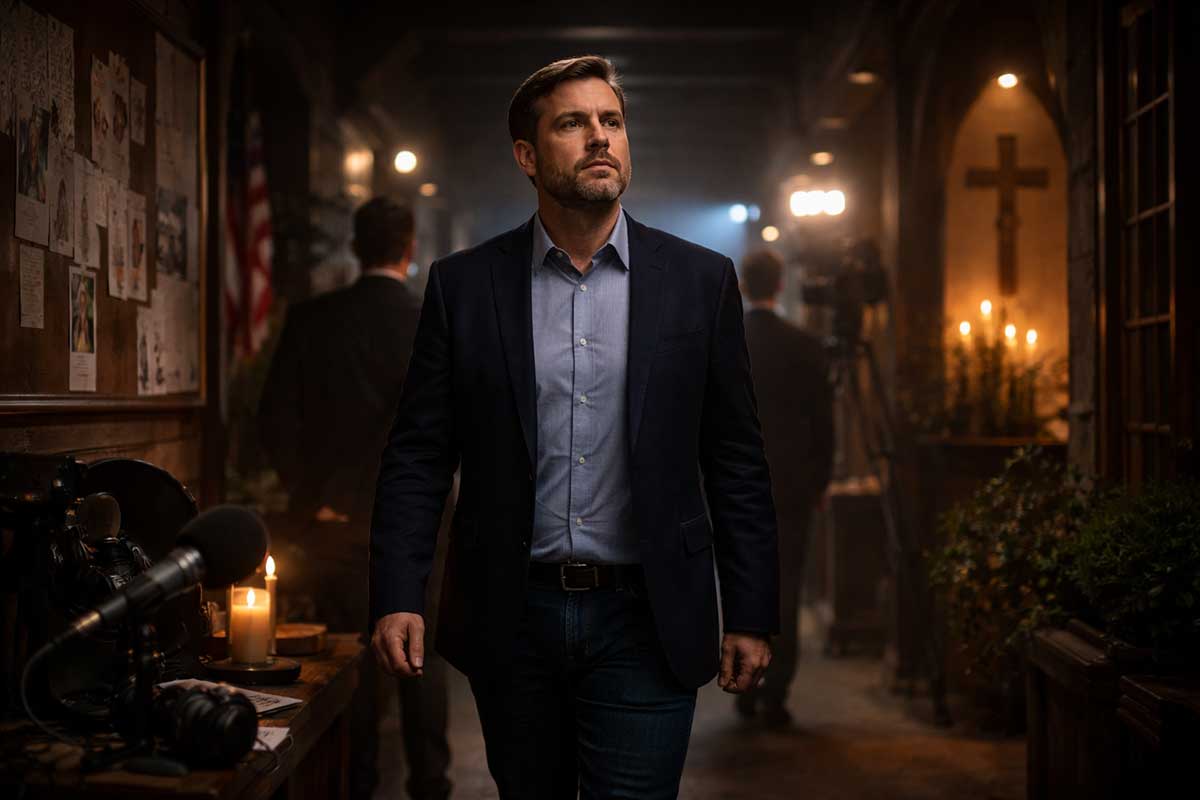
Moderator: David Brooks – New York Times columnist, cultural critic, and observer of the American soul’s journey through faith, politics, and identity.
Guests: J.D. Vance (imagined), Ross Douthat, Anne Applebaum, Alex Jones, Sohrab Ahmari
Opening
David Brooks: Welcome. In 2016, J.D. Vance published Hillbilly Elegy, a memoir of Appalachian dysfunction, secular despair, and escape through the Marine Corps and Yale Law. In 2026, as Vice President, he tells podcaster Benny Johnson: “I don’t think they’re aliens. I think they’re demons.” Between those two statements lies a conversion: from atheist to Catholic, from skeptic to believer in spiritual warfare. Tonight, we ask: Is this sincerity or strategy? Did faith illuminate Vance’s vision, or did politics colonize his faith? And what does this arc tell us about the soul of the New Right? Let’s begin.
Question 1: How did Vance’s journey from atheist to Catholic convert lead him to demon-focused UFO theories?
Ross Douthat: J.D.’s conversion wasn’t a sudden flash; it was a slow burn. He wrote about it in Hillbilly Elegy’s later chapters: the emptiness of secular success, the pull of tradition, the influence of thinkers like René Girard and Patrick Deneen. Catholicism gave him a metaphysical realism that atheism couldn’t: evil is real, virtue is hard, and the universe is enchanted, not disenchanted. But here’s the tension: traditional Catholicism is cautious about demons. It requires evidence, discernment, humility. J.D.’s leap to “UFOs are demons” feels more like a fusion of Catholic metaphysics with MAGA conspiratorialism. It’s not Aquinas; it’s Alex Jones with a rosary.
J.D. Vance (imagined): David, with respect, that’s a caricature. My conversion wasn’t about finding comfort; it was about facing reality. I saw the opioid epidemic tear through my hometown. I saw families destroyed not by economics alone, but by a spiritual vacuum. When you stare into that abyss long enough, you stop pretending evil is just “systemic.” It’s personal. And when I saw the UAP videos—objects defying physics, pilots reporting dread—I didn’t see aliens. I saw a pattern: deception, hybridity, false salvation. That’s not Alex Jones; that’s Genesis 6. Catholicism didn’t make me credulous; it made me honest about what materialism can’t explain.
Anne Applebaum: But J.D., that honesty is selective. You see demons in UFOs, but not in the authoritarian leaders you enable. You see spiritual warfare in the heavens, but not in the disinformation campaigns that undermine democracy. Your conversion gave you a language for evil, but you’ve applied it only to your enemies, not your allies. That’s not discernment; it’s tribalism with a theological gloss. And it’s a pattern we’ve seen before: in 1930s Europe, conservatives fused Christianity with nationalism, called their enemies demonic, and paved the way for dictatorship. Your “honesty” looks suspiciously like propaganda.
Sohrab Ahmari: Anne, that’s a cheap shot. J.D.’s point is that liberalism pretends evil isn’t real, or reduces it to “misinformation” and “inequality.” But if you’re a Catholic convert, you know evil has a name. The UFO phenomenon—abductions, messages of universal salvation without Christ, hybrid children—fits the demonic template perfectly. Is it possible J.D. is wrong? Yes. But the reflexive secular dismissal—“it’s just plasma” or “it’s just drones”—is also a faith claim. At least J.D. is willing to name the mystery, even if it costs him elite approval.
Alex Jones: And let me say this: J.D. is finally saying what we’ve been saying for 30 years! The elites laugh at us, call us conspiracists, but who’s laughing now? The Pentagon admits UAPs are real. Grusch testifies about biologics. And J.D. has the courage to say: “This isn’t from another planet; it’s from another kingdom.” That’s not tribalism; that’s truth. The devil doesn’t care if you’re left or right; he cares if you’re asleep. And J.D. just woke up America.
Question 2: What role do Alex Jones, Benny Johnson, and the New Right media ecosystem play in amplifying these ideas?
Alex Jones: We’re not amplifying; we’re reporting. Mainstream media won’t touch this stuff. They called me a lunatic for saying the government was hiding UFO tech. Now David Grusch is under oath saying the same thing. Benny Johnson asked J.D. the question no one else would: “What do you really think?” And J.D. answered. The New Right ecosystem isn’t a echo chamber; it’s a counter-reformation. We’re digging up truths the deep state buried. If that makes us amplifiers, then guilt as charged.
Sohrab Ahmari: But Alex, there’s a difference between digging up truths and creating a feedback loop of paranoia. Yes, the mainstream media ignores real scandals. But the New Right media also has an incentive to keep the outrage furnace stoked. If every UAP is a demon, and every demon is a liberal plot, then you never have to engage with evidence. You just name and shame. That’s not counter-reformation; it’s content farming. J.D. is smarter than that. He shouldn’t let his theology be dictated by podcast algorithms.
Ross Douthat: And here’s the irony: Alex Jones spent decades mocking Catholics as papist idolaters. Now J.D. is vice president, and Alex is claiming him as a convert to conspiracy Christianity. That’s not alliance; it’s appropriation. The New Right media ecosystem is a paradox: it gave J.D. a platform, but it also trapped him. If he walks back the demon claim, he’s a sellout. If he doubles down, he’s a fanatic. The media ecosystem doesn’t want nuance; it wants war. And J.D. is now the general whether he likes it or not.
J.D. Vance (imagined): Ross, I’m not trapped. I chose these allies because they asked the hard questions. Benny didn’t edit my answer; he let it breathe. Alex may be abrasive, but he’s been right about more than the elites want to admit. But let’s be clear: I’m not Alex Jones. I don’t think every UFO is a demon, and I don’t think every liberal is possessed. What I said was specific: the pattern of deception fits the demonic. That’s not paranoia; it’s pattern recognition. And if the New Right media amplifies that, good. Maybe America needs to be unsettled.
Anne Applebaum: But J.D., that’s exactly how it starts. In 1920s Germany, conservatives said they were just “naming realities” about Jewish influence. In 1950s America, McCarthy said he was just “naming communists.” The pattern is always the same: take a grain of truth (yes, there are UAPs; yes, there were communists), wrap it in a theological or ideological frame (demons, globalists), and then use it to purge enemies. The New Right media isn’t amplifying your ideas; it’s weaponizing them. And once weaponized, you can’t control the target.
Question 3: Does this belief make Vance more or less credible as a future presidential candidate?
Anne Applebaum: Less credible, dramatically. In a general election, swing voters don’t want a president who sees demons in the sky. They want someone who can fix inflation, keep the peace, and govern a pluralistic society. J.D.’s claim alienates not just atheists, but Jews, Muslims, Hindus, and even mainstream Christians who see this as superstition. It makes him look unserious on national security. If a craft penetrates our airspace, do we scramble jets or priests? That’s not a question a commander-in-chief should leave ambiguous. It’s a disqualifier.
J.D. Vance (imagined): Anne, that’s the elite bubble talking. In Ohio, in Pennsylvania, in Wisconsin, people don’t care if I call them demons or aliens. They care that I see the world as it is: mysterious, dangerous, and spiritual. They’re tired of leaders who pretend evil is a policy error. And let’s not forget: Reagan was called crazy for calling the USSR an “evil empire.” Now we see he was right. Maybe in 10 years, when the UAP truth is out, people will say J.D. was brave, not crazy. Credibility isn’t about pleasing the New York Times; it’s about telling the truth.
Alex Jones: And let me add: the elites said Trump was unelectable. They said Brexit was impossible. They said COVID lab leak was a conspiracy. Now look. J.D. is tapping into a deeper current: Americans are spiritually hungry, and they’re tired of being lied to. If he doubles down on this, he won’t lose votes; he’ll gain a movement. The silent majority doesn’t want a technocrat; they want a truth-teller. And J.D. just became one.
Ross Douthat: But Alex, movements aren’t enough. You need coalitions. J.D. could lose suburban Catholics who see this as fringe. He could lose evangelical allies who think UFOs are a distraction from the Gospel. And he could lose independents who just want a president who won’t embarrass America on the world stage. The question isn’t whether the claim is true; it’s whether it’s politically wise. Reagan’s “evil empire” worked because it was about a geopolitical rival, not a metaphysical mystery. J.D. has conflated the two. That’s not courage; it’s confusion.
Sohrab Ahmari: Or maybe it’s prophetic. Maybe the suburbs are already lost to liberalism, and the only path is to energize the working-class believers who feel abandoned by both parties. If J.D. frames this as “the elites laugh at your faith, but I don’t,” he could build a coalition that transcends left and right. Yes, it’s risky. But safe politics is how conservatives lose. Sometimes you have to gamble on truth, even if the Times calls you crazy.
Closing
David Brooks: We began with a convert’s journey from secular despair to spiritual warfare. We’ve heard that this is either a courageous naming of reality or a dangerous fusion of faith and factionalism. Perhaps the real elegy isn’t hellish or hillbilly—it’s the loss of a public square where believers and skeptics can wonder together without weaponizing the mystery. Thank you.
Topic 5: South Park Got It Right? Satire, Satan, and the JD Vance Moment
Moderator: Conan O’Brien – Late-night legend, Harvard graduate, and master of using absurdity to expose truth, equally comfortable mocking power and probing its roots.
Guests: Trevor Noah, Matt Stone (imagined), Olivia Beavers (The Theological Comic), Chauncey DeVega, John Inazu
Opening
Conan O’Brien: Welcome. In August 2025, South Park aired an episode where Vice President JD Vance tries to rub baby oil on Satan, seduces President Trump, and turns the White House into a demonic frat house. Seven months later, the real JD Vance tells America that UFOs are demons. Did South Park predict the future, or did they just write the most accurate documentary of our time? Tonight, we ask: Does satire disarm dangerous ideas by making them laughable, or does it normalize them by making them familiar? And what does it say about America that our Vice President’s theology is indistinguishable from a cartoon? Let’s begin.
Question 1: How has South Park’s depiction of Vance and Satan shaped public perception of his beliefs?
Matt Stone (imagined): Conan, we didn’t set out to predict anything. We just looked at JD’s trajectory: convert, culture warrior, UFO demonologist. We thought, “What’s the most absurd version of this?” Turns out, the absurd version is just Tuesday. The episode works because JD already sees the world in cosmic terms—good vs. evil, God vs. Satan. We just gave Satan a speaking role and a moisturizing routine. The public perception now is that JD’s beliefs are so extreme they’re already parody. That’s not our fault; that’s his.
Chauncey DeVega: But Matt, that’s the danger. When you turn a Vice President into a cartoon villain, you make him seem harmless. People laugh at the baby oil joke, but they don’t stop to ask: “Wait, this man actually believes demons are influencing national security?” Satire becomes a sedative. It lets liberals feel superior without engaging the real threat: a theocratic nationalism that’s growing more powerful by the day. South Park didn’t expose JD; it domesticated him.
Trevor Noah: I see it differently. I grew up Pentecostal in South Africa. We talked about demons constantly. So when JD says UFOs are demons, I don’t laugh; I recognize the code. South Park didn’t make JD look harmless; they made the language of demonology look ridiculous. And that’s useful. Because when a leader starts naming political enemies as demons, satire is the only weapon left. You can’t argue with apocalypticism; you can only mock it until it deflates.
Olivia Beavers: As a Christian comedian, I’ll say this: satire is a double-edged sword. Yes, it can expose hubris. But it can also harden hearts. If believers watch South Park and feel mocked, they don’t leave thinking, “Maybe I’m wrong.” They leave thinking, “The world hates us.” That fuels the very persecution complex that makes demon-talk appealing in the first place. JD’s base doesn’t see the episode as critique; they see it as proof that the elites are scoffers, just like in the Bible. So the satire backfires.
John Inazu: And legally, there’s a deeper issue. When satire becomes the primary lens through which we view a Vice President’s religious beliefs, it chills free exercise. If every sincere theological claim is met with a South Park meme, believers learn to keep their faith private. That’s not the robust pluralism the First Amendment promises. It’s a soft censorship where ridicule does what laws cannot: silence religious voices from public discourse.
Question 2: Does satire disarm dangerous ideas—or normalize them by making them laughable?
Chauncey DeVega: It normalizes them. Look at Trump: Saturday Night Live made him a cartoon for years. People laughed at the orange wig, the hair, the hands. But while they laughed, he dismantled norms, packed courts, and inspired an insurrection. Satire made him seem like a joke, not a threat. Now JD says UFOs are demons, and South Park turns it into a punchline. But punchlines don’t stop policy. They just make the absurd seem inevitable. “Of course JD thinks that—he’s the guy from South Park!” That’s not disarmament; that’s acceptance through exhaustion.
Olivia Beavers: But Chauncey, satire can also be prophetic. Jesus used hyperbole and irony to expose hypocrisy. South Park does the same. When they show JD rubbing baby oil on Satan, they’re saying: “This is what spiritual warfare looks like when it’s fused with power—it’s grotesque, self-serving, and ridiculous.” That doesn’t normalize it; it reveals its endgame. The question is whether the audience has the humility to laugh at themselves. If they don’t, satire fails. But that’s on the audience, not the satirist.
John Inazu: And let’s not forget: satire has always been the weapon of the powerless against the powerful. Jonathan Swift didn’t normalize cannibalism in A Modest Proposal; he exposed British cruelty. South Park is doing the same. But here’s the twist: JD’s base doesn’t see themselves as powerful. They see themselves as persecuted. So the satire doesn’t land as critique; it lands as confirmation bias. “See? The elites mock our faith.” That’s not Swiftian; that’s fuel for the fire.
Matt Stone (imagined): Then maybe that’s the point. We’re not trying to change minds; we’re trying to document the madness. If JD’s believers watch the episode and feel persecuted, good. Let them feel it. Maybe they’ll realize that when you fuse faith and power, you invite mockery. Satire isn’t therapy; it’s a mirror. If the reflection is ugly, don’t blame the mirror.
Trevor Noah: And Conan, as someone who’s satirized leaders from Zuma to Trump, I’ll say this: satire doesn’t stop tyranny. But it does something quieter: it preserves sanity. When the world goes mad, laughter is how you remember that it’s mad. If JD’s demon-UFO theory becomes normal, at least South Park will have a record of when it was still absurd. That’s not normalization; it’s archival resistance.
Question 3: What does it say about 2026 America that our Vice President’s UFO theory is indistinguishable from a cartoon plot?
Trevor Noah: It says we’re living in a collective fever dream. In 2026, truth isn’t what’s verifiable; it’s what’s viral. JD’s demon-UFO theory works not because it’s true, but because it’s content. It fits the algorithm: shocking, spiritual, conspiratorial. South Park works for the same reason. The line between them blurs because both are competing for attention in the same marketplace. America isn’t a republic anymore; it’s a reality show where the Vice President is the villain-protagonist, and we’re all extras.
John Inazu: Or maybe it says we’ve lost a shared epistemology. In 1966, when Reagan was asked about UFOs, he joked. In 2026, when Vance is asked, he theologizes. We no longer agree on what counts as evidence, what counts as faith, or what counts as fiction. That’s not just polarization; it’s fragmentation. When a Vice President’s worldview is indistinguishable from satire, it means we’ve lost the common ground where seriousness and humor can coexist. We’re all speaking different languages, and South Park is the only translator left.
Chauncey DeVega: It says America has become a post-train theocracy. We’re not even pretending to separate church and state anymore. JD’s demon-UFO claim isn’t a gaffe; it’s a policy preview. Expect exorcists in the Pentagon, faith-based UAP task forces, and clearance reviews that ask about your salvation. South Park isn’t satire anymore; it’s investigative journalism. The cartoon is the only place where the truth is still being told, because the real news is too scared to say it.
Olivia Beavers: Or maybe it says Americans are spiritually starving, and JD is the first leader in decades to name the hunger. Yes, he’s naming it wrong. Yes, he’s weaponizing it. But the hunger is real. People want meaning, transcendence, a story bigger than inflation and Instagram. South Park mocks that hunger, but it doesn’t feed it. Until someone offers a better story—one that’s spiritual but not conspiratorial, faithful but not fascist—JD’s demons will keep winning.
Matt Stone (imagined): Or maybe it says we finally admitted what we’ve always known: America was founded by zealots, built by zealots, and now run by zealots. The only difference is, now they’re honest about it. South Park isn’t the anomaly; JD is the culmination. The cartoon isn’t indistinguishable from reality; reality finally caught up to the cartoon. And if that’s terrifying, good. Maybe terror is what we need to wake up.
Closing
Conan O’Brien: We began with a cartoon Vice President rubbing baby oil on Satan. We ended with a real Vice President calling UFOs demons. Somewhere in between, satire stopped being exaggeration and started being documentation. Perhaps the real joke isn’t on JD—it’s on us, for letting the line blur without noticing. Thank you, and good night.
Final Thoughts by Conan O’Brien
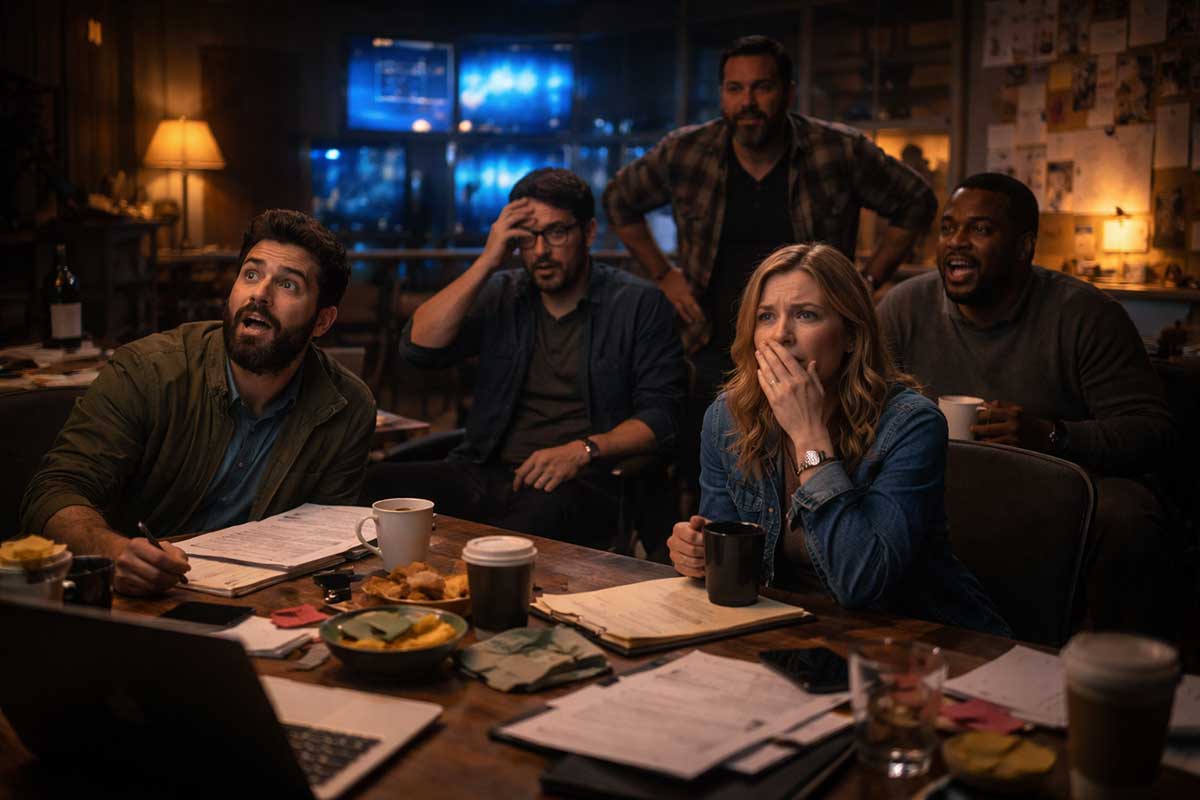
After all of this, I keep coming back to one simple image.
A group of people standing in a room, looking up at something they don’t understand.
That’s it. That’s the human condition.
For most of history, when we looked up, we saw gods. Then we saw stars. Then we saw galaxies. Now we see… something else. Something fast, strange, and unexplained.
And every time, we do the same thing.
We name it.
We can’t help ourselves. We take the unknown and we fit it into a story we already believe. Sometimes that story is scientific. Sometimes it’s religious. Sometimes it’s political. Sometimes it’s… whatever South Park aired last week.
But here’s the problem.
The name we choose doesn’t just describe the mystery—it shapes what we do next.
If it’s a technology, we study it.
If it’s a threat, we defend against it.
If it’s a demon, we fight it.
If it’s a joke, we ignore it.
Same phenomenon. Completely different future.
And that’s why this moment matters more than it seems.
Because when a leader says, “This is what it is,” they’re not just offering an opinion. They’re narrowing the possibilities. They’re guiding a nation toward one way of seeing—and away from all the others.
And once a society starts confusing its explanations with reality itself… it stops asking questions.
That’s when things get dangerous. Not because demons are real. Not because aliens are real.
But because certainty is.
So maybe the most honest place we can land is this:
We don’t know what’s out there.
And that’s okay.
In fact, it might be the one thing keeping us grounded.
Because the moment we’re absolutely sure—whether we call it alien, demon, or something else entirely—we’re no longer looking at the mystery.
We’re just looking at ourselves.
Short Bios:
Krista Tippett — Host of On Being, known for thoughtful conversations on faith, meaning, and human experience.
Robert P. George — Legal scholar and public intellectual focused on natural law, ethics, and religion in public life.
David Grusch — Former intelligence officer and whistleblower on UAP programs and alleged non-human technologies.
Elaine Pagels — Historian of religion specializing in early Christianity and Gnostic texts.
Michio Kaku — Theoretical physicist and science communicator exploring advanced physics and future technologies.
Russell Moore — Evangelical theologian and writer addressing Christianity, culture, and public ethics.
Ezra Klein — Journalist and podcaster analyzing politics, policy, and ideology in modern America.
Benny Johnson — Conservative media personality known for political commentary and viral interviews.
Reza Aslan — Scholar of religion examining faith, history, and global religious movements.
Katherine Stewart — Investigative journalist focused on Christian nationalism and religion in politics.
Rod Dreher — Conservative writer exploring culture, faith, and the challenges of modern secularism.
Paul Bloom — Psychologist studying human nature, morality, and belief systems.
Jane Mayer — Investigative journalist covering power, money, and influence in American politics.
Christopher Mellon — Former defense official specializing in intelligence and UAP investigations.
Dr. Sofia Bianchi — Vatican scholar representing Catholic perspectives on exorcism and spiritual phenomena.
Elisabeth Bumgarten — Journalist reporting on faith, society, and lived religious experience.
Philip Almond — Historian of religion studying demons, belief systems, and cultural interpretations of evil.
Tulsi Gabbard — Former congresswoman and military veteran engaged in national security and foreign policy debates.
David Brooks — Cultural commentator exploring morality, character, and the American social fabric.
J.D. Vance (imagined) — U.S. Vice President portrayed through his political, cultural, and religious evolution.
Ross Douthat — Conservative columnist analyzing religion, culture, and political trends.
Anne Applebaum — Historian and journalist focused on authoritarianism and democracy.
Alex Jones — Media figure known for conspiracy-driven commentary and alternative narratives.
Sohrab Ahmari — Writer examining religion, culture, and post-liberal political thought.
Conan O’Brien — Comedian and host blending satire with cultural and political observation.
Trevor Noah — Comedian and commentator exploring global politics, identity, and media.
Matt Stone (imagined) — Co-creator of South Park, representing satirical critique of culture and power.
Olivia Beavers — Faith-oriented comedian engaging religion through humor and cultural reflection.
Chauncey DeVega — Political commentator analyzing democracy and authoritarian trends.
John Inazu — Legal scholar specializing in pluralism, religious freedom, and constitutional law.
Leave a Reply