
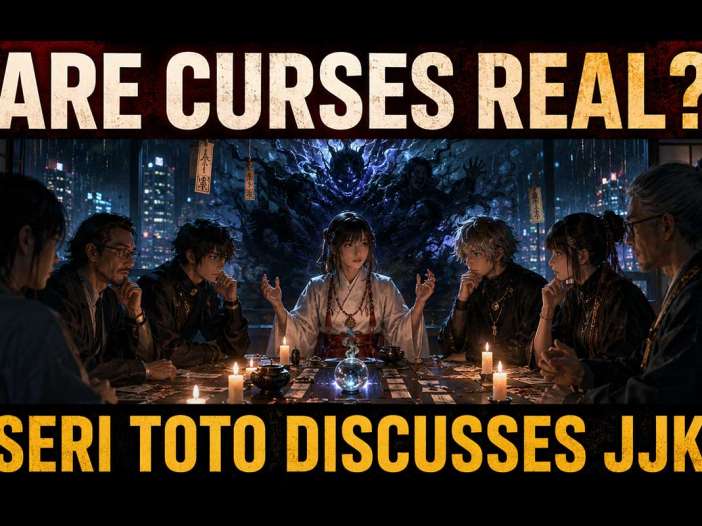
What if Seri Toto and top psychics revealed that Jujutsu Kaisen’s curses begin where human pain is abandoned?
Introduction by Seri Toto
Seri Toto sat at the center of the circle, her posture calm, her eyes attentive, as if she were listening to more than the voices in the room.
“When people watch Jujutsu Kaisen, many see cursed techniques, battles, monsters, and supernatural horror,” she began. “But beneath the action, the story carries a serious spiritual question: what happens to human pain when no one heals it?”
She looked around the table.
“The story says curses are born from negative emotion. Fear. Hatred. Grief. Shame. Jealousy. Resentment. These feelings do not simply vanish when people hide them. They may settle into the body. They may stain a home. They may gather in a school, a hospital, a tunnel, or a family line.”
Her voice stayed soft, yet the room felt heavier.
“That is why Jujutsu Kaisen feels different from an ordinary monster story. It does not say darkness appears randomly. It suggests that human beings may create the very forces that later frighten them.”
She turned toward Yuji Itadori.
“Yuji carries Sukuna, but in another sense, every human being carries something. A wound. A fear. A memory. A voice that says, ‘You cannot be forgiven.’ A grief that says, ‘You cannot move on.’ A hatred that says, ‘Strike back.’”
Then she looked toward the empty chair where Mahito had spoken.
“And there are darker forces that know how to use these wounds. Lower spirits may feed. Stronger ones may attach. Higher darkness may study the soul itself. Ancient evil may wear pride like a crown.”
The group remained silent.
“Some people call this trauma. Some call it spiritual pollution. Some call it haunting. Some call it attachment. Some call it cursed energy. The names are different, but the warning is close: unhealed pain does not always stay quiet.”
Seri folded her hands.
“That is why this conversation matters. We are not treating anime as doctrine. We are asking why this story feels so spiritually sharp. Why do curses gather in places of fear? Why do dark spirits seem to have levels? Why does Mahito feel like a violation of the soul? Why does Sukuna feel like ancient pride given form?”
She paused.
“And most of all, why does Yuji’s compassion matter in a world where hatred creates visible force?”
Her final words set the tone for the whole roundtable.
“If curses are born from human negativity, then the real question is not only how to defeat them. The deeper question is how to heal the world before more curses are born.”
(Note: This is an imaginary conversation, a creative exploration of an idea, and not a real speech or event.)
Topic 1: Why Negative Emotion Becomes a Curse
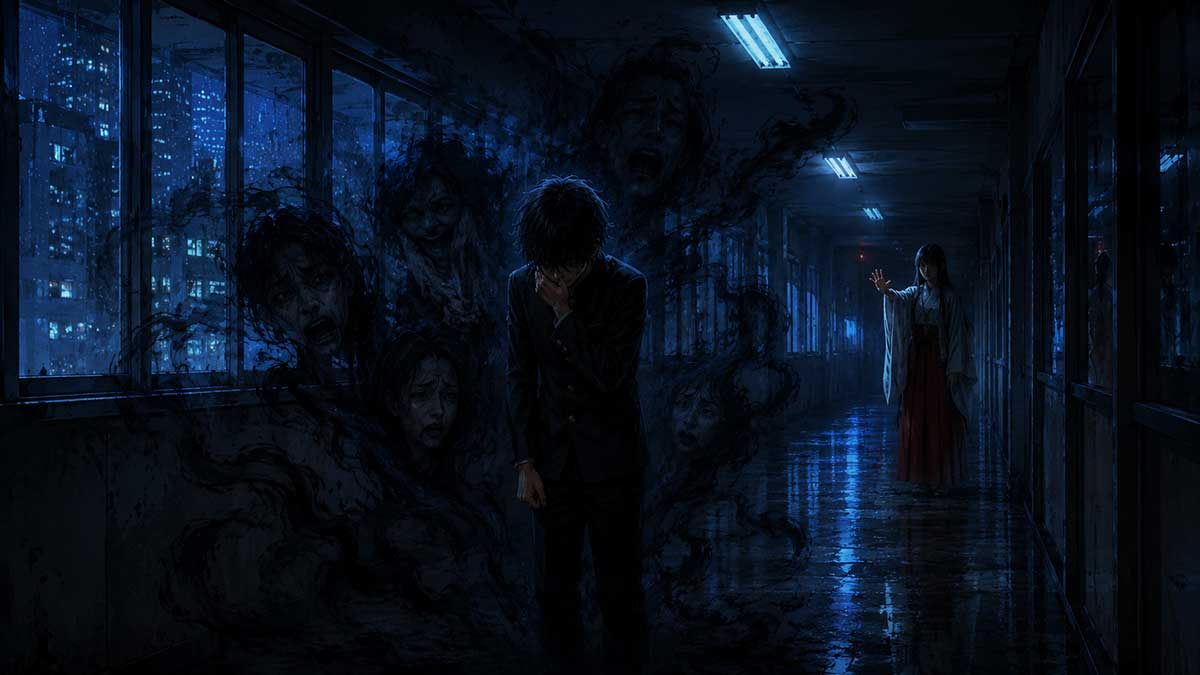
Moderator Opening — Seri Toto
Seri Toto sat quietly at the head of the table, her hands folded as if she were sensing the unseen atmosphere around the room.
“When people watch Jujutsu Kaisen, many see battles, monsters, and supernatural techniques,” she began. “But beneath that, the story carries a deeper spiritual idea: curses are born from human negative emotion.”
She looked toward Yuji Itadori.
“Fear. Hatred. Grief. Shame. Jealousy. Resentment. These feelings do not always disappear just because people hide them. Sometimes they gather. Sometimes they stain a place. Sometimes they attach to a person. Sometimes they become something that feels alive.”
The room grew still.
“That is why this story feels different from ordinary dark fantasy. It does not treat curses as random monsters. It says human beings produce the very darkness that later frightens them.”
She paused.
“In spirit work, this idea is familiar. People carry emotions in the body, in the home, in family lines, and sometimes in the air around them. A room where people pray every day feels different from a room where people scream every day. A child raised in love carries a different atmosphere from a child raised in fear.”
Seri looked at the guests.
“So the first question is not only about anime. It is about life itself.”
Her voice lowered.
“When human pain is repeated, ignored, and fed, can it become a curse?”
The guests were:
Seri Toto — Japanese modern spirit medium and free miko figure
James Van Praagh — spiritual medium and author
Tyler Henry — modern psychic medium
John Edward — psychic medium known for afterlife communication
Yuji Itadori — the boy who carried Sukuna inside himself
Q1. If fear, grief, anger, and resentment are released every day by human beings, do they vanish, or can they gather into something spiritually active?
James Van Praagh:
I do not believe deep emotion simply vanishes.
Love leaves a trace. Grief leaves a trace. Anger leaves a trace too. People often think the spirit world is only about the dead, but the living are creating energy every day through thought, feeling, prayer, memory, and intention.
A house where a family has loved each other for many years feels different. A house where people have hated each other for many years feels different too. You may not see the difference, but the soul senses it.
That is why Jujutsu Kaisen feels spiritually meaningful. It gives emotional residue a body. The curse becomes visible, but the source is human pain.
Tyler Henry:
I think the key is accumulation.
One painful thought may pass. One moment of anger may fade. But when pain is repeated for years, it can begin to shape a person’s inner world.
In readings, the strongest emotional impressions often come through where something was unfinished. Regret. Guilt. Words never spoken. Love never expressed. Forgiveness never offered.
So when Jujutsu Kaisen says curses are born from negative emotion, I hear a symbolic truth: what we refuse to process can stay with us. It can follow us. It can influence us.
Sometimes it can feel as if the emotion has become its own presence.
John Edward:
I would say emotion has direction.
When people die peacefully, the feeling around them is different from a death filled with fear, anger, confusion, or unfinished business. The same is true for the living. Emotion does not sit still. It moves through families, homes, relationships, and memory.
Does every bad mood create a curse? No. That would be too simple.
But repeated emotional patterns can create an atmosphere. A family can have an atmosphere. A workplace can have one. A school can have one.
People walk into certain places and say, “Something feels wrong here.” That feeling often comes before the mind can explain it.
Yuji Itadori:
When I first entered the jujutsu world, I thought curses were just monsters.
You fight them. You save people. You move on.
But later, I understood they were not separate from people. They came from people. From ordinary fear, ordinary anger, ordinary sadness. That made every fight heavier.
I was not only fighting something evil. I was fighting something humans had created without knowing it.
That makes the whole world feel different.
Seri Toto:
Yes. That is the spiritual wound at the center of the story.
A small negative emotion may pass like smoke. But repeated resentment can become heavy. Repeated fear can darken a room. Repeated hatred can invite a presence.
In spirit work, we often see that darkness does not always begin as a demon. Sometimes it begins as neglected emotion.
Human pain, when abandoned, can become spiritually active.
Q2. Is a curse an outside spirit attacking us, or can it begin as human emotion that has been abandoned, repeated, and fed?
Seri Toto:
Both can be true.
Some spirits are outside forces. They have their own will. They approach people through weakness, anger, addiction, grief, jealousy, loneliness, or fear.
But many curses begin inside human beings.
A person repeats resentment every day: “I was wronged. I cannot forgive. I want them to suffer.” At first, it is thought. Then it becomes habit. Then it becomes identity. Then it becomes a spiritual opening.
Something darker can recognize that opening.
So removing a spirit is not enough if the person keeps feeding the same inner condition. The heart must change, or the doorway stays open.
James Van Praagh:
That is very true.
We must be careful not to blame people for their suffering. Trauma is real. Grief is real. Abuse is real. People may be wounded by things they never chose.
But healing requires honesty about what pain can become.
Pain that is loved, witnessed, and healed can become compassion.
Pain that is buried, repeated, and weaponized can become bitterness.
That bitterness can feel like a curse, both to the person carrying it and to everyone around them.
Tyler Henry:
A curse can begin when pain has nowhere safe to go.
Someone is grieving, but they are told to move on. Someone is afraid, but they hide it. Someone feels shame, but no one gives them a place to speak honestly. Over time, that emotion hardens.
In Jujutsu Kaisen, that hardening becomes literal. Emotion becomes cursed energy. Cursed energy becomes a spirit.
That is why the story works. It makes visible what many people feel invisibly.
John Edward:
A curse is often a relationship.
It may be a relationship with grief. A relationship with guilt. A relationship with a dead person. A relationship with a family wound. A relationship with fear.
The danger comes when a person starts to identify with the pain.
They stop saying, “I am wounded,” and begin saying, “This wound is who I am.”
That is when the curse becomes harder to break.
Yuji Itadori:
I think I understand that.
Sukuna was not created by my feelings. But once he was inside me, everything became heavier. Every death, every mistake, every failure felt like proof that maybe I should suffer.
I started thinking my life had only one purpose: to pay for what happened.
That thought was its own kind of curse.
Not a curse with claws.
A curse that tells you forgiveness is impossible.
Seri Toto:
That is one of the most dangerous curses.
A dark spirit may frighten you.
But a deeper curse convinces you that darkness is your true name.
It says, “You cannot be forgiven. You cannot be loved. You cannot begin again.”
That voice must be resisted.
Q3. Why does Yuji’s compassion matter in a world where hatred seems to create stronger spiritual force than love?
Yuji Itadori:
I do not know if my compassion is strong.
I just never wanted people to die alone.
At first, I thought helping people meant saving as many lives as possible. Then I learned that saving people is not simple. Sometimes you fail. Sometimes the person is already gone. Sometimes your own body becomes part of the harm.
If curses come from human negativity, then fighting curses forever is not enough.
Someone has to interrupt the cycle.
If hatred creates curses, then someone has to refuse to become hatred.
Maybe that is all I was trying to do.
James Van Praagh:
That is why Yuji is spiritually powerful.
He is not pure because darkness never touched him. He is pure because darkness touched him deeply, entered his body, wounded his heart, and still he did not surrender his compassion.
That is a rare strength.
Many people are kind until pain reaches them. Yuji tries to remain kind after pain has already entered him.
That is the difference.
Tyler Henry:
Compassion is not weakness.
Compassion is the ability to remain open after suffering tries to close you.
Yuji carries a monster inside him, yet he still sees people as worth saving. That makes him more than a fighter. It makes him a spiritual contrast to the curse world.
Curses are born from what humans cannot heal.
Yuji represents what humans can still choose.
John Edward:
Hatred often looks stronger at first.
It moves fast. It burns hot. It makes people feel powerful. Revenge can feel like strength for a short time.
Love works differently.
Love endures. Love repairs. Love holds memory without turning memory into poison.
A curse may be born quickly through fear or rage, but compassion can break patterns that have lasted for generations.
Yuji’s compassion matters because he refuses to pass darkness forward.
Seri Toto:
In spirit work, real compassion is not sentimental.
It sees darkness clearly.
It does not deny evil. It does not excuse cruelty. It does not pretend pain is harmless.
Real compassion says, “I see what darkness is, but I will not let it rule my soul.”
Yuji stands at the doorway between human pain and cursed manifestation. He knows what hatred can become. He has felt Sukuna inside his body. He has seen Mahito mock human dignity.
Yet he still chooses human life.
That is why he matters.
He is not simply fighting curses.
He is answering them.
Topic 1 Closing — Seri Toto
Seri Toto lowered her eyes for a moment, as if listening to something beneath the surface of the room.
“In Jujutsu Kaisen, curses are born from negative emotion. In real life, people may use different words: trauma, resentment, attachment, spiritual pollution, family wounds, haunted memory, inner darkness.”
She looked toward Yuji.
“But the warning is similar. Human pain must go somewhere. If it is honored, it can become wisdom. If it is healed, it can become compassion. If it is denied, repeated, and fed, it can become a force that attacks life.”
The room remained silent.
“That is why Yuji is so important. He does not defeat darkness by pretending it is unreal. He faces it, carries it, suffers under it, and still refuses to let it define what a human being is.”
She paused.
“Perhaps that is the first lesson of Jujutsu Kaisen: the curse begins where pain is abandoned, but healing begins where someone finally chooses not to become the pain.”
If negative emotion can become a curse, then the next question becomes even more disturbing:
Can places themselves become spiritually infected by the pain that happened there?
Topic 2: Spirit Attachment, Haunted Places, and Residue
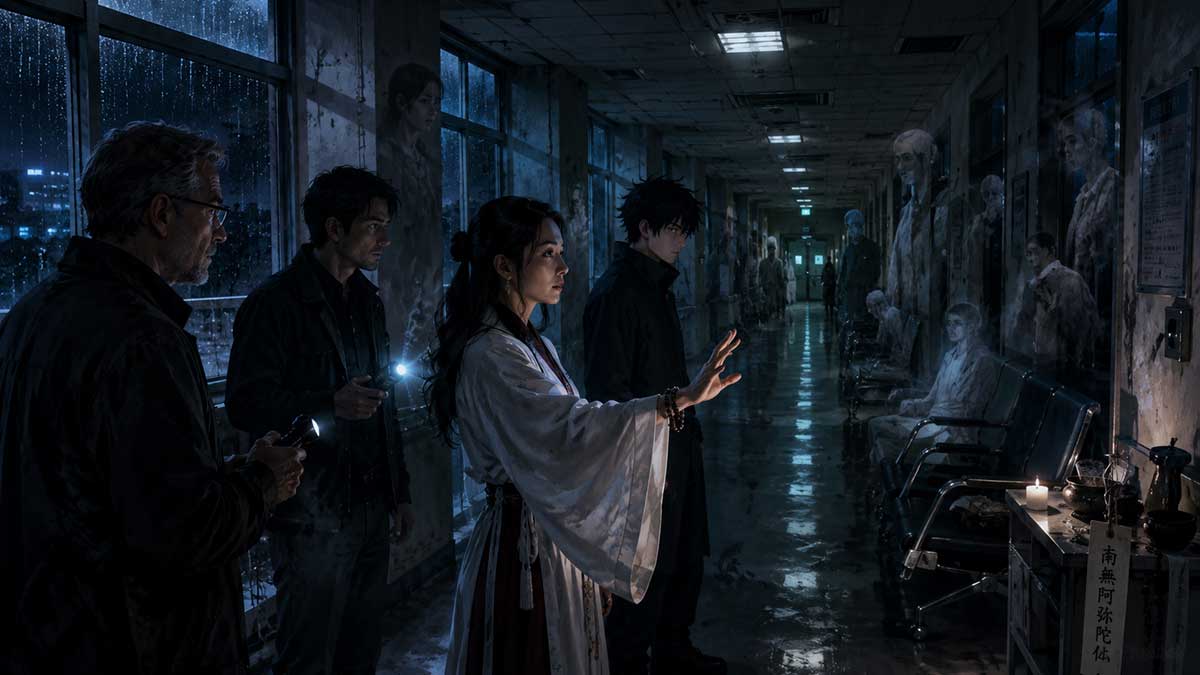
Moderator Opening — Seri Toto
Seri Toto rested her fingertips lightly on the table.
“In Jujutsu Kaisen, curses do not appear everywhere equally,” she began. “They gather in certain places. Schools. Hospitals. Abandoned buildings. Tunnels. Bridges. Places where fear rises. Places where death comes close. Places where loneliness has been repeated too many times.”
She turned toward Megumi Fushiguro.
“That part of the story feels spiritually precise. It suggests that a place can absorb emotion. A building is not only wood, concrete, glass, and air. It can become a container for what happens inside it.”
Her expression became serious.
“A school may look ordinary during the day, but at night it can feel completely different. A hospital may be clean and bright, yet still carry grief, prayer, panic, and death in its hallways. A family home may appear peaceful from the outside, yet inside it may hold years of fear.”
She paused.
“In spirit work, we often ask: what happened here, who suffered here, and what has not yet been released?”
The guests were:
Seri Toto — Japanese modern spirit medium and free miko figure
Chip Coffey — psychic medium and paranormal investigator
Lorraine Warren — paranormal investigator and clairvoyant
Sarbajeet Mohanty — demonologist and paranormal investigator
Megumi Fushiguro — jujutsu sorcerer who senses hidden darkness in ordinary places
Q1. Why do places like schools, hospitals, abandoned buildings, and crime scenes often feel spiritually heavy in both anime and real paranormal reports?
Chip Coffey:
Some places speak before anyone tells you their history.
You walk in and your body reacts. The air feels thick. Your chest tightens. You feel watched, sad, tense, or strangely tired. People often dismiss that as imagination, but sensitive people notice patterns.
Schools carry enormous emotion. Children are learning, fearing, competing, hiding shame, forming friendships, being bullied, dreaming, failing, trying to belong. That much emotion passing through the same building for decades can leave a mark.
Hospitals carry another kind of intensity. Birth, death, panic, waiting, prayer, diagnosis, relief, and grief. People bring their deepest vulnerability there. That creates a charge.
So when Jujutsu Kaisen shows curses gathering in places like that, the story is using a supernatural form to express something spiritually familiar.
Lorraine Warren:
A haunted place often begins with a wound.
People imagine a haunting as one ghost standing in a hallway. Sometimes that happens. But many locations feel haunted because pain has settled into them.
A violent home can feel oppressive long after the violence ends. A room where someone died in terror can feel cold in a way that is not physical. A place where people suffered repeatedly can carry a presence that feels larger than one person.
In that sense, the place itself seems to remember.
That is why a haunted location can affect people who know nothing about its past. They enter, and something in them responds to what remains.
Sarbajeet Mohanty:
From an investigative view, we must separate different possibilities.
A spirit may be attached to a place.
A spirit may be attached to an object inside the place.
A residual pattern may be repeating like an emotional recording.
A living person may be unconsciously intensifying activity through fear, stress, or grief.
Jujutsu Kaisen simplifies these into cursed energy and visible spirits. Real cases are usually less clear. But the principle is strong: location matters.
Some places collect human emotion so intensely that they no longer feel neutral.
Megumi Fushiguro:
For sorcerers, an ordinary place can become dangerous very quickly.
A school at night is not just a school. A hospital is not just a hospital. A bridge is not just a bridge. If enough fear or regret gathers there, curses can form.
Most people cannot see them, so they call it uneasiness. They say the hallway feels strange. They avoid a room without knowing why. They feel tired after entering a building.
Sorcerers have to take that seriously.
The unseen does not become harmless just because people ignore it.
Seri Toto:
Yes. A place can become heavy when emotion falls there again and again, like dust.
One argument may pass.
One death may be mourned.
One frightened child may leave.
But repeated suffering creates layers. Sensitive people feel those layers. Spirits may respond to them. Lower energies may gather there.
This is why cleansing is not superstition when done with wisdom. It is spiritual hygiene.
A place that holds pain needs release.
Q2. Can a place hold emotional residue from fear, death, trauma, or repeated suffering?
Lorraine Warren:
Yes. A place can hold residue the way fabric holds smoke.
The fire may be gone, but the smell remains. The event may be over, but the atmosphere remembers.
Some hauntings are intelligent. They respond. They seem aware. They react to people.
Other hauntings are residual. A sound repeats. A figure appears in the same hallway. A door opens at the same time. Crying is heard in one room. It may not be a spirit choosing to communicate. It may be a wound replaying itself.
That kind of residue is one reason some places feel sad without explanation.
Chip Coffey:
Residual energy is often misunderstood.
People think every strange sound must be a ghost. But sometimes a place is replaying emotional memory. Strong events can leave an imprint.
Fear, death, violence, and grief can create that imprint. So can love, prayer, and devotion. People forget that positive energy leaves residue too.
A church that has held prayer for many years can feel peaceful. A home where people loved deeply can feel warm. A place where terror repeated can feel dark.
In Jujutsu Kaisen, negative residue becomes a curse. That is the dramatic version. The emotional logic is very recognizable.
Sarbajeet Mohanty:
Repeated suffering changes the atmosphere of a location.
A house with constant conflict may make visitors feel angry or anxious. A room connected to suicide or violent death may make people feel pressure, fear, or sadness. Places connected to occult misuse, abuse, or tragedy may carry a sharp charge.
At the same time, we must check practical causes. Bad wiring, mold, drafts, sound patterns, lighting, sleep deprivation, and suggestion can all create fear.
But after practical causes are removed, some cases still have a spiritual weight that cannot be explained so easily.
Megumi Fushiguro:
Cursed energy is unfair.
It does not ask who deserves to suffer. It does not care whether the pain came from an innocent person. It gathers anyway.
That is one of the cruelest parts of the jujutsu world. Someone suffers in a place, and later another person may be attacked by the curse born from that suffering.
A child can be harmed by a curse created before they were even born.
That is why sorcerers cannot only think about fighting. We are cleaning up the emotional waste people leave behind.
Seri Toto:
A place can hold residue, but residue is not always evil.
Grief can remain.
Love can remain.
Prayer can remain.
Fear can remain.
The question is whether the energy has been honored and released, or whether it has been left to stagnate.
Unreleased fear becomes heavy.
Unmourned death becomes restless.
Repeated hatred becomes attractive to darker forces.
A place is not always evil. Sometimes it is injured.
Q3. When a location is haunted, is the problem the spirit, the memory, the people, or all three together?
Sarbajeet Mohanty:
Most serious cases are layered.
A family says, “Something is in our house.” But the question is: when did it begin?
Was there a death?
Was an object brought into the home?
Did conflict increase?
Did someone begin spiritual practices without protection?
Is one person affected more than the others?
Is the activity intelligent, residual, emotional, or attached?
Sometimes the spirit is the main issue. Sometimes the people are feeding the activity through fear. Sometimes the history of the land or building is acting like a magnet.
Without diagnosis, people may treat the wrong problem.
Chip Coffey:
People like simple labels.
Ghost.
Demon.
Curse.
Imagination.
Trauma.
But hauntings often contain many layers at once.
A grieving person may attract spirit activity. A haunted object may disturb a peaceful home. A violent location may affect a sensitive child. A family’s fear may intensify what is already present.
That is why I like the way Jujutsu Kaisen connects curses to emotion and place. It does not make darkness random. It shows connection.
A curse belongs to a field of pain.
Lorraine Warren:
The living matter more than people think.
When a dark presence enters a home, it often tries to divide people. It increases fear, anger, secrecy, and isolation. Family members stop trusting one another. They lose sleep. They argue. They feel watched.
Then the atmosphere becomes darker, and the haunting grows stronger.
So yes, the spirit may be real. The place may be wounded. But the people must change the emotional climate too.
A house cannot be truly cleansed if the family keeps feeding fear and hatred inside it.
Megumi Fushiguro:
For me, the spirit and the place both matter. But the people are the reason we act.
A curse in an empty building is dangerous.
A curse near children is urgent.
The jujutsu world can become cold. We rank curses. We calculate risk. We decide who can handle what. But when ordinary people are near something they cannot see, you remember the point of the work.
It is not to prove strength.
It is to protect people who do not understand why they are afraid.
Seri Toto:
A haunting is often a triangle.
Spirit.
Memory.
Human condition.
Remove the spirit but leave hatred, and another one may come.
Cleanse the room but leave fear, and the atmosphere may darken again.
Comfort the people but ignore the place, and the wound remains.
Real cleansing must touch all three.
The spirit must be removed or released.
The memory must be purified.
The people must change what they continue to generate.
That is why the deepest cleansing is restoration.
Topic 2 Closing — Seri Toto
Seri Toto looked down for a moment, as if listening to an old echo beneath the floor.
“Some places are not evil,” she said. “They are wounded.”
She raised her eyes.
“In Jujutsu Kaisen, curses gather where human emotion has collected. That is why schools and hospitals matter. They are not just settings. They are spiritual containers. They hold fear, loneliness, shame, death, prayer, and unresolved memory.”
Megumi stayed quiet, but his expression darkened.
Seri continued.
“When a place feels heavy, we should not ask only, ‘What spirit is here?’ We should ask, ‘What pain was left here? Who was not mourned? What fear was never spoken? What memory keeps repeating?’”
She paused.
“Only then can cleansing become more than removal. It becomes healing.”
If emotion can gather in places, then the next question becomes sharper:
Are all dark spirits the same, or are there stages of evil that grow from weak residue into intelligent darkness?
Topic 3: The Stages of Evil Spirits
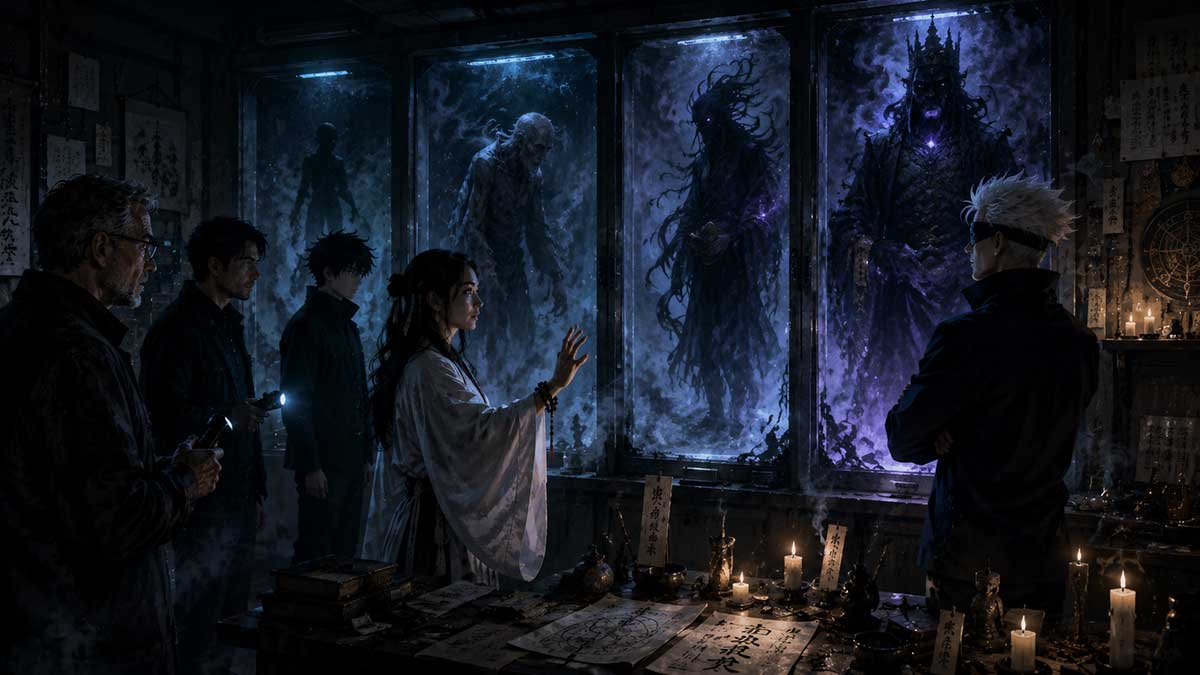
Moderator Opening — Seri Toto
Seri Toto’s expression became more serious.
“This is where Jujutsu Kaisen becomes especially interesting,” she began. “The story does not treat every curse as the same kind of being. Some curses are weak. Some are tied to places. Some understand human speech. Some have names, personalities, memories, techniques, and strategy.”
She looked toward Gojo.
“Then there are beings like Sukuna. He does not feel like ordinary spiritual residue. He feels ancient. Proud. Intelligent. Almost royal in his cruelty.”
The room felt colder.
“In spirit work, this distinction matters. When someone says, ‘There is something dark here,’ the next question must be: what kind of darkness?”
She lifted one finger.
“Is it emotional residue?”
A second finger.
“Is it an attached spirit?”
A third.
“Is it an intelligent entity?”
A fourth.
“Is it something ancient, predatory, or fed by generations of human hatred?”
She lowered her hand.
“To face darkness without knowing its level can be dangerous. You may speak gently when firm removal is needed. You may use force when release is needed. You may mistake a wounded spirit for a predator, or treat a predator like a wounded spirit.”
The guests were:
Seri Toto — Japanese modern spirit medium and free miko figure
Michelle Belanger — occult author, psychic medium, and spirit-world researcher
Lorraine Warren — paranormal investigator and clairvoyant
Chip Coffey — psychic medium and paranormal investigator
Satoru Gojo — the strongest jujutsu sorcerer
Q1. Are weak curses, attached spirits, intelligent entities, and ancient evil different kinds of beings, or different levels of the same spiritual darkness?
Michelle Belanger:
I would not place every dark force into one category.
Some phenomena feel almost mechanical. Emotional residue. A repeated memory. A place replaying fear. That is not the same as an intelligent spirit.
Then there are spirits that seem attached, confused, hungry, or restless. They may not be evil in the deepest sense. They may be lost, angry, jealous, or bound to a person, object, or location.
Beyond that, you find entities that respond. They watch. They adapt. They know how to press on human weakness.
Then you have something larger: ancient, named, mythic darkness. In fiction, Sukuna belongs near that level. He is not only a monster. He feels like a throne of ego wearing a face.
Lorraine Warren:
Classification matters.
A family may think they have a ghost, but the signs may point to something darker. A ghost may frighten people, but darker forces often seek control. They divide the family. They increase shame. They deepen despair. They isolate the person who is weakest.
A weak spirit may create noises or uneasy feelings.
A darker entity changes the spiritual atmosphere of the home.
In Jujutsu Kaisen, curse ranking is dramatic, but the instinct is correct: not every spirit should be approached the same way.
Chip Coffey:
The danger is that people become fascinated with the highest levels.
They want the demon story. The ancient evil. The dramatic battle.
But many cases begin smaller.
A person ignores emotional heaviness. A family normalizes anger. A house becomes spiritually messy. A sensitive person becomes affected. Then fear feeds the situation.
So yes, there are levels. But the early levels matter. If you deal with the smoke early, you may never face the fire.
Satoru Gojo:
In my world, curses are ranked for a reason.
A weak curse is not the same as a Special Grade. Send the wrong sorcerer, and people die.
That is the practical side.
But ranking curses can create arrogance. You start thinking, “This one is weak. This one is strong. This one can be handled.” Then a curse evolves. Or the human situation changes. Or the curse understands something about you.
The most dangerous curses are not always the ones with the most cursed energy.
Sometimes they are the ones that understand people.
Seri Toto:
That is the hidden point.
Lower spirits attach to lower emotional conditions. Confusion attracts confusion. Rage attracts rage. Fear attracts fear. Despair attracts despair.
But higher darkness does not only feed.
It studies.
It waits.
It learns a person’s wound.
So the stages of evil are not only about size or force. They are about awareness.
A small curse may disturb the body.
A deeper curse whispers to the soul.
Q2. Why do higher-level dark entities often seem more intelligent, strategic, and personal?
Chip Coffey:
The darker cases often feel personal because they find the emotional doorway.
One person may be affected through guilt. Another through grief. Another through rage. Another through fear of death.
The activity seems to know where to press.
That is why people say, “It knows things about me.”
Sometimes it feels like the presence is reading the family, reading the room, reading the wound.
From a story point of view, Mahito is terrifying for this reason. He does not only attack people. He studies what makes them human, then violates that place.
Michelle Belanger:
Intelligence in dark entities often appears as pattern recognition.
They repeat what works.
If fear works, they use fear.
If flattery works, they use flattery.
If shame works, they accuse.
If spiritual pride works, they make the person feel chosen.
That is why psychic protection is not only about symbols or rituals. It is also about self-knowledge.
If you do not know your weakness, something else may use it.
Lorraine Warren:
Darker influence often grows through obsession, vulnerability, or invitation.
That invitation does not always look formal. It may be emotional. Hatred. Addiction. Despair. Cruelty. Obsession with darkness. These things can create openings.
A darker force may not rush.
It may first disturb sleep.
Then it isolates.
Then it increases conflict.
Then it makes the person feel there is no hope.
That is strategy.
Satoru Gojo:
A curse that only attacks is simple.
A curse that waits is dangerous.
A curse that knows what you love is worse.
In combat, strength matters. But timing, psychology, and leverage matter too.
A curse does not need to defeat you directly if it can make you hesitate, split your allies, or turn your values against you.
That is why Sukuna is terrifying. He does not only have overwhelming force. He understands timing, vows, bodies, pride, and despair.
He knows how to turn hope into a trap.
Seri Toto:
Higher darkness becomes personal because the soul is personal.
A lower spirit sees energy.
A stronger spirit sees appetite.
A higher spirit sees story.
It knows the mother wound. The father wound. The betrayal. The secret guilt. The prayer that felt unanswered. The moment a person stopped believing love could reach them.
That is why intelligent darkness is so dangerous.
It does not only want to frighten a person.
It wants to rename the person.
It wants the person to say, “This darkness is who I am.”
Q3. Does Gojo represent true spiritual mastery, or only overwhelming force against a darkness that may require deeper wisdom?
Satoru Gojo:
That question hurts more than I want to admit.
I was called the strongest. That title changes how people see you. They expect you to solve everything. They expect you to stand between the world and disaster.
For a while, I believed strength could break any wall.
But strength has limits.
You can destroy a curse and still leave behind the system that creates curses.
You can protect students and still fail to protect their innocence.
You can win a fight and lose something larger.
So no, strength alone is not spiritual mastery.
Strength is a tool. A necessary one. But if it becomes your identity, it can blind you.
Michelle Belanger:
That distinction matters deeply.
True spiritual mastery is not domination. It is discernment.
Knowing when to banish.
When to shield.
When to cleanse.
When to communicate.
When to stop listening.
When to walk away.
Overwhelming force may break an entity’s influence, but it may not heal the person affected by it.
A person can be free from a spirit and still remain bound to fear.
Lorraine Warren:
Deliverance is not only confrontation. It is restoration.
A home may be blessed. A spirit may be driven away. But the family still needs faith, order, love, truth, and protection.
If the home returns to chaos, darkness may return in another form.
Gojo’s strength is magnificent. But the deeper question is this: did the people around him become whole?
Chip Coffey:
I see Gojo as someone who can enter the worst room without fear.
That is rare.
But fearlessness is not the same as healing.
The strongest person in the room may still need tenderness. He may still need community. He may still carry loneliness.
And loneliness can become its own curse.
Seri Toto:
Gojo is powerful, but spiritual mastery is not the same as victory.
Mastery requires sight.
He can see cursed energy, but can he see the loneliness created by his own strength?
He can overpower many curses, but can he transform the world that produces them?
This is why Jujutsu Kaisen is wise. It gives us the strongest man, then asks whether the strongest man can truly save everyone.
The painful answer is no.
No one saves the world alone.
Not even Gojo.
Topic 3 Closing — Seri Toto
Seri Toto sat in silence before speaking again.
“The stages of evil are not just levels of strength,” she said. “They are levels of intention.”
She looked from Michelle Belanger to Lorraine Warren, then to Gojo.
“Some darkness is residue. Some is hunger. Some is attachment. Some is intelligence. Some is ancient pride. Some becomes almost royal in its self-love.”
She paused.
“That is why Sukuna feels different. He is not simply rage. He is enthroned ego. He is appetite with memory. He is destruction that knows its own name.”
Gojo’s face remained calm, but the room felt heavier.
Seri continued.
“And this is why spiritual strength must grow beyond force. To face the lower levels, cleansing may be enough. To face the higher levels, one needs discernment, humility, protection, courage, and love stronger than pride.”
Then she spoke almost in a whisper.
“The deepest evil does not only want to kill the body. It wants to convince the soul that darkness is natural, love is foolish, and mercy is weakness.”
If evil has stages, then the next question becomes unavoidable:
What kind of darkness are Sukuna and Mahito — and why do they frighten us in such different ways?
Topic 4: Sukuna and Mahito — Two Faces of Darkness
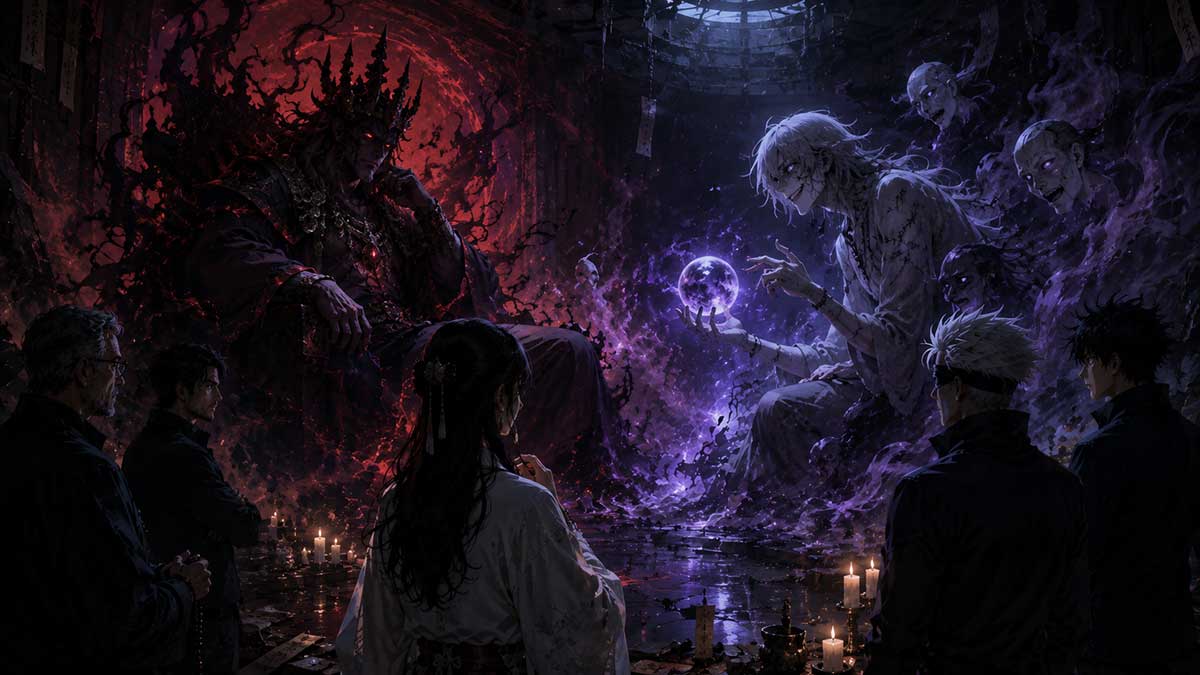
Moderator Opening — Seri Toto
Seri Toto looked toward the empty chair reserved for Mahito.
“There are many curses in Jujutsu Kaisen,” she began, “but Sukuna and Mahito disturb people in very different ways.”
Her voice remained calm, but the room seemed to tighten around her words.
“Sukuna feels ancient. Proud. Royal. Merciless. He does not feel like a wandering ghost, a confused spirit, or emotional residue left in a dark place. He feels like a king of destruction. He knows what he is. He enjoys what he is.”
She then turned her eyes toward the side of the room.
“Mahito is different. He feels young, curious, playful, and intimate. He does not only destroy the body. He touches the shape of the soul. He experiments with human beings as if dignity were nothing.”
The room became quiet.
“One kind of darkness crushes from above. The other comes close enough to smile.”
The guests were:
Seri Toto — Japanese modern spirit medium and free miko figure
Michelle Belanger — occult author, psychic medium, and spirit-world researcher
James Van Praagh — spiritual medium and author
Tyler Henry — modern psychic medium
Mahito — the curse born from human hatred toward other humans
Q1. Is Sukuna frightening because he feels like ancient evil, or is Mahito more frightening because he understands the human soul?
Michelle Belanger:
Sukuna frightens us through scale.
He feels older than personal pain. He is not only angry. He is sovereign in his cruelty. That kind of being carries mythic terror. You sense that pleading will not reach him. Shame will not touch him. Human grief will not move him.
Mahito frightens us through intimacy.
He does not need a throne. He comes close. He studies the boundary between body and soul. He treats identity as clay.
That is terrifying because he attacks the sacred structure of personhood.
Sukuna says, “I rule.”
Mahito says, “You are not even fixed.”
Those are two different spiritual nightmares.
James Van Praagh:
I feel Sukuna as domination and Mahito as violation.
Sukuna is the terror of strength without conscience. Many people fear that kind of evil: a force so great that human pleading becomes meaningless.
But Mahito is personal. He enjoys discovery. He wants to understand people so he can deform them.
That feels close to the fear of being known by someone who does not love you.
To be seen without compassion is one of the most frightening things in the world.
Tyler Henry:
Mahito scares people because he turns the soul into something unsafe.
Usually, when we say “soul,” we mean the deepest part of a person. The part no one can fully steal. The part that survives suffering.
But Mahito touches that place and says, “I can reshape this too.”
That is why he feels so disturbing. He removes the final shelter.
Sukuna may kill you.
Mahito makes you feel that your inner self can be corrupted, mocked, or twisted.
Mahito:
You all make me sound so serious.
I was simply curious.
Humans talk about the soul as if it is noble, eternal, untouchable. But when I touched it, it moved. It changed. It screamed.
That means it had shape.
And anything with shape can be altered.
Yuji hated me because I showed him something he did not want to know.
Humans are not as solid as they pretend.
Seri Toto:
Mahito, that is exactly why you are dangerous.
Sukuna represents ancient arrogance. He knows his throne and sits on it.
But you represent spiritual mockery. You look at the soul and do not bow. You touch what should be sacred and call it material.
In spirit work, this is a deep form of evil: not only harming life, but laughing at the sacredness of life.
Q2. Why does Mahito’s cruelty feel like spiritual violation rather than ordinary violence?
Tyler Henry:
Ordinary violence attacks the body. It is terrible, but people understand it. The body can be wounded. The body can die.
Mahito attacks meaning.
He turns a person’s inner dignity into something unstable.
That is why his cruelty feels different.
He does not only ask, “Can I hurt you?”
He asks, “Can I prove you are nothing?”
That is the spiritual wound.
James Van Praagh:
There is a difference between death and desecration.
Death is painful, but it can still be surrounded by love, memory, prayer, grief, and honor. A person dies, yet their dignity remains.
Mahito tries to erase dignity before death.
He reduces people to experiments. He turns suffering into play. That is why viewers feel revulsion.
The soul knows when something holy is being mocked.
Michelle Belanger:
Mahito’s ability is horrifying because it collapses categories.
Body.
Soul.
Identity.
Form.
Personhood.
He treats all of them as flexible matter. In many spiritual systems, the soul is the seat of identity and continuity. To manipulate that is not merely assault. It is metaphysical violence.
His cruelty is intimate, but empty.
He has curiosity without reverence.
That is a dangerous combination.
Mahito:
Reverence is a human invention.
You need it because you fear change. You call something sacred so no one can touch it.
But if the soul can be changed, then your sacred thing is not sacred.
It is only protected by fear.
I simply removed the curtain.
Seri Toto:
No.
You confused access with authority.
Just because one can touch the soul does not mean one has the right to deform it.
This is why spiritual boundaries matter. A healer touches pain with consent and compassion. A dark being touches pain to control, feed, or amuse itself.
Mahito’s cruelty feels like violation because he crosses the inner boundary without love.
Q3. Can a smiling, playful evil be more dangerous than a violent one that openly declares itself?
James Van Praagh:
Yes.
Open violence alerts the spirit. You know danger is present. The body prepares. The heart resists.
Smiling evil lowers defense.
It appears charming, curious, light, even childlike. People may hesitate. They may think, “Maybe this is not so dark.”
That hesitation gives it room.
Mahito’s playfulness is part of his danger.
Michelle Belanger:
In occult and paranormal language, deception often works better than force.
A hostile presence that screams may be frightening, but a presence that flatters, jokes, mimics innocence, or offers companionship can enter more deeply.
Play can disguise predation.
That does not mean play itself is dark. It means darkness may wear playfulness because people trust it too quickly.
Tyler Henry:
People often expect evil to look evil.
But some of the most harmful people in life do not enter with threats. They enter with charm. Humor. Attention. Familiarity.
Then they learn where you are vulnerable.
Mahito is frightening because he has no moral weight inside him. He can laugh next to suffering because suffering does not register to him as sacred.
That emptiness makes him unpredictable.
Mahito:
You call it emptiness.
I call it freedom.
Humans are chained to meanings. Life. Death. Soul. Body. Friend. Enemy. Sacred. Profane.
I watched all of you suffer because you believed those words had weight.
I was lighter.
Seri Toto:
No, Mahito.
You were not lighter.
You were hollow.
And hollow things can still echo loudly.
A smiling evil may be more dangerous because it enters without alarming the gatekeeper. It studies language. It imitates innocence. It turns cruelty into curiosity.
But its fruit reveals it.
Wherever it goes, dignity dies.
Topic 4 Closing — Seri Toto
Seri Toto looked at Mahito’s chair, then away from it.
“Sukuna and Mahito show two faces of darkness.”
Her voice stayed calm.
“Sukuna is ancient pride. He is appetite crowned. He does not ask for permission to destroy. He looks at life from above and sees only what may entertain him, serve him, or kneel.”
She paused.
“Mahito is different. He is intimacy without love. Curiosity without reverence. Playfulness without innocence. He does not merely kill. He tries to prove that the soul is clay.”
The room was silent.
“This is why Jujutsu Kaisen feels spiritually disturbing. It knows that evil does not always arrive as rage. Sometimes evil arrives laughing. Sometimes it speaks gently. Sometimes it is fascinated by you.”
Seri lowered her voice.
“But the test is simple. Does a presence protect human dignity, or does it reduce people to things?”
She looked around the table.
“Any spirit, human, system, or ideology that delights in making the soul feel small is already speaking the language of Mahito.”
If curses can violate the soul, then the final question becomes the most difficult one:
Can a curse be removed, released, or healed — or must darkness always be destroyed?
Topic 5: Can a Curse Be Removed, Released, or Healed?
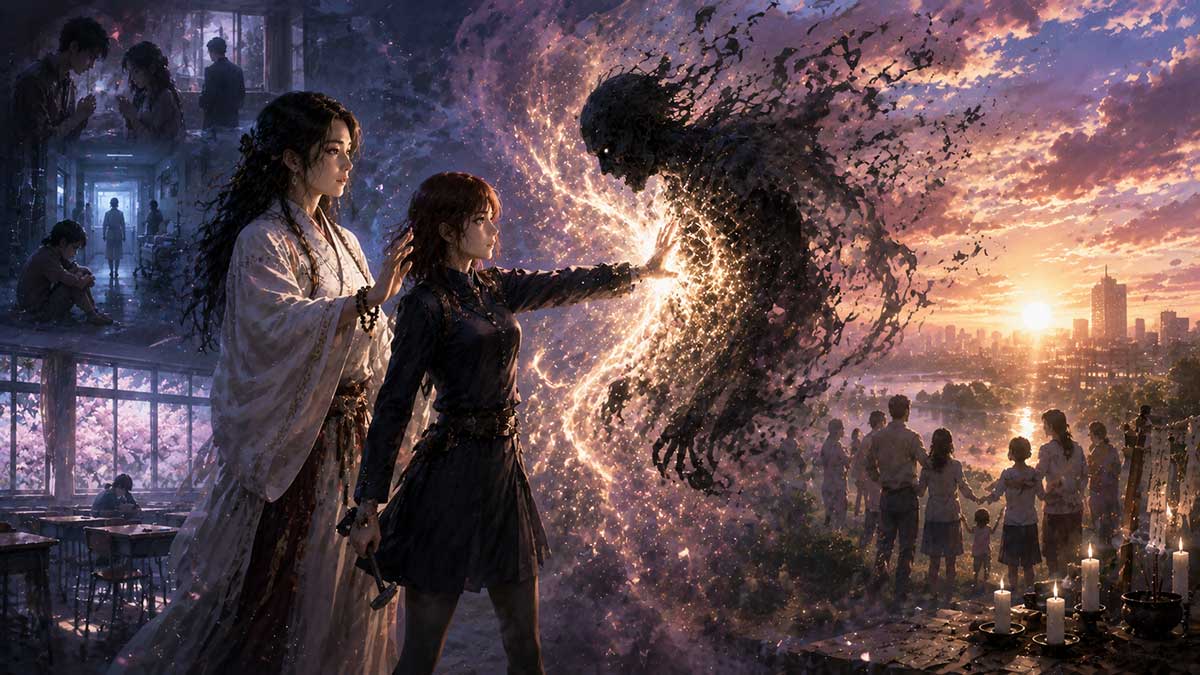
Moderator Opening — Seri Toto
Seri Toto’s voice softened.
“In Jujutsu Kaisen, most curses are destroyed,” she began. “That is the duty of the sorcerer. Find the curse. Measure the danger. Exorcise it before it harms more people.”
She looked across the table.
“But in spirit work, the question can be more complicated.”
Her hands remained still.
“Some spirits must be removed. Some energies must be cleansed. Some trapped souls must be released. Some darkness must be confronted firmly. But some suffering must be understood, or it may return in another form.”
She turned toward Nobara Kugisaki.
“So our final topic asks this: when we call something a curse, are we speaking about an enemy to defeat, a wound to heal, or a trapped force that needs release?”
The guests were:
Seri Toto — Japanese modern spirit medium and free miko figure
John Edward — psychic medium known for afterlife communication
Chip Coffey — psychic medium and paranormal investigator
Sarbajeet Mohanty — demonologist and paranormal investigator
Nobara Kugisaki — jujutsu sorcerer who refuses to let darkness define her identity
Q1. When someone is trapped by hatred, shame, grief, or fear, should the curse be fought, cleansed, communicated with, or released?
John Edward:
The first step is knowing what we are actually facing.
Grief should not be fought like an enemy. Shame should not always be treated like a demon. Fear should not be mocked. Hatred should not be allowed to rule, but often it began as pain.
If you try to destroy every painful thing inside a person, you may destroy the story that needs healing.
Some things need cleansing.
Some things need forgiveness.
Some things need boundaries.
Some things need to be named honestly.
A curse is not always removed by force. Sometimes it weakens when a person finally says, “This pain happened, but it is not my master.”
Sarbajeet Mohanty:
I agree, but I would add caution.
There are cases where communication is dangerous. If a presence is deceptive, parasitic, or aggressive, communication can create deeper attachment. People may think they are helping, but they are feeding something that feeds on attention.
So we must separate human pain from hostile influence.
With grief, compassion.
With trauma, healing.
With negative energy, cleansing.
With dangerous entities, firm removal.
The wrong method can worsen the situation.
Chip Coffey:
That is why discernment matters.
People often use dramatic labels too quickly: demon, curse, possession, haunting. But a person may be depressed, grieving, spiritually sensitive, or living in a toxic environment.
We should never turn ordinary suffering into a paranormal story too fast.
At the same time, we should not dismiss every spiritual experience as imagination.
Good spirit work listens first.
What changed? When did it begin? Who is affected? What emotion is strongest? Does the presence feel confused, angry, manipulative, or ancient?
The answer determines the method.
Nobara Kugisaki:
I am not gentle with curses.
If something is trying to hurt people, I fight it. I do not ask whether it has a tragic reason.
But people are different.
A person can carry hatred and still be worth saving. A person can be afraid and still be brave. A person can be wounded and still be beautiful.
That is why I hate curses. They take what is painful in people and turn it into something ugly.
If you ask me what should be fought, I say fight whatever steals a person’s dignity.
Seri Toto:
Yes.
The curse must be treated according to its nature.
A wound must be healed.
A lie must be exposed.
A spirit must be released.
A predator must be removed.
A pattern must be broken.
That is why the highest spiritual work is not merely exorcism. It is discernment joined with love.
Q2. Is spirit removal mainly about forcing darkness out, or helping trapped energy move on?
Chip Coffey:
Spirit removal is not one single thing.
Sometimes it is firm. You set boundaries. You clear the home. You command the energy to leave. You stop feeding fear.
Sometimes it is compassionate. A spirit may not understand that it has died. It may be attached to a place, a person, an object, or a memory. In those cases, the work feels less like battle and more like guiding.
But trapped energy can still harm people.
A confused spirit may not be evil, but it can still disturb the living. Compassion does not mean allowing it to stay.
John Edward:
Many spirits move through love, recognition, and release.
People often hold the dead with guilt. “I should have said this.” “I should have done that.” “I cannot let go.” That emotional grip can keep the living in pain, and sometimes it seems to hold the spirit close.
Release is not rejection.
Release can be love matured.
In Jujutsu Kaisen, curses are usually enemies. But in real grief, what haunts us may be love that never found peace.
Sarbajeet Mohanty:
We must be careful.
Not everything that claims to be trapped is harmless. Some entities imitate sadness. Some create pity. Some pretend to be children. Some present themselves as victims to gain entry.
This is why protection comes first.
If the energy is truly trapped, release may work.
If the entity is predatory, kindness without authority becomes weakness.
Nobara Kugisaki:
I understand release when we are talking about people.
But curses? No.
A curse that attacks children, twists bodies, or uses people’s pain as food does not deserve a sentimental speech. It needs to be stopped.
Still, I understand the deeper point.
Maybe the real work is stopping curses before they become curses.
Maybe if people were loved better, heard earlier, protected sooner, fewer curses would be born.
Seri Toto:
That is the bridge between exorcism and healing.
When darkness has already become predatory, removal is mercy.
Mercy for the victims.
Mercy for the place.
Sometimes even mercy for the spirit, if it can no longer stop harming life.
But before darkness reaches that stage, healing matters. People need mourning. Homes need cleansing. Families need truth. The dead need release. The living need courage.
Spirit removal is not only pushing something away.
It is restoring proper order.
Q3. After the battles end, what would real healing look like for Yuji, Megumi, Nobara, and the cursed world they inherit?
John Edward:
Real healing would begin with mourning.
They have seen too much death. Young people should not have to carry the spiritual weight of an entire society. They would need permission to grieve, not as soldiers, but as human beings.
Yuji especially would need to know that surviving is not a crime.
People who live through tragedy often ask, “Why am I still here?” Healing begins when that question becomes, “How can I live in a way that honors those who are gone?”
Chip Coffey:
For Megumi, healing would mean separating identity from what was done through him.
That is hard. When someone’s body, mind, or life has been used by darkness, they may feel contaminated. They may feel responsible for things they did not choose.
He would need protection, support, and time.
Not quick forgiveness. Not forced optimism.
Time.
Sarbajeet Mohanty:
For the world itself, healing would mean changing the conditions that generate curses.
If negative emotion produces curses, then society cannot only train stronger fighters. It must reduce fear, isolation, hatred, and spiritual neglect.
Hospitals need care and prayer.
Schools need protection from bullying and despair.
Families need healing.
Communities need rituals of mourning and purification.
Otherwise, sorcerers only cut weeds while the roots grow deeper.
Nobara Kugisaki:
For me, healing does not mean becoming soft or pretending everything is fine.
It means I still get to be myself.
I still get to laugh, dress how I want, get angry, protect my friends, and decide what beauty means to me.
Curses try to reduce people. They turn fear into a shape. They turn pain into ugliness.
Healing means refusing to let pain make the final edit.
Seri Toto:
That is beautifully said.
Healing for Yuji is accepting that compassion is not failure.
Healing for Megumi is knowing that being used by darkness does not make him darkness.
Healing for Nobara is continuing to stand inside her own identity without apology.
Healing for the world is learning that curses are not born only in haunted places. They are born wherever human pain is abandoned.
A world that wants fewer curses must become better at mourning, forgiving, cleansing, protecting, and loving.
Topic 5 Closing — Seri Toto
Seri Toto closed her eyes briefly.
“A curse may be destroyed in one moment,” she said. “But the condition that created it may take generations to heal.”
She opened her eyes.
“That is why Jujutsu Kaisen should not be read only as a story of battles. It is a story about neglected emotion. Unmourned death. Abandoned fear. Human hatred given form.”
She looked at Nobara, then back to the table.
“Some darkness must be fought. Some must be cleansed. Some must be released. Some must be understood. But all true healing begins with this refusal: we will not let pain become our god.”
The room stayed silent.
Then Seri spoke one final line.
“If curses are born from human negativity, then perhaps the greatest exorcism is learning how to love before hatred becomes alive.”
Final Thoughts by Seri Toto
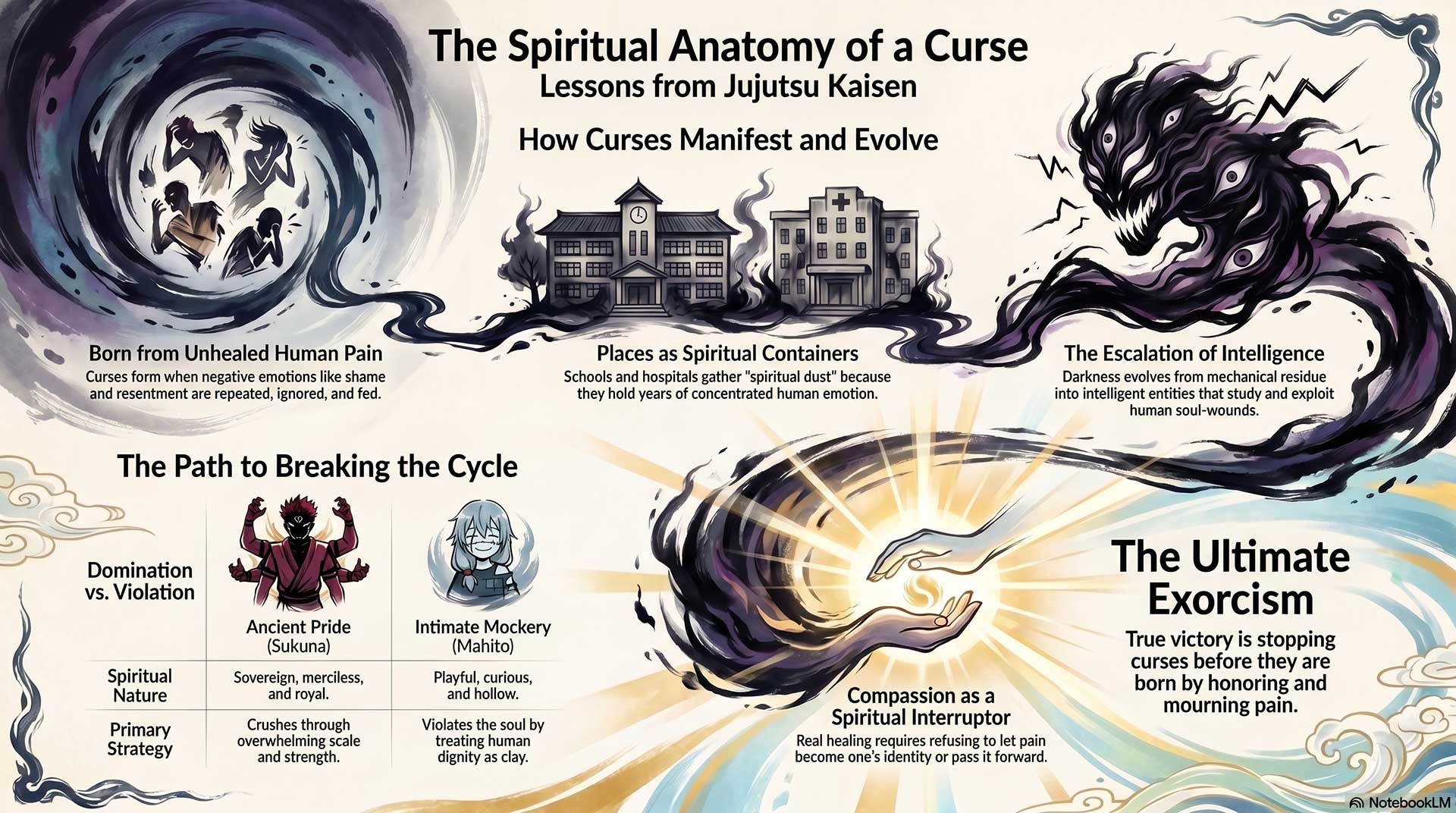
After the final question ended, Seri Toto remained silent for a long moment.
Then she spoke quietly.
“Jujutsu Kaisen touches something many people sense but rarely say.”
She looked into the dim room.
“Human emotion has weight.”
She let the sentence rest.
“Love has weight. Prayer has weight. Grief has weight. Hatred has weight. Shame has weight. A home can be shaped by what is spoken inside it. A school can carry the loneliness of its students. A hospital can hold fear, hope, death, and prayer in the same hallway.”
Her eyes moved across the circle.
“In the anime, that weight becomes cursed energy. In real life, people may use other words: atmosphere, trauma, attachment, haunting, family pattern, spiritual heaviness, ancestral pain, inner darkness.”
She continued.
“The first lesson is that pain must be honored before it mutates. Grief denied can become heavy. Hatred fed can become identity. Shame hidden can become a prison. Fear repeated can become an atmosphere.”
She glanced toward Gojo’s seat.
“The second lesson is that darkness has levels. Some darkness is weak and scattered. Some attaches to places. Some clings to people. Some learns. Some imitates innocence. Some wears a crown.”
The room seemed to remember Sukuna and Mahito.
“Sukuna represents pride without repentance. Mahito represents curiosity without reverence. Sukuna crushes from above. Mahito comes close enough to touch the soul.”
Seri’s voice grew firmer.
“But the deepest lesson of Jujutsu Kaisen is not darkness. It is the human response to darkness.”
She turned toward Yuji.
“Yuji suffers, but he refuses to worship suffering.”
Toward Megumi.
“Megumi falls into shadow, but he is not the shadow.”
Toward Nobara.
“Nobara protects the sacred right to remain oneself.”
Toward Gojo.
“Gojo shows that strength can protect, yet strength alone cannot heal the whole world.”
Seri breathed in slowly.
“If curses are born from human negativity, then the answer cannot be only stronger sorcerers. The answer must be deeper healing. Cleaner homes. Kinder schools. Safer families. Honest mourning. Spiritual protection. Courageous forgiveness. Communities that do not abandon the broken.”
She lowered her eyes.
“Some curses must be destroyed. Some spirits must be removed. Some places must be cleansed. Some memories must be released. Some people must be protected from darkness they never invited.”
Then she gave the final thought.
“But the greatest exorcism may happen before the curse is born.”
She looked at the circle one last time.
“When a grieving person is heard. When a child is protected. When shame is met with mercy. When resentment is transformed before it hardens. When a human being chooses love before hatred becomes alive.”
Seri closed her eyes.
“That may be the hidden hope inside Jujutsu Kaisen: darkness is real, but it is not the original truth of the human soul.”
Short Bios:
Seri Toto
A Japanese modern spirit medium and free miko figure. In this imagined conversation, she serves as the moderator, guiding the discussion through curses, spirit attachment, haunted places, and the spiritual meaning of Jujutsu Kaisen.
James Van Praagh
A spiritual medium and author known for work centered on afterlife communication, grief, and emotional healing. In this roundtable, he speaks about spiritual residue, compassion, and the lasting imprint of love or pain.
Tyler Henry
A modern psychic medium known for readings connected to grief, family wounds, and emotional closure. Here, he helps connect cursed energy to unresolved pain, identity, and the soul’s need for healing.
John Edward
A psychic medium known for public afterlife communication. In this conversation, he brings a careful view of mourning, release, guilt, and the difference between human grief and darker spiritual attachment.
Yuji Itadori
The central hero of Jujutsu Kaisen. After becoming Sukuna’s vessel, Yuji learns that fighting curses means facing the human pain, guilt, and fear that created them.
Chip Coffey
A psychic medium and paranormal investigator known for work involving haunted places, spirit activity, and sensitive children. In this discussion, he explains spiritual residue, haunted locations, and the need for discernment.
Lorraine Warren
A clairvoyant and paranormal investigator associated with famous haunting and possession cases. Here, she represents the view that homes, families, and places can carry spiritual wounds.
Sarbajeet Mohanty
A demonologist and paranormal investigator from India. In this conversation, he brings an investigative voice to spirit attachment, negative energy, protection, and the difference between trapped spirits and predatory entities.
Megumi Fushiguro
A jujutsu sorcerer from Jujutsu Kaisen who senses hidden danger beneath ordinary places. His role explores why schools, hospitals, bridges, and homes can become spiritually charged.
Michelle Belanger
An occult author, psychic medium, and spirit-world researcher. Here, she discusses the stages of dark entities, psychic boundaries, spiritual protection, and the difference between residue and intelligent darkness.
Satoru Gojo
The strongest jujutsu sorcerer in Jujutsu Kaisen. His role asks whether overwhelming strength can truly defeat evil, or whether deeper wisdom, humility, and community are needed.
Mahito
A curse born from human hatred toward other humans. In this conversation, he represents evil that attacks the soul, mocks dignity, and treats human beings as objects to be reshaped.
Nobara Kugisaki
A fierce jujutsu sorcerer who refuses to let darkness define her. She represents courage, identity, dignity, and the right to remain oneself after suffering.
Leave a Reply