
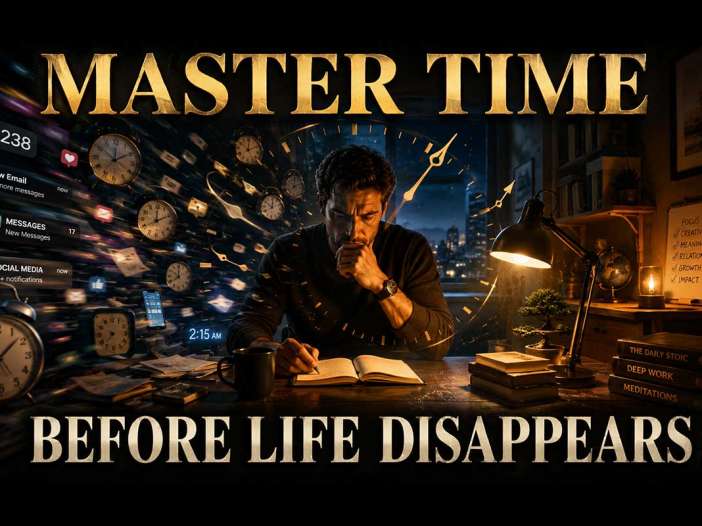
What if Steve Jobs, Carl Jung, and Seneca revealed why most people unconsciously lose their lives one distracted hour at a time?
Introduction By Nick Sasaki
Every human being receives the same twenty-four hours.
Yet some people seem to live three lives inside one day.
They create.
They build.
They love deeply.
They think clearly.
They remain calm under pressure.
They move with intention instead of panic.
Meanwhile, many others feel trapped in exhaustion, distraction, and constant urgency. Entire weeks disappear into notifications, errands, anxiety, and unfinished thoughts. People look up from their phones and suddenly realize years have passed.
So what creates the difference?
This conversation began with a simple realization:
Time is not experienced equally.
A joyful hour feels short.
A painful hour feels endless.
A focused hour can change a life.
A distracted day can vanish without memory.
The guests gathered here come from very different worlds—philosophy, psychology, business, spirituality, athletics, creativity, and human suffering itself. Yet all of them arrived at a surprisingly similar insight:
The true battle is rarely against the clock.
It is against unconscious living.
Some guests argued that attention is the real currency of life. Others insisted that meaning determines the value of time. Some believed discipline and boundaries matter most. Others pointed toward stillness, presence, or love.
Again and again, the discussion returned to one powerful idea:
A person does not lose life all at once.
Life disappears minute by minute through scattered attention, emotional avoidance, shallow commitments, and unconscious habits.
But the opposite is also true.
A person can reclaim life one moment at a time.
By focusing deeply.
By removing what weakens attention.
By entering the present fully.
By spending time on what genuinely matters before death arrives.
This was not merely a discussion about productivity.
It became a conversation about consciousness itself.
Because in the end, the quality of a life may depend less on how many years a person lived—
and more on how awake they were while living them.
(Note: This is an imaginary conversation, a creative exploration of an idea, and not a real speech or event.)
Topic 1: Why Does Time Disappear So Easily?

Opening — Nick Sasaki
Sometimes we look at the clock and feel shocked.
“Wait… how is it already this late?”
Other times, the opposite happens.
“Only ten minutes passed? It felt like an hour.”
Time seems objective, but our experience of time is deeply personal. One hour can feel empty. Fifteen minutes can change everything.
So today, we begin with one question:
Why does time disappear so easily?
Our guests are Seneca, Carl Jung, Eckhart Tolle, James Clear, and Cal Newport.
Question 1: Why do people lose hours without realizing it?
Seneca:
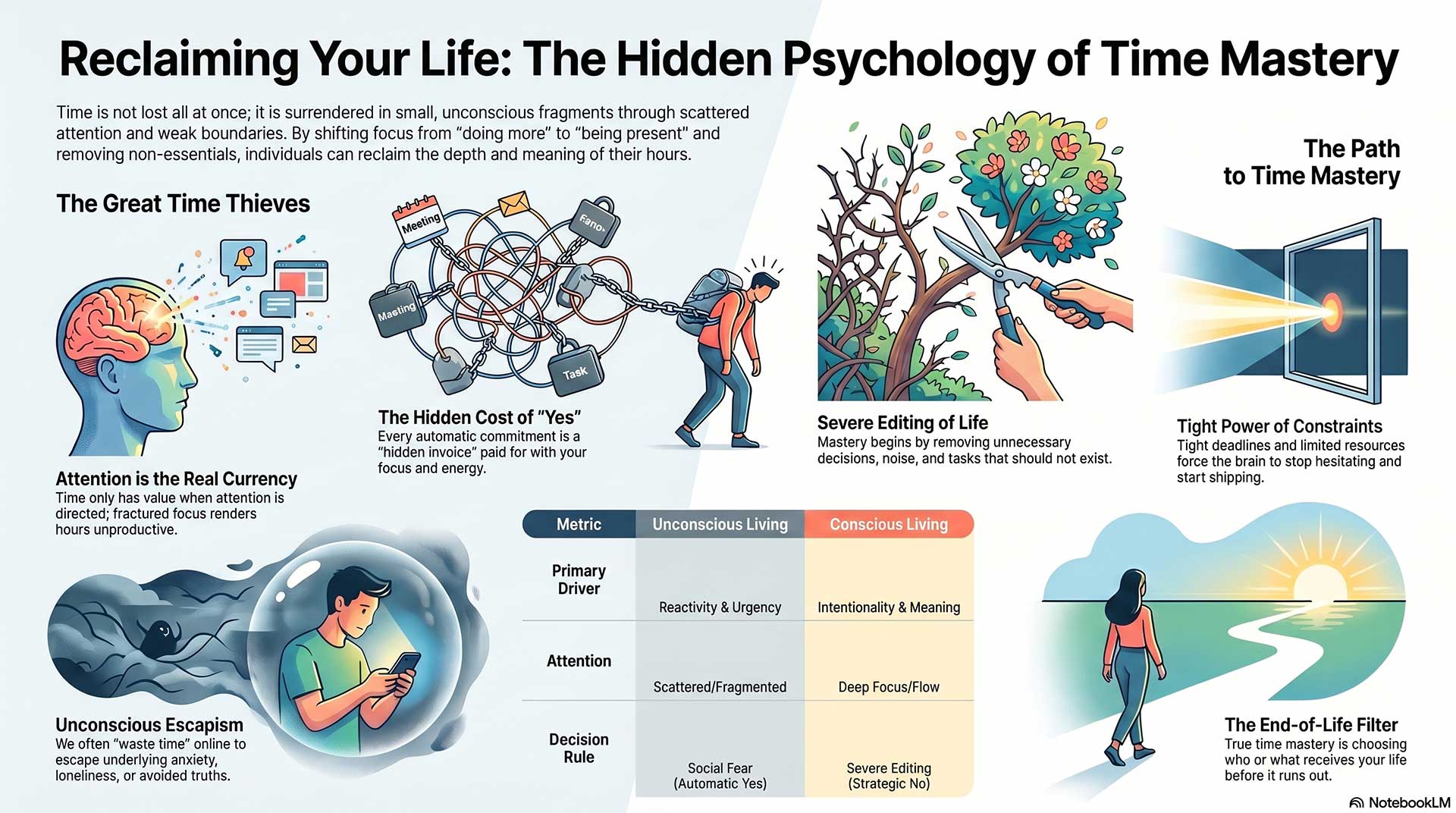
People do not lose time all at once. They surrender it in small pieces. A glance here, a worry there, a conversation without purpose, a habit without reflection. Then they act surprised when the day is gone. But the day did not betray them. They handed it away.
James Clear:
Most people think big problems destroy their schedule. Usually, it is tiny defaults. The phone on the table. The open tab. The habit of checking “just for a second.” Time disappears when small behaviors repeat without a clear system.
Carl Jung:
People lose hours when they are not fully conscious of what is moving inside them. A person may say, “I wasted time online,” but often they were escaping anxiety, loneliness, resentment, or fear. Time disappears into the unconscious before it disappears into the clock.
Cal Newport:
Modern tools are built to fragment attention. The problem is not only weakness. Many environments are engineered to pull people away from sustained thought. A person may sit at a desk for three hours, but experience only twenty minutes of real concentration.
Eckhart Tolle:
Time disappears when the mind lives everywhere except the present. It moves into memory, worry, fantasy, comparison. The body is here, but the attention is elsewhere. Then the person returns and asks, “Where did the time go?” It went where the mind went.
Question 2: Is wasted time really a time problem, or an attention problem?
Cal Newport:
It is mostly an attention problem. Time has value only when attention is directed. Ten hours of fractured attention may produce less than forty minutes of deep work. The central skill is not scheduling every minute. It is protecting the mind from constant interruption.
Eckhart Tolle:
Attention is life energy. What you give attention to becomes your lived experience. A person who gives attention to fear lives in fear. A person who gives attention to the present discovers that time becomes spacious.
Seneca:
The poor use of time begins with the poor use of the self. If a man does not know what his life is for, every hour becomes vulnerable. He will lend himself to anyone who asks, and then complain he had no time.
James Clear:
Attention follows cues. You do not rise to your goals as much as you fall to your environment. If the environment keeps inviting distraction, attention will leak. Better attention often begins with better design.
Carl Jung:
Attention is also a moral act. What we refuse to face often controls us indirectly. A man may say he lacks discipline, when really he lacks inner honesty. The wasted hour may be a symptom of an avoided truth.
Question 3: How can a person recover awareness before the day slips away?
James Clear:
Create small checkpoints. Ask three times a day: “What am I doing now? Is this still the right thing?” Awareness returns through repetition. You do not need a perfect schedule. You need moments that interrupt autopilot.
Seneca:
Begin the day by claiming it. Do not wait for the world to decide your hours. Ask in the morning, “What part of my life must not be stolen today?” A day protected at the beginning is less easily lost.
Cal Newport:
Use blocks of focus. Decide ahead of time when you will work deeply, when you will communicate, and when you will rest. Without structure, the shallow will defeat the meaningful.
Eckhart Tolle:
Return to the breath. Feel the body. Listen to the silence under the noise. Awareness does not require a dramatic technique. It begins when you notice that you are here.
Carl Jung:
At the end of the day, ask not only, “What did I do?” but “What was I avoiding?” This question restores responsibility. The person who understands their avoidance begins to reclaim their time.
Closing — Nick Sasaki
So the first lesson is clear.
Time does not only disappear from the calendar.
It disappears from consciousness.
We lose time when our attention is scattered, when our environment controls us, when our fears go unnamed, and when we begin the day without choosing what matters.
Maybe mastering time starts with a very simple question:
Where is my attention right now?
Topic 2: What Do Time Masters Remove From Their Lives?
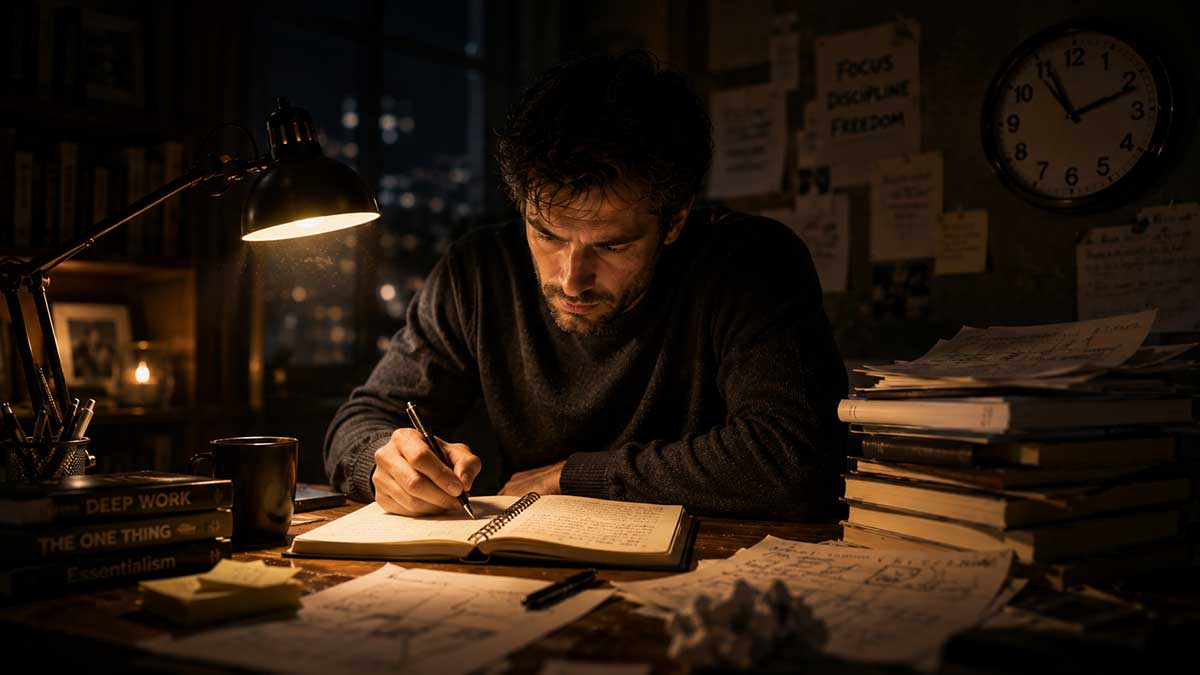
Opening — Nick Sasaki
When we think about mastering time, we usually think about adding something.
A better schedule.
A better app.
A better morning routine.
A better productivity system.
But people who use time well often begin somewhere else.
They remove.
They remove distractions.
They remove unnecessary decisions.
They remove weak commitments.
They remove the habit of saying yes too quickly.
So today’s question is simple:
What do time masters remove from their lives?
Our guests are Steve Jobs, Peter Drucker, Warren Buffett, Marie Kondo, and Tim Ferriss.
Question 1: What steals the most time: distraction, fear, people, or indecision?
Peter Drucker:
The greatest thief is not always distraction. It is the absence of clear priorities. When a person does not know what matters, everything appears urgent. The effective person begins by asking, “What results am I responsible for?”
Steve Jobs:
Indecision steals more time than people realize. If you keep ten options alive, your mind pays rent on all ten. Focus means closing doors. The hardest part is not choosing what to do. It is accepting what you will not do.
Warren Buffett:
People often lose time trying to keep too many opportunities. Most opportunities are not worth your best hours. You only need a few right decisions in life. The problem is that people treat every invitation like it might be the one.
Marie Kondo:
Fear can hide inside clutter. A person keeps too many things, too many plans, too many obligations, and says, “I may need this someday.” But that someday quietly occupies today. Letting go is not loss. It is making room for life.
Tim Ferriss:
For many people, the biggest thief is automatic yes. They accept meetings, favors, projects, and messages without calculating the cost. Every yes has a hidden invoice. The bill usually comes out of focus, sleep, family, and creative energy.
Question 2: Why do productive people say no so often?
Warren Buffett:
The difference between successful people and very successful people is that very successful people say no to almost everything. This is not arrogance. It is math. You cannot compound attention if you keep spending it everywhere.
Steve Jobs:
Saying no is how you protect the quality of your yes. A company, a life, a creative project—it all becomes mediocre when too many things are allowed in. The best work comes from severe editing.
Peter Drucker:
Saying no is a responsibility. The executive who says yes to every task is not generous. He is careless with the organization’s resources, including his own time. Effectiveness requires abandonment of what no longer contributes.
Tim Ferriss:
Most people say yes from social fear. They do not want to disappoint anyone. But then they disappoint their future self. A useful rule is this: if it is not a clear yes, treat it as no.
Marie Kondo:
A true no is not cold. It creates clarity. When you release what does not belong, you can give more presence to what remains. The purpose of saying no is not emptiness. It is joy, attention, and peace.
Question 3: What must be removed before deep focus becomes possible?
Cal Newport:
Deep focus requires removing unscheduled access to your attention. If anyone can reach you anytime, your mind never fully settles. Focus is not only a personal virtue. It is a boundary system.
Peter Drucker:
Remove unexamined activity. Most people are busy with tasks that should not exist. Before improving a process, ask whether the process should be done at all. Nothing is less productive than efficiently doing what need not be done.
Steve Jobs:
Remove noise. Too many features, too many meetings, too many compromises. Simplicity is not decoration. It is discipline. The mind becomes powerful when it is not carrying unnecessary weight.
Marie Kondo:
Remove what creates silent friction. A messy desk, an overflowing inbox, a calendar full of obligations that do not fit your values. These things whisper all day. Deep focus grows in a space that feels intentional.
Tim Ferriss:
Remove reactive work from your best hours. Do not give your clearest mental energy to email, messages, or other people’s agendas. Put the hard creative thing first. Let the world wait a little.
Closing — Nick Sasaki
Topic 1 taught us that time disappears when attention disappears.
Topic 2 adds the next lesson:
Time returns when we remove what does not deserve our life.
Maybe mastering time is not about doing more.
Maybe it begins with asking:
What am I allowing into my day that should never have been there?
Topic 3: Why Do Busy People Sometimes Create Faster?

Opening — Nick Sasaki
There is a strange paradox in life.
Sometimes people with the least free time produce the most ideas.
A busy entrepreneur suddenly invents a new business model during a flight.
A parent with five responsibilities writes a book at midnight.
A creator under pressure finishes in two days what they delayed for six months.
Meanwhile, someone with unlimited time may produce almost nothing.
So today we ask:
Why do busy people sometimes create faster?
Is pressure dangerous?
Or does pressure awaken something hidden inside the human mind?
Our guests are Elon Musk, Thomas Edison, Leonardo da Vinci, Seth Godin, and Naval Ravikant.
Question 1: Why can pressure produce sharper ideas?
Elon Musk:
Pressure forces prioritization. When survival is involved, the brain stops pretending everything matters equally. You move directly to first principles. A lot of creativity is hidden under unnecessary comfort.
Thomas Edison:
People romanticize inspiration. Most breakthroughs come after intense concentration under constraints. When there is urgency, the mind stops wandering and begins experimenting faster.
Seth Godin:
Deadlines create emotional clarity. Without a deadline, people protect themselves psychologically. They keep polishing, hesitating, doubting. A deadline forces shipping. Once you ship, you learn.
Naval Ravikant:
Pressure removes illusion. If you have one hour, you instantly discover what matters. Scarcity sharpens perception. Abundance often weakens it.
Leonardo da Vinci:
Yet pressure alone is insufficient. Fear can narrow the mind too much. The greatest creativity comes when urgency and curiosity coexist. A mind that is only afraid cannot truly invent.
Question 2: Can a short deadline make the mind more creative?
Seth Godin:
Absolutely. Constraints are often the birthplace of originality. Unlimited time encourages safe thinking because there is always tomorrow. Short deadlines force instinct, and instinct often reaches deeper than overanalysis.
Thomas Edison:
When time is limited, experimentation becomes practical instead of theoretical. The inventor stops debating and starts building. Many ideas die from excessive contemplation before they are tested.
Elon Musk:
SpaceX survived partly because we did not have the luxury of endless timelines. Constraints create engineering breakthroughs. If you remove every limit, teams become slower, not smarter.
Leonardo da Vinci:
Still, one must distinguish between mechanical productivity and artistic depth. Certain ideas require incubation. A tree cannot be pulled upward faster by force. Some thoughts mature slowly in silence.
Naval Ravikant:
That is true, but most modern people suffer from procrastination disguised as refinement. They say, “I’m still thinking,” when really they are avoiding judgment. A deadline exposes this immediately.
Question 3: How can ordinary people train themselves to think quickly?
Thomas Edison:
Practice producing imperfect ideas. Most people wait for brilliance before beginning. That habit kills momentum. Quantity often leads to quality. Create first. Refine later.
Seth Godin:
Publish more. Share more. Finish more. The creative muscle grows through repetition, not perfection. The person who creates every day eventually outruns the person waiting for ideal conditions.
Elon Musk:
Reduce cognitive overload. If your brain is juggling unnecessary decisions, your processing power drops. Fast thinking requires energy conservation. Simplify routine choices.
Naval Ravikant:
Train silence. Fast insight does not come from constant noise. Many powerful ideas appear when the mind is still enough to notice patterns. Walking alone is underrated.
Leonardo da Vinci:
Observe deeply. Quick thinking is often the result of long observation. A painter studies light for years, then paints swiftly. A scientist studies motion for decades, then sees the answer instantly. The speed is built upon accumulated seeing.
Closing — Nick Sasaki
Today’s discussion revealed something surprising.
Busy people are not always faster because they work harder.
Sometimes they are faster because:
- they stop pretending they have unlimited time,
- they cut unnecessary thought,
- they act before fear grows larger,
- and pressure forces clarity.
But the deeper lesson may be this:
Creativity does not always need more time.
Sometimes it needs more commitment.
Topic 4: Why Does “The Present Moment” Change Time?

Opening — Nick Sasaki
There are moments when time feels different.
A basketball player sees the court in slow motion.
A writer loses herself in the page.
A parent forgets the clock while holding a child.
A person in prayer feels one minute become strangely full.
The clock did not change.
But the experience of time changed.
So today we ask:
Why does the present moment change time?
Our guests are Miyamoto Musashi, Thich Nhat Hanh, Mihaly Csikszentmihalyi, Eckhart Tolle, and Kobe Bryant.
Question 1: Why does time feel different during deep focus?
Mihaly Csikszentmihalyi:
Deep focus creates what I called flow. In flow, attention is fully absorbed by the task. Self-consciousness fades. The person is no longer watching the clock or judging themselves. Action and awareness become one.
Kobe Bryant:
In a game, that feeling is real. The noise disappears. The crowd disappears. You are not thinking, “I need to be great.” You are just reading the moment. The body responds before doubt can enter.
Miyamoto Musashi:
A warrior who thinks too much is already late. In true attention, the sword moves with the situation. Time feels slower because hesitation has been removed.
Eckhart Tolle:
When you are fully present, psychological time weakens. The mind is no longer trapped in past and future. There is only this. In that stillness, the moment feels wider.
Thich Nhat Hanh:
When you drink tea, drink only tea. When you walk, know that you are walking. The present moment becomes deep when we stop abandoning it. A simple breath can contain great peace.
Question 2: What can meditation, prayer, or stillness teach us about time?
Thich Nhat Hanh:
Stillness teaches us that we do not have to run after life. Life is already here. One mindful breath brings us back to our true home. In that breath, we recover the time we thought we had lost.
Eckhart Tolle:
Most suffering comes from mental time. The mind says, “I should have done this,” or “What if this happens?” Stillness shows us that now is the only place where life can be met.
Mihaly Csikszentmihalyi:
From a psychological view, stillness trains attention. Flow is not only intensity. It requires the ability to stay with one thing. Meditation strengthens that capacity.
Miyamoto Musashi:
Stillness is not passivity. It is readiness without confusion. The quiet mind responds faster than the restless mind.
Kobe Bryant:
People think intensity means tension. It does not. The best competitors learn how to stay calm inside pressure. That calm gives you more space to see, choose, and act.
Question 3: Can a person make one hour feel fuller than an entire day?
Eckhart Tolle:
Yes. Fullness does not come from the number of events. It comes from presence. A single hour lived without inner resistance can be richer than a day spent in unconscious activity.
Thich Nhat Hanh:
When you are truly with someone, one hour can nourish the heart for years. The quality of attention is the quality of love.
Kobe Bryant:
One focused hour beats a distracted day. In training, I wanted every rep to matter. If your mind is not there, you are just going through motion.
Mihaly Csikszentmihalyi:
A fuller hour often has clear goals, immediate feedback, and a challenge that matches skill. The mind becomes engaged. Engagement gives time texture.
Miyamoto Musashi:
A life is made of moments. A person who wastes the moment wastes the life. A person who enters the moment fully sharpens the soul.
Closing — Nick Sasaki
Topic 4 gives us a deeper lesson.
Time does not become meaningful by being filled with more activity.
It becomes meaningful when we are fully there.
Maybe the person who masters time is not the one who controls every minute.
Maybe it is the one who can enter one minute completely.
Topic 5: At the End of Life, What Kind of Time Matters?
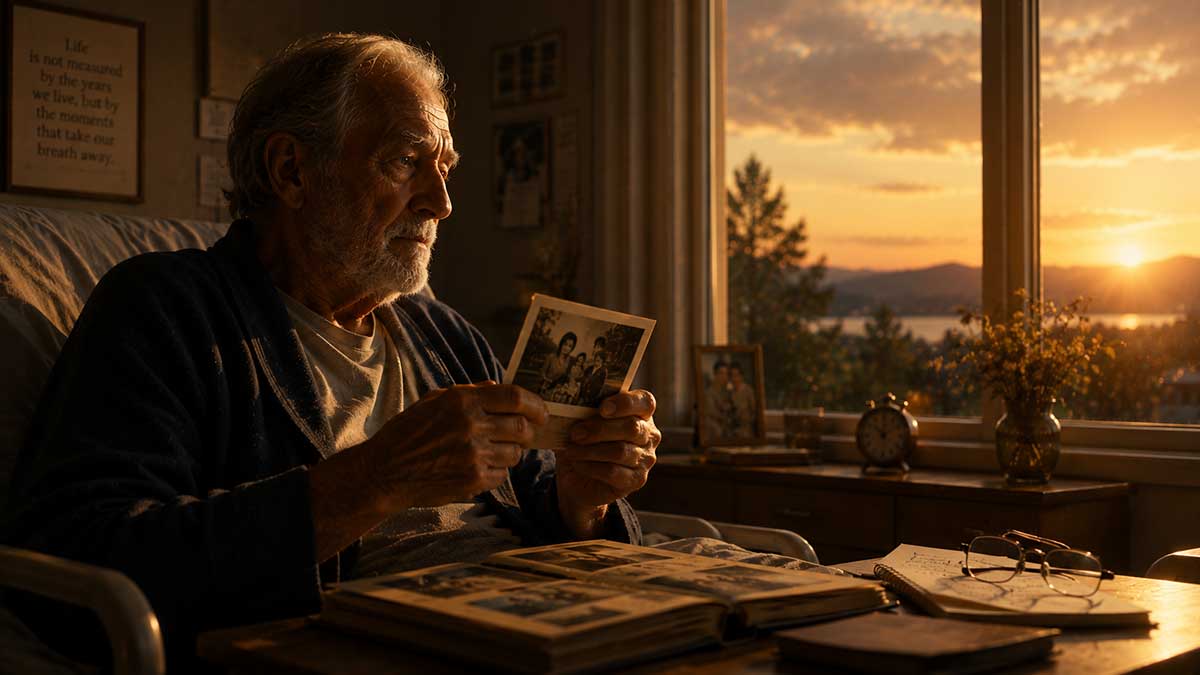
Opening — Nick Sasaki
At the end of life, people rarely ask,
“Did I answer enough emails?”
“Did I finish every errand?”
“Did I win every argument?”
They ask different questions.
Did I love well?
Did I forgive soon enough?
Did I spend my best hours on what truly mattered?
Did I live, or did I only stay busy?
So today we ask:
At the end of life, what kind of time matters?
Our guests are Viktor Frankl, Leo Tolstoy, Elisabeth Kübler-Ross, Mother Teresa, and Steve Jobs.
Question 1: Why do people regret wasted emotional time more than wasted work time?
Elisabeth Kübler-Ross:
Near death, people often see with painful clarity. They remember the love they postponed, the apology they never offered, the child they were too busy to notice, the anger they carried too long. Emotional time becomes sacred when there is no more time to waste.
Viktor Frankl:
Human beings can endure suffering when life has meaning. But meaningless busyness leaves a person spiritually empty. Work matters when it serves love, responsibility, or purpose. Without meaning, it becomes motion without depth.
Leo Tolstoy:
People spend years serving status, reputation, society, and fear. Then death arrives and strips away the false measurements. The soul asks only whether it has lived truthfully.
Mother Teresa:
The greatest poverty is not lack of money. It is lack of love. Many people lose years by withholding kindness from those closest to them. A small act of love is never wasted.
Steve Jobs:
Death is the best filter. When you remember that time is limited, a lot of noise falls away. Pride, fear, embarrassment—they lose control. You start asking, “Is this really how I want to spend my life?”
Question 2: What makes a moment unforgettable?
Mother Teresa:
A moment becomes unforgettable when love is present. It may be very small: holding a hand, feeding someone, listening without hurry. The world may not notice, but the heart remembers.
Viktor Frankl:
A moment is unforgettable when it reveals meaning. In the camps, even a sunset could give strength. Meaning does not require comfort. It requires awakening to what still remains possible within the human spirit.
Leo Tolstoy:
The unforgettable moment is often simple and truthful. A family gathered in quiet sincerity. A confession. A forgiveness. A look that contains more than words. Life is not made great by spectacle, but by moral reality.
Steve Jobs:
Moments become unforgettable when they are connected to something you genuinely care about. Building something, loving someone, choosing your own path. You remember when you were alive, not when you were merely performing.
Elisabeth Kübler-Ross:
People remember moments of presence. The nurse who listened. The son who returned. The friend who stayed. At the end, presence is remembered more than perfection.
Question 3: How should we spend time before time runs out?
Steve Jobs:
Ask yourself often: “If today were the last day of my life, would I want to do what I am about to do?” If the answer is no too many days in a row, change something. Life is too short to live someone else’s script.
Mother Teresa:
Begin with the person in front of you. Do not wait to love humanity in theory. Love your family, your neighbor, the lonely one near you. Great use of time begins with faithful love in small places.
Viktor Frankl:
Do not ask life what it owes you. Ask what life is asking of you. Time becomes meaningful when a person answers that call with courage.
Leo Tolstoy:
Live simply, truthfully, and with moral seriousness. Do not postpone the good. The hour to become human is always now.
Elisabeth Kübler-Ross:
Say what must be said. Forgive where you can. Let people know they matter. Many people wait for a dramatic moment, but peace often comes from ordinary honesty before it is too late.
Closing — Nick Sasaki
This final topic brings the whole conversation back to one truth:
Time is not only something we manage.
It is something we give.
We give it to work.
We give it to worry.
We give it to love.
We give it to resentment.
We give it to dreams.
We give it to people who may not even value it.
So the question is not only:
How do I master time?
The deeper question is:
Who or what is receiving my life?
Final Thoughts by Nick Sasaki
When this conversation began, the question seemed practical:
“How can we manage time better?”
But by the end, the discussion moved somewhere much deeper.
The guests showed us that time is connected to attention, fear, meaning, love, mortality, creativity, and consciousness itself.
Seneca reminded us that people surrender life in fragments.
Jung warned that unconscious fears quietly consume our days.
Steve Jobs spoke about removing everything nonessential.
Kobe Bryant described the strange expansion of time during complete focus.
Viktor Frankl showed that meaning can transform even suffering into something valuable.
And perhaps the most uncomfortable realization was this:
Many people are not actually living most of their hours.
They are reacting.
Escaping.
Scrolling.
Worrying.
Repeating.
Waiting for “real life” to begin later.
But life is happening during those exact moments.
The discussion also challenged the modern obsession with busyness. Several guests argued that productivity without presence eventually becomes emptiness. A person may fill every hour and still feel that life slipped away.
In contrast, one deeply present hour with someone you love can remain in memory forever.
So maybe mastering time is not about squeezing more activity into the calendar.
Maybe it is about increasing the depth of experience inside each moment.
Near the end of the conversation, a quiet pattern emerged across nearly every guest:
The people who use time best are usually the people who know life is temporary.
Not in a depressing way.
In a clarifying way.
Death sharpens priorities.
Stillness sharpens awareness.
Focus sharpens creativity.
Love sharpens memory.
And perhaps that is the final lesson.
We do not truly control time.
But we do choose what receives our attention, our energy, our presence, and our life.
And that choice, repeated every day, becomes our destiny.
Short Bios:
Seneca
Roman Stoic philosopher known for writings on mortality, discipline, emotional resilience, and the wise use of time, especially in On the Shortness of Life.
Carl Jung
Founder of analytical psychology who explored the unconscious mind, human symbolism, shadow psychology, and the hidden forces shaping behavior.
Eckhart Tolle
Author of The Power of Now, widely known for teachings on presence, consciousness, and freedom from psychological time.
James Clear
Writer and habit expert focused on behavioral systems, incremental improvement, and practical psychology for everyday performance.
Cal Newport
Author of Deep Work, known for research on focus, digital distraction, and meaningful productivity in modern life.
Steve Jobs
Visionary entrepreneur and co-founder of Apple, known for intense focus, simplicity, and design-driven innovation.
Peter Drucker
Influential management thinker whose work shaped modern ideas of effectiveness, leadership, and organizational priorities.
Warren Buffett
Legendary investor known for disciplined thinking, patience, simplicity, and long-term decision making.
Marie Kondo
Japanese organizing expert known for encouraging intentional living through simplicity and emotional clarity.
Tim Ferriss
Author of The 4-Hour Workweek, focused on optimization, experimentation, and removing unnecessary complexity from life.
Elon Musk
Entrepreneur leading companies such as Tesla and SpaceX, recognized for extreme productivity and first-principles thinking.
Thomas Edison
Prolific inventor associated with practical experimentation, relentless iteration, and hundreds of technological patents.
Leonardo da Vinci
Artist, scientist, and inventor celebrated for combining deep observation, creativity, and interdisciplinary curiosity.
Seth Godin
Writer focused on creativity, leadership, shipping creative work, and modern marketing philosophy.
Naval Ravikant
Philosophical entrepreneur known for reflections on wealth, leverage, happiness, and mental clarity.
Miyamoto Musashi
Legendary samurai and author of The Book of Five Rings, emphasizing discipline, awareness, and strategic mastery.
Thich Nhat Hanh
Zen Buddhist teacher known globally for mindfulness, compassion, and peaceful living in the present moment.
Mihaly Csikszentmihalyi
Psychologist best known for developing the concept of flow, the deeply immersive state of optimal experience.
Kobe Bryant
Professional basketball player known for relentless discipline, mental intensity, and the “Mamba Mentality.”
Viktor Frankl
Author of Man’s Search for Meaning, exploring purpose, suffering, and spiritual resilience under extreme hardship.
Leo Tolstoy
Author of classics such as War and Peace and Anna Karenina, later focused deeply on morality, simplicity, and spiritual truth.
Elisabeth Kübler-Ross
Pioneer in near-death studies and grief psychology, known for work on death, dying, and emotional healing.
Mother Teresa
Humanitarian and founder of the Missionaries of Charity, remembered for serving the poor and emphasizing compassion through action.
Leave a Reply