

What if growing up always means learning how to love people you cannot keep forever?
Introduction by Nick Sasaki
There are moments in life when time suddenly becomes visible.
High school graduation is one of those moments.
For years, students live inside a shared rhythm without fully realizing how deeply it shapes them. They wake up early, walk familiar hallways, sit beside familiar faces, complain about homework, laugh during lunch, and slowly build a world together through ordinary repetition. At the time, it often feels endless.
Then graduation arrives, and something strange happens.
The building still exists. The classrooms remain. The teachers continue teaching. Yet the world itself feels gone. Students realize they are not merely leaving a school. They are leaving a season of life that can never return in exactly the same form again.
That is why graduation carries both celebration and grief.
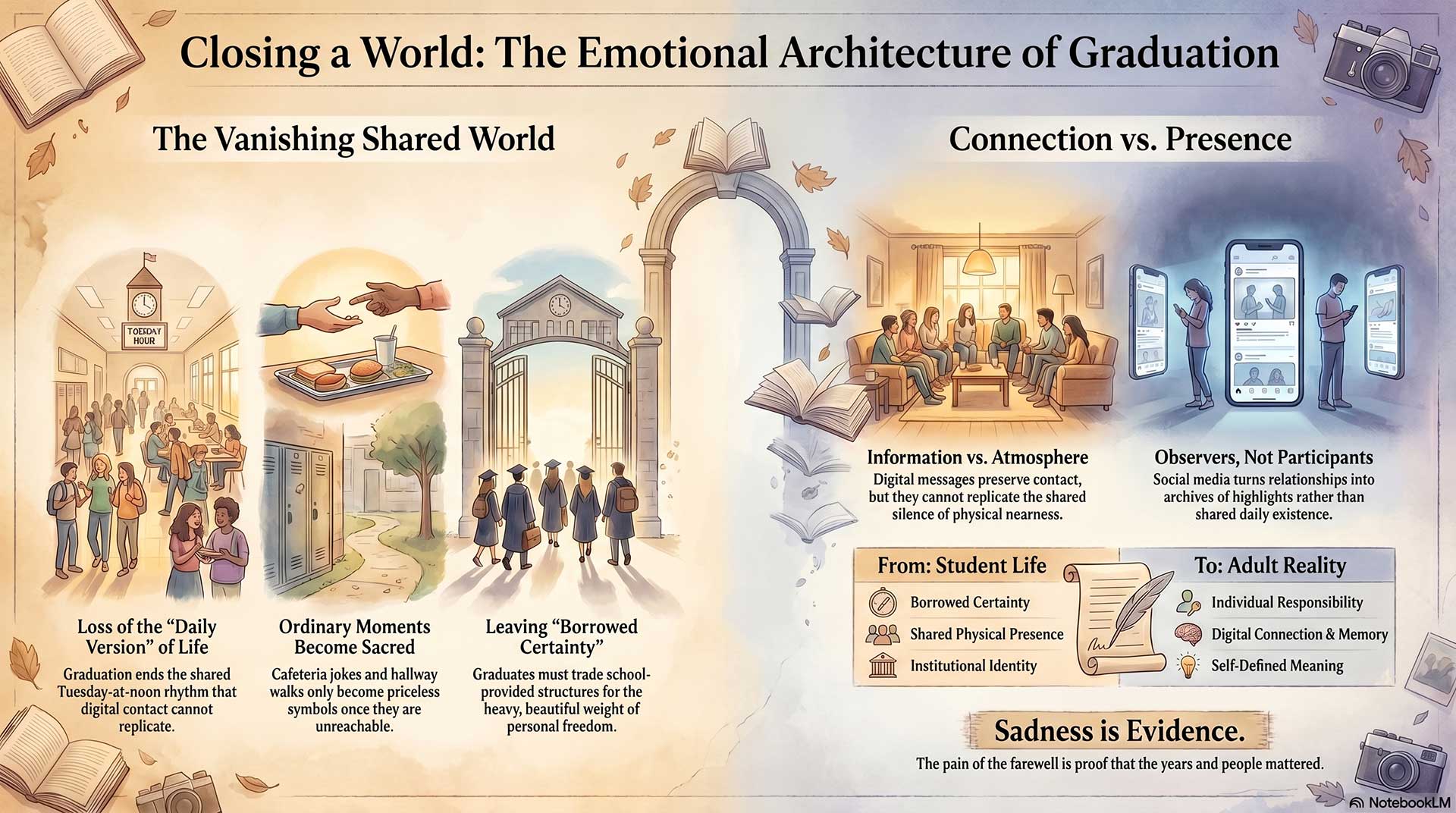
Modern technology softened some of the separation. Friends can still text, video chat, share photos, and remain connected online for years. Yet many graduates still experience loneliness afterward because digital communication cannot fully replace physical presence. A message preserves contact. It does not always preserve shared life.
At its deepest level, graduation becomes humanity’s first great lesson about time.
People who once saw each other every day suddenly move into different futures. Some friendships grow stronger. Some become memories. Some quietly fade without conflict or betrayal. Life simply keeps moving.
Yet hidden inside this sadness is something beautiful: proof that those years mattered.
The cafeteria conversations mattered. The awkward moments mattered. The group photos mattered. The walks home mattered. The people mattered.
Perhaps graduation feels so emotional because it awakens gratitude too late and too suddenly all at once.
This conversation gathers writers, philosophers, artists, educators, storytellers, and observers of human life to reflect on why growing up feels both exciting and heartbreaking — and why ordinary days often become sacred only after they are gone.
(Note: This is an imaginary conversation, a creative exploration of an idea, and not a real speech or event.)
Topic 1: Graduation as the End of a Shared World
Opening — Nick Sasaki
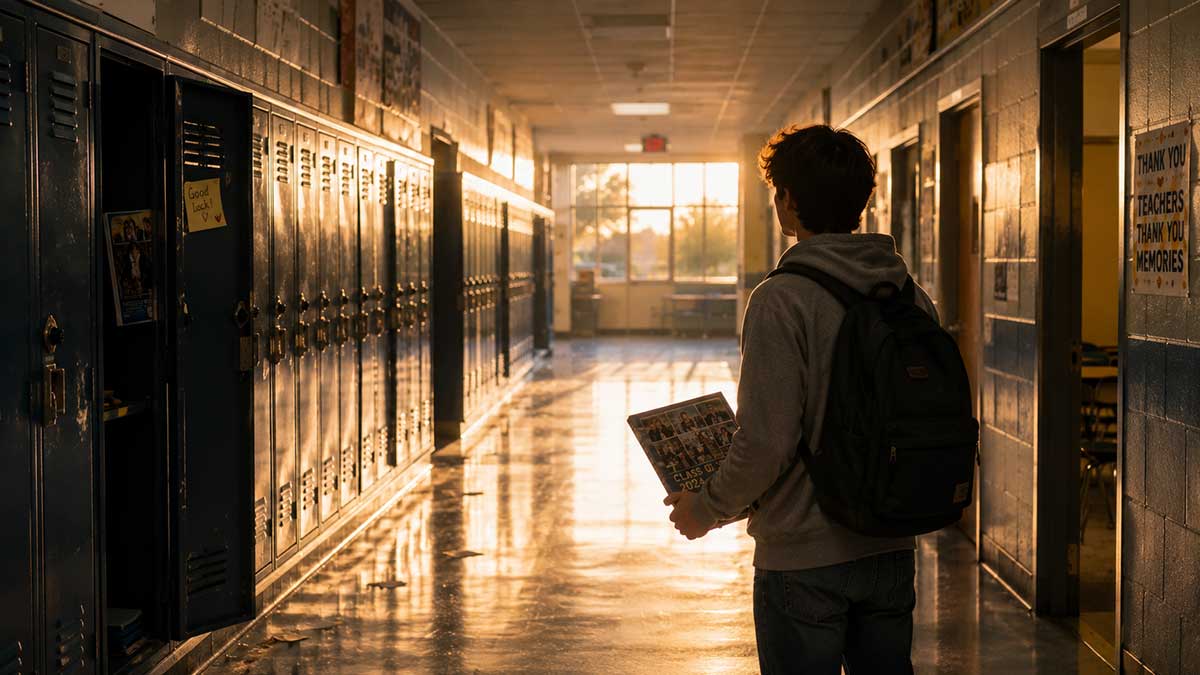
Graduation is not just a ceremony. It is the closing of a world.
For years, students wake up and return to the same hallways, the same classrooms, the same lunch tables, the same jokes, the same faces. They may complain about school, homework, teachers, exams, and routines, but hidden inside that ordinary rhythm is something sacred: belonging.
Then graduation arrives.
The strange thing is that nobody has died, yet something feels gone. The building remains. The friends remain. The memories remain. Yet the world that held them together disappears.
Today, we ask five voices to reflect on why graduation feels so emotional, and why the ordinary days of youth often become priceless only after they are over.
Guests: J.D. Salinger, John Hughes, L.M. Montgomery, Anne Frank, Makoto Shinkai
Question 1: Why does graduation feel like losing a whole world, not just leaving a school?
John Hughes:
A school is never just a school.
It is a little universe with its own rules, tribes, romances, embarrassments, heroes, and outcasts. A hallway can feel like a battlefield one day and home the next. A lunch table can become a family. A classroom can become the place where someone first feels seen.
Graduation hurts because everyone suddenly realizes the movie is ending.
Not the friendship. Not the love. Not the memory. But the setting — the shared stage — is gone.
L.M. Montgomery:
Youth makes homes out of places before it even knows it is doing so.
A classroom window, a tree outside the school, a path walked every morning — these become part of the soul. Students think they are simply passing through, but all the while, the place is becoming threaded into their hearts.
Graduation feels like losing a world because it is the first time many young people realize that happiness can be ordinary.
J.D. Salinger:
The awful part is that nobody warns you properly.
People say, “Congratulations,” and “Good luck,” and “You’ll do great.” They mean well. But nobody says, “You are about to lose the daily version of your life.”
That’s the part that gets you.
You can still call your friends. You can still see them. But you don’t get Tuesday at 12:17 anymore. You don’t get the same stupid joke at the same lunch table. You don’t get that exact air again.
Anne Frank:
A shared world becomes precious because it gives young people a feeling of safety.
Not perfect safety. School can be hard. People can be cruel. Yet there is a structure. There is repetition. There is the comfort of knowing who will be there tomorrow.
When graduation comes, tomorrow changes.
That is why the heart trembles. The young person is not only leaving a place. They are leaving a version of themselves that belonged there.
Makoto Shinkai:
Graduation is painful because distance begins quietly.
At first, everyone promises to stay close. They mean it. Their phones are full of messages. Their hearts are full of sincerity.
Yet life stretches people apart.
Different cities. Different schools. Different schedules. Different dreams. The sky above them may be the same, but the daily world is no longer shared.
That is why graduation feels like a beautiful disappearance.
Question 2: What makes ordinary school memories become precious only after they end?
L.M. Montgomery:
We rarely recognize beauty when it arrives in simple clothes.
A conversation after class. A friend waiting by the door. A teacher’s voice. A rainy afternoon. These things seem too small to treasure at the time.
Only later does the soul understand: those were the golden moments.
Not the grand achievements, but the repeated kindnesses. Not the perfect days, but the familiar ones.
J.D. Salinger:
People are terrible at knowing when they’re happy.
They think happiness has to announce itself. It doesn’t. It’s usually sitting there in a boring afternoon, wearing an old sweatshirt, eating cafeteria food with someone who makes you laugh.
Then years later, you’d give anything to sit there again for ten minutes.
That’s the trick life plays.
John Hughes:
Ordinary memories become precious because they were shared before anyone knew what they meant.
Teenagers are busy surviving themselves. They’re worried about who likes them, who ignores them, what they look like, what they’ll become. They don’t realize the ordinary scene is already becoming memory.
The locker slam. The bus ride. The awkward dance. The last bell.
Those details become emotional later because they carry the truth of youth: messy, funny, painful, alive.
Makoto Shinkai:
Memory changes the lighting.
A classroom that once seemed plain becomes filled with afternoon gold. A goodbye that seemed casual begins to echo. A short walk home becomes a scene the heart returns to many times.
The past is not always accurate, but it is meaningful.
It gathers small moments and turns them into symbols.
Anne Frank:
Ordinary memories become precious because they prove we lived among others.
To laugh with classmates, to sit beside friends, to share food, to learn together — these are quiet gifts. When they end, we see that they were never guaranteed.
Memory teaches gratitude late.
But still, gratitude is worth receiving, even late.
Question 3: Can young people truly understand the value of a season before it is gone?
Anne Frank:
Some can feel it, but not fully.
The young heart often senses that time is fragile. It may feel sadness before the final day. It may look at friends and wonder, “Will we ever be together like this again?”
Yet full understanding comes later.
That does not make youth foolish. It means youth is living forward, as it must.
John Hughes:
Teenagers understand more than adults think.
They may not have the words, but they feel the ending. That’s why graduation parties are loud. That’s why people laugh too hard, hug too long, take too many pictures.
They know something is happening.
They just don’t know how permanent it is.
J.D. Salinger:
No. Not completely.
And maybe they shouldn’t.
If young people fully understood how fast everything disappears, they might freeze. They need some innocence to keep moving. They need to believe that things will last a little longer.
The sadness comes later. That’s part of the deal.
L.M. Montgomery:
They can learn to cherish more.
Parents, teachers, and elders can help by saying gently, “Look around. This matters.” Not in a heavy way, but in a tender way.
A young person may not grasp the whole meaning, but they can be invited to notice.
To notice is already a form of gratitude.
Makoto Shinkai:
A season cannot be held by understanding it.
It can only be lived.
Perhaps the best young people can do is this: pause once in a while, look at the faces around them, and feel the quiet miracle of being together.
They do not need to understand everything.
They only need to be present.
Closing — Nick Sasaki
Graduation feels deep because it reveals something life rarely says out loud: a world can end without anyone doing anything wrong.
No betrayal. No disaster. No tragedy.
Just time.
The students move forward. The school remains behind. The friendships continue in new forms, but the daily closeness is gone. That is why the pain is real.
Yet the sadness is not only sadness. It is evidence.
Evidence that the lunches mattered. The jokes mattered. The classrooms mattered. The people mattered. The years mattered.
Graduation is not just the end of school.
It is the first great farewell to a shared world.
Topic 2: The Pain of Saying Goodbye to People Who Shaped You
Opening — Nick Sasaki
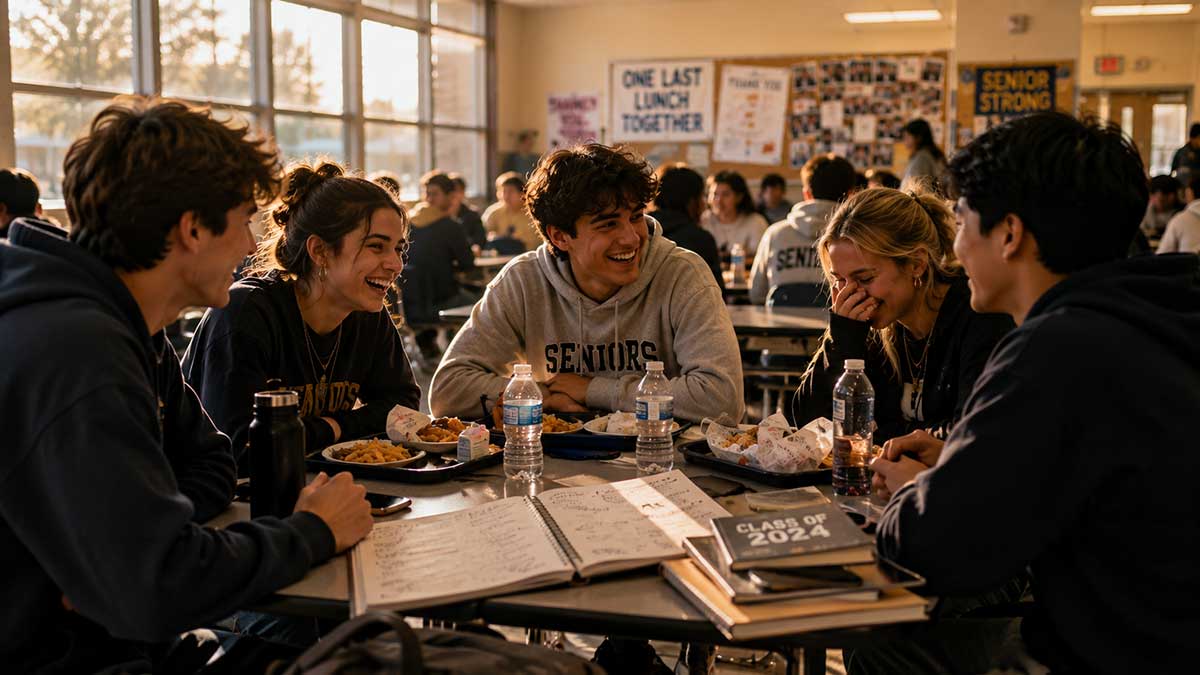
Goodbye hurts most when the people leaving are not strangers, but people who helped form us.
In school, friends do more than share time. They shape our humor, confidence, wounds, courage, habits, dreams, and sense of belonging. Some friends become witnesses to our awkward years. They remember who we were before we knew how to explain ourselves.
Graduation is painful because these people do not simply disappear from our contact list. They disappear from our daily life.
Today, we ask what it means to say goodbye to people who helped us become ourselves.
Guests: Maya Angelou, Fred Rogers, Kahlil Gibran, Taylor Swift, Haruki Murakami
Question 1: Why do friendships formed in youth often feel impossible to replace?
Fred Rogers:
Youthful friendships are powerful because they often begin before we are polished.
A friend from school may know the shy version of you, the confused version, the silly version, the version still learning how to stand. That kind of friendship carries a special tenderness.
Later in life, people often meet our more edited selves. But childhood friends remember the unfinished person.
That is why they feel irreplaceable.
Taylor Swift:
There is something about the people who knew your first heartbreaks, first dreams, first embarrassments, and first little victories.
They were there before the story had a shape.
You can make new friends later, beautiful friends, deep friends. But the old ones hold the original footage. They remember scenes you forgot. They remember the way you laughed before life became complicated.
That kind of memory is hard to recreate.
Maya Angelou:
Friends of youth are often mirrors before we know our own face.
They tell us who we are becoming. They laugh with us, wound us, forgive us, challenge us, and sometimes protect us from loneliness.
A young person may think friendship is only companionship. Later, they learn it was formation.
Those friendships feel impossible to replace because they participated in our making.
Haruki Murakami:
Some friendships belong to a particular room in time.
You can carry the friendship forward, perhaps, but you cannot recreate the room.
The classroom light. The rain outside. The walk home. The small silence between two friends who understand each other without saying much.
Later, you meet new people. You live new lives. But some friendships remain tied to the atmosphere where they were born.
Kahlil Gibran:
The friend of youth is not merely a companion on the road.
They are part of the road itself.
They walked beside you when your soul was still unfolding. They knew the springtime of your becoming. Their laughter entered your memory. Their kindness entered your courage.
Such a friend cannot be replaced, for no soul can return to the same dawn twice.
Question 2: Is goodbye painful because of distance, or because we are no longer the same people?
Haruki Murakami:
Distance is only the visible part.
The deeper pain is that time continues its quiet work. People change cities, schools, jobs, beliefs, habits. One day, you meet again and realize you still care for each other, but the old rhythm is gone.
Nobody betrayed the friendship. Life simply rearranged the furniture.
That is the sadness.
Taylor Swift:
Goodbye hurts because you know the group photo is already becoming a memory.
You may still text. You may still meet during holidays. But something changes when you are no longer living the same days together.
You are not losing love. You are losing the shared present.
And sometimes that hurts more.
Fred Rogers:
Distance can be hard, but change is natural.
A good friendship does not always need to stay the same to remain meaningful. Sometimes people grow apart in daily life, yet still carry one another with warmth.
The pain of goodbye may come from wanting everything to remain as it was.
But love can bless what was, and still make room for what comes next.
Maya Angelou:
Goodbye is painful because it asks us to accept movement.
The child becomes the adult. The student becomes the worker. The friend becomes a person with another path.
We suffer when we try to keep people frozen in the role they once played for us.
Love matures when it says, “I honor who you were to me, and I bless who you are becoming.”
Kahlil Gibran:
Distance wounds the body of friendship.
Change tests its spirit.
If friendship was only habit, distance may dissolve it. If friendship was love, it may become quieter, but not vanish.
The sorrow of goodbye is the soul learning that love is not possession. It is recognition.
Question 3: How should we honor people who walked with us but cannot stay with us?
Maya Angelou:
We honor them by becoming better, not bitter.
If someone helped you laugh, keep your laughter alive. If someone helped you stand, stand with dignity. If someone believed in you, become the kind of person who believes in others.
No friendship that forms us is wasted.
People leave fingerprints on our spirit. The noble task is to live in a way that makes those fingerprints visible.
Fred Rogers:
One beautiful way to honor people is to remember them with gratitude instead of regret.
You can say, “Thank you for being part of my life.” Maybe you say it in a letter. Maybe in a message. Maybe only quietly in your heart.
Gratitude does not erase sadness, but it makes sadness gentle.
It reminds us that separation is painful because connection was real.
Taylor Swift:
Make memory into a blessing, not a prison.
Take the picture. Save the note. Keep the song. But do not live trapped inside the hallway of the past.
Let those people remind you that you were loved once, known once, understood once.
Then go forward and create new rooms where love can find you again.
Haruki Murakami:
Some people should be remembered softly.
Not chased. Not forced back into the old pattern. Just remembered.
A song comes on. A certain season returns. A smell, a street, a joke. For a moment, they are with you again.
That may be enough.
Not every friendship must continue loudly to remain true.
Kahlil Gibran:
Honor them by letting them go without closing the door of love.
Say in your heart: “You walked with me when I needed walking. You laughed with me when I needed laughter. You knew me when I was still becoming.”
Then release them into their own sky.
For friendship is not made smaller by farewell. It becomes part of the unseen architecture of the soul.
Closing — Nick Sasaki
Graduation goodbye hurts because these are not just classmates. They are witnesses.
They saw the unguarded years. They shared ordinary days that later become sacred. They helped shape the person who now has to move on.
Some friendships will continue. Some will fade. Some will return years later in surprising ways. Some will remain only as memories.
But none of them were meaningless.
A person who walked with us for one important season may stay inside us for life.
Topic 3: Digital Connection and Physical Absence
Opening — Nick Sasaki
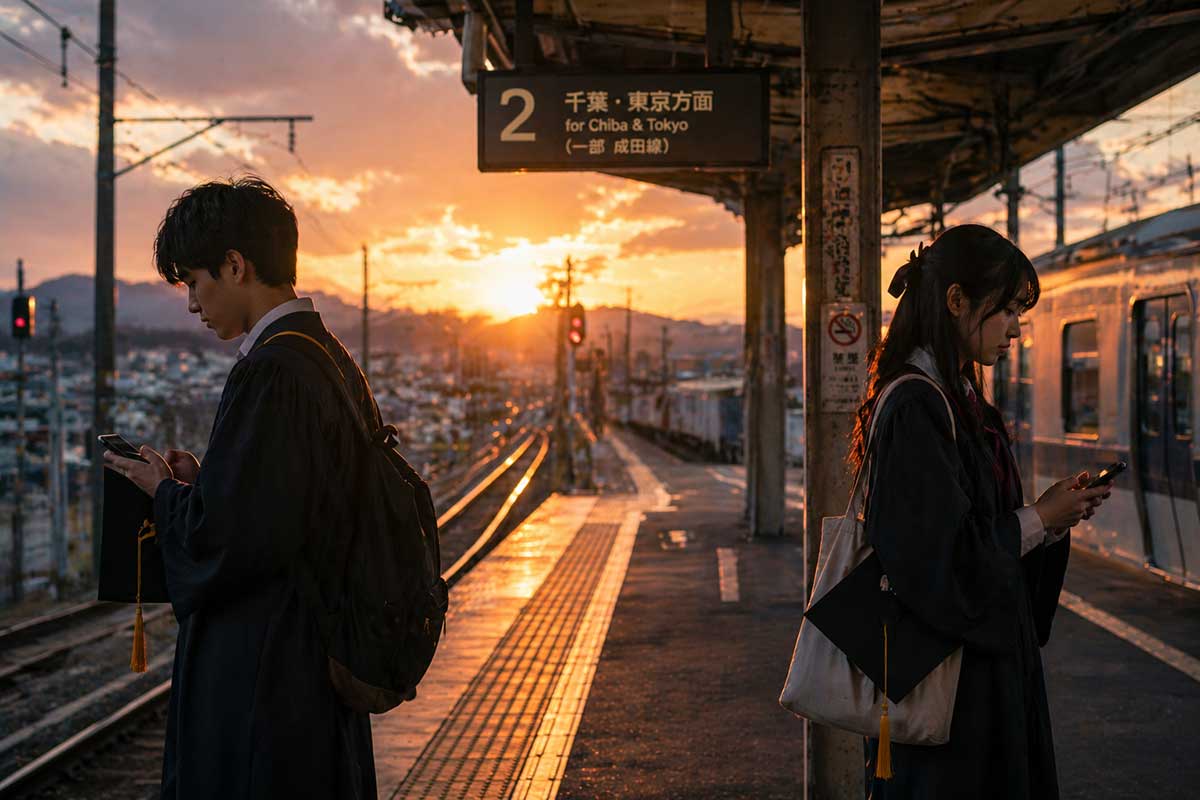
One of the strange realities of modern graduation is this: people no longer disappear completely.
In earlier generations, graduation often meant true separation. Friends moved away, letters became rare, phone calls expensive, and many relationships slowly faded into silence.
Today, students can remain connected instantly. Photos appear daily. Messages arrive within seconds. Group chats continue long after graduation day.
Yet many people still feel lonely afterward.
Why?
Perhaps technology preserves communication, but cannot fully preserve presence. Seeing someone online is different from sharing life beside them. A message can arrive instantly, yet still carry the ache of distance.
Today, we ask what is gained and lost when friendship moves from physical life into digital space.
Guests: Virginia Woolf, Antoine de Saint-Exupéry, Hayao Miyazaki, Makoto Shinkai, Robin Williams
Question 1: Why can messages keep contact alive but still fail to replace presence?
Antoine de Saint-Exupéry:
Presence is made of small invisible things.
Walking beside someone. Hearing their breathing. Sharing silence without discomfort. Looking at the same sunset without needing to explain it.
Messages carry words, but presence carries atmosphere.
That is why a person may text every day and still miss someone deeply.
Virginia Woolf:
Human closeness lives partly in interruption.
The accidental meeting in the hallway. The glance across a room. The shared boredom of sitting together quietly. Physical life contains countless tiny threads that digital communication cannot fully imitate.
Online, we speak intentionally. In life, we also belong unconsciously.
And belonging unconsciously is one of the great comforts of companionship.
Robin Williams:
A text can say, “I’m here for you.”
But it can’t always replace somebody laughing so hard next to you that you can’t breathe. It can’t replace the energy of a room full of friends being ridiculous together.
People underestimate how healing physical presence is.
Sometimes you don’t need advice. You just need someone sitting there eating pizza with you at midnight.
Makoto Shinkai:
Digital connection often preserves information, but not shared time.
You know what your friend posted. You know where they traveled. You know what song they like now. Yet you are no longer inside the rhythm of their daily existence.
You become observers of one another’s lives instead of participants.
That quiet shift creates loneliness.
Hayao Miyazaki:
Human beings are creatures of place.
Friendship grows through repeated physical moments — walking home together, waiting for the train, sharing food, hearing rain outside the classroom window.
Technology is useful, beautiful even, but the body still longs for nearness.
The heart remembers places, not only messages.
Question 2: What is lost when friendship no longer happens through daily shared life?
Virginia Woolf:
Continuity is lost.
Friendship once flowed naturally through ordinary repetition. Daily encounters stitched people together without effort. Over time, they accumulated emotional texture.
When friendship becomes occasional and scheduled, something delicate disappears: the quiet weaving of lives.
Without shared routine, people may still love one another, yet slowly stop inhabiting the same emotional world.
Robin Williams:
Spontaneity disappears.
The best moments are rarely planned. Somebody says something dumb in class. Somebody starts laughing uncontrollably. Somebody suddenly opens up during a late-night drive.
Life together creates surprise.
Once friendship becomes “Let’s find a time next month,” the magic changes shape.
Hayao Miyazaki:
Shared life creates memory through environment.
A group of students walking beneath cherry blossoms after school. The sound of shoes in the hallway. Summer light through classroom windows. Winter mornings at the station.
These scenes become emotional anchors.
When daily life separates, people may still care deeply, but new memories stop growing from the same soil.
Makoto Shinkai:
Distance changes timing.
One friend wakes while another sleeps. One is busy while another is lonely. Messages remain unread for hours or days. Gradually, emotional synchronization fades.
The sadness is subtle.
Nobody decides to drift apart. The clocks simply stop matching.
Antoine de Saint-Exupéry:
Daily life allows souls to recognize each other naturally.
Without shared life, friendship risks becoming performance — updates, highlights, announcements.
But true companionship often lives in ordinary moments: waiting together, doing nothing together, carrying silence together.
The soul hungers for shared existence, not only shared information.
Question 3: Can technology preserve closeness, or does it mainly preserve memory?
Makoto Shinkai:
It can preserve both, but imperfectly.
Technology helps people continue threads that once would have vanished completely. Some friendships survive because messages keep the bridge standing.
Yet technology also turns many relationships into archives.
Photos. Old chats. Saved videos. Memories replayed through glowing screens.
It preserves traces beautifully, but traces are not the same as presence.
Robin Williams:
Technology’s a tool. The heart still does the real work.
Two people can text constantly and feel empty. Two friends can speak once every six months and still feel deeply connected.
The real question isn’t the app. It’s whether people still make emotional room for each other.
That takes effort no technology can automate.
Virginia Woolf:
Memory thrives in fragments.
A photograph. A voice message. A typed sentence sent years ago at midnight. These digital remnants become modern forms of nostalgia.
Yet memory alone can become dangerous if one lives only backward.
Technology preserves echoes beautifully. Life still demands movement forward.
Hayao Miyazaki:
Young people must remember this carefully:
Do not become collectors of moments instead of living them.
Sometimes people record sunsets without watching them. They take photos with friends without truly feeling the friendship while it is happening.
Technology should support life, not replace attention.
The heart must remain awake to the present world.
Antoine de Saint-Exupéry:
Closeness is preserved through devotion, not convenience.
Technology makes communication easier. It does not make love deeper automatically.
A friendship survives when two souls continue choosing one another across time and distance.
No machine can perform that sacred choice for us.
Closing — Nick Sasaki
The digital age changed goodbye, but it did not erase longing.
Students can now remain connected for years after graduation. They can watch one another grow, succeed, marry, travel, struggle, and change. In many ways, this is a gift previous generations never had.
Yet the heart still recognizes the difference between contact and presence.
A message can arrive instantly from across the world. But it cannot fully recreate sitting beside someone during an ordinary afternoon that neither of you knew would someday become precious.
Perhaps that is why graduation still hurts, even now.
Technology preserved the voices.
But time still carried away the shared world.
Topic 4: Moving to the Next Level of Life

Opening — Nick Sasaki
Graduation is often celebrated as an achievement, but emotionally it feels more like a crossing.
A student stands between two worlds: one familiar, structured, and guided; the other uncertain, open, and demanding. For many young people, graduation becomes the first moment they truly feel the weight of freedom.
No one can completely tell them what comes next.
The classroom schedules end. The routines disappear. The path becomes less visible. Some feel excitement. Others feel fear. Most feel both at once.
Today, we ask what it means to move into the next level of life when the future has not yet revealed itself.
Guests: Socrates, Maria Montessori, Malala Yousafzai, Paulo Coelho, Viktor Frankl
Question 1: What does graduation ask a young person to leave behind?
Socrates:
Graduation asks the young to leave behind borrowed certainty.
In school, much of life is arranged by others. What to study, where to go, when to arrive, what success looks like. A student may complain about structure, yet structure protects the mind from many difficult questions.
After graduation, the individual must begin asking: “What kind of life is worth living?”
That question cannot be answered by exams.
Maria Montessori:
It asks them to leave passive dependence.
A healthy education should gradually prepare the child to stand independently in the world — emotionally, intellectually, morally. Graduation is not the completion of learning. It is the transfer of responsibility.
Now the young person must begin directing their own development.
That freedom is beautiful, but also heavy.
Malala Yousafzai:
Graduation asks young people to leave behind the fear of being only students.
Many students quietly doubt themselves. They know how to succeed in school, but wonder whether they can succeed in life. Yet education was never meant to become a cage of preparation without action.
There comes a moment when knowledge must walk into the world courageously.
Graduation is that invitation.
Paulo Coelho:
It asks them to leave behind the illusion that life has one clear map.
Many young people hope someone will reveal the perfect path. But life unfolds through movement, mistakes, encounters, risks, heartbreaks, and unexpected doors.
The next level of life begins when a person accepts uncertainty without surrendering hope.
Viktor Frankl:
Graduation asks the young to leave behind the comfort of identity given by institution.
A student says, “I am part of this school.” After graduation, the deeper question emerges: “Who am I when no structure defines me?”
That question can create anxiety.
Yet hidden inside anxiety is the possibility of meaning.
Question 2: How does education prepare someone for freedom, responsibility, and uncertainty?
Maria Montessori:
True education should prepare the whole person, not merely the worker.
A child must learn how to think, choose, cooperate, recover from mistakes, and live among others with dignity. Knowledge matters greatly, but character matters equally.
The purpose of education is not to create obedient machines.
It is to prepare free human beings capable of wise responsibility.
Socrates:
Education fails if it only fills memory without awakening self-examination.
A young person entering freedom without self-knowledge becomes vulnerable to confusion, manipulation, and empty ambition.
The educated soul must ask difficult questions continuously:
What is justice?
What is success?
What is happiness?
What kind of person am I becoming?
Without such inquiry, freedom becomes dangerous.
Malala Yousafzai:
Education gives voice.
Many young people enter adulthood afraid to speak, afraid to fail, afraid to stand apart from the crowd. But true learning should create courage — courage to think independently, to defend truth, to help others, and to continue learning long after graduation.
The future belongs to people willing to keep growing.
Viktor Frankl:
Education prepares people for uncertainty by teaching them that suffering and confusion are not signs that life has failed.
Every generation enters unknown territory. Plans collapse. Expectations change. Dreams evolve.
What matters is whether the individual can still discover meaning within uncertainty.
That inner capacity becomes one of the greatest strengths in adult life.
Paulo Coelho:
Education should prepare people to recognize their own calling.
Not everyone walks the same road. Some discover purpose early. Others wander for years before understanding themselves. Yet wandering itself may become part of the path.
Young people should not fear uncertainty so much that they refuse to begin.
Movement reveals direction.
Question 3: What kind of inner strength is needed when the next chapter has not yet revealed itself?
Viktor Frankl:
The strength to endure ambiguity.
Human beings suffer greatly when they demand complete certainty before moving forward. Life rarely grants that comfort. Meaning often appears step by step, not all at once.
A mature spirit learns to walk before the full road is visible.
Paulo Coelho:
Faith in possibility.
Not naive optimism, but the quiet belief that life still contains encounters, lessons, and doors unseen. Many young people panic because they believe they must have everything figured out immediately.
But destiny often whispers gradually.
Patience is part of courage.
Malala Yousafzai:
Courage to continue despite fear.
Many graduates secretly feel behind, confused, or uncertain. They compare themselves constantly. Yet bravery is not the absence of fear. It is movement despite fear.
Every meaningful future begins with imperfect steps.
Socrates:
Humility.
A young person entering adulthood should understand that wisdom begins by recognizing how much remains unknown. Pride resists learning. Humility keeps the soul alive and teachable.
The strongest mind is not the one pretending certainty.
It is the one willing to continue searching for truth.
Maria Montessori:
Inner discipline.
Freedom without discipline becomes chaos. Adulthood requires the ability to guide oneself without constant external control. To wake oneself. To focus oneself. To care for others voluntarily.
The next chapter belongs to those who can govern themselves with purpose and compassion.
Closing — Nick Sasaki
Graduation is exciting because life opens.
Graduation is frightening because life opens.
For the first time, many young people stand at the edge of a future no teacher can fully explain. The schedules disappear. The answers become less obvious. The responsibility grows heavier.
Yet this uncertainty is not proof that something is wrong.
It may be proof that life is finally becoming their own.
The next level of life does not begin when someone has everything figured out.
It begins when they gather the courage to step forward anyway.
Topic 5: The Beauty and Sadness of Growing Up
Opening — Nick Sasaki
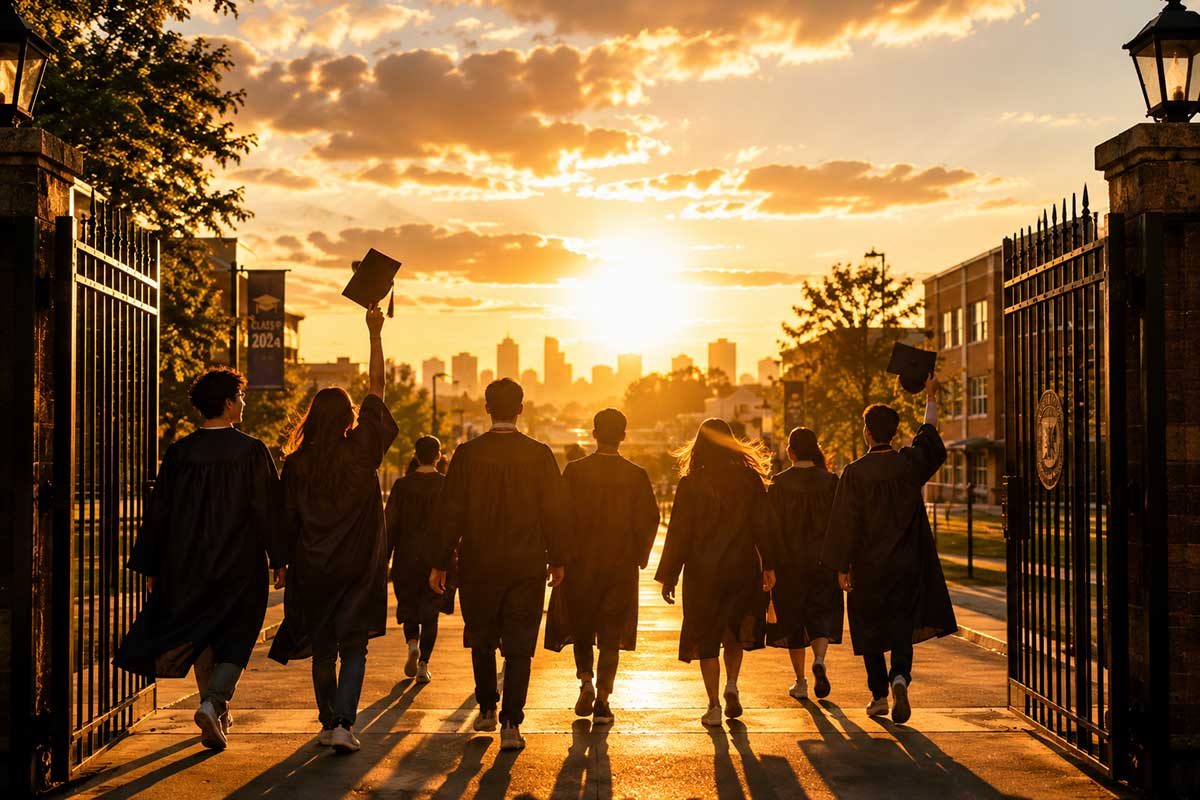
Growing up is one of the strangest experiences in human life.
As children, many people long for freedom, independence, adulthood, and possibility. Yet when those things finally arrive, they often discover an unexpected grief waiting beside them.
The places once visited every day become memories. Parents grow older. Friends drift away. The ordinary world of youth slowly disappears behind us, even as new worlds open ahead.
Graduation captures this contradiction perfectly.
It is joyful and heartbreaking at the same time.
Today, we ask why growing up always seems to carry both beauty and sadness together.
Guests: C.S. Lewis, Rainer Maria Rilke, Jane Austen, Louisa May Alcott, Nick Sasaki
Question 1: Why does growing up always include both excitement and grief?
C.S. Lewis:
Because every new beginning quietly asks for an old ending.
A child dreams of becoming older without realizing that growth requires leaving certain worlds behind forever. One cannot move into adulthood while remaining completely inside childhood.
The grief comes from realizing that beautiful things were temporary.
The excitement comes from discovering that life still continues beyond them.
Louisa May Alcott:
Growing up is bittersweet because the heart expands faster than it understands itself.
Young people begin to glimpse wider horizons — love, purpose, travel, independence, ambition — yet at the same time they begin losing the shelter of simpler days.
One part of the soul runs forward eagerly.
Another part looks backward through tears.
Jane Austen:
Maturity reveals complexity.
Children often experience life directly. Adults begin seeing consequences, fragility, sacrifice, and change. The world becomes richer, yet less innocent.
That knowledge deepens the soul, but it also introduces melancholy.
Still, there is dignity in learning to carry both joy and sorrow gracefully.
Rainer Maria Rilke:
Growth hurts because the soul stretches beyond its former shape.
A person cannot remain who they were. Life continuously calls them into larger spaces — emotionally, spiritually, relationally. Such transformation creates loneliness at times because the old self no longer fits, while the new self has not fully formed.
This in-between condition is one of the deepest human experiences.
Nick Sasaki:
When I think about graduation, I realize people are not only celebrating achievement. They are mourning time itself.
Students suddenly recognize that moments they thought were ordinary have become unreachable. The classroom, the laughter, the daily routines — they belonged to a season already disappearing.
Perhaps adulthood begins the moment we realize life keeps moving no matter how tightly we wish to hold certain moments still.
Question 2: What part of childhood should we carry with us into adulthood?
Louisa May Alcott:
Tenderness.
Children often love openly before the world teaches them caution. Adulthood may require wisdom, but it should never harden the heart completely.
A mature person who still protects gentleness possesses something precious.
C.S. Lewis:
Wonder.
Many adults confuse maturity with cynicism. Yet the loss of wonder is not wisdom. It is exhaustion.
A healthy adult should still feel awe before beauty, mystery, goodness, friendship, and the vastness of existence itself.
The childlike heart remains capable of gratitude.
Jane Austen:
Sincerity.
Young people often speak and feel with refreshing honesty before society trains them into performance and calculation. Adulthood benefits from refinement, certainly, but sincerity must survive refinement.
Without sincerity, sophistication becomes emptiness.
Rainer Maria Rilke:
Imagination.
The inner world of childhood contains emotional truth adults often neglect. Imagination allows the soul to remain alive to possibility, beauty, longing, and meaning beyond mere practicality.
A purely efficient life may function well, yet still starve the spirit.
Nick Sasaki:
I think we should carry emotional presence.
Children fully enter moments. They laugh completely. Cry completely. Become absorbed completely. Adults often live distracted, fragmented, divided between screens, worries, schedules, and regrets.
Maybe maturity is not abandoning childlike presence, but recovering it consciously.
Question 3: How can graduation become not just an ending, but a blessing?
Rainer Maria Rilke:
By accepting endings as sacred rather than cruel.
Many people resist change because they fear loss. Yet endings create the space where deeper becoming occurs. Graduation hurts precisely because something meaningful existed.
The pain itself honors the beauty of the season.
Jane Austen:
Graduation becomes a blessing when it awakens gratitude.
One may leave school realizing imperfect days were still valuable days. The friendships, routines, teachers, conversations, and even embarrassments formed part of a meaningful life chapter.
Gratitude transforms nostalgia from bitterness into warmth.
Louisa May Alcott:
It becomes a blessing when young people realize they are carrying others with them.
No graduate leaves alone emotionally. Inside them travel the lessons, encouragements, laughter, corrections, sacrifices, and love of many people.
A person entering adulthood carries an invisible community within their character.
C.S. Lewis:
Graduation becomes a blessing when one understands that longing itself has meaning.
The sadness of farewell points beyond temporary things. It reminds us that human beings were made for deep connection, permanence, love, and home. Earthly seasons pass, yet the longing they awaken may guide the soul toward greater wisdom and compassion.
Even sorrow can become a teacher.
Nick Sasaki:
Perhaps graduation is one of life’s first invitations to become thankful before something disappears completely.
To pause. To look around. To hug people a little longer. To recognize that ordinary days were never ordinary at all.
Maybe the real blessing of graduation is this:
For one brief moment, people become fully aware that life is precious while they are still living it.
Closing — Nick Sasaki
Growing up is beautiful because life keeps opening.
Growing up is painful because life keeps changing.
Graduation stands at the intersection of those two truths. Young people feel excitement for the future and grief for the past simultaneously. They are stepping forward while already missing what they are leaving behind.
Yet perhaps this mixture of joy and sadness is not a flaw in life.
Perhaps it is proof that life mattered.
A person who never grieves an ending may never have loved the season deeply in the first place.
And so graduation becomes more than a ceremony.
It becomes one of humanity’s quiet reminders that every season is temporary, every relationship is precious, and every ordinary day may someday become sacred memory.
Final Thoughts by Nick Sasaki
When people graduate, they often think they are saying goodbye to a school.
Years later, many realize they were saying goodbye to a version of themselves.
The version that laughed freely with friends every day.
The version that still lived close to childhood.
The version surrounded by familiar faces without needing appointments, schedules, or long-distance messages.
Adulthood slowly changes human relationships. People become busy. Responsibilities increase. Paths separate. Technology helps people remain connected, yet the soul still longs for shared physical life — for simple presence.
And maybe that is why graduation remains powerful across generations.
It reminds people that life is constantly moving, whether they are ready or not.
Yet this realization should not make us cynical. It should make us awake.
Awake to the value of ordinary moments.
Awake to the people sitting beside us now.
Awake to the fact that today’s routine may someday become tomorrow’s treasured memory.
Growing up does not mean abandoning the heart of youth completely.
A wise adult still keeps wonder.
Still keeps gratitude.
Still keeps tenderness.
Still keeps emotional presence.
The students who graduate today will eventually look back and understand something their younger selves could only partially feel:
The real treasure was never only the diploma.
It was the shared world they built together before time quietly carried everyone forward.
Short Bios:
J.D. Salinger — American novelist best known for exploring adolescence, alienation, and emotional transition in The Catcher in the Rye.
John Hughes — American filmmaker whose coming-of-age films captured the emotional reality of high school life and teenage identity.
L.M. Montgomery — Canadian author celebrated for stories of youth, memory, imagination, and growing up, especially through Anne of Green Gables.
Anne Frank — Jewish diarist whose reflections on hope, youth, and humanity became one of history’s most important personal testimonies during World War II.
Makoto Shinkai — Japanese filmmaker known for emotionally powerful stories about distance, longing, memory, and human connection, including Your Name.
Maya Angelou — American poet and civil rights voice whose work explored dignity, resilience, identity, and emotional healing.
Fred Rogers — Creator and host of Mister Rogers' Neighborhood, remembered for his compassion and emotional wisdom.
Kahlil Gibran — Lebanese-American writer and philosopher whose poetic reflections on love, friendship, and loss continue to inspire readers worldwide.
Taylor Swift — Singer-songwriter recognized for emotionally detailed storytelling about youth, memory, friendship, and change.
Haruki Murakami — Japanese novelist whose works often explore loneliness, nostalgia, memory, and emotional distance in modern life.
Virginia Woolf — English writer whose novels and essays examined consciousness, time, memory, and the hidden emotional layers of ordinary life.
Antoine de Saint-Exupéry — French writer and aviator best known for The Little Prince, a timeless reflection on love, friendship, and human meaning.
Hayao Miyazaki — Japanese animator and co-founder of Studio Ghibli, celebrated for stories about childhood wonder and emotional depth.
Robin Williams — American actor and comedian remembered for warmth, humor, and inspirational performances including Dead Poets Society.
Socrates — Ancient Greek philosopher whose teachings shaped Western philosophy through questions about wisdom, truth, and the examined life.
Maria Montessori — Italian educator and founder of the Montessori educational method centered on independence and whole-child development.
Malala Yousafzai — Pakistani activist and Nobel Peace Prize recipient advocating for girls’ education and human rights worldwide.
Paulo Coelho — Brazilian novelist best known for The Alchemist and themes of destiny, purpose, and personal journeys.
Viktor Frankl — Austrian psychiatrist and Holocaust survivor whose work explored meaning, suffering, and psychological resilience.
C.S. Lewis — British writer and Christian thinker known for reflections on imagination, longing, and moral growth through works like The Chronicles of Narnia.
Rainer Maria Rilke — Austrian poet whose writings explored solitude, transformation, beauty, and spiritual longing.
Jane Austen — English novelist celebrated for sharp insight into human relationships, maturity, and emotional intelligence.
Louisa May Alcott — American author known for Little Women and compassionate portrayals of family and growing up.
Nick Sasaki — Moderator and creator of ImaginaryTalks.com, exploring emotionally meaningful conversations across philosophy, spirituality, culture, and human experience.
Leave a Reply