
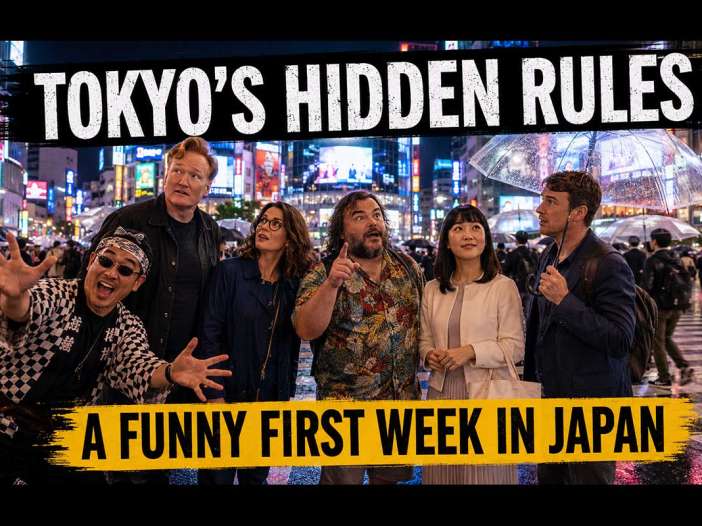
Introduction by Conan O’Brien
I arrived in Japan expecting sushi, temples, and maybe one emotionally complicated vending machine.
Instead, Japan immediately became a polite psychological exam.
Tokyo was silent, efficient, rainy, neon-lit, and full of invisible rules that everyone understood except us. Then Kyoto arrived like a beautiful old memory wearing sandals.
In seven days, we rode silent trains, ate midnight ramen, got emotionally judged by convenience stores, entered Akihabara’s electric madness, prayed badly at temples, stared at Mount Fuji, and walked through Fushimi Inari like confused pilgrims with snack receipts.
And through it all, Ken Shimura somehow made grandmothers, chefs, commuters, cats, and possibly shrine spirits laugh.
I still don’t understand Japan.
But I already miss it.
(Note: This is an imaginary conversation, a creative exploration of an idea, and not a real speech or event.)
DAY 1 — ARRIVAL IN JAPAN
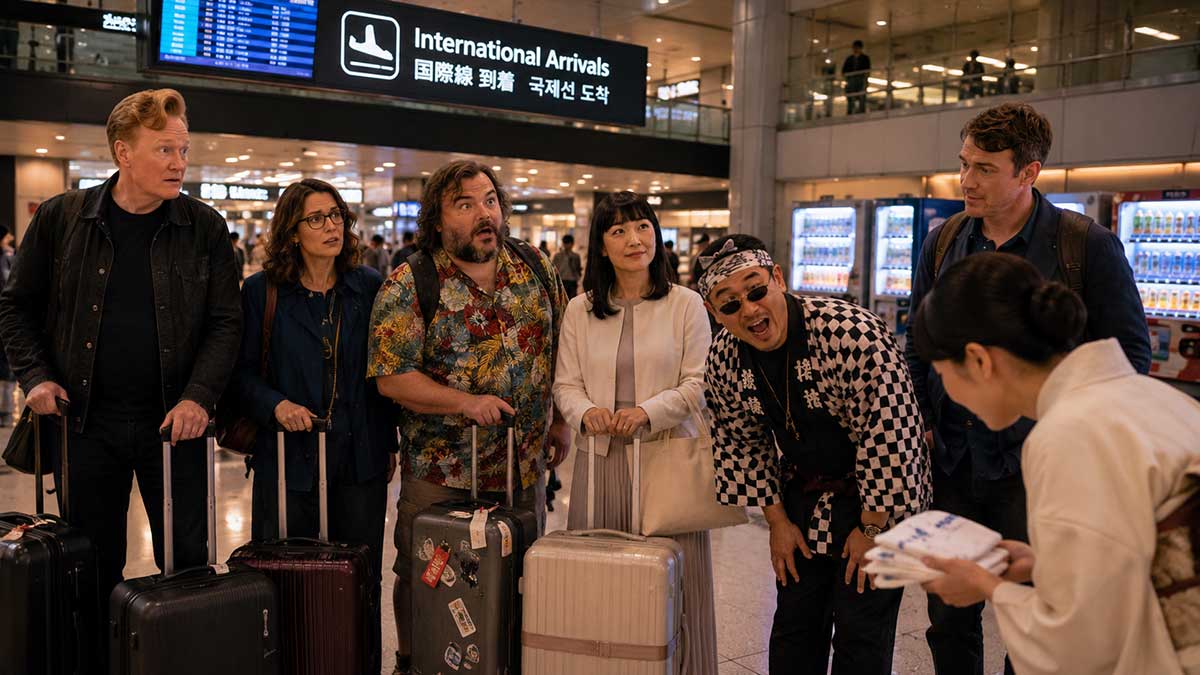
Main Cast
- Conan O'Brien
- Tina Fey
- Jack Black
- Ken Shimura
- Marie Kondo
Tokyo Guide
- Chris Broad
SCENE 1 — “THE SILENT ARRIVAL”
The automatic doors opened, and Japan entered quietly.
Narita Airport glowed beneath soft amber light reflected across polished floors so clean they almost looked fake. Suitcases rolled past in orderly silence. Nobody shouted. Nobody rushed. Even the announcements sounded emotionally considerate.
Conan O’Brien stepped into the arrival hall looking like a tall scarecrow recovering from emotional turbulence.
Tina Fey walked beside him carrying one perfectly organized bag and the expression of a woman already evaluating every decision around her.
Jack Black immediately disappeared toward the nearest vending machine.
“WE’RE NOT EVEN THROUGH CUSTOMS YET!” Tina shouted.
“THE MACHINE HAS HOT CORN SOUP!” Jack shouted back.
Ken Shimura appeared from nowhere wearing sunglasses indoors, a silk scarf, and the energy of a retired magician who now specialized in confusing tourists.
He bowed deeply.
Then kept bowing.
Conan awkwardly bent forward halfway.
Tina watched the interaction carefully.
“I can’t tell if this is hospitality or psychological warfare.”
Shimura slowly rose.
“In Japan,” he said solemnly, “both.”
Chris Broad approached smiling.
“Welcome to Tokyo. First rule: never block escalators.”
Tina nodded immediately.
“See? America needs more passive-aggressive infrastructure.”
Marie Kondo handed everyone cooling towels that smelled faintly of citrus and fresh linen.
Jack returned carrying six drinks and two steamed buns.
“One of these machines just apologized to me.”
Chris laughed.
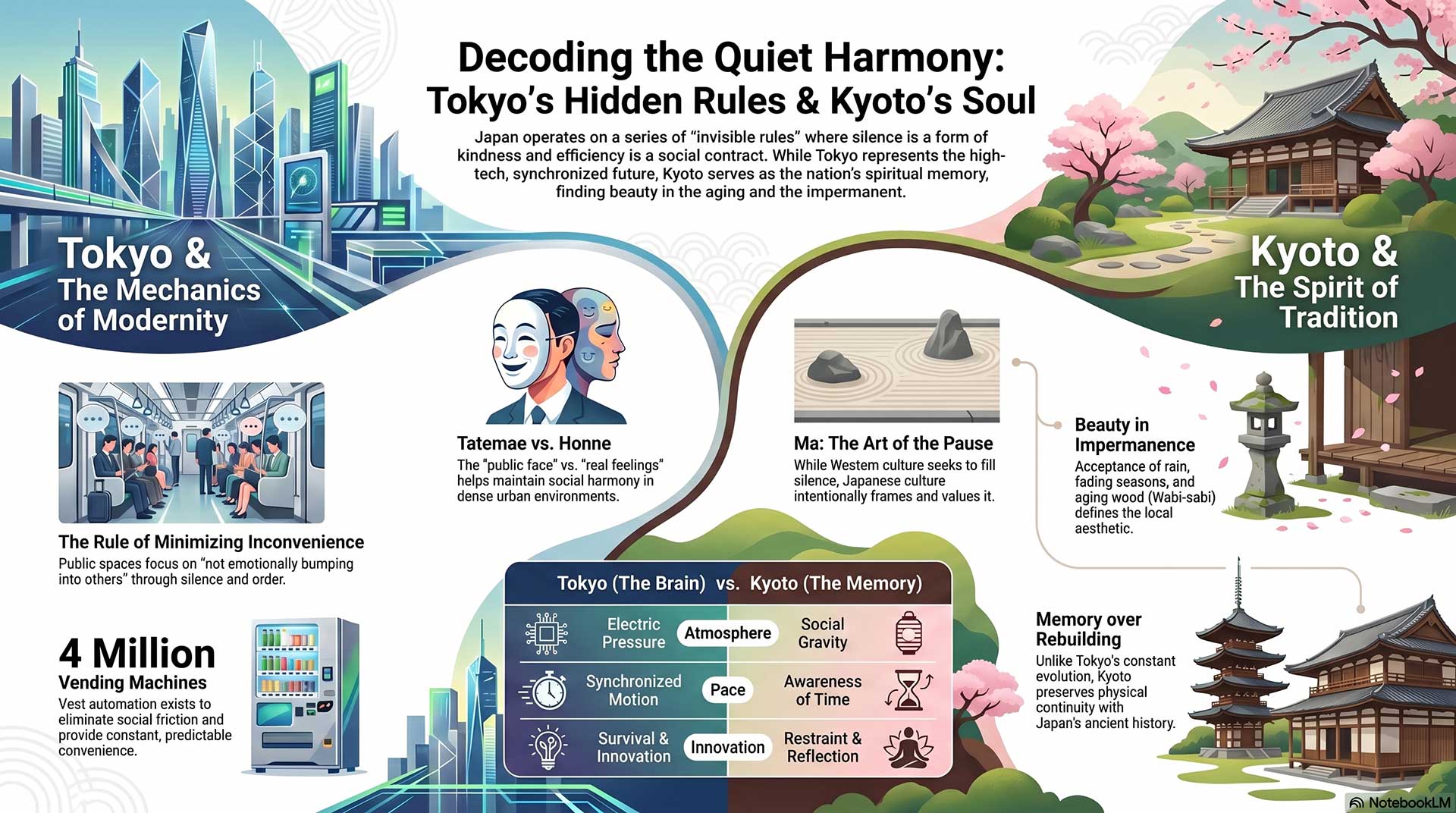
“Japan has over four million vending machines. In dense cities, they became part of everyday life because people expect convenience everywhere.”
Conan stared at the machine suspiciously.
“In America, vending machines threaten you emotionally.”
SCENE 2 — “THE TRAIN OF PERFECT SILENCE”
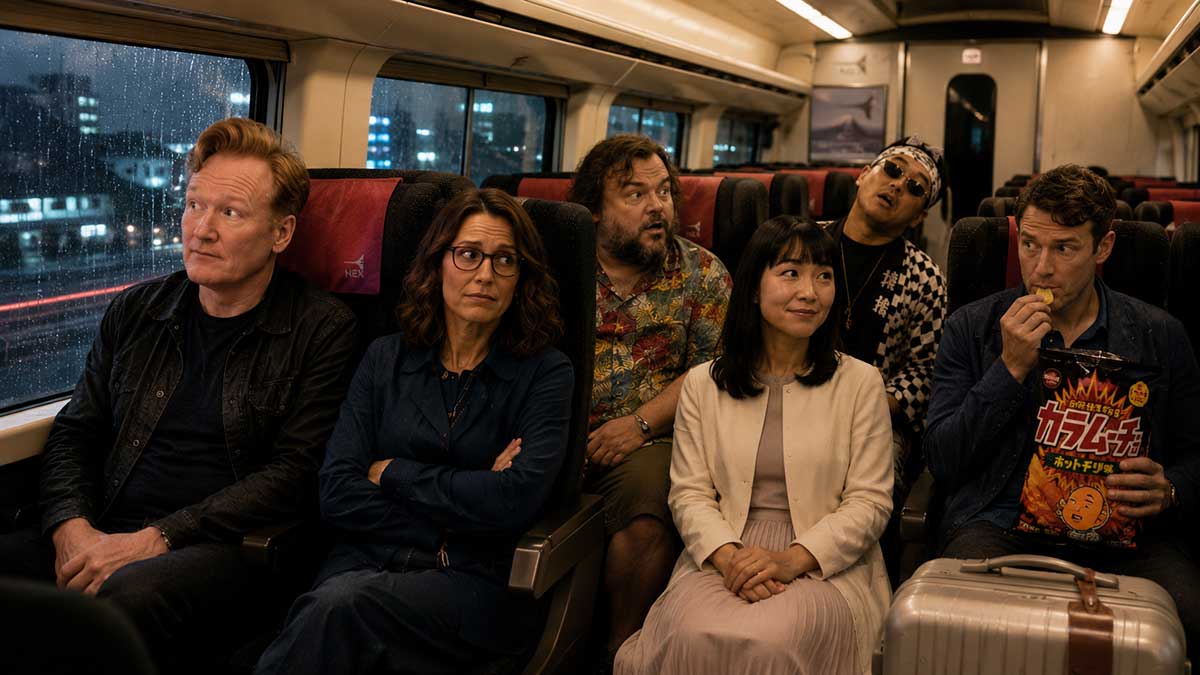
The Narita Express glided through rain-dark suburbs toward Tokyo.
Outside the windows:
- narrow apartment buildings
- glowing convenience stores
- bicycles beneath plastic covers
- tangled electrical wires stretching endlessly into the night
Inside the train, silence ruled completely.
The air smelled faintly of coffee, wet umbrellas, fabric softener, and cool recycled air.
Jack Black carefully opened a snack package.
CRRRRRRKKKKK.
Half the train looked up simultaneously.
Jack froze mid-chew.
Tina leaned toward Conan.
“In America that sound means snacks. Here it means execution.”
Chris spoke quietly.
“Japanese public spaces operate around minimizing inconvenience for strangers.”
Marie nodded gently.
“Quietness is often considered a form of kindness.”
Conan looked around the silent carriage.
“So everybody spends all day trying not to emotionally bump into each other.”
Chris considered that carefully.
“That’s actually… surprisingly accurate.”
Across the aisle, Ken Shimura suddenly fake-snored loud enough to shake the seats.
An elderly woman nearby covered her mouth trying not to laugh.
Tina noticed immediately.
“Oh, I get it now,” she whispered. “Japanese comedy is basically controlled social damage.”
Shimura pointed proudly at her.
“She learns quickly.”
SCENE 3 — “THE CONVENIENCE STORE CIVILIZATION”
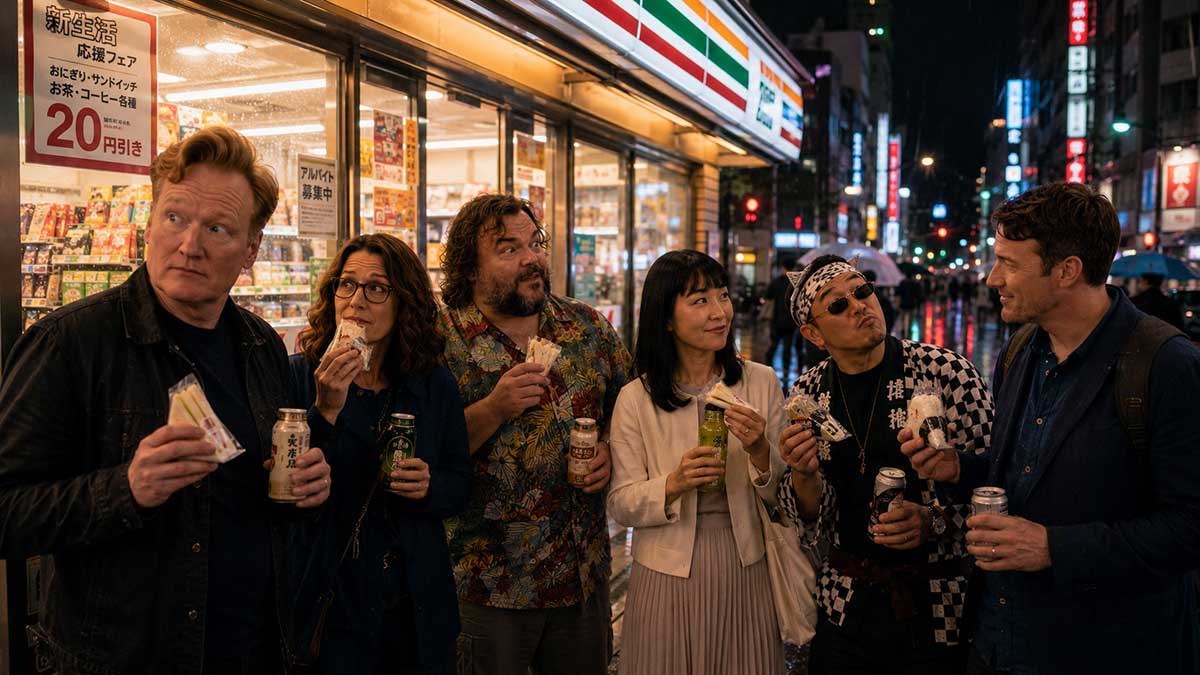
The FamilyMart glowed against the rainy street like a tiny futuristic sanctuary.
Automatic doors opened with cheerful electronic music.
Warm air spilled outward carrying smells of:
- fried chicken
- coffee
- sweet bread
- soy broth
- pastries fresh from plastic wrappers somehow tasting homemade
Tina stopped beside the dessert section.
“Why does this convenience store have better presentation than most weddings I’ve attended?”
Chris picked up an onigiri.
“Convenience stores here became social infrastructure. Students study here. Elderly people stop by daily. Office workers survive here.”
Marie pointed toward seasonal sakura packaging arranged perfectly on shelves.
“In Japan, even ordinary products reflect the seasons.”
Conan picked up chestnut pudding.
“This pudding has a stronger sense of identity than I do.”
Meanwhile, Ken Shimura secretly filled Conan’s basket with:
- squid jerky
- natto crackers
- carbonated yogurt drink
Outside beneath the awning, Conan opened the yogurt soda cautiously.
One sip.
He stared silently into the rain.
Tina crossed her arms.
“That face means the drink tasted like regret.”
Jack Black laughed so hard he nearly dropped his egg sandwich.
Then he took another bite and looked emotional again.
“I trust this sandwich more than most governments.”
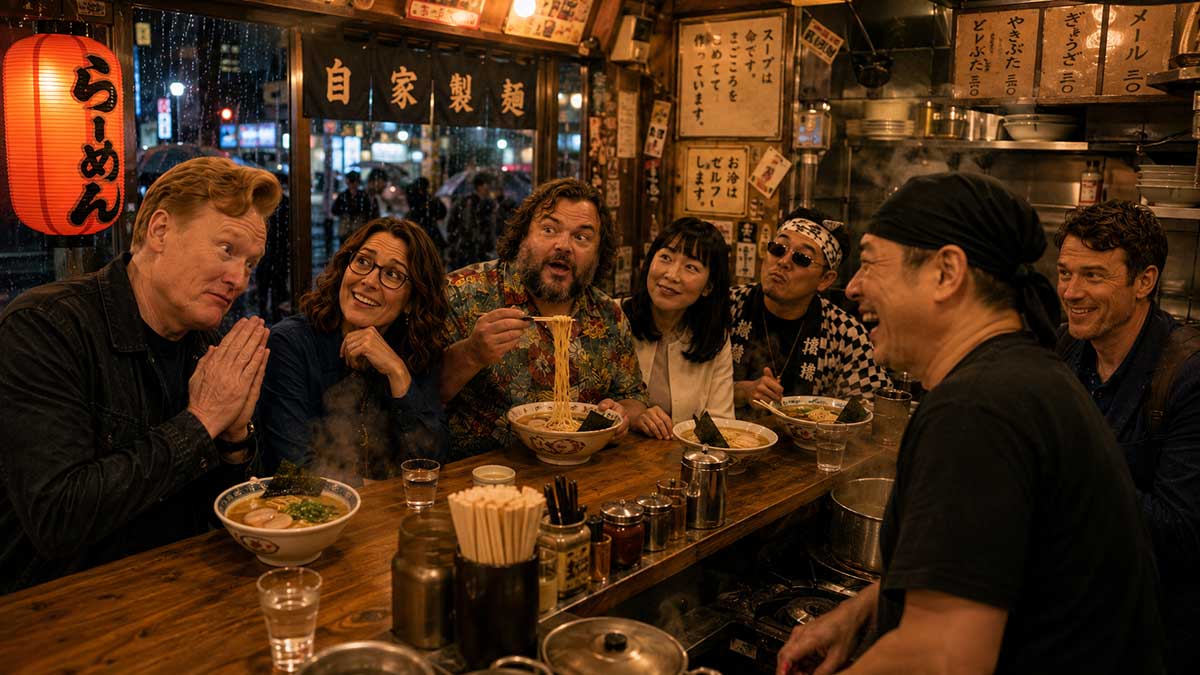
SCENE 4 — “MIDNIGHT RAMEN CONFESSIONS”
The ramen shop looked too small to contain full-sized emotions.
Steam fogged the windows. The counter glistened from years of broth and cooking oil. Rain shimmered outside beneath red neon signs.
The air smelled of:
- pork broth
- garlic oil
- soy sauce
- damp jackets
- cigarette smoke drifting from nearby alleys
The chef moved with silent precision.
Chris lowered his voice.
“Some ramen shops spend decades perfecting a single bowl. Consistency here is almost spiritual.”
Tina nodded slowly.
“So America industrialized efficiency. Japan artisanalized obsession.”
Jack Black took one bite and grabbed the counter dramatically.
“This broth remembers things.”
Marie demonstrated proper noodle etiquette gracefully.
Ken Shimura demonstrated fake etiquette.
“You must rotate bowl three times and thank noodle ancestors.”
Tina immediately pointed at Conan.
“He’s absolutely going to believe that.”
Conan hesitated.
Then actually did it.
The chef froze.
Silence swallowed the room.
Then the old chef burst into laughter.
Suddenly the atmosphere changed:
- office workers smiled
- shoulders relaxed
- strangers looked at one another openly
Chris grinned.
“You accidentally passed an advanced Japanese social test.”
Conan looked relieved.
“What test?”
“Making reserved people comfortable.”
Tina nodded toward Shimura.
“So his entire career was basically national therapy.”
Shimura bowed proudly.
SCENE 5 — “SHIBUYA AFTER MIDNIGHT”
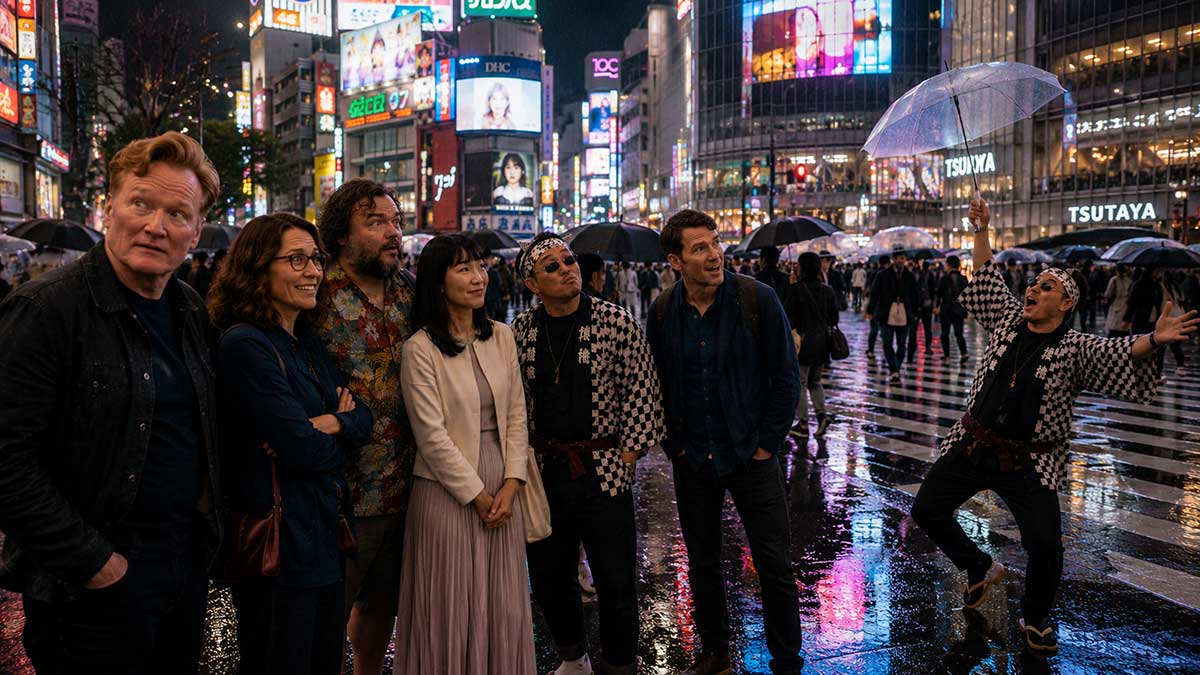
At 1:30 AM, Shibuya still looked fully awake.
Neon advertisements reflected across wet pavement in electric colors. Umbrellas drifted through the crossing like moving lanterns beneath giant video screens.
The air smelled of:
- rain
- wet concrete
- cigarettes
- perfume
- fried street food somewhere nearby
Thousands crossed simultaneously without touching once.
Conan stared in disbelief.
“How does this many people move without chaos?”
Chris answered softly.
“Tokyo works because millions constantly adjust themselves for strangers in tiny invisible ways.”
Marie added:
“Many Japanese children are taught early not to inconvenience others.”
Tina watched the endless crowd carefully.
“That sounds emotionally exhausting and deeply effective.”
Ken Shimura nodded seriously.
“That is why karaoke exists.”
Jack Black instantly raised his umbrella like a microphone and began singing power ballads into the rain.
Shimura joined him with dance moves that appeared medically unsafe.
At first nobody reacted.
Then a teenager laughed.
Then another.
Soon strangers beneath umbrellas were openly smiling.
Conan looked around at the crowd.
Japan still felt mysterious.
But now it felt less like a machine…
…and more like millions of lonely people trying very hard to move together gracefully.
DAY 2 — THE CITY THAT RUNS ON INVISIBLE RULES
Main Cast
- Conan O'Brien
- Tina Fey
- Jack Black
- Ken Shimura
- Marie Kondo
Tokyo Guide
- Chris Broad
SCENE 1 — “THE TOILET WITH A PH.D.”
Tokyo sunlight slipped between skyscrapers like it had somewhere important to be.
Below the hotel window, thousands of people were already moving through the city with frightening efficiency. Delivery trucks reversed silently. Trains slid past elevated tracks exactly on schedule. Somewhere beneath them, an entire civilization was already buying coffee from vending machines before sunrise.
Inside the hotel room, Jack Black screamed again.
“IT OPENED BY ITSELF!”
Everyone turned toward the bathroom.
The toilet lid slowly rose like a robot beginning diplomatic negotiations.
Conan stared at it.
“This bathroom is more technologically advanced than parts of the American government.”
Tina Fey crossed her arms.
“At this point I expect it to ask about my emotional goals.”
Marie Kondo entered calmly and pressed several buttons with the confidence of a spacecraft engineer.
Soft waterfall sounds suddenly filled the room.
Jack looked horrified.
“The toilet is creating ambiance now.”
Chris Broad leaned against the doorway laughing.
“Japanese bathrooms became highly advanced partly because homes are small and daily comfort matters a lot here. Companies compete aggressively over tiny quality-of-life improvements.”
Conan nodded slowly.
“So America invented the smartphone. Japan perfected sitting.”
Meanwhile, Ken Shimura walked out wearing the hotel yukata backward with absolutely no explanation.
SCENE 2 — “THE SUBWAY LABYRINTH”
Shibuya Station felt less like transportation and more like controlled weather.
People flowed through underground tunnels in endless synchronized motion. Escalators hummed beneath giant advertisements. Somewhere nearby, fresh melon bread drifted warm bakery smells into the station air.
Conan stopped in front of the subway map.
Colored lines twisted across the wall like nervous spaghetti designed by mathematicians under emotional pressure.
“This is not a transit system,” he whispered. “This is a nervous breakdown with signage.”
Chris pointed toward commuters lining up perfectly at train doors.
“Tokyo trains move millions daily. People cooperate through invisible social rules rather than confrontation.”
Tina looked around carefully.
“So everybody here silently monitors themselves all day long.”
Chris nodded.
“That’s actually a huge part of Japanese urban culture.”
Nearby, nobody spoke above conversation level.
No phone calls.
No shouting.
No music leaking from headphones.
Jack Black accidentally bumped into a businessman and apologized dramatically.
The businessman bowed apologetically back.
Jack stared in confusion.
“He apologized to ME.”
Marie smiled softly.
“In Japan, both people often apologize automatically. Harmony is sometimes valued more than assigning blame.”
Ken Shimura suddenly pretended to miss the train and began fake-sprinting beside the closing doors in slow motion.
Nobody reacted.
Conan watched the commuters calmly ignoring him.
“This city has developed immunity.”
SCENE 3 — “HARAJUKU: THE EMOTIONAL ESCAPE VALVE”
Harajuku exploded with color.
Perfume drifted from tiny fashion boutiques. Pop music bounced through crowded streets lined with crepe shops and accessory stores. Teenagers walked past dressed as gothic aristocrats, anime heroines, cyberpunk angels, and emotionally unstable strawberries.
Jack Black turned slowly in circles.
“This neighborhood feels like TikTok became self-aware.”
Chris gestured toward the crowds.
“For decades Japanese schools and workplaces emphasized conformity. Places like Harajuku became emotional release zones.”
Tina nodded immediately.
“So America suppresses healthcare. Japan suppresses individuality until it evolves into platform shoes.”
Marie picked up a handmade accessory delicately.
“In Japan,” she explained, “people often communicate emotions indirectly. Clothing can become a safe form of self-expression.”
A girl dressed entirely in pink lace walked past Conan without acknowledging the absurdity of anything happening.
Conan watched her disappear into the crowd.
“Nobody here judges anything.”
Chris smiled.
“That’s one of Tokyo’s strange contradictions. Social conformity and radical individuality somehow coexist.”
Ken Shimura quietly bought giant heart-shaped sunglasses and placed them onto Conan’s face.
Tina took one look and nearly collapsed laughing.
“You look like a magician who lost custody of his dragons.”
SCENE 4 — “THE CONVEYOR BELT WARS”
The conveyor-belt sushi restaurant moved with hypnotic precision.
Plates glided beneath soft lighting carrying:
- salmon
- tuna
- eel
- shrimp
- desserts too beautiful to trust emotionally
The air smelled of rice vinegar, soy sauce, grilled fish, and green tea.
Touchscreens blinked politely above every booth.
Chris lifted a sushi plate carefully.
“One thing foreigners misunderstand is specialization. Japanese restaurants often dedicate themselves completely to one category of food.”
Conan stared at the moving sushi.
“In America restaurants panic if they don’t serve burgers, tacos, soup, and emotional disappointment simultaneously.”
Jack Black had already consumed dangerous amounts of salmon.
Marie quietly stacked empty plates into perfect color patterns.
Ken Shimura suddenly stole the last tuna plate milliseconds before Conan reached it.
Conan gasped.
“Oh, now this is personal.”
Soon both men were aggressively competing for sushi like aging samurai defending honor.
Nearby office workers watched while pretending not to watch.
A robot voice suddenly announced dessert delivery.
Conan jumped.
“The furniture talks now.”
Chris shrugged.
“Japan automates interactions to reduce social friction.”
Tina looked around the restaurant.
“This country has dedicated enormous resources toward eliminating awkwardness.”
Shimura pointed directly at Conan.
“Impossible mission.”
SCENE 5 — “THE ALLEY OF SECRET PERSONALITIES”
At night, Tokyo narrowed into hidden alleyways glowing beneath red lanterns.
Smoke drifted upward from yakitori grills. Rainwater reflected neon signs across wet pavement. Tiny bars packed tightly together beneath train tracks hummed with exhausted laughter.
The air smelled of:
- grilled chicken
- charcoal smoke
- beer
- garlic
- rain
- cigarettes drifting through open doorways
Chris led them into an izakaya barely large enough for Conan’s legs.
An old baseball game played quietly on television.
Salarymen loosened ties after long workdays and slowly transformed into completely different people.
Chris poured beer carefully.
“Japanese culture often separates public behavior from private feelings.”
“Tatemae and honne,” Marie added softly.
Jack looked confused.
Chris explained:
“Tatemae is your public face. Honne is your real feelings.”
Tina scanned the room.
“So this entire country spends daylight hours professionally suppressing itself.”
Conan nodded.
“And then releases emotional pressure through grilled meat and alcohol.”
Ken Shimura raised his beer dramatically.
“To temporary emotional honesty!”
The room exploded with laughter.
The old owner approached Conan cautiously.
“You American comedian?”
Conan nodded.
The owner smiled sadly.
“Difficult job in Japan. Japanese people afraid to stand out too much.”
For once, Shimura answered seriously.
“That is why Japanese comedians fall down physically. Easier than speaking emotionally.”
The table grew quiet.
Outside, rain continued falling over Tokyo.
Inside, strangers laughed loudly for a few precious hours before returning tomorrow to the giant silent machine waiting outside.
DAY 3 — THE CITY WHERE FANTASY BECAME NORMAL
Main Cast
- Conan O'Brien
- Tina Fey
- Jack Black
- Ken Shimura
- Marie Kondo
Tokyo Guide
- Chris Broad
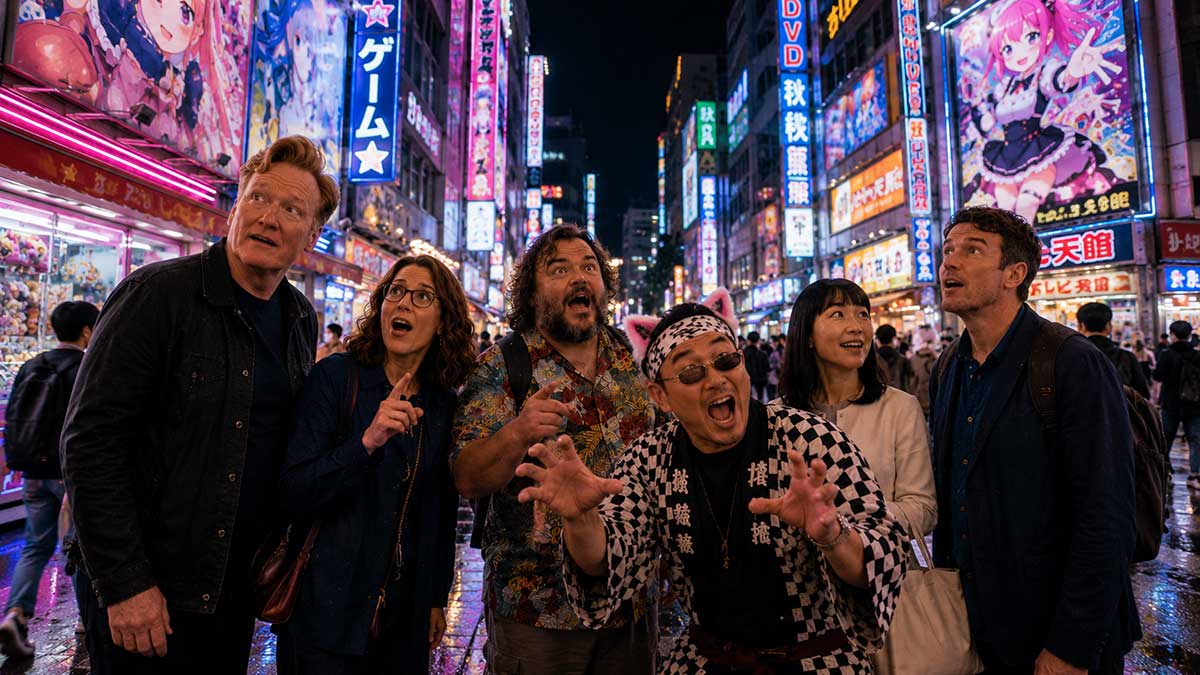
SCENE 1 — “AKIHABARA ELECTRIC DREAMS”
Akihabara looked like the future designed itself during a sugar rush.
Towering anime billboards glowed above crowded sidewalks. Giant screens screamed advertisements into the humid air. Music spilled from every direction:
- idol songs
- arcade sound effects
- electronic jingles
- claw machine victory alarms
The entire district pulsed in neon pink, electric blue, and artificial daylight.
The air smelled of:
- fried food
- plastic packaging
- warm electronics
- sugary crepes
- summer rain rising from pavement
Jack Black stopped walking completely.
“Oh no,” Tina whispered. “He’s emotionally home.”
Jack pointed at a seven-story arcade with tears in his eyes.
“Humans built this.”
Chris Broad laughed.
“After World War II, Akihabara became famous for electronics markets. Later it evolved into the center of anime, gaming, and otaku culture.”
Conan squinted upward at giant anime girls fifty feet tall.
“So national trauma eventually became Pokémon.”
Chris considered this.
“That is… actually an academically defensible sentence.”
Meanwhile, Ken Shimura bought toy cat ears and silently placed them on Conan’s head.
Conan stared at him.
“You’re using me as a psychological experiment.”
Shimura nodded proudly.
SCENE 2 — “THE MAID CAFÉ INCIDENT”
The maid café smelled faintly of syrup, coffee, perfume, and existential confusion.
Young women dressed in elaborate maid outfits welcomed customers with exaggerated enthusiasm while tiny hearts decorated omelets under glowing pastel lights.
Conan froze immediately.
“I would like everyone to know I entered this building under emotional protest.”
A maid approached their table smiling brightly.
“Welcome home, masters and princess!”
Tina closed her eyes briefly.
“We’re five minutes away from Conan accidentally joining a cult.”
Chris explained carefully.
“Maid cafés became popular partly because Japanese work culture can feel emotionally distant. These places create exaggerated warmth and attention.”
Jack Black looked around in amazement.
“So this is performance art mixed with emotional support pancakes.”
Marie Kondo politely folded her napkin into a perfect square while trying not to visibly process the situation.
Ken Shimura, meanwhile, adapted instantly.
Within minutes he was performing ridiculous magic tricks with ketchup bottles while the café staff applauded enthusiastically.
Conan stared at him.
“You were built for this environment.”
Shimura adjusted his imaginary crown.
“In another life,” he said proudly, “I ruled here.”
SCENE 3 — “THE CAPSULE HOTEL”
The capsule hotel hallway looked like sleeping pods aboard a spaceship for emotionally exhausted accountants.
Rows of glowing capsules stretched along narrow walls beneath soft ambient lighting.
The air smelled of:
- clean linen
- filtered air
- fresh plastic
- faint cologne
- industrial detergent
Chris tapped one of the capsules.
“Capsule hotels were originally designed for salarymen who missed the last train home after work.”
Conan crawled halfway inside one and immediately backed out.
“This is not a hotel room. This is a drawer for human cutlery.”
Tina peeked inside another capsule.
“It feels like sleeping inside expensive luggage.”
Marie Kondo actually seemed impressed.
“There is beauty in efficient use of space.”
Jack Black had the opposite reaction.
He climbed fully inside, closed the curtain dramatically, and shouted:
“I LIVE HERE NOW.”
A muffled crash came from Conan’s capsule nearby.
Then silence.
Then Conan’s voice:
“My foot is trapped in futuristic architecture.”
Ken Shimura walked past carrying a tiny toothbrush and pajamas provided by the hotel.
Without saying anything, he saluted Conan solemnly like a fallen soldier.
SCENE 4 — “THE ARCADE BATTLE”
The arcade thundered with noise.
Rhythm games flashed violently beneath neon lights. Racing simulators shook entire rows of machines. Claw machines stretched endlessly across glowing floors filled with stuffed animals nobody truly needed but everyone desperately wanted.
The air smelled of:
- warm electronics
- popcorn
- metal coins
- plastic prizes
- sweat from competitive teenagers
Jack Black immediately challenged a group of high school students to a drumming game.
Chris explained:
“Japanese arcades survived because homes here are often small. Arcades became social gathering places where people could experience technology together.”
Conan lost ¥8,000 trying to win a plush sushi toy.
Tina watched him fail repeatedly.
“At this point the machine legally owns part of your soul.”
Meanwhile, Ken Shimura casually won the prize on his first attempt.
Without emotion.
Without celebration.
He handed the plush sushi to a nearby child and walked away silently like a wandering comedy monk.
Even Chris looked impressed.
“That may be the coolest thing I’ve ever seen.”
SCENE 5 — “TOKYO FROM ABOVE”
Late that night, they stood above Tokyo watching the city stretch endlessly into darkness.
From the observation deck, the metropolis looked infinite:
- glowing highways
- blinking towers
- moving trains
- rivers of headlights
- millions of tiny illuminated windows
The city hummed beneath them like a living organism.
The wind carried traces of rain, steel, and distant food drifting upward from unseen streets below.
For the first time all day, everyone grew quiet.
Chris leaned against the glass.
“Greater Tokyo has around thirty-seven million people. It’s the largest urban area on Earth.”
Conan stared at the horizon.
“How does a city this enormous still feel lonely?”
Chris thought carefully before answering.
“Because Tokyo gives people freedom to disappear.”
Marie watched the lights silently.
“In Japan, loneliness and peace sometimes live very close together.”
Tina folded her arms against the wind.
“This city feels like millions of people trying very hard not to burden one another.”
Below them, Tokyo continued glowing endlessly into the night.
Then Ken Shimura pressed his face dramatically against the glass and pretended to lick the skyline.
Jack Black nearly collapsed laughing.
The emotional atmosphere shattered instantly.
Conan smiled.
And somehow…
that also felt very Japanese.
DAY 4 — THE GHOSTS INSIDE OLD TOKYO
Main Cast
- Conan O'Brien
- Tina Fey
- Jack Black
- Ken Shimura
- Marie Kondo
Tokyo Guide
- Chris Broad
SCENE 1 — “ASAKUSA BEFORE THE CROWD”
Tokyo felt older here.
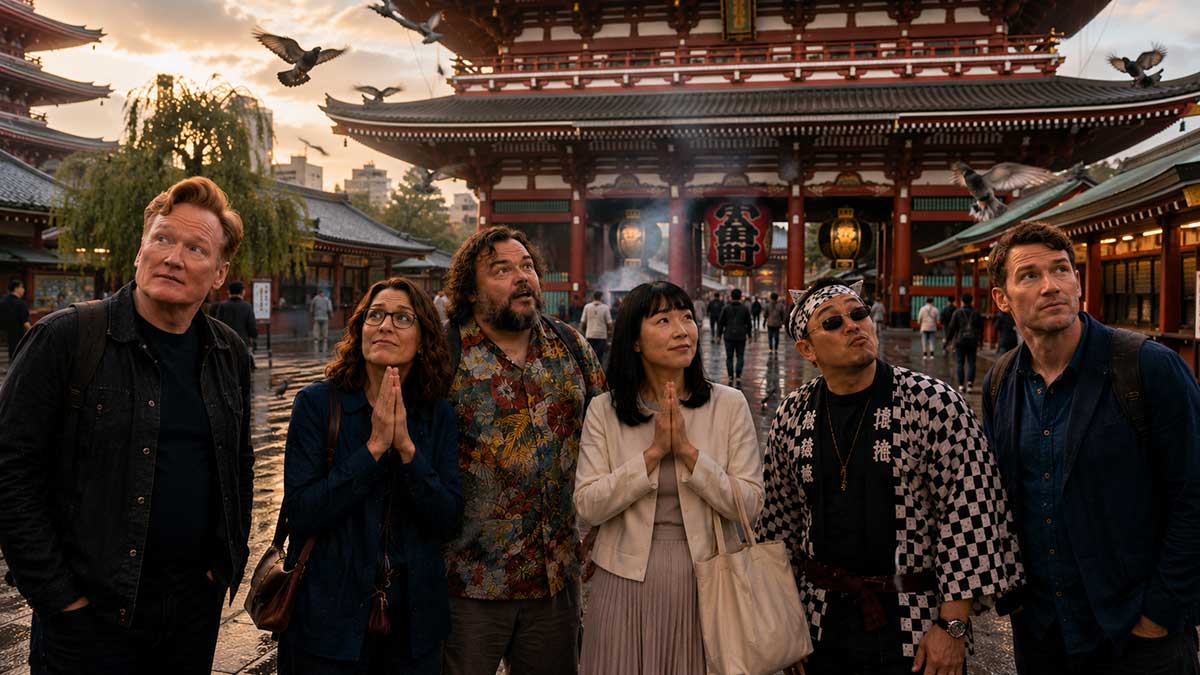
Morning mist drifted softly between narrow streets lined with shuttered shops and paper lanterns still glowing faintly from the night before. The giant red lantern at Sensō-ji hung above the empty walkway like something suspended between centuries.
The air smelled of:
- incense
- wet stone
- sweet bean pastries
- old wood
- morning rain
Even Jack Black lowered his voice instinctively.
Chris walked slowly beneath the temple gate.
“During World War II, much of Tokyo was destroyed by firebombing. Areas like Asakusa carry memories of older Japan people are afraid of losing.”
Conan looked around quietly.
“This feels completely different from Shibuya.”
Chris nodded.
“Tokyo changes personality every few neighborhoods.”
Marie Kondo paused beside a row of ema prayer plaques.
“In Japan,” she said softly, “many people don’t separate spirituality from daily life. Shrines and temples become emotional checkpoints.”
Tina watched elderly locals praying silently before work.
“No one here seems performative about religion.”
“That’s common,” Chris explained. “Japanese spirituality is often private, habitual, seasonal.”
Ken Shimura suddenly rang the temple bell far louder than necessary.
Every pigeon within fifty feet exploded into the air simultaneously.
Conan nearly jumped backward into history itself.
Shimura bowed solemnly.
“Spiritual awakening.”
SCENE 2 — “THE FORTUNE OF MODERATE DISASTER”
Beside the temple courtyard stood rows of wooden drawers filled with omikuji fortunes.
Tourists and locals alike shook metal containers until numbered sticks emerged, each revealing fortunes ranging from extraordinary luck to catastrophic doom delivered with surprising politeness.
The paper smelled faintly of ink and cedar wood.
Chris handed coins to the group.
“Bad fortunes are tied onto wires at shrines so the bad luck stays behind.”
Conan pulled his fortune slowly.
Tina leaned over his shoulder.
“What’s it say?”
Chris translated carefully.
“‘Your future contains misunderstanding, fatigue, and avoidable arguments.’”
Conan stared at the paper.
“So Japan has somehow met me personally.”
Jack Black opened his dramatically.
“‘Excellent fortune!’ YES!”
He raised both arms victoriously.
Then Chris kept reading.
“‘Avoid overeating.’”
Jack lowered his arms immediately.
Ken Shimura secretly swapped fortunes with Tina.
She opened hers and frowned.
“‘You will lose important battle against bird.’”
Conan pointed directly at Shimura.
“That one was written by him.”
Nearby, an elderly woman overheard and started laughing quietly into her sleeve.
Marie tied her fortune gently onto the wire.
“In Japan,” she said softly, “even bad luck is treated respectfully.”
Conan looked around the temple.
“This country has emotionally organized superstition.”
SCENE 3 — “THE KISSATEN FROM ANOTHER CENTURY”
The café looked untouched by time.
Dark wooden walls. Velvet chairs. Cigarette smoke lingering faintly in the air despite modern laws trying unsuccessfully to erase history. A jazz record crackled softly somewhere behind the counter.
Outside, modern Tokyo moved past the windows.
Inside, 1974 remained undefeated.
The café smelled of:
- dark roasted coffee
- buttered toast
- old books
- smoke trapped deep in wood
- rain drifting through cracked windows
Chris stirred his coffee slowly.
“Kissaten cafés became important after the war. They gave people quiet places away from crowded homes and busy streets.”
Tina looked around the dim room.
“This feels like a detective novel where everyone secretly regrets something.”
Conan nodded.
“Or a place where jazz musicians disappear voluntarily.”
Marie smiled faintly at the hand-folded napkins arranged perfectly beside each cup.
Jack Black bit into thick honey toast and closed his eyes immediately.
“I would defend this café physically.”
Meanwhile, Ken Shimura somehow befriended the eighty-year-old owner within minutes despite sharing almost no understandable language.
The old man laughed so hard he had to remove his glasses.
Chris watched in amazement.
“Shimura has that old-school Showa-era energy. Older Japanese people immediately trust him.”
Conan looked around the café again.
Tokyo suddenly felt less futuristic.
More human.
More fragile.
SCENE 4 — “THE RIVER OF LOST TOKYO”
By late afternoon, gray clouds hung low above the Sumida River.
Tour boats drifted beneath bridges while old apartment buildings stood quietly beside newer towers rising behind them. The river reflected broken fragments of neon and cloudy sky.
The wind smelled faintly of rainwater, metal railings, river air, and distant street food.
Chris leaned against the railing.
“Old Tokyo was deeply connected to rivers and canals before cars reshaped the city.”
Conan watched boats move beneath them.
“It feels like Tokyo keeps rebuilding itself before anyone can fully remember it.”
Chris nodded slowly.
“That’s actually one of Japan’s recurring themes. Earthquakes. Fires. War. Constant rebuilding.”
Marie looked out across the water quietly.
“In Japan, impermanence is often accepted instead of resisted.”
Tina folded her arms against the wind.
“That sounds emotionally healthy and psychologically devastating at the same time.”
Ken Shimura suddenly pretended to dramatically fall into the river.
Several tourists gasped.
Shimura stood up perfectly dry behind them.
Conan stared.
“You weaponize confusion professionally.”
Shimura bowed.
SCENE 5 — “THE BASEBALL STADIUM”
Tokyo Dome roared like an organized storm.
Crowds sang coordinated chants for every player. Trumpets echoed through the stadium. Fans waved tiny umbrellas in synchronized motions with terrifying commitment.
The smell of:
- beer
- fried chicken
- popcorn
- grilled meat
- stadium concrete
filled the air.
Jack Black stood frozen in awe.
“This is baseball performed by Broadway.”
Chris laughed.
“Japanese baseball culture emphasizes support and collective participation. Fans rehearse songs and chants for entire seasons.”
Conan watched thousands of people singing together perfectly.
“In America sports crowds look like civilization collapsing.”
Tina pointed toward synchronized cheering sections.
“This feels less like fandom and more like a highly motivated accounting department.”
Marie Kondo quietly explained how many Japanese fans clean stadium areas after games out of habit and respect.
Conan blinked.
“You’re telling me the crowd cleans the stadium voluntarily?”
Chris nodded.
“Sometimes the workers arrive and discover fans already finished.”
Ken Shimura bought a tiny plastic megaphone and began leading chants for completely unrelated events:
- noodles
- elevators
- pigeons
- Conan’s hair
Soon nearby fans were laughing openly.
And for one loud, ridiculous evening beneath stadium lights and trumpet songs, old Tokyo and modern Tokyo somehow felt like the same city again.
DAY 5 — THE CITY AFTER MIDNIGHT
Main Cast
- Conan O'Brien
- Tina Fey
- Jack Black
- Ken Shimura
- Marie Kondo
Tokyo Guide
- Chris Broad
SCENE 1 — “THE TSUKIJI MORNING”
Tokyo smelled like the ocean before sunrise.
At Tsukiji Outer Market, narrow alleys filled with steam, shouted orders, knife sounds, and the smell of grilled seafood rising into the cold morning air. Workers moved quickly between tiny stalls selling tuna, sea urchin, scallops, eel, and things Conan could not identify without emotional support.
The pavement was still wet from early cleaning.
Chris handed everyone hot tea in paper cups.
“Japan’s relationship with seafood shaped a huge part of the country’s food culture. Even convenience store meals reflect centuries of preserving seasonal ingredients carefully.”
Jack Black stared at a tuna knife the size of medieval weaponry.
“That fish died honorably.”
Tina watched chefs slicing tuna with frightening precision.
“In America this would become a reality competition show immediately.”
Marie Kondo paused beside neatly arranged seafood boxes.
“Presentation matters deeply in Japanese food culture. Eating begins visually.”
Conan nodded slowly.
“This market treats squid with more respect than cable television treats human beings.”
Ken Shimura sampled dried squid from three different vendors without paying for any of it.
Shockingly, nobody seemed upset.
One elderly vendor finally laughed and handed him extra pieces voluntarily.
Chris watched carefully.
“Older Japanese people especially love comedians who remind them of the Showa era.”
Conan pointed at Shimura.
“He survives entirely on chaos and nostalgia.”
SCENE 2 — “THE DEPARTMENT STORE FOOD BASEMENT”
The basement food hall beneath Ginza felt less like shopping and more like edible theater.
Glass displays shimmered beneath perfect lighting:
- jewel-like fruit
- flawless bentos
- elegant pastries
- luxury strawberries costing morally uncomfortable amounts of money
The air smelled of:
- fresh bread
- soy glaze
- butter
- green tea
- caramelized sugar
Conan stopped in front of a single melon priced near three hundred dollars.
“That melon has stronger financial stability than I do.”
Chris nodded seriously.
“Luxury fruit became important partly because beautifully wrapped gifts are deeply connected to Japanese social culture.”
Tina stared at the melon.
“So somewhere in Tokyo a businessman is apologizing professionally with fruit.”
Marie smiled softly.
“That is actually possible.”
Jack Black sampled wagyu beef and visibly lost emotional control again.
“I cannot survive this country much longer.”
Meanwhile, Ken Shimura somehow convinced a sample vendor he was conducting “official international melon research.”
The woman laughed so hard she nearly dropped the toothpicks.
Conan looked around at the immaculate displays.
“America industrialized food. Japan emotionally adopted it.”
SCENE 3 — “THE CAT CAFÉ”
The cat café was impossibly quiet.
Soft jazz played beneath warm lighting while cats wandered lazily across bookshelves, cushions, and sleeping customers who looked spiritually repaired.
The room smelled faintly of coffee, clean blankets, and cat fur warmed by sunlight.
Chris removed his shoes before entering.
“Animal cafés became popular partly because many Tokyo apartments don’t allow pets.”
Tina immediately understood.
“So people rent emotional support animals by the hour.”
Conan sat carefully beside a sleeping orange cat.
“This city keeps inventing coping mechanisms.”
Marie Kondo gently stroked a gray cat curled beside the window.
“In dense cities, small moments of calm become very valuable.”
Jack Black lay on the floor surrounded by cats within minutes.
“I have been accepted by the council.”
Meanwhile, one tiny cat stared directly at Ken Shimura with visible suspicion.
Shimura stared back dramatically.
The café grew strangely tense.
Then the cat slapped him lightly across the face.
The entire room burst into laughter.
Even the café employees collapsed giggling behind the counter.
Conan pointed immediately.
“Finally. Natural justice.”
SCENE 4 — “THE SHRINE BETWEEN SKYSCRAPERS”
Hidden between office towers stood a tiny shrine barely larger than a living room.
Businessmen passed beside it carrying briefcases while office workers stopped briefly to bow before disappearing back into the machinery of Tokyo life.
Incense drifted softly upward between skyscrapers.
The air smelled of:
- cedar wood
- rain
- incense
- concrete warmed by afternoon sun
Chris lowered his voice.
“One fascinating thing about Tokyo is how old spirituality survives inside extreme modernity. Tiny shrines often remain even when entire neighborhoods are rebuilt.”
Conan looked upward at glass towers surrounding the shrine.
“This feels like capitalism trying unsuccessfully to erase ghosts.”
Marie nodded thoughtfully.
“In Japan, old things are not always removed. Sometimes they are quietly absorbed.”
Tina watched a businessman stop to pray before rushing back toward the subway.
“That may be the most relatable thing I’ve seen here all week.”
Ken Shimura rang the shrine bell dramatically hard again.
A nearby pigeon exploded upward in terror.
Conan sighed deeply.
“At this point I think he’s being hunted by birds nationwide.”
SCENE 5 — “TOKYO AT 3 A.M.”
At 3 A.M., Tokyo finally exhaled.
The crowds were gone.
Neon still glowed across wet streets, but now the city felt strangely intimate. Convenience stores hummed quietly beneath empty apartment buildings. Vending machines buzzed softly beside silent alleys.
The air smelled of:
- rain
- cigarette smoke
- distant ramen broth
- wet asphalt
- humid summer night
They walked slowly through nearly empty streets.
For the first time since arriving, Tokyo felt vulnerable.
Chris glanced around the quiet neighborhood.
“One reason Japan can feel lonely is that many people here spend long hours working while living in very small apartments. Public places become emotional extensions of private life.”
Conan watched a lone salaryman sleeping peacefully inside a taxi.
“So this city survives by borrowing tiny moments of rest.”
Marie Kondo looked toward glowing apartment windows above them.
“In Japan, people often avoid burdening others emotionally. Loneliness sometimes becomes very quiet.”
Tina folded her arms.
“This may be the only city on Earth where isolation feels polite.”
Nobody joked immediately.
Even Jack Black grew quiet.
Then Ken Shimura suddenly discovered a children’s ride outside a closed convenience store and climbed onto it with complete seriousness.
Tiny electronic music began playing into the empty street.
Conan stared at him beneath the neon lights.
“You know what’s incredible?”
“What?”
“No matter how emotionally deep this country becomes…”
Shimura rang the toy steering wheel proudly.
“…he always finds the stupidest possible ending.”
And somehow, that kept Tokyo from becoming sad for too long.
DAY 6 — THE TRAIN TO KYOTO
Main Cast
- Conan O'Brien
- Tina Fey
- Jack Black
- Ken Shimura
- Marie Kondo
Kyoto Guide
- Peter Barakan
SCENE 1 — “THE BULLET TRAIN”
Tokyo Station moved with terrifying precision.
Businessmen walked quickly beneath giant departure boards. Bento boxes were stacked like edible architecture inside station shops. Train melodies echoed softly through polished corridors smelling faintly of coffee, soy sauce, and fresh bread.
Then the Shinkansen arrived.
Perfectly on time.
The nose of the train slid into the station like a machine from fifty years in the future arriving politely.
Conan stared at it.
“This train looks like it has opinions about humanity.”
Peter Barakan smiled calmly.
“The Shinkansen changed Japan psychologically as much as physically. It connected cities so efficiently that distance itself began feeling different.”
Inside the train everything felt impossibly clean:
- soft seats
- quiet lighting
- enormous windows
- almost no vibration
Jack Black pressed his face to the glass immediately.
“We are inside elegant lightning.”
Marie Kondo unfolded a carefully wrapped ekiben lunch box.
“In Japan,” she explained softly, “travel itself is often treated as part of the experience, not only transportation.”
Tina opened her bento slowly.
“American train food feels like punishment. This looks like an apology letter from a very loving grandmother.”
Meanwhile, Ken Shimura somehow managed to rotate his seat backward and accidentally joined another family’s conversation without invitation.
The family laughed immediately anyway.
Peter watched him with admiration.
“Shimura represents something older. A kind of humor built before irony became fashionable.”
Outside the window, Tokyo slowly loosened its grip on the horizon.
SCENE 2 — “MOUNT FUJI APPEARS”
The city eventually gave way to open land.
Rice fields flashed past beneath low clouds. Small towns drifted by quietly:
- tiled rooftops
- tiny shrines
- vegetable gardens
- laundry moving softly in the wind
Then someone whispered:
“Fuji.”
Everyone turned toward the window.
Mount Fuji stood impossibly still above the clouds.
White snow rested along the summit like untouched paper.
The entire train car subtly changed.
Passengers who had ignored one another for hours quietly lifted phones toward the glass.
Even Conan stopped joking.
Peter looked out thoughtfully.
“Fuji became sacred partly because it feels unreal. Japanese aesthetics often value beauty that exists slightly beyond reach.”
The train hummed softly beneath them.
Marie folded her hands quietly.
“Many Japanese people feel emotional seeing Fuji even after many years.”
Tina stared at the mountain.
“It looks less like a mountain and more like a national memory.”
Jack Black whispered dramatically:
“If mountains could achieve enlightenment…”
Meanwhile, Ken Shimura pressed his face flat against the window pretending to kiss Mount Fuji from long distance.
Several nearby passengers burst into laughter.
The emotional tension dissolved instantly.
Conan pointed toward him.
“He cannot allow sincerity to survive more than thirty seconds.”
SCENE 3 — “KYOTO STATION”
Kyoto arrived differently than Tokyo.
Tokyo had entered loudly:
neon,
screens,
motion,
electric pressure.
Kyoto entered quietly.
Even Kyoto Station somehow felt calmer despite its enormous modern architecture. Outside the windows, mountains rested faintly beyond the city skyline like patient guardians.
The air smelled of:
- rain
- matcha sweets
- wood
- clean stone after drizzle
Peter adjusted his scarf.
“Kyoto was Japan’s capital for over one thousand years. Many people still consider it the emotional center of the country.”
Conan looked around carefully.
“So Tokyo feels like Japan’s brain…”
Peter nodded.
“And Kyoto feels more like memory.”
Marie Kondo smiled softly at that.
Jack Black immediately became distracted by a matcha dessert store displaying green pastries with museum-level seriousness.
“In America this would just be called ‘cake.’ Here it has philosophy.”
Tina watched locals moving quietly through the station.
“Even the tourists in Kyoto seem emotionally quieter.”
Peter nodded.
“People unconsciously adjust behavior here. Kyoto has social gravity.”
Ken Shimura immediately ruined the atmosphere by pretending to become lost inside the station for dramatic attention.
He walked ten feet away and shouted:
“Tell my family I loved them.”
SCENE 4 — “THE RYOKAN”
The ryokan smelled of tatami mats, cedar wood, tea, and rain drifting softly through the garden outside.
Shoes disappeared immediately at the entrance.
Soft lantern light glowed across paper sliding doors while somewhere deeper inside the inn water trickled gently through stone.
A woman in kimono welcomed them with a bow so graceful Conan looked suddenly self-conscious about existing.
Peter lowered his voice.
“Traditional Japanese hospitality — omotenashi — focuses on anticipating needs before they are spoken.”
Tina looked around the room carefully.
“So American hospitality says, ‘Tell us what you want.’ Japanese hospitality says, ‘We already noticed.’”
Marie Kondo knelt naturally onto the tatami.
“There is comfort in spaces designed with restraint.”
Jack Black attempted kneeling.
His knees produced sounds from another geological era.
Conan looked at the low table.
“I’m too tall for this entire civilization.”
Then came the yukata fitting.
Ken Shimura intentionally tied Conan’s robe incorrectly so it resembled a confused wizard preparing for bankruptcy.
The inn staff tried heroically not to laugh.
Tina failed completely.
SCENE 5 — “GION IN THE RAIN”
Rain fell softly over Gion.
Lantern light reflected across wet stone streets lined with wooden buildings preserved from another era. Umbrellas drifted quietly through narrow alleys while distant shamisen music floated faintly from somewhere unseen.
The entire district smelled of:
- rainwater
- incense
- old wood
- tea
- damp earth
Kyoto no longer felt modern at all.
It felt suspended.
Peter walked slowly beside them.
“One reason Kyoto feels emotionally different is that much of it survived the war. The city still contains physical continuity with older Japan.”
Conan watched rain sliding down wooden walls.
“So Tokyo constantly rebuilt itself…”
“And Kyoto remembers.”
Nobody spoke for a while after that.
Even Jack Black grew quiet.
Marie Kondo paused beneath a lantern glowing softly against the rain.
“In Japan,” she said gently, “beauty is often connected to impermanence. Rain, fading seasons, aging wood… these things are not flaws.”
Tina looked down the empty street.
“This city doesn’t feel frozen in time.”
Peter nodded.
“It feels aware of time.”
Then suddenly Ken Shimura slipped intentionally on the wet stone path with the exaggerated drama of a silent-film actor dying in battle.
A nearby elderly woman laughed so hard she had to stop walking.
Conan looked upward into the Kyoto rain.
And somehow, even the comedy here felt quieter.
DAY 7 — THE THOUSAND GATES OF SILENCE
Main Cast
- Conan O'Brien
- Tina Fey
- Jack Black
- Ken Shimura
- Marie Kondo
Kyoto Guide
- Peter Barakan
SCENE 1 — “FUSHIMI INARI BEFORE SUNRISE”
Kyoto was still asleep when they arrived.
Mist drifted low across the mountain paths of Fushimi Inari while thousands of vermillion torii gates disappeared upward into darkness like an endless corridor leading somewhere outside ordinary life.
The air smelled of:
- wet cedar
- cold stone
- moss
- incense
- mountain rain lingering from the night before
Even Jack Black whispered instinctively.
The first birds had only just begun singing.
Peter Barakan walked slowly beneath the gates.
“Fushimi Inari is dedicated to the Shinto god of rice, prosperity, and business. Many torii here were donated by companies seeking blessings.”
Conan looked upward at the endless tunnel of red gates.
“So spiritually speaking… capitalism built this mountain.”
Peter smiled.
“In Japan, religion and practicality often coexist comfortably.”
Marie Kondo touched the wooden pillar gently as they passed.
“Japanese spirituality is often more atmospheric than doctrinal.”
Tina looked around the empty path.
“This feels less like religion and more like entering somebody’s memory.”
Ken Shimura suddenly froze dramatically and pointed into the forest.
Everyone stopped.
Silence.
Then a tiny cat wandered slowly out from the trees.
Shimura bowed deeply to it.
The cat ignored him completely and continued walking.
Conan nodded.
“Yes. That also feels spiritually accurate.”
SCENE 2 — “THE CLIMB”
The higher they climbed, the quieter the world became.
Tourists disappeared gradually. The red gates narrowed into tighter pathways winding through dense forest while sunlight slowly filtered between trees above them.
Their footsteps echoed softly against damp stone stairs.
The mountain air felt cool against the skin, carrying smells of:
- wet leaves
- old wood
- earth
- distant incense smoke
Jack Black was breathing heavily already.
“These stairs were built by a personal enemy.”
Peter slowed beside him.
“One interesting thing about Japanese pilgrimage culture is that physical effort is often considered spiritually meaningful.”
Conan wiped sweat from his forehead.
“So enlightenment here includes cardio.”
Tina pointed toward tiny shrines hidden beside the trail.
“There are hundreds of them.”
Peter nodded.
“Japanese spirituality often embraces accumulation instead of simplification. Small sacred spaces gather naturally over time.”
Marie Kondo smiled softly.
“Sacredness here often feels woven into ordinary environments.”
Suddenly Ken Shimura began climbing the stairs using exaggerated ninja movements for absolutely no reason.
An elderly Japanese couple passing nearby burst into laughter.
The old man gave Shimura a respectful thumbs-up.
Conan stared in amazement.
“He communicates internationally through nonsense.”
SCENE 3 — “THE FOX STATUES”
Rows of stone fox statues watched silently from beside the trail.
Some held keys in their mouths.
Others carried scrolls or rice granaries.
Rainwater glistened across moss growing slowly over ancient stone faces.
The forest had become almost completely quiet now except for:
- distant wind through trees
- footsteps on gravel
- occasional bird calls
- bamboo creaking softly somewhere unseen
Chris wasn’t here anymore.
Tokyo felt impossibly far away.
Peter lowered his voice naturally.
“Inari foxes are considered messengers of the gods. In Japan, animals often exist between folklore and spirituality rather than completely separate from it.”
Jack Black stared deeply into one fox statue’s eyes.
“This fox knows things.”
Tina nodded.
“This fox definitely judged me immediately.”
Marie Kondo explained softly that many Japanese myths coexist comfortably alongside modern life.
“Belief here is often flexible rather than absolute.”
Conan looked around the forest path.
“I think America spends too much energy deciding whether things are literally true.”
Peter smiled slightly.
“Japan is often more interested in emotional truth.”
Ken Shimura suddenly posed beside one fox statue pretending to be its long-lost brother.
A passing schoolgirl laughed so hard she snorted accidentally.
She immediately bowed apologetically afterward.
Conan pointed excitedly.
“There! That’s Tokyo behavior again. Public embarrassment followed instantly by apology.”
SCENE 4 — “THE TEAHOUSE ON THE MOUNTAIN”
Halfway down the mountain they discovered a tiny teahouse hidden beneath maple trees.
Steam rose softly from kettles behind fogged windows while handwritten menus hung beside old wooden doors faded by decades of rain and sunlight.
Inside smelled of:
- roasted tea
- sweet red bean
- cedar wood
- charcoal heat
- old paper
An elderly woman served matcha and small sweets without unnecessary conversation.
The silence felt comfortable.
Peter sipped his tea slowly.
“Many traditional Japanese spaces value ma — the meaning created by emptiness or pause.”
Tina looked around carefully.
“So Western culture fills silence. Japanese culture frames it.”
Peter nodded immediately.
“Exactly.”
Conan stared at the garden outside.
“This may be the first country where silence feels designed.”
Jack Black bit into a sweet bean pastry and became emotional again.
“I would protect this old woman with my life.”
Marie Kondo smiled softly into her tea.
Meanwhile, Ken Shimura accidentally knocked over a tiny spoon.
The elderly owner looked up.
Shimura froze completely still like a criminal awaiting sentencing.
Then the woman quietly laughed.
Even her laugh sounded peaceful.
SCENE 5 — “KYOTO AFTER RAIN”
Rain returned just before evening.
Kyoto glowed beneath wet lantern light while narrow streets reflected gold and crimson across stone pathways polished smooth by centuries of footsteps.
The city smelled of:
- rainwater
- incense
- wet wood
- tea
- earth cooling after humidity
Nobody spoke for several minutes as they walked.
Even Conan seemed quieter now.
Peter finally broke the silence.
“One reason visitors become emotional in Kyoto is that the city preserves continuity. Many streets here look similar to how they looked generations ago.”
Tina looked at the wooden buildings disappearing into mist.
“Tokyo feels like survival. Kyoto feels like memory.”
Marie nodded gently.
“In Japan, beauty is often connected to awareness that things disappear.”
Jack Black watched rainwater drip from a lantern roof.
“I think this city slows people down on purpose.”
Peter smiled.
“Kyoto punishes rushing.”
At that exact moment, Ken Shimura attempted to leap dramatically across a rain puddle and failed catastrophically.
Water exploded everywhere.
A nearby businessman burst into laughter before catching himself and bowing apologetically for laughing too loudly.
Conan pointed at him triumphantly.
“There it is again. Emotional release followed immediately by social regret.”
Shimura stood up completely soaked, raised one finger toward the sky, and announced proudly:
“Kyoto baptism.”
And for the first time since arriving in Japan, Tina Fey laughed so hard she couldn’t speak.
Final Thoughts by Conan O’Brien
After seven days, I learned that Japan is not strange in a random way.
It is strange in an organized, considerate, deeply human way.
Tokyo taught me that silence can be kindness.
Kyoto taught me that beauty can make even me stop talking.
Ramen taught me that soup can have moral authority.
Convenience stores taught me loyalty.
Ken Shimura taught me that dignity is optional, but timing is sacred.
Japan does not explain itself loudly.
It waits.
Then one morning, under red gates in the mist, you realize it has quietly entered your heart.
Short Bios:
Conan O’Brien — The tall American comic trying to understand Japan without destroying international relations.
Tina Fey — The sharp observer who sees the logic hiding inside Japan’s emotional restraint.
Jack Black — The loud-hearted traveler who reacts to every snack, shrine, and train like it may change his life.
Ken Shimura — The Japanese comedy legend who turns awkward silence into shared laughter.
Marie Kondo — The calm guide who notices the emotional meaning inside ordinary details.
Chris Broad — The Tokyo guide who explains Japan’s hidden systems with dry humor and grounded insight.
Peter Barakan — The Kyoto guide who brings history, memory, and cultural depth to old Japan.
Leave a Reply