
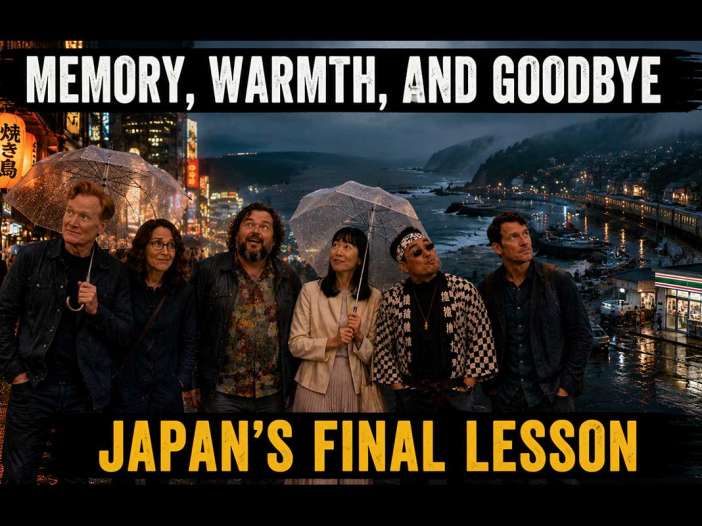
Introduction by Conan O’Brien
By week three, Japan stopped feeling like a country I was visiting.
It started feeling like a dream I was about to wake up from.
The north felt colder.
Quieter.
Older somehow.
Not old in years.
Old in emotion.
There were fishing towns where the wind sounded louder than people.
Train stations with almost nobody left.
Neighborhoods rebuilt after disaster where life continued anyway.
Tokyo nights where people finally spoke honestly after midnight jazz and too much whiskey.
And somewhere between snow-covered vending machines and silent train rides, I realized Japan had been teaching us something the entire time.
Not through speeches.
Not through slogans.
Through atmosphere.
Japan communicates through small moments:
- hot ramen in freezing air
- convenience stores glowing at midnight
- train announcements echoing through empty stations
- umbrellas shared silently in the rain
Meanwhile, Ken Shimura somehow continued turning emotional national melancholy into physical comedy.
Which, honestly, may be Japan’s greatest cultural achievement.
(Note: This is an imaginary conversation, a creative exploration of an idea, and not a real speech or event.)
DAY 15 — THE ISLAND WHERE JAPAN ENDS
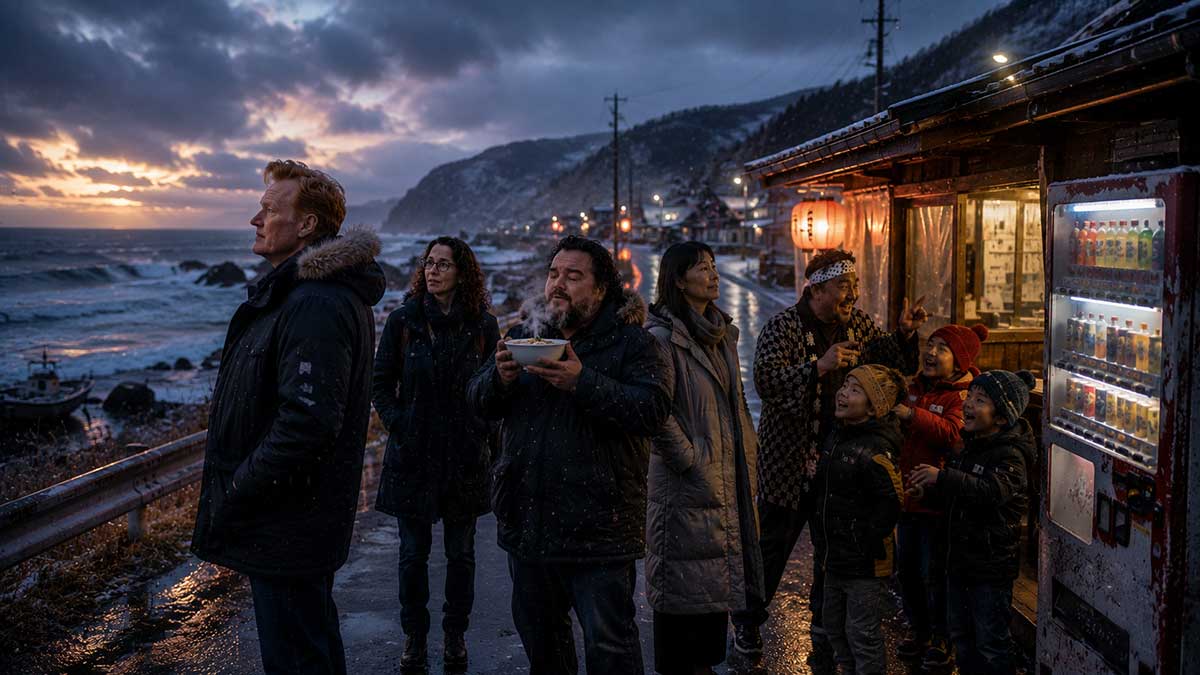
Main Cast
- Conan O'Brien
- Tina Fey
- Jack Black
- Ken Shimura
- Marie Kondo
Hokkaido Guide
- John Daub
SCENE 1 — “THE FERRY”
The ferry groaned softly against the frozen dock before pushing slowly into gray northern water.
Snow drifted sideways across the deck while distant mountains faded gradually into fog behind them.
Everything felt enormous:
- sea
- sky
- silence
- cold
The ocean smelled of:
- salt
- diesel fuel
- freezing air
- wet metal
Conan gripped the railing immediately.
“This is no longer transportation. This is survival with seating.”
John Daub pulled his coat tighter.
“Hokkaido and northern islands often feel emotionally separate from mainland Japan. More isolated. More weather-driven.”
Jack Black stared at the endless sea dramatically.
“I think we’re entering folklore.”
Inside the ferry cabin, old vending machines hummed beside rows of sleeping passengers wrapped in blankets.
Marie Kondo poured hot tea quietly.
“In Japan, long journeys often become reflective spaces.”
Tina looked around the dim cabin.
“Everyone here looks like they’re returning from something emotional.”
Meanwhile, Ken Shimura had somehow befriended three elderly fishermen within twenty minutes.
Nobody understood how.
Soon all four men were laughing hysterically over canned coffee while the ocean rolled outside the windows.
Conan pointed at Shimura.
“He keeps integrating himself into hidden Japan.”
SCENE 2 — “THE COASTAL VILLAGE”
The village looked almost unreal beneath the snow.
Tiny houses clustered beside the shoreline beneath steep hills while fishing boats rested frozen against the harbor under layers of white.
No convenience stores.
No crowds.
No music.
Only:
- wind
- distant waves
- creaking ropes against boats
- crows somewhere above the harbor
The air smelled sharply of:
- saltwater
- snow
- fish drying indoors
- wood smoke
John looked around quietly.
“Many remote fishing towns in Japan are shrinking quickly. Younger generations often leave permanently.”
Conan watched smoke rising slowly from chimneys.
“This feels like the edge of something.”
Marie Kondo nodded softly.
“In Japan, isolation often creates stronger attachment to seasons and local traditions.”
Tina stared toward the nearly empty harbor.
“You can feel how hard winter would be here.”
Jack Black stopped beside a tiny shrine facing the ocean.
“This town looks like it survived by sheer stubbornness.”
Meanwhile, Ken Shimura had already joined a local snow-shoveling group despite nobody inviting him.
The old women supervising the work laughed nonstop watching his intentionally overdramatic shoveling technique.
One woman eventually handed him roasted sweet potatoes as reward.
Conan shook his head slowly.
“He keeps getting adopted by elderly people.”
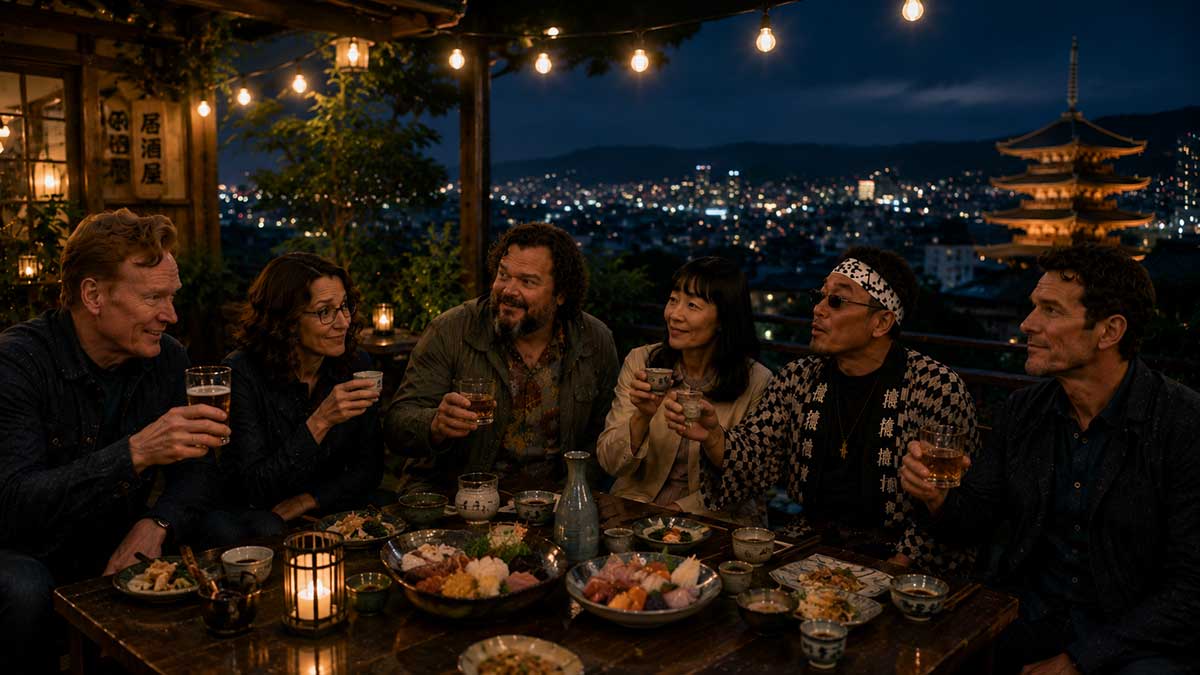
SCENE 3 — “THE SEAFOOD DINNER”
Dinner arrived beside windows covered softly in snow.
Crab steamed heavily from giant metal pots while grilled fish crackled over charcoal beside bowls of miso soup and fresh rice.
The room glowed gold beneath old lantern light.
Outside:
only darkness and snow.
Inside smelled of:
- butter
- seafood
- charcoal
- cedar wood
- warm sake
John cracked open crab legs carefully.
“Remote coastal communities often developed incredibly rich food traditions because preserving and preparing seafood became central to survival.”
Jack Black held up a crab leg like sacred treasure.
“This animal sacrificed itself heroically.”
Conan burned his fingers immediately trying to open one too fast.
“Japan keeps teaching patience through pain.”
Marie Kondo watched steam drifting upward from the meal.
“In winter, warmth itself becomes part of flavor.”
Tina looked around the nearly empty inn dining room.
“I think Americans forget how emotionally powerful seasonal food can be.”
Then Ken Shimura attempted to demonstrate “advanced crab-opening technique.”
The crab shell launched directly across the room into Conan’s soup.
Perfect accuracy.
Silence.
Then the elderly inn owner laughed so violently she had to lean against the wall.
Even Conan started laughing.
And somehow the dinner became warmer after the disaster.
SCENE 4 — “THE LIGHTHOUSE”
The lighthouse stood alone against the sea.
Wind slammed against the cliffs hard enough to shake coats while dark waves crashed below through drifting snow and fading evening light.
The world had narrowed into:
- ocean
- rock
- snow
- wind
Nothing else.
The air smelled violently clean:
- salt
- ice
- stormwater
- cold stone
Nobody spoke much.
John finally broke the silence.
“One reason many Japanese stories involve isolation is geography. Mountains, islands, storms, difficult winters — communities often lived physically separated for long periods.”
Conan looked out at the black ocean.
“This feels less like scenery and more like endurance.”
Marie Kondo stood quietly beside the railing.
“In Japan, harshness and beauty are often accepted together.”
Tina watched snow vanishing into the sea wind.
“I think modern countries spend enormous energy trying to eliminate discomfort.”
Jack Black pulled his hood tighter.
“And Japan keeps turning discomfort into poetry.”
For several moments even Ken Shimura remained unusually quiet.
Then a gust of wind stole his knit cap and launched it directly off the cliff.
Everyone watched silently as it vanished into darkness.
Shimura stared at the ocean dramatically.
Conan nodded sympathetically.
“The north has claimed tribute.”
SCENE 5 — “THE NIGHT WALK”
Late that night they walked through the sleeping village beneath falling snow.
Almost every window glowed softly behind curtains while snow muted every sound except their footsteps.
No cars passed.
No voices carried through the streets.
The village smelled of:
- cedar smoke
- snow
- soup drifting from houses
- cold night air
Conan walked slowly beneath the lanterns.
“I’ve never seen quiet like this before.”
John looked around the empty street.
“Places like this are disappearing gradually. Some villages lose residents every year.”
Marie Kondo watched snow collecting silently on rooftops.
“In Japan, people sometimes mourn things before they fully disappear.”
Tina folded her scarf tighter.
“This whole country feels aware that time is moving.”
Jack Black looked upward into the snowfall.
“I think America fears aging.”
He looked around the village.
“Japan seems to sit beside it.”
Nobody answered immediately.
Then somewhere ahead in the darkness…
they heard music.
Tiny.
Terrible.
Determined.
They followed the sound around the corner.
Ken Shimura sat alone beside a vending machine playing a toy harmonica for absolutely nobody while snow fell softly around him.
The vending machine light glowed against the storm.
Conan stared at the scene quietly.
“That may be the saddest and funniest thing I’ve ever seen.”
And somewhere between loneliness, absurdity, warmth, and snow…
Japan finally stopped feeling foreign at all.
DAY 16 — THE CITY THAT NEVER FULLY WOKE UP
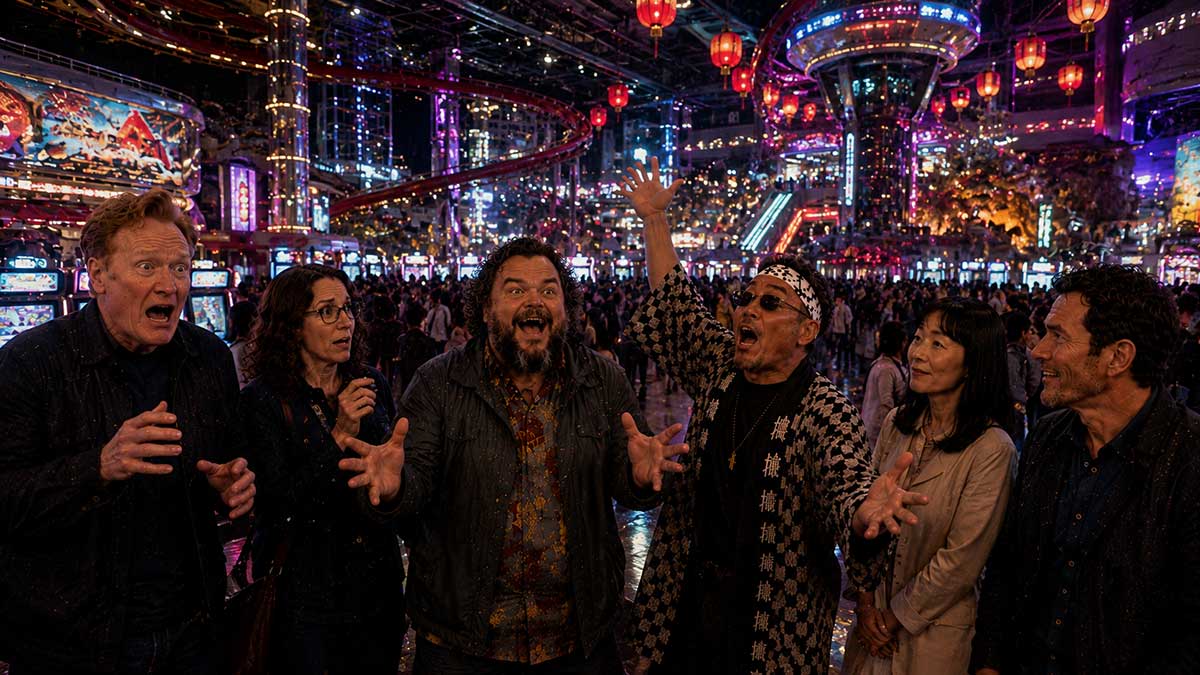
Main Cast
- Conan O'Brien
- Tina Fey
- Jack Black
- Ken Shimura
- Marie Kondo
Northern Japan Guide
- John Daub
SCENE 1 — “THE RETURN SOUTH”
The train leaving the coast felt warmer than before.
Snow still covered the landscape outside, but now the group watched it differently. Small villages drifted past beneath pale morning light while smoke rose quietly from isolated homes surrounded by white fields.
The train hummed softly through the frozen countryside.
The air smelled faintly of:
- coffee
- snow melting from boots
- warm fabric
- instant noodles
Nobody rushed to speak.
Conan stared out the window for a long moment.
“I think Japan tricked us.”
Tina glanced over.
“How?”
“It pretended to be about technology.”
Outside, an old farmer cleared snow slowly from his roof.
Conan continued quietly.
“But it’s actually about endurance.”
John Daub nodded thoughtfully.
“Japan modernized incredibly fast, but emotionally many parts of the country still move according to older rhythms.”
Marie Kondo folded her scarf carefully.
“In Japan, old and new often exist together instead of replacing one another.”
Jack Black watched distant mountains sliding past the glass.
“I feel like Tokyo was the surface layer.”
Then he looked back toward the snowy villages disappearing behind them.
“And this was the hidden part.”
Meanwhile, Ken Shimura had somehow fallen asleep sitting perfectly upright while still holding a half-eaten sweet potato.
A nearby grandmother took a photograph of him like spotting rare wildlife.
SCENE 2 — “THE CITY UNDER THE TRACKS”
By evening they arrived back in the city.
But this part of Japan looked different from Tokyo’s polished neon or Osaka’s chaotic warmth.
Beneath elevated train tracks stretched endless narrow alleys packed tightly with:
- tiny bars
- noodle counters
- standing restaurants
- smoking office workers
- flickering lanterns
Train rumble shook the ceiling every few minutes.
The air smelled heavily of:
- grilled meat
- beer
- cigarette smoke
- soy sauce
- rain-soaked concrete
Conan looked upward as another train thundered overhead.
“This feels like a city built inside its own leftovers.”
John smiled.
“Postwar Japan rebuilt quickly and efficiently. Spaces beneath train lines became entire hidden social worlds.”
Tina looked around the packed alley.
“This is the opposite of minimalist Japan.”
Marie Kondo nodded softly.
“Japanese aesthetics also include density and intimacy.”
Jack Black watched cooks grilling skewers inches from customers’ faces.
“I trust food more when there’s slight danger involved.”
Meanwhile, Ken Shimura had already entered a standing bar and somehow become temporary employee within six minutes.
No one understood how it happened.
The owner handed him an apron willingly.
Conan stared at the scene.
“He keeps assimilating into side quests.”
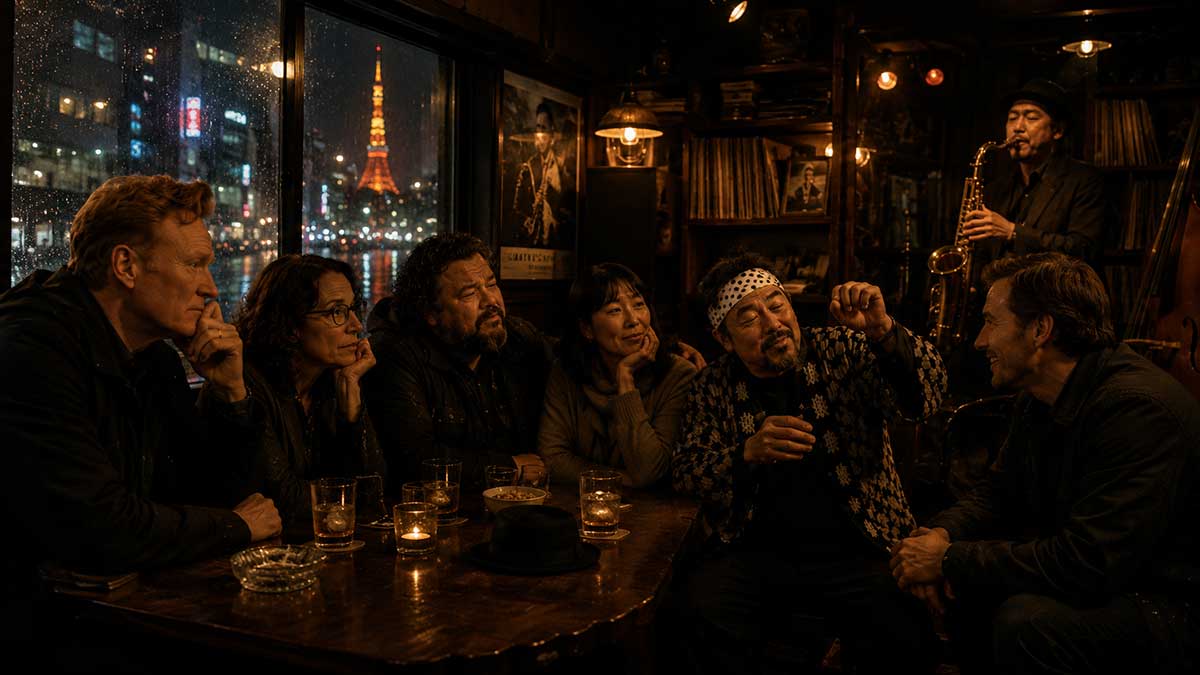
SCENE 3 — “THE JAZZ BAR”
The jazz bar was hidden behind an unmarked door above a staircase barely wide enough for Conan’s shoulders.
Inside:
dim lights,
vinyl records,
dark wood,
whiskey glasses,
and music so soft it felt woven into the air itself.
The room smelled of:
- old books
- whiskey
- cigarette smoke trapped in wood
- coffee
- rain drifting through cracked windows
Nobody talked loudly.
People simply listened.
John leaned toward the group.
“Japan developed one of the world’s deepest jazz appreciation cultures after the war. Listening cafés became places where people escaped crowded daily life.”
Conan looked around the silent room.
“This feels less like entertainment and more like collective emotional processing.”
Tina nodded immediately.
“Everyone here looks like they lost someone beautifully.”
Marie Kondo closed her eyes briefly as the saxophone played.
“In Japan, sadness is not always treated as something to escape.”
Jack Black whispered:
“This room feels lonely in a healthy way.”
Then everyone slowly turned.
Ken Shimura sat near the back of the room pretending to play invisible saxophone with total emotional commitment.
The bartender saw him…
paused…
and slid him a real toy saxophone from somewhere beneath the counter.
The entire bar quietly lost composure.
Even the jazz musicians started laughing mid-song.
Conan shook his head.
“This man keeps accidentally becoming national therapy.”
SCENE 4 — “THE BOOKSTORE OPEN AT MIDNIGHT”
The bookstore remained open past midnight.
Rows of books stretched beneath warm lighting while customers wandered silently between shelves carrying baskets filled with novels, philosophy books, manga, and magazines.
Outside, rain tapped softly against the windows.
Inside smelled of:
- paper
- coffee
- ink
- rainwater carried in on coats
Conan ran his hand slowly across a shelf of translated American literature.
“Japan may actually care more about books than America does.”
John nodded.
“Reading culture remained strong partly because commuting trains created daily reading time for generations.”
Tina looked around the store thoughtfully.
“This country seems built around small private worlds.”
Marie Kondo paused beside a shelf of poetry books.
“In crowded societies, solitude often becomes internal.”
Jack Black sat cross-legged reading bizarre Japanese ghost stories beside the manga section.
Meanwhile, Ken Shimura had somehow discovered a children’s picture book and was dramatically reading it aloud to two fascinated toddlers despite understanding almost none of the actual words.
The children were laughing hysterically anyway.
Their exhausted mother bowed repeatedly in gratitude.
Conan stared at Shimura.
“He doesn’t communicate through language anymore.”
SCENE 5 — “THE CROSSWALK AGAIN”
Late that night they returned to Shibuya Crossing.
Rain reflected neon across the pavement exactly like the first night.
Thousands of people still moved through the intersection in organized waves beneath giant glowing screens.
Yet now the city looked completely different.
The air smelled of:
- rain
- coffee
- wet asphalt
- cigarette smoke
- street food drifting through cold night air
Conan stood silently beneath the lights.
“The first time we came here, Tokyo felt alien.”
Tina nodded.
“Now it feels… tired.”
John looked out over the crossing.
“Japanese cities can appear efficient from outside. But many people here carry enormous emotional pressure quietly.”
Marie Kondo watched umbrellas drifting through the crowd.
“In Japan, loneliness often hides inside functioning systems.”
Jack Black looked toward the endless apartment towers stretching into darkness.
“That may be true everywhere now.”
Nobody joked.
For several moments the crossing moved silently around them like a giant living machine.
Then suddenly from somewhere behind them came loud dramatic shouting.
They turned.
Ken Shimura had somehow organized a group of drunk salarymen into performing synchronized dance moves beneath the rain.
The businessmen were laughing harder than anyone.
Strangers nearby began cheering.
Even exhausted office workers waiting at the crosswalk started smiling openly.
Conan watched the scene beneath the neon lights.
And for the first time, he realized something strange:
Japan wasn’t hiding emotion.
It was protecting it.
DAY 17 — THE CITY THAT NEVER STOPPED REBUILDING
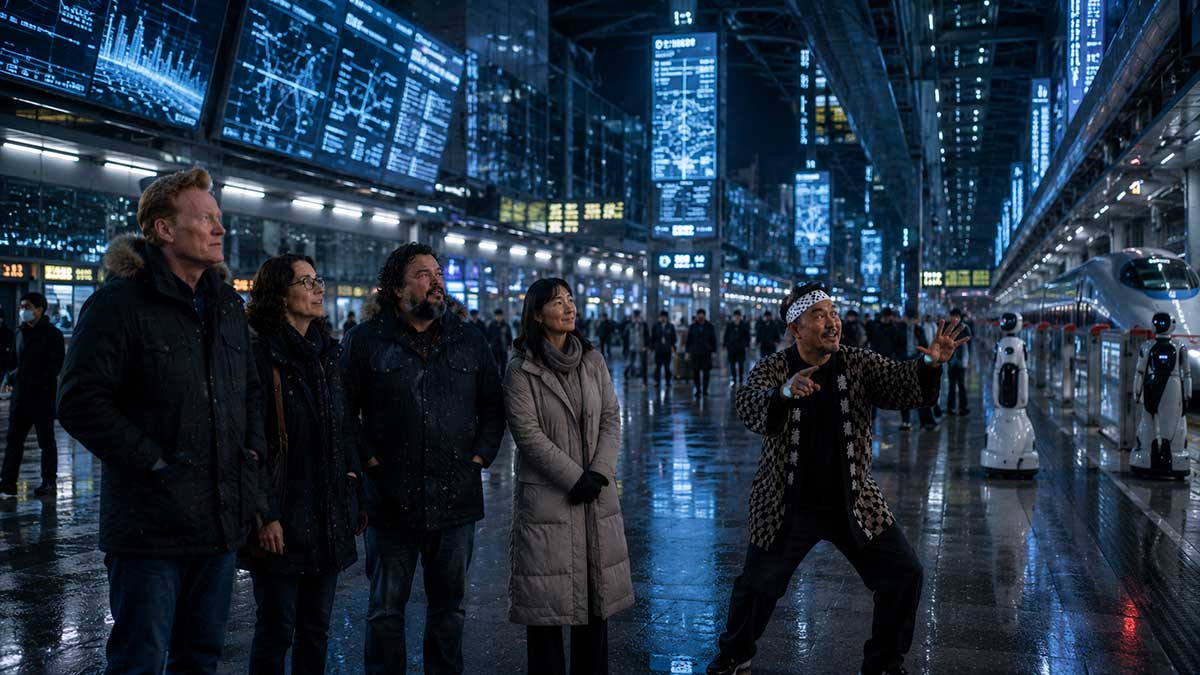
Main Cast
- Conan O'Brien
- Tina Fey
- Jack Black
- Ken Shimura
- Marie Kondo
Tohoku Guide
- Chris Broad
SCENE 1 — “THE TRAIN TO TOHOKU”
The train north felt different from earlier journeys.
Tokyo faded behind them once again, but now the landscapes outside the window carried more weight:
- quiet towns
- broad rivers
- forests climbing mountainsides
- seawalls beside distant coastlines
The rhythm of the train felt slower emotionally somehow.
The cabin smelled faintly of:
- coffee
- fresh bento rice
- newspapers
- rain drying from jackets
Chris Broad sat quietly for a while before speaking.
“Tohoku has a very different identity from Tokyo. More rural. More resilient. After the 2011 earthquake and tsunami, the region became emotionally symbolic for many Japanese people.”
Conan looked out at small farming towns passing by.
“I think outsiders sometimes imagine Japan as one giant city.”
Chris nodded.
“But much of Japan still revolves around regional identity, local traditions, and surviving difficult geography.”
Marie Kondo folded her train ticket carefully.
“In Japan, northern regions are often associated with endurance and emotional strength.”
Tina looked toward distant gray coastline barely visible beneath clouds.
“This trip keeps becoming less touristy and more human.”
Meanwhile, Ken Shimura had somehow fallen asleep with his mouth open while balancing an unopened canned coffee perfectly on his forehead.
Nobody disturbed him.
Even the conductor smiled while passing by.
SCENE 2 — “THE COASTLINE”
The ocean arrived suddenly.
Cold gray water stretched endlessly beside rebuilt coastal towns protected by enormous seawalls now standing between homes and the sea.
Everything looked clean.
Ordered.
Reconstructed.
Yet somehow fragile.
The wind smelled sharply of:
- saltwater
- seaweed
- rain
- concrete still carrying traces of ocean air
Chris stood quietly beside the seawall.
“Many towns here were almost completely destroyed in 2011. Entire communities disappeared within minutes.”
Nobody joked.
Even Jack Black became still.
Conan looked toward the ocean.
“It’s strange. Japan often feels emotionally controlled…”
He glanced at the sea.
“But nature here feels completely uncontrollable.”
Chris nodded slowly.
“That tension shaped a lot of Japanese psychology historically — earthquakes, tsunamis, typhoons, fires. Impermanence isn’t theoretical here.”
Marie Kondo watched waves striking the seawall.
“In Japan, rebuilding is often treated as part of life rather than exception.”
Tina folded her arms against the wind.
“I think Americans believe stability is permanent.”
No one answered immediately.
Then suddenly Ken Shimura attempted to pose heroically against the ocean wind.
The wind immediately knocked his scarf directly into the sea.
Everyone watched silently as it vanished forever.
Conan sighed.
“The Pacific continues taking sacrifices.”
SCENE 3 — “THE TEMPORARY SHOPPING STREET”
The shopping street had been rebuilt from temporary structures years earlier.
Small restaurants, seafood shops, bookstores, cafés, and bakeries stood side by side beneath simple roofs while locals moved quietly through narrow walkways carrying groceries and umbrellas.
The air smelled warmly of:
- fried seafood
- coffee
- fresh bread
- rainwater
- grilled fish
Chris nodded toward the storefronts.
“After the disaster many communities rebuilt gradually through temporary spaces like these. Some became permanent because people grew attached to them.”
Conan looked around carefully.
“This place doesn’t feel tragic.”
Chris smiled softly.
“No. It feels stubborn.”
Marie Kondo stopped beside handmade crafts created by local residents.
“In Japan, rebuilding often includes preserving community connection, not only infrastructure.”
Jack Black bought far too many pastries from a tiny bakery run by an elderly woman.
Again.
Tina pointed immediately.
“You’ve been adopted by every grandmother north of Osaka.”
Meanwhile, Ken Shimura somehow ended up helping a seafood vendor advertise scallops by shouting exaggerated fake commercials into the street.
Within minutes:
- tourists gathered
- locals laughed
- actual sales increased
The vendor bowed repeatedly in gratitude.
Conan watched in disbelief.
“He accidentally stimulates regional economies.”
SCENE 4 — “THE SCHOOL ON THE HILL”
The school overlooked the ocean from high ground.
Children’s drawings still decorated the hallway while photographs and messages from years earlier remained preserved carefully inside glass displays.
Outside the windows, the sea stretched silently toward the horizon.
The building smelled faintly of:
- polished floors
- paper
- rain
- old wood
- ocean air drifting uphill
Chris spoke quietly.
“This school became known because teachers evacuated students uphill quickly during the tsunami. Many lives were saved.”
Nobody interrupted.
Conan looked at tiny shoes lined neatly near the entrance.
“I don’t know why that detail keeps affecting me.”
Marie Kondo touched the railing gently.
“In Japan, memory is often preserved through small ordinary objects.”
Tina stared toward handwritten messages from survivors and families.
“This country mourns very quietly.”
Jack Black looked out at the ocean again.
“But it remembers loudly.”
For once…
even Ken Shimura stayed completely silent.
Then near the exit, a small child visiting with family recognized him unexpectedly from old television reruns.
The little boy waved shyly.
Shimura immediately made a ridiculous face.
The child burst into laughter so suddenly the entire emotional heaviness softened without disappearing.
Chris looked at Shimura thoughtfully.
“I think comedy matters more after tragedy than people realize.”
Conan nodded quietly.
“Because laughing proves you survived.”
SCENE 5 — “THE EVENING FESTIVAL”
That evening the town held a small local festival beside the river.
Lanterns reflected across the water while drums echoed softly through cool night air. Families gathered beneath food stalls selling:
- yakitori
- grilled squid
- shaved ice
- sweet rice cakes
The smell of charcoal smoke drifted through the evening.
Children ran between lanterns wearing summer yukata while elderly couples sat quietly watching performances on a temporary stage.
Chris smiled watching the crowd.
“Festivals became especially important after the disaster. They reminded communities that life was still continuing.”
Conan looked around the glowing riverside.
“This doesn’t feel like denial.”
Chris shook his head.
“No. It feels like resistance.”
Marie Kondo watched lanterns moving gently in the wind.
“In Japan, celebration and sadness often exist together.”
Tina listened to festival drums echoing against the dark river.
“I think this country understands recovery differently than we do.”
Then suddenly cheering erupted near the stage.
Ken Shimura had somehow joined the local dancers again.
Of course.
Children followed him immediately.
Then parents.
Then elderly couples.
Soon half the festival was laughing and dancing beneath lantern light.
Jack Black jumped in without hesitation.
Conan watched the scene beside the river.
And somewhere between grief, rebuilding, memory, food, laughter, and drums echoing through the night…
Japan stopped feeling mysterious.
It simply felt alive.
DAY 18 — THE CITY WHERE THE FUTURE ARRIVED EARLY
Main Cast
- Conan O'Brien
- Tina Fey
- Jack Black
- Ken Shimura
- Marie Kondo
Tokyo Guide
- Chris Broad
SCENE 1 — “ODAIBA MORNING”
Tokyo Bay looked silver beneath the morning clouds.
Glass towers reflected softly across the water while automated trains slid silently above elevated tracks connecting artificial islands built from reclaimed land.
Everything felt engineered:
- roads
- shorelines
- skylines
- even the horizon itself
The air smelled of:
- seawater
- coffee drifting from cafés
- rain on concrete
- ocean wind moving through steel structures
Conan stared out across the bay.
“This feels like Japan built a city after watching science fiction for thirty years.”
Chris Broad nodded.
“Odaiba represented Japan’s future-facing optimism during the economic bubble years. Technology, entertainment, architecture — everything aimed toward tomorrow.”
Tina looked around carefully.
“The weird thing is… this version of the future already feels nostalgic.”
Chris smiled slightly.
“That’s very Japanese actually. Japan often preserves older visions of the future instead of constantly replacing them.”
Marie Kondo watched automated trains crossing quietly over the water.
“In Japan, technology is often designed to feel gentle rather than aggressive.”
Jack Black pointed dramatically toward the giant Gundam statue in the distance.
“Oh no.”
Everyone turned.
Jack’s breathing changed immediately.
“I think I’m about to become spiritually unavailable.”
Meanwhile, Ken Shimura had somehow already convinced tourists he was an “official robot inspector.”
Three people believed him completely.
SCENE 2 — “THE GIANT ROBOT”
The giant robot stood motionless against the gray sky.
Towering above the plaza, the Gundam looked less like a statue and more like something temporarily choosing not to move.
Crowds gathered beneath it taking photographs while dramatic orchestral music played softly through hidden speakers.
The plaza smelled faintly of:
- popcorn
- rain
- machine oil
- fresh pavement
Chris crossed his arms looking upward.
“One reason giant robots became so culturally important in Japan relates partly to postwar identity, technology, reconstruction, and anxiety about the future.”
Conan stared at the machine.
“So America processed trauma through superheroes…”
Chris nodded.
“And Japan processed it through emotionally complicated robots.”
Tina looked toward children staring upward in awe.
“This country somehow made existentialism marketable.”
Marie Kondo smiled softly.
“Japanese stories often focus on coexistence between humanity and technology rather than domination.”
Jack Black walked slowly toward the statue like a pilgrim approaching sacred ground.
“I understand nothing… and yet I understand everything.”
Then suddenly the Gundam’s head moved slightly during the scheduled animation sequence.
Steam hissed upward.
Lights activated.
The crowd gasped collectively.
At the exact same moment, Ken Shimura saluted the robot dramatically and shouted:
“MY COMMANDER!”
Several nearby children immediately copied him.
Conan buried his face in his hands.
“He’s radicalizing the youth.”
SCENE 3 — “THE ARCADE OF THE FUTURE”
The VR arcade glowed in electric blue light.
Motion sensors tracked players across giant open rooms while immersive games projected entire digital worlds around screaming participants wearing futuristic headsets.
Everything beeped softly:
- scanners
- machines
- startup tones
- electronic voices politely explaining rules
The air smelled faintly of:
- electronics
- plastic
- coffee
- ozone from overheated hardware
Chris adjusted his headset.
“Japan often blends play and technology more comfortably than many countries. Entertainment becomes a testing ground for future interaction.”
Conan looked deeply suspicious of the equipment.
“This headset absolutely harvests souls.”
Tina watched teenagers fighting invisible monsters in perfect seriousness.
“The future appears to involve adults paying money to punch imaginary ghosts.”
Jack Black entered full VR combat mode immediately.
Within seconds he was:
- screaming
- rolling
- emotionally negotiating with digital enemies
Marie Kondo somehow remained elegant even inside virtual reality.
Nobody understood how.
Meanwhile, Ken Shimura accidentally wandered into the wrong simulation room and began enthusiastically participating in a virtual office meeting game instead of the zombie survival game everyone else was playing.
Several strangers inside the simulation bowed respectfully to him as fake coworkers.
Conan stared at the monitor.
“He adapted instantly to fictional employment.”
SCENE 4 — “THE CONVEYOR BELT OF TOMORROW”
Dinner arrived by high-speed conveyor belt.
Touchscreens glowed above every booth while robotic systems delivered sushi directly toward tables with tiny musical jingles announcing arrival.
Everything moved efficiently:
- plates
- orders
- tea dispensers
- payment systems
The restaurant smelled of:
- rice vinegar
- grilled eel
- soy sauce
- green tea
- machinery warming the air
Chris pointed toward automated lanes flying past the booths.
“Japan embraced automation partly because urban efficiency and labor shortages pushed innovation naturally into daily life.”
Conan watched robotic trays zoom past.
“This feels like eating inside a polite dystopia.”
Tina tapped her touchscreen carefully.
“The machine thanked me for ordering water. I’m now emotionally indebted to software.”
Marie Kondo arranged empty plates neatly without thinking.
Jack Black ordered so many dishes the conveyor system briefly became overwhelmed.
A warning tone sounded.
Conan pointed immediately.
“He’s broken the future.”
Meanwhile, Ken Shimura discovered the robot voice announcing completed orders and began responding dramatically every single time:
“THANK YOU, MIGHTY MACHINE.”
Soon nearby children were also bowing respectfully toward the conveyor belt system.
Chris laughed so hard he nearly spilled tea.
SCENE 5 — “TOKYO BAY AT NIGHT”
That night Tokyo Bay shimmered beneath endless lights.
Rainbow Bridge glowed against the darkness while airplanes crossed slowly overhead and distant skyscrapers blinked across the water like artificial constellations.
The city looked infinite again.
But now it felt different from Day 1.
The air smelled of:
- seawater
- rain
- engine exhaust
- warm night air drifting from the city
Chris leaned against the railing quietly.
“One thing visitors often misunderstand is that Japan isn’t really futuristic because of gadgets.”
Conan looked toward the skyline.
“What is it then?”
Chris thought carefully.
“It’s futuristic because society reorganized itself around density, aging populations, small spaces, long work hours, and collective systems earlier than many countries.”
Tina watched lights reflecting across the bay.
“So we’re not looking at the future…”
She paused.
“We’re looking at an early version of problems everyone else eventually gets.”
Marie Kondo nodded softly.
“In Japan, adaptation often happens quietly.”
Jack Black stared at the skyline.
“This country keeps feeling beautiful and slightly exhausted at the same time.”
Nobody answered immediately.
Then suddenly music erupted nearby.
They turned.
Ken Shimura had somehow discovered a tiny children’s coin-operated robot ride beside the waterfront.
The robot slowly rotated in circles playing cheerful electronic music into the Tokyo night.
Shimura saluted the skyline proudly from atop the tiny machine.
Conan watched the glowing city behind him.
And somehow…
the ridiculousness no longer distracted from Japan’s complexity.
It revealed it.
DAY 19 — THE NIGHT TOKYO FINALLY SPOKE HONESTLY
Main Cast
- Conan O'Brien
- Tina Fey
- Jack Black
- Ken Shimura
- Marie Kondo
Tokyo Guide
- Chris Broad
SCENE 1 — “THE MORNING COMMUTE”
The train platform felt like a living tide.
Thousands of commuters stood in quiet lines beneath fluorescent lights while arrival melodies echoed gently through the station. Everyone moved quickly but almost nobody spoke.
Shoes tapped against polished floors in synchronized rhythm.
The air smelled of:
- coffee
- perfume
- damp coats
- train brakes heating metal
Then the train arrived.
Bodies compressed inward with practiced efficiency.
Conan stared at the crowd.
“This is not transportation. This is cooperative claustrophobia.”
Chris Broad nodded.
“Tokyo’s rail system handles extraordinary density because people collectively follow invisible behavioral rules.”
Inside the packed train nobody:
- shouted
- pushed aggressively
- made phone calls
People simply endured together quietly.
Tina held onto the overhead strap carefully.
“This feels like civilization surviving through mutual emotional suppression.”
Marie Kondo smiled softly.
“In Japan, consideration for strangers is often expressed through self-restraint.”
Jack Black looked visibly trapped between two businessmen.
“I’ve become human luggage.”
Meanwhile, Ken Shimura somehow managed to start a silent facial-expression conversation with an exhausted salaryman standing across from him.
Within minutes the man was trying desperately not to laugh publicly.
Conan noticed immediately.
“He’s weaponizing eye contact now.”
SCENE 2 — “THE OFFICE DISTRICT”
Glass towers rose endlessly above the streets.
Office workers crossed intersections carrying identical black bags beneath gray skies while convenience stores filled with people buying quick lunches before disappearing back into elevators and fluorescent meeting rooms.
Everything moved with controlled urgency.
The streets smelled of:
- coffee
- printer paper drifting from office buildings
- cigarette smoke near designated corners
- rain beginning again
Chris slowed near a smoking area packed with businessmen.
“One major issue Japan struggles with is overwork. Long hours became normalized partly through postwar economic culture and social expectations.”
Conan watched exhausted workers staring at phones outside the towers.
“This city runs on tiredness.”
Tina looked toward endless office windows above them.
“And nobody seems allowed to admit it openly.”
Marie Kondo nodded quietly.
“In Japan, endurance is often respected socially.”
Jack Black looked genuinely concerned now.
“So when do people actually live?”
Chris hesitated slightly before answering.
“That question is becoming more common here.”
Nobody joked immediately.
Then suddenly Ken Shimura emerged from a convenience store wearing a fake necktie made entirely from plastic grocery bags.
Several exhausted office workers nearby burst into spontaneous laughter.
One businessman bowed repeatedly toward him while still laughing.
Conan watched carefully.
“That may be the first honest emotional reaction those people had all morning.”
SCENE 3 — “THE HOST CLUB STREET”
By evening they entered Kabukichō.
Neon signs stacked endlessly upward through narrow streets while hosts in expensive suits stood outside clubs calling softly to pedestrians beneath rain-soaked lights.
The district felt electric:
- music leaking from doorways
- laughter
- perfume
- cigarette smoke
- endless advertisements glowing through the rain
Chris looked around carefully.
“Kabukichō reflects another side of Tokyo — loneliness monetized into entertainment, companionship, fantasy, escape.”
Conan watched young hosts greeting customers with practiced warmth.
“This entire neighborhood feels emotionally expensive.”
Tina pointed toward massive host club advertisements featuring heavily styled young men.
“This looks like vampire capitalism.”
Marie Kondo lowered her voice gently.
“In Japan, emotional needs are often expressed indirectly. Entire industries formed around companionship.”
Jack Black looked genuinely fascinated.
“So people pay to feel noticed.”
Chris nodded quietly.
“In dense urban societies, emotional attention becomes valuable.”
Rain reflected neon across the wet pavement around them.
For a moment the city suddenly felt deeply lonely again.
Then Ken Shimura somehow convinced one host club promoter to let him hold promotional signs beside the entrance.
Within minutes he was enthusiastically advertising:
- ramen
- tax refunds
- emotional recovery
- pigeons
Commuters walking past were openly crying laughing.
Even the actual hosts gave up and joined him.
Conan stared in amazement.
“He just accidentally unionized nightlife.”
SCENE 4 — “THE KARAOKE ROOM”
The karaoke room glowed beneath purple lights and giant screens displaying dramatic music videos completely unrelated to the songs themselves.
Drinks arrived constantly.
So did fried food.
The room smelled of:
- beer
- lemon soda
- fried chicken
- perfume
- electronics warming the air
Chris picked up the microphone smiling.
“Karaoke became culturally important partly because it allows emotional expression inside socially acceptable private spaces.”
Conan nodded immediately.
“So Japan invented controlled emotional release chambers.”
Tina scrolled through song lists.
“This country keeps building pressure valves for human feelings.”
Marie Kondo surprisingly chose an old Japanese ballad and sang softly with startling sincerity.
The entire room became quiet.
Even Jack Black looked emotional afterward.
Then Jack responded by performing an unbelievably intense rock version of a children’s anime theme song.
The room nearly collapsed.
Meanwhile, Ken Shimura performed old comedy songs from the Showa era.
Something changed instantly.
The atmosphere softened.
Chris smiled watching him.
“Older Japanese comedy carried warmth differently. Less cynical. More communal.”
Conan looked around the room.
For the first time the trip didn’t feel like foreigners observing Japan anymore.
It felt like everyone inside the room had temporarily become part of it.
SCENE 5 — “THE CONVENIENCE STORE GOODBYE”
Near 2 A.M., they stopped again at a convenience store.
Rain shimmered beneath neon lights while exhausted office workers quietly bought dinners, beer, umbrellas, and midnight desserts beneath cheerful electronic music that somehow never sounded tired.
The store smelled warmly familiar now:
- coffee
- fried chicken
- sweet bread
- plastic wrappers
- rain drifting in every time the doors opened
Conan stood beside the drink refrigerator quietly.
“You know what’s strange?”
Tina looked at him.
“The first week, everything in Japan felt exotic.”
He looked around the store.
“Now this just feels comforting.”
Chris smiled slightly.
“That happens to many people here. Japan’s daily systems slowly become emotionally reassuring.”
Marie Kondo carefully selected small snacks for the train tomorrow.
“In Japan, reliability itself can feel calming.”
Jack Black carried enough food for what appeared to be a minor emergency.
Meanwhile, Ken Shimura stood beside the hot snack counter talking animatedly with the elderly cashier.
Neither seemed eager for the conversation to end.
The cashier eventually handed him an extra croquette quietly “for the road.”
Shimura bowed deeply.
For once…
without exaggeration.
Outside, rain continued falling softly over Tokyo.
Conan looked back through the convenience store window.
The city still felt complicated.
Still lonely.
Still overwhelming.
But now he finally understood something:
Japan wasn’t cold.
It was careful.
DAY 20 — THE LAST FULL DAY IN JAPAN
Main Cast
- Conan O'Brien
- Tina Fey
- Jack Black
- Ken Shimura
- Marie Kondo
Tokyo Guide
- Chris Broad
SCENE 1 — “THE MORNING PACKING”
The hotel room looked different now.
Suitcases lay open across the floor surrounded by:
- train tickets
- snack wrappers
- folded maps
- souvenirs
- receipts from cities already beginning to feel distant
Outside the window, Tokyo moved exactly as it always had.
Rain slid slowly down the glass.
The room smelled faintly of:
- coffee
- laundry detergent
- paper bags
- rain drifting in through slightly opened curtains
Nobody packed quickly.
Chris Broad sat near the window quietly.
“One strange thing about Japan trips is that many visitors become emotional only at the end.”
Conan folded a convenience store umbrella carefully.
“Because the country doesn’t overwhelm you immediately.”
He looked around the room.
“It accumulates.”
Marie Kondo smiled softly while organizing gifts into perfectly balanced luggage arrangements.
“In Japan, emotional attachment often forms through repetition and small experiences.”
Tina held up a random receipt from a ramen shop in Sapporo.
“Why do I suddenly feel nostalgic for paper?”
Jack Black stared into his suitcase filled almost entirely with snacks.
“I regret nothing.”
Meanwhile, Ken Shimura had somehow packed absolutely nothing correctly.
One suitcase contained:
- socks
- a giant crab plushie
- pudding
- only one shoe
- three toy robots
Conan stared silently.
“You packed like a raccoon fleeing civilization.”
SCENE 2 — “THE LAST WALK”
Instead of visiting famous places, they walked through an ordinary neighborhood.
Tiny cafés opened quietly beside narrow streets while bicycles rested beneath apartment stairways still wet from the rain.
An old woman watered plants outside a convenience store.
Schoolchildren passed carrying umbrellas almost larger than themselves.
The city smelled softly alive:
- coffee
- wet concrete
- bread from a nearby bakery
- cigarette smoke
- rainwater
Chris walked slowly beside them.
“One thing people often remember most about Japan isn’t landmarks.”
He gestured toward the neighborhood.
“It’s ordinary life.”
Conan nodded immediately.
“The giant robot was incredible.”
He looked toward a tiny ramen shop opening for lunch.
“But somehow this feels more important.”
Marie Kondo smiled.
“Daily atmosphere carries emotional memory.”
Tina watched office workers waiting patiently at a crosswalk despite no cars coming.
“This country really believes rules matter even when nobody’s watching.”
Jack Black bought hot canned coffee from a vending machine one final time and held it dramatically against his chest.
“I will miss these tiny metal friends.”
Meanwhile, Ken Shimura somehow joined a group of kindergarten children walking in matching yellow hats.
The teachers were laughing too hard to stop him.
Conan watched the tiny accidental parade disappear around the corner.
“He keeps merging into Japan like background software.”
SCENE 3 — “THE BOOKSTORE AGAIN”
They returned to the bookstore from Day 16.
The same warm lights.
The same smell of paper and coffee.
The same quiet customers moving slowly between shelves.
Rain tapped softly against the windows again.
Conan wandered toward the translated literature section.
“This place feels calmer now.”
Chris nodded.
“That’s another thing people notice. Japan often rewards familiarity.”
Marie Kondo selected a small poetry collection carefully.
“In Japan, many spaces reveal themselves gradually.”
Tina sat near the café section watching people read quietly alone.
“I think Americans confuse stimulation with happiness.”
Jack Black had become deeply invested in bizarre Japanese ghost stories involving haunted umbrellas and emotionally unstable cats.
Of course he had.
Meanwhile, Ken Shimura discovered the same toddlers from before somehow returning with their mother.
The children immediately ran toward him laughing.
Without hesitation, Shimura resumed dramatic storytelling using:
- random sound effects
- exaggerated dancing
- almost no understandable words
The mother bowed gratefully again.
Chris watched thoughtfully.
“You know… older Japanese comedians often carried emotional warmth more than sarcasm.”
Conan looked at Shimura surrounded by laughing children.
“I think that’s why he works everywhere.”
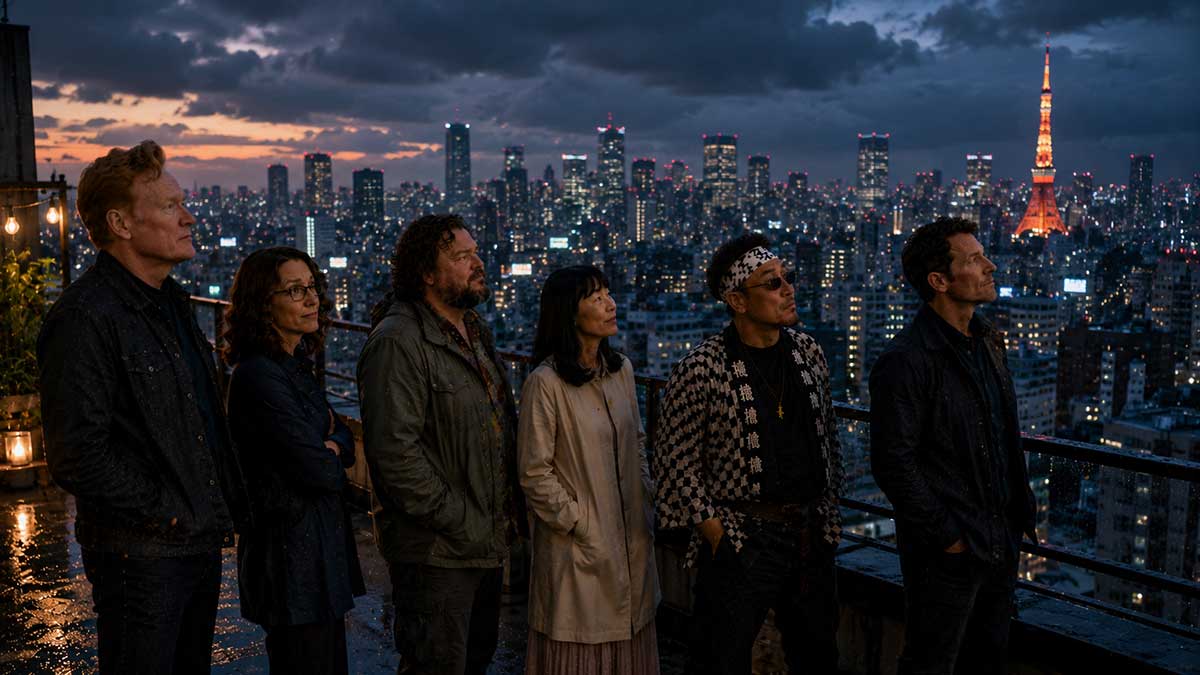
SCENE 4 — “THE ROOFTOP”
By evening they stood on a quiet rooftop overlooking Tokyo one final time.
Clouds drifted slowly above endless buildings stretching toward the horizon while trains moved like glowing threads through the city below.
The rain had stopped.
For the first time in days, the sky opened slightly.
The air smelled of:
- wet asphalt
- cooling summer air
- distant restaurant smoke
- the city itself
Nobody spoke immediately.
Conan leaned against the railing.
“When I first came here…”
He looked across Tokyo.
“I thought Japan was about efficiency.”
Chris smiled faintly.
“Most foreigners do.”
Marie Kondo folded her hands gently.
“But Japan is also about care.”
Tina nodded slowly.
“Care for details. Care for strangers. Care for atmosphere. Care for not burdening people.”
Jack Black looked out toward the endless skyline.
“And also emotional damage hidden beneath unbelievable customer service.”
Everyone laughed quietly.
Even Chris.
Then they all noticed something strange.
Ken Shimura was unusually silent.
He stood near the edge of the rooftop watching Tokyo carefully.
For several long seconds nobody interrupted him.
Finally Conan walked beside him.
“What are you thinking?”
Shimura looked out over the city.
Then answered softly:
“Japan always looks strongest at night.”
No joke followed.
And somehow…
that was the funniest and saddest thing he had said the entire trip.
SCENE 5 — “THE LAST CONVENIENCE STORE”
Near midnight they stopped one last time beneath the familiar glow of a convenience store.
Automatic doors opened.
Warm air spilled outward.
The same cheerful music played again.
The smell hit instantly:
- fried chicken
- coffee
- sweet bread
- instant noodles
- rainwater drying from jackets
Everything felt strangely emotional now.
Conan stood beside the drink refrigerator quietly.
“This may sound ridiculous…”
Tina looked at him.
“But I think I’m going to miss Japanese convenience stores more than some relatives.”
Chris laughed softly.
“You’re not the first person to say that.”
Marie Kondo selected small desserts carefully for tomorrow’s flight.
“In Japan, consistency itself can become comforting.”
Jack Black carried enough snacks to survive a natural disaster again.
Meanwhile, the elderly cashier from the previous night recognized Ken Shimura immediately.
Her entire face lit up.
She handed him another croquette before he even reached the counter.
Shimura bowed deeply again.
This time the cashier bowed even deeper back.
Outside, Tokyo glowed softly beneath damp streets and endless windows stretching upward into darkness.
Conan looked back one final time through the convenience store glass.
And finally understood:
Japan wasn’t trying to impress anyone.
It was simply trying very hard not to let people feel alone.
DAY 21 — THE DEPARTURE
Main Cast
- Conan O'Brien
- Tina Fey
- Jack Black
- Ken Shimura
- Marie Kondo
Final Guide
- Chris Broad
SCENE 1 — “THE LAST TRAIN TO THE AIRPORT”
Morning rain covered Tokyo one final time.
The airport train moved quietly through endless neighborhoods:
- apartment balconies
- narrow streets
- vending machines glowing beneath gray sky
- convenience stores opening for another ordinary day
Everything continued exactly as before.
The train smelled faintly of:
- coffee
- rain-soaked coats
- breakfast sandwiches
- warm train upholstery
Nobody talked much at first.
Conan stared out the window.
“I thought leaving Japan would feel dramatic.”
Tina looked at the passing city.
“But instead it feels like leaving someone who quietly understood you.”
Chris Broad smiled faintly from across the aisle.
“That’s a very common reaction.”
Marie Kondo folded her hands gently over her bag.
“In Japan, attachment often forms slowly and indirectly.”
Jack Black held a convenience store egg sandwich with almost spiritual reverence.
“I am not emotionally prepared to lose this sandwich technology.”
Meanwhile, Ken Shimura had fallen asleep again.
This time wearing a neck pillow backward.
A nearby businessman noticed.
Then silently rotated his own neck pillow backward too.
Conan stared at the man.
“It’s spreading.”
SCENE 2 — “THE AIRPORT”
Narita Airport felt strangely calm.
Travelers moved quietly beneath high ceilings while rolling suitcases echoed softly across polished floors reflecting pale morning light.
The familiar airport music sounded almost comforting now.
The air smelled of:
- coffee
- perfume
- bakery bread
- clean air conditioning
- rain carried inside automatically opening doors
Conan looked around slowly.
“The first day this place felt alien.”
Chris nodded.
“And now?”
Conan thought carefully.
“Now it feels… organized enough to trust.”
Marie Kondo smiled softly.
“Japan often expresses care through systems.”
Tina watched airport employees bow gently toward passengers.
“This country somehow made logistics feel emotional.”
Jack Black was buying dangerous quantities of airport snacks again.
Of course.
Meanwhile, Ken Shimura had somehow become involved in helping a confused American tourist operate a luggage scale despite speaking almost no English.
Within minutes:
- the tourist was laughing
- nearby staff were laughing
- even the luggage scale seemed emotionally lighter somehow
Conan watched quietly.
“He doesn’t solve confusion.”
He smiled faintly.
“He makes confusion less lonely.”
SCENE 3 — “THE WINDOW OVER THE RUNWAY”
Rain streaked slowly across the giant airport windows.
Airplanes moved carefully through the gray morning while passengers sat quietly beside charging stations, coffee cups, and half-finished conversations.
The runway lights blurred softly through the weather.
The lounge smelled of:
- coffee
- rain
- airport curry
- electronic warmth from charging devices
Nobody seemed eager to leave yet.
Chris looked out at the planes.
“One thing long Japan trips often change is pacing.”
Tina nodded slowly.
“I think America trained us to move aggressively through life.”
Marie Kondo folded a small paper receipt carefully before putting it into her notebook.
“In Japan, attention itself can become a form of gratitude.”
Jack Black stared toward the rain outside.
“This country made me notice tiny things again.”
Conan smiled quietly.
“Like what?”
Jack thought for a moment.
“Warm canned coffee.”
“Train sounds.”
“Convenience stores at 2 A.M.”
“People trying not to burden strangers.”
Nobody joked after that.
Then suddenly from behind them came dramatic shouting.
Ken Shimura had discovered the moving walkway and was pretending it was an Olympic event.
Several exhausted travelers started laughing immediately.
Even airport staff were trying not to smile.
Conan shook his head affectionately.
“He refuses to let sadness become self-important.”
SCENE 4 — “BOARDING”
The boarding announcement arrived softly.
Nobody rushed.
Lines formed naturally with almost unsettling efficiency while rain continued tapping against the runway outside.
The moment suddenly felt real.
Conan looked back once toward the terminal windows.
Tokyo was somewhere beyond the clouds now.
Invisible.
Still awake.
Chris stood near the gate quietly.
“You know,” he said softly, “many people come to Japan expecting futuristic spectacle.”
He smiled slightly.
“But usually what stays with them is ordinary kindness.”
Marie Kondo bowed gently.
“In Japan, care is often shown through small repeated actions.”
Tina looked around the boarding line.
“I think that’s why this place lingers emotionally.”
Jack Black adjusted the ridiculous amount of snacks inside his backpack.
“I came here expecting entertainment.”
He looked toward the gate.
“I think I accidentally learned tenderness.”
Nobody laughed.
For once…
even Ken Shimura became still.
Then just before boarding, he suddenly reached into his coat pocket and handed Conan a tiny object.
The little toy robot from Odaiba.
Conan stared at it quietly.
Shimura shrugged.
“For remembering.”
No joke.
No performance.
Just that.
And somehow…
that hit harder than anything else.
SCENE 5 — “THE SKY ABOVE JAPAN”
The airplane finally rose through clouds above Japan.
Tokyo disappeared beneath white sky while sunlight slowly broke across the horizon, turning the clouds gold above the endless Pacific.
Inside the cabin most passengers slept quietly beneath dim lights.
The air smelled faintly of:
- coffee
- recycled air
- blankets
- distant airplane meals
Conan held the tiny robot in his hand while staring out the window.
For a long time nobody spoke.
Then Tina finally broke the silence.
“So…”
She looked around the cabin.
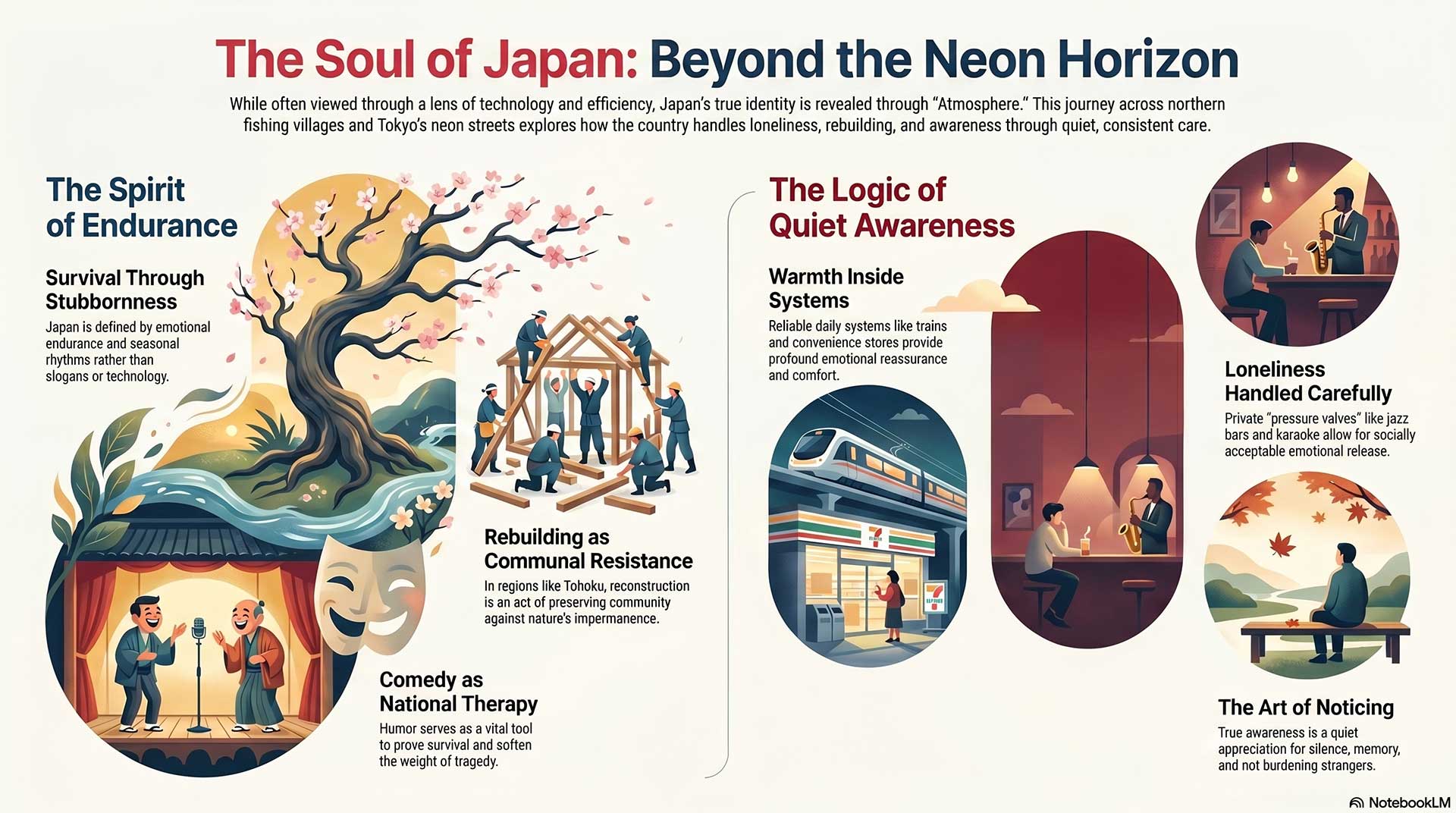
“What was Japan actually about?”
Nobody answered immediately.
Finally Marie Kondo spoke softly.
“Awareness.”
Chris nodded slightly.
“Endurance.”
Jack Black smiled faintly.
“Warmth hidden inside systems.”
Conan looked out toward the clouds.
“Loneliness handled carefully.”
Then everyone looked toward Ken Shimura.
He thought seriously for perhaps the first time in the entire trip.
Outside the airplane window, morning sunlight spread slowly across the clouds.
Finally Shimura nodded once and said:
“Free croquettes.”
The entire row collapsed laughing.
And somewhere above the Pacific Ocean…
Japan followed them home.
Final Thoughts by Conan O’Brien
On the last morning, Japan looked softer.
Maybe it was the sunrise through the airplane window.
Maybe exhaustion.
Or maybe Japan changes you slowly enough that you only notice at the end.
When I first arrived, I thought Japan was about:
- efficiency
- weirdness
- technology
- politeness
But after three weeks, I think Japan is actually about awareness.
Awareness of:
- other people
- silence
- seasons
- memory
- loneliness
- beauty that disappears quickly
America often teaches you to express yourself loudly.
Japan teaches you to notice things quietly.
And somewhere over the Pacific Ocean, holding a tiny toy robot I bought from a vending machine at 1:30 in the morning for reasons I still cannot explain, I realized something:
I wasn’t leaving Japan with answers.
I was leaving with feelings.
And honestly, those tend to last longer.
Short Bios:
Conan O’Brien — The emotionally overwhelmed American comedian who slowly discovers Japan may understand loneliness, beauty, and human connection better than he expected.
Tina Fey — The sharp observer who notices the emotional contradictions hidden beneath Japan’s politeness and order.
Jack Black — The loudhearted traveler experiencing spiritual awakening through ramen, fishing towns, jazz bars, and convenience store snacks.
Ken Shimura — The legendary Japanese comedian proving humor can survive sadness, silence, snowstorms, awkwardness, and even abandoned towns.
Marie Kondo — The calm emotional interpreter helping the group understand how Japan communicates through atmosphere instead of explanation.
John Daub — The guide uncovering northern Japan’s forgotten coastlines, disappearing towns, and hidden resilience.
Chris Broad — The grounded cultural translator helping explain modern Japan’s strange mix of futurism, nostalgia, loneliness, and warmth.
Leave a Reply