
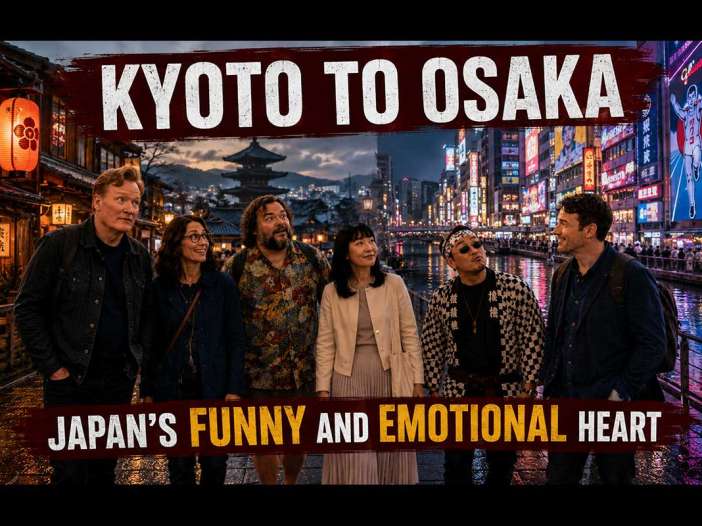
Main Introduction by Conan O’Brien
Week one felt like Japan introducing itself carefully.
Week two felt like Japan inviting us deeper inside.
Tokyo was speed, systems, and stimulation.
But Kyoto, Osaka, rural towns, hidden train stations, old candy shops, fishing villages, and onsen towns revealed something else entirely:
a country quietly carrying memory everywhere.
Some places felt ancient.
Some felt abandoned.
Some felt lonely in ways that were hard to explain.
And somehow, in the middle of all this emotional reflection, Ken Shimura kept turning random strangers into lifelong friends using nothing but terrible dancing and dangerous levels of confidence.
I began this trip trying to understand Japan intellectually.
That plan completely collapsed somewhere around a snow-covered vending machine.
(Note: This is an imaginary conversation, a creative exploration of an idea, and not a real speech or event.)
DAY 8 — THE CITY OF HIDDEN RULES
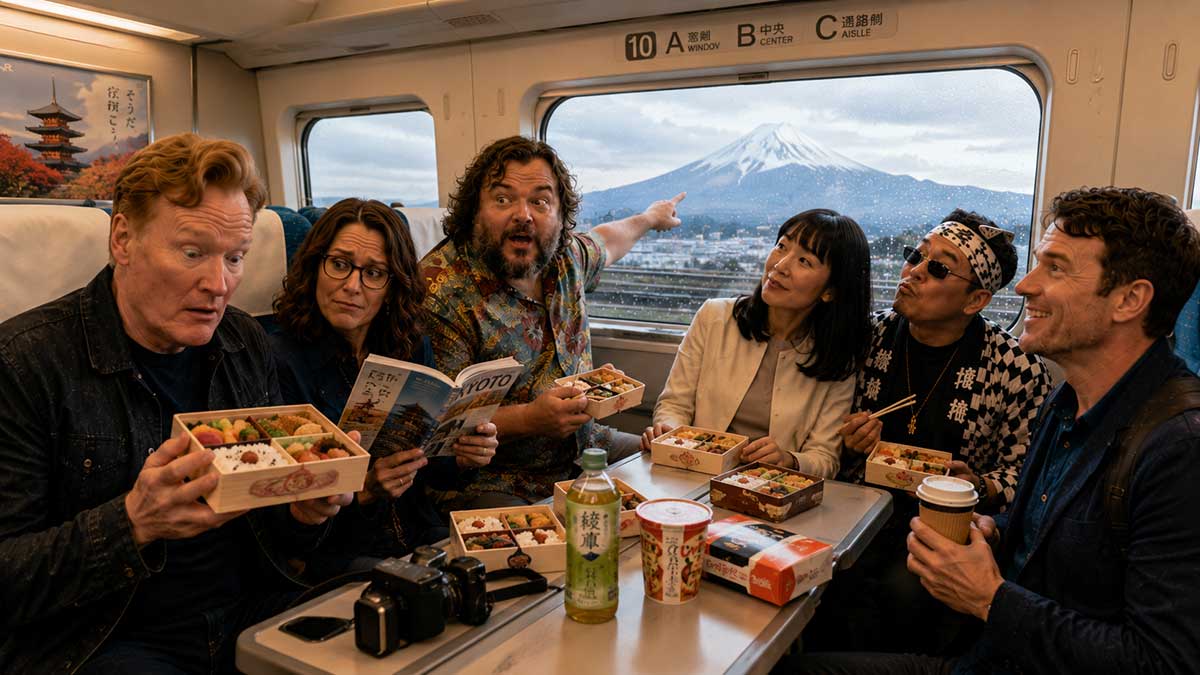
Main Cast
- Conan O'Brien
- Tina Fey
- Jack Black
- Ken Shimura
- Marie Kondo
Kyoto Guide
- Peter Barakan
SCENE 1 — “THE BAMBOO FOREST”
The bamboo moved before the wind arrived.
Tall green stalks swayed softly above the narrow path in Arashiyama while pale morning light filtered downward in shifting patterns across damp stone and moss.
The sound was unlike ordinary trees.
Not rustling.
Whispering.
The air smelled of:
- wet earth
- bamboo
- rain lingering in leaves
- distant river water
Even tourists unconsciously lowered their voices.
Peter Barakan walked slowly beneath the towering grove.
“The Japanese government once listed the sound of this bamboo forest among the country’s protected soundscapes.”
Conan looked upward.
“This forest has better acoustics than most theaters.”
Marie Kondo closed her eyes briefly, listening.
“In Japan, natural sounds are often treated as part of emotional atmosphere.”
Jack Black spread his arms dramatically.
“I want this sound playing during all future panic attacks.”
Tina looked around at the perfectly framed pathways.
“This place feels suspiciously cinematic.”
Peter smiled.
“Kyoto has influenced visual storytelling for generations — films, anime, paintings, even video games.”
Meanwhile, Ken Shimura had found a fallen bamboo stick and was pretending to duel invisible samurai tourists.
An elderly monk walking past watched him carefully.
Then nodded with complete seriousness as if approving ancient warrior technique.
Conan stared in disbelief.
“Japan keeps rewarding him.”
SCENE 2 — “THE MONKEY MOUNTAIN”
The climb to the monkey park was steeper than expected.
Kyoto spread below them through breaks in the trees:
- temple rooftops
- distant mountains
- rivers cutting through the city
- layers of gray clouds drifting overhead
The air grew cooler higher up the mountain.
Sweat mixed with smells of forest soil, cedar bark, and humid summer leaves.
Jack Black stopped halfway up the trail breathing heavily.
“These monkeys better possess spiritual wisdom.”
Peter laughed softly.
“Japanese macaques adapted remarkably well to human environments. In Japanese folklore, monkeys were often seen as mediators between mountains and people.”
At the summit, wild monkeys wandered freely across the overlook.
Conan immediately became nervous.
“I don’t trust anything with human hands.”
Tina pointed toward a warning sign.
“Do not stare directly into monkey eyes. Good. Finally, social rules I already understand.”
Marie Kondo carefully offered food through the feeding room window.
One monkey accepted it gently.
Another monkey immediately stole food from Jack Black with astonishing precision.
Jack gasped dramatically.
“He robbed me with confidence.”
Ken Shimura responded by challenging the monkey to a silent staring contest.
The monkey won immediately.
Even Peter Barakan laughed hard enough to lose composure for several seconds.
SCENE 3 — “THE TEA CEREMONY”
The tea room felt impossibly still.
Tatami mats softened every footstep. Light filtered gently through paper screens while steam rose quietly from an iron kettle resting above charcoal heat.
The room smelled of:
- matcha
- tatami straw
- cedar wood
- incense
- warm paper
Every movement inside seemed deliberate.
Measured.
Precise.
The tea master bowed softly before beginning.
Peter lowered his voice instinctively.
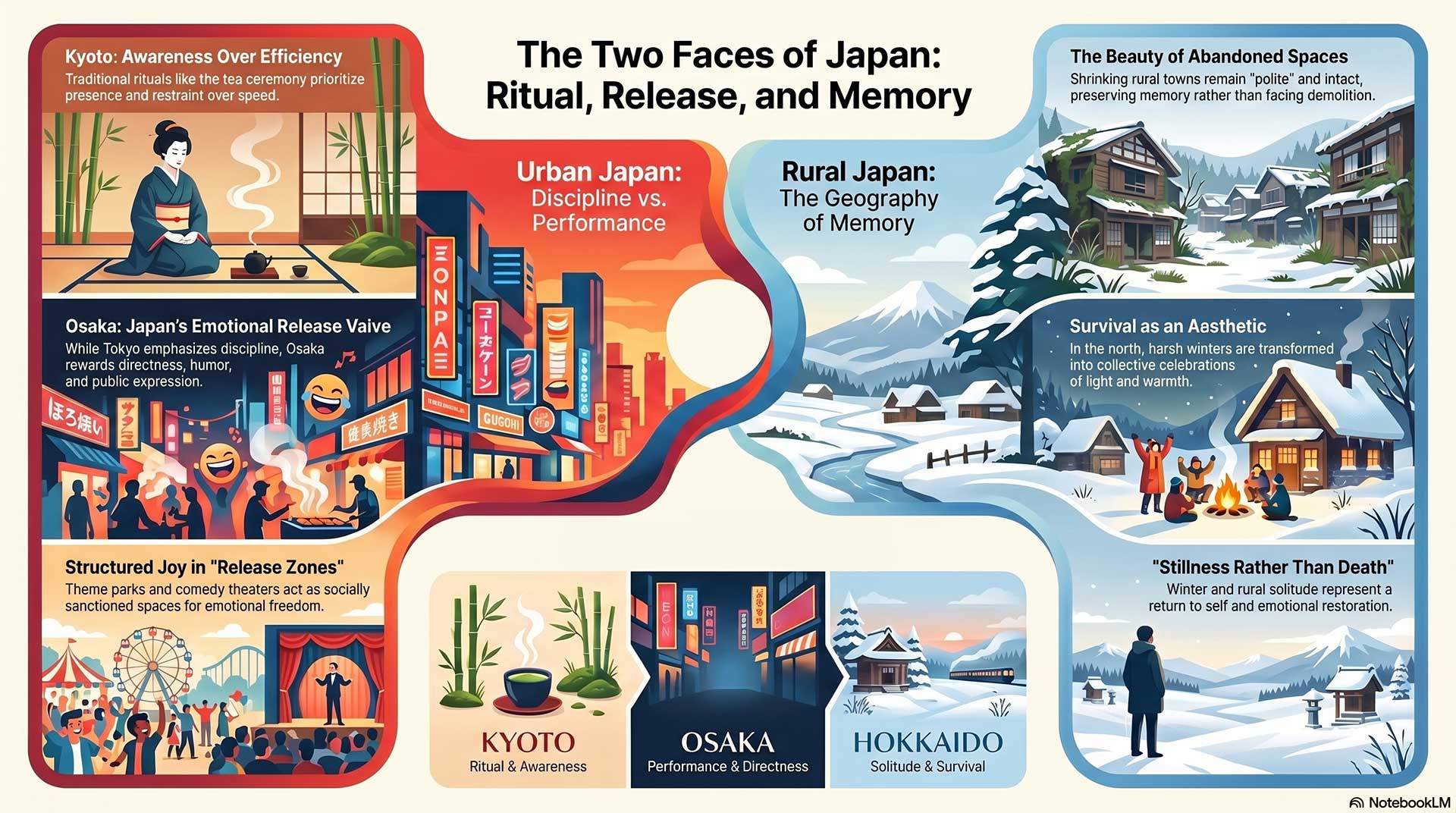
“The tea ceremony was deeply influenced by Zen Buddhism. The goal is not efficiency but awareness.”
Conan immediately looked terrified.
“I am catastrophically unqualified for awareness.”
Marie Kondo accepted her tea bowl gracefully.
“In Japan, beauty is often found through restraint and repetition.”
Tina watched the tea master’s hands carefully.
“This entire ceremony feels like anxiety transformed into elegance.”
Jack Black tried kneeling properly for thirty seconds before both knees audibly surrendered.
The sound echoed through the silent room like distant gunfire.
Conan closed his eyes.
“We’ve dishonored centuries.”
Then came the drinking ritual.
Ken Shimura intentionally demonstrated fake etiquette to Conan again:
- rotate bowl five times
- bow toward ceiling
- whisper respectfully to tea leaves
Tina pointed immediately.
“No. No, absolutely not.”
Conan hesitated anyway.
The tea master watched silently.
Then unexpectedly smiled.
Even Peter looked surprised.
“Tea ceremony masters usually don’t react much.”
Shimura bowed proudly.
“Ancient technique.”
SCENE 4 — “THE PHILOSOPHER’S PATH”
The Philosopher’s Path curved quietly beside a narrow canal lined with trees bending gently over the water.
Rain began again in soft drifting waves.
The sound of water moving beside stone pathways mixed with distant bicycle bells and occasional temple bells echoing somewhere deeper in the city.
The air smelled of:
- rain
- moss
- wet leaves
- river water
- incense drifting from nearby temples
Peter walked slowly beneath his umbrella.
“The path was named after philosopher Nishida Kitarō, who reportedly walked here daily while thinking.”
Conan looked around.
“America names roads after presidents. Japan names walking paths after introspection.”
Marie Kondo smiled softly.
“There is respect here for quiet thought.”
Tina watched rain ripple across the canal.
“This city feels like it was specifically engineered to trigger unresolved emotions.”
Nobody argued with that.
Jack Black unexpectedly grew serious.
“I think Kyoto makes people notice time differently.”
Peter nodded immediately.
“Yes. Kyoto reminds people that things disappear.”
For several moments nobody joked.
Then Ken Shimura suddenly attempted to skip dramatically across stepping stones beside the canal and nearly fell directly into the water.
A passing schoolboy laughed so hard he had to stop walking.
Conan pointed at Shimura triumphantly.
“He sacrifices dignity so strangers may experience joy.”
SCENE 5 — “THE DINNER WITHOUT WORDS”
Dinner arrived one small plate at a time.
Kaiseki cuisine looked less like food and more like edible seasons arranged carefully across lacquer trays and ceramic bowls.
Tiny portions carried astonishing detail:
- grilled river fish
- mountain vegetables
- delicate tofu
- translucent sashimi
- flowers placed intentionally beside dishes
The room glowed beneath warm lantern light.
Outside, rain tapped softly against the garden stones.
The air smelled of:
- charcoal
- soy glaze
- steamed rice
- cedar
- tea
Peter looked carefully at the meal.
“Kaiseki emphasizes seasonality, balance, and progression. The experience matters as much as flavor.”
Conan examined a tiny leaf placed carefully beside one dish.
“In America this garnish would already be suing somebody.”
Marie Kondo smiled quietly.
“In Japanese aesthetics, small details are often treated seriously because they shape emotional atmosphere.”
Jack Black ate slowly for once.
“This meal feels… respectful.”
Tina nodded.
“Kyoto somehow turned dinner into philosophy.”
Then everyone noticed Ken Shimura staring intensely at one tiny decorative leaf beside his plate.
Slowly…
carefully…
he ate it.
The waitress gasped softly.
Peter burst into uncontrollable laughter for the first time all week.
Conan stared at Shimura in disbelief.
“You ate the decoration.”
Shimura nodded proudly.
“No wasted beauty.”
And somehow…
that also sounded strangely wise.
DAY 9 — OSAKA: THE CITY THAT SAYS WHAT TOKYO IS THINKING
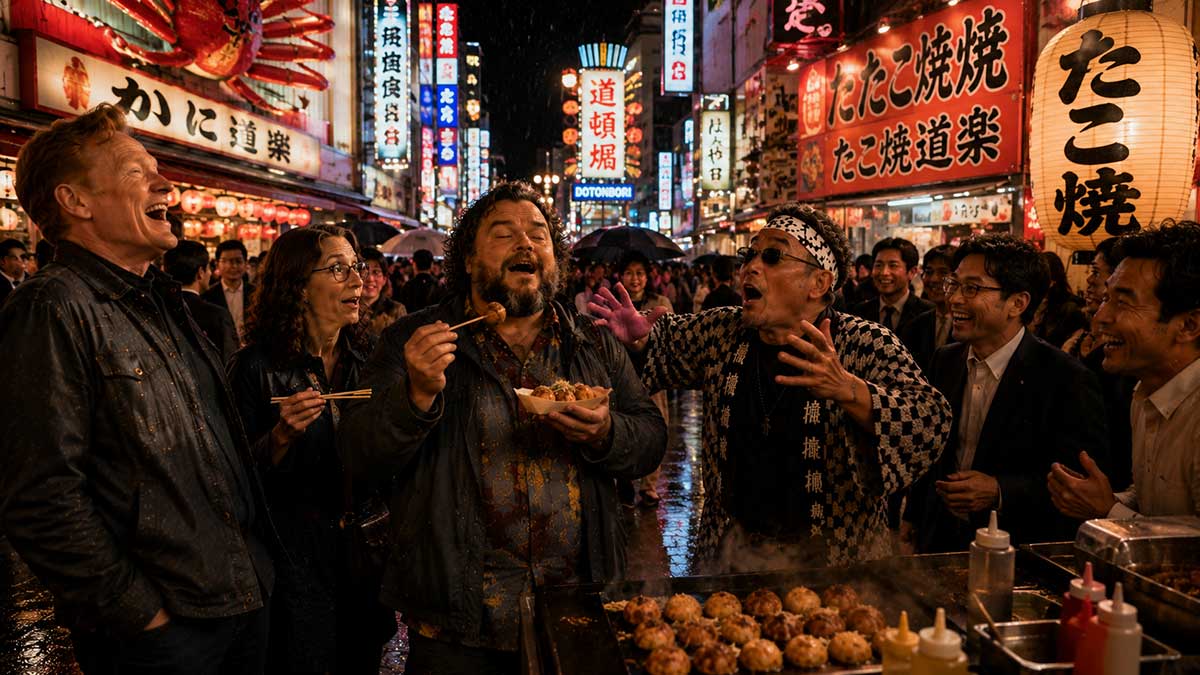
Main Cast
- Conan O'Brien
- Tina Fey
- Jack Black
- Ken Shimura
- Marie Kondo
Osaka Guide
- John Daub
SCENE 1 — “THE ARRIVAL IN OSAKA”
Osaka did not enter quietly.
The city hit them immediately:
- giant moving crab signs
- neon everywhere
- shouting vendors
- sizzling grills
- laughter spilling from alleyways before noon
Even the air felt louder.
The smell of:
- takoyaki batter
- grilled meat
- frying oil
- sweet sauce
- cigarette smoke
hung above the streets like edible weather.
Conan stopped beneath the giant Glico sign and looked around cautiously.
“Tokyo was emotionally suppressing itself. Osaka feels like it already had three drinks.”
John Daub laughed immediately.
“People often joke that Tokyo is where Japan works, but Osaka is where Japan relaxes.”
Tina pointed toward two strangers loudly arguing and laughing at the same time.
“That’s the first public human emotion I’ve seen in nine days.”
Marie Kondo smiled softly.
“Osaka people are often considered warmer and more direct.”
Jack Black spread his arms dramatically.
“I HAVE FOUND MY PEOPLE.”
Meanwhile, Ken Shimura had already started fake-selling invisible takoyaki to confused tourists.
Shockingly, several people played along immediately.
Conan stared.
“This city rewards bad behavior instantly.”
SCENE 2 — “THE TAKOYAKI STREET”
Steam rose from takoyaki grills lining the crowded street.
Vendors flipped octopus-filled batter balls with impossible speed while customers crowded shoulder-to-shoulder beneath glowing signs and hanging lanterns.
Oil crackled constantly.
Sauce brushed across hot takoyaki released smells of:
- bonito flakes
- mayonnaise
- grilled octopus
- soy glaze
- smoke drifting upward into humid air
John Daub pointed toward the crowd.
“Osaka is often called ‘Japan’s kitchen.’ Historically it became a merchant city where food culture developed very aggressively.”
Jack Black bit into fresh takoyaki immediately.
Instant regret.
The inside was lava.
He made a sound Conan later described as:
“a walrus discovering betrayal.”
Tina nodded calmly.
“Every tourist in Japan burns their mouth on takoyaki. It’s basically immigration.”
Marie carefully waited before eating hers.
“In Japan,” she said softly, “patience is often rewarded.”
Conan blew cautiously on one.
“I appreciate a country willing to weaponize snacks.”
Meanwhile, Ken Shimura pretended his takoyaki was alive and escaping from chopsticks.
Nearby office workers burst into open laughter without even trying to hide it.
John looked impressed.
“Osaka comedy culture is deeply tied to everyday interaction. People here often joke naturally with strangers.”
Conan watched the crowd.
“So Tokyo tries not to inconvenience strangers…”
John nodded.
“Osaka tries to entertain them.”
SCENE 3 — “THE RETRO ARCADE”
The arcade smelled like warm circuitry and forgotten decades.
Old fighting games blinked beneath dim lights while cigarette smoke drifted lazily through the second floor. The sounds of:
- button mashing
- coin drops
- retro game music
- victory alarms
echoed through narrow rooms filled with machines older than some customers.
John pointed toward rows of vintage cabinets.
“Japan preserved arcade culture longer than many countries because homes remained smaller and public entertainment spaces stayed important.”
Conan touched an old fighting game cabinet reverently.
“This machine looks like it witnessed the fall of empires.”
Jack Black immediately challenged local teenagers to rhythm games and lost catastrophically within seconds.
Tina watched his defeat calmly.
“You moved like a raccoon fighting electricity.”
Marie Kondo quietly became unexpectedly skilled at puzzle games.
Everyone stared.
Conan blinked.
“You’ve been hiding this.”
Marie smiled politely.
“In Japan, many people enjoy games privately.”
Meanwhile, Ken Shimura sat beside an elderly man at a racing game cabinet.
Without exchanging more than two understandable words, both men suddenly began pretending to drive with exaggerated terror through invisible traffic.
The entire arcade started laughing.
John shook his head in amazement.
“He communicates like old Osaka television.”
SCENE 4 — “THE COMEDY THEATER”
The comedy theater smelled of beer, old velvet seats, sweat, and anticipation.
Posters covered the walls featuring decades of comedians frozen mid-reaction. Inside, audiences laughed loudly without restraint — something Conan still wasn’t emotionally prepared for in Japan.
John leaned toward the group.
“Osaka is strongly associated with manzai comedy — fast back-and-forth routines between a fool and a straight man.”
Tina immediately pointed at Conan and Shimura.
“Oh my God. We accidentally assembled a trans-Pacific manzai act.”
Conan looked horrified.
“I refuse to become internationally categorized.”
Onstage, comedians screamed, argued, exaggerated reactions, and insulted one another with machine-gun timing.
The audience loved every second.
Marie Kondo laughed harder than anyone expected.
Jack Black watched with fascination.
“This feels closer to vaudeville than modern stand-up.”
John nodded.
“Japanese comedy evolved differently partly because harmony mattered socially. Physical exaggeration and role-based humor became safer than direct confrontation.”
Conan glanced at Shimura beside him.
“That explains… literally everything about this man.”
Then the host unexpectedly invited audience volunteers onto the stage.
Before anyone could react, Ken Shimura had already accepted.
The crowd exploded immediately.
Even younger audience members recognized him instantly.
For ten glorious minutes:
- Conan suffered publicly
- Tina laughed until crying
- Jack Black joined a fake samurai duel
- Shimura controlled the room effortlessly
When they finally returned to their seats, Conan looked emotionally exhausted.
“I think I just survived cultural exchange combat.”
SCENE 5 — “DOTONBORI AFTER RAIN”
Rain fell lightly across Dotonbori after midnight.
Neon reflections rippled across the canal while giant signs glowed through drifting steam and cigarette smoke. Laughter spilled from bars into crowded streets still alive long after Tokyo might have gone quiet.
The city smelled of:
- fried food
- rainwater
- beer
- grilled meat
- humid concrete
John leaned against the railing overlooking the canal.
“One reason Osaka feels emotionally different is history. Merchant culture here rewarded openness, negotiation, personality.”
Conan watched strangers yelling happily across the street.
“So Tokyo became discipline…”
“And Osaka became performance.”
Marie Kondo smiled softly at the noise around them.
“Both are Japanese. Just different expressions.”
Tina looked toward endless neon reflections.
“Tokyo hides emotion elegantly. Osaka throws emotion directly at your face.”
Jack Black raised convenience-store beer toward the skyline dramatically.
“To cities with unhealthy levels of personality!”
Nearby strangers cheered immediately.
Then Ken Shimura climbed onto a tiny decorative ledge and began conducting imaginary orchestra music for passing pedestrians.
Instead of ignoring him…
people started bowing dramatically while walking past.
Conan watched the entire scene in disbelief.
“I finally understand Osaka.”
Tina looked at him.
“What?”
“This city would absolutely adopt a raccoon if it could cook.”
DAY 10 — THE KINGDOM OF CONTROLLED CHAOS
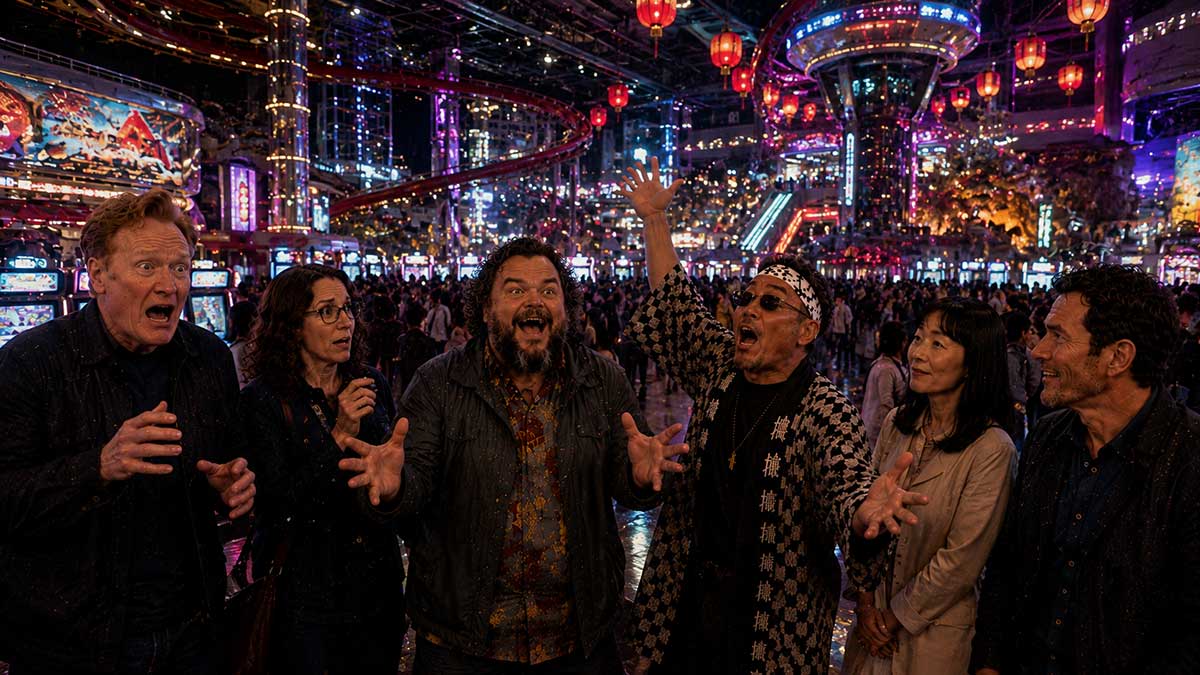
Main Cast
- Conan O'Brien
- Tina Fey
- Jack Black
- Ken Shimura
- Marie Kondo
Osaka Guide
- John Daub
SCENE 1 — “THE TRAIN TO UNIVERSAL STUDIOS”
The train to Universal Studios Japan was filled with anticipation and matching hats.
Children bounced in seats clutching popcorn buckets larger than their torsos while teenagers carried glowing character headbands like ceremonial armor.
Even the adults looked suspiciously excited.
The train smelled of:
- caramel popcorn
- coffee
- sunscreen
- perfume
- warm plastic packaging
Jack Black had already purchased a ridiculous themed hat before reaching the station.
Conan stared at it.
“You look like a wizard who lost a custody battle.”
John Daub pointed toward the crowd.
“One interesting thing about Japanese theme parks is how fully people commit emotionally. Matching outfits, themed accessories, coordinated experiences — group participation matters.”
Tina looked around the train.
“This feels less like tourism and more like organized joy.”
Marie Kondo adjusted her neatly folded park map.
“In Japan, shared experiences are often treated very carefully.”
Ken Shimura somehow appeared wearing three different souvenir hats stacked vertically on his head like unstable architecture.
Nobody questioned it.
Several children bowed respectfully at him anyway.
SCENE 2 — “THE HARRY POTTER AREA”
The moment they entered the Wizarding World, Osaka disappeared.
Snow-covered rooftops rose above narrow stone streets while orchestral music drifted through cold artificial mist. Shop windows glowed warmly beside lanterns flickering against castle walls in the distance.
The air smelled of:
- butterbeer
- roasted nuts
- caramel
- wet stone
- smoke drifting from fake chimneys
Jack Black looked genuinely emotional.
“This is what would happen if childhood won.”
John explained quietly.
“Japanese guests are known for extremely immersive park behavior. Many visitors prepare outfits and accessories weeks in advance.”
Tina pointed toward a fully grown businessman carrying a wand with complete sincerity.
“No one here is embarrassed.”
“That’s the fascinating part,” John replied. “Japan can be socially restrained in daily life, but highly expressive inside structured environments.”
Conan looked around slowly.
“So Japanese society basically creates emotional release zones.”
Marie nodded.
“Contexts matter deeply here.”
Meanwhile, Ken Shimura had acquired a wand and was pretending to duel random pigeons near the castle entrance.
A nearby employee nearly collapsed laughing.
SCENE 3 — “THE RIDE”
The roller coaster climbed slowly into gray Osaka clouds.
Below them the park stretched outward beneath flashing lights, music, and moving crowds that suddenly looked very far away.
The safety bars clicked into place.
Conan immediately regretted every decision leading to this moment.
“I’m too old to experience velocity recreationally.”
Jack Black raised both fists triumphantly.
“This is how I leave Earth.”
The ride launched.
Everything became:
- screaming
- wind
- neon blur
- stomach collapse
- existential reevaluation
Tina screamed once, then immediately sounded annoyed at herself for screaming.
Marie somehow remained composed with supernatural dignity.
John laughed uncontrollably the entire ride.
Ken Shimura, however, used the coaster to perform elaborate fake-death scenes every time the ride turned sharply.
At one point Conan became genuinely concerned he had medically expired.
When the ride finally stopped, everyone stumbled out beneath bright lights and drifting music.
John wiped tears from his eyes.
“Japanese rides often focus heavily on immersion and pacing instead of pure intensity.”
Conan grabbed the railing weakly.
“I briefly met God and he was also confused.”
SCENE 4 — “THE PARADE”
By evening, the park transformed completely.
Music thundered through the streets while glowing parade floats rolled beneath artificial fog and synchronized lights. Characters waved dramatically as crowds cheered with astonishing emotional commitment.
The smell of:
- popcorn
- fried chicken
- sweet churros
- rain beginning again
- machine smoke from parade effects
filled the air.
Children sat on parents’ shoulders holding glowing toys like tiny lanterns.
John watched the crowd carefully.
“One thing Japan does extremely well is coordinated spectacle. Festivals, sports events, parades — there’s strong cultural appreciation for synchronized shared experiences.”
Tina pointed toward rows of guests all filming simultaneously with perfect timing.
“This country could organize the apocalypse beautifully.”
Conan watched families cheering together.
“There’s something strangely comforting about how seriously Japan takes fun.”
Marie smiled softly.
“People here often work very hard. Shared joy becomes important.”
Then suddenly music shifted.
Without warning, Ken Shimura somehow joined the parade dancers for nearly thirty seconds before security realized he did not belong there.
The crowd erupted instantly.
Jack Black nearly collapsed laughing onto the pavement.
Even the security guard was laughing too hard to stay authoritative.
Conan stared in disbelief.
“This man has no natural predators.”
SCENE 5 — “THE EMPTY PARK AFTER CLOSING”
After closing time, the park became strangely peaceful.
The crowds disappeared gradually until only distant cleaning crews remained beneath glowing lights and damp pavement reflecting artificial colors into the night sky.
Music still played softly through nearly empty streets.
The air smelled faintly of:
- rainwater
- sugar
- wet concrete
- machine oil
- leftover popcorn
Conan sat quietly beside the dark canal.
For once, nobody joked immediately.
John leaned against the railing.
“Japanese entertainment culture can feel intense because daily life often demands emotional control. Places like this become temporary permission to feel openly.”
Tina looked back toward the now-empty castle.
“So the fantasy isn’t really about magic.”
John nodded.
“It’s about emotional freedom.”
Marie Kondo watched workers quietly cleaning the empty streets.
“In Japan, endings are often treated carefully too.”
Jack Black looked unexpectedly thoughtful.
“I think this country understands exhaustion better than most places.”
Nobody answered for a while.
Then, somewhere behind them, tiny parade music suddenly restarted.
Everyone turned.
Ken Shimura was riding slowly through the empty street alone inside a children’s electric cart wearing wizard robes and waving majestically at absolutely nobody.
Conan closed his eyes.
“Of course he survived the kingdom.”
And beneath the fading lights of Osaka, somehow the absurdity no longer interrupted the beauty.
It completed it.
DAY 11 — THE COUNTRYSIDE THAT JAPAN LEFT BEHIND
Main Cast
- Conan O'Brien
- Tina Fey
- Jack Black
- Ken Shimura
- Marie Kondo
Rural Japan Guide
- John Daub
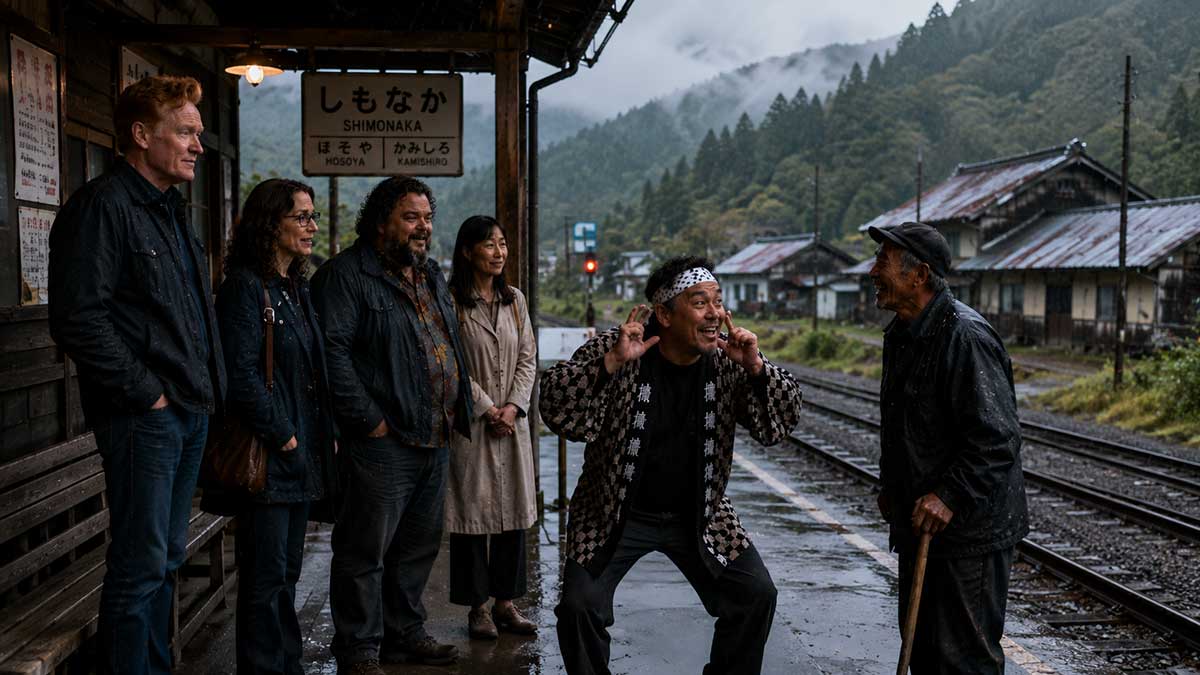
SCENE 1 — “THE LOCAL TRAIN”
The train grew quieter with every station.
Osaka’s neon disappeared gradually behind them, replaced by rice fields, narrow rivers, abandoned houses, and small towns resting beneath low gray clouds.
The train itself felt older too.
Softer seats.
Faded advertisements.
Windows that rattled gently against the rain.
The air smelled faintly of:
- wet fabric
- earth
- canned coffee
- old metal
- rain drifting through station doors
An elderly woman boarded carrying vegetables wrapped carefully in newspaper.
Nobody looked at phones much anymore.
Conan stared out the window.
“This feels like Japan after everyone went home.”
John Daub nodded quietly.
“Many rural towns here are shrinking rapidly. Younger people move to cities for work, leaving older generations behind.”
Marie Kondo watched empty houses pass beside overgrown gardens.
“In Japan, abandoned places often remain untouched for a long time.”
Tina folded her arms thoughtfully.
“In America abandoned towns feel angry. Here they feel… quiet.”
Jack Black looked out at endless rice fields.
“I think this train is lowering my blood pressure.”
Then Ken Shimura somehow made friends with the elderly woman using only exaggerated facial expressions and dramatic vegetable admiration.
Five minutes later she handed him a cucumber.
Conan pointed immediately.
“He’s collecting grandmothers across Japan.”
SCENE 2 — “THE UNMANNED STATION”
The station had no staff.
Just one platform.
One bench.
One faded timetable fluttering slightly in the wind.
Rain tapped softly against the roof while mountains disappeared behind drifting mist beyond the tracks.
The station smelled of:
- wet wood
- moss
- cold air
- old rainwater trapped inside concrete
Conan stepped onto the empty platform slowly.
“This feels like the beginning of either healing or a horror film.”
John laughed quietly.
“Thousands of small stations across Japan became unmanned over time as populations declined.”
Tina looked around at the silence.
“No advertisements. No noise. No rush.”
Marie Kondo sat briefly on the wooden bench.
“There’s a kind of loneliness here that feels very gentle.”
Jack Black found a tiny local vending machine standing alone beside the road.
Of course he did.
“This machine stayed loyal to the community.”
Meanwhile, Ken Shimura dramatically pretended the train had abandoned him forever and began delivering an emotional farewell speech to absolutely nobody.
A passing farmer slowed his truck just long enough to laugh openly before driving away into the rain.
Conan shook his head.
“This country keeps producing side characters more charming than main characters.”
SCENE 3 — “THE OLD SWEET SHOP”
The candy shop looked frozen in another decade.
Glass jars lined wooden shelves beneath faded handwritten signs while old fans turned lazily overhead. Tiny candies, rice crackers, chocolates, and nostalgic snacks filled the room with smells of sugar, soy sauce, paper packaging, and old wood.
A tiny television played quietly in the corner.
The owner looked at least ninety years old.
John smiled warmly.
“Dagashi shops like this used to exist everywhere in Japan. Many are disappearing now.”
Conan picked up candy shaped like tiny cola bottles.
“This feels less like shopping and more like archaeology.”
Marie Kondo carefully examined handmade packaging.
“In Japan, nostalgia is often preserved physically.”
Tina looked around the dim little store.
“You can feel time inside this room.”
Jack Black immediately bought:
- thirty-seven candies
- a toy whistle
- mystery gum
- something shaped like squid
The old shopkeeper laughed softly watching him.
Meanwhile, Ken Shimura somehow discovered old kendama toys near the register.
Five minutes later:
- children gathered outside the shop
- Shimura was performing tricks
- the old owner was crying laughing
Conan leaned toward Tina.
“He’s basically reconnecting rural Japan to itself.”
SCENE 4 — “THE ABANDONED SCHOOL”
The school stood empty beside the hillside.
Windows reflected gray sky above cracked pavement where weeds pushed through old basketball courts. Inside, dusty desks still faced blackboards covered faintly with forgotten chalk marks.
The silence felt enormous.
The building smelled of:
- dust
- rain
- old books
- wood floors
- summer humidity trapped for years
John walked carefully through the hallway.
“Some rural schools close because there simply aren’t enough children anymore.”
Conan looked at tiny shoes still lined neatly near the entrance.
“That may be the saddest thing I’ve seen in Japan.”
Marie Kondo touched the worn classroom desk gently.
“In Japan, objects often carry emotional memory.”
Tina stared toward the empty playground outside.
“You can almost hear what used to be here.”
Nobody joked for a while.
Even Jack Black became quiet.
Then somewhere down the hallway, a loud dramatic scream echoed through the building.
Everyone rushed toward the sound.
Ken Shimura stood inside the music room pretending an old mannequin had attacked him.
The mannequin wore a school uniform.
Shimura pointed accusingly at it.
Conan exhaled deeply.
“I knew emotional devastation couldn’t survive him forever.”
Even John Daub doubled over laughing against the hallway wall.
SCENE 5 — “THE ONSEN TOWN AT NIGHT”
By evening they arrived at a tiny onsen town hidden between mountains.
Lanterns reflected across wet streets while steam drifted upward from hot spring baths into cold night air. Guests walked slowly through town in yukata sandals beneath soft rain and glowing wooden signs.
The entire town smelled of:
- sulfur from hot springs
- rainwater
- cedar wood
- steamed rice
- mountain air
Conan stood beside the river watching steam rise into darkness.
“This feels like Japan remembering itself.”
John nodded softly.
“Many onsen towns became places where exhausted urban people escaped temporarily from modern life.”
Marie Kondo looked toward glowing ryokan windows.
“In Japan, bathing is often emotional restoration, not just cleanliness.”
Tina breathed deeply.
“I think this entire country was designed around recovery.”
Jack Black dipped one foot into the hot spring water and nearly transcended physically.
Then came the yukata walk through town.
Ken Shimura intentionally wore his sandals backward.
Nobody corrected him.
An elderly couple passing nearby simply laughed warmly as he shuffled dramatically through the street pretending great spiritual suffering.
Conan watched steam rising into the mountain rain.
Tokyo suddenly felt impossibly far away.
And for the first time since the trip began…
Japan no longer felt fast.
DAY 12 — THE NIGHT JAPAN DISAPPEARED INTO SNOW
Main Cast
- Conan O'Brien
- Tina Fey
- Jack Black
- Ken Shimura
- Marie Kondo
Hokkaido Guide
- John Daub
SCENE 1 — “THE FLIGHT NORTH”
The farther north they traveled, the quieter Japan became again.
Clouds stretched endlessly beneath the airplane while mountain ranges emerged occasionally through breaks in the white like sleeping giants beneath snow.
The cabin smelled faintly of:
- coffee
- cold recycled air
- instant soup
- winter jackets damp from rain
Conan looked out the window.
“Japan keeps changing genres.”
John Daub nodded.
“Hokkaido feels very different historically and culturally from the rest of Japan. Much of its development happened relatively recently compared to Kyoto or Tokyo.”
Tina watched frozen rivers winding below.
“So Tokyo feels compressed. Hokkaido feels unfinished.”
Marie Kondo folded her blanket carefully.
“There is emotional spaciousness in the north.”
Jack Black pressed against the window dramatically.
“I think we’re flying into a Studio Ghibli memory.”
Meanwhile, Ken Shimura had somehow convinced a flight attendant to let him wear an oversized emergency blanket like a royal cape.
Several nearby passengers were already laughing before landing.
SCENE 2 — “SAPPORO IN WINTER”
Snow fell softly across Sapporo.
Not aggressively.
Not dramatically.
Just endlessly.
Streetlights glowed warmly through drifting snowflakes while bundled pedestrians moved quietly between underground passages and glowing ramen shops.
The entire city felt insulated from the outside world.
The air smelled of:
- cold air
- miso ramen broth
- cigarette smoke
- snow
- grilled seafood
Conan immediately lost physical coordination walking on ice.
“I’ve become an elderly giraffe.”
John laughed.
“Hokkaido winters shaped local culture deeply. People here developed stronger indoor food culture, underground walkways, and extremely practical attitudes toward weather.”
Tina stared at snow piled taller than parked cars.
“This city didn’t defeat winter. It negotiated coexistence.”
Marie Kondo watched snow collecting silently on rooftops.
“Snow changes sound. Everything becomes softer.”
Jack Black opened his mouth dramatically trying to catch snowflakes.
A local businessman walked past and nodded approvingly as if this were spiritually normal.
Meanwhile, Ken Shimura intentionally walked like a penguin through the street until nearby schoolchildren copied him.
Soon an entire accidental penguin parade formed behind him.
Conan stared in disbelief.
“He spreads nonsense like folk tradition.”
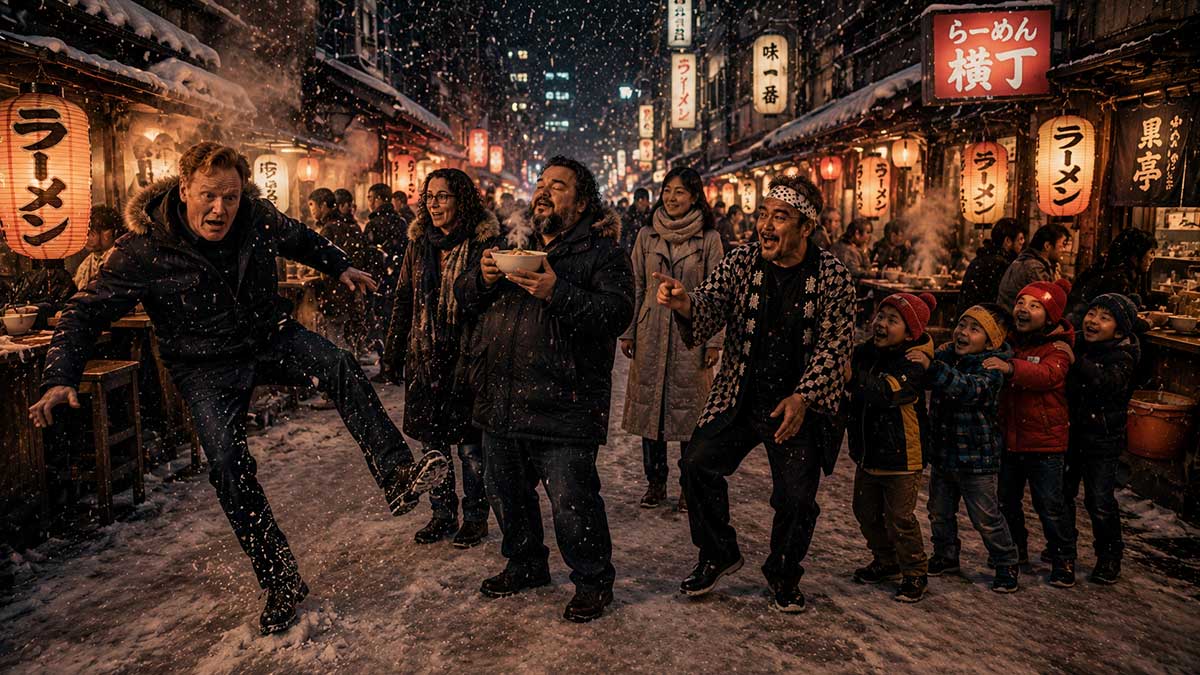
SCENE 3 — “THE RAMEN ALLEY”
The ramen alley glowed beneath steam and snow.
Tiny noodle shops lined the narrow passage while warm yellow light spilled onto icy pavement outside. Every doorway carried slightly different smells:
- butter
- garlic
- pork broth
- miso
- seafood stock
The cold air sharpened everything.
John rubbed his hands together.
“Hokkaido became famous for richer ramen styles partly because people needed heavier food during severe winters.”
Jack Black nearly cried after the first spoonful of miso ramen.
“This soup could survive wars.”
Conan watched steam rising from bowls around the crowded shop.
“I understand winter cultures now. You people invented emotional broth.”
Tina pointed toward office workers eating silently beside them.
“Cold weather creates more serious eating.”
Marie Kondo smiled softly into her tea.
“In Japan, seasonal food often reflects survival history.”
Meanwhile, Ken Shimura accidentally inhaled chili powder while attempting an overly dramatic noodle slurp.
He coughed violently for thirty straight seconds while still trying to maintain dignity.
The entire ramen shop erupted with laughter.
Even the chef had to turn around briefly to recover.
Conan nodded proudly.
“He suffers publicly so others may heal.”
SCENE 4 — “THE SNOW FESTIVAL”
The snow festival looked unreal.
Massive sculptures rose beneath colored lights:
- castles
- anime characters
- temples
- giant creatures carved entirely from snow and ice
Families walked slowly through the frozen park carrying hot drinks while snow drifted continuously beneath glowing winter lights.
The air smelled of:
- hot chocolate
- roasted corn
- snow
- butter potatoes
- cold metal
John pointed toward the sculptures.
“Hokkaido communities became highly organized around surviving winter together. Festivals like this transform harsh weather into collective celebration.”
Tina looked upward at a cathedral carved entirely from ice.
“This country turns suffering into aesthetics disturbingly well.”
Jack Black bought roasted corn larger than his forearm.
Marie Kondo quietly photographed small details instead of giant sculptures:
- lantern reflections
- footprints in snow
- steam rising from cups
Conan noticed.
“You always photograph the emotional background.”
Marie smiled softly.
“That is often where memory lives.”
Then suddenly the crowd ahead exploded laughing.
Ken Shimura had climbed onto a tiny snow hill and was pretending to conduct the falling snow like an orchestra.
Small children immediately joined him.
Within minutes dozens of strangers were waving imaginary batons beneath the snowfall.
John shook his head slowly.
“I genuinely think he could unite municipalities.”
SCENE 5 — “THE ONSEN IN THE SNOW”
That night they entered an outdoor hot spring surrounded entirely by snow.
Steam rose upward into freezing air while snowflakes drifted softly through darkness and disappeared against the surface of the water.
The contrast felt impossible:
- freezing air on the face
- burning heat beneath the water
- silence everywhere except wind through trees
The world smelled of:
- mineral water
- cedar wood
- snow
- cold mountain air
Nobody spoke for a long time.
Even Conan became still.
John finally broke the silence quietly.
“Hokkaido reminds many Japanese people of distance. Space. Solitude. Nature strong enough to ignore human schedules.”
Tina watched snow disappearing into the water.
“This may be the most peaceful thing I’ve ever experienced.”
Marie Kondo closed her eyes.
“In Japan, bathing often means returning to yourself.”
Jack Black leaned backward into the steaming water dramatically.
“If I die here… tell people I died soup-adjacent.”
Nobody laughed immediately.
Then nearby snow suddenly exploded upward.
Ken Shimura had slipped attempting to sit elegantly on a rock.
A nearby elderly man laughed so hard he slapped the water repeatedly.
Soon everyone was laughing into the steam beneath falling snow.
And surrounded by winter, silence, and ridiculous humanity…
Japan suddenly felt less like a country.
And more like a state of mind.
DAY 13 — THE SEA OF MEMORY
Main Cast
- Conan O'Brien
- Tina Fey
- Jack Black
- Ken Shimura
- Marie Kondo
Hokkaido Guide
- John Daub
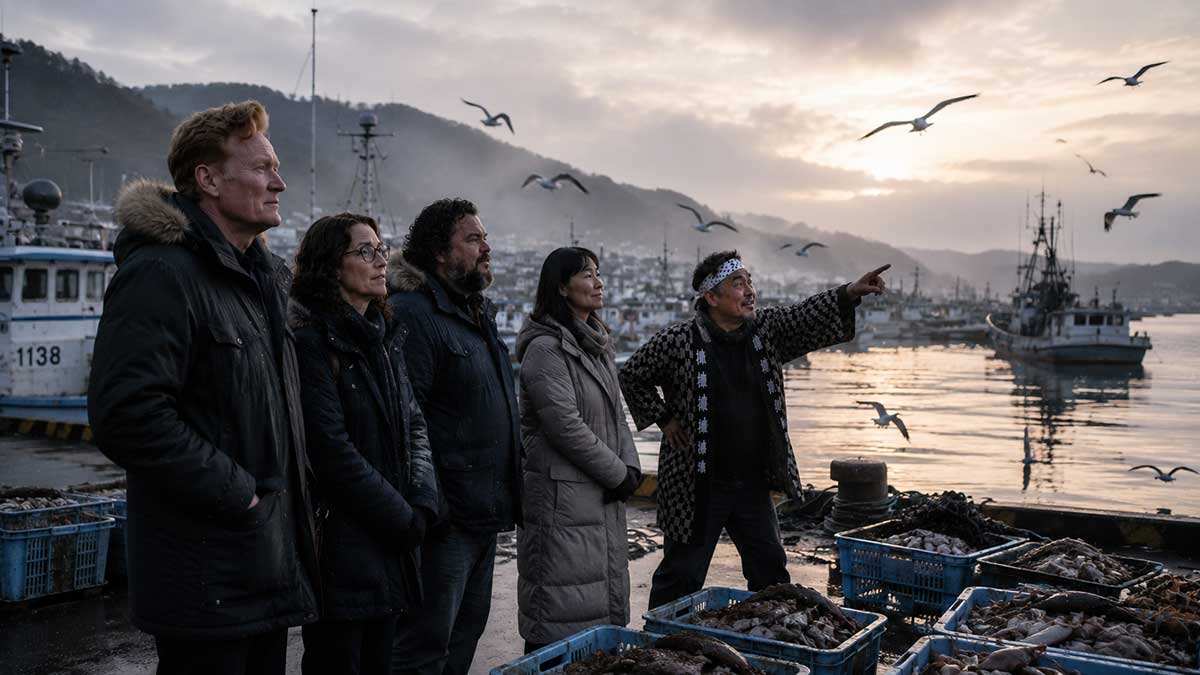
SCENE 1 — “THE FISHING PORT”
Morning arrived wrapped in gray sky and sea wind.
The fishing port looked almost monochrome:
- steel-colored water
- snow piled beside warehouses
- gulls circling above boats
- fishermen moving slowly through cold mist
Everything smelled intensely alive:
- saltwater
- diesel fuel
- fish
- seaweed
- cold iron
The wind cut through coats instantly.
Conan pulled his scarf tighter.
“This weather feels personally offended by humanity.”
John Daub watched workers unloading crates of crab and sea urchin.
“Hokkaido seafood culture became legendary partly because these waters are extremely nutrient-rich. Cold oceans create incredible fish quality.”
Jack Black stared reverently at giant crabs moving slightly inside tanks.
“These creatures look ancient and judgmental.”
Marie Kondo watched fishermen working silently together.
“In Japan, craftsmanship often includes physical endurance.”
Tina looked around the harbor.
“This place feels brutally honest.”
Nobody posed for tourists.
Nobody smiled unnecessarily.
Nobody performed hospitality.
People simply worked.
Meanwhile, Ken Shimura somehow acquired oversized rubber fishing boots and began marching dramatically across the dock pretending to captain an invisible ship through a storm.
A fisherman laughed so hard he nearly dropped a crate of squid.
Conan pointed at Shimura.
“He keeps accidentally becoming local folklore.”
SCENE 2 — “THE SEAFOOD MARKET”
The seafood market glowed with fluorescent light and steam.
Rows of tanks bubbled beside displays of:
- king crab
- scallops
- sea urchin
- salmon roe
- squid still glistening with seawater
Vendors shouted prices over the noise of water pumps and moving carts.
The market smelled overwhelmingly of:
- ocean salt
- fresh fish
- butter sizzling on grills
- charcoal smoke
- cold wet floors
John pointed toward trays of uni.
“Hokkaido sea urchin is famous partly because the cold water creates sweeter flavor and firmer texture.”
Conan stared at the bright orange sea urchin suspiciously.
“This looks like something an alien species would worship.”
Jack Black ate one immediately.
Then froze completely.
Tina looked concerned.
“Is he okay?”
Jack whispered:
“I just tasted the Pacific Ocean achieving enlightenment.”
Marie Kondo laughed softly into her tea for the first time all morning.
Meanwhile, Ken Shimura pretended a giant crab claw had grabbed his sleeve and began acting out a dramatic life-or-death battle in the middle of the market.
Tourists gathered instantly.
Even the crab vendor joined the performance.
John shook his head slowly.
“This man could survive any era of Japanese television.”
SCENE 3 — “THE AINU MUSEUM”
The museum stood quietly beside frozen trees and drifting snow.
Inside, carved wooden artifacts, woven clothing, ceremonial tools, and old photographs revealed another side of Japan most visitors rarely saw.
The building smelled faintly of:
- cedar wood
- old paper
- smoke from traditional hearth displays
- winter air carried inside by coats
John lowered his voice naturally.
“The Ainu are the indigenous people of northern Japan. For many years their culture faced suppression and forced assimilation.”
Conan walked slowly through the exhibits.
“I don’t think most foreigners even realize Japan has indigenous history.”
John nodded.
“Japan often presents itself as culturally uniform, but reality is more complicated.”
Marie Kondo paused beside traditional embroidery patterns.
“There is sadness when cultures disappear quietly.”
Tina looked at old photographs hanging beneath soft museum lighting.
“Every country edits its own memory.”
Nobody joked for a while.
Even Jack Black became reflective.
Then suddenly they heard soft flute music from another exhibit room.
They turned.
Ken Shimura had somehow joined a cultural demonstration and was attempting to play a traditional instrument with catastrophic incompetence.
The sound resembled:
- injured birds
- haunted wind
- emotional plumbing
The elderly instructor laughed so hard tears formed instantly.
Even the museum atmosphere softened.
Conan exhaled.
“He physically cannot allow historical heaviness to fully collapse a room.”
SCENE 4 — “THE SNOWY TRAIN CROSSING”
The train crossing sat alone beside an empty road buried in snow.
Telephone wires stretched across white fields disappearing into distant mountains while snow drifted sideways beneath fading afternoon light.
Then came the bell.
Soft at first.
Then louder.
A single local train passed through the storm glowing warmly against the cold landscape before disappearing again into whiteness.
The air smelled of:
- snow
- cold metal
- smoke from distant chimneys
- frozen earth
Nobody spoke immediately afterward.
John finally smiled quietly.
“Japanese cinema often uses trains emotionally. They represent distance, transition, missed connections, memory.”
Conan watched the empty tracks.
“This feels like the ending of a film where nobody properly explained their feelings.”
Tina nodded immediately.
“Which is every Japanese film.”
Marie Kondo looked toward smoke rising from a distant farmhouse.
“There is beauty in quiet movement.”
Jack Black pulled his coat tighter.
“I think winter makes people more honest.”
Then Ken Shimura suddenly attempted to recreate a dramatic movie farewell scene beside the tracks.
He waved a handkerchief emotionally into the snow despite nobody departing.
A nearby elderly couple burst into laughter inside their tiny parked truck.
Conan pointed toward them.
“See? This country survives emotionally through tiny moments like that.”
SCENE 5 — “THE NORTHERN NIGHT SKY”
That night the clouds finally cleared.
Above the frozen countryside, the stars appeared shockingly bright — sharper and colder than city skies ever allowed.
Snow reflected pale moonlight across silent fields while distant trees stood black against the horizon.
The world smelled of:
- snow
- cold air
- cedar smoke from fireplaces
- winter silence itself
Even breathing sounded loud.
John looked upward.
“One thing people forget about modern life is how rarely we experience true darkness anymore.”
Conan stood with hands in his coat pockets.
“Tokyo felt like humanity overpowering nature.”
He looked at the stars.
“This feels like nature patiently waiting.”
Marie Kondo watched snow glitter beneath moonlight.
“In Japan, winter often represents stillness rather than death.”
Tina folded her arms against the cold.
“I haven’t checked my phone in hours.”
Jack Black looked genuinely amazed by the sky.
“I forgot the universe was this large.”
For once…
even Ken Shimura became quiet.
Then after nearly thirty full seconds of silence, he slipped accidentally into deep snow and vanished almost completely.
Only one gloved hand remained visible.
Conan stared upward into the stars.
“There he is.”
Tina nodded calmly.
“Nature finally fought back.”
DAY 14 — THE TOWN WHERE TIME FROZE
Main Cast
- Conan O'Brien
- Tina Fey
- Jack Black
- Ken Shimura
- Marie Kondo
Hokkaido Guide
- John Daub
SCENE 1 — “THE ABANDONED AMUSEMENT PARK”
The amusement park appeared suddenly through the trees.
Rusting rides stood half-buried beneath snow while faded cartoon mascots stared blankly from cracked signs weathered by decades of winter storms.
The Ferris wheel no longer moved.
Neither did anything else.
Wind pushed softly through broken ticket booths carrying smells of:
- rust
- snow
- wet wood
- frozen earth
- old machinery
Conan stopped walking.
“This feels like Pixar directed by existentialism.”
John Daub nodded quietly.
“Japan has thousands of abandoned places — schools, hotels, parks, entire villages. Population decline and economic shifts left many places frozen in time.”
Marie Kondo stared at a faded children’s ride covered in snow.
“In Japan, abandoned places are often left intact instead of demolished immediately.”
Tina looked toward silent roller coaster tracks disappearing into trees.
“America abandons places angrily. Japan abandons places politely.”
Jack Black walked slowly beneath the rusted Ferris wheel.
“This place feels sad without being violent.”
No graffiti.
No smashed chaos.
Just silence.
Then suddenly dramatic screaming echoed through the empty park.
Everyone turned.
Ken Shimura had somehow activated a tiny coin-operated panda ride still barely functioning after decades.
The panda moved forward three inches.
Music from 1987 crackled weakly into the snowy air.
Conan stared at him in disbelief.
“He found the last surviving organism.”
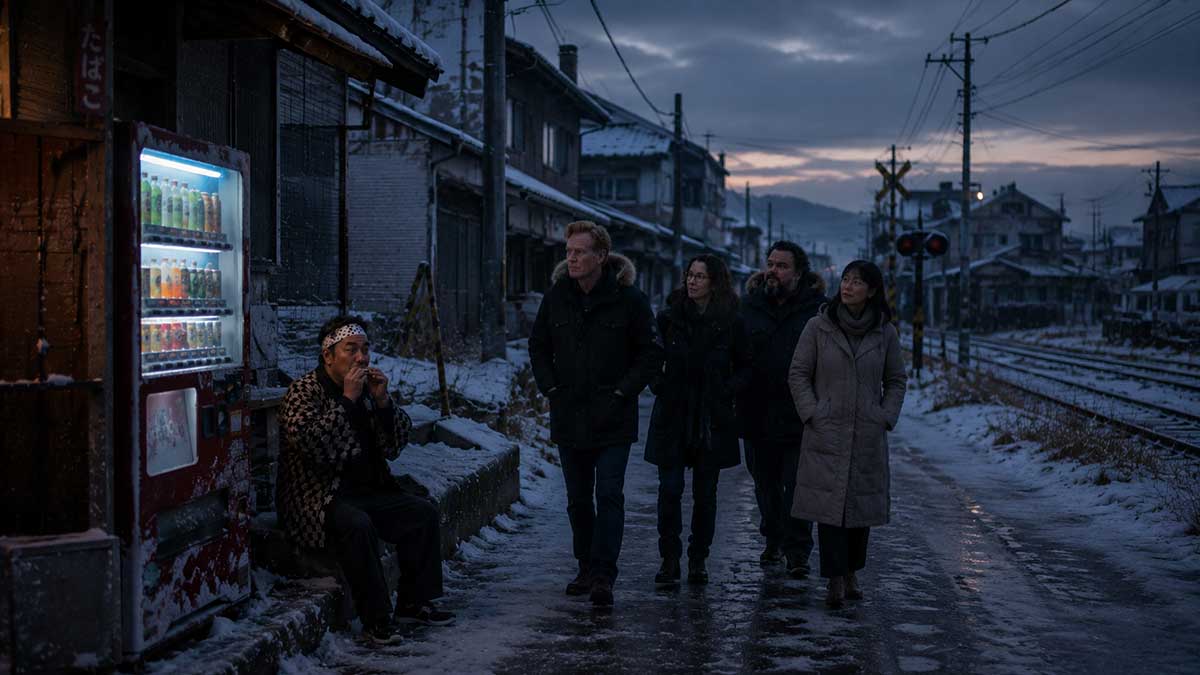
SCENE 2 — “THE VENDING MACHINE IN THE MIDDLE OF NOWHERE”
The vending machine stood alone beside an empty road buried in snow.
No buildings nearby.
No houses.
No visible reason for existence.
Yet somehow it glowed warmly against the gray afternoon like a tiny lighthouse for lost travelers.
The machine hummed softly beneath drifting snowflakes.
The air smelled of:
- cold metal
- snow
- distant wood smoke
- electricity warming the machine interior
Jack Black approached reverently.
“This is no longer a vending machine. This is a spiritual guardian.”
John laughed softly.
“Japan’s vending machine culture expanded partly because low crime rates made unattended machines practical almost everywhere.”
Conan bought hot canned coffee from the machine and held it carefully against the cold.
“This country refuses to let despair fully win.”
Tina looked around the empty road.
“There’s something strangely comforting about finding warmth exactly where nobody expected it.”
Marie Kondo smiled quietly.
“Small comforts matter deeply in Japanese daily life.”
Then Ken Shimura bowed respectfully toward the vending machine.
To everyone’s horror…
the machine malfunctioned briefly and dispensed two extra drinks by accident.
Complete silence.
Conan slowly pointed at Shimura.
“He has achieved machine diplomacy.”
SCENE 3 — “THE SNOW-COVERED SHRINE”
The shrine emerged silently through falling snow.
Stone fox statues stood half-covered in white while red torii gates cut sharply through the pale landscape like brushstrokes against blank paper.
No tourists.
No voices.
Only snow.
The air smelled of:
- cedar
- incense
- snow
- cold stone
Their footsteps softened instantly beneath thick snowdrifts.
John lowered his voice naturally.
“One fascinating thing about Japanese spirituality is how closely tied it remains to seasons and physical environments.”
Conan watched snow collecting on the shrine roof.
“This feels less like religion and more like weather becoming sacred.”
Marie Kondo nodded softly.
“In Japan, nature itself often carries emotional meaning.”
Tina looked toward tiny prayer plaques moving slightly in the wind.
“I think Americans sometimes separate spirituality too aggressively from ordinary life.”
Nobody argued.
Then suddenly Ken Shimura attempted to ring the shrine bell dramatically again.
His glove froze briefly to the metal rope.
For several seconds he remained physically trapped in complete silence while snow fell around him.
Jack Black collapsed laughing into the snowbank.
Even John had to remove his glasses from laughing too hard.
Conan nodded calmly.
“Nature finally set boundaries.”
SCENE 4 — “THE OLD MAN AND THE FIRE”
By evening they found shelter inside a tiny farmhouse beside the mountains.
An elderly man sat near an old stove feeding wood carefully into the fire while snow tapped softly against the windows outside.
The room glowed amber beneath warm light.
The air smelled of:
- burning cedar
- tea
- smoke
- old tatami
- simmering soup
Nobody spoke loudly.
The old man poured tea slowly into worn ceramic cups.
John translated quietly as they talked.
“He says winters here used to isolate villages completely for days or weeks.”
Conan looked around the tiny room.
“This house feels older than modern stress.”
Marie Kondo watched steam rising from soup bowls.
“In Japan, warmth often feels emotional as well as physical.”
Tina stared toward family photographs hanging beside the clock.
“You can feel generations inside homes like this.”
Jack Black accepted another bowl of soup with visible gratitude.
Meanwhile, Ken Shimura somehow ended up helping the old man split firewood outside.
The old farmer laughed continuously watching Shimura struggle dramatically against one stubborn log.
Snow continued falling around them while laughter drifted through the cold air.
Conan watched from the doorway.
“He keeps finding the last remaining old men in Japan and healing them somehow.”
SCENE 5 — “THE TRAIN THROUGH THE BLIZZARD”
The train moved slowly through the blizzard.
Outside the windows, the world had almost disappeared entirely into white.
Occasionally:
- distant lights
- lonely houses
- telephone poles
- dark trees
emerged briefly before vanishing again beneath snow and darkness.
Inside the carriage everything felt warm and dimly peaceful.
The air smelled of:
- heated fabric
- coffee
- snow melting from boots
- old train upholstery
Most passengers slept quietly beneath soft yellow lights.
John looked out into the storm.
“Japan’s relationship with trains is emotional partly because trains connect isolated places people fear losing.”
Conan watched snow striking the glass.
“This trip started feeling like tourism.”
He looked around the quiet carriage.
“Now it feels like Japan is slowly revealing itself.”
Marie Kondo rested quietly beside the window.
“In Japan, trust often builds slowly.”
Tina watched sleeping passengers gently swaying with the train.
“This country rewards patience.”
For once…
even Ken Shimura remained unusually quiet.
Then suddenly the train hit a bump.
Shimura’s cup noodles launched directly upward and landed perfectly back into his hands without spilling a drop.
The entire train car applauded spontaneously.
Conan stared at him.
“He’s become protected by narrative structure.”
Final Thoughts by Conan O’Brien
By the end of week two, Japan no longer felt futuristic.
It felt human.
Not perfect.
Not endlessly cheerful.
Not emotionally simple.
Human.
We saw villages slowly disappearing.
Schools standing empty.
Old men keeping traditions alive beside wood fires.
Communities rebuilding after loss.
Tiny ramen shops creating more emotional healing than most therapy sessions.
Japan hides emotion differently than America does.
In America, feelings often explode outward.
In Japan, they settle quietly into:
- rituals
- food
- politeness
- trains
- festivals
- hot baths
- shared silence
And maybe that is why the smallest moments stayed with me most.
A grandmother giving sweet potatoes.
A fisherman laughing at Ken Shimura.
Warm canned coffee during cold rain.
A train station with nobody left inside it.
Japan doesn’t shout its meaning at you.
It waits patiently until you’re quiet enough to notice.
Short Bios:
Conan O’Brien — A confused American comedian slowly realizing Japan may understand emotional survival better than he does.
Tina Fey — The sharp observer noticing how loneliness, beauty, and politeness quietly coexist across Japan.
Jack Black — The emotional traveler discovering spiritual enlightenment through ramen, vending machines, and onsen baths.
Ken Shimura — The legendary Japanese comedian proving laughter may be the most important survival tool in the country.
Marie Kondo — The calm emotional center of the trip, revealing how Japan communicates through atmosphere and care.
John Daub — The northern Japan guide uncovering hidden villages, forgotten towns, food culture, and the quieter side of the country.
Chris Broad — The grounded cultural interpreter helping explain Japan’s deeper systems, contradictions, and emotional complexity.
Leave a Reply