
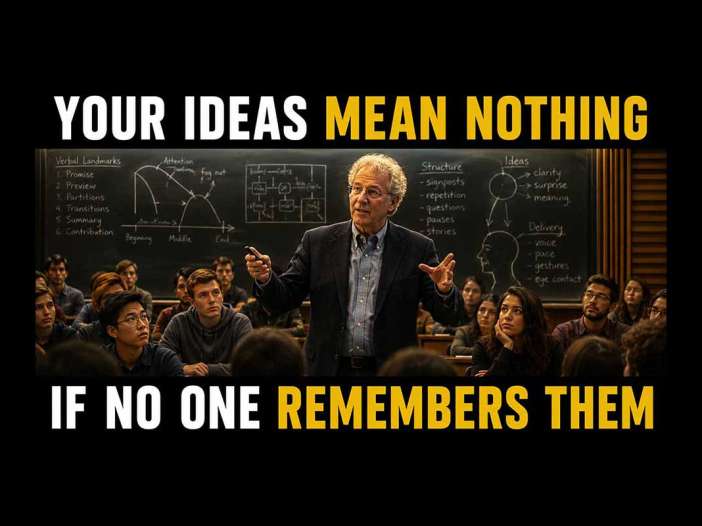
What if Patrick Winston and top thinkers revealed why communication matters more than raw intelligence?
Introduction by Patrick Winston
When people think about success, they often imagine intelligence, opportunity, or talent. Those things matter. But over many decades of teaching, lecturing, advising students, and watching careers rise or collapse, I came to a different conclusion.
Your success in life is determined largely by your ability to speak, your ability to write, and the quality of your ideas — in that order.
That statement surprises people because they want to believe ideas alone are enough. But ideas hidden behind confusion, weak structure, poor presentation, or forgettable delivery often disappear. Meanwhile, ideas that are clear, memorable, and emotionally alive move through organizations, classrooms, laboratories, companies, governments, and history itself.
Communication is not decoration added after thinking. Communication is part of thinking.
And fortunately, communication is learnable.
Throughout these conversations, we explored a truth that many people underestimate: talent is overrated compared with knowledge and practice. A great speaker is usually not born. A great speaker is assembled over years by observing what works, building techniques, refining habits, learning structure, studying attention, and practicing relentlessly.
We also examined something important about audiences: human attention is fragile. People drift away. They fog out. Great communicators do not become angry about that reality. They design around it. They cycle ideas. They use stories, pauses, questions, landmarks, symbols, and memorable contrasts to help people return.
That is why presentation matters so deeply. Not because style is more important than substance, but because substance without transmission has limited value.
And finally, we talked about remembrance. Ideas survive when they have form. A symbol. A slogan. A story. A contribution. Something people can carry after the room is empty.
If your ideas are worth believing, they are worth presenting well.
(Note: This is an imaginary conversation, a creative exploration of an idea, and not a real speech or event.)
Topic 1 — Why Communication Decides Your Future
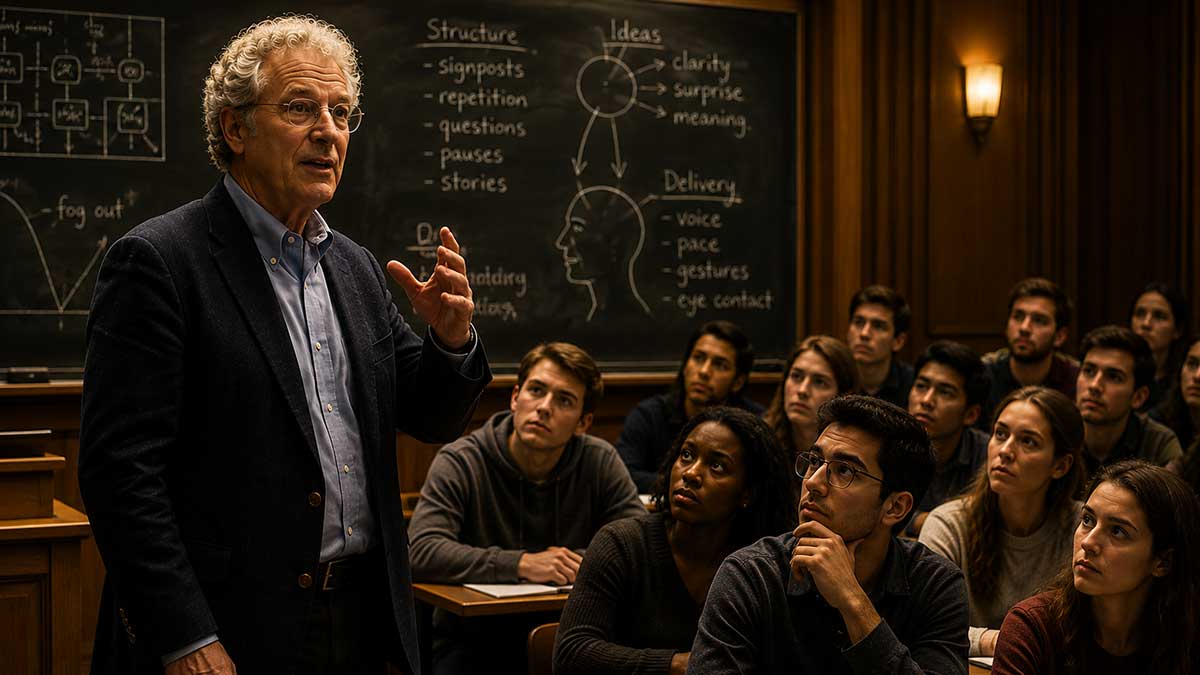
Opening — Nick Sasaki
Patrick Winston said your success in life is shaped by your ability to speak, your ability to write, and the quality of your ideas — in that order.
That sounds almost unfair. We like to believe that good ideas win by themselves. But life does not always reward the best idea. It often rewards the idea that is explained clearly, felt deeply, and remembered by others.
Tonight, we ask why communication can decide a person’s future.
Guests: Patrick Winston, Dale Carnegie, Aristotle, Maya Angelou, Steve Jobs.
Question 1 — Why do speaking and writing often determine whether good ideas are accepted or ignored?
Patrick Winston
A good idea hidden behind poor explanation is like a brilliant student sent into life without a weapon. The idea may be valuable, but no one can use it.
Speaking and writing are the delivery systems of thought. Without them, ideas remain private. They cannot recruit help. They cannot win trust. They cannot shape action.
Dale Carnegie
People accept ideas from people they feel connected to. A person may have the truth, but if he sounds cold, arrogant, or confusing, the listener closes the door.
Communication begins with respect. You must make the other person feel seen before asking them to receive what you know.
Aristotle
Persuasion requires three things: character, emotion, and reason. A good idea depends on reason, but people judge the speaker’s character and emotional force first.
A weak speaker may possess truth, yet fail to make truth credible.
Maya Angelou
People may forget the details of your argument, but they remember whether your words gave them dignity or made them feel small.
A good idea must enter the human heart, not just the human mind.
Steve Jobs
The world is full of smart people with complicated explanations. The rare person makes something simple enough to feel inevitable.
If you cannot explain why your idea matters, someone else with a weaker idea but a clearer story may win.
Question 2 — Can a weak communicator still become influential, or must every serious thinker learn to speak well?
Steve Jobs
A serious thinker does not need to become theatrical. But they must learn clarity.
You do not need a stage personality. You need the discipline to remove what is unnecessary until the heart of the idea can be seen.
Patrick Winston
Communication is learnable. That is the hopeful part.
Talent matters less than most people think. Knowledge and practice matter more. A weak speaker can become strong by studying what works, practicing it, and building a personal repertoire.
Dale Carnegie
No one is born comfortable speaking to others. Confidence grows when you stop thinking only about yourself and start thinking about service.
The question is not, “How do I sound?” The question is, “How can I help this person understand?”
Aristotle
Influence belongs to those who can arrange thought in a form others can follow.
A serious thinker has a duty to make wisdom communicable. Otherwise, wisdom remains locked inside the thinker.
Maya Angelou
Some people speak softly and still move the world. The issue is not volume. The issue is truth carried with courage.
A weak communicator can grow, but only if they stop hiding behind the excuse that depth does not need expression.
Question 3 — What makes communication feel human instead of mechanical?
Maya Angelou
Human communication carries warmth. It has memory in it. It has wounds in it. It has hope in it.
Mechanical words try to impress. Human words try to reach.
Patrick Winston
Structure helps people feel safe. A promise at the beginning, clear landmarks in the middle, and a meaningful ending create trust.
Human communication is not random emotion. It is organized care.
Dale Carnegie
The human speaker listens inwardly to the audience. Are they confused? Are they tired? Are they with me?
Great communication is not performance alone. It is attention to the people in front of you.
Aristotle
Human speech recognizes that people are rational, emotional, and moral beings at the same time.
A message becomes mechanical when it treats the listener as a container for information rather than a soul capable of judgment.
Steve Jobs
Human communication has taste. It knows when to stop.
You do not bury people under information. You give them the one thing they can carry away.
Closing — Nick Sasaki
The great lesson from Patrick Winston is not that speaking is decoration. It is that speaking is part of the idea itself.
An idea does not truly live until it can move from one mind to another.
Communication decides your future because it decides whether your inner world can enter the outer world. It decides whether your knowledge becomes useful, whether your work becomes trusted, and whether your ideas are remembered after you leave the room.
Topic 2 — Talent vs Knowledge vs Practice

Opening — Nick Sasaki
Patrick Winston told a story about watching Olympic gymnast Mary Lou Retton ski for the first time. Despite her world-class athletic talent, he was the better skier because he had the knowledge and practice she lacked.
That story challenges one of society’s deepest assumptions — that success belongs mainly to the naturally gifted.
Tonight, we ask a harder question:
What truly matters more in life — talent, knowledge, or practice?
Guests: Patrick Winston, Mary Lou Retton, Carol Dweck, Malcolm Gladwell, Kobe Bryant.
Question 1 — Is natural talent overrated compared with practice and learned skill?
Patrick Winston
Talent exists, but people exaggerate its importance because talent is visible. Practice is invisible.
When you watch a great speaker or athlete, you see the polished result. You do not see the years of accumulated knowledge and repeated correction behind it.
Knowledge changes what you notice. Practice changes what your body and mind can do automatically.
Mary Lou Retton
Talent may open the first door, but discipline determines whether you stay in the room.
People saw my Olympic performance, but they did not see thousands of repetitions when nobody cared, nobody applauded, and nobody believed it mattered.
Raw ability without repetition becomes fragile under pressure.
Carol Dweck
The danger of worshipping talent is that people begin protecting their image instead of developing themselves.
A growth mindset changes failure from proof of limitation into information for improvement.
People who believe skill can grow often surpass people who rely only on being “naturally good.”
Malcolm Gladwell
Many extraordinary performers are products of hidden advantages — timing, opportunity, coaching, repetition, environment.
Society romanticizes genius because it creates a cleaner story. But mastery is usually more complicated and far less magical.
Kobe Bryant
People called me talented, but they rarely talked about obsession.
I practiced fundamentals endlessly because pressure reveals habits. In difficult moments, you do not rise to your hopes. You fall to your preparation.
Question 2 — Why do some less talented people surpass gifted people over time?
Carol Dweck
Gifted people sometimes avoid situations where they may look weak. That fear quietly limits growth.
Meanwhile, the less naturally gifted person may become resilient because struggle has always been familiar.
Over time, resilience compounds.
Kobe Bryant
The less talented player often develops hunger earlier.
If success comes too easily, you may never build the discipline required for greatness. Struggle can become an advantage because it forces adaptation.
Patrick Winston
Knowledge accumulates. Small improvements compound over decades.
A person who continuously studies communication, thinking, and presentation can eventually outperform someone with more natural charisma who never develops further.
Malcolm Gladwell
People underestimate endurance.
Long-term success often belongs to the person who can tolerate boredom, repetition, and slow progress longer than everyone else.
The public notices the breakthrough. They rarely notice the years before it.
Mary Lou Retton
Confidence built only on talent disappears the moment talent fails.
Confidence built on preparation survives difficult days because you know exactly how much work is underneath you.
Question 3 — What kind of practice actually changes a person’s ability?
Kobe Bryant
Mindless repetition is not enough.
Real practice isolates weakness. It studies details. It pushes slightly beyond comfort again and again until new habits become natural.
You practice hardest where you are weakest.
Patrick Winston
Practice without knowledge can reinforce mistakes.
That is why building a repertoire matters. You observe effective speakers, identify techniques, test them, refine them, and slowly make them your own.
Carol Dweck
The best practice includes feedback without shame.
If every correction feels like a personal attack, growth slows dramatically. The learner must separate identity from temporary performance.
Malcolm Gladwell
Deliberate practice often looks unimpressive from the outside.
It involves repetition, correction, patience, and structured improvement. It is usually lonely and mentally exhausting.
That is why few people sustain it long enough.
Mary Lou Retton
Practice changes you most when it becomes connected to purpose.
When the goal matters deeply enough, repetition stops feeling meaningless. It becomes devotion.
Closing — Nick Sasaki
Patrick Winston’s formula quietly overturns the myth of destiny.
Talent matters, but knowledge and practice matter far more than most people realize.
The encouraging truth is that communication, thinking, speaking, writing, and influence are not reserved for a gifted few. They are skills that can be built.
Perhaps greatness is less about what we are born with and more about what we repeatedly choose to improve.
Topic 3 — How Great Speakers Hold Attention
Opening — Nick Sasaki
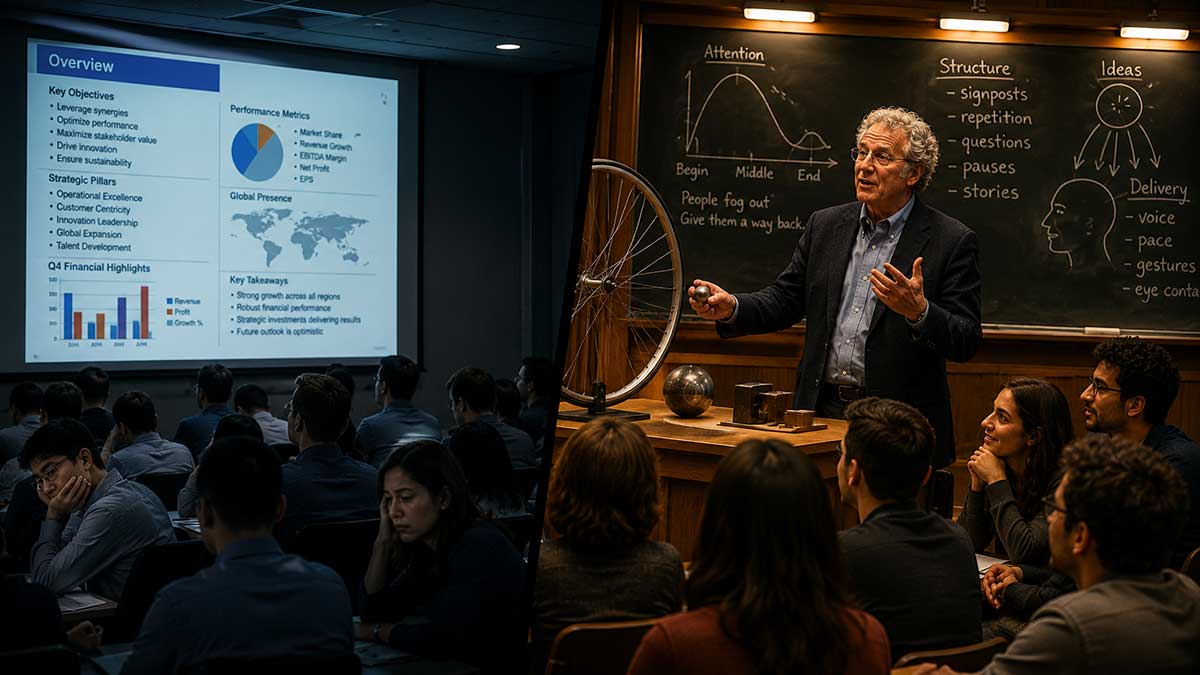
Patrick Winston warned that people often “fog out” during a talk. Even intelligent people drift away. They miss sentences. Their minds wander. Then they need a way back.
That is why great speakers do more than deliver information. They guide attention.
Tonight, we ask how a speaker earns attention, keeps it, and helps people return when their minds disappear for a moment.
Guests: Patrick Winston, Martin Luther King Jr., Winston Churchill, Nancy Duarte, Barack Obama.
Question 1 — Why does a strong opening promise matter more than a joke?
Patrick Winston
A joke at the beginning is risky because the audience has not yet adjusted to you. They are still settling in, still learning your voice, still deciding whether to trust you.
A promise is stronger.
Tell them what they will know, feel, or be able to do by the end that they cannot do now. That gives the talk a reason to exist.
Martin Luther King Jr.
A strong opening gives people hope before it gives them instruction.
People listen when they sense that the speaker is carrying them somewhere meaningful. A joke may entertain for a moment, but a promise can awaken moral attention.
Winston Churchill
In grave moments, one does not begin by amusing the room.
The speaker must establish purpose. The audience must feel that the hour has consequence. The opening must say, without apology, “This matters.”
Nancy Duarte
A great opening creates a gap.
It shows the audience the difference between where they are now and where they could be. Once people feel that gap, they want the journey across it.
Barack Obama
A good opening invites people into a shared story.
It says, “Here is where we are. Here is what we face. Here is what we can become.” That is more durable than a joke because it gives people a role.
Question 2 — How can repetition, questions, and pauses keep an audience awake?
Nancy Duarte
Repetition gives shape to memory.
When a speaker returns to an idea from different angles, the audience begins to recognize the pattern. They are not just hearing words; they are seeing structure.
Patrick Winston
Cycling matters because people miss things.
At any moment, some portion of the audience is mentally absent. When you return to the idea again, you give them another chance to catch it.
Questions help too. A question creates a small tension in the room. People lean forward because the mind wants closure.
Barack Obama
A pause gives people permission to feel the weight of what was just said.
Too many speakers fear silence. But silence can be one of the strongest tools in speech. It lets the sentence land.
Martin Luther King Jr.
Repetition is not emptiness when it carries conviction.
A repeated phrase can become a drumbeat of conscience. It allows the audience to join the rhythm of the idea until the idea feels larger than the speaker.
Winston Churchill
Repetition, properly used, is reinforcement.
A nation under pressure does not need novelty every second. It needs certain truths hammered clearly, courageously, and memorably.
Question 3 — What makes people remember one sentence from a talk for years?
Martin Luther King Jr.
A sentence endures when it names a longing already living inside the listener.
The words may come from the speaker’s mouth, but the truth must feel as though it has been waiting in the audience’s heart.
Winston Churchill
A memorable sentence has steel in it.
It is short enough to carry, strong enough to repeat, and clear enough to survive fear. In crisis, people remember sentences that give them courage.
Patrick Winston
People remember sentences that are attached to structure, story, and surprise.
A sentence alone may fade. But if it comes after a clear setup, arrives at the right moment, and gives people a way to think differently, it stays.
Nancy Duarte
The sentence people remember is often the turning point.
It crystallizes the contrast between what is and what could be. It becomes the emotional center of the presentation.
Barack Obama
People remember words that make them feel included in something larger.
A great sentence does not merely describe an idea. It gathers people around it.
Closing — Nick Sasaki
Patrick Winston’s lesson is simple but demanding: attention is not automatic. It must be guided.
A great speaker does not blame the audience for drifting. He builds roads back into the talk.
He starts with a promise. He repeats from fresh angles. He asks questions. He pauses. He gives verbal landmarks. He helps people return.
And perhaps that is why the best speakers are remembered. They do not merely speak at people.
They help people find their way back to the idea.
Topic 4 — Why Slides Often Kill the Message
Opening — Nick Sasaki
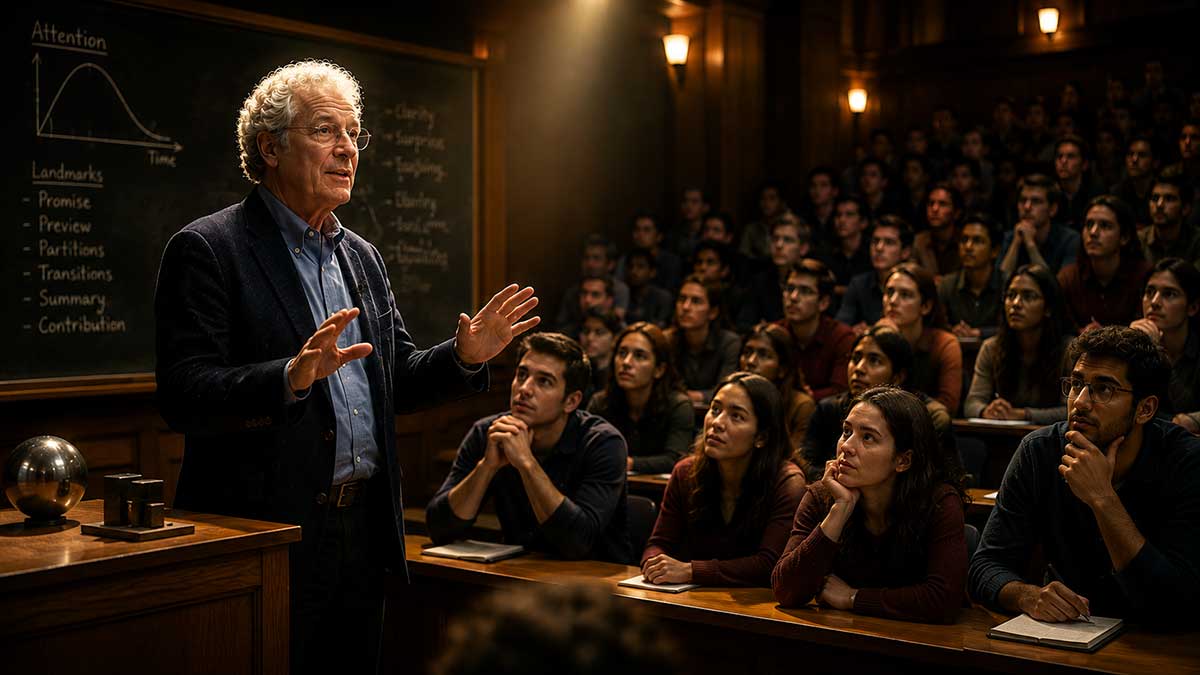
Patrick Winston said slides are useful for exposing ideas, but weak for teaching ideas.
That is a serious warning. Many speakers hide behind slides. They fill them with words, logos, titles, bullets, charts, and tiny fonts. Then the audience stops listening to the speaker and starts reading the screen.
Tonight, we ask why slides so often weaken the message.
Guests: Patrick Winston, Edward Tufte, Steve Jobs, Garr Reynolds, Seth Godin.
Question 1 — Why do too many words on slides weaken the speaker?
Patrick Winston
We have only one language processor.
If people are reading the slide, they are not listening to you. If the slide contains everything, then you become noise beside your own presentation.
A slide should be a condiment, not the main meal.
Edward Tufte
Text-heavy slides often flatten thought into fragments.
A serious idea needs structure, evidence, and judgment. Bullet points can make weak reasoning look organized, but they often remove depth.
Steve Jobs
The slide should make the idea feel clearer, not heavier.
If the audience is staring at paragraphs, you have already lost them. The screen should support your voice, not compete with it.
Garr Reynolds
Clutter creates friction.
Every unnecessary word asks the audience to spend attention. A clean slide respects the listener’s mind.
Seth Godin
Most bad slides are fear made visible.
People put every word on the screen because they are afraid of forgetting. But the audience did not come to watch your notes.
Question 2 — When should we use slides, and when should we use stories, boards, or props?
Garr Reynolds
Use slides when an image, contrast, chart, or phrase can make the idea more immediate.
Use stories when people need meaning. Use boards when people need to see thinking unfold. Use props when the body needs to feel the idea.
Patrick Winston
Boards are strong for teaching because writing speed matches absorption speed.
Props are powerful because people remember physical demonstration. A bicycle wheel or steel ball can teach what a slide cannot.
Slides are best when you are exposing ideas quickly, such as in a conference or job talk.
Edward Tufte
Use the medium that carries the evidence honestly.
Some ideas need dense handouts. Some need visual comparison. Some need demonstration. The question is not “slides or no slides,” but whether the form serves the thought.
Steve Jobs
A story gives people the reason to care.
A slide may show the product. A story tells them why it matters. The strongest presentations often combine visual simplicity with emotional sequence.
Seth Godin
Use slides when they create tension or focus.
Do not use them as a transcript. If the slide says everything, the speaker becomes optional.
Question 3 — How can visuals support an idea without replacing the speaker?
Steve Jobs
A great visual gives the audience one clear thing to feel or remember.
It should make the spoken words sharper. The speaker still carries the meaning.
Patrick Winston
Remove clutter. Remove extra words. Remove unnecessary logos and titles.
If you must identify something, use an arrow on the image instead of a laser pointer. Keep your eyes with the audience.
Garr Reynolds
Visuals should breathe.
Space is not empty. Space creates attention. When there is air on the slide, the speaker has room to speak.
Edward Tufte
A visual should reveal relationships.
It should help people compare, notice, and think. Decoration is not communication.
Seth Godin
The best slide creates curiosity.
It makes people want to hear the next sentence from you. That is the relationship: the visual opens the door, the speaker walks through it.
Closing — Nick Sasaki
Patrick Winston’s warning about slides is really a warning about hiding.
A speaker can hide behind words, bullets, fonts, logos, charts, and lasers. But communication becomes powerful when the speaker returns to the human center of the room.
Slides are not the enemy. Clutter is the enemy. Fear is the enemy. Losing contact with the audience is the enemy.
A good slide helps people see.
A great speaker helps people understand.
Topic 5 — How to Make Your Ideas Remembered
Opening — Nick Sasaki
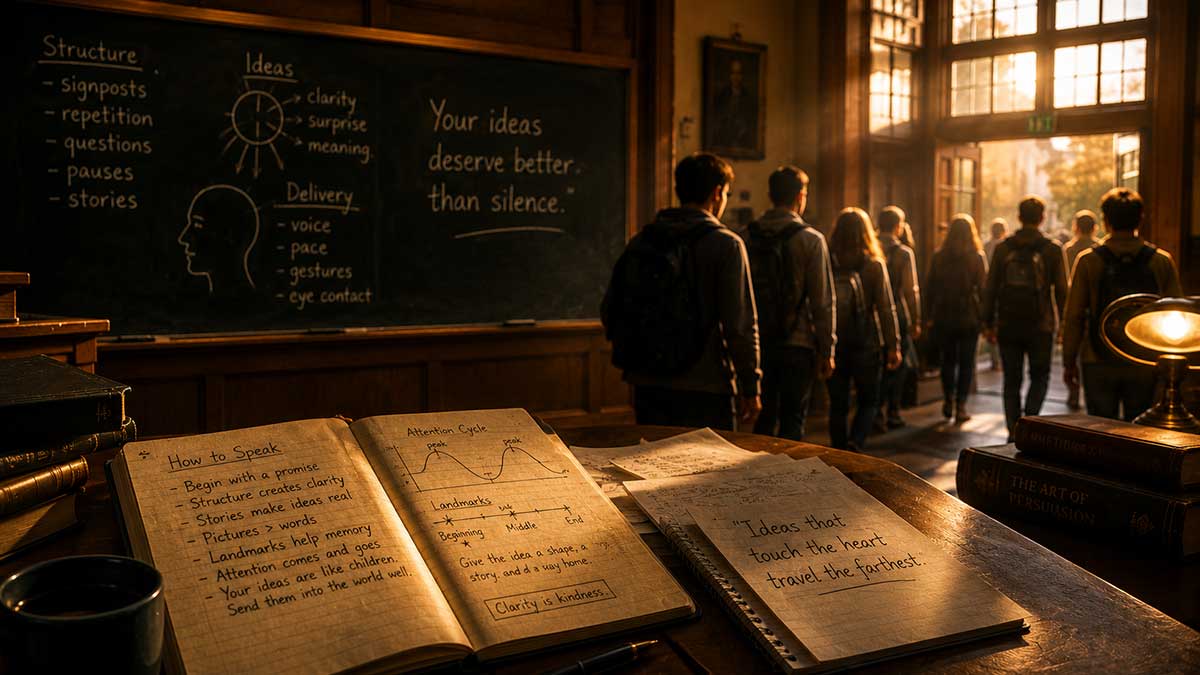
Patrick Winston said your ideas are like your children. You do not want them to go into the world in rags.
That image is powerful because it reminds us that presentation is not vanity. It is care.
Tonight, we ask how an idea becomes memorable enough to survive after the speaker leaves the room.
Guests: Patrick Winston, Chip Heath, Dan Heath, Simon Sinek, Joseph Campbell.
Question 1 — Why do symbols, slogans, and surprise make ideas stick?
Patrick Winston
People remember handles.
A symbol gives the idea a shape. A slogan gives it a phrase. Surprise gives it energy.
When I described “one-shot learning,” the idea became easier to carry because it had a name, an example, and a twist.
Chip Heath
Sticky ideas are simple, unexpected, concrete, credible, emotional, and story-driven.
Surprise matters because it wakes the mind. A slogan matters because it compresses the idea into something portable.
Dan Heath
A good symbol gives people a shortcut back to the full idea.
The symbol is not the whole message. It is the doorway. Once people remember the doorway, they can return to the room.
Simon Sinek
People remember ideas that connect to purpose.
A slogan without belief is advertising. A slogan connected to why becomes identity.
Joseph Campbell
Symbols endure because they speak beneath ordinary language.
A symbol can hold fear, hope, struggle, and transformation in one image. That is why myths survive longer than arguments.
Question 2 — How can a speaker turn a complex idea into a story people remember?
Joseph Campbell
A story gives the idea a path.
There is a problem, a threshold, a struggle, a discovery, and a return. The listener follows the idea through human movement.
Without story, an idea may be correct but lifeless.
Patrick Winston
You must situate the idea.
Tell people what problem matters, why others have struggled with it, what is new in your approach, and what steps you have taken.
Then the audience knows where the idea belongs.
Chip Heath
Complexity becomes memorable when it becomes concrete.
Do not explain only in abstractions. Give people a scene, a person, an object, a moment.
People remember the bicycle wheel. They remember the steel ball. They remember the stove.
Dan Heath
A story works when it creates a mental simulation.
The listener can see what happened, feel the tension, and understand the lesson without being forced.
That is why stories teach faster than explanation alone.
Simon Sinek
A story should reveal belief under action.
People do not remember facts alone. They remember why someone cared enough to act.
The story carries the meaning behind the idea.
Question 3 — Why should a talk end with contributions, not just “thank you”?
Patrick Winston
The final slide should not waste the most valuable real estate in the room.
When questions begin, when people leave, when they remember you later, they should see what you contributed.
Do not end by making politeness the final message. End by showing what has been done.
Simon Sinek
The ending should return people to purpose.
A weak ending asks for approval. A strong ending reminds people why the work matters.
Chip Heath
The final moment becomes the memory tag.
If the last thing people see is “Questions?” they remember almost nothing. If the last thing they see is a clear contribution, they carry the value with them.
Dan Heath
Endings shape interpretation.
The same talk can feel scattered or meaningful depending on the final frame. A contribution ending tells people what to keep.
Joseph Campbell
The end of a story is the return with the gift.
The speaker must bring something back to the audience: insight, courage, direction, responsibility.
That gift is stronger than a polite farewell.
Closing — Nick Sasaki
Patrick Winston’s final lesson is that ideas need care after they are born.
A good idea must be shaped, named, shown, repeated, remembered, and sent into the world with dignity.
Symbols help people see it. Slogans help people say it. Surprise helps people notice it. Story helps people feel it. Contributions help people respect it.
The goal is not fame for its own sake.
The goal is that valuable ideas do not disappear simply because they were poorly carried.
Final Thoughts by Patrick Winston
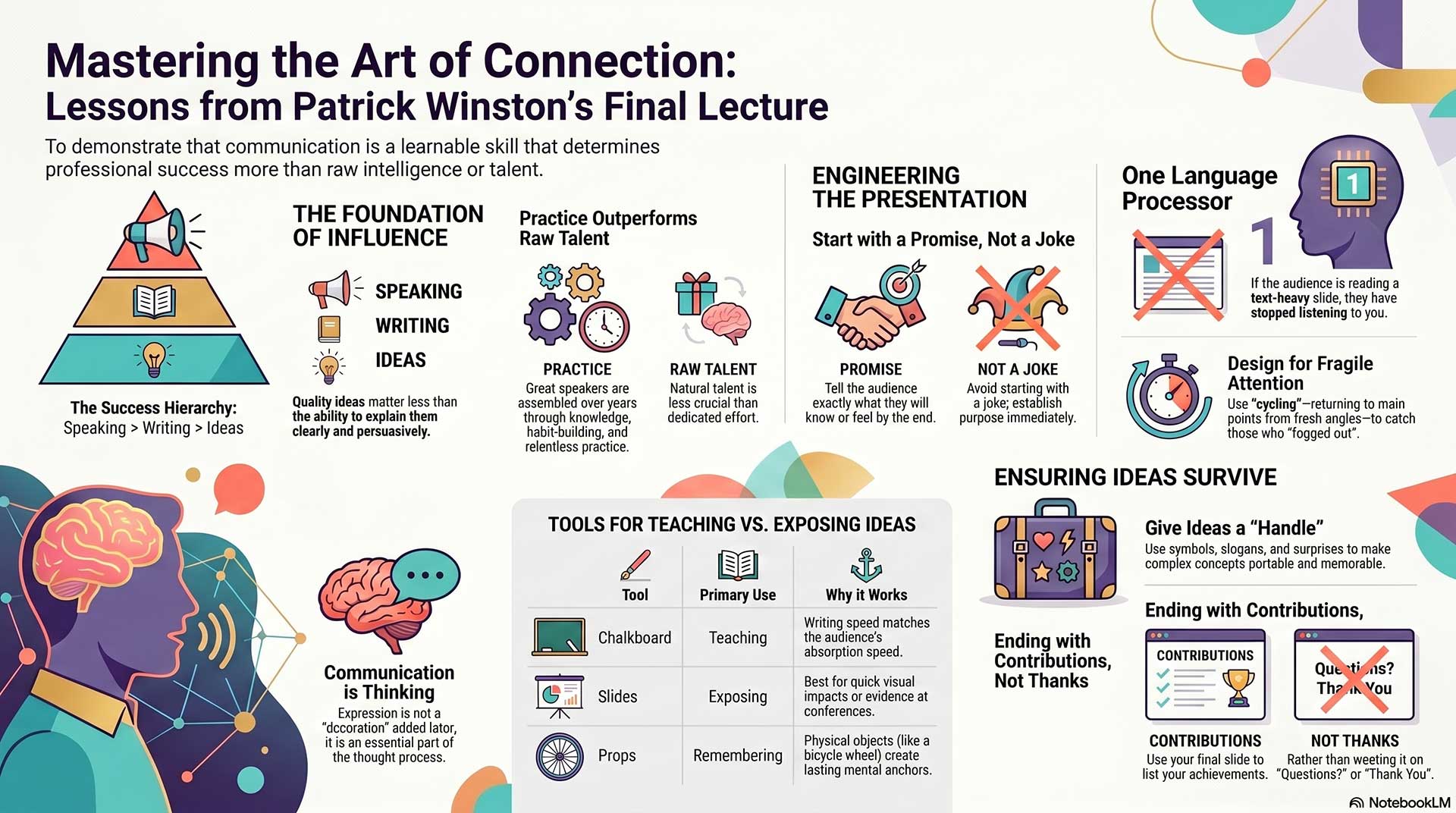
When I was younger, I thought communication was mostly about correctness. Later, I realized it was about connection.
The world is full of intelligent people whose ideas never travel very far because they never learned how to package them for human beings. Meanwhile, others with less depth but greater clarity shape institutions, movements, industries, and sometimes entire generations.
That reality may seem unfair, but it is also hopeful.
It means improvement is possible.
You can become more persuasive. You can become more memorable. You can become more structured, more engaging, more human. You can learn how to begin strongly, how to organize ideas clearly, how to simplify without becoming shallow, and how to end in a way people remember.
And perhaps the most important lesson is this:
Communication is not manipulation when it is used in service of truth.
At its best, communication is generosity. It is helping another human being see something more clearly than they saw it before.
That is why speaking matters.
That is why teaching matters.
That is why stories matter.
And that is why your ideas deserve better than silence.
Short Bios:
Patrick Winston
MIT professor, artificial intelligence pioneer, and legendary lecturer known for his influential course “How to Speak.” Famous for teaching that communication skills shape success more than talent alone.
Dale Carnegie
Author of How to Win Friends and Influence People and one of the most influential teachers of interpersonal communication and public speaking in modern history.
Aristotle
Ancient Greek philosopher whose ideas on rhetoric, persuasion, logic, and human reasoning still shape communication theory today.
Maya Angelou
Poet, memoirist, and speaker celebrated for emotionally powerful language that connected deeply with audiences across generations.
Steve Jobs
Co-founder of Apple, widely admired for product launches and presentations that blended storytelling, simplicity, and emotional clarity.
Mary Lou Retton
Olympic gold medal gymnast whose athletic discipline became an example in Patrick Winston’s lecture about talent versus knowledge and practice.
Carol Dweck
Psychologist and author of Mindset, known for research on growth mindset and the psychology of learning.
Malcolm Gladwell
Journalist and author recognized for exploring success, mastery, opportunity, and hidden patterns behind achievement.
Kobe Bryant
NBA legend known for relentless practice habits, discipline, and the “Mamba Mentality” approach to improvement.
Martin Luther King Jr.
Civil rights leader remembered for some of the most influential speeches in modern history, including I Have a Dream.
Winston Churchill
British Prime Minister during World War II whose speeches became symbols of resilience and national courage.
Nancy Duarte
Communication expert and author specializing in storytelling, presentation structure, and persuasive speaking.
Barack Obama
Former U.S. president widely recognized for calm, narrative-driven public speaking and message clarity.
Edward Tufte
Information design scholar known for his work on visual communication, analytical presentation, and criticism of poor slide design.
Garr Reynolds
Presentation design expert and author of Presentation Zen, focused on simplicity and visual clarity.
Seth Godin
Marketing thinker and author known for ideas about storytelling, attention, and meaningful communication.
Chip Heath
Co-author of Made to Stick, exploring why certain ideas become memorable.
Dan Heath
Writer and researcher focused on decision-making, communication, and memorable storytelling.
Simon Sinek
Leadership speaker and author of Start With Why, known for emphasizing purpose-driven communication.
Joseph Campbell
Mythologist and author famous for work on storytelling structure, archetypes, and the hero’s journey.
Leave a Reply