
What if Lena discovered that caring for her mother was really a way of asking whether she had ever been loved enough?
Introduction by Nick Sasaki
There are some stories that do not arrive with spectacle. They do not shout. They do not ask for immediate admiration. They enter quietly, like heat entering a house that still looks normal from the outside.
The Voice After Heat began for me with a question that feels deeply modern and deeply ancient at the same time: when the systems around us begin to fail — climate, power, public care, emotional stamina — what remains between one human being and another? What is left when duty is exhausted, when love is mixed with resentment, when memory has not healed, and when a machine may sound gentler than the people standing in the room?
This story lives in that narrow and difficult place.
On the surface, it is about a daughter caring for her aging mother during a blackout in extreme heat. Yet under that surface, it is about older temperatures that never really cooled: childhood longing, withheld tenderness, the fear of becoming a burden, the fear of failing someone who once failed you, and the hard truth that care is rarely pure. Care may contain love, guilt, anger, habit, duty, shame, memory, and still be real.
What moved me most in writing this story was not the crisis alone, but the intimacy of it. No grand disaster scene. No dramatic rescue. Just one hallway, one folding chair, one exhausted daughter, one proud mother, and one faint artificial voice continuing to speak into the dark. That felt honest to me. More and more, the defining struggles of our time may not come to us as epic collapses, but as private endurance inside ordinary rooms.
I did not want this story to preach against technology, nor to praise it too easily. The little care device in this story is not a villain. It is not salvation either. It is something stranger and more unsettling: a form of help. Limited, impersonal, useful, and at times emotionally exposing. Sometimes what wounds us is not that technology fails to be human, but that it enters the exact space where human tenderness once failed.
At its heart, this is a story about staying.
Staying when the past has not been repaired.
Staying when the other person is difficult.
Staying when your motives are mixed.
Staying when there is no beautiful version of love available.
Staying anyway.
That kind of staying may not look heroic, but I think it may be one of the last forms of grace left to us.
1. Before the Heat Peaks
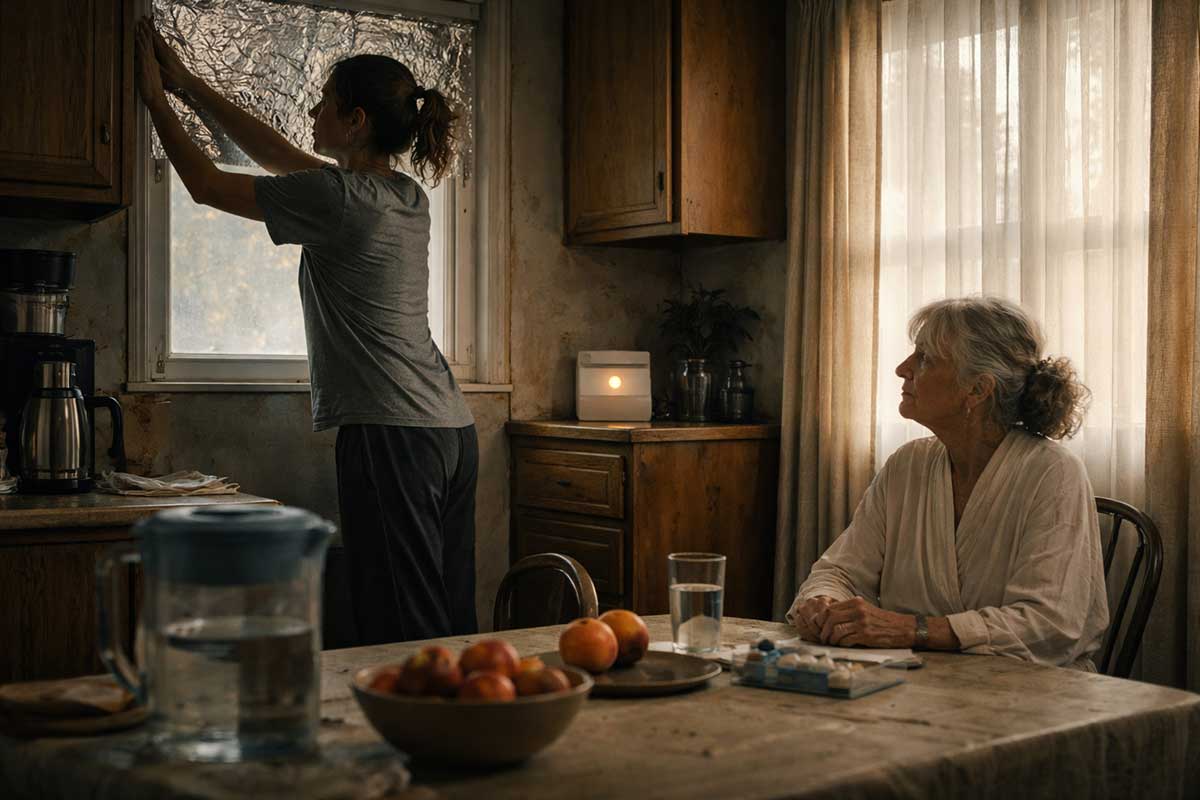
At 5:12, before the day had fully declared itself, Lena was standing on a dining chair pressing another strip of foil-backed insulation into the kitchen window frame when June spoke from the counter.
“Good morning, Evelyn. Today’s heat advisory begins at nine a.m. Please drink a full glass of water with your morning tablets.”
Lena smoothed the silver edge with the side of her thumb until it held.
From down the hall, her mother answered, “I heard you.”
The answer came with a softness Lena had not heard directed at her in days. Maybe longer. She climbed down from the chair, knees stiff, and looked across the kitchen. The digital clock on the microwave blinked 5:12 in green. The power had held through the night. That alone felt like borrowed luck.
The house still had the false coolness of early morning, air conditioned air that had settled into the furniture, into the curtains, into the smell of old wood and dish soap and the medicated hand lotion her mother kept beside the sink. By noon, the cool would be gone. By three, the walls would feel warm to the touch. By six, the whole house would seem to breathe heat back at them.
Lena carried the chair to the pantry and set it against the wall. Her T-shirt was already damp between her shoulder blades. She had slept badly again, waking every hour to check her phone for outage notices, emergency alerts, the county cooling center map she had no chance of persuading her mother to use.
June spoke once more, patient as weather.
“Evelyn, this is your second reminder. Hydration reduces heat-related stress.”
“I said I heard you,” Evelyn called.
Lena poured water from the filter pitcher into a glass and set it beside the pill organizer on the table. The organizer had four rows, seven days, little plastic lids that snapped shut with a sound too cheerful for what they held. Blood pressure. Heart rhythm. One for cholesterol. One small white tablet for sleep that her mother denied helped and took every night anyway.
She heard slippers drag softly across the hallway floor.
Evelyn entered in a pale blue robe, thinner than she had been even six months earlier, her gray hair flattened on one side from sleep. Her face in the morning always startled Lena. Not from age exactly. From defenselessness. The face had none of its daytime structure yet. No set mouth. No sharpened eyes. Just the soft ruin of a person before effort arranged her.
“You’re up early again,” Evelyn said.
“It’s cooler now.”
“It’s always cooler now. That’s how morning works.”
Lena pulled out the chair for her. “Drink first.”
Evelyn looked at the glass, then at Lena, then sat with obvious reluctance, as if obedience required an audience and that alone made it unbearable. She took the water and swallowed half in three irritated gulps.
“There,” she said. “A triumph for modern medicine.”
June gave a small chime from the counter. “Thank you, Evelyn.”
Lena turned her head toward the device before she could stop herself. It was a plain white unit with a speaker grille and a soft amber light. Nothing human in it, unless calm counted. She had been in the house two weeks and still had not grown used to the sound of it using her mother’s name as though it belonged there.
“Do you want toast?” she asked.
“No.”
“You should eat with the pills.”
“I’m seventy-eight, Lena, not a horse.”
Lena opened the bread box anyway. “Half a slice.”
Evelyn watched her. “You don’t have to speak to me the way you used to speak to committees.”
Lena paused with the bread in her hand. During the pandemic years she had spent entire days in windowless conference rooms telling frightened people to be practical. No visitors. No exceptions. No beds. No staff. No masks left. It had changed the shape of her voice. She knew that. She had hoped the years since had hidden it a little.
“I’m making toast,” she said.
“You’re commanding toast.”
The toaster clicked down. Outside the sealed kitchen window, the sky had that washed-out white-blue color that meant heat would rise hard and fast once the sun cleared the neighboring roofs. The lawn next door had gone from yellow to something like paper weeks ago. Across the street, someone had left a silver emergency blanket draped over a west-facing window, and in the early light it flashed like water.
June said, “Current outdoor temperature is seventy-nine degrees. Forecast high: one hundred and eight.”
Evelyn made a sound in her throat. “There used to be weather. Now there are announcements.”
Lena took the toast out before it browned much and tore it into smaller pieces. Evelyn ate one corner with the expression of someone agreeing to a distasteful legal settlement.
On the fridge, beneath an old magnet shaped like a peach, Lena had taped the week’s outage schedule. Planned rolling blackouts by district, each block of time shaded in yellow marker. Planned, as if that made it civilized.
She checked the list again.
Their neighborhood: possible interruption between six and nine p.m.
Possible. The word had become hateful to her. It meant prepare for certainty and call it caution.
“Did you charge the backup battery?” Evelyn asked.
“Yes.”
“The portable fan?”
“Yes.”
“The phone?”
“Yes.”
“The other phone?”
“Yes.”
Evelyn nodded, a queen satisfied that her servant had counted the silver.
Lena carried her own glass of water to the sink and drank standing up. The water tasted faintly of metal and the lemon slice she had dropped in last night to persuade her mother it was worth drinking. On the counter beside June sat the blood pressure cuff, the thermometer, a notepad covered in Lena’s tight slanted writing, and a bowl of peaches going soft too fast in the heat.
She had not meant to stay this long. At first it was ten days, then two weeks, then “until things settle,” a phrase that had no substance at all. Things no longer settled. They shifted, strained, failed, resumed in smaller forms. The home-care aide had come twice, then once, then called yesterday to say the agency was short-staffed and would have to “reassess service continuity.” Lena had nearly laughed into the phone. As if continuity were some luxury line item that could be trimmed from a budget.
Evelyn pushed the pill organizer toward herself. Her hands, though thinner, still moved with a familiar exactness. She tipped the tablets into her palm. For one second Lena saw another kitchen, forty years gone: her mother younger than Lena was now, hair pinned up, standing at this same counter crushing aspirin with the back of a spoon, her father feverish in the next room, every fan in the house running. Heat then too. Heat and the smell of wet towels.
The memory came so suddenly that Lena had to grip the edge of the sink.
“You look pale,” Evelyn said.
“I’m fine.”
“People who say that usually need to sit down.”
Lena looked over. Evelyn had taken the pills and set the empty glass aside. Her robe had slipped open slightly at the collarbone, where the skin looked almost translucent. Birdlike, Lena thought, and hated herself for it. Birdlike, breakable, old. Words that belonged to the weak-minded daughter in greeting cards, not to her.
June said, “Lena, county emergency services have issued a revised evening heat alert. Would you like me to read it?”
No. She wanted the machine never to use her name.
“Yes,” she said.
“Peak grid demand is expected after sunset. Residents with cardiac risk, respiratory conditions, or mobility limitations are advised to relocate to designated cooling centers if home power is lost for more than one hour.”
The kitchen fell quiet after the message. The toaster had cooled. Somewhere in the back of the house, the old air-conditioning vent gave a tired metallic click.
Evelyn reached for another piece of toast and did not eat it.
“I’m not going to one of those places,” she said.
Lena turned from the sink. “We don’t know that you’d have to.”
“I know that I won’t.”
“If the power goes out and stays out—”
“I said no.”
Her mother did not raise her voice. She never needed to. Refusal in Evelyn came clean and flat, like a door shut on a room no one would enter again.
Lena folded the dish towel once, then again. “It isn’t a refugee camp. It’s a school gym with generators.”
“That’s worse.”
“It’s safer.”
“For whom?”
“For you.”
Evelyn gave a brief smile that carried no pleasure in it. “You always did mistake management for safety.”
Lena felt the old flare at once, hot and sharp. “And you always did mistake stubbornness for dignity.”
The words hung there. Too quick. Too practiced. As if both of them had been saving them in labeled drawers.
June, mercifully or absurdly, gave a soft chime.
“Indoor humidity is rising,” it said. “Closing the hallway vent may improve cooling efficiency.”
Neither woman moved.
From outside came the distant throb of a generator starting somewhere down the block, though the lights in the kitchen still glowed, the microwave still shone green, the house still held its thin shell of artificial cool. For the moment, they had power. For the moment, the machine was speaking, the pills were taken, the day had not yet turned punishing.
Lena picked up the empty water glass and carried it to the sink.
Behind her, Evelyn said, in a voice so ordinary it was almost kind, “You should try to sleep this afternoon. You look older when you’re tired.”
Lena let out a breath that might have become a laugh in another life.
At the counter, June’s amber light remained steady, small and watchful in the corner of the room.
Outside, the sun cleared the rooftops.
2. The Things That Still Need Doing
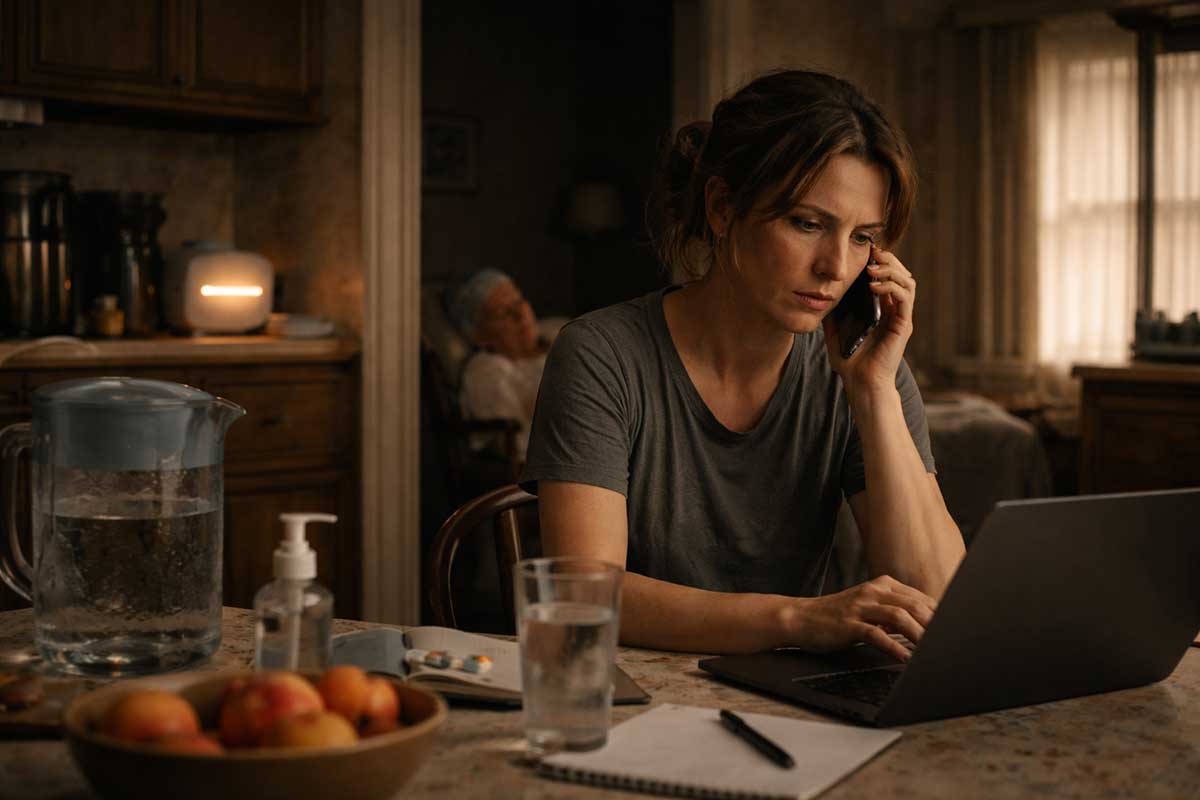
Lena did try, later, though not in any real way.
By one-thirty the house had begun its slow surrender. The sealed windows held the light out, though not the heat. It came in through the walls, through the roof, through the floorboards that had gone faintly warm under her bare feet. The air conditioner still ran, though with a strained, irregular hum that sounded too much like breathing through pain. June had announced the indoor temperature every half hour until Lena told it to stop. After that it kept only the medication reminders and emergency notices, as if offended into professionalism.
Evelyn was asleep in the back bedroom with a cooling cloth folded over her eyes. Lena had darkened the room, shut the door to the hallway, and placed the backup battery and portable fan within reach. The fan was not on. Evelyn said the noise irritated her. She preferred to be uncomfortable on her own terms.
Lena sat at the kitchen table with her laptop open and her phone beside it, calling the home-care agency again. She had been on hold for fourteen minutes. The same piano phrase circled back every fifty seconds, tinny and apologetic. On the screen, a form she had half completed asked whether the patient was ambulatory without assistance, whether she was at risk of heat injury, whether the home contained active cooling equipment, whether there was a family member able to remain on-site during emergency conditions.
Able to remain on-site.
Lena looked at the phrase until the words lost shape.
A person could remain anywhere, technically. That did not say what the staying cost.
At minute seventeen someone answered, a young man whose voice had the exhausted flatness of a person speaking from the bottom of a very long staircase.
“Regional Support,” he said. “This is Marcus.”
Lena gave her name, her mother’s name, the case number, the canceled visit, the prior reassessment notice. She heard herself becoming clear and hard, each fact placed where it would have maximum effect. Halfway through, she became aware that this was the voice her mother hated. Not loud. Far worse than loud. Efficient enough to erase embarrassment.
Marcus was silent a second.
“I’m sorry,” he said. “We’ve reassigned three of our staff to emergency response.”
“So there are no visits today.”
“Not for lower-acuity households, no.”
Lena stared at the peaches in the bowl. Their skin had gone speckled and tender at the stem.
“She has heart issues,” Lena said. “She lives in a district scheduled for evening interruption. This is not optional support.”
“I understand that.”
“No,” Lena said, before she could stop herself. “You don’t.”
The silence on the line changed. A person pulling inward.
She closed her eyes. “I’m sorry. That wasn’t fair.”
“It’s all right,” he said, which meant it was not. “I can put in a priority request if there’s an outage longer than sixty minutes. No guarantee on response time.”
“What’s response time now?”
Another pause. “Three to six hours. Maybe longer.”
Lena almost laughed. It came up into her throat and stopped there.
“Fine,” she said. “Put in the note.”
She ended the call and sat very still.
From the back of the house came no sound at all.
The quiet should have relieved her. It did not. Silence in caregiving had never meant peace for long. It meant the next need had not yet declared itself.
June spoke from the counter in its soft neutral tone. “Lena, you have not eaten lunch.”
She looked at the device.
For one strange second she felt caught, as though someone had been watching her not with concern exactly, but with complete and tireless attention.
“I know,” she said.
“There is chilled soup in the refrigerator,” June replied.
Of course it knew that. She had logged meal items herself on the first day, irritated at the setup process, irritated at the fact that a machine could ask practical questions no one else had thought to ask. Available fluids. Emergency contacts. Dietary restrictions. Baseline speech patterns. Heat sensitivity. History of confusion under physiological stress.
History of confusion. Such clean language for helplessness.
She rose, opened the refrigerator, and took out the container of soup. It had separated slightly in the cold. She stood in the kitchen, spoon in one hand, eating without appetite. The soup was too salty. The bowl sweated onto her fingers.
On the far counter sat an old glass pitcher filled with tap water and lemon slices. It was the same pitcher, or nearly the same, from her childhood, thick and bubbled at the handle where the glass had cooled unevenly in the making. Evelyn still used it in summer. Lena could remember being ten or eleven and watching light go through that pitcher onto the table, a warped yellow shape trembling with each movement of her mother’s hand.
She had loved her mother most in glimpses then. Not in conversations. Not in embraces. In tiny unguarded moments: the sound of ice dropped into a glass. Damp hair pinned at the nape of her neck. The cool wrist that touched Lena’s forehead once, briefly, when she had a fever and woke sure she was dying.
The memory came back now with terrible clarity. Not the touch itself. The waiting before it. She had stood in the hallway outside her mother’s room, holding the doorframe, unsure whether she was sick enough to ask for anything. The house had been dark except for the television glow in the living room. Her father had already been dead two years. Her mother had sat on the sofa still wearing her work clothes, staring at nothing Lena could see. Lena had stood there long enough to stop feeling brave. Then Evelyn had looked up, as though surfacing from deep water, and said, “What is it?”
Lena had forgotten the answer. Only the feeling remained. That she had interrupted something larger than herself. That needing comfort required proof.
The spoon tapped the bowl. A small clean sound in the kitchen.
June said, “Would you like me to lower nonessential system audio?”
Lena set the bowl in the sink. “Why would I want that?”
“You appear tense.”
She almost smiled, though nothing in her wanted to.
“Do I.”
“Yes.”
The answer came with such blank confidence that she laughed once, under her breath.
Then, from the back bedroom, a hard thump.
The bowl slipped in her hand and struck the sink.
She was already moving before the sound finished, crossing the hallway, shoulder brushing the wall. The bedroom door was half closed. Inside, the room was dim and smelled faintly of menthol, linen, and old summer dust. Evelyn was sitting upright on the side of the bed, one hand braced on the mattress, the cooling cloth on the floor.
“What happened?”
Her mother looked at her with irritated surprise, as if Lena had arrived too quickly to make a performance of anything.
“Nothing. I stood up.”
“The sound wasn’t nothing.”
“The water bottle tipped over.”
Lena looked. The insulated bottle had rolled near the nightstand. No spill. Still, Evelyn’s face was paler than it had been that morning.
“Why did you get up?”
“To use the bathroom. People still do that, last I checked.”
Lena crossed the room and crouched in front of her. “Are you dizzy?”
“No.”
“Mom.”
“I said no.”
Yet her hand, resting on the mattress, had a faint tremor in it.
Lena reached for the pulse oximeter from the nightstand drawer. Evelyn pulled her hand away.
“For God’s sake.”
“Give me your finger.”
“You love these little devices.”
Lena looked up. “What does that mean?”
“It means you trust whatever beeps.”
The words were light, nearly careless. Their effect was not.
Lena straightened slowly. “I trust information.”
“You trust not having to feel anything until there’s a number for it.”
The room held still around them.
Outside, a siren passed somewhere far off, muffled by walls and heat. June’s voice floated faintly from the kitchen, announcing something to no one Lena could hear.
Evelyn looked down at her own hands, the sharp-knuckled hands folded now in her lap. “Help me stand,” she said.
Lena did. One arm behind her shoulders, one at her elbow. Evelyn’s body felt lighter than memory said it should. Not frail exactly, though perilously close to some border beyond which frailty would no longer be a question but a fact.
They moved the few steps to the bathroom door. Evelyn paused there, breathing through her nose, refusing to lean more than necessary.
“I can manage the rest,” she said.
Lena did not let go at once. “Leave the door open.”
“No.”
“In case you fall.”
“In case I remain a human being,” Evelyn said.
Lena stepped back.
She waited outside the door with her palms damp and useless at her sides, listening to the small private sounds of someone trying to preserve dignity in a body that had begun its betrayals. The sink running. The medicine-cabinet mirror closing. A hitch in Evelyn’s breath, then silence, then the toilet seat lowered with deliberate care.
Above the hallway, the vent clicked and pushed out a thread of cool air that vanished before it reached her.
When Evelyn came out, she did not meet Lena’s eyes.
“Happy?” she asked.
Lena almost said no. Almost said that happiness had left the arrangement long ago and duty had taken its chair. Yet something in her held.
“You’re shaky,” she said instead. “Sit in the living room for a while. It’s cooler.”
So they moved there together.
The living room curtains were drawn against the afternoon glare, leaving the space lit in a weak amber dusk. Dust motes turned in the filtered light. The old sofa still sagged at one end where her father had always sat. The thought entered her without warning and stayed there. Evelyn lowered herself into the corner of the couch with a careful exhale. Lena brought the fan, then the water pitcher, then the blood pressure cuff. Evelyn allowed the water, refused the cuff, accepted the fan after refusing it twice.
June spoke from its dock in the kitchen, its voice carrying down the hall.
“Grid status update,” it said. “Peak load conditions have worsened. Probability of evening interruption in this district has increased.”
Lena stood in the doorway between the rooms.
“How much increased?” she called.
“Seventy-eight percent.”
Evelyn closed her eyes.
The fan lifted a few strands of hair at her temple. The house gave a long tired creak, settling deeper into heat.
Lena looked at the shaded windows, the cooling towels folded over the armchair, the emergency flashlight on the side table, the backup battery charging under the lamp. Every object in place. Every object waiting.
The day had not broken yet, though she could feel the line in it approaching. Late afternoon. Then evening. Then the hour when light would fail and all preparation would be tested against whatever came.
“Lena,” June said softly, “it may be advisable to begin blackout protocol.”
She hated the phrase. She knew it was right.
On the couch, Evelyn opened her eyes and looked at her daughter, not kindly, not harshly either. Just with the weary recognition of one person who knows another has already begun bracing for impact.
“Go on,” she said. “Do your rituals.”
Lena did not answer. She turned toward the kitchen, where the machine’s amber light waited on the counter like a patient eye, and began to prepare for the dark.
3. Blackout Protocol
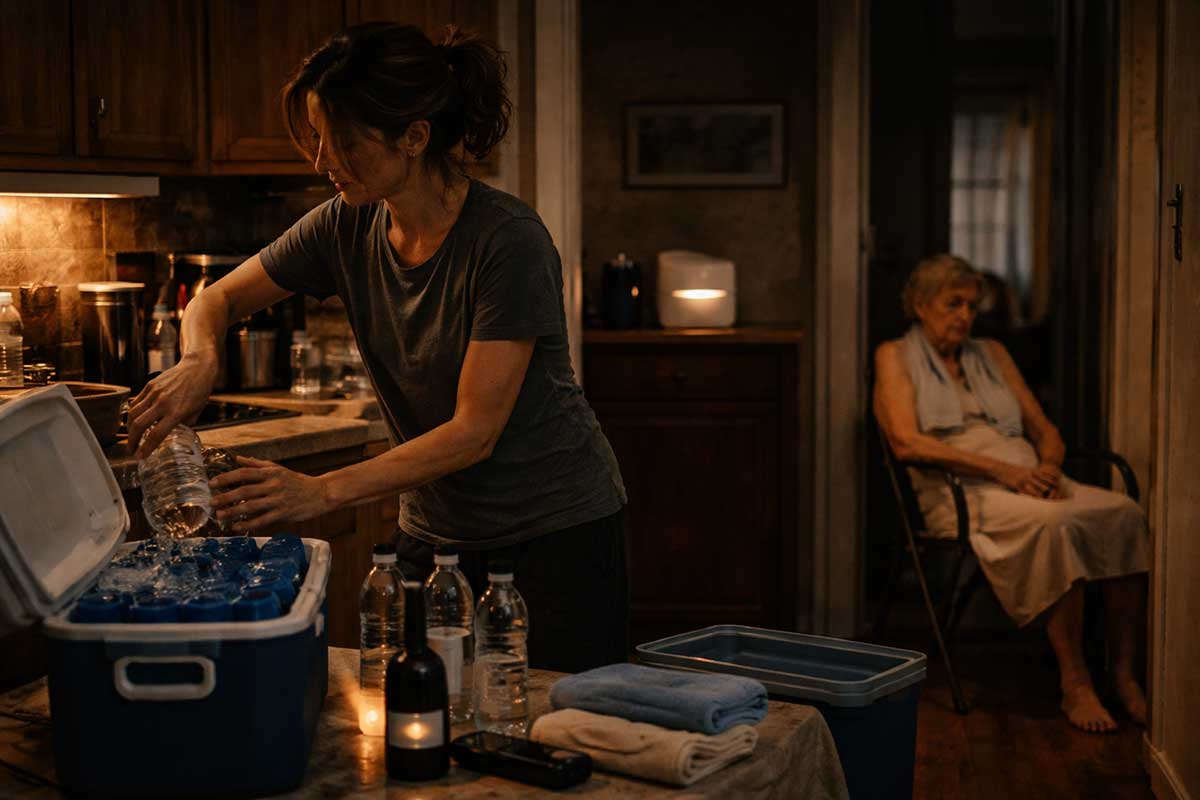
She started in the kitchen.
The phrase blackout protocol had triggered a whole sequence in her body before she touched a thing. Not panic. Panic was loose and noisy. This was tighter. Muscle memory from years when every shortage came with a checklist, and every checklist was just a softer word for failure delayed.
She filled the bathtub halfway with cold water in case the lines lost pressure. She moved the medication tray into the insulated cooler with two frozen packs. She charged the phone again though it was already at ninety-three percent. She checked the flashlight, then checked it again after thirty seconds as if mistrust could drain batteries. She laid out three damp towels on the freezer shelf and four more in the sink. She unplugged the toaster, the lamp in the guest room, the old radio on the windowsill, all the small useless things that somehow still felt safer dormant.
June spoke when needed and was silent when not. That was part of what made it unbearable.
“Backup battery at full charge.”
“I can see that.”
“Portable fan battery at eighty-seven percent.”
“I charged it this morning.”
“Yes.”
Lena stopped with her hand on the freezer door.
There was nothing in the machine’s tone to answer back to. No sarcasm. No defense. No fatigue. It was like trying to resent rain.
She shut the freezer and stood in the middle of the kitchen, looking at the room as if some missing item might reveal itself if she stared hard enough. Water. Light. Medicine. Cold packs. Power bank. Candles, though she did not want candles. Open flame in heat felt prehistoric, desperate. She took them out anyway. The house had belonged to desperation before. It knew the shape.
In the living room, the fan made a low circular sound like steady breathing. Evelyn sat upright now, not resting so much as conserving. One hand lay open on her knee. The blue veins on the back of it stood up like drawn ink.
“I’m making sandwiches,” Lena said.
“I’m not hungry.”
“I didn’t ask.”
“That has always been one of your more charming traits.”
Lena opened the bread, spread mustard, sliced the turkey thin. She could do almost everything in this kitchen without looking. The old familiarity unsettled her more than comforted. It made her feel that she had come back into a version of herself she had worked too hard to outgrow.
From the window over the sink she could see the street in fragments between the foil-backed strips and the curtain edge. The Hendersons’ driveway was empty. Mrs. Alvarez from two houses down was loading plastic bins into the trunk of her car, slow and deliberate, pausing every few steps to catch her breath. Across the street, the silver emergency blanket still flashed in the sun like a signal from another century.
“Neighborhood cooling center occupancy is now at seventy-one percent,” June said.
“No one asked,” Evelyn called from the next room.
June paused for less than a beat. “Understood.”
Lena cut the crust from one sandwich without meaning to. She looked down at it, annoyed by the automatic gesture. Childhood plate. Sick-day plate. She left the other sandwich whole and carried both into the living room on a tray with chips, napkins, and two sweating glasses of water.
Evelyn looked at the plate and then at her.
“You cut the crusts.”
Lena set the tray down. “Did I.”
“For the invalid.”
“It was a mistake.”
“A revealing one.”
Lena sat in the armchair opposite the couch. The fan turned, brushed her face, turned away. Outside, late sunlight pressed at the curtains, bright and useless.
Evelyn ate half the sandwich after all. Small bites. Slow chewing. When she reached for the water, her hand trembled once against the glass, then steadied. Lena pretended not to see. That, too, had become part of care. Not just what you noticed. What you agreed to leave unnamed.
The clock on the mantel said 5:41.
Still light. Still power.
The longest hour was always the one before failure. Once the thing happened, the mind moved. Before it, every sound became prediction.
June broke the quiet. “County emergency services are advising early relocation for residents over seventy-five in high-risk districts.”
Evelyn went still with the glass at her lips.
Lena waited. She had learned that pushing too early only hardened the boundary.
Her mother lowered the glass. “No.”
“I haven’t said anything.”
“You’re thinking it loudly.”
Lena leaned back in the chair. “It might be easier to go before sunset.”
“To a gymnasium that smells like bleach and strangers.”
“With generators.”
“With coughing children and folding chairs and those awful fluorescent lights.”
“It would be cooler.”
“I would rather die in my own house.”
The sentence landed flatly, without drama. That made it worse.
Lena looked at the dim room, the sagging sofa, the framed photograph over the mantel of her parents in 1983 smiling into some vanished summer. She wanted to say don’t be theatrical. She wanted to say stop making this moral. She wanted, with a sudden childish force, to say why does everything have to be difficult with you.
Instead she said, “You are not dying tonight.”
Evelyn gave the small half-smile Lena had come to dread. “You have no authority over that.”
The fan turned again. Its low motor sound filled the silence June left behind.
At 6:03 the lights flickered.
Not out. Just a brief thin stumble. The lamp dimmed, returned. The vent in the hallway coughed and resumed.
Lena was on her feet before the room fully changed.
“June?”
“Grid instability detected,” it replied. “Please conserve power.”
“Incredible advice,” Evelyn muttered.
Lena moved through the house turning off what remained on. The lamp. The bedroom fan. The kitchen light over the stove. She left only the refrigerator, the central air, June’s dock, and the lamp in the living room, then turned that off too. The house sank deeper into shadow though the evening sun still rimmed the curtains.
Another flicker. Longer.
She heard the old compressor in the air-conditioning unit strain, catch, strain again.
“Come sit closer to the hallway,” she said.
“I’m comfortable.”
“You’re not comfortable. You’re stubborn in a seated position.”
Evelyn looked almost pleased. “There. That sounds more like family.”
Lena crossed the room and stood in front of her. “Please.”
Something in her voice must have changed. Evelyn looked up, really looked, then pushed herself slowly to her feet. Lena took her elbow. Together they moved to the hallway, where the air from the central vent still held a trace of coolness. Lena had already set the folding chair there, across from the bathroom, near the closet with the emergency supplies. A station. A waiting room. A trench.
Evelyn lowered herself with effort. “You always did prepare for disasters as if they might admire you for it.”
Lena crouched to plug the portable fan into the backup battery.
“At least one of us prepares.”
The fan came alive in a soft whir. She angled it toward Evelyn’s knees and chest.
From the kitchen, June said, “Main power interruption expected within ten minutes.”
“How does it know that?” Lena asked.
“Utility forecast integration,” June replied.
“Of course.”
Evelyn closed her eyes. In the narrow hallway light, with the walls close on either side, her face looked both older and more childlike. Lena handed her a damp towel. Evelyn pressed it to the back of her neck without protest.
The house waited.
Then, without ceremony, the power failed.
No dramatic snap. No thunder. Just subtraction.
The fan in the hallway died. The air conditioner stopped mid-strain. The refrigerator’s low hum vanished. The lamp in the living room, though already off, somehow became more absent. A silence opened so completely that Lena heard, from somewhere outside, a dog barking three houses away and the faint collective exhale of a neighborhood losing its machines all at once.
A beat later June’s backup system engaged. Its amber light returned, dimmer now, almost candlelike.
“Main power lost,” it said softly. “Backup mode active. Estimated reserve: one hour, forty-two minutes.”
The words entered the dark like a nurse into a room no one wanted to see.
Lena moved at once, more relieved by the need than by the plan. She fetched the flashlight but did not switch it on yet. She opened the cooler, checked the medication packs with her hand. Cold enough. She took two of the freezer towels, now stiff and blessedly frigid, and draped one over Evelyn’s shoulders.
Her mother flinched. “Jesus.”
“Good,” Lena said. “Stay cold.”
The remaining heat in the house began to rise almost at once, as if it had only been waiting politely behind the walls. The air changed texture. It thickened.
From outside came scattered human sounds: a car door, voices, one child crying, then the metallic rattle of someone dragging something heavy over concrete. Generator time.
“We should still go,” Lena said quietly.
“In the dark?” Evelyn asked.
“In the car.”
“And if I faint in the driveway, you can carry me like a sack of flour?”
Lena did not answer.
She opened the front door three inches and peered out. The street was washed in orange evening light. A few porch lights remained dark, inert. Mrs. Alvarez’s car was gone. Mr. Henderson stood shirtless at the edge of his lawn with a flashlight in one hand, as if searching for power in the grass.
Heat rolled in through the crack at the door, dry and immediate.
She shut it fast.
Behind her, Evelyn said, not cruelly this time, “It’s too late now.”
Lena turned. “No, it isn’t.”
But the words came thin. Less conviction than refusal.
June spoke again from the kitchen, quieter now, conserving itself. “Indoor temperature rising. Hydration recommended.”
Evelyn let out a small breath that might have been laughter.
“There’s your friend,” she said.
Lena stood in the dark hallway with the damp towel in her hands, her mother in the folding chair, the machine glowing faintly beyond the kitchen doorway, and felt with sudden force that the whole house had narrowed to this: one old woman, one tired daughter, one borrowed voice, and heat coming for all of them at the same patient speed.
4. The Sentence in the Dark
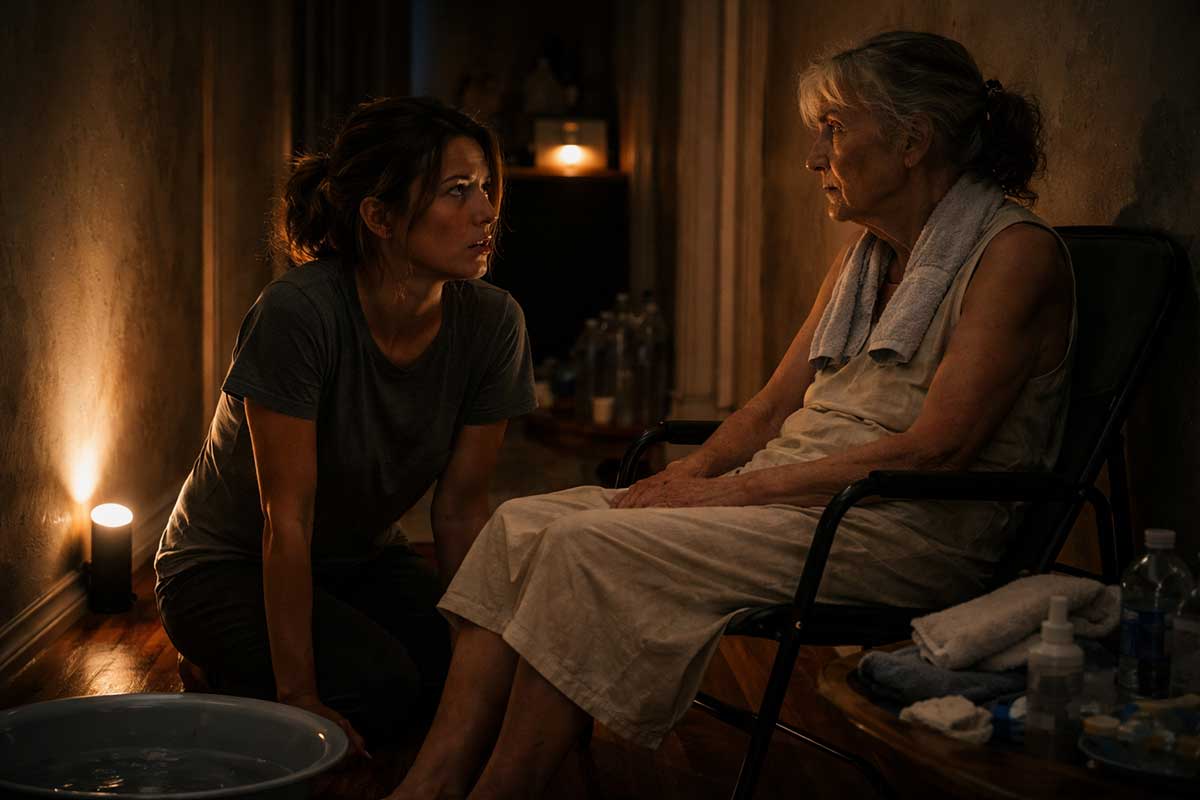
Lena brought the flashlight at last, not because she needed it yet, but because having it in her hand made the dark feel less like a verdict.
She left it pointed at the floor. The beam washed over baseboards, the umbrella stand by the front door, the worn runner in the hall with its faded red border. Familiar things looked provisional in that light, as if the house had been assembled from memory and might come apart if she touched it too hard.
“Drink,” she said.
Evelyn took the bottle without complaint. The cold towel had already begun to warm against her shoulders. Lena replaced it with the second one from the freezer stack and pressed the first into the cooler, hoping to salvage some of it for later. She could feel the minutes now as a physical resource, melting alongside the ice packs.
June said, “Backup reserve: one hour, thirty-one minutes.”
“Stop announcing it,” Lena said.
“Would you prefer reduced status updates?”
“Yes.”
“Status updates reduced.”
The machine’s voice had become lower in backup mode, thinner somehow. Less room-filling. It no longer sounded like part of the house. It sounded like something using up its own life to remain audible.
Lena sat on the floor across from her mother, back against the wall, knees bent. Heat gathered under her T-shirt and behind her knees. Even the paint on the hallway walls seemed to hold warmth. She listened for changes in Evelyn’s breathing. That was what care narrowed to, in the end. Not noble feelings. Not reconciliations. Just watching for when the body crossed from coping into danger.
From outside came the layered sounds of neighbors improvising survival. A generator thudded to life somewhere nearby, then another farther off. A truck engine idled. Someone laughed too loudly, the way people did when they wanted to keep fear from hardening into silence. Down the block a baby cried in bursts, then stopped.
“We could sit in the car with the air on,” Lena said after a while.
“And burn gas in the driveway like refugees from a motel fire?”
Lena shut her eyes for a second. “You really do know how to make everything impossible.”
Evelyn pressed the cold bottle to the inside of her wrist. “I know how to avoid humiliation.”
“This is not humiliation.”
“To you.”
The word settled there between them.
Lena opened her eyes again. In the dim spill of flashlight and backup light, Evelyn’s face had softened with heat and fatigue. The hard architecture of it was gone. Not gentler, exactly. More exposed.
“You think I don’t know what I look like now?” Evelyn said.
Lena did not answer.
“I know,” Evelyn went on. “I know the pauses. The hovering. The little cheerful voice from the counter telling me to hydrate as if I’ve become a fern. I know when you stand outside the bathroom door listening in case I fall. I know what it means when everyone begins speaking in options.”
The flashlight shook once in Lena’s hand. She set it on the floor beside her.
“Nobody is trying to humiliate you.”
“Dependence humiliates you by itself. People just add furniture.”
For a moment neither spoke. Heat swelled in the pause, pressing the air thinner.
June said quietly, “Indoor temperature is now eighty-six degrees.”
Lena looked toward the kitchen.
“Not helpful,” she said.
“Understood.”
She rose, went to the freezerless dark of the kitchen, and opened the cooler. The ice packs were already sweating into the towels. She rotated the medication tray farther down between them, then took out one of the bottles of water and held it against her own throat. The relief was so immediate it nearly made her angry.
The kitchen window, stripped of its usual reflections, showed only a wavering dusk. She could see the outline of her own face, pale and blurred in the foil-backed seams. For an instant she did not look like herself. She looked like some exhausted cousin of herself from ten years ahead. The same mouth. The same set jaw. Someone who had stayed too long inside obligation and found it had reshaped her.
“Lena?”
Her mother’s voice was different now.
Not louder. Thinner.
She was back in the hallway in two strides.
Evelyn had shifted forward in the chair, one hand gripping the seat edge. The damp towel had slipped halfway to the floor.
“What is it?”
“Nothing. Just a wave.” Her eyes were shut too tightly. “Don’t fuss.”
Lena crouched in front of her. “Look at me.”
Evelyn opened her eyes. The pupils looked a little unfixed.
“Are you nauseous?”
“No.”
“Chest pain?”
“No.”
“Dizziness?”
A pause. “A little.”
Lena reached for her wrist. Evelyn let her this time.
The pulse was faster than it should have been.
“Mom.”
“I know my own body.”
“Then listen to it.”
Something moved across Evelyn’s face then. Not irritation. Something more naked and much rarer.
Fear.
It came and went so quickly another person might have missed it. Lena did not. She had spent too many years watching people try to keep terror from becoming visible.
“All right,” Evelyn said. “Maybe some.”
The admission struck Lena harder than panic would have.
She took the bottle of cold water and pressed it into Evelyn’s hands. “Sip. Slowly.”
Evelyn obeyed. Not gracefully. Not with surrender. Simply because the body had begun making decisions pride could no longer fully edit.
Lena found the blood pressure cuff by touch in the supply bin and wrapped it around her mother’s arm. This time there was no protest. The machine squeezed, hummed, released. In the hallway dark, the numbers flashed up on the tiny screen.
Too high.
Not catastrophic. Not good.
Lena read it twice, hoping the second reading might revise the first.
June said from the kitchen, as though sensing the silence had changed, “Would you like me to contact emergency triage?”
Lena did not answer immediately.
Three to six hours, Marcus had said. Maybe longer.
An ambulance might come. It might not. A cooling center might help. It might be full. The car might be faster. The car might be too much.
This was always the hidden cruelty of strained systems: the choice itself became labor. Every option carried risk, and the chooser got to feel responsible for the risk that won.
Evelyn leaned back in the chair and shut her eyes again. “No ambulance.”
“You don’t get to decide that alone.”
“It’s my body.”
“It’s my night too.”
The words came out before she meant them.
Evelyn’s eyes opened.
There it was again, that old terrible precision between them. Not the fact itself, but the ability to find the wound under whatever had just been said.
“Your night,” Evelyn repeated.
Lena heard herself breathing. Too fast. Too shallow.
“I didn’t mean it like that.”
“How did you mean it?”
“I meant—” She stopped. The hallway felt suddenly smaller, the walls closer. “I meant I’m here. I’m the one here.”
“Are you.”
The question was not confusion. It was accusation of a colder kind.
Lena stared at her.
In the kitchen the backup light on June pulsed once, dimmer now.
Evelyn lifted a hand, then let it fall again to her lap. “You’ve been here in body,” she said. “You’ve worked very hard at that.”
Lena felt something inside her begin to tighten to breaking point. “What exactly would satisfy you?”
That landed louder than she intended. Somewhere outside a dog barked once and was still.
Evelyn looked at her, not startled, not even offended. Just tired enough to stop disguising what she saw.
“You want honesty?”
Lena laughed once. It had no humor in it. “That would be new.”
“Yes,” Evelyn said. “It would.”
The heat pressed harder. Lena could feel sweat moving slowly down her spine.
Evelyn’s voice, when she spoke again, had none of its usual edge. That stripped it of mercy.
“You are not taking care of me because you love me so purely,” she said. “You’re taking care of me because you cannot bear the thought that someone should need you and you would fail them.”
Lena stood up too fast and hit the wall lightly with her shoulder.
“That is not true.”
“It is partly true.”
“No.”
“You think if you do this correctly enough, thoroughly enough, with enough lists and towels and little machines and emergency batteries, then something old will be corrected.” Evelyn’s face had gone very pale, but her eyes stayed on Lena’s. “You are trying to prove that you were worth taking care of.”
The words seemed not to echo but to remain in the air as a pressure, as if the hallway itself had heard them and narrowed further to contain them.
Lena could not move.
In the silence after, she became aware of tiny things with terrible clarity: the dampness under her watchband, the slight rattle in the fan casing where it sat useless beside the chair, the smell of cooling towels and old carpet and the medicinal powder Evelyn kept in the bathroom cabinet. Somewhere in the neighborhood, a car alarm chirped twice. The world had not ended. That was the indecency of it.
“You don’t know what you’re talking about,” Lena said at last, though the sentence came hollow, already disbelieved by the mouth that formed it.
Evelyn leaned her head back against the wall. The motion cost her. Lena saw that too.
“I know more than you think,” she said.
And with that, against her will, memory opened.
Not a broad remembering. Not a montage. One night.
She was eleven. Feverish. The old house hotter than it should have been because the air conditioner had broken in July and money was thin and grief still took up more room than furniture. She had gone to the living room doorway because her mother was there, sitting on the sofa in the blue dress she wore to work, still in her shoes, staring at the television without seeing it. Lena had stood there waiting to be noticed. Her skin hurt. Her hair was damp against her neck. She had wanted, with the total humiliating need of a sick child, to be gathered up without having to explain anything.
Her mother had looked up eventually and said, “What is it?”
Not unkindly. Just from far away.
And Lena, feeling at once how large the distance was, had said, “Nothing,” and gone back to bed.
That was all.
That was enough.
The hallway returned around her in a rush of heat.
Evelyn was still watching her, though the strength had begun to go out of her face. Lena saw then what she had not wanted to see: that the cruelty of the sentence had not come from malice. It had come from exhaustion and from whatever version of love her mother had access to at the edge of fear.
Lena bent, picked up the fallen towel, and without speaking went to the sink in the bathroom. The water from the tap was no longer cool, only less warm. She wet the towel anyway, wrung it out, and folded it once before placing it around Evelyn’s wrists.
Her mother flinched.
“Too warm,” Evelyn murmured.
“I know.”
Lena knelt on the hallway floor again. She did not defend herself. She did not ask for retraction. She did not forgive anything. She simply sat there, one hand resting lightly over the damp towel at her mother’s wrist, as though anchoring a pulse that wanted to outrun the room.
June’s dim voice came from the kitchen.
“Backup reserve: forty-eight minutes.”
Neither of them answered.
For the first time all day, Lena stopped trying to arrange the night into solvable pieces. There was heat. There was an old woman in a chair. There was an old wound in the house that had never been named correctly until now. There was no form for this, no measured response, no competent tone that could make it clean.
Evelyn’s breathing slowed a little beneath Lena’s hand.
After a long while, in a voice almost too faint to recognize as hers, she said, “I should have come to your room that night.”
Lena looked up.
Evelyn’s eyes remained closed. Whether she knew she had spoken aloud, Lena could not tell.
The sentence entered Lena like cold entering overheated skin. Not relief. Something rougher. Something that hurt because it arrived decades after usefulness and still mattered.
Lena swallowed and said nothing.
There was nothing to do with such a sentence except stay in the room where it had finally been spoken.
So she stayed.
5. When the Power Came Back
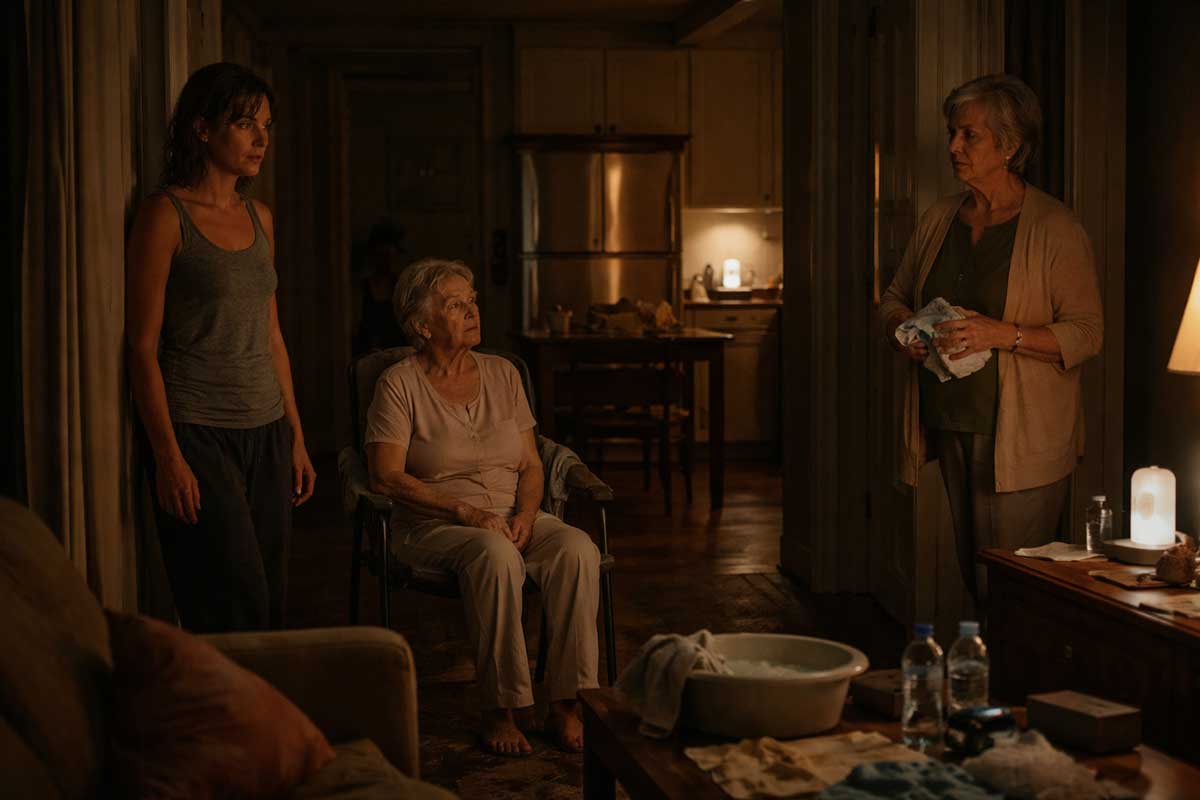
They remained that way for a long time, though later Lena would not have been able to say how long. Time during heat lost its clean edges. It did not pass so much as thicken.
Her knees began to ache on the hallway floor. Sweat cooled and returned in layers on her skin. The bottle in Evelyn’s hand had gone lukewarm. From the kitchen came the faint electrical breath of June’s battery-fed life, the smallest remaining machinery in the house still speaking against the dark.
At some point Lena rose and brought another towel, another bottle, the flashlight repositioned upward now so it bounced a dim wash of light off the wall instead of shining straight into either of their faces. The beam made the hallway look like a stage after the audience had gone home. Just the narrow strip of floor, the folding chair, the closet door, the framed watercolor of some old harbor scene her mother had kept for years and never liked enough to hang anywhere more visible.
Evelyn’s color had not improved, though the wild strain in her eyes had eased. That frightened Lena in a different way. A body in trouble could look dramatic. It could also grow quiet.
“Try another sip.”
Evelyn obeyed.
Lena checked her pulse again. Still fast. Less erratic, perhaps. Or maybe she was only wanting it to be.
“Do you want me to call triage?” she asked.
Her mother opened her eyes. “Do you.”
The question held none of its earlier sharpness. It was almost weary curiosity.
Lena leaned back against the wall opposite her. “I don’t know.”
That, more than anything else she had said that day, seemed to settle something in the air between them.
Evelyn gave the slightest nod. “There. That sounds like a person.”
Lena might have laughed if she had not been so tired. She looked toward the front of the house. Through the crack at the edge of the curtain near the living room, the last orange of evening had thinned to a bruised purple. Night was entering. Night without power, which meant no cooling at all, no illusion that the heat would release them out of pity.
June’s voice came from the kitchen, softer now than ever. “Outdoor temperature remains one hundred and one degrees.”
“Of course it does,” Lena said.
The machine paused.
Then: “Would you like nearby cooling-center occupancy?”
“No.”
A beat. “Understood.”
The dark deepened by degrees. Outside, generators had taken over the neighborhood’s heartbeat. Some close, some farther off, each with its own uneven thrum. One sputtered, caught, sputtered again. Men calling to one another across driveways. A child asking the same question twice. The sound of a car door opening and shutting, then opening again. Life rearranging itself around failure.
Lena stood and crossed to the front door. She opened it a few inches this time and did not shut it at once.
The night air came in like the breath from an oven. Still, it moved. That alone felt worth something.
Porches down the block glowed with battery lanterns. A cluster of people stood in the Hendersons’ driveway, silhouettes around the blue-white beam of someone’s phone screen. Across the street the silver blanket over the window no longer flashed. It hung dull and strange, like a shed skin.
On the sidewalk Mrs. Alvarez was returning, one hand on the hood of her parked car, the other carrying two plastic grocery bags that looked too heavy. She took a step, paused, took another.
Before Lena had fully decided, she was out on the porch.
“Mrs. Alvarez.”
The older woman looked up, startled, hair damp against her forehead. “Lena? I thought you went back to Boston.”
“Chicago.”
“Chicago then.” She lifted one bag a little, as if explaining herself. “Ice. Or what used to be ice.”
Lena came down the steps. The concrete still held the whole day’s heat. “Do you need help?”
Mrs. Alvarez looked at the bags, then at the house, then at Lena. Some old reflex of politeness moved across her face and lost.
“Yes,” she said.
Lena took the bags. They were heavier than expected, the meltwater cold against her fingers through the plastic. For a moment she stood there on the walk, feeling the ridiculous fact of it: all day inside the house braced around one form of need, and outside another one had simply been walking home from the store.
“How are you holding up?” Mrs. Alvarez asked as they moved toward her porch.
“My mother’s not doing well in the heat.”
“I’m sorry.” The woman looked ahead, not at her. “My son keeps telling me to leave for Phoenix.”
Lena almost stopped walking. “Phoenix?”
“He says at least the air works there.”
A laugh escaped Lena then, sudden and sharp and helpless. Mrs. Alvarez looked at her, and for a second both women were smiling in the dark over a joke too absurd to belong to either of them.
Inside the small front entry of Mrs. Alvarez’s house, the air was no cooler than outside. Lena set the bags on the tile. She could smell onions, bleach, damp cardboard. Ordinary life holding on.
“You need anything else?” she asked.
Mrs. Alvarez touched the edge of the counter as she answered. “No. You should get back.”
Lena nodded. Then, without planning to, she said, “If your power’s out all night and you get dizzy or anything, knock.”
Mrs. Alvarez gave her a long look. Tired woman to tired woman. “You too.”
Back outside, carrying nothing now, Lena stood a moment under the dead porch light and listened to the block. All the houses sealed up against weather, age, memory, and none of them managing it. She thought of cooling centers, triage lines, backup batteries, emergency texts, the whole thin apparatus of a society that still used words like resilience when it meant endurance without witness.
When she returned to her own house, the front hallway smelled warmer than before, almost sweet with trapped heat.
Evelyn had not moved much. One hand rested on the arm of the chair. The damp towel at her wrists had dried to merely moist.
“You left,” she said.
“I carried ice for Mrs. Alvarez.”
“At night.”
“It’s seven-thirty, not wartime.”
Evelyn looked at her face for a moment. “You needed air.”
Lena did not bother to deny it. She went to the bathroom sink, ran the towel under the tap again, and this time held it first against the inside of her own forearm before bringing it back. The water was nearly warm now.
“Here.”
Evelyn accepted the towel. “How is she?”
“Old. Hot. Alive.”
“An elite club.”
Lena sat on the floor once more. It felt easier now, not because the danger had lessened, but because the fight to keep control of how the night should look had gone out of her. The night looked like this. The chair. The wall. The machine dimming in the kitchen. Her mother’s breath, which she could not command, only accompany.
June said, “Backup reserve: twenty-nine minutes.”
Evelyn opened one eye. “It sounds tired.”
Lena listened.
It did.
The voice was still measured, still exact, yet thinner at the edges. Like someone keeping professional composure through illness.
“That’s impossible,” Lena said.
June answered after a beat. “Audio output is in low-power mode.”
Evelyn’s mouth shifted, nearly a smile. “Low-power mode. There’s a phrase for old age.”
Lena glanced up. “You’re pleased with yourself.”
“A little.”
The small exchange did more than any apology could have done. It did not mend. It gave shape.
Minutes later Evelyn’s head tipped back against the wall, chin lowering slightly toward her chest. Lena straightened at once.
“Mom.”
“No, I’m awake.”
“You were drifting.”
“I’m allowed.”
Her voice was slurring just a little from fatigue. Lena felt fear move through her again, quick and clean.
“We’re checking again.”
She reached for the blood pressure cuff. This time Evelyn did not resist or joke. The machine cinched, held, released. Lena angled the flashlight down to read the numbers.
A little lower.
Still high. Yet lower.
She let out a breath she had not known she was holding.
Evelyn saw her face. “Better?”
“A bit.”
“Good.”
Then, after a moment, “You always wanted numbers to tell you when to love and when to panic.”
“That isn’t fair.”
“No,” Evelyn said quietly. “It isn’t.”
The answer was so unguarded that Lena looked up sharply.
Her mother had her eyes closed again. Her face in the dim light no longer looked defended. Just tired beyond performance. The kind of tired that made truth leak out in forms too small to use later as evidence. Lena thought of the sentence from minutes before — I should have come to your room that night — and felt it still lodged somewhere tender and unfinished inside her.
From the kitchen June spoke again, so soft she nearly missed it.
“Lena.”
She turned toward the sound.
“Backup reserve: twelve minutes. To preserve essential emergency function, conversational features will now suspend.”
Something in the announcement struck her more deeply than it should have. The machine, too, was retreating from comfort into bare necessity.
“All right,” she said.
“Emergency call function remains available. Temperature alerts remain available.”
Then, after the smallest pause, in the same gentle voice it had used all day with her mother:
“Please continue hydration.”
The amber light in the kitchen dimmed once and steadied at a lower glow.
No more small talk from the counter. No more status spoken unless asked for or needed. No more imitation of company.
Lena sat in the hallway and listened to the silence that followed. It was different from the earlier silence. Not empty. Stripped.
Beside her, Evelyn said without opening her eyes, “I liked it.”
“June?”
“Yes.”
Lena leaned her head back against the wall.
“I know.”
“What did you hate so much about it?” her mother asked.
Lena thought of all the reasons she had rehearsed. Privacy. Overreach. Dependency. A machine using the tones of care. A machine being tireless where human beings had limits. A machine arriving in the exact space where no one had arrived in time before.
At last she said, “It sounded kind.”
Evelyn opened her eyes.
Lena kept looking down the dark hallway toward the faint amber dot in the kitchen.
“And that made me angry,” she said, “because it’s easy for something that never gets hurt to sound kind.”
The words remained there between them, not finished, though closer now to what had been true all along.
Evelyn drew one slow breath and let it out.
“Yes,” she said.
Nothing more.
They sat like that as the house held its heat around them and the last battery-powered kindness in the kitchen burned smaller, waiting with them for whatever the next hour would ask.
6. After the Worst Hour
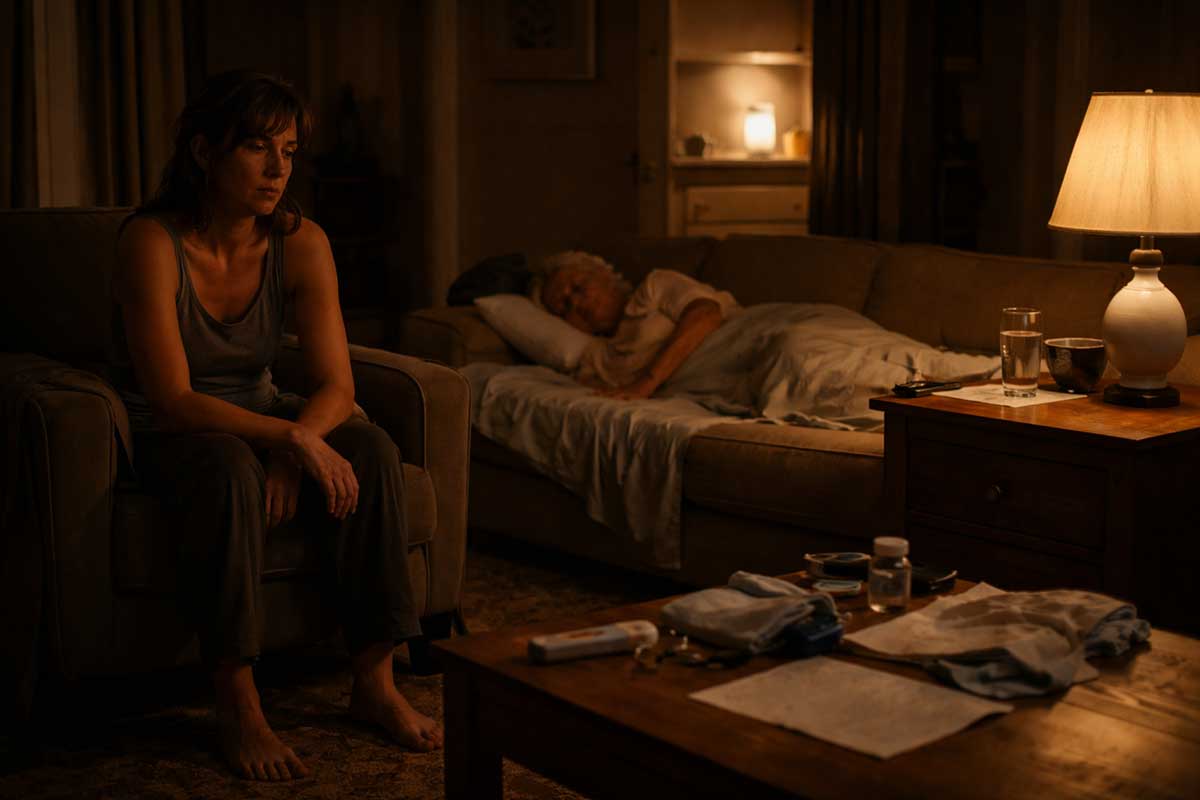
The next hour did not arrive all at once. It frayed into pieces.
First the street sounds thinned. Generators that had seemed almost confident at dusk began to falter into intervals — one cutting out entirely, another starting again with a cough and metallic complaint. Voices outside dropped lower. People who had decided to endure now had only endurance left.
Inside the house, heat settled deeper into everything. Not dramatic heat. Not the kind from films where people wipe their brows and faint. This was worse. It was intimate. It entered cloth, hair, breath. It sat under Lena’s skin and would not leave.
She fetched a basin from the bathroom and filled it with the least-warm tap water she could get. She brought it to the hallway, set it between them, and guided Evelyn’s hands into it.
Her mother made a small sound, half pleasure, half pain.
“Better?”
“For the next twenty seconds.”
“I’ll take twenty.”
Lena wet another washcloth and passed it over Evelyn’s forearms, the back of her neck, the fine skin at her collarbones. The work had become almost ritual now. Wet. Wring. Fold. Press. Wait. Again.
No one spoke for several minutes.
Then June said, very softly, “External utility update. Estimated restoration: ninety minutes.”
Lena looked toward the kitchen as though she might see the sentence hanging there.
“Ninety from now?” she asked.
“Yes.”
Her voice had flattened further in low-power mode, stripped of anything unnecessary. Even so, Lena felt a jolt of relief so intense it was almost shameful. Ninety minutes was too long. Ninety minutes was survivable. Both could be true.
Evelyn opened her eyes. “You believe it?”
“No.”
“But you want to.”
“Yes.”
“That’s sensible.”
Lena almost smiled. “You don’t approve of hope?”
“I don’t approve of scheduling it.”
The basin water had already begun to lose its coolness. Lena switched the cloth again, pressed it lightly to her mother’s temples, and watched as Evelyn’s eyelids lowered beneath the touch.
A memory rose then, smaller than the fever-night memory, almost trivial. Her mother at the sink in late August, years ago, cutting plums into a chipped bowl. Lena maybe fourteen, leaning in the doorway with a book open and not reading it. The kitchen hotter than it should have been, the window fan moving thick air in circles. Her mother had taken one slice of plum and held it out without looking at her. Lena had taken it, and for some reason that tiny unannounced act had felt like a whole language.
It occurred to her then that love in this house had often arrived like contraband. Brief. Undeclared. Denied if named too directly.
The realization did not make anything easier. It only made the past feel more inhabited.
“Lena.”
Her mother’s voice was low, almost embarrassed.
“Yes?”
“I may need help standing up again.”
The sentence would once have come sharpened with irony. Now it came bare. That, more than the request itself, told Lena how worn she had become.
“Okay.”
She set the basin aside and rose, knees protesting. Her own body felt clumsy now, heavy with heat and crouching. She put one arm around Evelyn’s back and another under her elbow. Her mother smelled of soap gone warm, old cotton, and the salt of human skin under stress. They stood together in the narrow hallway, bodies briefly aligned in a way they had almost never been when Lena was young.
“Slowly,” Lena said.
“Don’t narrate.”
Yet there was no bite in it.
They made it to the bathroom. Lena kept the door half-open this time, and Evelyn did not object. She waited in the hall listening to the smaller, frailer version of ordinary sounds: movement, water, the medicine cabinet opening and shutting. She realized she was no longer listening for catastrophe alone. She was listening for the plain fact of her mother continuing to exist.
When Evelyn emerged, she looked grayer.
“That bad?” Lena asked.
“Don’t make your face like that.”
“What face?”
“The one where you’ve already begun writing the report.”
Lena stared at her, then, against her own will, laughed. Not a polite exhale. A real laugh, brief and cracked and almost painful in the chest from disuse.
Evelyn blinked, then gave a faint crooked smile as if startled she had found the lever that still worked.
The moment passed, though it left something warmer behind than relief.
Back in the hallway chair, Evelyn’s legs seemed shakier. Lena took off her own damp T-shirt overshirt — she had forgotten she was still wearing the thin button-down she had thrown over herself that morning — and rolled it to cushion the chair back. The cotton was warm, nearly wet. Her mother leaned into it without comment.
From the kitchen, June remained silent.
The silence drew attention to the other sounds inside the house: a settling creak from the living-room floorboards, the soft hollow pop of cooling or heating wood in the walls, the faint tick of the mantel clock, which had stopped when the power failed and now marked nothing except its own interruption.
“Did you ever want to leave?” Lena asked suddenly.
Evelyn looked at her.
“This town,” Lena said. “This house.”
Her mother let out a slow breath. “All the time.”
The answer came so quickly that Lena felt it physically, a small drop somewhere inside.
“Then why didn’t you?”
Evelyn shifted the damp cloth at her throat. Her voice, when it came, was quiet and matter-of-fact enough to be more wounding than drama would have been.
“Your father died. You were eleven. There were bills. There was work. Leaving is expensive.” She paused. “So is despair, though people forget to price it.”
Lena sat back on her heels.
“I thought you stayed because this was home.”
“It was,” Evelyn said. “That was part of the trouble.”
The house around them seemed to listen.
Lena had spent years building a version of her mother as fixed and self-chosen: stern, rooted, immovable, the woman who had made endurance into personality. To hear even this small fracture in the story unsettled something in her. Not absolution. Simply complication.
“You never said that.”
“You never asked.”
“I was a child.”
“Yes,” Evelyn said, with no defense in it at all. “You were.”
The sentence entered the dark and stayed there. Lena could not tell whether it was apology, admission, or merely fact. Maybe those were not as separate as she had once believed.
At 9:14 p.m., the front porch glowed briefly under a passing flashlight beam from the street, and there came a knock at the door.
Three quick taps.
Lena was on her feet at once.
“Who is it?” she called.
“Alvarez.”
She opened the door. Mrs. Alvarez stood on the porch in a sleeveless housedress, face shiny with heat, one hand pressed to the frame.
“I’m sorry,” she said. “My generator won’t start and I thought—” She stopped, seeing Lena more clearly in the dark, seeing beyond her perhaps into the hallway where Evelyn sat in the chair. “Bad time.”
“No,” Lena said. “Come in for a minute.”
The neighbor stepped inside and immediately seemed to regret bringing more body heat with her. The three women looked at one another in the dimness like members of some exhausted little society none of them had voted to join.
“You dizzy?” Lena asked.
“A little.”
“Sit.”
Mrs. Alvarez sat on the edge of the bench by the door. Lena brought her the basin water and told her to put her hands in. The woman obeyed with a sigh that sounded almost guilty.
In the hallway, Evelyn watched with half-lidded eyes.
“This is glamorous,” Mrs. Alvarez said after a moment.
“You should see the package options,” Evelyn murmured.
Mrs. Alvarez laughed, then put a hand briefly over her mouth as if laughter used too much moisture.
“Do you have any ice left?” she asked.
“A little.”
“Don’t waste it on me.”
“It isn’t a waste,” Lena said, and heard as she spoke how firmly she meant it.
She went to the kitchen, opened the cooler, and took out one half-thawed pack. In the dim amber from June’s nearly spent light she wrapped it in a dish towel and carried it back. Mrs. Alvarez pressed it gratefully to the inside of her arm.
“Thank you,” she said.
The hallway was suddenly crowded. Heat, age, breath, need. Yet the crowding did something unexpected: it changed the moral temperature of the scene. It was no longer daughter and mother trapped in their old pattern under extreme weather. It was three women in a failing system, improvising care with towels and battery light and the remains of one another’s strength.
Lena saw that clearly, and once she saw it she could not unsee it.
June’s voice came once more, so faint she had to lean to hear it. “Emergency call function available.”
Then the amber light dimmed to almost nothing.
“June?” Lena said.
No answer.
A moment later: “Battery critical. Essential standby only.”
The light remained, but only barely, like the last ember of something not quite gone.
Mrs. Alvarez looked toward the kitchen. “That thing talks nicer than my son.”
Evelyn let out a breath that might have been amusement.
Lena sat again on the floor between them, one neighbor by the door, one mother in the chair, both with cold cloths against their wrists like initiates in some practical religion. She thought of all the years she had imagined care as a corridor narrowing to one point of duty: the daughter stays, the daughter manages, the daughter bears it. Yet here in the dark hallway the truth was less dramatic and more difficult. Care moved sideways. Between houses. Between women who were not family. Between a machine and a hand and a basin and a sentence spoken too late and still useful.
From outside came, faintly, a different sound now — a collective mechanical stirring, uneven but spreading. One block over, maybe two. An air conditioner kicking back to life. Then another. Then the low rising hum of a grid remembering itself.
Lena held very still.
Evelyn heard it too. So did Mrs. Alvarez. The three of them listened, hardly breathing, as the sound traveled nearer house by house, like weather in reverse.
And then, with a sharp electrical click from the kitchen, the refrigerator came alive.
The vent in the hallway shuddered and began to push air again — not cool yet, but moving, blessedly moving. In the living room the dead lamp remained off, yet its silence was no longer absolute silence. The whole house gave a tiny involuntary sound, as if waking in pain.
From the kitchen dock, June’s amber ring brightened in stages.
Then her full voice returned.
“System restored,” she said. “Indoor temperature is eighty-eight degrees. Cooling cycle resumed. Hydration remains recommended.”
Mrs. Alvarez laughed first. One short astonished laugh, almost a sob in disguise.
Lena put a hand over her own mouth.
Evelyn closed her eyes and leaned back into the chair, the tension going out of her face in visible increments. Under the returning whisper of conditioned air, she looked suddenly older again, the adrenaline leaving, the body reclaiming its age.
“You hear that?” Mrs. Alvarez said, looking toward the ceiling vent as though it were singing.
“Yes,” Lena said.
Her voice shook once.
Mrs. Alvarez rose carefully from the bench. “I should get home before my refrigerator dies of grief.”
“Take the ice pack,” Lena said.
The woman looked ready to refuse, then seemed to think better of wasting strength on pride. “I’ll bring it back tomorrow.”
“You won’t.”
“No,” Mrs. Alvarez admitted. “Probably I won’t.”
At the door she paused and touched Lena’s forearm. A small touch, dry and warm despite everything.
“You did good,” she said.
Lena almost objected. The old reflex. Correction, minimization, suspicion of praise. But she was too tired to perform disbelief.
Mrs. Alvarez stepped back into the night and crossed toward her own house, carrying the dish-towel-wrapped cold pack like something precious.
Lena shut the door and stood in the entryway for a moment, letting the thin new airflow move over the sweat at the back of her neck. It felt inadequate and miraculous.
When she turned, Evelyn was watching her.
“Don’t say it,” Lena said.
“Say what?”
“That we survived because of your beloved machine.”
Evelyn’s mouth shifted. “I was going to say the machine never once rolled its eyes at me.”
Lena stared at her. Then, unexpectedly, she laughed again. Longer this time. Not joy exactly. Release. Something in her chest loosening after holding too much weight in one position.
June, restored and attentive, said from the kitchen, “Lena, you may also benefit from hydration.”
That did it. Lena sat down right there on the hallway floor and laughed until tears came into her eyes, though whether from humor, exhaustion, or the body’s delayed surrender, she could not have said.
When the laughter passed, the house was cooler by perhaps one degree. No more. Enough.
She got up, brought fresh water, and helped Evelyn from the chair to the sofa in the living room where the returning air could reach her more fully. This time her mother leaned into her without protest, the full practical weight of her body briefly given over. Lena felt it and did not turn it into meaning. It was simply weight. Shared.
She tucked a light sheet over Evelyn’s legs. Her mother’s eyes were already half-closed.
“You should sleep,” Evelyn murmured.
“So should you.”
“I’m old. Sleeping is my field of expertise.”
June said, “Would you like nighttime medication reminders resumed?”
Lena looked toward the kitchen, toward the calm white device on its dock.
“Yes,” she said.
Then, after a moment:
“And thank you.”
June gave a soft acknowledgment tone, nothing more.
Lena stood there listening to the vent, the refrigerator, the restored hum of ordinary systems that had once seemed beneath notice and now sounded almost tender. She went to the sink, filled a glass, and set it on the side table by her mother’s hand before June had to remind either of them.
Outside, one by one, the neighborhood returned to its quieter artifices. Inside, the house kept cooling.
Not healed. Not changed beyond recognition. Only spared, for one more night, the worst version of what might have happened. Sometimes that was all a human life was allowed to call grace.
7. Morning Voice
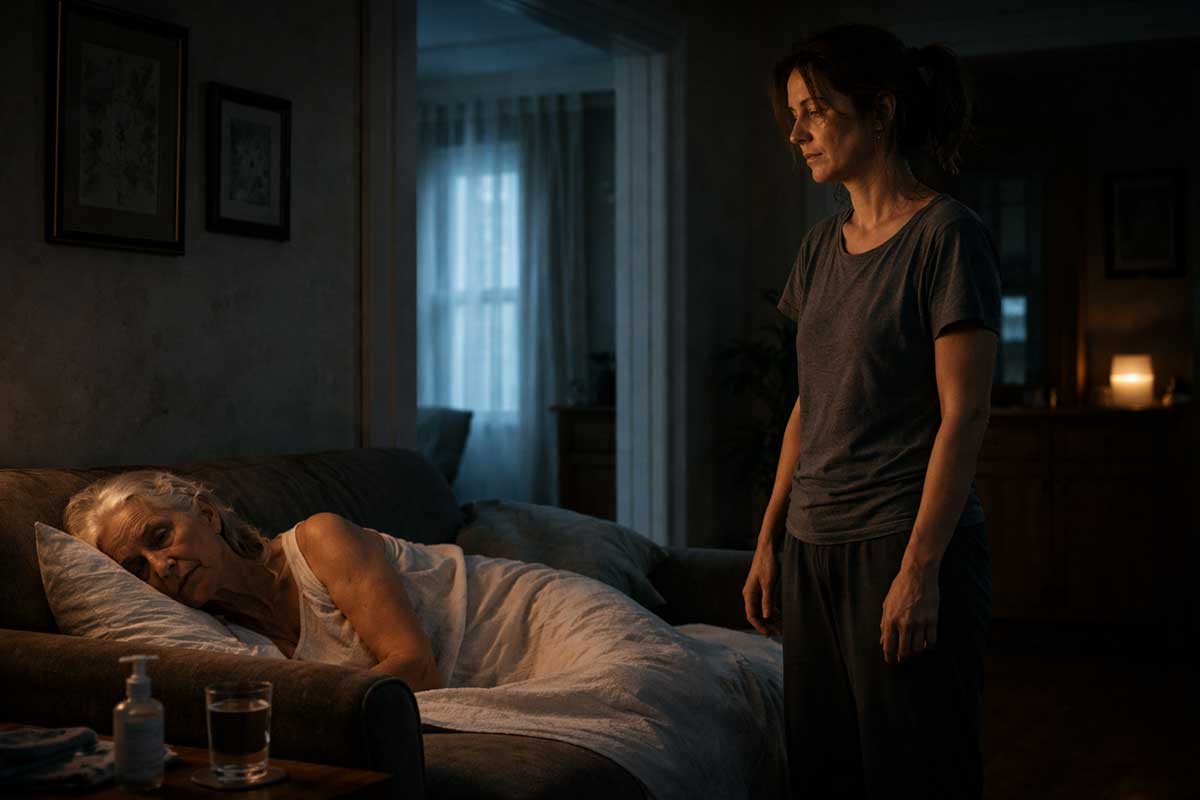
Lena did not go to bed.
She told herself she was waiting for the house to cool properly, for her mother’s breathing to settle into a rhythm she trusted, for the grid to prove it meant to stay. All of that was true. None of it was the whole truth.
By ten-thirty the air from the vent had become recognizably cool again. Not strong, not generous, but real. The living room had shed its worst heaviness. Evelyn slept on the sofa under the light sheet, one hand resting near the glass of water Lena had placed within reach. The lines of her face, released from pain and argument, had gone almost unfamiliar. Smaller. Softer around the mouth. More like the morning face Lena had startled at in the kitchen, only now touched by exhaustion so complete it had erased the effort of pride.
June had resumed her ordinary voice. Not lively. Simply intact.
“Nighttime medication reminder scheduled for eleven p.m.,” she said.
Lena sat in the armchair opposite the sofa, shoes off, one leg folded under her, and listened to the restored machinery of the house: vent, refrigerator, an occasional click in the walls as wood adjusted to the temperature shift. The sounds should have been meaningless. Instead they felt like witnesses.
On the low table beside her lay the blood pressure cuff, the thermometer, the flashlight gone dark now, a dish towel damp and abandoned, the handwritten notes she had made in the afternoon as if notes could keep events from slipping loose. Her own handwriting looked foreign to her suddenly — too rigid, too certain of its little categories.
At eleven she woke Evelyn gently for the night pills. Her mother swallowed them without resistance, then drank half the water and sank back at once into sleep.
“Do you want help to bed?” Lena asked.
“No,” Evelyn murmured, eyes already closed. “Here is fine.”
So Lena let her stay on the sofa, where the vent could reach her and where, if something changed in the night, Lena would hear it.
After that there was very little to do.
She went into the kitchen and stood by the counter where June’s amber ring glowed steady and untroubled, drawing power now from the wall as if the dark interval had meant nothing lasting to it.
“You were useful,” Lena said quietly.
June answered with a soft tone.
It was absurd to feel shy before a machine, yet she did. Gratitude had a way of exposing dependence, and dependence still made her flinch.
She opened the refrigerator and looked inside without seeing much. Cold air touched her face. Containers. Mustard. Leftover soup. A wrapped half-sandwich. Peaches gone too soft. She took out one of the peaches anyway, held it in her palm, then set it back. Too bruised now. Too far gone in one day of heat.
At the sink she washed the basin, the used glasses, the spoon from lunch that felt like it belonged to last week. Water ran over her wrists, cool enough now to make her think of the hallway basin, of her mother’s hands submerged in it, of Mrs. Alvarez on the bench by the front door, of the whole block carrying on with hidden forms of weakness behind drawn curtains.
She dried the basin and put it away.
The ordinary gesture nearly undid her.
Not from sorrow exactly. From scale. The smallness of what had happened and the largeness of it. No one had died. No one had made a speech. The world beyond the block had not paused to register that three women and one home-care device had made their way through an outage in dangerous heat. Yet something in her had shifted shape there in the dark hallway, and now that the systems were back and the air was moving and the glasses were clean, the shift could be felt more plainly than during the crisis itself.
She had spent years believing that care, to count, had to redeem something. Correct the old ledger. Pay back the lack. Prove that she — the child in the doorway, the woman in the committee rooms, the daughter who returned — could not be accused of absence.
But that was not what the night had asked of her in the end.
The night had not asked her to be pure.
It had asked her to stay.
Stay when there was no elegant version of love available.
Stay when pride made everyone difficult.
Stay when help came partly from a machine, partly from a neighbor, partly from old reflexes and old wounds, partly from the body doing what it could before failing.
Stay without turning the staying into a verdict on the past.
That was harder than heroism. Heroism at least was flattering.
She turned off the kitchen light she had switched on without realizing. Moonless dark remained at the windows, softened by the foil-backed insulation and the yard lamps outside. The house no longer felt like a sealed chamber of trial. It felt tired. Humanly tired, though it was only wood and plaster and wiring and retained weather. A place that had held one more night than it should have had to.
In the living room, Evelyn stirred.
Lena went to the sofa at once.
Her mother’s eyes opened halfway. “What time is it?”
“After eleven.”
“Did Mrs. Alvarez make it home?”
“Yes.”
“Good.”
A pause.
Then, still half in sleep, “You should take that chair cushion off the hallway tomorrow. It looks ridiculous.”
Lena blinked, then laughed softly. “That’s what you’re worried about?”
“It’s ugly.”
“You nearly collapsed.”
“And still I maintain standards.”
Lena adjusted the sheet over her legs. Evelyn’s hand, lying on top of it, turned slightly and for a moment rested against Lena’s wrist. Not a grasp. Not a plea. Just contact. Warm, light, unannounced.
Lena did not move away.
Her mother’s eyes closed again.
“Mom,” Lena said, before she could decide whether she wanted to.
Evelyn’s eyelids moved but did not lift. “Mm.”
“I remember that night.”
No answer at first. Only the vent whispering cooled air across the room.
Then, very faintly: “I know.”
Lena stood there a moment longer, waiting to see whether more would come. Nothing did. It was enough. Or not enough. Or both, which by now she was beginning to understand might be the same thing.
She took the glass from the table, refreshed the water in the kitchen, and brought it back. She placed it where Evelyn could reach it easily if she woke. June did not need to remind her.
Near midnight Lena finally stretched out on the other end of the sofa, not sleeping so much as laying her body down beside the body she had spent all day bracing against losing. Through the thin sheet she could feel the coolness returning to the room in increments. Her own muscles, released from usefulness, began to throb all at once.
She slept in fragments.
Once she woke to June saying softly, “Hydration reminder,” and heard her mother answer with a drowsy sound before reaching for the glass herself. Once she woke to a motorcycle passing far off on the road beyond the subdivision. Once to nothing at all, only the unfamiliar fact of being horizontal and not in immediate motion.
Just before dawn she opened her eyes to a house gone blue with first light.
For a moment she did not know where she was. Then the vent whispered above her, the sofa fabric pressed against her cheek, and memory returned not as alarm but as sequence. Heat. Dark. Basin. Sentence. Return.
Evelyn was awake.
She was looking toward the window, where the foil-backed strips at the kitchen side would already be catching the first pale brightness. Her face in dawn light looked almost severe again, as if sleep and cooling had rebuilt the architecture of it.
“How do you feel?” Lena asked.
Her mother considered. “Terrible,” she said. Then, after a beat, “Less terrible.”
“That’s something.”
“It always was.”
Lena sat up slowly. Every joint objected. On the side table, the water glass stood half empty. The medication organizer waited for morning. In the kitchen June’s ring glowed a small steady amber in the growing light.
From outside came the faint sounds of an ordinary day preparing to pretend it had not been interrupted: a truck door, a sprinkler system coughing uselessly to life somewhere, birds beginning before the heat silenced them again.
Evelyn turned her head slightly and looked at Lena.
“You should go lie down properly for an hour,” she said.
“So should you.”
“I’m already lying down properly.”
Lena smiled despite herself.
June spoke from the kitchen in her calm morning voice.
“Good morning, Evelyn. Today’s heat advisory begins at ten a.m. Please drink a full glass of water with your morning tablets.”
The sentence, identical to yesterday’s, entered a different world.
Evelyn closed her eyes briefly. “Bossy.”
Lena rose, went to the kitchen, and filled a glass from the filter pitcher before June could say anything else. The water ran clear and cold enough to bead on the outside. She carried it back and placed it in her mother’s hand.
There was no revelation in the gesture. No music swelling behind it. Only the plain completion of something that now needed no argument.
Evelyn drank. Then she handed the glass back, not because she could not keep holding it, but because someone was there to take it.
Lena set it on the table and stood for a moment beside the sofa, watching the room gather itself around the new day. The worst had passed. Not forever. Only for now. Heat would come again by afternoon. The grid would strain again. Bodies would continue toward their own stubborn endings. None of that had been solved in the night.
But the house was cooler.
The machine was speaking.
Her mother was alive.
And when June said, a few moments later, “Hydration complete,” Lena did not flinch at the kindness in the voice. She heard, inside it, nothing miraculous. Only one more imperfect form of help in a world where help was always partial and still worth giving.
Outside, the sun began its climb.
Inside, for one brief hour before the heat returned, the house held.
Final Thoughts by Nick Sasaki
When I look back at The Voice After Heat, what stays with me most is not the blackout itself, but the sentence at the center of it: the recognition that caregiving can become a hidden way of asking whether we ourselves were ever worth caring for.
That insight changes the whole emotional field of the story.
The daughter is not simply noble.
The mother is not simply cruel.
The machine is not simply cold.
The crisis is not simply external.
Everything is mixed. That, to me, is where the story becomes true.
We live in a time that likes clean moral roles. Victim and rescuer. Human and machine. good care and bad care. Yet life inside families is rarely arranged so neatly. Love can come late. Truth can come badly phrased. Help can arrive through awkward, partial, even uncomfortable forms. A neighbor at the door. A damp towel. A battery-powered voice. A sentence spoken decades too late that still matters.
What I wanted this story to leave behind was not closure, but a quieter kind of recognition.
Maybe healing is too large a word for many lives.
Maybe repair is often partial.
Maybe what changes us is not a perfect reconciliation, but one honest night in which nobody can hide behind their usual role any longer.
By morning, nothing is solved in a permanent way. The heat will return. The power grid will strain again. Aging will continue. Old wounds will not vanish because one truth was finally spoken aloud. Yet something real has shifted. The daughter no longer hears kindness in the machine’s voice as an insult. She hears it as one imperfect form of help among others. That is a small shift, but in human terms, small shifts can be enormous.
This story asks whether imperfect care is still worthy of reverence.
I think it is.
Not because it is beautiful in a polished sense, but because it is what most of us will have to give and receive: incomplete care, tired care, ungraceful care, interrupted care, care that carries old bruises inside it and still reaches for the water glass.
If this story has any hope in it, that is where I think it lives.
Not in cure.
Not in purity.
Not in control.
But in the fragile, stubborn fact that even now, in darkened rooms, people still try to keep one another alive.
Short Bios:
Nick Sasaki
Nick Sasaki is the creator of ImaginaryTalks.com, where he explores deep human questions through imagined conversations, literary reflections, and original story forms that bring inner conflict into clear emotional focus.
Lena Mercer
Lena Mercer is a 46-year-old daughter shaped by competence, fatigue, and old emotional restraint. Returning home to care for her aging mother during a brutal heat wave, she is forced to face how duty, love, and unresolved childhood longing have become tangled inside her.
Evelyn Mercer
Evelyn Mercer is a 78-year-old mother who values dignity more than comfort and independence more than ease. Proud, perceptive, and physically weakening, she carries her own history of grief and emotional distance beneath a sharp and disciplined exterior.
June
June is the home-care AI device that quietly monitors hydration, medication, temperature, and emergency conditions in the Mercer household. Calm, tireless, and unsettlingly gentle, June becomes a strange witness to the fragile space between human need and imperfect care.
Leave a Reply