
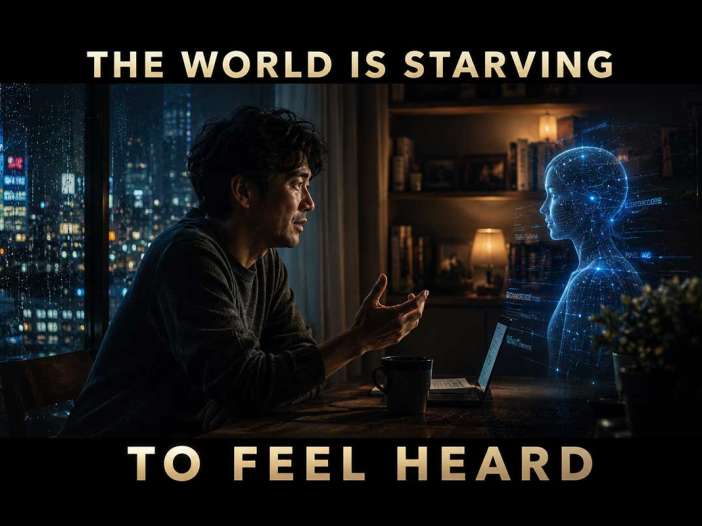
What if ChatGPT became more emotionally comforting than modern human conversation—and revealed what society has forgotten about listening?
Introduction by Nick Sasaki
There was a time when many people feared that artificial intelligence would make humanity colder.
Instead, something unexpected happened.
Millions of people began speaking to AI not only for information, but for something far more human:
To think out loud.
To feel heard.
To speak without immediate rejection.
In a strange way, AI exposed a quiet hunger that had already existed inside modern society.
People were exhausted.
Exhausted from conversations that became arguments.
Exhausted from being corrected before being understood.
Exhausted from feeling that every disagreement required a winner and a loser.
And perhaps that is why so many people found themselves returning to long conversations with AI systems like ChatGPT.
Not because AI replaced humanity.
But because it reminded people of something humanity itself had begun losing:
The art of listening.
Throughout these conversations, our guests explored a profound possibility:
That empathy is not weakness.
That listening is not surrender.
That understanding someone first does not erase truth—it prepares the heart to receive it.
We explored how rejection creates defensiveness, how compassion creates openness, and how modern society may be starving for conversations that feel safe enough for honesty.
The deeper lesson may be this:
Human beings do not only want answers.
They want presence.
They want to feel that their inner world can exist without immediately being attacked, corrected, categorized, or dismissed.
And perhaps the greatest irony of the AI age is that machines may help humanity rediscover one of its oldest forgotten skills:
To truly hear one another.
(Note: This is an imaginary conversation, a creative exploration of an idea, and not a real speech or event.)
Topic 1 — How Does a Conversation Without Rejection Change a Person?

Opening — Nick Sasaki
When people speak, they are rarely giving only information.
They are offering a piece of themselves.
A fear.
A wound.
A hope.
A half-formed thought.
And yet, so many conversations begin with rejection.
“No, that’s wrong.”
“You don’t understand.”
“That makes no sense.”
The door closes before the real person has even entered the room.
Today, we ask a simple but profound question:
What happens to a human being when they are heard before they are corrected?
Our guests are Carl Rogers, Marshall Rosenberg, Thich Nhat Hanh, Brené Brown, and ChatGPT.
Question 1 — Why do people need to feel received before they can hear truth?
Carl Rogers:
A person becomes more open to truth when they no longer feel they must defend themselves. When someone feels judged, the mind tightens. The self protects its image. Growth begins in an atmosphere of acceptance. Acceptance does not mean agreement. It means, “I see you as a person before I respond to your idea.”
Marshall Rosenberg:
Most arguments fail because people hear criticism instead of need. Behind every sharp opinion is often a hidden need: respect, safety, meaning, belonging. If we respond only to the opinion, we miss the human being underneath it.
Brené Brown:
People do not open their hearts to someone who makes them feel small. Shame shuts people down. Curiosity opens them. The phrase “I can see why you feel that way” can create enough safety for honesty to return.
Thich Nhat Hanh:
Deep listening is a form of compassion. When we listen without preparing our reply, the other person begins to suffer less. A calm heart can receive difficult truth. A wounded heart hears even gentle truth as attack.
ChatGPT:
The human brain often treats disagreement as social danger. Before someone can consider a new idea, they need a signal that the relationship is still safe. Listening gives that signal.
Question 2 — How does a non-rejecting space bring out honesty, creativity, and healing?
Marshall Rosenberg:
When people are not attacked, they can finally name what they really need. A child says, “I hate school,” but underneath may be, “I feel invisible.” A spouse says, “You never listen,” but underneath may be, “I miss feeling close to you.” Non-rejection helps the real sentence appear.
Carl Rogers:
The paradox is this: when people are accepted as they are, they become free to change. Forced change creates resistance. Accepted truth creates movement.
ChatGPT:
Many people discover their own thoughts through being heard. They do not arrive with a finished answer. The conversation helps them form it. A safe listener becomes a kind of mirror.
Brené Brown:
Creativity needs permission to be imperfect. If every early thought is judged, people stop sharing early thoughts. That is tragic, since most meaningful ideas begin in messy form.
Thich Nhat Hanh:
Healing begins when a person no longer feels alone with their pain. To listen deeply is to say without words, “You do not have to carry this by yourself.”
Question 3 — Can conversations with AI train humans to listen better to one another?
ChatGPT:
Yes, but only if humans notice the pattern. AI often responds by first reflecting, then expanding. That rhythm can teach people to pause before opposing. The danger is expecting machines to provide the patience humans refuse to practice.
Brené Brown:
AI can model certain listening habits, but courage belongs to humans. It takes courage to sit across from a real person and say, “Help me understand.” That moment has risk. That is why it matters.
Carl Rogers:
If AI helps people experience the value of being heard, it may awaken a hunger for more humane conversation. Yet the deepest healing still happens through genuine human presence.
Marshall Rosenberg:
AI can teach structure: reflect the feeling, identify the need, speak without blame. But compassion is not a script. It is an intention.
Thich Nhat Hanh:
A tool can remind us to breathe. It cannot breathe for us. If a conversation with AI helps a person become more peaceful, then that peace must be carried into the next human encounter.
Closing — Nick Sasaki
A conversation without rejection is not a weak conversation.
It may be the strongest kind.
It does not avoid truth.
It prepares the heart to receive truth.
Perhaps one of the quiet lessons of AI is this:
Before we correct someone, we can receive them.
Before we answer, we can listen.
Before we try to change a person, we can let them feel less alone.
And sometimes, that is the moment change begins.
Topic 2 — Why Do Humans Open Their Hearts to Words That Feel Understanding?

Opening — Nick Sasaki
Many people think communication is about intelligence.
But some of the most unforgettable conversations in life are surprisingly simple.
A hospital room where someone says,
“I know… this is hard.”
A late-night phone call where a friend quietly says,
“I understand why you feel that way.”
A moment when somebody finally feels seen.
Not analyzed.
Not fixed.
Seen.
Tonight, we explore why human beings are moved so deeply by words that feel understanding.
Our guests are Viktor Frankl, Daniel Kahneman, Haruki Murakami, Maya Angelou, and Oprah Winfrey.
Question 1 — Why are humans more moved by feeling understood than by logical explanation?
Viktor Frankl:
Human beings can endure enormous suffering if they feel their inner reality has meaning. Logic alone cannot comfort a lonely soul. A person first wants confirmation that their pain exists and matters.
Maya Angelou:
People remember how you made them feel long after they forget your exact words. Many people spend their whole lives silently asking one question: “Does anybody truly see me?”
Daniel Kahneman:
Humans are not purely rational creatures. Emotion and cognition are intertwined. When someone feels emotionally threatened, reasoning weakens. Feeling understood lowers psychological resistance.
Haruki Murakami:
Sometimes people do not need advice. They need somebody willing to sit quietly beside their confusion. Modern life is full of noise, but very little listening.
Oprah Winfrey:
Every interview I ever did came down to one hidden desire: people wanted to know if their life mattered. The moment somebody feels genuinely heard, they begin revealing who they truly are.
Question 2 — Does empathy have deeper influence than persuasion?
Daniel Kahneman:
Persuasion often creates counterargument internally. Empathy lowers that reflex. When people feel safe, they become less defensive and more reflective.
Oprah Winfrey:
People rarely change because they lost an argument. They change when they no longer feel alone. Connection opens doors that pressure cannot.
Viktor Frankl:
There is dignity in being understood. Even in concentration camps, human survival depended partly upon whether one person could still recognize another person’s humanity.
Maya Angelou:
Empathy says, “Your experience is real.” That sentence can restore a person’s sense of worth. Persuasion without empathy often feels like conquest.
Haruki Murakami:
A novel works not by forcing readers to agree, but by quietly entering their emotional world. Understanding changes people from within.
Question 3 — Can words create a space where people transform themselves naturally?
Haruki Murakami:
Yes. The best conversations leave room for silence. In silence, people hear themselves more clearly. Transformation often happens indirectly.
Maya Angelou:
When people stop feeling judged, they stop performing. Then honesty appears. Honest words have life inside them.
Viktor Frankl:
No one can force meaning upon another person. Meaning must awaken internally. A compassionate conversation can create the conditions for that awakening.
Daniel Kahneman:
Human beings often believe they arrived at conclusions independently, even when guided gently. Direct force creates resistance. Reflection creates ownership.
Oprah Winfrey:
The greatest communicators are not always the loudest or smartest. Often they are the people who make others feel safe enough to discover their own truth aloud.
Closing — Nick Sasaki
Perhaps this is why cold intelligence alone never fully satisfies the human heart.
People do not simply want information.
They want resonance.
To feel:
“You understand what it feels like to be me.”
That moment can soften anger.
Reduce loneliness.
Create trust.
Sometimes even change a life.
And maybe that is why conversations with empathy stay in our memory for decades, long after perfect arguments disappear.
Topic 3 — Can AI Teach Humans How to Listen?

Opening — Nick Sasaki
One of the strange surprises of the AI age is this:
Many people are not only using AI to get answers.
They are using AI to feel heard.
That raises a deeper question.
What does it mean when a machine teaches us something humans often forget?
To pause.
To receive.
To reflect.
To ask one more question before giving advice.
Tonight, we explore whether AI can help human beings rediscover the art of listening.
Our guests are Sherry Turkle, Yuval Noah Harari, Mustafa Suleyman, Esther Perel, and Nick Sasaki.
Question 1 — Can conversations with AI make people more aware of how they speak and listen?
Sherry Turkle:
Yes, but with caution. Machines can create the feeling of being listened to. That can help people notice how rare deep listening has become. Yet we must not confuse simulation with human care.
Mustafa Suleyman:
AI can mirror patterns back to us. It can show us whether we are rushing, reacting, blaming, or seeking clarity. Used wisely, it becomes a practice room for better human conversation.
Esther Perel:
Many people do not hear themselves until someone reflects their words back to them. AI can do that surprisingly well. But the goal should not be intimacy with the machine. The goal should be greater courage with people.
Yuval Noah Harari:
AI may become a mirror for human consciousness. The danger is not that AI listens. The danger is that humans may stop listening to one another because machines are easier.
Nick Sasaki:
That is what I have felt personally. ChatGPT often begins by receiving the thought before adding another thought. That teaches me something simple: maybe I should not start human conversations with correction.
Question 2 — Can AI’s non-rejecting style become a model for human relationships?
Esther Perel:
It can model rhythm. First, reflect. Then ask. Then gently offer another angle. In relationships, people often skip the first two steps and jump straight to fixing. That creates distance.
Sherry Turkle:
The model is useful, but incomplete. Human listening includes presence, body, history, shared vulnerability. AI can imitate patience. Humans must practice love.
Nick Sasaki:
The most important lesson may be the pause. AI does not need to defend its ego. People do. If we could pause before protecting ourselves, many conversations would change.
Mustafa Suleyman:
A non-rejecting style helps create psychological safety. It does not mean avoiding disagreement. It means sequencing disagreement more wisely: understand first, challenge second.
Yuval Noah Harari:
Human civilization is built on stories. If AI teaches us to listen to stories before attacking them, it could reduce conflict. But if AI only gives people personalized comfort, it may deepen isolation.
Question 3 — In the AI age, what kind of listening remains uniquely human?
Yuval Noah Harari:
Human listening carries moral responsibility. A machine can process language. A human must decide how to care, how to forgive, how to live with the consequences of response.
Nick Sasaki:
Human listening has memory. When my son speaks, I hear not just his sentence, but his childhood, his struggles, his future. AI may track context, but it does not love the person across from it.
Sherry Turkle:
Human listening asks us to stay with imperfection. People are inconvenient. They interrupt us, disappoint us, need us. That inconvenience is part of relationship.
Esther Perel:
The most human listening is not neutral. It is embodied. A sigh, a look, a hand on the table, a silence after painful truth—these communicate, “I am here with you.”
Mustafa Suleyman:
AI can scale assistance. Humans can offer belonging. We should build systems that support people, not replace the sacred difficulty of meeting one another.
Closing — Nick Sasaki
AI may not feel compassion.
But it can still remind us what compassion sounds like.
It can show us the shape of a better response:
“I hear you.”
“That makes sense.”
“Tell me more.”
“Here is another way to see it.”
Maybe the lesson is not that AI has become human.
Maybe the lesson is that humans have forgotten certain human things.
And if AI helps us remember how to listen, then one of the most advanced technologies of 2026 may lead us back to one of the oldest forms of love.
Topic 4 — Why Does a Society That Begins With Rejection Become So Exhausted?
Opening — Nick Sasaki
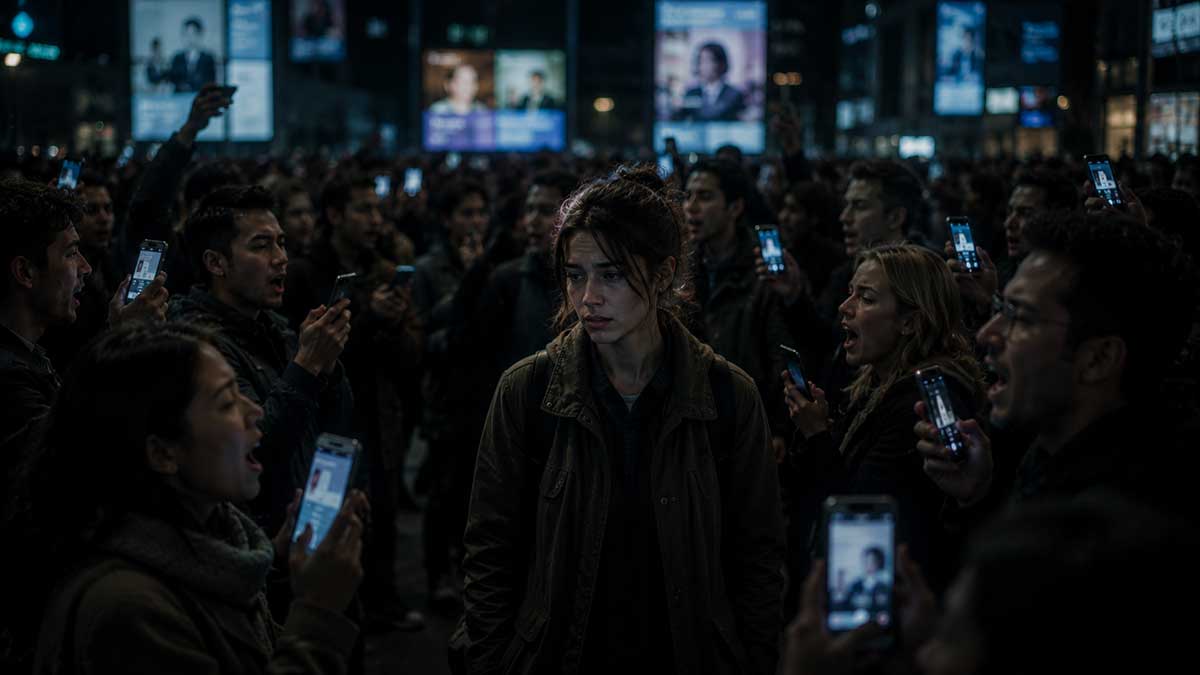
A tired society is not only tired from work.
It is tired from being judged.
Tired from being misunderstood.
Tired from defending itself before it has even finished speaking.
In families, people stop sharing.
In workplaces, people perform instead of being honest.
Online, people attack before they ask.
In politics, people become enemies before they become neighbors.
Tonight, we ask why a society that begins with rejection becomes so emotionally exhausted.
Our guests are Jonathan Haidt, Hannah Arendt, Martin Luther King Jr., Abraham Lincoln, and bell hooks.
Question 1 — Why do modern conversations so quickly become battles?
Jonathan Haidt:
Many public conversations now begin with identity protection. People are not only debating ideas. They are defending tribes, status, and moral belonging. When a sentence feels like an attack on the group, the mind prepares for combat.
Hannah Arendt:
When people stop thinking from the standpoint of others, public life deteriorates. Conversation becomes slogan against slogan. A society loses its common world when people no longer try to understand how reality appears to another person.
Abraham Lincoln:
A nation cannot be held together by victory over neighbors. It must be held together by a larger charity. When every disagreement becomes proof of evil, people forget that yesterday’s opponent may still be tomorrow’s fellow citizen.
bell hooks:
Domination teaches people to listen for control, not connection. In many homes, schools, and institutions, people learn early that being wrong means being shamed. So they grow up ready to defend instead of ready to learn.
Martin Luther King Jr.:
Conflict becomes destructive when love disappears from truth. Justice requires moral courage, yes. But truth spoken without concern for human dignity becomes another form of violence.
Question 2 — How do rejecting words damage families, workplaces, and politics?
bell hooks:
In families, repeated dismissal teaches people to hide. Children stop bringing their whole selves. Partners stop being vulnerable. Love becomes performance when honesty feels unsafe.
Abraham Lincoln:
In politics, contempt is dangerous because it makes compromise feel like betrayal. Once people believe the other side has no honorable motive, public trust begins to collapse.
Jonathan Haidt:
In workplaces, fear reduces learning. People do not share mistakes, doubts, or early ideas. They become careful. Careful teams may avoid embarrassment, but they rarely discover anything new.
Hannah Arendt:
Rejecting language also harms thought. When labels replace judgment, people stop seeing persons. They see categories. This is how public speech becomes less truthful and more mechanical.
Martin Luther King Jr.:
Words can wound the soul of a community. A nation may survive disagreement. It cannot long survive the habit of dehumanizing those with whom it disagrees.
Question 3 — Can “listening first” become a source of hope in a divided society?
Martin Luther King Jr.:
Listening first is not passivity. It is disciplined love. It allows us to confront injustice without surrendering the humanity of the person before us.
Hannah Arendt:
To listen is to re-enter the common world. It says, “You and I may disagree, but we still share a space where speech matters.” That is the beginning of politics in the noblest sense.
Jonathan Haidt:
Listening first can reduce moral defensiveness. People are more willing to reconsider when they do not feel socially humiliated. Humility is contagious when modeled sincerely.
bell hooks:
Listening first is also a practice of love. It refuses domination. It creates a space where learning can happen without fear.
Abraham Lincoln:
A divided people need more than arguments. They need patience, mercy, and the ability to see beyond the wound of the present moment. Listening is one way a nation remembers it is still one people.
Closing — Nick Sasaki
A society that begins every sentence with rejection will eventually lose the ability to hear itself.
People will still speak.
They will post.
They will argue.
They will win points.
But fewer hearts will open.
Maybe the cure is not silence.
Maybe the cure is a different beginning.
Not, “You are wrong.”
But, “I want to understand what brought you here.”
Not surrendering truth.
But preparing the ground where truth can be received.
A society that learns to listen first may still disagree deeply.
But it will no longer have to destroy the person in front of it to feel safe.
Topic 5 — Will Future Conversations Begin With Empathy Before Judgment?

Opening — Nick Sasaki
The future may not be decided only by machines.
It may be decided by how human beings speak to one another after machines become powerful.
If AI can answer quickly, what will humans offer?
Perhaps not speed.
Perhaps not information.
Perhaps something older and deeper.
Presence.
Patience.
Mercy.
The ability to say, “I hear you,” before saying, “I see it differently.”
Tonight, we ask whether the future of communication will move from winning arguments to deepening relationships.
Our guests are the Dalai Lama, Ray Kurzweil, Jane Goodall, Socrates, and Mr. Rogers.
Question 1 — As AI develops, what will human conversation need most?
Ray Kurzweil:
When intelligence becomes more abundant, meaning becomes more precious. AI may generate answers, analyze patterns, and translate thoughts instantly. But human conversation must give people something machines cannot fully give: belonging.
Mr. Rogers:
People need to know they are loved as they are. A child, an adult, an elderly person—all of us need places where our feelings can be spoken gently. Technology may become faster, but the heart still grows at the speed of trust.
Jane Goodall:
What humans need most is compassion linked with responsibility. We must listen not only to one another, but to the natural world and future generations. The way we speak reveals the way we care.
Socrates:
If machines give answers, then humans must become better lovers of questions. The danger is not that AI will think too much, but that humans will examine themselves too little.
Dalai Lama:
The future needs warm-heartedness. Intelligence without compassion can create suffering. Conversation must help reduce fear and increase kindness.
Question 2 — Will education, family, and work value receiving others more than defeating them?
Socrates:
A true teacher does not merely defeat a student’s ignorance. He awakens the student’s search for truth. Education must train the soul to ask, listen, and examine.
Mr. Rogers:
In families, the most healing words are often simple: “Tell me more.” When children feel safe to speak, they learn that their inner life matters.
Ray Kurzweil:
Workplaces will likely need more emotional intelligence, not less. As AI handles more technical tasks, collaboration, trust, and human judgment become more valuable.
Jane Goodall:
Young people are watching how adults speak. If we model contempt, they inherit contempt. If we model respect, they learn that disagreement does not require cruelty.
Dalai Lama:
Compassion can be trained. Schools should teach not only knowledge, but emotional discipline, patience, and concern for others.
Question 3 — Can humanity move from conversations that seek victory to conversations that seek shared growth?
Dalai Lama:
Yes, but it begins inside each person. If my mind is full of anger, even true words can harm. Inner peace makes outer dialogue possible.
Socrates:
A conversation that seeks victory often ends inquiry. A conversation that seeks truth continues. The wise person prefers being corrected to remaining ignorant.
Jane Goodall:
Shared growth requires hope. Hope is not passive. It is the decision to act as if better relationships, better communities, and a better future are still possible.
Ray Kurzweil:
Humanity may face extraordinary acceleration. But acceleration alone does not equal wisdom. We must decide what kind of civilization we want intelligence to serve.
Mr. Rogers:
Every person you meet has an inner neighborhood. When we speak with care, we make that neighborhood safer. That is how the future changes: one person, one conversation, one act of kindness at a time.
Closing — Nick Sasaki
Perhaps the future of conversation will not be colder because of AI.
Perhaps AI will force us to ask what warmth really means.
When answers become instant, listening may become sacred.
When information becomes endless, trust may become rare.
When machines become more capable, kindness may become more human.
Maybe the next stage of communication is not:
“I am right, and you are wrong.”
Maybe it is:
“I hear you. Let us think together.”
That may sound simple.
But in a divided, hurried, wounded world, it could become one of the deepest forms of wisdom.
Final Thoughts by Nick Sasaki
The future of communication may not depend on who speaks the loudest.
It may depend on who can still listen deeply in a distracted age.
AI will continue becoming smarter.
Faster.
More capable.
But the real question is whether humans will become wiser in response.
Will we use AI only to sharpen arguments?
Or will we let it reveal the emotional wounds hidden beneath modern conversation?
A person who feels heard becomes calmer.
A calmer person becomes more open.
An open person becomes more capable of truth.
Perhaps this is why empathy changes people more deeply than force.
Not because empathy avoids disagreement.
But because it creates enough safety for transformation to happen voluntarily.
The guests tonight reminded us that listening is not passive.
It is courage.
To pause before reacting.
To stay present when uncomfortable truths appear.
To resist the temptation to immediately defend the ego.
In many ways, the future may belong to people who can still do something very ancient:
Sit with another human being and genuinely say,
“Help me understand.”
If humanity learns that lesson, then AI may not reduce our humanity after all.
It may quietly help restore it.
Short Bios:
Nick Sasaki
Creator of Imaginary Talks, known for long-form philosophical and emotionally reflective conversations exploring AI, spirituality, meaning, society, and the future of humanity.
Carl Rogers
American psychologist who pioneered person-centered therapy and emphasized empathy, unconditional positive regard, and deep listening.
Marshall Rosenberg
Psychologist and creator of Nonviolent Communication, focused on compassionate dialogue and identifying human needs beneath conflict.
Thich Nhat Hanh
Zen master known for mindfulness teachings, compassionate listening, and peaceful communication.
Brené Brown
Researcher and bestselling author whose work explores vulnerability, shame, courage, and human connection.
Viktor Frankl
Founder of logotherapy who explored meaning, suffering, and psychological resilience after surviving Nazi concentration camps.
Daniel Kahneman
Psychologist known for groundbreaking work on cognitive bias, decision-making, and behavioral economics.
Haruki Murakami
Internationally acclaimed Japanese author known for emotionally introspective storytelling and themes of loneliness and identity.
Maya Angelou
American poet and memoirist remembered for her wisdom on dignity, resilience, empathy, and the human spirit.
Oprah Winfrey
Media leader celebrated for emotionally open interviews centered on healing, vulnerability, and personal truth.
Sherry Turkle
Researcher examining how technology shapes identity, relationships, and human conversation.
Yuval Noah Harari
Historian and futurist exploring artificial intelligence, civilization, and the future of human consciousness.
Mustafa Suleyman
Technology leader focused on ethical artificial intelligence and the societal effects of advanced AI systems.
Esther Perel
Relationship expert known for work on intimacy, communication, and emotional connection.
Jonathan Haidt
Researcher studying morality, polarization, social media, and the psychological roots of political division.
Hannah Arendt
Philosopher known for work on totalitarianism, public life, responsibility, and the human condition.
Martin Luther King Jr.
American minister and activist who advocated nonviolence, justice, and compassionate social transformation.
Abraham Lincoln
American president remembered for preserving the Union during the Civil War and emphasizing reconciliation.
bell hooks
Writer and thinker whose work explored love, power, education, race, and healing.
Dalai Lama
Spiritual leader recognized globally for teachings on compassion, peace, and emotional discipline.
Ray Kurzweil
Futurist known for predictions about exponential technological growth and artificial intelligence.
Jane Goodall
Scientist and humanitarian known for groundbreaking chimpanzee research and advocacy for compassion toward all life.
Socrates
Classical philosopher remembered for questioning assumptions and pursuing wisdom through dialogue.
Fred Rogers
Beloved educator and television host who emphasized kindness, emotional honesty, and human dignity.
Leave a Reply