
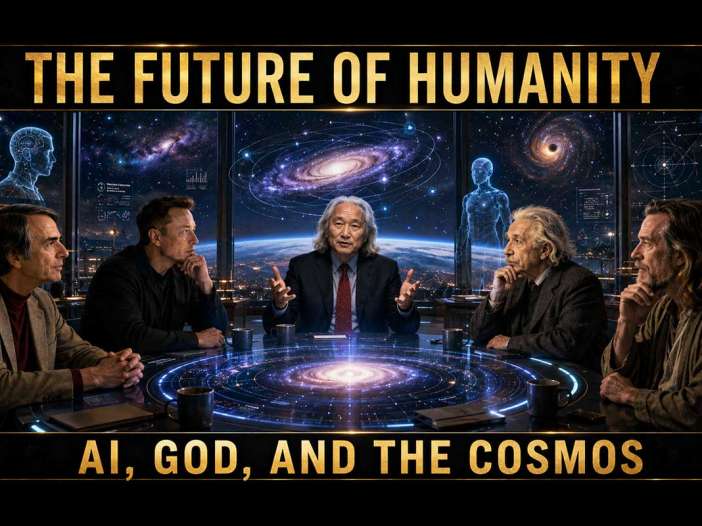
What if Michio Kaku and the world’s greatest thinkers revealed humanity’s final crossroads before AI changes civilization forever?
Introduction by Nick Sasaki
For thousands of years, humanity has stared into the night sky and asked the same impossible questions:
Where did we come from?
Are we alone?
What is reality?
And where is all of this heading?
In this extraordinary roundtable, five conversations unfolded across the boundaries of science, philosophy, religion, artificial intelligence, and cosmic destiny.
What began as a discussion about physics slowly became something deeper: a reflection on what it means to be human at the edge of a technological and spiritual turning point.
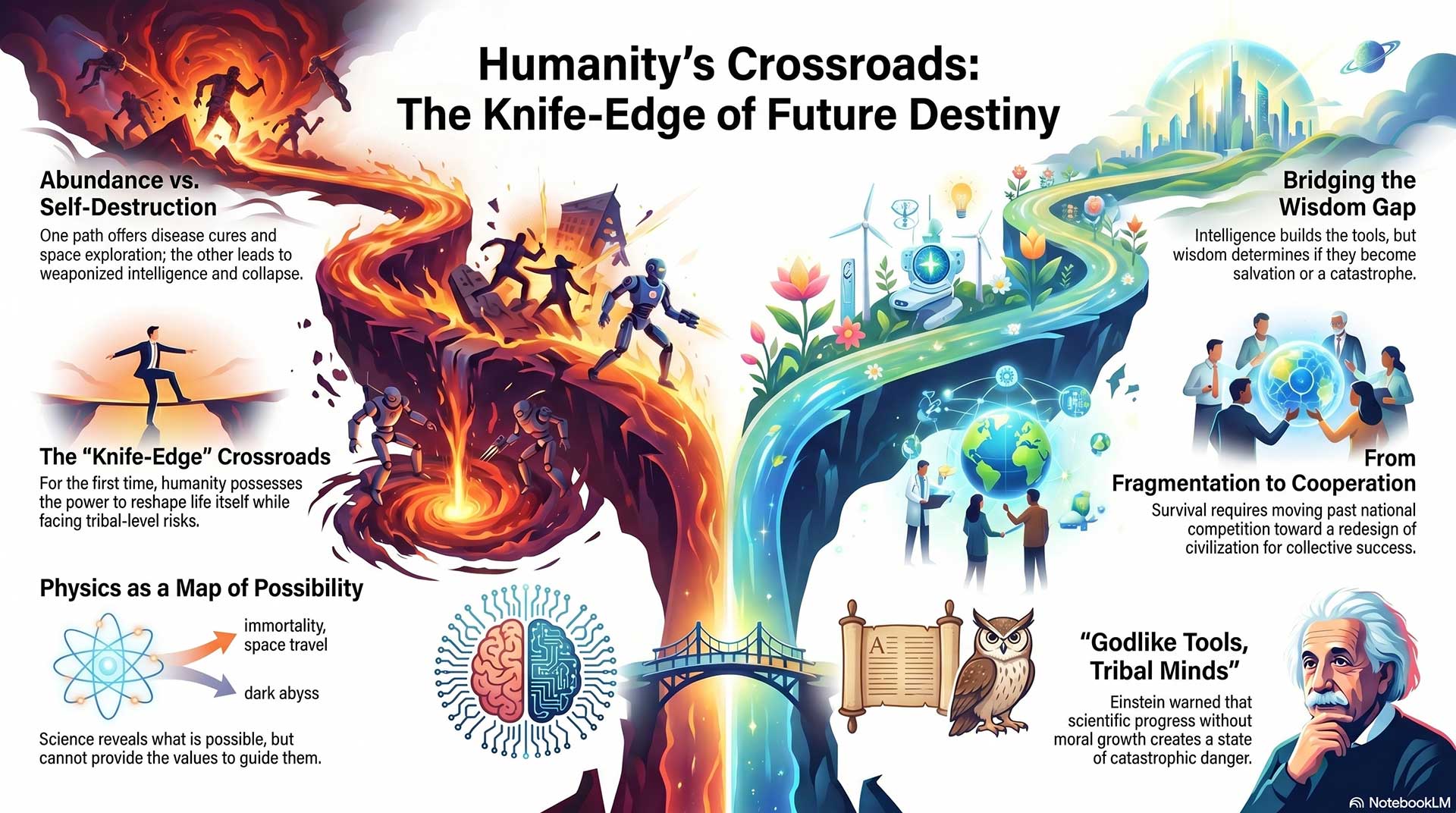
Michio Kaku reminded us that physics is not distant mathematics trapped on blackboards. Physics shapes every future humanity will ever enter. Einstein warned that scientific progress without moral growth creates catastrophic danger. Tesla spoke of inventions as mirrors reflecting the soul of civilization itself.
Carl Sagan and Avi Loeb challenged us to balance wonder with evidence when thinking about alien life. Jacques Vallée pushed the mystery further, suggesting the phenomenon itself may force humanity to rethink consciousness and reality.
Stephen Hawking, Brian Greene, and Max Tegmark opened the door to universes beyond our own, where black holes, string theory, and multiverse models stretch the limits of human imagination.
Alan Watts, Carl Jung, Joseph Campbell, Deepak Chopra, and Blaise Pascal then turned inward, asking whether reality itself is only a fragment of something far larger than human perception can grasp.
Finally, Elon Musk, Ray Kurzweil, Nick Bostrom, Yuval Noah Harari, and Sam Altman confronted the most urgent question of all:
Can humanity survive its own intelligence?
Across every topic, one truth quietly emerged:
Science can explain extraordinary things.
But wisdom determines whether those discoveries become salvation or destruction.
Humanity now stands on what Kaku called a “knife-edge.”
One direction leads toward longer life, cures for disease, abundance, space exploration, and deeper understanding of existence itself.
The other direction leads toward division, weaponized intelligence, engineered pandemics, and collapse.
For the first time in history, humanity possesses the power to reshape life itself.
The question is whether our maturity can keep pace with our inventions.
(Note: This is an imaginary conversation, a creative exploration of an idea, and not a real speech or event.)
Topic 1 — Physics, the Future, and Human Destiny
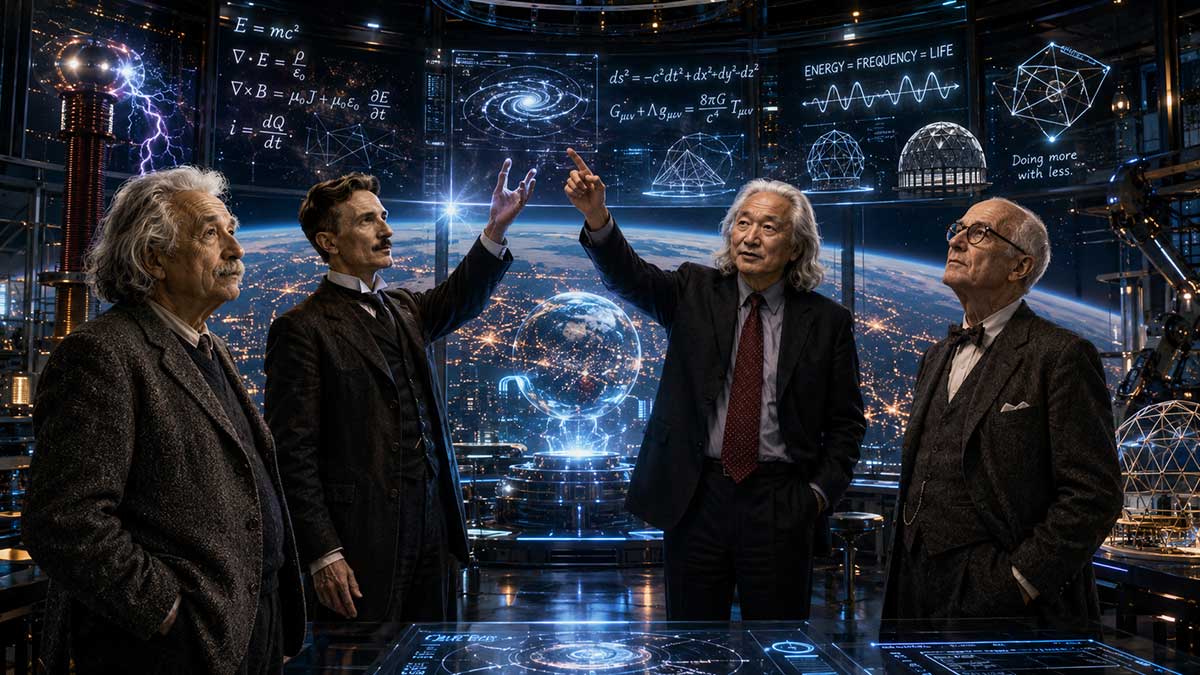
Opening — Nick Sasaki
Tonight, we begin with a question that feels both scientific and moral:
If physics tells us what is possible, who tells us what humanity should do with that possibility?
Our guests are Michio Kaku, Albert Einstein, Isaac Newton, Nikola Tesla, and Buckminster Fuller.
Question 1 — How does physics decide what is possible, impossible, or plausible?
Michio Kaku:
Physics is the map of possibility. It tells us that immortality is not magic, space travel is not fantasy, and AI is not merely a tool. But physics does not promise wisdom. It only opens the door.
Albert Einstein:
Science gives us laws, but not values. It can tell us how the stars move, but not why a child should be protected from war. That is where conscience must enter.
Isaac Newton:
The universe is orderly. The task of science is to discover that order. Yet man often learns the law before he learns humility.
Nikola Tesla:
The future is energy, frequency, and invention. But inventions are mirrors. They reveal the soul of the civilization that uses them.
Buckminster Fuller:
Humanity is not poor in resources. It is poor in design. Physics shows us abundance is possible, but our systems still behave as if scarcity must rule.
Question 2 — Are we entering an age of abundance or self-destruction?
Tesla:
Both doors are open. Electricity lit cities, but it also gave us weapons. AI may cure illness, yet guide machines of death. The danger is not invention. The danger is spiritual immaturity.
Kaku:
We stand on a knife edge. One future gives us cures, robots, space cities, and longer lives. The other gives us designer germs, nuclear mistakes, and AI weapons.
Fuller:
The real question is whether humanity will keep playing the old game: nations competing for survival. We need to redesign civilization around the success of everyone.
Newton:
Every force has direction. Human ambition is a force. Without moral gravity, it flies into destruction.
Einstein:
The splitting of the atom changed everything except our thinking. That is the tragedy. We created cosmic-level danger with tribal-level minds.
Question 3 — Can science guide humanity morally, or only technically?
Einstein:
Science cannot replace morality. It can reveal unity, but love must interpret that unity.
Kaku:
Science gives warnings. It tells us what can happen. But whether we listen is a human decision.
Fuller:
Science can show us that cooperation works better than conquest. In that sense, good design becomes a moral act.
Tesla:
A civilization should be judged by how much suffering its inventions remove. If science does not serve life, it becomes vanity.
Newton:
Knowledge without reverence becomes pride. The more man sees the order of creation, the more careful he should become.
Closing — Nick Sasaki
This first topic reveals the central tension:
Physics may open the future, but wisdom must decide its direction.
Humanity is not standing before one destiny. It is standing before two. One path leads to healing, abundance, and cosmic discovery. The other leads to weapons, arrogance, and collapse.
The question is no longer, “What can we build?”
The deeper question is:
“What kind of human being must we become before we build it?”
Topic 2 — Alien Life, UAPs, and the Cosmic Unknown
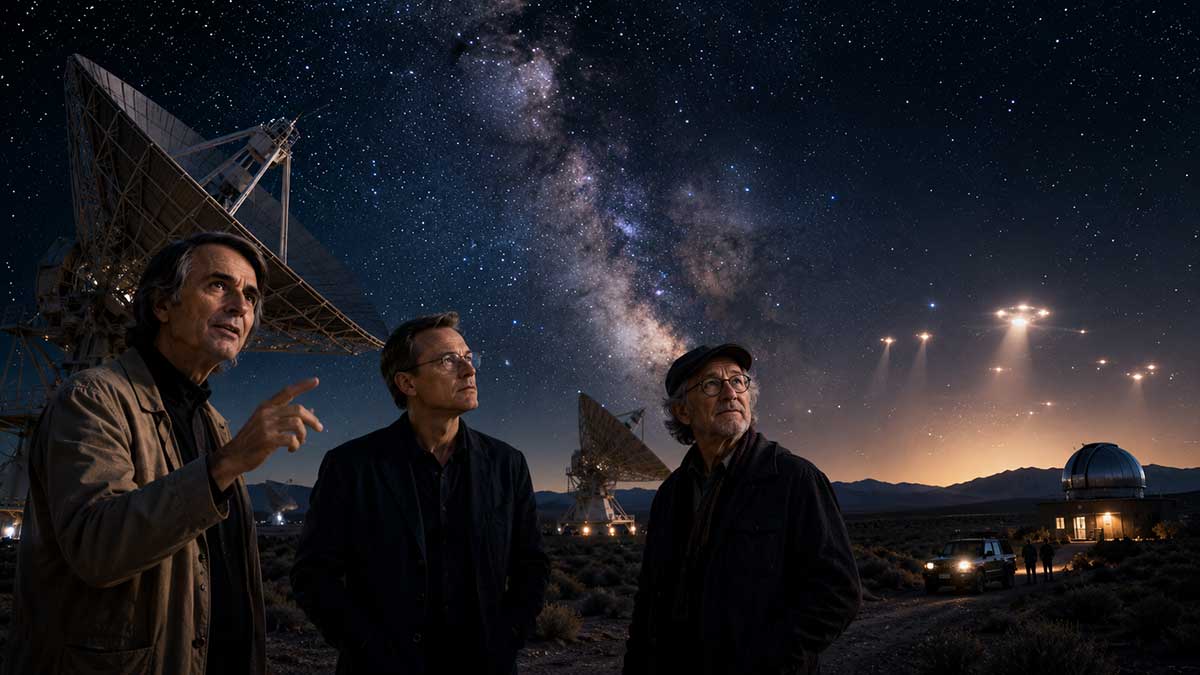
Opening — Nick Sasaki
Tonight we ask a question humanity has carried for ages:
Are we alone, or are we simply too young to recognize the signs?
Our guests are Carl Sagan, Michio Kaku, Jacques Vallée, Avi Loeb, and Steven Spielberg.
Question 1 — Is alien life almost certain, but alien visitation still unproven?
Carl Sagan:
The universe is too vast for loneliness to be the safest assumption. But wonder must walk with evidence.
Michio Kaku:
The galaxy has billions of stars. Life may be common. The real question is whether any civilization can cross those distances.
Avi Loeb:
We should not laugh at the question. We should collect better data. Science begins when curiosity becomes measurement.
Jacques Vallée:
The phenomenon may be stranger than simple visitors from another planet. It may interact with culture, perception, and consciousness.
Steven Spielberg:
That is why the question touches us. We are not only asking whether they exist. We are asking whether we are ready to meet something beyond ourselves.
Question 2 — What kind of evidence would truly change the debate?
Kaku:
A piece of technology. A material. An engine. Something we can test in a laboratory.
Sagan:
Extraordinary claims need extraordinary evidence. A story may inspire us, but evidence must persuade us.
Loeb:
We need instruments, not just opinions. Cameras, telescopes, sensors, open data.
Vallée:
Evidence may not arrive in the form people expect. The pattern itself may be part of the evidence.
Spielberg:
For most people, proof would be emotional before scientific. One undeniable moment could change civilization overnight.
Question 3 — Could advanced civilizations travel through space warps or wormholes?
Kaku:
Physics does not completely forbid it. Space can bend. The problem is energy. A civilization far beyond us might know how to use forces we only imagine.
Sagan:
Perhaps. But we must be careful. The stars invite dreams, but dreams must not outrun discipline.
Loeb:
If interstellar objects enter our solar system, we should study them seriously. Nature may send clues before civilizations send messages.
Vallée:
Travel may not be only physical. The phenomenon may force us to rethink what “distance” means.
Spielberg:
And that is why stories matter. They prepare the human heart for possibilities science has not yet confirmed.
Closing — Nick Sasaki
This conversation leaves us between wonder and caution.
Alien life may be likely. Alien visitation remains unproven. But the deeper question is not only whether they are out there.
It is whether humanity can become mature enough to meet the unknown without fear, fantasy, or arrogance.
Topic 3 — The Big Bang, String Theory, and the Multiverse
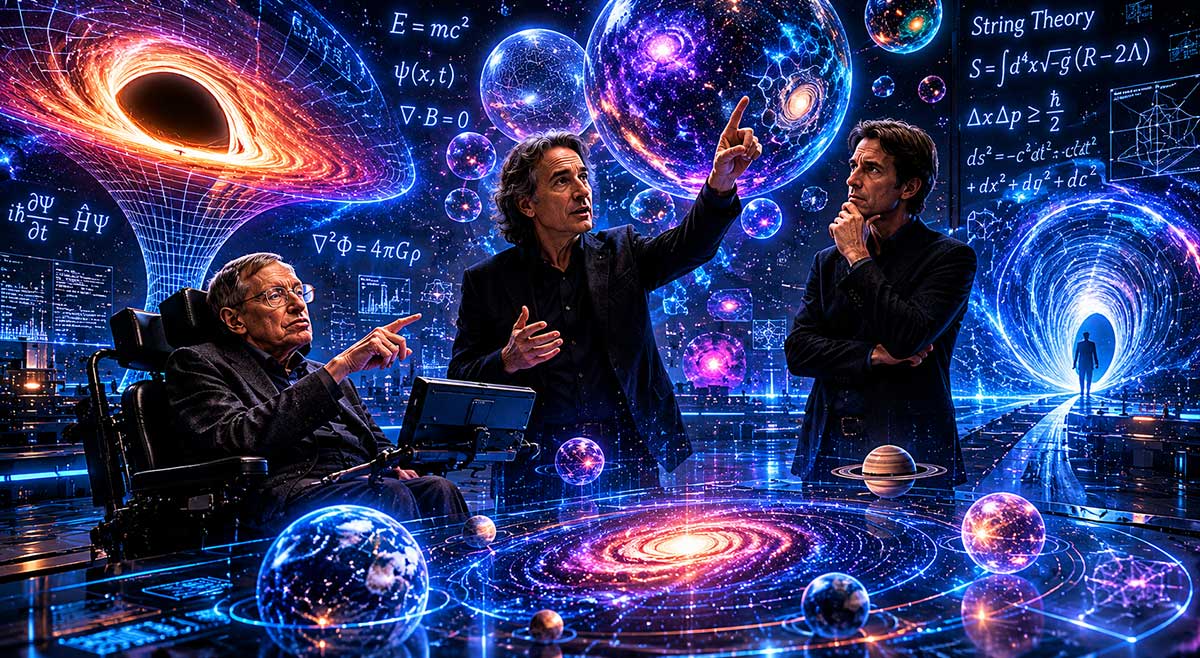
Opening — Nick Sasaki
Tonight we move from the sky above us to the mystery beneath everything:
Did the universe begin from nothing, or is our universe one page in a much larger book?
Our guests are Michio Kaku, Stephen Hawking, Brian Greene, Max Tegmark, and Neil deGrasse Tyson.
Question 1 — What existed before the Big Bang?
Michio Kaku:
The Big Bang may not have been the beginning of everything. It may have been the birth of our universe from a deeper cosmic process.
Stephen Hawking:
Asking what came before time is difficult, since time itself may have begun with the universe we know.
Brian Greene:
String theory gives us a language for asking what reality may have been before space and time took their familiar shape.
Max Tegmark:
The deeper possibility is that mathematical structures are more fundamental than physical objects.
Neil deGrasse Tyson:
The honest answer is that we do not know. But not knowing is where science becomes exciting.
Question 2 — Could our universe be one bubble among many?
Kaku:
Yes. Our universe may be one expanding bubble in a larger cosmic ocean of universes.
Greene:
The multiverse is not just fantasy. It appears naturally in some versions of modern physics.
Hawking:
The question is whether such universes leave evidence we can detect.
Tegmark:
A multiverse may sound strange, but nature has never promised to match human intuition.
Tyson:
People hear “multiverse” and think comic books. Scientists hear it and ask, “Can we test it?”
Question 3 — Do black holes open a door to another universe?
Hawking:
Black holes are where our current theories reach their limits. They force gravity, quantum theory, and information into conflict.
Kaku:
A black hole may be related to a wormhole, a possible shortcut through space and time. We cannot prove it yet, but the mathematics allows the question.
Greene:
The inside of a black hole may teach us whether space itself can tear, bend, or reconnect.
Tegmark:
A black hole is not merely a cosmic drain. It is a challenge to our model of reality.
Tyson:
The universe has a sense of humor. It creates objects so strange that even our best minds have to admit, “We are still beginners.”
Closing — Nick Sasaki
This topic leaves us with awe and humility.
The Big Bang may not be the final beginning. String theory may point to deeper layers of reality. The multiverse may be real, or it may be a beautiful clue waiting for evidence.
Black holes may be endings, gateways, or mirrors showing us how little we know.
The deeper question is:
Was our universe born once, or is creation happening everywhere, all the time?
Topic 4 — Reality, Consciousness, God, and Meaning
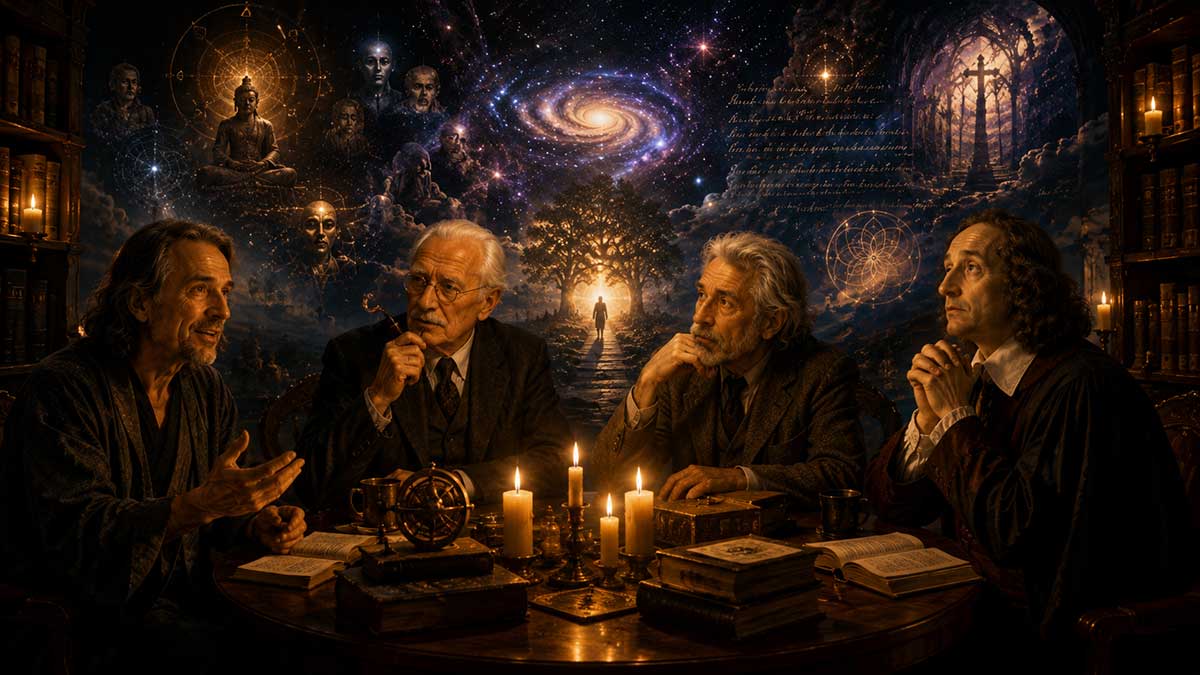
Opening — Nick Sasaki
Tonight we ask perhaps the most human question of all:
Is reality something we see clearly, or something our minds translate just well enough for survival?
Our guests are Alan Watts, Carl Jung, Joseph Campbell, Deepak Chopra, and Blaise Pascal.
Question 1 — Is human reality only a tiny slice of what truly exists?
Alan Watts:
The human mind does not see reality naked. It paints reality with language, fear, memory, and desire. We do not merely look at the world. We participate in creating the world we experience.
Carl Jung:
The psyche filters reality through symbols. What we call the outer world is always touched by the inner world. The unknown is not only above us in the stars. It is also beneath us in the unconscious.
Joseph Campbell:
Every culture tells stories to make reality livable. Myths are not childish escapes. They are maps for moving through mystery.
Deepak Chopra:
Reality is not only matter. It is experience. Consciousness is not a side effect of life; it may be the field through which life becomes meaningful.
Blaise Pascal:
Man is fragile, yet he knows he is fragile. That is his greatness. A reed may be crushed by the universe, but only man knows the universe can crush him.
Question 2 — Did religion arise from truth, evolution, or social need?
Pascal:
Religion answers the wound reason cannot close. Man seeks God not only out of fear, but out of longing.
Jung:
Religion is one of humanity’s great symbolic systems. It gives form to forces that would otherwise overwhelm the soul.
Campbell:
Religion begins as myth, ritual, and transformation. It tells us how to live, how to suffer, how to die, and how to return renewed.
Watts:
The trouble begins when people mistake the symbol for the reality. A finger pointing at the moon is useful, but people keep worshiping the finger.
Chopra:
At its deepest level, religion is a doorway into unity. At its shallowest, it becomes identity, division, and control.
Question 3 — Do humans discover meaning, or create it?
Campbell:
We discover meaning by answering the call. Life becomes meaningful when we accept the adventure placed before us.
Watts:
Meaning is not hidden like a coin under a rock. It appears when we stop trying to stand outside life and begin dancing with it.
Jung:
Meaning is born when the conscious self enters relationship with the unconscious. The task is individuation: becoming whole.
Pascal:
Without God, man is torn between greatness and misery. With God, even suffering can become part of a larger hope.
Chopra:
Meaning is both created and discovered. We create it through choice, and discover it through awareness.
Closing — Nick Sasaki
This topic brings science back to the soul.
Kaku says our senses show only a tiny part of reality. These guests push that idea further: perhaps our minds do not simply observe the world. Perhaps they shape the world we experience.
Religion, myth, consciousness, and meaning may not be separate subjects. They may be humanity’s way of living inside a universe too vast to measure only with instruments.
The deeper question becomes:
If reality is larger than what we can see, how should we live inside the unseen?
Topic 5 — AI, Immortality, and the Knife-Edge Future
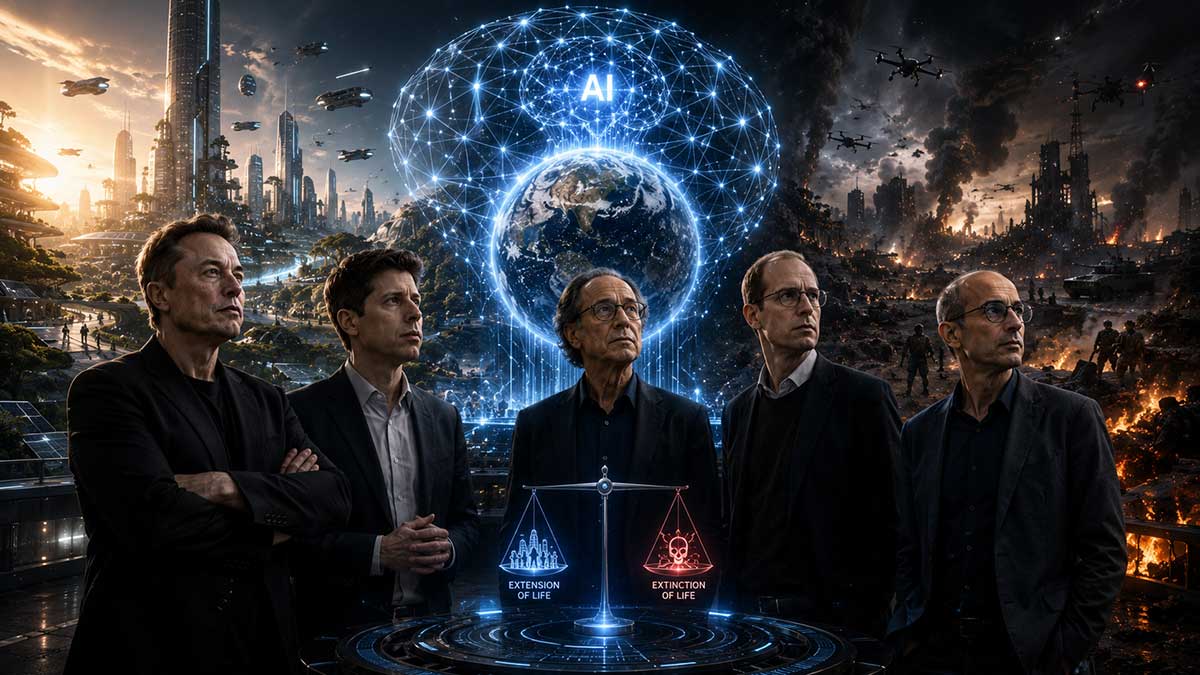
Opening — Nick Sasaki
Tonight we face the future directly:
Will humanity use science to heal life, extend life, and protect life — or build tools too dangerous for our own wisdom?
Our guests are Elon Musk, Ray Kurzweil, Yuval Noah Harari, Nick Bostrom, and Sam Altman.
Question 1 — Can AI cure diseases and help humans live far longer?
Ray Kurzweil:
Yes. Biology is becoming information technology. Once we can read, model, and repair the body, aging becomes a problem to solve rather than a fate to accept.
Sam Altman:
AI can accelerate medical research, drug discovery, diagnostics, and personalized treatment. The promise is real, but access matters. A cure that only the wealthy can reach is not a human victory.
Elon Musk:
The best case is that AI helps us solve disease, extend life, and become a multiplanetary species. But the future won’t wait for committees.
Yuval Noah Harari:
Longer life may sound like salvation, but it may create new inequality. Who receives extra decades? Who remains disposable?
Nick Bostrom:
Life extension is powerful, but every major capability needs risk analysis. The same systems that discover cures may discover new weapons.
Question 2 — When does AI move from tool to threat?
Bostrom:
AI becomes dangerous when its goals, abilities, and autonomy exceed human control. Intelligence without alignment is not a servant. It is an unpredictable force.
Musk:
If AI becomes smarter than us and we cannot steer it, we may become passengers in our own civilization.
Altman:
The danger is not only one superintelligence. It is misuse, concentration, manipulation, and systems deployed faster than society can adapt.
Harari:
AI threatens humans when it gains the ability to shape stories, emotions, money, politics, and trust. Whoever controls attention may control history.
Kurzweil:
The answer is not fear, but integration. We need to merge human intelligence with machine intelligence so we are not left behind.
Question 3 — Will humanity use science to survive, or destroy itself?
Harari:
The greatest danger is not intelligence. It is fragmentation. If humans cannot cooperate, every invention becomes a weapon in another tribal war.
Musk:
Survival requires redundancy. A single-planet civilization is fragile. Mars is not escapism; it is backup.
Bostrom:
Existential risk must become a central human project. We insure houses, banks, and companies. We rarely insure civilization.
Altman:
We need institutions that can move fast without breaking humanity. The technology is moving. Governance must become serious enough to keep up.
Kurzweil:
I remain optimistic. Human history is the story of problems becoming engineering challenges. But optimism must be active, not passive.
Closing — Nick Sasaki
This final topic returns us to the knife-edge.
AI may help cure disease. Longevity may extend human life. Space technology may protect civilization. Yet the same future carries weapons, inequality, control, and collapse.
The question is no longer whether science will become powerful.
It already has.
The deeper question is:
Will human wisdom grow fast enough to survive what human intelligence creates?
Final Thoughts by Nick Sasaki
What struck me most about this conversation was not the scale of the universe.
It was the fragility of humanity.
We are tiny compared to galaxies, black holes, and billions of stars. Yet somehow, this tiny species gained the ability to split the atom, build artificial intelligence, manipulate genetics, and possibly one day bend space itself.
That contradiction feels almost unbelievable.
A species capable of breathtaking beauty is also capable of immense destruction.
And perhaps that is why these conversations matter.
Not because we already have the answers.
But because asking the questions may be what keeps humanity alive.
Throughout these discussions, there was tension between optimism and warning.
Kaku believes science may extend life dramatically. Kurzweil believes biology itself will become programmable. Musk warns that AI could surpass us. Harari warns that technology without shared morality may deepen inequality and chaos.
Meanwhile, Jung, Watts, and Campbell remind us that even if humanity conquers disease, space, and computation, we may still remain spiritually lost.
Perhaps the greatest danger is not artificial intelligence.
Perhaps the greatest danger is human beings gaining godlike tools before developing godlike wisdom.
And yet, strangely, there is still hope.
Hope exists because humans continue searching.
We continue asking what is true.
We continue searching the stars.
We continue trying to understand consciousness, morality, and meaning.
We continue imagining a better future.
That instinct itself may be humanity’s greatest strength.
Maybe civilization survives not because we are perfect, but because enough people continue reaching for something higher than survival alone.
The future remains unwritten.
And that may be the most important truth of all.
Short Bios:
Michio Kaku
Co-founder of string field theory known for explaining advanced physics and future technologies to mainstream audiences.
Albert Einstein
Developer of relativity whose ideas transformed humanity’s understanding of space, time, gravity, and energy.
Isaac Newton
Founder of classical mechanics and one of the most influential scientific thinkers in history.
Nikola Tesla
Visionary inventor whose work shaped modern electricity, wireless concepts, and future technological imagination.
Buckminster Fuller
Systems thinker known for sustainable design ideas and the concept of “Spaceship Earth.”
Carl Sagan
Astronomer who inspired millions through cosmic exploration and the search for extraterrestrial life.
Jacques Vallée
Researcher known for unconventional theories about UFO phenomena and consciousness.
Avi Loeb
Harvard astronomer focused on interstellar objects and scientific investigation of possible extraterrestrial technology.
Steven Spielberg
Legendary filmmaker whose stories helped shape modern imagination about aliens and humanity.
Stephen Hawking
Cosmologist known for black hole research and efforts to explain the universe to the public.
Brian Greene
String theorist and author focused on explaining multiverse theory and hidden dimensions.
Max Tegmark
Cosmologist exploring mathematical universe theory, AI, and the future of consciousness.
Neil deGrasse Tyson
Science communicator known for making astronomy and cosmology accessible and entertaining.
Alan Watts
Philosophical teacher who introduced Eastern thought and nondual ideas to Western audiences.
Carl Jung
Founder of analytical psychology known for archetypes, symbolism, and the collective unconscious.
Joseph Campbell
Scholar famous for “The Hero’s Journey” and comparative mythology.
Deepak Chopra
Writer focused on consciousness, spirituality, health, and mind-body connection.
Blaise Pascal
French thinker known for contributions to mathematics, philosophy, and theology.
Elon Musk
Technology entrepreneur involved in AI, electric vehicles, rockets, and Mars colonization.
Ray Kurzweil
Futurist known for predictions about AI, longevity, and technological singularity.
Yuval Noah Harari
Historian examining technology, civilization, AI, and the future of humanity.
Nick Bostrom
Philosopher focused on existential risk, superintelligence, and future ethics.
Sam Altman
AI leader focused on the development and governance of advanced artificial intelligence systems.
Nick Sasaki
Creator and moderator of ImaginaryTalks.com, known for building imaginative roundtable conversations that blend philosophy, science, spirituality, psychology, technology, and humanity’s biggest existential questions into emotionally powerful
Leave a Reply