
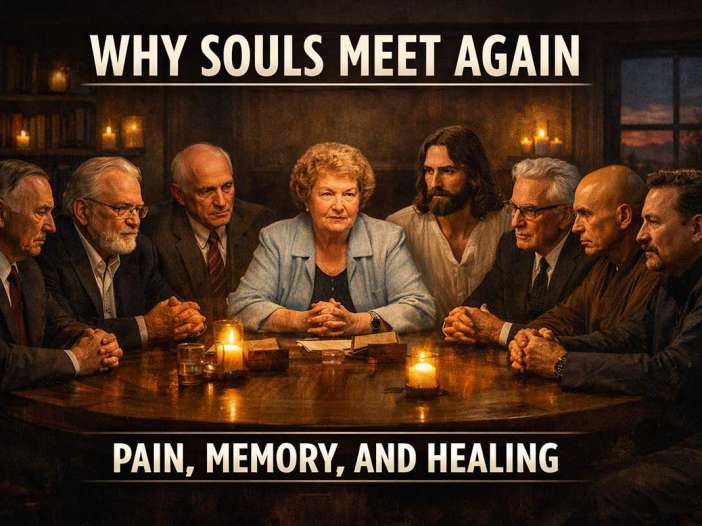
What if Dolores Cannon revealed that the people who hurt you most were part of your soul’s deepest lesson?
Introduction by Nick Sasaki
Some questions do not leave us alone.
Why does one person feel familiar the moment we meet them? Why do certain dreams stay in the heart like memory instead of imagination? Why do some wounds seem older than this life, and why does forgiveness feel so costly, yet so necessary? And what if this life is not a random chain of events, but part of a much larger journey of the soul?
That is the spirit behind this five-part imagined conversation series inspired by the teachings and themes often associated with Dolores Cannon. This is not a transcript of real words spoken by these figures together. It is a creative spiritual exploration built around questions that have moved people for generations: pre-birth connection, soul memory, repeated pain, forgiveness, and the deeper purpose of earthly life.
Across these five topics, we move through a clear inner path. First, we ask whether some relationships were chosen before birth. Then we ask why dreams, déjà vu, and sudden emotion can feel ancient. From there, we face the harder possibility that souls may return to heal unfinished pain. Then we enter the difficult gate of forgiveness, where truth and release must somehow live together. At last, we step back and ask whether life itself is a classroom for the soul.
What moves me about this series is that it does not treat human life as flat. It treats every meeting, every loss, every sorrow, and every turning point as something that may hold far more depth than we first assume. It does not ask us to deny pain. It asks us to look at pain with more humility, more courage, and more openness to meaning.
Whether you read these conversations as spiritual truth, symbolic psychology, or thoughtful imaginative reflection, my hope is the same: that they help you see your own life with greater tenderness and wonder.
Maybe some people do enter our lives for reasons older than memory.
Maybe some grief really is waiting to be understood.
Maybe forgiveness is not weakness, but liberation.
Maybe this life is teaching us far more than we realize while we are inside it.
If so, then even our hardest questions may be part of the path.
(Note: This is an imaginary conversation, a creative exploration of an idea, and not a real speech or event.)
Topic 1 — Did our souls choose certain relationships before birth?

Participants
- Dolores Cannon
- Brian Weiss
- Michael Newton
- Edgar Cayce
- Carl Jung
Question 1
Are some of the most important people in our lives part of a soul agreement made before birth, and what would that really mean?
Dolores Cannon
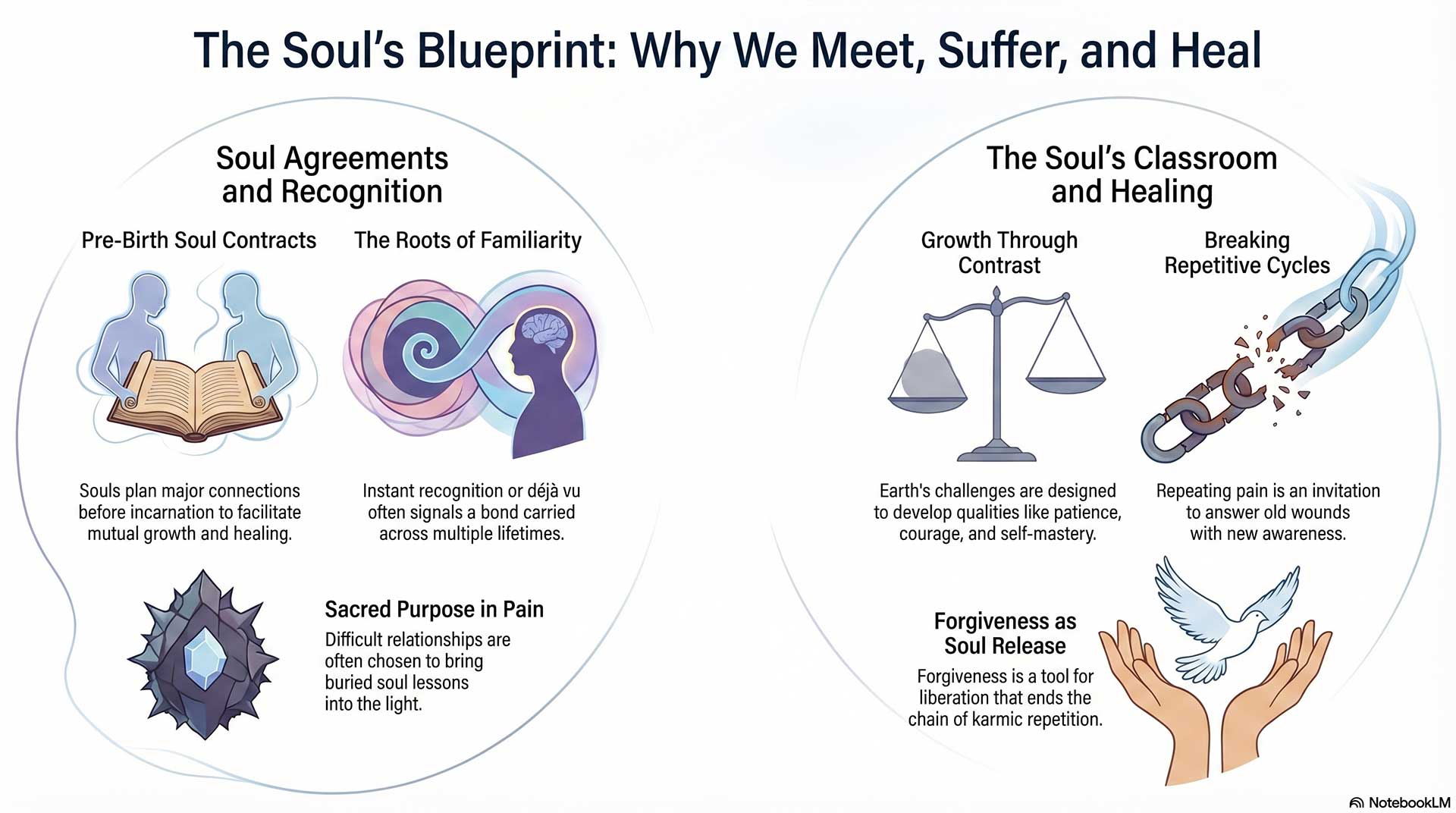
Yes, many of them are. Before birth, souls may gather and plan major connections for the coming life. They may choose to return as family, friends, partners, rivals, or brief but powerful influences. This does not mean every detail is locked in place. It means certain meetings carry intention. From the soul level, these meetings are chosen for growth, balance, healing, or awakening. From the human level, they can feel mysterious, unfair, beautiful, or painful. A soul agreement means the relationship was not empty from the start. It carried purpose before the first meeting ever happened.
Brian Weiss
That matches much of what people described in regression. They often encountered the same souls across many lifetimes, though the roles changed. A mother in one life might return as a brother, a spouse, or a child in another. The outer form shifts, but the inner bond continues. That helps explain why some people matter far more than their short time in our life would suggest. The agreement is not always about comfort. Quite often it is about helping one another complete some important emotional or spiritual task.
Michael Newton
In life-between-lives work, many people reported planning periods before incarnation. They described review, preparation, and discussion with guides and soul companions. They seemed to understand that certain relationships would be central to the next life’s lessons. This did not remove freedom. It created a framework. The agreement meant, “We will meet. We will help bring this issue forward. We will create conditions where growth becomes possible.” What happens after the meeting still depends on awareness and choice.
Edgar Cayce
Souls are drawn together by law, by memory, by unfinished movement, and by the need for development. Some meetings come from love carried forward. Some from imbalance still seeking correction. Some from service still waiting to be offered. To say there is a pre-birth agreement is to say that spirit is not careless. There is order beneath what appears sudden. The soul may return to those it has loved, failed, harmed, depended upon, or helped, until what is distorted is made straighter and what is broken is made cleaner.
Carl Jung
I would speak with some caution about literal pre-birth contracts, yet I fully recognize that certain relationships arrive with a sense of deep inevitability. They bear psychic weight from the start. They do not feel invented by chance. They feel discovered. Whether one calls this a soul agreement or a meaningful pattern in the deeper psyche, the effect is the same: the meeting seems to belong to a larger design. The other person enters not merely as an individual, but as a figure carrying symbolic, emotional, and spiritual consequence.
Question 2
Why do certain relationships feel instantly familiar, unusually heavy, or life-changing from the very beginning?
Brian Weiss
Many people describe this in almost identical language: “I know I just met this person, but I feel as if I’ve known them forever.” That kind of familiarity may come from previous shared lifetimes. The emotional memory remains even when conscious memory is gone. This can show up as trust, longing, sorrow, fear, attraction, protectiveness, or even immediate grief. The strength of the feeling often tells us the bond is not starting fresh. It is continuing.
Carl Jung
At times, another person constellates something immense in the psyche. The meeting does not stay on the social surface. It reaches down into deeper layers at once. We may feel familiarity because the person touches an archetypal pattern already alive within us: the lost companion, the beloved, the redeemer, the betrayer, the guide. This is why the relationship feels heavier than reason allows. One is meeting a person, yes, but one is also meeting a hidden region of one’s own soul.
Dolores Cannon
The soul recognizes before the mind understands. The conscious mind forgets when we come into the body, but the subconscious still holds the deeper record. So when an important person appears, the first response may come through emotion, not logic. People often think, “This makes no sense, but I feel something huge here.” That is often the soul reacting to someone it already knows. The intensity can feel loving or painful. Either way, it is telling you the connection matters.
Michael Newton
A relationship can also feel intense from the beginning because it is attached to a major lesson. The deeper self may know immediately that this person will become part of a turning point. That can produce strong reactions before any evidence exists on the surface. Instant ease, instant tension, instant caution, instant tenderness — all of these may come from the soul sensing the weight of what the connection is meant to bring forward.
Edgar Cayce
The heart often responds before the intellect has gathered its facts. Sudden recognition may come from old ties still active beneath the surface of consciousness. A heavy feeling may point to unfinished duty, unfinished sorrow, or unfinished love. One should not surrender judgment to emotion alone, yet neither should one dismiss such impressions. They may be the first whisper of a much older story.
Question 3
Can even painful relationships carry a sacred purpose in the growth, awakening, and healing of the soul?
Michael Newton
Yes, though sacred purpose must never be confused with permission for harm. A painful relationship may exist to bring hidden material into awareness. It may expose fear, dependence, shame, guilt, weakness, or a lack of self-worth. Once exposed, these can be worked with. The purpose is not endless suffering. The purpose is awakening. Sometimes the lesson is learned within the relationship. Sometimes the lesson is to leave it.
Edgar Cayce
Pain alone does not purify. Yet pain may become fruitful through the soul’s response to it. A difficult relationship may teach patience, mercy, restraint, truthfulness, humility, or courage. It may uncover selfishness that was hidden under sentiment. It may show where love is still mixed with fear or pride. In such a case, the bond serves a holy end, not because the hurt is good, but because the soul grows cleaner through meeting it rightly.
Dolores Cannon
Some of the hardest roles are taken by souls who care about us deeply from the higher level. One soul may agree to leave, betray, resist, disappoint, or wound so that another soul can face something it has avoided for lifetimes. People do not like hearing that, and I understand why. From the human side, the pain is very real. Still, from the soul side, a hard relationship can be part of a plan to bring buried lessons into the light. That never means staying in abuse. It means the pain may still hold meaning.
Carl Jung
The painful relationship often becomes the site of confrontation with the shadow. It reveals what the ego would rather not know: its dependency, fantasy, vanity, fear, possessiveness, or hunger. This is why such bonds can become decisive for inner development. They strip illusion. They force consciousness. A sacred purpose appears when suffering is not merely endured, but transformed into greater self-knowledge and depth of being.
Brian Weiss
Many people later discover that the relationship which hurt them most also opened the door to their deepest healing. It brought buried grief to the surface. It showed them patterns they had repeated for lifetimes. It taught compassion, boundaries, self-respect, or forgiveness. The sacred purpose is not the wound itself. It is what becomes possible once the wound is finally seen clearly.
Topic 2 — Why do dreams, déjà vu, and sudden emotion feel older than this life?

Participants
- Dolores Cannon
- Carl Jung
- Brian Weiss
- Edgar Cayce
- James Van Praagh
Question 1
Why do some dreams feel less like imagination and more like memory, warning, or unfinished truth?
Dolores Cannon
Some dreams carry a completely different quality from ordinary dreaming. They do not feel scattered or random. They feel structured, emotional, and real. In my work, that often pointed to the subconscious bringing forward material the conscious mind had forgotten. A recurring place, a face never seen in waking life, a deep sorrow, a name, a scene that repeats again and again — these can all suggest that something unfinished is trying to rise. The dream feels like memory because, at the subconscious level, it often is memory.
Carl Jung
A dream may come from much deeper levels than personal thought. It can emerge from regions of the psyche older than the present identity. That is why certain dreams arrive with unusual gravity. They do not feel invented. They feel revealed. The dream may contain symbols, landscapes, and emotional truths that the waking ego cannot place, yet cannot dismiss. Such dreams often carry the force of something hidden but real, something that has waited for the right moment to become conscious.
Brian Weiss
Many people wake from certain dreams with grief, love, fear, or longing far too strong to explain by daily life alone. They may dream of losing a child they never had, calling out to someone they do not know, or standing in a place they have never visited. Later, in regression, those images sometimes connect to scenes from another lifetime or to deep unresolved emotional material. The dream serves as an opening. It is often the first sign that buried memory is still alive.
Edgar Cayce
The soul keeps impressions. In sleep, when the body is quiet and the mind less guarded, these impressions may enter awareness. Some dreams are reflections of the day. Some are symbolic teachings. Some may be warnings. And some seem to come from experience the soul has truly known. These remain with the dreamer. They carry weight. They touch the heart in a way that ordinary fantasy does not.
James Van Praagh
The soul speaks through feeling, image, and energy. That is why a dream can leave you shaken for days. It may not be about literal proof at first. It may be about opening a door. A dream that feels older than this life is often carrying truth from a deeper field of consciousness. It may be spirit communication, soul memory, or a message wrapped in emotion so the person cannot ignore it.
Question 2
What is really happening when a place, face, or moment creates powerful déjà vu or unexplained recognition?
Carl Jung
Déjà vu disturbs the rational personality because it introduces an experience of prior knowing without visible cause. One enters a room, hears a sentence, sees a face, and feels, “I have already lived this.” The moment seems to split open. Psychologically, one might say that a deeper pattern has been activated, one carrying symbolic force far beyond the immediate event. Yet the felt certainty of déjà vu often exceeds any simple explanation. It points to a psyche not fully contained within ordinary linear time.
Dolores Cannon
When people described strong déjà vu, I often felt they were brushing against something the soul already knew. The conscious mind may not have the full story, but the soul recognizes the person, the place, or the situation instantly. Sometimes the recognition comes first and the explanation comes later. It can be a clue that a place mattered before, a person mattered before, or a planned moment has just arrived in the life.
Brian Weiss
Many people experience an immediate emotional response to a stranger or to a place they have never visited. They may feel safe for no reason, homesick for no reason, afraid for no reason, or deeply moved for no reason. Then later, under deeper exploration, the feeling turns out to have roots. Déjà vu is often not the whole memory. It is the edge of the memory. It is the signal that something meaningful lies behind the curtain.
Edgar Cayce
The soul may return to familiar patterns, familiar places, and familiar companions as part of its continuing journey. When that occurs, there may be a stirring in consciousness before the mind can explain it. Déjà vu is often a sign of resonance. The soul feels what the intellect has not yet named. Such moments should be treated with respect. They may be brief, yet they can reveal much.
James Van Praagh
I see déjà vu as one of those moments when the veil becomes thinner. Time does not feel as closed. The soul remembers something the personality forgot. It may last only seconds, but it can carry tremendous force. Many people brush it aside, yet these moments can be deeply sacred. They remind us that we are living inside a mystery much bigger than ordinary logic.
Question 3
Can sudden grief, fear, longing, or emotional intensity be signs of buried soul memory trying to rise into awareness and healing?
Brian Weiss
Yes, very often they can. People sometimes carry emotional burdens that do not fully match the facts of their current life. A powerful fear of water, sorrow around a place they have never been, longing for someone they have never met, or intense grief that seems to come from nowhere. When explored carefully, these reactions sometimes connect to earlier trauma or relationships carried across lifetimes. Once the source is seen, the feeling starts to make sense, and that itself can begin healing.
James Van Praagh
Strong unexplained feeling is often the soul trying to get our attention. Emotion has memory. Spirit has memory. So when a sudden wave of sadness, fear, or homesickness rises for no clear reason, I would not dismiss it too quickly. Something deeper may be knocking. The feeling may be asking to be honored, listened to, and understood rather than pushed away.
Dolores Cannon
The subconscious stores everything. That is why buried memory can surface first as emotion. A person may not know why they panic, why they cry, why they feel drawn to someone, or why a certain place affects them so strongly. The conscious mind says, “This makes no sense.” But the subconscious knows exactly where it comes from. Once the deeper memory is accessed, the emotional charge often begins to release. The feeling was never random. It had a source.
Edgar Cayce
Not every strong feeling comes from another lifetime, but some may. The soul carries unfinished impressions until they are rightly met. A fear without a present cause, a grief too deep for the current moment, or a longing that seems older than one’s years may all point to memory beneath the surface. The task is not to become fascinated with the mystery alone, but to use the recognition for healing, humility, and deeper compassion.
Carl Jung
An unexplained emotion tells us that something autonomous is active in the psyche. Whether one names it soul memory, unconscious residue, or transpersonal inheritance, the key fact remains: the person is being visited by material larger than conscious control. Such emotion should not be mocked or inflated. It should be entered with seriousness. If the hidden sorrow is met honestly, it may reveal a truth the waking self has avoided for a very long time.
Topic 3 — Do souls return to heal unfinished pain from another lifetime?
Participants
- Dolores Cannon
- Michael Newton
- Brian Weiss
- Thich Nhat Hanh
- Viktor Frankl
Question 1
Why would a soul return to meet the same pain, person, or wound again instead of leaving it behind?
Michael Newton
From the soul perspective, returning to the same pain is not usually about being trapped. It is about completion. A lesson that was not fully learned, a grief that was never faced, or a bond that remained unresolved may continue to hold energy. The soul may choose to meet that energy again under new conditions so it can respond with more awareness than before. What looks like repetition from the human side may actually be an attempt at resolution from the soul side.
Dolores Cannon
People ask that question from the personality level, and of course the personality says, “Why would I ever choose that?” But the higher self sees much more. It sees the whole pattern, not just one painful chapter. If a wound is still active, the soul may return to it because it wants freedom from it. Not punishment. Not cruelty. Freedom. The soul may know that unless the buried pain is brought back into the light, it will keep shaping choices, fears, and relationships again and again.
Brian Weiss
In regression work, many people discovered that what seemed like random pain in this life had appeared in other forms before. The soul was not returning to suffer for nothing. It was returning because something still needed healing. Sometimes the return made it possible to grieve what had never been grieved. Sometimes it allowed forgiveness. Sometimes it helped the person stop carrying guilt, terror, or abandonment into yet another life. The return was painful, but it also opened the possibility of release.
Thich Nhat Hanh
When suffering is not understood, it continues. It may continue in one lifetime, across generations, or in ways that feel much older than the present moment. If we return to the same wound, it may be because the wound has not yet received enough awareness, enough compassion, enough deep looking. The pain is asking to be held differently. This is why returning is not always a failure. It may be another chance to transform what has long been carried in darkness.
Viktor Frankl
Human beings cannot endure pain well when they experience it as empty repetition. Yet if the return to pain carries purpose, the meaning changes. The soul may return to the same wound because something new has become possible there: courage where there was fear, mercy where there was hatred, responsibility where there was helplessness. The question is not only why pain returns. The question is what new answer the soul may now be capable of giving.
Question 2
Is repeated suffering karma, mercy, unfinished learning, or a chance to answer old pain in a new way?
Brian Weiss
I would be careful with the idea of punishment. Many people already suffer under shame, and they do not need spirituality used against them. Repeated suffering often seems closer to unfinished learning than to divine revenge. There may be karmic threads, yes, but those threads are often tied to growth and balance rather than condemnation. The return of pain can be a new opportunity to respond more consciously than before.
Dolores Cannon
People often turn karma into something heavy and frightening, but that misses the point. The universe is about learning. A soul may be hurt in one life and become the one who hurts in another, not because the universe is cruel, but because true compassion can grow only when the soul understands both sides. Repeated suffering may contain karma, but it is also full of mercy, because the soul is being given another chance to see clearly and heal what was left unfinished.
Michael Newton
In my view, it can be all of those things working together. There may be karmic balance. There may be unfinished lessons. There may be real mercy in the fact that the soul is allowed another opportunity. Souls do not enter these hard experiences alone. They come with guidance, preparation, and often with other souls who agree to help bring the lesson forward. That larger context matters. It means repeated suffering is held inside a field of purpose, not chaos.
Viktor Frankl
I do not use the language of karma in the same way, but I do know that suffering becomes far more destructive when it is stripped of meaning. If pain returns, one vital freedom remains: the freedom to answer it. That answer may change everything. What was once only loss may become sacrifice, witness, growth, or moral awakening. So yes, repeated suffering can become a chance to answer old pain in a new way, and that may be the beginning of dignity.
Thich Nhat Hanh
When we look deeply, we see causes and conditions. What has not been transformed continues. Anger continues. Fear continues. Attachment continues. This is why suffering may come back. Yet there is compassion in this return, because each moment also brings the possibility of mindfulness. If we meet the pain with breathing, presence, and understanding, then the cycle can weaken. The return of suffering is painful, but it may also be the bell calling us back to awareness.
Question 3
How can we tell whether a painful reunion is meant for healing, release, and transformation rather than endless repetition?
Thich Nhat Hanh
A reunion meant for healing may begin in sorrow, but over time it brings more awareness, more truth, and more peace. A reunion meant only for repetition keeps feeding confusion, fear, craving, and injury. We can ask gently: what is this connection watering in me? Is it watering my deepest goodness, or only my oldest wound? This question must be held with honesty and compassion.
Michael Newton
Not every powerful connection is meant to continue. Some are meant to awaken memory, bring a lesson to the surface, and then end. Healing shows itself through growth in consciousness. The person becomes clearer, steadier, more compassionate, more discerning. Repetition feels different. The same wound keeps firing with no real increase in awareness. If the reunion produces only chaos and keeps the soul asleep inside old patterns, then the lesson may be to step back rather than stay.
Dolores Cannon
People make mistakes here. They feel the soul recognition and think, “This must mean I’m supposed to stay with this person no matter what.” No. Recognition is not the same as assignment. Someone may be from your soul group and still not be right to keep close in this lifetime. The purpose of the reunion may be to trigger the lesson, not to preserve the relationship. Healing is shown when the person begins choosing from clarity instead of compulsion.
Brian Weiss
Healing leaves signs. The person begins to understand their reactions. Old fears soften. Compassion grows. Boundaries become healthier. The relationship may deepen, or it may end, but either way something opens and moves. Endless repetition feels trapped. The same pain loops again and again without insight or release. That is often a sign that more reflection, support, or distance is needed.
Viktor Frankl
One way to tell is to ask whether the encounter calls forth a higher self or only a more desperate self. Does it deepen responsibility, truth, and inward freedom, or does it reduce the person to compulsion and confusion? Meaningful suffering, however painful, enlarges the soul. Empty repetition shrinks it. Over time, the direction becomes visible. Healing leads toward dignity. Repetition leads toward captivity.
Topic 4 — Why is forgiveness so hard, and why does it free the soul?

Participants
- Dolores Cannon
- Jesus
- Thich Nhat Hanh
- C. S. Lewis
- Viktor Frankl
Question 1
What does forgiveness truly mean when the wound was deep, the loss was real, and the heart still remembers everything?
Jesus
Forgiveness does not mean pretending the wound never happened. It does not mean calling evil good or saying betrayal caused no damage. The truth must be faced plainly. Forgiveness begins there. It is the choice to stop letting hatred rule the heart. A person may still grieve, still speak truth, still seek what is right, and yet refuse to let vengeance become the center of the soul.
Thich Nhat Hanh
Many people think forgiveness means forcing a smile over pain. That is not true forgiveness. First, we must touch the suffering with mindfulness and tenderness. We must know our anger, our sorrow, our fear. When we look deeply, we may begin to see that the one who hurt us was full of suffering too. This does not erase the wound. It opens the door to compassion. Forgiveness grows from deep seeing.
C. S. Lewis
Forgiveness sounds noble until one has something real to forgive. Then it becomes one of the hardest acts in human life. It does not mean approving the offense. It means giving up the right to cherish resentment forever. That is painful, since resentment can become a dark kind of treasure. We hold it because it seems to prove that our suffering mattered.
Viktor Frankl
When suffering is grave, forgiveness cannot be reduced to sentiment. The wounded person must not be robbed of truth. Yet even in deep injury, a final freedom remains: the freedom to choose what the wound will make of us. Forgiveness is one possible answer to that question. It is not quick. It is not shallow. It is the refusal to let injury define the final meaning of one’s life.
Dolores Cannon
From the soul level, forgiveness is release. Souls may come together in difficult roles for learning, healing, and growth. Yet here on earth, the pain feels entirely real, and it is real. Forgiveness is not saying the pain did not matter. It is saying, “I will not carry this wound forward into every future choice, every future bond, and perhaps even every future lifetime.”
Question 2
Why does holding on to pain often feel safer, stronger, or more honest than letting it go?
C. S. Lewis
Because pain can become identity. A person may think, “If I release this, what remains of my case against the one who hurt me?” Resentment seems to guard the wound, yet over time it guards it too well. It keeps it alive. The grievance promises protection, but soon it behaves more like a jailer than a shield.
Dolores Cannon
People often think anger is strength. They think, “If I let this go, then they win.” But that comes from the fearful personality, not from the higher self. The soul knows the cost of carrying bitterness. It grows heavy under it. Pain repeated, replayed, and protected can shape lifetimes. Holding on feels powerful at first, but it drains freedom.
Thich Nhat Hanh
Pain can feel safe because it is familiar. Even suffering can become a habit. The mind says, “At least I know this place.” Letting go can feel like stepping into emptiness. Yet when we breathe gently with our suffering, we discover that we do not disappear when anger softens. We become larger than the anger. We become more alive.
Viktor Frankl
There is a tragic comfort in bitterness. It gives shape to suffering. It offers a simple story: “I was hurt, so now I remain the hurt one.” Releasing that identity can feel frightening, since freedom asks something of us. Once I am no longer only the victim of the wound, I must ask what I will become next. That question is far more demanding than hatred.
Jesus
Many hold pain tightly because they fear justice will vanish if they open their hand. Yet the heart is not healed by clenching. A closed hand cannot receive mercy. To release hatred is not to abandon truth. It is to trust that the soul was made for more than endless revenge.
Question 3
How can forgiveness free the soul without denying truth, justice, boundaries, or the seriousness of what happened?
Viktor Frankl
Forgiveness and justice are not the same act. Justice concerns what is right, what must be named, what must be faced. Forgiveness concerns the inner relation of the wounded person to the wound. A person may forgive and still testify. A person may forgive and still set boundaries. A person may forgive and still insist that wrong be named as wrong. The soul is freed not by denial, but by truth joined to inward release.
Jesus
Truth does not stand against forgiveness. Truth makes forgiveness real. If there were no wrong, there would be nothing to forgive. The wounded heart may seek what is right and still refuse to become the mirror of the harm it has received. Forgiveness breaks the chain without pretending the chain never existed.
Thich Nhat Hanh
When we forgive, we do not say that suffering was acceptable. We say that we do not wish to create more suffering from the suffering we received. Firmness can remain. Clear boundaries can remain. Honest speech can remain. Compassion is not weakness. It is lucid strength. It allows action without poison.
Dolores Cannon
From the soul point of view, forgiveness is what stops the old pattern from repeating itself over and over. Earthly consequences still matter. Lessons still matter. Boundaries still matter. Yet if the soul leaves a wound locked inside hatred, the energy often continues. Forgiveness frees the soul from that loop. It does not erase the truth of what happened. It ends the chain.
C. S. Lewis
People often confuse forgiveness with excusing. They are not the same. If you excuse, you claim no real wrong was done. If you forgive, you admit that a real wrong was done and choose not to live forever on its poison. That distinction is morally serious. Forgiveness is not blindness. It is courage.
Topic 5 — Is this life a classroom for the soul?

Participants
- Dolores Cannon
- Michael Newton
- Edgar Cayce
- Carl Jung
- Viktor Frankl
Question 1
Did we come into this life mainly to seek comfort, or to learn through love, loss, struggle, and awakening?
Dolores Cannon
From the soul level, this life was never meant to be only about comfort. Earth is intense. It is dense, emotional, difficult, and full of contrast. Souls come here because this kind of environment creates powerful opportunities for growth. Pain is not the goal, but pain often becomes one of the strongest teachers. The problem is that once we are inside the human personality, we forget why we came and start judging the lesson only by how much it hurts.
Michael Newton
In life-between-lives work, many souls seemed to know before birth that incarnation would involve challenge. They did not come here expecting ease. They came to develop qualities such as patience, courage, compassion, discernment, and self-mastery. A hard life does not automatically mean something has gone wrong. Sometimes it means the soul chose a meaningful curriculum, one that could not be completed in a softer setting.
Edgar Cayce
The earth may be seen as a place where ideals must become action. Love must become service. Faith must become endurance. Wisdom must become conduct. In such a place, resistance is unavoidable. The soul meets limitation, consequence, temptation, and sorrow. Yet these may become redemptive if they turn the person toward truth, humility, and deeper alignment with the divine.
Carl Jung
The modern person often wants happiness without transformation. Yet the psyche does not deepen through comfort alone. It grows through conflict, contradiction, loss, and the confrontation with what has been denied. We do not seek suffering for its own sake, but without friction, the personality often remains shallow. Difficulty can become the furnace in which consciousness grows.
Viktor Frankl
Human life does not ask whether we would prefer only joy. It asks what we will do with what is given. Suffering becomes destructive when it is empty, but when meaning is found, even pain may deepen rather than destroy the person. So I would say we are not here to chase pain, nor to flee it at all costs, but to answer life in such a way that even hardship may become morally and spiritually fruitful.
Question 2
What might the soul be trying to learn through relationships, suffering, separation, purpose, and repeated human experience?
Michael Newton
Many souls seemed to return again and again to work on love in more mature forms. Not only attachment, not only desire, but love joined with patience, freedom, and responsibility. Relationships reveal what is still immature. Suffering reveals where the soul still resists. Separation reveals fear, dependency, and grief. Repeated experience gives the soul more than one chance to learn what it could not yet hold the first time.
Edgar Cayce
The deepest lesson is often love, but human beings begin by loving imperfectly. They love through fear, pride, need, or possession. Life refines this. Loss may teach tenderness. Suffering may teach mercy. Separation may teach faithfulness beyond the visible. Repeated struggle may slowly move the soul out of selfishness and into a larger, purer charity.
Dolores Cannon
A lot of spiritual growth begins when a person can no longer pretend. Relationships bring up wounds. Suffering brings up hidden beliefs. Separation brings old pain right to the surface. Then the person is finally forced to see what is there: abandonment, guilt, anger, fear, unworthiness, control. Once these things rise, healing can begin. The soul is often trying to learn clarity, release, compassion, and freedom from old patterns.
Viktor Frankl
The soul may be learning that meaning does not disappear when life becomes painful. Love reveals meaning most clearly. Loss reveals how deeply meaning was present. Purpose teaches that a person can still answer life with dignity even when results are uncertain. Repeated human experience may be teaching the soul to remain faithful to what matters, even when suffering tries to make everything seem empty.
Carl Jung
The soul may be learning wholeness. Relationships reveal projection. Suffering reveals shadow. Separation reveals the illusions of the ego. Repetition reveals what has not yet been integrated. The person is drawn again and again toward the same inner material until it becomes conscious enough to be transformed. What is learned is not merely endurance, but depth.
Question 3
How does a person begin to live differently once they see life as part of a much larger soul journey rather than a random series of events?
Edgar Cayce
Such a person may begin to live with greater responsibility. If life is continuous, then thought, action, and intention matter more deeply than before. One becomes more careful in judgment, more patient in struggle, and more prayerful in daily conduct. The question shifts from “What is easiest?” to “What is true, loving, and good for the soul?”
Dolores Cannon
Fear begins to change. Death begins to change. Even painful experiences begin to change. A betrayal is no longer only a betrayal. A strange meeting is no longer only coincidence. A dream is no longer only a dream. The person starts to see clues, patterns, and purpose where they once saw only chaos. That does not remove pain, but it gives pain a larger context, and that changes everything.
Michael Newton
A broader soul view often makes people less reactive and more intentional. They may approach relationships with more reverence, knowing that even difficult bonds may hold lessons. They may judge themselves less harshly, since growth unfolds across a long journey. Yet they may also take their choices more seriously, since each choice contributes to the soul’s continuing development.
Carl Jung
To glimpse life as part of a larger journey is to step out of spiritual flatness. Existence becomes layered, symbolic, and alive with meaning. The individual is no longer trapped in the narrow ego-story of success and failure. This can be unsettling, since it dissolves the illusion of total control. Yet it also brings dignity. One begins to live as a participant in mystery rather than merely a consumer of events.
Viktor Frankl
Such a person may live with greater courage. If life is larger than immediate pain, one need not collapse before every hardship. Meaning becomes less dependent on comfort and more rooted in response. The soul learns to ask, not only “What is happening to me?” but “What is life asking of me now?” That question can transform the whole way a person walks through the world.
Final Thoughts by Nick Sasaki
After walking through all five topics, what stays with me most is this: the soul may be living inside a story much larger than the personality can see.
We spend so much of life reacting to what is in front of us. We call a meeting chance. We call a dream strange. We call repeated pain bad luck. We call forgiveness impossible. We call suffering meaningless. Yet when these deeper voices are placed side by side, another possibility appears. Perhaps some meetings are ancient. Perhaps some inner reactions come from memory below the surface. Perhaps pain returns, not to crush us, but to invite a different answer. Perhaps forgiveness is the moment the chain finally breaks. Perhaps life itself is not merely something we endure, but something through which the soul is being shaped.
What I appreciate most in these themes is that they do not cheapen suffering. They do not tell us to smile at pain or pretend every wound is easy to explain. The loss is still real. The betrayal is still real. The confusion is still real. But the series keeps pointing toward one deeper hope: that suffering need not be empty.
That matters.
It matters because so many people carry feelings they cannot explain — fear, longing, grief, recognition, heaviness, tenderness, spiritual homesickness. If these conversations do anything worthwhile, I hope they help people feel less alone inside those mysteries.
I also think this series keeps returning to one quiet truth: healing is not always about getting every answer. Sometimes it is about seeing enough to love better, release better, forgive better, and live with more awareness than before.
That may be the deepest lesson of all.
Not that we solve the soul completely.
Not that we master every mystery.
But that we become a little freer, a little wiser, and a little more merciful in the way we carry what life has given us.
If these five conversations leave any mark, I hope it is this one: that your life may hold more meaning than pain first suggests, and your soul may be much less lost than you sometimes fear.
Short Bios:
Dolores Cannon
A past-life regression hypnotherapist and author known for work on reincarnation, soul planning, hidden memory, and the spiritual purpose behind human experience.
Brian Weiss
A psychiatrist and author whose work on past-life regression brought wide public attention to the idea that healing may reach across more than one lifetime.
Michael Newton
A hypnotherapist known for research on life between lives, soul groups, spiritual guides, and the possibility that souls prepare for major lessons before birth.
Edgar Cayce
An American mystic known for readings on karma, healing, reincarnation, spiritual growth, and the long arc of the soul’s development.
Carl Jung
A Swiss psychiatrist whose work on the unconscious, archetypes, shadow, and synchronicity gives rich language to inner life and meaningful human connection.
James Van Praagh
A spiritual teacher and medium known for writings on the afterlife, signs from spirit, soul continuity, and emotionally intuitive forms of spiritual perception.
Thich Nhat Hanh
A Vietnamese Zen teacher whose teachings on mindfulness, suffering, compassion, and peace have helped many people approach pain with greater gentleness and awareness.
Viktor Frankl
A psychiatrist, Holocaust survivor, and author who taught that meaning can still be found even in suffering, and that human dignity lives in how we respond.
Jesus
The central figure of Christianity, whose teachings on love, mercy, truth, forgiveness, and the transformation of the human heart continue to shape spiritual life across the world.
C. S. Lewis
A Christian writer and thinker known for clear, searching reflections on morality, suffering, forgiveness, faith, and the hidden struggles of the human soul.
Leave a Reply