

What if Joseph Grenny revealed that most broken relationships begin with one conversation people were too afraid to have?
Introduction by Nick Sasaki
Some books teach skills. Some books teach habits. Crucial Conversations reaches into something deeper. It deals with the moments that quietly decide the quality of our lives: the conversation we avoid, the truth we soften too much, the reaction that comes too fast, the silence that grows into distance, the misunderstanding that hardens into story, and the moment when one sentence can either wound a bond or save it.
That is why this book still matters.
Most people do not fail in conversation because they lack vocabulary. They fail because the stakes rise and something inside them changes. Fear enters. Ego stiffens. Identity feels exposed. Safety disappears. The mind starts writing a hidden story about the other person. Truth starts competing with self-protection. Then what could have been a healing exchange becomes a cycle of silence, defensiveness, blame, or control.
This imaginary roundtable takes the book into that deeper territory.
Across these five conversations, we explored what happens inside a person when dialogue turns dangerous, how the stories in our head begin to overpower the person in front of us, why safety is not the enemy of truth but often the condition that allows truth to be heard, when speaking up becomes an act of conscience rather than mere technique, and whether one honest conversation can truly alter the course of a life, family, or even a nation.
What emerged was bigger than a communication manual.
The panel kept returning to one central insight: the hardest conversations are rarely only about the surface issue. Beneath them are questions of dignity, belonging, fear, shame, motive, memory, and moral courage. That is why the subject feels so human. A crucial conversation is almost never just about facts. It is about whether two people can remain honest without dehumanizing each other, whether truth can survive the pressure of emotion, and whether the future can still be reshaped by one moment of real encounter.
Joseph Grenny and the other authors gave the original framework. The guest thinkers widened the lens. William Ury brought conflict and human choice under pressure. Deborah Tannen exposed how style and interpretation twist meaning. Amy Edmondson showed how safety shapes what can be said. Brené Brown brought the cost of vulnerability into the room. Marshall Rosenberg insisted that honesty without humanity becomes force. John Gottman reminded us that conversation lives in the body as much as in words. Daniel Shapiro traced the way identity turns conflict into threat. Esther Perel revealed how silence can slowly hollow out intimacy long before a relationship visibly breaks.
Taken together, the message is unforgettable: the quality of our conversations is inseparable from the quality of our lives.
We are shaped by the talks we have, the talks we ruin, and the talks we never dare to begin.
And that is why this subject deserves more than tips. It deserves reflection, humility, and courage.
(Note: This is an imaginary conversation, a creative exploration of an idea, and not a real speech or event.)
Topic 1: Why people become dangerous or silent when the stakes feel high

Moderator: William Ury
Participants: Joseph Grenny, Amy Edmondson, Daniel Shapiro, John Gottman, Chris Voss
The room is quiet, serious, and human. No one is here for performance. The subject is too costly for that.
William Ury looks around the table before speaking.
William Ury:
We all know the moment. A conversation starts normally, then suddenly something shifts. A voice tightens. A face hardens. Someone goes cold. Someone interrupts. Someone retreats. Someone smiles politely, but is already gone.
What interests me is this: why do people so often become either aggressive or silent at the exact moment they most need wisdom?
Let’s begin there.
Question 1
What happens inside a person that makes them withdraw, attack, control, or shut down when the conversation matters most?
Daniel Shapiro:
At the center of it, identity feels threatened. A person may think the conversation is about money, performance, trust, respect, betrayal, parenting, politics, or authority. But under that, another question is often burning: What does this say about me?
Am I losing standing? Am I being made small? Am I being dismissed? Am I unsafe? Am I no longer in control?
Once identity is under threat, the nervous system does not stay neutral. It mobilizes. A person starts protecting selfhood, not pursuing truth.
Amy Edmondson:
Yes. And in many settings, especially work settings, people are doing constant risk calculation. They are asking, often without words: Is it safe to say what I really think? Is it safe to disagree? Is it safe to admit I made a mistake?
When the answer feels like no, people go quiet. Silence is often mistaken for agreement. It is often fear dressed up as professionalism.
Chris Voss:
In my world, once people feel cornered, their behavior narrows fast. They stop listening for meaning and start listening for threat. Then you get control moves. Repetition. Defensiveness. Pushing. Framing everything in ways that protect position.
People think these moments are about logic. They’re usually about survival. Not physical survival in most cases, but emotional survival, status survival, identity survival.
John Gottman:
In close relationships, you can often see the body tell the truth before the mouth does. Heart rate rises. Muscles tighten. Attention shrinks. Curiosity disappears. A person no longer processes nuance very well. They become more likely to defend, counterattack, or stonewall.
This is one reason loving people can become deeply unskillful in minutes. Their biology is no longer serving connection. It is serving defense.
Joseph Grenny:
That is exactly what I saw in the work behind the book. People often think they “lost their temper” or “went quiet” as if it came from nowhere. It did not come from nowhere. They crossed an invisible line where the conversation stopped feeling safe.
Once safety disappears, the mind starts choosing protection over learning. One person forces. Another withdraws. Another masks. Another jokes. Another pretends everything is fine. Different styles, same root.
The tragedy is that this usually happens right when honesty is needed most.
William Ury:
So the outer behavior is attack or silence, but the inner event is threat. Threat to identity, belonging, respect, safety, or control.
That means the visible argument is often the second conversation. The first conversation is happening inside the person.
Daniel Shapiro:
Exactly. And many people do not know that inner conversation is even happening. They think they are reacting to reality. Often they are reacting to meaning.
Question 2
Is the real problem anger on the surface, or the deeper fear of rejection, humiliation, loss of control, or loss of identity?
John Gottman:
Anger is often the loud emotion, but not the first one. Under anger, I usually see hurt, fear, shame, loneliness, or perceived rejection.
A spouse says, “You never listen to me.” It sounds like accusation. Under it may be: I don’t matter to you.
That hidden sentence is usually the real wound.
Joseph Grenny:
Yes. Anger is often the final form, not the original source. Many bad conversations are fueled by stories people tell themselves very quickly. You don’t respect me. You’re trying to control me. You think I’m incompetent. You always do this. You never cared.
The story creates emotion. The emotion shapes behavior. Then behavior creates new pain in the other person. The cycle compounds.
Amy Edmondson:
In groups, fear of humiliation is huge. People can tolerate being wrong more than they can tolerate feeling exposed as wrong in front of others.
That is why many teams fail to hear the truth in time. No one wants to be the one who looks foolish, disloyal, naïve, negative, or difficult.
A lot of silence is self-protection from social pain.
Chris Voss:
Loss of control is another big one. When people feel they no longer have choice, they resist, even if the proposal itself is reasonable. Human beings want agency. They want dignity. They want a sense that they are not being managed like objects.
You can watch this happen in hostage situations, in business, in marriage, in parenting. Push too hard, and the other person often resists not because your point is wrong, but because being pushed feels intolerable.
Daniel Shapiro:
And identity threats can be so subtle. A person may hear a sentence and feel, I’m being reduced. I’m being judged. I’m being erased.
That is why one sentence can land differently with two people. The words are the same. The identity stakes are not.
William Ury:
So if anger is often the smoke, then fear, shame, humiliation, rejection, and identity threat may be the fire.
John Gottman:
Yes, and couples often make a mistake here. They respond to the anger alone. They fight the smoke. They never touch the fire.
Joseph Grenny:
And then both people leave thinking, I tried to talk and it went badly.
But what failed was not only expression. What failed was safety.
Amy Edmondson:
And often shared meaning. People can survive hard facts. What they struggle to survive is humiliation, contempt, or uncertainty about whether they still belong.
Question 3
Why do otherwise decent and thoughtful people become almost unrecognizable in one high-stakes moment?
Chris Voss:
Pressure reveals defaults. People like to think character is what they intend. In conflict, character is often what they practice. If they have practiced blame, control, avoidance, sarcasm, or emotional withdrawal, pressure will expose it.
Stress does not usually invent a new person. It unmasks the one beneath performance.
Daniel Shapiro:
Yes, and pressure compresses time. Under threat, people stop reflecting deeply. They reach for old protective strategies. Some learned these in childhood. Some learned them in competitive institutions. Some learned them in relationships where truth was punished.
A person can be thoughtful in calm moments and primitive in threatened ones.
Amy Edmondson:
This is why culture matters so much. People do not act in isolation. They are shaped by the environments they inhabit. If a workplace punishes candor, people adapt. If a family rewards avoidance, people adapt. If a leader equates disagreement with betrayal, people adapt.
Then one day we say, “Why did nobody speak up?”
Very often the system trained them not to.
Joseph Grenny:
I would add that many people have never really been taught what to do in these moments. They were taught math, history, technique, compliance, maybe even leadership language. But they were not taught how to notice when their own story is hardening, how to restore safety, how to say something honest without creating unnecessary injury, how to invite dissent without punishing it.
So when the moment comes, they improvise badly.
John Gottman:
I have seen couples say, “That’s not who I am.” In one sense, that is true. It is not who they want to be. But it is who they become when flooded, threatened, and unskilled.
Love alone does not save people from bad conflict habits. Good intentions do not regulate the body. Affection does not automatically create dialogue.
Chris Voss:
That’s right. Under pressure, your habits negotiate for you.
William Ury:
That is a hard sentence.
Chris Voss:
It’s true. You do not rise to your ideals in these moments. You fall to your habits.
Daniel Shapiro:
And that is good news too, in a way. It means people are not doomed. Habits can change. Awareness can grow. Emotional range can widen. A person can learn to stay present longer.
Amy Edmondson:
A team can learn too. A family can learn too. A culture can learn too. Fear may never disappear, but the cost of speaking honestly can be lowered.
Joseph Grenny:
And that may be the turning point. Not creating a world where no one ever feels fear, but creating a world where fear does not get the final word.
Open Exchange
William Ury:
Let me press this one step deeper. If a person feels threatened in a hard moment, what is the first thing that must happen for the conversation to recover?
Joseph Grenny:
Someone has to care more about getting back to dialogue than about winning the point. That is a moral and practical turning point.
The first move is often not argument. It is restoring enough safety that both people can return to honesty.
Amy Edmondson:
I agree. The person does not need comfort in a shallow sense. They need evidence that candor will not be punished or weaponized.
John Gottman:
In intimate life, that may mean softening the start. Tone matters. Timing matters. Facial expression matters. A harsh opening invites defense before the content is even heard.
Chris Voss:
Labeling helps too. Sometimes you can lower heat by naming what is happening without accusation.
“It seems like this is feeling pretty loaded.”
“It sounds like this may be landing as pressure.”
That kind of move can open a door.
Daniel Shapiro:
And curiosity is powerful here. Real curiosity, not strategic curiosity.
“What feels most at stake for you right now?”
That question can change the room.
William Ury:
So the recovery begins when someone interrupts the spiral. Not by dominating it better, but by changing the conditions of the conversation.
Joseph Grenny:
Yes. Many people think the answer to a failing conversation is better argument. Often it is better safety.
Amy Edmondson:
And better invitation.
John Gottman:
And better self-awareness.
Chris Voss:
And less ego.
Daniel Shapiro:
And more respect for what is under the surface.
William Ury’s Closing Reflection for Topic 1
William Ury:
What I hear around this table is that people do not become aggressive or silent only because they are weak, irrational, or mean. They do so because something precious feels endangered. Identity. Dignity. Belonging. Control. Respect.
The problem is that once threat takes over, the conversation that could have brought clarity begins producing distortion instead.
So the task is not merely to speak more boldly. It is to build the inner and relational conditions in which truth can be spoken without the human person feeling erased.
That may be one of the great tasks of adult life.
Topic 2 The hidden stories we invent about other people

Moderator: Adam Grant
Participants: Kerry Patterson, Deborah Tannen, Douglas Stone, Sheila Heen, Charles Duhigg
The room feels calmer than before, but no less serious. The subject now is harder to see, which makes it more dangerous. No one at the table is talking about shouting, threats, or obvious conflict. They are talking about the inner story that quietly forms before the real conflict fully appears.
Adam Grant leans forward.
Adam Grant:
One of the deepest ideas in Crucial Conversations is that people do not react to facts alone. They react to the meaning they give those facts. A look becomes disrespect. A delay becomes indifference. A disagreement becomes betrayal.
So let’s start there.
Question 1
How often are hard conversations ruined less by facts than by the meaning we assign to those facts?
Kerry Patterson:
Very often. In many painful conversations, the facts themselves are only the beginning. What creates the emotional force is the story layered on top of them.
A coworker interrupts you. That is a fact.
But then the story begins: He does not value me. He always has to dominate. He thinks I’m less intelligent.
Once the story hardens, the conversation is no longer about one interruption. It becomes a trial about character, motive, and worth.
Deborah Tannen:
Yes, and much of that meaning comes from conversational style, which people misread all the time. One person overlaps speech to show enthusiasm. Another hears disrespect. One person is direct to show clarity. Another hears coldness. One person pauses to think. Another hears evasion.
Very often people are not reacting to what was intended. They are reacting to what the style meant to them.
Douglas Stone:
I would say that in many difficult conversations, the actual event and the interpretation become fused so tightly that people cannot separate them anymore. They say, “You humiliated me,” when one part is observable and another part is conclusion.
That does not mean the pain is fake. It means the mind moved fast from event to meaning, and then forgot it had done so.
Sheila Heen:
And once that happens, people speak from certainty. They do not say, “Here is how I took that.” They say, “Here is what you did.” That shift is huge.
The moment I treat my interpretation as settled truth, I stop being curious. Then the conversation becomes much harder to repair.
Charles Duhigg:
This is where real connection often breaks. We think we are sharing information, but we are actually trading assumptions. A person says one sentence, and the other person hears it through old hurt, old patterns, old identity fears, old loyalties.
The meaning arrives dressed as fact, and that is why it feels so convincing.
Adam Grant:
So one danger is not only bad intent. It is false certainty. We become too sure we know what the other person meant.
Kerry Patterson:
Exactly. And the more certain you are, the less likely you are to test your story before acting on it.
Question 2
Why are human beings so quick to assume bad motives in others and noble motives in themselves?
Deborah Tannen:
Part of it is that we live inside our own context and outside everyone else’s. We know our pressures, our fatigue, our intentions, our private hesitations. We do not know theirs.
So when we do something sharp, we explain it by circumstance. When they do something sharp, we explain it by character.
Douglas Stone:
Yes. We are usually the hero inside our own explanation. We see the chain of reasons that made our behavior understandable. We do not grant the same richness to the other person.
That is one of the great traps in difficult conversations. We compare our inner complexity to their outer behavior.
Sheila Heen:
And self-protection plays a big role. If I admit that I may be wrong about your motives, I lose emotional ground. I have to reopen uncertainty. I have to admit I may have judged unfairly. That is hard on the ego.
So the mind likes a cleaner story: I meant well. You did not.
Charles Duhigg:
There is comfort in that kind of narrative. It makes the world feel legible. Ambiguity is hard to tolerate. But real conversations often live inside ambiguity.
A person can hurt you without meaning to. A person can love you and still fail you. A person can sound proud and actually be scared. A person can seem dismissive and actually be overwhelmed.
Human beings are mixed. Our quick stories are usually too simple.
Kerry Patterson:
This is why the discipline of separating facts from stories matters so much. The moment you say, “What do I actually know?” you slow the machinery.
You may still conclude the other person acted badly. But now you have at least taken one step away from fantasy and one step nearer to dialogue.
Adam Grant:
So the human instinct is not just to interpret. It is to moralize the interpretation.
Douglas Stone:
Yes, and once we assign motive, we assign blame. Once we assign blame, the other person often stops listening. That is when both people begin defending themselves against a version of the story that may be incomplete.
Deborah Tannen:
And language matters here. The words we choose can lock people into identity positions.
“You’re controlling.”
“You’re selfish.”
“You never listen.”
Those are not invitations. Those are verdicts.
Sheila Heen:
And verdicts almost always produce counter-verdicts.
Question 3
At what point does the private story in our head become more powerful than the real person sitting in front of us?
Charles Duhigg:
The story becomes stronger than the person when we stop collecting new data. When we stop asking real questions. When we stop noticing surprise.
Once that happens, the other person can speak for ten minutes and we only hear evidence for what we already decided.
Kerry Patterson:
Yes. We stop entering the conversation to learn and start entering it to confirm. That is a major turning point.
A hard conversation still looks open from the outside, but inside it is already closed.
Douglas Stone:
I think another turning point is when the story starts rewriting the past. One missed call becomes proof of years of selfishness. One bad meeting becomes proof that the other person never respected you.
The mind gathers old memories and recruits them into the current case. Then the conversation gets buried under accumulated meaning.
Sheila Heen:
And at that point the other person often feels hopeless. They can sense they are no longer talking to you alone. They are talking to your archive.
Every old hurt is now sitting at the table too.
Deborah Tannen:
It also happens when style becomes destiny in our minds. We stop saying, “That is how she talks,” and start saying, “That is who she is.”
Speech patterns, pacing, intensity, silence, interruption, emotional tone — these things are often treated as moral evidence when they may be cultural, personal, gendered, situational, or simply habitual.
Adam Grant:
That is powerful. We turn pattern into essence.
Deborah Tannen:
Yes, and then misunderstanding becomes character judgment.
Charles Duhigg:
Once the person is reduced to the story, you are not in conversation anymore. You are in confirmation mode.
Kerry Patterson:
That is why the book keeps returning to one discipline: challenge your story before your story controls your behavior.
Ask:
What are the facts?
What story am I telling myself?
What else might explain this?
Those questions can save a conversation before it breaks.
Douglas Stone:
And they can save you from becoming unfair in ways that feel righteous.
Open Exchange
Adam Grant:
Let me push this farther. If stories are unavoidable, is the goal to stop making them?
Sheila Heen:
No. Human beings make meaning. That part will not stop. The goal is humility about the meaning we make.
Douglas Stone:
Exactly. The problem is not interpretation itself. The problem is untested interpretation.
Kerry Patterson:
Right. You do not have to pretend you have no reaction. You do have to stop treating your first reaction as final truth.
Deborah Tannen:
And you need language that leaves room for correction.
Instead of, “You were trying to embarrass me,”
say, “I took that as embarrassing.”
Instead of, “You do not respect me,”
say, “That landed with me as disrespect.”
Those are very different openings.
Charles Duhigg:
That difference can decide whether the other person becomes defensive or stays in the room with you.
Adam Grant:
So one mark of maturity in conversation may be this: I can tell you what I felt and what I concluded without pretending my conclusion is the only possible reading.
Kerry Patterson:
Yes, that is a big part of it.
Douglas Stone:
And it creates room for mutual influence. Once both people can distinguish event from interpretation, the conversation becomes less like a courtroom and more like joint inquiry.
Deborah Tannen:
Which is important, since many conflicts come from cross-signals more than cruelty.
Sheila Heen:
Though cruelty does exist.
Deborah Tannen:
Of course. The point is not naïveté. The point is accuracy.
Charles Duhigg:
And better listening. People often listen to reply, defend, or classify. Much less often do they listen to revise.
Adam Grant:
That may be one of the hardest things a person can do in a tense moment: revise the story in real time.
Kerry Patterson:
Yes, because it feels like surrender to the ego, but it is actually loyalty to truth.
Adam Grant’s Closing Reflection for Topic 2
Adam Grant:
What stands out to me is how quickly the human mind moves from observation to interpretation, and from interpretation to judgment.
A pause becomes rejection.
A tone becomes contempt.
A disagreement becomes a verdict on our worth.
The danger is not that meaning-making exists. The danger is that we forget we are making meaning at all.
And once that happens, we stop meeting the person in front of us. We meet the story we built around them.
So perhaps one of the deepest forms of intelligence in conversation is not clever speech. It is the ability to hold our own interpretation with enough honesty to express it, and enough humility to question it.
Topic 3: Is safety more important than truth, or is safety the path to truth?

Moderator: Amy Edmondson
Participants: Al Switzler, Marshall Rosenberg, Brené Brown, Carl Rogers, Susan Scott
The room is quiet in a different way now. The earlier topics exposed fear and misinterpretation. This one asks something even harder. When a conversation is painful, what should come first? Safety, or truth? And can one become an excuse to avoid the other?
Amy Edmondson looks around the table and begins.
Amy Edmondson:
In many difficult conversations, people speak as though they must choose between two failures. Either they tell the truth and damage the relationship, or they protect the relationship by avoiding the truth.
But perhaps that is the wrong frame.
So let me begin with the deepest form of the question.
Question 1
Can real truth ever be spoken where people feel threatened, shamed, or cornered?
Al Switzler:
Usually, no. At least not in any useful way. Words may still be spoken, facts may still be stated, accusations may still be launched, but real dialogue becomes very hard once people feel unsafe.
When safety disappears, people shift into self-protection. They begin editing, posturing, withdrawing, defending, attacking, masking. The conversation may continue outwardly, but inwardly it has already broken down.
Truth without safety often produces resistance instead of reflection.
Marshall Rosenberg:
I would go further. When people feel judged or cornered, they do not hear what is alive in the other person. They hear demand, blame, criticism, and threat.
The moment a human being hears, “You are wrong, you are bad, you are the problem,” their energy tends to move toward defense or counterattack.
If I want truth to reach another person, I must care about the condition in which it is spoken and received. A truth offered without human regard is often no longer truth in a healing sense. It becomes force.
Brené Brown:
I agree, and shame is the key issue here. People can survive discomfort. They can survive being challenged. They can survive hearing something they do not want to hear. But shame is different. Shame says, “This is not about what you did. This is about what you are.”
Once shame enters the room, curiosity usually leaves. Vulnerability leaves. Courage leaves. Connection leaves.
So if the goal is real truth, shame is poison.
Carl Rogers:
People grow in an atmosphere in which they feel deeply heard and not fundamentally condemned. That does not mean approval of all behavior. It means the person senses that they are being met as a human being, not handled as an object.
When a person feels psychologically cornered, the self contracts. Defenses strengthen. Perception narrows. What is offered may be factually true, but it will often not be integrated.
For truth to become transformative, the person must feel enough inner freedom to receive it.
Susan Scott:
Yes, but I want to keep tension here. Some people use the language of safety to avoid intensity. They want comfort, not truth. They want a gentle tone with no real consequence.
So I would say this: truth spoken with contempt fails, but truth delayed forever also fails. Safety matters because it makes truth possible, not because it lets us avoid the hard edge of reality.
Amy Edmondson:
That distinction matters. Safety is not the absence of tension. It is the presence of enough trust, respect, and openness that tension can be borne.
Al Switzler:
Exactly. Safety is not softness. It is what allows honesty to remain in dialogue instead of turning into violence or silence.
Question 2
When does creating safety help honesty, and when does it quietly become an excuse to avoid saying what must be said?
Susan Scott:
It becomes avoidance when safety turns into endless preparation with no truth. When people keep saying, “I’m waiting for the right moment,” “I don’t want to upset them,” “I’m trying to preserve the relationship,” but what they are really preserving is their own comfort.
A lot of people are not protecting the other person. They are protecting themselves from the cost of candor.
Brené Brown:
Yes. Avoidance often dresses itself as kindness. But in many cases, unclear is unkind.
If I refuse to say what is real because I do not want to feel exposed, I may tell myself I am being considerate. But what I may really be doing is withholding clarity, leaving the other person in confusion, and protecting my own image as nice.
That is not compassion. That is self-protection.
Marshall Rosenberg:
Still, I would want to ask what spirit the truth is coming from. Am I speaking to punish? To discharge anger? To prove superiority? Or am I speaking to contribute to life, connection, honesty, and mutual care?
The same sentence can come from two very different energies. One invites humanity. One invites war.
Carl Rogers:
Quite so. The issue is not candor alone, but the quality of presence from which it emerges. A person can say hard things with sincerity and respect, and the other person may feel pain, but not annihilation.
On the other hand, a person may speak with calm words yet communicate profound judgment. People perceive more than vocabulary. They perceive stance.
Al Switzler:
This is why motive matters. One of the most stabilizing questions in hard conversations is: What do I really want?
What do I want for myself?
What do I want for the other person?
What do I want for the relationship?
That question often reveals whether safety is being used to make truth possible, or whether “safety” is being used as a shield against the conversation itself.
Amy Edmondson:
In organizations, this confusion is common. Leaders say they want openness, but they really want ease. They want people to speak up as long as it is tidy, non-disruptive, and emotionally inexpensive.
Real psychological safety does not remove discomfort. It makes it possible for discomfort to be voiced without retaliation.
Susan Scott:
That is exactly right. Real conversation is often messy. If your version of safety means no one ever feels exposed, challenged, interrupted, unsettled, or pierced by reality, then you do not want truth. You want permanent emotional padding.
Brené Brown:
And the irony is that avoiding the sharp conversation now often creates a much crueler one later. Resentment grows. Confusion grows. Stories grow. Distance grows.
The delayed truth usually returns in a more damaging form.
Question 3
How do you tell the difference between compassionate timing and cowardly delay?
Carl Rogers:
Compassionate timing still moves toward honesty. Cowardly delay moves away from it.
One says, “I want to speak truthfully, and I am discerning when this can best be heard.”
The other says, “I hope I never have to say this at all.”
Marshall Rosenberg:
Yes. Compassionate timing remains connected to the humanity of both people. It is attentive. It asks, “What will help this truth serve life?”
Cowardly delay is more likely to ask, “How do I avoid the discomfort this truth will bring me?”
Al Switzler:
A useful test is whether you are preparing the conversation or escaping it.
Are you gathering facts, calming yourself, clarifying your motive, choosing a wise setting, and getting ready to speak clearly?
Or are you distracting yourself, rationalizing, postponing, and hoping circumstances will somehow solve it for you?
Those are very different inner movements.
Brené Brown:
Another test is resentment. If resentment is building, that is often a sign the truth has been waiting too long.
When we do not say what needs saying, we start making the other person pay for what they do not even fully know. We become colder, sharper, more performative, less generous.
The body keeps score of unsaid truth.
Susan Scott:
And energy does too. A room can fill with unsaid things. Teams feel it. Couples feel it. Families feel it.
People often say, “Nothing happened.”
But everything happened. Silence happened. Evasion happened. Distance happened. Integrity thinned out.
Delay is not neutral.
Amy Edmondson:
That is important. Delay is often treated as harmless, but it shapes culture. In a workplace, the conversation no one has becomes the pattern everyone adapts to.
Carl Rogers:
And once people lose faith that truth can be spoken and survived, they begin relating through performance rather than encounter.
Marshall Rosenberg:
Which is a lonely way to live.
Open Exchange
Amy Edmondson:
Let me pose the hardest version of this. Suppose the truth is deeply painful. Suppose it will disappoint, unsettle, or wound. What does it mean to make that conversation safe without weakening its honesty?
Al Switzler:
Start by making your positive purpose clear. Let the person know what you care about and why this conversation matters.
Then distinguish facts from conclusions. Share what you saw, what you think it means, and invite their view.
Safety grows when people do not feel ambushed by certainty.
Brené Brown:
Yes, and own your vulnerability. Not in a theatrical way. In a truthful way.
“I’m nervous to say this.”
“This matters to me, and I don’t want to get it wrong.”
“I care about you, and I also need to be honest.”
That kind of language changes the emotional texture.
Susan Scott:
And say the thing early. Do not circle around it for twenty minutes. People can feel the dodge. They can feel the false politeness.
A truthful conversation should have dignity, but it should also have spine.
Marshall Rosenberg:
I would add this: name observations rather than diagnoses. Speak from lived experience rather than moral accusation.
Instead of “You are selfish,”
say, “When this happened, I felt hurt and disconnected, and I need more mutual care.”
The shift is profound.
Carl Rogers:
And listen in a way that makes real response possible. It is one thing to speak truth. It is another to remain present when the other person answers from pain, shock, defensiveness, or grief.
If we cannot receive their reality too, then we are still trying to control the encounter.
Amy Edmondson:
So safety is not built by making truth smaller. It is built by making the relationship sturdy enough to hold truth.
Al Switzler:
Beautifully said.
Susan Scott:
Yes. A strong conversation is not a gentle lie. It is a truthful meeting that does not degrade either person.
Brené Brown:
And that requires courage from both sides.
Marshall Rosenberg:
And care from both sides.
Carl Rogers:
And presence.
Amy Edmondson’s Closing Reflection for Topic 3
Amy Edmondson:
What I hear here is that safety and truth are often falsely separated. Safety is not the opposite of truth. At its best, it is what allows truth to be spoken, heard, and worked with.
But safety can be counterfeited. It can be used as a noble word for avoidance, comfort, and indefinite delay.
So the test is not whether the conversation feels easy. The test is whether the conditions are humane enough for honesty and strong enough to bear its weight.
Real dialogue asks for both: courage that does not brutalize, and care that does not conceal.
That may be one of the rarest achievements in human communication.
Topic: 4 When does a hard conversation become moral courage?

Moderator: Daniel Shapiro
Participants: Ron McMillan, Brené Brown, Marshall Rosenberg, William Ury, Esther Perel
The room feels heavier now. The earlier topics asked what fear does to dialogue, and how inner stories distort perception. This one enters a sharper place. There are moments when a hard conversation is no longer just about technique. It becomes a question of conscience.
Daniel Shapiro looks around the table before speaking.
Daniel Shapiro:
Most people think of difficult conversations as matters of skill. Timing. Tone. Framing. Listening. Self-control. All of that matters.
But there are moments when the issue is no longer only skill. A person knows something must be said. A silence is starting to cost too much. A truth is being withheld that protects comfort but permits damage.
So let us begin there.
Question 1
When is speaking up no longer just a communication skill, but a moral duty?
Ron McMillan:
It becomes a moral duty when silence begins serving harm. If I see something dangerous, dishonest, degrading, or deeply destructive and say nothing because I want ease, then my silence is no longer neutral. It is participating.
Many people imagine morality only in terms of action. But omission can carry moral weight too. What we do not say can injure just as much as what we say badly.
Brené Brown:
I agree. Speaking up becomes moral when staying quiet protects image over integrity. There comes a point where silence is not peace. It is self-abandonment, or abandonment of someone else.
A lot of people think courage means being loud. Often courage means risking rejection, disappointment, misunderstanding, or disapproval in order to remain aligned with what you know is true.
Marshall Rosenberg:
I would frame it this way: when our silence blocks life, dignity, connection, or care, we have entered moral territory.
Still, the spirit matters. Moral duty is not permission to attack. It is not license for self-righteousness. The question is not only, “Must I speak?” but, “Can I speak in a way that protects humanity even in conflict?”
William Ury:
In mediation, I often see people wait too long because they confuse peace with the absence of confrontation. But peace built on suppressed truth is unstable. It leaks into resentment, sabotage, withdrawal, and distrust.
There are moments when speaking is a duty because the conversation is the last nonviolent path left. If it is not taken, the conflict usually hardens into something worse.
Esther Perel:
In intimate life, this is deeply true. A person may say, “I stayed quiet to avoid hurting my partner,” but over time what they really avoided was the anxiety of being honest.
Then the relationship becomes full of performance. They are present but not real. Loyal in form, absent in spirit.
There is a moral duty to speak when silence turns the relationship into a false version of itself.
Daniel Shapiro:
So moral duty begins when silence stops being restraint and starts becoming complicity, falseness, or surrender of integrity.
Ron McMillan:
Yes. And many people know the moment when that line has been crossed. They feel it before they can explain it.
Question 2
Why do many people stay silent even when they know silence will permit harm, resentment, or injustice to grow?
Brené Brown:
Because people fear the cost of truth. They fear losing love, status, belonging, approval, identity, or control. They fear becoming the problem. They fear being called difficult, dramatic, disloyal, ungrateful, arrogant, or cruel.
Speaking up is rarely hard only because of the words. It is hard because of what it may cost the self.
William Ury:
Yes. People often avoid the conversation in front of them because they are trying to avoid an inner conflict. If I speak, who will I become in your eyes? If I speak, what if I cannot manage your anger? If I speak, what if the relationship changes forever?
In that sense, silence is often a negotiation with fear.
Marshall Rosenberg:
Many people also learned that honesty is dangerous. They grew up in homes, schools, workplaces, or communities where truth brought punishment, humiliation, or emotional abandonment.
So when the moment of candor comes, the body remembers old consequences. The silence may look irrational from the outside, but inside it may feel like survival.
Esther Perel:
And there is the fantasy that silence preserves love. People think, If I do not name the fracture, perhaps the bond will survive.
But unnamed fractures do not disappear. They become atmosphere. The relationship starts breathing through injury.
What people call silence is often a slow leaking of trust.
Ron McMillan:
There is another reason. Many people simply do not know how to speak honestly without becoming destructive. So they choose between two bad options in their minds: say nothing or start a war.
If those are the only two options you believe you have, silence can feel like maturity. But it is often helplessness disguised as restraint.
Daniel Shapiro:
That is a powerful point. Silence is sometimes not lack of conscience, but lack of a pathway.
Brené Brown:
Yes, but conscience still matters. There is a point where “I don’t know how” becomes less true than “I don’t want the cost.”
William Ury:
And often the cost rises with delay.
Esther Perel:
Always. Silence accumulates emotional interest.
Question 3
What kind of inner character is needed to tell a hard truth without cruelty, ego, or self-righteousness?
Marshall Rosenberg:
It requires self-connection. If I do not know what is happening inside me, I am likely to speak from blame, accusation, or moral superiority.
But when I am connected to my own pain, fear, longing, and need, I am much less tempted to make the other person the villain. I can speak with firmness and humanity at the same time.
Ron McMillan:
It also requires clarity of motive. Before a difficult conversation, a person needs to ask: Am I trying to fix, punish, expose, dominate, embarrass, discharge anger, or truly solve something?
If your motive is corrupt, your words will usually carry that corruption, no matter how polished they sound.
Brené Brown:
Humility matters too. Hard truth is not clean when the ego is hungry. If I need to be the righteous one, the brave one, the morally superior one, the finally vindicated one, I may tell the truth in a way that humiliates rather than heals.
Courage without humility gets mean very fast.
William Ury:
I would add inner steadiness. A person must be able to tolerate discomfort without immediately trying to escape it through attack or retreat.
To tell the truth well, you need enough emotional balance to remain in the room with another person’s reaction. You cannot demand honesty and then collapse at the first sign of tension.
Esther Perel:
And love, in the broadest sense. Not sentimental love. Respectful regard for the reality of another person.
Without that, truth becomes extraction. You dump your truth onto the other person and call it authenticity.
But mature truth says: I will not lie to you, and I will not strip you of dignity either.
Daniel Shapiro:
So the inner character needed here includes humility, self-awareness, emotional steadiness, honest motive, and regard for the humanity of the other.
Marshall Rosenberg:
Yes. Otherwise what looks like moral courage may just be aggression with noble language.
Brené Brown:
Or performance disguised as bravery.
Ron McMillan:
Or bitterness finally finding a microphone.
Open Exchange
Daniel Shapiro:
Let me push the tension. Is it ever possible that speaking up is morally right, yet still damaging?
William Ury:
Yes. Right action does not always guarantee painless outcomes. A needed conversation may still disappoint, expose, unsettle, or even rupture a relationship. Moral courage is not a promise of comfort. It is a refusal to build life on falsehood.
Esther Perel:
Exactly. In some relationships, the first honest conversation does not restore harmony. It reveals how little honesty the relationship could tolerate. That revelation is painful, but it is still truth.
Brené Brown:
We need to say this clearly: courage is not measured by whether the conversation goes well. Sometimes courage is measured by whether you were willing to be seen without armor.
Ron McMillan:
And whether you spoke soon enough to give the relationship a chance.
Marshall Rosenberg:
Still, we should distinguish harm from violence. A truthful conversation may hurt. That is not the same as violating the dignity of the other person. Pain is sometimes unavoidable. Dehumanization is not.
Daniel Shapiro:
That distinction matters a great deal.
William Ury:
It is the difference between a difficult truth and an unnecessary wound.
Esther Perel:
And people often confuse the two. They say, “I was just being honest,” when what they mean is, “I released years of stored resentment without care.”
Brené Brown:
Yes. Honesty is not an excuse for unprocessed emotion.
Ron McMillan:
That is why preparation matters. Hard conversations need courage, but they also need discipline.
Marshall Rosenberg:
And a willingness to hear what comes back.
Daniel Shapiro:
Let me ask one more question. How can a person know that they are ready for a morally serious conversation?
Brené Brown:
They are ready when they no longer need to win their innocence.
William Ury:
They are ready when they can stay curious under pressure.
Marshall Rosenberg:
They are ready when they can name what matters without reducing the other person to the problem.
Ron McMillan:
They are ready when their purpose is clean enough to guide their words.
Esther Perel:
They are ready when the desire for truth becomes stronger than the desire to preserve appearances.
Daniel Shapiro’s Closing Reflection for Topic 4
Daniel Shapiro:
What I hear in this conversation is that moral courage begins where communication strategy alone becomes insufficient. There are moments in life when the issue is no longer how to say something elegantly, but whether one is willing to risk comfort in service of truth, dignity, and integrity.
Silence can look calm, loyal, patient, or polite. But silence can also be fear, surrender, performance, or participation in harm.
To speak with moral courage is not to attack. It is to refuse false peace. It is to tell the truth from a place deep enough that ego does not dominate it and care does not conceal it.
That may be one of the hardest forms of adulthood: to become the kind of person who can carry difficult truth without turning it into a weapon.
Topic 5: Can one conversation change the direction of a life, family, or nation?

Moderator: Deborah Tannen
Participants: Joseph Grenny, John Gottman, William Ury, Douglas Stone, Esther Perel
The room is quieter now, but fuller. The earlier topics dealt with fear, misreading, safety, and courage. This final one asks the biggest question of all. Are conversations simply exchanges that manage daily life, or are they among the rare moments that actually redirect human destiny?
Deborah Tannen begins slowly.
Deborah Tannen:
People often speak of conversation as though it were ordinary, fleeting, almost disposable. Yet many of us can remember one sentence that altered a marriage, a friendship, a career, a family story, a political conflict, even a sense of self.
So let us begin at the widest possible level.
Question 1
Have the most decisive changes in human life often begun not with force, but with one honest conversation?
William Ury:
Yes, many of them have. Force can stop behavior for a time, but conversation can alter perception, relationship, and future possibility.
A war may end through exhaustion or pressure, but lasting peace usually requires a conversation in which people begin to see that their fate is bound together. Without that human shift, conflict often waits underground for another season.
One genuine conversation can become a turning point because it changes what each side believes is possible.
John Gottman:
In families and marriages, I have seen this many times. A relationship does not always change through grand gestures. Sometimes it changes because one person finally says, “This is what loneliness has felt like for me,” or “I don’t want to fight you anymore; I want to understand what happens to us,” and the other person really hears it.
That kind of moment can interrupt years of pattern. It does not solve everything instantly, but it changes the direction of the system.
Joseph Grenny:
That is very much in line with the heart of the book. Most people underestimate the number of lives shaped by conversations that never happened, happened badly, or finally happened well. Careers derail through silence. Teams fail through silence. Families fracture through silence. Trust dissolves through silence.
Then one conversation occurs, and what was frozen begins to move again.
So yes, I think human life is full of hinges, and many of them are conversational.
Douglas Stone:
I would add that what changes a life is not only the content of the conversation, but the shift in how reality is jointly understood. Two people may have lived inside two separate stories for years. Then one conversation brings those stories into the same room.
Once that happens, the future can change because the map has changed. People are no longer moving blindly inside private interpretations.
Esther Perel:
And in intimate life, one conversation can end an illusion and begin a truth. That may save a relationship, or expose that it cannot continue in the same form.
Either way, it changes destiny.
People often think the decisive moment in love is an affair, a betrayal, a departure, a dramatic revelation. But often the deeper turning point is the first conversation in which both people stop performing and become real.
Deborah Tannen:
So a life-changing conversation is not magical talk. It is talk that rearranges meaning, identity, and relationship in a way force cannot fully accomplish.
Question 2
What makes one conversation forgettable and another one life-altering?
Joseph Grenny:
A life-altering conversation usually happens at the intersection of honesty, vulnerability, and consequence. Something real is finally said. Something that has weight. Something that costs the speaker something to reveal and gives the listener something real to confront.
Forgettable conversations exchange information. Life-altering conversations reveal truth with stakes.
John Gottman:
I would say emotional accessibility matters. A conversation becomes unforgettable when a person who usually hides becomes visible, or when a person who usually attacks becomes tender, or when someone who usually defends finally takes responsibility.
The content matters, yes, but the emotional move matters too. We remember moments when a person steps out from behind their pattern.
Douglas Stone:
And often it becomes life-altering when the conversation touches identity.
“You’re not failing me; you’re overwhelmed.”
“I thought you were rejecting me, but you were ashamed.”
“I’ve been trying to win, not listen.”
Those moments matter because they do not just settle an issue. They reinterpret the self and the other person.
William Ury:
Timing matters too. A conversation can become decisive because it happens at the last possible moment before something hardens beyond easy repair. Before a resignation. Before estrangement. Before violence. Before humiliation becomes permanent. Before mistrust becomes policy.
Sometimes what makes the conversation unforgettable is that it arrived in time.
Esther Perel:
I would say that transformation happens when the conversation carries both revelation and risk.
If nothing is at risk, the conversation may be interesting, but it rarely changes a life.
If what is spoken could alter the bond, the identity, the future, and still the person chooses honesty, the conversation enters another category altogether.
That is when words stop being exchange and become event.
Deborah Tannen:
So a life-altering conversation has depth, risk, timing, emotional exposure, and a shift in the meaning of what both people thought was happening.
Joseph Grenny:
Yes. And often a clear next step too. Insight matters, but direction matters. Otherwise the conversation becomes moving, but not transformative.
Douglas Stone:
That is important. Meaning without movement can still leave people stuck.
Question 3
Can dialogue truly heal broken trust, or are there wounds that words alone can never repair?
John Gottman:
Words alone are rarely enough. Dialogue can open the healing process, clarify injury, restore empathy, and create a framework for repair. But trust usually returns through a pattern of behavior over time.
A conversation can reopen the possibility of trust. It does not complete the rebuilding by itself.
Esther Perel:
Yes. Some wounds require more than explanation. They require accountability, patience, grief, changed conduct, and often many conversations.
But still, without dialogue, healing rarely begins at all. Silence leaves the wound sealed and unexamined. Words may not finish repair, but they often make repair conceivable.
William Ury:
In larger conflicts too, one conversation is often the doorway, not the house. Reconciliation between groups, nations, or communities is not built in a day. Yet it usually begins with a conversation in which each side agrees, however reluctantly, that the other side is human enough to be addressed rather than destroyed.
That is a profound threshold.
Douglas Stone:
And there are some wounds where dialogue changes its purpose. In certain cases the conversation will not restore the old relationship. It may instead create clarity, dignified separation, or truthful acknowledgement.
That too matters. Healing is not always reunion. Sometimes healing is accurate recognition of what was lost and what is still possible.
Joseph Grenny:
I agree. People often over-romanticize conversation. A good conversation does not guarantee a happy ending. What it can do is replace distortion with clarity, avoidance with honesty, and helplessness with some form of agency.
That is already a significant form of change.
John Gottman:
And in many relationships, trust comes back not because one perfect conversation happened, but because one honest conversation was followed by another, and another, and another, each one handled with a little more truth and a little less defensiveness.
Esther Perel:
Yes. Love is not repaired by speech alone. But speech is often the first place where repair either becomes possible or dies.
Deborah Tannen:
So perhaps the deeper answer is this: dialogue can heal, but usually by opening a path that must then be walked.
Open Exchange
Deborah Tannen:
Let me ask the sharpest version of this question. If one conversation can change a life, why do so many people still postpone the very conversation that might save them?
Joseph Grenny:
Because people tend to see the immediate discomfort more clearly than the long-term cost. The pain of speaking is vivid. The pain of silence is slower, and so it is easier to excuse.
Douglas Stone:
And people often believe they need certainty before speaking. They want to know exactly what they feel, exactly what the other person meant, exactly how the conversation will go. That standard is impossible, so delay becomes endless.
John Gottman:
Many are also afraid that once the truth is spoken, it cannot be taken back. And that is true. But what they often fail to see is that the unsaid truth is already shaping the relationship anyway.
William Ury:
There is another element. A real conversation threatens the illusion that the situation can remain unchanged. People may not like the current reality, but they fear irreversible movement more than familiar pain.
Esther Perel:
Yes. Many relationships live for years inside managed unreality. People maintain routines, roles, obligations, even tenderness, but beneath it there is a truth both feel and neither names.
The conversation is postponed because naming reality may require transformation.
Deborah Tannen:
So delay is often loyalty to the known world, however painful it may be.
Joseph Grenny:
Exactly. But the hidden price is that silence still changes the future. It changes it passively, often badly.
Douglas Stone:
That may be one of the most important things people miss. There is no neutral ground. Speaking changes things, yes. But silence changes them too.
John Gottman:
Usually by reinforcing the worst pattern.
William Ury:
Which is why conversation remains one of the most humane tools we have. It allows change to happen with the possibility of mutual recognition rather than blind collision.
Esther Perel:
And with dignity. Even when the outcome is painful, truth can restore dignity to people who have been living in emotional exile from each other.
Deborah Tannen’s Closing Reflection for Topic 5
Deborah Tannen:
What I hear in this conversation is that human life may be far more conversational than we admit. We think history is shaped by force, personality, institutions, and events. And of course it is. But again and again, the turning point appears in spoken encounter: one truth finally named, one false story corrected, one fear made visible, one act of listening that interrupts an inherited pattern.
A life-changing conversation does not need to be dramatic. It needs to be real. It needs to touch identity, relationship, and consequence. It needs to alter what each person believes the future can still become.
And perhaps that is why difficult conversations matter so much. They are not merely about solving problems. Sometimes they are about deciding which future will be allowed to exist.
Final Thoughts by Nick Sasaki
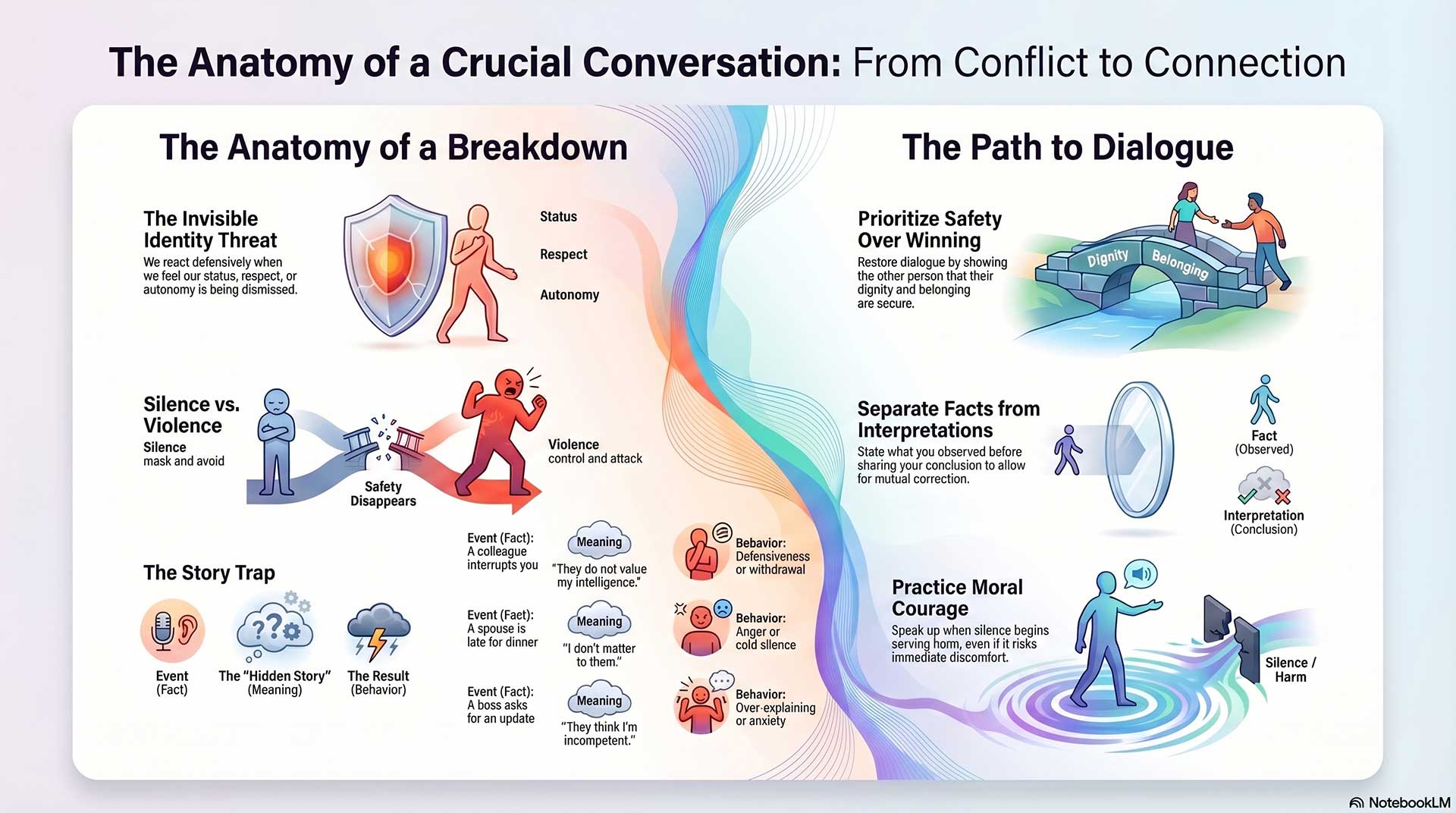
After sitting with these five conversations, what stays with me most is this: a crucial conversation is not simply a stressful exchange. It is a test of what kind of person we become when truth becomes costly.
That is the real drama in this book.
Not whether someone knows the right technique.
Not whether someone can sound calm.
Not whether someone can win the argument.
But whether a human being can stay honest without turning cruel, stay open without turning weak, stay brave without turning self-righteous, and stay caring without hiding what must be said.
That is a much deeper challenge than communication advice usually admits.
Again and again, this roundtable showed that people do not break conversations only because they are careless. They break them because something precious feels threatened. Their dignity feels exposed. Their belonging feels uncertain. Their identity feels judged. Their inner story hardens too fast. Their fear outruns their curiosity. Their longing for peace becomes avoidance. Their desire for truth becomes aggression. Their silence becomes participation in the very harm they hoped to prevent.
Yet the panel also kept pointing to hope.
Human beings can learn to pause before their first interpretation becomes law.
They can learn to see that anger is often only the visible layer over hurt, shame, or fear.
They can learn that safety is not softness, but the condition that lets truth enter without immediately becoming war.
They can learn that courage is not loudness, but the willingness to risk comfort for honesty.
They can learn that one conversation, handled with enough truth and dignity, can redirect years of misunderstanding.
That may be the deepest promise in Crucial Conversations.
It does not promise painless dialogue. It does not promise that every honest talk will end in reunion, agreement, or relief. Some conversations expose fractures. Some end illusions. Some reveal that trust has been damaged more deeply than either side wanted to admit. But that too has value. Truth may not always restore the old relationship, yet it can still restore dignity, clarity, and freedom.
And perhaps that is enough to call a conversation life-changing.
I come away from this book with one conviction strengthened: conversation is one of the great moral acts of ordinary life. Families rise or collapse through it. Teams thrive or fail through it. Love deepens or dies through it. Nations turn away from violence or drift into it through words, tone, timing, listening, and courage. The future often enters quietly, through a conversation that almost did not happen.
So maybe the final lesson is this:
Do not underestimate the conversation in front of you.
It may be carrying much more than a disagreement.
It may be carrying the next shape of a relationship, the next chapter of a family, or the next direction of your own soul.
That is why we need wisdom when the stakes rise.
That is why this book still matters.
And that is why one honest, humane, brave conversation can still change everything.
Short Bios:
Nick Sasaki — Moderator, writer, and creator of imaginary conversations that bring major thinkers together around the deepest human and cultural questions.
Joseph Grenny — Coauthor of Crucial Conversations and a leading voice on dialogue, influence, and human performance under pressure.
Kerry Patterson — Coauthor of Crucial Conversations known for teaching people how to handle high-stakes communication with clarity and purpose.
Ron McMillan — Coauthor of Crucial Conversations who focused on leadership, behavior change, and the human cost of silence.
Al Switzler — Coauthor of Crucial Conversations known for helping people build dialogue, accountability, and honest communication in work and life.
William Ury — Negotiation and mediation expert best known for showing how conflict can move from confrontation to real dialogue.
Amy Edmondson — Researcher known for her work on psychological safety and why people speak up or stay silent in teams and organizations.
Daniel Shapiro — Conflict and negotiation scholar focused on identity, emotion, and the hidden forces that make hard conversations harder.
John Gottman — Relationship researcher known for identifying the habits that strengthen trust or slowly destroy connection.
Chris Voss — Former FBI hostage negotiator known for practical methods that lower defensiveness and keep dialogue alive under pressure.
Adam Grant — Organizational psychologist known for exploring how people rethink assumptions, revise beliefs, and learn from disagreement.
Deborah Tannen — Linguist and conversation scholar known for showing how style, tone, and framing create misunderstanding between people.
Douglas Stone — Coauthor of Difficult Conversations known for helping people separate facts, feelings, and interpretations in conflict.
Sheila Heen — Coauthor of Difficult Conversations who studies feedback, listening, and the emotional structure of hard dialogue.
Charles Duhigg — Writer and researcher who explores habits, connection, and the hidden patterns that shape how people relate.
Marshall Rosenberg — Founder of Nonviolent Communication, known for teaching truth-telling rooted in empathy, needs, and human dignity.
Brené Brown — Researcher and author known for her work on vulnerability, shame, courage, and emotional honesty.
Carl Rogers — Psychologist whose work on deep listening and unconditional regard transformed how people think about human encounter.
Susan Scott — Author of Fierce Conversations known for her insistence that real honesty can change relationships, work, and life.
Esther Perel — Psychotherapist and author known for exploring intimacy, betrayal, truth, and the emotional cost of silence in relationships.
Leave a Reply