
Introduction
Some war stories begin with armies.
This one begins with a kitchen.
That matters.
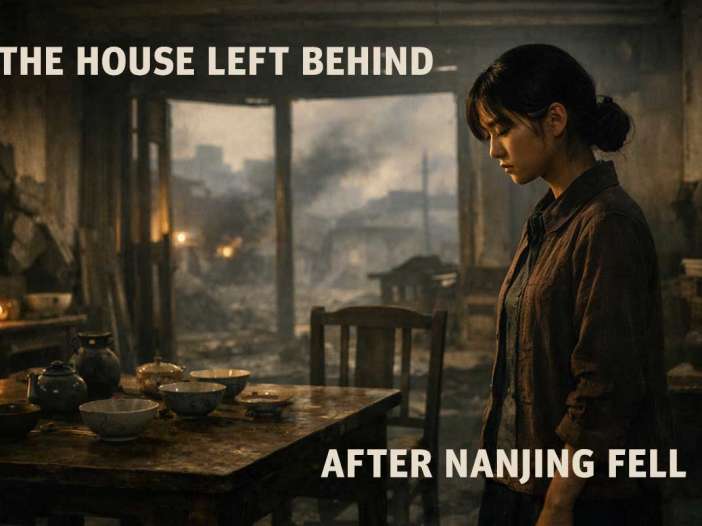
The House Left Behind in Nanjing is not built from strategy, headlines, or battlefield maps. It begins inside a family home, where morning steam rises from breakfast, a mother moves through familiar tasks, a father still wants to believe the capital will hold, a daughter quietly notices what others are trying not to say, and a younger brother mistakes courage for the ability to sound unafraid. That is where this story starts — not in history as abstraction, but in home as lived reality.
That is also what makes the story painful.
The fall of a city is often told in public language: armies advancing, governments retreating, defenses collapsing. But for ordinary people, catastrophe rarely arrives in those terms first. It arrives as changed faces in the market. A quieter meal. A father whose reassurance sounds weaker than it did the day before. A mother who begins counting rice instead of trusting speeches. A grandmother who understands that houses can remain standing even after the life inside them has already begun to disappear.
This story was written to stay close to that smaller truth.
At its center is Li Lan, a young woman who becomes the emotional witness of her family’s unraveling. Through her, we see that war does not begin only with gunfire. It begins with hesitation. With altered routines. With words like safe and later and not yet starting to lose their weight. By the time the city falls, something has already been collapsing for days inside the family itself.
That is one of the deepest concerns of this work: that the destruction of home begins before walls are broken.
This story also refuses a false simplification. It does not leave out the terror of massacre, the threat that falls on women, the helplessness of fathers, the fear that children absorb too early, or the silence that follows violence too large for immediate speech. But it does not turn suffering into spectacle. Its center of gravity is not shock for its own sake. It is what fear does to closeness. How people stop knowing how to touch one another. How love remains and yet changes shape. How a family can survive and still lose the form of itself.
That distinction matters.
I did not want this to be a story that merely says, “This happened.”
I wanted it to ask, “What remains in people after this happens?”
A mother’s hand that pauses before touching her daughter.
A boy who grows quiet too soon.
A father who cannot hold his daughter’s gaze.
A grandmother whose presence becomes the memory of the house itself.
A table that still stands, even after its meaning has changed.
For me, the deepest sorrow in this story is not only that innocence is destroyed. It is that ordinary life continues afterward. Water still has to be fetched. Food still has to be set out. People still sit at the table. Morning still comes. Survival is not clean. It does not restore. It only carries memory forward into the next day.
That is why this is not simply a story of destruction.
It is a story of endurance in altered form.
Of survival without return.
Of a house that remains, and yet cannot become what it once was again.
If the story lingers, I think it lingers there — in the quiet understanding that history does not only kill. It also changes the meaning of home, of family, of touch, of silence, and of the future itself.
Chapter 1 — When Nanjing Was Still Home
There was steam in the kitchen that morning.
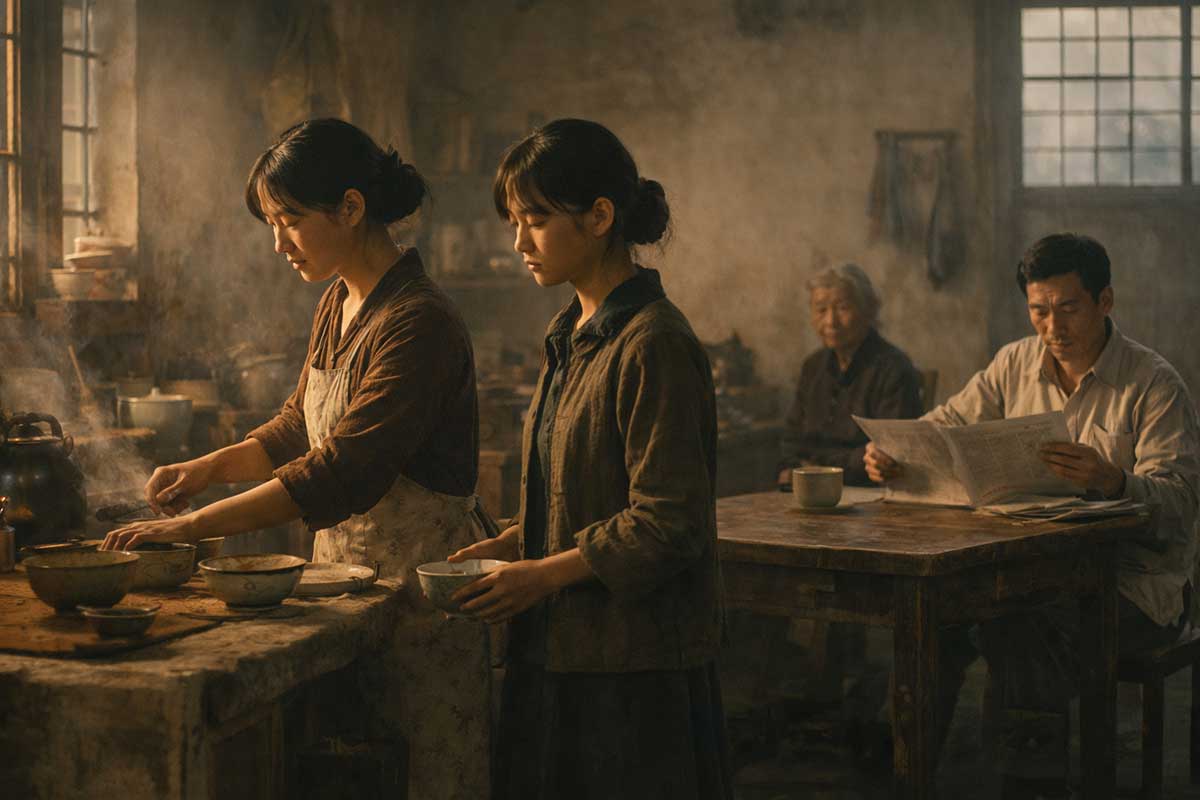
Chen Meilian lifted the lid from the pot just enough to check the rice, and a soft white cloud rose into the chill air before fading. The house still held the ordinary sounds of morning: the crackle of charcoal, the light touch of bowls against wood, the low movement of people who knew each other well enough not to speak loudly. Such sounds usually steadied her. That day, they did not.
“Lan, hand me the small dish from the top shelf.”
Li Lan rose on her toes, reached for it, and placed it beside her mother without clatter. At seventeen, she had learned the quiet rhythm of the house. She knew how to enter a task without getting in the way. Meilian had long taken comfort in that. Still, there were moments when her daughter’s carefulness troubled her. Lan noticed too much. Girls who noticed too much often saw what should never have reached them.
“Hengyi, are you up yet?” Meilian called.
No answer came at first. Then, from the back room, a sleepy voice: “I’m up.”
“That is not the voice of someone who is up,” Lan said.
A short struggle followed, then Li Hengyi appeared with his hair still wild from sleep. He was fourteen, thin, newly stretched by growth, and already trying to sound older than he was. Boyhood had not quite left his face, though he behaved as if he had already buried it.
“I said I’m awake.”
“You still look asleep.”
“You’re noisy in the morning.”
Lan nearly smiled. Meilian nearly did too. Then there came a quiet clearing of the throat from the corner of the room.
Li Wentao was already seated.
A newspaper lay open in front of him, along with a few papers from work. He had not put on his glasses. He did not seem to be reading. His eyes were fixed on the page in the way a man looks at something only so he will not have to look somewhere else.
“Your porridge is ready,” Meilian said.
Wentao answered with a small sound and nothing more.
In the next room, old Madam Zhao shifted and sat straighter. She had the habit of listening to a house before fully entering the day. Lan had often thought that old people, after long years, learned to hear more than the rest of them.
“It sounds uneasy outside,” the grandmother said.
The air in the room paused.
“Does it?” Meilian asked, though she had heard it too.
“There are too many doors shutting this early.”
Wentao looked up, though he still said nothing. Hengyi was not yet alert enough to understand the weight in the room. Lan understood only that something had changed, and that everyone else knew it had changed too.
She listened.
A cart somewhere on the road. Quick voices. The wooden crack of a gate shutting. None of it loud. Yet all of it wrong for that hour.
They sat down to breakfast. Rice porridge. Pickled vegetables. Small side dishes. Nothing special, though it was enough. Meilian served each bowl in turn, all the time recalling the level of rice left in the bin. Still enough for now. Yet it seemed to be running out faster than before.
“I’m going to the market today,” she said.
Wentao gave a short nod.
“Lan is coming with me.”
Lan nodded too.
“If there is rice, I may buy a little more.”
This time Wentao looked up.
“That may be unnecessary.”
Meilian set a bowl in front of Hengyi. “Unnecessary is not the word I would use.”
“People are getting carried away.”
Grandmother Zhao picked up her chopsticks. “When people’s faces begin to change, something is already happening.”
Again, silence.
Hengyi tried to force lightness into the room. “Nothing will happen. This is Nanjing.”
Wentao answered him at once, as if seizing the line for himself.
“That’s right. This is the capital. It won’t fall so easily.”
Lan looked at her mother. Meilian said nothing. Still, it was plain she was no longer standing in the same place as her husband.
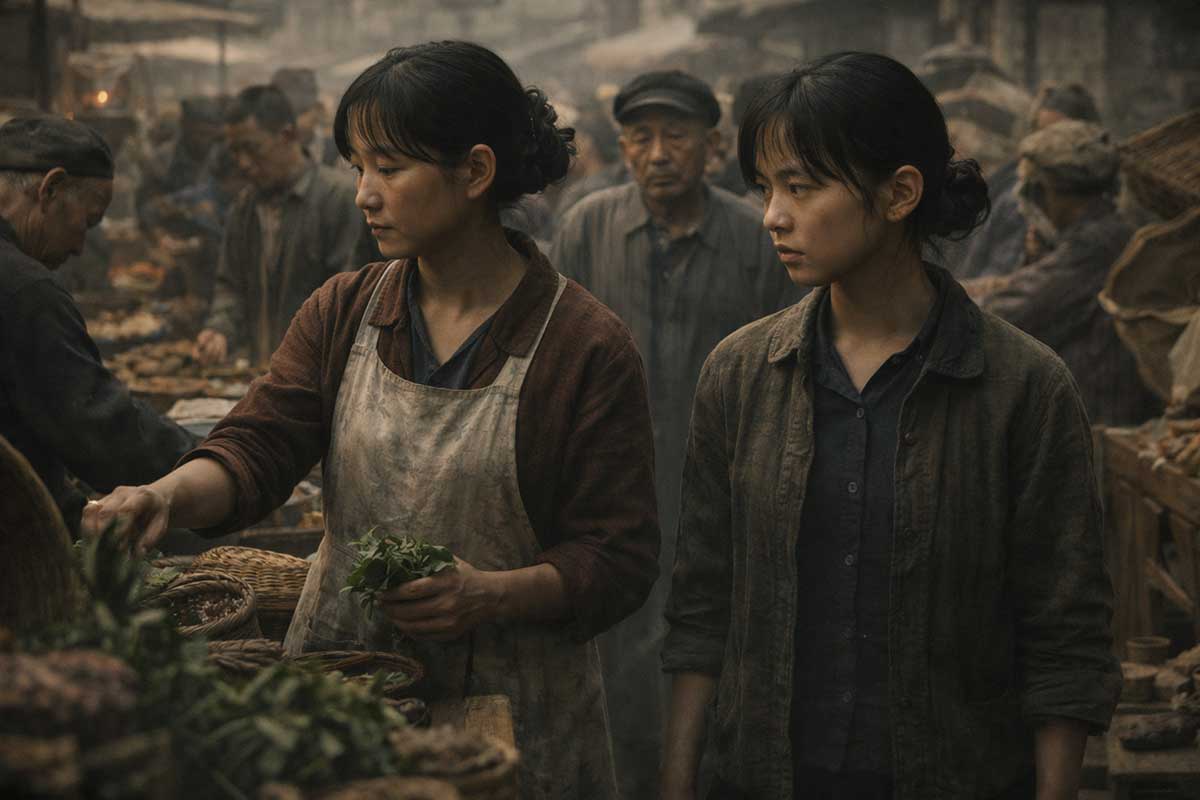
After breakfast, mother and daughter went to market. The morning air bit at their hands. The streets were already crowded. Not with the usual softness of buying and selling, but with something tighter. Faces were drawn. Movements were quick. No one wasted time.
A line had formed at the rice shop.
“So early?” Lan asked.
Meilian did not answer right away.
Women near the front were speaking in low voices.
“They already sent relatives away.”
“Where?”
“South, I heard. Before it gets worse.”
At another stall, men murmured the names of places and troop movements. Shanghai. Soldiers. Leaving.
The rice seller was quieter than usual. He weighed, counted, handed over. No jokes. No familiar talk. Meilian bought more than she had planned.
On the way home, Lan asked, “Do you think people are really leaving?”
“Some are.”
“Father says it will hold.”
“Your father wants to believe that.”
The answer was not harsh. It was simply true.
Then Meilian added, “When times turn bad, listen less to big words. Watch the small things.”
“The small things?”
“The price of rice. The way people walk. The look in a shopkeeper’s eyes.”
Lan remembered that.
School still opened that day. Teachers stood at the front. Students sat in rows. Yet attention slid from every desk toward the windows. In the pauses between lessons, girls whispered about relatives, departures, fathers who said one thing and mothers who packed another.
One of Lan’s friends said, “My uncle has already sent his wife away.”
Another replied, “This is Nanjing. It can’t come to that here.”
On another day, that sentence might have sounded strong. On that day, it sounded thin.
By the time Lan returned home, Wentao had not yet come back. Meilian moved through the kitchen with no wasted motions. Hengyi pretended to study. Grandmother Zhao sat by the window and listened.
Near dusk, footsteps hurried to the gate.
It was not her father.
It was Zhou Ming.
“Good evening.”
His breathing was uneven. He had come quickly.
“Is Father home?” Lan asked.
“Not yet,” her mother answered.
Ming hesitated, then said, “The city feels worse today. People are moving out. More than yesterday.”
Meilian stopped in the doorway. “That many?”
He nodded. “And the talk of the Safety Zone is growing.”
Lan had heard the phrase only once before, without understanding it.
“Will it really be safe?” she asked.
Ming lowered his eyes before answering. “I don’t know. I only know people are trying.”
That uncertain answer somehow frightened her more than certainty would have.
At last Wentao returned.
One glance at his face was enough. He looked not merely tired, but changed by what he had seen.
Ming spoke first. “It isn’t good.”
Wentao set down his things and said, “They say it can still hold.”
“Who says that?” Meilian asked.
He looked at her. “Those above us.”
Those above us.
The phrase sounded weaker than belief.
At supper, Hengyi tried again to sound older than his years.
“If anything happens, I’ll protect everyone.”
No one laughed.
Lan looked at him. The line was not foolish. It was desperate.
Grandmother Zhao put down her chopsticks. “When a country begins to shake, people’s faces change before the walls do.”
That night Lan stood at the window and looked into the dark street.
Nanjing was still there. The city had not vanished. The houses stood. The roads still ran where they had always run.
Yet the words “It is the capital” no longer carried the strength they had the day before.
It seemed to her that perhaps cities did not collapse first.
Perhaps people did.
Chapter 2 — The Capital That Could Not Protect Them
The next morning the noise outside began before the house was ready for it.
Lan woke to footsteps, wagon wheels, doors shutting hard. Morning no longer rose from the kitchen first. It came from the street.
By the time she entered the main room, Meilian had already lit the fire. The work of her hands had turned sharper. She moved fast, not in panic, but in the way of someone who had begun to count time differently.
“The family across the way is packing,” she said.
Lan looked out. Bundles had been set by the gate. An older woman stood beside them, looking up and down the road.
“Do you think they’re leaving?”
“Enough people are thinking of it.”
Wentao emerged, saw the same sight, and said, “They may be overreacting.”
Grandmother Zhao answered, “People rarely overreact all in the same direction.”
At breakfast, Hengyi said again, “Nothing will happen. This is Nanjing.”
Wentao took up the sentence. “Yes. It is the capital. It won’t fall so easily.”
Yet the words felt weaker now, almost as if he needed them more than anyone else.
Later he left for work. When he returned that evening, his face had darkened.
“What is it?” Lan asked.
He sat before replying. “The offices are unsettled. The schools too. No one says much directly.”
“Do they still think it will hold?” Meilian asked.
“Those above still say so.”
Again that phrase.
Above.
No longer “we.”
No longer “certainly.”
Meilian opened the rice bin after he went to wash. She checked the salt. The water. The charcoal. She had begun, without saying the words, to prepare the house for the possibility that the house would not hold them.
“Mother,” Lan said, “is it really that serious?”
Meilian answered without looking up. “When rice begins to matter more than speeches, it usually is.”
That afternoon Zhou Ming came again. This time he did not even try to soften his urgency.
“The Safety Zone may be real,” he said. “Foreigners are said to be helping gather civilians.”
“May be real,” Wentao repeated.
“It is still more than sitting and waiting.”
Wentao’s expression tightened. “Can everyone get in?”
“I don’t know.”
“Can it truly protect anyone?”
“I don’t know that either.”
Ming looked from one face to the next.
“But I know the city does not feel safer than yesterday.”
That night the family sat under lamplight. The same table. The same bowls. The same room.
Only now each face carried a different kind of strain.
Before they went to bed, Lan looked once more at the light on the walls and thought that even the lamp seemed weaker than before.
Chapter 3 — Those Who Flee, Those Who Stay
Lan did not sleep much that night.
The house had gone quiet, yet not into rest. It was the quiet of people pretending they could still wait.
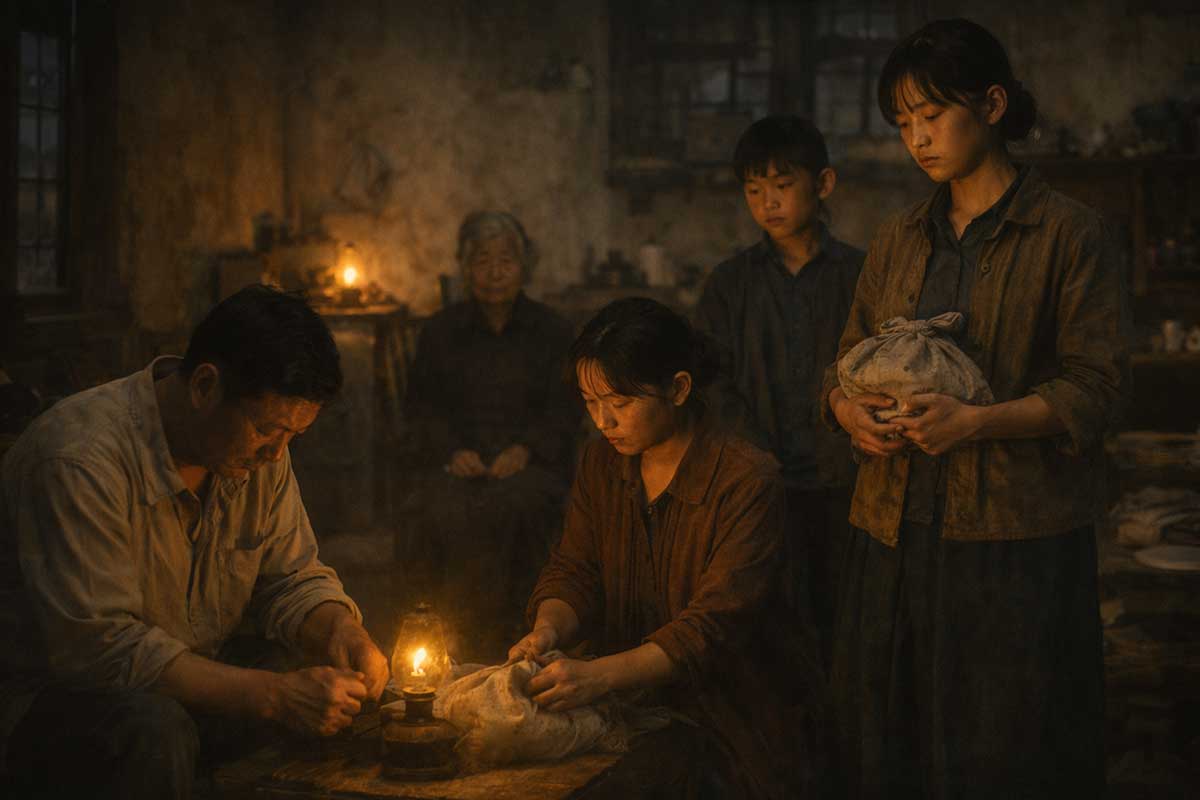
At dawn she found her mother already kneeling over small bundles on the floor — cloth, medicine, food, a few clothes, all reduced to what hands could carry.
“Mother,” Lan said.
“Choose your things,” Meilian answered. “Only what matters.”
That turned out to be impossible.
Lan sat before her belongings and understood, for the first time, that choosing what to take meant choosing what to abandon. A book. A hairpin. A winter jacket. A keepsake from her grandmother. A family photograph. Which part of herself was small enough to carry?
Hengyi came to the doorway carrying his own little bundle.
“What do you have?” Lan asked.
“Nothing important.”
Inside were a childhood writing brush, a small knife, and a carved token from their father.
“Planning to defend the house with that?”
“If I have to.”
Lan wanted to smile. She could not. He meant it as much as a frightened fourteen-year-old boy could mean anything.
“Are you afraid?” she asked.
He shot back, “Aren’t you?”
After a moment she answered, “Yes.”
That honesty startled him into silence.
The harder confrontation came later, in Grandmother Zhao’s room.
“I will not leave,” the old woman said.
No one answered at first.
Then she repeated it. “I will not leave this house.”
Meilian knelt beside her. “You must.”
“No.”
Wentao stood very still. Lan watched her father’s face and saw that this was the point at which duty became unbearable.
“This is where I have lived,” the grandmother said. “I will not spend my last days dying in a stranger’s place.”
“If we stay, we may lose everything,” Meilian said.
Grandmother Zhao gave the room a long look, as if fixing it in her eyes one piece at a time.
“If we leave, what comes back may not be this house at all.”
No one could answer that.
Later Zhou Ming arrived in haste.
“You need to move soon,” he said.
“Soon is not the same as possible,” Wentao replied.
Ming met his eyes. “Late is worse.”
By evening the family sat again in the main room, trapped inside the same question. Leave with whom? Carry what? Move where? Bring the grandmother how? Trust what safety?
“Maybe we should go tonight,” Meilian said.
Wentao answered, “I need a little more time.”
She turned toward him with all her fatigue laid bare. “Time is the one thing that is no longer waiting for us.”
Grandmother Zhao said from the next room, “Take the children. Leave me.”
“No,” Hengyi burst out.
“Then all of you will be slowed by me,” she said.
Nothing cut deeper than the truth.
No decision satisfied everyone. No decision looked clean. Yet the day ended, and still no final movement had been made.
That night Lan walked through the house in the lamplight and looked at everything as if it had already become memory.
The table.
Her father’s desk.
Her grandmother’s place.
The kitchen.
Her brother asleep.
She thought: remember this.
The moment she thought it, she knew loss had already begun.
Chapter 4 — When Home Ceased to Be Home
Morning came without morning sounds.
No market voices. No calm kitchen rhythm. Only running feet, doors slamming, strained voices from the road.
Everyone in the house was already in motion.
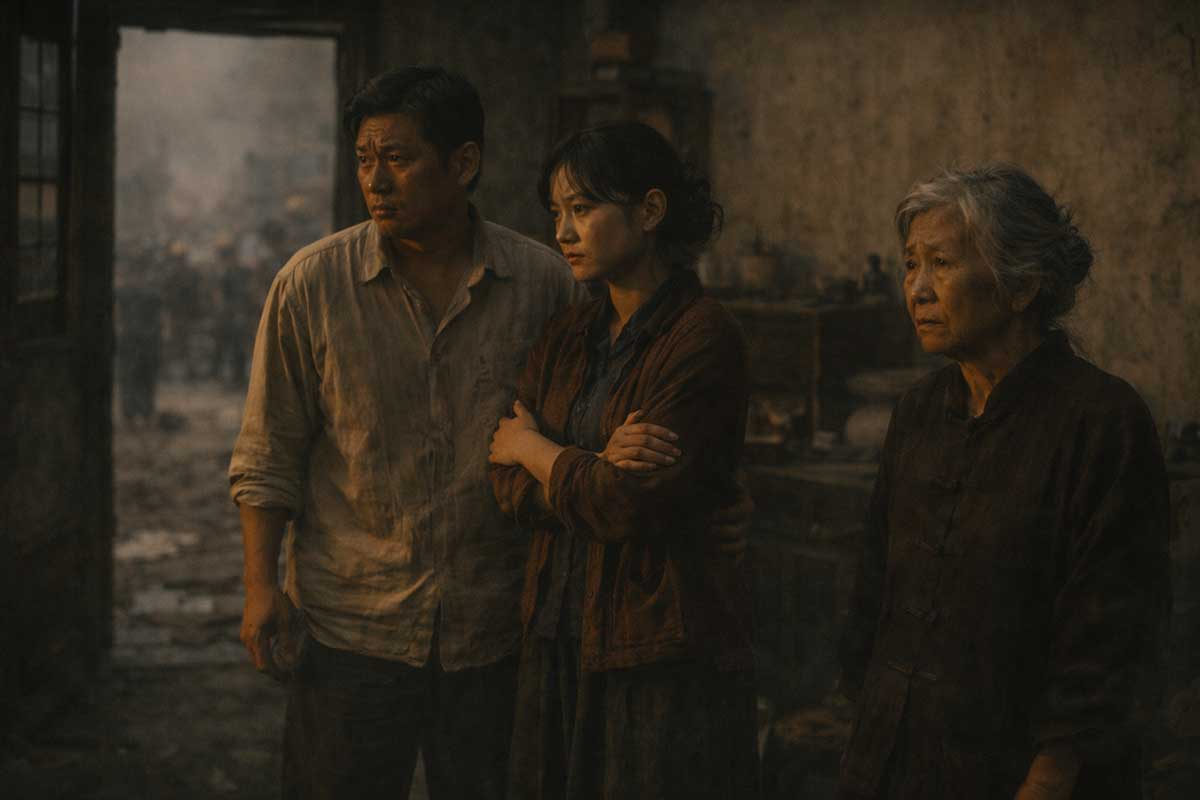
Meilian tightened bundles. Wentao moved from doorway to room and back again. Hengyi tried to stand like someone older. Grandmother Zhao sat upright, grave and still.
“This is not the same morning,” she said.
It was not.
Wentao stepped outside to look. When Zhou Ming arrived, his face carried the answer before his words did.
“It’s bad,” he said. “Do not wait any longer.”
At last Wentao said the words that had taken too long to come.
“We leave.”
That was not the end of the struggle.
Grandmother Zhao still resisted. “I cannot walk. Take the others.”
“No,” Meilian said.
“No,” Hengyi said even louder.
Wentao bent to lift his mother. It was not only her body he seemed to raise onto his back. It was the whole weight of the house.
Lan looked once across the room.
The table.
The lamp.
Her father’s papers.
The grandmother’s seat.
Her mother’s cooking pots.
Nothing had been broken yet.
Still, the room no longer felt like safety.
That was the true beginning of the fall.
They stepped into the street. People were moving without direction, not together but against each other’s fear. Some carried bundles. Some children cried. Some men shouted. Others stood as if their bodies had forgotten what decision looked like.
At a crossing up ahead, people surged back the other way.
“Not there,” someone shouted.
Another voice began to say something and stopped in the middle of it.
Then Meilian’s hand gripped Lan’s arm hard.
“Do not lift your face,” she whispered.
Lan did not fully understand. Still, she understood enough.
She was no longer simply someone escaping danger. She had become someone who must be hidden from it.
Around them came sounds that never formed a single picture: something heavy striking wood, a voice cut short, a door closing hard, boots, breath, a woman’s muffled cry from somewhere not visible.
No one in the family saw everything.
That was part of the terror.
Lan kept her eyes lowered. The unseen grew larger than sight.
Wentao halted once, only once, under the combined weight of his mother and indecision.
“Here!” Zhou Ming shouted, calling them toward a narrower way.
They moved again.
In those moments Lan learned that staying together as a family could become almost impossible in a single morning. To protect. To carry. To hide. To decide. No one could do it all.
Later, when the noise thinned for an instant, Lan looked up.
Her mother was still there.
Her brother was still there.
Her father was still there.
Her grandmother.
Zhou Ming.
That fact nearly brought relief.
Then came the next truth.
Still there, for now, was not the same as safe.
Lan did not yet think in formal words that the city had fallen.
What she knew was smaller, and far more painful.
The time inside their house — the time that had belonged to them — had ended.
She did not cry.
Some losses arrive too large for tears at first.
Chapter 5 — The Silence After Survival
The first thing Lan noticed afterward was not who remained.
It was what was missing.
A voice.
A breath in the room.
The weight of something familiar that no longer settled where it should.
Her mother was alive.
Hengyi was alive.
Her father.
Her grandmother.
Zhou Ming too.
Yet all of them had changed.
Meilian’s hands changed first. She moved before she spoke. She found water. She found cloth. She arranged a place to sit. She told Lan to drink.
Lan took the water but could not at first swallow.
“Mother…”
That was all she could say.
Meilian looked at her daughter and, for the briefest instant, hesitated before touching her.
Not from lack of love.
From love made uncertain by pain.
Lan felt it. She wanted to lean into her mother and, at the same time, could not bear being held too suddenly.
In that moment she understood:
She would not go back to being the girl she had been.
Nearby, Hengyi sat with his knees drawn close, staring ahead. Gone were the loud claims that he would protect everyone. Gone too was the easy speech of a boy. What remained was a silence too old for him.
“Are you all right?” Lan asked.
“I’m fine,” he said.
He was not.
Their father sat with the stillness of a man who had failed in the place where a father most wants never to fail. Once, when Lan looked at him, he could not meet her eyes for more than a second.
At last he said only, “I’m sorry.”
Lan wanted to tell him that the guilt did not belong where he was trying to place it. Yet she could not. She knew what he meant.
Grandmother Zhao, who had insisted on staying with the house to the last possible moment, said only, “If you are alive, drink water.”
It was the sort of sentence only she could make sound like both command and mercy.
Time moved after that, though not in the old way.
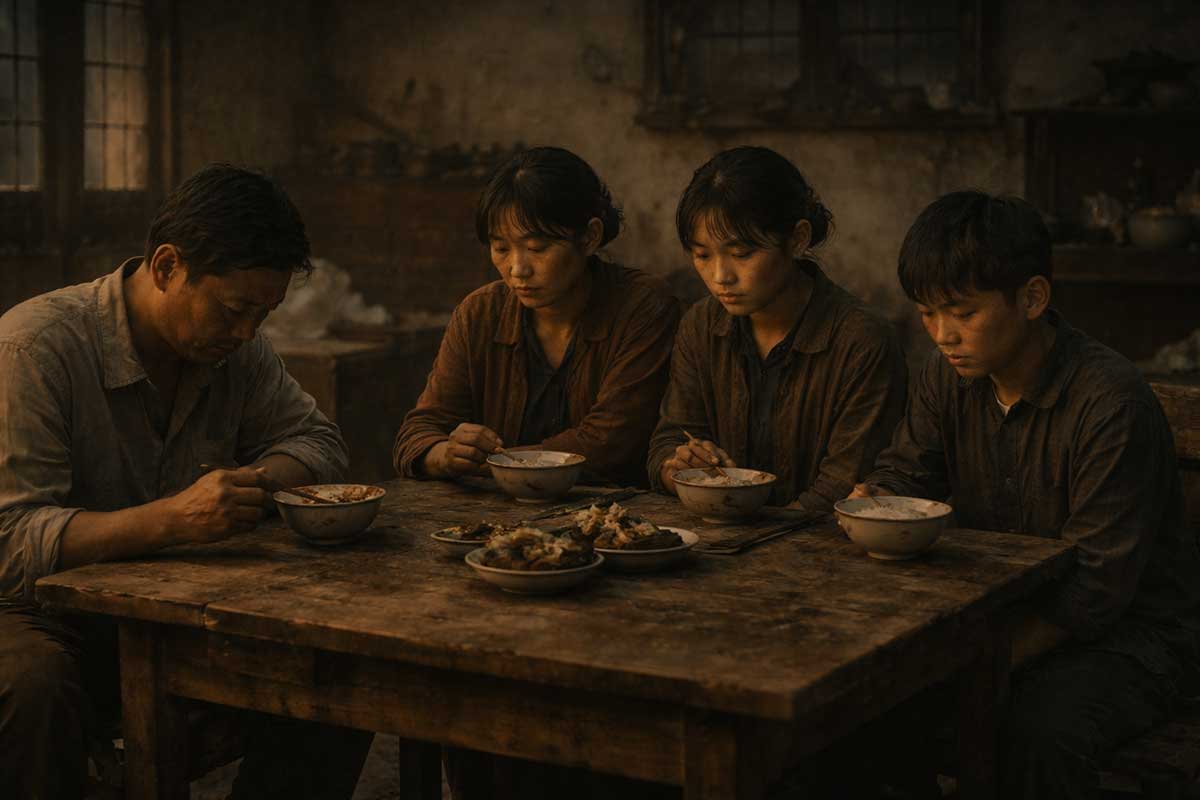
When the family sat again around a meal, the shape of home returned before its meaning did. Bowls on a table. Evening light. Familiar places.
No familiar ease.
Meilian once reached to straighten Lan’s bowl and stopped halfway, her hand suspended in the air for a heartbeat before withdrawing.
No one spoke of that pause.
No one needed to.
Unspoken things had become the air of the house.
Hengyi grew quiet in a deeper way. He no longer argued for the sake of sounding strong. He no longer said he would protect everyone. The loss had entered him through silence, not speech.
One day he asked Lan, “Do you think we’re all right now?”
She could not answer.
“All right” no longer meant one thing.
Was the city all right?
Was the house?
Were they?
“I don’t know,” she said.
He nodded. “No. I guess not.”
Their grandmother’s cough still sounded through the house in the evenings. Yet even that familiar sound no longer meant safety. The meaning of sounds had changed. Their father’s chair moving. Their mother setting down a lid. Their brother’s footsteps. Small things now struck deep.
When Zhou Ming came by again, Lan saw at once that he too was no longer the young man who had once stood at their gate carrying news.
He tried at first to say, “I’m glad you’re safe.”
Then he stopped and corrected himself.
“I’m glad I found you.”
Lan nodded.
After a pause he said, “It doesn’t feel right to call this safety.”
“No,” she answered. “It doesn’t.”
That was enough.
Sometimes the deepest truth fits only in the shortest lines.
The seasons could move on. Still the house did not become what it had been.
A home can remain standing and yet lose its old meaning.
They still sat at the table.
They still ate.
They still slept under the same roof.
Morning still came.
Survival had not restored them.
It had only carried them forward in broken form.
One evening Lan stood alone at the window.
Nanjing had gone quiet.
Not healed.
Not restored.
Quiet.
Inside her, the door closing, her mother’s halted hand, her father’s apology, her brother’s silence, her grandmother’s voice — none of it was over.
Then she began to understand that survival was not rescue.
It was memory, carried into the days that followed.
Morning would keep coming. That was its own hard mercy.
And for those who remained, living meant receiving those mornings anyway.
Final Thoughts
When this story ends, it does not end with closure.
That feels right.
A family sits together again. Food is placed on the table. The house still exists in some form. The city has gone quieter. Yet nothing has truly been restored. That, to me, is the emotional truth this story protects.
Too often, stories of historical atrocity are pulled in one of two directions. Either they become distant and academic, reduced to dates and scale, or they become overwhelmed by the event itself, leaving little room to understand what happens to the people who remain alive after the worst moment has passed. This story tries to resist both tendencies. It keeps history present, but it stays with the family. It stays with what silence sounds like in a room after fear has entered it and never fully left.
That is why the final chapters matter so much.
Li Lan does not emerge as someone “healed.”
Meilian does not become a symbol of simple strength.
Wentao does not receive relief through apology alone.
Hengyi does not mature in some noble or triumphant way.
The grandmother does not stand only for endurance.
Each of them carries damage differently, and that difference is what makes the family feel true.
The mother keeps moving because people must still live.
The father carries helplessness in a way he cannot put into language.
The daughter becomes a witness by surviving.
The son loses the right to remain a child.
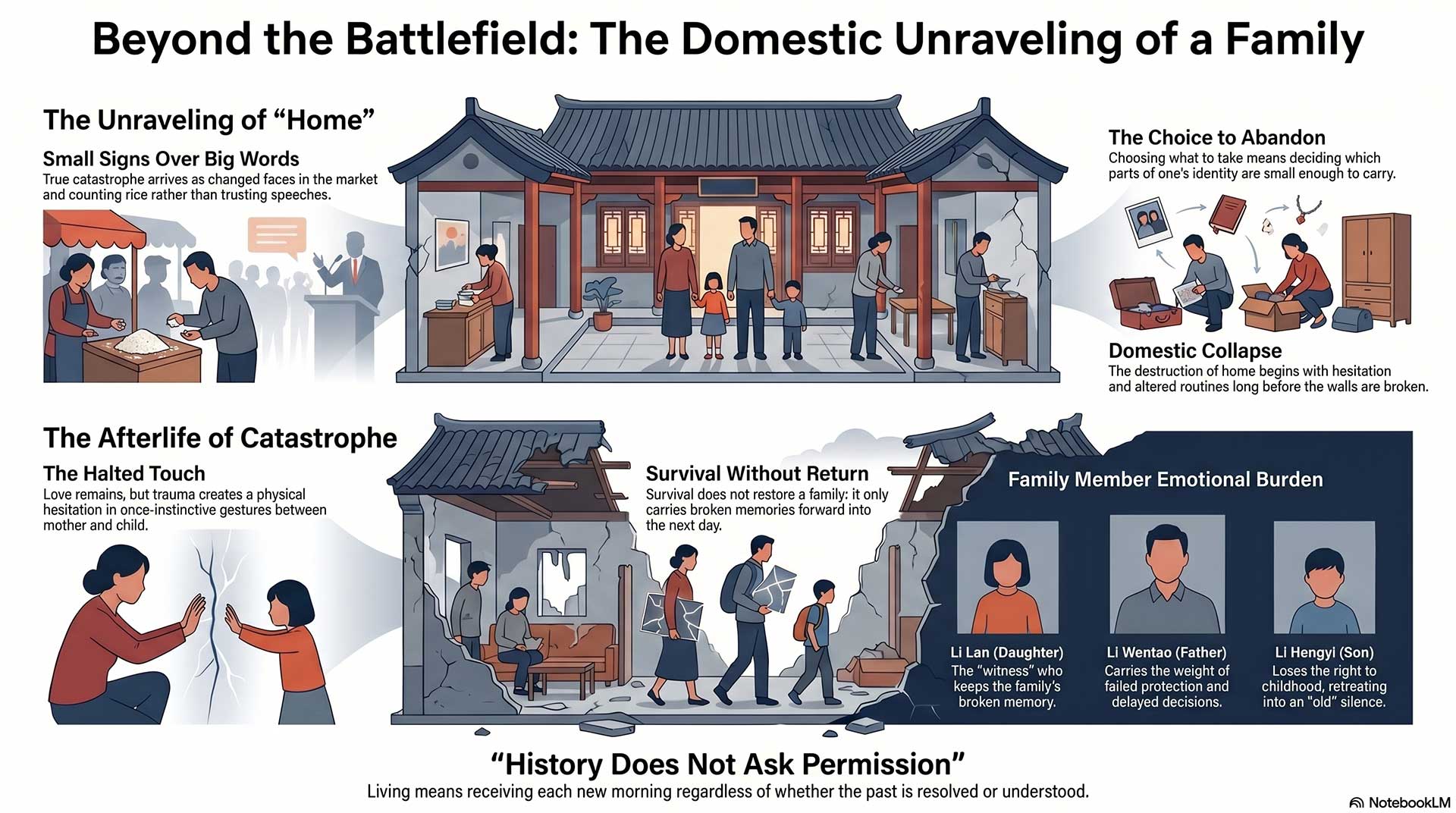
And the house itself becomes a place where the shapes of ordinary life remain visible, but their emotional meaning has changed.
I think that is one of the strongest things in the story: it does not claim that the family “accepts” what happened. It does not pretend that understanding, naming, or continuing forward is the same as peace. It simply shows that people sometimes go on living in broken form, not because they have resolved the past, but because morning keeps arriving anyway.
That is a hard truth, but a necessary one.
For me, one of the most painful details in the story is not an act of violence. It is the mother’s hand stopping before it touches her daughter. That small hesitation says everything. Love is still there. Care is still there. But the old ease is gone. The body remembers what language cannot hold. This is how trauma enters domestic life — not only through memory, but through pause, distance, sound, posture, and all the things that were once instinctive.
The same is true of the son’s silence, the father’s lowered eyes, the grandmother’s changing place in the room. These are not decorative emotional details. They are the actual afterlife of catastrophe.
And that is why the story continues to matter after the city falls.
The destruction of a home is not finished when the danger passes.
It continues in the meanings attached to bowls, chairs, footsteps, and evening light.
It continues in the future a daughter can no longer imagine the same way.
It continues in a family that is still together, yet no longer knows how to be together as before.
That is what this story leaves me with: not resolution, but a kind of grave recognition.
A house can remain standing and still be lost.
A family can survive and still be changed beyond repair.
Silence can become the truest form of testimony when pain is too deep for clean speech.
And yet there is one quiet dignity here too.
They remain.
They remember.
They sit down again.
They keep living.
Not because everything is all right.
But because history does not ask permission before forcing the living into the next day.
This story understands that.
That is why it lingers.
Short Bios:
Nick Sasaki
Nick Sasaki is a writer, curator, and creative host of emotionally serious stories and imagined dialogues that explore history, war, memory, morality, and the hidden afterlife of trauma. His work often focuses less on events alone than on what remains inside people after those events are over.
Li Lan
Li Lan is the central emotional witness of the story, a young woman in Nanjing whose quiet sensitivity makes her the one who notices the house changing before anyone can fully name what is happening. By surviving, she becomes the keeper of the family’s broken memory.
Chen Meilian
Chen Meilian is the mother of the family and the practical center of the home. She senses danger early, acts before others are ready, and continues to keep the family alive even after ordinary tenderness becomes difficult.
Li Wentao
Li Wentao is the father, a thoughtful man who wants to believe the capital will hold and who carries the burden of delayed decisions and helplessness. His silence becomes one of the heaviest moral presences in the story.
Li Hengyi
Li Hengyi is the younger brother, still a boy at the start, who tries to sound brave before he understands what bravery can and cannot do. The war forces him into silence before he has had time to remain fully young.
Grandmother Zhao
Grandmother Zhao is the elderly grandmother whose attachment to the house gives the family’s dilemma its deepest emotional weight. She represents memory, continuity, and the truth that home is never merely a structure.
Zhou Ming
Zhou Ming is the young neighbor who carries news from the outside world into the family’s inner life. He understands danger earlier than most, yet learns that knowing what is coming is not the same as being able to save everyone from it.
Leave a Reply