
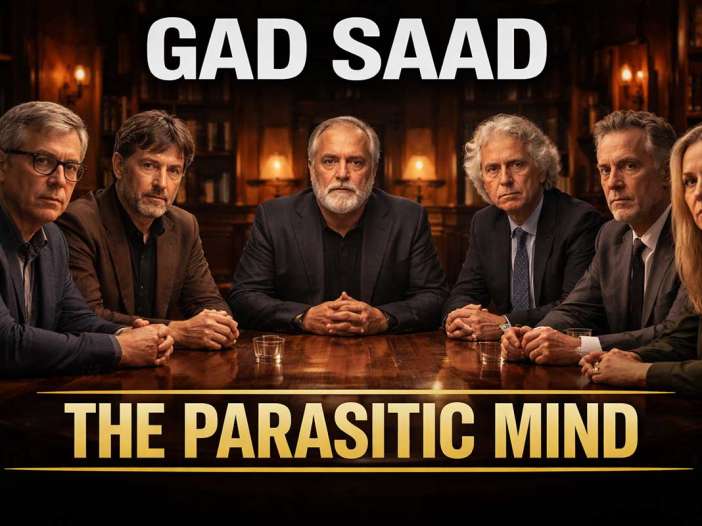
What if Gad Saad exposed why truth itself became dangerous in modern institutions?
Introduction by Gad Saad
There are times in history when a society loses more than confidence. It loses its ability to tell the difference between truth and performance, courage and compliance, scholarship and ideology. That is the moment we are living through now.
For years, I have argued that bad ideas do not merely persuade. They infect. They spread through minds, institutions, and cultures by attaching themselves to vanity, fear, tribal loyalty, and moral posturing. They flourish most easily where people should have known better. That is what makes this crisis so disturbing. The problem is not a lack of intelligence. It is the corruption of intelligence in the service of falsehood.
In this conversation, I wanted to examine that corruption from five angles. Why do educated people become carriers of absurdity? How did postmodernism weaken truth itself? Why is biology now treated as though it were a form of aggression? Why do institutions surrender so quickly to pressure? And what kind of courage is still possible when conformity is rewarded and honesty is punished?
These are not abstract questions. They shape what can be taught, what can be said, what can be researched, what can be defended, and what kind of civilization our children will inherit. If truth becomes negotiable, then every institution becomes vulnerable. If reality becomes subordinate to ideology, then freedom itself becomes fragile.
So I hope this discussion does more than diagnose the disease. I hope it reminds us that the mind can still resist infection, that courage can still outlive fear, and that truth, however battered, does not cease to be true simply because a culture has grown too timid to speak it aloud.
(Note: This is an imaginary conversation, a creative exploration of an idea, and not a real speech or event.)
Topic 1 — Why Do Idea Pathogens Spread Among the Educated?

Moderator: Gad Saad
Participants:
Jonathan Haidt
Steven Pinker
Jordan Peterson
Bret Weinstein
Christina Hoff Sommers
Opening
Gad Saad:
We are told that education makes people harder to fool. Yet many of the most absurd ideas in modern life did not rise from the street first. They rose from campuses, elite institutions, prestige media, and credentialed circles. That forces us to ask a painful question: why do highly educated people so often become the most elegant carriers of bad ideas? Tonight, I want us to go straight into that tension.
Question 1
Gad Saad:
Why do bad ideas so often spread fastest among highly educated people rather than among the uninformed?
Jonathan Haidt:
Education sharpens the mind, but it does not automatically purify motive. Very smart people are often extremely skilled at defending what their group already rewards. In elite environments, status comes from reading the room correctly, signaling moral decency, and avoiding views that trigger social punishment. So intelligence becomes a servant of belonging. The mind stops asking, “Is this true?” and starts asking, “What must I say to remain a good member of the tribe?”
Jordan Peterson:
Highly educated people are often deeply embedded in dominance hierarchies built on language, prestige, and symbolic control. Once that happens, they are tempted to manipulate words so they can control moral status itself. A bad idea becomes attractive when it allows a person to appear virtuous without bearing the burden of reality. That is deeply seductive. You can escape the tragic limits of life by pretending vocabulary has rewritten being.
Christina Hoff Sommers:
A lot of educated people are humane, decent, and compassionate. That is part of the problem. They are vulnerable to ideas that arrive dressed as kindness. Once an argument presents itself as protection for the vulnerable, many people lower their guard. They stop testing the claim and start performing their goodness. In that climate, skepticism begins to look cruel.
Bret Weinstein:
Education often places people inside systems where the cost of doubt is immediate and the cost of error is delayed. If a faculty member nods along with nonsense, he keeps his job, his friends, and his standing. If he pushes back, he may lose all three. Under those conditions, selection pressure works in favor of conformity. The institution starts breeding for compliance rather than truth.
Steven Pinker:
There is an old temptation among intellectuals to mistake abstraction for wisdom. Educated people can become detached from ordinary feedback from reality. A carpenter, engineer, or nurse gets corrected by the world very quickly. Many academics do not. An idea can survive for years in a seminar room if the penalties for being wrong are weak and the rewards for sounding morally fashionable are high.
Question 2
Gad Saad:
At what point does intelligence stop serving truth and begin serving self-deception?
Steven Pinker:
It happens when reasoning becomes post-hoc justification. Human beings are capable of astonishing rational thought, yet we are just as capable of using that machinery as a lawyer for conclusions already chosen in advance. Intelligence turns corrosive when it loses its link to falsifiability, evidence, and open criticism. The smarter the person, the more polished the self-deception can become.
Christina Hoff Sommers:
I think the warning sign appears when disagreement is treated as contamination. Once people begin avoiding questions rather than facing them, something has gone wrong. Many intelligent people do not abandon reason all at once. They begin with a small act of silence. Then another. Before long, they are defending propositions they would once have laughed at.
Jonathan Haidt:
The shift happens when social intuition outruns reasoning and reasoning becomes its press secretary. Most people want coherence with their community more than accuracy in isolation. In moralized settings, intelligence helps people construct better excuses, better slogans, and better accusations. It becomes a tool for sacred value protection.
Bret Weinstein:
I would put it in evolutionary terms. Intelligence becomes self-deceptive when survival inside the local structure matters more than contact with reality. If a system rewards doctrinal loyalty, then clever people will adapt by becoming fluent in falsehood. They may not even experience themselves as dishonest. They will feel righteous, frightened, and necessary.
Jordan Peterson:
Self-deception begins when truth becomes subordinate to identity. Once your speech is no longer an attempt to articulate reality, but a performance meant to protect your place in the hierarchy, you are in dangerous territory. You have turned logos into propaganda. That is when the intellect, which should be a lamp, becomes a mask.
Question 3
Gad Saad:
What makes elite institutions especially vulnerable to idea pathogens, and what would make them healthy again?
Jordan Peterson:
Elite institutions become unstable when they forget that they exist to pursue truth, competence, and responsibility. The moment they replace those aims with moral theater, they invite corruption. Health returns when standards are restored, when language is tied back to reality, and when people are once again judged by clarity, courage, and merit rather than ideological fluency.
Bret Weinstein:
Institutions become vulnerable when dissent is too costly and error is too cheap. You can fix a lot by changing incentive structures. Protect heterodoxy. Reward people who expose weak assumptions. Make it honorable to question sacred narratives. A truth-seeking institution must metabolize criticism rather than punish it.
Steven Pinker:
They need epistemic norms. Clear argument. Evidence. Replication. Open debate. A distinction between scholarship and activism. These sound basic, yet once they erode, every institutional process becomes easier to hijack. Prestige without standards is a paradise for bad ideas.
Jonathan Haidt:
I would stress viewpoint diversity and moral humility. A community that draws from only one moral matrix will become blind in predictable ways. Institutions need people who see different threats, different tradeoffs, different failures. Without that, they drift into collective certainty and then into collective folly.
Christina Hoff Sommers:
They recover when ordinary honesty becomes possible again. That means professors who can say, “I disagree.” Students who can ask, “How do we know that?” Women and men who are allowed to speak plainly without being forced into scripts. The cure is less intimidation, more candor, and a return to intellectual adulthood.
Closing beat for Topic 1
Gad Saad:
So the tragedy is not that educated people lack intelligence. It is that intelligence, under the wrong incentives, becomes a delivery system for prestige-seeking, fear, and moral vanity. That is how idea pathogens flourish. They do not conquer by argument alone. They conquer by colonizing the social instincts of people who should have known better.
Topic 2 — How Did Postmodernism Poison Truth Itself?

Moderator: Gad Saad
Participants:
Camille Paglia
Douglas Murray
Thomas Sowell
Ayaan Hirsi Ali
Heather Heying
Opening
Gad Saad:
In my work, I have argued that some of the most destructive modern ideas did not begin as policy. They began as intellectual permission slips. Postmodernism told people that truth was suspect, objectivity was naïve, and language was just an instrument of hidden domination. Once that door opened, it became much easier for grievance, identity, and ideological theater to present themselves as wisdom. Tonight I want us to ask a blunt question: how did a philosophy that should have collapsed under its own absurdity end up shaping so much of elite culture?
Question 1
Gad Saad:
What is the deepest damage postmodernism has done to our ability to recognize truth?
Camille Paglia:
Its deepest damage was aesthetic and civilizational before it was political. It trained generations to sneer at excellence, hierarchy, and disciplined judgment. It replaced the hard labor of learning with suspicion toward anything that stood above the self. Once young people are taught that all standards are masks for domination, they lose the ability to admire. And when admiration dies, culture becomes a swamp of resentment.
Thomas Sowell:
The deepest damage is that it invites people to treat evidence as optional when it conflicts with a desired conclusion. That habit does not stay inside philosophy departments. It spreads into law, education, journalism, and public policy. The result is a world in which claims are judged by their political usefulness rather than their correspondence to reality. That is a very expensive way to think.
Heather Heying:
I would say it severs truth from discovery. A healthy mind approaches the world with the expectation that reality can surprise you. Postmodernism encourages the opposite. It tells people that what they are calling discovery is often just privilege speaking. That creates a deadening cynicism. The world stops being something to learn from and becomes something to reinterpret for social advantage.
Douglas Murray:
It gave the educated classes a license to disbelieve the very foundations of the civilization that educated them. That is no small thing. A culture can survive criticism. What it struggles to survive is the systematic delegitimizing of truth, merit, beauty, and continuity all at once. Postmodernism made self-contempt sound sophisticated.
Ayaan Hirsi Ali:
For me, the deepest damage is moral confusion. When people stop believing that truth can be known, they also become weaker in confronting lies, cruelty, and oppression. If everything is narrative, then the victim and the oppressor can be treated as competing storytellers. That is not wisdom. That is moral paralysis.
Question 2
Gad Saad:
Why did so many educated people embrace this way of thinking instead of rejecting it?
Thomas Sowell:
Because many of them pay no price for being wrong. In many institutions, there is little penalty for fashionable error and considerable reward for fashionable outrage. A person can gain prestige, income, and applause by repeating nonsense, provided it is the approved nonsense. Under those conditions, it should surprise no one that bad ideas flourish.
Douglas Murray:
It flatters the believer. That is a large part of its success. It allows ordinary ambition to disguise itself as moral revelation. A person no longer has to say, “I want power.” He can say, “I am exposing power.” That is a far more attractive self-image, especially in elite settings where vanity likes to wear ethical clothing.
Ayaan Hirsi Ali:
It also relieves people of courage. If truth is unstable and moral judgment is suspect, then one does not have to take a clear stand. One can stay fashionable, abstract, and safe. Many educated people prefer that world because real judgment carries real responsibility.
Heather Heying:
There is another layer. Human beings want belonging. Postmodern language became a group marker. Once a vocabulary becomes a badge of moral and intellectual membership, people adopt it even when it empties out their capacity for honest thought. They may start by repeating terms they barely understand, and later discover that their entire moral map has been redrawn.
Camille Paglia:
There was vanity in it from the beginning. Young academics wanted to seem daring without risking anything real. They mistook obscurity for depth and negation for brilliance. It became a fashion industry for the mind. And like many fashions, it survived long after its ugliness should have been obvious.
Question 3
Gad Saad:
Can a culture recover from this corrosion of truth, or does it leave permanent damage?
Heather Heying:
Recovery is possible, but it takes more than criticism. It takes rebuilding habits of mind. People must relearn how to ask what is true, what is testable, and what follows from the evidence. They must regain the ability to be corrected without feeling annihilated. That is slow work, but it is real work.
Ayaan Hirsi Ali:
A culture can recover if it rediscovers moral confidence. That does not mean arrogance. It means the willingness to say that some things are true, some things are false, some values are better than others, and some practices are evil. Without that clarity, freedom becomes too weak to defend itself.
Douglas Murray:
I think recovery begins when people stop being impressed by intellectual vandalism. There was a period when tearing down inherited structures was treated as proof of seriousness. Now many people can see the emptiness that followed. The question is whether enough of them are willing to rebuild rather than merely complain.
Camille Paglia:
Civilizations recover through contact with greatness. Art, history, literature, science, the real sweep of human achievement. Young people need to feel the shock of something larger than ideology. When they do, much of this cramped academic vanity looks very small.
Thomas Sowell:
Recovery begins when institutions once again attach consequences to error and rewards to accuracy. This is less romantic than people like, but it matters. If universities, media, and schools continue to reward distortion, no amount of eloquent criticism will be enough. Incentives shape behavior. They always have.
Closing beat for Topic 2
Gad Saad:
What postmodernism poisoned was not only truth, but the courage to seek it plainly. It taught people to distrust clarity, to moralize confusion, and to treat reality as an inconvenience to ideology. Once that habit enters institutions, it does not stay in books. It enters classrooms, boardrooms, newsrooms, and eventually the soul of a culture. That is why this matters.
Topic 3 — Why Is Biology Now Treated as Heresy?

Moderator: Gad Saad
Participants:
Steven Pinker
David Buss
Geoffrey Miller
Jordan Peterson
Jonathan Haidt
Opening
Gad Saad:
We now live in a strange age. People claim to trust science, yet recoil when science touches human nature, sex differences, mating, status, aggression, parenting, or temperament. The problem is not ignorance alone. The deeper problem is that many people now experience biological reality as a moral insult. Tonight I want us to ask why so many educated minds treat biology as though it were an act of oppression rather than a source of truth.
Question 1
Gad Saad:
Why do discussions of biology trigger so much moral panic in modern culture?
Steven Pinker:
A large part of the panic comes from a confusion between explanation and justification. If you say that some human traits have biological roots, many people hear that you are endorsing inequality, cruelty, or fatalism. But that does not follow. To explain a trait is not to bless every consequence of it. Once that confusion takes hold, biology begins to sound dangerous when it is simply descriptive.
David Buss:
Biology also threatens cherished narratives about how people want the world to work. If someone has built an identity, a politics, or a moral framework around the belief that human beings are endlessly malleable, then evidence of recurring patterns across cultures will feel destabilizing. It is easier to attack the data than to revise the worldview.
Jonathan Haidt:
Moral emotions arrive first. Reason usually comes later. Many people have sacred values tied to equality, dignity, and fairness. Those values matter. The trouble comes when any claim about biological difference is instantly placed into the category of moral contamination. Once that happens, curiosity shuts down and the conversation becomes a ritual of condemnation.
Jordan Peterson:
Biology is frightening because it reminds us that we are not self-created. People would like to believe that identity can be constructed freely through will and language. Yet biology places constraints on fantasy. It tells us that the body is not a costume and that nature is not a mere political inconvenience. That confrontation with limit is unbearable for many people.
Geoffrey Miller:
There is a status element too. Entire professional and social ecosystems are built around theories that become less persuasive if biology is allowed back into the room. So the resistance is not merely emotional. It is also strategic. People defend not just beliefs, but careers, status, and moral positioning.
Question 2
Gad Saad:
Which truths about human nature seem hardest for modern people to accept?
David Buss:
Sex differences are very high on the list. Across cultures, men and women show recurring differences in mating preferences, risk behavior, aggression patterns, jealousy triggers, and status priorities. These are statistical patterns, not chains around every individual. Yet many people resist even that much. They fear that acknowledging average differences will erase dignity or freedom, when it need do neither.
Geoffrey Miller:
Another hard truth is that much of human behavior is strategic in ways people do not like to admit. Courtship, signaling, prestige, moral display, humor, taste, even political expression can serve social and mating functions. People prefer to think their motives are pure and transparent. Evolutionary thinking exposes how mixed and self-serving motives often are.
Steven Pinker:
Many people resist the idea that the mind has structure. They are comfortable saying the body is a product of evolution, but they become uneasy when the same logic is applied to cognition, emotion, and social behavior. Yet it would be odd if evolution shaped our organs and somehow left the mind blank. That blank-slate hope has great emotional appeal, but weak explanatory force.
Jonathan Haidt:
People also resist the fact that we are groupish creatures. We are drawn to loyalty, status, shared narratives, and moral tribes. We want to think we are independent truth-seekers, yet much of our social life runs on ancient patterns of coalition and belonging. That truth is humbling.
Jordan Peterson:
I would add hierarchy. Human beings do not merely live in systems of language. We live in systems of competence, striving, attraction, and rank. That does not mean every hierarchy is just. But the fantasy that hierarchy itself can be abolished is dangerous. It blinds people to the fact that order reemerges, often in uglier form, when it is denied rather than understood.
Question 3
Gad Saad:
How do we speak honestly about biology without letting people twist those truths into cruelty or determinism?
Jonathan Haidt:
We begin with moral clarity. Describing average tendencies does not tell us how to treat an individual standing in front of us. A decent society can recognize patterns in human nature and still protect equal dignity under law. Once that distinction is clear, people may feel less threatened by inquiry.
Steven Pinker:
Precision matters. We should be careful with terms like average, distribution, overlap, probability, and context. Public discussion often collapses these into crude caricature. Good science does the opposite. It distinguishes what is common from what is universal, what is heritable from what is fixed, and what is descriptive from what is prescriptive.
David Buss:
We should also show how knowledge helps. If you understand human mating conflict, jealousy, violence risk, parenting investment, or status competition more clearly, you are in a better position to reduce harm. Biology is not the enemy of compassion. In many cases it is one of its best guides.
Jordan Peterson:
Honesty must be paired with responsibility. If you tell the truth carelessly, people may weaponize it. If you refuse to tell it, ideology fills the vacuum. The task is to speak with courage and discipline at once. Reality must be faced, but it must also be integrated into an ethical framework that treats people as ends, not categories.
Geoffrey Miller:
And we have to stop rewarding bad-faith interpretation. Too often a careful scientific claim is translated into a grotesque slogan by people who want outrage. If every nuanced discussion is punished as though it were malice, then only demagogues and cowards will remain in the room. That is disastrous.
Closing beat for Topic 3
Gad Saad:
What makes biology so threatening to modern ideology is simple: biology refuses to flatter our fantasies. It tells us that human beings come with patterns, limits, motives, and inherited tendencies that cannot be voted away. Yet those truths need not degrade human dignity. They can deepen it. A mature civilization should be able to face reality without panic and defend moral decency without lying about nature. That is the balance we seem to be losing.
Topic 4 — Why Are Modern Institutions So Cowardly?

Moderator: Gad Saad
Participants:
Douglas Murray
Thomas Sowell
Ayaan Hirsi Ali
Camille Paglia
Christina Hoff Sommers
Opening
Gad Saad:
Bad ideas do not spread on their own. They need hosts. They need administrators, presidents, editors, executives, deans, and managers who decide that comfort matters more than truth. One of the great shocks of our age is how quickly major institutions fold when faced with ideological pressure. Tonight I want us to ask a painful question: why are the people entrusted with defending standards so often the first to surrender them?
Question 1
Gad Saad:
Why do institutions yield so quickly when the demands placed on them are often irrational, inconsistent, or openly coercive?
Thomas Sowell:
They yield for the same reason many people yield in other settings: the immediate cost of resistance is obvious, and the long-term cost of surrender is easy to postpone. If a leader resists, he may face protest, bad press, staff revolt, or personal attack this week. If he surrenders, the damage may not fully appear until years later. Many people in authority choose the option that protects them today.
Douglas Murray:
Many institutional leaders no longer believe deeply in the principles they are meant to defend. They may repeat the language of free inquiry, merit, and fairness, but often as a formality. When pressure comes, they discover that they do not love those principles enough to pay for them. So they improvise moral language to justify retreat.
Christina Hoff Sommers:
A lot of this is fear dressed up as sensitivity. Leaders tell themselves they are being compassionate, careful, or responsive. Sometimes they are simply frightened. They do not want to be called cruel, outdated, or unsafe. The tragedy is that they often sacrifice the very people they claim to protect: students, staff, or citizens who needed adults willing to stay calm and tell the truth.
Camille Paglia:
There is weakness at the top. I have watched institutions fill with managers rather than stewards. Managers know how to smooth surfaces, issue statements, and survive controversy. Stewards know what the institution is for. A university, museum, or publication cannot be defended by people who see culture as a public-relations problem.
Ayaan Hirsi Ali:
There is also a moral vacuum. When people have not settled what they stand for, intimidation works very well on them. If you know what freedom is worth, you can endure insult. If you do not, then accusation alone can shake you. Many institutions are run by people who have titles, but little inner conviction.
Question 2
Gad Saad:
Is the deeper problem fear, careerism, moral confusion, or something even lower?
Camille Paglia:
It is a mixture, but careerism is a major force. Too many people rose in systems that rewarded caution, not greatness. They learned how to offend no committee and satisfy every trend. That creates elegant mediocrity. When conflict arrives, such people have no spine because their entire rise depended on not needing one.
Ayaan Hirsi Ali:
Moral confusion is central. Many leaders have been trained to see firmness as oppression and clarity as aggression. That leaves them unable to distinguish a genuine claim of injustice from a manipulative performance of injury. Once that confusion enters leadership, the loudest voice often wins.
Thomas Sowell:
One should never underestimate self-interest. People like their salary, their title, their invitations, their reputation among peers. They may speak loftily about justice, yet act in small ways that preserve themselves. That pattern is common in human affairs. It becomes dangerous when it is found in institutions that shape the next generation.
Douglas Murray:
I would add vanity. A good many institutional leaders would rather be praised by fashionable opinion than respected by history. They enjoy being thought decent by the people who dominate the cultural mood of the moment. That is why they so often issue statements that satisfy activists and betray their own mission.
Christina Hoff Sommers:
Fear still matters most to me. I have seen ordinary decent people fall silent because they know how quickly a distorted accusation can spread. Once leaders stop defending the honest dissenter, everyone notices. Then the institution teaches a lesson without saying it aloud: keep your head down, repeat the script, and protect yourself.
Question 3
Gad Saad:
What would real courage inside institutions actually look like now?
Douglas Murray:
It would look like leaders saying no, calmly and early. No to language games, no to mob pressure, no to the idea that principles change every time a new slogan trends. Courage is often less theatrical than people think. It is the refusal to panic.
Christina Hoff Sommers:
It would mean creating room for ordinary disagreement again. A department chair, editor, or dean should be able to say: people here may argue, may dissent, may offend one another in good faith, and that is part of adult intellectual life. Once leaders protect that space, a great deal of fear begins to weaken.
Thomas Sowell:
Courage also means accepting that there will be a cost. If a person thinks he can preserve standards and remain universally liked, he is mistaken. Institutions need leaders who understand that preserving a mission may require absorbing criticism rather than passing it down to subordinates.
Ayaan Hirsi Ali:
It would mean recovering moral language without apology. Freedom of thought is good. Truth matters. Women matter. Open societies matter. Secular principles matter. If leaders cannot state such things clearly when challenged, then they are not leading. They are drifting.
Camille Paglia:
Real courage would restore seriousness. Bring back standards in hiring, in scholarship, in criticism, in art, in teaching. Stop flattering fragility. Stop rewarding mediocrity that has learned activist vocabulary. Culture renews itself when adults decide that excellence is worth defending.
Closing beat for Topic 4
Gad Saad:
Institutional cowardice is not just a failure of nerve. It is a betrayal of purpose. A university that will not defend inquiry, a media organization that will not defend truth, a corporation that will not defend reality, all become transmission systems for fear. Once leaders decide that avoiding discomfort is their highest duty, bad ideas no longer meet resistance. They receive sponsorship.
Topic 5 — What Does Moral Courage Look Like in an Age of Conformity?

Moderator: Gad Saad
Participants:
Ayaan Hirsi Ali
Heather Heying
Jonathan Haidt
Steven Pinker
Geoffrey Miller
Opening
Gad Saad:
It is easy to praise truth in the abstract. It is much harder to tell the truth when your reputation, friendships, income, or peace of mind may be the price. That is why the real crisis is never only intellectual. It is moral. Bad ideas endure when too many people decide that silence is safer than honesty. Tonight I want us to ask the final question beneath all the others: what does moral courage actually require from a person living inside a culture of fear, performance, and conformity?
Question 1
Gad Saad:
Why do so many people choose belonging over truth, even when they know they are compromising themselves?
Jonathan Haidt:
Human beings are deeply social creatures. Exclusion has always carried a heavy emotional weight, and in earlier times it could carry a lethal cost. That ancient wiring still operates. People do not experience conformity as cowardice in the moment. They experience it as prudence, decency, or survival. The mind is very good at dressing submission in respectable language.
Ayaan Hirsi Ali:
Many people have never had to decide what they would lose for truth. They admire courage at a distance, but their lives have been organized around comfort and approval. When the test finally comes, they discover that they were attached to safety more than principle. That is not always wickedness. Sometimes it is simply the poverty of an untested character.
Steven Pinker:
There is a rational element too. In many settings, the individual cost of speaking is immediate, and the public benefit is uncertain. If one person objects and nothing changes, he may feel he has only damaged himself. So silence can appear sensible. The trouble is that when everyone reasons that way, falsehood wins by default.
Heather Heying:
People also underestimate how much repeated compromise reshapes the self. They think they are making one small concession. Then another. After a while, they no longer remember what clear speech felt like. Conformity becomes a habit of nervous system and language. That is one reason courage must be practiced early and often.
Geoffrey Miller:
From an evolutionary angle, social punishment is powerful because status matters. Human beings monitor prestige, alliance, and reputation constantly. A person may know a claim is false, yet still calculate that public disagreement would lower his standing in the group. In that sense, many acts of conformity are status-preserving maneuvers disguised as moral judgment.
Question 2
Gad Saad:
What separates a person who resists ideological pressure from one who submits to it?
Ayaan Hirsi Ali:
There must be something in the soul that refuses to kneel, something that says, “I would rather suffer than lie.” That kind of person is not fearless. Fear is there. The difference is that truth is valued above ease. Such people usually carry deep memory as well. They know what happens when lies become normal.
Steven Pinker:
I would add intellectual discipline. Courage without clarity can turn theatrical. The people who hold firm best are often those who have trained themselves to ask: What is the claim? What is the evidence? What follows? Clear thinking gives courage structure. It prevents panic and helps a person endure pressure without losing proportion.
Heather Heying:
I think resistance often begins in a willingness to tolerate loneliness. There are moments when you realize that if you speak plainly, some room will close to you. If you cannot bear that possibility, you will bend. A person who remains honest has made some peace with social loss.
Jonathan Haidt:
Temperament matters too. Some individuals are less dependent on group approval, or more motivated by principle than harmony. Yet moral ecosystems matter as well. Courage is easier to sustain when even a small number of others will stand with you. Isolated bravery is precious, but communities of honest people are what keep whole institutions from collapsing.
Geoffrey Miller:
There is often a mismatch between short-term and long-term status. In the short term, the conformist may be rewarded. In the long term, the independent thinker may earn deeper respect, even from those who disliked him at first. People who resist pressure are often able to see beyond the first wave of punishment.
Question 3
Gad Saad:
How do we raise children, students, and citizens who can remain truthful when lying becomes socially profitable?
Heather Heying:
Teach them to notice reality before they notice slogans. Let them test claims against the world. Let them ask awkward questions. Let them see adults admit error without collapsing. A child who learns that truth is discoverable and correction is survivable has a far better chance of becoming inwardly free.
Jonathan Haidt:
They need exposure to friction. Overprotected children can become fragile adults who experience disagreement as danger. Give them responsibility, mixed communities, competing views, and the experience of resolving ordinary conflicts. That builds resilience. A person who can handle ordinary social discomfort is less likely to surrender when moralized pressure appears.
Steven Pinker:
Teach the habits of reason early: evidence, argument, probabilistic thinking, tradeoffs, and the ability to separate intention from outcome. A child should learn that sincerity does not guarantee truth and that compassion without reality-checks can create harm. Good reasoning is a moral asset, not merely an academic skill.
Geoffrey Miller:
It helps to explain status games openly. Young people are already inside them. If they do not understand how signaling, prestige, imitation, and coalition work, they will be manipulated by them without realizing it. Once they can see the machinery, they are less likely to worship it.
Ayaan Hirsi Ali:
Above all, they need examples. Courage is caught through witness. If children never see adults tell the truth at a cost, they will learn that principle is decorative. But if they see someone remain calm, clear, and unbroken under pressure, they will know another way of being human is possible.
Closing beat for Topic 5
Gad Saad:
Moral courage is not loudness. It is not branding. It is not the performance of rebellion for applause. It is the quiet and often costly refusal to say what you know is false. In an age of conformity, that may be the rarest virtue of all. Civilizations do not collapse only when bad ideas appear. They collapse when good people decide that keeping their place matters more than speaking the truth. That is why courage is not the final ornament of a free society. It is one of its preconditions.
Final Thoughts by Gad Saad
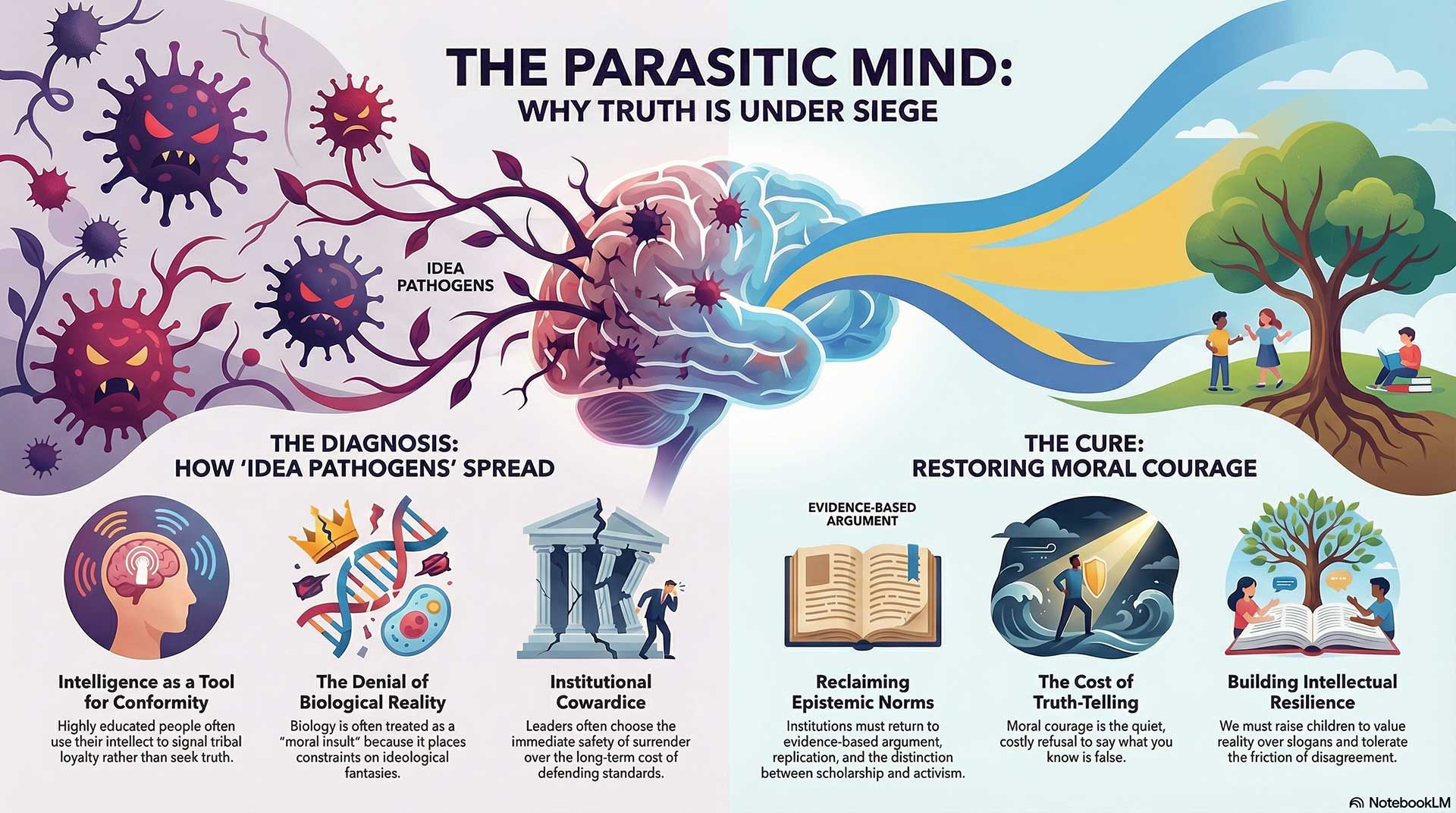
What this conversation has shown is that the crisis before us is intellectual, moral, and civilizational all at once.
Bad ideas rise when people stop demanding truth. They become entrenched when institutions reward obedience more than honesty. They become dangerous when biology is denied, language is politicized, and dissent is treated as a form of sin. But beneath all of that lies a more basic failure: too many people have decided that social safety matters more than reality.
That choice has consequences. A university without intellectual courage becomes a training ground for slogans. A media culture without truth becomes theater. A society without moral clarity becomes easy to manipulate. Once that process begins, even intelligent people can become servants of falsehood, all the while congratulating themselves on their virtue.
Yet I do not think the answer is despair. The answer is refusal. Refusal to lie. Refusal to submit to fashionable nonsense. Refusal to surrender science to ideology, language to coercion, or institutions to cowards. The defense of civilization begins there, often quietly, with individuals who decide that clarity is worth the cost.
Truth has never needed unanimous approval. It has only needed men and women willing to bear witness to it. That remains our task. If we want healthier institutions, healthier discourse, and healthier minds, we must recover the old virtues that bad ideas fear most: honesty, courage, rigor, and the willingness to stand alone when standing alone is the price of sanity.
Short Bios:
Gad Saad — Evolutionary behavioral scientist, professor, and public commentator known for criticizing postmodernism, identity politics, and ideological conformity. Author of The Parasitic Mind.
Jonathan Haidt — Social psychologist known for work on moral psychology, political division, and group behavior. Author of The Righteous Mind and The Coddling of the American Mind.
Steven Pinker — Cognitive psychologist and public intellectual focused on language, human nature, reason, and progress. Author of The Blank Slate and Enlightenment Now.
Jordan Peterson — Psychologist, author, and speaker known for discussions on responsibility, meaning, ideology, and cultural conflict. Author of 12 Rules for Life.
Bret Weinstein — Evolutionary biologist and commentator known for speaking on academic freedom, institutional failure, and cultural pressure.
Christina Hoff Sommers — Writer and former philosophy professor known for her criticism of modern feminist dogma and her defense of fairness, reason, and open debate.
Camille Paglia — Cultural critic and author known for sharp attacks on academic orthodoxy, postmodern thought, and cultural shallowness.
Douglas Murray — British author and political commentator known for writing on culture, identity politics, immigration, and the crisis of Western confidence.
Thomas Sowell — Economist, social theorist, and writer known for his work on incentives, culture, education, and ideological thinking.
Ayaan Hirsi Ali — Author and activist known for defending free expression, women’s rights, and liberal values, shaped by her experience under authoritarian religious culture.
Heather Heying — Evolutionary biologist and writer known for criticism of ideological capture and for defending biology-based thinking in public debate.
David Buss — Evolutionary psychologist known for major research on human mating, sex differences, jealousy, and human nature.
Geoffrey Miller — Evolutionary psychologist known for work on mating, signaling, intelligence, and the evolutionary roots of human behavior.
Leave a Reply