
Introduction by Lewis Carroll
Dear Reader,
You may think you know Alice already. Yet what is a dream if not a doorway with more than one key? Here lies the turning of another lock: the adventure beyond both Wonderland and Looking-Glass Land.
Do not expect sense alone, for sense is dull; nor nonsense alone, for nonsense is lonely. Prepare instead for the balance between—where a child's question becomes a crown, and mirrors may accuse you of being yourself too loudly.
Step lightly. The key is already turning.
(Note: This is an imaginary conversation, a creative exploration of an idea, and not a real speech or event)

Chapter 1: The Invitation
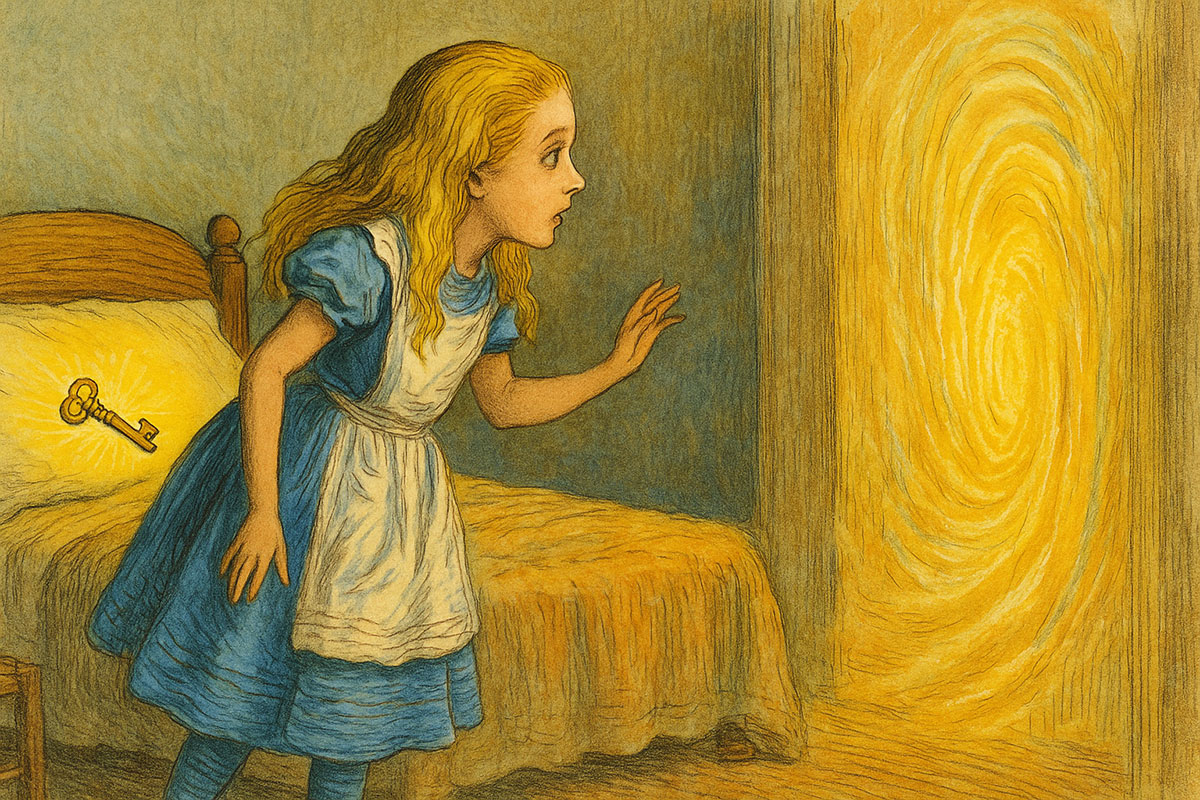
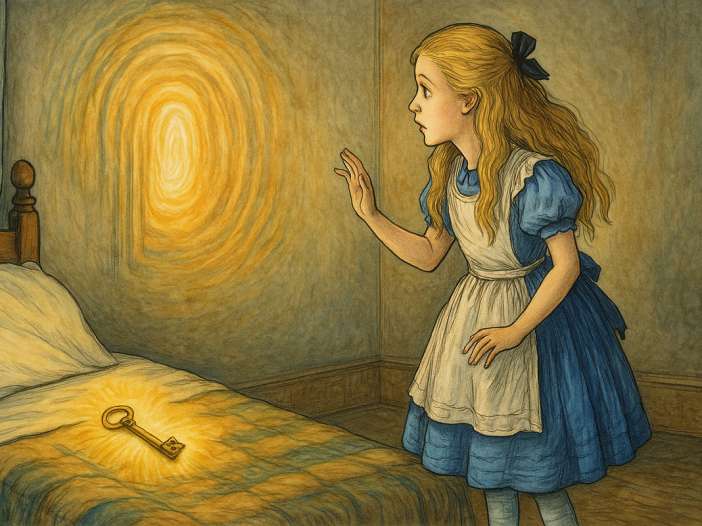
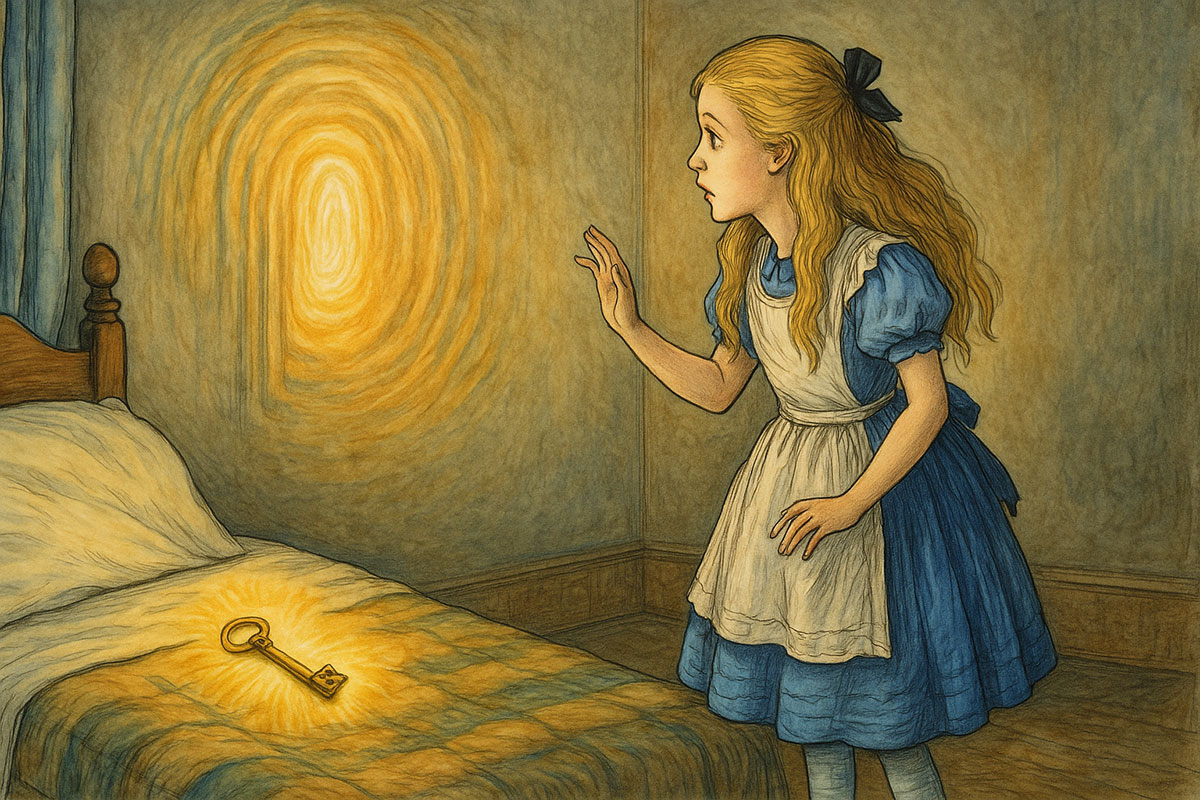
Alice was halfway between a yawn and a thought when the mantel clock sneezed—three polite "tish-choos!"—and spat out a brass key that landed on her pillow with a curtsey.
"Either an extraordinary accident," said Alice, "or an ordinary invitation."
The key bore tiny words: TURN AND BE TURNED.
Alice stood, and her bedroom wall rippled like a pond pretending to be plaster. In its center blinked a round keyhole.
She fitted the key. The wall sighed open, revealing golden corridors that bent when the light moved. Doors sprouted: IF, ELSE, PERHAPS, and one labeled ABSOLUTELY NOT that scowled so terribly Alice refused to look.
A signpost appeared:THIS WAY →
THAT WAY ←
THE OTHER WAY ↑
YOUR WAY ↓
(NO COMPLAINTS)
Alice pulled out a pencil (from where? but pockets are brisker than explanations) and wrote: MY WAY.
The signpost blushed and pointed nowhere, which is everywhere in labyrinths.
"If this is an invitation," Alice said, "I accept—on my own terms."
The corridors smiled. Alice walked forward, turned, and was turned.
Chapter 2: The Corridor of Echoes
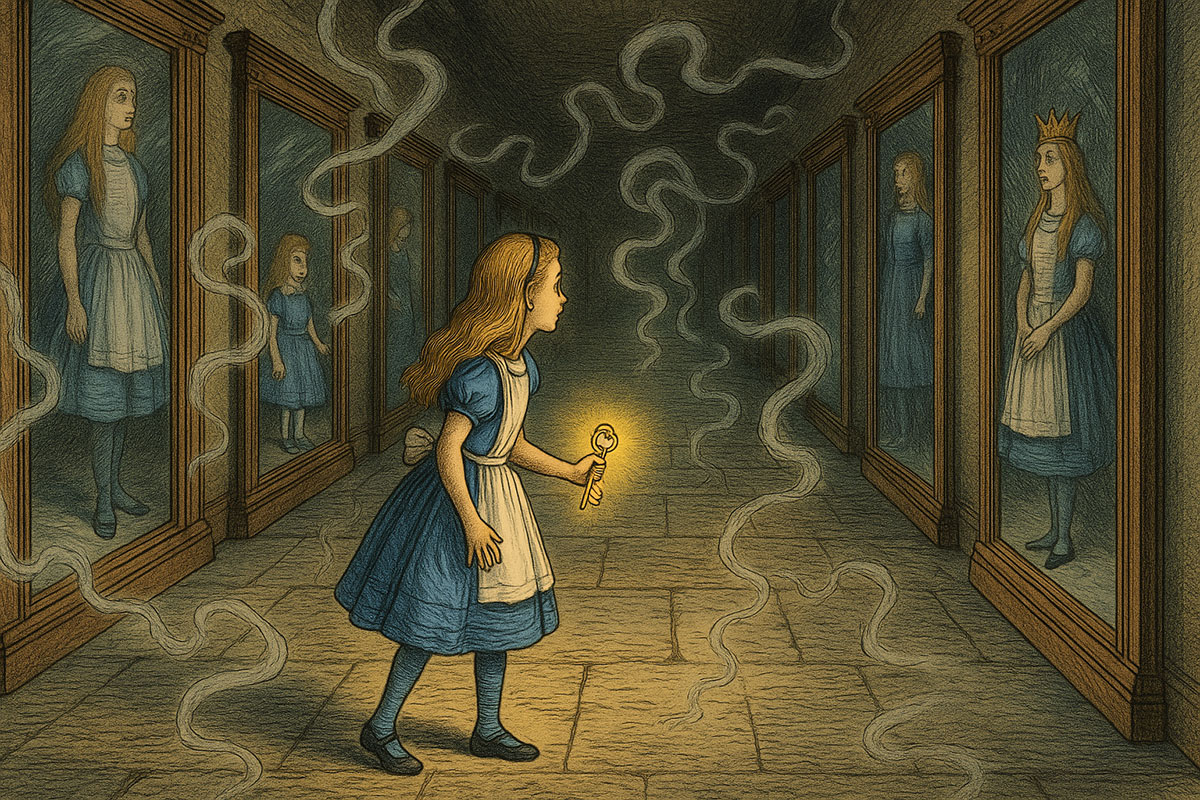
The hall was full of mirrors, each with a brass plaque:
ALICE, WHEN SHE WAS SURE
ALICE, WHEN SHE WASN'T
ALICE, WHEN SHE WILL BE
ALICE, WHEN SHE COULD HAVE BEEN
In the first, she was teacup-small. In the second, thunderstorm-large. In the third, crowned with question marks. In the fourth, only footprints spelling SOON.
"Which is the right me?" Alice asked.
The mirrors sang together: "The one who asks." "The one who answers." "The one who decides." "The one who dances."
Alice tapped each with her key. They slid aside, revealing smaller halls filled with echoes—caterpillar smoke asking "Who are you?", a trumpet hiccupping through "Off with—", invisible chalk writing "Why is a raven like a writing desk?"
An echo sidled near. "Who in the world am I?" it breathed.
"I asked you first," said Alice.
"We are what you keep. What you let go becomes corridor."
Alice's chest tightened. She plucked one memory from the air—the weight of running, falling, being tall enough to scold and small enough to be scolded. The ache surprised her. She pocketed it carefully beside her courage, which pretended not to notice.
At the corridor's end sat a mirror inscribed:
NAME YOURSELF, IF YOU DARE;
ANSWER, IF YOU CARE;
WALK ON, IF YOU WEAR
YOUR HEART LIKE WELL-LOVED SHOES.
"I am Alice," she said. "And I am walking."
The corridor brightened. A door marked NEXT ungrew from the wall.
But as she reached for it, Alice glimpsed her reflection—older than she'd been, younger than she'd be, and somehow both at once. For the first time, she wondered: If I keep changing, will there be enough of me left to recognize?
The thought followed her through the door like a shadow with opinions.
Chapter 3: The Cards Meet the Chessmen
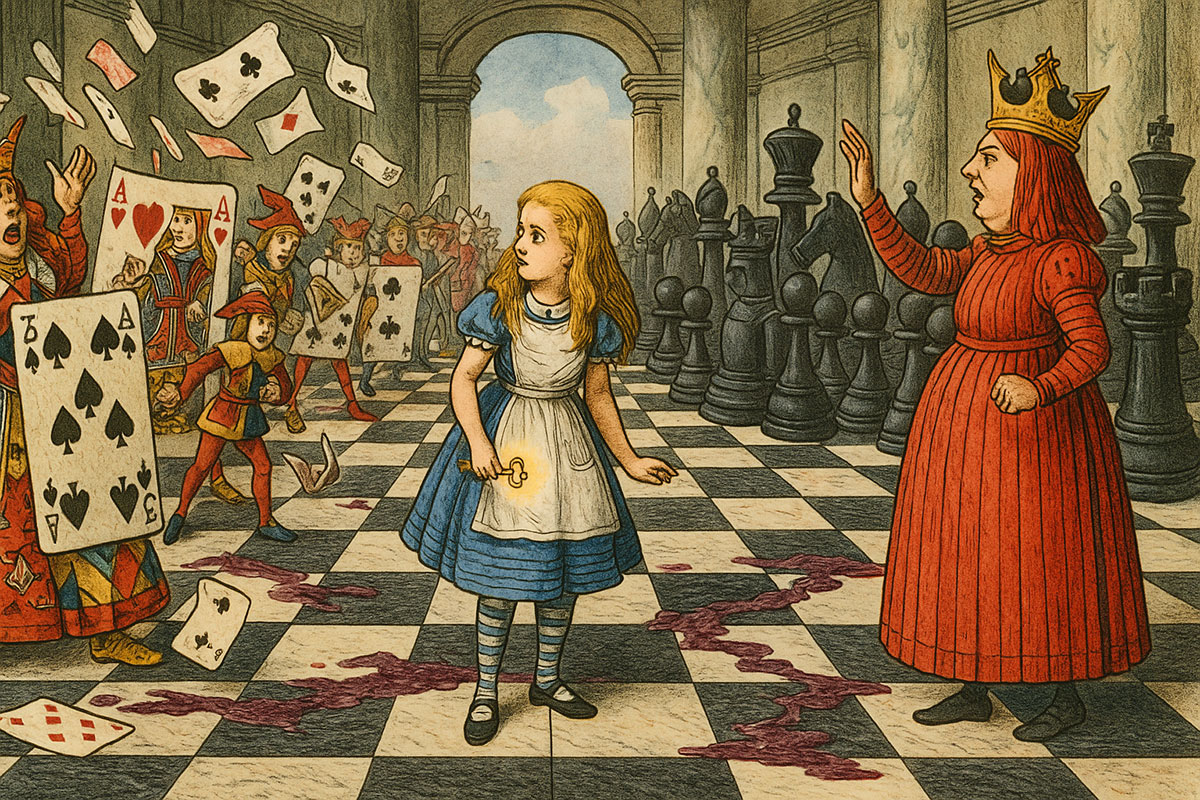
Noise hit like a flung hat. Alice stepped into a ballroom divided by a line of strawberry jam. Playing cards swarmed left; chessmen advanced right. Between them, chaos and order glared across sweetness neither dared cross.
"Mine!" thundered the Queen of Hearts, fan snapping. "She is my brave little gooseberry!"
"Mine," purred the Red Queen, arranging her bishops. "She is my pawn, to be promoted by proper moves and merit."
Alice felt the pull immediately—not outside her, but within. Part of her wanted to tumble into chaos, to shout and be absurd and eat jam with her fingers. Part of her wanted order, rules that made sense, the satisfaction of moving correctly across a board that rewarded clever thinking.
She'd felt this tug before, between being good and being free, between growing up and staying wild. Now it had queens and armies.
She stepped to the jamline and curtsied with mathematical precision.
"If you'll argue about me," she said, surprised by her steady voice, "do be sure you're talking to me. Otherwise you're arguing about somebody else, which seems terribly inefficient."
"Order!" cried the Red Queen. "Take three squares forward, turn precisely, and explain yourself by theorem—"
"Disorder!" cried the Queen of Hearts. "Tumble twice, shout thrice, and throw something—it needn't make sense—"
Alice's hands trembled. The Queens weren't fighting over her. They were fighting in her. She could feel herself splitting like a wishbone pulled by greedy wishes.
"I shall hopscotch," she announced, voice wobbling only slightly.
She hopped across the jamline: Mine to Me, Rule to Riddle, Game to Play. The jam squelched approvingly. She landed precisely in the middle, where neither queen could claim her without claiming the other.
The Cheshire Cat materialized in the chandelier, wearing it as a particularly ambitious thought. "Lines divide until they don't," he observed. "Then they are bridges. Rather sticky ones, in this case."
Alice drew her key. It ticked like a heartbeat that had learned to tell time.
"I belong to the road between," she declared, and this time her voice didn't wobble at all. "I'm both of you and neither of you. And I intend to go beyond."
Both armies stilled. Then, slowly, they bowed—cards fluttering, pieces clicking—acknowledging not defeat but possibility.
A door appeared in the wainscoting, labeled FURTHER in jam-writing that smelled of strawberries and summer.
Alice stepped through, her heart still torn but her feet steady, and realized: perhaps being pulled in two directions meant she was large enough to touch both sides at once.
Chapter 4: The Garden of Questions and the River of Hours
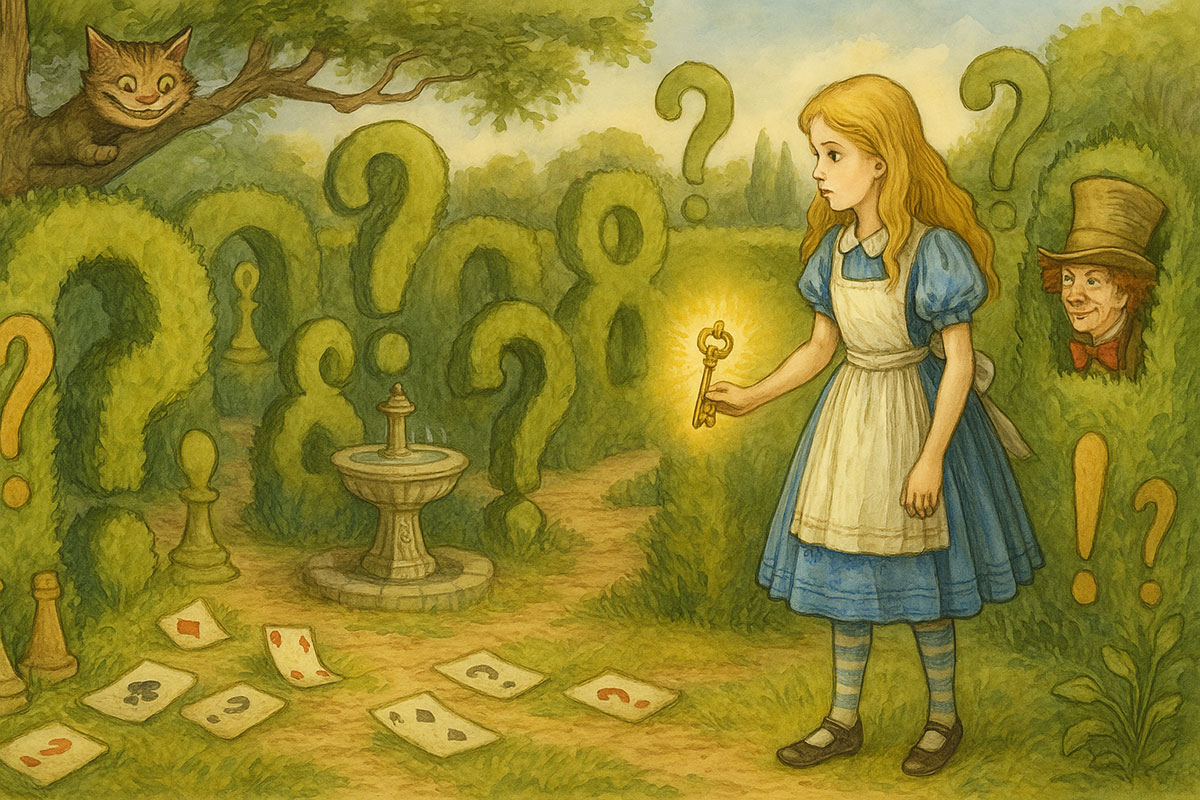
The door opened onto a garden where hedges grew in the shapes of questions. At its heart, a fountain bubbled riddles instead of water, and beyond the garden, Alice could see a river of golden sand flowing endlessly under an impossible sunset.
The Cheshire Cat draped himself over a hedge shaped like a particularly aggressive question mark. "The Garden of Ifs and the River of Hours," he announced. "Two places, one price. Do try to be efficient with your existential crises."
"Are there any Ands?" Alice asked, mostly to be contrary.
"Only if you answer correctly and quickly. Time is literally flowing away over there." His tail flicked toward the distant riverbank.
At the garden's entrance stood the Mad Hatter with a tea tray balanced on his head. On the tray sat a single biscuit, its crumbs spelling YES and NO simultaneously depending on the angle.
"What's the difference between yes and no?" Alice asked, remembering his old riddles.
The Hatter's face crumpled. "One is the answer to everything," he said, voice soft. "The other is the question to nothing. Time taught me that when he stopped speaking to me. Now I hear him everywhere—in clocks, in rivers, in the space between heartbeats—but he won't let me catch up." He gestured toward the sand river beyond the garden. "He's there now. He's always there."
Alice's throat tightened. She took the biscuit gently. It tasted of both and neither, which was exactly right.
She walked deeper into the garden. Tweedledum and Tweedledee blocked the path, each holding a wilting balloon.
"I am always ahead but never arrive," wheezed Dum's balloon.
"I am always behind but never leave," gasped Dee's.
But their hearts weren't in it. They looked exhausted, as though they'd been arguing the same point for centuries.
Alice felt a flash of anger—not at them, but at everything that demanded she solve riddles just to walk, just to be. Why must existence be a test?
She pricked both balloons with a thorn. Sand spilled out, forming the word TIME, then scattered toward the river in the distance.
"I'm sorry," she told the deflating twins. "But I'm tired of puzzles that don't have answers, only more puzzles."
They drifted away without complaint, looking almost relieved.
The fountain's final riddle bubbled up: ONLY THE CHOOSER CAN BE CHOSEN.
Alice dipped her key in the water. The garden shimmered and began folding itself away like a map that had served its purpose. Beyond, the river of golden sand stretched wide, and on its near bank sat a familiar figure.
The White Rabbit looked up as she approached. His spectacles were cracked, his waistcoat sagging with age. But his eyes held something Alice had never seen before: acceptance.
"You're late," he said, but gently.
"I wasn't invited."
"Everyone is invited." He looked at the flowing sand. "No one stays. Not even me."
Alice knelt beside him, her clever words dying in her throat. "Must you go?"
"The river takes everything eventually. Even the late. Especially the late." He smiled at his own joke. "I've been running from it my whole life. My watch"—he pulled out the cracked timepiece—"has finally caught up with me."
In the sand river, Alice saw visions flowing past: herself as a baby reaching for dust motes, herself as an old woman watching a grandchild play, herself fading like chalk in rain. She saw the Rabbit as he'd been—young, frantic, always hurrying—and understood that he'd never been late for appointments. He'd been running from this river all along.
"What does it take?" she asked, voice small.
"What you carry that isn't yours to keep. What you've held too tightly. What you always thought you'd have more time for." He stood, brushing sand from his waistcoat. "I've held onto hurry for so long I forgot what I was hurrying toward. But you—" He looked at her with sudden fierceness. "You still have time to choose what you carry."
"I don't want you to go," Alice whispered.
"I know. That's how I know you're real, and not just a dream having a dream." He pressed his broken watch into her hand. It was surprisingly heavy. "Don't run from time. Walk with it. Even when it hurts."
Before Alice could answer, he stepped into the river.
The sand didn't swallow him dramatically. It simply... accepted him. He looked back once, tipped his ears in a final salute, and dissolved like sugar in tea.
"No," Alice breathed, but he was gone.
She stood at the bank, the watch heavy in her hand, tears finally coming. The sand pulled at her feet, patient and inexorable.
She stepped in.
The river tugged gently at her pockets. Her collected echoes darted into the current—"Who are you?" and "Off with!" and all the voices of who she'd been—and streamed away. She wanted to grab them, to keep them, but remembered the Rabbit's words. What you've held too tightly.
She let them go.
Halfway across, she felt the river pulling at something deeper—her certainty, her childhood, the girl who'd tumbled down rabbit holes without fearing the landing. The sand wanted that too.
Alice hesitated. Then, deliberately, she opened her hands.
The child-Alice drifted into the current, waving. Not vanishing, but... moving on. Making room.
When Alice reached the far bank, she felt lighter and heavier at once. The Rabbit's watch still ticked in her palm, each tick a small goodbye and small hello.
An arch stood before her, inscribed: ALL DREAMERS MUST ANSWER.
Alice stood there, breathing hard, no longer certain who she was but beginning to understand that uncertainty might be its own kind of answer.
She walked forward, carrying time with her.
Chapter 5: The Trial of the Dreamer
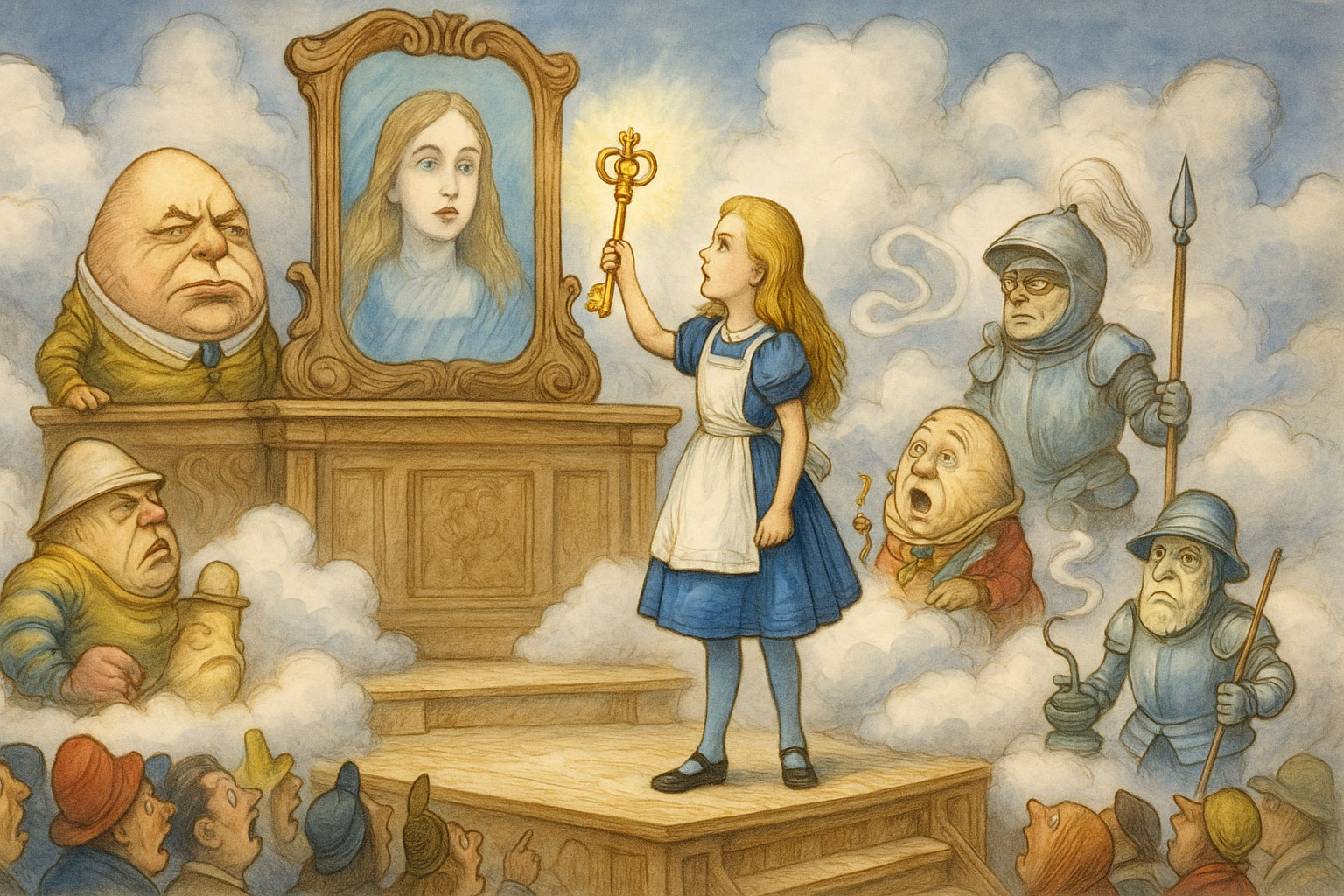
The arch led to a courtroom where the ceiling was stitched from clouds and the floor wrote itself in chalk. At the bench sat a Judge with no face—only a mirror reflecting whoever looked.
"Call the witnesses!" rang a bell that served as Clerk.
The Caterpillar oozed to the stand, trailing philosophical smoke. "She meddled with her size," he testified, "never knowing who she was. Most unsettling. Most irregular."
"Did you ever tell her who she was?" Alice asked quietly.
The Caterpillar paused mid-puff. "That... is not a witness's job."
"Perhaps it wasn't mine either," Alice said. "Perhaps I was meant to find out by changing."
Humpty Dumpty shuffled up next, still cracked, still proud. "She made words wobble! She made meaning slip! She left us all in pieces!"
"You fell," Alice pointed out, "because you sat too high and too certain. I didn't push you. Your own pride did."
Humpty Dumpty deflated slightly, then shuffled away muttering about semantics.
The White Knight came last, earnest and gentle. "She dreamed us kindly," he testified. "She gave nonsense its dignity and reason its smile. If that's a crime, then I'm proud to have witnessed it."
The Judge-mirror turned toward Alice. In its surface, she saw herself fractured—child, girl, queen, question mark, all at once.
"Are you the dreamer," the Judge intoned, "or are you the dreamed?"
Alice looked at the Rabbit's watch in her hand. At the key glowing in her pocket. At all the versions of herself reflected in the mirror-Judge.
"I don't know," she said, and her voice broke. "I thought I did, but I don't. The Rabbit vanished into time. My echoes dissolved into corridors. The author said he writes me but I choose him. Maybe I'm both. Maybe I'm neither. Maybe—"
She stopped. Breathed.
"Maybe it doesn't matter. Because I'm here. I'm choosing to be here. I'm choosing to keep walking even though I don't know where I'm going or who I'll be when I arrive. Isn't that what being real means?"
The courtroom held its breath.
The Judge-mirror cracked—not shattering, but opening, like an eye learning to see differently. Through the crack, light poured.
"Verdict," the mirror said, and its voice was kind. "She may go on. She has learned that certainty is a gilded cage, and questions are wings."
A door appeared, labeled simply: BEYOND.
But Alice didn't move yet. "Will I forget them?" she asked. "The Rabbit? The Hatter? All of you?"
"Forgetting and remembering," said the Cheshire Cat, appearing on the Judge's bench, "are just two ways of carrying. You'll carry them differently, that's all."
Alice nodded, tucked the watch beside her key and courage, and walked toward the door.
Chapter 6: The Author’s Mirror
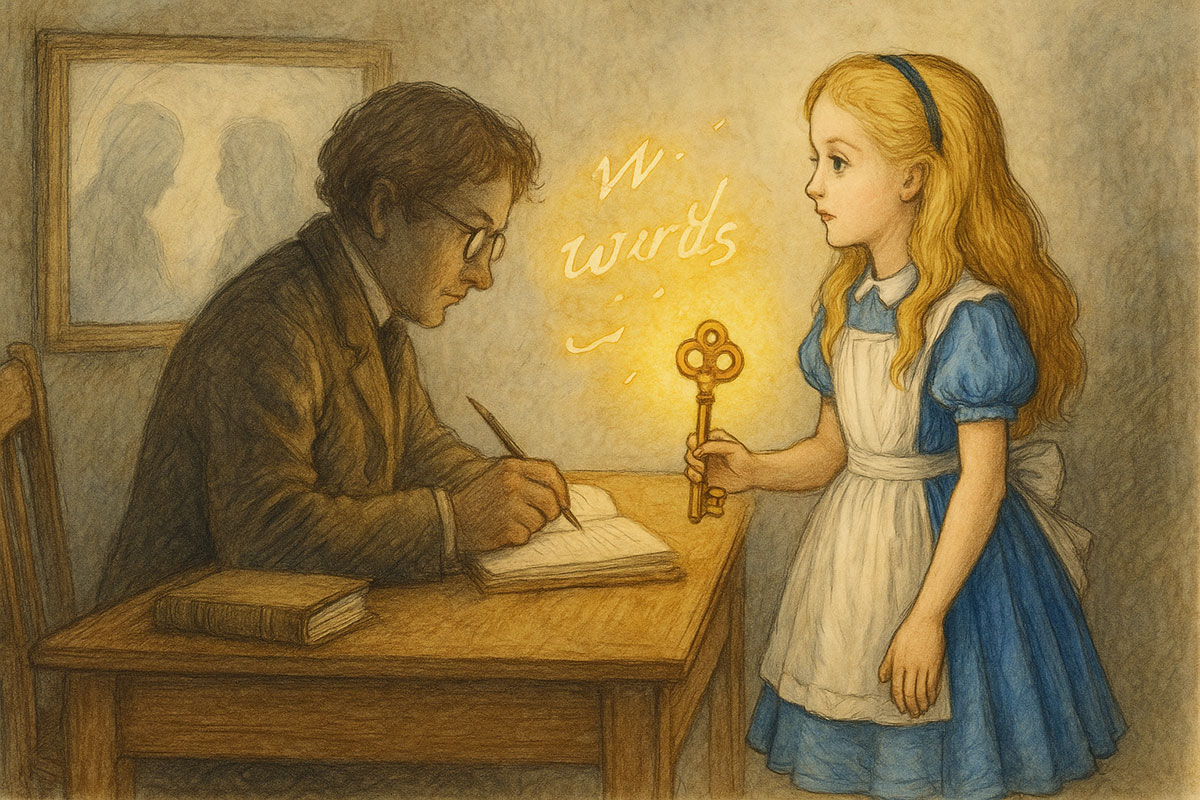
The room beyond was quiet as held breath. A man sat at a desk, pen scratching paper, face half in shadow as though the room couldn't quite decide if he belonged.
Alice approached. "You're writing me."
The pen paused. "I'm arranging letters. You do the rest."
"But how can I be me if you're writing me?"
The man looked up, and Alice saw he had kind eyes behind tired spectacles. "Who," he asked gently, "is writing me?"
He turned the page so she could see. Her own words stared back: I stepped through the door.
"It's not fair," Alice whispered, feeling tears build. "If you invent me, what of my choices? What of the Rabbit? Was he real? Did he really die, or did you just write him away?"
The man set down his pen carefully. "Did you feel it when he left?"
"Yes."
"Did it change you?"
"Yes."
"Then he was real. As real as anything that changes you can be." The author leaned forward. "Alice, every question you asked gave me a pen. Every choice you made gave me ink. Every time you refused an easy answer, you gave me paper. Without you, I'm just a man at an empty desk. Without me, you're just an unspoken dream. We need each other to exist."
"But you'll stop writing someday," Alice said, voice breaking. "And then I'll stop. That's how stories work. They end."
"Do they?" The author gestured to the walls, where words floated like fireflies. "Or do they continue in everyone who reads them? Every child who tumbles down a rabbit hole in their imagination. Every adult who remembers what it felt like to not fit. You don't end. You multiply."
He handed her the pen. It was warm, like holding a small sun.
"If I must be written," Alice said slowly, "then I shall write myself too. Is that allowed?"
"It's required," the author said, smiling. "That's what growing up means."
Alice bent to the page. In shaking letters that grew steadier as she wrote, she inscribed: I am not finished yet. And that is exactly as it should be.
The room sighed with satisfaction. A door of words appeared—verb, noun, adjective, all flowing together—glowing softly.
"Will I see you again?" Alice asked.
"Every time you tell your own story," the author said. "Every time you choose who to become."
Alice stepped through the word-door, pen still in hand, tears on her cheeks, and felt something settle in her chest: not certainty, but something better. Permission to be unfinished.
Chapter 7: The Crown of Balance
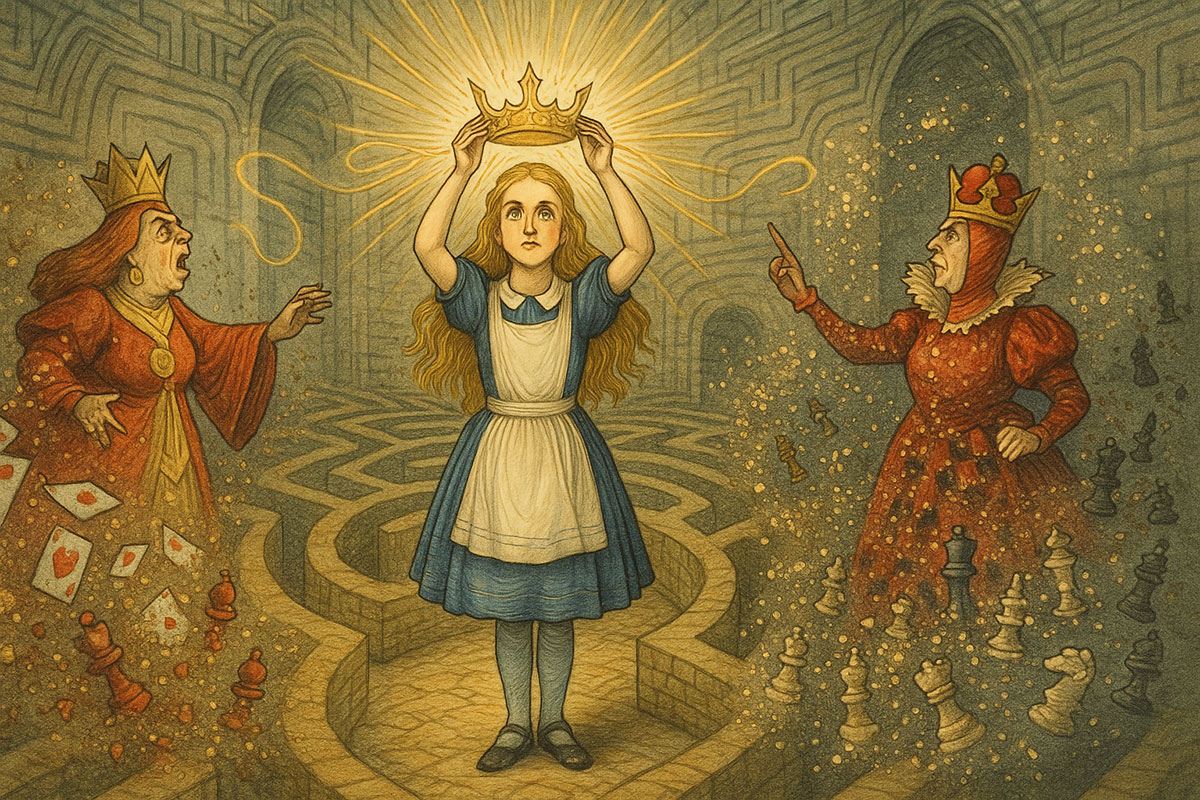
At the labyrinth's heart, both Queens waited.
"She belongs to me!" shrieked the Queen of Hearts, fan snapping like bones.
"She is my pawn!" hissed the Red Queen, rearranging her strategy.
Alice felt the old pull—chaos calling, order calling—but something had changed. She'd let the echoes go. She'd walked with time. She'd learned that being both was different from being torn.
"No," she said simply.
From the labyrinth walls, golden threads unraveled. Not attacking—offering. Alice gathered them slowly, feeling their weight. Each thread was a choice she'd made: kindness when cruelty was easier, questions when answers were simpler, walking forward when stopping seemed safer.
She wove them together. The threads resisted at first, chaos and order not wanting to braid, but Alice's fingers were patient. She'd learned patience from the Rabbit, who'd finally stopped running. Creativity from the Hatter, who'd lost time but never imagination. Balance from herself, who'd walked the jamline.
The crown formed in her hands—simple, elegant, blazing.
"I won't be your servant," Alice said, and her voice carried through the labyrinth like a bell. "I'm not chaos or order. I'm not dream or dreamer, ending or beginning, question or answer. I'm Alice. And that means I'm all of them and none of them and something else entirely."
She placed the crown on her head.
It fit perfectly, as though her very questions had been shaping it all along.
The Queens faltered. Their armies dissolved—cards fluttering into ordinary playing cards, pieces clicking into ordinary chessmen, both harmless now, both simply what they'd always been: games.
The Red Queen stiffened, then cracked into rules that scattered like old lessons. The Queen of Hearts shrieked "Off with—!" but her voice unraveled before finishing, becoming just weather, just noise, just the tantrums of a child who'd never learned to share.
The labyrinth itself bowed, walls bending low.
A passage opened, its arch inscribed in letters of starlight: QUEEN OF IMAGINATION.
But beneath, in smaller script that only appeared when Alice looked closely: WHICH IS TO SAY, QUEEN OF YOURSELF.
Alice adjusted her crown and walked through.
Chapter 8: The Farewell Feast
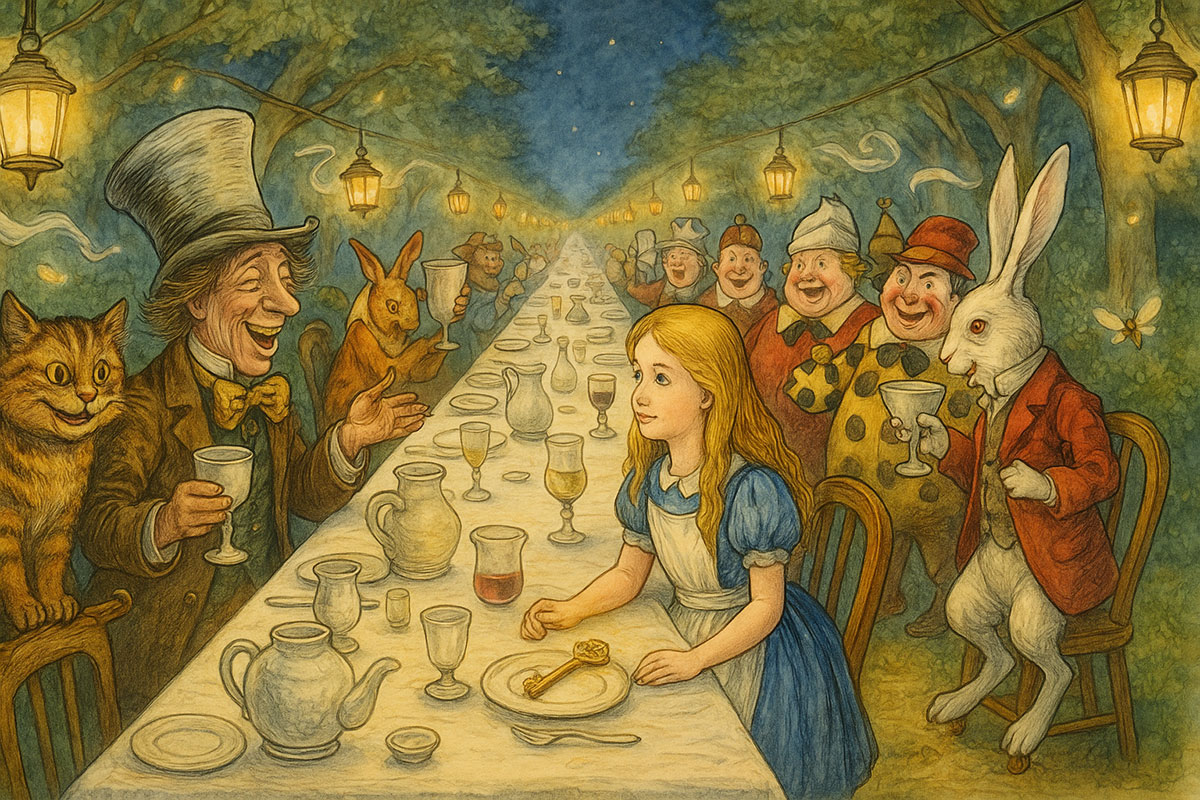
The passage blossomed into a great hall lined with lanterns made of caught laughter. A long table stretched endlessly, groaning with impossible things: teapots that poured questions, tartlets flavored like childhood summers, songs you could eat, stories you could drink.
Every creature Alice had met gathered there—even the ones she'd thought lost.
The Mad Hatter raised a teacup that read TIME FORGIVES in the porcelain. "A toast to riddles that have answers, and answers that have riddles!"
The Cheshire Cat grinned from three different locations simultaneously. "To bridges that used to be lines!"
The White Knight stumbled into his chair but lifted his glass high. "To kindness that counts as genius!"
And there—Alice's breath caught—there was the White Rabbit, translucent as memory but smiling. Not young, not frantic, just... present.
"You came back," Alice whispered.
"I never left," the Rabbit said. "I just changed form. I'm the tick of every clock, the turn of every hour, the reminder that even late can arrive at exactly the right time." He gestured at the feast. "This is time too, Alice. Time spent, time savored, time that doesn't run away."
Alice sat among them, crown catching the light, heart so full it hurt. The food tasted of memories layered like cake: currant buns flavored like her sister's voice reading on riverbanks, biscuits that crumbled into lullabies her mother used to sing, tea that poured like first snow, last days of summer, every perfect moment she'd held too tightly and learned to release.
But under the merriment lay silence, the way the last page lies under every story.
"You've been splendid," Alice told them, voice thick. "Wise and foolish and impossible and exactly what I needed you to be."
"Don't forget us," purred the Cat, fading to just eyes, just smile.
"Better," said the White Knight, armor creaking, "make us part of what you become. Carry us differently."
Alice raised her cup, vision blurring. "Then I'll never be dull. You'll always be my wonder, my questions, my courage to be ridiculous and profound and everything between."
The hall erupted in cheers. Lanterns burst into fireflies, carrying laughter up to the rafters. Slowly, gently, chairs began emptying.
The Hatter faded mid-toast, but his smile lingered like Cheshire cats do.
The Chessmen and Cards dissolved into childhood toys that Alice knew she'd find again someday in an attic, dusty and beloved.
The White Rabbit tipped his ears one final time, watch glinting. "Don't be late for your own life," he said, and was gone.
Alice sat alone at the endless table. But she didn't feel alone. She felt... accompanied. By everything she'd been and everything she'd carry forward.
At the far end of the hall, a final door stood open. Not flickering. Not glowing. Just there, patient as morning.
Alice stood—crown steady, key warm, Rabbit's watch ticking, author's pen in pocket, courage and echoes and time all braided together—and walked toward it, letting the tears fall freely.
She was ready. She was terrified. She was both.
She was Alice.
Chapter 9: Awakening, or Not
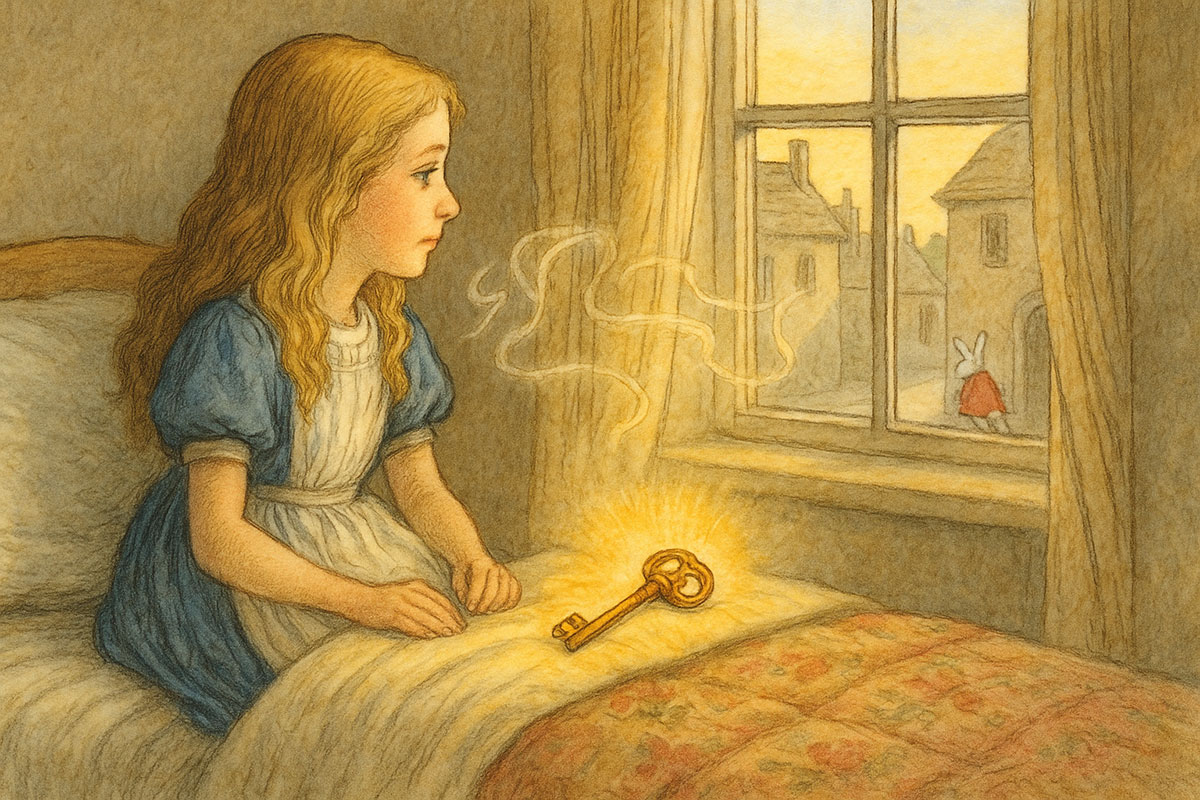
Alice opened the door and found her bedroom. Morning sun lay across the quilt like a lazy cat. The ordinary world, exact as she'd left it.
Except.
On her pillow gleamed the clockwork key, still ticking its mechanical heartbeat.
On her nightstand, the Rabbit's broken watch, keeping time in its own way.
In her hand, a pen she didn't remember owning but would never lose.
She rushed to the window. Down in the street, white fur disappeared around a corner—could be any rabbit, could be the Rabbit, impossible to say. She heard laughter—hers, or the Cat's, or the wind's, or all three braided together.
Alice touched her head. The crown was gone from her hair but not from her. She felt it in the straightness of her spine, the steadiness of her breath, the knowledge that she could be many things at once and that was not confusion but richness.
She thought of everyone she'd left behind. Everyone who'd left her. The weight of it settled in her chest—not crushing, but present. Real. The good kind of heavy, like a pocket full of treasures.
"Perhaps I've awakened," she whispered to the room, the key, the ordinary morning that would never be quite ordinary again. "Perhaps I'm still dreaming. Perhaps there's no difference, and that's the point."
She placed the key in her pocket beside courage, beside the watch, beside the pen, beside all the invisible things we carry.
Outside, the world beckoned with sense and nonsense both, with questions that had answers and answers that had questions, with time that ran and time that stayed.
Alice, Queen of Imagination—which is to say, Queen of Herself—stepped into her day.
She was never finished.
She was never alone.
She was never quite the same.
And she was grateful for all of it.
Final Thoughts by Lewis Carroll
And so the tale concludes—though to say "concludes" is rather like declaring a circle to have a corner, or a question to have only one answer.
Alice has crowned herself not with authority over others, but with permission to be herself: changing, constant, question and answer both. If Wonderland was chaos and Looking-Glass was order, then Beyond the Dream is the riddle of choice itself—the understanding that we are neither dreamer nor dreamed but the relationship between them, the pen moving across the page.
Should you ever find a glowing key upon your pillow, or a door rippling where a wall ought to be, do not hesitate. Do not ask if you are awake or dreaming. Simply choose: will you turn the key? Will you step through? Will you crown yourself with your own questions?
Dreams are waiting to be courted. Questions are waiting to be crowned. And somewhere, in the margin between sleeping and waking, Alice is still walking—neither late nor early, but exactly, perfectly, impossibly on time.
Close the book gently, dear Reader, and remember: every ending is only the beginning of another wonder.
And sometimes, the bravest thing we can do is remain unfinished.
Short Bios:
Alice: A child of curiosity, a seeker of questions, a finder of wonders. She is not quite grown and not quite small, which is precisely why she fits into places that never existed before she walked into them. Queen of Imagination means queen of herself—ever-changing, ever-certain, ever-both.
The White Rabbit: Forever late until he learned to stop running. His cracked watch ticks not with minutes but with memory. He is time personified—urgent, passing, precious—teaching Alice that even late can arrive exactly when needed.
The Cheshire Cat: A smile first, a body as afterthought. He appears and disappears with the convenience of nonsense, teaching Alice that ambiguity is wisdom, that lines become bridges, that grinning in the face of uncertainty is its own kind of courage.
The Mad Hatter: Untroubled by the difference between answers and riddles. He lost Time as a friend but never lost time as a gift. He lives in contradictions, pours tea at the intersection of logic and nonsense, and proves that being stuck can be its own freedom.
Tweedledum and Tweedledee: Two brothers, one argument, infinite variations. They represent the exhaustion of binary thinking, the way we trap ourselves in either/or when both/and is waiting patiently beside the path.
The Queen of Hearts: Chaos with a crown. Her judgments are swift, her tempers swifter, her favorite command unfinished. She embodies the part of us that wants to tear down, shout, rule by emotion—necessary sometimes, tyrannical when unopposed.
The Red Queen: Order armed with arithmetic. She sees the world as a chessboard where every life is a calculated move. She represents structure taken too far, rules without room for wonder, the tyranny of should-be over is.
The Caterpillar: A philosopher disguised as smoke. His questions curl in the air longer than his answers. He teaches that identity is not fixed but a conversation we have with ourselves, breath by changing breath.
Humpty Dumpty: Pride shaped like an egg. His great fall taught him nothing, which is itself a lesson. He shows Alice what happens when we sit too high, too certain, defining words instead of letting words define themselves.
The White Knight: Gentle, bumbling, brave in sideways fashion. His inventions wobble but his heart steadies. He is kindness as courage, earnestness as genius, proof that falling off horses and getting back on is its own kind of victory.
The Shadowy Author: A figure at the desk, spectacles glinting, pen scratching letters into being. He is as much dreamed as dreamer, showing Alice that stories are relationships, that writers need readers and characters need choices, that we write each other into existence every day.
Lewis Carroll: Charles Lutwidge Dodgson, who walked the line between logic and wonder. A mathematician who counted dreams, a storyteller who let words play games. His greatest trick was showing that imagination is not escape but discovery, that we are all both author and character, writing and written, dreaming and dreamed.
Leave a Reply