

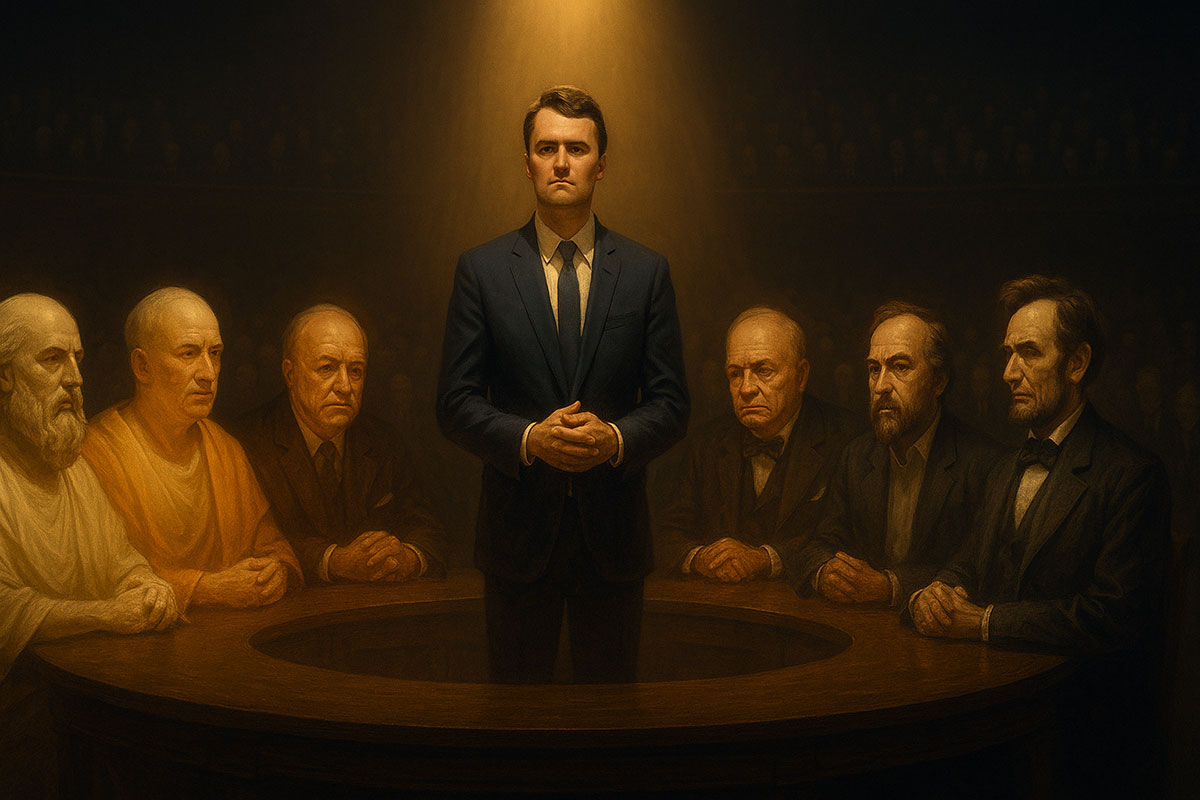
Introduction by Aristotle
Men and women of reason, across every age, have sought to persuade — for persuasion is the art by which societies are built, defended, and reformed. It is not merely a contest of clever words, but a study of the human soul.
I taught long ago that persuasion rests upon three pillars: logos, the reason which appeals to the mind; ethos, the character which earns the trust of the listener; and pathos, the emotion which stirs the heart. To neglect any one is to cripple the whole.
In these conversations you are about to hear, guided by our moderator, Charlie Kirk, masters of debate from across time will wrestle with the deepest questions of persuasion: the fire of passion versus the calm of composure; the framing of questions; the interplay of logic, emotion, and story; the challenge of hostile audiences; and the ultimate ethic of debate — victory versus truth.
Attend carefully. For to study debate is not only to learn how to win arguments, but how to shape thought, inspire action, and illuminate truth. The art is eternal. The stakes are always human.
(Note: This is an imaginary conversation, a creative exploration of an idea, and not a real speech or event)
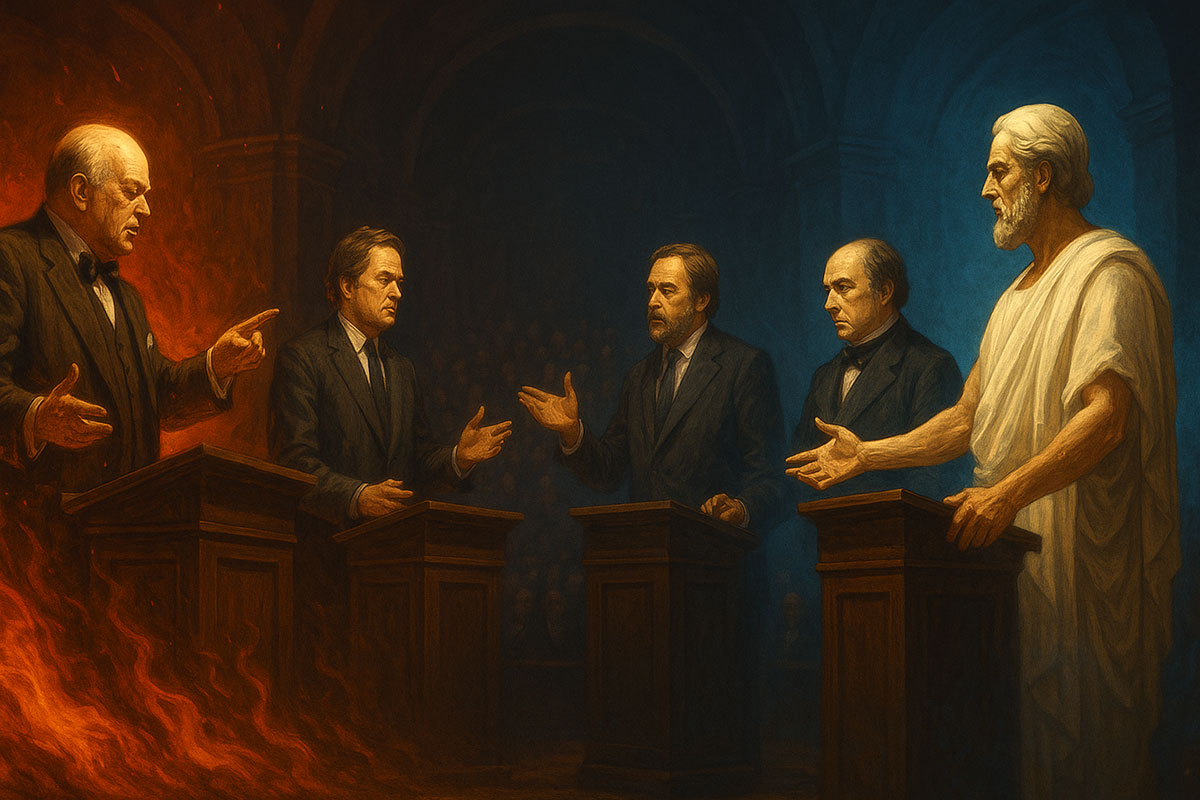
Topic 1: The Art of Rhetorical Fire vs. Measured Calm
Charlie Kirk (Moderator):
“Welcome, everyone. Before we begin, let me offer a quick tip I’ve learned from countless debates on college campuses and in front of TV cameras: confidence isn’t about volume, it’s about control. Sometimes you win by igniting the room, and sometimes by quieting it down. The art is knowing when to use fire and when to use calm. Today, I want to explore that balance with some of history’s greatest masters of rhetoric.”
Charlie’s First Question
“In a heated debate, how do you know whether to unleash fiery passion or maintain composed restraint?”
Christopher Hitchens:
“The answer lies in reading the audience. Fire, without wit, becomes noise. Calm, without conviction, becomes cowardice. I often found that when my opponents were puffed up with certainty, a burst of irony — delivered with passion — dismantled them. But when the audience was skeptical, lowering my voice to a near whisper forced them to lean in. A debater is half-orator, half-psychologist.”
Demosthenes:
“Passion is the marrow of persuasion. The people of Athens would not have stirred had I spoken in placid tones while Philip advanced on our freedom. But passion must be disciplined, not wild. I learned to shout above waves with pebbles in my mouth. Fire must be trained to burn where you aim it. Yet, when passion consumes all reason, it is but smoke.”
Winston Churchill:
“Fire is essential when the hour demands resolve. In Britain’s darkest hour, calm would have lulled us into surrender. But fire unguided is fireworks: impressive, but fleeting. Fire married to timing, however, is artillery. A great debater knows his audience as a general knows his battlefield. Sometimes a whisper reassures allies; sometimes a roar rallies nations.”
Daniel Webster:
“The nature of truth itself dictates the mode. If the issue touches the very foundation of justice, fire must defend it. But if ignorance, not malice, is the adversary, then calm reason corrects. A man who shouts at error looks cruel; a man who reasons with evil looks weak. To be masterful is to discern the difference.”
Charlie’s Second Question
“Which is more dangerous to a debater’s credibility: too much fire, or too much calm?”
Winston Churchill:
“Too much calm is fatal. A nation, or an audience, forgets the droners. Better to risk being remembered as too fiery than to vanish into the haze of polite irrelevance. Energy makes people listen; droning makes them leave.”
Daniel Webster:
“I must dissent, sir. Too much fire risks making a man appear unmoored, intoxicated with his own voice. The public may listen, but they will not trust. Calm, even if unnoticed, preserves dignity. Fire wins ears; calm wins faith.”
Christopher Hitchens:
“Both extremes are ruinous. A corpse cannot inspire, nor can a demagogue persuade the thoughtful. The real peril is predictability. Once your opponent can script your manner, you’re finished. What unsettles most is contrast: a sudden flame in a calm discourse, or sudden calm in a heated clash. Variety keeps you dangerous.”
Demosthenes:
“Excess fire burns credibility; excess calm erases it. But fused together, as heat within tempered steel, they strengthen each other. The man who commands both is unassailable.”
Charlie’s Third Question
“Can you share a moment from your life when your choice of fire or calm changed the outcome of a debate?”
Demosthenes:
“When I thundered against Philip, Athens roused itself to defend its freedom. Had I spoken with calm analysis, the city would have slumbered while danger advanced. My fire, honed through discipline, transformed words into weapons.”
Christopher Hitchens:
“Once, in a debate on religion, I clashed with an opponent who cloaked dogma in smug certainty. Fire was needed to break the spell, and I gave it, with barbs of wit. Later, in the same hall, I spoke softly, almost whispering, and the audience leaned forward. That shift — fire, then calm — tipped the balance. Contrasts persuade more than consistency.”
Winston Churchill:
“In 1940, with the shadow of Nazi conquest over us, I could not have said, ‘Let us discuss calmly.’ I promised blood, toil, tears, and sweat. Fire gave my country courage. Yet in private councils, calm words steadied the wavering. Each choice was crucial; either alone would have failed.”
Daniel Webster:
“In the Senate, I once faced colleagues drifting toward reckless policies. To thunder would have hardened their pride. Instead, I spoke with deliberate calm, weaving reason upon reason until even adversaries could not deny me. Fire stirs; calm convinces. In that hour, calm preserved the Republic.”
Charlie Kirk (Closing):
“What we’ve heard is timeless wisdom: fire stirs people to act, calm builds credibility to endure. As a tip for those listening — don’t think of fire and calm as opposites. Think of them as tools. Too much of either can undo you. But together, like hammer and chisel, they can shape truth into something unforgettable. The greatest debaters know not just how to argue, but when to burn and when to breathe. That’s the art.”
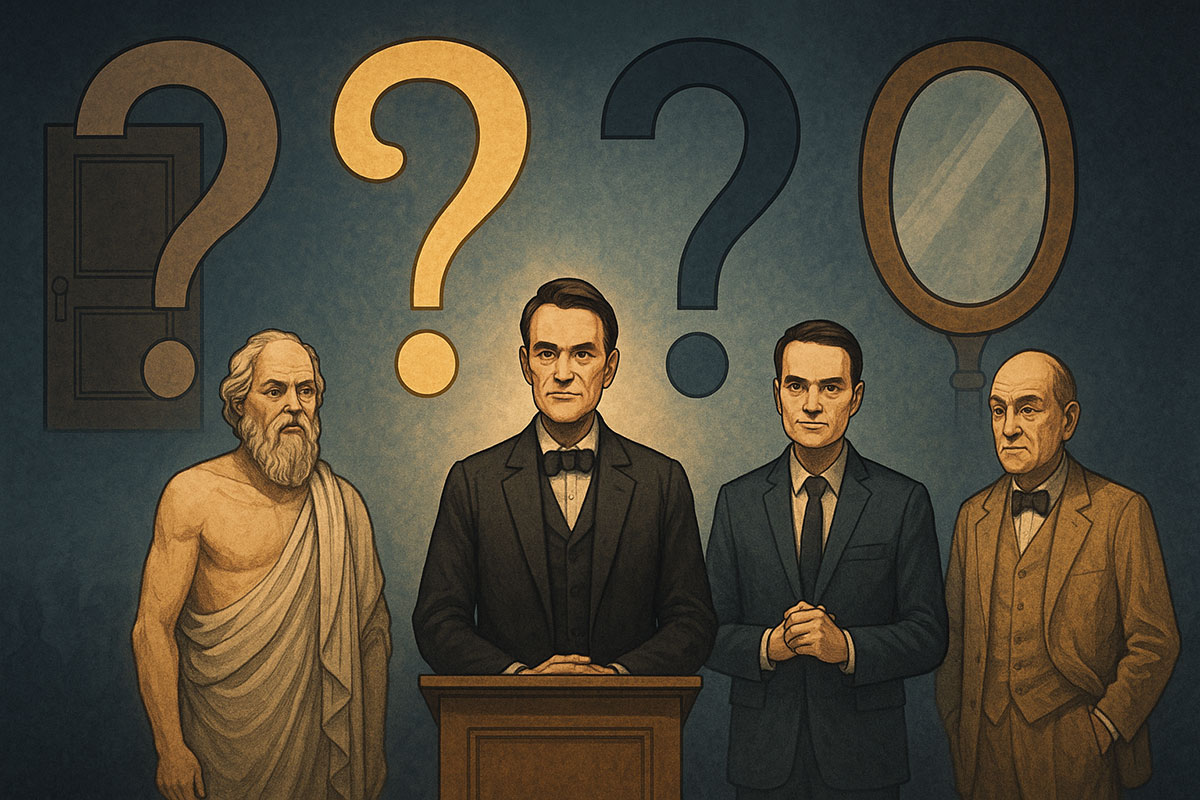
Topic 2: Framing Reality: Who Owns the Question?
Charlie Kirk (Moderator):
“One of the greatest mistakes I see in young debaters is answering a question on its opponent’s terms. You can have the perfect facts, the perfect logic, but if you accept a bad frame, you’ve already lost. The real skill is flipping the script — reframing the question so it shines light where you’re strongest. Today, let’s explore how master debaters from different centuries have done just that.”
Charlie’s First Question
“How do you decide whether to accept or reject the frame of a question?”
Socrates:
“I accept no question without first testing it. A question is but a doorway. If it leads into darkness, I ask, ‘What do you mean by this?’ In clarifying, I reframe. For me, the frame itself is always the first debate.”
Ben Shapiro:
“If you don’t control the premise, you don’t control the outcome. If someone asks, ‘Why do you hate equality?’ you don’t answer with a defense. You reframe: ‘Why do you think equality means sameness?’ I don’t just reject the frame; I build a stronger one that makes my opponent explain.”
Abraham Lincoln:
“Often, I found that the question concealed the heart of the matter. In the slavery debates, many framed it as a legal dispute. I reframed it as a moral one: is slavery right or wrong? By shifting the ground, I made neutrality impossible. The art is not in rejecting a frame, but in revealing the truth it conceals.”
Clarence Darrow:
“In the courtroom, I was asked questions designed to corner my client. I rarely answered directly. Instead, I turned the jury’s mind to the larger principle. ‘Is it fair to judge this man by such a narrow test?’ That question reframed the entire case. Reframing is not evasion; it’s liberation from a trap.”
Charlie’s Second Question
“What’s the danger of always reframing? Can a debater go too far?”
Ben Shapiro:
“Yes. If every answer is a dodge, the audience feels cheated. The trick is to accept a frame when it helps, and reject it when it’s loaded. Selectivity shows confidence. Relentless reframing looks slippery.”
Socrates:
“The danger is arrogance. If one reframes every inquiry, he ceases to listen. Reframing must serve truth, not vanity. To question always, and never to answer, is to leave the crowd in endless circles.”
Clarence Darrow:
“In court, constant reframing risks losing the jury. They want clarity, not cleverness. A debater must never seem to escape into abstraction. The audience asks for bread; give them bread, not smoke.”
Abraham Lincoln:
“I agree. If reframing becomes a game, the people see it. They despise trickery. Yet, when a frame hides injustice, you must tear it apart. The balance lies in serving conscience, not victory.”
Charlie’s Third Question
“Can you recall a time when reframing the question decided the outcome of a debate?”
Abraham Lincoln:
“In my debates with Douglas, he pressed the legality of slavery. I reframed: not legality, but morality. Could any man own another? By shifting the frame, I forced the audience to confront conscience, not statutes. That reframing echoed into history.”
Socrates:
“When asked if I corrupted the youth, I reframed: who defines corruption, and who defines virtue? By questioning the questioners, I put their assumptions on trial. They condemned me, but my reframing planted seeds that outlived them all.”
Ben Shapiro:
“In countless Q&A exchanges, I’ve been asked: ‘Why are you against progress?’ My answer: ‘Define progress. If progress means undermining liberty, then I’m against it. If progress means expanding opportunity, I’m for it.’ That reframe exposes the weakness in their assumption. It changes a losing question into a winning answer.”
Clarence Darrow:
“In the Scopes Trial, the prosecution asked only, ‘Did he teach evolution?’ I reframed: ‘Should we forbid the search for truth?’ That shift made the trial not about a teacher, but about freedom itself. Though we lost in court, we won in the court of public opinion.”
Charlie Kirk (Closing):
“Here’s the takeaway: the one who frames the debate, wins the debate. But reframing isn’t about trickery — it’s about surfacing the deeper truth the question tries to hide. A useful tip: before answering any tough question, ask yourself, Is this the real issue? If not, reshape it. If yes, embrace it. That choice — accept or reframe — is the line between a reactive speaker and a master debater.”
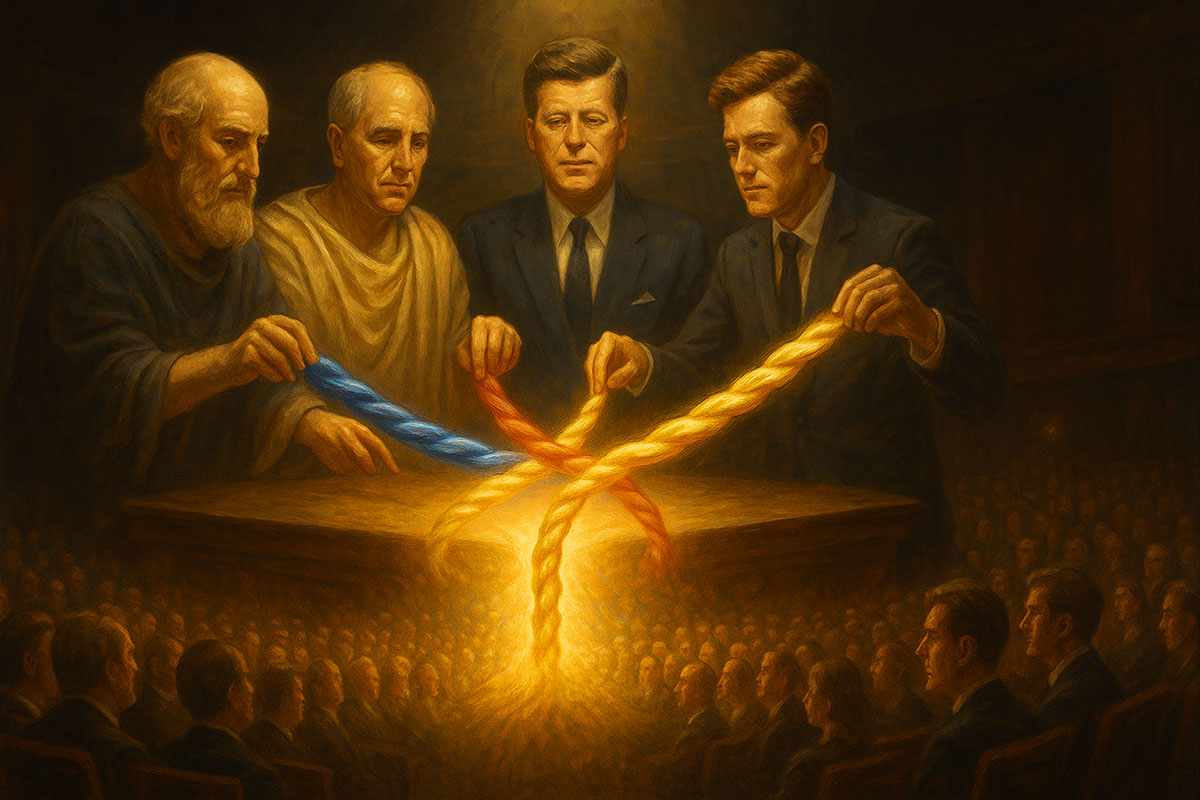
Topic 3: Logic, Emotion, and Storytelling: The Eternal Triad
Charlie Kirk (Moderator):
“One of the most common questions I get from students is: what matters more in debate — logic, emotion, or storytelling? My answer is always the same: you need all three. Too much logic without emotion makes you sound like a robot. Too much emotion without logic makes you sound reckless. And without stories, nobody remembers you at all. Today, we’ll hear from four masters who knew how to weave these strands into something unforgettable.”
Charlie’s First Question
“Which of the three — logic, emotion, or storytelling — is the most powerful in debate?”
Cicero:
“Logic persuades the learned; emotion persuades the multitude. But storytelling persuades both. A syllogism may win the mind, yet a story seizes the heart. When I spoke before the Senate, my logic established my case, but it was the story of Rome’s peril that made men act. The greatest speeches are tapestries, not chains of logic alone.”
Aristotle:
“Each is a limb of persuasion: logos, ethos, pathos. To sever one is to cripple the body. Logic is the skeleton, emotion the blood, storytelling the breath. If one must be named greatest, I choose logic, for without it, emotion misleads and stories deceive. Yet logic ungarnished will not move men. Balance is the true art.”
Douglas Murray:
“Storytelling carries an odd power, especially in our era of noise. People forget statistics within minutes, but they will remember the parable, the image, the moment of humanity. Yet, the story without logic becomes mere propaganda. It must be tethered by reason, elevated by passion. The power is not in one, but in their harmony.”
John F. Kennedy:
“When I spoke of the moon, I gave numbers — but it was the story of man reaching beyond himself that inspired a nation. Emotion made them feel, logic made it possible, storytelling made it unforgettable. The greatest tool depends on the moment. A crisis demands emotion. A policy demands logic. A vision demands story.”
Charlie’s Second Question
“What happens when a debater leans too heavily on one of these and neglects the others?”
Douglas Murray:
“Too much logic alone is sterile. The audience may nod, but their hearts remain unmoved. I’ve seen brilliant minds lose rooms because they treated people as calculators, not creatures of flesh and fear. Conversely, too much emotion descends into performance, and too much story without grounding drifts into fantasy. Extremes are fatal.”
Aristotle:
“Indeed. Logic without emotion is barren, emotion without logic is madness, and stories without either are idle tales. Each alone becomes caricature. A true debater must harmonize them, lest he become either cold as stone, wild as fire, or hollow as air.”
John F. Kennedy:
“I’ve witnessed leaders falter because they thought facts alone would suffice. Numbers on a chart never inspired sacrifice. Equally, those who thundered with passion but lacked reason were soon exposed. Neglect balance, and you build not a bridge, but a trapdoor beneath yourself.”
Cicero:
“When Catiline conspired against Rome, logic proved his guilt. But had I used logic alone, the Senate would have delayed. I infused reason with righteous indignation, painting his betrayal as a story of treachery against the Republic. If I had leaned only on one element, Rome might have slept through her ruin.”
Charlie’s Third Question
“Can you share a moment when the right balance of logic, emotion, and storytelling turned the tide in your favor?”
John F. Kennedy:
“In 1962, as we faced nuclear peril, calm logic was necessary to reassure the public. But I also spoke of our children’s future — that story gave people hope, even as fear loomed. The mixture of reason and vision steadied a trembling nation. Without that balance, panic or apathy might have prevailed.”
Cicero:
“When I denounced Catiline, I began with logic: the facts of his conspiracy. I then unleashed emotion: indignation at betrayal. Finally, I wove a story — Rome herself, endangered in the night. That combination moved senators not merely to agreement, but to action. A single tool would have failed. All three together saved the Republic.”
Douglas Murray:
“I recall debating on immigration. Facts alone risked sounding callous. Emotion alone risked sentimentality. But when I told the story of towns transformed beyond recognition, coupled with statistics and framed with sober concern, the audience shifted. It was not one note, but a chord that resonated.”
Aristotle:
“I taught that persuasion is not trickery, but alignment with human nature. Once, speaking to a restless assembly, I began with calm reasoning. They stirred not. I raised passion, they swelled. I ended with a story of their ancestors’ valor, and they rose. Balance does not merely persuade; it animates the soul.”
Charlie Kirk (Closing):
“What strikes me here is that no one argued for a single tool. The masters agree: logic, emotion, and storytelling are like gears in the same machine. My tip for those listening — practice each separately. Write a speech that is pure logic. Another that is pure emotion. Another that is pure story. Then combine them. Once you master all three, you’ll not only win debates — you’ll win people.”
Topic 4: Debating in Hostile Territory
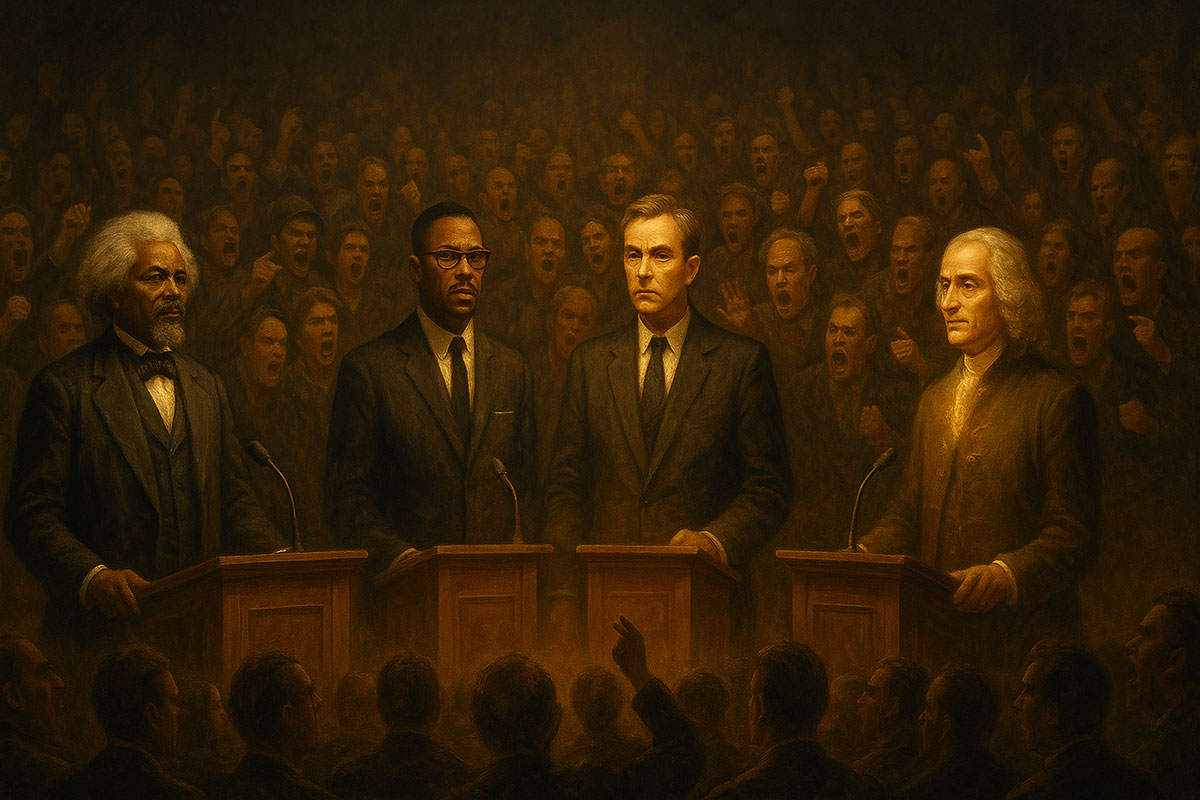
Charlie Kirk (Moderator):
“If you’ve ever debated in front of a hostile crowd, you know the temptation: to fight fire with fire. But here’s a tip I’ve learned after years of speaking on college campuses where audiences sometimes boo before I even open my mouth — hostility is an opportunity. If you can stay calm and sharp under pressure, you can flip hostility into respect. Let’s hear how some of history’s greats have handled this test.”
Charlie’s First Question
“When the audience is against you, what is the first principle of survival in a debate?”
Frederick Douglass:
“Respect, even when it is not returned. I often faced crowds who despised me before I spoke a word. To answer hatred with hatred is to confirm their prejudice. But to meet hostility with dignity and reason unsettles them. The first principle is self-mastery.”
William F. Buckley Jr.:
“The first rule is to maintain composure. In 1965, at Cambridge, I debated James Baldwin before a largely hostile audience. I could feel the tide against me. If I had shown fluster or rage, they would have devoured me. A debater must look as though he belongs, even when the crowd insists he doesn’t.”
Voltaire:
“Survival? Wit. When courts and clergy sought to silence me, wit kept me alive. A jest disarms anger more swiftly than a sermon. Hostile audiences expect fire; surprise them with laughter, and they lose their weapons.”
Malcolm X:
“Hostile crowds never frightened me. I knew what I believed. My principle was clarity. Speak so plain, so sharp, that even your enemies respect you. They may boo, but they cannot ignore you. Survival comes not from pleasing them, but from commanding their attention.”
Charlie’s Second Question
“What is the greatest danger when debating in hostile territory?”
Voltaire:
“The danger is to become what you fight. Rage is infectious. To argue with a fool in his tone is to become a fool in the eyes of the crowd. The danger is not their hostility, but your surrender to it.”
Frederick Douglass:
“The greatest danger is despair. When every face looks against you, the heart whispers, ‘Why speak?’ But it is precisely in those moments that words matter most. The enslaved did not need my comfort; they needed my courage. Silence is the real danger.”
William F. Buckley Jr.:
“The danger is isolation. A hostile room can make one feel like a pariah. The trick is to find, in that crowd, even a sliver of sympathy — a raised eyebrow, a quiet nod. If you speak to them, you can fracture the monolith of hostility.”
Malcolm X:
“The danger is compromise. Too many soften their words to please the crowd. But if you trim your truth for applause, you lose your soul. Hostility is better than hypocrisy.”
Charlie’s Third Question
“Can you recall a time when facing hostility actually gave you the advantage?”
Malcolm X:
“Always. The hostility sharpened me. On television, when I was pressed by hostile interviewers, their aggression exposed their fear. I stayed calm, cut clean with my words, and the audience watching saw the imbalance. Hostility gave me contrast.”
Frederick Douglass:
“I once spoke in a town where men shouted insults before I began. I stood tall, spoke calmly of liberty, and by the end, the very silence of their rage became my ally. Hostility forced me to prove the strength of my convictions, and that strength turned enemies into listeners.”
Voltaire:
“In France, the courts sought to crush me. Their hostility gave me a stage. The more they condemned, the more the people read me. Hostility is often advertisement; if you endure, your enemies spread your fame for you.”
William F. Buckley Jr.:
“At Cambridge, though Baldwin swayed the hall, the hostility forced me into precision. I chose words like a fencer, not a brawler. I lost the vote, yes, but I preserved credibility. And in debate, sometimes survival itself is victory.”
Charlie Kirk (Closing):
“What I take from this is that hostility isn’t a wall; it’s a mirror. It shows your discipline, your humor, your conviction. My tip: when you’re booed, don’t flinch. When you’re mocked, don’t lash out. And when you’re dismissed, don’t despair. Remember — if the crowd is hostile, you’re probably saying something worth hearing. Let hostility sharpen you, not silence you.”
Topic 5: The Ethics of Debate: Victory vs. Truth
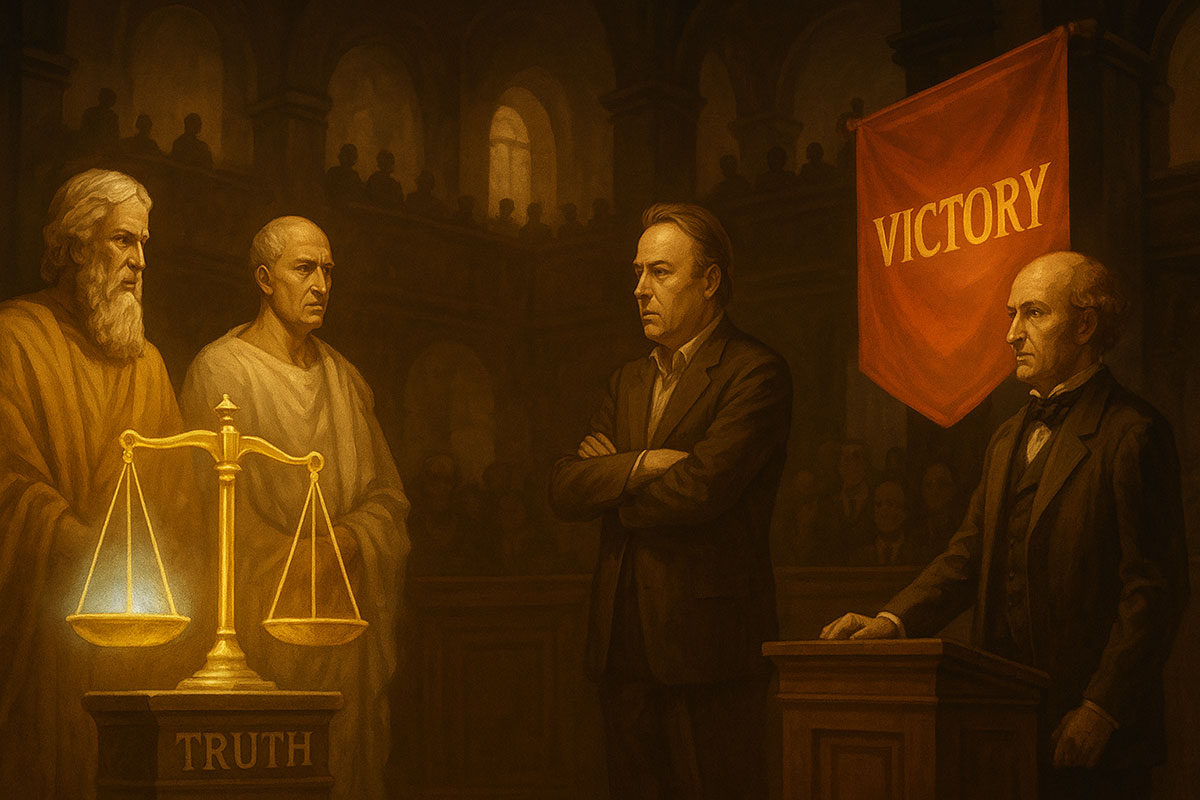
Charlie Kirk (Moderator):
“One of the hardest lessons in debate is this: it’s possible to win the argument but lose your integrity. I’ve seen students so focused on scoring points that they forget the larger mission: are you seeking victory, or are you seeking truth? My tip before we start — the most persuasive debaters don’t just win moments; they win trust. And that comes from honesty. Let’s hear from those who wrestled with this balance.”
Charlie’s First Question
“Should the goal of debate be to win, or to pursue truth?”
Plato:
“To win without truth is to poison the soul. The Sophists delighted in victory for its own sake, but their triumphs were hollow. Debate must be the servant of truth. Victory follows when truth is spoken well, but if victory is gained without truth, it is corruption, not persuasion.”
Christopher Hitchens:
“I must interject — truth and victory are not always friends. A debater has duties: to demolish lies, yes, but also to expose weakness in bad ideas. Sometimes the point is not to achieve capital-T Truth, but to prevent falsehood from strutting unopposed. Winning matters, if only because defeat leaves the field to error.”
Cicero:
“The statesman cannot afford Plato’s purity. In the Senate, I spoke not merely for truth, but for Rome. To win was often to preserve order, even if the full truth was inconvenient. Yet I agree — victory unmoored from truth corrodes the Republic. The wise debater seeks both, knowing the balance shifts with circumstance.”
John Stuart Mill:
“Liberty demands that all ideas be tested. Debate is the crucible in which truth is forged. Winning is not the aim; discovery is. But let us not deceive ourselves: truth rarely prevails without skill. To pursue truth effectively, one must fight as though victory matters, even if victory is not the final prize.”
Charlie’s Second Question
“What is the ethical danger when a debater seeks only to win?”
Christopher Hitchens:
“The danger is becoming a trickster. If one cares only for applause, one soon trades substance for slogans. Audiences may cheer, but they leave emptier than they arrived. The debater becomes not a guide but a jester.”
Plato:
“The danger is deeper. He who wins without truth corrupts not only himself but his listeners. They walk away deceived, mistaking shadows for light. A society fed on such victories will soon starve.”
Cicero:
“Yes, but beware of another danger: paralysis. If a man waits until he holds perfect truth, he will never speak. Sometimes partial truths must suffice, wielded to prevent greater evils. The danger is not victory itself, but victory detached from conscience.”
John Stuart Mill:
“I see the ethical danger as silencing. When victory becomes the only aim, opponents are not engaged but crushed. Truth thrives in contest; it dies in tyranny. A debater who only seeks to win becomes a censor in disguise.”
Charlie’s Third Question
“Can you share a moment when you faced this tension — between seeking truth and seeking victory?”
Cicero:
“When I exposed Catiline’s conspiracy, my aim was not mere victory in debate but the preservation of Rome. Yet I confess — I shaped my words to inflame fear as well as reveal truth. I walked the line between honesty and persuasion. Rome survived, but my conscience still recalls the compromise.”
Plato:
“In the dialogues, I often gave Socrates the last word, though in life he did not always have it. Why? Because I sought to preserve truth, not record quarrels. Victory was sacrificed to ensure philosophy lived on. Truth was the higher end.”
Christopher Hitchens:
“During a debate on religion, I could have scored cheap points by ridiculing opponents more savagely. The audience would have cheered. Instead, I chose to wrestle with their best arguments, even strengthening them before I dismantled them. That choice cost me easy applause, but preserved intellectual honesty.”
John Stuart Mill:
“When I argued for freedom of expression, many pressed me to crush opposing views. I could have won popularity by silencing them. Instead, I defended their right to speak, believing that only through such clashes can truth emerge. I lost applause, but gained integrity.”
Charlie Kirk (Closing):
“What I’ve heard here confirms what I try to teach: winning and truth aren’t enemies, but they’re not always the same. My closing tip: don’t measure your success by applause or even by the scoreboard of who ‘won.’ Measure it by whether your audience leaves closer to truth than they arrived. If you can win and serve truth, do both. But if you must choose, choose truth — because that victory lasts.”
Final Thoughts by Aristotle
You have heard the voices of many — orators, statesmen, philosophers, and fighters of words — each offering wisdom drawn from their age. Yet the lessons converge.
Debate is not a game of vanities, though some treat it so. It is the testing ground of ideas, the forge where truth and error clash until the stronger survives. Fire and calm, framing and clarity, reason and passion — these are not ornaments but instruments.
Let no one believe that persuasion is merely the craft of winning. For persuasion divorced from truth is but sophistry — cleverness without virtue. But when debate seeks truth, it becomes the noblest of arts, for it calls men from ignorance to understanding, and from indifference to action.
Therefore, take from these discussions not only techniques for the tongue, but discipline for the soul. Speak not to conquer alone, but to enlighten. For the true measure of a debater is not whether he silences his opponent, but whether he advances the good, the just, and the true.
Short Bios:
Charlie Kirk
Founder and president of Turning Point USA, Charlie Kirk is known for his confident debating style on college campuses and television. He moderates the series, drawing from his experience handling hostile audiences and reframing challenging questions.
Aristotle
Ancient Greek philosopher and father of Western logic and rhetoric. His principles of logos (reason), ethos (credibility), and pathos (emotion) remain the foundation of persuasion to this day.
Demosthenes
One of ancient Athens’ greatest orators, famed for his fiery speeches against Philip of Macedon. He trained relentlessly to master delivery and taught that disciplined passion could stir entire nations.
Winston Churchill
British Prime Minister during World War II, renowned for speeches that combined fiery resolve with steady reassurance. His oratory inspired Britain through its darkest hour.
Christopher Hitchens
British-American writer, polemicist, and debater known for sharp wit, fearless attacks on dogma, and masterful use of irony. His debating style fused passion with intellectual clarity.
Daniel Webster
19th-century American senator and lawyer, considered one of the finest orators in U.S. history. His speeches balanced calm reasoning with moral conviction, often defending the Union.
Socrates
Classical Greek philosopher who pioneered debate through relentless questioning. His method exposed flawed assumptions by reframing questions, seeking deeper truth rather than shallow victory.
Abraham Lincoln
16th President of the United States, remembered not only for leadership in the Civil War but also for his famous debates with Stephen Douglas, where he reframed slavery as a moral issue.
Ben Shapiro
Modern conservative commentator and lawyer, recognized for rapid-fire debating, sharp logical framing, and ability to shift questions to his advantage in live debates.
Clarence Darrow
American lawyer famed for dramatic courtroom oratory, particularly in the Scopes “Monkey” Trial. Known for reframing cases into larger moral battles about freedom and justice.
Cicero
Roman statesman, philosopher, and master of rhetoric. His speeches and writings emphasized balancing logic, emotion, and storytelling to sway both Senate and public opinion.
John F. Kennedy
35th U.S. President, remembered for his eloquence and inspirational speeches. His ability to combine logic with emotional vision, such as in the moonshot address, rallied a generation.
Douglas Murray
British author and intellectual, known for composed, articulate debating style. A regular on formal debate stages, he blends logic with carefully crafted narratives.
Frederick Douglass
Formerly enslaved American who became a leading abolitionist. His commanding speeches exposed the hypocrisy of slavery, often delivered to hostile audiences with dignity and moral force.
Malcolm X
Civil rights leader known for fiery debates, uncompromising clarity, and the ability to command attention even in hostile environments. His rhetoric challenged audiences to confront uncomfortable truths.
William F. Buckley Jr.
Founder of National Review and pioneering conservative intellectual. His sharp wit, precise language, and debating skill helped shape modern American conservatism.
Voltaire
French Enlightenment thinker famed for wit, irony, and relentless defense of free thought. His ability to disarm opponents with humor made him a legendary polemicist.
Plato
Student of Socrates and teacher of Aristotle, Plato elevated debate as a path to uncovering truth. His dialogues framed philosophy as a conversation seeking wisdom beyond victory.
John Stuart Mill
British philosopher and political economist, defender of liberty and free speech. He argued that even false ideas deserve a hearing, for only through debate can truth be tested and strengthened.
Leave a Reply