

Prologue
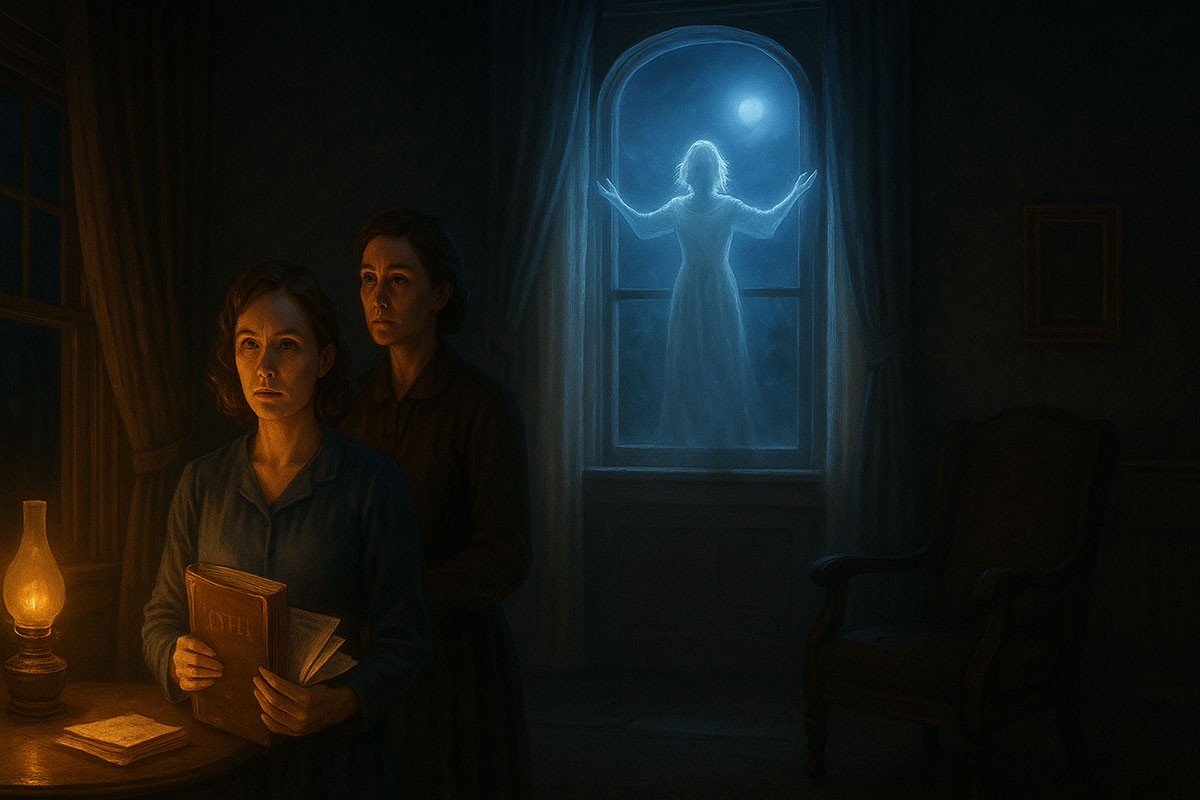
(The stage is dim. A faint golden light presses through the suggestion of a window. A clock ticks slowly, louder than it should. The Chorus speaks as if both inside the room and far beyond it.)
Chorus
This is a story measured in minutes, yet echoing for generations.
A single hour — an hour of grief, of revelation, of freedom found and lost.
A woman opened her heart to the sky, and in that fragile span of time she touched the life she had never dared to name.
Others will call it joy. Others will call it sorrow.
But what she saw was herself.
And though the world will close its window upon her,
her breath, her thought, her hour
will not be silenced.
(The window glows brighter, then dims as lights rise on Scene 1.)
(This performance begins with a familiar tale and unfolds into newly imagined acts, offering an original continuation inspired by its themes.)

Scene 1 — The Moment of News

Form: A chamber play that moves between a Victorian parlor and an upstairs bedroom. The action is intimate, breath-by-breath, as thought becomes revelation.
Setting (split stage):
Stage Left — The Parlor: A modest 1890s sitting room. Lace curtains, a small sofa, a marble-topped table with a vase of fresh lilacs, a hat stand by the door.
Stage Right — Louise’s Bedroom: A simple room with an armchair angled toward an open window. Beyond the sash: the suggestion of rooftops, new leaves, a patch of blue sky after rain.
Lights: Afternoon light, soft and variable—brighter by the bedroom window, dimmer in the parlor. When the window draws Louise, the light there warms and breathes.
Sound: The faint patter of a recent shower receding; a distant street vendor’s call; sparrows; a far melody from someone singing; the steady, quiet tick of a clock.
The Parlor
At rise: Josephine stands by the table, crumpled telegram in hand, struggling to steady her voice. Richards—a young man in travel-worn coat—hovers near the door, hat crushed in his fingers.
Josephine
(reading again, barely)
A list… of the killed. An accident near the junction. They say there was no mistake.
Richards
I came as soon as I could. I was at the newspaper office when the bulletin came. They’ll verify, but— (he falters) —I thought it kinder if we were the ones to tell her.
They look toward the invisible staircase. Silence. The clock ticks. Louise appears in the doorway—slender, composed, a softness in her face that is not weakness so much as attentiveness. She has the air of someone who listens more deeply than she speaks.
Louise
Josephine? Richards? You look like rain left indoors.
Josephine
(going to her, taking her hands)
Sit with me a moment, dear.
Louise
Is it Mother? No? Then what—?
Richards
Mrs. Mallard—Louise—there’s been a railroad disaster. At the north line. They… (he cannot dress it further)
They believe Brently was among the dead.
A quiet falls so complete the sparrows can be counted. Then it breaks. Louise does not scream. She folds. A sob tears through her and she is in Josephine’s arms, shaking, the telegram crushed between them. Richards looks away, helpless, and then back—ready to catch a fall, to stand guard against any additional blow.
Josephine
(hushing, rocking)
My dear, my dear—be careful—your heart. Breathe.
Louise
I am breathing. I am… (another sob) I am breathing.
She pulls free—not harshly, but with a strange, urgent courtesy—as if grief itself directs her steps.
Louise
I need my room.
Josephine
Let me come—
Louise
No. Please. Only… please.
She goes. Josephine makes to follow, but Richards holds her sleeve.
Richards
Give her a minute. She’s strong in ways we don’t expect.
Lights dim in the parlor and swell in the bedroom.
The Bedroom
Louise enters as if the room had been waiting for her. She closes the door gently and crosses to the armchair by the open window. She sinks, not collapsing but placing herself, as if to listen. Outside, the world is impossible in its indifference: new leaves tremble, a blue patch widens, a neighbor laughs, a hawker sings faintly, “Fresh! Fresh!”
Louise
(half to herself)
How dare the day be gentle.
She weeps. Not prettily, not performatively—just the body emptying itself of an old shape. Then the weeping thins to breath. The clock’s tick grows louder; the sparrows insist on their small, faithful song. Louise looks at the patch of sky the way a traveler checks a map.
A slow, almost imperceptible change trembles through her posture. She leans toward the window, fingers relaxing against the armrest, pulse audible in the quiet. A word shapes itself without her permission.
Louise
(whisper)
Free.
She startles at her own mouth, covers it with her hand as if the sound could fly back inside and become un-said. But the word knocks again, steadier.
Louise
Free… free… free.
Light at the window warms; the spring breath enters the room. Louise does not smile exactly; something unfurls beneath her face—relief like a thaw. She is not heartless; she is honest.
Louise
(softly, afraid and sure at once)
No more lines drawn for me. No more days planned for me. No tender hands arranging my hours with good intentions and a gentleman’s will.
Years—mine. Mornings—mine. Rooms—mine. Silence—mine.
She steadies, speaking now with the rhythm of someone taking first steps after a long confinement.
Louise
He was kind, yes. He was often kind. (a small, sad smile) And sometimes love came. Sometimes it did not. That truth matters less than this: I am my own.
She looks out: leaves, sky, light, movement. The world uncoils; she meets it without apology.
Louise
Spring and summer—and all sorts of days—that will be mine. I will wake when I wish and open a book without asking. I will walk alone, and I will not explain to anyone why that is joy. I will say “yes” and “no” and even “later” and “never” and they will mean what I mean by them.
(body and breath aligning)
Body and soul… free.
A knock at the door startles the room.
Josephine
(off)
Louise, let me in. You’ll make yourself ill. You know the doctor said—
Louise
I am not making myself ill. (a laugh like wind) I am letting myself live.
Josephine
(off, trembling)
Please, dearest—
Louise
In a moment.
Silence returns. Louise rises. She looks at herself—not in a mirror, but in the window glass—as if meeting a woman only rumored before now. She presses her palm to her chest, not in distress but in recognition.
Louise
I will cry for him—in some other hour. In this one, I will not pretend I am not grateful. Forgive me, world. Forgive me, Brently. (a breath)
No, do not forgive me. Witness me.
She opens the door.
The Stair
Light braids the two rooms; the parlor returns as a muted echo. Josephine stands there, eyes wet and vigilant. Richards has moved closer to the front door without meaning to, listening for footsteps. Louise steps from the bedroom changed—not glamorously, not dramatically—but upright, lit from within as if a weather system has shifted in her chest. Josephine gasps; then, seeing no tears, she reads it as calm.
Josephine
There’s my girl. Careful on the stairs. Take my hand.
Louise
I can take my own.
They descend together, Josephine hovering but letting her move. Richards turns, relief softening his vigilance.
Richards
If you’d like, I can send a boy to the office—verify—make certain—
Louise
Yes. Verify. Make certain. (she is not cruel—only clear)
They reach the last step. The front door clicks. It swings inward on a gust of damp spring air. Brently stands there—travel-stained, composed, an umbrella under one arm, his face puzzled by the roomful of astonishment.
Brently
Why—what’s this? I came by the back streets; there was talk of— (he stops, sees their faces) Louise?
Time becomes a held breath. Josephine cries out—joy, relief, shock—a bouquet of sounds. Richards lunges with reflex born of the bulletin, one arm out as if human hands could halt the return of a living man. Louise does not speak. Her eyes take him in—hat, coat, the familiar way he stands—and in the same instant, the future she had just assembled with such careful, quivering hope folds like paper in rain.
The clock ticks once. Twice. A hand goes to Louise’s heart—not to welcome, but to shield. She sways.
Josephine
Louise!
Richards
Careful!
They reach for her too late. Louise’s body yields as though a string has been cut. She is caught, lowered, held—Josephine’s hands frantic at her cheeks, Richards calling to the street.
Richards
Doctor! Fetch the doctor!
The street answers—footfalls, a slam, the quick scurry of a boy sent running. Brently kneels, bewildered, guilty without knowing his crime.
Brently
I wasn’t near the accident—they’ve made some mistake—Josephine, tell me—
Josephine
(weeping)
Hush—be still—oh, Louise, Louise—
A Doctor appears—summoned or imagined by the stage’s sudden compression of time; he kneels, touches the wrist, the throat, the ear to the chest. He looks up with the terrible efficiency of his trade.
Doctor
(softly, to them; in the tone of professional truth made gentle)
Heart disease. The joy that kills.
Silence takes the room. Outside, the singing voice resumes, faint but steady; the sky has never been purer. Brently stares at his wife, then at the face of the sister, then at Richards—lost in a story he did not know he was in. Josephine’s hand closes around Louise’s—warm in hers, already cooling in the world’s.
The bedroom window’s light lingers on the empty armchair. On the sash, new leaves move as if to the breath of someone just beyond the frame. The world continues, indecent in its faithfulness.
Blackout.
Scene 2 — The Aftermath
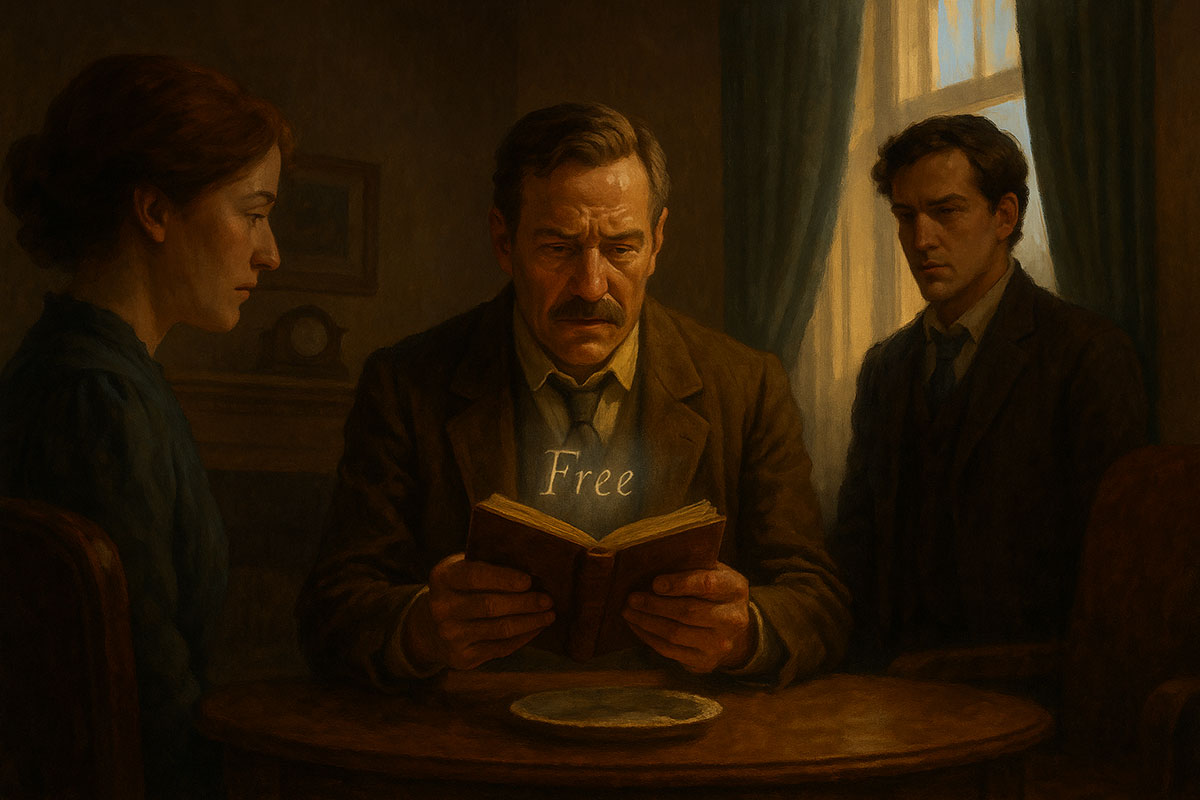
Setting: The Mallard home. Morning light. A stillness hangs over the rooms — not the silence of peace, but of absence. The parlor has been cleared of flowers and visitors. The faint smell of candle wax and wilted lilacs lingers.
Lights: Pale dawn glow through the lace curtains, weaker than the day before. The window is closed. Shadows gather in the corners.
Sound: A clock ticks with exaggerated steadiness. A faint sound of a broom sweeping outside — the street resuming its business.
The Parlor
At rise: Josephine sits at the marble-topped table, face drawn with exhaustion. A black shawl wraps her shoulders. Richards stands by the door, hat in hand, his coat still damp from morning dew. Brently Mallard paces restlessly, his face haggard — not with grief alone, but with confusion, a man searching for a language that does not exist.
Josephine
The doctor said it was the heart. That it was joy that killed her. (she shudders) But I knew her. I saw her face when she opened that door. It was not joy.
Richards
Be careful, Josephine. The world will not hear it as you do. To them, it is simple: she loved him, she died of gladness. That is the story that will be told.
Josephine
And what story will I tell myself when I lie awake? That my sister longed for freedom, and the moment she touched it, God struck her down?
Silence. Brently stops pacing. He looks at them with red-rimmed eyes, as if hearing strangers discuss a stranger.
Brently
Freedom. That is the word she wrote. (he pulls a small leather diary from his coat — Louise’s diary, found in her room) I read it last night, when the house was still. She filled its pages with thoughts I never suspected.
Josephine
(leaning forward, desperate)
Then you saw it too. She wanted more than what we gave her.
Brently
(speaking as if to himself)
She wrote of mornings she wished to keep for herself. Of doors she wished to open without asking. She even wrote— (he falters, the word bitter in his throat) —she even wrote that sometimes my love felt like a chain, no matter how kind the hand that held it.
Josephine
(quietly, almost ashamed but firm)
It was true. She never said it aloud, but I heard it in her silences.
Richards
Mr. Mallard— (hesitant) —you must not torment yourself. We are none of us to blame for thoughts the world teaches women not to confess.
Brently
But she confessed them, Richards. She confessed them to herself, and now to me, when she is beyond answering.
The Diary
Lights narrow to a pool around Brently as he opens the diary. His voice takes on a different cadence — Louise’s voice. Each passage is punctuated by the others watching, reacting.
Brently (reading as Louise)
“Today I looked out the window and saw the sky deepen into blue, and I thought: if I could claim even one hour of this as mine, only mine, I would call it happiness.”
Josephine
(softly)
Yes, she said that to me once… not in words, but in the way she sighed at the window.
Brently (reading as Louise)
“Brently is good, yes. He is kind, yes. But kindness too can bind, when it leaves no space for breath. I dream sometimes of rooms where no one knocks, where silence is my companion and not my prison.”
He falters. His hand trembles. He closes the diary suddenly, as if to shut the words away. Silence fills the room, heavier than grief.
Brently
Was I her jailer, then? A man who offered love but built walls she never named?
Josephine
No, brother. You were what the world asked you to be. She was what the world allowed her to be.
Richards
And in that brief hour, she saw beyond it.
The Weight of Guilt
Brently sinks into the chair. His face is pale. He stares at the diary in his hands like a relic that burns.
Brently
They say she died of joy. But if that were true, would her hand have been so cold in mine? Would her face have worn such a look? No. She died of something else—something we cannot tell the neighbors, nor the priest. She died of freedom lost.
Josephine
And what shall we tell ourselves?
The question lingers. The clock ticks. The sound of the broom outside ceases, replaced by a horse-drawn cart passing. The world moves on.
Richards
(stepping forward, steady but troubled)
You asked if you were her jailer. Perhaps we all were. Perhaps marriage itself is the cage. But cages are built by centuries, not by one man.
Brently
But she saw me as the bars. That is enough to damn me.
Josephine
Or to release you, if you can bear to see her truth.
Final Tableau of Scene 2
The three sit in silence, separated though only steps apart: Brently with the diary heavy in his lap, Josephine clutching her shawl, Richards standing stiff as though before a judge. The room feels smaller than it did at dawn, as if Louise’s absence has pressed the walls inward.
Above them, faintly lit, the window in Louise’s bedroom appears again — the suggestion of leaves and sky. But the window is shut now. The air does not move.
The clock ticks once. Twice. The lights fade to a dim glow over the closed diary in Brently’s hands.
Blackout.
Scene 3 — The Shifting House
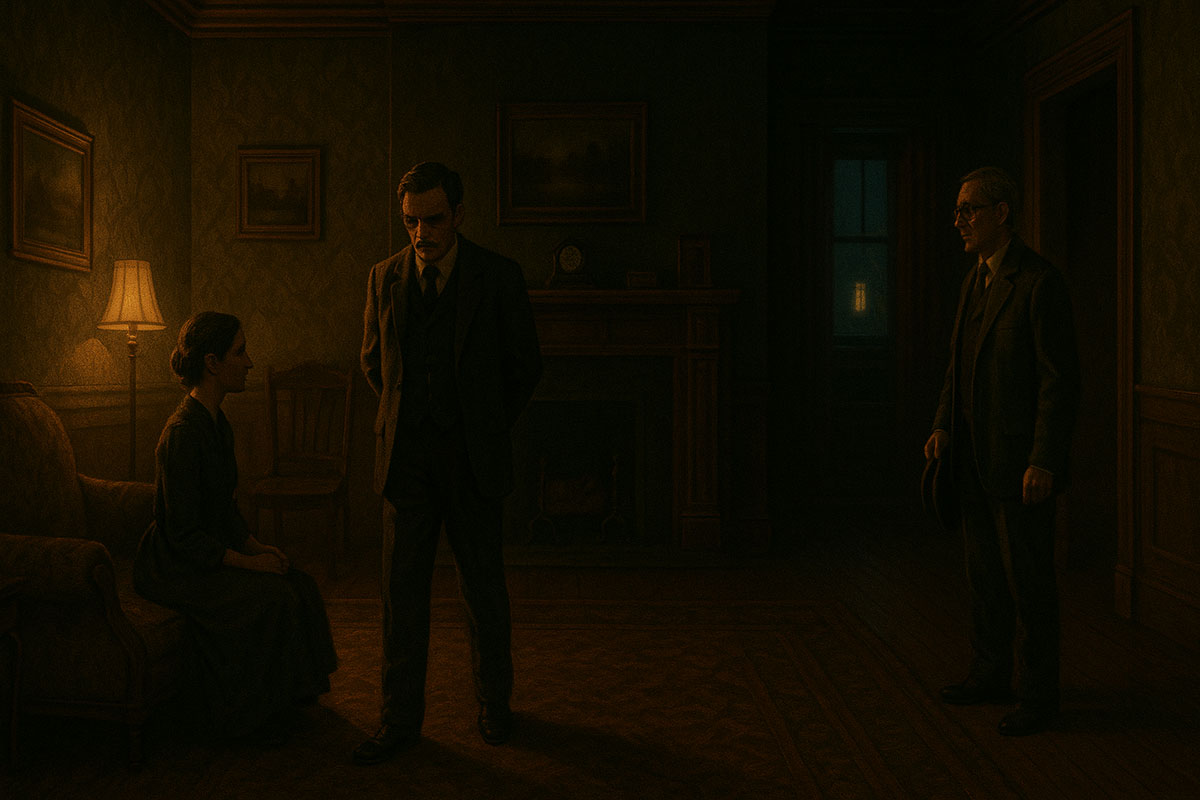
Setting: The Mallard home, months after Louise’s death. Dust has begun to gather in places once kept neat. A vase of dried flowers sits where fresh lilacs once stood. The diary is absent from sight, though its presence lingers like an unspoken word.
Lights: Late afternoon, golden but fading. Shadows stretch long across the parlor. Upstairs, the window in Louise’s room glows faintly, though no one sits there.
Sound: The creak of floorboards. The occasional clip of hooves on cobblestone outside. A hush in the air, as if the house itself listens.
The Parlor
At rise: Brently sits alone in the armchair. His face is thinner, his eyes sunken with restless nights. He fiddles absently with his wedding band. Josephine enters quietly with a tray of tea, watching her brother-in-law with worry.
Josephine
You hardly eat. You hardly speak. A house left too long in silence grows haunted.
Brently
It is haunted. (he looks up at her) Haunted by words that should never have been written, yet cannot be unwritten.
Josephine
Louise’s diary.
Brently
(softly)
Every night I hear it. Not the words, but the meaning. She dreamed of freedom, Josephine. And what did I dream? Of a wife content at my side. Two dreams cannot live in the same room. One must smother the other.
Josephine
Perhaps she wished for freedom and loved you both. Contradictions live in all hearts.
Brently
(half-smiling, bitter)
Contradictions? No. Chains.
He rises, pacing. The room seems too small for him now. Josephine watches, troubled, then pours tea with trembling hands.
The Gossip
A knock. Richards enters with his hat in hand. He hesitates before speaking, as though weighing his words.
Richards
I came not as a messenger but as a friend. There’s talk in town. Whispers about Louise.
Josephine
What talk?
Richards
That she died not from joy, but from… despair. That she longed for more than her marriage gave her.
Brently
(half to himself)
The diary. Someone has spoken of it.
Richards
Not by name, not yet. But women—wives, daughters—speak her name softly, as if she were a saint of some hidden church. They say she glimpsed what others only dream.
Josephine
(quiet, almost proud)
Then perhaps she has not died at all.
Brently
(angrily)
You would make her an idol? A martyr to freedom? And leave me—what? A villain?
Richards
Not a villain. A man. But men will bear the weight of the cage until they choose to see it.
Silence. The air tightens. Brently sinks into his chair again, pressing his hands over his eyes.
The Ghost of Louise
Lights shift subtly. Upstairs, the faint glow of the window brightens. A soft sound of sparrows. Brently lowers his hands, glancing toward the stair as though hearing her footsteps.
Brently
At night I dream she stands at that window, whispering that word again. “Free.” Always “Free.” And when I wake, the word lies on my tongue like ash.
Josephine
Then perhaps the word is not meant to haunt, but to change.
Brently
Change what? A marriage that is dust? A heart that is still?
Josephine
Change you.
The silence brims with weight. Brently rises, trembling, as though the very walls lean in. Richards steps forward, gentle but unyielding.
Richards
Mr. Mallard, the house itself seems to wait for your choice. Will it remain a tomb, or will you let it breathe again?
The clock ticks louder. The window’s glow dims back to its faint outline. Brently looks from the parlor to the stair, his face torn between shame, grief, and some stirring resolve.
Final Tableau of Scene 3
*The three stand apart: Brently near the stair, caught between the memory above and the gossip outside; Josephine with her tray of tea cooling in her hands, watching with hope and fear; Richards near the door, the messenger of a world already shifting.
The room darkens as the day fades. The diary is not seen, but the ghost of its words fills the air. Upstairs, the window glows faintly once more, as if Louise herself breathes through it.
Blackout.
Scene 4 — The Rebellion of Memory
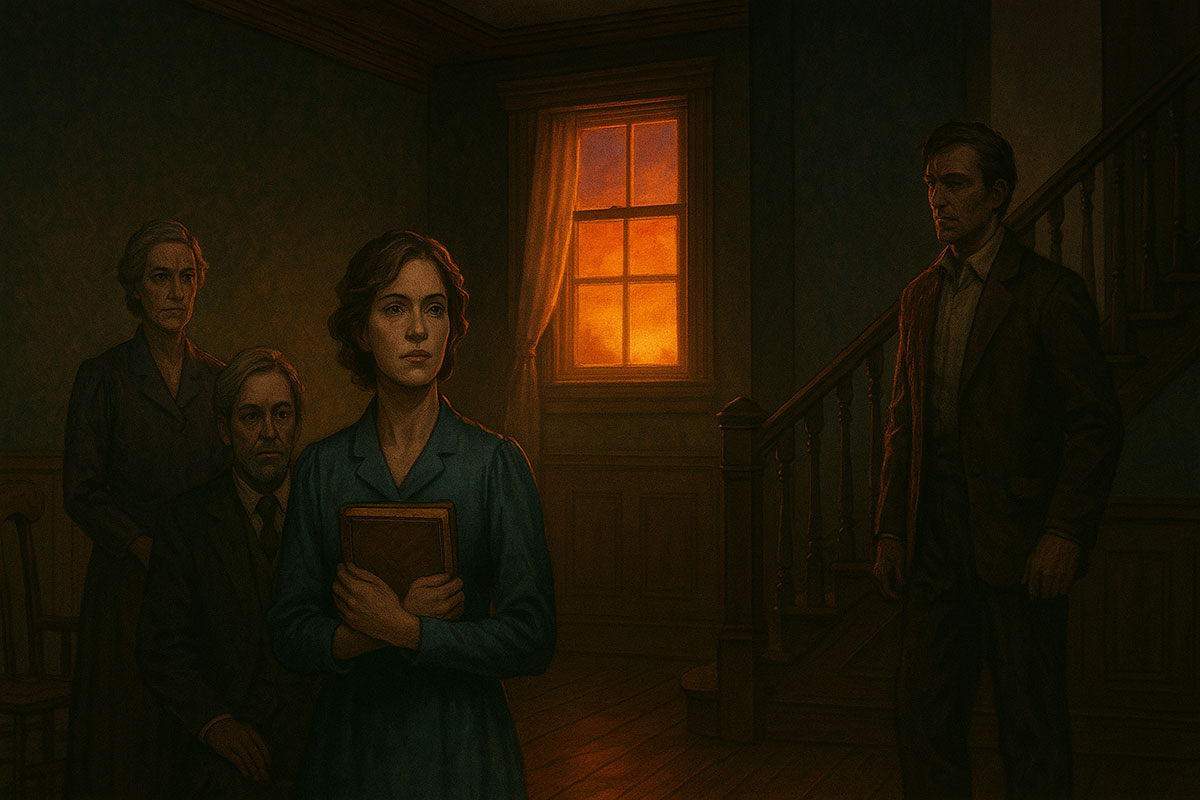
Setting: The Mallard home, several years after Louise’s death. The house shows its age: wallpaper faded, chairs worn, shutters creaking. Upstairs, Louise’s old room is closed off, but her window still glows faintly when light strikes it.
Lights: Late evening, lamplight within, but a fiery sunset stains the curtains. The house seems to hold its breath.
Sound: The muted rumble of carriages outside. From time to time, faint voices of neighbors passing — snippets of gossip and laughter.
The Parlor
At rise: Brently Mallard, older now, sits at the table. His shoulders are stooped, his hair touched with gray. He holds Louise’s diary, its cover worn from handling. Josephine enters with her daughter, Clara, a young woman of twenty with bright, determined eyes. Clara carries papers and pamphlets in her arms.
Josephine
Clara insisted on coming. She’s been restless with her thoughts, and I thought you should hear them.
Clara
(placing the pamphlets on the table)
They’re publishing essays now, Mr. Mallard. About women — their rights, their voices. Some even mention Louise, though not by name. I think they’ve heard whispers of her words.
Brently stiffens, clutching the diary.
Brently
Louise’s thoughts were private. They were not meant for printing presses or parlors.
Clara
But they burned too bright to remain locked away. She saw what so many feel and cannot say. That marriage can be a kindness, yes, but also a cage. That freedom is not selfishness, but the very breath of the soul.
Josephine
(softly, with quiet pride)
She did see that.
Brently closes the diary sharply, as if silencing it.
Brently
She also loved me. Will you make her memory a weapon against me? Against all men?
Clara
(steadily)
Not against love, Mr. Mallard. Against chains.
The Town Divided
A knock at the door. Richards enters, older too, his coat dusted with travel. His face is weary, but his voice is steady.
Richards
The town is split. Some call Louise a saint of liberty, others a traitor to her marriage vows. There are meetings — whispered at first, now louder. Young women read her words and find their own in them.
Josephine
And the men?
Richards
Some scoff. Some rage. Some fear what they cannot cage.
Silence falls. Brently stares at the diary as if it were a ticking bomb. Clara steps closer, her eyes fierce.
Clara
It matters what you do, Mr. Mallard. You hold her words. You can keep them hidden and let them rot in shadows, or you can allow them to breathe.
Brently
(voice trembling)
And if I do, what becomes of me? Am I the husband who loved his wife, or the jailer who killed her spirit?
Clara
You are both. And you are neither. You are the one who chooses what she will mean to the world.
The Choice
Brently rises, holding the diary as if it weighs more than stone. He walks toward the stair, toward Louise’s room. The others watch, silent. At the closed door, he pauses, pressing his forehead against the wood.
Brently
Louise… I have lived with your silence longer than I lived with your voice. The world is asking for you now. Shall I give them the truth, or shall I bury you again?
The window above glows faintly, as if answering. A breeze stirs the curtains downstairs. Clara steps forward, her voice trembling but resolute.
Clara
Let her speak. For all of us.
Brently hesitates, then opens the diary. He looks down at the words, and something in his face shifts — grief, love, shame, and release all at once. He holds it out to Clara.
Brently
Then take it. I am too weary to carry her voice any longer.
Clara accepts the diary reverently, as though receiving a torch. Josephine clasps her daughter’s hand, pride shining through tears. Richards bows his head, as if witnessing a solemn rite.
Final Tableau of Scene 4
*The stage glows with the fading fire of sunset. Clara stands with the diary against her heart. Brently remains at the foot of the stair, looking upward, his face lined with surrender. Josephine and Richards flank Clara, forming a quiet circle of witnesses.
Above them, Louise’s window glows brighter than before, as though the word “Free” lingers in the air, unseen but undeniable.
Blackout.
Scene 5 — The Final Revelation (Many Years Later)
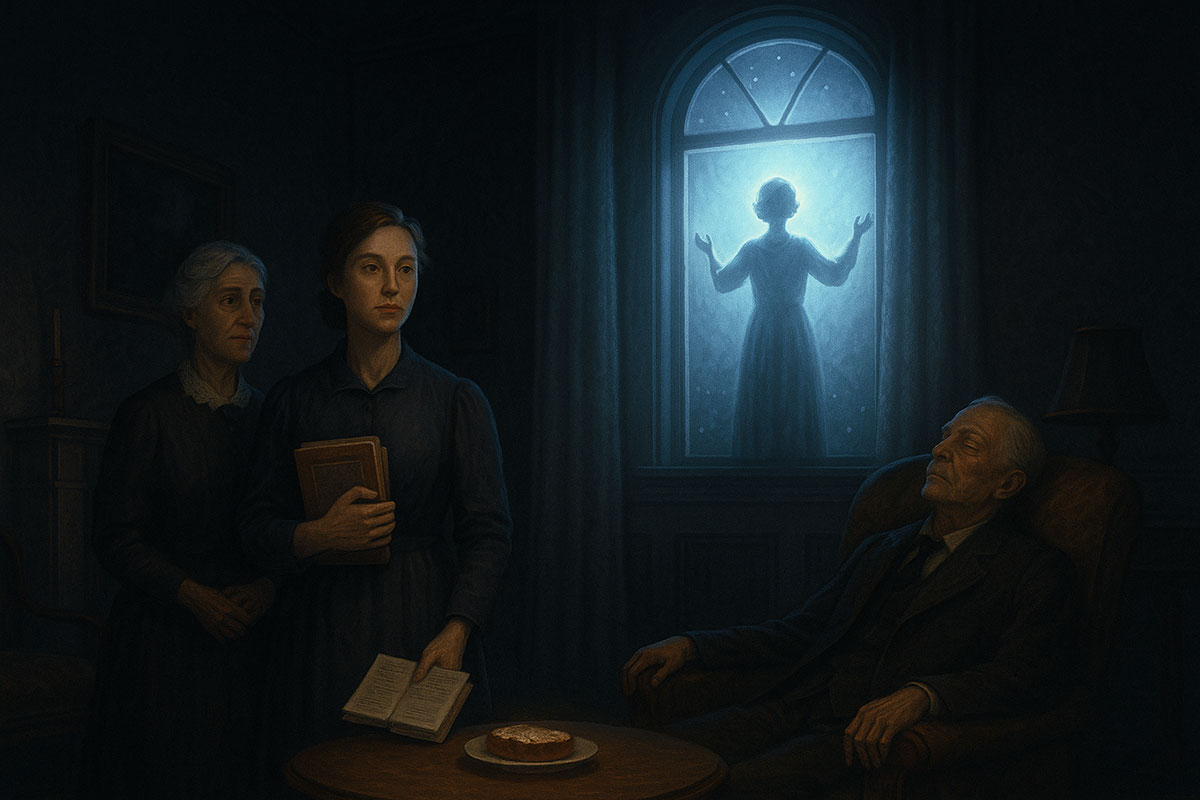
Setting: The Mallard home, many years after Louise’s death. The house is frail now — shutters loose, wallpaper faded, the air heavy with dust. Upstairs, Louise’s room has been long shut, but her window remains, a ghostly rectangle of light. A small writing desk stands at center stage, scattered with papers and pamphlets. A single oil lamp glows.
Lights: Evening deepening into night. A warm but flickering glow from the lamp, contrasting with the pale moonlight that spills faintly through Louise’s unseen window.
Sound: The occasional hoot of an owl. A slow, labored tick of the old clock. From far off, muffled voices of a gathering — women reading, children listening, the beginnings of a movement carried on the wind.
The Parlor
At rise: Brently Mallard, very old now, sits slumped in the armchair. His hands tremble. His breath is shallow but deliberate. On the table beside him lies Louise’s diary, worn thin from years of touch. Clara, now grown into a strong, confident woman in her thirties, enters. She places a bundle of freshly printed pamphlets on the desk.
Clara
They’ve published her words at last. Women are reading them aloud in gatherings, in kitchens, even in the church steps when the sermons end. She is no longer a whisper. She is a voice.
Brently lifts his head slowly, his eyes watery but alert.
Brently
Her words. Not mine. Not yours. Hers. (he gestures to the pamphlets) And what do they call her?
Clara
A prophet. A sister. A mirror. Some say she died of weakness. More say she died of strength too sharp for her time.
Brently lets out a long breath, almost a sigh of release.
Brently
So it is done. She has escaped the walls at last.
The Reckoning
Clara kneels by him, taking his hand. His grip is weak but steady. He looks into her eyes with the weight of decades.
Brently
I have carried two truths, Clara. That I loved her. And that I caged her. Both are real. Both live in me.
Clara
And still, you gave her words back to the world. That is the truth that will remain.
Brently
(slowly, with effort)
When she died, they said it was joy that killed her. But I knew… I knew it was the loss of joy. The loss of freedom. The loss of that single hour she had tasted.
He presses her hand with surprising strength.
Brently
Promise me you will not lose it. Not for any man. Not for any law.
Clara
I promise.
The Passing
*Silence. The clock ticks louder, then falters, as though winding down. Brently’s head lowers, his hand slipping gently from Clara’s. She holds it a moment longer, then realizes it has gone slack. She closes his eyes tenderly.
The lamplight flickers. The window above brightens faintly, the same glow Louise once leaned toward. For a moment, Brently’s face seems peaceful — not absolved, but at rest.
The Legacy
Josephine, now white-haired and frail, enters slowly, leaning on a cane. She sees her daughter kneeling by Brently, the pamphlets beside them, the diary still open on the table. She lifts the diary and places it over the pamphlets like a benediction.
Josephine
Then both their voices will remain. One who dreamed, and one who bore the burden.
Clara rises, holding both diary and pamphlets against her chest. Her eyes shine not with tears alone, but with fire.
Clara
No longer whispers. No longer secrets. Her hour will outlast every chain.
Final Tableau of Scene 5
*The stage glows with moonlight through Louise’s window, brighter than at any point in the play. Clara stands at center with the diary and pamphlets, framed by the faint light of her aunt’s legacy. Josephine stands beside her, proud though weary. The shadow of Brently remains in the armchair, still, as if finally part of the house’s silence.
*The voices from outside swell faintly — women speaking, children echoing, a chorus of freedom carried on the wind. The word “Free” is never spoken on stage, yet it trembles in the air.
The light from the window pulses once, like a heartbeat, then fades into darkness.
Blackout.
Epilogue
(The stage is hushed. The window glows faintly once more, moonlight streaming down. The Chorus returns, softer now, as if speaking from the pages of a diary or the hush of memory.)
Chorus
She is gone, yet not gone.
Her hour remains, carried in whispers, in diaries, in the quiet defiance of those who remember.
They said she died of joy.
But we know she died of truth.
And truth, once spoken, does not die.
What is one hour to a world that measures in centuries?
It is a spark. A heartbeat. A seed.
Enough to grow into voices, into change, into freedom yet to come.
(The window glows one last time, a pulse like breath, then fades into darkness. Blackout.)
Short Bios:
Leave a Reply