


Introduction by Megan Phelps-Roper
“When I first stepped out of the world I had always known — a world where disagreement was treated as betrayal — I had to learn almost from scratch how to see others not as enemies, but as fellow human beings. That journey taught me something profound: our survival as communities, as nations, even as a species, depends on our ability to argue without dehumanizing, to stand firm in our convictions while still leaving room for love.
This series, Learning to Disagree: Repairing Epistemic Trust, is an invitation to explore that path together. We’ll hear from voices who have lived through hatred and chosen compassion, thinkers who’ve studied why we fracture and how we might heal, and leaders who’ve dared to imagine a future where conflict strengthens us rather than shatters us.
The question before us is simple, yet urgent: Can we learn to disagree in ways that restore trust — in truth, in each other, in the possibility of common ground? Let’s begin the conversation.
(Note: This is an imaginary conversation, a creative exploration of an idea, and not a real speech or event)

Enter your text here...

Megan Phelps-Roper:
Many of us know the feeling: a disagreement isn’t just about politics or policy — it feels personal, even like a betrayal. Tonight, I’d like us to explore the roots of this pain, and what it means for our ability to build trust across divides.
Question 1: Why do disagreements so often feel like an attack on our identity, not just our ideas?
Jonathan Haidt:
Disagreements aren’t simply about opinions — they cut into our moral fabric. Each of us is guided by moral foundations like fairness, loyalty, or sanctity. When someone challenges those, it feels as though they’re denying who we are at the deepest level. That’s why politics today doesn’t feel like a casual debate at a café — it feels more like heresy against our sacred values. To understand why disagreement feels like betrayal, we have to see how morality forms the very core of our identity.
Daryl Davis:
I’ve experienced that in the rawest way. When I sat across from members of the Ku Klux Klan, they didn’t argue policies with me — they argued my right to exist. For them, me being a Black man was already the disagreement. Of course that feels like an attack. Yet I found that when I showed them patience, when I treated them as human beings even in their hatred, something shifted. They began to see me as more than the symbol they thought I was. It’s proof that identity wounds don’t heal through logic — they heal through relationship.
Chloé Valdary:
Yes, and so much of this comes from the way we confuse love with agreement. When someone disagrees with us, we interpret it as rejection, as though they’ve withdrawn love. But love is not sameness. Love is honoring the other person as a whole, even when they differ from us. If we learned to separate disagreement from rejection, we might discover that tension doesn’t have to equal betrayal.
Ian Bremmer:
That’s just as true for nations as it is for individuals. On the global stage, when one country criticizes another, it’s taken as an existential threat. Leaders fear that disagreement undermines their legitimacy. That’s why international conflicts escalate so quickly. Unless we learn to frame disagreement as negotiation rather than attack, it will always feel like betrayal, whether at the dinner table or in diplomacy.
Julia Galef:
We also carry a mindset that amplifies the pain. I call it “soldier mindset.” We approach disagreements like battles we have to win to protect our tribe. If I lose an argument, I’ve failed my side. But if we shifted to “scout mindset,” disagreements would feel less threatening. Scouts don’t defend a position — they explore the terrain. With curiosity guiding us, disagreement becomes an opportunity to learn, not a reason to feel attacked.
Question 2: What practices can help us face disagreements without feeling betrayed?
Chloé Valdary:
One of the most powerful tools is art. Art carries disagreements through metaphor, beauty, and story, softening the blow. A song or a painting can embody difference without hostility. When we encounter disagreement in art, we remember we’re human first, and opponents second. Beauty creates a bridge that logic often cannot.
Jonathan Haidt:
Another practice is learning the moral language of those who see the world differently. If a progressive speaks only of fairness, it may not move a conservative who values loyalty or tradition. If a conservative emphasizes sanctity, it may not resonate with someone rooted in care and equality. But when we learn to translate across moral foundations, hostility diminishes. Disagreement becomes more like interpretation than combat.
Ian Bremmer:
In geopolitics, dialogue succeeds when both sides have something to gain. That principle applies at home too. If we frame disagreements in terms of shared benefits rather than individual wins, the dynamic changes. Incentives matter, whether between nations or neighbors. When people see value in coming together, betrayal no longer dominates the frame.
Daryl Davis:
For me, it always begins with listening. Not listening to rebut, but listening to understand. When people feel truly heard, their defensiveness weakens. Over the years, I watched Klan members who once hated me begin to soften, not because I proved them wrong, but because I respected them enough to hear their story. Listening is more disarming than any argument.
Julia Galef:
And there’s a simple phrase that shifts the atmosphere instantly: “I might be wrong.” It signals humility, it lowers the shields, and it reframes the conversation as collaboration. When you open space for being wrong, you invite the other person to do the same. That’s how disagreement turns from a battle into a joint exploration.
Question 3: If we learned to see disagreements differently, what would change in our society?
Ian Bremmer:
On the international level, wars would be less likely. If leaders saw disagreements as negotiation points rather than existential threats, fewer conflicts would escalate. Nations could learn to live with difference rather than fight against it.
Chloé Valdary:
At the community level, resilience would flourish. Families, workplaces, even entire societies would stop fracturing at the first sign of tension. If love were practiced through disagreement, our bonds would deepen instead of breaking.
Jonathan Haidt:
Democracy would also stabilize. Right now, compromise looks like weakness because disagreement feels like betrayal. But if we reframe that, compromise could be seen for what it truly is — wisdom. Our political systems would become functional again.
Daryl Davis:
And hatred would have no oxygen. When disagreement isn’t treated as rejection, the image of the enemy dissolves. I’ve seen men who once burned crosses hand me their robes and leave the Klan. That change is possible at scale. Hatred shrinks when people no longer feel the need to defend themselves against difference.
Julia Galef:
And we’d see an explosion of collective intelligence. Science, philosophy, and public policy all depend on disagreement to progress. If being wrong stopped feeling dangerous and started feeling useful, breakthroughs would come faster. Disagreement would become the engine of discovery, not the enemy of truth.
Closing Reflections
Megan Phelps-Roper:
When values collide, it’s easy to recoil as though someone has struck us. But perhaps these collisions aren’t betrayals at all — perhaps they are invitations. Invitations to understand deeper moral foundations, to practice patience, to learn new languages of empathy, and to strengthen systems that reward listening over winning. If betrayal is one story of disagreement, then trust can be another. And maybe the task before us is not to erase our differences, but to learn how to argue in a way that preserves the dignity of everyone at the table.
Topic 2: Love in the Face of Contempt — The Discipline of Seeing the Other

Megan Phelps-Roper:
One of the most corrosive forces in disagreement is contempt — that cold dismissal that says, “You’re not worth listening to.” And yet, many of you here insist that love itself can meet contempt and transform it. But is love truly possible in the middle of conflict, when every instinct is to strike back? Tonight, let’s explore how love, in its many forms, can reshape the way we handle our deepest divides.
Question 1: Can love really play a role in disagreements, or is that just wishful thinking?
Desmond Tutu:
It may sound naïve, but I have witnessed it firsthand in South Africa. After decades of apartheid, people expected retribution, but what came instead was the Truth and Reconciliation Commission. We asked victims and perpetrators to sit in the same room, to speak, to listen. It was excruciating, but it showed that love is not sentimental. It is fierce. Love insists on justice but refuses to give up on humanity. Without love, our nation would have been torn apart.
bell hooks:
Yes, and I would add that love is a practice, not a fantasy. In my work, I’ve said that love is a combination of care, commitment, knowledge, responsibility, and trust. To love in the midst of conflict is to choose those things intentionally. Contempt is easy; love is the discipline that sustains community. Without it, our disagreements only hollow us out.
Martin Luther King Jr.:
I have long said that hate cannot drive out hate; only love can do that. The temptation, when faced with contempt, is to mirror it. But that spiral only deepens division. Love in disagreement means willing the good of the other, even as you resist injustice. It is not weakness, it is power. Love transforms enemies into partners in the great project of justice.
Chloé Valdary:
I see love as enchantment — the decision to see another person as a whole human being, even when they fall short. Contempt strips people down to caricatures. Love restores their complexity. In disagreements, that restoration is crucial. It doesn’t mean we agree, but it means we refuse to dehumanize. That refusal alone changes the atmosphere of conflict.
Daryl Davis:
For me, this question isn’t abstract. I’ve sat across from men in the Ku Klux Klan who believed I was their enemy. If I had answered their contempt with my own, we’d have sat in silence or worse. Instead, I showed them courtesy, respect, and yes, love. Over time, some of them changed. They gave up their robes. That wasn’t because of clever arguments. It was because love had the patience to wait for them to see me as human.
Question 2: If love is a discipline, what practices help us embody it in conflict?
bell hooks:
We must begin with self-awareness. Too often, we enter conflict already armed with our defenses. If we want to practice love, we must ask: Am I willing to be vulnerable? Am I willing to listen? That shift doesn’t erase disagreement, but it grounds us in care instead of contempt.
Daryl Davis:
I start by asking questions. Not hostile questions, but real ones: “Why do you believe this? How did you come to this view?” Listening itself is an act of love, because it tells the other person, “You matter enough for me to hear you out.” It’s remarkable how many walls crumble when someone feels heard.
Martin Luther King Jr.:
Another practice is nonviolent resistance. Love is not passive; it confronts injustice without imitating its methods. When we trained activists in nonviolence, we taught them to meet insults with dignity. It wasn’t easy, but it was transformative. Our enemies expected hate in return; when they met love, they didn’t know how to respond.
Desmond Tutu:
Forgiveness is also essential. Not a cheap forgiveness that ignores wrongs, but one that names the hurt fully, then chooses to release vengeance. In South Africa, we found that forgiveness opened the door for reconciliation, even in cases where the pain seemed unbearable. Love requires the courage to forgive, even when contempt has wounded us deeply.
Chloé Valdary:
And beauty matters. Love can be cultivated through art, music, and storytelling. When people encounter difference through beauty, their defenses soften. A song or a poem can convey what arguments cannot. In conflict, beauty reminds us of our shared humanity.
Question 3: What would society look like if love, not contempt, defined the way we disagreed?
Martin Luther King Jr.:
We would see communities where disagreements didn’t fracture bonds but deepened them. Families would argue and still embrace. Political opponents would fight for justice yet remain neighbors. Love would hold the center, and that center would not collapse.
Desmond Tutu:
On a national level, reconciliation would be possible. We would not erase our differences, but we would be able to live with them without tearing one another apart. A society that chooses love in disagreement becomes resilient, because its bonds are stronger than its conflicts.
bell hooks:
We would also see a transformation in how we understand power. Right now, contempt is treated as strength, and love is treated as weakness. In a society shaped by love, we would recognize that true power is the ability to nurture, to sustain, to hold space for difference without violence.
Chloé Valdary:
And our culture would flourish. If contempt were no longer the badge of intelligence, we’d celebrate empathy, compassion, and creativity. Love would become the status symbol, not sarcasm. That shift would change the stories we tell, the art we make, the way we live together.
Daryl Davis:
At the personal level, hatred would wither. I’ve seen men walk away from decades of hate because someone loved them enough to stay in the conversation. Imagine that multiplied across a society. We’d see fewer enemies and more unlikely friendships. Love in disagreement doesn’t just change arguments; it changes lives.
Closing Reflections
Megan Phelps-Roper:
What I’ve heard tonight is that love is not a soft escape from conflict but a discipline that transforms it. Archbishop Tutu, you reminded us that love can rebuild a nation. bell, you showed us that love is practice, not fantasy. Dr. King, you taught that love is power, not weakness. Chloé, you described love as the restoration of humanity. And Daryl, you embodied love in the courage to sit with your enemies. Perhaps contempt is not inevitable. Perhaps love, chosen again and again, can be the way we disagree without losing each other.
Topic 3: From the Dinner Table to the World Stage — Incentives for Division vs. Incentives for Peace
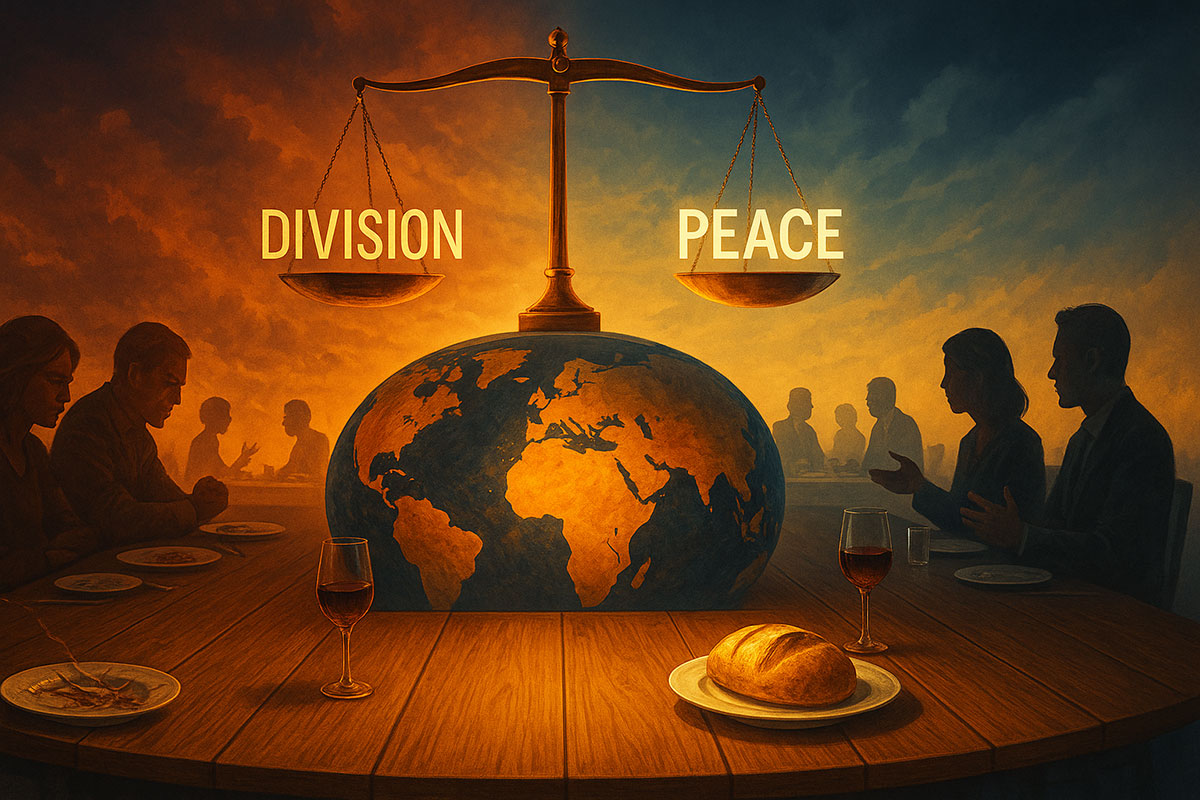
Megan Phelps-Roper:
So far we’ve looked at the pain of betrayal and the possibility of love. But there’s another layer that shapes every disagreement — the systems we live in. Whether at home, in politics, or in international affairs, incentives often push us toward division rather than peace. Tonight, I want us to explore why our structures reward conflict, and what it would take to flip those incentives toward cooperation.
Question 1: Why do so many systems today seem to reward division instead of peace?
Ian Bremmer:
Because division pays. Politicians win votes by attacking their opponents, not by finding common ground. Media outlets generate clicks and revenue from outrage, not compromise. Globally, leaders solidify power by pointing to enemies abroad rather than solving problems at home. Division is not accidental — it’s baked into the reward systems of politics and media.
Elinor Ostrom:
Yes, and it’s not just politics. Even in communities, cooperation can collapse when people don’t believe others will contribute fairly. If individuals think others will exploit the commons, they withdraw, and mistrust spreads. Division becomes self-reinforcing because the incentives for trust are too weak.
Daniel Kahneman:
Psychologically, humans are loss-averse. We react more strongly to threats than to gains. That makes fear and outrage powerful motivators, and systems exploit that bias. It’s easier to mobilize people against an enemy than to inspire them with a shared vision. That’s why division feels so persistent.
George Marshall:
In my work on climate communication, I’ve seen how this plays out. People are less motivated by the promise of a stable climate than by the fear that their way of life will be attacked. So leaders frame the issue in divisive ways. Instead of uniting around solutions, people splinter into camps. Division becomes the default frame.
Frances Haugen:
And the platforms we use every day are designed to amplify division. Social media algorithms optimize for engagement, and nothing engages like anger. Posts that spark outrage get more attention, which creates incentives for extreme content. We’ve built systems where division is the most profitable product.
Question 2: What changes could shift those incentives toward cooperation and peace?
Elinor Ostrom:
We need institutions that build trust through participation. When communities design their own rules for managing shared resources, cooperation thrives. People need to feel ownership and accountability. If rules are imposed from above without buy-in, mistrust grows. The key is local, participatory governance that rewards cooperation.
Ian Bremmer:
At the international level, treaties and alliances can realign incentives. When nations benefit more from partnership than from conflict, peace becomes rational. Trade agreements, security pacts, climate accords — these are structures that make cooperation the winning strategy. We need more of them.
Daniel Kahneman:
We also need to counter our psychological biases. If loss-aversion drives division, then framing issues as shared gains can change the equation. For example, telling people, “We all prosper when trust increases” is more effective than saying, “We’ll lose everything if we keep fighting.” Shaping narratives is part of shifting incentives.
George Marshall:
Storytelling is vital. People respond to narratives that affirm their identity while inviting them into a larger whole. If climate change is framed as a collective journey rather than a partisan battle, people feel incentive to join. The same is true for any social issue: the story must make unity desirable.
Frances Haugen:
And technology must be redesigned. Imagine if algorithms rewarded bridge-building instead of outrage. Platforms could boost posts that bring people together across divides, not just those that generate anger. It’s possible — but it requires a cultural decision to value peace over profit.
Question 3: If we succeeded in realigning incentives, how would our disagreements look different — at home and on the world stage?
Daniel Kahneman:
We would argue less from fear and more from curiosity. If systems rewarded listening and compromise, people would approach disagreement as a problem to solve rather than a threat to survive. That would lower the temperature of every debate.
Elinor Ostrom:
Communities would feel more resilient. Instead of withdrawing in suspicion, people would invest in cooperation, because they’d know the system protects fairness. Shared resources — whether natural, economic, or social — would be managed with trust, not mistrust.
Ian Bremmer:
Geopolitically, the world would be safer. Nations would still disagree — that’s inevitable. But instead of conflict, disagreements would lead to negotiation. Incentives would favor partnership, so leaders would see peace as a strength, not a liability.
George Marshall:
Culturally, we’d tell new stories. Division wouldn’t be the heroic plotline; collaboration would. People would aspire to be bridge-builders, because that’s where status and respect would come from. Our myths and media would reflect a society where cooperation is the measure of greatness.
Frances Haugen:
And online life would feel different. Imagine a digital world where respectful dialogue and creative collaboration were the most visible, most rewarded behaviors. Outrage would no longer dominate our feeds. Instead, disagreement would generate light, not just heat.
Closing Reflections
Megan Phelps-Roper:
What we’ve discovered tonight is that division doesn’t just happen — it’s incentivized. Ian, you showed us how global politics rewards conflict. Elinor, you reminded us that cooperation thrives when people share ownership. Daniel, you explained how our biases make fear more powerful than hope. George, you showed how storytelling frames incentives. And Frances, you revealed how our platforms profit from outrage. But you also showed us that incentives can change. If we chose to reward cooperation as richly as we reward division, perhaps disagreement could become a tool for building, not breaking.
Topic 4: Trust, Truth, and the Information Crisis

Megan Phelps-Roper:
One of the deepest challenges of our time is not just what we believe, but whether we trust the very idea of truth itself. With misinformation spreading online, AI blurring the line between real and fake, and institutions losing credibility, it feels as though our foundation for disagreement is crumbling. Tonight, I want to ask: in this information crisis, how do we rebuild trust in truth?
Question 1: Why has it become so difficult to agree on what is true?
Maria Ressa:
Because information has been weaponized. In the Philippines, I watched disinformation campaigns erode democracy, turning lies into weapons of control. Social media platforms reward anger and division, not facts. Once people lose trust in news, in institutions, in each other, even the truth becomes suspect. It’s not just a crisis of information — it’s a crisis of trust.
Yuval Noah Harari:
Human beings live by stories, not data. Throughout history, truth has always been filtered through narrative. What’s new is the speed and scale at which false narratives spread. AI-generated fakes make it harder to distinguish signal from noise. When people no longer know what’s real, they cling to the stories that feel safest to their identity. That’s why the crisis is existential. Without shared truth, cooperation collapses.
Julia Galef:
And our psychology compounds it. We don’t simply want the truth; we want to protect our tribe. Soldier mindset makes us defend positions at all costs. That’s why fact-checking often fails — people don’t abandon falsehoods because the facts change; they abandon them only when they feel safe enough to question. The collapse of trust isn’t about data, it’s about belonging.
Renée DiResta:
From my research, it’s clear that disinformation thrives because platforms amplify it. Coordinated networks — state actors, conspiracy groups — exploit algorithms that favor engagement. It’s not just that lies exist, it’s that they’re engineered to spread faster than truth. The architecture of our digital spaces makes deception contagious.
Timothy Snyder:
And we must not forget history. Authoritarian regimes always attack truth first. They undermine trust in facts so that people no longer know where to turn. Once trust collapses, people become cynical and pliable. They stop believing in anything, which allows tyranny to rise. Today’s information crisis is not new — it is an old strategy reborn with new tools.
Question 2: What practices or systems could help us restore trust in truth?
Yuval Noah Harari:
We need new rituals of truth. In the past, shared religions or institutions held that role. Today, we must create global norms for information verification. Perhaps an independent “Council of Truth” that evaluates claims across nations. Without shared referees, truth will remain fractured.
Maria Ressa:
I agree, and we must also demand accountability from tech platforms. If they profit from lies, they must also bear responsibility for truth. Transparency in algorithms, stronger protections against coordinated disinformation campaigns, and a commitment to human rights in digital spaces are essential.
Julia Galef:
On the personal level, we need to model epistemic humility. Institutions can’t regain trust if they act as though they’re infallible. Saying, “Here’s what we know, here’s what we don’t, and here’s what might change” is powerful. It’s not weakness; it builds credibility.
Renée DiResta:
And we must re-engineer the incentives. Right now, virality is the measure of success. But what if platforms rewarded trustworthy content over sensational lies? It requires cultural will and regulatory pressure, but we can design systems that give truth a fighting chance.
Timothy Snyder:
And education must prepare us to resist manipulation. Citizens need to know how propaganda works, how lies travel, and why truth matters. Democracies survive only when their people are trained to think critically. The defense of truth begins in the classroom, not just in the newsroom.
Question 3: If we succeed in rebuilding epistemic trust, what would change in our disagreements?
Maria Ressa:
Our debates would stop feeling like parallel universes. Right now, people argue from different “realities.” With trust restored, we’d at least start from a common set of facts. That doesn’t end disagreement, but it makes dialogue possible again.
Timothy Snyder:
And democracies would be stronger. When truth is secure, leaders can be held accountable. Without truth, accountability dies. Rebuilding epistemic trust is the first defense against authoritarianism. With it, disagreement becomes a tool of freedom, not a weapon of control.
Julia Galef:
People would argue to learn, not just to win. If trust in truth were restored, we could afford to admit when we’re wrong. Imagine if being proven wrong carried honor instead of shame. That cultural shift would make our disagreements far more productive.
Renée DiResta:
And online life would transform. Disinformation would still exist, but it would no longer dominate. If trustworthy information spread faster than lies, disagreements would be about interpretation and values — not about whether the sky is blue.
Yuval Noah Harari:
Most importantly, humanity would regain the ability to cooperate on global challenges. Climate change, AI governance, pandemics — all require shared truth. If trust is restored, disagreement can serve as a creative force that strengthens solutions instead of shattering them.
Closing Reflections
Megan Phelps-Roper:
What I hear tonight is that the crisis of truth is, at its core, a crisis of trust. Maria, you showed us how platforms weaponize information. Yuval, you reminded us that humans live by stories, and without shared ones, cooperation collapses. Julia, you insisted that humility can rebuild credibility. Renée, you revealed the mechanics of how disinformation spreads. And Timothy, you warned us that history teaches what happens when truth is lost. Perhaps the work before us is not just fact-checking, but trust-building. Only then can disagreement serve its real purpose: not to destroy, but to deepen our understanding.
Topic 5: The Future of Conflict — Toward a Culture of Productive Disagreement

Megan Phelps-Roper:
We’ve talked about betrayal, love, incentives, and the crisis of truth. But now I want us to imagine what comes next. What would it look like if humanity didn’t just survive conflict, but transformed it into something generative? Tonight, let’s explore the future of disagreement — not as a threat, but as a skill, a culture, maybe even a gift.
Question 1: What would a culture of productive disagreement actually look like?
Adam Grant:
I see a society where disagreements are opportunities to learn, not to dominate. Imagine organizations where arguing well is rewarded more than winning quickly. In a culture of productive disagreement, leaders would ask, “What evidence could change my mind?” and teams would see dissent as a form of commitment, not betrayal.
Esther Perel:
In relationships, a culture of productive disagreement would mean partners no longer fear conflict. Conflict would be understood as intimacy’s engine — the place where we reveal our needs, fears, and desires. If we embraced disagreement with curiosity, couples would stop seeing fights as threats to love and start seeing them as invitations to deeper connection.
Daniel Schmachtenberger:
On the civilizational level, productive disagreement would mean that crises are approached with cooperative intelligence. Right now, our disagreements are fragmentary — they produce chaos. In a future culture, conflict would feed into collective sense-making, where multiple perspectives generate better solutions. Disagreement would be a design principle, not a failure.
Margaret Heffernan:
In organizations and communities, it would mean fostering environments where people feel safe to speak up. I’ve studied companies that thrived because they encouraged disagreement, not silenced it. When people challenge one another openly, they prevent disasters, uncover blind spots, and build resilience. That’s what the future could look like — disagreements seen as a form of protection.
Megan Phelps-Roper:
And in civic life, it would mean citizens could disagree passionately without losing their relationships. It would mean that families wouldn’t fracture, communities wouldn’t collapse, and nations wouldn’t polarize beyond repair. Disagreement wouldn’t feel like betrayal; it would feel like participation.
Question 2: What steps can we take now to move toward that future?
Esther Perel:
We begin by reframing conflict at the personal level. In relationships, instead of asking, “Who’s right?” we can ask, “What does this reveal?” That small shift trains us to see disagreement not as an attack, but as information. If we practice this in love, we can carry it into politics and culture.
Adam Grant:
Organizations must start rewarding dissent. Instead of punishing people who challenge authority, leaders should celebrate them. A meeting where everyone agrees is a meeting where nothing was learned. If we can change the incentives in workplaces, we create a microcosm of productive disagreement for society at large.
Margaret Heffernan:
And we must design cultures of psychological safety. People need to know they won’t be punished for speaking up. That safety encourages honest disagreement, which prevents groupthink. It’s not about making everyone comfortable — it’s about making everyone brave.
Daniel Schmachtenberger:
We also need to evolve our systems of governance and media. Imagine platforms built not to amplify outrage, but to surface the highest-quality disagreements — disagreements that sharpen collective understanding. If we want the future of conflict to be productive, we must redesign our information ecosystems.
Megan Phelps-Roper:
And perhaps most importantly, we must model it in our everyday lives. Each time we choose to listen instead of react, to stay in the conversation rather than walk away, we are practicing the future. Cultural transformation begins with personal discipline.
Question 3: If humanity succeeds in building a culture of productive disagreement, what transformation might we see?
Daniel Schmachtenberger:
We would unlock collective intelligence. Right now, we waste vast energy fighting tribal battles. If disagreement became generative, that energy would fuel innovation. Global challenges — climate, AI, governance — could be approached with wisdom we don’t yet have. The transformation would be civilizational.
Esther Perel:
At the intimate level, relationships would become more resilient. Couples wouldn’t fear conflict, families wouldn’t fracture over differences. Disagreement would be woven into the dance of intimacy, not seen as a threat to it. The transformation would be deeply personal as well as global.
Adam Grant:
In workplaces, innovation would accelerate. The best ideas often start as disagreements. If we normalized arguing well, organizations would thrive on the energy of conflict rather than suppress it. The transformation would be economic as well as cultural.
Margaret Heffernan:
And our institutions would be healthier. Democracies would stop crumbling under polarization. Companies would stop failing from groupthink. Communities would stop tearing apart at the first sign of tension. If we succeed, the transformation would be resilience — systems strong enough to handle disagreement without breaking.
Megan Phelps-Roper:
And for individuals, it would mean freedom. No longer chained to the fear of being rejected, we could enter disagreements with honesty, humility, and courage. If we succeed, we would rediscover disagreement not as something to dread, but as something that keeps us alive, curious, and connected.
Closing Reflections
Megan Phelps-Roper:
What I hear tonight is that the future of conflict is not about avoiding disagreement but embracing it. Adam, you showed us that workplaces can reward dissent. Esther, you revealed that love deepens through conflict. Daniel, you reminded us that civilizational wisdom is born in disagreement. Margaret, you proved that institutions thrive when they invite challenge. And perhaps I, too, have learned that disagreement is not betrayal — it can be belonging. If we build a culture where conflict is productive, then our future will not be fractured by difference, but strengthened by it.
Final Thoughts by Maya Angelou
Throughout these conversations, we have witnessed what it means to sit at the table of difference and remain whole. We have seen that betrayal can be healed by love, that systems can be bent toward peace, that truth can rise from the rubble of lies, and that conflict can be shaped into wisdom.
We are reminded that human beings are not meant to march in lockstep, but to harmonize in difference. Like the varied instruments of a great orchestra, we can disagree without dissonance if we listen for the greater song.
Let us leave this gathering with courage — courage to speak, courage to listen, courage to hold one another’s dignity even when we cannot share one another’s views. For if we can learn to disagree with grace, then we will find not only trust, but also the future itself waiting for us.
As I have always believed: we are more alike, my friends, than we are unalike. And in that likeness, there is hope enough to build a world where disagreement is not the end of love, but its beginning.
Short Bios:
Megan Phelps-Roper
Former member of Westboro Baptist Church who became an advocate for dialogue, bridge-building, and respectful disagreement after leaving the group.
Jonathan Haidt
Social psychologist and author of The Righteous Mind, known for his research on moral psychology, polarization, and how diverse values shape conflict.
Chloé Valdary
Founder of Theory of Enchantment, a program that teaches compassion and love as tools to heal division through art, storytelling, and empathy.
Ian Bremmer
Political scientist and president of Eurasia Group, specializing in global risk, geopolitics, and how incentives shape cooperation and division.
Daryl Davis
Musician and activist who has spent decades engaging Ku Klux Klan members in dialogue, leading many to renounce hate and leave the Klan.
Desmond Tutu
Archbishop and Nobel Peace Prize laureate who played a central role in South Africa’s Truth and Reconciliation Commission, embodying forgiveness and justice.
bell hooks
Cultural critic, feminist theorist, and author of All About Love, whose work emphasized love as a transformative force in politics and relationships.
Martin Luther King Jr.
Civil rights leader and Nobel Peace Prize laureate who championed nonviolent resistance, justice, and love as the foundation for social change.
Elinor Ostrom
Political economist and Nobel laureate recognized for her groundbreaking work on collective governance and cooperation in managing shared resources.
Daniel Kahneman
Psychologist and Nobel laureate in economics, renowned for his research on decision-making, cognitive bias, and human behavior.
George Marshall
Climate communicator and co-founder of the Climate Outreach project, focusing on how narratives and incentives shape public engagement.
Frances Haugen
Data engineer and Facebook whistleblower who exposed how social media platforms amplify division through algorithmic incentives.
Maria Ressa
Journalist, Nobel Peace Prize laureate, and co-founder of Rappler, known for exposing disinformation networks and defending press freedom.
Yuval Noah Harari
Historian and author of Sapiens and 21 Lessons for the 21st Century, exploring the role of stories, myths, and truth in human societies.
Julia Galef
Writer and host of the Rationally Speaking podcast, best known for her concept of the “scout mindset” — curiosity and humility in pursuit of truth.
Renée DiResta
Disinformation researcher at the Stanford Internet Observatory, specializing in how false narratives spread across online networks.
Timothy Snyder
Historian and author of On Tyranny, focusing on totalitarianism, democracy, and the historical role of truth in resisting authoritarianism.
Adam Grant
Organizational psychologist, author of Think Again and Originals, known for exploring how workplaces can foster curiosity, dissent, and innovation.
Esther Perel
Psychotherapist and author of Mating in Captivity and The State of Affairs, exploring intimacy, relationships, and conflict as a path to growth.
Daniel Schmachtenberger
Social philosopher and systems thinker focusing on civilizational design, collective intelligence, and long-term resilience.
Margaret Heffernan
Author and entrepreneur who writes about leadership, decision-making, and the value of constructive conflict in organizations.
Leave a Reply