

Introduction by O. Henry
Ladies and gentlemen, I must confess something that troubles me still, these years after I set down my pen on that tale of the combs and chain. I called Jim and Della Young wise—as wise as the Magi who brought gifts to Bethlehem. I tied it with a neat bow and called it finished.
But stories, like lives, do not end when the writer wishes them to. They continue in back rooms and boarding houses, in the long years after the dramatic gesture fades. And I have come to wonder—though it pains me to admit—whether I told the truth, or merely a truth, or perhaps just a pretty lie we tell ourselves about love and sacrifice.
What follows is what I did not write, could not have written, in 1905. Perhaps I lacked the courage. Perhaps I lacked the years. But Jim and Della lived on without my permission, and their story grew more complicated than my tidy ending allowed.
Judge for yourself whether they were wise. I am no longer certain I can.
(Note: This is an imaginary conversation, a creative exploration of an idea, and not a real speech or event)

Chapter 1: The First Gift

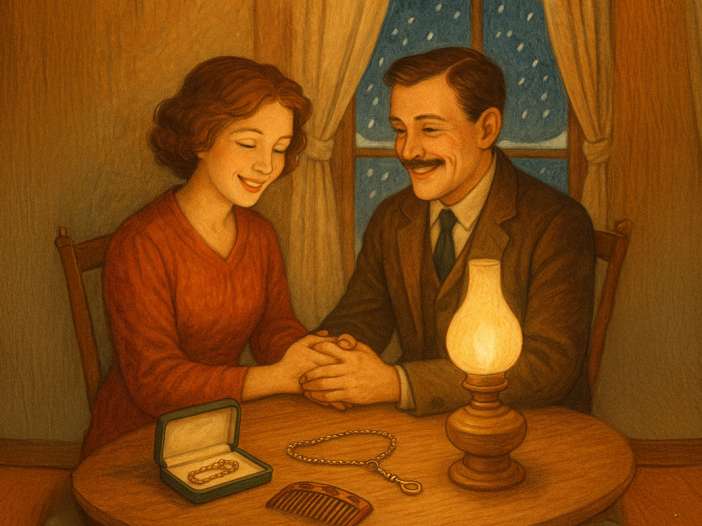
You know this part. The hair, the watch, the combs, the chain. Christmas Eve 1902, and two fools so in love they traded away their treasures to buy each other useless gifts. I wrote it once; I will not write it again.
But I will tell you what I did not write: how Della's hands shook as Madame Sofronie's scissors took the first cut. How Jim stood in the jeweler's shop for twenty minutes, the watch in his palm, before he could make himself set it on the counter. How they both wept that night, not from joy but from something more complicated—the terrible understanding that love asks everything and gives back only itself.
The room filled with laughter, yes. I wrote that. But I did not write how quickly the laughter stopped, or how they lay awake afterward, each wondering what they had done.
In my story, I called it wisdom. Perhaps it was. Or perhaps it was only youth, which believes every grand gesture will be rewarded with meaning.
Chapter 2: Spring Thaw, 1903

The watch came back in March.
Not as it had been—the case was dented, the crystal cracked, the second hand frozen at twenty past three. A pawnbroker's son brought it to their door with a note: Deceased estate. You're listed as previous owner. No charge.
Jim held it like a man holds a letter from a former lover. Della watched his face and saw not joy but something closer to violation, as though a door he'd nailed shut had swung open in the night.
"All winter I told myself it was gone for good," he said. "I made peace with it."
The combs stayed in their box. Della's hair, cropped and curling at her ears, would not hold them. She tried once, in April, pinning them desperately to hair too short to grip. They clattered to the floor, and she left them there for Jim to find when he came home.
He put them back in their box without a word.
By summer, both gifts sat in the bottom drawer of the dresser, wrapped in newspaper. They did not speak of them. The watch in Jim's pocket was a new one, cheap, purchased with overtime pay. It kept better time than his grandfather's had.
And yet.
On their anniversary in June, Della woke to find Jim sitting at the window, the broken watch in his hands, winding the frozen stem over and over. He did not know she was watching. His face in the dawn light looked like a man trying to remember something he'd lost.
"Jim?" she whispered.
He startled, shoved the watch in his pocket. "Go back to sleep, Del."
She did not.
That was the first night they slept on opposite edges of their narrow bed, a space between them where a question neither could ask took up residence: When something returns, does it mean you should never have given it away?
Chapter 3: The Neighbor's Eye, 1903-1904

Mrs. Finnegan noticed everything. She noticed how Della's hair grew back in tight curls instead of smooth waves, how it would never be the same. She noticed Jim's hand going to his vest pocket, checking for a watch that was there but broken.
And she noticed, most of all, what they didn't have.
The basket appeared at Christmas: preserves, a knitted scarf, three oranges, a note in shaky handwriting: From friends who care.
Della brought it inside and set it on the table. She did not cry. She did not smile. She simply stood there, staring at the oranges as though they were accusation made flesh.
Jim came home to find her still standing. "We should be grateful," he said, but the words came out wrong, bitter.
"Should we?"
They ate the preserves. They wore the scarf on alternate days, keeping careful mental accounts of who had worn it more. And with each use, the debt grew heavier—not to Mrs. Finnegan, but to each other.
You made us into charity cases, his silences said. You sold your watch and now we're poor enough for pity.
You cut my hair and gave me combs I can't use, hers replied. You made me into someone I don't recognize.
Neither said these things aloud. But the boarding house walls were thin, and fights don't require volume.
By February, Della had taken in piecework, ruining her eyes over buttonholes by candlelight. Jim stayed late at the office without overtime, redoing work he'd already finished perfectly, anything to delay coming home. They were saving, though neither knew for what. To repay kindness they hadn't asked for? To rebuild treasures they'd destroyed? To purchase back the people they'd been before that Christmas Eve?
One night, Della looked up from her needle to find Jim asleep in his chair, ink drying on his cuff, his mouth open in a way that made him look old. She watched him breathe and thought: We are becoming the kind of people who count the cost of oranges, and no Christmas Eve can make us young enough to stop.
She woke him gently. He looked at her with eyes that seemed to ask: Who are you? Who did you used to be?
Neither of them knew anymore.
Chapter 4: The Lie We Told Ourselves, 1905-1906

I will tell you what I did not include in my published tale: they almost left each other in the summer of 1905.
Not with screaming or thrown dishes. Not with another lover or a dramatic exit. Just Della sitting on the bed one August morning, looking at a train schedule she'd picked up at the station, tracing the route back to her sister's house in Pittsburgh.
Jim found her there. "Planning a trip?"
"Maybe."
The word hung between them like smoke. He sat beside her on the bed—not touching, a careful six inches between them—and for a long time neither spoke.
Finally: "That first Christmas," Jim said slowly, "I thought we'd made something. A story we could tell ourselves. About love being sacrifice."
"Yes."
"But we just made ourselves poor, Del. And then we spent three years resenting each other for it."
She folded the train schedule in half, in quarters, in eighths. "I look at you sometimes and I can't remember what you looked like before. Before the watch was gone. Before you looked so tired."
"I look at you," Jim said, "and I see someone trying to grow back into a person who doesn't exist anymore."
The truth sat between them, ugly and undeniable: the grand gesture had not made them wise. It had made them strangers.
"Do you want me to go?" Della whispered.
Jim was quiet for so long she thought he wouldn't answer. Then: "No. But I don't know if wanting you to stay is enough."
She unfolded the train schedule. Refolded it. Tore it in half.
"Then we'll find out," she said.
They did not embrace. They did not weep. They simply sat there on the edge of the bed, two people who had given everything for each other and discovered that everything is sometimes not enough, choosing—deliberately, without romance—to see if ordinary days could build what Christmas Eve had failed to.
It was not a happy ending. But it was a choice.
Chapter 5: The Gift of Time, 1925

I must be brief now, for I find myself uncertain of the ending.
Twenty-three years. The boarding house became a small house, then an apartment again when Jim's lungs failed. The watch broke for good and was never replaced—Jim stopped carrying one altogether. Della's hair went white and was cut short. The combs were lost in a move, or sold in a lean year. Neither could remember which, and neither minded.
Their daughter visited on Christmas Eve 1925. Sarah, age nineteen, who had grown up hearing the story of the watch and the hair as though it were scripture. Her parents as Magi, their love a lesson.
She found them in their small room, Jim in his chair by the radiator, Della perched on the arm, their hands intertwined in that unconscious way of people who have touched each other for decades.
"Tell me the story again," Sarah said, as she had every Christmas since she could talk. "About the combs and the chain."
Della and Jim looked at each other. Something passed between them—a question, an answer, an understanding.
"Your mother," Jim began, then stopped. Started again. "Your mother sold her hair for me."
"And your father sold his watch for me," Della continued.
"And we were fools."
"Complete fools."
Sarah frowned. "But you always said you were wise. Like the Magi."
"Did we?" Della's voice was soft. "Or did a writer say that, and we spent twenty-three years trying to believe him?"
Jim shifted in his chair. "The truth, Sarah, is that we gave away things we loved and got back things we couldn't use. Then we spent three years hating each other for it."
"Four years," Della corrected gently.
"Four years. And then we spent nineteen more years learning that love isn't about the dramatic gesture. It's about staying when the gesture has faded. It's about choosing, every ordinary morning, to make coffee for someone whose snoring kept you awake. It's about ten thousand tiny gifts that no one writes stories about."
Sarah looked stricken. "So the sacrifice was... pointless?"
Della considered this. Outside, the city moved on—young couples hurrying home with packages, recreating the same story she and Jim had lived, believing this time it would be different.
"Not pointless," she said finally. "But not wise, either. We were young and dramatic and we thought suffering for love would make the love mean more. It didn't. It just made us suffer."
"The wise part," Jim added, "came later. When we chose to stay even after we learned that grand gestures are just gestures. When we gave each other not hair and watches, but mornings and midnights. Grocery lists and doctor visits. Silence that wasn't angry anymore, just comfortable."
Della leaned her head against Jim's. "The Magi brought their gifts and left. We brought ours and stayed. I'm not sure which is wiser."
"I'm not sure wisdom is the word I'd use at all," Jim said.
"What word would you use?"
He thought about it. "Stubborn?"
Della laughed—that same laugh from Christmas Eve 1902, unchanged by twenty-three years. "Yes. Stubborn enough to keep choosing each other even when we didn't like each other very much."
Sarah sat with this, trying to reconcile the myth she'd been told with the truth she was hearing. "So what was the gift, then? If not the combs and chain?"
Jim and Della looked at each other again. This time, neither answered immediately.
Because the truth was this: the gift was not the hair or the watch. It was not time, though they had given each other that. It was not even love, though they had that too.
The gift was the choosing. Over and over, in full knowledge that the story wasn't as beautiful as they'd hoped, that the sacrifice hadn't made them wise, that they were just two ordinary people who had made a foolish gesture once and then spent decades living with the consequences.
The gift was staying.
"I don't know," Della said finally, honestly. "Ask me again when I'm dying."
Jim squeezed her hand. "Ask us both."
And Sarah, who had come looking for a fairy tale, left with something more complicated: the knowledge that her parents were neither magi nor fools, but simply human, and that perhaps that was wiser than either.
Final Thoughts by O. Henry
I sit here now, considering what I have written, and I find I must revise my earlier conclusion.
I called them wise once. I was wrong.
I called them the wisest of all who give gifts. I was presumptuous.
The truth—and this is the truth I could not write in 1905—is that Jim and Della Young were no wiser than any of us. They made a dramatic gesture in their youth because dramatic gestures feel like love when you're young. Then they spent decades learning what I could not teach them: that love is not one grand sacrifice but ten thousand small ones, many of them tedious, none of them suitable for stories.
Did their Christmas Eve matter? Yes and no. It bound them to each other, but also to a narrative they could not escape. It gave them a story to tell, but also a story to live up to. Perhaps they would have been happier if they'd kept their hair and watch and learned to love in quieter ways.
Or perhaps not. Perhaps the foolish gesture was necessary—not because it was wise, but because it was theirs. Because it marked the beginning of a long conversation between two people about what love means and what it costs and whether the cost is worth paying.
I don't know anymore. And that, dear reader, is perhaps the wisest thing I can tell you.
The Magi brought gold, frankincense, and myrrh to a child they would never see again. It was a beautiful gesture. But they did not stay to change diapers, to walk the floors with a colicky infant, to watch that child grow and disappoint them and surprise them and break their hearts.
Jim and Della stayed.
Whether that makes them wiser or merely more stubborn, I leave for you to decide.
Guard your treasures if you wish. Spend them foolishly if you must. But remember this: the gift that matters is not the one you give on Christmas Eve. It is the one you give again the next morning, and the morning after that, and every ordinary morning thereafter, until giving and living become the same word and you can no longer remember which is which.
That is all I know.
That, and this: I told them they were wise as the Magi, and they believed me, and perhaps that belief was itself a gift—or perhaps a curse.
We are all, in the end, at the mercy of the stories we tell about ourselves.
Choose yours carefully.
Short Bios:
O. Henry (William Sydney Porter)
An American short story writer (1862–1910) known for his wit, wordplay, and trademark twist endings. The Gift of the Magi remains his most beloved story—though whether he told the truth about Jim and Della, or merely a beautiful lie, remains open to interpretation.
Jim Young
A man who sold his grandfather's watch for love and spent twenty-three years discovering whether that made him wise or just young. He never bought another watch. He never needed to. Time passed anyway.
Della Young
A woman who cut her hair for love and let it grow back white. The combs were lost in 1909. She noticed in 1912. She mourned them in 1918. By 1925, she had forgotten what they looked like.
Sarah Young
The daughter of two people who became mythological before they learned to become human. She carries their story like a weight and a gift, uncertain which it is.
Mrs. Finnegan
A neighbor who gave what she could and never knew whether she had helped or hurt. We rarely do.
The Magi
Three wise men who brought gifts to a stranger's child and left. No one knows what became of them. Perhaps wisdom is knowing when to leave. Perhaps it's knowing when to stay. Perhaps it's both.
Leave a Reply