
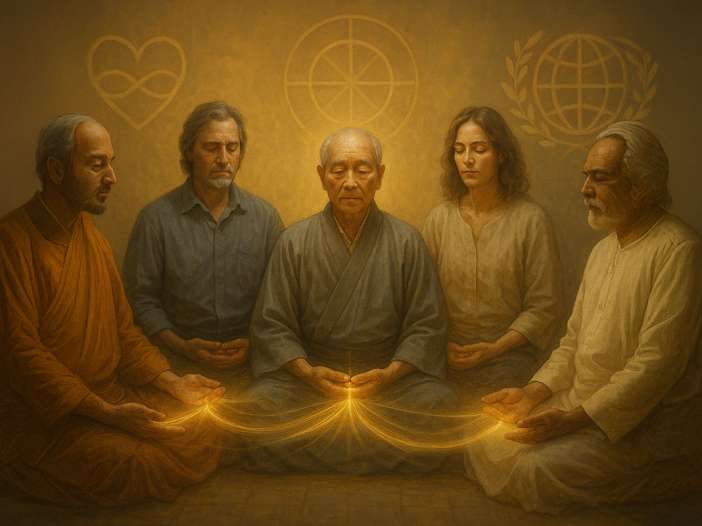

Introduction by Mikao Usui
When I first sat in meditation on Mount Kurama, I sought clarity. I did not seek to create a system, but to awaken to the truth that already lives within all beings. Reiki is not mine — it is the universal life energy, flowing through everything.
When I taught, I emphasized not only the healing of the body, but the cultivation of the heart. That is why I left you the precepts: Do not anger. Do not worry. Be grateful. Practice diligently. Be compassionate to yourself and others. These are not words to recite, but a way to live.
Now, as Reiki has traveled beyond Japan into every corner of the world, it has changed shape, spoken in many languages, and entered many cultures. Yet its essence is unchanged: the remembrance of harmony, compassion, and light. Let us begin this dialogue with gratitude, as Reiki continues to serve humanity.
(Note: This is an imaginary conversation, a creative exploration of an idea, and not a real speech or event)
Topic 1: Returning to the Roots of Reiki

Moderator:
When Reiki spread across the world, it often became associated mainly with hand-healing and stress relief. But Reiki’s founder, Mikao Usui, emphasized much more — the precepts, meditation, and spiritual transformation. To begin, I’d like to ask: What does it truly mean to return to the roots of Reiki today?
Question 1: What does it truly mean to return to Reiki’s roots today?
Frans Stiene:
Returning to the roots is like remembering that Reiki is not a “technique” but a way of being. Usui Sensei gave us the precepts: “Just for today, do not anger, do not worry, be grateful, practice diligently, be compassionate.” These are not optional — they are the practice. Reiki is about polishing the heart, so our hands naturally radiate kindness and healing. To return to the roots means making these precepts the foundation of everything we do.
Chujiro Hayashi (legacy voice):
In my time, I saw how people needed structure — hand positions, protocols — to trust the method. But if we cling only to technique, we miss the spirit. Usui Sensei was clear: Reiki was to awaken the heart and connect with the universal life force. When we return to the roots, we balance discipline with spirit. Healing others is noble, but cultivating inner peace first is essential.
Hiroshi Doi:
For me, it means practicing Reiki as it is still preserved within the Usui Reiki Ryōhō Gakkai. The precepts are recited morning and night. Meditation, breathing practices, and sensitivity training are central. It is not enough to simply “do Reiki on others.” One must live Reiki — embodying gratitude, harmony, and compassion in daily life. Returning to the roots means remembering Reiki is a spiritual path, not only a therapy.
William Lee Rand:
In the West, many people first encounter Reiki as a method of stress relief. That’s fine, but the deeper practice is about spiritual development. When I developed Holy Fire Reiki, it was to help practitioners connect directly with higher consciousness. To return to the roots, we must understand Reiki as a journey — one that leads to peace within ourselves and service to humanity.
Balakrishna Guruji:
Reiki’s roots are love. When Usui rediscovered Reiki on Mount Kurama, he tapped into the universal vibration of compassion. Returning to the roots means remembering that every session, every symbol, every precept is a doorway to divine love. Too often people chase Reiki for power or quick fixes. The root is humility: “I am not the healer, but the channel of God’s energy.”
Moderator:
Thank you. Let’s go deeper. Usui Sensei said, “Reiki is for the improvement of mind and body.” How can modern practitioners live Reiki in daily life, beyond the healing table?
Question 2: How can modern practitioners live Reiki in daily life, beyond healing sessions?
Hiroshi Doi:
It begins each morning with practice. In Japan, we sit quietly, hands in gasshō, and recite the precepts. This is not ritual — it is a resetting of the mind. When anger or worry arises, we remember: just for today. In this way, daily life itself becomes Reiki practice. Even how we greet our neighbors, how we eat, how we breathe — all can be infused with Reiki.
Frans Stiene:
I often tell my students, “Don’t leave Reiki on the treatment table.” If you chant the precepts, practice meditations, and cultivate a compassionate mind, then when you walk into a grocery store, you radiate Reiki. Living Reiki is when your presence itself soothes others. It is when your smile, your silence, your listening become healing acts. Reiki becomes not something you “do” but something you “are.”
William Lee Rand:
In my experience, when people allow Reiki to guide their decisions, they begin to live with more integrity, compassion, and trust. Holy Fire, for example, continues to work within you even when you are not consciously “doing Reiki.” Daily life becomes infused with that energy. It influences how we respond to conflict, how we create, and how we serve. Living Reiki means letting that higher guidance flow in everything we do.
Chujiro Hayashi (legacy voice):
When I taught, I reminded students that healing the sick was only part of Reiki. The greater work is cultivating self-mastery. Daily life offers constant practice. When difficulties arise, do not avoid them — place your hands together, breathe, recall the precepts, and let Reiki guide your response. This is how practitioners bring harmony into families, workplaces, and society.
Balakrishna Guruji:
In India, we say seva — selfless service — is the highest practice. Living Reiki is not only meditation or healing, but helping someone cross the street, comforting a child, forgiving when it is hard to forgive. When you radiate Reiki in daily actions, you don’t need to tell people you are a healer. They will feel your presence and know.
Moderator:
Beautifully said. Finally, I want to ask: If Mikao Usui were sitting here today, what do you think he would tell us about the true essence of Reiki?
Question 3: If Usui Sensei were here today, what would he remind us about Reiki’s essence?
Balakrishna Guruji:
He would say: “Do not complicate what is simple.” Reiki is love, kindness, compassion. He would remind us to live with gratitude and humility, and to remember that healing begins within.
Frans Stiene:
I imagine he would laugh gently and say, “Stop making Reiki so mechanical.” He would point us back to the precepts. He would say that Reiki is not about collecting levels or symbols, but about embodying peace, courage, and compassion.
William Lee Rand:
I think he would be delighted to see Reiki spreading worldwide, but he would caution us not to forget the inner work. He would remind us that Reiki is both personal and universal — it is about awakening to our divine nature and using that to help humanity evolve.
Chujiro Hayashi (legacy voice):
I believe he would tell us, “Return to practice.” Sit. Breathe. Recite the precepts. Heal yourself. From there, everything else flows. The essence is not in outward display but in inner transformation.
Hiroshi Doi:
He would remind us that Reiki is the way of harmony. The kanji for Reiki, 霊気, points to the mysterious spiritual energy that pervades all. He would urge us to experience Reiki directly — through practice, through silence, through living with gratitude — not merely through words or intellectual understanding.
Moderator (closing):
Thank you, Masters. What shines through is that returning to the roots of Reiki is not about nostalgia, but about practice — living the precepts, embodying compassion, and remembering Reiki as a way of life. It is less about technique and more about transformation.
Topic 2: Reiki in the Modern Healing Landscape

Moderator:
Today Reiki is not only practiced in quiet homes and dojos, but also in hospitals, therapy centers, and even online. This expansion raises both opportunities and challenges. Let me begin: How can Reiki integrate meaningfully with modern medicine and wellness systems?
Question 1: How can Reiki integrate with modern healthcare and wellness systems?
William Lee Rand:
Reiki has already made strides into mainstream healthcare — from hospices in the U.S. to cancer centers where Reiki sessions are offered to patients. I’ve seen how Reiki reduces stress, improves recovery, and brings comfort even when cure isn’t possible. The key is research. Hospitals want data, and fortunately, studies now support Reiki’s benefits. Integration requires us to speak both languages: the scientific and the spiritual.
Hiroshi Doi:
In Japan, Reiki has long been practiced as a path of personal cultivation, not primarily as a medical therapy. Yet I see value in working with healthcare. We must be careful not to reduce Reiki to “symptom relief” only. If practitioners enter hospitals, they should bring not only technique but the deeper spirit of Reiki: compassion, harmony, presence. Otherwise, we risk losing its essence.
Balakrishna Guruji:
When Reiki enters hospitals in India, people sometimes view it with suspicion, as if it were “mystical.” But once they experience relief, the suspicion dissolves. Integration is not just about convincing doctors — it’s about touching patients. Doctors heal the body, Reiki soothes the soul. Together, they form a complete care system.
Jason Klein:
I often work with people dealing with trauma and emotional burnout. Reiki integrates beautifully with psychotherapy. It helps regulate the nervous system, opening space for deeper healing. For healthcare integration, practitioners need to respect boundaries, use language that professionals trust, and show consistency in results. It’s not about replacing medicine but amplifying it.
Tristan LeMarr:
As someone who speaks to younger audiences, I see integration happening digitally. Many people use apps for meditation, breathwork, therapy — Reiki is part of that ecosystem. In hospitals, yes, but also in the palm of your hand. The future of integration is hybrid: Reiki sessions online, self-practice tools in apps, and Reiki-informed wellness coaches working side by side with doctors and therapists.
Moderator:
Thank you. Now, let’s explore a challenge. Reiki has become global, and sometimes commercialized. How can we maintain authenticity while also making Reiki accessible to modern seekers?
Question 2: How do we balance authenticity with accessibility in modern Reiki?
Jason Klein:
Authenticity is about alignment. If you embody Reiki in your daily life — the precepts, compassion, humility — then whether you teach in a yoga studio or a corporate seminar, you’re authentic. Accessibility doesn’t mean dilution. It means meeting people where they are while staying true to Reiki’s heart.
William Lee Rand:
I agree. Reiki must evolve with the world. Holy Fire Reiki, for example, arose as a way to meet the modern seeker’s need for direct connection to higher consciousness. Some worry this dilutes tradition, but I see it as expansion. The balance lies in honoring Usui’s original principles while allowing Reiki to reveal new dimensions.
Hiroshi Doi:
Authenticity is rooted in practice. Too often, people rush through levels, collect certificates, and then teach without embodying the precepts. To maintain authenticity, we must emphasize personal cultivation — meditation, humility, discipline. Accessibility is good, but not at the cost of depth. Students must understand that Reiki is not only a tool, but a lifelong path.
Balakrishna Guruji:
In India, spiritual practices have always faced this tension. Yoga, for example, became global but lost some of its spiritual essence. Reiki must avoid this trap. We must remind practitioners: Reiki is not a commodity, but a divine gift. Share it freely, yes, but with reverence. When you live it authentically, accessibility naturally follows.
Tristan LeMarr:
For the younger generation, accessibility is everything. If Reiki feels closed, elitist, or hidden, it won’t survive. We need to speak in today’s language — podcasts, TikTok, workshops. Authenticity doesn’t mean rigid tradition; it means integrity. Be real, be compassionate, be transparent. That’s how Reiki stays both authentic and accessible.
Moderator:
Excellent. One final question. Looking ahead, what role do you see Reiki playing in the future of global health and human well-being?
Question 3: What role will Reiki play in the future of global health?
Tristan LeMarr:
I see Reiki as part of everyday mental health care. Just like meditation became mainstream, Reiki will be a common tool for stress management, emotional regulation, and self-healing. It won’t be exotic; it will be ordinary — a practice you can learn at school or use at work. That’s the future.
Balakrishna Guruji:
The future of health must include spirit. Modern medicine treats the body; Reiki awakens the soul. As crises of anxiety, depression, and emptiness rise, Reiki will serve as a bridge — restoring people’s connection to love, gratitude, and inner peace. Its role is to remind humanity of wholeness.
William Lee Rand:
I see Reiki helping humanity evolve spiritually. It will support not only individual health but also global healing. We already hold world peace meditations where thousands of Reiki practitioners connect simultaneously. The future role of Reiki is collective: aligning humanity with compassion and unity, so we can heal not just individuals, but the planet itself.
Hiroshi Doi:
Reiki will continue to be a path of personal and social harmony. Its role will not be limited to hospitals or clinics, but in families, schools, workplaces. When people live the precepts, conflict decreases and gratitude increases. Reiki’s role in the future is to create communities that live in harmony.
Jason Klein:
From my perspective, Reiki will become increasingly accepted as a complementary therapy for trauma, stress, and chronic illness. Science will validate what practitioners already know: that energy and consciousness influence healing. Its role will be to restore balance where medicine alone cannot reach.
Moderator (closing):
Thank you all. What emerges is a vision where Reiki works hand in hand with modern healthcare, yet never loses its roots in compassion and authenticity. It becomes not only a treatment, but a way of living — a force for healing individuals, communities, and perhaps even the world itself.
Topic 3: The Globalization and Adaptation of Reiki

Moderator:
Reiki began on Mount Kurama in Japan, but today it’s practiced everywhere — from yoga studios in California to healing centers in India, and even online communities. That raises a key question: What are the blessings and challenges of Reiki’s globalization?
Question 1: What are the blessings and challenges of Reiki’s globalization?
William Lee Rand:
The blessing is obvious: millions of people who might never have set foot in Japan now experience Reiki’s healing power. From America to Africa, Reiki has become a global household word. But the challenge is that in spreading so widely, it sometimes becomes diluted — taught quickly, without grounding in practice. The task is to celebrate accessibility while protecting the depth of the tradition.
Frans Stiene:
I see both light and shadow. Reiki’s globalization means people everywhere can experience its healing touch, yes. But too often, it has been reduced to technique alone — “put your hands here, feel the energy.” Usui’s original path was deeply spiritual, rooted in meditation and self-cultivation. The challenge is to remind people that Reiki is not just global, but also timeless. Its essence must not be lost in translation.
Tristan LeMarr:
As someone who works online, I’d say the globalization of Reiki is happening through digital platforms more than anything. That’s a blessing — you can learn from masters without leaving your home. But the challenge is misinformation. TikTok and Instagram spread simplified versions: “Five minutes of Reiki to fix your life.” We need to guide people to authentic sources, so they get more than sound bites.
Balakrishna Guruji:
When Reiki came to India, people embraced it quickly. The blessing was that it fit naturally into our culture, which already respects prana and energy healing. But the challenge was commercialization. Many see Reiki as a way to make money fast. That is dangerous. Reiki should be shared as service, not business first. Globalization must keep humility at its center.
Hiroshi Doi:
For me, the greatest blessing is that Reiki’s spirit now touches people everywhere. But I must echo caution. When Reiki left Japan, much of its meditative depth was left behind. Western systems emphasized symbols and attunements, but not daily practice of the precepts. Globalization is a gift, but the challenge is to restore balance — bringing back the roots, even as Reiki adapts.
Moderator:
Thank you. Now, let’s consider the second question: How can Reiki adapt to different cultures while still preserving its essence?
Question 2: How can Reiki adapt to diverse cultures without losing its essence?
Balakrishna Guruji:
Reiki is universal energy — it belongs to no religion, no nation. In India, we did not need to “adapt” it, because it resonates with our tradition of prana, chakras, and meditation. What matters is intention. If teachers emphasize love and service, Reiki adapts naturally. The danger is when people add unnecessary rituals from outside and confuse the essence.
Frans Stiene:
Adaptation must always begin with the precepts. Anger, worry, gratitude, diligence, compassion — these are universal. They do not need translation. If practitioners in France or Brazil live these precepts, they are practicing Reiki’s heart. Cultural flavor is fine — chanting in different languages, for instance — but the essence is beyond culture. It is human.
William Lee Rand:
Reiki adapts best when it meets people’s needs. In the U.S., many wanted a system that fit into healthcare, so we developed approaches that hospitals could accept. In other places, people seek spiritual awakening, and Reiki adapts there too. The key is integrity: teachers must stay rooted in the energy, not in personal ambition. Then Reiki will adapt without distortion.
Tristan LeMarr:
Young people adapt Reiki by blending it into everyday life. They use it alongside yoga, journaling, even fitness. That’s good! But I always remind them: Reiki isn’t just a tool on your wellness shelf. It’s a practice of presence. The way to preserve its essence is to encourage consistency. Daily practice, even five minutes, keeps it alive no matter the culture.
Hiroshi Doi:
Preserving essence requires us to pass on what Usui taught: meditation, sensitivity training, gasshō, the precepts. Adaptation is fine if these are not forgotten. Otherwise, Reiki risks becoming something else entirely. Cultural expression is natural, but the roots must be clear. Without the precepts, Reiki is not Reiki.
Moderator:
Now a final question. Looking forward, what do you envision for the future of Reiki as a global practice?
Question 3: What is the future of Reiki as a global practice?
Frans Stiene:
I envision Reiki returning to its spiritual depth. As the world faces stress, conflict, and disconnection, people will hunger for more than surface techniques. They will seek practices that help them live with compassion. Reiki’s future lies in guiding people inward — back to their own heart.
Tristan LeMarr:
The future is digital and communal. I imagine global Reiki circles happening online every day — thousands of people meditating together, sending healing energy across borders. Reiki will become part of the collective consciousness, not just individual practice. That’s powerful.
William Lee Rand:
I see Reiki contributing to global peace. We already hold world meditations where practitioners send Reiki to humanity and the planet. In the future, I believe Reiki will support humanity’s spiritual evolution. It will be as common as prayer or meditation — not fringe, but central to our global culture.
Balakrishna Guruji:
I see Reiki helping to heal division. In families, communities, even nations, Reiki will remind us of our shared humanity. The future is service. Reiki practitioners will step forward as peacemakers, as healers of the heart. That is why Reiki came to the world.
Hiroshi Doi:
For me, the future is simple. Reiki will survive if practitioners practice. If they embody the precepts, if they meditate, if they cultivate harmony, then Reiki will live for generations. If not, it may become diluted and fade. The responsibility is ours — to preserve, to share, to live it fully.
Moderator (closing):
What emerges here is a vision of Reiki that is both global and rooted. It can adapt across cultures, speak through technology, and serve the modern world — but only if practitioners remember its essence. The challenge is balance: spreading wide without losing depth, adapting without diluting. Reiki’s future, it seems, is as much about our choices as it is about the energy itself.
Topic 4: The Role of Energy and Consciousness in Healing

Moderator:
Reiki is often described as “universal life energy,” but how do we really understand the role of energy and consciousness in the healing process? Let’s begin: What is Reiki’s energy, and how does it actually bring about healing?
Question 1: What is Reiki’s energy, and how does it bring about healing?
Jason Klein:
When I work with clients, I see Reiki energy as a harmonizer. Trauma leaves imprints — frozen patterns in the nervous system and the subconscious. Reiki doesn’t “fix” them like a mechanic. Instead, it creates safety, balance, and coherence, so the body and mind can naturally release tension. Healing comes not from forcing but from restoring harmony.
Balakrishna Guruji:
In my understanding, Reiki is the vibration of divine compassion. When a practitioner channels Reiki, it is not their personal energy but the universal prana flowing through them. Healing happens because this frequency dissolves blocks of fear, anger, or illness, returning us to alignment with love. The body remembers wholeness when it touches this vibration.
Frans Stiene:
I like to remind students: Reiki is not outside us. It is our innate essence — pure, luminous awareness. When we practice, we peel away layers of worry, anger, ego. Then the natural light of our consciousness shines forth. Healing is not “adding energy” but revealing what has always been whole within us.
William Lee Rand:
From my perspective, Reiki is spiritually guided life force energy. It works intelligently. We don’t have to direct it; it knows where to go. Healing occurs because Reiki lifts our vibration, connecting us with higher consciousness. When that connection is strong, the body, mind, and spirit reorganize toward health. That’s why it helps not only physical illness but emotional and spiritual struggles.
Tristan LeMarr:
For me, Reiki feels like tuning an instrument. When people are stressed, their “string” is out of tune — tight, discordant. Reiki is the resonance that brings them back into pitch. Healing happens because energy responds to energy. It’s not magic; it’s resonance. When you resonate with calm, compassion, and balance, your body and mind align with that frequency.
Moderator:
Thank you. Now let’s go deeper. If consciousness is central to Reiki, how can practitioners train their awareness to strengthen healing?
Question 2: How can practitioners cultivate consciousness to enhance healing?
Frans Stiene:
This is essential. If the practitioner is distracted, angry, or worried, the flow is clouded. That’s why Usui taught meditations and precepts — they train the mind. Daily gasshō meditation, chanting, breathing practices — these purify consciousness. When the practitioner’s awareness is clear, Reiki shines through effortlessly.
Tristan LeMarr:
I tell younger practitioners: don’t just “do Reiki” like a task. Practice mindfulness in everyday life. Notice your breath while scrolling on your phone. Practice gratitude while cooking. This everyday awareness builds presence, and presence is what strengthens Reiki. Consciousness training doesn’t have to be heavy — it can be woven into your lifestyle.
William Lee Rand:
Consciousness is strengthened through surrender. In Holy Fire Reiki, we practice letting go — allowing the energy to guide rather than controlling it. When you surrender ego and trust in higher guidance, Reiki flows more powerfully. Meditation helps, yes, but openness is the key. The more you release personal will, the more universal will moves through you.
Jason Klein:
In trauma work, I emphasize grounding. Practitioners need to be fully present in their bodies before they can hold space for others. Consciousness training includes self-regulation: breathing, centering, and noticing our own triggers. If we’re not aware of ourselves, we can’t offer true healing presence. Consciousness is contagious — calm awareness in the practitioner awakens calm awareness in the client.
Balakrishna Guruji:
In our tradition, we practice mantra and seva. Mantra clears the mind; seva (service) clears the ego. Both raise consciousness. A Reiki practitioner who chants or serves with humility becomes a clear channel. It is not technique alone — it is purity of heart that makes Reiki strong.
Moderator:
Powerful. Finally, I’d like to ask: What does this union of energy and consciousness mean for the future of healing in our world?
Question 3: What is the future of healing through energy and consciousness?
Balakrishna Guruji:
The future of healing is the marriage of science and spirit. Medicine will continue to treat the body, but consciousness will be recognized as the missing piece. Reiki will be part of this awakening, reminding humanity that love and energy are as important as medicine and surgery.
Jason Klein:
I believe trauma healing will evolve to include energy and consciousness practices. Psychology alone cannot always reach the deepest wounds. Reiki offers a way to access the body’s wisdom without retraumatization. The future will be integrative: therapists, doctors, and energy practitioners working together.
Frans Stiene:
The future is not about Reiki becoming something “new,” but about people returning to themselves. As the world grows more chaotic, practices that restore inner stillness will become essential. Reiki’s future lies in helping people realize their original nature — luminous, compassionate, free. Healing will not be only about symptoms, but about awakening.
William Lee Rand:
I see Reiki supporting humanity’s spiritual evolution. As people connect to higher consciousness, they will create more harmonious societies. Healing is not only individual but collective. Reiki can help reduce conflict, inspire compassion, and even influence global events through collective practice. The future of healing is planetary.
Tristan LeMarr:
For the next generation, energy and consciousness won’t feel “alternative.” They’ll be normal. Kids will learn mindfulness and Reiki in schools. Apps and technology will guide daily practice. The stigma will fade. The future is where healing through consciousness is simply part of life, as ordinary as brushing your teeth.
Moderator (closing):
What a vision. From divine compassion to resonance, from surrender to self-awareness, you’ve shown that Reiki is more than energy work — it is consciousness training for the heart. The future of healing, it seems, is not just treating illness but awakening humanity to its own luminous nature.
Topic 5: Reiki as a Path of Service and Compassion

Moderator:
At the heart of Reiki are Usui’s precepts, which point us toward compassion, gratitude, and humility. Today I want to ask: How does Reiki guide us to live a life of service and compassion?
Question 1: How does Reiki guide us to live a life of service and compassion?
Balakrishna Guruji:
Reiki is divine love flowing through human hands. When we practice, we discover that we are not the healer — God is the healer. That realization dissolves pride and opens the heart. Compassion is not something we try to do; it flows naturally. Reiki teaches us to serve without expectation, like a river that gives water to all, without asking who is thirsty.
Frans Stiene:
For me, compassion is the natural result of practice. When we sit with the precepts, when we breathe with awareness, the self-centered mind softens. We begin to feel the suffering of others as our own. Service then becomes effortless. Reiki guides us to live as compassionate beings, not because it is a rule, but because it is our true nature revealed.
William Lee Rand:
Reiki calls us to share beyond ourselves. It’s not only personal healing but a mission to uplift humanity. That’s why I emphasize world peace meditations — thousands of practitioners sending Reiki for harmony. Compassion becomes collective. Reiki teaches us that service to humanity is service to Spirit itself.
Jason Klein:
I’ve seen Reiki awaken compassion even in those who come for personal reasons, like stress relief. After a few sessions, they start asking, “How can I help others with this?” Reiki opens the heart. It dissolves isolation and shows us that we are connected. That connection becomes the foundation of service.
Hiroshi Doi:
In Japan, we emphasize that Reiki is not merely a technique. It is a way of life. Service is embedded in the daily practice of gasshō and the precepts. Compassion is not a side effect but the very purpose. When practitioners embody Reiki sincerely, their lives naturally become expressions of service.
Moderator:
Thank you. Let’s take this further. What does it look like to embody Reiki compassion not only in healing sessions, but in ordinary daily life?
Question 2: How can Reiki practitioners embody compassion in everyday life?
Jason Klein:
Compassion in daily life means listening deeply — to friends, family, even strangers. Reiki teaches presence. When you are truly present, people feel seen, and that itself is healing. Everyday compassion can be as simple as putting down your phone and giving someone your full attention.
Frans Stiene:
Yes, compassion is not only in the hands, but in the eyes, the voice, the silence. If you practice Reiki meditations, you begin to embody calm. Then your presence becomes medicine. When you drive, when you cook, when you smile — you radiate Reiki. Ordinary life becomes extraordinary through compassionate presence.
Hiroshi Doi:
In Japan, we say: Reiki is practice, not philosophy. Compassion is expressed not only by thinking kind thoughts, but by living them. Bowing to others with respect, speaking with sincerity, caring for small details — this is Reiki in daily life. True compassion is lived quietly, not displayed.
Balakrishna Guruji:
In India, seva — service — is the highest practice. For a Reiki practitioner, that means using Reiki not just for paying clients, but for anyone in need: the sick neighbor, the crying child, even the stranger on the street. Ordinary life becomes sacred when you ask, “How can I serve?” Compassion is not occasional; it is constant.
William Lee Rand:
I agree. Compassion in everyday life also means being guided by Reiki energy in decisions. How we spend money, how we treat the planet, how we respond in conflict — all these are opportunities for compassion. Reiki is not something we do for one hour; it is a way to live every hour.
Moderator:
Beautiful. One final question: What legacy of service and compassion should Reiki practitioners aim to leave for the future?
Question 3: What legacy of service and compassion should Reiki practitioners leave?
William Lee Rand:
The legacy I envision is a world where Reiki is part of everyday life, where generations practice it naturally, and where compassion is woven into our culture. If practitioners dedicate themselves not only to healing individuals but to collective peace, that will be their greatest gift to the future.
Hiroshi Doi:
The legacy must be sincerity. Too often, practices become commercialized and lose purity. If we practice sincerely — living the precepts, meditating, embodying compassion — then future generations will inherit a path of truth. That is the greatest legacy: to transmit Reiki uncorrupted, as a path of harmony.
Balakrishna Guruji:
I would say the legacy is love in action. Not words, not certificates, but actions of kindness that ripple outward. If Reiki practitioners live so that people remember them for their compassion, then Reiki’s light will never fade. The legacy is not in books but in lives touched.
Frans Stiene:
For me, the legacy is awakening. Reiki is not about creating followers or empires, but about helping people realize their own luminous nature. If each practitioner leaves behind even a few people who discovered inner peace through Reiki, then the world slowly transforms. The legacy is one of inner freedom.
Jason Klein:
I believe the legacy is community. Reiki breaks the illusion of separation. If practitioners can build communities of care — where people support, listen, and heal together — then future generations will know Reiki not as a technique, but as a way of being together in compassion. That is what I hope we leave behind.
Moderator (closing):
What a profound conclusion to our series. Reiki, at its heart, is not simply energy healing, but a way of living — a way of embodying compassion in each breath, each act of kindness, each choice we make. The legacy you describe is not one of techniques or certificates, but of lived compassion, service, and awakened humanity.
Final Thoughts by Mikao Usui
You have heard the voices of those who carry Reiki forward in this age — in hospitals and homes, in meditation halls and digital spaces, across cultures and continents. This makes me grateful. But remember: the true essence of Reiki is not found in technique or theory, but in your daily heart.
If you live the precepts, Reiki is alive in you. If you embody compassion, you are Reiki. Let us not forget: healing is not only for the body, but for the mind, and for the spirit. Reiki is not something you own or control; it is something you remember and allow.
My wish is that Reiki practitioners everywhere live sincerely, serve selflessly, and shine compassion without end. Then, Reiki will continue to be what it was always meant to be — not the possession of one man, but the shared light of humanity.
Short Bios:
Leave a Reply