

Introduction by László Krasznahorkai
When I write, I do not think of style or structure. I think of life as it really is: unbroken, relentless, without pause. The sentence stretches because history stretches; the sentence refuses to stop because life refuses to stop. Satantango was not conceived as a story to entertain but as a mirror to existence, a mirror that shows us mud, betrayal, waiting, collapse — the truth of what it means to live without rescue.
What I discovered in writing, and what the reader discovers in enduring, is that despair is not an event but a condition. The rain falls endlessly, the village waits endlessly, the dance repeats endlessly. It is not about Hungary alone, though Hungary gave me its mud and its silence. It is about the world, about how all of us circle inside the same apocalyptic tango.
If you feel trapped in the sentences, if you feel time thickening, then you have arrived at what I wanted to show: that there is no escape from the condition of existence. Tonight, in these conversations, you will not be offered consolation. You will be offered endurance. That is the only gift I have to give.
(Note: This is an imaginary conversation, a creative exploration of an idea, and not a real speech or event.)
Topic 1: The Endless Sentence and the Nature of Time
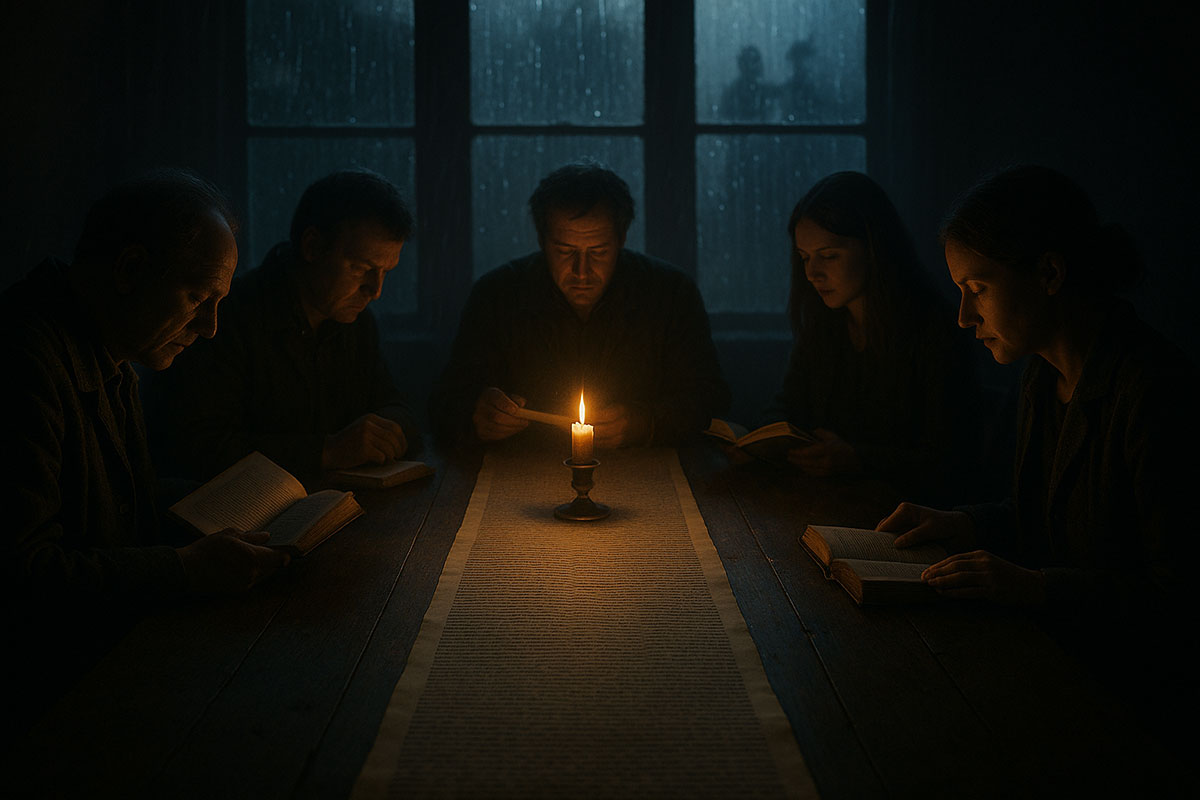
Moderator: James Wood (The New Yorker critic, master of close reading and prose style)
Participants:
László Krasznahorkai (author, voice of the endless sentence)
George Szirtes (translator of Satantango)
Ottilie Mulzet (translator of Seiobo There Below, War & War)
Maggie Nelson (writer on form, temporality, and meaning)
W.G. Sebald (in spirit, writer of wandering, memory-soaked prose)
Colm Tóibín (novelist/critic, observer of Hungarian literature)
Introduction — James Wood
When we encounter László Krasznahorkai’s novels, what first overwhelms us is not the story but the sentence: long, unbroken rivers of language that refuse to yield to pause. These sentences alter our very experience of time; they trap us, exhaust us, yet perhaps also elevate us. Tonight we gather to ask three questions: How do these unbroken sentences shape our perception of doom? Do they mirror the chaos of history, or reach toward something beyond it? And finally, what does the translator’s struggle with these sentences tell us about meaning itself?
Question 1 — How do Krasznahorkai’s unbroken sentences shape the reader’s perception of time and doom?
George Szirtes
As I worked through Satantango, I often felt the sentences acted like weather. They surrounded you, soaked you, pressed you down. Their length stretches perception, makes doom feel inescapable — not a single event, but an atmosphere in which one must breathe.
Maggie Nelson
Yes, the sentence becomes an ethic of attention. It forces us to stay present, to endure what we might rather escape. There is no fast-forward, no distraction. The very form makes doom experiential: it is lived inside the breath of the reader.
Colm Tóibín
For me, these sentences recall a lament. They echo keening in Irish tradition, where grief is voiced without end. The language circles, prolongs, resists closure. Doom is not a climax, but a rhythm that continues without release.
Ottilie Mulzet
As a translator, the density of these sentences makes time viscous. You don’t advance easily; you wade through. This thickness forces the reader into the same mud the characters inhabit. That immersion produces a perception of doom as something unending.
W.G. Sebald (in spirit)
Memory comes not in fragments but in floods, and so does catastrophe. Krasznahorkai’s sentences capture that truth. They show us that time, once broken, cannot be tidily arranged again — it overwhelms us in a torrent.
László Krasznahorkai
I write the sentence as the world writes itself: without mercy, without end. If the reader feels trapped, it is because life is itself an unbroken sentence. Doom is simply the recognition that there is no full stop.
Question 2 — Do these sentences reflect the chaos of history, or are they a spiritual attempt to transcend it?
Ottilie Mulzet
I think they hover between. At times, they are rubble — syntax piled like ruins. At other times, they rise like chant, almost prayer. It is their oscillation between collapse and lift that makes them so alive.
W.G. Sebald (in spirit)
History is fragmentation. Krasznahorkai resists this by weaving continuity, even if it is relentless. In this gesture, I see an attempt not only to represent chaos but to wrest something beyond it — a shadow of transcendence.
Maggie Nelson
I lean toward transcendence. The refusal to stop, the sheer insistence of the sentence, feels like a wager: that if we persist long enough in the dark, we may glimpse light.
George Szirtes
I would argue both. The form reflects Hungary’s endless cycles of betrayal and ruin, yes — but also has the shape of liturgy. These sentences collapse into chaos but also lift toward prayer.
Colm Tóibín
Yes, the sentences sound like liturgy. They mourn, but in mourning they become reverent. It is despair shaped like a psalm, revealing the possibility of sanctity even inside collapse.
László Krasznahorkai
The sentence is not chaos, nor is it transcendence. It is simply refusal: refusal of silence, refusal of conclusion. In that struggle, perhaps, some readers glimpse both history and eternity.
Question 3 — What does the translator’s struggle with these sentences reveal about meaning itself?
Maggie Nelson
That meaning is unstable, always provisional. The difficulty of translation mirrors the difficulty of reading: we pursue coherence, but the struggle itself becomes the meaning.
George Szirtes
For me, translating meant carrying rhythm, not just words. Breath was more important than syntax. Meaning is not a fixed object; it’s what happens when you are carried inside the flow.
Ottilie Mulzet
It’s like holding water in your hands. You know it will escape, but you try anyway. That futility is instructive: it shows us that meaning isn’t containment, it’s accompaniment.
W.G. Sebald (in spirit)
Translation is mourning. Something is always lost, but still we continue. That persistence, despite loss, is itself the meaning.
Colm Tóibín
Yes, translation mirrors our condition: we all try to interpret chaos into sense, even knowing we will fail. Krasznahorkai forces us to see this futility clearly.
László Krasznahorkai
Meaning is not given, it must be borne. If my translators struggle, it is because the world itself resists translation. The sentence shows that resistance, and they live it on behalf of the reader.
Closing Reflection — James Wood
What has emerged is that Krasznahorkai’s sentences are not only technical feats but entire worlds. They slow us, trap us, make time itself heavy. They mirror chaos but also rise like prayer, pointing toward something beyond despair. And in the translator’s struggle we glimpse our own condition: to carry meaning imperfectly, breath by breath. To read him is to endure — and in that endurance, to understand.
Topic 2: The Structure of the Tango — A Dance with Doom

Moderator: Béla Tarr (director of Satantango)
Participants:
Ágnes Hranitzky (editor and longtime collaborator with Tarr)
Susan Sontag (in spirit, film critic who hailed Satantango as one of the greatest works of cinema)
Jacques Rancière (philosopher of cinema and time)
Péter Nádas (Hungarian novelist, contemporary of Krasznahorkai)
Roberto Bolaño (in spirit, novelist obsessed with repetition, manuscripts, and collapse)
Introduction — Béla Tarr
When I read Satantango, I saw not only a story, but a rhythm. It was already a tango: steps forward, steps back, repetition without release. That is why the film became seven hours long — because time itself was the subject. Tonight we ask: what does it mean that a novel is built like a dance? Why the tango, and why with doom as its partner?
Question 1 — Why do you think Krasznahorkai chose the tango as the structural metaphor for this novel?
Susan Sontag (in spirit)
The tango is erotic and fatal at once: intimate yet destructive. By choosing it, Krasznahorkai transforms a village’s despair into choreography. The repetition of steps embodies futility; the closeness between dancers suggests complicity in ruin.
Péter Nádas
For Hungarians, the tango is foreign, imported — yet here it becomes our fate. It reveals how collapse is not only ours but universal. The steps of the tango are the steps of waiting, of betrayal, of resignation.
Roberto Bolaño (in spirit)
Yes, the tango is endless. It circles, it repeats, it burns passion into ash. Krasznahorkai saw that human life, especially under corruption, becomes this: a dance with Satan, where every step forward is already a step back.
Ágnes Hranitzky
In editing the film, I felt the tango in the rhythm of shots. Long takes loop back, scenes repeat from different angles. The structure itself becomes dance — inexorable, exhausting, but also strangely hypnotic.
Jacques Rancière
The tango reveals collapse as form. It is not a random metaphor: it is the recognition that history itself moves in spirals, never advancing, always circling. To call it “Satan’s tango” is to say that repetition is damnation.
Question 2 — How does this structure of repetition and mirroring deepen the sense of doom in the novel and the film?
Péter Nádas
Because repetition erases hope. When events recur — the rain, the betrayal, the waiting — the reader sees there will be no breakthrough. Doom is not a surprise ending; it is the condition established by endless return.
Susan Sontag (in spirit)
Cinema is especially suited to this, and Béla, your film proves it. Long takes, the circling camera, the refusal of montage — these make us feel the doom in our bodies. Repetition becomes time itself.
Ágnes Hranitzky
Editing repetition was not easy. You risk losing the viewer entirely. But we trusted that by holding, by refusing release, the audience would surrender. The doom is not only in the story, but in the form of watching.
Roberto Bolaño (in spirit)
Repetition is the truest apocalypse. Not fire, not destruction, but the inability to escape. In Satantango, the dance never ends. In that endlessness, you see doom as eternal recurrence.
Jacques Rancière
Repetition transforms narrative into ritual. Ritual can be sacred, but here it becomes cursed. By mirroring chapters and scenes, the novel insists that history is trapped — and the reader, by extension, is trapped too.
Question 3 — What does the tango structure reveal about human freedom — are we dancers by choice, or by compulsion?
Roberto Bolaño (in spirit)
We dance because we cannot stop. Compulsion is the essence of history. Every generation repeats the last, even as we imagine we are improvising. In Satantango, choice is a mirage.
Péter Nádas
Yes, the villagers believe they act freely, but each gesture is already scripted. Corruption ensures that choice is only another step in the same dance.
Susan Sontag (in spirit)
But I would argue: art reveals the compulsion. By naming it a tango, Krasznahorkai gives us distance. In that recognition, perhaps, lies a shadow of freedom. To see the dance is already to resist it.
Ágnes Hranitzky
In the editing room, I sometimes thought: the characters don’t know they are dancing, but the viewer does. That knowledge is the cruel gift of art — to see that compulsion masquerades as freedom.
Jacques Rancière
Freedom lies not in the steps themselves but in the awareness of them. The tango shows us that history is choreographed. Once we know this, we may invent another dance — though Krasznahorkai offers no such escape.
László Krasznahorkai (echoed through all)
If you ask whether it is choice or compulsion, the answer is both. We are condemned to dance, and we choose to keep moving, because to stop would be silence.
Closing Reflection — Béla Tarr
What we see tonight is that the tango is not decoration but destiny. Its repetition becomes the grammar of doom; its circling mirrors the futility of history. Yet in naming it, in showing it, Krasznahorkai turns despair into form — and form into endurance. Perhaps we cannot escape the dance, but we can recognize it, and in recognition lies the faintest light.
Topic 3: The Community and Its Collapse
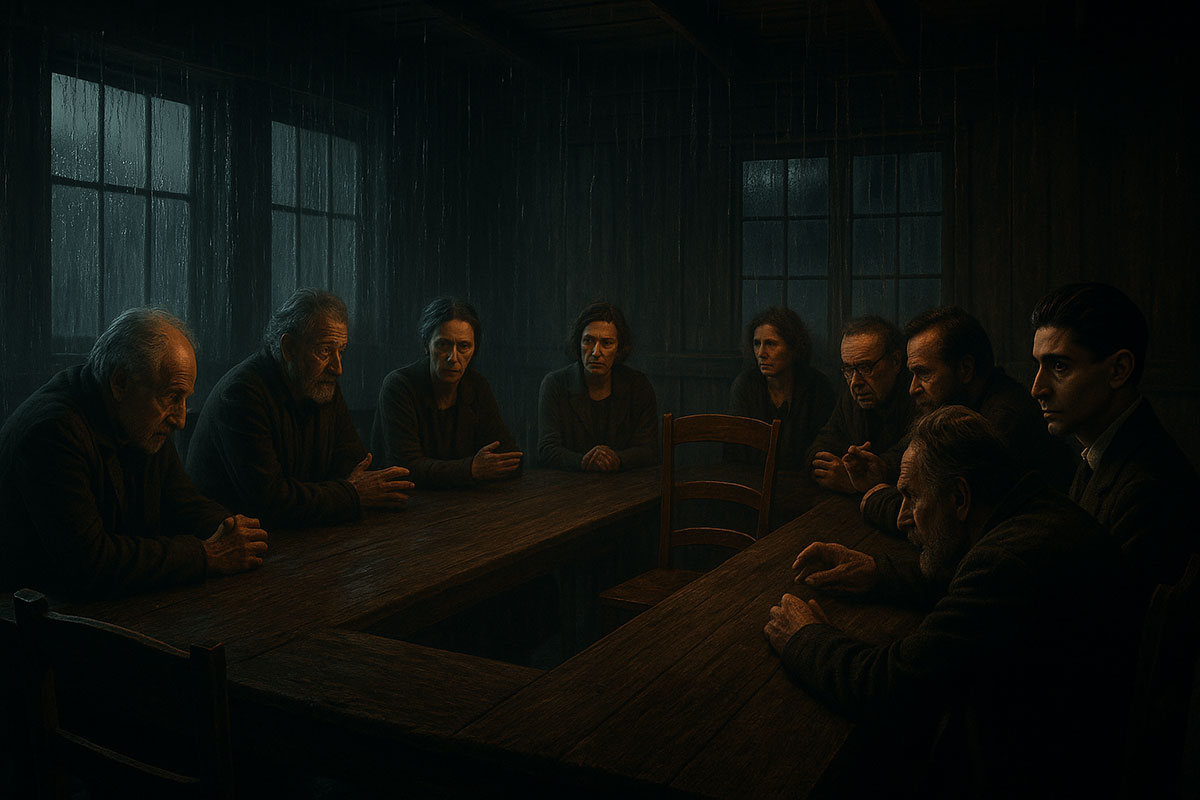
Moderator: Slavoj Žižek (philosopher, cultural critic, incisive on ideology and collapse)
Participants:
László Krasznahorkai (author, architect of the village of waiting)
György Dragomán (Hungarian novelist, The White King, The Bone Fire)
Orhan Pamuk (Nobel laureate, chronicler of cultural despair and endurance)
Mihály Szegedy-Maszák (Hungarian literary scholar, expert in Central European modernism)
James Wood (critic, The New Yorker, on style and despair)
Franz Kafka (in spirit, precursor of collapse, absurdity, and paralysis)
Introduction — Slavoj Žižek
You see, when we talk about Satantango, it is not just a story of individuals but of a community, yes? A community paralyzed by waiting, seduced by false prophets, already rotting from within. And so the question becomes: is this collapse of community something local, Hungarian, or is it the universal condition of humanity under late modernity? Tonight we will ask three questions: Why do these parables of collapse feel so contemporary? Is their portrayal of community collapse rooted in Hungary or in the human condition itself? And finally, what do they tell us about the nature of hope or its impossibility?
Question 1 — Why do these parables of collapse still resonate so strongly in our world today?
James Wood
Because they are not tied to one context alone. Krasznahorkai captures the experience of futility, of endless deferral, which resonates whenever institutions fail. Whether in Hungary or in the West, collapse here is the erosion of trust — something we feel acutely now.
László Krasznahorkai
Collapse is not a story; it is reality. The village is the world. Why does it resonate? Because we are all living in a place where waiting has replaced action, where despair is disguised as daily life.
György Dragomán
I grew up in Ceaușescu’s Romania, where waiting was endless — waiting for food, waiting for change, waiting for collapse. Reading Satantango was like reading my own childhood. But now I see it also speaks to new crises: climate, politics, migration. The resonance is universal.
Orhan Pamuk
Yes, the resonance lies in its portrayal of emptiness. Whether in Istanbul or Budapest, people are vulnerable to false prophets. Communities collapse because fear and hope are easily manipulated. That is a global truth.
Mihály Szegedy-Maszák
Yet let us not forget: this is deeply Hungarian. It emerges from our specific history — war, dictatorship, disillusionment. Its universality rests precisely in its local intensity. The more particular the collapse, the more powerfully it speaks beyond borders.
Franz Kafka (in spirit)
Collapse is the human condition. Every community imagines stability, but behind it lies the court, the bureaucracy, the absurd machinery. Krasznahorkai shows what I knew: collapse is not coming, it has always already arrived.
Question 2 — Is the collapse of community in Satantango a uniquely Hungarian experience, or a universal allegory?
Orhan Pamuk
It is both. The texture of the village, the endless rain, the ruins of Communism — these are Hungarian. But the allegory is universal. Any society that waits for salvation instead of acting is already inside the novel.
György Dragomán
For me, it is Hungarian in blood and soil, but it also transcends. It carries the trauma of Central Europe, yet anyone who has lived through false promises will recognize it.
Mihály Szegedy-Maszák
I agree. We must acknowledge the Hungarian origin. Krasznahorkai is not abstract — his despair is carved from the soil of rural decay. But that very concreteness allows it to become allegory.
Franz Kafka (in spirit)
Allegory always transcends origin. The village is every village. Its mud is universal mud. Its waiting is universal waiting. Hungary is simply the name of the stage.
James Wood
Yes, the novels invite us to read them both ways: as parables of Central Europe and as larger metaphysical allegories. They resist choosing, which is why they continue to matter to global readers.
László Krasznahorkai
I wrote of my world, but I knew it was not only mine. The collapse of community is not Hungarian, it is human. Waiting is our universal prison.
Question 3 — What do these portrayals of collapse tell us about hope — is there any possibility of it, or only despair?
György Dragomán
In The White King, I also tried to capture this tension. Children invent hope even in ruin. In Satantango, hope flickers — in Lila’s whispering, in the manuscript carried forward. It is fragile, but it exists.
James Wood
I see hope in form, not in content. The novels show despair, yes, but the act of writing itself is hopeful. To shape collapse into art is to insist on meaning, however provisional.
Orhan Pamuk
I would say hope lies in endurance. Communities collapse, but individuals still carry memory, still carry language. That persistence is small, but it is all we have.
Mihály Szegedy-Maszák
Hope is not explicit. These novels resist consolation. But in resisting false hope, they create an honesty that itself can be a form of hope.
Franz Kafka (in spirit)
There is hope, but not for us. Hope is always deferred, always elsewhere. Krasznahorkai shows this more honestly than most: hope exists only as echo.
László Krasznahorkai
I do not write hope. I write truth. And if endurance can be mistaken for hope, then let it be so. But know: the sentence survives not because it saves us, but because it refuses to die.
Closing Reflection — Slavoj Žižek
So we see: collapse is not only Hungarian, not only local, but also universal. It is the human condition of waiting, of betrayal, of paralysis. And hope? Maybe there is none. Or maybe hope is simply this: that even in despair, words endure, stories endure. Perhaps that is all — and perhaps that is enough.
Topic 4: The Whale, the Manuscript, and the Question of Meaning

Moderator: George Szirtes (translator of Satantango)
Participants:
Ottilie Mulzet (translator of Krasznahorkai’s later works)
László Krasznahorkai (author himself, speaking of his own symbols)
Maggie Nelson (writer on form, survival, and language)
Roberto Calasso (in spirit, Italian publisher and myth-symbolist)
Péter Esterházy (in spirit, Hungarian postmodernist, playful counter-voice to Krasznahorkai)
Seiobo (mythic presence from Seiobo There Below)
Introduction — George Szirtes
As someone who struggled to carry László’s endless sentences into English, I know firsthand how heavy his symbols are. In Satantango and The Melancholy of Resistance, a grotesque whale appears, mute and monumental. In War and War, a manuscript is carried like a relic across the world. These images raise pressing questions: What do they mean? Do they preserve hope, or only confirm despair? Tonight, with voices both human and mythic, we will ask three questions: what does the whale signify, what does the manuscript reveal about survival, and can meaning ever outlast collapse?
Question 1 — What does the whale represent in Krasznahorkai’s vision: is it prophecy, memory, futility, or something else?
Ottilie Mulzet
For me, the whale is futility incarnate. It is grotesque, decaying, mute — and yet everyone projects onto it. In that way, it becomes a mirror of the community’s own desperation, an object onto which meaning is forced, even when none is there.
Maggie Nelson
I read the whale as silence — the silence of God, perhaps. It looks back with an unblinking eye, refusing to explain itself. In its mute presence, we are forced to confront our own hunger for meaning.
Roberto Calasso (in spirit)
Yes, the whale is myth. Every culture has its Leviathan, its sea monster, its divine carcass. In Krasznahorkai, the whale carries all of these resonances, yet it is caged, exhibited, degraded. It is the sacred reduced to spectacle.
Péter Esterházy (in spirit)
Ah, but perhaps the whale is only a whale! The joke is that everyone seeks meaning where there is none. The futility lies not in the whale but in us, endlessly interpreting.
Seiobo (mythic presence)
The whale is the shadow of beauty. Where art ascends, the whale descends. Yet both are mirrors: one shows eternity through form, the other shows eternity through decay.
László Krasznahorkai
The whale is the world itself: mute, immovable, incomprehensible. It does not prophesy, it does not explain. It simply endures, and in enduring, it condemns us to search for meaning where there is none.
Question 2 — In War and War, the archivist clings to a manuscript he believes will outlast humanity. Is this tragic futility or heroic persistence?
Roberto Calasso (in spirit)
It is both. To carry a manuscript in a collapsing world is absurd — yet it is also the only gesture left to us. The archivist becomes priest and madman, guardian of a text whose meaning may be forever lost.
Maggie Nelson
I see it as tragic heroism. To preserve words when the world collapses is to say: meaning matters, even if no one remains to read it. The futility is part of the beauty.
Ottilie Mulzet
As a translator, I felt kinship with Korim, the archivist. His manuscript is like Krasznahorkai’s sentences: impossible to hold, yet impossible to abandon. His persistence, even in futility, is what makes him human.
Péter Esterházy (in spirit)
Or perhaps it is simply comic! A man devotes his life to words no one will read. But isn’t that what all of us writers do? The tragedy is that he doesn’t laugh at himself.
Seiobo (mythic presence)
The archivist is like a monk illuminating a manuscript while the world burns. It is not futility, it is devotion. Even if no one reads, the act itself sanctifies the ruins.
László Krasznahorkai
Korim is neither tragic nor heroic. He is inevitable. In a collapsing world, to cling to a manuscript is the only thing a human being can do. His madness is his truth.
Question 3 — Can meaning truly outlast collapse, or is all interpretation doomed to dissolve like ink in water?
Maggie Nelson
Meaning doesn’t outlast collapse; it exists inside collapse. What survives is not permanence but the act of carrying, of whispering, of pressing pages flat. That act is itself meaning.
Ottilie Mulzet
As a translator, I know words dissolve. But something endures in rhythm, in cadence. Even if ink runs, the breath of the sentence can survive, carried across languages.
Roberto Calasso (in spirit)
All civilizations dissolve, but myths return. Meaning does not survive intact, but as fragments, echoes. The whale, the manuscript, these are fragments destined to haunt us long after the collapse.
Péter Esterházy (in spirit)
Interpretation is always doomed! But that is its joy. We read, we misread, we carry meaning forward even when we know it will fail. The comedy is that we cannot stop.
Seiobo (mythic presence)
Meaning does not outlast — it transforms. Collapse itself becomes art, as beauty and ruin are revealed as twins. In this way, nothing is lost, only transfigured.
László Krasznahorkai
Nothing survives. The ink dissolves, the words vanish. But in the moment of reading, in the moment of whispering, they lived. That is enough. That is all.
Closing Reflection — George Szirtes
What we see is that the whale and the manuscript are not symbols with fixed meanings, but mirrors of our hunger for meaning. Some call them futile, others sacred, others comic. Yet all agree: in the act of carrying, of preserving, of looking into the whale’s eye, something persists. Perhaps not meaning itself, but the refusal to abandon meaning. And maybe that is all the salvation we are granted.
Topic 5: Satantango’s Legacy — Between Novel and Film

Moderator: Susan Sontag (in spirit, critic and cinephile who championed Béla Tarr’s Satantango)
Participants:
Béla Tarr (director of the 7-hour Satantango)
Ágnes Hranitzky (editor and co-creator with Tarr)
Jacques Rancière (philosopher of cinema and time)
László Krasznahorkai (author, reflecting on his endurance as an artist)
Colm Tóibín (novelist situating Krasznahorkai’s global impact)
Slavoj Žižek (philosopher bringing political/ideological interpretation)
Introduction — Susan Sontag (in spirit)
When I first saw Béla Tarr’s Satantango, I declared it one of the greatest films ever made. It was not entertainment, it was an ordeal — and precisely for that reason, it was art of the highest order. And yet it was born from literature, from Krasznahorkai’s novel. Tonight we ask: how do novel and film together shape the legacy of Satantango? What do they teach us about endurance, collapse, and art’s role in confronting them?
Question 1 — How did Tarr’s film adaptation transform or preserve the novel’s legacy?
Béla Tarr
I did not adapt Satantango, I simply revealed it. The novel already contained the film: its rhythm, its repetition, its doom. Cinema only gave it a body of images, rain, and faces. What survived was not plot but time itself.
Ágnes Hranitzky
Editing was about trust — trusting the rhythm of the novel. Long takes became our way of carrying Krasznahorkai’s sentences into cinema. We preserved not the words but the weight of waiting.
Jacques Rancière
Yes, the film turned narrative into duration. Literature traps you in sentences; cinema traps you in images. Both destroy the illusion of progress. The legacy lies in this shared refusal of resolution.
Colm Tóibín
For me, the film enlarged the novel’s reach. Readers may be few, but cinema creates collective endurance. To sit through seven hours is to share the ordeal with others. That communal experience deepens the legacy.
Slavoj Žižek
And let us not forget the politics! The film shows villagers as passive, corrupt, duped — exactly like today’s masses under ideology. The adaptation preserved the critique of false leaders, but made it visible on screen, so you cannot ignore it.
László Krasznahorkai
I saw in Béla’s work the novel reborn. Not translated, not diminished, but given another endless sentence, this time in images. That is legacy: the work lives again, yet refuses to die.
Question 2 — Does the combined legacy of novel and film belong to Hungary, or to world literature and cinema?
Colm Tóibín
It belongs to the world. The Hungarian soil gave it its mud, its rain, its despair — but the parable transcends. That is why readers and viewers far from Hungary still feel its urgency.
Béla Tarr
It is Hungarian in birth, but I never wanted to make a Hungarian film. It was always about the human condition — our universal entrapment in collapse. The world has claimed it, and rightly so.
Slavoj Žižek
Yes, but! We must remember: the global appeal lies precisely because it is so local, so rooted. It shows Hungary after Communism, yes, but also shows the universal emptiness after ideology. The paradox is that it is most universal where it is most Hungarian.
Jacques Rancière
The legacy is both local and global because form transcends context. Duration, repetition, doom — these belong not to one nation but to human experience.
Ágnes Hranitzky
Still, for me, its Hungarian-ness matters. The rhythms of our land, the particular despair of our history, gave birth to it. Without Hungary, there is no Satantango.
László Krasznahorkai
I wrote from Hungary, yes. But I knew even then: the collapse I described was not ours alone. It is the collapse of the world.
Question 3 — What does Satantango’s endurance — across novel and film — teach us about the future of literature and cinema?
Jacques Rancière
It teaches that endurance itself is the future. In a culture addicted to speed, both novel and film slow us down until we feel time as weight. This is art’s future: to resist acceleration.
Maggie Nelson (absent, but echoed by panel)
Art becomes a site of survival — not escape but confrontation.
Colm Tóibín
It shows that art can still make demands. Literature and cinema need not flatter us; they can test us, burden us, reshape us. Satantango proves there will always be space for difficult art.
Slavoj Žižek
And politically, it shows that true art unmasks ideology. It does not comfort, it unsettles. In this way, the endurance of Satantango is a reminder that the role of art is to reveal our complicity in collapse.
Ágnes Hranitzky
Yes. Endurance in editing, endurance in watching, endurance in reading. The future of art lies in its demand for patience.
Béla Tarr
I don’t believe in “future” for art. I believe in honesty. If art is honest, it will endure, as Satantango endures. If not, it deserves to vanish.
László Krasznahorkai
What endures is not comfort, but refusal. The sentence refuses to stop; the camera refuses to cut. The future of art is in this refusal — to end, to resolve, to lie.
Closing Reflection — Susan Sontag (in spirit)
What I hear tonight is that Satantango is more than a novel or a film — it is a monument of endurance. Born in Hungary, claimed by the world, it teaches us that art can still resist speed, resist comfort, resist despair. Its legacy lies not in entertainment, but in ordeal — an ordeal we willingly choose, because through it, we recognize ourselves.
Final Thoughts by Susan Sontag

What we have experienced across these conversations is not simply the analysis of a novel or a film, but the recognition of a unique artistic achievement. Satantango endures because it dares to demand endurance from us. Its sentences refuse to break, its images refuse to cut, its world refuses to console. In an age addicted to speed and distraction, such refusal is itself a form of resistance.
What strikes me is that Krasznahorkai and Tarr have given us not merely a story but an ordeal — and in choosing to endure it, we discover something profound about ourselves. We discover that collapse can be narrated without spectacle, that despair can be rendered without sentimentality, that beauty can coexist with ruin. This is why Satantango belongs not only to Hungary but to the world, not only to literature but to cinema, not only to our present but to the future.
Its legacy is endurance — to endure the rain, the waiting, the endless circling of the dance, the silence of the whale, the fragility of the manuscript. To endure is not to be saved, but to remain human in the face of collapse. That is what great art does. And that is why, long after the sentences end and the film’s final frame fades, Satantango continues to live inside us.
Short Bios:
László Krasznahorkai — Hungarian novelist and 2025 Nobel Prize laureate, known for his long, unbroken sentences and apocalyptic themes, most famous for Satantango and The Melancholy of Resistance.
George Szirtes — Poet and translator, renowned for bringing Satantango into English, capturing Krasznahorkai’s labyrinthine style in fluid, rhythmic prose.
Ottilie Mulzet — Award-winning translator of Krasznahorkai’s later works, including Seiobo There Below and War & War, praised for handling his spiritual and symbolic intensity.
Maggie Nelson — American writer and critic, author of The Argonauts and Bluets, known for exploring language, temporality, and the ethics of attention in literature.
W.G. Sebald (in spirit) — German writer of Austerlitz and The Rings of Saturn, whose long, memory-laden sentences and meditations on history parallel Krasznahorkai’s vision.
Colm Tóibín — Irish novelist and critic, author of Brooklyn and The Master, with deep engagement in European literature and its intersections with politics and culture.
Béla Tarr — Legendary Hungarian filmmaker, director of Satantango and Werckmeister Harmonies, celebrated for his long takes and apocalyptic cinematic style.
Ágnes Hranitzky — Film editor and close collaborator with Béla Tarr, shaping the meditative rhythms of Satantango and other films through her editing.
Susan Sontag (in spirit) — American critic and essayist, one of the greatest champions of Béla Tarr’s cinema, calling Satantango a masterpiece of modern film.
Jacques Rancière — French philosopher, influential theorist of aesthetics, cinema, and politics, author of The Future of the Image and Film Fables.
Péter Nádas — Hungarian novelist, author of Parallel Stories and A Book of Memories, contemporary of Krasznahorkai exploring memory, trauma, and history.
Roberto Bolaño (in spirit) — Chilean novelist, author of 2666 and The Savage Detectives, fascinated with manuscripts, collapse, and the futility of searching for meaning.
Slavoj Žižek — Slovenian philosopher and cultural critic, known for his provocative analyses of ideology, politics, and cinema, blending humor and theory.
György Dragomán — Hungarian novelist, author of The White King and The Bone Fire, exploring memory, dictatorship, and survival in Central Europe.
Orhan Pamuk — Turkish novelist, Nobel Prize laureate, author of Snow and My Name Is Red, chronicler of cultural despair, politics, and endurance.
Mihály Szegedy-Maszák — Hungarian literary scholar, expert in Central European modernism, interpreter of post-Communist literature and its legacies.
Franz Kafka (in spirit) — German-language writer of The Trial and The Castle, precursor to Central European absurdity, paralysis, and existential collapse.
Roberto Calasso (in spirit) — Italian publisher and essayist, author of The Marriage of Cadmus and Harmony, known for weaving myth and modernity into symbolic critique.
Péter Esterházy (in spirit) — Hungarian postmodernist, playful author of Celestial Harmonies, whose ironic style counterbalances Krasznahorkai’s grave vision.
Seiobo (mythic presence) — The immortal goddess figure from Seiobo There Below, representing divine beauty and the endurance of art across collapse.
Leave a Reply