

Introduction by Karen Armstrong
Every religion begins not with certainty, but with trembling.
Long before anyone named God, humans gathered in dark caves and beneath open skies, awed by the power of thunder, wind, and fire. Fear was their first teacher. It told them that life was fragile, that death was inevitable, that the forces shaping existence lay beyond their control. And yet, out of that trembling, something extraordinary was born — the longing to make meaning.
Religion, in its purest form, was never meant to be a fortress against fear. It was meant to be a bridge through it. In every tradition, from the chants of Vedic India to the psalms of Jerusalem, from the desert meditations of Muhammad to the enlightenment of the Buddha, faith began as a response not to terror, but to mystery. Fear, when transmuted by reflection, became awe. Awe became ritual. Ritual became the language through which humanity learned to touch the invisible.
But history tells another story as well — the story of what happens when fear is not transformed but harnessed. Fear of chaos became hierarchy; fear of heresy became persecution; fear of the other became war. Institutions arose to contain the unpredictable energy of faith, to domesticate mystery into obedience. What was once a living relationship between human frailty and divine wonder hardened into systems of power and control.
And yet, despite every distortion, the longing behind religion has never died. Beneath all our fear-driven dogmas, a quiet current of love persists — the same love that inspired prophets to challenge empires, mystics to renounce wealth, monks to embrace silence, and ordinary people to forgive the unforgivable.
This series, The Sacred and the Scared, is not an indictment of religion but an invitation to remember its essence. We will explore how fear, in all its faces — fear of death, fear of difference, fear of change — has shaped the spiritual journey of humankind. We will see how fear divides, how it manipulates, but also how it refines. Because within fear lies a profound truth: what we fear most reveals what we value most deeply.
The great sages have always known this. Jesus told his followers, “Be not afraid.” The Buddha taught that understanding fear is the path to liberation. The Qur’an reminds believers that God is nearer than the jugular vein — closer than fear itself. And modern psychology affirms what the mystics knew all along: that to heal the world, we must first heal the frightened mind.
Perhaps humanity is ready now for a new kind of religion — not one that divides, but one that awakens; not one that promises safety, but one that cultivates courage.
Fear built civilizations, yes — but love, in the end, must civilize them.
As we begin this exploration, let us remember that the story of religion is also the story of fear’s transformation into wisdom. To understand fear is not to condemn faith; it is to purify it. For only when we face the darkness honestly can the light of the sacred truly be seen.
May this dialogue not offer easy answers, but help us listen — not only to one another, but to that trembling still hidden inside the human soul, calling us, even now, toward peace.
(Note: This is an imaginary conversation, a creative exploration of an idea, and not a real speech or event.)
Topic 1 — Fear and the Birth of Religion: Why Humans Made Gods in Their Own Anxiety

Moderator: Karen Armstrong
Participants: Yuval Noah Harari, Carl Jung, Joseph Campbell, Alan Watts, and Karen Armstrong
Opening by Karen Armstrong
When we study the earliest traces of religion, we find not creeds or doctrines, but trembling. Early humans lived under vast skies, lightning splitting mountains, death striking without reason. Out of that fear, they began to sense pattern—something beyond chaos.
Today I want to ask: Was fear our first prayer? Or was it awe mistaken for fear?
(Question 1) — What do you think was the original emotional root of religion — fear, awe, or something else?
Yuval Noah Harari:
If we look anthropologically, fear was the foundation. The earliest humans faced predators, famine, and death daily. Religion emerged as a coping mechanism — a social technology to manage collective anxiety. It provided stories to turn chaos into meaning. When we say “the gods are angry,” we’re not describing reality — we’re describing human helplessness projected onto the sky. Fear was the engine; myth was the steering wheel.
Carl Jung:
Yes, but I would say fear was the door, not the foundation. Behind fear lies the numinous — that overwhelming sense of being in the presence of something vast. The psyche needed symbols to integrate that experience. If you repress fear, it becomes neurosis. But if you ritualize it, you touch the divine. Fear, properly met, becomes awe. That’s why our ancestors painted caves: to meet the terror within in sacred form.
Alan Watts:
I think what we call “fear of the unknown” was really fascination with it. Fear and curiosity are twins. When lightning flashed or death arrived, early humans didn’t just cower — they wondered. Religion is the poetry of that wonder. The problem began when wonder hardened into worry — when control replaced curiosity. Then fear stopped being transformative and became institutional.
Joseph Campbell:
I agree, Alan. The earliest myths were maps of terror. You could say fear was the raw material, but myth was the art. “The hero’s journey” begins with fear — the dragon, the abyss — and ends with transformation. Religion began as the drama of fear turned into courage. When fear became taboo instead of teacher, religion lost its vitality.
Karen Armstrong:
That resonates deeply. So perhaps fear is not sin but signal — a signal that we are standing before mystery. In the Bible, “the fear of the Lord” once meant reverence, not panic. Only later did it become moral intimidation.
(Question 2) — How did this early fear evolve into organized religion and, eventually, systems of control?
Joseph Campbell:
Once myth became system, the storytellers were replaced by administrators. When fear was democratized, priests arose to manage it. They turned myth — which liberates — into law — which restricts. The original purpose was still to protect the tribe, but gradually, it served the institution. The hero’s inner fear became the state’s outer weapon.
Yuval Noah Harari:
That’s right. As societies grew, collective fear needed central management. You couldn’t have a thousand interpretations of thunder anymore. You needed one narrative to unite people — and obedience became survival. Religion became early governance. Fear wasn’t just theological; it was political infrastructure. It gave kings divine legitimacy and armies moral certainty.
Alan Watts:
Exactly. The tragedy is that fear, once a private doorway to mystery, became a public instrument of control. When you tell someone, “Be not afraid,” but then threaten them with eternal fire, you create dependency. True spirituality helps people face fear; false religion profits from it.
Carl Jung:
And the psyche mirrored this. Institutional religion externalized the inner journey. Instead of confronting the dragon within, we created devils without. Collective projection allowed societies to avoid their own shadow. Fear repressed becomes violence — hence holy wars, witch hunts, and crusades. Humanity has been trying to conquer its own unconscious on battlefields ever since.
Karen Armstrong:
And yet, fear still teaches. Even institutional control cannot fully suppress its wisdom. Every mystical tradition — from the desert hermits to the Zen monks — arose as rebellion against fear-based religion. They said, “Go inward. Meet your terror. You’ll find God there, not in the threat of punishment.”
(Question 3) — If fear gave birth to religion, what can modern faith do to transcend it?
Alan Watts:
We must learn to trust the unknown again. Fear tries to freeze the flow of life; religion must thaw it. The essence of enlightenment, whether in Christianity or Buddhism, is surrender — letting go of the need to control mystery. When you stop resisting uncertainty, fear transforms into play. The cosmos stops being a courtroom and becomes a dance.
Yuval Noah Harari:
And practically, we must teach people to recognize fear narratives — especially political or religious ones. Most “holy” fears are manufactured. If we can see that fear is a form of social programming, we gain freedom. The next stage of human spirituality will be one of transparency — knowing that our gods mirror our inner states.
Carl Jung:
Fear will never disappear; it is archetypal. But it can be integrated. Modern religion must help people relate to fear, not banish it. The shadow is sacred. Only by embracing our fear of death, insignificance, and change can we encounter the Self — the divine image within. What we call God may be the part of us that loves even our fear.
Joseph Campbell:
Yes. Fear tells us where we still need to grow. When you follow your fear, you find your treasure. The challenge for modern faiths is to tell stories that no longer weaponize fear but redeem it — myths of reconciliation, not conquest. The new “holy war” should be fought within, not without.
Karen Armstrong:
Beautifully said. Perhaps we’re coming full circle — back to awe, but now with awareness. Fear once gave us religion; perhaps understanding fear can now give us peace.
True faith, after all, is not the absence of fear — it’s the courage to love while trembling.
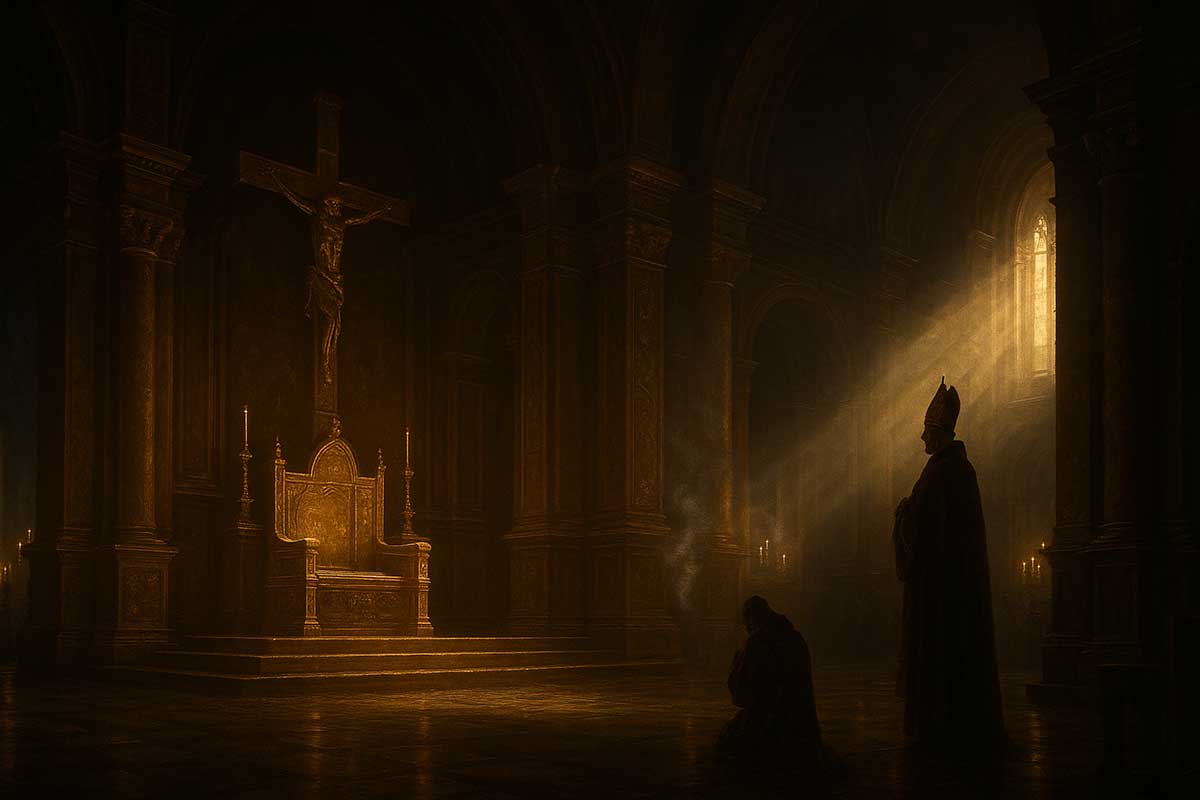
Topic 2 — When Reverence Becomes Control: Institutional Fear and the Rise of Holy Violence
Moderator: Reza Aslan
Participants: Bishop Desmond Tutu, Malcolm X, Simone Weil, Arundhati Roy, and Reza Aslan
Opening by Reza Aslan
Fear was never just a private feeling — it became a political resource. Once religion began managing large populations, fear was institutionalized. Kings ruled “by divine right.” Priests declared rebellion a sin. In nearly every tradition, obedience became holiness.
But I wonder — at what point did reverence for the sacred become fear of authority?
(Question 1) — How does institutional religion turn sacred reverence into control?
Bishop Desmond Tutu:
It happens when love becomes law. The early church began as a community of compassion, but over time it grew frightened — frightened of chaos, of heresy, of losing moral order. Fear drove it to codify faith, to make grace conditional. Apartheid in South Africa used that same religious fear: “God wills separation.” It’s always the same lie — that control protects holiness. True faith doesn’t dominate; it liberates.
Simone Weil:
Yes, Bishop, fear turns grace into gravity. Institutions cling to dogma because they cannot bear the silence of God. They mistake structure for safety. The danger of organized faith is that it seeks to remove uncertainty, yet uncertainty is the very condition of love. When faith becomes a fortress, fear is its foundation stone.
Malcolm X:
For me, it’s about power. When religion gets tied to empire, it stops serving the soul and starts serving the system. The white man’s Christianity in America wasn’t about salvation — it was about control. The slaveholders used the Bible to keep us obedient. “Fear God and honor your master.” Religion taught fear of freedom because freedom threatened their power. That’s what happens when the institution fears its own collapse — it calls that fear divine.
Arundhati Roy:
And that’s not just the past. Look at India today, or anywhere nationalism merges with religion. Politicians sell fear in the name of devotion. “If you question us, you betray your gods.” It’s psychological colonization. People internalize fear until obedience feels holy. The temple becomes a theater of loyalty, not spirituality.
Reza Aslan:
You all touch on the same pattern — fear of loss, fear of disorder, fear of freedom itself. It seems every institution eventually fears the spirit it was born to serve.
(Question 2) — Can fear-based control ever truly serve moral order, or does it always corrupt it?
Simone Weil:
Fear can create order, but never virtue. It can restrain behavior, but it cannot awaken conscience. When people obey from fear, they are still asleep. True morality begins when the soul acts freely — not to avoid punishment, but because love compels it. Every saint is disobedient to fear.
Malcolm X:
Right. Fear can’t make people righteous — it just makes them quiet. When you live under fear, you survive, but you don’t live. I saw this in the Nation of Islam too — when faith becomes about rules, it loses its revolution. The Prophet didn’t come to build prisons of purity. He came to break them. Once I stopped fearing white America — and even my own organization — that’s when I finally found Islam.
Bishop Desmond Tutu:
Fear can never produce justice. During apartheid, the government used fear to silence churches, and some clergy went along, thinking “peace at any cost.” But fear-driven peace is just oppression with polite manners. When we finally faced our fear — when we refused to obey unjust laws — that’s when reconciliation became possible. Courage, not control, is the fruit of real faith.
Arundhati Roy:
Exactly. Fear creates the illusion of morality because it looks orderly. But look closer — it’s always brittle. It breaks under pressure. Whether it’s patriarchy or caste, systems of fear depend on people staying small. That’s not religion — that’s architecture of anxiety. Fear builds temples to insecurity.
Reza Aslan:
And yet fear is persuasive because it works — temporarily. Societies run on fear until they can’t anymore. The challenge for religion is to create moral cohesion without coercion — a faith secure enough to survive freedom.
(Question 3) — How can religion reclaim reverence without fear — to inspire devotion instead of domination?
Bishop Desmond Tutu:
By returning to love as its center. Jesus never built an empire; he built relationships. The church must recover that radical tenderness — the courage to listen, to forgive, to include. Once you realize God’s love is unconditional, fear loses its job. The most dangerous person to any tyrant is the one who’s not afraid.
Simone Weil:
And by embracing vulnerability. The divine does not compel; it invites. The only true authority is one that refuses to dominate. Religion must once again become a school of humility — where uncertainty is not failure but faith’s breathing space.
Malcolm X:
And by telling the truth about fear. Let’s stop pretending fear is holy. Let’s name it — call out who benefits from it. Real spirituality makes you fearless, because you’ve already faced yourself. Once a man stops fearing his own shadow, no priest or president can own him.
Arundhati Roy:
I’d add that institutions must decentralize. Every time spirituality becomes property — of a church, a party, a nation — fear becomes its guard dog. Real reverence grows wild, not fenced. When people pray together across difference, fear starts to dissolve because it can’t survive proximity. Fear needs distance to breathe.
Reza Aslan:
So perhaps the future of faith is small and fearless — not global in power, but intimate in truth. Fear built cathedrals; love will build community.
Maybe religion’s redemption will come when it stops trying to rule the world — and starts trying to heal it.
Closing Reflection by Reza Aslan
It seems the lesson is ancient and new at once:
Fear may have built the altar, but love keeps the flame.
Every institution must choose — to protect its power through fear, or to risk it all for freedom.
Only one of those paths leads to God.
Topic 3 — The Mirror of the Other: Fear Between Faiths and Civilizations

Moderator: Rabbi Jonathan Sacks
Participants: Imam Feisal Abdul Rauf, Thomas Merton, the Dalai Lama, Vandana Shiva, and Rabbi Jonathan Sacks
Opening by Rabbi Jonathan Sacks
Every faith begins with a story about belonging — yet too often, that same story creates boundaries. The Hebrew Bible calls Israel to be “a light unto the nations,” but when fear enters, the light becomes a wall.
Across centuries, Jews, Christians, and Muslims have feared one another as heretics or rivals, while the East quietly observed: perhaps the real heresy is fear itself.
So I ask: why does the other — the one who believes differently — so easily become the object of our fear?
(Question 1) — Why do different faiths fear each other so deeply, even when they worship the same God or seek the same peace?
Imam Feisal Abdul Rauf:
Because difference threatens identity. Many Muslims, Christians, and Jews carry inherited trauma — centuries of domination, exile, crusades, occupation. We project those wounds onto one another. Fear becomes the way we remember history. It’s not theology that divides us; it’s insecurity masquerading as faith. When we feel safe in God, we stop needing enemies to prove we’re right.
Thomas Merton:
Yes, fear is a failure of contemplation. We live in the illusion of separation. When we stop praying with the heart and start defining God with the intellect, we begin to draw lines — “this is holy, that is not.” Monastic silence reveals something profound: that every prayer, whatever its name, echoes the same longing. The tragedy is that religions mistake their language for the experience itself.
Vandana Shiva:
And fear of the other is always linked to fear of the feminine — of nature, of interdependence. Western religion in particular built hierarchies to control what it couldn’t understand. The earth, women, indigenous traditions — all became “the other.” Fear of plurality is fear of losing domination. But the universe itself thrives on diversity. Harmony is not sameness; it’s symphony.
The Dalai Lama:
In Buddhism we say ignorance is the root of fear. When you see only surface differences — robe, ritual, scripture — you miss the shared aspiration for compassion. Fear is born when the mind clings to “I” and “mine.” Interfaith harmony begins when we realize: there is no “other,” only different expressions of the same search for happiness. To remove fear, we must train the heart in understanding.
Rabbi Jonathan Sacks:
Perhaps fear of the other is fear of seeing ourselves reflected. Every faith mirrors another’s strengths and failings. Judaism sees in Christianity a love it sometimes hides; Islam sees in Judaism a discipline it sometimes lacks. If we could look into each other’s eyes without the shield of doctrine, we might recognize not rivals, but relatives.
(Question 2) — How have civilizations turned that fear into violence, and what lessons can we draw from those histories?
Vandana Shiva:
Colonialism was the great project of fear disguised as civilization. The West feared what it called “primitive,” and so conquered it. But the conquered learned to fear themselves — to internalize inferiority. Today’s religious conflicts are still echoes of that same hierarchy. Healing begins when cultures stop imitating their oppressors’ fear.
Imam Feisal Abdul Rauf:
Violence often comes when faith loses humility. The Crusades, jihad, pogroms — each began with the conviction that God was threatened and needed defense. But God does not need protection; humans do. When religion identifies too closely with political power, fear becomes fuel for domination. The Qur’an says, “There is no compulsion in religion.” Yet every century, we forget.
Thomas Merton:
And even monastic traditions have been guilty. The Church feared heresy more than hypocrisy. When we confuse unity with uniformity, we end up crucifying difference. Violence is always an attempt to make outer order substitute for inner peace. The monk who fears doubt will persecute the heretic. That’s spiritual immaturity with swords.
The Dalai Lama:
I have seen this fear firsthand. In Tibet, Chinese leaders feared religion because they feared freedom of thought. And some Tibetans feared Chinese because they feared losing identity. Both sides suffered. Violence multiplies fear, never ends it. Only compassion — seeing the other’s pain as our own — begins to break the circle. Peace is not the absence of war; it is the absence of fear.
Rabbi Jonathan Sacks:
Yes. The 20th century taught us that fear armed with technology becomes catastrophe. After the Holocaust, I realized that the greatest antidote to religious fear is memory — not to dwell in trauma, but to transform it into responsibility. “Never again” means never again to anyone. Fear isolates; shared suffering unites.
(Question 3) — How can faith traditions overcome this mirror fear and build a future grounded in mutual reverence, not rivalry?
The Dalai Lama:
By teaching emotional literacy. We educate the mind but not the heart. Every faith should begin its catechism with compassion training — mindfulness, empathy, listening. When we cultivate warmheartedness, fear melts naturally. You cannot fear someone you truly understand.
Imam Feisal Abdul Rauf:
We must also build institutions of encounter — mosques, synagogues, and churches that collaborate on service projects, not just dialogue panels. Shared compassion creates shared safety. When people work side by side to feed the hungry, theological fear disappears. It’s replaced by kinship.
Vandana Shiva:
And by remembering our ecological unity. The planet itself is the ultimate interfaith sanctuary. If we can learn to honor the Earth together, we’ll rediscover a spirituality that transcends boundaries. Environmental crisis could be the teacher that finally unites religions — because all our fears, in the end, depend on the same fragile world.
Thomas Merton:
I would add silence. Without silence, there can be no understanding. Let each tradition retreat into its own depth and return with humility. The contemplative must lead the activist. Only inner reconciliation can sustain outer peace. When we meet God in silence, we meet the God beyond labels.
Rabbi Jonathan Sacks:
So perhaps interfaith dialogue is not just diplomacy — it is therapy. We are healing the human family from inherited trauma. The moment we stop fearing one another’s difference and start seeing it as divine design, religion becomes what it was always meant to be: a symphony of awe.
The mirror ceases to divide — it begins to reflect light.
Closing Reflection by Rabbi Jonathan Sacks
Fear was the first idol. We’ve been worshiping it for millennia — in temples of nationalism, in altars of purity.
But faith, at its best, calls us to break that idol.
When we meet one another beyond fear, we don’t lose God.
We find Him — finally — in each other’s eyes.
Topic 4 — Fear Within the Self: The Inner War Behind Outer Wars

Moderator: Thich Nhat Hanh**
Participants: Eckhart Tolle, Karen Armstrong, Jiddu Krishnamurti, Pema Chödrön, and Thich Nhat Hanh
Opening by Thich Nhat Hanh
So far we have spoken of fear between religions, nations, and histories.
But today, I wish to bring the conversation home — to the war that lives inside each of us.
Before any bomb falls, there is already a battlefield in the mind: fear of loss, fear of not being enough, fear of disappearing.
If we cannot make peace within, how can we make peace without?
(Question 1) — What is the true nature of fear within the human being, and why does it have such power over us?
Eckhart Tolle:
Fear is the mind’s oldest companion. It arises when we identify with thought — with the story of “me” that wants to survive at all costs. Fear feeds on time: the future that might hurt us, the past that still haunts us. But in the present moment, fear cannot breathe. When you are truly here, the mind loses its grip, and you realize that fear is not your enemy — it’s the signpost pointing you back to now.
Pema Chödrön:
Yes. In Buddhism, we say fear is a natural reaction to moving closer to truth. When the ego senses that its walls are dissolving, it trembles. That trembling isn’t wrong; it’s awakening. But we run away from it — we armor ourselves with opinions, routines, or control. The practice is to stay — to feel fear fully without trying to escape. That’s how fear becomes compassion.
Karen Armstrong:
From a theological perspective, fear began as the awareness of vulnerability. In the Garden story, Adam and Eve hide — that’s the birth of consciousness of separation. Religion’s purpose was to guide that awareness toward awe, not shame. But once we moralized fear, calling it sin, we created guilt. Modern believers often inherit that — confusing self-knowledge with condemnation.
Krishnamurti:
Fear is born when thought projects itself into the future. The moment you say, “I might lose,” or “I might die,” the image creates the emotion. It’s mechanical. We suffer because we identify with the image — with “my success,” “my reputation,” “my beliefs.” Observe it without judgment, and fear ends instantly. There’s no method; only seeing. The ending of fear is the beginning of intelligence.
Thich Nhat Hanh:
So, fear is not a monster but a teacher. When I breathe mindfully and smile to my fear, it becomes smaller, like a child who only needed to be held. Understanding is love’s other name. When we understand our fear, it transforms into peace.
(Question 2) — How does unrecognized fear lead to conflict — within relationships, communities, or even religions?
Karen Armstrong:
When we do not face our inner fear, we project it outward. That’s how theology turns violent. The person who secretly fears doubt will persecute the heretic. The leader who fears vulnerability will invent an all-powerful God who demands submission. Fear denied becomes moral rigidity. Compassion, by contrast, grows from self-honesty.
Eckhart Tolle:
Collective fear creates collective ego — what we call ideology. When individuals identify with a thought structure — religion, nation, or movement — they feel safe from their personal insecurities. But that safety is an illusion. The moment someone challenges the ideology, fear resurfaces, and the mind attacks to defend itself. All wars are the outer theater of inner resistance.
Pema Chödrön:
I see this every day. When we don’t make friends with our own fear, we look for someone to blame for it. We lash out at partners, neighbors, or governments. But blaming is just fear’s disguise. In mindfulness practice, we learn to pause. That pause is a revolution. It interrupts the ancient chain of fear → aggression → guilt. If enough people practiced pausing, entire nations might change course.
Krishnamurti:
You cannot fight fear with discipline or belief. That only creates conflict between the controller and the controlled — which is still fear. The world is violent because each person carries the seed of control in their own mind. To end violence, you must end control — which means meeting fear without motive. Then action arises naturally, from clarity, not compulsion.
Thich Nhat Hanh:
Yes. When I worked with refugees, I saw that the deepest wound was not physical hunger but spiritual fear — fear that the world had no compassion left. When one person learns to breathe peacefully, they can calm a village. Inner peace is not selfish. It radiates like fragrance. The real revolution is a quiet breath.
(Question 3) — How can we transform fear into spiritual awakening — both personally and collectively?
Pema Chödrön:
Through gentleness. We can’t bully fear into disappearing. When fear arises, say, “Hello, old friend. You’re welcome here.” That warmth melts the frozen heart. Over time, we see fear as the doorway to bodhicitta — the awakened heart. You stop asking, “How can I get rid of fear?” and start asking, “What is fear trying to show me about love?”
Krishnamurti:
Understanding ends fear, not effort. Awareness without choice — that is the essence. To look at fear without the desire to change it is to end the division between observer and observed. That ending is the beginning of peace. No teacher, no system can do this for you. Freedom from fear is the birth of the sacred.
Eckhart Tolle:
Collectively, humanity must awaken from identification with thought. That’s the spiritual shift of our age. When more people realize they are the awareness behind their emotions, not the emotions themselves, fear will no longer control societies. Fear thrives on unconsciousness. The moment you become conscious of it, it dissolves — like darkness meeting light.
Karen Armstrong:
And we must reintroduce compassion into theology. The mystics of every tradition taught that God is found not through power, but through surrender. If institutions embraced vulnerability — admitting “we don’t know” — religion itself could evolve. Fear dies in the presence of humility.
Thich Nhat Hanh:
When we make peace with our own fear, we make peace with the world.
Breathe in — you invite the wounded child.
Breathe out — you smile with understanding.
One conscious breath can end generations of fear.
This is the revolution that requires no violence — only presence.
Closing Reflection by Thich Nhat Hanh
The outer wars we fight — in politics, in religion, in family — are the echoes of the inner war.
When we learn to hold our fear instead of hiding it, the guns begin to fall silent.
To love our fear is to end the ancient cycle of enemies.
Because in truth, there was never an enemy — only the parts of ourselves waiting to be loved.
Topic 5 — Beyond Fear: Toward a Spiritual Maturity That Transcends Violence

Moderator: The Dalai Lama
Participants: Archbishop Desmond Tutu, Thich Nhat Hanh, Rumi (represented poetically), Paramahansa Yogananda, and the Dalai Lama
Opening by The Dalai Lama
Throughout our journey, we have seen how fear shaped religion — from its birth in awe to its corruption in control, and its transformation through awareness.
Now, let us imagine the next step — what happens when fear no longer drives faith at all?
When humanity finally outgrows the need to divide, punish, or defend in God’s name — what does spirituality become?
Let us explore what it means to live beyond fear.
(Question 1) — What does a faith beyond fear actually look like? How does it feel to live in that state?
Archbishop Desmond Tutu:
It feels like laughter after long sorrow. When you are no longer afraid, you rediscover joy as a form of worship. During apartheid, they tried to crush us with fear, but love kept breaking through — in songs, in humor, in tears. Faith beyond fear doesn’t ignore suffering; it sings through it. It trusts that the universe bends toward justice, even when we can’t see it bend. God’s smile is bigger than our terror.
Thich Nhat Hanh:
To live beyond fear is to live in deep presence. You are no longer pulled by the ghosts of the past or the storms of the future. Each breath becomes enough. You smile to impermanence instead of resisting it. Fear depends on time — on “what if.” When you are fully here, the “if” disappears. What remains is peace so simple that the world calls it miraculous.
Paramahansa Yogananda:
True fearlessness comes when you know you are not the body, not the mind, but the soul — eternal, untouched by life or death. In meditation, you feel this directly. The more you experience your divine nature, the less the material world can frighten you. You realize that God is not somewhere else; God is your very consciousness. Fearlessness is divine memory restored.
Rumi:
Love has no fear because it has nothing to protect. The heart that has dissolved its boundaries feels only expansion. The warrior of love walks into fire singing, because he knows the flame and the self are not two. When the lover becomes the Beloved, what remains to fear?
The Dalai Lama:
When we let compassion lead, fear becomes unnecessary. The mind that understands interdependence sees enemies as teachers. Even pain becomes an opportunity to deepen understanding. A faith beyond fear is not passive — it’s deeply alive, courageous, and tender at once.
(Question 2) — How do individuals and societies move from fear-driven religion to fearless compassion?
Thich Nhat Hanh:
It begins with one mindful person. You cannot force fearlessness. You cultivate it, breath by breath. When I see fear in a soldier’s eyes, I don’t tell him, “Be brave.” I breathe with him. I let my calm become his mirror. Collective peace begins with shared calm. A society without fear begins with communities that can breathe together.
Archbishop Desmond Tutu:
And with forgiveness. Nothing disarms fear faster than forgiveness. When we forgive, we refuse to let fear dictate the story. South Africa taught me that reconciliation isn’t weak; it’s the highest courage. Only the fearless can forgive, because only love trusts that it will not die from disappointment. If we can teach children forgiveness instead of vengeance, we will raise a generation free from inherited fear.
Rumi:
Fear builds walls; love turns them to windows. When people dance together, they forget who is Muslim or Christian or Jew. We need more dancing, less doctrine. The cure for fear is celebration — not denial, but the ecstatic remembrance that we are already whole. When the flute plays, no one asks what religion the musician belongs to.
Paramahansa Yogananda:
Education must include the soul. The world trains minds for success, but not for serenity. Teach meditation to every child — teach them to contact the peace within. When people experience even a moment of inner stillness, they recognize truth directly, not through fear-based instruction. Fear fades when the soul awakens to its own divinity.
The Dalai Lama:
Yes. And leadership must model this transformation. Political and religious leaders have a responsibility to speak not from fear, but from compassion. The people mirror their energy. If leaders are calm, citizens become calm. If leaders are afraid, they infect millions. True leadership is emotional hygiene for humanity.
(Question 3) — What is the ultimate spiritual destiny of humanity once fear no longer governs it?
Rumi:
When fear dies, poetry begins. Humanity will speak again in the language of wonder. There will be no temples of stone — only hearts radiant with remembrance. The universe will be our scripture, and silence its holy verse. We will stop asking for heaven because we will be living inside it.
Paramahansa Yogananda:
In that state, life becomes divine play — lila. The soul will express God’s joy through science, art, and kindness. When fear ends, creativity flows unhindered. Religion will no longer divide; it will harmonize with truth discovered in every field. We will see no contradiction between mysticism and modernity, because both spring from the same cosmic intelligence.
Archbishop Desmond Tutu:
We’ll finally realize that salvation was never about escape — it was about embrace. Heaven isn’t elsewhere; it’s here, when fear no longer holds us hostage. The divine dream is a world where everyone sees everyone else as family. Then peace won’t be a miracle; it’ll be normal.
Thich Nhat Hanh:
Yes. Fearless humanity will live in the rhythm of interbeing. The earth will breathe with us again. We will care for the trees, for the waters, for one another, as extensions of our own body. When you touch life this deeply, violence becomes unthinkable — not by law, but by love.
The Dalai Lama:
And perhaps that is enlightenment not for monks, but for mankind — to live compassionately without borders, peacefully without fear. The world will still have pain, but not panic; change, but not chaos. Humanity’s maturity is to understand that love, not fear, is our natural state.
When we finally remember that, we will no longer need to search for God — we will simply reflect Him.
Closing Reflection by The Dalai Lama
Fear built civilizations.
But compassion will build eternity.
When the heart grows wider than its own pain, when nations learn to breathe before they strike, when faith forgets to be afraid — then we will have entered the age of wisdom.
And it will not be the end of religion, but its fulfillment.
Final Thoughts — by Karen Armstrong

If religion began in fear, perhaps its true destiny is to end in love.
Throughout human history, fear has worn many faces: the fear of divine wrath, of moral failure, of hell, of the stranger, of change itself. Each has left its mark upon the spiritual imagination. But what we have learned — painfully, across centuries — is that fear cannot deliver the peace it promises. It only creates more of itself.
The mystics understood this long before modern psychology gave it words. Meister Eckhart said that love is the “slaying of fear.” Rumi called fear “the guard of the treasure.” Thich Nhat Hanh taught us to smile to our fear as if it were a child who has lost its way. They knew that fear does not vanish through denial or conquest, but through understanding.
To live without fear is not to live without caution — it is to live without hostility. When fear loosens its grip, compassion naturally arises. We begin to see others not as threats, but as mirrors. The Jew sees the Muslim as a fellow seeker. The Christian sees the Buddhist as a companion in silence. The atheist, too, becomes part of this sacred conversation — for what matters is not belief, but awareness.
It may be that humanity is entering what some have called a second axial age — a time when consciousness itself must evolve. The first axial age, two and a half millennia ago, gave us prophets, philosophers, and the birth of moral awareness. The second may demand something even greater: emotional maturity, the courage to outgrow fear as our moral compass.
That transformation begins within. When we learn to look at our fear — the fear of being unworthy, unseen, unloved — we discover that beneath it lies tenderness, the quiet heartbeat of the sacred. That is the essence of all great religion: to teach us how to live vulnerably in a world we cannot control.
If fear built the walls of our temples, love will open their doors. If fear invented judgment, love will teach forgiveness. And if fear divided us into tribes, love will remind us that the divine has no preference for one people, one language, one creed.
The challenge of our time is not to abandon religion, but to let it evolve. The next revolution will not be in doctrine or ritual — it will be in empathy. The new prophets will be those who can stand without hatred, those who can hold fear with tenderness until it dissolves into light.
Perhaps, then, we will finally understand what the mystics meant when they said, “There is no path to peace; peace is the path.”
Fear was the beginning of our story.
Love must be its end.
Short Bios:
Karen Armstrong — British author and former nun known for her comparative-religion classics The Case for God and A History of God. She interprets faith traditions as evolving responses to the human experience of awe and fear.
Yuval Noah Harari — Israeli historian and philosopher, author of Sapiens and Homo Deus. He examines how collective myths—often born from fear—shaped civilizations and moral systems.
Carl Jung — Swiss psychiatrist and founder of analytical psychology. He explored archetypes and the “shadow,” seeing fear as the psyche’s invitation to wholeness.
Joseph Campbell — American mythologist whose Hero’s Journey framework revealed how humanity turns fear into narrative transformation.
Alan Watts — British philosopher who bridged Eastern and Western spirituality, teaching that fear dissolves when one surrenders to life’s flow.
Reza Aslan — Iranian-American scholar of religions, author of No god but God. He studies how belief systems become political power structures.
Archbishop Desmond Tutu — South African cleric and Nobel Peace laureate who fought apartheid with joy and forgiveness, embodying faith beyond fear.
Malcolm X — American Muslim minister and civil-rights leader whose spiritual evolution transformed fear and anger into dignity and clarity.
Simone Weil — French philosopher-mystic who linked suffering, attention, and divine love, seeing fear as a gateway to compassion.
Arundhati Roy — Indian novelist and activist who critiques how religion and nationalism weaponize fear against freedom.
Rabbi Jonathan Sacks — Former Chief Rabbi of Britain, theologian, and moral voice for interfaith cooperation; author of Not in God’s Name.
Imam Feisal Abdul Rauf — Islamic scholar and interfaith bridge-builder, founder of the Cordoba Initiative, promoting dialogue over division.
Thomas Merton — Trappist monk and writer whose contemplative works united Christian mysticism with universal spirituality.
The Dalai Lama — Spiritual leader of Tibetan Buddhism and Nobel laureate, teaching compassion and inner peace as antidotes to fear.
Vandana Shiva — Indian eco-philosopher and activist who connects spiritual ecology with justice and planetary harmony.
Thich Nhat Hanh — Vietnamese Zen master and peace activist who taught “mindfulness of fear” and interbeing as paths to reconciliation.
Eckhart Tolle — Contemporary spiritual teacher, author of The Power of Now, emphasizing presence as liberation from the mind’s fear.
Jiddu Krishnamurti — Indian philosopher who rejected authority and taught direct perception as freedom from psychological fear.
Pema Chödrön — American Buddhist nun known for her practical wisdom on transforming fear and uncertainty into compassion.
Rumi — 13th-century Persian mystic whose ecstatic poetry dissolves the boundaries between fear, love, and divine union.
Paramahansa Yogananda — Indian yogi and author of Autobiography of a Yogi, who taught meditation as the realization of fearless divine consciousness.
Leave a Reply