


Introduction Kazuo by Ishiguro
When I think back to The Remains of the Day, I see not only the butler, Stevens, but also the many voices that shaped the book behind the scenes. Angela Carter, my fierce mentor, who never let me hide behind politeness. Malcolm Bradbury, who insisted stories must also wrestle with history. Deborah Rogers, who believed in my voice before anyone else. Robert McCrum, who guided me as an editor and friend. And, closer to home, my wife Lorna, who still reads me as if I were a beginner, unflinchingly honest.
I gathered them here — and alongside them, the spectral voices of Kafka, Tanizaki, Proust, Dostoevsky, Beckett, Ozu — not because they all spoke directly into the book, but because they hover over it. Their work, their criticism, their companionship, formed the ground on which I could write Stevens into being.
This gathering is less a panel of experts than a chorus of presences — some alive in memory, some on the page, some in the room with me still. Together, we ask what silence, loyalty, memory, and love mean, not only for a character in fiction, but for all of us.
(Note: This is an imaginary conversation, a creative exploration of an idea, and not a real speech or event)

Topic 1 — Silence as a Form of Power — Or Powerlessness?

Kazuo Ishiguro (Moderator)
We begin with the central paradox of The Remains of the Day: Stevens’ silence. Is his refusal to speak his truth a form of dignity and power, or is it simply powerlessness in disguise?
First Question
Ishiguro: When Stevens keeps silent — with Miss Kenton, with Lord Darlington, even with himself — is this a strength or a weakness?
Angela Carter: Silence is never neutral. It’s a political act, especially in a house where dangerous ideas are spoken. Stevens’ silence becomes complicity. He thinks he’s preserving dignity, but he’s erasing his moral agency.
Franz Kafka: Silence can be both. It is a cage, but also the only language left to the powerless. Stevens’ silence is like one of my clerks lost in bureaucracy: he is swallowed, yet his refusal to break role is the only resistance he has.
Jun’ichirō Tanizaki: In Japanese aesthetics, silence is often grace. But here it feels hollow. Stevens’ silence has no poetry, only avoidance. It hides truth, whereas true silence should reveal it.
Lorna Ishiguro: From the personal side, silence in a marriage or family is destructive. Stevens’ silence with Miss Kenton isn’t noble. It’s fear. And fear disguised as dignity can ruin lives.
Samuel Beckett: Silence is the joke of existence. Stevens polishes a spoon and says nothing — that’s theatre already. His silence is absurd. But in absurdity, perhaps, he finds the only meaning he can manage.
Second Question
Ishiguro: Can silence ever protect dignity? Or does it always end in self-betrayal?
Angela Carter: Silence protects dignity only if it masks truth for survival. Stevens’ silence protects nothing. It’s a tragic self-erasure.
Kafka: Dignity, in a world of power, is an illusion. His silence is a performance of dignity for himself. But what is dignity if no one sees it? A mask worn in an empty room.
Tanizaki: True dignity is in restraint, yes. But Stevens restrains not out of wisdom, but denial. That is not dignity — that is blindness.
Lorna Ishiguro: Dignity is meaningless if it costs intimacy. What is the point of pride if the person beside you never hears what you truly feel?
Beckett: Dignity is polishing a spoon while the world collapses. Silence is the punchline. We laugh, we cry, we keep polishing.
Third Question
Ishiguro: If Stevens had broken his silence — spoken his love, or questioned his master — would his life have been redeemed? Or was silence inevitable for him?
Angela Carter: One word could have changed his fate. That’s the tragedy. The silence wasn’t inevitable — it was chosen.
Kafka: Even if he spoke, would anyone hear him? Words can be just as powerless as silence. But the attempt — the attempt — is what gives meaning.
Tanizaki: A confession, spoken simply, could have given beauty to his life. Silence leaves nothing behind. A word would have left a trace.
Lorna Ishiguro: Yes. If he had told Miss Kenton he cared, even once, she would have stayed. His silence wasn’t destiny. It was fear.
Beckett: Redeemed? No. Speaking would only have changed the rhythm of the absurd. But at least he would not have left the stage with empty hands.
Ishiguro (closing reflection):
So perhaps silence is not dignity, but a mask that Stevens wore until it became his face. In the end, he chose silence as if it were power — but discovered it was only emptiness.
Topic 2 — The Betrayal of Loyalty: When Duty Becomes Blindness

Kazuo Ishiguro (Moderator)
Let’s move to another core theme of The Remains of the Day: Stevens’ loyalty to Lord Darlington. At what point does loyalty — a virtue — become a betrayal of conscience?
First question
Ishiguro: When Stevens serves Lord Darlington unquestioningly, is this loyalty admirable, or is it a moral failure?
Malcolm Bradbury: In the historical context, it’s a failure. Britain in the interwar years was riddled with aristocrats seduced by appeasement. Stevens, by refusing to question, becomes part of that drift. His loyalty was blind, and blindness in such a time was dangerous.
Robert McCrum: For readers, the fascination lies in the contradiction. Loyalty is supposed to be noble, but here it’s suffocating. It’s admirable in the abstract, but in practice it becomes complicity with folly.
Deborah Rogers: What makes Stevens so tragic is that he mistakes loyalty for virtue, and virtue for survival. But literature thrives on such contradictions. Without his blindness, we wouldn’t care as deeply about his humanity.
Dostoevsky: Loyalty without conscience is slavery. True loyalty requires suffering with one’s soul awake. Stevens’ obedience is not loyalty — it is an abdication of moral struggle, the very thing that makes us human.
Harold Pinter: Loyalty? Don’t dress it up. It’s silence at the wrong moment. It’s a pause where a word should be. In politics, in the theatre, that silence is violence.
Second question
Ishiguro: Does Stevens’ loyalty reflect his own choice, or was he a victim of the system — bred into servitude, unable to act otherwise?
Bradbury: There’s truth in both. The English class system conditioned men like Stevens to see service as identity. But he also had moments when he could have spoken — and didn’t. That is choice, even if hidden under habit.
McCrum: The brilliance of the novel is that readers can’t entirely absolve him, nor wholly condemn him. The system trapped him, yes, but he clung to the trap.
Rogers: It’s precisely why the story resonates: we all live within systems that reward silence. Stevens is both victim and participant. That tension is universal.
Dostoevsky: No man escapes choice. Even the serf knows he may resist, though he fears the lash. Stevens’ tragedy is not that he was a servant, but that he made peace with his chains.
Pinter: Systems give us scripts. Stevens followed his too well. He never improvised. That’s the failure.
Third question
Ishiguro: If Stevens had questioned Lord Darlington — even once — would it have changed history, or only himself?
Bradbury: History would not have shifted. But Stevens’ sense of self might have. To question Darlington would have given him a moral compass, rather than an empty mirror.
McCrum: Exactly. The novel isn’t about saving Europe — it’s about saving one man’s soul. Stevens failed to save his own.
Rogers: But the resonance lies in that very smallness. We recognize ourselves in him. We may not stop history, but we can betray or redeem ourselves in small choices every day.
Dostoevsky: To speak, even if no one hears, redeems the speaker. To be silent, when truth burns in the heart, condemns the soul.
Pinter: A word at the right moment can explode a room. Stevens had the match in his pocket. He never struck it.
Ishiguro (closing reflection):
So Stevens’ loyalty, which he thought was his greatest dignity, may have been his greatest failure. By serving without question, he betrayed not only the world but himself.
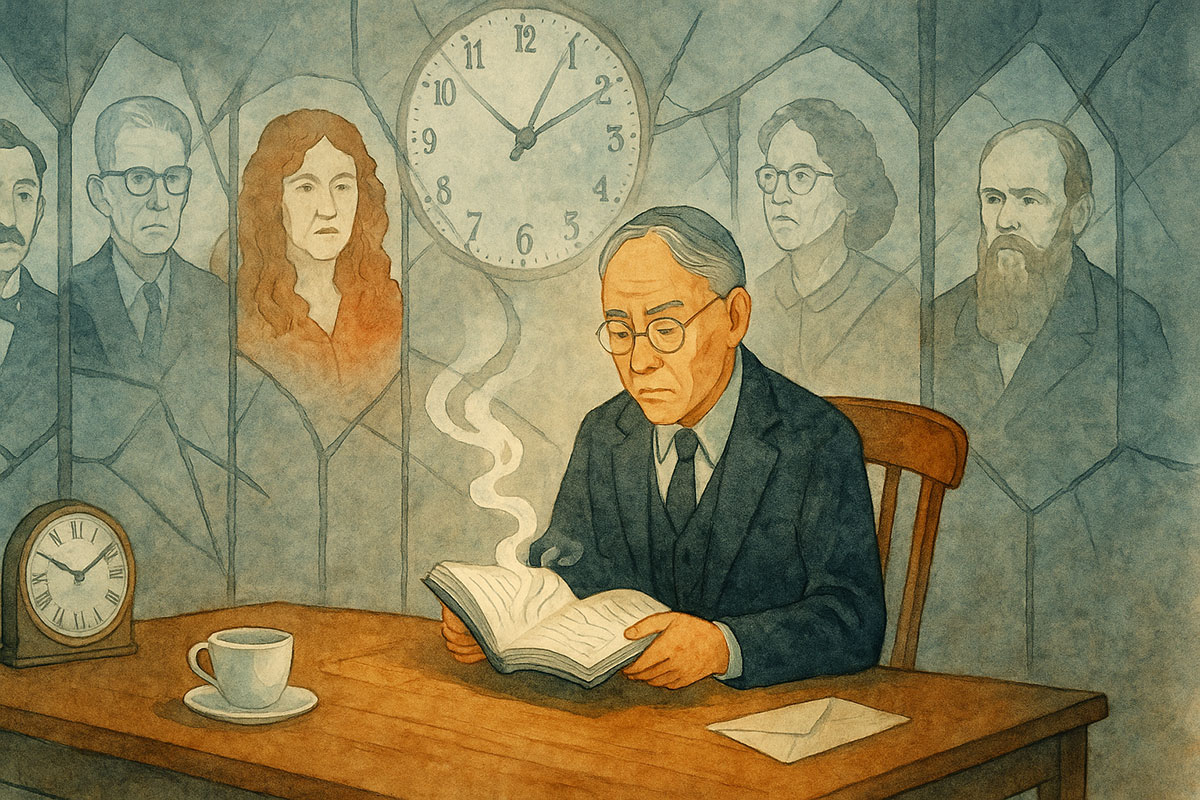
Topic 3: The Fragility of Memory and the Narrator’s Lie
Kazuo Ishiguro (Moderator)
Stevens tells his story with great composure, but memory is slippery. He forgets, he edits, he lies — to us, to others, to himself. Let’s talk about memory’s fragility.
First question
Ishiguro: Is Stevens’ narration unreliable, or is it the truest form of memory — fractured, selective, and self-protective?
Proust: Memory is never whole. It comes in fragments, summoned by taste, by sound, by regret. Stevens’ narration is not deceit — it is precisely what memory is: fragile, partial, shaped by longing.
Beckett: He remembers by not remembering. He edits until nothing remains but polish. That’s memory too — emptiness dressed as recollection.
Angela Carter: It’s self-protection. He tells himself stories to survive, to keep his world neat. But it’s also self-deception — his dignity depends on lies.
Lorna Ishiguro: We all rewrite our lives. But Stevens erases too much. His version of events isn’t just selective; it’s a mask. And when you wear a mask too long, you forget the face underneath.
Dostoevsky: Memory reveals the soul’s struggle. Stevens hides from his guilt, but the cracks show. His silences, his evasions — they are confessions in disguise.
Second question
Ishiguro: Does unreliable memory make Stevens more human, or less?
Proust: More human. To be human is to misremember, to shape the past until it becomes bearable. His lies are our lies.
Beckett: Less. He’s hollowed out. The man becomes the mask. Humanity shrinks until only service remains.
Carter: More and less. More human because we recognize ourselves in him. Less human because he refuses to confront the damage his silence caused. Humanity requires courage.
Lorna Ishiguro: More. If he had remembered perfectly, if he told his story with brutal clarity, we would not care for him. It’s the cracks, the evasions, that make him real.
Dostoevsky: Humanity is not in truth alone, but in the torment of seeking it. Stevens does not seek. He hides. That makes him pitiable, but still human.
Third question
Ishiguro: If memory shapes our identity, who is Stevens really — the man he was, or the man he tells us he was?
Proust: He is both. We are always both. The remembered self and the lived self are never the same, but both are true in their way.
Beckett: He is neither. He’s a shadow polishing shadows. His story is a void with silver edges.
Carter: He’s the man who chose silence, even in memory. His narration is one more act of service — serving his pride, not his truth.
Lorna Ishiguro: He is the man he tells us he was, because that’s what remains. When all is gone, the story is the life. And his story is one long silence.
Dostoevsky: He is the man who could have spoken, and did not. The weight of that unsaid truth is who he is. Memory shows us not what happened, but what was lost.
Ishiguro (closing reflection):
So memory is both prison and mirror. Stevens’ lies reveal him more than truth ever could. In the end, he is the sum of his silences, his evasions, his fragile recollections. And perhaps… so are we.
Topic 4: Love Deferred: Miss Kenton and the Cost of Words Unspoken
Kazuo Ishiguro (Moderator)
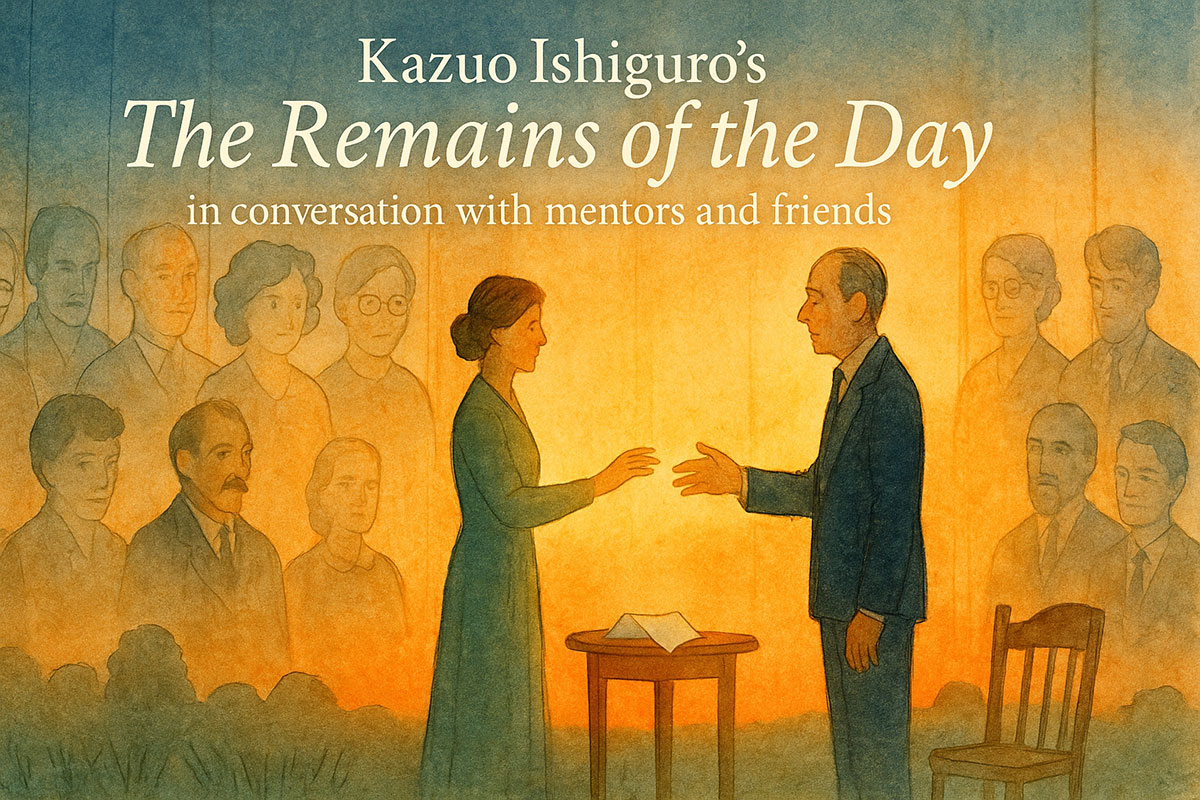
One of the deepest wounds in The Remains of the Day is not political but personal — Stevens’ silence toward Miss Kenton. Let’s consider what is lost when love remains unspoken.
First question
Ishiguro: What do Stevens and Miss Kenton’s unspoken words tell us about love — is it restraint, or is it fear?
Tanizaki: In Japanese tradition, love often hides in gestures — a teacup placed, a silence shared. But Stevens’ restraint feels empty. It is not beauty. It is fear.
Ozu: Love is most powerful in absence. A hallway where two pass but do not meet, a table where silence holds the unsaid. Yet here the absence is not graceful — it aches because it was avoidable.
Angela Carter: Let’s not romanticize it. His silence is not noble. It is cowardice. He denies her agency, her chance to choose, by never speaking. That’s not love — that’s erasure.
Lorna Ishiguro: I see fear. Fear of rejection, fear of losing dignity. But love requires risk. Without risk, there is nothing.
Proust: Love deferred becomes memory’s ghost. It grows larger in absence than it ever could in presence. Stevens’ silence transforms a possibility into a life-long wound.
Second question
Ishiguro: Could Stevens and Miss Kenton have lived happily, had he spoken? Or was their love always doomed by who they were?
Tanizaki: Happiness, perhaps. But not certainty. A confession may have led to a quiet life together — one more modest than the grandeur of Darlington Hall, but filled with warmth. That possibility was real.
Ozu: Even if they had married, silence may have followed them. Stevens’ nature was restraint. He would not easily change. But the chance — the chance itself — might have brought peace.
Carter: It’s too easy to say it was doomed. That absolves him. No — he had a choice. His silence killed what could have been.
Lorna Ishiguro: I agree. Happiness is never guaranteed. But to not even try — that is the true tragedy.
Proust: Even if happiness had eluded them, the attempt would have mattered. A love spoken, even if fleeting, carries more weight than a silence that lasts forever.
Third question
Ishiguro: Why does unspoken love haunt us more than spoken love that fails?
Tanizaki: Because it remains perfect in the imagination. Untouched, untested, unbroken. That makes it unbearable.
Ozu: Cinema has always known this. A missed train, a door that closes too soon — we carry that moment longer than any fulfilled embrace.
Carter: Because it is theft. Miss Kenton was denied the chance to choose. Stevens’ silence didn’t just rob himself, it robbed her. That wound festers because it was never confronted.
Lorna Ishiguro: Because regret multiplies in silence. We replay the “what if” endlessly. A failed love ends. An unspoken one never ends.
Proust: Love left unspoken becomes eternal. It is remembered, embellished, mourned — but never lived. That is why it haunts.
Ishiguro (closing reflection):
Perhaps Stevens’ greatest betrayal was not of history, but of his own heart. Silence preserved his dignity, but it destroyed his chance at love. And so what remains is not happiness, but the shadow of what might have been.
Topic 5: Art, History, and the Remains of a Day

Kazuo Ishiguro (Moderator)
Stevens’ story isn’t only about one man. It reflects an entire historical moment — the collapse of Britain’s old order, the dangers of appeasement, the cost of silence. Let’s explore how art, history, and personal tragedy intertwine.
First question
Ishiguro: Is The Remains of the Day ultimately a personal tragedy, or is it a mirror of Britain’s history between the wars?
Malcolm Bradbury: Both. Stevens’ blind loyalty is a metaphor for Britain’s aristocracy clinging to old illusions. His personal failure is inseparable from the nation’s.
Kafka: History is just another bureaucracy — faceless, crushing. Stevens’ silence mirrors society’s silence, a nation trapped in polite phrases while catastrophe gathers.
Tanizaki: History always lives inside the personal. Stevens’ restraint, Miss Kenton’s deferred love — these small silences echo the larger decline of an empire.
Robert McCrum: Readers see both: a man’s wasted life and a country’s lost innocence. The novel endures because it fuses the intimate with the historical.
Angela Carter: Let’s not forget the political. Stevens’ silence props up a system complicit in fascism. His tragedy is Britain’s tragedy: mistaking obedience for virtue.
Second question
Ishiguro: Can literature reshape how we understand history, or does it only illuminate what was already there?
Bradbury: Literature reshapes. Remains reframed how we see appeasement — not just policy, but lived in servants’ halls, in silences at dinner tables.
Kafka: Literature doesn’t explain history. It distorts it, making its absurdity plain. In distortion we glimpse the truth.
Tanizaki: Literature reframes history as atmosphere. We feel the decline, the fragility, through Stevens’ pauses more than any speech.
McCrum: Absolutely. History books give facts. Novels give us the human cost. That’s why readers turn to Ishiguro.
Carter: Literature can expose history’s lies. Remains reveals how loyalty and silence served the powerful. That illumination is radical.
Third question
Ishiguro: If Stevens represents Britain’s “remains of the day,” what does his silence teach us about the future?
Bradbury: That dignity without conscience leads only to decline. Nations, like men, cannot survive on silence.
Kafka: The future is another bureaucracy, another silence. Stevens’ lesson is that we remain trapped.
Tanizaki: That silence without beauty is emptiness. The future must speak, must confess, if it is to endure.
McCrum: That history is always personal. Stevens’ silence warns us that the smallest choices — to speak or not — ripple into the fate of nations.
Carter: That silence is never innocent. The future depends on our refusal to let politeness mask injustice.
Ishiguro (closing reflection):
So Stevens becomes not just a man, but a mirror — of his nation, of his time, of all of us. His silence tells us what happens when history is left unchallenged. What remains of the day is not only his tragedy, but the cautionary echo of our own.
Final Thoughts Kazuo by Ishiguro
What I hope you take from these conversations is not an answer, but a recognition: that behind every novel lies a web of voices. None of us writes alone. The sternness of Beckett’s silences, the tenderness of Tanizaki’s gestures, the honesty of Angela Carter’s challenges, the encouragement of Bradbury, Rogers, McCrum, and the clear-eyed critique of my wife — all of these shaped The Remains of the Day.
If Stevens’ tragedy is silence, then my act of gratitude is to give voice to those who stood behind me. They remind me — and perhaps you too — that art is not solitary. It is a dialogue across time, culture, and friendship.
And so, what remains of this day, and of that butler’s life, is not only the sorrow of words unsaid, but the living presence of mentors and friends whose echoes guide us still.
Short Bios:
Kazuo Ishiguro
Nobel Prize–winning novelist, known for works such as The Remains of the Day, Never Let Me Go, and Klara and the Sun. His fiction explores memory, silence, dignity, and regret with subtle, restrained prose.
Angela Carter
Celebrated British novelist and short story writer, noted for her feminist, magical realist works such as The Bloody Chamber. Mentor to Ishiguro during his MA at UEA, urging him to confront the politics within literature.
Malcolm Bradbury
English author, critic, and co-founder of the UEA Creative Writing program. His teaching emphasized the intersection of history and fiction, influencing a generation of writers including Ishiguro.
Deborah Rogers
Renowned literary agent who discovered and supported Ishiguro early in his career. Known for her sharp instincts and dedication to nurturing writers.
Robert McCrum
Editor at Faber & Faber who published Ishiguro’s early works. As both editor and later literary commentator, he shaped the reception of Ishiguro’s writing.
Lorna Ishiguro
Kazuo Ishiguro’s wife and closest reader. Known for her honest and critical feedback, she kept him grounded, treating him as a perpetual beginner to keep his work sharp.
Franz Kafka
Influential 20th-century writer whose surreal, unsettling tales of alienation and bureaucracy (The Trial, The Metamorphosis) shaped Ishiguro’s sense of ambiguity and quiet dread.
Jun’ichirō Tanizaki
Japanese novelist admired for his exploration of beauty, tradition, and subtlety. His aesthetics of restraint and shadow deeply influenced Ishiguro’s quiet narrative style.
Marcel Proust
French modernist author of In Search of Lost Time, whose deep reflections on memory and time echo strongly in Ishiguro’s focus on recollection and regret.
Samuel Beckett
Playwright of the absurd (Waiting for Godot), master of silence, minimalism, and existential futility. His influence appears in Ishiguro’s quiet, pared-down characters.
Fyodor Dostoevsky
Russian novelist of conscience and moral struggle (Crime and Punishment). His exploration of guilt, silence, and redemption resonate in Ishiguro’s work.
Harold Pinter
British playwright known for sharp dialogue, pauses, and political undertones. His “Pinteresque” silences echo in Ishiguro’s restrained style.
Yasujirō Ozu
Japanese filmmaker revered for his meditative portrayals of family and everyday life. His use of stillness and absence parallels Ishiguro’s narrative silences.
Leave a Reply