
Introduction by Howard Gardner
When we speak of leadership, we often focus narrowly on strategy, power, or charisma. Yet leadership is fundamentally about human development. The way leaders shape the growth of individuals, teams, and societies determines whether their legacy will be one of division or unity, of stagnation or renewal.
In the 21st century, the demands on leaders are unlike any before. Technology connects us instantly yet fragments our attention. Global challenges such as climate change, inequality, and polarization test our moral compass. And artificial intelligence, while expanding our potential, also raises profound questions about identity, purpose, and responsibility.
In my own work on multiple intelligences, I have argued that human capacity is not singular but plural. Leaders of tomorrow must embrace this reality — recognizing and cultivating diverse strengths across their organizations. Leadership beyond 2025 is not about producing followers; it is about creating multipliers of intelligence and character.
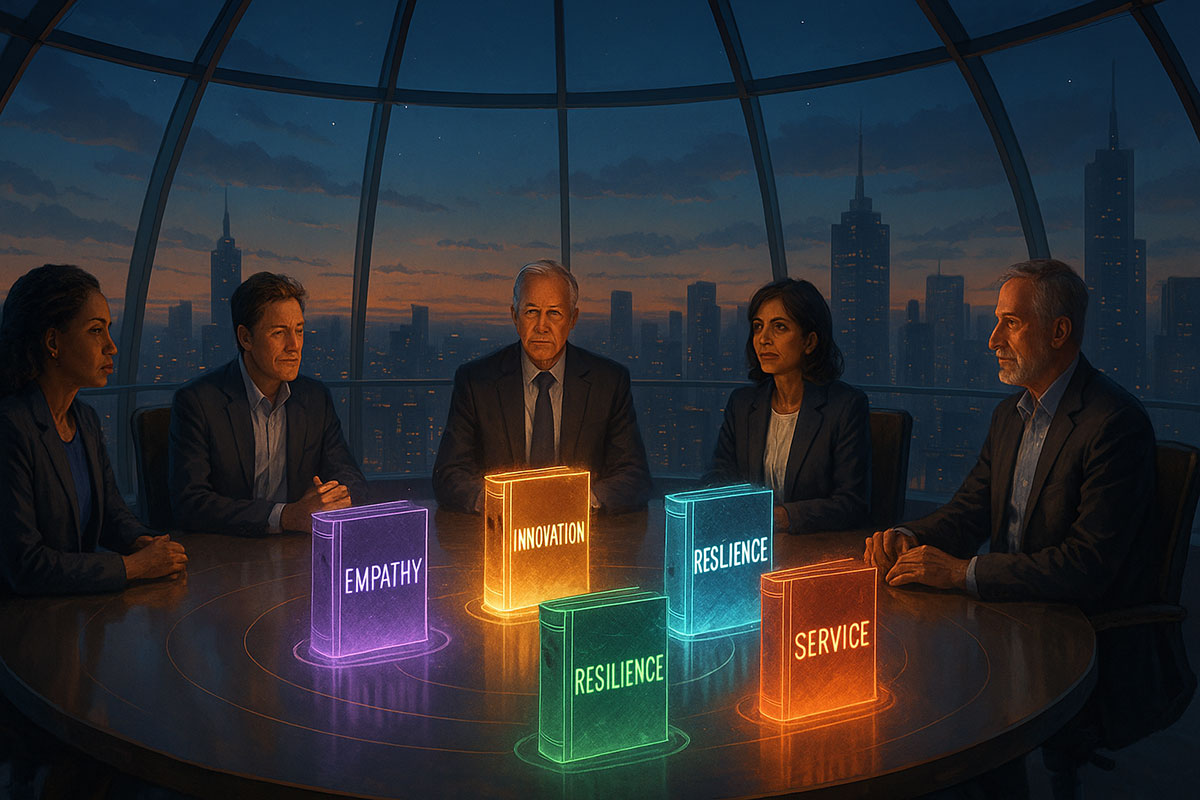
This series of conversations brings together voices who represent the spectrum of leadership today: visionaries, scholars, innovators, and practitioners. They remind us that the essence of leadership is not merely efficiency or profit but the shaping of human potential guided by vision, empathy, innovation, resilience, and service.
As you read, consider not only what leadership looks like now but what it must become — for your team, your community, and for generations that follow.
(Note: This is an imaginary conversation, a creative exploration of an idea, and not a real speech or event.)
Topic 1: The Future of Leadership — Vision Beyond 2025

Moderator: Karen Armstrong
Renowned writer on comparative religion and modern culture, guiding the conversation with thoughtful depth.
Opening
Karen Armstrong: Welcome, everyone. Leadership is at a crossroads — technology, globalization, and cultural shifts are transforming how influence and responsibility are expressed. I’d like us to start by asking:
How are leadership principles shifting in the era of AI, remote work, and global uncertainty?
Question 1: Shifts in Leadership Principles
Simon Sinek: Leadership is becoming less about command-and-control and more about clarity of purpose. With AI and remote teams, people crave meaning and trust more than ever. Leaders must anchor their organizations in “why,” because when uncertainty rises, purpose is the one compass everyone can follow.
Brené Brown: I agree with Simon. Vulnerability is no longer optional — it’s essential. A leader who admits not having all the answers builds resilience in their teams. In remote work especially, we can’t lead through presence alone; we must lead through connection.
Adam Grant: I’d add that flexibility is now a core principle. Leaders need to be willing to rethink assumptions constantly. The half-life of ideas has never been shorter. Those who cling to outdated models of leadership risk becoming irrelevant.
John C. Maxwell: To me, leadership has always been influence — nothing more, nothing less. The context changes, but the foundation remains. What I see now is a greater emphasis on values-driven influence, because technology can’t replace character.
Indra Nooyi: From my experience leading PepsiCo, the shift is toward holistic responsibility. Stakeholders today expect leaders to care not just about shareholders, but employees, communities, and the planet. That’s a radical evolution from 20 years ago.
Karen Armstrong: Thank you. Let’s take this deeper.
What timeless leadership traits still matter most, regardless of trends?
Question 2: Timeless Leadership Traits
John C. Maxwell: Integrity is the bedrock. Without it, no amount of charisma or vision can sustain leadership. People follow leaders they trust, not leaders who impress.
Indra Nooyi: I would emphasize listening. It’s not glamorous, but it’s timeless. The best decisions I ever made came from truly listening to voices that others might overlook.
Simon Sinek: Courage. Not the absence of fear, but the willingness to act despite fear. Every era has uncertainty, but the leader’s role is to step forward when others hesitate.
Brené Brown: Empathy. If you can’t see and feel through the eyes of those you lead, you will always be blind to their needs. Empathy builds loyalty, creativity, and shared resilience.
Adam Grant: I’d add curiosity. Leaders who stay curious keep learning. They avoid stagnation, and they invite innovation from their teams. Curiosity protects us from arrogance.
Karen Armstrong: Wonderful insights. Now, one last challenge.
How can leaders balance adaptability with consistency in vision?
Question 3: Adaptability vs. Consistency
Indra Nooyi: Leaders need a “north star” — a vision that doesn’t change — while strategies can evolve. For PepsiCo, our north star was “performance with purpose.” The tactics shifted, but the principle remained.
Simon Sinek: Yes, vision is the mountain peak. The path to climb it can change with weather conditions, but the peak itself must stay fixed. That consistency allows adaptability without confusion.
Adam Grant: I’d caution against mistaking rigidity for vision. A strong vision should actually make you more flexible, because you’re free to innovate as long as you’re moving toward the same overarching goal.
Brené Brown: Balance comes from trust. If people trust your integrity, they’ll accept course corrections. Adaptability without trust feels like inconsistency; adaptability with trust feels like wisdom.
John C. Maxwell: At the end of the day, leadership is about people, not plans. If your people believe in your mission, they’ll weather the changes with you. The balance is relational, not just strategic.
Closing Reflections
Karen Armstrong: What a rich conversation. We’ve heard that while leadership must adapt to AI, remote work, and global crises, its timeless roots — integrity, empathy, courage, curiosity, listening — remain unchanged. And the balance between adaptability and consistency comes from holding fast to purpose while allowing flexibility in execution.
Leadership beyond 2025, then, is not about technology or tactics alone. It is about vision, trust, and humanity guiding us into an uncertain future.
Topic 2: Leading with Empathy & Emotional Intelligence

Moderator: Karen Armstrong
Bringing depth and perspective, guiding the discussion into the heart of human-centered leadership.
Opening
Karen Armstrong: Welcome back, everyone. In our last conversation, we touched on timeless traits of leadership. Today, I want to explore something that has come to the forefront: empathy and emotional intelligence. These qualities are often praised, but not always understood in practice. Let’s begin with this question:
Why is emotional intelligence more critical to leadership success today than ever before?
Question 1: Why Emotional Intelligence Matters Now
Daniel Goleman: Emotional intelligence has always mattered, but the modern workplace magnifies its importance. Hybrid teams, cultural diversity, and digital communication strip away nonverbal cues, making self-awareness and empathy essential. Without them, miscommunication multiplies.
Brené Brown: Exactly. Vulnerability is a core part of emotional intelligence. Leaders who show humanity invite humanity in return. In a polarized, fast-moving world, connection is the glue that keeps teams together.
Satya Nadella: From my journey at Microsoft, I’ve seen how empathy drives innovation. We didn’t succeed because we were the smartest; we succeeded when we began to truly understand our customers’ pain points and our employees’ aspirations.
Sheryl Sandberg: Emotional intelligence also has an economic impact. Teams with high EQ leaders have lower turnover, stronger collaboration, and better performance. It’s not “soft skills”; it’s the hard foundation of effective leadership.
Liz Wiseman: I’d add that emotional intelligence multiplies talent. A leader who brings out the best in others through empathy creates an exponential effect. It’s not about the leader being the genius, but about creating a room of geniuses.
Karen Armstrong: Thank you. Let’s go deeper.
How can vulnerability be a strength in leadership rather than a liability?
Question 2: Vulnerability as Strength
Brené Brown: Vulnerability is the birthplace of courage. Leaders who admit uncertainty or mistakes create psychological safety. That doesn’t mean oversharing or abdicating responsibility — it means being real.
Satya Nadella: When I first became CEO, I had to admit that Microsoft had become too inward-looking. By showing humility and opening myself to criticism, I gave permission for the company to change. Vulnerability was the first step to renewal.
Sheryl Sandberg: After my husband passed away, I learned that vulnerability created deeper bonds with colleagues. It allowed me to lead with compassion, not just authority. People don’t want perfection; they want authenticity.
Liz Wiseman: I’ve seen leaders fear vulnerability because they think it undermines credibility. But in reality, it creates empowerment. When leaders admit they don’t have all the answers, others step up with their own brilliance.
Daniel Goleman: From a neuroscience perspective, vulnerability activates empathy in others. When leaders reveal their humanity, mirror neurons in the brain encourage connection. It’s literally hardwired into us to respond positively.
Karen Armstrong: Powerful insights. Let’s close with this:
What practical steps help leaders build trust across diverse teams?
Question 3: Building Trust Across Diverse Teams
Liz Wiseman: Start by asking better questions and really listening to the answers. Leaders who create a culture where every voice matters generate trust naturally. Inclusion begins with curiosity.
Daniel Goleman: Self-regulation is equally important. Leaders who stay calm under stress model stability. In diverse teams, emotions spread quickly — leaders must be conscious of the emotional climate they set.
Sheryl Sandberg: Transparency builds trust. Whether it’s pay equity, promotions, or company challenges, when leaders communicate openly, they show respect for every individual. Openness reduces suspicion.
Satya Nadella: I believe in the power of shared purpose. Trust grows when teams rally around something larger than themselves. For Microsoft, that was empowering every person and organization on the planet to achieve more. Purpose unites diversity.
Brené Brown: And never underestimate small acts of empathy. Checking in, remembering details about someone’s life, showing you care — those create bonds stronger than grand speeches. Trust is built moment by moment.
Closing Reflections
Karen Armstrong: What we’ve learned today is that emotional intelligence is no longer an accessory to leadership; it’s the foundation. Vulnerability, far from being weakness, is the gateway to courage, connection, and authenticity. And trust — the lifeblood of any team — is nurtured through listening, transparency, empathy, and shared purpose.
In an age of division and uncertainty, emotional intelligence doesn’t just make leaders more effective; it makes them more human. And perhaps, that is the deepest kind of leadership of all.
Topic 3: Extreme Leadership — Lessons from High-Stakes Environments

Moderator: Karen Armstrong
Known for weaving wisdom across traditions, today guiding the discussion into the intense realm of crisis and high-stakes leadership.
Opening
Karen Armstrong: In extreme environments — whether military, space exploration, or high-pressure business situations — leadership becomes a matter of survival. I’d like to begin with this:
What can business leaders learn from military and crisis leadership?
Question 1: Lessons from Military & Crisis Leadership
Jocko Willink: Discipline equals freedom. In combat, if your team doesn’t prepare and execute with discipline, you lose lives. In business, discipline in processes, training, and communication creates freedom to adapt when chaos strikes.
Stanley McChrystal: I’d add the lesson of decentralization. In Iraq, we had to move from a command-and-control model to a networked one. Business leaders can learn to empower small teams with autonomy, as long as the mission is clear.
Patrick Lencioni: From my work, I’d say the key is trust. In high-stakes environments, people can’t waste energy covering their vulnerabilities. Teams that trust each other can respond faster under pressure.
Chris Hadfield: In space, every action has consequences. The lesson is preparation and simulation. Leaders must prepare their teams for every scenario so that when a crisis hits, the response is automatic and calm.
Leif Babin: For me, it comes down to ownership. Leaders must take responsibility, not blame others. When leaders own everything in their world, teams follow their example, even under fire.
Karen Armstrong: Thank you. Now let’s focus on accountability.
How does accountability shape team culture under pressure?
Question 2: Accountability Under Pressure
Patrick Lencioni: Accountability is the backbone of teamwork. Without it, cracks appear quickly. In a crisis, when roles blur, accountability keeps people aligned and prevents finger-pointing.
Leif Babin: Exactly. In combat, accountability means life or death. If someone doesn’t do their job, people can die. In business, the stakes are different, but the principle is the same — everyone must own their part.
Chris Hadfield: In space, accountability is non-negotiable. Every astronaut must know their checklist and execute perfectly, because your teammates’ lives depend on it. That level of accountability builds trust stronger than words.
Stanley McChrystal: I would emphasize shared accountability. It’s not just individuals — the whole system must hold itself accountable. Leaders who model humility invite accountability throughout the organization.
Jocko Willink: Accountability is leadership. If the team fails, it’s on you as the leader. That mindset sets the culture. Teams thrive when leaders stop passing the buck and instead say, “This is on me.”
Karen Armstrong: Powerful. For our final question:
Where’s the balance between discipline and flexibility in tough conditions?
Question 3: Discipline vs. Flexibility
Chris Hadfield: Spaceflight taught me that discipline provides the framework, but flexibility saves lives. You follow checklists until the moment reality throws something new at you — then creativity kicks in. It’s both, not one or the other.
Jocko Willink: Discipline gives you the foundation. Flexibility without discipline is chaos. But once discipline is in place, flexibility becomes possible. It’s the paradox: structure gives you freedom.
Patrick Lencioni: In teams, discipline creates trust, but flexibility creates innovation. The balance is cultural. If leaders reward both responsibility and creative problem-solving, teams won’t freeze under pressure.
Stanley McChrystal: In war, the balance comes from adaptability. You can’t plan for every enemy move, but you can build disciplined habits that allow rapid adjustment. Organizations must train for resilience, not rigidity.
Leif Babin: I’d say the key is communication. Discipline ensures everyone is aligned, but flexibility requires rapid, clear communication to adjust course. Without that, flexibility devolves into disorder.
Closing Reflections
Karen Armstrong: What a striking discussion. We’ve seen that high-stakes environments teach us timeless lessons: discipline creates freedom, trust builds speed, accountability saves lives, and flexibility within structure creates resilience.
For business leaders, the message is clear: lead with ownership, empower with trust, and prepare relentlessly — but when the unexpected comes, adapt with calm confidence.
Extreme leadership is not about fearlessness; it’s about disciplined courage under fire.
Topic 4: Innovation & Leadership — Building the Future

Moderator: Karen Armstrong
Today, she guides us through the intersection of leadership and innovation — how leaders inspire creativity while steering organizations toward the future.
Opening
Karen Armstrong: Innovation has become the lifeblood of leadership in a rapidly changing world. Yet it’s also one of the hardest things to sustain without burning out teams or losing focus. To begin, I’d like to ask:
How do leaders foster creativity while still driving results?
Question 1: Fostering Creativity & Results
Clayton Christensen: From my research on disruptive innovation, I’ve found that leaders must create space for experimentation. Results matter, but creativity requires environments where failure is not punished, but studied.
Reed Hastings: At Netflix, we fostered creativity by giving freedom with responsibility. We didn’t micromanage; we trusted people to innovate, and we were ruthless about clarity of results. Creativity thrives when people feel trusted, not policed.
Jim Collins: I’d add discipline. Creativity without discipline is chaos. The greatest companies channel creative energy into consistent, scalable systems. Innovation is not random — it’s built on disciplined thought and disciplined action.
Arianna Huffington: We also need to value well-being. Creativity dies when people are exhausted. Leaders who encourage rest, reflection, and renewal unlock deeper creativity that’s sustainable.
Eric Ries: My work on The Lean Startup shows that creativity and results can align through rapid feedback loops. Leaders don’t need to choose between them — they can build systems where creativity directly drives measurable progress.
Karen Armstrong: Thank you. Let’s move to something I hear often from executives.
What leadership qualities separate companies that innovate from those that stagnate?
Question 2: Qualities of Innovative Leaders
Reed Hastings: Courage. Innovators must be willing to break old rules. Too many leaders cling to what worked yesterday. Companies that stagnate usually have leaders afraid to disrupt their own success.
Jim Collins: I’d say humility. Paradoxically, the most enduring innovators are often the most humble leaders. They channel ambition into the mission, not themselves. Stagnation often comes from leaders more concerned with ego than evolution.
Arianna Huffington: Empathy, too. Innovation is about meeting human needs in new ways. Leaders who deeply understand people — employees and customers alike — create products and cultures that matter.
Eric Ries: Persistence. Innovation is rarely a lightning strike; it’s iteration. Leaders who can stay patient while testing, failing, and refining build innovative organizations.
Clayton Christensen: I’d add perspective. Leaders of innovative companies see beyond short-term gains. They’re willing to cannibalize their own business before competitors do it for them. That long-term vision is rare but essential.
Karen Armstrong: Wonderful. Now let’s turn to a challenge many leaders face today.
How do leaders prevent burnout while pushing for disruptive progress?
Question 3: Preventing Burnout Amid Disruption
Arianna Huffington: This is my life’s mission — to prove that burnout is not the price of success. Leaders must model sustainable habits: sleep, recovery, and boundaries. Otherwise, teams equate progress with exhaustion, and innovation collapses.
Eric Ries: Preventing burnout requires iteration, not perfection. When leaders demand breakthroughs every quarter, people burn out. But when progress is framed as a series of small, validated experiments, momentum is sustainable.
Clayton Christensen: Leaders should also align innovation with purpose. Burnout often comes when people don’t see meaning in their work. When innovation connects to a larger mission, people push through challenges with energy.
Jim Collins: I’d argue for consistency. Chaos burns people out. But when leaders provide a clear framework — core values, disciplined processes — innovation feels like building, not flailing. Stability protects creativity.
Reed Hastings: Transparency is critical. If leaders are clear about risks, goals, and trade-offs, teams can manage their energy. Burnout happens when people feel they’re running blindly without understanding why.
Closing Reflections
Karen Armstrong: Today, we’ve seen that innovative leadership is not a gamble, but a disciplined practice. Creativity thrives with trust, feedback, and courage. The leaders who drive innovation are humble, persistent, and deeply human in their empathy and perspective. And sustainable innovation demands more than ideas — it requires leaders to safeguard the energy and well-being of their people.
Innovation and leadership, then, are not separate. They are two sides of the same coin: vision and execution, fueled by people who believe in the future they are building.
Topic 5: Ethical & Servant Leadership in a Polarized World

Moderator: Karen Armstrong
Here to guide the discussion into the moral and spiritual dimensions of leadership in today’s divided society.
Opening
Karen Armstrong: Leadership is not just about results — it is also about values, ethics, and service. In a polarized world, these qualities are being tested daily. I’d like to start with this:
What does it mean to be a servant leader in today’s competitive landscape?
Question 1: Servant Leadership Today
Ken Blanchard: Servant leadership flips the pyramid. Instead of people serving the leader, the leader serves the people. In today’s competitive environment, this means putting the growth of employees first. When they thrive, the organization thrives.
Angela Duckworth: Servant leadership is also about grit. Serving others doesn’t mean avoiding challenge; it means committing to their long-term growth even when it’s difficult. Persistence on behalf of others is service in action.
Robert Greenleaf: I coined the term “servant leadership” because I saw that true leaders must first ask, Do those served grow as persons? In today’s world, that question is more urgent than ever.
Stephen Covey: Servant leadership is principle-centered leadership. It means aligning actions with universal principles like fairness, integrity, and human dignity — even when markets push for shortcuts.
Malala Yousafzai: To me, servant leadership is standing up for the voiceless. It’s using influence not to advance oneself but to empower others — especially those who have been excluded or silenced.
Karen Armstrong: Thank you. That brings us to the moral tension.
How can leaders make ethical decisions when profits and principles collide?
Question 2: Profits vs. Principles
Stephen Covey: The key is to operate from abundance, not scarcity. Leaders who think in scarcity believe they must choose profit over principle. But when leaders act with integrity, they build trust — and trust is the ultimate economic multiplier.
Ken Blanchard: I’ve seen organizations sacrifice principle for short-term profit, only to lose long-term sustainability. Ethical leadership is not anti-profit; it’s the best foundation for lasting profit.
Malala Yousafzai: Ethics must come first. If leaders compromise human dignity for profit, they lose legitimacy. Young people today are watching closely — they want to support organizations with moral courage.
Angela Duckworth: I’d frame it as grit for values. It’s easy to bend under pressure, but ethical grit means holding on when compromise feels tempting. The test of leadership is what you refuse to sell.
Robert Greenleaf: When profits and principles collide, the leader’s task is to widen the horizon. What looks like a collision may be a failure of imagination. Ethical creativity seeks a path where both can exist — though it may demand sacrifice in the short run.
Karen Armstrong: Such powerful answers. Let’s close with this:
Can humility and service-based leadership scale to global impact?
Question 3: Scaling Humility & Service
Angela Duckworth: Absolutely. Humility scales through culture. If leaders reward humility and perseverance rather than arrogance and shortcuts, those values cascade through entire organizations, and from there into society.
Robert Greenleaf: Servant leadership was never meant to remain small. When institutions adopt it, society changes. The measure is not whether humility can scale, but whether leaders are willing to let it.
Malala Yousafzai: I’ve seen it scale in movements for education and justice. Humility is powerful because it inspires solidarity. Service attracts allies, and allies create global waves of change.
Ken Blanchard: Scaling humility means decentralizing power. Servant leadership empowers others to lead. When leadership is shared, the impact multiplies beyond any one person.
Stephen Covey: And humility is not weakness; it is strength under control. When leaders embrace humility globally, they build bridges instead of walls. That is the only way to create sustainable peace and prosperity.
Closing Reflections
Karen Armstrong: Today, we’ve learned that servant leadership is not a relic of the past, but a revolutionary response to the challenges of our time. Profits without principles are hollow, but when leaders ground themselves in service, humility, and ethical courage, their influence ripples far beyond balance sheets.
Servant leadership can, in fact, scale — not through domination, but through empowerment, trust, and a vision rooted in human dignity. In a divided world, this may be the leadership we need most.
Final Thoughts by Frances Hesselbein
When I reflect on leadership, I return to a simple truth: leadership is a matter of how to be, not how to do. Techniques, strategies, and models are important, but they will always be secondary to the character of the leader.
This series has shown us that leadership is not confined to a boardroom or battlefield. It lives in the quiet moments when a leader chooses courage over fear, empathy over detachment, and service over self-interest. In a polarized world, these choices define our future.
Servant leadership is not weakness; it is the highest form of strength. It requires humility to listen, resilience to persevere, and integrity to hold fast to principles when profits tempt otherwise. And it requires vision — not a vision that elevates the leader alone, but one that lifts an entire community.
The leaders we have heard from here embody these qualities. They remind us that while the tools of leadership evolve — from AI dashboards to global networks — the heart of leadership remains timeless: to serve with courage, to lead with love, and to inspire others to do the same.
As you step back into your own world, I invite you to ask not, “Who will follow me?” but rather, “Whom will I serve, and how will I help them grow?” The answer to that question is the truest measure of leadership.
Short Bios:
Howard Gardner
Harvard psychologist best known for his theory of multiple intelligences. His work has reshaped how we understand human potential and leadership in education, business, and society.
Frances Hesselbein
Former CEO of the Girl Scouts of the USA and Presidential Medal of Freedom recipient. Widely regarded as one of the most influential servant leaders of the 20th century.
Simon Sinek
Author of Start With Why and Leaders Eat Last. Known for his focus on purpose-driven leadership and inspiring organizations through vision and clarity.
Brené Brown
Research professor at the University of Houston and author of Dare to Lead. Famous for her groundbreaking work on vulnerability, courage, and empathy in leadership.
John C. Maxwell
International leadership expert and bestselling author of The 21 Irrefutable Laws of Leadership. His books and teachings have influenced leaders worldwide.
Adam Grant
Organizational psychologist at Wharton and bestselling author of Think Again and Give and Take. Known for research on motivation, creativity, and workplace culture.
Indra Nooyi
Former CEO and Chairperson of PepsiCo and author of My Life in Full. Recognized for pioneering purpose-driven leadership and advancing diversity in business.
Daniel Goleman
Psychologist and author of Emotional Intelligence. His work has made EQ a cornerstone of leadership development across industries.
Satya Nadella
CEO of Microsoft and author of Hit Refresh. Credited with transforming Microsoft through a culture of empathy, collaboration, and innovation.
Sheryl Sandberg
Former COO of Meta (Facebook) and author of Lean In. A leading voice on leadership, gender equity, and resilience in the workplace.
Liz Wiseman
Executive advisor and author of Multipliers: How the Best Leaders Make Everyone Smarter. Known for her research on leadership that amplifies team intelligence.
Jocko Willink
Former U.S. Navy SEAL commander and co-author of Extreme Ownership. Brings battlefield lessons into leadership for business and life.
Leif Babin
Former U.S. Navy SEAL officer and co-author of The Dichotomy of Leadership. Focused on practical applications of military leadership principles in business.
Stanley McChrystal
Retired U.S. Army General and author of Team of Teams. Renowned for modernizing military leadership strategies with networked approaches.
Chris Hadfield
Canadian astronaut and author of An Astronaut’s Guide to Life on Earth. Shares lessons from space exploration about preparation, accountability, and calm leadership.
Patrick Lencioni
Founder of The Table Group and author of The Five Dysfunctions of a Team. Expert in organizational health and team-based leadership.
Jim Collins
Business researcher and author of Good to Great. Known for identifying principles that enable companies and leaders to achieve long-term greatness.
Clayton Christensen
Harvard professor and author of The Innovator’s Dilemma. Pioneer of disruptive innovation theory, shaping how leaders think about change and growth.
Eric Ries
Entrepreneur and author of The Lean Startup. Advocates for rapid experimentation and iterative leadership in innovation-driven organizations.
Reed Hastings
Co-founder and former CEO of Netflix, co-author of No Rules Rules. Known for building a culture of freedom and responsibility to drive innovation.
Arianna Huffington
Founder of The Huffington Post and Thrive Global. Author of Thrive, promoting well-being, resilience, and leadership that avoids burnout.
Ken Blanchard
Co-author of The One Minute Manager and pioneer of servant leadership. His work has transformed leadership training across the globe.
Robert Greenleaf
Originator of the servant leadership philosophy, author of Servant Leadership. Emphasized the moral responsibility of leaders to serve first.
Stephen Covey
Author of The 7 Habits of Highly Effective People. Advocated principle-centered leadership, emphasizing timeless values in personal and organizational success.
Angela Duckworth
Psychologist and author of Grit. Her research highlights perseverance and passion as essential leadership qualities.
Malala Yousafzai
Nobel Peace Prize laureate and author of I Am Malala. A global advocate for girls’ education and servant leadership rooted in courage and justice.
Leave a Reply