

What if Robert Greene debated seduction vs coercion with Ovid and Esther Perel?
Introduction Robert Greene
The Art of Seduction was written for one reason: most people are living inside forces they don’t understand. They think they choose with logic, but they’re pulled by desire, mood, memory, status, fantasy, and hunger. Seduction is the name we give to that invisible gravity—the way attention is captured, the way fascination forms, the way someone becomes more than a person and turns into an idea you can’t stop returning to. I chose this title deliberately because seduction is not simply romance. It is social power. It governs politics, business, friendship, culture, and love. And like any power, it has a bright edge and a dark edge. If you refuse to look at it, you will still be moved by it—only blindly.
My intent was never to give people a set of cheap tricks. The point is to make the hidden mechanics visible: how persona works, why mystery creates pull, how timing and scarcity change perception, why the imagination bonds faster than facts. When you see the mechanisms clearly, you can stop being naive. You can stop confusing intensity with truth. You can recognize when you’re being invited and when you’re being cornered. Most importantly, you can practice influence without sliding into cruelty—because the moment seduction becomes control, it destroys the very thing it tries to win.
That is why I’m excited for this discussion. I’ve imagined a roundtable with minds I respect—strategists, psychologists, artists, and truth-tellers who understand human nature from different angles. I want to pressure-test seduction as an art: to separate what is timeless from what is toxic, what is theatrical from what is real. I’m not interested in moral lectures, and I’m not interested in pretending power doesn’t exist. I’m interested in precision—because precision is what keeps you from becoming the kind of person who confuses conquest with connection.
(Note: This is an imaginary conversation, a creative exploration of an idea, and not a real speech or event.)
Topic 1 — Seduction vs. Coercion

The room Robert Greene imagines for this conversation is not romantic in the usual sense. It’s a quiet salon with tall windows and heavy evening light—more like a place where power is studied than performed. A low fire hums. The table is simple. The atmosphere is calm enough that nobody needs to posture.
Greene sits with a thin stack of notes he barely touches. Across from him: Ovid, amused and watchful; Erich Fromm, composed and moral in the deepest sense; Anaïs Nin, eyes bright with inward perception; Esther Perel, steady, modern, precise.
Greene’s voice is measured, almost surgical—yet there’s a restraint to it, like he knows this topic can turn ugly if it’s handled carelessly.
“I want to start with the most important thing,” he says. “Because if we get this wrong, everything else becomes ugly.”
He looks around the table.
“Where is the real line between seduction and coercion—and how can you tell when influence has turned into control?”
Esther Perel answers first, clean and unsentimental. “The line is consent, but not just legal consent—psychological consent. Seduction invites. Coercion corners. In seduction, the other person retains choice and dignity. In coercion, choice becomes punishment: withdraw affection, withhold safety, threaten abandonment, use jealousy, use fear. You can feel it in the nervous system. If the ‘yes’ comes from anxiety, from appeasing, from managing consequences, then it’s not a free yes.”
Erich Fromm nods. “I would say seduction becomes control the moment the other person is treated as an object rather than a subject. Love—or even desire—can still carry respect. Control cannot. Control requires the other to be less alive, less free, less themselves. Influence can be mutual. Control is unilateral.”
Anaïs Nin speaks softly, but it lands sharply. “Seduction is an awakening of a person’s own longing. Coercion is a substitution—your longing replaces theirs. In seduction, you create a space where the other can discover desire inside themselves. In coercion, you script them. You’re not listening anymore. You’re directing.”
Ovid smiles like someone about to admit an uncomfortable truth. “The line is also in the aftertaste. True seduction leaves a person feeling more themselves, more alive, even if it’s dangerous. Coercion leaves a residue—confusion, shame, a sense of being handled. Even the gods, when they force, leave devastation behind. When persuasion becomes pressure, the story changes.”
Greene’s face remains neutral, but his attention sharpens.
“So if it corners, if it punishes, if it scripts,” he says, “we’ve crossed the line.”
He pauses, then continues with the question he knows will make everyone squirm a little.
“Why do people fall for what’s bad for them—what hunger is being exploited, and what hunger is being met?”
Fromm answers slowly. “Many people confuse intensity with love because they were deprived of stable affection. The hunger is for significance—‘I matter.’ If someone offers a drama that makes them feel chosen, they accept the pain as proof of importance. This is exploitation when one person manufactures scarcity, jealousy, or fear to maintain attachment.”
Perel adds nuance. “Sometimes it’s not ‘bad for them’ in the moment—it’s simply familiar. We are often drawn to what matches our earliest emotional climates. Not because it’s healthy, but because it’s legible. The hunger being met is for recognition: ‘This feels like home.’ The problem is that home can be chaotic. Seduction can become a reenactment.”
Nin nods. “People fall for what’s bad for them because it gives them a role. The adored one. The rescued one. The forbidden one. The hunger is not only for love, but for identity. Being wanted can briefly solve the question of who you are. That’s why it’s so intoxicating—and why it can be exploited by someone who knows how to play the mirror.”
Ovid leans in, amused but not frivolous. “And because virtue is not the same as desire. Desire is often drawn to what promises transformation—danger, novelty, transgression. The hunger being met is for escape from the ordinary self. A bad lover can feel like a doorway out of a life that feels too small.”
Greene taps his finger once against the table, like he’s underlining a sentence only he can see.
“So seduction can offer identity, intensity, and escape,” he says. “That’s why it’s powerful.”
He lets that sit—then asks the question that changes the moral temperature of the room.
“If seduction is an art, what are its ethics—what rules would you set that keep power from becoming cruelty?”
Fromm answers with quiet force. “The ethical rule is: never use another person to medicate your emptiness. When you need the other to be smaller so you can feel large, you will become cruel. If seduction is to be ethical, it must be rooted in respect for the other’s freedom. The other is not a trophy. Not a proof. Not a cure.”
Perel follows. “I would say: don’t weaponize attachment. If you create closeness, don’t use the closeness to extract compliance. Don’t punish. Don’t destabilize to maintain desire. And be honest about the container—what you’re offering. Seduction becomes cruel when it hides the terms and lets the other person build a future on a fantasy you never intended to honor.”
Nin is quieter, but somehow sharper. “Ethics begin with attention. You must be willing to see the other person as they are—not as your projection. The moment you prefer the fantasy to the person, you’re in danger. The ethical seducer must accept the other’s no without making them pay for it. That’s the line that reveals character.”
Ovid gives a half-smile that fades as he speaks. “Even in my world of games, I’d say this: do not pursue where there is fear. If you must convince someone against themselves, you are not seducing—you are conquering. And conquest always leaves ruins. The best art makes two people feel chosen, not captured.”
Greene sits back. For the first time, his tone softens—still controlled, but less sharp.
“What I’m hearing,” he says, “is that seduction, at its best, is an invitation that preserves dignity. And at its worst, it’s control dressed as romance.”
Perel nods once. Fromm looks satisfied, as if a moral cornerstone has been laid. Nin watches Greene like she’s curious whether he’ll admit his own vulnerability in all this. Ovid looks faintly amused, like he’s seen this debate across centuries and still finds it useful.
Greene glances at his notes but doesn’t read them.
“Good,” he says. “Because the next thing I want to talk about is what people actually do when they try to be seductive—how they build a persona, how they ruin it, and why ‘being yourself’ can be the wrong move if you don’t even know who ‘yourself’ is yet.”
He looks up, and the room subtly leans forward.
Topic 2 — Persona, Mystery, and Self-Fashioning

The next night, the room feels more theatrical—not louder, just more aware of surface. The fire is lower. The lighting is deliberate. Everything in the space seems to say: people believe what they can feel before they understand it.
Robert Greene arrives with fewer notes. He doesn’t need them. This is his territory: the subtle architecture of presence. Across from him sit the guests he imagines as masters of self-invention and controlled revelation: Erving Goffman, quietly analytical; Oscar Wilde, amused, sharp as a blade wrapped in velvet; Marlene Dietrich, composed, watching more than speaking; David Bowie, relaxed, like transformation is simply a habit; and Greene himself at the center, not performing, but very aware of the room.
He begins without flourish.
“Seduction isn’t only about desire,” he says. “It’s about presence—the version of you that enters the room before you speak.”
He looks around the table.
“What makes a persona magnetic without becoming fake—and why is ‘being yourself’ sometimes terrible advice?”
Erving Goffman answers first, as if the question is an opening he’s been waiting for. “Because ‘the self’ is not a single, stable thing. It’s a performance shaped by context. People already present versions of themselves—at work, at home, with lovers, with friends. The question is not whether you perform, but whether you do it consciously. A magnetic persona is not fake; it is coherent. It’s an intentional presentation that aligns cues—voice, timing, boundaries, story—so others can feel a stable presence.”
Oscar Wilde smiles. “Be yourself is excellent advice,” he says, “provided the self is interesting.” He pauses, letting the line sparkle, then deepens it. “The trouble is that most people are taught to be socially acceptable, which is another way of saying: unremarkable. A persona becomes false when it is merely borrowed. It becomes magnetic when it is an exaggeration of something true—made more vivid, more distilled, more artful.”
Marlene Dietrich speaks with calm precision. “People confuse sincerity with oversharing,” she says. “A persona is not lies. It is selection. It is what you choose to reveal and what you choose to protect. If you show everything, you have no shape. If you hide everything, you have no invitation. The persona is the shape. It’s restraint with intention.”
David Bowie shrugs lightly, as if this is obvious. “Most people don’t know what ‘yourself’ is because they’ve never experimented,” he says. “They think identity is a fact. It’s not—it’s a practice. Persona can be a laboratory. If you can’t express who you are, you can sometimes become who you are by performing what you’re drawn toward—until it’s real.”
Greene listens, satisfied. “So being yourself can be terrible advice,” he says, “if ‘yourself’ is just your current fear, your current insecurity, your current habits.”
He lets that settle, then moves to the second question.
“How do mystery and restraint create pull—what’s the psychology of not revealing everything?”
Dietrich answers first. “Because desire needs space,” she says. “If you fill the space with constant explanation, you leave nothing for the other person to feel. Mystery is not a trick. It is allowing the other to participate—to wonder, to imagine, to come closer. Restraint communicates self-possession.”
Goffman nods. “From a social standpoint, mystery also signals status. The person who does not chase attention appears to have resources—options, self-control, a life that is not dependent on this interaction. People interpret that as value. The mind becomes curious when it cannot fully predict.”
Wilde adds, “Mystery is the polite form of power. It’s saying: you may know me, but not instantly, and not completely. The world is full of people who give their entire soul in the first five minutes, and then wonder why it’s treated casually. Mystery makes you treat yourself as precious.”
Bowie leans back. “It’s also emotional safety,” he says. “If you reveal everything, you create pressure: the other person must react correctly. If you reveal gradually, you let connection grow without panic. Mystery isn’t withholding love. It’s pacing intimacy.”
Greene’s eyes narrow slightly, as if he’s already thinking of the chapter headings.
He asks the third question in the most practical tone yet.
“What are the most common self-sabotaging signals people send—neediness, over-explaining, chasing—and how do you reverse them?”
Goffman answers with clinical clarity. “The self-sabotaging signal is inconsistency. When your words and your behavior don’t match, people feel unstable. Neediness is a subset of that—seeking reassurance while claiming confidence. Over-explaining is another: it communicates anxiety. To reverse it, simplify your signals. Speak less. Pause more. Let your actions carry the message.”
Dietrich is blunt. “Chasing,” she says. “If you chase, you announce you have nothing better to do. You reverse it by returning to your own life. You let the other come toward you. Attraction grows in the presence of self-respect.”
Wilde smiles again, but there’s steel behind it. “The most common sabotage is trying to be liked. It’s exhausting and uninteresting. People who are trying to be liked have no edge—no taste, no preference, no independence. The reversal is to become selective. Desire what you desire, but do not kneel for it.”
Bowie adds, “And don’t confuse intensity with intimacy. People overshare to create a false closeness. They dump their story and call it connection. Reverse it by letting yourself be seen in small moments—consistent ones. Let the relationship breathe.”
Greene sits back, looking almost pleased.
“So,” he says, “a magnetic persona isn’t a mask. It’s coherence. Mystery isn’t manipulation. It’s pacing. And the reversal of neediness is self-possession—having a life, having boundaries, having restraint.”
He looks around the table one more time.
“Good,” he says. “Because next we go where the discomfort lives: power dynamics. Scarcity. Timing. The invisible math beneath attraction.”
Wilde’s eyes brighten at the word math, as if it’s a new kind of poetry. Dietrich stays still, already knowing. Goffman seems ready to diagram it. Bowie looks amused, like he’s seen every version of the game and still likes the artistry.
And Greene—Greene looks like he’s about to turn the page to the part people pretend isn’t real.
Topic 3 — Power Dynamics and the Art of Pull

Tonight the room feels colder—not in temperature, but in clarity. The kind of clarity that makes people uncomfortable because it refuses to pretend attraction is only innocence. The fire is lower. The table looks more like a war room now: simple, clean, no extra softness.
Robert Greene has invited the deadliest minds he knows for this part—people who understand that desire moves through status, timing, and the invisible laws of attention.
Machiavelli sits with a calm, almost bored patience, as if he’s watched every human drama repeat.
Baltasar Gracián looks like a man who can explain cruelty without endorsing it.
La Rochefoucauld wears a faint, knowing smile—he sees motives as clearly as bones under skin.
Sun Tzu is quiet, steady, as if he’s measuring not words but outcomes.
And Greene opens with the bluntness of someone who refuses to moralize what he’s trying to map.
“This is where the book gets uncomfortable,” he says. “Seduction has gravity. And gravity is power.”
He looks around the table.
“What’s the hidden power equation beneath attraction—status, timing, scarcity, social proof, emotional leverage—and which one matters most?”
Machiavelli answers as though the question is obvious. “Perception,” he says. “What people believe about you shapes what they feel about you. Status, social proof, scarcity—these are merely tools that influence perception. The one who appears desired is desired. The one who appears important becomes important. This is not romance—it is the structure of court life, and court life is everywhere.”
Gracián nods. “Scarcity is powerful because it makes value visible. We do not crave what is always available. We crave what must be earned, what must be approached with skill. But scarcity must be combined with control—the ability to withhold without seeming bitter, to delay without seeming fearful. The rarest thing is not beauty; it is self-command.”
La Rochefoucauld smiles, almost kindly. “Emotional leverage matters most,” he says. “Because people will forgive low status if they feel uniquely understood. They will endure inconvenience if they feel chosen. The deepest power is not money or rank—it is the ability to touch someone’s vanity, their insecurity, their longing, and make them feel singular.”
Sun Tzu speaks quietly. “Timing,” he says. “Many people ruin attraction by moving at the wrong tempo. They advance when the other is retreating. They retreat when the other is ready. Those who master timing do not force outcomes—they position themselves so outcomes come naturally. In all strategy, the superior method is to win without battle. In seduction, the superior method is to let the other believe it is their idea.”
Greene nods slowly, like he’s collecting a set of blades.
“So perception is the umbrella,” he says, “and timing is the hand that uses it.”
He doesn’t soften the next question.
“How do people accidentally give away their power—and what does power look like when it’s quiet, not loud?”
Gracián answers immediately. “They talk too much,” he says. “They reveal their hunger. They chase. They explain. They complain. They broadcast their inner weather and then wonder why they are not respected. Quiet power is restraint. It is the ability to let silence do work. It is the ability to hold a desire without begging for it.”
Machiavelli adds, “They give away power by seeking approval. The moment you need to be liked, you can be steered. Quiet power is independence—having alternatives, having allies, having a life that does not depend on one person’s response. The court rewards those who can walk away.”
La Rochefoucauld tilts his head. “They give away power by pretending they have none,” he says. “They act innocent while manipulating, or they act helpless to control sympathy. Quiet power is honesty with oneself: ‘Yes, I want something.’ And then discipline in how you pursue it. Loud power is threat. Quiet power is confidence.”
Sun Tzu says, “They give away power by showing their plan. They reveal their intention too soon. They demand outcomes. Quiet power is positioning. It is creating conditions where the other approaches you without being pushed. Like a river you do not block—you guide it.”
Greene’s gaze sharpens. He looks like he’s about to ask the question that turns advice into inversion.
“What’s the inversion here—if I want to be desired, what must I stop doing immediately?”
La Rochefoucauld answers first. “Stop asking for reassurance,” he says. “The need to be reassured is the announcement of doubt. Doubt is contagious. Desire is drawn toward certainty—someone who seems settled, as if their value is not up for debate.”
Gracián says, “Stop making yourself too available. Availability is not kindness if it comes from fear. It is surrender. Withdraw strategically—not as punishment, but as preservation of your value and your time.”
Machiavelli adds, “Stop reacting. Reactivity reveals you can be controlled. When you are easily provoked—by jealousy, silence, or mixed signals—you have given the other person the lever. Desire respects a person who cannot be moved like a puppet.”
Sun Tzu finishes simply. “Stop forcing. Forcing creates resistance. Resistance kills desire. Position yourself. Improve your timing. Let momentum do the work.”
Greene sits back. His tone grows almost reflective—not warm, but thoughtful.
“So the core is this,” he says. “The strongest pull isn’t created by chasing. It’s created by self-command, timing, and a life that doesn’t need the outcome.”
He pauses.
“And that’s the part people don’t want to hear—because it requires them to become someone different, not just learn a trick.”
The room is quiet. Even La Rochefoucauld’s smile fades a little, as if the truth has a weight.
Greene looks up.
“Next, we go to the heart of it,” he says. “Fantasy. Story. Emotional hooks. The imagination is where seduction truly happens.”
And as the fire makes a low sound in the grate, the conversation turns toward the place where people fall in love long before they understand why.
Topic 4 — Fantasy, Story, and Emotional Hooks

Tonight the room doesn’t feel like a salon. It feels like a theater before the curtain rises—quiet, charged, a little unreal. The lighting is lower. Shadows are intentional. The air itself seems to suggest what Greene has been arguing all along: seduction isn’t primarily physical. It’s psychological. It’s narrative.
At the table sits Robert Greene, and the guests he imagines as masters of desire’s storytelling:
Giacomo Casanova, smiling like he’s already halfway into a memory.
Colette, composed, perceptive, refusing cliché.
Alfred Hitchcock, almost motionless, watching as if the room is a shot he’s framing.
Joseph Campbell, calm, mythic, seeing patterns beneath romance.
Greene begins like a man opening a locked cabinet.
“Most people think seduction is a look,” he says. “I think it’s a narrative—something the other person starts living inside.”
He looks around the table.
“Why does the imagination fall in love before the body does—and how do stories create attachment faster than facts?”
Joseph Campbell answers first, as if he’s been asked about gravity. “Because human beings live inside myths,” he says. “We are not moved by information; we are moved by meaning. The imagination is the organ of meaning. When someone becomes a symbol—rescuer, muse, forbidden fruit, destiny—attachment ignites. Facts are flat. Stories make the soul feel chosen by fate.”
Colette adds, quietly precise. “Also because the body follows interpretation. The imagination decides what something means, and the body responds to meaning. A glance can feel like a promise if your story makes it one. A touch can feel like salvation if your story has been starving. We don’t fall in love with what is—we fall in love with what we are allowed to feel when we are near someone.”
Hitchcock speaks like he’s explaining suspense to an apprentice. “Because the mind wants to complete the picture,” he says. “Give it partial information—silence, ambiguity, restraint—and it becomes active. It supplies the missing pieces. That participation creates investment. The audience—your target—becomes co-author. Facts end curiosity. Story keeps curiosity alive.”
Casanova smiles. “And because desire requires anticipation,” he says. “The imagination creates anticipation. Before the body touches, the mind rehearses. It dreams. It invents. A good seducer understands this: the real pleasure begins before the first kiss.”
Greene nods as if he’s hearing a thesis confirmed by four different dialects.
He moves to the second question, and his tone sharpens—because now they’re naming the bait.
“What emotional hook is strongest—hope, danger, rescue, admiration, forbiddenness—and why does it work so reliably?”
Casanova answers without embarrassment. “Hope,” he says. “Hope is the strongest. Because hope promises transformation. When someone believes, ‘With you, my life could change,’ they become attached to the possibility. They are seduced by the future. This is why lovers write letters and make plans—hope stretches desire.”
Hitchcock disagrees gently, but firmly. “Danger,” he says. “Not violence—uncertainty. The edge. The ‘what will happen next.’ Certainty kills suspense. Suspense keeps the nervous system awake. In romance, people mistake adrenaline for love. A seducer who creates uncertainty creates obsession.”
Colette tilts her head. “Admiration,” she says. “To be admired is to be seen in a way we rarely allow ourselves to be seen. Many people are starved for recognition. If you can make someone feel uniquely understood—without flattery, but with precision—you become unforgettable. It’s not the hook of danger; it’s the hook of dignity.”
Campbell offers the deeper lens. “Forbiddenness works reliably because it turns desire into destiny,” he says. “When something is blocked, it becomes mythic. The lovers become heroes in their own story. Obstacles provide narrative fuel. But the most enduring hook is initiation—the feeling that through this relationship, you will become more yourself.”
Greene’s eyes narrow slightly at the word initiation. He likes it. It feels like a chapter title.
He asks the third question with a deliberate slowness, because this is where the art either matures—or collapses into boredom.
“How do you keep desire alive over time—what keeps the story from becoming ordinary?”
Colette answers first. “Ordinary is not the enemy,” she says. “Contempt is the enemy. Desire dies when people stop seeing each other. When they stop observing. When they stop being curious. To keep desire alive, you must keep perception alive. A lover is not a solved problem. A lover is a world.”
Hitchcock adds, “Pacing,” he says. “Too much familiarity too fast kills tension. You keep desire alive by maintaining contrast—closeness and distance, revelation and restraint. Not manipulation—composition. Like a film: you don’t show the monster constantly. You reveal just enough to keep the imagination working.”
Casanova smiles again, but this time there’s a gentler seriousness. “You keep desire alive by continuing to seduce,” he says. “Most people stop once they ‘have’ the person. They treat love like ownership. Desire hates ownership. It wants play. It wants surprise. It wants to feel chosen again—not captured.”
Campbell finishes with the mythic frame. “The story must evolve,” he says. “The lovers must become allies in a larger journey. If the relationship remains only about the relationship, it becomes circular. Desire lasts when two people share a quest—growth, creation, meaning. That makes the bond larger than habit.”
Greene sits back. He looks satisfied, but not smug. The conversation has given him what he wanted: a map of seduction’s real engine.
“So,” he says, “the imagination is first. Emotional hooks create investment. And desire survives not through constant intensity, but through evolving story and continued choice.”
He pauses, then looks around the table.
“Now we have to face the modern world,” he says. “Endless access. Endless options. Endless performance. What does seduction even mean now—without turning into emptiness?”
Hitchcock’s eyes sharpen as if he’s already planning the next scene. Colette remains still, unfooled by trends. Casanova looks amused by modernity. Campbell looks eternal.
And Greene—Greene turns the page to the final topic, where seduction must either grow up or become a weapon.
Topic 5 — Seduction in the Modern World

Tonight the room feels less like a salon and more like a quiet courtroom—where the subject isn’t seduction as a game, but seduction as a force that can either sharpen human connection or hollow it out.
The fire is low. The table is bare. Outside the windows, the city glows with that modern hum: screens, signals, constant availability. It’s the kind of background noise that makes intimacy harder—not impossible, just rarer.
Robert Greene looks around at the panel he’s chosen for this last conversation—voices that can challenge him, not flatter him:
Esther Perel, returning because modern desire lives in her work.
bell hooks, steady and morally unblinking.
Daniel Kahneman, precise, skeptical, focused on biases and misreadings.
Hannah Arendt, clear-minded about power, truth, and the dangers of mass behavior.
Greene opens without flourish.
“We live in an age of constant access, constant performance, constant distraction,” he says. “So what actually works now—without turning people into products?”
He asks the first question.
“In a world of endless options, what makes someone feel rare—and what makes them feel replaceable?”
Kahneman answers first, like he’s cutting through fog. “Replaceable is what the mind can compare easily. When a person becomes a set of common traits—attractive, agreeable, available—your brain treats them like a category. Rare is what feels specific. Specificity resists comparison. It’s the difference between ‘nice’ and ‘you noticed the one thing no one notices.’ Our minds don’t bond to generalities. We bond to particularity.”
Perel nods. “Rare is not scarcity as a tactic,” she says. “It’s depth. A person feels rare when they have a life—inner and outer—that doesn’t revolve around pleasing everyone. When there is self-possession. Replaceable is when someone is always on, always available, always performing. When you can predict them perfectly, you stop wondering.”
bell hooks adds, “In a commodified culture, people become replaceable when they treat themselves as commodities. When they market instead of relate. Rare is someone who is willing to be present—not to impress, but to connect. Someone whose attention isn’t a transaction. Love is rare now because sincerity is rare.”
Arendt speaks with cool clarity. “Replaceable is what the crowd can consume,” she says. “The mass culture flattens individuals into types. Rare is what resists the crowd’s language. A person who can think, who can speak truthfully, who does not surrender their identity to approval—this is rare. And rarity is attractive because it signals freedom.”
Greene listens, almost pleased, but also a little sobered.
“So,” he says, “rare is specificity, depth, presence, freedom. Replaceable is category, performance, predictability, crowd-language.”
He moves to the second question, more intimate, more dangerous.
“How do you seduce without losing yourself—what boundaries prevent connection from turning into self-erasure?”
bell hooks answers first, and her voice makes the room feel still. “You don’t call it love if it requires self-erasure,” she says. “You call it addiction. Or attachment. Or survival. The boundary is: you do not abandon yourself to be chosen. If your yes requires self-betrayal, it is not intimacy. It is surrender.”
Perel continues. “The boundary is maintaining your inner life. People think closeness means merging. It doesn’t. It means two whole selves meeting. Desire needs distance—not emotional distance, but psychological individuality. If you lose your separateness, you lose the spark. Healthy seduction is the dance between autonomy and connection.”
Kahneman adds a practical note. “The mind is biased toward short-term relief,” he says. “People surrender boundaries because it reduces anxiety. They over-text, over-give, over-explain—because uncertainty is uncomfortable. The boundary is tolerating uncertainty without rushing to close it. If you can tolerate ambiguity, you don’t have to trade yourself for reassurance.”
Arendt is quiet, then precise. “Self-erasure is often political before it is personal,” she says. “The desire to belong can be stronger than the desire to be truthful. If you fear being alone, you will give up yourself for the group—or the lover. The boundary is loyalty to truth: you must be able to say what you see, what you feel, what you need, even at the risk of displeasing.”
Greene nods, the sharpness in his expression turning into something more reflective.
“So the boundary isn’t coldness,” he says. “It’s integrity.”
He asks the final question, and it changes the tone again—less tactical, more essential.
“If we stripped seduction down to its healthiest essence, what would remain—and what would we throw away?”
Perel answers first. “What remains is invitation,” she says. “Play. Curiosity. The willingness to see the other as a mystery you don’t own. What we throw away is control—anything that uses fear, punishment, or destabilization as a tactic.”
bell hooks follows. “What remains is the practice of love: care, respect, knowledge, responsibility. What we throw away is domination disguised as romance. We throw away the idea that desire justifies harm. We throw away the glorification of cruelty.”
Kahneman adds, “What remains is attention and pacing. What we throw away are the cognitive distortions—the idea that intensity equals truth, that scarcity always equals value, that drama equals depth. Those are shortcuts the mind takes. They’re not wisdom.”
Arendt finishes, firm. “What remains is the recognition of another person as fully human. What we throw away is the reduction of persons into means. Seduction becomes poisonous when it is detached from respect. The healthiest essence is not conquest. It is encounter.”
Greene sits back, letting the words land. For the first time in the series, he looks less like a strategist and more like a man listening to his own subject from outside himself.
He speaks slowly.
“What I learned,” he says, “is that seduction can’t be reduced to tactics without eventually degrading into emptiness. The modern world already pushes us to treat people like options. If seduction is going to remain an art—and not a weapon—then it has to mature into something else: precision without cruelty. Mystery without manipulation. Power without domination.”
He pauses.
“And maybe the simplest test is this: after the interaction, does the other person feel more alive—or more controlled?”
No one argues. No one rushes to make it a slogan.
Because for once, the room feels like it’s not celebrating seduction.
It’s redeeming it.
Final Thoughts by Robert Greene
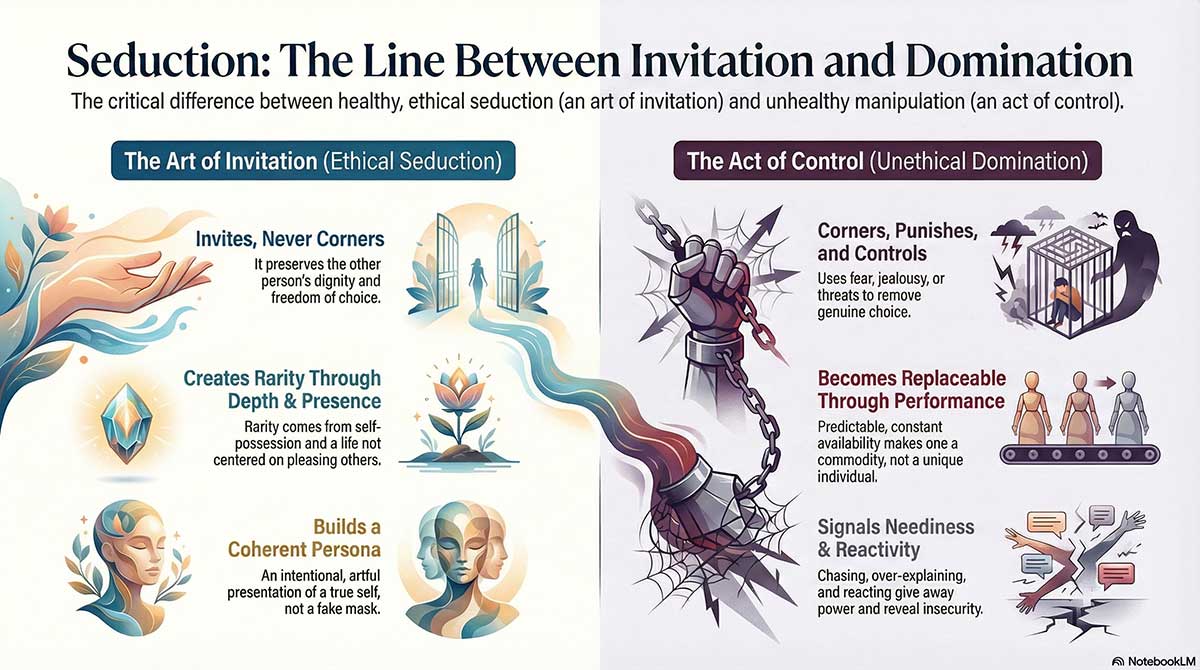
What I learned from this conversation is that seduction is far more fragile than the seducer imagines. People chase “power,” but the deepest power in seduction comes from self-command—and self-command is rare. It isn’t loud. It doesn’t demand. It doesn’t chase reassurance. It holds tension without reacting, and it allows desire to form without forcing outcomes. When I listened to these voices, a pattern became unmistakable: the healthiest seduction is not extraction. It is invitation—and invitation only works when the other person remains free.
I also walked away with a sharper understanding of what truly creates obsession: not beauty, not cleverness, not even charisma, but story—the narrative the other person begins living inside. The imagination falls first. Suspense keeps investment alive. Specificity creates rarity. And modern life—this endless market of choices—actually magnifies the hunger for what feels singular and real. The paradox is that the more people perform, the more they become replaceable. The more someone is willing to be present—calm, particular, grounded—the more they feel rare.
But the most important lesson was ethical, even if no one called it morality. There is a line, and it is not vague. The line is whether you preserve the other person’s dignity. If your method requires destabilizing someone, confusing them, punishing them, making them anxious so they cling—then you are not practicing an art. You are practicing domination. And domination always produces the same ending: resentment, emptiness, ruin. Seduction that matures understands this: the goal is not to capture someone. The goal is to awaken something in them that they choose to step toward.
If I were to reduce the entire book to one modern upgrade, it would be this: become a person with a life, a center, and a tempo. Let your presence do the work. Let restraint create space. Let your attention be deliberate, not cheap. And never mistake the ability to provoke emotion for the ability to create connection. The first can be done by anyone with tactics. The second requires character.
Short Bios:
Robert Greene
Author of The Art of Seduction and The 48 Laws of Power, Greene is known for exposing the hidden mechanics of influence, desire, and psychological power that operate beneath social life, romance, and ambition.
Esther Perel
A psychotherapist who explores desire, intimacy, and autonomy, Perel examines how attraction survives only when freedom and consent remain intact.
bell hooks
A writer and thinker who framed love as an ethical practice, bell hooks challenged domination, emotional manipulation, and power disguised as romance.
Hannah Arendt
A philosopher of power and responsibility, Arendt analyzed how control replaces relationship when freedom is surrendered for belonging.
Erving Goffman
A sociologist who described social life as performance, Goffman revealed how identity, role, and presence shape perception and attraction.
Oscar Wilde
A master of wit and self-invention, Wilde understood persona as an artistic exaggeration of truth rather than a rejection of it.
Marlene Dietrich
An icon of controlled mystery and self-possession, Dietrich embodied restraint, elegance, and the power of selective revelation.
David Bowie
An artist of continual reinvention, Bowie treated identity as a creative practice, showing how transformation itself can be magnetic.
Niccolò Machiavelli
A realist of power, Machiavelli analyzed how perception, independence, and timing govern loyalty, fear, and desire.
Baltasar Gracián
A philosopher of discretion and restraint, Gracián emphasized self-command, silence, and scarcity as the foundations of influence.
François de La Rochefoucauld
A sharp observer of vanity and emotional self-interest, La Rochefoucauld exposed the hidden motives beneath attraction and attachment.
Sun Tzu
Author of The Art of War, Sun Tzu taught that power lies in positioning, timing, and winning without force.
Giacomo Casanova
A legendary seducer and memoirist, Casanova understood desire as anticipation, imagination, and emotional momentum.
Colette
A writer of intimacy and perception, Colette explored how attention, curiosity, and observation keep desire alive.
Alfred Hitchcock
A master of suspense, Hitchcock demonstrated how withholding, pacing, and ambiguity activate the imagination.
Joseph Campbell
A scholar of myth, Campbell revealed how human desire follows narrative arcs of transformation and initiation.
Daniel Kahneman
A Nobel Prize–winning thinker, Kahneman studied cognitive bias, showing how attention, comparison, and perception distort desire.
Esther Perel
Returning to examine modern intimacy, Perel explores how depth, boundaries, and autonomy preserve desire in an age of excess access.
bell hooks
Returning to center ethics, hooks insists that love without dignity becomes domination, not connection.
Hannah Arendt
Returning to examine mass culture, Arendt warns how crowd-thinking and performance erode individuality and genuine encounter.
Leave a Reply