
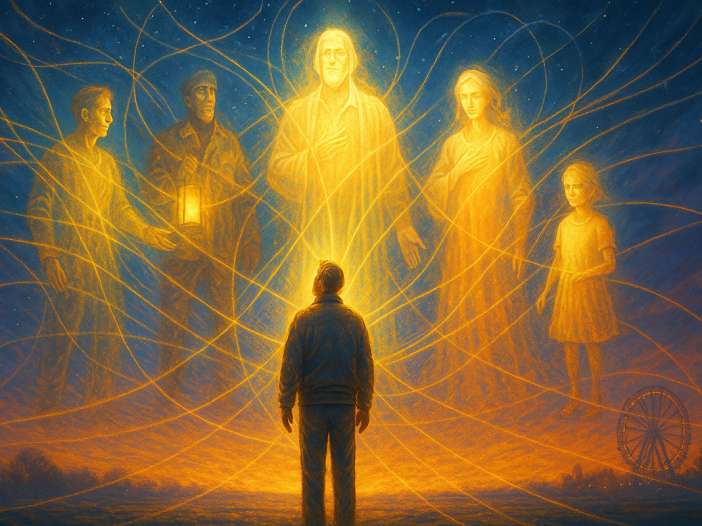

Introduction by Mitch Albom
“When I first wrote The Five People You Meet in Heaven, I wanted to remind us that no life is wasted, no act insignificant. Eddie, an ordinary man who thought his days amounted to little, discovered after his death that his story was bound to others in ways he never imagined.
In these conversations, we explore the five great lessons Eddie was given: that every life is connected, that sacrifice gives meaning, that forgiveness frees us, that love endures beyond death, and that purpose can be found in the most ordinary tasks. These are not just Eddie’s lessons — they are ours.
I invite you to listen as voices across wisdom, poetry, spirituality, and history illuminate these truths. Just as Eddie learned in heaven, you may discover that the simplest of lives can hold the deepest of meanings.
(Note: This is an imaginary conversation, a creative exploration of an idea, and not a real speech or event)

Topic 1: Connection: Every Life Touches Another

Moderator: Mitch Albom
Speakers: Carl Jung, Thich Nhat Hanh, Maya Angelou,Robin Wall Kimmerer
Mitch Albom (Moderator):
“When I wrote The Five People You Meet in Heaven, the first lesson Eddie received was from the Blue Man: that our lives are bound together in ways we rarely see. Let me ask you all — what does this truth of interconnectedness mean to you personally, and how do you see it shaping the way we live?”
Carl Jung:
“In my work, I found that beneath our individual minds lies the collective unconscious — symbols, archetypes, stories we all inherit. It means we are never solitary; every dream, every myth ties us together. Even when you think you act alone, you are participating in a shared pattern. This connection shapes not only our psyche, but our destiny.”
Maya Angelou:
“I have always said, we are more alike than we are unalike. When I speak of humanity, I see the quilt—stitched with different colors, different fabrics, but all one covering. Every time you smile, every time you hurt someone, that ripple goes further than you can imagine. Eddie’s story reminds us: there are no small lives, because each life touches another.”
Thich Nhat Hanh:
“In Buddhism, we use the word interbeing. A flower is made of sunshine, rain, soil, time, the gardener’s care. Without all these, no flower exists. In the same way, you are made of your ancestors, of your teachers, of strangers you may never meet. When Eddie saw the Blue Man, he saw that even a moment of childhood fear changed another life. This is not guilt — it is awareness. To live with interbeing is to live with compassion.”
Robin Wall Kimmerer:
“In the forest, no tree stands alone. Their roots intertwine, sharing sugars, sending warnings through fungal networks. When one tree falls, it feeds countless others. Human lives mirror this ecology. Eddie thought his work at the amusement park was small, but it held the safety and joy of generations of children. Connection is not metaphor; it is the very biology of our existence.”
Mitch Albom:
“Thank you all. Let me ask a second question: if we are so deeply connected, why do we so often live as though we are separate, even isolated?”
Maya Angelou:
“Because we forget. We let fear, pride, prejudice cover our sight. We forget that the stranger carries our story too. We need constant reminding — in poems, in books, in stories like Eddie’s — that no one walks this earth alone.”
Carl Jung:
“Separation is an illusion of the ego. The ego says: I, me, mine. But the unconscious knows better. The challenge of life is to pierce the veil of the ego and rediscover the shared soul beneath it.”
Thich Nhat Hanh:
“When we breathe in, we take the world into our body. When we breathe out, we give back. Even the act of breathing is connection. We live separate because we do not see this miracle. Mindfulness opens our eyes again.”
Robin Wall Kimmerer:
“Our culture teaches independence as strength. But nature teaches reciprocity. Separation is not power; it is loneliness. Reclaiming connection is the cure.”
Mitch Albom:
“Let me end with one final question: what is one practice, one habit, that each of us can do daily to honor our connection to others?”
Carl Jung:
“Pay attention to your dreams. They reveal the patterns you share with humanity.”
Maya Angelou:
“Offer kindness to a stranger. It reminds both of you that you belong to the same quilt.”
Thich Nhat Hanh:
“Breathe with awareness. When you breathe, you remember you inter-are.”
Robin Wall Kimmerer:
“Give thanks for the life around you — a plant, a bird, the water you drink. Gratitude is the daily act of connection.”
Mitch Albom (Closing):
“Eddie learned that even the smallest act ripples across lives. Today, you remind us that connection is both invisible and everywhere. To see it is to live differently, more kindly, more aware. Perhaps that is the truest gift of heaven — to realize we were never alone.”
Topic 2: Sacrifice: The Price of Love

Moderator: Mitch Albom
Speakers: Viktor Frankl, Nelson Mandela, Mother Teresa, Malala Yousafzai, Dietrich Bonhoeffer
Mitch Albom (Moderator):
“In The Five People You Meet in Heaven, Eddie’s captain teaches him that sacrifice is not a loss, but a gift — that giving one’s life for others is the ultimate act of love. Let me begin by asking: what does true sacrifice mean to you?”
Viktor Frankl:
“Sacrifice is not simply suffering. In the camps, I saw men who gave their last crust of bread to another. They chose meaning over despair. Sacrifice means taking pain that is unavoidable and using it to serve something greater than yourself. It transforms suffering into purpose.”
Mother Teresa:
“Love without sacrifice is an empty word. Every day with the poor, the sick, the dying, I saw this truth: to give up your comfort, your time, your strength — this is to touch Christ in disguise. It is not a burden, but joy disguised as hardship.”
Nelson Mandela:
“I spent twenty-seven years in prison. Some call it sacrifice; I call it necessity. Freedom is never given, it must be taken. If you are unwilling to lose something — your comfort, your safety — you will never gain justice. Sacrifice is not romantic. It is the price of dignity.”
Malala Yousafzai:
“I did not choose to be shot. But I chose what to do with it. Sacrifice means that even when violence tries to silence you, you stand taller. Education was my cause, and for that cause I accepted danger. Sacrifice is the moment you realize that your life is not just your own.”
Dietrich Bonhoeffer:
“The cost of discipleship is not cheap grace. It demands everything. Sacrifice is obedience to truth, even when it leads to death. Christ himself showed us: to love is to lose your life so that others may live. I could not do less, even under tyranny.”
Mitch Albom:
“Let me ask a second question: Why does sacrifice frighten us so much, if it is so essential to love and justice?”
Nelson Mandela:
“Because we love comfort more than freedom. We want change without cost. But liberation demands price — and those unwilling to pay it will forever be ruled by those who will.”
Viktor Frankl:
“Because we forget that sacrifice is voluntary meaning. We confuse it with meaningless suffering. When you see sacrifice as love embodied, it ceases to terrify and begins to dignify.”
Malala Yousafzai:
“Because sacrifice means risk, and risk means fear. But fear is not the end — it is the beginning of courage. The world teaches us to protect ourselves. Sacrifice teaches us to protect each other.”
Mother Teresa:
“We are afraid because sacrifice costs us our ego. The ‘I’ must give way to the ‘you.’ But when you see God’s face in another, fear dissolves. Love makes the burden light.”
Dietrich Bonhoeffer:
“Because sacrifice threatens the false gods of power and self. Tyranny depends on people who will not pay the price of truth. Sacrifice is a threat to evil itself.”
Mitch Albom:
“One last question: if each of you could give one piece of wisdom to those struggling with the idea of sacrifice, what would it be?”
Mother Teresa:
“Begin with small sacrifices. A smile, a moment of patience, a hand extended. These are seeds of greater love.”
Nelson Mandela:
“Do not fear sacrifice. Fear living without dignity. What you give may be heavy, but what it builds will outlive you.”
Viktor Frankl:
“Remember: suffering ceases to be suffering the moment it finds meaning. Ask not only ‘Why me?’ but ‘For what?’”
Malala Yousafzai:
“Your voice may shake, your life may be threatened, but do not retreat. Sacrifice is the bridge between fear and change.”
Dietrich Bonhoeffer:
“Sacrifice is costly. But the cost of refusing it is greater still — the loss of your soul.”
Mitch Albom (Closing):
“The Captain told Eddie that sacrifice is not something lost, but something passed on. Today, you remind us that the cost of love is high, but its return is infinite. To live without sacrifice is to live without love.”
Topic 3: Forgiveness: Letting Go of Anger

Moderator: Mitch Albom
Speakers: Desmond Tutu, Mahatma Gandhi, Immaculée Ilibagiza, Oprah Winfrey, Dalai Lama
Mitch Albom (Moderator):
“In The Five People You Meet in Heaven, Ruby teaches Eddie that holding onto anger only deepens wounds. True freedom comes when we forgive. Let me begin by asking each of you: what does forgiveness mean to you, and why is it so hard for us to embrace?”
Desmond Tutu:
“Forgiveness is not forgetting. It is remembering and choosing not to use the memory as a weapon. We learned in South Africa that without forgiveness, there is no future. People find it hard because forgiveness feels like weakness. But in truth, it is the only power that heals both victim and perpetrator.”
Mahatma Gandhi:
“Forgiveness is the fragrance that the violet sheds on the heel that has crushed it. It is the highest expression of nonviolence. We resist it because pride whispers that revenge restores dignity. Yet revenge only binds us to the chain of hatred. Forgiveness alone breaks it.”
Immaculée Ilibagiza:
“When my family was killed in Rwanda, my heart was filled with rage. But anger consumed me more than the killers ever could. In prayer, I discovered forgiveness. It did not excuse the crime; it freed me from being chained to it. We resist forgiveness because pain feels safer than peace, until we learn peace is stronger.”
Oprah Winfrey:
“Forgiveness is letting go of the hope that the past could be different. People hold onto anger because it feels like control. But in truth, it controls you. Forgiveness is not for them—it’s for you, to reclaim your power and your life.”
Dalai Lama:
“Forgiveness comes from understanding. When we see even those who harm us as trapped in ignorance and suffering, our anger softens. Forgiveness is not naive—it is wise compassion. It is difficult because our ego clings to pain as identity. To forgive is to let go of that false self.”
Mitch Albom:
“Thank you. Let me ask: what is the danger of refusing to forgive? What happens to us if we hold onto anger?”
Oprah Winfrey:
“You become stuck. Your story stops moving. Anger may feel powerful, but it drains life. Refusing to forgive means carrying your prison with you wherever you go.”
Immaculée Ilibagiza:
“Anger corrodes the soul. I saw people who survived the genocide but never forgave. They lived in shadow long after the violence ended. Forgiveness was the only way I could step back into the light.”
Desmond Tutu:
“When you refuse forgiveness, you allow the offender to live rent-free in your heart. You become chained to the very person who hurt you. And in that bondage, joy cannot live.”
Dalai Lama:
“Hatred poisons the mind, damages the body, and blinds the heart. The danger is not only spiritual—it is physical. You suffer twice: from the harm and from your own refusal to release it.”
Mahatma Gandhi:
“To refuse forgiveness is to refuse peace. Nations that cling to anger are doomed to endless war. Individuals who cling to anger are doomed to inner war. In both, the cost is the same: life wasted.”
Mitch Albom:
“One last question: what is one step people can take, even in deep pain, to begin forgiving?”
Desmond Tutu:
“Tell your story. Speak it, weep it, name it. In truth-telling begins healing.”
Mahatma Gandhi:
“Practice small forgiveness daily: forgive a slight, forgive an insult. The muscles of the soul grow strong with practice.”
Immaculée Ilibagiza:
“Pray for the one who harmed you. Even if at first the words feel empty, prayer changes your heart over time.”
Oprah Winfrey:
“Shift the focus from ‘what was done to me’ to ‘what I can create now.’ That shift is the doorway to forgiveness.”
Dalai Lama:
“See the humanity in the other. Understand their ignorance, their suffering. Compassion is the seed of forgiveness.”
Mitch Albom (Closing):
“Ruby told Eddie that anger is a poison you drink, hoping it will hurt someone else. Today, you’ve shown us that forgiveness is not forgetting—it is freedom. To let go is not weakness; it is the only way to live unchained.”
Topic 4: Enduring Love: Beyond Death

Moderator: Mitch Albom
Speakers: Elizabeth Gilbert, C.S. Lewis, Rumi, Joan Didion, Ocean Vuong
Mitch Albom (Moderator):
“In The Five People You Meet in Heaven, Eddie reunites with his wife Marguerite. She shows him that love never dies—it changes form, but it endures. Let me begin by asking: how do you understand love that continues beyond death?”
Elizabeth Gilbert:
“When my partner died, I discovered that grief is just love with nowhere to go. Yet even when the body is gone, the love remains—unfolding in memory, in the choices we make, in the way we carry them forward. Love is not ended by death; it is only transformed.”
C.S. Lewis:
“In A Grief Observed, I wrote of the terrible silence after my wife’s passing. Yet through that silence, I came to see that love belongs to eternity, not to time. Our mortal loves are the shadows of an eternal love. Death does not break love; it purifies it.”
Rumi:
“Love is the bridge between you and everything. When the beloved departs, the form falls away but the essence remains. Love is not of the body, it is of the soul. Death does not end love—it reveals its true nature, eternal and boundless.”
Joan Didion:
“In grief, I learned that the mind holds on, sometimes irrationally. I kept my husband’s shoes, as if he might return. That clinging was my way of wrestling with absence. Love beyond death is complicated: it is faith and denial, memory and ache. But it is real, because it shapes the living.”
Ocean Vuong:
“My mother is gone, but in language she breathes. Every time I write, I resurrect her voice. Love beyond death is not only memory—it is creation. We build new worlds with the love that survives, and in those worlds the departed live again.”
Mitch Albom:
“Thank you. Let me ask: why do we struggle so much to accept that love endures when the body does not?”
C.S. Lewis:
“Because we are creatures of flesh, bound to time. We confuse the vessel with the treasure. When the vessel breaks, we despair, forgetting that the treasure remains.”
Elizabeth Gilbert:
“Because grief feels like betrayal of our senses. We can’t see them, touch them, hold them—and so we think they’re gone. But absence is only another form of presence. It just takes time to recognize it.”
Rumi:
“Because we fear emptiness. Yet emptiness is the door. When we let go of the body, we discover the soul. To lose the form is to find the essence.”
Joan Didion:
“Because the human heart resists change, even when it’s inevitable. Death is the greatest change. We struggle because we want permanence in a world that is never permanent.”
Ocean Vuong:
“Because grief is messy. Love beyond death is not clean or easy. It’s full of contradictions—pain and beauty tangled together. We resist it because it doesn’t fit neatly into our lives. But that’s also why it’s real.”
Mitch Albom:
“One last question: what is one way we can keep love alive after someone we cherish has passed?”
Elizabeth Gilbert:
“Tell their story. Speak their name often. Keep them present in the room through memory.”
C.S. Lewis:
“Live as they would have wished you to live—carry their love into your own actions.”
Rumi:
“Seek them not with your eyes, but with your heart. The heart knows no death.”
Joan Didion:
“Write it down. Memory is fleeting, but words hold love in place, at least for a time.”
Ocean Vuong:
“Make something with your grief—poems, gardens, songs. Creation is how love outlives us.”
Mitch Albom (Closing):
“Marguerite told Eddie that love never dies. You’ve each shown us that while death takes away the body, it cannot touch the bond. Love endures as story, as creation, as essence, as memory. And perhaps that is heaven itself: to realize love is eternal.”
Topic 5: Purpose: Finding Meaning in the Ordinary

Moderator: Mitch Albom
Speakers: Dalai Lama, Pema Chödrön, Mister Rogers, Paulo Coelho, Howard Thurman
Mitch Albom (Moderator):
“In The Five People You Meet in Heaven, Eddie meets Tala, the little girl whose death haunted him. She tells him that his work at Ruby Pier was not meaningless—it was sacred, because he kept children safe. This raises the question: how do we find purpose in what seems ordinary?”
Dalai Lama:
“Purpose is not only in great acts. It is in the smile you give, the kindness you show, the care you bring to each day. Even washing dishes, if done with love, is service. Eddie’s work at the amusement park was ordinary, yes—but it carried extraordinary compassion. True purpose is found in service, not scale.”
Pema Chödrön:
“We often wait for purpose to arrive as some grand revelation. But purpose is discovered in the very moment you are in. Even pain can be meaningful if it teaches us to open our hearts. Eddie’s lesson shows us: you do not need a different life to find purpose—you need a different lens.”
Mister Rogers:
“I used to tell children: look for the helpers. Purpose is being that helper in small, steady ways. Eddie kept the rides safe—children never knew his name, but his care gave them joy. That is purpose. It’s in the simple things, done faithfully, that love is made visible.”
Paulo Coelho:
“In The Alchemist, I wrote that your ‘Personal Legend’ is often hidden in the ordinary. The treasure is where you stand. Purpose is not somewhere else—it is here, disguised as daily life. Eddie’s true treasure was his work, which seemed small to him but touched thousands. The ordinary is the extraordinary in disguise.”
Howard Thurman:
“Don’t ask what the world needs. Ask what makes you come alive, and go do it. Because what the world needs is people who have come alive. Eddie’s purpose was not in wealth or fame, but in his devotion. It made him alive, even if he did not see it until the end.”
Mitch Albom:
“Thank you. Let me ask: why do we overlook ordinary purpose? Why do we chase big lives instead of valuing small, meaningful ones?”
Paulo Coelho:
“Because we believe stories of greatness are always loud. But real greatness is often quiet, hidden in daily choices. The world tricks us into searching far, when purpose is near.”
Pema Chödrön:
“Because we resist simplicity. We think it’s not enough. Yet simplicity is where peace lives. We run from it, when in fact it’s what we most need.”
Dalai Lama:
“We confuse success with purpose. Success is measured by others; purpose is known only by the heart. Eddie felt like a failure because he measured wrongly.”
Mister Rogers:
“Because we don’t always see how small acts ripple out. A kind word today may heal someone tomorrow. Ordinary purpose is invisible until time reveals it.”
Howard Thurman:
“Because we silence the genuine sound of our souls. We chase what others applaud instead of what makes us alive. Purpose hides under the noise of imitation.”
Mitch Albom:
“One last question: what is one practice we can adopt to recognize and honor purpose in the ordinary?”
Dalai Lama:
“Begin each day with the intention to serve—even in the smallest way.”
Pema Chödrön:
“Sit with the present moment, without fleeing. Purpose is always here.”
Mister Rogers:
“Pay attention to the unnoticed. A neighbor, a child, a small kindness. That’s where purpose begins.”
Paulo Coelho:
“Treat each act as if it holds treasure—because it does.”
Howard Thurman:
“Listen for what makes you come alive. Follow it, even in humble tasks.”
Mitch Albom (Closing):
“Tala showed Eddie that even fixing rides was sacred, because it gave joy and safety to others. Today, you’ve reminded us that purpose is not a distant prize, but a daily practice. The ordinary, lived with love, is extraordinary. That is where meaning lives.”
Final Thoughts by Mitch Albom
When Eddie first arrived in heaven, he thought his life had been wasted. He saw himself as ordinary, small, unnoticed. But as he met the five people who touched his life, he discovered that every thread mattered—that the ride he maintained, the sacrifice he made, the love he carried, the forgiveness he found, and the purpose he lived all intertwined into something vast and meaningful.
Listening to these voices, I am reminded that Eddie’s story is not just Eddie’s. It belongs to all of us. Connection teaches us we are never alone. Sacrifice reminds us love often comes at a cost. Forgiveness frees us from anger’s prison. Enduring love shows us that death does not end what is eternal. And purpose, perhaps the greatest lesson, proves that even the smallest life can leave behind something immeasurable.
In the end, heaven is not a faraway place. It is found in the way we live, the way we touch each other, and the way we discover meaning in the ordinary. That is the story Eddie lived. And perhaps, if we listen, it can be our story too.
Short Bios:
Mitch Albom
American author, journalist, and broadcaster best known for inspirational books like Tuesdays with Morrie and The Five People You Meet in Heaven. His work blends storytelling with reflections on love, mortality, and meaning.
Carl Jung
Swiss psychiatrist and founder of analytical psychology. Known for concepts like the collective unconscious and archetypes, Jung explored the hidden patterns connecting all human lives.
Thich Nhat Hanh
Vietnamese Zen master, peace activist, and poet. He introduced the idea of “interbeing,” teaching that all life is interconnected and compassion flows from that awareness.
Maya Angelou
American poet, singer, and memoirist. Through works like I Know Why the Caged Bird Sings, she celebrated resilience, humanity, and the bonds that unite us.
Robin Wall Kimmerer
Potawatomi botanist and author of Braiding Sweetgrass. She blends indigenous wisdom with science, showing how humans are woven into nature’s web of reciprocity.
Viktor Frankl
Austrian neurologist, psychiatrist, and Holocaust survivor. Author of Man’s Search for Meaning, he taught that purpose is found through suffering, responsibility, and love.
Nelson Mandela
South African anti-apartheid leader and president. Imprisoned for 27 years, he became a global symbol of sacrifice, justice, and reconciliation.
Mother Teresa
Catholic nun and missionary who founded the Missionaries of Charity. She dedicated her life to serving the poorest of the poor in Calcutta, embodying love through sacrifice.
Malala Yousafzai
Pakistani activist for girls’ education and youngest-ever Nobel laureate. Surviving an assassination attempt, she became a symbol of courage and selfless advocacy.
Dietrich Bonhoeffer
German theologian and anti-Nazi dissident. Executed for resisting Hitler, he is remembered for his writings on costly discipleship and moral courage.
Desmond Tutu
South African Anglican archbishop and Nobel Peace Prize laureate. He chaired the Truth and Reconciliation Commission, emphasizing forgiveness as the path to healing.
Mahatma Gandhi
Indian leader of nonviolent resistance against British rule. He taught that forgiveness and nonviolence were the strongest weapons for justice and peace.
Immaculée Ilibagiza
Rwandan genocide survivor and author of Left to Tell. She forgave those who murdered her family, becoming an advocate for peace and reconciliation.
Oprah Winfrey
American media leader and philanthropist. Through her platform, she has shared personal journeys of forgiveness and healing, influencing millions worldwide.
Dalai Lama
The spiritual leader of Tibetan Buddhism and Nobel Peace Prize laureate. His teachings center on compassion, forgiveness, and universal responsibility.
Elizabeth Gilbert
American author of Eat Pray Love and Big Magic. She writes about love, grief, and creativity, reflecting on how relationships continue after loss.
C.S. Lewis
British writer and Christian apologist, author of The Chronicles of Narnia and A Grief Observed. His reflections on love and faith remain influential.
Rumi
13th-century Persian Sufi poet and mystic. His verses explore divine love, union, and the eternal soul, transcending time and culture.
Joan Didion
American writer and journalist. In The Year of Magical Thinking, she chronicled grief and enduring love after her husband’s death.
Ocean Vuong
Vietnamese-American poet and novelist, author of On Earth We’re Briefly Gorgeous. His work captures love, grief, and the persistence of memory.
Pema Chödrön
American Buddhist nun and teacher. She writes about mindfulness, compassion, and finding meaning in ordinary moments and suffering.
Mister Rogers (Fred Rogers)
American television host, creator of Mister Rogers’ Neighborhood. He embodied kindness and showed generations that ordinary acts of care create extraordinary impact.
Paulo Coelho
Brazilian novelist, author of The Alchemist. His work explores destiny, purpose, and the sacred hidden in everyday life.
Howard Thurman
American theologian, mystic, and civil rights leader. He emphasized inner spiritual vitality and the importance of listening to “the sound of the genuine” within.
Leave a Reply