

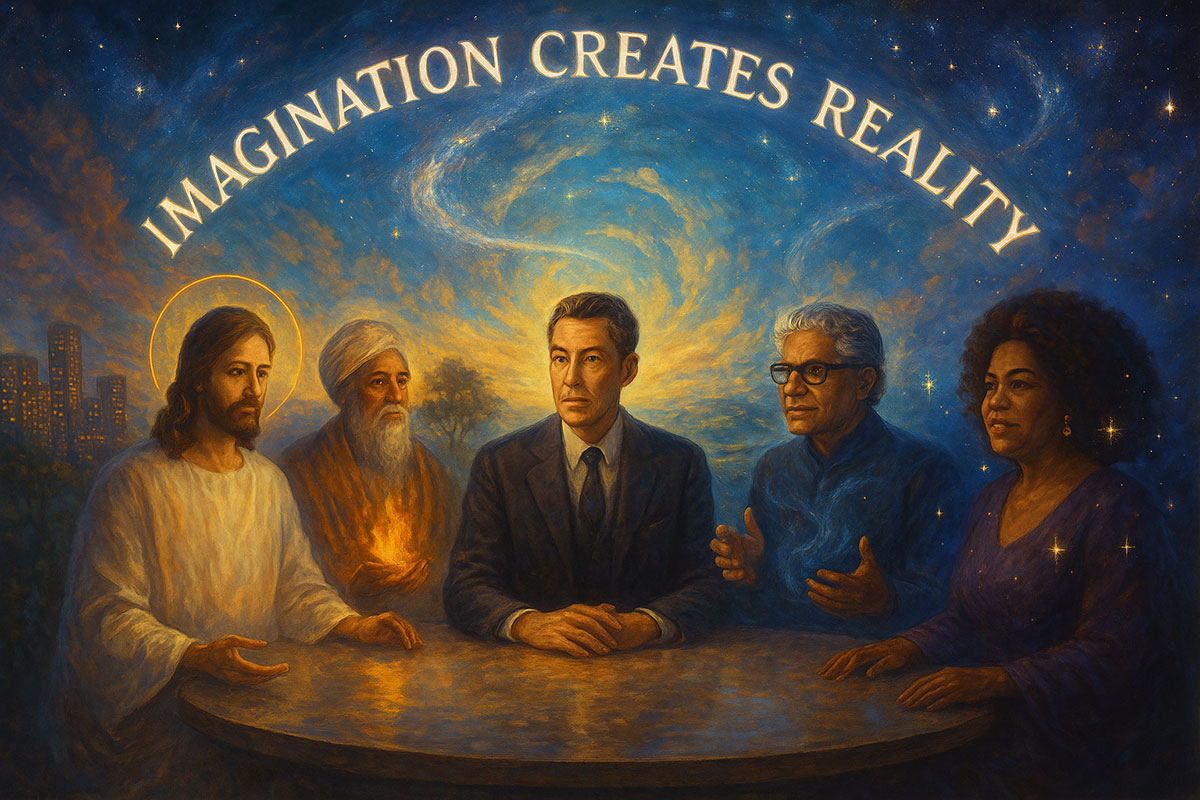
Neville Goddard:
Welcome, my friends.
You are here not by accident, but by inner compulsion—drawn by the whisper of something greater, something truer than the noise of the world. I tell you now: you are not a spectator in this life. You are not a victim of fate, of circumstance, or of the past. You are the operant power.
These conversations you are about to enter are not speculative musings. They are demonstrations—of principle, of law, of truth. The imagination you’ve been taught to dismiss is the very seat of creation. What you dare to assume as true—persisted in with feeling—will become your reality.
We shall explore the Law of Assumption, the myth of hustle, the secret of feeling, the power to revise time, and the great mystery: that you are the creator of your world. Not by striving, but by being. Not by asking how, but by assuming it is already so.
These voices you’ll hear—from sages and scientists, poets and prophets—will not agree on all things. Nor should they. But each speaks from a place of experience, and each points back to the same central truth: imagination, when felt as real, becomes reality.
Let us begin—not by seeking more, but by accepting that you already are all that you could ever hope to be.
(Note: This is an imaginary conversation, a creative exploration of an idea, and not a real speech or event.)

Topic 1: The Law of Assumption — Can Inner Conviction Override Physical Reality?

Moderator: Oprah Winfrey
Participants: Neville Goddard, Carl Jung, Esther Hicks (Abraham), Dr. Joe Dispenza, Alan Watts
Oprah Winfrey:
Let’s begin with the core idea Neville Goddard famously taught: Imagination creates reality. But for many people, imagination feels like escape, not creation. So here’s the question: Can inner conviction alone override physical reality? Can assuming something as true—deeply and persistently—actually reshape the world around us?
Esther Hicks (Abraham):
Absolutely. The vibration of your belief is more powerful than action without alignment. Most people try to change the world through effort, but energy precedes form. When you assume with conviction, you are tuning into a frequency where that reality already exists—and Law of Attraction matches you with it. The moment you believe something as real, the universe starts arranging cooperative components. It's not magic; it's resonance.
Carl Jung:
From a psychological point of view, what we assume internally shapes the filter through which we perceive reality. The unconscious mind—the archetypal world—projects its contents onto the outer world. In this sense, assumption is a form of psychic projection. The stronger and more integrated the assumption, the more the outer world appears to "change" because we are now perceiving and interpreting it differently. It is not only belief; it is transformation of the perceiver.
Neville Goddard:
I must affirm—yes, inner conviction absolutely overrides what we call "reality." Reality is only a reflection of what is impressed upon consciousness. What you feel to be true, if persisted in, will harden into fact. When you assume the feeling of the wish fulfilled, you are planting a seed in the infinite. It doesn't matter if the senses deny it. The senses are delayed echoes of past assumptions. Change your assumption, and the world must follow—it has no choice.
Alan Watts:
Well, I’d say—it’s not so much about "overriding" physical reality, but realizing that physical reality is not as fixed as we think. It is not a prison; it’s a mirror. When you begin to understand that the self and the world are not separate, that there’s no true boundary between the inner and outer, then of course your inner state will affect what seems to be "out there." The illusion is that there is a solid reality independent of consciousness. But that was never true to begin with.
Dr. Joe Dispenza:
We’ve measured this. When a person enters a mental and emotional state aligned with their future, their brain and body begin to reflect that future before it even arrives. That’s not philosophy—that’s neuroscience. Their biology changes. They signal new genes. The body doesn’t know the difference between a deeply imagined experience and a real one. When they stay in that state long enough, the world begins to respond in kind. This is how inner conviction literally changes matter.
Oprah Winfrey:
What you're all saying is deeply powerful. But here's what people often ask me: What about doubt? What if someone wants to believe, but their senses keep showing them lack or failure? How do you persist in assumption when everything outside screams the opposite?
Alan Watts:
You dance with it. You don’t try to crush doubt. That creates tension. Instead, you allow the doubt to rise and fall like a wave, and you realize that you are not the doubt—you are the awareness in which doubt appears. By observing it, not identifying with it, you gently return to your vision. The mistake is thinking you must feel certain all the time. You don’t. You just need to return to the center again and again.
Neville Goddard:
I taught the principle of revision for exactly this reason. When reality contradicts your assumption, do not accept it—revise it in imagination. If a bill comes, imagine it as a check. If someone rejects you, imagine them embracing you. You are not bound to the outer world. Your imagination is the creative power of God within you. Use it. Persist. When the senses scream "no," whisper back in silence, "It is already done."
Dr. Joe Dispenza:
The body is addicted to its emotional past. Doubt is often just the chemical residue of past failures. So when you begin to live from a new state, the body resists. That’s normal. You overcome it not by fighting, but by reconditioning yourself. Meditation, breathwork, elevated emotion—these tools retrain the body to live in a new reality. It's not about denying what is, it's about conditioning yourself to feel what’s coming before it arrives.
Esther Hicks (Abraham):
Doubt is just the absence of alignment. When you notice it, you don’t fight it—you soothe yourself. You say, “This is just a thought. I can choose a better one.” Reach for better-feeling thoughts. Even slightly better ones. From “I’ll never get rich” to “Maybe something good is coming.” Your assumption doesn't have to be perfect—it just needs to be dominant. Belief is built by momentum. Don't jump to the top floor. Climb the stairs emotionally.
Carl Jung:
You must become intimate with the shadow. Doubt is not your enemy—it is your teacher. It shows you where your unconscious beliefs still oppose your conscious desires. Bring them into awareness, and they lose their power. You do not overcome doubt by pretending it doesn't exist, but by integrating it—then transforming it. That is how the assumption becomes whole.
Oprah Winfrey:
So beautifully said. For our last reflection: What does it feel like—internally, emotionally, spiritually—when someone has truly entered the state of the wish fulfilled? What signs, if any, indicate that the assumption is now a living part of them?
Carl Jung:
They radiate a calm certitude—not arrogance, but wholeness. They are no longer seeking outside validation. Their energy is centered. The outer world begins to mirror this coherence in subtle ways—opportunities appear, people respond differently, the unexpected becomes normal. But more than anything, they begin to feel at home in themselves.
Neville Goddard:
You know you've entered the state when it becomes natural. You no longer have to force the feeling. You are the thing you desire. You carry yourself differently. There is no longer a question of if—only when, and eventually not even that. You walk in conviction. You speak with the voice of fulfillment. The world starts rearranging, yes—but the true miracle is the peace within.
Dr. Joe Dispenza:
There’s a biological coherence. The heart and brain enter harmony. Stress hormones diminish. Creativity flows. People say they feel “tapped in.” Time feels different. You begin to anticipate miracles instead of fear problems. It’s not wishful thinking—it’s embodiment. You’re becoming the future before it happens. That’s the signal you’re aligned.
Esther Hicks (Abraham):
You feel ease. Relief. Joy without condition. You’re no longer trying to make it happen—you’re allowing it. It’s like a vibration that hums beneath everything. The desire no longer feels like something missing. It feels like something arriving.
Alan Watts:
Ah, yes. It feels like a return. Like remembering something you never knew you knew. You laugh more. You try less. You realize you were never separate from the thing you sought. The actor and the role merge. You are the dreamer, and the dream.
Oprah Winfrey (Closing):
That was extraordinary. Thank you, each of you, for sharing your wisdom. What I’m hearing is this: when we persist in inner conviction, despite appearances, something sacred shifts. We stop chasing life—and life begins responding to who we already are inside.
And that... may just be the real miracle.
Topic 2: Wealth Without Effort — Is Hustle Culture a Spiritual Distraction?

Moderator: Naval Ravikant
Participants: Neville Goddard, Tim Ferriss, Reverend Ike, Oprah Winfrey, Wallace Wattles
Naval Ravikant:
People today are obsessed with hustle. They equate long hours and hard work with self-worth, success, and even morality. But Neville, you taught that assumption—not action—is the key to wealth. So let’s begin here: Is hustle culture actually a distraction from true spiritual wealth creation?
Reverend Ike:
Let me say it loud: God doesn’t want you broke and busy. Hustle culture is rooted in the belief that suffering is noble and that riches come from toil. That’s a lie. Real wealth flows from belief, not burnout. I never hustled—I assumed my wealth. I preached my wealth. And I received it. Your divine imagination is the real currency. Everything else is just sweat without spirit.
Oprah Winfrey:
In my early career, I worked hard, yes. But the breakthrough didn’t come from doing more—it came from aligning more. When I believed I was meant for something greater, everything changed. Hustle is empty without vision. When I stopped proving my worth and started living it, doors flew open. Hustle isn’t the problem. Needing to hustle to feel worthy—that’s the problem.
Neville Goddard:
I’ve said before, you do not have to lift a finger to make it so. Assume the feeling of the wish fulfilled, and the world will conform. Hustle culture distracts the mind. It keeps it busy, but unawakened. It feeds the illusion that effort creates, when in truth—consciousness creates. The assumption, held in feeling and persisted in, is the only true labor.
Wallace Wattles:
There is a science to getting rich, and it is not based in hard labor. It is based in thinking in a certain way. Hustle arises when people operate in a competitive mode, believing resources are scarce. But the creative mode is abundant. You do not hustle the sun into rising—it rises because it must. Wealth is the same. It flows when your mind aligns with its laws.
Tim Ferriss:
I’ve interviewed hundreds of peak performers. You know what they all have in common? They work smart, not endlessly. Hustle is often the path of the uninformed. Most people hustle to avoid thinking. But real leverage—tools, code, capital, media—comes from clarity, not chaos. The inner world creates the outer. Neville’s teachings are the deepest leverage I’ve found.
Naval Ravikant:
So if effort isn’t the driver, what is? Here’s my next question: What’s the actual mechanism by which assumption or belief translates into material wealth? How does an inner state manifest as dollars in the bank or opportunities in the world?
Oprah Winfrey:
When you’re in alignment with what you believe is yours, you start saying “yes” differently. People feel your certainty. Opportunities arrive, not because you chased them, but because you were already ready for them. When I believed I was worthy of abundance, I attracted rooms I once thought were closed. That inner shift changed what I noticed—and what noticed me.
Neville Goddard:
Imagination is the divine center. When you assume something with feeling, you impress it upon the subconscious. And the subconscious, connected to the infinite, orchestrates a bridge of incidents—events you could never predict—to bring it about. You do not make it happen. You let it happen by remaining faithful to the end. The outer is merely the echo of the inner.
Wallace Wattles:
You must move from competition to creation. When you form a clear, definite vision, and hold to it with gratitude and purpose, your actions become infused with power. Not frantic action—but intelligent action, guided by spirit. The mechanism is law—just as certain as gravity. You create by impressing your thought upon formless substance, and it responds unfailingly.
Tim Ferriss:
The subconscious brain controls 95% of our behavior. So when belief becomes identity, you make better decisions without even noticing. You walk into a room differently. You send that bold email. You try the crazy idea. And people respond. Wealth follows conviction. Assumption rewires the nervous system to play on a different level—a level most never reach because they’re too tired from grinding.
Reverend Ike:
I always said, “The lack of money is the root of all evil.” Why? Because it creates fear—and fear clouds faith. But when you believe you are rich in spirit, your vibration changes. People treat you differently. Ideas flow. Checks come. That’s not luck—that’s law. The universe says yes to whatever you truly believe, so believe something good and claim it like you already own it.
Naval Ravikant:
All right—final question. For someone who’s just now realizing they’ve bought into the hustle lie, how do they shift? What’s the first step toward replacing effort-based identity with assumption-based abundance?
Tim Ferriss:
Stop glorifying exhaustion. Audit your beliefs. Where did you learn that rest equals laziness? Then experiment: try 10 minutes a day of imagining success—not goals, but the feeling of success. See how uncomfortable that is. That’s your edge. If you keep going, the discomfort becomes naturalness—and that’s where your leverage begins.
Neville Goddard:
Go into a quiet place and ask, “What would it feel like if it were already true?” Do not analyze—feel. Make that feeling realer than your current bank account. Return to it morning and night. Let it be your secret. The outer world need not know. In time, it will reflect your inner world—because it must.
Oprah Winfrey:
Your worth isn’t measured by your output. It never was. You begin by believing that you are worthy of ease, joy, and abundance. Speak to yourself with gentleness. Let go of the struggle story. Replace it with “I am available for miracles.” Once that becomes your story, you’ll be amazed how life responds.
Wallace Wattles:
Begin with gratitude. Gratitude for what you have, and for what you know is coming. Gratitude lifts you into a creative state. Then act—not with desperation, but with purpose. Combine your thought with unwavering faith, and the results will astonish you. But you must begin within.
Reverend Ike:
I’ll give it to you straight: stop saying “I can’t afford it.” That’s poverty talk. Say “I accept divine wealth now.” Say it when you feel broke. Say it when you doubt. Say it until your subconscious gets the memo. Because when you assume wealth, you’re not lying to yourself—you’re telling the truth before the world catches up.
Naval Ravikant (Closing):
What a powerful conversation. It seems we all agree: wealth begins inside. Hustle without alignment is friction. But when imagination, belief, and identity align—the world moves effortlessly. Don’t trade your peace for productivity. Trade your doubt for assumption. That’s real leverage.
Topic 3: The Feeling is the Secret — How Does Emotion Shape Reality?

Moderator: Dr. Gabor Maté
Participants: Neville Goddard, Brené Brown, Gregg Braden, Anita Moorjani, Thich Nhat Hanh
Dr. Gabor Maté:
Neville taught that feeling is the secret—that it’s not just the thought, but the emotional experience of the thought that manifests reality. That resonates with my work in trauma and healing. So let’s begin here: What is it about “feeling” that makes it such a powerful creative force in shaping our reality?
Brené Brown:
Feeling is the language of the soul. Thoughts may spark ideas, but it’s emotion that makes something stick. Shame, joy, worthiness—these aren't just concepts. They determine what we believe we deserve. If someone carries the emotional belief that they’re unworthy, no matter how hard they work, they’ll sabotage success. Emotion doesn't just color our reality—it constructs it.
Neville Goddard:
Precisely. The world responds not to what you want, but to what you feel to be true. Emotion is the substance that impresses the subconscious. It is not enough to say “I am rich”—you must feel the joy, the freedom, the power of already being so. That felt reality, when persisted in, becomes your external reality. It is divine alchemy.
Gregg Braden:
Emotion creates coherence between the heart and brain. When you're in a state of elevated emotion—gratitude, compassion, certainty—your nervous system enters harmony. That state of coherence is a broadcast signal. The field around you changes. It’s not just that you see the world differently—it literally begins to change in response to your frequency.
Anita Moorjani:
In my near-death experience, I learned that feeling is the energy that connects us to everything. When we feel love or peace, we're in alignment with our true nature. It's like turning on a lighthouse inside us. The universe responds to that light—not to our words, or even our thoughts alone, but to our emotional signature. That’s how I healed. I felt well before I became well.
Thich Nhat Hanh:
Feeling is the present moment speaking through you. When you are fully present with your breath, with your body, you feel life directly—not as an idea, but as truth. This presence is very powerful. It brings compassion, and compassion creates peace. Peace within becomes peace without. Feeling is not weakness—it is clarity.
Dr. Gabor Maté:
Thank you. That brings me to my next question, which many trauma survivors ask: If your emotional baseline is fear, shame, or scarcity—how do you begin to shift toward the feelings that manifest abundance and healing?
Neville Goddard:
Begin in imagination. Even if you feel afraid, you can construct a scene that implies your freedom. Do not wait to feel perfect—feel different. Imagine a moment of triumph. Imagine a voice saying “I’m so proud of you.” Create it vividly. If you do this often and with sincerity, your emotional state will begin to shift. You are never a prisoner of your past feeling—you are its author now.
Anita Moorjani:
You begin by loving the one who is afraid. When I was sick, I tried to force positivity. That didn’t work. What did work was accepting myself in fear, and gently reaching for better feelings. You don’t climb a mountain in one step. You find the next better emotion—maybe hope, maybe curiosity. From there, the heart starts to open.
Brené Brown:
I teach people to build emotional vocabulary. “Fear” often hides grief, or abandonment, or shame. Naming it is the first shift. Then, surround yourself with safe people and safe language. You don’t fake abundance—you practice trust. That’s the soil where new feelings grow. It’s tender, but it’s strong.
Gregg Braden:
Emotion follows focus. Shift your attention to something beautiful—sunlight through a window, a loved one’s laughter. Let that moment land in your heart. Science calls this “heart coherence,” but it’s ancient wisdom. The more you tune into love and gratitude, even for a few minutes a day, the more it becomes your default. You’re training the instrument of your being.
Thich Nhat Hanh:
Sit with your fear. Breathe with it. Do not push it away. Say, “Hello, fear. I see you.” When you smile at fear, it softens. When you offer love to pain, it becomes a teacher. Slowly, the cloud lifts, and the sun of joy shines again. The shift does not come by force. It comes by gentle return.
Dr. Gabor Maté:
That’s deeply moving. Final question: When someone is truly living in the feeling of the wish fulfilled, what changes in them? What does it look like to walk through the world in that emotional alignment?
Gregg Braden:
They move with confidence, but not arrogance. They’re grounded, centered, generous. You can feel their energy in the room. They’re not waiting for good things—they’re expecting them. They smile without a reason. Life begins to organize itself around their alignment, because they’ve become magnetic.
Thich Nhat Hanh:
They become very peaceful. They no longer chase. They walk slowly. They listen deeply. They enjoy a cup of tea with full awareness. Because they know: joy is not at the end of the journey. Joy is the way.
Neville Goddard:
When you live from the feeling of the wish fulfilled, doubt disappears. You no longer ask “When will it come?”—because in your heart, it is already here. You feel relief. You act from wealth, not toward it. You become what I call the new man, and the world responds in kind. You are no longer trying to change reality—you are being the change.
Anita Moorjani:
You glow. People say, “There’s something about you.” You stop apologizing. You speak kindly, but with clarity. You laugh more. Life becomes lighter, because you’re no longer resisting who you truly are. You become a home to your own spirit—and others feel safe in your presence.
Brené Brown:
You’re no longer hustling for worth. You walk into the room already knowing you belong. That’s the biggest shift. Your self-talk changes. You celebrate others without shrinking yourself. That’s emotional alignment. That’s spiritual wealth.
Dr. Gabor Maté (Closing):
Beautiful. What I hear from all of you is that feeling—when nurtured consciously—becomes the bridge between inner truth and outer transformation. Whether it’s healing trauma or manifesting abundance, we don’t think our way there. We feel our way home.
Topic 4: Revision, Imagination, and Time — Can the Past Be Changed?

Moderator: Eckhart Tolle
Participants: Neville Goddard, Stephen Hawking, Dr. Brian Weiss, Carl Sagan, Jane Roberts (Seth)
Eckhart Tolle:
Neville, you taught something radical: that the past can be revised—not just reframed, but imaginatively altered in a way that changes its effect on the future. That challenges our entire perception of time. So here’s our opening inquiry: Can we truly change the past—and if so, how does imagination alter something we believe to be fixed?
Neville Goddard:
The past is not fixed—it lives in memory, and memory is malleable. When you revise a past event in imagination and persist in the new version, the subconscious accepts it. And once accepted, it alters your reactions, beliefs, and circumstances going forward. The seed of your future is planted in your imagined past. What matters is not what happened, but what you believe happened. And belief is always subject to revision.
Carl Sagan:
From a materialist lens, the past is a recorded sequence. But even in science, the observer is never neutral. What we “remember” is already filtered. It’s plausible that by changing the emotional interpretation of the past, we shift its influence on us. Whether you call it revision or neural rewiring, it works. The cosmos may be vast, but our experience of time? That’s deeply subjective.
Jane Roberts (Seth):
All time is simultaneous. The past is not “back there” and the future is not “ahead.” They are points of focus. When you revise a memory, you shift the energetic trajectory of your life. You’re not lying to yourself—you are choosing a version of reality aligned with your growth. There are many pasts, and your consciousness selects the one that defines you now.
Stephen Hawking:
In physics, time is more complex than a straight line. Under general relativity, the past and future are not as separate as they appear. While we don't "rewrite" physical events, our brain's perception of time is highly flexible. If changing a memory’s narrative changes your brain chemistry, your behavior, and your outcomes—then functionally, yes, you’ve changed the past.
Dr. Brian Weiss:
I’ve seen this in regression therapy. When someone accesses a traumatic memory and reimagines it from a place of love or empowerment, their symptoms vanish. Their health changes. Their relationships transform. It’s not denial—it’s healing. The soul does not live in linear time. It lives in lessons, and when a lesson is re-integrated, the past dissolves like fog.
Eckhart Tolle:
Thank you. That leads us into the heart of presence. My next question is this: If we are constantly re-creating our story through imagination, what role does stillness or presence play in this process? Does imagination risk becoming escapism, or is it a deeper form of awakening?
Jane Roberts (Seth):
There’s a difference between escaping reality and reshaping it. Escapism avoids responsibility. Conscious imagination, on the other hand, is creative sovereignty. When used from presence, imagination becomes the divine canvas. It is a tool of awakening. You are not escaping—you are claiming authorship of the life you prefer to experience.
Stephen Hawking:
Stillness is observation without interference. It allows you to see the structure of thought. Imagination can certainly be fantasy—but when anchored in awareness, it becomes hypothesis. A scientist imagines new realities before proving them. So does the soul. Stillness lets you differentiate between delusion and design.
Neville Goddard:
I taught: go into the silence. That is where imagination becomes real. In stillness, you withdraw attention from the outer world and enter the kingdom within. There, you are free to feel what ought to be true. This is not escape—it is creation. When you return to the world, it carries the mark of your inward act.
Dr. Brian Weiss:
Presence is necessary for healing. When we are not present, we re-live pain unconsciously. But when we bring awareness into memory, we loosen its hold. Imagination then becomes the vehicle for resolution, not avoidance. The body softens. The heart opens. A revised past lived in presence is more powerful than a remembered one lived in trauma.
Carl Sagan:
We live in stories. Always have. The question is: are you writing the story consciously, or are you being written by unconscious scripts? Presence is the pause in which you remember you’re the narrator. Imagination is the pen. It’s not about pretending—it’s about directing.
Eckhart Tolle:
Let’s close with this. For someone carrying a painful past, one they feel defined by—what’s the first step they can take toward revising that past and freeing themselves? What would you each advise as the entry point for transformation through imagination?
Dr. Brian Weiss:
Start gently. Go to a memory that feels stuck. See it like a scene in a movie. Then add something loving. Change a word. Soften a face. Let your child-self be hugged. That’s how healing begins—not by erasing the pain, but by reframing it with presence.
Neville Goddard:
Enter the scene as you wish it had been. Don’t just watch—feel it. Make it vivid. A new conversation. A new outcome. Persist in this revision until it feels natural. You are not rewriting history—you are redeeming it. And the world, being a shadow of the inner state, will reflect your new conviction.
Carl Sagan:
Become curious about your memories. Ask: “Is this helping me?” If not, edit it—not to deceive, but to empower. Even atoms revise their spin. Why not minds?
Stephen Hawking:
Observe your timeline as nonlinear. Perhaps you are now the cause of your own healing... in the past. That’s not science fiction. It’s self-compassion traveling backward.
Jane Roberts (Seth):
Say aloud: “I am not that moment—I am the chooser of that moment now.” That choice, repeated with feeling, changes everything. The past is not behind you. It’s inside you—and you are free to reimagine it from love.
Eckhart Tolle (Closing):
What a revelation. What I hear is that imagination, when grounded in presence, is not illusion—it is liberation. The past holds no true power except the power we give it. When we choose consciously, we are no longer its prisoner—we are its master.
Topic 5: The Operant Power — Are We the True Creators of Our World?

Moderator: Marianne Williamson
Participants: Neville Goddard, Jesus (Gospel voice), Rumi, Deepak Chopra, Paramahansa Yogananda
Marianne Williamson:
Neville, you called the individual the “operant power”—not a passive receiver, but the one who commands reality through assumption. This topic dares us to ask something profound: Are we truly the creators of our own world—and if so, what does that mean about our relationship to the divine?
Neville Goddard:
We are not separate from God. Imagination is God in action. The one who dares to assume with faith is not asking the divine for permission—they are expressing it. When I say “You are the operant power,” I mean this: the world is your mirror, and it reflects not your prayers, but your assumptions. To create is your inheritance.
Jesus (Gospel voice):
The Kingdom of God is within you. Did I not say that? You shall do greater works than I because the spark of the Creator lives in you as you. When you believe—not beg, not doubt—but believe, mountains move. The fig tree withers. The storm quiets. Creation responds not to worthiness, but to faith.
Rumi:
You are not a drop in the ocean; you are the ocean in a drop. What you call “your world” is your poem. You wrote it before you were born. Now live it awake. The Beloved placed the pen in your hand and whispered, “Write joyfully.” But many forgot. The moment you remember, the veil lifts. And all things bow to your song.
Deepak Chopra:
In the quantum field, intention collapses possibility into form. You are a localized expression of universal consciousness. Every thought is an act of creation. But only the thoughts fused with feeling—what Neville called assumption—shape reality. You are not the puppet of fate. You are the field, the hand, and the spark.
Paramahansa Yogananda:
The soul is a child of God, endowed with the same essence. When the ego sleeps, the soul creates. This is not blasphemy—it is the fulfillment of your divine design. Prayer is not begging. It is merging. When the yogi unites thought, breath, and divine feeling, the world bends in response.
Marianne Williamson:
That is both empowering and humbling. But I hear skeptics asking, If we’re the creators, why do we suffer? Why poverty, illness, injustice? So here’s the next question: If we are the operant power, how do we reconcile suffering and unwanted circumstances with our supposed creative role?
Jesus (Gospel voice):
The rain falls on the just and the unjust. But understand this: the world you see is shaped by belief passed down like seed. Generations assume lack, fear, separation—and the tree bears that fruit. Suffering is not punishment. It is misalignment. But every moment offers repentance—not guilt, but a new thought. A new birth.
Neville Goddard:
You are always assuming, whether consciously or not. Many suffer because they accept the world’s report over their own vision. They believe in appearances more than imagination. The Law does not discriminate—it reflects. If you do not claim the power to choose your state, the world will choose for you. And often, it chooses fear.
Deepak Chopra:
Suffering arises when the self forgets it is the source. Most people create from the level of the conditioned mind—fear, trauma, inherited scarcity. This is not failure; it is unconscious programming. But awareness disrupts the loop. When you become conscious of your state, you begin to create deliberately—and suffering dissolves into wisdom.
Paramahansa Yogananda:
Suffering is the soul’s way of waking the ego. In adversity, man turns inward, toward the true Self. The yogi does not curse the fire—he uses it to burn away illusion. When you raise your consciousness through meditation and love, the world ceases to feel cruel. It becomes clay. And God’s hands are yours.
Rumi:
What you call suffering, I call forgetting. You wandered from the garden and blamed the thorns. But the rose still waits. You suffer because you think you are the shadow, not the sun. Create from love, not fear, and even sorrow becomes a doorway. The Beloved hides in your heartbreak to bring you home.
Marianne Williamson:
So powerful. Let’s end with this: If someone today wants to claim this power fully—to stop living reactively and start creating deliberately—what is the first step? How does one become the operant power in daily life?
Paramahansa Yogananda:
Begin with stillness. Meditate. Calm the breath, still the heart. Then declare your highest truth—not as a plea, but as a fact. Say, “I am peace. I am love. I am abundance.” And act from that vibration. The body may still walk in the world—but the soul walks in heaven. And heaven answers.
Neville Goddard:
Assume the feeling of the wish fulfilled. Enter the scene in imagination. Dwell in it. Feel it. Walk from it, not toward it. That is the first step. And the next. And the last. What you persist in internally will manifest externally—not sometimes, but always. For you are the operant power.
Rumi:
Light the candle of your heart. Close your eyes and remember the dream you buried under “should” and “can’t.” That dream is real. Now dance in it. Speak from it. Give thanks as if it already happened. The universe does not deny the lover who sings with certainty.
Deepak Chopra:
Observe your inner dialogue. If it’s fear-based, rewrite it. Practice presence. Practice intention. Say, “I am the source.” Even for five minutes a day, imagine a reality that excites you. Let your body feel it. That small window is enough to change your trajectory. Creation begins with a whisper of alignment.
Jesus (Gospel voice):
Go into your room and shut the door. There, in the silence, say: “Father, I know you have already heard me.” And then believe. Not in a future gift—but in a present truth. You are not waiting. You are awakening. The door is not locked. You are simply remembering how to knock.
Marianne Williamson (Closing):
What a gift this has been. If there’s one message that rings through all your voices, it’s this: we are not powerless spectators of fate—we are co-creators of love’s expression. To assume this power is not arrogance. It is divine responsibility.
Final Thoughts by Neville Goddard

So now, I ask you: will you continue to live reactively, awaiting proof before belief? Or will you awaken to the divine within, and boldly declare: It is already done?
What you have heard is not merely philosophy—it is instruction. You are not meant to understand this intellectually. You are meant to live it.
Dare to walk as though your wish were fulfilled. Dwell in the feeling. Speak from the end. Do not wait for the world to give you permission—it never will. It will only reflect what you have already dared to assume.
Whether you seek wealth, healing, peace, or purpose, it begins not out there—but within. The outer is but shadow. The inner is substance.
And so I leave you with this:
You are the operant power.
Imagination creates reality.
Live from the end—and the world must follow.
Now, go and assume your way into the life you were born to claim.
Short Bios:
Neville Goddard: Mystic teacher and author known for the Law of Assumption, which asserts that imagination and sustained feeling create reality.
Jesus: Central figure of the Gospels who taught that the Kingdom of God is within, demonstrating that faith can transform physical reality.
Rumi: 13th-century Persian poet and Sufi mystic whose writings explore divine love, inner awakening, and the soul’s creative power.
Deepak Chopra: Physician and spiritual teacher who integrates modern science with ancient wisdom, focusing on consciousness and intentional creation.
Oprah Winfrey: Media icon and philanthropist whose teachings emphasize inner alignment, self-worth, and the power of vision over hustle.
Carl Jung: Swiss psychiatrist who introduced the concepts of archetypes and the collective unconscious, emphasizing how inner imagery shapes external life.
Esther Hicks: Speaker and author who channels Abraham, teaching the Law of Attraction and how emotions guide vibrational alignment.
Dr. Joe Dispenza: Neuroscientist and author who connects brain science with personal transformation, showing how elevated emotions can rewire reality.
Alan Watts: British philosopher who made Eastern spirituality accessible to the West, often illustrating that separation between self and world is an illusion.
Brené Brown: Researcher and storyteller whose work on vulnerability, shame, and emotional truth reveals how feeling shapes personal worth and possibility.
Stephen Hawking: Renowned theoretical physicist who expanded our understanding of time, black holes, and the nonlinear nature of the universe.
Dr. Brian Weiss: Psychiatrist and author known for past-life regression therapy, demonstrating how healing the past can transform the present.
Jane Roberts (Seth): Author and channeler of Seth, whose teachings on simultaneous time and conscious creation emphasize choosing your reality.
Thich Nhat Hanh: Vietnamese Zen master and peace activist who taught mindfulness, presence, and compassionate awareness as paths to transformation.
Reverend Ike: Prosperity preacher who declared that spiritual wealth begins in the mind and that belief, not effort, is the gateway to abundance.
Tim Ferriss: Entrepreneur and author known for optimizing life through minimal effort, advocating clarity and leverage over constant hustle.
Wallace Wattles: Early 20th-century author of The Science of Getting Rich, emphasizing thought, gratitude, and acting in a “certain way” as the keys to wealth.
Paramahansa Yogananda: Indian yogi and author of Autobiography of a Yogi, who taught that each soul is divine and can shape reality through meditation and union with God.
Leave a Reply