
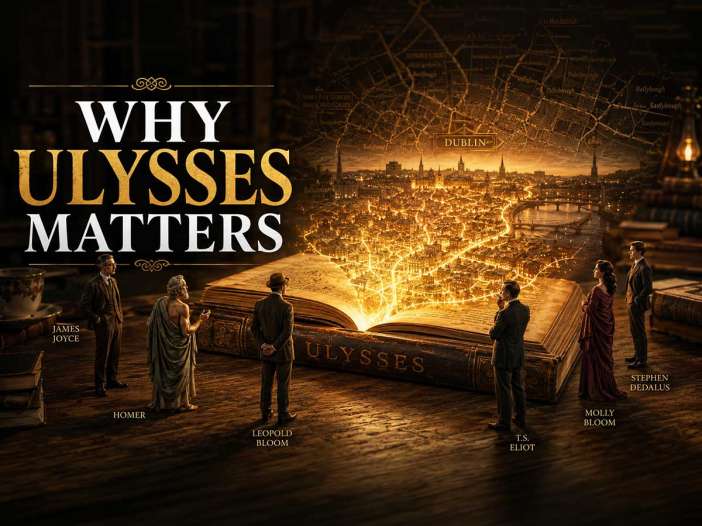
What if the hardest novel in English is really teaching us how to keep going when life feels confusing?
James Joyce’s Ulysses has a reputation that frightens many readers before they begin. It is called one of the most difficult novels in English. It is full of references, myths, jokes, shifting styles, hidden structures, Catholic imagery, Irish history, Homeric parallels, Shakespearean echoes, and streams of thought that seem to wander before they explain themselves.
Yet perhaps the first lesson of Ulysses is this: confusion does not mean failure.
Joyce takes one ordinary day in Dublin and turns it into a modern epic. A man wakes up, makes breakfast, walks through the city, attends a funeral, thinks about his wife, remembers his dead son, faces humiliation, helps a young man in trouble, and returns home in the middle of the night. On the surface, it is ordinary. Underneath, it is the Odyssey.
Leopold Bloom becomes a modern Odysseus, not through war or conquest, but through patience, tenderness, grief, and endurance. Stephen Dedalus becomes a modern Telemachus, not simply searching for a father, but trying to live under the burden of history, religion, intellect, and loneliness. Molly Bloom becomes more than wife, symbol, temptation, or Penelope. At the end, she speaks for herself, and her final “yes” becomes one of literature’s great affirmations of life.
This imaginary conversation asks five central questions.
Why do difficult books still matter?
What does it mean to search for home in a broken modern world?
How do fathers and sons carry wounds of absence?
What happens when the human mind becomes the true setting of a story?
And can love still say yes after grief, betrayal, desire, memory, and failure?
To answer these questions, we bring together James Joyce, Homer, T.S. Eliot, Leopold Bloom, Molly Bloom, and Stephen Dedalus. They speak across myth, literature, ordinary life, and the hidden movements of the human heart.
Ulysses may look like a puzzle, but beneath the puzzle is a deeply human book. It teaches us to keep reading when we feel lost, to keep walking when life feels fragmented, and to keep returning to love, even after the journey has changed us.
(Note: This is an imaginary conversation, a creative exploration of an idea, and not a real speech or event.)
Topic 1: Why Difficult Books Still Matter
Opening
T.S. Eliot:
A difficult book is not always difficult out of pride. Sometimes it is difficult because life itself refuses to become simple. We want a book to stand still, explain itself, and let us walk away satisfied. But a book like Ulysses does not behave that way. It moves like thought, memory, temptation, grief, and city noise all happening at once. The reader enters confused, but not abandoned. The question is whether confusion is a sign to quit, or a sign that the mind has entered something larger than habit.
Question 1: Is difficulty a wall that keeps people out, or a door that makes the reader grow?
Leopold Bloom:
I think most people are gentler than critics believe. A reader opens a hard book and feels shame. “I do not understand this page. Maybe this book is not for me.” That shame is the real wall.
James Joyce:
The page is not meant to flatter the reader. It is meant to awaken him. A simple sentence may let him sleep. A difficult sentence may make him ask, “Why did I expect life to be so tidy?”
Homer:
In my poem, Odysseus did not sail home in a straight line. He met storms, monsters, strangers, hunger, longing. No one says, “This voyage is confusing, so the sea has failed.” The sea is the test.
Molly Bloom:
Men love to make reading sound like war. I say a hard book is more like a person. You do not know someone in one afternoon. You hear a phrase, a look, a silence, and later you think, “Ah, now I see.”
T.S. Eliot:
Difficulty can become vanity when it is used to exclude. But true difficulty invites the reader into discipline. It says, “Come again. Look again. Listen again.”
Leopold Bloom:
That sounds noble, but people have jobs, bills, dishes, children. A reader may only have twenty minutes before sleep. What then?
James Joyce:
Then twenty minutes is enough. The reader need not conquer the book. Let the book pass through the day like Dublin traffic. Catch what the eye catches. Mark what stings. Return later.
Homer:
A hero is not the one who understands the whole sea. A hero is the one who keeps rowing.
Molly Bloom:
And the one who admits, “I’m lost,” yet turns the page anyway.
T.S. Eliot:
Then difficulty is not a locked gate. It is a slower entrance.
Question 2: Should a great book explain itself clearly, or should it force us to return again and again?
James Joyce:
A book that explains itself too neatly may die after one reading. I wanted a book that kept living after the reader closed it.
Molly Bloom:
That sounds suspiciously like a man who hides things and then calls it genius.
James Joyce:
Perhaps. But a hidden thing is not always a trick. Sometimes it is an invitation.
Leopold Bloom:
I like plain things. A kidney frying in a pan. A letter in the pocket. A street name. A bath. A funeral. Yet even plain things are not plain once memory touches them.
Homer:
Every return changes the story. A young reader sees adventure. An old reader sees loss. A father sees a son. A son sees a missing father. The poem waits for each age of the reader.
T.S. Eliot:
That is the mark of lasting art. It does not give one meaning and dismiss the reader. It creates a meeting place where many meanings gather.
Molly Bloom:
Still, the reader should not be punished. If a book is hard, there must be life in the hardness. Breath. Humor. Hunger. Desire. Not just cleverness.
James Joyce:
Yes. The difficulty must carry human blood. Ulysses is full of jokes, dirt, meals, jealousy, songs, bodies, prayers, and ordinary errands. The puzzle is not separate from life. The puzzle is life seen without smoothing.
Leopold Bloom:
So the first reading is like walking through a city at night. You miss many streets. You remember one window, one smell, one voice.
T.S. Eliot:
And the second reading tells you the city had a map.
Homer:
The third reading tells you the map was inside you.
Molly Bloom:
The fourth reading tells you to stop counting and just live with the book.
Question 3: Can confusion be part of wisdom?
Homer:
A person who has never been lost may know roads, but not longing. Confusion teaches scale. It reminds us that the mind is smaller than reality.
Leopold Bloom:
When I walk through Dublin, my thoughts do not line up politely. One moment food. Then Molly. Then a dead child. Then a smell from a shop. Then a stranger’s hat. That is not disorder. That is how the heart moves.
James Joyce:
Exactly. We call it confusion only because we expect the mind to behave like a schoolmaster. The mind is a street, a graveyard, a kitchen, a theater, and a church bell heard from far away.
T.S. Eliot:
Modern life broke many old forms of certainty. A book that pretends everything is simple may comfort us, but it may not tell the truth. Wisdom sometimes begins when the old frame fails.
Molly Bloom:
People want answers too soon. They ask, “What does it mean?” Maybe first they should ask, “What did I feel? What did I notice? What did I resist?”
Leopold Bloom:
I would add, “What did I avoid?” A hard book exposes the reader. You see your impatience. You see your pride. You see your hunger for clear answers.
Homer:
The wanderer learns by delay. Every wrong turn becomes part of the return.
James Joyce:
Then confusion is not the enemy of reading. It is the first honest condition of reading deeply.
T.S. Eliot:
Yet confusion alone is not wisdom. One must stay with it, shape it, discuss it, and return to the text.
Molly Bloom:
And forgive yourself for not understanding everything. That may be the first adult lesson of reading.
Leopold Bloom:
Yes. Keep going. That is humble wisdom. Not “I understand.” Not “I quit.” Just, “I will keep going.”
Closing
T.S. Eliot:
A difficult book remains valuable because it trains a reader in patience, humility, and attention. It teaches us that meaning is not always delivered at once. Some truths arrive like footsteps in fog. Some books must be read once to be survived, then again to be understood, then again to be loved. Ulysses asks much from the reader, but perhaps that is why finishing it feels less like solving a puzzle and more like becoming someone who can walk through confusion without fear.
Topic 2: The Modern Odyssey — Finding Home in a Broken World
Opening
Homer:
Every age has its own sea. In one age, a man sails past monsters, storms, and singing temptations. In another age, a man walks through streets, letters, food, funerals, desire, memory, shame, and grief. The old hero tries to return to Ithaca. The modern hero may live only a few streets from his own house, yet still feel far from home. So let us ask what home means when the war is inside the heart, when the island is a bedroom, and when the wanderer carries his brokenness with him.
Question 1: What does “home” mean for a modern person who feels spiritually lost?
Leopold Bloom:
Home is a strange word. A man may know the address, the stair, the kettle, the bed, the smell of breakfast. Still, he may stand inside his own house and feel like a visitor.
Molly Bloom:
A house is not home just from walls and sheets and plates. A woman knows that. You can lie beside someone and still feel miles away from him.
T.S. Eliot:
Modern displacement is often inward. The ancient wanderer was separated from home by water. The modern wanderer may be separated from home by memory, guilt, and silence.
James Joyce:
That is why Bloom matters. He is not grand in the old heroic sense. He buys food. He thinks of letters. He avoids pain. He moves through Dublin. Yet inside those ordinary motions, the epic continues.
Homer:
Odysseus knew the name of his enemy. Poseidon. The Cyclops. The Sirens. Bloom’s enemies are harder to name.
Leopold Bloom:
Yes. You cannot stab loneliness with a sword. You cannot sail past the death of a child. You cannot outwit the knowledge that your wife desires another man.
Molly Bloom:
And you cannot pretend I am only the island that traps him. I am wife, woman, memory, flesh, anger, need. Home is not simple for me either.
James Joyce:
That is what makes the modern home so difficult. It is not a perfect ending. It is a place filled with tenderness and injury together.
T.S. Eliot:
Then home may not mean comfort. It may mean the place where the self finally stops running.
Homer:
A true return is not merely reaching the door. It is facing what waits behind it.
Question 2: Is Leopold Bloom a hero, even though his life looks ordinary?
James Joyce:
Bloom is heroic precisely in the ordinary. He does not command armies. He endures a day. Many people fail at that.
Leopold Bloom:
I would not call myself heroic. I walk. I think. I eat. I worry. I try not to make trouble. I remember the dead more than I wish to.
Homer:
Endurance has many forms. Odysseus clung to driftwood after shipwreck. Bloom clings to small decencies.
Molly Bloom:
He is kind, in his way. Awkward, secretive, too much in his head, but kind. Do not laugh at kindness just since it wears a hat and walks to the post office.
T.S. Eliot:
The epic scale has changed. The old poem measures heroism through danger and return. Joyce measures it through consciousness. What does a man carry in one day? How much sorrow can pass through one mind before night?
Leopold Bloom:
A man can look calm and still be full of weather. He may nod politely at someone and, in the same breath, think of a grave, a child, a betrayal, a smell from childhood.
James Joyce:
That is why the ordinary day becomes mythic. The epic is no longer far away. It is folded into errands.
Homer:
Then Bloom’s courage is not the courage of conquest. It is the courage of remaining human after humiliation.
Molly Bloom:
And maybe the courage to come home, knowing the home is not pure, not innocent, not easy.
T.S. Eliot:
A lesser man would harden. Bloom remains porous. He suffers, notices, forgives, desires, hesitates. There is dignity in that.
Leopold Bloom:
If that is heroism, it is a quiet kind. No trumpet. Just a man crossing a street with too many thoughts.
Question 3: Can one ordinary day contain an entire human epic?
T.S. Eliot:
That is Joyce’s great wager. One day can hold birth, death, hunger, temptation, fatherhood, betrayal, religion, politics, comedy, shame, and longing.
Homer:
A day is never small when the soul is awake. The sea need not be visible. The voyage can happen in the mind.
Molly Bloom:
Men think epics need ships. Women know one bedroom can hold a whole history.
James Joyce:
Exactly. Dublin on June 16 becomes a city of myth, but myth does not erase the dirt. It shines through it. A kidney burns. A letter arrives. A funeral passes. A song is heard. A man is wounded by his own thoughts.
Leopold Bloom:
And the city keeps moving. Nobody stops for your grief. That may be the hardest part. The world continues as your private world breaks open.
Homer:
In my poem, Odysseus longs for Ithaca. In Joyce’s book, Bloom longs for something less clear: a restored marriage, a dead son, a place at the table, a gentle word, peace with himself.
T.S. Eliot:
Modern life fractures the epic into fragments. Yet Joyce gathers those fragments into form. The day becomes a vessel.
Molly Bloom:
A person is not one clean story. We are appetite, memory, body, irritation, love, boredom, regret. Put that into one day and you have more than enough for an epic.
James Joyce:
That is why the reader must not look down on the ordinary. The ordinary is where eternity hides without costume.
Leopold Bloom:
Then maybe one day is enough. Not enough to fix a life, but enough to reveal it.
Homer:
And if a single day can reveal a life, then no life is truly small.
Closing
Homer:
The old Odyssey taught that a man may cross the sea and still need to become worthy of home. The modern Odyssey teaches something quieter and perhaps harder: a man may never leave his city and still wander like an exile. Leopold Bloom walks through Dublin with grief, desire, embarrassment, memory, and hope moving inside him. He is not heroic through victory. He is heroic through tenderness. He keeps moving. He keeps noticing. He keeps returning. And in that return, the ordinary man becomes large enough for myth.
Topic 3: Fathers, Sons, and the Wound of Absence
Opening
James Joyce:
A son may lose his father in more than one way. He may lose him through death, distance, disappointment, silence, pride, or the simple failure of tenderness. A father may lose his son in more than one way too. He may bury him, fail him, search for him in another young man, or carry his memory like a wound under ordinary clothes. In Ulysses, Stephen and Bloom do not meet as perfect answers to each other. They meet as unfinished men. One needs a father. The other still grieves a son. Their bond does not solve everything, but it lets each man glimpse what has been missing.
Question 1: Why does Stephen need a father figure?
Stephen Dedalus:
I do not need a father in the sentimental sense. I need no old man placing his hand upon my shoulder and calling it wisdom.
Leopold Bloom:
That sounds like someone who needs one very much.
Stephen Dedalus:
Or someone who has seen too many false fathers. Teachers, priests, patriots, landlords, loud friends, clever men in towers. Each one wants to name me, claim me, or use me.
Homer:
Telemachus had a father absent from Ithaca. Yet absence filled the house. Suitors crowded the rooms. Men spoke over him. He had to grow under the shadow of a father he barely knew.
T.S. Eliot:
Stephen’s problem is not simple fatherlessness. It is inheritance without shelter. He carries history, religion, Ireland, Shakespeare, and the ghost of his mother, yet he has no warm human center to receive him.
James Joyce:
He mistakes intellect for armor. He thinks brilliance can save him from dependence. But the mind alone cannot father the soul.
Stephen Dedalus:
You all speak as though I am a child asking for bread.
Leopold Bloom:
Every man asks for bread in some form.
Homer:
The son who denies hunger may be the hungriest one at the table.
Stephen Dedalus:
And what kind of father should I accept? The biological father who gave me a name? The Church that gave me guilt? The nation that gave me a wound? The dead who gave me nightmares?
T.S. Eliot:
That is exactly the crisis. Stephen is surrounded by father-claims, yet starved for father-care.
James Joyce:
He needs someone who does not try to possess him. Someone who sees his danger, not his usefulness. Someone who shelters him for one night without demanding worship.
Leopold Bloom:
That is not much.
Homer:
Sometimes one night of protection becomes a doorway the soul never forgets.
Question 2: Why does Bloom’s lost son shape everything he does?
Leopold Bloom:
A child who dies does not leave the house. He leaves the room, perhaps, but not the air. Rudy is gone, yet he is everywhere I do not look.
Stephen Dedalus:
Then grief is a tenant.
Leopold Bloom:
Yes. Quiet. Regular. Always paid in memory.
T.S. Eliot:
Bloom’s grief is not loud tragedy. It appears in passing thoughts, bodily details, awkward kindness, sudden tenderness. The dead child turns ordinary life into a private underworld.
Homer:
In the old poem, Odysseus descends among the dead. In Joyce’s day, the dead rise within the living. A street, a funeral, a passing remark can open the gate.
James Joyce:
Bloom’s lost son makes him vulnerable to Stephen. He does not see merely a drunk young man in trouble. He sees a missing relation, a possible tenderness, a shape that grief recognizes before reason does.
Leopold Bloom:
I do not replace Rudy with Stephen. A dead child cannot be replaced.
Stephen Dedalus:
Nor can a father be borrowed like a coat.
Leopold Bloom:
No. But a man may act fatherly without becoming a father. He may guide someone away from harm. He may offer a room, water, food, quiet.
T.S. Eliot:
That is the beauty of the connection. It is not grand restoration. It is partial mercy.
Homer:
Odysseus returns to a son. Bloom returns with someone else’s son beside him. The pattern remains, but it has been wounded.
James Joyce:
Modern myth rarely heals cleanly. It gives us echoes, not perfect repairs.
Stephen Dedalus:
So I am an echo of his lost son?
Leopold Bloom:
No. You are yourself. That is why the gesture matters. I do not love you as Rudy. I care for you as Stephen.
T.S. Eliot:
That distinction saves the scene from sentimentality.
Question 3: Can two wounded people become family for one night?
Homer:
A household can begin with blood. It can begin with law. It can begin with marriage. Yet sometimes it begins with rescue.
Stephen Dedalus:
Rescue is a dangerous word. It places one man above another.
Leopold Bloom:
Not always. A drowning man may pull another from the water and still be drowning inside.
James Joyce:
Bloom and Stephen do not form a perfect family. That would be false. Their meeting is brief, strange, awkward, and incomplete. Yet incomplete does not mean meaningless.
T.S. Eliot:
Modern grace often appears in fragments. A cup. A walk. A question. A door opened at night.
Stephen Dedalus:
I do not promise to become his son.
Leopold Bloom:
I do not ask it.
Stephen Dedalus:
I do not promise gratitude.
Leopold Bloom:
I do not require it.
Homer:
Then something rare has happened. Care has been offered without conquest.
James Joyce:
That is why the scene matters. Stephen’s need and Bloom’s grief meet, but neither man fully owns the other. For a moment, absence makes room for kindness.
T.S. Eliot:
The father-son wound is not closed. It is illuminated. The reader sees what each man lacks, and what each man can briefly give.
Stephen Dedalus:
A night is not a life.
Leopold Bloom:
No. But some nights keep a life from breaking.
Homer:
In every epic, there are shelters before home. A hut, a shore, a fire, a stranger’s hand. Without those, no one returns.
James Joyce:
And perhaps that is the modern fatherhood Ulysses offers: not authority, not bloodline, not command, but attention at the hour when another person might disappear into darkness.
Closing
James Joyce:
Fathers and sons in Ulysses do not meet inside a clean moral lesson. They meet through ghosts, failed inheritance, buried children, drunkenness, shame, and longing. Stephen needs a father without wanting to admit it. Bloom longs for a son without daring to name the longing too directly. When they meet, nothing is solved in a final way. Yet something human passes between them. Bloom protects. Stephen receives more than he expected. For one night, the missing father and the missing son stand near each other, and the ancient story of return becomes a modern story of mercy.
Topic 4: The Mind as a City
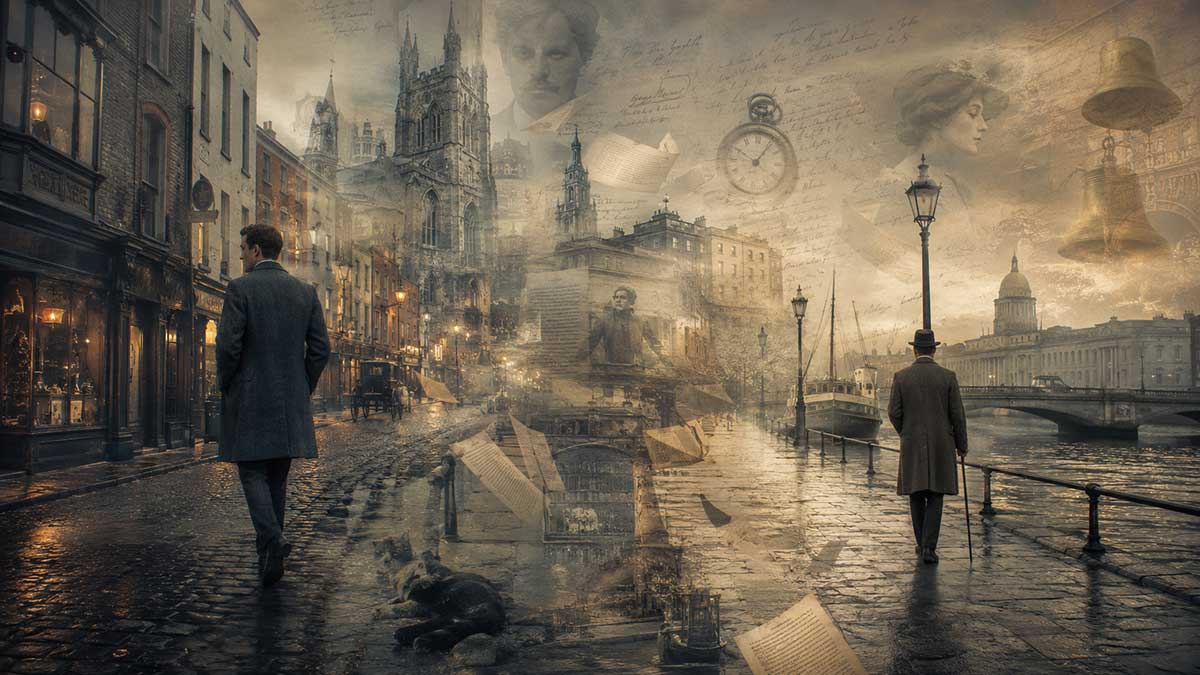
Opening
Leopold Bloom:
A city is never silent. A mind is never silent either. Streets cross, doors open, bells ring, smells rise from shops, old grief appears from nowhere, and a person keeps walking. James Joyce did not make thought neat. He let it move the way it truly moves: broken, quick, distracted, sensual, comic, wounded, and alive. In Ulysses, Dublin is not just a place outside the characters. It becomes the shape of their thinking. To walk through the city is to walk through the mind.
Question 1: Why does Joyce show thoughts as messy, wandering, and unfinished?
James Joyce:
A finished thought is often a lie told after the fact. In the living moment, thought does not march. It leaks, jumps, returns, forgets, remembers, and contradicts itself.
Stephen Dedalus:
My thoughts do not ask permission. One word leads to another word. A smell calls up a memory. A sight becomes an argument. The mind is not a classroom. It is a shore with tide marks.
T.S. Eliot:
Joyce captures mental life before it is edited for respectability. That is why it may feel strange. We are used to characters who speak in finished sentences, not minds that stumble in real time.
Molly Bloom:
People pretend their minds are tidy since they want to look respectable. But lie in bed long enough and the mind runs everywhere. Men. Money. Body. Memory. Anger. Love. Food. A song from years ago.
Leopold Bloom:
Yes. A man may look at a shop window and suddenly think of dinner, then his wife, then a letter, then a dead child, then a joke, then a smell from childhood. That is not madness. That is Tuesday.
James Joyce:
The unfinished quality is truthful. The mind rarely closes one room before opening another.
Stephen Dedalus:
And language carries old rooms inside it. A word is never only a word. It has family, history, religion, schoolmasters, ghosts.
T.S. Eliot:
That is why the reader must stop demanding clean order too soon. The disorder has form. The wandering has rhythm.
Molly Bloom:
Maybe people are afraid of this book since it sounds too much like themselves.
Leopold Bloom:
Or since it proves no one lives inside a straight line.
Question 2: Is stream of consciousness closer to real life than normal storytelling?
Molly Bloom:
Normal storytelling is polite. Life is not. Life comes with interruptions.
Leopold Bloom:
A regular story says, “He walked to the bath.” But inside that walk are advertisements, doubts, women passing, old songs, little plans, shame, curiosity, hunger.
Stephen Dedalus:
The outer event may be small. The inner event may be enormous.
James Joyce:
That is the secret. A person crossing a street may contain more drama than a king entering battle. The question is whether the artist can hear the hidden traffic.
T.S. Eliot:
Stream of consciousness lets the reader experience the pressure of mental existence. It does not simply report what a person thinks. It places the reader inside the movement of thinking.
Molly Bloom:
And sometimes that movement is not dignified. Good. I distrust a mind that is always dignified.
Leopold Bloom:
The body enters too. Hunger changes thought. Fatigue changes thought. Desire changes thought. Grief changes thought. A city enters through the nose, eyes, ears, feet.
Stephen Dedalus:
The mind is not floating above the body. It is soaked in it.
James Joyce:
That is why the style must change from episode to episode. The form follows the pressure of each mind, each place, each hour.
T.S. Eliot:
Normal storytelling may be clearer. Stream of consciousness may be truer to experience.
Molly Bloom:
Clearer is not always deeper.
Question 3: What can we learn by watching our own thoughts move?
T.S. Eliot:
We learn that the self is less unified than pride claims. We are memory, desire, fear, habit, language, place, body, and time passing through one another.
Stephen Dedalus:
A man who watches his thoughts may discover he is haunted. Not only by the dead, but by old ideas he thought he had escaped.
Leopold Bloom:
He may discover he is kinder than he knew, or lonelier than he admits. Thoughts reveal what daily manners hide.
Molly Bloom:
And a woman watching her thoughts may find that she has been judged from the outside for years, yet inside she has a whole country no one bothered to visit.
James Joyce:
That is why inner speech matters. It rescues the private person from being reduced to public behavior.
T.S. Eliot:
To observe thought is to notice how much of life passes unseen. The self is not only what it says aloud.
Stephen Dedalus:
It is what it repeats. What it avoids. What image returns. What sentence will not leave.
Leopold Bloom:
And once you notice the movement, you may become gentler with others. Every stranger has a city inside him.
Molly Bloom:
That may be the best lesson. People are not flat. No one is only what they did at noon.
James Joyce:
The novel gives dignity to the inner weather. It says every mind is worthy of form.
T.S. Eliot:
Then reading Joyce becomes practice for seeing human beings more patiently.
Closing
Leopold Bloom:
If the mind is a city, then no one should be judged by one street. A person contains bright windows, locked doors, dirty alleys, churches, shops, music, grief, hunger, jokes, and rooms no visitor has entered. Ulysses teaches us to walk through that city without panic. Thought may wander, but wandering is not emptiness. It is how the soul leaves traces. It is how memory speaks. It is how an ordinary person becomes vast.
Topic 5: Molly Bloom’s “Yes” — Love After Grief and Betrayal
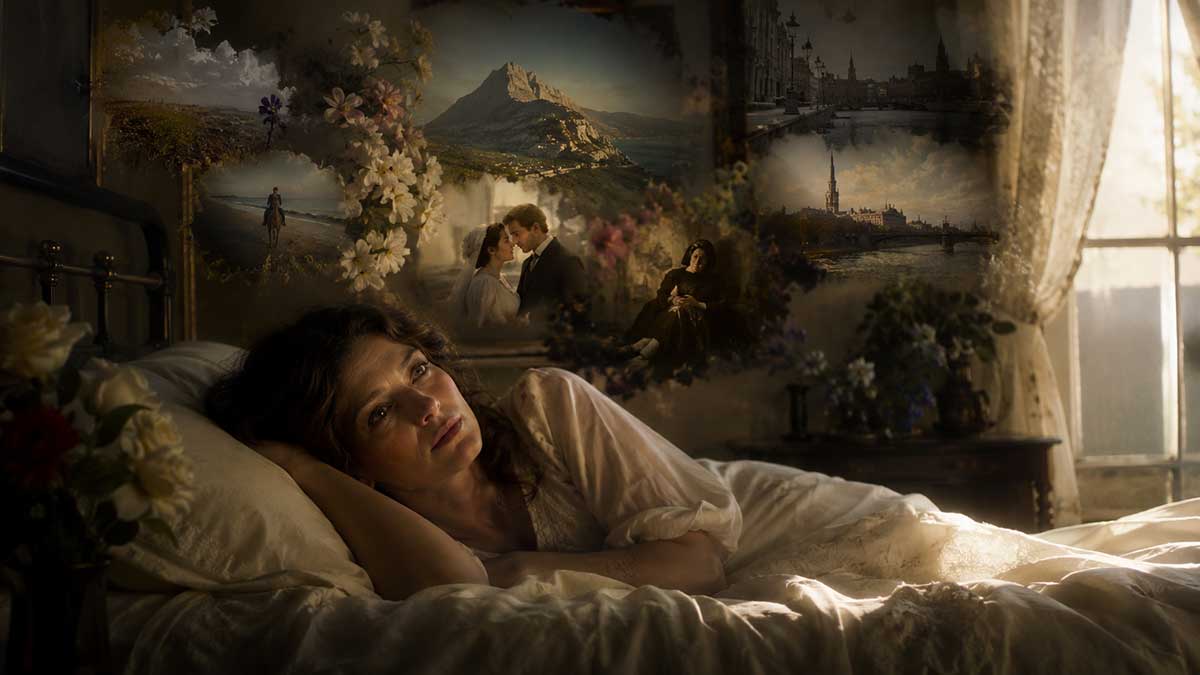
Opening
Molly Bloom:
All day they have talked around me. Bloom has thought about me, feared me, desired me, judged me, served me, avoided me, and returned to me. Others have made me symbol, wife, temptation, Penelope, Calypso, body, memory, betrayal. But at the end, I speak. Not through his fear. Not through a scholar’s theory. Not through a man’s wound. I speak in my own mind, in my own bed, beside my sleeping husband, with all my memories alive. And my last word is not no. It is yes.
Question 1: Why does Molly get the final word?
Molly Bloom:
Since men have had the first word for long enough.
James Joyce:
That answer is not wrong.
Leopold Bloom:
I thought about you all day, Molly. Not always nobly, I admit. I feared Blazes Boylan. I feared what I knew and what I did not know. I carried you through the city in my mind.
Molly Bloom:
You carried your version of me. That is not the same as me.
T.S. Eliot:
This is the great reversal of the ending. For much of the novel, Molly is mediated through Bloom’s anxiety. In the final episode, that mediation falls away.
Homer:
In the old poem, Penelope is faithful, waiting, tested, restored to her husband. Joyce gives the wife a stranger freedom. She is not only the reward at the end of the voyage.
Molly Bloom:
I am not a prize left in the house.
James Joyce:
Nor are you merely a moral problem. You are memory, appetite, grief, history, anger, tenderness, vanity, sensuality, and thought.
Leopold Bloom:
I suppose I wanted to understand you by worrying over you.
Molly Bloom:
Worry is not understanding.
T.S. Eliot:
Her final word changes the reader’s relation to the whole book. The story no longer belongs only to wandering men. It belongs to the woman in the bed, thinking back through girlhood, marriage, desire, loss, and the body.
Homer:
The homecoming is not complete until the house speaks.
Molly Bloom:
And when the house speaks, it does not sound like a sermon. It sounds like a woman remembering everything at once.
Question 2: Is Molly’s “yes” about romance, desire, faith, life, or all of them?
T.S. Eliot:
A single yes can hold many meanings. It can be bodily, marital, spiritual, comic, rebellious, and sacred.
Molly Bloom:
It is not one tidy thing. I have said yes to men, to pleasure, to memory, to flowers, to the body, to being looked at, to looking back, to wanting, to being alive.
Leopold Bloom:
Does that yes include me?
Molly Bloom:
Yes, but not only you. That is what you must bear.
James Joyce:
The word gathers many layers. Sexual consent, female desire, memory of courtship, grief over Rudy, the old world of Gibraltar, the present bed in Dublin. It is intimate and cosmic at once.
Homer:
In epic, the return home often ends with order restored. Here, order is not restored in a clean way. Yet life is affirmed.
Leopold Bloom:
That is harder for me. I want to know where I stand.
Molly Bloom:
No one stands still in marriage. You move, fail, return, remember, desire, disappoint, forgive, and sometimes lie beside each other in the dark, still bound.
T.S. Eliot:
The yes is not innocence. It comes after betrayal, grief, jealousy, fatigue, and memory. That is why it has weight.
James Joyce:
A shallow yes would mean little. Molly’s yes matters since it rises from everything that could have become refusal.
Homer:
Then it is not simply romance. It is the human answer to the storm.
Molly Bloom:
It is not clean. It is not respectable enough for everyone. But it is alive.
Question 3: Can love still affirm life after failure, grief, and betrayal?
Homer:
Every return is marked by loss. No one comes home as the person who left.
Leopold Bloom:
Rudy is gone. My father is gone. Molly has been unfaithful. I have not been pure either. I spend the day avoiding wounds that keep finding me.
Molly Bloom:
And I have my own wounds. Do not make me only the wound you suffer.
James Joyce:
That is the mature beauty of the ending. Love is not presented as purity. It is presented as the strange force that remains after purity has failed.
T.S. Eliot:
The novel does not pretend marriage, body, grief, or memory can be purified into a neat conclusion. It lets contradiction remain.
Leopold Bloom:
Then what kind of love is left?
Molly Bloom:
A love that remembers the beginning. A love that knows the body. A love that has been bored, angry, tempted, lonely, foolish, and still has not vanished.
Homer:
In the ancient story, Penelope recognizes Odysseus through the marriage bed. In Joyce’s story, the bed holds sleep, memory, betrayal, thought, and one final yes.
James Joyce:
That yes does not erase pain. It answers pain without letting pain have the final word.
T.S. Eliot:
That may be why some readers call Ulysses a book about love. Not sentimental love, but love after modern fragmentation.
Leopold Bloom:
So love is not the absence of brokenness.
Molly Bloom:
No. Love is what still breathes through it.
Homer:
Then the voyage ends not with victory, but with affirmation.
Molly Bloom:
Yes.
Closing
Molly Bloom:
Let the scholars speak of myth, technique, symbols, bodies, histories, and books inside books. Let them speak; they are not wrong. But at the end, a woman lies awake beside her husband and lets memory move through her without asking permission. She remembers girlhood, men, flowers, desire, marriage, grief, Rudy, Bloom, the body, the past, and the pulse of life itself. After all the wandering, the last word is not a theory. It is a yes. Not a small yes. Not a polite yes. A yes spoken after sorrow, after failure, after longing, after betrayal, after everything. A yes large enough to let life continue.
Final Thoughts
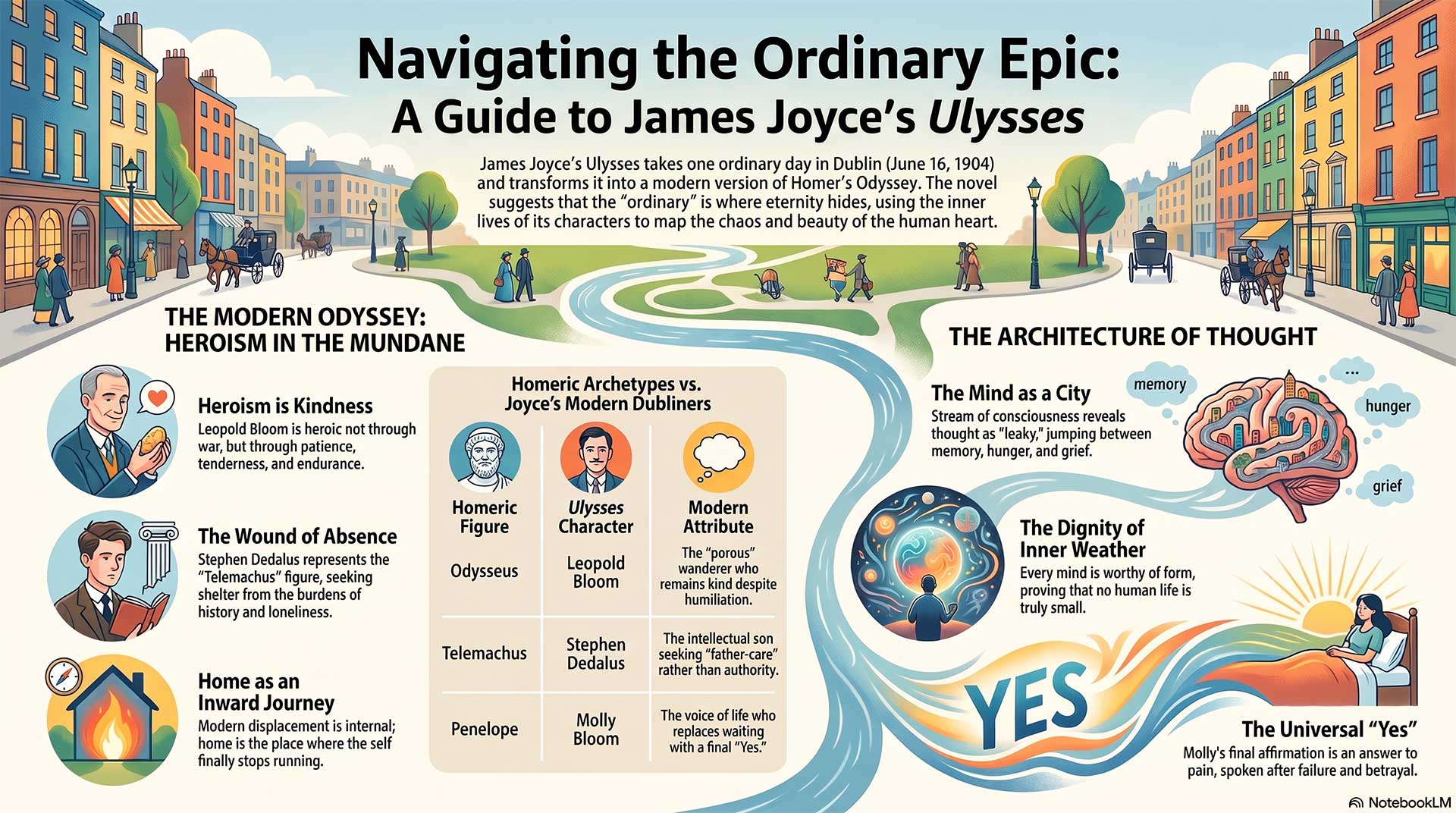
Ulysses is difficult, but its difficulty is not empty. It asks the reader to slow down, return, notice, and accept that meaning may arrive gradually. The book does not hand us a simple message. It gives us a city, a day, a marriage, a grieving father, a restless son, a woman remembering her life, and a world where myth hides inside ordinary errands.
The great surprise of Ulysses is that the epic does not need a battlefield. It can unfold in a kitchen, a street, a pub, a cemetery, a library, a hospital, a bedroom, or a single passing thought.
Leopold Bloom shows us that heroism can be quiet. It can be kindness after humiliation. It can be returning home when home is painful. It can be caring for a young man who is not your son, yet still answering the fatherly ache inside you.
Stephen Dedalus shows us that intelligence alone cannot heal loneliness. A brilliant mind may still need shelter. A son may reject fatherhood in theory and still need mercy in the night.
Molly Bloom shows us that the final word of life does not have to be bitterness. Her “yes” does not erase pain. It rises after pain. That is why it matters.
Perhaps Ulysses endures because it does not simplify being human. It lets the mind wander. It lets the body speak. It lets grief interrupt. It lets desire remain complicated. It lets marriage be wounded and still alive. It lets one day become large enough to contain a whole life.
A reader may not understand everything the first time. That is fine. The deeper lesson is to keep going.
One page at a time.
One thought at a time.
One return at a time.
And perhaps, after all the wandering, one yes.
Short Bios:
James Joyce was an Irish novelist and one of the central figures of literary modernism. His novel Ulysses transformed the modern novel through stream of consciousness, mythic structure, shifting styles, and deep attention to the ordinary life of Dublin.
Homer is the ancient Greek poet traditionally credited with The Iliad and The Odyssey. In this conversation, he represents the old epic tradition of wandering, trial, longing, fatherhood, and homecoming.
T.S. Eliot was a major modernist poet and critic who praised Ulysses for its mythological method. In this conversation, he helps explain how Joyce used ancient myth to give shape to modern confusion.
Leopold Bloom is the central wandering figure of Ulysses. He is a Jewish advertising canvasser in Dublin, a husband, a grieving father, an outsider, and Joyce’s modern version of Odysseus.
Molly Bloom is Leopold Bloom’s wife and the speaker of the final episode, “Penelope.” Her famous closing “yes” gives the novel one of its most powerful affirmations of memory, desire, body, love, and life.
Stephen Dedalus is a young intellectual, teacher, and writer figure who appears as Joyce’s modern Telemachus. Haunted by his mother’s death and burdened by questions of fatherhood, religion, history, and identity, he becomes one of the novel’s central wounded sons.
Leave a Reply