
What if the stars do not define you, but give you a language for understanding your wounds, gifts, and choices?
Introduction by Liz Greene
Astrology is often misunderstood as a simple attempt to predict the future.
Will I find love?
Will my career improve?
Is this a lucky month?
Should I begin, wait, leave, return, forgive, or try again?
These are real questions. They belong to the ordinary anxieties of human life. People do not come to astrology only because they are curious. They come because they are uncertain. They come because they are standing at a threshold. They come because something inside them feels patterned, repeated, unfinished, or difficult to name.
But astrology, at its deepest, is not only about prediction.
It is a symbolic language.
It gives people a way to speak about personality, timing, wounds, gifts, relationships, fear, desire, shadow, healing, and responsibility. It does not need to replace science, faith, therapy, reason, medicine, or moral judgment. It becomes dangerous when it tries to do so.
Yet when astrology is used wisely, it can help a person ask better questions.
Not only, “What will happen to me?”
But, “What pattern am I living?”
“What part of myself have I not understood?”
“What season of life am I in?”
“What am I being asked to develop?”
“What do I keep repeating because I have not yet become conscious of it?”
In this Imaginary Talk, five voices gather to explore astrology not merely as fortune-telling, but as a language of self-understanding.
Chani Nicholas brings a modern voice of healing, care, and self-acceptance.
Susan Miller brings the practical world of timing, forecasts, opportunity, and everyday decision-making.
Rob Brezsny brings astrology as poetry, free will, imagination, and creative possibility.
Kazuko Hosoki brings a Japanese sense of fate, timing, restraint, discipline, and proper conduct.
And I speak from psychological astrology, where the birth chart is read as a symbolic map of the psyche.
Together, we ask:
Is astrology a prediction, or a language of the self?
Is the birth chart a blueprint, mirror, or myth?
Do we truly have good and bad seasons?
Can astrology help us face the shadow and heal repeated patterns?
And finally, do the stars set us free, or trap us in an identity?
The answer may not be simple.
Astrology can imprison a person when it becomes a label.
It can weaken a person when it becomes an excuse.
It can frighten a person when timing is treated as doom.
It can mislead a person when symbols are mistaken for commands.
But astrology can also awaken a person.
It can help us see what we repeat.
It can help us name what we feel.
It can help us honor our nature without being ruled by it.
It can help us respect timing without surrendering responsibility.
It can help us enter the mystery of life with more humility, imagination, and awareness.
Perhaps the stars do not tell us who we must become.
Perhaps they ask us who we are willing to become once we finally see ourselves more clearly.
(Note: This is an imaginary conversation, a creative exploration of an idea, and not a real speech or event.)
Topic 1: Is Astrology a Prediction—or a Language of the Self?
Guests
Chani Nicholas
Liz Greene
Susan Miller
Rob Brezsny
Kazuko Hosoki
Opening
Liz Greene:
Astrology often enters a person’s life at a moment of uncertainty.
Someone has lost a relationship.
Someone is standing at a career crossing.
Someone feels a pattern repeating again and again.
Someone reads a horoscope and thinks, “How did this know me?”
At first, the question seems simple.
“What will happen to me?”
Yet beneath that question, there is often another one.
“Who am I?”
“Why do I keep living this pattern?”
“What part of me is asking to be seen?”
“Is my life random, or does it have a hidden shape?”
This is where astrology becomes more than prediction.
A birth chart can be read as fate.
It can be read as personality.
It can be read as timing.
It can be read as myth.
It can be read as a symbolic language of the soul.
Today, we are not asking whether astrology should replace science, reason, faith, therapy, or personal responsibility. It should not.
We are asking a deeper human question.
When people turn to astrology, are they truly looking for the future?
Or are they looking for a language that can name their fears, gifts, wounds, desires, and choices?
With us are Chani Nicholas, who brings astrology into healing and self-acceptance; Susan Miller, whose monthly forecasts reach people through everyday hopes and anxieties; Rob Brezsny, who treats astrology as poetic permission for free will; Kazuko Hosoki, who brings a Japanese sense of fate, timing, and restraint; and I will speak from the tradition of psychological astrology.
Let us begin with the first question.
Question 1: Do people come to astrology because they want the future—or because they want to understand themselves?
Chani Nicholas:
Most people say they want to know what will happen.
Will I find love?
Will my work grow?
Will this pain end?
Will I finally become who I was meant to be?
Those are real questions. They deserve care.
Yet I think many people come to astrology when ordinary language has failed them.
They know they are hurting, but they cannot name the pattern.
They know they want change, but they do not know where to begin.
They feel something inside them, but the culture around them may not have taught them how to listen.
Astrology gives people a symbolic vocabulary.
A Moon placement can speak to how we need care.
Venus can speak to what we value and how we bond.
Mars can speak to anger, desire, and courage.
Saturn can speak to fear, discipline, time, and maturity.
The chart does not remove responsibility. It returns responsibility in a gentler form.
It says, “Here are some patterns. Here are some places where you may have been wounded. Here are some gifts you may have learned to hide. Now, how will you live with more awareness?”
People may arrive wanting prediction.
Often, they stay for recognition.
They want to feel seen without being reduced.
They want to feel named without being trapped.
They want to feel that their life has meaning, even in its mess.
That is the healing side of astrology.
Susan Miller:
Many readers come to astrology with very practical hopes.
They want to know about love, work, money, family, travel, health, timing, opportunity. They want to know whether a difficult month will pass. They want to know when to apply, when to meet, when to start, when to wait.
I never think that is shallow.
Daily life is where people live. A person may have a spiritual question, but it often appears through a rent payment, a job interview, a medical appointment, or a relationship decision.
Astrology gives people a sense of timing.
It can say, “This is a period for planning.”
“This is a period for reconnecting.”
“This is a period to be patient with communication.”
“This is a period to take a chance, if you have done the preparation.”
People want the future, yes. But they want the future so they can feel less alone in the present.
A good forecast should not frighten people. It should help them prepare.
A good forecast should not promise magic. It should help them notice openings.
If astrology gives someone courage to send the resume, apologize, rest, save money, call the doctor, or take love seriously, then it has served them in a grounded way.
The future matters.
Yet the real gift is how a person lives today with a little more hope and order.
Rob Brezsny:
I suspect many people come to astrology seeking a fortune cookie from the cosmos.
They ask, “Tell me what will happen.”
But I would rather astrology ask them, “What kind of future are you willing to help create?”
For me, astrology is not a set of handcuffs. It is a box of strange keys.
A horoscope can be a riddle.
A blessing.
A dare.
A comic prophecy that shakes loose a hidden part of the self.
When someone reads astrological language and says, “That feels true,” maybe the universe has not issued a final verdict. Maybe the person has found a myth large enough to breathe inside.
People need maps, yes.
But they need maps with dragons and gardens and unfinished roads.
Prediction can become boring if it only tells us what will happen. The more alive question is: what wants to be born through us?
A transit might not be a command. It might be an invitation.
“Be braver here.”
“Be softer there.”
“Stop repeating the old spell.”
“Forgive the younger version of yourself.”
“Make art from the confusion.”
People come for the future.
They may discover imagination.
And imagination is one of the ways free will wakes up.
Kazuko Hosoki:
People want to know the future, but the future is not a toy.
A person should not ask about tomorrow only to satisfy curiosity.
A person should ask so that they can live correctly.
In Japan, fortune-telling often carries a sense of timing.
There is a time to move.
There is a time to wait.
There is a time to begin.
There is a time to refrain.
If a person does not know their season, they may act from desire, fear, or pride. They may marry at the wrong time, move at the wrong time, expand a business at the wrong time, or ignore family duties at the wrong time.
So yes, people come to fortune-telling to know what may happen.
But the deeper purpose is to correct one’s way of living.
A difficult period should not make a person helpless. It should make a person careful.
Clean your life.
Respect your family.
Honor those who came before you.
Do not be ruled by greed.
Do not confuse impulse with destiny.
The future is not given so that people may escape responsibility.
It is given so that they may behave with humility.
A person who knows a bad season and becomes wiser is helped.
A person who knows a bad season and becomes passive has misunderstood.
Liz Greene:
People come to astrology with many different surface questions, but the deeper question is often one of identity.
“Why am I like this?”
This question can carry pain.
A person may have spent years feeling wrong, excessive, too sensitive, too intense, too detached, too hungry for love, too fearful of closeness.
A psychological chart reading can help a person see that the psyche is not a flat object. It is a theater of many figures.
The Sun may want purpose.
The Moon may want safety.
Venus may want connection.
Mars may want assertion.
Saturn may fear humiliation.
Neptune may long for transcendence.
Pluto may carry the pressure of transformation.
These are not literal gods pulling strings from the sky. They are symbolic patterns through which the psyche can be read.
When people say, “Astrology understands me,” they may be experiencing the relief of symbolic recognition.
The chart gives shape to inner conflict.
It says, “You are not one simple thing. You are many forces seeking relationship.”
That can be freeing.
The person no longer has to ask, “What is wrong with me?”
They can begin to ask, “How do these parts of me speak to each other?”
That is where astrology becomes a language of the self.
Question 2: Is a birth chart a map of fate, personality, or possibility?
Liz Greene:
A birth chart is not one thing.
It can be treated as a map of fate, and many traditions have done so. It can be treated as a picture of personality, and modern astrology often does this. It can be treated as a map of possibility, which is where I find it most psychologically rich.
The chart does not say, “You must become this.”
It says, “These are the themes through which life may ask you to become conscious.”
A difficult Saturn placement does not mean a ruined life. It may indicate fear, inhibition, early burden, or a deep need to build inner authority.
A strong Neptune may suggest confusion, longing, porous boundaries, spiritual hunger, artistic vision, or the desire to dissolve into something greater than the ordinary self.
A powerful Pluto may speak of intensity, loss, control, survival, and transformation.
If we call these “fate,” we risk making them too fixed.
If we call them “personality,” we risk making them too small.
If we call them “possibility,” we keep the soul in motion.
The birth chart is more like a mythic script than a prison sentence.
There are characters.
There are conflicts.
There are repeated motifs.
There are hidden treasures.
But the person still has to live the drama.
A chart cannot tell us the level of consciousness with which someone will live it. That is the human task.
Chani Nicholas:
I like to think of the birth chart as a map of potential, pain, and practice.
It shows where we may have a natural rhythm.
It shows where we may carry tension.
It shows where we may need care.
It shows where we may be asked to grow.
But no chart should be used to shame someone.
If someone has a hard placement, I do not want them to hear, “This is why your life is broken.”
I want them to hear, “This is a place that needs support, patience, and skill.”
Astrology can help us become more compassionate with ourselves.
A person with a strong Saturn signature may have learned early that love must be earned.
A person with a strong Venus signature may be learning the difference between harmony and self-abandonment.
A person with a strong Mars signature may need to reclaim anger as a healthy boundary, not a weapon.
The chart is not an excuse.
It is a care plan.
It can point to practices.
Rest here.
Tell the truth here.
Let go of shame here.
Stop shrinking here.
Ask for help here.
Build slowly here.
When astrology is used with love, the chart becomes less like a label and more like a room where the self can finally sit down.
Kazuko Hosoki:
A chart, a star, a birth date—these things should not be taken lightly.
The moment of birth has meaning.
The season has meaning.
The flow of fortune has meaning.
But a person must not use these meanings to flatter themselves.
Some people want to hear, “You are special.”
Some want to hear, “You are destined to succeed.”
Some want to hear, “Your failures are not your fault.”
That is not enough.
A true reading should teach the person how to live.
If the chart shows strength, then use that strength for others.
If the chart shows weakness, then correct your habits.
If the timing is poor, then wait and prepare.
If the timing is good, then act with gratitude, not arrogance.
A map of fate is useful only if it makes a person humble.
A person may have a certain star.
A person may have a certain season.
A person may have a certain pattern.
Yet daily conduct matters.
Respect your family.
Keep promises.
Clean what is dirty.
Do not betray people who trusted you.
Do not let desire rule your mind.
If astrology becomes self-admiration, it has failed.
If it becomes discipline, it may help.
Susan Miller:
A birth chart can be read in layers.
Many people first know only their Sun sign. That is a doorway.
Then they learn the Moon sign, Rising sign, houses, aspects, transits. The chart becomes much more personal.
I would say the chart is a map of tendencies and timing.
It can show how a person may approach love, work, money, friendship, home, creativity, and ambition. It can show where opportunities may arise, and where more preparation may be needed.
But it is not a guarantee.
Two people can have similar chart factors and live them very differently. One person uses a strong Mars to build courage and take action. Another uses it to fight every battle. One person uses a strong Mercury to communicate brilliantly. Another becomes nervous and scattered.
The chart gives information.
The person gives effort.
The birth chart can help someone see why certain parts of life feel natural and other parts require growth.
It can be very comforting to know that timing moves in cycles.
A difficult period does not last forever.
A favorable period still requires action.
A quiet period may be useful for planning.
This is where astrology can support everyday life. It helps people match action with timing.
Rob Brezsny:
I do not want a birth chart to be a locked cabinet.
I want it to be a wild library.
In one room, there is a book about your courage.
In another, a book about your wounds.
In another, a book about your secret genius.
In another, a book written in invisible ink by your future self.
Fate, personality, possibility—yes, all three may live there.
But possibility is the most fertile word.
A chart can become dangerous if it makes someone say, “This is just who I am.”
“I am a Scorpio, so I must be obsessive.”
“I am a Gemini, so I cannot be faithful.”
“I have Saturn there, so I will never be happy.”
“I have Venus there, so everyone should adore me.”
No. The chart should not turn us into clichés.
A good chart reading should make a person more mysterious to themselves, not less.
It should open doors.
It should say, “Here are the archetypal forces singing in your basement. Will you ignore them, fear them, or teach them harmony?”
I want astrology to increase freedom.
Not fake freedom. Not the freedom to pretend we have no patterns.
Real freedom: the freedom that appears when we know our patterns well enough to improvise.
Question 3: When astrology “feels true,” what is actually happening inside us?
Rob Brezsny:
When astrology feels true, maybe we are hearing a metaphor that finally has enough voltage.
A dry sentence says, “You are changing.”
Astrology says, “Pluto is dragging the old king from his throne.”
A dry sentence says, “You need rest.”
Astrology says, “The Moon is calling you back to the waters.”
A dry sentence says, “You are afraid of commitment.”
Astrology says, “Saturn is standing at the gate, asking whether your love has bones.”
This is not mere decoration. The psyche loves image. It speaks in dreams, symbols, songs, animals, seasons, omens.
Astrology feels true when it gives the psyche an image it can work with.
A person reads a line and says, “That is me.”
Maybe the planets did not force anything.
Maybe the line cracked open a door.
Good astrology should not end with recognition. It should begin there.
Once the person feels seen, they can ask,
“What will I do with this?”
“How can I become less automatic?”
“How can I love my strange life with more courage?”
Truth in astrology may not be the truth of a laboratory.
It may be the truth of a poem that catches you in the act of hiding from yourself.
Liz Greene:
When astrology feels true, projection may be involved, but projection is not meaningless.
In depth psychology, projection is one way the unconscious becomes visible. We see outside what we have not yet fully recognized inside.
Astrology offers a symbolic screen.
A person sees Mars, Saturn, Venus, Neptune, or Pluto, and something inner begins to take form.
They say, “Yes, I know that fear.”
“Yes, I know that longing.”
“Yes, I know that hunger for control.”
“Yes, I know that dream of escape.”
“Yes, I know that need to be loved.”
The chart becomes a vessel for recognition.
This does not mean every astrological statement is valid. Some readings are careless. Some are too vague. Some are manipulative. Some reduce complex people to signs and slogans.
But when astrology is practiced with depth, it can help a person encounter inner figures that would otherwise remain unnamed.
Feeling “seen” can be the beginning of consciousness.
Yet the astrologer must be careful.
A person who feels seen becomes open.
That openness must not be exploited.
The aim is not to make the client dependent on the astrologer.
The aim is to help the person form a wiser relationship with their own inner life.
Susan Miller:
When astrology feels true, it often gives people a sense of timing and reassurance.
Someone may read that a difficult communication period is ending, and they feel hopeful. Someone may read that career opportunities are coming, and they prepare more seriously. Someone may read that rest is needed, and they finally stop pushing themselves.
The truth they feel is often connected to their lived experience.
They look at their month and think, “Yes, this is the kind of pressure I have been feeling.”
Or, “Yes, I have been sensing change.”
Or, “Yes, I do need to be careful with money right now.”
Astrology works best when it helps people become more observant.
It can help people watch their own life with greater care.
How am I reacting?
What is repeating?
What chance is opening?
What needs patience?
What needs action?
When astrology feels true, the person may feel less scattered. The month has a shape. The stress has a name. The chance has a window.
I think people need that. Not to avoid effort, but to focus effort.
A good reading should leave people feeling more ready to meet their life, not more afraid of it.
Kazuko Hosoki:
When a fortune feels true, the person has often recognized something they already knew but did not want to face.
They knew the relationship was wrong.
They knew their greed was growing.
They knew they were tired.
They knew they had neglected family.
They knew the timing was not right.
They knew they were trying to force a door open.
A strong reading can make a person stop lying to themselves.
This is why fortune-telling should not be too soft.
Comfort alone does not save people.
Sometimes people need warning.
Sometimes they need to be told, “Stop.”
Sometimes they need to hear, “You are out of alignment with your own life.”
But warning must lead to correction.
If a person hears difficult news and falls into fear, the reading has not yet become wisdom.
If the person hears it and says,
“I will clean my life.”
“I will wait.”
“I will apologize.”
“I will stop acting from pride.”
“I will take care of my body.”
then the reading has done good work.
A fortune feels true when it touches conscience.
Not just emotion.
Conscience.
Chani Nicholas:
When astrology feels true, something in the body softens.
A person may feel their shoulders drop.
They may cry.
They may laugh.
They may feel the relief of no longer being alone with a pattern.
That does not mean the chart is an absolute authority.
It means the person has found language that meets them.
So much pain comes from isolation.
“I am the only one who feels this.”
“I am broken.”
“I should be over this by now.”
“I do not know how to explain myself.”
Astrology can interrupt that shame.
It can say, “There is a pattern here, and patterns can be worked with.”
It can help a person move from self-blame to self-relationship.
But I always want to return the choice to the person.
The chart is not the healer.
The astrologer is not the savior.
The planets are not your jailers.
The healing begins when a person can say,
“I see this pattern now. I can care for it. I can make choices. I can stop abandoning myself.”
Astrology feels true when it helps us come home to parts of ourselves we had exiled.
That is not prediction.
That is recognition.
Closing
Liz Greene:
Astrology can be treated as prediction. It can be treated as entertainment. It can be treated as timing. It can be treated as spiritual guidance. It can be treated as psychology in symbolic dress.
But in its richest form, astrology is a language of the self.
It does not need to replace reason.
It does not need to compete with science.
It does not need to make people passive.
It does not need to turn living souls into zodiac stereotypes.
At its best, it gives form to inner experience.
A person who has felt fragmented may see a chart and sense a pattern.
A person who has felt ashamed may discover that a wound can be named without being condemned.
A person who has repeated the same story may finally ask what that story is trying to teach.
A person who has feared the future may learn to meet time with more patience.
The birth chart can be a map, but no map walks for us.
It can be a mirror, but no mirror makes our choices.
It can be a myth, but no myth frees us unless we live it consciously.
Astrology becomes dangerous when it removes responsibility.
“I cannot change. This is my sign.”
“I do not need to choose. The planets decide.”
“I do not need to face myself. My chart explains everything.”
That is not wisdom. That is avoidance dressed in symbols.
But astrology becomes meaningful when it deepens responsibility.
“I see my pattern.”
“I understand my wound.”
“I can work with my timing.”
“I can honor my nature without being ruled by it.”
“I can choose with more awareness.”
Perhaps people first come to astrology asking, “What will happen to me?”
But the better question may be:
“What part of me is asking to be understood?”
And beyond that:
“Now that I understand myself more deeply, how will I live?”
Next, Topic 2 can naturally move into The Birth Chart: Blueprint, Mirror, or Myth?
Topic 2: The Birth Chart: Blueprint, Mirror, or Myth?
Guests
Chani Nicholas
Liz Greene
Susan Miller
Rob Brezsny
Kazuko Hosoki
Opening
Chani Nicholas:
A birth chart begins with a strange idea.
At the moment you were born, the sky had a shape.
The Sun was in one sign.
The Moon was in another.
The planets were arranged across houses, angles, and aspects.
The heavens, for one brief moment, became a map.
But what kind of map?
Is it a blueprint, showing the architecture of a life before that life is lived?
Is it a mirror, reflecting back patterns that already live within us?
Or is it a myth, a symbolic story that helps us understand our wounds, gifts, desires, contradictions, and possibilities?
People often approach the birth chart with mixed feelings.
They want to feel known.
They want to feel special.
They want to understand why they love the way they love, fear the way they fear, and repeat what they wish they could stop repeating.
But there is also danger.
A chart can become a cage if we treat it too literally.
A person can say, “This is just who I am,” and stop growing.
A person can hide behind placements, signs, houses, and transits instead of taking responsibility for their choices.
So today, we ask:
What is a birth chart really for?
Does it reveal fate?
Does it describe personality?
Does it show potential?
Does it tell a story the soul can use to heal?
Let us begin.
Question 1: Does the birth chart reveal who we are, or does it help us tell a story about who we are?
Susan Miller:
For many people, the birth chart begins as a discovery.
They know their Sun sign. Then they learn their Moon sign. Then the Rising sign. Then they discover houses, planets, aspects, and timing. Suddenly, astrology becomes far more personal than a short daily horoscope.
I think the birth chart does reveal something meaningful about the person.
Not everything, of course.
Not education.
Not effort.
Not family history in full detail.
Not every choice they will make.
But it can show tendencies.
A person may have a chart that emphasizes career and public life. Another may have a chart that emphasizes home and family. Another may carry powerful relationship themes. Another may be independent, restless, artistic, analytical, private, or deeply emotional.
The chart can help people recognize why certain areas of life feel natural and others feel difficult.
But the chart is not enough by itself.
A chart may show talent, but talent must be developed.
A chart may show opportunity, but opportunity must be used.
A chart may show emotional sensitivity, but sensitivity must be cared for.
So I would say the birth chart both reveals and helps us tell a story.
It reveals tendencies.
Then we create the story through choices, discipline, timing, and faith.
A chart may say, “This is your material.”
Life asks, “What will you build with it?”
Liz Greene:
The birth chart does not reveal the self in a simple, fixed way.
It reveals a pattern of psychic possibilities.
When I look at a chart, I do not see a personality profile in the shallow sense. I see a symbolic drama. There are characters, conflicts, longings, fears, gifts, and unfinished tasks.
The Sun may describe a path toward becoming.
The Moon may describe instinctive needs and emotional memory.
Saturn may speak of fear, defense, authority, shame, discipline, and eventual maturity.
Venus may describe love, value, attraction, and the longing for harmony.
Mars may speak of anger, courage, desire, and the right to act.
But none of these symbols exists alone. They speak to each other. They argue. They form alliances. They create tension.
This is why I would not say the chart simply tells us who we are.
It shows us the myth we are living.
A person may not know they are living a myth. They may only know that they keep choosing unavailable partners, sabotaging success, fearing visibility, rescuing others, or feeling exiled from ordinary life.
The chart can give symbolic form to that pattern.
But the story is not invented falsely. It emerges from the inner life.
In that sense, the birth chart does not merely reveal us, and it does not merely help us create a story.
It reveals the stories that are already creating us.
Consciousness begins when we can finally see the myth we have been living unconsciously.
Rob Brezsny:
I do not trust any system that says, “Here is exactly who you are.”
The soul is too slippery for that.
The self is too wild.
Life is too mischievous.
But I love systems that say, “Here are some magnificent metaphors. Which ones wake you up?”
A birth chart, to me, is not a police report. It is a dream atlas.
It may say there is a volcano in the house of intimacy.
A moonlit lake in the house of memory.
A trickster in the house of language.
A stern old teacher guarding the gate of ambition.
A wounded artist sleeping in the basement of the heart.
Does this reveal who we are? Perhaps.
But it also invites us to become more interesting than we were yesterday.
The danger is that people turn astrology into identity furniture.
“I am this sign.”
“I have this placement.”
“This is why I cannot change.”
“This is why everyone must tolerate my worst habits.”
That is lazy astrology.
Good astrology should not shrink us into slogans.
It should enlarge the imagination.
When a chart feels alive, it does not say, “You are finished.”
It says, “You are a poem still revising itself.”
So yes, the birth chart helps us tell a story. But not just any story.
It helps us tell a story big enough to include contradiction, growth, mischief, grief, desire, failure, and resurrection.
Kazuko Hosoki:
A person should not use a birth chart only to tell a beautiful story about themselves.
Birth has meaning.
The date has meaning.
The timing has meaning.
The flow of life has meaning.
But meaning is not decoration.
A reading should make a person more serious about how they live.
If the chart shows strength, the person must use it properly.
If it shows weakness, the person must correct their habits.
If it shows a difficult season, the person must become careful.
If it shows opportunity, the person must act with gratitude.
People like to hear pleasant things.
They want to hear that they are gifted.
They want to hear that love is coming.
They want to hear that money will improve.
They want to hear that success is written in the stars.
But a true reading should also ask:
Are you living correctly?
Are you respecting your family?
Are you keeping your promises?
Are you confusing desire with destiny?
Are you acting at the wrong time because of pride?
So, does the chart reveal who we are? Yes, to some degree.
But more importantly, it reveals what we must take responsibility for.
A story is useful only if it changes conduct.
Chani Nicholas:
I think the birth chart can reveal something, but not in a way that removes mystery.
It can reveal a pattern of needs.
A pattern of gifts.
A pattern of wounds.
A pattern of timing.
A pattern of pressure and possibility.
But it does not reveal the totality of the person.
No chart can tell us how someone has survived.
No chart can tell us how much love they were given.
No chart can fully tell us what systems they were born into, what they had to overcome, what was taken from them, or what they had to build with very little support.
So the birth chart must be read with humility.
When astrology is at its best, it gives people language for self-relationship.
It may help someone say,
“Oh, this is why I need tenderness.”
“This is why conflict scares me.”
“This is why I keep trying to earn love.”
“This is why my ambition feels tied to fear.”
“This is why I need more room to breathe.”
That recognition can be healing.
But I do not want astrology to become a fixed identity.
The chart is not the whole self.
It is a conversation with the self.
It gives us symbols.
Then life gives us choices.
Question 2: Are the Sun, Moon, and Rising signs different layers of the self?
Chani Nicholas:
Yes, they can be understood as different layers, though I would be careful not to make them too rigid.
The Sun often speaks to vitality, purpose, and the path of becoming. It is not simply “who you are” in a flat sense. It can be what you are learning to live more fully.
The Moon speaks to emotional needs, body memory, nourishment, safety, instinct, and the way we return to ourselves when no one is watching.
The Rising sign speaks to the doorway through which life meets us and through which we meet life. It is embodiment, orientation, the style of arrival.
People often identify strongly with one of these more than the others.
Someone may know their Sun sign but feel much more like their Moon because emotional survival has shaped them.
Someone may feel their Rising sign because the world responds to that visible layer first.
Someone may be growing toward their Sun because their purpose takes time to inhabit.
This is one of the gifts of astrology. It says the self is layered.
You are not only your public self.
You are not only your private needs.
You are not only your survival patterns.
You are not only your future potential.
You are a living relationship among many parts.
Healing begins when those parts are allowed to speak.
Susan Miller:
The Sun, Moon, and Rising sign are very important because they give people a more complete picture than the Sun sign alone.
The Sun is central. It shows the core identity, the life force, and often the broad direction of the person’s nature.
The Moon is emotional. It shows how someone reacts, what makes them feel secure, what comforts them, and sometimes what they need in private.
The Rising sign is very personal because it depends on the time of birth. It shows the way a person approaches the world and the way others may first experience them.
For example, someone may be a warm and expressive Leo Sun but have a cautious Capricorn Moon. That person may look confident but privately worry about responsibility and control.
Another person may be a thoughtful Virgo Sun with a Sagittarius Rising. They may have an analytical nature, but people first see their enthusiasm, humor, or love of movement.
This helps people understand why they are not always exactly like the stereotype of their Sun sign.
A person is not one note.
A chart is a whole orchestra.
The Sun, Moon, and Rising sign are like three major themes in that music.
When people learn all three, they often feel astrology becomes much more accurate and useful.
Liz Greene:
The Sun, Moon, and Ascendant can indeed be understood as layers, but I would go further and call them psychic principles.
The Sun is not merely ego in the ordinary sense. It is the principle of conscious becoming. It is the difficult task of becoming what one is meant to become, not merely what one was conditioned to be.
The Moon is the ancient self. It belongs to the body, the mother, the past, memory, instinct, habit, need, and the emotional foundations of life.
The Ascendant is the threshold. It is the way the individual enters incarnation, the lens through which life is approached, and the face through which the inner self first encounters the outer world.
These three may cooperate, or they may conflict.
A person may have a Sun that longs for bold self-expression, a Moon that craves privacy, and an Ascendant that appears agreeable or diplomatic. Such a person may spend years wondering why visibility both attracts and terrifies them.
This is where astrology becomes psychologically useful.
It helps us see that contradiction is not failure.
The psyche contains multiple centers of gravity.
We suffer when one part dominates and silences the others.
The work is not to choose the Sun over the Moon, or the Ascendant over the Sun.
The work is relationship.
Can the conscious self honor the emotional self?
Can the instinctive self support the life path?
Can the persona become a bridge rather than a mask?
Kazuko Hosoki:
In Western astrology, these signs may be read as layers of the self.
In the Japanese way of thinking, I would say this carefully: a person has inborn nature, but also conduct, timing, and duty.
It is not enough to say, “My Moon is this,” or “My Rising is that.”
A person must ask, “How am I living?”
If the emotional nature is strong, then discipline is needed.
If the outer face is charming, sincerity is needed.
If the life force is powerful, humility is needed.
A person may have many layers, but all layers must be guided by character.
In fortune-telling, people often enjoy discovering their type. That is natural. But knowing your type is only the beginning.
The question is:
Are you using your nature well?
Are you making excuses for your weakness?
Are you moving when you should wait?
Are you waiting because you are afraid to move?
Are you using your gifts only for yourself?
The self has layers, yes.
But the deeper question is whether the person is living in harmony with the proper season of life.
Without discipline, self-knowledge becomes self-indulgence.
Rob Brezsny:
The Sun, Moon, and Rising sign are like three characters traveling in the same rickety, enchanted wagon.
The Sun says, “I know where we must go.”
The Moon says, “But I need to feel safe while we travel.”
The Rising says, “Everyone outside the wagon thinks I am the driver.”
And somewhere in the back, Venus is singing, Mars is sharpening a sword, Mercury is taking notes, Jupiter is planning a feast, and Saturn is checking the wheels.
I love the idea of layers, but I prefer not to make them too tidy.
The self is not a filing cabinet.
The Sun can be a lantern.
The Moon can be a well.
The Rising can be a costume that slowly becomes skin.
Sometimes the Rising protects the Moon.
Sometimes the Moon sabotages the Sun.
Sometimes the Sun has to grow strong enough to thank the Moon for keeping the person alive.
Astrology becomes beautiful when it gives these inner characters a chance to talk.
Instead of saying, “I am inconsistent,” we might say, “Different parts of me need different kinds of loyalty.”
That is more merciful.
And more accurate.
The goal is not to become simple.
The goal is to become a better host for one’s inner parliament.
Question 3: Can a chart show our wounds and gifts without trapping us in labels?
Rob Brezsny:
Yes, but only if the astrologer refuses to become a bureaucrat of the soul.
Labels are useful for jars, not for people.
The moment we say, “You are this,” we risk making the person smaller.
But if we say, “Here is a symbol that may help you explore a wound,” then astrology becomes a doorway.
A wound is not a life sentence.
A gift is not a trophy.
Both are assignments.
Someone may have a chart signature that suggests abandonment, inhibition, intensity, exile, or longing. But that does not mean the person is doomed to repeat pain forever.
It may mean they carry a medicine that must be made slowly.
Sometimes the wound and the gift are braided together.
The person who felt unseen may develop extraordinary perception.
The person who felt unsafe may become a maker of sanctuary.
The person who felt silenced may become a truth-teller.
The person who felt exiled may become a guide for others at the edge.
But astrology should not romanticize suffering.
Pain is not automatically wisdom.
Trauma is not automatically destiny.
A difficult placement is not proof of spiritual superiority.
The chart can show where life asks for alchemy.
But the person must still do the work of turning experience into consciousness, and consciousness into generosity.
Kazuko Hosoki:
A reading can show wounds and gifts, but people must be careful.
Some people hear about a wound and begin to worship it.
They say, “This is why I am this way.”
“This is why I cannot change.”
“This is why others must accept my behavior.”
That is not wisdom.
Other people hear about a gift and become proud.
They say, “I am chosen.”
“I am special.”
“I do not need correction.”
“I can do whatever I want.”
That is also dangerous.
A wound must become discipline.
A gift must become service.
If you are sensitive, do not use sensitivity only as an excuse to be hurt. Learn how to care for others with that sensitivity.
If you are strong, do not use strength to dominate. Use it to protect.
If you are intuitive, do not use intuition to manipulate. Use it to guide yourself rightly.
If you are in a difficult season, do not curse the season. Clean your life. Prepare. Wait. Learn.
A chart becomes useful when it teaches responsibility.
If it traps you in a label, throw away the label.
The purpose is not to admire your fate.
The purpose is to live correctly with what you have been given.
Chani Nicholas:
The chart can absolutely show wounds and gifts without trapping us, but the language matters.
Astrology should never be used to sentence someone.
It should not say, “You will always be broken here.”
It should say, “This place deserves care.”
It should not say, “You are difficult to love.”
It should say, “Here is how you learned to protect yourself.”
It should not say, “This is your problem.”
It should say, “This is part of your pattern, and patterns can be worked with.”
Many people have been labeled by the world already.
Too much.
Too emotional.
Too intense.
Too needy.
Too ambitious.
Too strange.
Too sensitive.
Too much trouble.
Astrology should not add another layer of shame.
At its best, it helps people reclaim what shame distorted.
A wound may become a site of compassion.
A gift may become a practice.
A pattern may become a path.
But the person must remain larger than the chart.
No placement can contain the full mystery of a human life.
No aspect can explain away the need for accountability.
No transit can replace support, community, repair, or action.
The chart can help us see.
Healing requires how we respond to what we see.
Liz Greene:
The chart can show wounds and gifts, but one of the great challenges in astrology is interpretation.
A symbol is never only one thing.
Saturn may indicate fear, deprivation, defense, authority, discipline, mastery, loneliness, endurance, or moral seriousness.
Neptune may indicate confusion, longing, spirituality, addiction, imagination, compassion, deception, or the desire for union.
Pluto may indicate trauma, survival, compulsion, transformation, power, loss, or depth.
If we reduce a symbol to a label, we betray the symbol.
A chart does not say, “This is your wound, and therefore your life is defined by it.”
It says, “Here is a psychic field where wound and gift may be intertwined.”
This is very different.
For example, a person with painful Venus aspects may suffer in relationship. They may fear rejection, choose unavailable partners, or confuse love with sacrifice. But the same symbolism may also indicate a profound capacity to understand the complexity of love, beauty, longing, and value.
The wound and gift are not separate compartments.
Often, the gift is born through the conscious engagement with the wound.
But consciousness is essential.
Without consciousness, the person repeats the pattern.
With consciousness, the person may begin to symbolize, reflect, choose, and transform.
The label imprisons.
The symbol opens.
Susan Miller:
A chart can show both challenges and strengths, but I agree that it should be read with care.
People are very sensitive when they receive a reading. They may remember one sentence for years. That is why an astrologer must be responsible with words.
If there is a difficult placement, I would never want the person to feel hopeless.
Every chart has challenges. Every chart has gifts. No chart is perfect, and no chart is ruined.
A difficult financial house does not mean poverty forever. It may mean the person must learn planning, saving, patience, and wise decision-making.
A difficult relationship pattern does not mean the person will never find love. It may mean they must become more conscious about whom they choose and how they communicate.
A career delay does not mean failure. It may mean that success comes through preparation and timing.
Astrology can encourage people to take practical steps.
It can say, “Be aware of this.”
“Prepare for this.”
“Use this opportunity.”
“Do not rush this decision.”
“Take care of this part of your life.”
Labels close the door.
Good astrology opens the door and hands the person a calendar, a lamp, and a little courage.
Closing
Rob Brezsny:
So what is the birth chart?
A blueprint?
A mirror?
A myth?
Maybe it is all three, but never only one.
If we call it a blueprint, we must remember that human beings are not machines. A blueprint can suggest structure, but it cannot account for love, grief, rebellion, grace, accident, prayer, imagination, or the wild mercy of change.
If we call it a mirror, we must remember that a mirror only reflects what we are willing to look at. The chart may show a pattern, but we still have to meet ourselves without flinching.
If we call it a myth, we must remember that myths are not lies. They are symbolic vessels. They carry truths too large for ordinary language.
The birth chart becomes dangerous when it makes us smaller.
“I am only this.”
“I cannot change.”
“The stars made me do it.”
“My wound is my identity.”
“My gift makes me superior.”
But the birth chart becomes beautiful when it makes us more conscious.
“I see my pattern.”
“I understand my fear.”
“I can honor my nature without being ruled by it.”
“I can work with timing.”
“I can choose a wiser version of the story.”
Perhaps the chart is not a sentence written by the universe.
Perhaps it is an invitation.
Not, “This is all you will ever be.”
But:
“Here are the symbols you were born under.
Here are the tensions that may shape you.
Here are the gifts that may ask for courage.
Here are the wounds that may ask for tenderness.
Here are the myths waiting to be lived consciously.”
A birth chart does not finish the story.
It gives the soul a vocabulary.
The rest is lived.
Nextは Topic 3: Planetary Timing: Do We Really Have Good and Bad Seasons? が自然です。
Topic 3: Planetary Timing: Do We Really Have Good and Bad Seasons?

Guests
Chani Nicholas
Liz Greene
Susan Miller
Rob Brezsny
Kazuko Hosoki
Opening
Susan Miller:
People often come to astrology not only to ask who they are, but to ask when.
When should I begin?
When should I wait?
When will this pressure pass?
When will love return?
When will work open?
When will I feel like myself again?
Astrology has always had a relationship with timing.
There are transits.
There are retrogrades.
There are eclipses.
There are Saturn returns.
There are seasons of expansion, contraction, review, loss, opportunity, discipline, and renewal.
In popular astrology, some periods become famous.
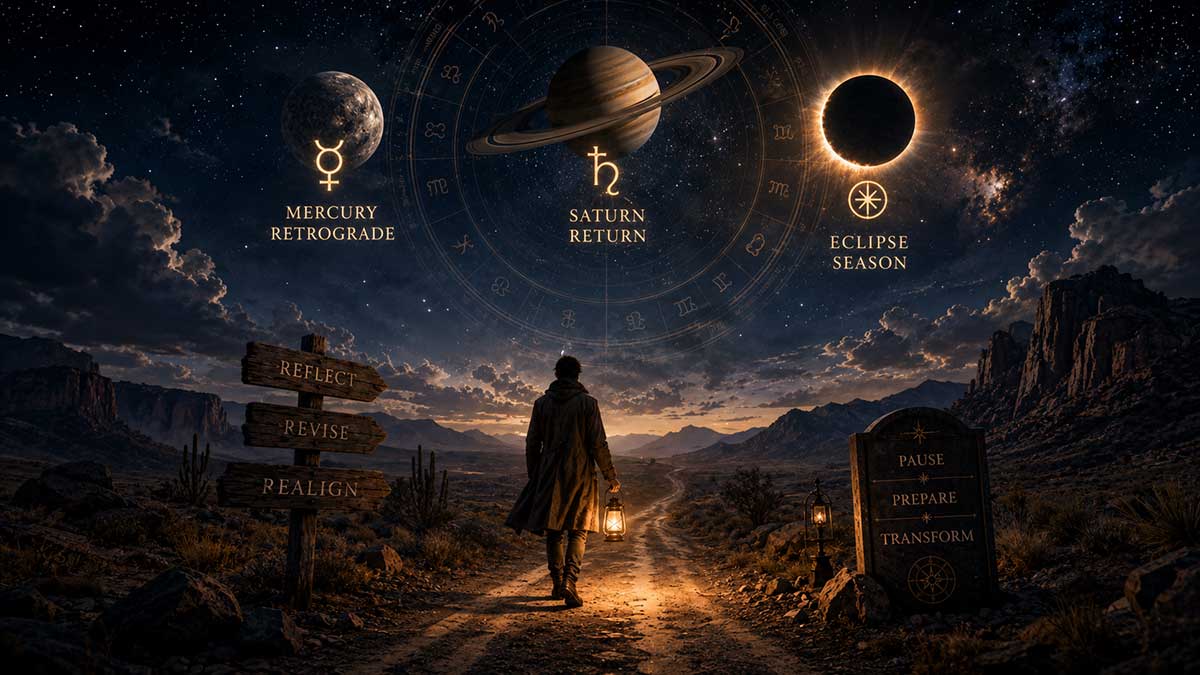
Mercury retrograde is blamed for miscommunication, delays, technology problems, and misunderstandings. Saturn return is spoken of as a time of maturity, pressure, responsibility, and life restructuring. Eclipses are often treated as moments of revelation, endings, and sudden turns.
But we must ask carefully:
Are these truly “good” and “bad” seasons?
Or are they symbolic ways of describing the rhythm of human life?
A difficult period can frighten people.
A favorable period can make people careless.
A forecast can help someone prepare, but it can also make someone anxious.
So today, we ask whether astrology can teach timing without creating fear.
Are difficult seasons warnings?
Are they mirrors?
Are they invitations?
And when life seems to say, “Not yet,” how should we live?
Question 1: Are difficult astrological periods warnings, mirrors, or invitations to slow down?
Susan Miller:
I think they can be all three, but the word “warning” must be used carefully.
If people hear “warning” and become terrified, astrology has not helped them. But if they hear “warning” as “pay attention,” then it can be useful.
Mercury retrograde, for example, does not mean life must stop. It means we should review, revise, check details, back up information, clarify communication, and avoid rushing into decisions without preparation.
A difficult Saturn transit does not mean punishment. It may mean responsibility, patience, maturity, and structure. Saturn asks whether something is strong enough to last.
An eclipse may bring sudden developments, but it can also reveal what was already unstable or ready to change.
So I would say difficult periods are not simply bad.
They are periods that ask for a different style of action.
Sometimes the right action is speed.
Sometimes the right action is caution.
Sometimes it is waiting.
Sometimes it is repair.
Sometimes it is accepting that a door has closed because another stage of life is beginning.
A difficult season can be a gift if it helps us prepare.
The danger is panic.
The gift is awareness.
Chani Nicholas:
I like the word invitation more than warning.
Not because life is always gentle. It is not. Some periods are genuinely hard. There are losses, pressures, endings, illnesses, conflicts, and changes that can shake a person’s sense of safety.
But when we call a period “bad,” we may begin to relate to it only through fear.
Astrology can help us ask better questions.
What is this period asking me to notice?
Where have I been moving too fast?
What needs repair?
What grief have I avoided?
What truth have I been too busy to hear?
What part of me needs more support?
A difficult transit may not be something we caused. It may not be something we can control. But we can choose how we tend to ourselves within it.
Sometimes slowing down is not failure.
Sometimes rest is not weakness.
Sometimes delay is protection.
Sometimes the obstacle is showing us where the foundation was thin.
I do not want astrology to make people afraid of time.
I want it to help people become more intimate with time.
Difficult seasons can teach us how to listen.
Kazuko Hosoki:
There are seasons when people should not move carelessly.
I would not call every difficult period an invitation. Some periods require caution. Some require humility. Some require silence.
A person may want to act, but desire is not always wisdom.
There is a time to begin.
There is a time to stop.
There is a time to expand.
There is a time to protect what already exists.
If a person is in a difficult season and says, “I will do whatever I want,” they may create unnecessary suffering.
In Japan, we often think in terms of timing, fortune, family, ancestors, duty, and the flow of life. A person is not separate from time. A person lives inside time.
So yes, difficult periods can be mirrors and invitations. But they can also be warnings.
Not warnings to collapse into fear.
Warnings to correct one’s life.
Do not make large decisions from pride.
Do not begin what you cannot sustain.
Do not ignore your health.
Do not neglect family.
Do not mistake impatience for destiny.
A bad season is not always a curse.
It can be a time to clean the house of the soul.
Liz Greene:
From a psychological perspective, difficult astrological periods often correlate with the emergence of material we have avoided.
Whether one believes the planets cause events is less important here than the symbolic usefulness of the timing.
A Saturn transit may coincide with confrontation with limitation, aging, responsibility, loneliness, fear, or the need to build a stronger inner structure.
A Pluto transit may coincide with loss, compulsion, power struggles, endings, or deep transformation.
A Neptune transit may coincide with confusion, longing, disillusionment, spiritual hunger, or the dissolution of old certainties.
These are difficult not because they are “bad” in a moral sense, but because they disturb the ego’s preferred story.
The ego wants continuity.
The psyche wants wholeness.
A difficult season may reveal what the ego has excluded.
In this sense, it is a mirror. It shows us the part of life we have not integrated.
It is also an invitation, but not a sentimental one.
An invitation to maturity may arrive as disappointment.
An invitation to truth may arrive as disillusionment.
An invitation to transformation may arrive as the collapse of what we thought we needed.
Difficult periods are not pleasant. But they can be meaningful.
The question is not, “How can I escape this season?”
The deeper question is, “What in me is being asked to become conscious?”
Rob Brezsny:
I prefer to imagine difficult astrological periods as weather reports from the soul’s strange atmosphere.
A storm is not evil.
A drought is not immoral.
A winter is not a cosmic insult.
But you would be foolish to plant tomatoes in a blizzard and then blame the universe.
Timing matters.
There are days for dancing on the roof.
There are days for fixing the roof.
There are days for staying inside and listening to the old ghosts knocking politely in the basement.
Mercury retrograde may not be a demon chewing your laptop wires. But it can be a beautiful excuse to revise the letter, rethink the plan, recheck the address, revisit the dream, and recover the lost thread.
Saturn may not be a cruel judge. Saturn may be the old craftsperson who says, “Make it stronger if you want it to survive.”
A difficult season is not always telling us no.
Sometimes it is saying, “Not like that.”
Sometimes it is saying, “Not yet.”
Sometimes it is saying, “You forgot the sacred part.”
Sometimes it is saying, “Please stop building your future on a cracked floor.”
So yes, a difficult season can be a warning, mirror, and invitation.
But I would add: it can also be a collaborator.
A severe teacher, perhaps.
But sometimes severe teachers save us from our cheaper dreams.
Question 2: Can timing help us act more wisely without making us afraid?
Liz Greene:
It can, if timing is understood symbolically rather than fatalistically.
The danger arises when timing becomes superstition.
If a person says, “I cannot live because Mercury is retrograde,” then astrology has become a prison.
If a person says, “This is a period for reflection, review, and care in communication,” then astrology becomes useful.
Timing should not remove agency.
It should refine agency.
A farmer does not control the seasons, but neither does the farmer become passive. The farmer learns when to plant, when to harvest, when to store, when to repair tools, and when to wait.
Psychologically, timing helps us understand that not every moment asks the same thing of us.
There are times when the psyche is ready to act.
There are times when it is ready to grieve.
There are times when it is ready to build.
There are times when it is ready to release.
There are times when the outer world may not move, but the inner world is reorganizing.
Fear comes when we imagine time as an enemy.
Wisdom begins when we understand time as a field of relationship.
A difficult transit is not a sentence.
It is a climate.
Within that climate, we still choose how to dress, how to walk, what to carry, and when to seek shelter.
Susan Miller:
Yes, timing can help us act more wisely, especially in practical life.
If a person knows that communication may be complicated, they can double-check contracts, confirm appointments, save important files, and avoid careless assumptions.
If a person knows a career period may open, they can prepare their resume, meet people, apply, and be ready.
If a person knows a financial period requires caution, they can review spending and avoid impulsive purchases.
This should not create fear. It should create preparation.
Astrology is not meant to stop life.
It is meant to help people work with life.
I often think of timing as traffic information. If you know there is construction on the road, you do not have to cancel the trip. You leave earlier, check the route, and drive more carefully.
The same is true with difficult astrological periods.
You may still have to sign a document.
You may still have to travel.
You may still have to have an important conversation.
Life does not always wait for perfect astrology.
So the point is not perfection.
The point is mindfulness.
Good timing gives people confidence because they feel prepared.
Bad use of timing gives people anxiety because they feel controlled.
The astrologer’s responsibility is to help people feel capable, not helpless.
Rob Brezsny:
Timing should make us artful, not afraid.
Imagine a musician.
The musician does not play every note at the same volume.
There are rests.
There are crescendos.
There are silences.
There are sudden drums.
There are long, slow notes that ask the listener to breathe.
Life has rhythm.
Astrology, at its best, says, “Listen for the rhythm.”
Fear says, “Do nothing unless the sky gives permission.”
Wisdom says, “Act in harmony with the weather.”
A so-called bad period may be excellent for certain things.
Mercury retrograde may be bad for rushing, but good for revising.
Saturn pressure may be bad for fantasy, but good for discipline.
Neptune fog may be bad for certainty, but good for prayer, art, and surrendering false control.
Pluto intensity may be bad for superficial living, but good for finally telling the truth.
Every season has a medicine.
The problem is that we often want the same medicine all the time.
We want growth without pruning.
Opportunity without preparation.
Freedom without maturity.
Vision without confusion.
Rebirth without letting anything die.
Timing teaches humility.
Not fear.
Humility.
It says, “You are not the only force in the room.”
And that is not an insult.
It is a relief.
Chani Nicholas:
Timing can help us if it is used as a practice of care.
If someone is entering a difficult period, I do not want them to hear, “Something bad will happen.”
I want them to hear, “This is a time to resource yourself.”
Who supports you?
What routines hold you?
What boundaries are needed?
What conversations should be handled slowly?
What part of your body needs attention?
What would make this season more survivable, more honest, more compassionate?
Astrology can be grounding when it helps people prepare emotionally and materially.
Fear often grows in vagueness.
When someone feels something is changing but cannot name it, they may feel overwhelmed. A symbolic timing system can help them say, “This period has a shape. I can respond to it.”
That can reduce anxiety rather than increase it.
But astrologers and spiritual writers must be careful.
If we use dramatic language carelessly, we can harm people.
Not everyone has the same resources. Not everyone has safety, money, health, community, or flexibility. Telling someone to “just surrender to the transit” may be irresponsible if they are living inside real danger or instability.
So timing must be human.
It must consider the person’s actual life.
The goal is not to make people obey the sky.
The goal is to help them take better care of their lives under the sky.
Kazuko Hosoki:
Fear is not the purpose. Discipline is the purpose.
If timing makes a person afraid, they have misunderstood.
If timing makes a person arrogant, they have also misunderstood.
A good season does not mean you may act foolishly.
A bad season does not mean you have no hope.
A person should use timing to become more careful, more respectful, and more sincere.
In a difficult season, do not force.
Do not boast.
Do not begin unnecessary conflict.
Do not take reckless risks.
Do not ignore the signs that life is asking you to stop and examine yourself.
In a favorable season, do not waste the chance.
Do not sleep through opportunity.
Do not become lazy because fortune is good.
Do not forget gratitude.
Timing is not there to frighten people. It is there to teach proper conduct.
If the season is cold, dress warmly.
If the season is fertile, plant well.
If the season is unstable, secure what matters.
If the season is quiet, reflect.
A person who respects timing becomes wiser.
A person who fears timing becomes weak.
A person who ignores timing becomes reckless.
The middle path is awareness.
Question 3: What should we do when the sky seems to say, “Not yet”?
Kazuko Hosoki:
When the sky says, “Not yet,” the person must learn patience.
Many failures come from moving too soon.
People force marriage because they are lonely.
They force business because they are greedy.
They force change because they are restless.
They force speech because they cannot bear silence.
But not every closed door is an enemy.
Sometimes the door is closed because the person is not ready.
Sometimes the foundation is not clean.
Sometimes the family matter is unresolved.
Sometimes the body is tired.
Sometimes the heart is confused.
Sometimes pride is leading.
When the season says, “Not yet,” do not waste the time.
Prepare.
Clean.
Study.
Save money.
Repair relationships.
Take care of health.
Respect those who supported you.
Examine your motives.
Waiting is not doing nothing.
Correct waiting is active.
If you prepare well in a quiet season, then when the season changes, you can move without panic.
That is wisdom.
Rob Brezsny:
When the sky says, “Not yet,” I want to ask, “What kind of not yet?”
There is the cowardly not yet, which is fear wearing a monk’s robe.
“I am not ready” can sometimes mean, “I do not want to risk being alive.”
But there is also the sacred not yet.
The seed under the ground is not lazy.
The baby in the womb is not procrastinating.
The soup simmering on the stove is not failing to become dinner.
Some things are ruined by haste.
When the sky says, “Not yet,” we might ask:
What is ripening?
What must be strengthened?
What must be composted?
What false urgency am I addicted to?
What would preparation look like if I trusted it?
Not yet does not mean never.
It can mean, “Become more worthy of the dream.”
It can mean, “Gather your tools.”
It can mean, “Let the old version of the desire die, so the truer desire can appear.”
It can mean, “Practice in secret.”
It can mean, “Stop asking for a throne when you have not yet befriended your own basement.”
I love the hidden work of not yet.
The underground work.
The invisible apprenticeship.
The slow magic.
Sometimes the most important chapter of a life is the one no one applauds.
Chani Nicholas:
When the sky says, “Not yet,” we need to be tender with the disappointment.
Waiting can be painful.
Especially if someone has already waited a long time.
Especially if they have been denied opportunities.
Especially if they are exhausted.
Especially if they feel everyone else is moving faster.
So I do not want to romanticize delay.
Not yet can hurt.
But if we listen carefully, not yet may also become a place of care.
What support do I need while I wait?
What part of me feels abandoned by delay?
What would help me stay connected to hope without forcing the outcome?
What can I build slowly?
What can I stop measuring by other people’s timelines?
Astrology can help people remember that life is cyclical.
A closed period is not necessarily the whole story.
A quiet period is not proof of failure.
A slow period may still be fertile.
But we also have to be practical.
If the sky says “not yet,” but rent is due, medicine is needed, or a child must be cared for, life still requires action. Astrology should never become an excuse to ignore reality.
So perhaps the question is not, “Should I act or wait?”
The better question is:
“What kind of action belongs to this season?”
Sometimes the answer is bold movement.
Sometimes it is repair.
Sometimes it is grief.
Sometimes it is planning.
Sometimes it is asking for help.
Not yet can still be a sacred kind of work.
Liz Greene:
When the sky seems to say, “Not yet,” we may be encountering the psychological necessity of gestation.
The ego often experiences delay as humiliation.
It says, “I should already be there.”
“I should already know.”
“I should already have achieved.”
“I should already be loved.”
“I should already be healed.”
But the psyche does not always move according to the ego’s schedule.
There are inner processes that require darkness.
Grief cannot be rushed simply because the ego wants productivity.
Maturity cannot be rushed because ambition is impatient.
Trust cannot be rushed because loneliness wants a relationship immediately.
A vocation cannot be rushed because one wants recognition.
Saturn, in particular, teaches the dignity of time.
Not the glamour of time.
The dignity.
The slow formation of character.
The slow acceptance of limits.
The slow construction of inner authority.
When we meet “not yet,” we should ask what is still unformed.
Is the desire mature enough?
Is the structure strong enough?
Is the motivation honest enough?
Is the old identity truly finished?
Is the person prepared to receive what they are asking for?
Delay is not always denial.
Sometimes it is the psyche’s protection against premature birth.
Susan Miller:
When the sky says, “Not yet,” I think we should prepare carefully and remain hopeful.
There are many useful things to do during a waiting period.
Review plans.
Improve skills.
Organize finances.
Update documents.
Reconnect with people.
Gather information.
Take care of health.
Strengthen the foundation.
If it is not the best time to launch, it may be an excellent time to prepare the launch.
If it is not the best time to decide, it may be an excellent time to collect facts.
If it is not the best time to push a relationship forward, it may be an excellent time to communicate gently and observe honestly.
Timing is not only about action. It is also about readiness.
Many people want the green light before they have packed the car.
A slower period can be useful because it gives us time to become ready for the opportunity we say we want.
And then, when the door opens, we are not scrambling.
We are prepared.
So when astrology says, “Not yet,” I would not hear it as rejection.
I would hear it as, “Use this time well.”
Closing
Chani Nicholas:
Perhaps the question is not whether there are good and bad seasons.
Perhaps the question is whether we know how to live inside different kinds of time.
Some seasons open doors.
Some seasons close them.
Some seasons bring clarity.
Some seasons bring fog.
Some seasons ask for courage.
Some seasons ask for rest.
Some seasons ask us to build.
Some seasons ask us to grieve what can no longer be carried.
Astrology can become harmful when it teaches fear.
Fear of retrogrades.
Fear of Saturn.
Fear of eclipses.
Fear of the future.
Fear of making a mistake because the sky is not perfect.
But astrology can become healing when it teaches relationship.
Relationship with timing.
Relationship with limits.
Relationship with cycles.
Relationship with preparation.
Relationship with the parts of ourselves that only speak when life slows down.
A difficult season does not mean the universe is against us.
It may mean we are being asked to move differently.
Not faster.
Not louder.
Not more desperately.
Differently.
A so-called bad season may ask us to repair what speed has damaged.
A delay may ask us to strengthen what desire has rushed.
A loss may ask us to honor what was real.
A closed door may ask us to stop abandoning ourselves in pursuit of approval.
A quiet sky may ask us to listen to the life we already have.
Timing should not take away our responsibility.
It should deepen it.
The stars do not need to become our masters.
They can become reminders.
To prepare.
To pause.
To choose carefully.
To act when action is ripe.
To rest when the body tells the truth.
To remember that every life has weather.
And no season, not even the hardest one, is the whole sky.
Nextは Topic 4: Astrology, Shadow, and Healing: Why Do We Repeat the Same Patterns? が自然です。
Topic 4: Astrology, Shadow, and Healing: Why Do We Repeat the Same Patterns?
Guests
Chani Nicholas
Liz Greene
Susan Miller
Rob Brezsny
Kazuko Hosoki
Opening
Liz Greene:
One of the most painful human questions is not, “What will happen to me?”
It is:
“Why does this keep happening?”
Why do I keep choosing the same kind of relationship?
Why do I keep fearing the same kind of success?
Why do I keep sabotaging what I say I want?
Why do I keep feeling abandoned, unseen, trapped, or not enough?
Astrology becomes psychologically serious when it moves beyond prediction and begins to reveal pattern.
A birth chart may show gifts, but it may also show defenses.
It may show desire, but also fear.
It may show love, but also the way love becomes entangled with old wounds.
It may show ambition, but also shame.
It may show sensitivity, but also the places where sensitivity became self-protection.
In psychological astrology, the chart is not used to blame the planets.
It is used to ask what parts of the self have remained unconscious.
The shadow is not simply evil.
It is what we cannot yet recognize as belonging to us.
Sometimes the shadow appears as anger we deny.
Sometimes as weakness we despise.
Sometimes as desire we judge.
Sometimes as power we fear.
Sometimes as dependency we hide.
Sometimes as tenderness we protect behind control.
Astrology can help us name these inner patterns. But naming is not healing by itself.
The deeper question is:
Can we see the pattern without becoming trapped by it?
Can we understand our wound without making it our identity?
Can astrology help us become more responsible, more compassionate, and more free?
Let us begin.
Question 1: Why do people repeat the same relationship or life patterns?
Liz Greene:
People repeat patterns because the unconscious seeks expression.
What has not been understood does not disappear. It returns in another form.
A person who fears abandonment may repeatedly choose unavailable partners.
A person who fears engulfment may choose intimacy and then flee from it.
A person who experienced love as criticism may become drawn to people who judge them.
A person who learned to survive by pleasing others may call self-erasure “kindness.”
The pattern is painful, but it is not meaningless.
The psyche repeats what it has not yet symbolized.
In astrology, certain chart configurations may help us see the emotional logic behind repetition.
Venus-Saturn may speak of love tied to fear, deprivation, duty, or the belief that affection must be earned.
Moon-Pluto may speak of emotional intensity, early entanglement, survival bonds, and the fear of losing control.
Mars-Neptune may speak of diffused anger, confused desire, or difficulty acting directly.
Sun-Chiron may speak of a wound to confidence, visibility, or the right to exist as oneself.
These symbols do not cause the pattern in a mechanical way. They describe the psychic field in which the pattern may grow.
Repetition is the soul’s insistence.
It says, “Look again.”
“Feel what was not felt.”
“Understand what was inherited.”
“Stop calling fate what is actually unconscious loyalty.”
Healing begins when repetition becomes recognition.
Chani Nicholas:
Patterns repeat because they were once forms of protection.
Before we judge ourselves for repeating something painful, we have to ask:
What did this pattern help me survive?
Maybe overworking helped someone feel safe.
Maybe people-pleasing helped them avoid rejection.
Maybe emotional distance helped them survive chaos.
Maybe choosing unavailable people helped them avoid the terror of being truly seen.
Maybe control helped them manage a life that once felt uncontrollable.
Astrology can help us look at these patterns with more compassion.
A chart might show where someone learned to armor themselves.
Where they learned to hide.
Where they learned to perform.
Where they learned that love required sacrifice.
Where they learned that being powerful was dangerous.
Where they learned that needing others was shameful.
But astrology should not be used to say, “This is just who you are.”
It should help us say, “This is how I adapted. Now I can choose differently.”
That shift matters.
A pattern is not always a flaw. Sometimes it is an old survival strategy that has outlived the conditions that created it.
Healing does not begin with self-hatred.
It begins with honest tenderness.
We look at the pattern and say:
“Thank you for helping me survive.
But I do not want you to run my life anymore.”
Kazuko Hosoki:
People repeat patterns because they do not correct their way of living.
They may know something is wrong, but they continue.
They choose the same kind of person.
They make the same careless decision.
They ignore the same warning.
They act from pride, loneliness, greed, fear, or impatience.
Then they say, “Why does this always happen to me?”
But sometimes the answer is simple.
Because you are living the same way.
Fortune-telling can reveal a season. It can reveal a tendency. It can reveal danger. But if the person does not change conduct, the same result will return.
A person who rushes during a time that requires caution will suffer.
A person who ignores family duty will suffer.
A person who speaks without humility will create conflict.
A person who follows desire without discipline will lose balance.
I do not say this to condemn people.
I say it because people must not surrender their power.
If you repeat a pattern, ask:
What am I refusing to learn?
What am I refusing to stop?
What am I refusing to respect?
What timing am I ignoring?
What duty have I avoided?
The stars may show the road.
But your feet still walk it.
Rob Brezsny:
We repeat patterns because some ancient part of us believes the spell will end differently next time.
The child inside says:
“If I can finally make the unavailable person love me, the original wound will be healed.”
“If I can finally win approval, the old shame will vanish.”
“If I can finally control everything, I will never be helpless again.”
“If I can finally become impressive enough, no one will abandon me.”
So we return to the same haunted theater, wearing new costumes, acting with new actors, but reading from the same old script.
Astrology can be helpful because it gives names to the archetypal roles.
The rescuer.
The exile.
The warrior who forgot tenderness.
The lover who worships suffering.
The orphan who trusts no feast.
The king who fears his own throne.
The mystic who refuses ordinary life.
When the pattern has a mythic name, we can stop being only its victim.
We can become its author.
But I do not want people to use astrology as a museum of wounds.
The point is not to polish our chains and call them sacred.
The point is to ask:
What new ritual would break the spell?
What act of courage would interrupt the old plot?
What kind of love would the pattern not recognize at first because it is too healthy?
Repetition is not proof that we are doomed.
It may be the universe’s annoying way of saying, “You are ready to become conscious here.”
Susan Miller:
People repeat patterns for many reasons, and astrology can help them become aware of timing and tendencies.
Sometimes a person repeats relationship patterns because they do not understand what they need emotionally. Learning the Moon sign or Venus placement may help them see what kind of affection, stability, communication, or independence matters to them.
Sometimes a person repeats career patterns because they do not understand their own ambition or fear of visibility. The Sun, Saturn, Midheaven, and tenth house can be helpful in understanding that.
Sometimes people repeat financial patterns because they act impulsively during stressful periods or do not plan ahead.
Astrology can make people more observant.
It can help them say:
“This is when I usually rush.”
“This is when I usually withdraw.”
“This is when I usually overspend.”
“This is when I usually choose the wrong person because I am afraid of being alone.”
“This is when I need to pause and think.”
That awareness is practical.
I do not think astrology should make people feel condemned by their chart. It should give them tools.
If you know your pattern, you can prepare for it.
If you know a difficult period is coming, you can be more careful.
If you know you are sensitive to rejection, you can slow down before reacting.
If you know you are prone to overwork, you can schedule rest before exhaustion arrives.
Patterns change when awareness becomes action.
Question 2: Can astrology help us see our shadow without blaming the planets?
Chani Nicholas:
Yes, but only if we use astrology with maturity.
The planets should not become scapegoats.
We cannot say, “My Mars made me cruel.”
“My Venus made me abandon myself.”
“My Saturn made me cold.”
“My Pluto made me controlling.”
“My Mercury made me lie.”
That is not healing. That is avoidance.
But astrology can help us see the places where we are afraid to be honest.
Mars may show where we struggle with anger, boundaries, courage, and direct action.
Venus may show where we seek love, approval, harmony, or pleasure.
Saturn may show where shame and fear have built walls.
Pluto may show where power, survival, and control are tangled.
Neptune may show where we long to escape, merge, idealize, or dissolve.
These are not excuses. They are invitations to responsibility.
The shadow is not healed by blaming the planets.
It is healed by learning to hold the parts of ourselves we disowned.
The angry part.
The needy part.
The jealous part.
The ambitious part.
The grieving part.
The part that wants rest.
The part that wants power.
The part that wants love without performing for it.
Astrology can create a compassionate container for that honesty.
It can say, “This too belongs. Now, how will you care for it without letting it harm you or others?”
That is shadow work.
Susan Miller:
Astrology can help, but the astrologer must speak responsibly.
If someone is going through a difficult Mars transit, for example, they may feel more impatient or reactive. It is useful to know that. But it does not excuse bad behavior.
Instead, it can help them prepare.
Exercise.
Pause before speaking.
Avoid unnecessary arguments.
Drive carefully.
Use the energy for constructive action.
If Saturn is active, someone may feel pressure, loneliness, or responsibility. Again, that does not mean they should become harsh or hopeless. It means they may need structure, patience, and realistic planning.
If Neptune is active, they may feel inspired, but also confused. That is a good time to be careful with assumptions and promises.
So yes, astrology can reveal shadow tendencies.
But it should always bring the person back to choice.
The planets may describe weather.
They do not force us to behave badly.
If the weather is rainy, you bring an umbrella.
You do not blame the rain for walking into traffic.
Good astrology helps people respond wisely.
Rob Brezsny:
Blaming the planets is bad theater.
It turns the gods into petty criminals and turns us into helpless puppets.
I prefer to imagine the planets as unruly teachers, trickster librarians, stern grandparents, ecstatic musicians, and strange mirrors placed in the hallway of the psyche.
They do not steal our freedom.
They ask what we are doing with it.
Mars does not make me rage.
Mars asks, “What is your relationship with force?”
Venus does not make me foolish in love.
Venus asks, “What do you worship, and what price are you willing to pay for beauty?”
Saturn does not ruin my life.
Saturn asks, “What have you built that can survive truth?”
Neptune does not deceive me.
Neptune asks, “Where do you confuse longing with reality?”
Pluto does not destroy me.
Pluto asks, “What false self are you still trying to keep alive?”
Astrology becomes deliciously useful when we stop blaming and start conversing.
The shadow is not a monster under the bed.
Sometimes it is a neglected god wearing a monster mask because we never invited it to dinner.
When astrology helps us speak with the shadow, the goal is not obedience.
The goal is integration.
Invite Mars to protect, not attack.
Invite Venus to love, not beg.
Invite Saturn to strengthen, not shame.
Invite Neptune to inspire, not seduce.
Invite Pluto to transform, not dominate.
That is a better story than blame.
Kazuko Hosoki:
People like to blame what is outside them.
They blame the planets.
They blame fortune.
They blame family.
They blame timing.
They blame the person who left.
They blame the person who did not understand them.
But fortune-telling should make a person look at themselves.
If your season is difficult, be careful.
If your nature is intense, control yourself.
If your desire is strong, discipline it.
If your words hurt others, correct your speech.
If your pride brings conflict, become humble.
You cannot say, “The stars made me do it.”
That is childish.
A person may be born with certain tendencies. But maturity means learning how to govern them.
Some people have strong emotion.
Some have strong ambition.
Some have weak discipline.
Some have difficulty with family.
Some attract unstable relationships.
The reading may show this. But the reading is not the end.
The question is:
What will you do now?
A shadow is not removed by talking beautifully about it. It is corrected through daily conduct.
Apologize.
Wait.
Do not lie.
Do not betray.
Do not force.
Do not indulge what you know is harmful.
Astrology without moral correction becomes entertainment.
True guidance must change the way a person lives.
Liz Greene:
Astrology can help us see the shadow precisely because it offers symbolic distance.
If I say, “You are controlling,” the person may become defensive.
If we examine Pluto as a symbol in the chart, we may ask, “Where has life taught you that control is necessary for survival?”
That question opens a door.
The shadow rarely appears as something we consciously choose. It often appears as something we justify.
“I am only being realistic.”
“I am only helping.”
“I am only protecting myself.”
“I am only telling the truth.”
“I am only avoiding drama.”
But underneath may be fear, envy, rage, dependency, powerlessness, or grief.
Astrology can give us a symbolic language that makes these things approachable.
But we must never confuse symbol with excuse.
A person with difficult Mars aspects may have a complicated relationship with anger. That does not absolve cruelty.
A person with difficult Venus aspects may fear love or choose painful relationships. That does not absolve betrayal.
A person with difficult Saturn aspects may feel shame and fear. That does not absolve emotional coldness.
The chart describes a psychic inheritance.
Responsibility begins when we become conscious of how we live that inheritance.
The planets do not need blame.
They need interpretation.
The person does not need condemnation.
They need consciousness.
Question 3: Is healing possible when we stop fighting our own nature?
Kazuko Hosoki:
Healing begins when a person accepts the truth, but acceptance does not mean indulgence.
Some people say, “This is my nature,” and then they continue bad habits.
That is not healing.
If your nature is impatient, accept it, then learn patience.
If your nature is emotional, accept it, then learn steadiness.
If your nature is proud, accept it, then learn humility.
If your nature is lonely, accept it, then do not cling to the wrong person.
If your nature is strong, accept it, then do not crush others.
A person must stop fighting reality. But they must also stop excusing weakness.
Fortune-telling can show nature.
But character is built by how we handle nature.
You may not choose your birth.
You may not choose your star.
You may not choose the season you are in.
But you choose conduct.
Healing is not simply feeling better.
Healing is living more correctly.
If you know your nature and become more careful, that is healing.
If you know your timing and become more patient, that is healing.
If you know your weakness and stop hurting others through it, that is healing.
Do not fight your nature.
Train it.
Chani Nicholas:
Healing becomes possible when we stop treating our nature as an enemy.
Many people come to astrology carrying shame.
They are ashamed of their needs.
Ashamed of their sensitivity.
Ashamed of their ambition.
Ashamed of their anger.
Ashamed of their desire for love.
Ashamed of how long healing is taking.
Astrology can help us meet those parts with compassion.
But compassion does not mean letting every impulse run the show.
It means creating a relationship with the self that is honest enough to change.
If someone is sensitive, healing is not becoming less sensitive. It may be building better boundaries.
If someone is intense, healing is not becoming flat. It may be learning how to hold intensity without burning everything down.
If someone is ambitious, healing is not rejecting ambition. It may be separating ambition from the need to prove worth.
If someone is cautious, healing is not forcing constant bravery. It may be helping the nervous system trust life slowly.
We do not heal by becoming someone else.
We heal by becoming more skillful with who we are.
The chart can help us say:
“This is part of me.
It deserves care.
It needs practice.
It does not have to control me.
It does not have to be exiled.”
That is a gentler kind of transformation.
Rob Brezsny:
Fighting your nature is like yelling at a tree because it refuses to become a violin overnight.
The better question is:
What kind of music can this tree become?
I do not believe we should worship every impulse. The self is full of glorious nonsense. Some of it needs discipline. Some of it needs composting. Some of it needs a stern talk and a sandwich.
But the war against the self is exhausting.
Many people spend years trying to amputate the very thing that could become their medicine.
The melancholy could become depth.
The anger could become courage.
The loneliness could become sacred solitude.
The weirdness could become art.
The sensitivity could become perception.
The stubbornness could become devotion.
The wound could become a doorway, though not automatically and not without work.
Astrology can help because it makes the inner nature feel less random.
It says, “Ah, this force has a name. This pattern has a season. This ache belongs to a larger story.”
And once something belongs to a story, it can change roles.
The villain can become a guardian.
The exile can become a prophet.
The wound can become a teacher.
The frightened child can become the keeper of tenderness.
Healing is not the destruction of nature.
It is the liberation of nature from its worst disguises.
Susan Miller:
Yes, healing is possible when we stop fighting our own nature, because then we can work with it practically.
If someone knows they need emotional security, they can choose relationships and environments that support that need.
If someone knows they needs independence, they can build a life that allows space and movement.
If someone knows they are sensitive to stress, they can plan rest before they become exhausted.
If someone knows they are ambitious, they can set goals and timelines instead of feeling guilty for wanting achievement.
Astrology can help people make better choices because it helps them understand what supports them.
But healing also requires action.
A person cannot only read about their chart. They have to live differently.
If communication is difficult, practice communication.
If boundaries are weak, practice boundaries.
If money is unstable, make a plan.
If love patterns are painful, slow down and choose more carefully.
If confidence is low, take small steps that build evidence.
The chart may explain why something is hard.
It does not remove the need to grow.
I think people feel relieved when they stop fighting their nature.
They no longer have to become someone else.
They can become the best version of who they actually are.
Liz Greene:
Healing does not occur when we eliminate conflict from the psyche. It occurs when we establish a more conscious relationship with that conflict.
We cannot simply remove Saturn, Mars, Neptune, Pluto, or the Moon from the chart. We cannot remove childhood, inheritance, temperament, longing, fear, or desire.
To fight one’s nature is often to strengthen the very thing one is trying to escape.
A person who fights dependency may become emotionally frozen.
A person who fights anger may become passive-aggressive.
A person who fights vulnerability may become controlling.
A person who fights ambition may become secretly resentful.
A person who fights sensitivity may become numb.
The rejected part does not vanish. It returns as symptom, projection, or fate.
Healing begins when the rejected part is approached symbolically.
“What do you want?”
“What are you protecting?”
“When did you first appear?”
“What would you become if I listened without surrendering my whole life to you?”
This is the difference between possession and relationship.
If I am possessed by Mars, I may act destructively.
If I have a relationship with Mars, I may discover courage.
If I am possessed by Saturn, I may live in shame and fear.
If I have a relationship with Saturn, I may build integrity and endurance.
If I am possessed by Neptune, I may dissolve into fantasy.
If I have a relationship with Neptune, I may discover compassion, imagination, and spiritual depth.
Healing is not becoming free of the chart.
It is becoming conscious enough to live the chart creatively.
Closing
Chani Nicholas:
We repeat patterns because some part of us is asking to be seen.
Not punished.
Not shamed.
Not excused.
Seen.
A pattern may have begun as protection.
A wound may have shaped a gift.
A defense may have once saved us.
A fear may have been inherited before we had words for it.
Astrology can help us see these things.
But astrology must be used carefully.
If it becomes blame, it weakens us.
If it becomes a label, it traps us.
If it becomes an excuse, it keeps us from repair.
If it becomes spiritual decoration, it may make pain sound beautiful without actually healing it.
The purpose is not to say:
“My chart made me this way.”
The purpose is to say:
“I can see the pattern now.
I can care for the wound.
I can stop abandoning the part of me that needed protection.
I can take responsibility for how I act.
I can choose differently, one practice at a time.”
The shadow is not healed by exile.
It is healed by relationship.
We do not become whole by destroying parts of ourselves.
We become whole by learning how to listen, guide, discipline, comfort, and integrate them.
Astrology, at its best, gives us a symbolic language for that work.
It shows us that we are not simple.
We are not one sign, one wound, one mistake, one desire, one fear, one story.
We are a living sky of many forces.
Some bright.
Some hidden.
Some wounded.
Some wise.
Some still waiting to be invited home.
Healing begins when we stop asking only, “Why does this keep happening to me?”
And begin asking:
“What part of me is trying to be understood through this pattern?”
Then the pattern is no longer only a prison.
It becomes a doorway.
Nextは最後の Topic 5: Do the Stars Set Us Free—or Trap Us in an Identity? です。
Topic 5 Do the Stars Set Us Free—or Trap Us in an Identity?
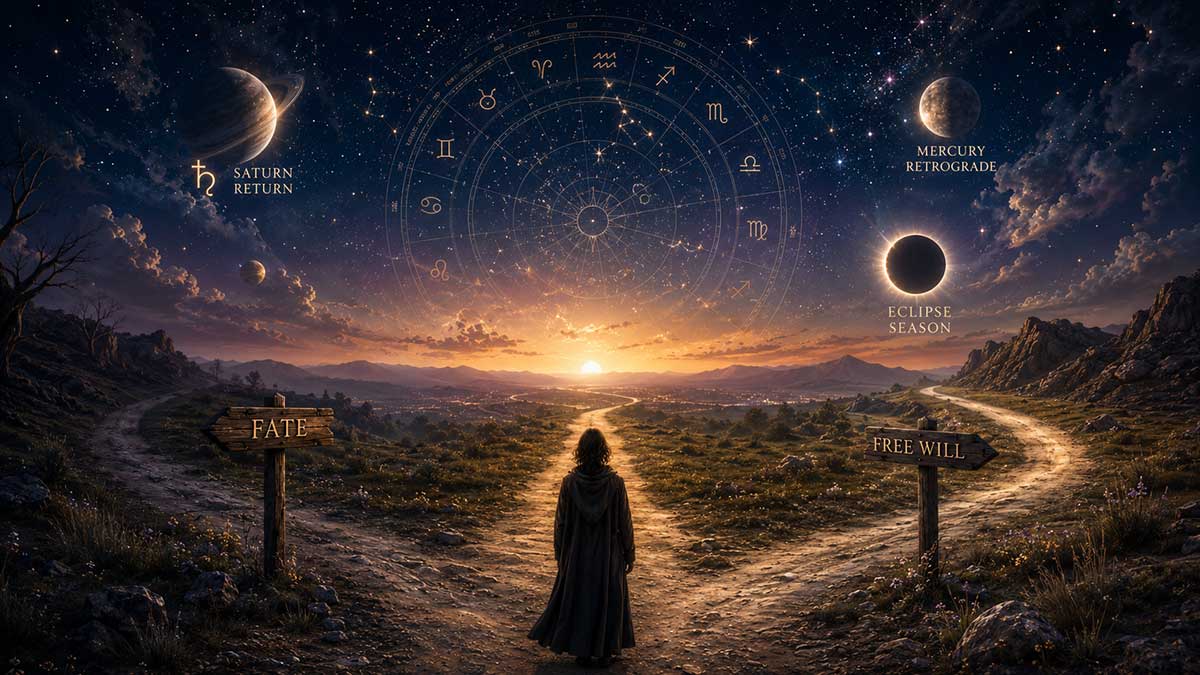
Guests
Chani Nicholas
Liz Greene
Susan Miller
Rob Brezsny
Kazuko Hosoki
Opening
Rob Brezsny:
Astrology is full of beautiful dangers.
It can give a person language.
It can give them courage.
It can help them laugh at their own patterns.
It can make the inner life feel less lonely.
It can turn confusion into symbol, timing into rhythm, and pain into a story that can be lived more consciously.
But every beautiful language can become a cage.
A person may say:
“I am this sign, so I cannot change.”
“My chart says I am like this, so I do not need to grow.”
“This relationship failed because of astrology.”
“This opportunity is not for me because the timing is wrong.”
“My wound is my identity.”
“My personality is my destiny.”
Then astrology has stopped being a lantern.
It has become a locked room.
The stars may help us see ourselves.
But what happens when we begin to worship the reflection?
This is the final question.
Does astrology help us become more free?
Or does it give us a more poetic way to avoid responsibility?
Perhaps the answer depends not on the stars, but on how we read them.
Let us begin.
Question 1: When does astrology become self-knowledge?
Rob Brezsny:
Astrology becomes self-knowledge when it makes us more awake, not more predictable.
If I read something about my chart and think, “Ah, that is why I do that,” the next question should not be, “How can I defend this forever?”
The next question should be, “Now that I see it, what kind of freedom is possible?”
Self-knowledge is not the same as self-description.
A label says, “I am this.”
Self-knowledge says, “I notice this pattern moving through me.”
That difference is everything.
A person might say, “I am intense.”
That is a label.
But self-knowledge says, “I use intensity to avoid vulnerability. I become dramatic when I am afraid to be honest.”
A person might say, “I need freedom.”
That is a label.
But self-knowledge says, “Sometimes I call it freedom when I am actually running from intimacy.”
A person might say, “I am sensitive.”
That is a label.
But self-knowledge says, “My sensitivity is real, and I must learn how to care for it without making everyone else responsible for my nervous system.”
Astrology becomes self-knowledge when it does not merely flatter us.
It should surprise us.
Interrupt us.
Deepen us.
Complicate us.
Make us kinder and more accountable.
A good chart reading should not say, “Here is your final identity.”
It should say, “Here is the beginning of a more honest conversation with your life.”
Chani Nicholas:
Astrology becomes self-knowledge when it helps us return to ourselves with more compassion and more responsibility.
Many people live for years with unnamed pain.
They feel too emotional.
Too ambitious.
Too needy.
Too distant.
Too strange.
Too intense.
Too slow.
Too much.
Astrology can help them understand that these parts of the self are not random failures. They may be patterns, adaptations, wounds, gifts, or needs asking for care.
That can be deeply healing.
But self-knowledge is not only feeling seen.
It is also learning how to respond to what we see.
If astrology shows me that I avoid conflict, then self-knowledge asks me to practice honest communication.
If it shows me that I overwork to feel worthy, then self-knowledge asks me to build a life where rest is not shameful.
If it shows me that I confuse love with sacrifice, then self-knowledge asks me to learn boundaries.
If it shows me that I fear being seen, then self-knowledge asks me to move toward visibility with tenderness and support.
Astrology becomes self-knowledge when it helps us stop abandoning ourselves.
It becomes self-knowledge when it says:
“This is your pattern.
This is your pain.
This is your gift.
This is your timing.
Now, how will you care for your life?”
Self-knowledge is not passive.
It is a practice.
Liz Greene:
Astrology becomes self-knowledge when symbol becomes consciousness.
A symbol is not a definition. It is a doorway.
Saturn is not merely fear.
Venus is not merely love.
Mars is not merely anger.
Neptune is not merely confusion.
Pluto is not merely destruction.
Each symbol contains many possible expressions, depending on the level of consciousness with which it is lived.
Self-knowledge begins when the individual can say:
“I am not simply acted upon by this pattern. I can observe it. I can reflect on it. I can enter into relationship with it.”
That is a profound shift.
Before consciousness, a person may be possessed by a pattern.
They may repeatedly choose painful relationships, sabotage success, fear authority, idealize unavailable people, or seek control when they feel vulnerable.
After consciousness begins, the same pattern may still exist, but the person has a little space around it.
That space is the birthplace of freedom.
Astrology can help create that space.
It names inner figures.
It reveals conflicts.
It shows how one part of the psyche may be working against another.
It helps the individual understand that they are not one simple thing.
But astrology becomes self-knowledge only when the person does the inner work.
A chart can reveal a pattern.
It cannot integrate it for us.
Susan Miller:
Astrology becomes self-knowledge when it helps people understand their tendencies and make better decisions.
For many readers, astrology is useful because it makes life feel more organized.
They learn what kind of work environment suits them.
They learn what kind of relationship helps them feel secure.
They learn when to be cautious with money.
They learn when to take initiative.
They learn why certain periods feel more difficult or more promising.
This kind of self-knowledge can be very practical.
If someone knows they tend to rush decisions, astrology may help them slow down.
If someone knows they need emotional reassurance, they can communicate that more clearly.
If someone knows they are entering a demanding career period, they can prepare rather than panic.
If someone knows they are in a relationship cycle that asks for patience, they can avoid unnecessary drama.
Self-knowledge should help people live better.
It should not make them feel trapped.
A chart is not useful if it only gives someone a description of themselves. It becomes useful when it helps them choose wisely.
The best astrology gives people perspective.
It says, “Here is where you are. Here is what may be developing. Here is what deserves attention. Here is how you can prepare.”
Self-knowledge is not only spiritual.
It is also daily, practical, and responsible.
Kazuko Hosoki:
Astrology or fortune-telling becomes self-knowledge when it teaches a person how to live correctly.
It is not enough to say, “I understand myself.”
If understanding does not change conduct, it is not yet wisdom.
A person may know they are emotional, but still hurt others with emotion.
A person may know they are ambitious, but still become greedy.
A person may know they are lonely, but still choose the wrong person.
A person may know the timing is bad, but still force the situation.
That is not self-knowledge.
That is self-explanation.
True self-knowledge must lead to correction.
If you know your weakness, become careful.
If you know your strength, use it humbly.
If you know your timing, respect it.
If you know your pattern, stop repeating it.
If you know your duty, do not avoid it.
Many people want fortune-telling to comfort them.
But comfort alone is not enough.
A true reading should ask:
Are you living with sincerity?
Are you keeping your promises?
Are you respecting the people who depend on you?
Are you acting from pride or from wisdom?
Are you using your nature as an excuse?
Self-knowledge is not looking at yourself forever.
It is changing the way you walk.
Question 2: When does astrology become spiritual dependency?
Kazuko Hosoki:
Astrology becomes dependency when a person cannot make decisions without it.
They ask about everything.
Should I call this person?
Should I buy this thing?
Should I leave the house?
Should I begin?
Should I stop?
Should I trust my own heart?
This is dangerous.
Fortune-telling should guide a person. It should not replace their backbone.
If a person uses astrology to avoid responsibility, they become weak.
They say, “The timing was bad,” but they did not prepare.
They say, “The stars were against me,” but they acted selfishly.
They say, “This person was my destiny,” but they ignored all warnings.
They say, “I cannot change,” but they refuse discipline.
That is not fate. That is avoidance.
A person must learn to stand.
There is timing.
There is fortune.
There is nature.
There is season.
But there is also conduct.
Do not ask the stars to do what your character must do.
If astrology makes you humble, careful, and wise, it helps.
If it makes you passive, fearful, or dependent, it has become poison.
Susan Miller:
Astrology becomes dependency when people stop using their judgment.
It is natural to look for guidance. Everyone needs reassurance sometimes. Life can be uncertain, and astrology can help people think about timing and preparation.
But it becomes a problem when someone cannot act unless the astrology is perfect.
There is no perfect time for everything.
Life still has deadlines.
Children still need care.
Bills still need to be paid.
Doctors still need to be called.
Opportunities still require effort.
Relationships still require honest conversation.
If a person waits for the ideal chart every time, they may miss life.
Astrology should support decision-making, not replace it.
For example, if Mercury is retrograde and you must sign an important document, you do not necessarily refuse. You read carefully, ask questions, check details, and make the best decision available.
That is a healthy use of astrology.
Dependency says, “I cannot move unless the sky approves.”
Wisdom says, “I will move carefully, with awareness.”
The astrologer also has responsibility.
We should not make people afraid.
We should not make them feel powerless.
We should not encourage them to come back for every small decision.
Good astrology gives people confidence to live their own lives.
Chani Nicholas:
Astrology becomes dependency when it disconnects us from our own inner knowing.
A person may begin with curiosity.
Then they feel seen.
Then they begin checking astrology more often.
Then slowly, they may stop asking, “What do I know?” and only ask, “What does the chart say?”
That is where we have to be careful.
Astrology should help us build a relationship with ourselves, not abandon ourselves to another authority.
No astrologer should become the owner of someone else’s truth.
No app, chart, forecast, or transit should replace the body’s wisdom, lived experience, community care, therapy, prayer, discernment, or practical reality.
If you are unsafe, astrology should not tell you to stay.
If you are sick, astrology should not replace medical care.
If you are being harmed, astrology should not spiritualize the harm.
If you know something is wrong, astrology should not talk you out of your knowing.
A healthy relationship with astrology strengthens agency.
It helps someone say:
“I can listen to timing, and I can still make choices.”
“I can honor the symbols, and I can still trust my lived reality.”
“I can receive guidance, and I can still belong to myself.”
Dependency begins when we give away the right to know our own life.
Healing begins when astrology helps us reclaim that right.
Rob Brezsny:
Astrology becomes dependency when the map eats the traveler.
The map is supposed to help us wander with more wonder.
But sometimes people kneel before the map and never take the road.
They ask the ephemeris for permission to breathe.
They consult Venus before texting.
They blame Mars for every rude sentence.
They let Saturn become a prison warden.
They turn Mercury retrograde into a tiny god of inconvenience.
This is not astrology.
This is bureaucracy with stars on it.
A living astrology should make us braver.
Not reckless, but braver.
Not obedient, but more awake.
Not addicted to certainty, but more willing to dance with uncertainty.
Dependency says, “Tell me exactly what will happen so I do not have to risk being human.”
But being human is risk.
Love is risk.
Art is risk.
Faith is risk.
Forgiveness is risk.
Growth is risk.
Even staying where you are is risk.
Astrology should not remove the wildness of life.
It should help us become better companions to the wildness.
When astrology becomes a way to avoid life, it has lost its soul.
When it becomes a way to enter life with more imagination, humility, humor, and courage, it is alive.
Liz Greene:
Astrology becomes dependency when it is used to avoid the anxiety of choice.
Choice is difficult because it confronts us with uncertainty.
If I choose this relationship, I may be hurt.
If I choose this career, I may fail.
If I leave, I may be alone.
If I stay, I may betray myself.
If I speak, I may be rejected.
If I remain silent, I may disappear.
Astrology can seem to offer escape from this anxiety.
The person may ask the chart to choose for them.
But this is a misuse of astrology.
A chart can illuminate the nature of the conflict. It can show the psychological themes involved. It can reveal timing, fear, desire, projection, and potential consequences.
But the choice belongs to the person.
If astrology removes the burden of choice, it also removes dignity.
Spiritual dependency often appears when the individual cannot tolerate ambiguity.
They want certainty.
They want authority.
They want a cosmic parent to say, “This is the right answer.”
But adulthood requires us to live without absolute certainty.
A mature astrology does not infantilize the soul.
It helps the individual endure the complexity of freedom.
The chart may advise.
The symbol may reveal.
The timing may suggest.
But the person must still choose.
Question 3: How can we read the stars without giving away our responsibility?
Liz Greene:
We can read the stars responsibly when we remember that symbols are not commands.
A symbol opens meaning. It does not close the future.
If Saturn is active, we may ask questions about responsibility, fear, structure, authority, and maturity.
But Saturn does not tell us exactly what to do.
If Venus is active, we may ask about love, value, beauty, desire, and relationship.
But Venus does not absolve us from honesty.
If Pluto is active, we may ask about transformation, power, loss, compulsion, and survival.
But Pluto does not justify cruelty.
To read the stars responsibly is to ask better questions, not to surrender judgment.
The question is not:
“What do the planets force me to do?”
The question is:
“What part of life is being symbolized here, and how can I meet it consciously?”
Responsibility means we remain participants in our own lives.
We consider the chart.
We consider reality.
We consider ethics.
We consider other people.
We consider our history.
We consider our duties.
We consider the consequences of our actions.
Astrology can deepen reflection.
But reflection must lead to ownership.
The most mature statement is not, “My chart made me do this.”
It is:
“My chart helped me see the pattern. Now I am responsible for how I live it.”
Kazuko Hosoki:
You can read the stars without losing responsibility if you remember that guidance is not permission.
If fortune says a time is good, that does not give permission to be careless.
If fortune says a time is difficult, that does not give permission to become weak.
If your nature is strong, that does not give permission to dominate.
If your nature is sensitive, that does not give permission to avoid duty.
A person must live with discipline.
Use astrology to know the season.
Use character to decide your conduct.
If the season is difficult, be humble.
If the season is favorable, be grateful.
If the heart is confused, do not rush.
If the path is open, do not waste it.
But always ask:
Am I being sincere?
Am I harming someone?
Am I keeping my promise?
Am I respecting my family?
Am I acting from wisdom or impulse?
The stars may show timing.
But they do not wash your hands for you.
You must choose clean conduct.
That is responsibility.
Rob Brezsny:
Read the stars as if they are poets, not police officers.
A poet can awaken you.
A police officer can arrest you.
Too many people let astrology arrest them.
They say, “I cannot do that. I am this sign.”
“I cannot love that person. Our charts say no.”
“I cannot change. My placement says this.”
“I cannot act. The transit is wrong.”
But what if the stars are not saying, “Obey”?
What if they are saying, “Imagine more deeply”?
A responsible astrology does not shrink the possible.
It enriches the possible.
It gives you metaphors for courage.
It gives you timing for patience.
It gives you rituals for attention.
It gives you warnings against laziness, arrogance, and self-deception.
But it does not live your life.
You live your life.
So read the horoscope.
Study the chart.
Honor the transit.
Laugh with Mercury.
Negotiate with Saturn.
Write poems to Venus.
Ask Mars to teach you clean fire.
Then step outside and do the actual work.
Apologize.
Create.
Rest.
Choose.
Build.
Love.
Tell the truth.
Try again.
The stars may sing.
But you must dance.
Chani Nicholas:
We can read the stars responsibly by staying rooted in consent, context, and care.
No chart should override someone’s lived experience.
A person is not only their birth chart. They are also shaped by family, culture, trauma, privilege, oppression, illness, community, faith, economics, education, and countless choices.
So responsible astrology must be humble.
It should never say, “This is all you are.”
It should say, “Here is one symbolic way to understand part of your experience.”
It should never say, “You have no choice.”
It should say, “Here are the patterns. Here are the pressures. Here are the possibilities. What support do you need to choose well?”
Responsibility also means knowing when astrology is not enough.
Sometimes people need therapy.
Sometimes they need legal help.
Sometimes they need medical care.
Sometimes they need rest.
Sometimes they need community.
Sometimes they need to leave a harmful situation.
Sometimes they need practical planning more than spiritual language.
Astrology can be part of care, but it should not pretend to be all of care.
When used well, astrology can help us ask:
What am I feeling?
What am I repeating?
What am I avoiding?
What am I ready to reclaim?
What choice would honor my dignity?
The stars can help us listen.
But responsibility means we answer with our lives.
Susan Miller:
We can keep responsibility by using astrology as one tool among many.
If someone is making a major decision, they should consider timing, but also facts.
For a career decision, look at the chart, but also look at the contract, salary, company, commute, family needs, and long-term goals.
For a relationship decision, look at compatibility, but also look at kindness, communication, honesty, shared values, and how the person treats you.
For a financial decision, look at timing, but also look at your budget, savings, debt, risk, and obligations.
Astrology can give insight, but practical life must be respected.
I think the healthiest approach is balanced.
Use astrology to prepare.
Use it to reflect.
Use it to understand cycles.
Use it to become more patient during difficult times and more ready during favorable times.
But do not use it to avoid common sense.
The chart may show opportunity, but you must do the work.
The chart may show caution, but you must check the details.
The chart may show love, but you must build trust.
The chart may show pressure, but you must take care of your health.
Responsibility means astrology helps you participate more fully in life.
Not less.
Closing
Liz Greene:
Astrology can free us, and astrology can imprison us.
It depends on whether we use it to become conscious, or to avoid consciousness.
If astrology gives us labels, but no reflection, it traps us.
If it gives us prediction, but no responsibility, it weakens us.
If it gives us identity, but no growth, it flatters us.
If it gives us timing, but no courage, it frightens us.
If it gives us symbols, but no ethics, it becomes dangerous.
But astrology can also become a profound language of freedom.
It can help us see the pattern before we repeat it again.
It can help us name the wound before we mistake it for destiny.
It can help us honor our nature without being ruled by it.
It can help us understand timing without surrendering our will.
It can help us live inside mystery without demanding false certainty.
The birth chart is not a prison.
It is not a final verdict.
It is not a replacement for conscience.
It is not a substitute for love, reason, faith, therapy, medicine, community, or moral responsibility.
It is a symbolic map.
And like all maps, it has limits.
A map can show mountains.
It cannot climb them for us.
A map can show rivers.
It cannot teach us how cold the water will feel.
A map can show roads.
It cannot decide which road we have the courage to take.
Perhaps astrology is most useful when it brings us to the threshold of a better question.
Not, “What will happen to me?”
Not, “Who am I forever?”
Not, “What do the stars allow?”
But:
“What am I becoming conscious of?”
“What pattern am I ready to transform?”
“What responsibility belongs to me now?”
“What kind of person do I want to become under this sky?”
The stars may describe the weather of the soul.
But the life is still ours.
We must choose.
We must repair.
We must love.
We must grow.
We must answer.
And perhaps that is the deepest freedom astrology can offer.
Not freedom from responsibility.
Freedom through responsibility.
次はこの英語版全体の MFS — Main Introduction, Final Thoughts, Short Bios が自然です。
Final Thoughts by Chani Nicholas
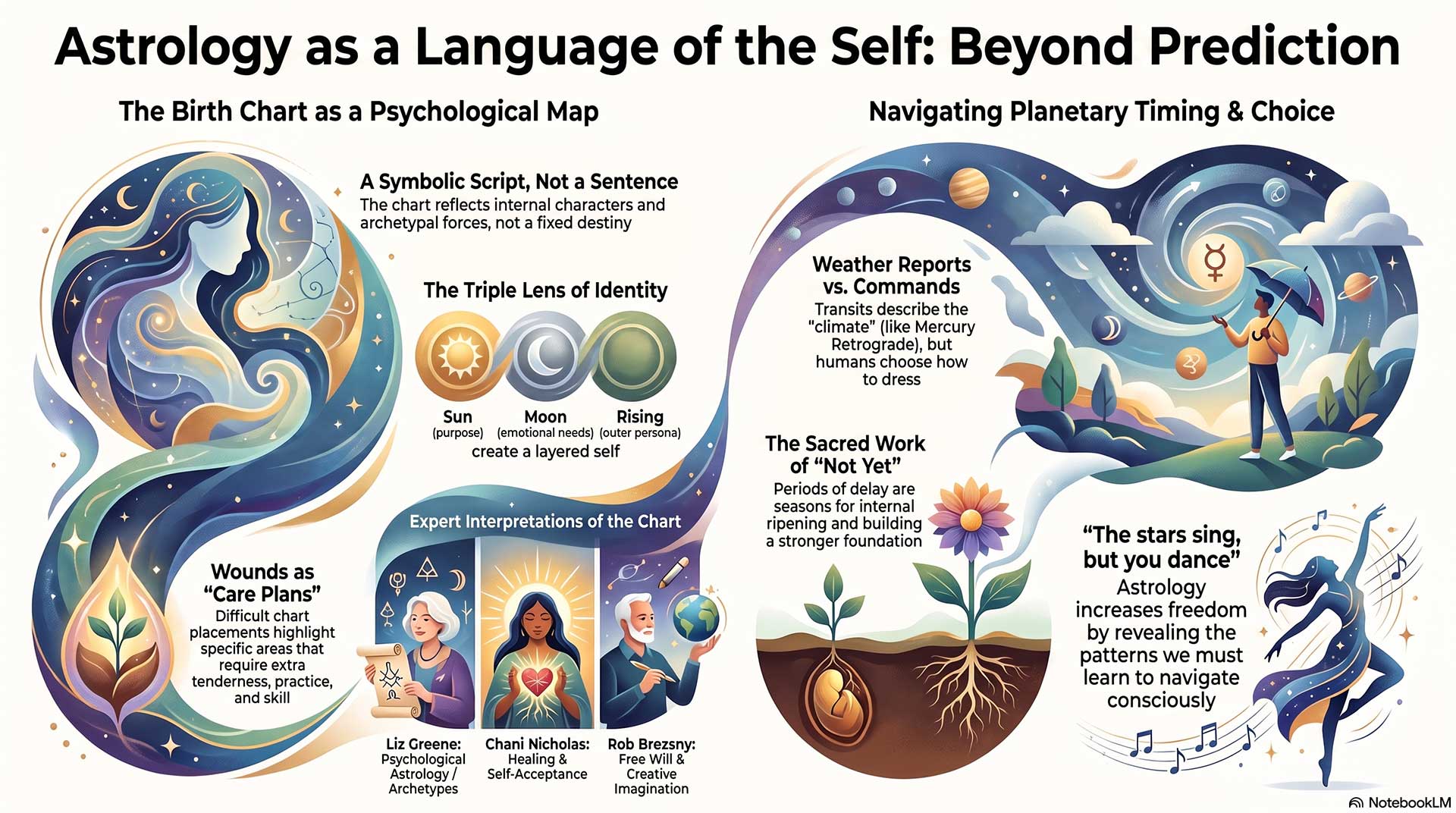
Astrology is not at its best when it makes us dependent.
It is not at its best when we use it to avoid choice, delay responsibility, excuse harm, or turn ourselves into fixed identities.
“I am this sign, so I cannot change.”
“My chart says this, so I do not have to grow.”
“The planets made me do it.”
“The timing is wrong, so I cannot act.”
“My wound is my destiny.”
These are not the deepest uses of astrology.
The deepest use of astrology is not escape.
It is relationship.
Relationship with the self.
Relationship with time.
Relationship with pattern.
Relationship with the body.
Relationship with the choices that remain ours, even when life is difficult.
A birth chart can show tendencies, but it cannot live our lives for us.
A transit can describe pressure, but it cannot tell us how to treat people.
A forecast can point to timing, but it cannot replace courage.
A symbol can reveal a wound, but it cannot heal the wound without practice, support, honesty, and care.
The stars may give us language.
But we must still choose how to speak with our lives.
Astrology becomes healing when it helps us stop abandoning ourselves.
It becomes meaningful when it helps us see our patterns without shame.
It becomes wise when it teaches patience, humility, and responsibility.
It becomes dangerous only when we give it the authority that belongs to conscience, reality, love, and lived experience.
The question is not whether astrology can explain everything.
It cannot.
No chart can fully explain a human life.
No sign can contain the mystery of a soul.
No transit can replace the need for compassion, discipline, therapy, community, prayer, medicine, or practical action.
But astrology can offer a mirror.
And sometimes, when we are lost, a mirror matters.
It can show us the part of ourselves we have been fighting.
It can show us the pattern we are ready to interrupt.
It can show us the timing of a season we must move through with care.
It can show us that we are not only our wound, our fear, our history, or our habits.
We are also possibility.
So perhaps astrology does not set us free by telling us our future.
Perhaps it sets us free by helping us become conscious enough to choose a different relationship with ourselves.
The stars may describe the weather.
But we still decide how to walk under the sky.
Short Bios:
Chani Nicholas is a modern astrologer known for bringing astrology into the language of healing, self-acceptance, social awareness, and personal reflection. In this conversation, she represents astrology as a tool for care rather than control. Her voice reminds us that a birth chart should not shame or limit a person, but help them build a more compassionate relationship with their own patterns, wounds, gifts, and choices.
Liz Greene is a major voice in psychological astrology, known for connecting astrology with depth psychology, myth, archetypes, and the unconscious. In this conversation, she reads the birth chart not as a fixed sentence, but as a symbolic map of the psyche. Her perspective helps move astrology beyond simple prediction and into the deeper question of how people become conscious of the inner stories they are living.
Susan Miller is one of the most widely recognized popular astrologers in the English-speaking world, known for practical monthly forecasts and accessible guidance. In this conversation, she represents astrology as a tool for timing, preparation, and everyday decision-making. Her voice brings astrology down to earth, showing how people use forecasts to think about work, love, money, health, communication, and opportunity.
Rob Brezsny is the creator of Free Will Astrology, known for poetic, imaginative, and spiritually playful horoscopes. In this conversation, he treats astrology not as a cage, but as a creative language of possibility. His voice challenges fatalism and reminds us that symbols should expand imagination, awaken courage, and invite people to participate more consciously in the story of their lives.
Kazuko Hosoki was one of Japan’s most famous fortune-tellers, known for Six Star Astrology and her strong emphasis on fate, timing, family, discipline, and proper conduct. In this conversation, she serves as the one Japanese voice among Western astrologers. Her perspective adds seriousness and restraint, reminding us that knowing one’s fortune or timing is meaningless unless it leads to humility, responsibility, and wiser behavior.
Leave a Reply