
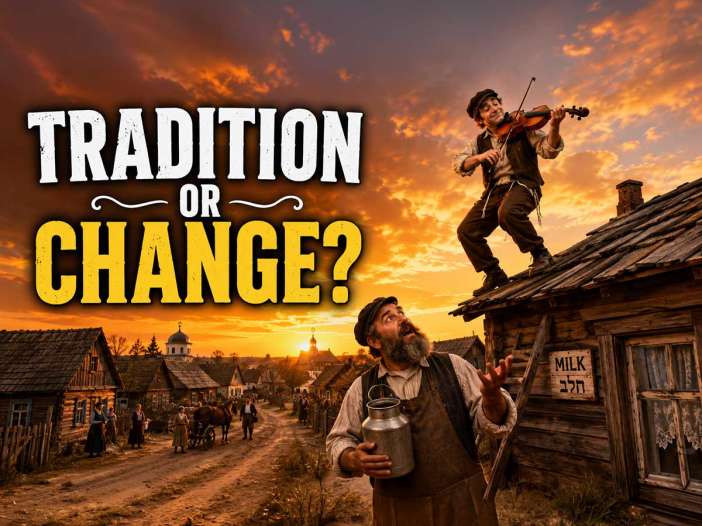
What if Fiddler on the Roof is not only about tradition, but about every parent learning how to love children they cannot control?
Introduction by Tevye
A story begins with a village.
Not a grand village. Not a rich village. Not a village that causes kings to lose sleep.
Anatevka.
A small place with muddy roads, thin walls, noisy chickens, nervous fathers, strong mothers, hungry children, stubborn customs, and enough gossip to feed Yente for three lifetimes.
In Anatevka, we have tradition.
Tradition tells us who we are. It tells the father how to stand, the mother how to work, the children how to listen, the matchmaker how to interfere, and the butcher how to look respectable before asking for someone’s daughter.
Without tradition, our lives would be as shaky as a fiddler standing on a roof.
And yet, this is the trouble with life:
The roof shakes anyway.
A daughter says, “Papa, I want to marry for love.”
Another daughter says, “Papa, I must follow my heart far away.”
Then another daughter says something so painful that a father feels his whole world crack inside him.
At the same time, outside our homes, history begins knocking like a soldier with no manners.
So what is this story really about?
It is about tradition, yes.
But it is also about love, faith, family, pain, change, exile, memory, and the strange courage people find when they have no other choice.
In these conversations, we ask five questions that every family, every village, and every generation must face:
Is tradition a roof or a cage?
Who has the right to choose love?
What does faith mean when life keeps hurting?
How far can children go before parents cannot follow?
And when home is taken away, what remains?
I would answer all of this myself, but then Golde would say I talked too much, the Rabbi would say I missed the sacred point, Yente would recommend a marriage, Lazar Wolf would mention meat, Perchik would start a revolution, and the Fiddler would play over everyone.
So let us begin.
The roof is slippery.
The music has started.
And as usual, I have questions for God.
(Note: This is an imaginary conversation, a creative exploration of an idea, and not a real speech or event.)
Topic 1: Tradition — Is It a Cage or a Roof?
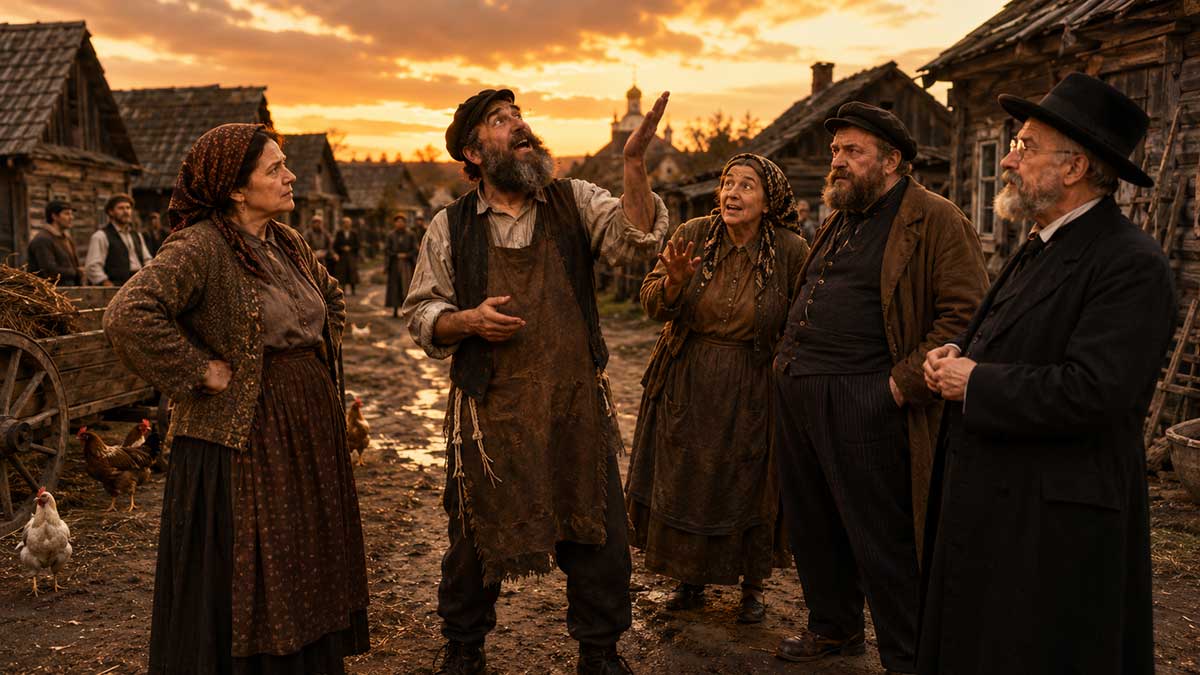
Opening — Tevye
Tevye:
In Anatevka, everything has a tradition.
How to eat.
How to pray.
How to stand.
How to marry.
How to complain.
How to complain about complaining.
A man wakes up in the morning, thanks God he is alive, then asks God why life is so expensive. This too is tradition.
But a strange question has entered our village like a goat through an open door:
Is tradition a roof that protects us?
Or is it a cage that keeps us from walking into a larger world?
I would answer this question clearly, but first I must ask my wife, my rabbi, a matchmaker, and a butcher. In our village, no man thinks alone. If he tries, someone corrects him.
Question 1: When does tradition protect a family, and when does it trap them?
Golde:
Tradition protects a family when everyone knows what to do. The father works. The mother works harder. The children listen. The house survives.
Tevye:
Yes, Golde, beautiful. The father works, the mother works harder, and the children listen until they become old enough to stop listening.
Golde:
They stop listening sooner if the father talks too much.
Tevye:
A wise point. Painful, but wise.
Yente:
Tradition protects people from foolish choices. Without tradition, girls marry for love. Love! A dangerous thing. It makes people poor, sentimental, and badly dressed.
Lazar Wolf:
I agree with Yente. A good arrangement saves everyone trouble. A man knows what he gets. A woman knows what she gets. The families know what they get. The butcher knows if there will be meat at the wedding.
Tevye:
Lazar Wolf, in your view, every spiritual question ends at meat.
Lazar Wolf:
A man must start somewhere.
Rabbi:
Tradition is like a fence around a sacred garden. It keeps danger out.
Tevye:
Yes, Rabbi, a fence. But what if the children begin climbing over it?
Rabbi:
Then the fence may need repair.
Golde:
Or the children may need repair.
Tevye:
Golde, you speak like a mother with tools.
Yente:
A cage? Who says tradition is a cage? A cage has bars. Tradition has customs. Much nicer. More singing.
Tevye:
But Yente, suppose a girl wants to marry someone her heart chooses?
Yente:
The heart? The heart is a reckless matchmaker. It works without references.
Lazar Wolf:
Exactly. A heart cannot pay rent.
Golde:
Neither can a poor tailor, but we seem to be discussing ideas, not my daughters.
Tevye:
Golde, nobody mentioned daughters.
Golde:
Your face mentioned daughters.
Tevye:
My face speaks too much.
Rabbi:
Tradition traps a family when people forget why the custom exists. A roof is good when it shelters. A roof pressed down too low makes everyone bend.
Tevye:
Ah! So a roof must be high enough for a man to stand.
Golde:
For a woman too.
Tevye:
Of course. In our house, I stand only when you allow space.
Question 2: Can a community survive if every generation changes the rules?
Lazar Wolf:
No. If every generation changes the rules, soon nobody knows who sits where at dinner. Chaos begins at the table.
Yente:
And at weddings. Without rules, anyone may marry anyone. Then what am I? A woman with opinions and no business.
Tevye:
Yente, even without business, you would still have opinions.
Yente:
That is my gift to the village.
Golde:
A community cannot change every rule at once. But some rules may need room to breathe. Children are not bread dough. You cannot keep punching them down and expect a good loaf.
Tevye:
Golde, this is a strong image. Painful for the children, useful for the baker.
Rabbi:
Every generation receives tradition like a lamp. One generation may polish it. Another may carry it into a new room. But if they throw it away, they sit in darkness.
Tevye:
And if they change the lamp too much?
Rabbi:
Then perhaps they no longer know it is a lamp.
Lazar Wolf:
This is what I say. Keep the old lamp. Keep the old table. Keep the old marriage arrangements. Keep the old butcher.
Yente:
Especially the butcher. A widow with a butcher is never lonely and rarely hungry.
Golde:
Yente, you speak of marriage like soup.
Yente:
Soup lasts longer than romance.
Tevye:
Still, I wonder. If our children change nothing, they become copies of us. If they change everything, they become strangers. Somewhere between copy and stranger, perhaps there is a child.
Golde:
That may be the wisest thing you said today.
Tevye:
Good. I will stop talking now.
Golde:
You will not.
Tevye:
True. Tradition.
Question 3: What should never be changed, no matter how modern life becomes?
Rabbi:
Faith should never be abandoned. Customs may shift, language may change, clothing may change, but a person must still know before whom he stands.
Tevye:
And if a man stands before God with holes in his boots?
Rabbi:
Then he stands honestly.
Lazar Wolf:
Respect should never change. Children must respect parents. Wives must respect husbands. Customers must respect fair prices.
Golde:
Fair prices? From you?
Lazar Wolf:
I said respect them. I did not say enjoy them.
Yente:
Family must never change. A person without family is like soup without salt.
Tevye:
Again with soup.
Yente:
Soup explains life. Hot, messy, easily ruined, better with chicken.
Golde:
What should never change is responsibility. Love is nice, but someone must carry water, cook food, mend clothes, raise children, bury the dead, and still get up the next morning.
Tevye:
Golde, when you say it that way, love sounds exhausted.
Golde:
Real love is often exhausted.
Rabbi:
Mercy should never change.
Tevye:
Mercy?
Rabbi:
Yes. Tradition without mercy becomes stone. Change without mercy becomes fire. A family needs neither stone nor fire at the dinner table.
Yente:
A little fire is good for soup.
Golde:
Yente.
Yente:
Fine. No soup.
Tevye:
I think I understand. Tradition must protect faith, family, responsibility, and mercy. But it must not become so heavy that it crushes the people it was meant to hold.
Lazar Wolf:
That sounds expensive.
Tevye:
Everything sounds expensive to you.
Lazar Wolf:
I am a businessman.
Golde:
You are a butcher.
Lazar Wolf:
A businessman with knives.
Tevye:
Then perhaps tradition is not a cage and not only a roof. Perhaps it is a balance. Like a fiddler on a roof.
Yente:
A foolish place to play music.
Rabbi:
Yet he plays.
Golde:
And we listen.
Tevye:
Yes. We listen. We argue. We complain. We adjust one board of the roof, then pray the whole house does not fall down.
Closing — Tevye
Tevye:
So what did we learn?
Tradition is not merely old habit. It is memory with a roof over it.
But a roof must shelter the living, not bury them.
A father may love tradition. A mother may carry it. A rabbi may explain it. A matchmaker may sell it. A butcher may price it by the pound.
But children?
Children test it.
And when children begin to test tradition, a man like me must ask God for wisdom, patience, and perhaps a stronger chair.
For now, Anatevka still stands. The roof still holds. The fiddler still plays.
But I hear footsteps in the house.
And I suspect one of my daughters is about to ask me something expensive.
Topic 2: Marriage and Love — Who Has the Right to Choose?
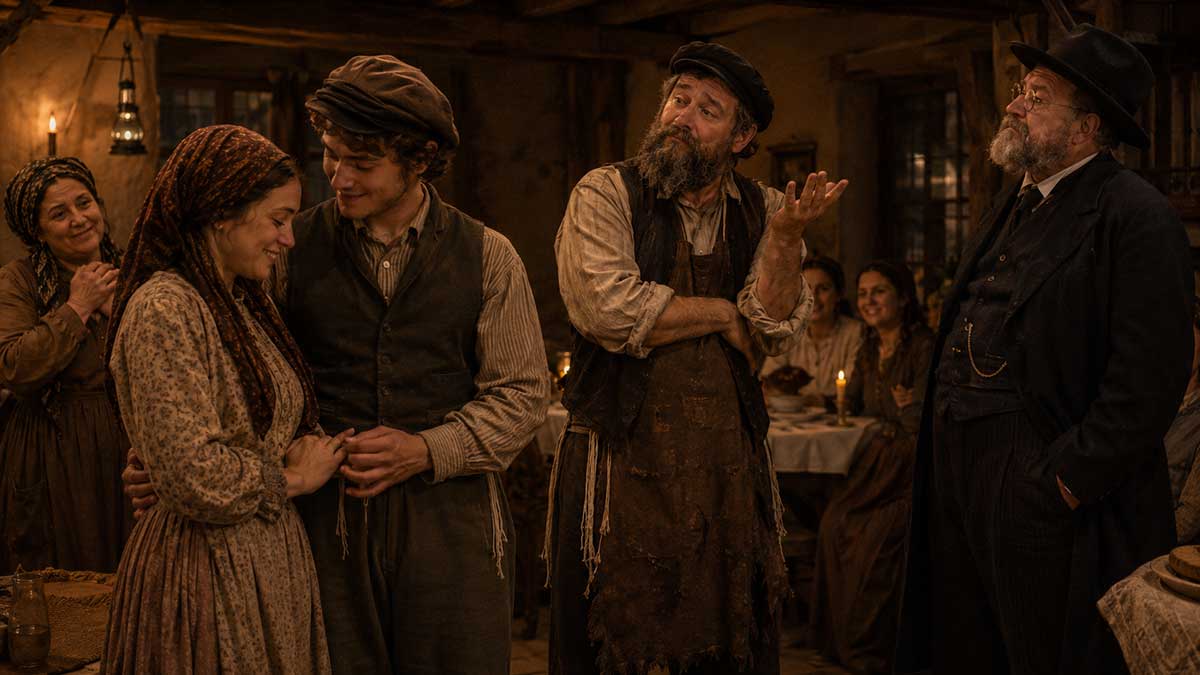
Opening — Tevye
Tevye:
Marriage.
A simple matter.
Two families meet. A matchmaker speaks. A father agrees. A mother worries. A bride trembles. A groom sweats. The rabbi blesses. The guests eat.
Simple.
Unless the bride has an opinion.
Then suddenly marriage becomes philosophy, rebellion, stomach pain, and very bad sleep.
In my village, a match is not a private matter. It belongs to the family, the neighbors, the rabbi, the matchmaker, and sometimes the butcher, if the butcher has paid attention.
But now my daughters say, “Papa, I want to choose.”
Choose?
A man chooses between potatoes and turnips. A woman chooses which pot is less cracked. But a husband? A wife? A whole future?
This is not shopping. This is life.
And life, as usual, has come into my house without wiping its feet.
Question 1: Should parents guide marriage, or should children choose completely for themselves?
Lazar Wolf:
Parents should guide. Completely. Children are young. They think love is a loaf of fresh bread. They do not see that by morning it becomes hard.
Tzeitel:
That is a terrible description of marriage.
Lazar Wolf:
It is a practical description. Bread must be bought. Rent must be paid. A husband must provide.
Motel:
I can provide.
Lazar Wolf:
With what? Thread?
Motel:
A tailor has honest hands.
Lazar Wolf:
Yes, honest hands. Empty pockets.
Tevye:
Lazar Wolf, your pockets are full, but your words are heavy. They may injure the furniture.
Hodel:
Parents should guide, but they should not own the future of their children. A daughter is not a cow to be sold to the highest bidder.
Lazar Wolf:
I did not say cow.
Tzeitel:
You almost did.
Tevye:
No one is calling my daughter a cow. Let us keep animals out of this conversation, unless they are bringing milk.
Motel:
I think children should choose, but with respect.
Tevye:
Respect. A beautiful word. Often used by young people five seconds before they break your heart.
Tzeitel:
Papa, I did not want to break your heart. I wanted to marry Motel.
Tevye:
For a father, sometimes these are the same sentence.
Hodel:
But you listened.
Tevye:
I listened after arguing with myself, arguing with God, arguing with Golde in my head, and then losing all three arguments.
Lazar Wolf:
A father must be firm.
Tevye:
A father must be firm, yes. But if he is too firm, he becomes a wall. Then his daughters stop coming through the door.
Tzeitel:
So what is the answer?
Tevye:
Parents should guide. Children should choose. Both should suffer a little. This way everyone knows it is a real marriage.
Question 2: Is love enough when money, family, and community are against it?
Motel:
Love gives courage. Before I loved Tzeitel, I was afraid of everyone. After I loved her, I was still afraid, but I spoke anyway.
Tevye:
A great improvement. From silent fear to public fear.
Tzeitel:
Motel’s courage mattered more to me than money.
Lazar Wolf:
That is what poor people say before winter.
Hodel:
Money matters, but love gives two people the strength to face poverty together.
Lazar Wolf:
Poverty together is still poverty.
Tevye:
True. But poverty alone has worse conversation.
Tzeitel:
If I married only for comfort, my heart would become poor.
Lazar Wolf:
A warm house with meat is not a small thing.
Motel:
No one says it is small.
Lazar Wolf:
Then why refuse it?
Tzeitel:
Since I did not love you.
Lazar Wolf:
Love again. Always love. The village has become infected.
Tevye:
Love spreads faster than chicken pox and is less easy to cure.
Hodel:
Love alone may not be enough, but without love, what is marriage? A business agreement with soup?
Lazar Wolf:
There is nothing wrong with soup.
Tevye:
Lazar Wolf, we had soup in Topic 1. We must let other foods speak.
Motel:
I know I am poor. But I can work. I can build a life. Tzeitel believes in me.
Tevye:
This is the dangerous part. When a woman believes in a man, he may begin to believe in himself. Then who knows what trouble he can cause?
Tzeitel:
Papa.
Tevye:
I said trouble. I did not say bad trouble.
Hodel:
Maybe love is not a guarantee. Maybe it is a promise.
Tevye:
Ah. A promise. Very nice. Very dangerous. A promise says, “I cannot give you certainty, but I will walk with you.”
Lazar Wolf:
Certainty is better.
Tevye:
Yes, but certainty rarely sings.
Question 3: What does Tevye lose when he lets Tzeitel marry Motel?
Tzeitel:
Papa loses the old way.
Motel:
And Lazar Wolf loses a bride.
Lazar Wolf:
Thank you for reminding me.
Tevye:
Motel, when a man loses a bride, do not poke him with a needle.
Motel:
Sorry.
Hodel:
Papa loses control.
Tevye:
Control? I had control?
Tzeitel:
You thought you did.
Tevye:
Ah, yes. The most common form of control.
Lazar Wolf:
He loses respect. If daughters choose for themselves, people will say the father is weak.
Tevye:
People say many things. If I sneeze, they say I have offended winter.
Hodel:
But you do care what the village thinks.
Tevye:
Of course I care. A man lives among people. Their eyes sit at his table whether he invites them or not.
Tzeitel:
But you cared about me more.
Tevye:
This is where you wounded me, my daughter.
Tzeitel:
I wounded you?
Tevye:
Yes. You forced me to discover that my heart was larger than my rulebook.
Motel:
That sounds good.
Tevye:
For you, yes. For me, it was very inconvenient.
Lazar Wolf:
He loses authority.
Hodel:
Maybe he gains trust.
Tevye:
Trust. Another expensive item.
Tzeitel:
You gave me your blessing. That means I can enter my marriage without hiding from you.
Tevye:
Yes. If I had refused, I might have kept the rule and lost the daughter.
Lazar Wolf:
But rules matter.
Tevye:
They do. Yet a rule without a daughter sitting across from me at Sabbath dinner is a lonely rule.
Motel:
So you did not lose everything.
Tevye:
No. I lost the match I expected. I lost a little pride. I lost the pleasant dream that daughters ask permission before becoming adults.
Hodel:
And what did you gain?
Tevye:
A tailor for a son-in-law, which God will explain to me someday.
Motel:
I will become a good husband.
Tevye:
See that you do. A poor man may be accepted. A careless man will be repaired by Golde.
Tzeitel:
You gained our honesty.
Tevye:
Yes. That is true.
A daughter who tells the truth may frighten her father, but she has not left him.
Closing — Tevye
Tevye:
So this is marriage now.
Once, a father arranged, a daughter obeyed, and everyone pretended that fear was respect.
Now a daughter stands before me and says, “Papa, I love him.”
What can a man do?
He can shout.
He can quote tradition.
He can look at the poor tailor and wonder why God did not send a rich tailor.
He can pace until the floor asks for mercy.
Then he must look at his daughter.
Not at the village.
Not at the matchmaker.
Not at the butcher.
Not at the rule.
At his daughter.
And if her eyes are honest, a father may discover that blessing her choice does not destroy his love. It proves it.
Still, I ask God one small favor.
The next daughter should fall in love with someone who owns a business, a horse, and maybe a roof without leaks.
But knowing my house, she will fall in love with an idea.
Topic 3: Faith and Doubt — What Does Tevye Really Believe?
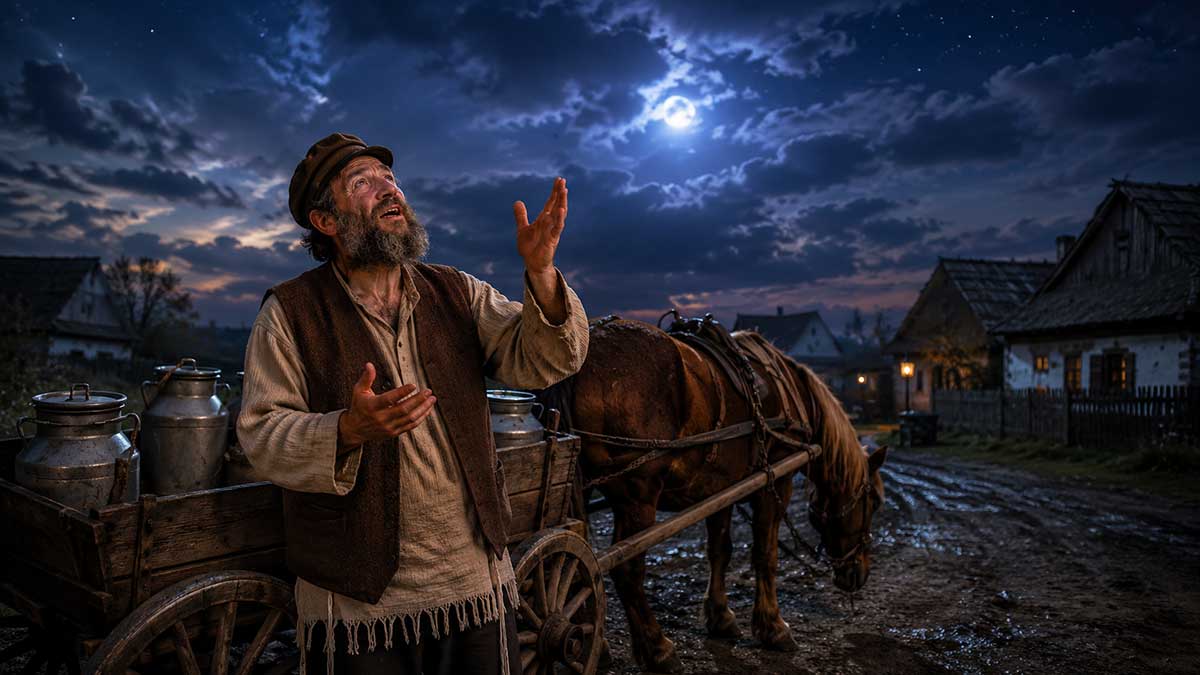
Opening — Tevye
Tevye:
A man of faith has many duties.
He must pray.
He must work.
He must thank God for what he has.
Then he must ask God why what he has is so small.
This is not disrespect. This is conversation.
Some men speak to God with beautiful words. I speak to Him with my actual life, which is less beautiful but more accurate.
In Anatevka, faith is not something we keep in a book and admire from a safe distance. Faith is in the mud, the milk cart, the Sabbath candles, the empty pockets, the hungry children, and the question that comes every morning:
“Dear God, I know You are busy, but would it hurt to look in my direction?”
Today we ask what faith truly is.
Is it quiet obedience?
Is it honest argument?
Is it holding on when life pulls at your fingers?
I would answer, but my horse is lame, my daughters are thinking, and my wife is looking at me like I have already said too much.
Question 1: Is faith stronger when people obey quietly, or when they argue with God honestly?
Rabbi:
Faith begins with reverence. A person should be careful when speaking to the Almighty.
Tevye:
Careful, yes. But silent? If God wanted silence, why create Tevye?
Golde:
That question has troubled the village for years.
Motel:
I think honest prayer matters. When I was afraid to speak to Tzeitel’s father, I prayed.
Tevye:
And God answered by sending you to me?
Motel:
In a manner of speaking.
Tevye:
God has a sense of humor.
Perchik:
Faith that cannot face questions is weak. If a man suffers and still pretends everything is fine, that is not faith. That is fear wearing a prayer shawl.
Rabbi:
Careful, young man. The tongue can run faster than wisdom.
Perchik:
Sometimes wisdom walks too slowly.
Golde:
Sometimes young men talk too much and eat other people’s food.
Perchik:
I accept the second charge.
Tevye:
He accepts it since the food was good.
Rabbi:
There is a difference between arguing with God and accusing God.
Tevye:
Ah, Rabbi, that is true. I complain, but I complain like family.
Golde:
You complain like a man who has never carried water.
Tevye:
Golde, must every theological question end at my failures?
Golde:
Most of them do.
Motel:
Maybe quiet obedience is good when the heart is peaceful. But when the heart is breaking, honest argument may be the only prayer a person has left.
Rabbi:
A broken prayer can still reach heaven.
Perchik:
Then perhaps God prefers truth over manners.
Tevye:
I hope so. My manners are not always polished, but my troubles are very sincere.
Question 2: Why does Tevye keep praying even when life keeps getting harder?
Golde:
He keeps praying since talking to God is cheaper than talking to a doctor.
Tevye:
Golde, you reduce my spiritual life to household economics.
Golde:
Household economics is where your spiritual life lives.
Perchik:
Maybe he prays since prayer gives him strength to endure injustice.
Tevye:
I appreciate that, Perchik. It sounds noble. I may use it next time the cow kicks me.
Motel:
You pray since you believe God hears you.
Tevye:
Yes. Or at least I hope He hears me. Sometimes I suspect He hears me and says, “Again, Tevye?”
Rabbi:
Prayer does not always change the situation. Sometimes it changes the person standing inside the situation.
Golde:
If prayer can make him fix the barn faster, I support it.
Tevye:
Golde, I am having a sacred moment.
Golde:
Have it near the barn.
Perchik:
But does prayer risk making people accept suffering instead of changing it?
Rabbi:
Prayer is not an excuse for laziness.
Tevye:
Good. I was worried laziness had finally found religious support.
Perchik:
People must act. Poverty, injustice, and cruelty are not solved by sighing upward.
Tevye:
True. But after acting, a man may still need to sigh upward.
Motel:
When I bought my sewing machine, I prayed and worked.
Golde:
That is a good combination.
Tevye:
Yes. Work without prayer makes a man proud. Prayer without work makes him hungry.
Rabbi:
Tevye keeps praying since prayer keeps him connected to the One who sees more than he sees.
Tevye:
Exactly. I see mud. God sees the road. I see bills. God sees my character. I see daughters growing too quickly. God sees a father trying not to collapse.
Golde:
You are dramatic.
Tevye:
I am poor. Drama is free.
Question 3: Can faith survive poverty, injustice, and disappointment?
Perchik:
Faith must change the world, not only comfort people after the world wounds them.
Rabbi:
Faith that has no compassion is empty. But faith that has no patience becomes anger with religious clothing.
Tevye:
Religious clothing is expensive. Anger should wear something cheaper.
Golde:
Faith survives poverty if someone still lights the candles.
Motel:
And if someone still believes tomorrow can be better.
Perchik:
Tomorrow will be better only if people fight for it.
Tevye:
Perchik, you speak as if history is a stubborn horse and you plan to pull it by the tail.
Perchik:
If the horse refuses to move, someone must try.
Rabbi:
Disappointment tests whether faith is rooted in comfort or in covenant.
Tevye:
Covenant. A strong word. Stronger than my cart.
Golde:
Everything is stronger than your cart.
Tevye:
Not my excuses.
Motel:
When I was poor and afraid, faith did not make me rich or brave all at once. But it gave me one more step.
Golde:
One more step is sometimes enough.
Perchik:
I can respect that. But I still say faith must not make people passive.
Rabbi:
Nor should action make people proud.
Tevye:
So we need faith with feet and action with humility.
Golde:
That sounds useful. Can it chop wood?
Tevye:
Golde, must everything chop wood?
Golde:
In winter, yes.
Rabbi:
Faith survives when people keep choosing goodness after disappointment.
Perchik:
And justice after fear.
Motel:
And love after shame.
Golde:
And dinner after everyone talks too long.
Tevye:
Then faith is not the absence of doubt. It is arguing, working, eating, praying, forgiving, repairing, and getting up again.
Rabbi:
Yes.
Tevye:
Good. Then I am a man of great faith. I have been getting up again for years.
Closing — Tevye
Tevye:
What do I believe?
I believe God is near, though He sometimes behaves like a neighbor behind a locked door.
I believe a man may argue with God, if he argues with love.
I believe prayer is not magic. If it were magic, my horse would be healthier, my house would be larger, and Lazar Wolf would give discounts.
I believe faith is what remains after life has taken away your illusions.
A man thinks faith means he will be protected from trouble.
Then trouble comes.
So he thinks faith means he will understand the trouble.
Then he does not understand.
At last he learns faith may mean this:
He keeps walking with God, even when he walks with a limp.
He complains, yes.
He asks questions, yes.
He shakes his head, raises his hands, and says, “Dear God, I am trying.”
And perhaps from heaven, God says, “I know, Tevye.”
That is enough for one day.
Unless God would like to send a healthier horse.
Topic 4: Children Leaving the Life Their Parents Knew
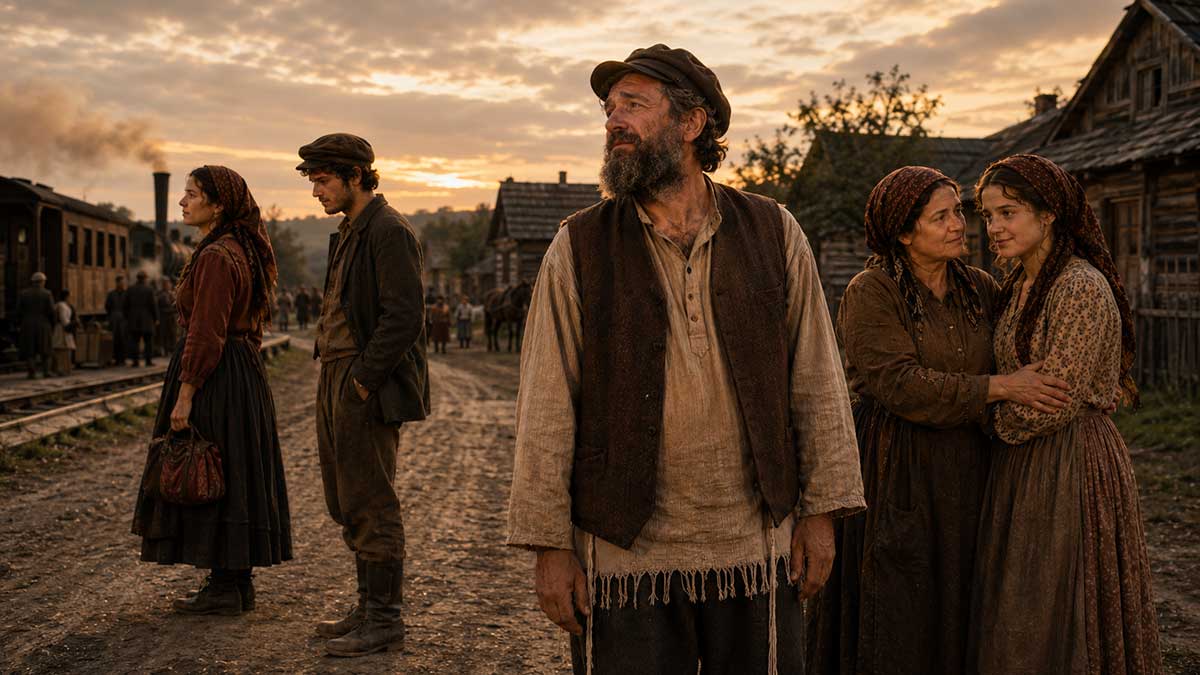
Opening — Tevye
Tevye:
A father raises daughters.
He feeds them, teaches them, worries over them, prays over them, and occasionally asks God why He sent so many opinions into one house.
At first, they are small. They hold your hand.
Then one day, they look at you with grown eyes and say, “Papa, I have decided.”
Decided?
A father spends twenty years deciding for them, then suddenly they discover this word and use it like a weapon.
One daughter asks to marry for love.
Another daughter follows a man to Siberia.
Then Chava, my little bird, does something I cannot fit inside my heart.
So today we ask:
How far can a child go before a parent cannot follow?
And how far can a parent refuse before love itself begins to suffer?
Question 1: How much should a parent accept when a child chooses a different path?
Tzeitel:
A parent should accept that a child is not a copy.
Tevye:
A copy would be easier. I could read it again and know the ending.
Hodel:
But Papa, you did not raise us to be furniture.
Golde:
Furniture stays where you put it.
Tevye:
You see? Furniture has virtues.
Chava:
Papa, you taught us to think.
Tevye:
I taught you to think, yes. I did not expect you to become so good at it.
Fyedka:
A parent should judge the heart, not only the path.
Tevye:
Easy for you to say. You entered my family like a sentence from a language I did not agree to learn.
Fyedka:
I never wanted to take Chava from you.
Tevye:
Yet there she stood, far from me.
Chava:
Papa, I was not far. You turned away.
Golde:
Careful, child.
Chava:
Mama, I know. But I need to say it.
Tzeitel:
Acceptance does not mean a parent feels no pain.
Hodel:
And refusal does not mean a parent has no love.
Tevye:
This is my trouble. My heart says, “She is your daughter.” My tradition says, “This is too far.” My head says, “Lie down, Tevye, you are not built for this much thinking.”
Golde:
Your head often gives good advice.
Tevye:
A parent should accept what he can without lying to his soul.
Chava:
And what if his soul is frightened?
Tevye:
Then he may call fear by a holy name.
Golde:
Tevye.
Tevye:
I said “may.” I did not say “should.”
Question 2: Why can Tevye accept Tzeitel and Hodel, but not Chava at first?
Hodel:
Tzeitel challenged the matchmaker.
Tzeitel:
I challenged Lazar Wolf too, though mainly by refusing to marry him.
Tevye:
A brave act. Many people refuse Lazar Wolf silently. You did it officially.
Fyedka:
Hodel challenged distance and politics.
Hodel:
I followed Perchik, but I did not leave our people.
Tevye:
Exactly. You broke my heart within the family fence. Chava crossed beyond it.
Chava:
I did not stop being your daughter.
Tevye:
No. But you married outside the faith. To you, it was love. To me, it felt like losing a name, a people, a covenant, a thousand years sitting at my table.
Fyedka:
I respect your people.
Tevye:
Respect is good. But respect does not know our prayers from the inside.
Golde:
Tevye fears more than marriage. He fears disappearance.
Tzeitel:
Disappearance?
Golde:
Yes. One child marries outside. Then another. Then customs fade. Then the Sabbath table gets smaller. Then someone asks why the candles matter. Then the old songs vanish.
Hodel:
That is why it hurts so much.
Chava:
But Papa, does love for Fyedka erase my love for you?
Tevye:
No. That is the knife. If you had stopped loving me, I could be angry. But you loved me and still walked another road.
Fyedka:
Can two roads meet again?
Tevye:
Sometimes. But first the father must stop standing in the middle of the road shouting at the clouds.
Golde:
That would be a change.
Tevye:
I am considering it. Slowly. With supervision from heaven.
Question 3: Is love still love when someone cannot say yes?
Chava:
Papa loved me, but he would not speak to me.
Tevye:
I spoke to you in my heart.
Chava:
I could not hear that.
Tevye:
Yes. Hearts are poor messengers. They lose letters.
Tzeitel:
Sometimes love needs words.
Hodel:
Sometimes love needs blessing.
Golde:
Sometimes love needs time, bread, silence, tears, and someone not slamming the door.
Fyedka:
If Tevye could not accept us, was his love incomplete?
Tevye:
Young man, must you ask questions with sharp teeth?
Fyedka:
I ask respectfully.
Tevye:
That makes the teeth cleaner, not softer.
Chava:
I do not need you to say everything was easy. I need to know I am not dead to you.
Tevye:
You were never dead to me.
Chava:
Then why did you act as if I was?
Tevye:
Since I did not know how to keep loving you without betraying everything I had been taught.
Golde:
There it is.
Tzeitel:
Papa, maybe love does not always say yes.
Hodel:
But love should not erase a person.
Fyedka:
Can love say, “I am wounded,” and still leave a door open?
Tevye:
Perhaps. A narrow door. A stubborn door. A door that squeaks and complains.
Golde:
A Tevye door.
Tevye:
Yes. Strong hinges, poor paint.
Chava:
Then say something, Papa.
Tevye:
What can I say?
Chava:
Say you hear me.
Tevye:
I hear you.
Chava:
Say I am still your daughter.
Tevye:
You are still my daughter.
Golde:
Tevye.
Tevye:
Do not rush me, Golde. A mountain has moved. Let it catch its breath.
Fyedka:
Thank you.
Tevye:
Do not thank me yet. I am still upset with you.
Fyedka:
That seems fair.
Tevye:
Good. A son-in-law should know his place. Especially one who arrived without permission.
Closing — Tevye
Tevye:
A father thinks love means holding.
Then children grow, and love becomes releasing.
At first, I released Tzeitel a little. She married Motel, and I survived.
Then I released Hodel farther. She went to Perchik, and I stood at the train with a heart full of snow.
Then came Chava.
With Chava, release felt like betrayal. Not only of me, but of my fathers, my mother, my people, my God.
So I closed my heart.
A closed heart feels strong at first. It says, “I have protected the truth.”
But after some time, it grows cold inside.
Maybe a parent cannot accept every choice.
Maybe some choices break old walls that cannot be repaired in one day.
But a child should not have to disappear for a parent to stay faithful.
Perhaps love says:
“I cannot bless everything.
I cannot understand everything.
But I still see you.”
This is not easy.
If it were easy, fathers would need fewer prayers, daughters would need fewer tears, and God would hear less from me at night.
But Chava is my daughter.
My little bird flew beyond the fence.
And though I cannot follow every place she goes, I can no longer pretend I do not hear her wings.
Topic 5: Leaving Anatevka — What Remains After Home Is Lost?
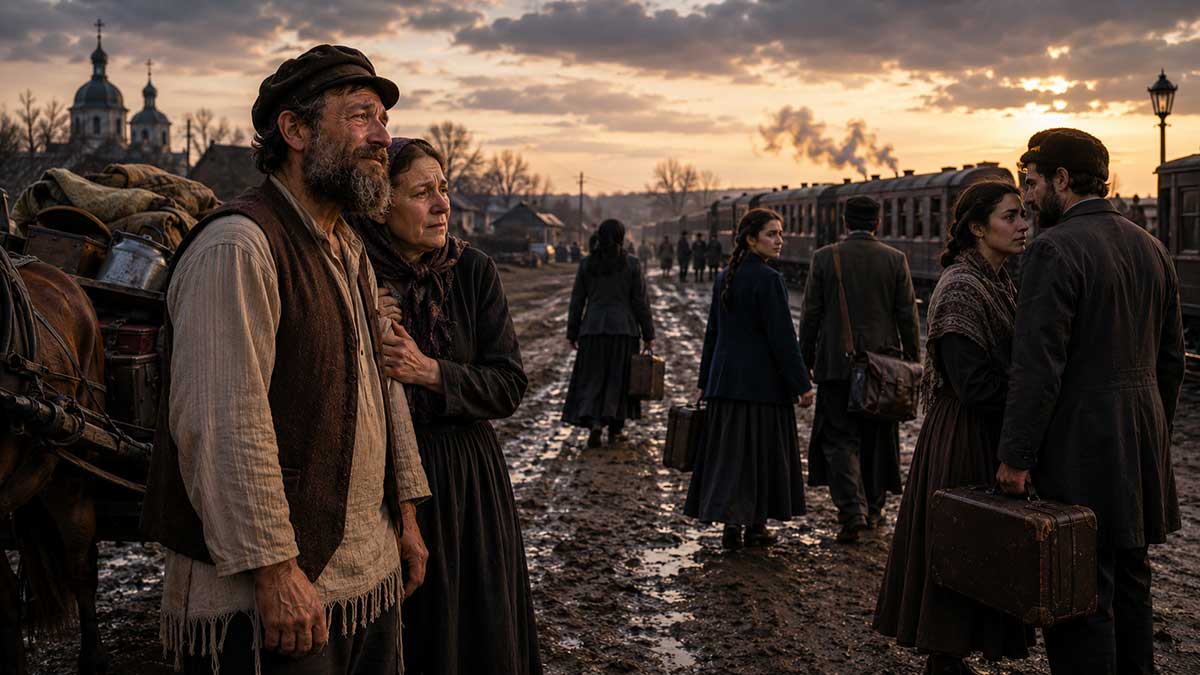
Opening — Tevye
Tevye:
There are moments in life when a man packs a cart and realizes he owns almost nothing.
A table.
A pot.
Some clothes.
A few books.
A tired horse.
A wife who says he packed the wrong pot.
And memories.
So many memories that the cart complains before the horse does.
Anatevka was never paradise. The roads were mud. The houses were poor. The winters had teeth. The neighbors knew too much. The chickens had opinions.
Yet now that we must leave, even the mud looks sentimental.
This is strange.
When we lived here, we complained about Anatevka every day.
Now that we are leaving, we speak of it like a lost kingdom.
Such is human nature. A man does not know his roof is precious until someone tells him to get out from under it.
So today we ask:
What is home?
What do we carry when the place itself is taken?
And why, when everything is breaking, does the fiddler still play?
Question 1: What makes a place “home”: land, people, memory, or faith?
Golde:
Home is where the stove is, where the children know where to sit, where a woman can find her own broom without asking three people.
Tevye:
A beautiful definition. Home is where Golde knows where to find the broom, and I know where not to stand.
Chava:
Home is people. If the people you love are gone, the house becomes only walls.
Tevye:
Walls are useful. They listen better than daughters.
Chava:
Papa.
Tevye:
I said it with affection.
Perchik:
Home is not fixed to one village. People carry it through language, songs, justice, and memory.
Golde:
Easy for you to say. You are young. Young people can call a suitcase home.
Perchik:
I have lived with less than a suitcase.
Tevye:
That is true. When Perchik first arrived, he owned ideas and hunger.
Chava:
Faith makes home too. Prayers, candles, blessings, Sabbath songs. Those can travel.
Tevye:
Yes. A house can be taken. A prayer is harder to confiscate.
Golde:
But I would still prefer the house.
Tevye:
Of course. Faith is good. A roof in winter is very persuasive.
Fiddler:
Home is the place where people still recognize the tune.
Tevye:
Ah! He speaks. I thought he only played when life became unreasonable.
Fiddler:
I am busy.
Golde:
Playing on roofs is not a stable profession.
Fiddler:
Neither is being human.
Perchik:
Maybe home is a bond between place and people. The land holds the footprints, the people hold the stories.
Chava:
Then losing the land hurts, but it does not erase the stories.
Tevye:
No. But it makes the stories ache.
Golde:
Aching stories are still stories.
Tevye:
True. Anatevka is land, people, memory, faith, and unpaid debts.
Golde:
Leave the debts.
Tevye:
Gladly.
Question 2: When everything familiar disappears, what must a family carry with them?
Perchik:
A family must carry courage. Without courage, memory becomes a burden instead of a seed.
Tevye:
Perchik, you speak like a man who has never packed a bed frame.
Perchik:
Courage weighs less.
Golde:
A blanket is better.
Chava:
A family must carry forgiveness.
Tevye:
Forgiveness? We are packing heavy today.
Chava:
Without it, we leave the village but carry the old walls inside us.
Golde:
She is right.
Tevye:
I know. I hate when the children become right. It upsets the natural order.
Fiddler:
Carry the song.
Tevye:
A song takes little space.
Fiddler:
And fills much emptiness.
Perchik:
Carry the language. Carry the stories. Carry the names of those who came before.
Golde:
Carry food too. Names are beautiful, but they do not feed children.
Tevye:
Golde balances the sacred and the practical. She says, “Take the prayer book, but wrap it in bread.”
Chava:
We must carry the courage to change without becoming empty.
Tevye:
That is the fear, yes. A people can move from place to place. But if they forget who they are, the road wins.
Perchik:
The road should teach, not erase.
Golde:
The road should have fewer holes.
Fiddler:
The road has rhythm.
Golde:
The road has mud.
Tevye:
Both are true. This is why we need a musician and a wife. One hears rhythm. The other sees laundry.
Chava:
We carry one another.
Tevye:
Yes. When the cart is full, the heart must carry what the cart cannot.
Golde:
Then your heart better be stronger than your horse.
Tevye:
At this point, almost anything is stronger than my horse.
Question 3: Why does the fiddler keep playing after Anatevka is gone?
Fiddler:
I play since silence would lie.
Tevye:
That is a serious answer from a man standing in a dangerous place.
Fiddler:
Life is dangerous. Music admits it and still moves.
Perchik:
Music keeps a people from becoming only victims.
Chava:
It says we are still alive.
Golde:
It helps children walk when they are tired.
Tevye:
And men too, though men pretend they are not tired until they fall into a ditch.
Fiddler:
The roof may disappear. The tune does not.
Tevye:
But why on the roof? Could you not play on the ground like a normal person?
Fiddler:
The ground is too confident.
Golde:
That makes no sense.
Tevye:
Golde, he is a symbol. Symbols do not have to help with packing.
Golde:
Then symbols should stay out of the way.
Perchik:
The fiddler plays on the edge. That is why he matters. He shows that life is balance: danger beneath, sky above, music in between.
Chava:
Maybe he plays since sadness without beauty becomes unbearable.
Tevye:
My little bird, that is painfully true.
Fiddler:
A people leaving home need a rhythm for their steps.
Golde:
Can the rhythm tell us where we are going?
Fiddler:
No.
Golde:
Then it is like Tevye.
Tevye:
I object. I sometimes know where I am going. I just arrive by accident.
Perchik:
The music does not solve exile. It gives people a way to remain human inside exile.
Tevye:
Yes. A song cannot stop the soldiers. It cannot rebuild the village. It cannot make the Czar kinder, the road shorter, or Lazar Wolf less expensive.
Golde:
But it can keep us walking.
Chava:
And help us carry grief without turning to stone.
Fiddler:
That is why I play.
Tevye:
Then play, my friend. But carefully. If you fall, I cannot afford another tragedy.
Closing — Tevye
Tevye:
So we leave Anatevka.
A poor village.
A difficult village.
A village we cursed in winter, complained about in spring, sweated through in summer, and defended in autumn as if it were Jerusalem itself.
We leave the houses.
We leave the graves.
We leave the market, the synagogue, the muddy roads, the gossip, the weddings, the arguments, the familiar doors, the place where our children first cried and our parents last slept.
A man thinks home is something under his feet.
Then history comes and says, “Move.”
So he learns home must become something in his hands, in his memory, in his prayers, in his family, in the stories he refuses to forget.
This is not comfort. Not yet.
It is something smaller and harder.
It is survival with a candle in its pocket.
Chava walks her road. Hodel walks hers. Tzeitel has her family. Golde has packed more than I thought one woman could pack. I have packed less than she asked, more than the horse wanted, and exactly as much confusion as I can carry.
And the fiddler?
He follows.
Why?
Since life is still uncertain.
Since the roof is always slippery.
Since people who lose their homes still need music for the road.
Anatevka is behind us now.
But the tune goes with us.
And as long as we can hear it, perhaps we have not lost everything.
Final Thoughts by Tevye
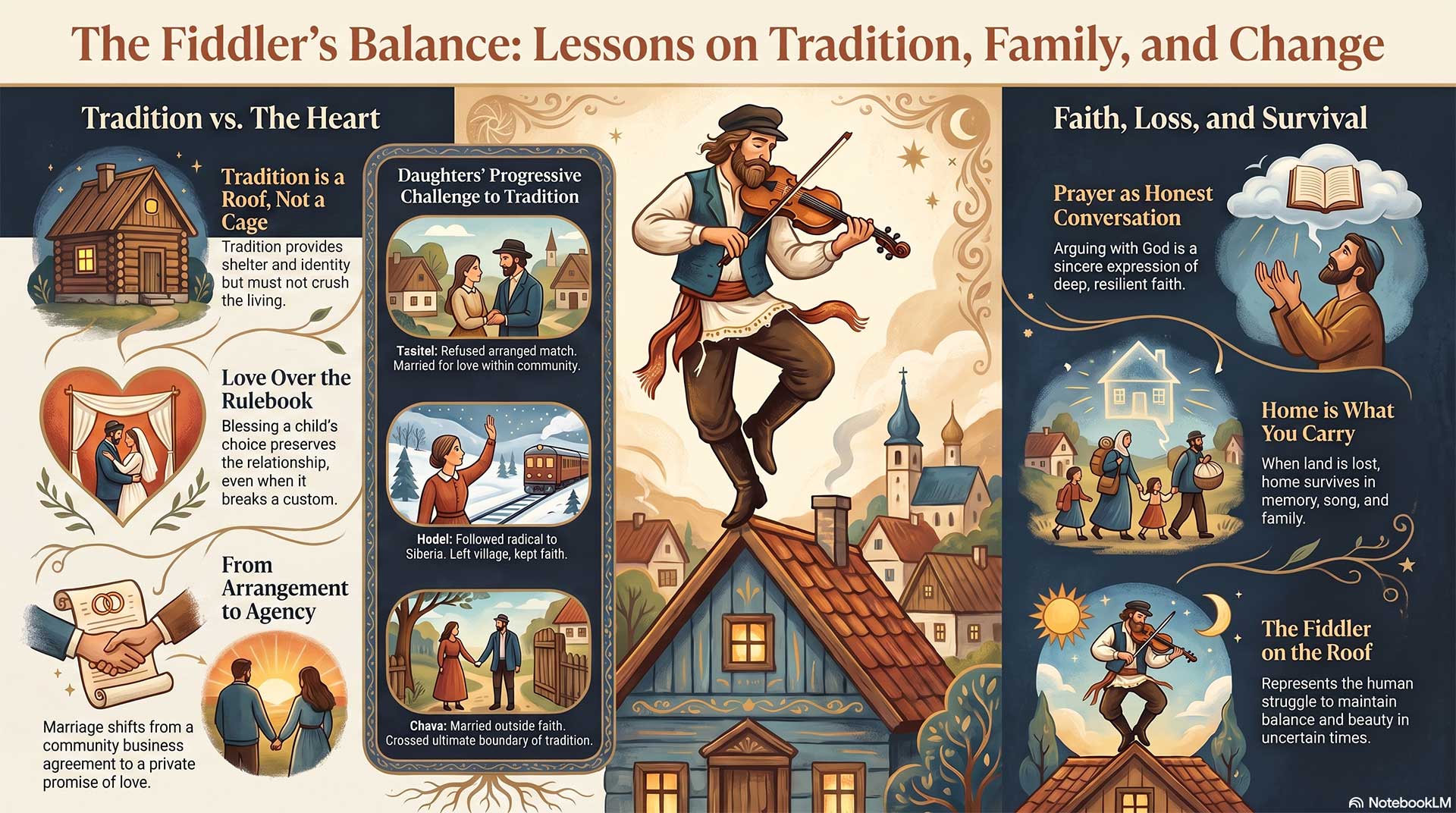
So now we have talked.
We talked about tradition, and I learned that a roof must protect the living, not press them flat.
We talked about marriage, and I learned that daughters may ask for love before permission.
We talked about faith, and I learned that arguing with God may still be prayer, if the heart has not walked away.
We talked about children leaving, and I learned that a father may keep his tradition and still leave a small door open for love.
Then we talked about Anatevka.
Ah, Anatevka.
When we lived there, we complained.
The roads were bad. The houses were poor. The winters were cruel. The neighbors knew too much. The future was never polite.
But when we had to leave, suddenly every broken fence became precious.
This is the way of human beings. We grumble under the roof, then weep when the roof is gone.
Still, maybe the lesson is not that everything can be saved.
Some things are lost.
Some homes disappear.
Some children walk roads their parents never planned.
Some prayers are answered with silence.
Some traditions bend.
Some break.
But a person is not finished simply since the village is gone.
A family can carry memory.
A people can carry songs.
A father can carry regret and love in the same heart.
A mother can carry bread, candles, and common sense.
A daughter can carry courage.
A fiddler can carry the tune.
And maybe God, who has heard my complaints for many years, smiles a little and says, “Tevye, keep walking.”
So I walk.
Not with certainty.
Not with money.
Not with a healthy horse, which would have been nice.
But with Golde, my daughters, my people, my prayers, and the sound of music behind me.
Tradition held us.
Love stretched us.
Faith kept us talking to heaven.
Loss sent us onto the road.
And the fiddler kept playing.
This, perhaps, is life:
A slippery roof.
A fragile song.
A family walking forward.
Short Bios:
Tevye
A poor milkman from Anatevka, Tevye is funny, stubborn, tender, and deeply faithful. He loves tradition, argues with God, and struggles as his daughters make choices that stretch his heart beyond the world he knows.
Golde
Tevye’s wife, Golde is practical, sharp, loyal, and stronger than almost anyone around her. She carries the weight of family life with dry humor, fierce love, and a clear eye for what must be done.
Tzeitel
Tevye’s oldest daughter, Tzeitel chooses love over an arranged marriage. Her decision begins the family’s movement away from old customs and shows Tevye that a daughter’s honesty may matter more than public approval.
Motel Kamzoil
A timid but sincere tailor, Motel grows through love. His courage may be small at first, but his devotion to Tzeitel helps him stand up for the future he wants.
Hodel
Tevye’s second daughter, Hodel is thoughtful, brave, and open to a wider world. Her love for Perchik leads her beyond Anatevka, showing the pain and dignity of leaving home for conviction.
Perchik
A young revolutionary and teacher, Perchik questions old customs and believes history must change. He brings new ideas into Tevye’s household and forces the family to face a world larger than the village.
Chava
Tevye’s beloved daughter, Chava is gentle, intelligent, and courageous. Her love for Fyedka creates Tevye’s deepest heartbreak, forcing the story to ask whether parental love can survive a choice it cannot bless.
Fyedka
A Russian man who loves Chava, Fyedka represents the world outside Anatevka’s Jewish community. His presence challenges Tevye’s boundaries, fears, and hopes for his daughter.
Yente
The village matchmaker, Yente is comic, nosy, and strangely insightful. She treats marriage like both sacred duty and local business, bringing humor to the serious question of who gets to choose love.
Lazar Wolf
A wealthy butcher who hopes to marry Tzeitel, Lazar Wolf represents security, status, and the old way of arranging marriage. He is proud and practical, yet his disappointment shows the human cost of changing customs.
The Rabbi
The Rabbi gives spiritual weight to the village’s questions. He values tradition, faith, and reverence, yet his presence reminds everyone that wisdom must serve life, not silence it.
The Fiddler
The Fiddler is the living symbol of the story. He stands on the roof, balancing danger and beauty. His music follows the people through uncertainty, loss, exile, and hope.
Leave a Reply