

What if the life you fear becoming is the clearest map to the life you need to build?
Introduction by Dan Koe
Most people do not fail from one bad choice.
They lose themselves through quiet drift.
A little more distraction.
A little less discipline.
A little more comfort.
A little less courage.
A little more waiting for the right time.
Then one day, they look around and realize their life has been built by habit, not intention.
This conversation begins with a hard question:
What future are you already creating through the things you repeat?
The anti-vision is not meant to create shame. It is meant to create sight. It shows the body, mind, work, relationships, and inner life that may appear if nothing changes.
But fear alone is not enough.
Fear can wake you up.
Structure keeps you awake.
Focus gives you direction.
Repetition builds skill.
Meaning turns effort into identity.
Across these five conversations, we explore how a person moves from drift to design. Brain science explains why threat, dopamine, attention, and repetition shape behavior. Psychology explains why shame, courage, and identity matter. Spiritual wisdom reminds us that a disciplined life must be more than productivity.
The deeper question is not, “How do I get ahead of other people?”
The deeper question is:
How do I stop betraying the life I know I am capable of living?
A person does not need to disappear from the world. He needs to disappear from what weakens him.
A person does not need endless motivation. He needs a system that survives the days when motivation is gone.
A person does not need a perfect future. He needs one honest action repeated enough times to become proof.
That is where a new identity begins.
Not in fantasy.
Not in noise.
Not in one emotional decision.
It begins when a person sees the cost of the old life, chooses the opposite, and starts building it one ordinary day at a time.
(Note: This is an imaginary conversation, a creative exploration of an idea, and not a real speech or event.)
Enter your text here...
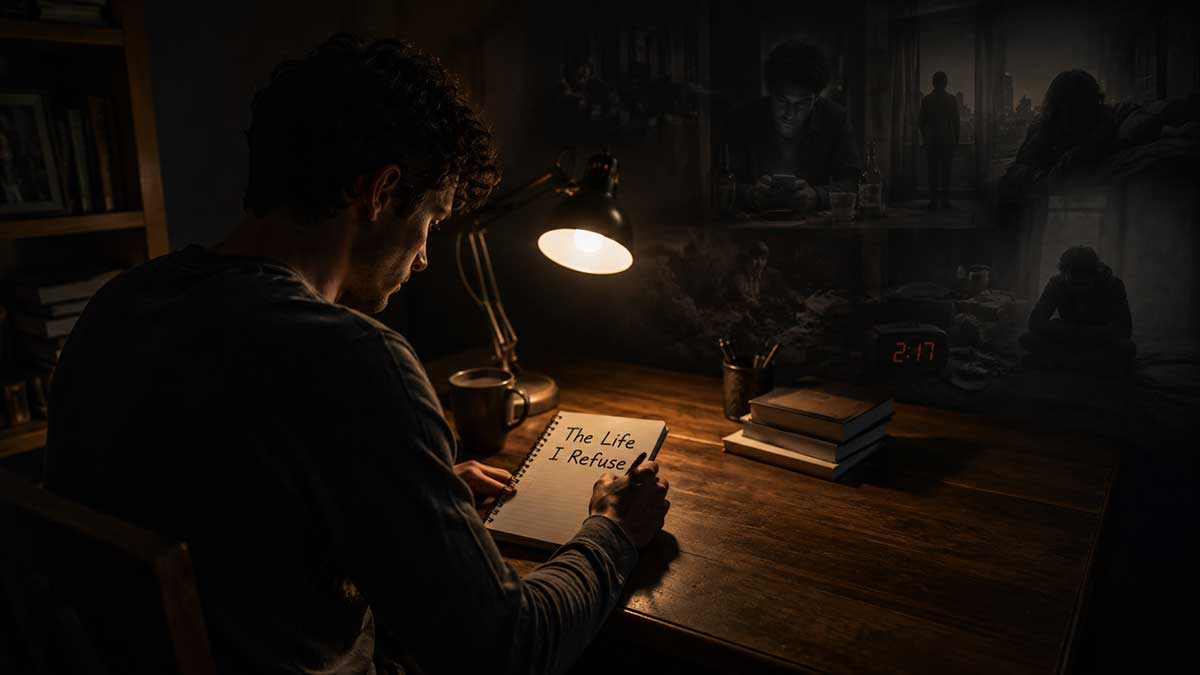
Opening — Dan Koe
Most people try to build a future by asking, “What do I want?”
That sounds noble, but it is often too abstract. The dream is blurry. The desire is borrowed. The goal sounds impressive, but it does not touch the nervous system.
A sharper question is this:
“What life do I refuse to live?”
That question cuts deeper. It forces honesty. It shows the cost of staying the same.
Today, we are asking whether fear can be used wisely. Can an anti-vision wake us up? Can discomfort become discipline? Can the future we dread reveal the future we are called to build?
Question 1: Why does the brain often respond faster to a negative future than a positive dream?
Andrew Huberman:
The brain is built to detect threat. A vague dream may feel inspiring, but a clear danger creates urgency. If someone imagines becoming weak, broke, distracted, lonely, or dependent, the nervous system pays attention. That does not mean fear should rule the person, but it can create enough activation to begin change.
Lisa Feldman Barrett:
The brain is always predicting. It is asking, “What is likely to happen next?” An anti-vision gives the brain a vivid prediction: “If I continue this pattern, this is where I may land.” That prediction can create discomfort. The discomfort is data. It says the current path may not match the life the person wants to construct.
Viktor Frankl:
A human being can endure much when there is meaning. Yet people often awaken first through the sight of meaninglessness. They look at a possible future and say, “This cannot be my life.” That rejection is not despair. It can be the first act of freedom.
Jordan Peterson:
People often need to see the dragon before they pick up the sword. A positive vision can be too sentimental. An anti-vision shows the monster: wasted talent, resentment, bitterness, decay. That image can be morally useful. It says, “You know where this road goes. Now choose.”
Dan Koe:
Exactly. People wait for motivation, but they do not look honestly at the consequence of their habits. If you keep scrolling, avoiding, eating poorly, escaping, and lying to yourself, you are building something. It may be the wrong thing, but you are still building. The anti-vision makes that visible.
Question 2: When does fear become useful, and when does it become self-punishment?
Lisa Feldman Barrett:
Fear becomes useful when it helps the brain prepare action. It becomes harmful when it traps the person in a fixed identity. “I do not want this future” can be helpful. “I am broken and doomed” is not helpful. The first statement opens choice. The second closes it.
Jordan Peterson:
Fear must be paired with responsibility. If fear leads only to panic, resentment, or self-hatred, it corrupts the individual. But if fear leads to confession, planning, sacrifice, and truth, it becomes a teacher. The question is not whether fear exists. The question is whether the person can make it serve something higher.
Andrew Huberman:
Physiologically, fear without action can become chronic stress. That harms focus, sleep, mood, and behavior. Fear with a clear action plan can be different. The body learns, “I can respond.” The antidote is movement: write the plan, train, focus, build, repeat.
Dan Koe:
That is why I never want people to stop at the anti-vision. The anti-vision is the spark. It is not the home. You use it to create the vision, then the system. If all you do is stare at what you hate, you become bitter. If you use it to build the opposite, you become disciplined.
Viktor Frankl:
Fear becomes destructive when the person sees no meaning beyond escape. A life cannot be built only on fleeing pain. The person must move from “I do not want this” to “This is what I am responsible for.” Meaning turns fear into direction.
Question 3: Can an anti-vision help people change their identity instead of just changing habits?
Viktor Frankl:
Yes, but only when the person sees the moral nature of the choice. Identity is not only a collection of habits. It is the answer to the question, “Who am I becoming through my choices?” The anti-vision reveals one possible self. The person then becomes responsible for refusing it.
Dan Koe:
Most people try to change habits without changing identity. They say, “I need to wake up earlier,” but they still see themselves as someone who wastes mornings. The anti-vision creates a clean break. It says, “That version of me has a destination, and I refuse it.” Then the vision gives you the new identity.
Andrew Huberman:
The brain changes through repeated action. Identity may feel abstract, but it becomes real through behavior. If someone writes every day, trains every day, studies every day, and removes distractions, the nervous system starts to encode a different self-pattern. Repetition makes identity believable.
Jordan Peterson:
Identity change demands a confrontation with the shadow. People often know exactly what is wrong, but they refuse to articulate it. The anti-vision forces articulation. “Here is the cowardly version of me. Here is the resentful version. Here is the lazy version.” Once named, it can be battled.
Lisa Feldman Barrett:
Identity is partly constructed through the stories we repeat and the actions we rehearse. An anti-vision can interrupt an old story. But the brain needs a new model to live into. That is why the positive vision matters. The person must practice becoming the future self, not merely reject the past self.
Closing — Dan Koe
The anti-vision is not meant to make you hate yourself.
It is meant to make drifting impossible.
A person changes when the cost of the old life becomes too clear to ignore. The anti-vision creates that clarity. It shows the future that passive habits are already building.
Then the real work begins.
You write the opposite.
You choose the system.
You remove what drains you.
You repeat the fundamentals.
You build proof that you are becoming someone else.
Fear may wake you up, but meaning must lead you forward.
Topic 2: Entropy of the Mind — Why Life Falls Apart Without Order

Opening — James Clear
Most people do not ruin their lives in one dramatic moment.
They drift.
One skipped workout becomes a pattern.
One distracted morning becomes a distracted year.
One ignored responsibility becomes a hidden weight.
One small compromise becomes a life that no longer feels chosen.
Dan Koe calls this entropy: when life falls into disorder unless we create structure. The question is not whether we want order. The question is whether we are willing to build it before chaos builds our life for us.
Today, we ask what happens to the mind when there is no system, no aim, no rhythm, and no honest plan.
Question 1: Why does the human mind drift into distraction when there is no clear structure?
Cal Newport:
The mind does not naturally protect attention. Attention must be protected by rules, rituals, and boundaries. When there is no structure, the most stimulating thing wins. That is usually the phone, the feed, the inbox, the urgent message, or the shallow task pretending to be important.
Robert Sapolsky:
The brain is always conserving energy. If a person has no clear priority, the brain often chooses the easiest reward. That reward may not be meaningful. It may only be immediate. Distraction is not a moral failure every time. It is often biology meeting a poorly arranged environment.
Jordan Peterson:
Chaos enters when the person refuses to aim. A human being needs a target. Without a target, every impulse becomes a possible master. The danger is not only distraction. The danger is fragmentation. You become pulled apart by every desire, every resentment, every fear.
Thomas Merton:
A scattered mind is often a soul without silence. Many people call it distraction, but beneath it is avoidance. Silence asks us to face ourselves. So we reach for noise. Order begins when a person can sit quietly and hear what his life is asking of him.
James Clear:
Most habits are responses to cues. If your environment is full of cues for distraction, you will repeat distraction. If your environment is built for focus, focus becomes easier. People overestimate willpower and underestimate setup. Structure is not a prison. It is a path.
Question 2: Is discipline mainly willpower, or is it environmental design?
Robert Sapolsky:
Willpower is real, but it is unstable. It changes with sleep, stress, hunger, social pressure, hormones, and past conditioning. A person who depends only on willpower is fighting the brain all day. A better approach is to make the desired behavior easier and the harmful behavior harder.
James Clear:
Discipline is often the result of removing friction. Put the book on the desk. Put the phone in another room. Prepare gym clothes the night before. Block the distracting site. Schedule the work. The person who looks disciplined may simply have fewer bad options available.
Thomas Merton:
Environment matters, but the inner room matters too. A monk may live in a monastery and still be restless. A businessman may live in a noisy city and still possess inward order. Outer structure helps. Inner surrender deepens it.
Cal Newport:
Modern life is engineered to break concentration. So the serious person needs deliberate rules. Deep work needs time blocks. Digital tools need limits. Communication needs boundaries. You cannot leave your attention exposed and expect a meaningful life to appear.
Jordan Peterson:
Discipline is a covenant with your future self. Environment can help, but the individual must still choose sacrifice. You give up a lower pleasure for a higher aim. That is maturity. If you refuse sacrifice, you do not escape pain. You only choose a worse pain later.
Question 3: What kind of daily order protects the soul, not just productivity?
Thomas Merton:
Order that protects the soul begins with quiet. Not emptiness, but listening. A day needs a sacred center. Prayer, reflection, stillness, gratitude, honest reading—these protect a person from becoming only useful, only efficient, only busy.
Jordan Peterson:
Start with what is near. Clean your room. Tell the truth. Keep one promise. Repair one relationship. Finish one task. People want cosmic answers, but the soul is strengthened through concrete responsibility. Order is moral before it is practical.
Cal Newport:
A soul-protecting schedule includes depth and disconnection. Long stretches without interruption. Time for craft. Time for family. Time away from performance. Productivity without boundaries becomes another form of disorder.
James Clear:
The daily order should be small enough to repeat and meaningful enough to matter. Ten minutes of planning. Thirty minutes of focused work. A walk. A meal that respects the body. A clean evening shutdown. Identity is built through repeated votes.
Robert Sapolsky:
Do not ignore the body. Sleep, movement, food, sunlight, and social connection shape the mind. People often treat discipline as a purely mental issue, then wonder why they collapse under stress. A stable nervous system gives order a better chance.
Closing — James Clear
Entropy does not announce itself.
It enters quietly through neglected habits, open loops, weak boundaries, and days without direction.
The answer is not to control every second. The answer is to create enough order that your life has a center.
A clear morning.
A protected block of work.
A body that is cared for.
A room that is not fighting you.
A promise you keep daily.
A moment of silence before the noise begins.
This is how a person stops drifting.
Not through one heroic decision, but through small structures repeated until the future begins to look chosen.
Topic 3: Dopamine, Distraction, and the Cost of Cheap Pleasure

Opening — Anna Lembke
Modern life gives us pleasure without effort.
A phone can give stimulation in seconds.
A game can give progress without real-world risk.
A feed can give novelty without wisdom.
A like can give approval without intimacy.
Dan Koe’s advice to “disappear” is really about reclaiming mental energy. It is not about rejecting people. It is about rejecting the habits, apps, and pleasures that train the brain to avoid discomfort.
Today, we ask why cheap pleasure is so hard to resist, why distraction feels normal, and what it takes to rebuild attention in a world that profits from stealing it.
Question 1: Why does the brain choose low-value pleasure even when we know it weakens us?
Anna Lembke:
The brain is drawn to pleasure that is easy, fast, and repeatable. Dopamine is not simply about pleasure. It is about wanting, seeking, and repeating. When someone checks the phone over and over, the brain is learning a loop. The person may not even enjoy it anymore, yet the wanting continues.
Dan Koe:
That is the trap. People think they are relaxing, but they are training weakness. Every time you choose a cheap hit over meaningful work, you vote for the distracted version of yourself. The scary part is that it feels harmless in the moment.
Andrew Huberman:
Fast dopamine can reduce motivation for slower rewards. If the nervous system gets used to high stimulation, ordinary effort feels painful. Reading, writing, training, building a skill, or sitting in silence may feel boring. The issue is not boredom itself. The issue is a brain that has been trained to expect constant novelty.
Johann Hari:
We must be careful not to blame the individual alone. Many people are surrounded by systems built to fragment attention. Apps, ads, feeds, and algorithms are shaped around keeping people engaged. A distracted person may need discipline, but society has created an environment that makes focus harder.
Cal Newport:
Cheap pleasure wins when there is no deeper plan. If your day has no clear purpose, your attention will be captured by whatever is easiest. The serious life requires rules. Without rules, the phone becomes the schedule.
Question 2: Are modern apps training people to avoid discomfort?
Cal Newport:
Yes. Many apps train the mind to escape the first hint of friction. Waiting in line, sitting alone, writing a hard sentence, facing a difficult emotion—these moments used to build mental stamina. Now they are filled instantly. That weakens the ability to stay with demanding work.
Andrew Huberman:
Discomfort is part of growth. Training, learning, and creative work all require friction. If the brain learns to escape discomfort too quickly, it loses tolerance for effort. The person may still want success, but the nervous system resists the path that creates it.
Anna Lembke:
Pleasure and pain are connected. If we overload the pleasure side, the brain often responds by making us feel lower later. This is why constant stimulation can lead to restlessness, anxiety, or emptiness. The person keeps seeking relief from the very thing creating imbalance.
Dan Koe:
Most people are addicted to escaping themselves. That is why “disappear” matters. You need space where nobody can reach you, nothing can ping you, and no cheap pleasure can numb you. At first, it feels uncomfortable. Then your mind starts coming back online.
Johann Hari:
Discomfort should not be romanticized too much. Some people are escaping pain that has real roots: loneliness, stress, bad work, broken community, or lack of meaning. The answer is not just deleting apps. People need lives worth paying attention to.
Question 3: What does it mean to “disappear” without becoming lonely or emotionally closed?
Johann Hari:
Healthy disappearance means leaving the things that drain attention, not cutting off love. Humans need connection. The danger is confusing isolation with healing. A person should reduce shallow stimulation and increase real belonging.
Dan Koe:
Exactly. Disappear from the noise, not from the people who matter. Disappear from habits that make you feel weak. Disappear from people who only bond through distraction, gossip, partying, complaining, or wasting time. Then reappear with a stronger identity.
Cal Newport:
A better phrase might be selective withdrawal. You withdraw from low-value inputs so you can commit to high-value work, deep relationships, and creative output. The goal is not silence for its own sake. The goal is attention with purpose.
Anna Lembke:
The brain needs a reset period. Less stimulation can feel painful at first. But over time, ordinary life becomes more rewarding again: conversation, walking, reading, prayer, work, food, sunlight. The nervous system can relearn balance.
Andrew Huberman:
A practical version is to create protected blocks: no phone in the morning, no social media before deep work, no notifications during training or writing, no screen in the bedroom. These are not extreme choices. They are basic protection for attention and motivation.
Closing — Anna Lembke
Cheap pleasure is expensive.
It costs attention.
It costs motivation.
It costs patience.
It costs the ability to enjoy ordinary life.
The answer is not to hate pleasure. The answer is to restore balance.
A meaningful life needs effort, silence, friendship, work, health, and long-term reward. Disappearing is not about vanishing. It is about returning to yourself.
You remove what numbs you.
You protect what strengthens you.
You let the brain remember that real joy often comes after effort, not before it.
Topic 4: The Boring Fundamentals — Why Mastery Looks Ordinary

Opening — Anders Ericsson
Most people admire mastery after it becomes beautiful.
They see the finished performance.
They see the calm expert.
They see the effortless movement.
They see the success after years of invisible repetition.
But mastery is built in private.
It is built through correction, boredom, failure, feedback, and returning to the same basic movement again and again.
Dan Koe says the fundamentals look boring from the outside. But to the person practicing them, they are not boring. They are the path out of misery and into skill.
Today, we ask why people avoid repetition, what happens in the brain when practice becomes automatic, and how ordinary daily action can become meaningful.
Question 1: Why do people chase novelty instead of repeating the fundamentals?
Carol Dweck:
Novelty feels safer than mastery. When someone keeps jumping to new tactics, new plans, and new identities, they can avoid the discomfort of being bad at one thing long enough to grow. A growth mindset accepts the awkward stage. It says, “I am not good yet, but I can improve through practice.”
Angela Duckworth:
People underestimate repetition. They think grit means dramatic effort, but much of grit is returning to the same task on ordinary days. Passion is not constant excitement. It is sustained devotion. The person who keeps showing up when the work feels plain is often the one who improves.
Miyamoto Musashi:
A warrior who seeks novelty before form is already weak. First, grip the sword correctly. Stand correctly. Breathe correctly. Strike correctly. Repeat until the body no longer debates. Freedom comes after form, not before it.
Jiro Ono:
People see sushi and think it is simple. Rice, fish, hand, knife. But every small act contains a lifetime. The rice must be felt. The temperature must be known. The hand must learn pressure. The ordinary action becomes deep when you give your whole life to it.
Anders Ericsson:
The beginner wants results. The expert wants feedback. That is the difference. Fundamentals are not mere repetition. They are deliberate practice: repeating with attention, measuring mistakes, correcting them, then returning again. This is where skill grows.
Question 2: What happens in the brain when practice becomes automatic?
Anders Ericsson:
With practice, the mind builds better mental representations. A beginner sees many scattered details. An expert sees patterns. This frees attention. The expert can respond faster, notice subtleties, and correct errors that a beginner cannot even perceive.
Carol Dweck:
Automatic skill can make effort feel more rewarding. In the beginning, effort feels like proof that we are failing. Later, effort becomes proof that we are learning. The brain starts to expect growth from challenge.
Miyamoto Musashi:
When the body learns, the mind becomes quiet. The strike no longer needs argument. The feet move. The hand moves. The eye sees. This is not magic. It is training that has sunk beneath thought.
Angela Duckworth:
Automaticity protects persistence. When every action requires emotional debate, people quit. But when a routine becomes part of daily life, it takes less inner negotiation. The person saves energy for harder problems.
Jiro Ono:
At first, the student must think about everything. Later, the hand knows. But the hand only knows after many years of correction. Effort disappears from the outside, but it has not disappeared. It has become part of the person.
Question 3: How can ordinary repetition become meaningful rather than deadening?
Jiro Ono:
Repetition becomes meaningful when it is done with respect. If you treat the task as small, your spirit becomes small. If you treat the task as worthy, the task teaches you. Rice can teach patience. A knife can teach humility. A morning can teach devotion.
Angela Duckworth:
Purpose changes repetition. Practice connected to a larger reason feels different from practice done only for praise. A writer writes daily not just to publish, but to serve readers. An athlete trains not just to win, but to become trustworthy under pressure.
Carol Dweck:
People need to connect repetition with identity. “I am doing pushups” is weaker than “I am becoming someone who keeps promises to myself.” The repeated action becomes meaningful when it becomes evidence of a new self.
Anders Ericsson:
Meaning grows when progress becomes visible. Tiny improvements matter. Better timing. Clearer writing. Cleaner movement. Deeper focus. The person begins to enjoy refinement. That is a major shift from chasing quick reward to respecting craft.
Miyamoto Musashi:
Do not despise the ordinary. The ordinary is where character is tested. Anyone can dream of greatness. Few can sharpen the blade every morning.
Closing — Anders Ericsson
The fundamentals look boring only to the spectator.
To the person inside the work, they become a language.
The writer learns the sentence.
The athlete learns the body.
The craftsman learns the hand.
The thinker learns attention.
The disciplined person learns trust.
Mastery is not built by chasing the next exciting thing.
It is built by returning to the right thing with better eyes.
The beginner repeats and becomes tired.
The master repeats and begins to see.
Topic 5: The Origin Story — How People Rebuild Their Identity

Opening — Viktor Frankl
A person is not finished by the life he has lived.
He is shaped by it, wounded by it, instructed by it, but not imprisoned by it.
There comes a moment when a human being sees two futures. One is the continuation of the old pattern. The other is unknown, demanding, and alive.
Dan Koe calls this the origin story: the moment someone stops drifting and begins building a new self.
Today, we ask what makes a person finally change, how identity is rebuilt, and how success can be carried without losing humility.
Question 1: What causes a person to finally say, “I cannot keep living this way”?
Dan Koe:
Most people do not change when life is slightly uncomfortable. They change when the cost becomes undeniable. They see the future their habits are building, and it disgusts them. That moment matters. It is not weakness. It is the first honest signal that the old identity is dying.
Brené Brown:
Many people reach that point through shame, but shame cannot be the place they stay. Shame says, “I am bad.” Accountability says, “I made choices that hurt me, and I can make different choices.” The turning point happens when someone can tell the truth without collapsing under it.
David Goggins:
You get sick of your own excuses. That is the moment. You look in the mirror and realize nobody is coming. No rescue. No perfect timing. No magic motivation. The old you has been running the show, and the new you has to take command.
Carl Jung:
The turning point often arrives when the unconscious can no longer be ignored. The life one has avoided begins to speak through anxiety, dreams, resentment, fatigue, and repeated failure. The rejected parts of the self return, asking to be integrated.
Viktor Frankl:
A human being changes when he sees that life is asking something of him. The question is no longer, “What do I want from life?” It becomes, “What does life require from me now?” Responsibility awakens the person.
Question 2: Is identity changed through thought, action, suffering, or community?
Carl Jung:
Identity changes through confrontation with the whole self. Thought alone is too clean. Action alone can become escape. Suffering alone can become bitterness. Community alone can become dependence. The person must bring the shadow into consciousness and begin living with greater truth.
David Goggins:
Action. You can think all day and still be the same person. Identity changes when you do the hard thing you said you would do. Run when you do not want to run. Study when you want to quit. Train when nobody sees it. You build the new self through proof.
Brené Brown:
Action matters, but people need safe truth-telling too. We heal in connection. If someone changes in total secrecy, they may become disciplined but emotionally guarded. Real identity change includes being seen without the mask.
Dan Koe:
It is all of them, but action makes it real. You need a vision, then a system, then repeated evidence. You become the person who writes daily by writing daily. You become focused by protecting attention. You become healthy by living like a healthy person before you fully feel like one.
Viktor Frankl:
Suffering may open the door, but meaning must guide the person through it. Without meaning, suffering can crush the soul. With meaning, suffering can become a place of decision. The person says, “I cannot control all that happened, but I can choose who I become in response.”
Question 3: How do people stay humble when they begin succeeding?
Brené Brown:
They remember that success does not remove vulnerability. A person can gain money, influence, strength, or recognition and still carry fear. Humility means staying honest about that. It means success does not become armor.
Dan Koe:
The danger is identifying with the result. You get the body, the money, the audience, the business, then think you are above the fundamentals. That is when entropy comes back. Humility is staying loyal to the system that built you.
Viktor Frankl:
Success must remain in service to meaning. If achievement becomes the final aim, the person may become empty. But if success is used to serve, teach, love, and create, then achievement remains human.
David Goggins:
Stay close to the truth. You are still capable of weakness. You are still capable of quitting. You are still capable of lying to yourself. The moment you think you have arrived, you start losing the edge that saved you.
Carl Jung:
Humility comes from knowing that the ego is not the whole self. Success inflates the ego. The deeper person remembers the mystery within himself and others. He does not confuse recognition with wholeness.
Closing — Viktor Frankl
An origin story is not the story of becoming perfect.
It is the story of becoming responsible.
A person sees the old life clearly.
He feels the cost of drifting.
He names the future he refuses.
He chooses the future he must serve.
He begins again through action.
Identity is rebuilt one decision at a time.
Not once.
Not dramatically.
Not for applause.
Quietly, repeatedly, and honestly.
The old self does not vanish in a single day. But each truthful action weakens it. Each promise kept strengthens the new one.
That is how a life is rebuilt.
Final Thoughts by Dan Koe
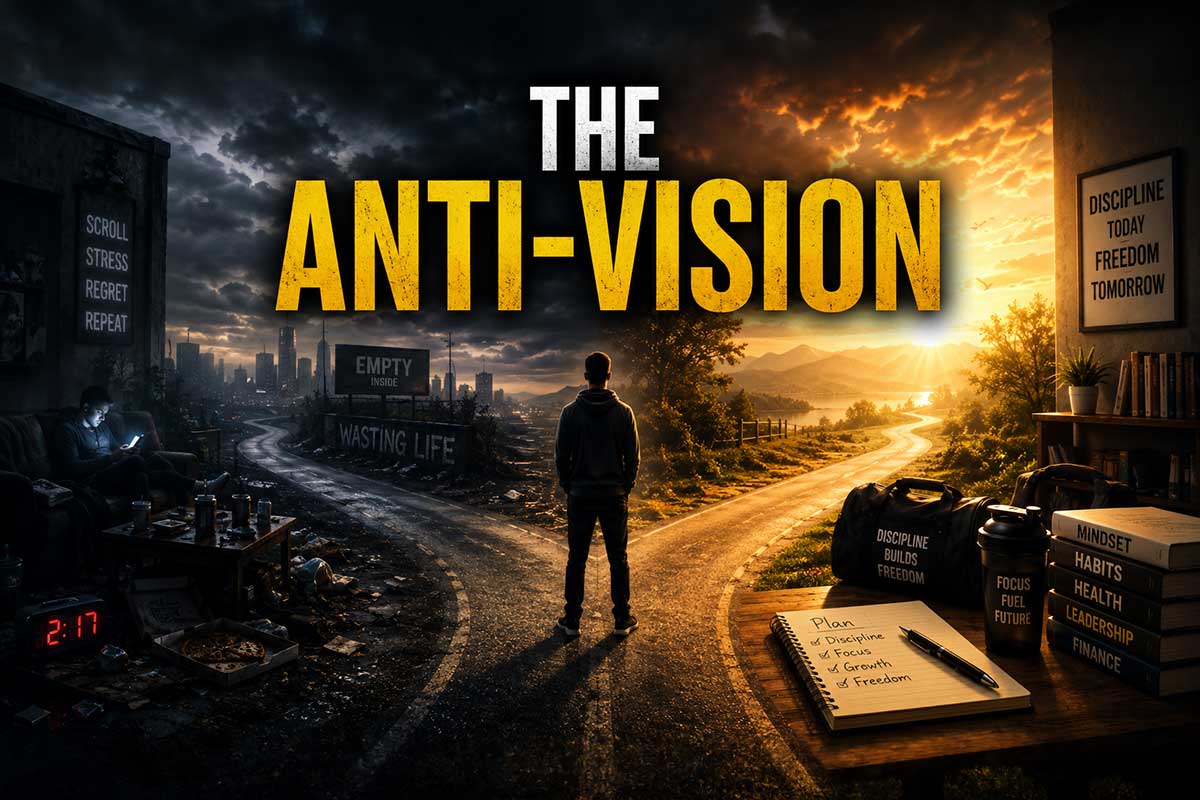
The anti-vision is the alarm.
It tells you where your current habits are taking you.
But an alarm is not a life. You do not live inside the warning. You wake up, stand up, and move.
The real work is quieter.
You plan your week.
You protect your attention.
You train your body.
You practice the skill.
You leave the cheap pleasure alone.
You return to the fundamentals before anyone praises you.
This is how identity changes.
At first, the new life feels unnatural. The old self still reaches for comfort. The old mind still wants escape. The old pattern still asks to be chosen.
But each time you choose the better action, you create evidence.
Evidence that you are no longer drifting.
Evidence that your attention belongs to you.
Evidence that discipline is not punishment, but self-respect.
Evidence that the future is being built right now.
Success is not the sudden arrival of a different person.
It is the slow death of the version of you that kept choosing comfort over truth.
And the slow birth of the person who keeps one promise, then another, then another.
That is how you get ahead.
Not by chasing speed.
By creating order where there was chaos.
By choosing meaning where there was escape.
By practicing mastery where there was impatience.
By becoming someone your future self can trust.
Short Bios:
Dan Koe
Dan Koe is a creator, writer, and self-education thinker known for teaching vision, focus, digital leverage, personal systems, and identity-based work.
Andrew Huberman
Andrew Huberman is a neuroscientist whose work explains dopamine, stress, motivation, sleep, focus, and behavior change through the lens of the brain and nervous system.
Lisa Feldman Barrett
Lisa Feldman Barrett is a psychologist and neuroscientist known for her work on emotion, brain prediction, and how people construct inner experience.
Viktor Frankl
Viktor Frankl was a psychiatrist and Holocaust survivor whose work centered on meaning, responsibility, suffering, and the human capacity to choose one’s response.
Jordan Peterson
Jordan Peterson is a psychologist and author known for exploring responsibility, order, chaos, meaning, personal transformation, and moral development.
James Clear
James Clear is the author of Atomic Habits and a leading voice on habits, systems, identity change, and small repeated actions.
Robert Sapolsky
Robert Sapolsky is a neuroscientist and biologist known for his work on stress, behavior, biology, hormones, and human decision-making.
Cal Newport
Cal Newport is an author and computer science professor known for deep work, digital minimalism, attention, and focused productivity.
Thomas Merton
Thomas Merton was a Trappist monk, writer, and contemplative thinker whose work explored silence, prayer, solitude, inner order, and spiritual life.
Anna Lembke
Anna Lembke is a psychiatrist known for her work on dopamine, addiction, pleasure, pain, and the challenge of living in a high-stimulation culture.
Johann Hari
Johann Hari is an author and journalist who writes about attention, addiction, depression, loneliness, and social forces that shape human behavior.
Anders Ericsson
Anders Ericsson was a psychologist known for his research on deliberate practice, expertise, skill development, and the long path to mastery.
Carol Dweck
Carol Dweck is a psychologist known for the growth mindset, showing how beliefs about learning shape effort, resilience, and improvement.
Angela Duckworth
Angela Duckworth is a psychologist known for her work on grit, perseverance, passion, and long-term achievement.
Miyamoto Musashi
Miyamoto Musashi was a legendary Japanese swordsman and philosopher whose writings explored discipline, strategy, form, and mastery.
Jiro Ono
Jiro Ono is a master sushi chef known for lifelong devotion to craft, precision, repetition, and refinement.
Brené Brown
Brené Brown is a researcher and author known for her work on shame, courage, vulnerability, belonging, and wholehearted living.
Carl Jung
Carl Jung was a psychiatrist and founder of analytical psychology, known for the shadow, individuation, archetypes, dreams, and the unconscious.
David Goggins
David Goggins is an endurance athlete and author known for mental toughness, personal accountability, discipline, and identity transformation.
Leave a Reply