
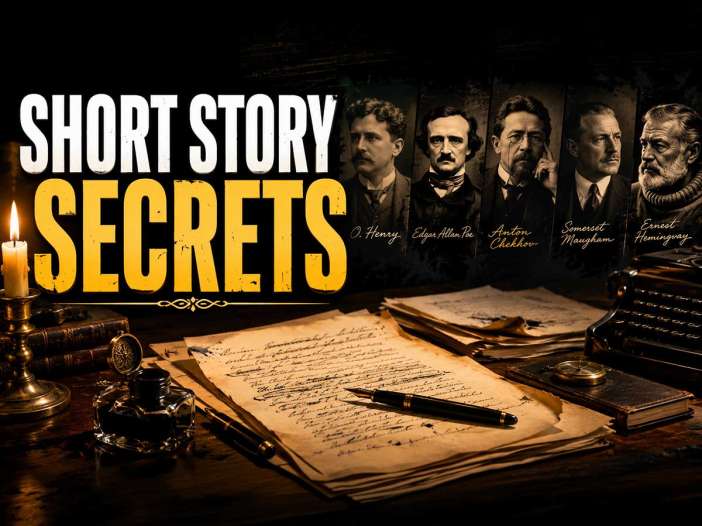
What if O. Henry, Chekhov, Poe, Hemingway, Kafka, and Alice Munro sat together to teach the art of short fiction?
What makes a short story unforgettable?
A novel may build a world through length, many scenes, and many turns of life. A short story has less room. It must do its work with pressure, silence, selection, and precision. One object, one mistake, one memory, one sentence, or one final reversal can carry the weight of an entire life.
In this imaginary conversation, twelve masters of short fiction gather to speak across time:
O. Henry, Somerset Maugham, Anton Chekhov, Guy de Maupassant, Edgar Allan Poe, Jorge Luis Borges, Franz Kafka, Ernest Hemingway, Katherine Mansfield, Saki, Ryūnosuke Akutagawa, and Alice Munro.
Each writer brings a different answer to the same creative challenge.
O. Henry believes the ending can reveal the hidden heart. Maupassant believes a story should expose illusion, vanity, and the painful cost of desire. Poe insists that every short story must move toward one powerful emotional effect. Chekhov trusts ordinary life, unfinished feeling, and the quiet sadness of people who do not fully understand themselves. Hemingway teaches that what is left unsaid may carry more force than what is spoken.
Mansfield listens for delicate emotional changes. Munro stretches one moment across memory and time. Kafka brings fear without explanation. Borges turns a few pages into a library of infinity, mirrors, dreams, and fate. Akutagawa questions truth itself. Saki sharpens comedy until it becomes dangerous. Maugham watches human weakness with calm, worldly intelligence.
Together, they explore five subjects at the center of short story craft:
The secret of a memorable ending.
The art of revealing human nature in a few pages.
The power of leaving things unsaid.
The use of shock, fear, and unsettling truth.
The way a small story can feel larger than its length.
This conversation is not only about literature. It is about how human beings hide, reveal, misunderstand, sacrifice, betray, remember, fear, and recognize themselves.
A great short story does not need to say everything.
It needs to choose the one thing that makes everything else visible.
(Note: This is an imaginary conversation, a creative exploration of an idea, and not a real speech or event.)
Topic 1: The Secret of a Memorable Ending
5 Guests
Edgar Allan Poe — Master of atmosphere, terror, and the “single effect” of a short story.
O. Henry — Master of the twist ending, emotional reversal, and hidden generosity.
Guy de Maupassant — Master of irony, social cruelty, and bitter revelation.
Saki — Master of sharp wit, dark comedy, and final-line surprise.
Ryūnosuke Akutagawa — Master of moral ambiguity, unstable truth, and psychological shock.
Opening
Edgar Allan Poe:
A short story does not merely stop. It closes like a door, tightens like a noose, or echoes like a sound in an empty room.
Many young writers think the ending is something added after the story has already been told. I disagree. The ending begins in the first sentence. Every image, every silence, every desire, every fear must move toward the final impression.
Tonight, we speak of endings—not just clever endings, but memorable ones. Endings that surprise, wound, haunt, or change the meaning of everything that came before.
Let us begin.
Question 1: Should a short story ending surprise the reader, wound the reader, or quietly haunt the reader?
O. Henry:
I have always loved surprise. The reader walks along a familiar road, then suddenly discovers the road has curved behind him. A good ending should make the reader smile and say, “Ah, it was there all along.”
Guy de Maupassant:
Surprise alone is not enough. A toy can surprise. A joke can surprise. A true ending should expose something human. Vanity, pride, hunger, shame—these are stronger than mere cleverness.
Saki:
I prefer an ending that behaves badly. A polite story may enter through the front door, but the ending should sneak out through the window with the silverware.
Akutagawa:
I am less interested in surprise than unease. A story may end, yet the reader’s certainty should not. In life, truth is rarely clean. People speak, confess, defend themselves, and still the center remains dark.
Poe:
Each of you seeks a different final effect. O. Henry seeks recognition through reversal. Maupassant seeks exposure. Saki seeks mischief with teeth. Akutagawa seeks doubt. I seek unity of emotion.
O. Henry:
Surprise works only when it becomes recognition. The reader must feel tricked for one heartbeat, then grateful the next. If the ending feels random, the writer has failed.
Maupassant:
Yes. The ending must grow from the character’s weakness. In “The Necklace,” the final revelation matters because years of suffering suddenly become useless, tragic, and absurd. The ending wounds the reader because the wound was prepared by vanity.
Saki:
And vanity deserves a wound now and then. Readers enjoy moral instruction more when it arrives wearing a wicked smile.
Akutagawa:
But a wound can be too simple. If the reader knows exactly whom to blame, the story may become smaller. I prefer when the ending makes the reader question judgment itself.
Poe:
Then the answer may be this: a memorable ending may surprise, wound, or haunt—but it must do one thing completely. A weak ending tries to do many things and leaves no lasting mark.
O. Henry:
For me, the best ending turns the story inside out without tearing it.
Maupassant:
For me, it removes the mask.
Saki:
For me, it lets the mask bite back.
Akutagawa:
For me, it breaks the mirror.
Poe:
For me, it seals the chamber.
Question 2: What makes a twist feel earned rather than cheap?
Maupassant:
A cheap twist changes facts. An earned twist changes meaning.
Saki:
That is a fine sentence. Annoyingly fine.
O. Henry:
I agree with it. The writer should not lie. The truth must be visible, but placed where the reader will not stare too long. A comb, a watch, a necklace, a window—small objects can carry the secret quietly.
Poe:
The twist must belong to the emotional design. A sudden secret twin, an unknown fortune, a letter never hinted at—these are tricks, not endings.
Akutagawa:
A false twist treats the reader as an enemy. It says, “I defeated you.” A true twist treats the reader as a witness who missed something human.
Saki:
One must mislead with manners. Never cheat the reader. Simply invite the reader to make the wrong assumption, then let the assumption fall into a pit.
O. Henry:
Yes. In a twist ending, the reader often traps himself. The writer merely arranges the room.
Maupassant:
The arrangement must come from desire. A person wants admiration, wealth, safety, love, reputation. That desire creates blindness. The ending reveals what the blindness cost.
Poe:
The first line must know the last line. The atmosphere must prepare the final blow. If the ending belongs to a different story, the reader feels the seam.
Akutagawa:
A twist can be moral, not only factual. A reader may learn that the noble man was selfish, the criminal was honest, the victim was proud, or the witness was unreliable. The outer event may remain the same, yet the meaning shifts.
Saki:
The best twist makes the reader reread the first paragraph with suspicion.
O. Henry:
Or affection.
Saki:
Suspicion is more fun.
Maupassant:
Affection can be painful too. A sacrifice hidden until the final moment can move the reader deeply. But sentiment must be disciplined. If the writer begs for tears, the reader resists.
Poe:
Restraint strengthens the effect. The ending should strike; it should not explain its own greatness.
Akutagawa:
And it should not solve more than the story has earned. Some endings gain strength by refusing complete explanation.
O. Henry:
So a twist is earned when the ending feels both unexpected and inevitable.
Maupassant:
Unexpected in event.
Saki:
Inevitable in cruelty.
Akutagawa:
Inevitable in human weakness.
Poe:
Inevitable in design.
Question 3: Is the best ending one that answers the story, or one that changes the meaning of everything before it?
Akutagawa:
An answer can be too small. Many stories end by explaining what happened. But human life is not only a sequence of events. It is a conflict of memories, motives, and self-deceptions. I prefer an ending that changes the reader’s position.
Poe:
A final answer can still be strong if it completes the intended effect. In terror, the last revelation may close the trap. The reader sees the horror fully, and escape is no longer possible.
Saki:
I like endings that change the furniture of the whole story. What looked innocent becomes dangerous. What looked silly becomes cruel. What looked respectable becomes ridiculous.
O. Henry:
A good ending can answer and transform at the same time. In the final turn, the reader understands what happened, but more than that, understands the heart behind it.
Maupassant:
Transformation is superior. A mere answer satisfies curiosity. A changed meaning unsettles the soul.
Akutagawa:
In “In a Grove,” the ending does not give one clean answer. Instead, the reader sees how truth can be shaped by pride, fear, desire, and shame. The story ends, but judgment remains troubled.
Poe:
Yet there must be form. Ambiguity without control is mist. Ambiguity with design is shadow.
Saki:
Very gloomy, but correct. A confusing ending is not the same as a mysterious one. Mystery needs precision.
O. Henry:
And warmth needs precision too. A tender ending fails if it becomes too soft. The writer must hold back just enough.
Maupassant:
The ending should force the reader to reinterpret the beginning. The first scene should not vanish after the final line. It should return with new meaning.
Akutagawa:
That is the real test. Can the story be read again with deeper discomfort?
Saki:
Or deeper amusement.
Poe:
Or deeper dread.
O. Henry:
Or deeper love.
Maupassant:
Perhaps the best ending does not merely answer the plot. It reveals the price of the plot.
Akutagawa:
And the hidden self beneath the plot.
Saki:
And the joke the reader was standing inside.
Poe:
Then the finest ending changes the air around the whole story. It does not only close the tale. It makes the beginning tremble.
Closing
Edgar Allan Poe:
We have spoken of surprise, wounds, haunting silence, and the strange justice of final lines.
A weak ending merely stops.
A clever ending surprises.
A stronger ending reveals.
A lasting ending returns to the reader after the book is closed.
The young writer should not begin by asking, “How can I trick the reader?” That question is too small.
Ask instead:
What truth is hidden in the first sentence?
What does the character refuse to see?
What assumption is the reader making?
What final feeling must remain?
For O. Henry, the ending reveals the heart.
For Maupassant, it exposes illusion.
For Saki, it delivers a polished little act of mischief.
For Akutagawa, it breaks certainty.
For me, it completes the single effect.
A short story ending is not the last step. It is the secret destination the story has been walking toward from the beginning.
Topic 2: How to Reveal Human Nature in a Few Pages
5 Guests
Somerset Maugham — Master of worldly observation, irony, desire, and moral compromise.
Anton Chekhov — Master of ordinary lives, quiet disappointment, and open-ended human feeling.
Alice Munro — Master of memory, time, hidden regret, and the long shape of a life.
Katherine Mansfield — Master of small emotional turns, social tension, and delicate inner change.
Ernest Hemingway — Master of silence, restraint, and emotion left beneath the surface.
Opening
Somerset Maugham:
A short story has little space, yet it must suggest a full human being. That is its difficulty and its charm.
A novel may follow a person through years of habit, error, love, vanity, defeat, and self-deception. A short story has no such luxury. It must choose one dinner, one letter, one glance, one betrayal, one silence, one afternoon when a person unexpectedly reveals more than intended.
Human nature is rarely declared. It slips out.
A man is generous, yet wishes to be admired for it. A woman is loyal, yet resents the life her loyalty has built. A child sees something adults have hidden. A quiet person says one sentence, and a whole marriage appears.
Tonight, we ask how a writer can reveal a life in a few pages.
Question 1: How much should a writer explain about a character’s inner life?
Chekhov:
Very little, if the scene is alive. People do not walk through life explaining themselves. They cough, wait, avoid one another, speak too loudly, or fail to speak at all. The reader feels the soul through behavior.
Maugham:
Yet the writer must know more than he says. I have met many people who believed they hid themselves well. They did not. Their vanity showed in a pause. Their cruelty showed in politeness. Their hunger showed in kindness.
Hemingway:
Do not explain the wound. Show how the man holds the glass. Show what he says when he refuses to talk. The reader will know.
Mansfield:
Yes, but silence must carry feeling. A character may look at a flower, a hat, a table laid for guests, and suddenly her whole life trembles. The inner life is not always hidden in dramatic action. It can appear in perception.
Munro:
Sometimes explanation comes years later. A person may not know what a moment meant when it happened. Memory returns and changes the scene. The writer can let the reader see that the character has been living under the shadow of something barely named.
Maugham:
I agree. A writer should resist too much explanation, yet not worship obscurity. If the reader cannot sense the motive, the character becomes smoke.
Chekhov:
Motive is often mixed. A doctor may be kind and tired. A wife may be affectionate and bored. A student may be idealistic and vain. A short story should allow contradiction.
Hemingway:
People lie in plain words. That is useful. Let them say, “I am fine.” Then let the room say otherwise.
Mansfield:
The room, the weather, the food, the clothing, the tone of a guest—these can reveal inner life with grace. A young woman may not say, “I am lonely.” She may laugh too brightly at a party.
Munro:
A character’s inner life often appears through what she leaves out. What she will not tell her husband. What she will not admit to herself. What she remembers only after it is too late to change anything.
Maugham:
Then perhaps the writer should explain only what gives the reader entry, never what robs the reader of discovery.
Chekhov:
The reader should feel trusted.
Hemingway:
And made to work.
Mansfield:
But not abandoned.
Munro:
Given enough light to see, and enough shadow to wonder.
Question 2: Can one small moment reveal an entire lifetime?
Munro:
Yes. A small moment can open backward and forward through time. A woman sees a former lover in a store. A daughter reads a letter after her mother dies. A man hears one ordinary sentence and understands that his marriage has been built around avoidance. The moment is small. The life around it is not.
Hemingway:
One sentence can do it. One drink refused. One train waited for. One thing nobody says. The story does not need to carry the whole life on the page. It needs to make the reader feel the weight under it.
Maugham:
I would say one moment reveals a lifetime when it catches a person off guard. Most people perform themselves. They have a role: husband, wife, artist, gentleman, martyr, sinner, saint. The short story waits for the performance to slip.
Mansfield:
A child at a garden party may see poverty for the first time. A young woman may feel happiness and fear in the same breath. These moments matter since they divide life into before and after.
Chekhov:
Yet writers must be careful. Life is not always arranged around revelation. Sometimes the moment passes, and the person does not change. That, too, can reveal a life.
Munro:
That is very true. A reader may expect transformation. Often people receive a glimpse, then continue. Years later, that glimpse becomes meaningful. The short story can hold both the moment and the later ache.
Hemingway:
A story can end before the character understands it.
Maugham:
And the reader may understand more than the character. That is one of fiction’s pleasures, and one of its cruelties.
Mansfield:
The small moment must be chosen with care. It cannot be small in meaning, only in outward size. A look across a room can matter more than a scandal.
Chekhov:
The writer must not push too hard. If the story announces, “This is the great moment,” the moment shrinks. Let life appear ordinary. The reader will sense the break.
Munro:
Time helps. A single moment becomes large when the writer lets us feel what led to it and what it quietly changes.
Hemingway:
Leave the explosion off the page if needed. Show the pressure before it.
Maugham:
Or show the smile after it, when the character pretends nothing has happened.
Mansfield:
That pretending is often the story.
Chekhov:
Yes. The human being after the moment may be more revealing than the moment itself.
Question 3: Is human nature best shown through action, silence, contradiction, or memory?
Mansfield:
I would begin with contradiction. A person may love her guests and feel trapped by them. A woman may enjoy beauty and feel ashamed of her comfort. A child may adore her family and suddenly see its coldness. Human nature appears when feelings do not agree with one another.
Hemingway:
Action matters. What people do under pressure says more than what they claim. A man can speak bravely. Watch what he does when he is afraid.
Chekhov:
Silence matters more than action at times. In ordinary life, many decisive things are not said. A man does not confess loneliness. A woman does not say she is disappointed. The silence sits between them like furniture.
Munro:
Memory matters since people keep revising themselves. They tell one version at twenty, another at forty, another near death. Human nature is not fixed in one scene. It changes under memory.
Maugham:
I would choose all four, but with a warning. Action without motive becomes melodrama. Silence without pressure becomes blankness. Contradiction without shape becomes confusion. Memory without selection becomes fog.
Hemingway:
Selection is the whole craft.
Mansfield:
And rhythm. The writer must know when to move close to the character and when to step back. Too much closeness can suffocate the reader. Too much distance can freeze feeling.
Chekhov:
A character should not be reduced to a lesson. The drunkard is more than drink. The foolish woman is more than folly. The selfish man may still love his dog. Give people their full confusion.
Munro:
A story becomes rich when the reader feels that every person has a private history beyond the page. The minor character, too, has a life. The mother, the neighbor, the clerk, the former lover—each carries unseen time.
Maugham:
Human nature is often most visible when people justify themselves. Listen to a man explain why he did a selfish thing. He may reveal more in the excuse than in the act.
Hemingway:
Or let him refuse to explain.
Mansfield:
Or let his wife hear the excuse and look away.
Chekhov:
Or let nothing change, which can be the saddest ending.
Munro:
Memory may return years later and make that unchanged life painful in a new way.
Maugham:
Then perhaps human nature is best shown through pressure. Action, silence, contradiction, and memory are only different ways pressure becomes visible.
Hemingway:
Put pressure on the character. Cut the extra words.
Mansfield:
Let the smallest gesture carry feeling.
Chekhov:
Let the person remain human, not solved.
Munro:
Let time deepen what the moment cannot fully say.
Closing
Somerset Maugham:
To reveal human nature in a few pages, the writer must avoid the obvious path.
Do not tell us that a man is vain. Let him perform humility in front of someone he wishes to impress.
Do not tell us that a woman is lonely. Let her arrange flowers for guests she secretly dreads.
Do not tell us that a marriage is dying. Let one person ask a simple question, and let the other answer too late.
The short story is the art of choosing the right pressure point. A whole life need not be shown. One charged moment can reveal the pattern.
Chekhov teaches us to trust ordinary life.
Hemingway teaches us to trust silence.
Mansfield teaches us to trust delicate perception.
Munro teaches us to trust time and memory.
I would add only this: trust human inconsistency.
People are rarely one thing. They are kind and selfish, brave and afraid, loyal and resentful, honest and self-protective. A short story becomes memorable when it catches that contradiction before it disappears.
Topic 3: The Art of Leaving Things Unsaid
5 Guests
Ernest Hemingway — Master of restraint, silence, and the emotion hidden beneath simple words.
Anton Chekhov — Master of quiet endings, unresolved lives, and ordinary sorrow.
Katherine Mansfield — Master of delicate feeling, social tension, and emotional atmosphere.
Alice Munro — Master of memory, omission, regret, and the secrets people carry over time.
Franz Kafka — Master of unexplained dread, alienation, and the anxiety of life without clear answers.
Opening
Ernest Hemingway:
A short story does not need to say everything. It needs to know everything.
That is the difference.
A writer may leave out the strongest emotion, the old wound, the shame, the fear, the thing the character cannot name. But the writer must know it. If the writer does not know what is under the surface, the silence becomes empty. If the writer knows, the silence can carry more weight than a speech.
People rarely tell the full truth. They talk around it. They joke. They drink. They ask about the weather. They say they are fine. A short story can live in that gap between what is said and what is meant.
Tonight, we speak about what a story should leave unsaid.
Question 1: What should a short story hide from the reader?
Hemingway:
Hide the wound. Show the limp. If a man is broken, do not explain every cause. Let him order another drink, refuse a question, look at the door, and speak too plainly. The reader will feel the rest.
Chekhov:
A story should hide what life itself hides. People do not understand themselves completely. They make choices, then call them duty, love, boredom, or necessity. The writer should let that confusion remain alive.
Kafka:
I would hide the reason. A man wakes inside a punishment, yet no one explains the law. He asks why, and the world replies with procedures. This is close to life. Many suffer before they know the charge.
Mansfield:
I would hide the deepest feeling until it trembles through something small. A woman may touch a hat, notice a flower, hear a laugh from another room, and suddenly the reader senses grief. The story does not need to name the grief too quickly.
Munro:
A story can hide the event that shaped everything. A child may remember a room, a road, a voice, but avoid the central truth for years. The reader follows the avoidance. What is left out becomes part of the story’s structure.
Hemingway:
The danger is softness. A writer leaves something out, then fears the reader will miss it, so he explains it later. That ruins the pressure.
Chekhov:
Yes. Trust the reader, but do not starve the reader. There must be enough detail to make the silence meaningful.
Kafka:
The silence must have walls. The reader should feel trapped by what is not said.
Mansfield:
Or touched by it. Not every silence is terror. Some silence is tenderness, embarrassment, longing. A person may be unable to speak from love, not fear.
Munro:
Silence changes with time. What a girl cannot say at sixteen may become the story she tells herself at sixty. The writer may hide something early, then let memory circle it later.
Hemingway:
Keep the strongest thing under the water. Let the reader see the tip.
Chekhov:
And let the water remain real.
Kafka:
Let the water rise.
Question 2: When does ambiguity create depth, and when does it create confusion?
Kafka:
Ambiguity creates depth when the reader feels that the uncertainty belongs to the world of the story. Confusion comes when the uncertainty belongs only to the writer’s carelessness.
Mansfield:
Yes. A vague story is not the same as a subtle one. Subtlety has shape. The reader may not know everything, but the feeling is precise.
Munro:
Ambiguity gains depth when it reflects how people remember. Memory is selective. A person may honestly recall one detail and bury another. The story may not give one clean answer, since the person living it never had one.
Hemingway:
Confusion is extra fog. Ambiguity is a clean shadow.
Chekhov:
In life, many questions remain open. Did the person love? Did he waste his life? Did she choose freedom, or merely another form of loneliness? A story does not need to close every door.
Kafka:
A door may stand open and still deny entry. That is useful.
Mansfield:
The reader should feel invited, not abandoned. In a strong ambiguous ending, the reader keeps thinking. In a weak one, the reader merely asks, “What happened?”
Hemingway:
The writer must cut what is false, not what is needed.
Munro:
One way to avoid confusion is to make the emotional truth clear, even when the factual truth remains uncertain. The reader may not know exactly what happened long ago, but can feel what it did to the character.
Chekhov:
That is very close to life. We often know the sadness before we know the cause.
Kafka:
Or the guilt before the crime.
Mansfield:
Or the loneliness before the confession.
Hemingway:
A good story can leave out the answer and still land the punch.
Munro:
The unanswered part should expand the story after reading, not collapse it.
Chekhov:
A story becomes deep when its silence resembles life.
Question 3: Can silence in a story be more powerful than confession?
Mansfield:
Yes. Confession can be too direct. A person saying, “I am unhappy,” may move us less than a person laughing at the wrong moment. Silence lets feeling gather around the scene.
Chekhov:
People often live entire lives without confessing what hurts them most. A short story should respect that. The unsaid word may be the most truthful word in the room.
Hemingway:
Confession can weaken a scene. If the character says the exact thing the story has been showing, the story loses force. Let the reader arrive there.
Munro:
But some stories need a confession that fails. A person may finally speak and discover that speech changes nothing. Or she may confess too late, to the wrong person, with the wrong memory. That can be devastating.
Kafka:
Silence can be more powerful since it has no judge. A confession seeks response. Silence remains unanswered. It grows larger.
Mansfield:
A dinner table can hold more drama than a courtroom if everyone knows what cannot be said.
Chekhov:
A doctor may sit beside a patient and understand his own emptiness, yet say nothing. That silence may reveal more than a declaration.
Hemingway:
In a good scene, people speak about one thing and mean another. The real conversation runs underneath.
Munro:
Years later, a character may realize what was hidden in that conversation. The past becomes louder after silence has had time to work.
Kafka:
Silence may mean terror. It may mean the law has no face. It may mean the father will not explain, the office will not answer, the gate will not open.
Mansfield:
Or it may mean a woman has seen too much in one afternoon and cannot yet form the sentence.
Chekhov:
Silence is not empty when it contains a choice.
Hemingway:
Or a wound.
Munro:
Or a memory.
Kafka:
Or a sentence never spoken by the court, yet already carried out.
Mansfield:
Then perhaps silence is most powerful when the reader feels what it costs.
Closing
Ernest Hemingway:
Leaving things unsaid is not a trick. It is discipline.
A writer must know the hidden wound, the withheld fact, the fear beneath the dialogue, the memory the character avoids. Then the writer must decide how much the reader needs, and how much the story can carry in silence.
Chekhov teaches that life often remains unresolved.
Mansfield teaches that feeling can pass through the smallest gesture.
Munro teaches that memory hides and reveals across time.
Kafka teaches that what is unexplained can become terrifying.
A short story does not become stronger by explaining everything. It becomes stronger when what is left unsaid has weight.
The page may end.
The silence should not.
Topic 4: Short Story as Shock, Fear, and Unsettling Truth
5 Guests
Edgar Allan Poe — Master of terror, guilt, obsession, and psychological collapse.
Franz Kafka — Master of absurd fear, invisible authority, and human alienation.
Jorge Luis Borges — Master of intellectual dread, infinite patterns, and reality turned uncertain.
Ryūnosuke Akutagawa — Master of moral darkness, conflicting truth, and spiritual unease.
Guy de Maupassant — Master of cruel realism, irony, fear, and the brutality hidden in ordinary life.
Opening
Edgar Allan Poe:
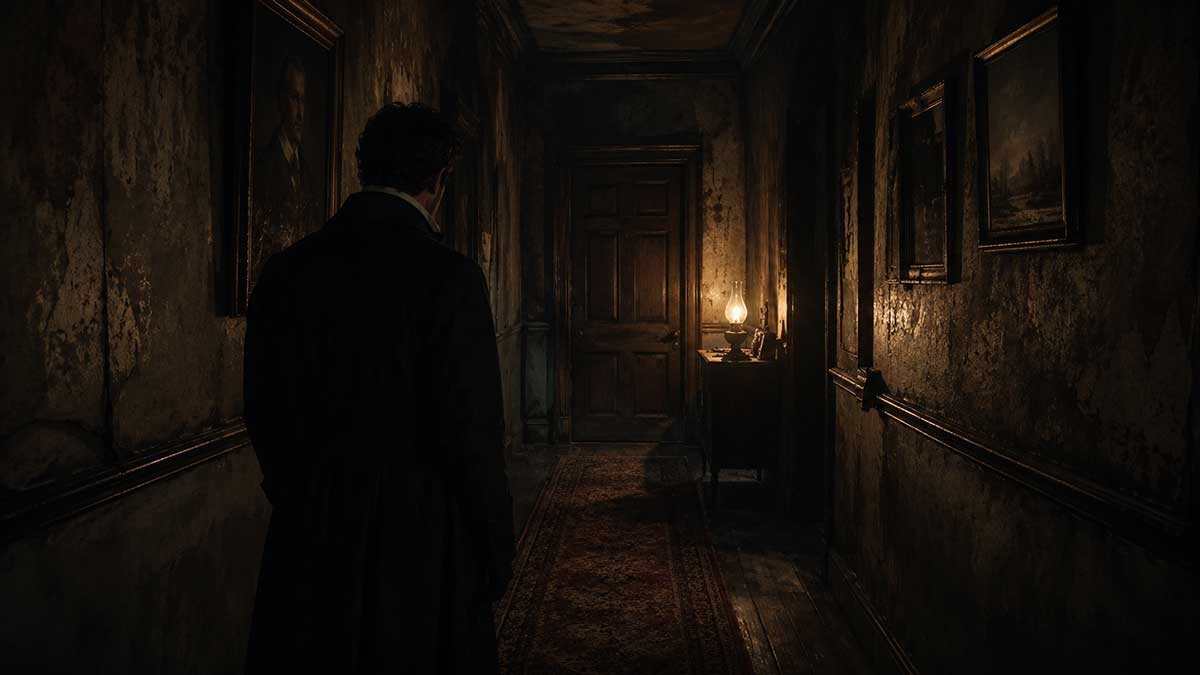
Fear in a short story does not need a castle, a corpse, or a ghost.
It needs pressure.
A room can become terrifying if guilt is trapped inside it. A law office can become terrifying if no one explains the accusation. A mirror can become terrifying if it suggests that the self is less stable than we believed.
The short story is suited to fear since it gives the reader no long road of escape. It closes in quickly. It selects one dread, one image, one wound, one moral stain, and tightens around it.
Tonight, we speak of shock, fear, and unsettling truth.
Question 1: Why do some short stories disturb us more than novels?
Poe:
A short story can strike with unity. It does not wander. It does not permit the reader to rest in side roads. Every sentence gathers around one effect, and that effect may be terror.
Kafka:
A novel may explain the prison. A short story may simply place a man inside the cell and leave the key unnamed. That is often more frightening. The mind suffers when it cannot find the rule.
Maupassant:
A short story disturbs us since it can remove comfort quickly. A respected person is revealed as cruel. A happy life is shown to be built on vanity. A pleasant room becomes a trap. There is no time for escape into grandeur.
Akutagawa:
It can disturb us since it leaves judgment unfinished. A murder may be described by several people, yet truth becomes less clear with each voice. The reader wants moral order. The short story may deny it.
Borges:
A short story can make a small idea endless. A book, a coin, a dream, a map, a name—one object may open into something vast. The reader is disturbed when the familiar becomes too large to hold.
Poe:
Length can dilute terror. Fear must be concentrated. The heart hears a sound beneath the floor. The reader waits. The sound grows. The story ends before comfort can return.
Kafka:
Fear grows when the event has no proper explanation. A man becomes an insect. A messenger never arrives. A gate stands open, yet one man waits his whole life before it. The lack of explanation is the wound.
Maupassant:
I trust fear that comes from life. Poverty, war, desire, social shame, illness, old age. These need no monster. Human society produces enough horror.
Akutagawa:
Human beings produce enough horror inside themselves. Shame, pride, fear of disgrace, hunger for beauty, need for honor. A short story can show one moment when these forces tear the soul.
Borges:
A short story can disturb by suggesting that reality is an arrangement we have mistaken for truth. The reader closes the story, yet the idea continues moving.
Poe:
Then the short story disturbs through compression.
Kafka:
Through unanswered law.
Maupassant:
Through exposure.
Akutagawa:
Through moral fracture.
Borges:
Through the infinite hidden inside the brief.
Question 2: Is fear stronger when it comes from the supernatural, society, guilt, or the self?
Maupassant:
Society frightens me most. A ghost may vanish. Society remains. It judges, starves, humiliates, rewards hypocrisy, and teaches people to destroy themselves for reputation.
Poe:
Guilt is stronger. A man may escape society, but not the beating in his own mind. The crime is buried, the body hidden, the room silent—yet the soul hears what the ear cannot bear.
Kafka:
I would say authority without a face. Society frightens, yes, but invisible authority is worse. It does not need to shout. It summons, records, delays, refuses, and never explains itself.
Akutagawa:
The self may be most frightening. A person wants to believe he is honorable, yet fear makes him selfish. A person seeks beauty, yet beauty becomes cruelty. We are often strangers to our own motives.
Borges:
Fear may come from thought itself. What if time is circular? What if every choice has already happened? What if a man meets his own death not as accident, but as pattern? The mind can become its own haunted house.
Poe:
The supernatural works best when it touches guilt. A ghost without conscience is decoration. A ghost that speaks to a buried crime becomes necessary.
Maupassant:
I distrust the supernatural unless it reveals human weakness. A phantom may be less frightening than a husband, a creditor, a uniform, a crowd.
Kafka:
The insect in “The Metamorphosis” is horrible, yet the family’s response is worse. The body changes, but the household reveals itself.
Akutagawa:
Yes. Fear grows when the outer horror reveals an inner truth. The event may be strange, but the shame is real.
Borges:
The deepest fear may be that the self is not the center. We want to be authors of our lives. A strange pattern suggests we may be characters inside a text we cannot read.
Poe:
That is a refined terror.
Kafka:
Refined terror is still terror.
Maupassant:
I prefer rough terror. Hunger. Debt. Desire. A soldier in the dark. A woman trapped by class. A poor man ruined by appearances.
Akutagawa:
Both forms meet in the human heart. The mind fears mystery. The body fears pain. The soul fears disgrace.
Borges:
And the story gathers them into one image.
Question 3: Can a story be frightening without monsters, murder, or visible danger?
Kafka:
Certainly. A letter that never comes can frighten. A door that remains closed can frighten. A clerk who says nothing can frighten. Fear begins when a person loses access to meaning.
Maupassant:
A dinner table can frighten if everyone is pretending. A marriage can frighten if affection has become performance. A necklace can frighten if it represents years of life wasted for illusion.
Poe:
A sound can frighten. A silence can frighten. A thought repeated too often can frighten. Visible danger is not required when the mind supplies the enemy.
Akutagawa:
A story can be frightening when a character makes a small moral surrender. No blood, no scream, no monster—only a person discovering that survival may cost his soul.
Borges:
A harmless object can frighten if it suggests endlessness. A book that contains every book. A point that contains every place. A memory that cannot forget. Too much knowledge can become terror.
Kafka:
The office corridor may be more frightening than a battlefield if one cannot leave it. People think fear needs movement. Often fear is waiting.
Maupassant:
Waiting for money. Waiting for judgment. Waiting for a lover. Waiting for a doctor. Waiting for a secret to be discovered. Yes, waiting can be cruel.
Poe:
Suspense is the art of delayed contact. The reader knows something must happen. The delay becomes the blade.
Akutagawa:
At times, nothing happens outwardly. The danger is that the character recognizes himself. Recognition can be harsher than punishment.
Borges:
A story without visible danger may frighten through implication. The page says little, but the idea behind it opens and does not close.
Kafka:
The reader may ask, “What is the danger?” Then slowly understand: the danger is the order of things.
Maupassant:
Or the habits of people.
Poe:
Or the hidden crime.
Akutagawa:
Or the divided soul.
Borges:
Or the structure beneath reality.
Poe:
Then a story can frighten without spectacle. It needs a pressure the reader cannot dismiss.
Closing
Edgar Allan Poe:
A frightening short story is not made by adding darkness. It is made by choosing the right darkness.
For Maupassant, fear may come from society, vanity, class, war, and the cruel facts of life.
For Kafka, fear comes from a rule no one explains.
For Borges, fear comes from the mind discovering patterns too vast to master.
For Akutagawa, fear comes from moral uncertainty and the divided self.
For me, fear comes when the hidden thing insists on being heard.
The young writer should not begin with a monster. Begin with pressure. Begin with guilt, shame, waiting, a closed door, a false memory, a polite lie, a sound in the wall, a truth no one wants to name.
A short story frightens most when it feels smaller than the fear it contains.
Topic 5: How to Build a Story That Feels Larger Than Its Length

5 Guests
Jorge Luis Borges — Master of vast ideas, mirrors, books, dreams, infinity, and reality turned strange.
Alice Munro — Master of entire lives compressed into memory, regret, choice, and time.
Somerset Maugham — Master of narrative control, human contradiction, and worldly perspective.
Anton Chekhov — Master of ordinary life, quiet sorrow, and endings that remain open.
O. Henry — Master of compression, setup, reversal, and emotional payoff.
Opening
Jorge Luis Borges:
A short story is brief only in pages.
Inside a few pages, a writer may place a lifetime, a city, a marriage, a sin, a dream, a library, a lost chance, a secret that changes the past, or a final gesture that changes every earlier sentence.
The short story does not become large by adding more events. It becomes large by choosing one image, one decision, one memory, or one hidden truth that opens beyond itself.
A single coin may suggest fate.
A single road may suggest a life.
A single gift may reveal love.
A single silence may contain years.
Tonight, we ask how a writer can make a small story feel spacious, lasting, and complete.
Question 1: How can a short story feel like it contains a whole world?
Borges:
The story must suggest more than it states. A map may stand for an empire. A library may stand for all knowledge. A mirror may stand for endless versions of the self. The secret is not size. It is implication.
Alice Munro:
For me, a short story feels large when the reader senses time around it. A woman may sit in a kitchen for one afternoon, but if the story carries childhood, marriage, disappointment, and memory behind that afternoon, the room expands.
O. Henry:
A small story grows when every detail works twice. A comb is a comb, but it is love too. A watch is a watch, but it is sacrifice too. The object is small. The feeling is large.
Chekhov:
Life is already large. The writer does not need to decorate it. One tired doctor, one lonely schoolteacher, one bored wife, one disappointed student—if observed truthfully, each contains more than the writer can fully explain.
Maugham:
A story gains breadth when the writer understands the social air around the character. A man’s choice is never only his own. Money, class, desire, reputation, religion, age, and fear all press upon him. A few pages can suggest all of that if the writer chooses the right pressure point.
Borges:
A short story should feel like a visible fragment of a hidden design. The reader sees one tile and imagines the mosaic.
Munro:
Or sees one memory and feels the life around it.
O. Henry:
Or sees one mistake and understands the heart.
Chekhov:
Or sees no grand mistake at all, only the quiet weight of being alive.
Maugham:
The writer must not crowd the story. Too much material makes it smaller. Selection creates size.
Borges:
Yes. The unsaid corridors must remain open.
Munro:
The reader must sense that every character existed before the story began and will continue after it ends.
Chekhov:
Even if they do not change.
O. Henry:
Even if one final act changes how we see them.
Maugham:
Even if they leave the room still deceiving themselves.
Question 2: Should a short story focus on one moment, one decision, or one hidden truth?
Maugham:
I would begin with one hidden truth. The moment and decision matter only when they reveal what someone has been concealing from others or from himself. Without that hidden truth, the event is merely an event.
Chekhov:
Sometimes there is no single hidden truth. A person feels tired, dissatisfied, hopeful, ashamed, and tender all at once. I prefer a moment that catches this mixture without forcing it into a lesson.
Munro:
A decision can be small at the time and enormous later. A girl leaves home. A woman does not answer a letter. A man tells one lie. Years pass before the meaning becomes clear. The story may focus on the decision, but its real subject is the life that grows from it.
O. Henry:
A hidden truth gives the ending its turn. The reader thinks one thing is happening, then discovers the truer thing underneath. But the hidden truth must be planted honestly. The reader should not feel cheated.
Borges:
I am drawn to the hidden structure behind the moment. A man makes a choice, yet perhaps the choice has been repeated through centuries. A dreamer dreams a man, then learns he too is dreamed. The moment becomes large when it opens into pattern.
Maugham:
Pattern is useful, but character must remain alive. A story should not become a puzzle with names attached. Human weakness gives the pattern blood.
Chekhov:
And mercy. Even foolish people should not be handled with contempt.
Munro:
The writer may not know the hidden truth at first. Sometimes it appears during revision, when one small detail begins to glow.
O. Henry:
Then the writer returns to the beginning and places the lantern where it should have been all along.
Borges:
Revision reveals destiny after the fact.
Chekhov:
Or removes false destiny and lets life breathe.
Maugham:
Perhaps the answer depends on the writer’s temperament. O. Henry trusts the hidden truth that turns the ending. Chekhov trusts the charged moment. Munro trusts the decision seen through time. Borges trusts the pattern beneath the visible.
Munro:
And you trust motive.
Maugham:
I trust motive, hypocrisy, and the little bargains people make with themselves.
O. Henry:
A useful trio.
Borges:
Then the writer may begin with any of the three: moment, decision, or hidden truth. But the story becomes large only when that one element touches something beyond itself.
Question 3: What gives a short story lasting value: plot, character, atmosphere, theme, or final insight?
O. Henry:
I will defend plot first. Not plot as machinery alone, but plot as meaningful arrangement. A story gives pleasure when events click into place and the final turn reveals feeling. Plot can carry the heart.
Borges:
I will defend idea. A short story can last if it changes the reader’s relation to time, memory, identity, or reality. A plot may be simple, yet the idea behind it may keep unfolding.
Chekhov:
Character. But not character as explanation. A living person on the page is never exhausted. We remember people more than events. We remember their hesitations, their blindness, their small hopes.
Maugham:
I would say final insight. Plot, character, atmosphere, and theme are all servants of the moment when the reader sees more clearly. Not a moral, necessarily. A recognition.
Munro:
Time gives lasting value. The story remains with us when it understands that people change, memories shift, and old choices continue speaking. The final insight may come late, perhaps too late for the character.
O. Henry:
Yet the reader loves form. A story that wanders may contain truth, but it may not be remembered. Shape matters.
Chekhov:
Shape matters, but it must not strangle life.
Borges:
Atmosphere matters too. A story can be remembered as a feeling: dread in a library, heat in a village, silence in a room, snow outside a window.
Maugham:
Theme matters when hidden inside people. If the theme walks in front, waving its arms, fiction becomes sermon.
Munro:
The best stories often contain several forms of value. A plot may lead us in. A character may hold us. Atmosphere may surround us. Time may deepen us. The final insight may return later.
O. Henry:
I like that. The short story is a small box, but it can hold many compartments.
Borges:
Or a small book that contains a library.
Chekhov:
Or a small life that suggests all lives.
Maugham:
Or a small deception that reveals the human race.
Munro:
Or a small memory that will not stay small.
Borges:
Then lasting value may come from this: the story ends in language, but continues in thought.
Closing
Jorge Luis Borges:
A short story feels larger than its length when it leaves doors open inside the reader.
It may do this through one object, one memory, one decision, one reversal, one quiet disappointment, one idea too large for the page, or one character who seems to have lived before the first sentence and continues after the last.
O. Henry teaches that compression can lead to emotional revelation.
Chekhov teaches that ordinary life contains depths no plot can exhaust.
Maugham teaches that human motive can widen even the smallest scene.
Munro teaches that time can enter a story through memory and regret.
A short story need not contain many events. It must contain consequence.
The young writer should ask:
What is the visible story?
What is the larger life behind it?
What detail can carry more than one meaning?
What will remain after the final sentence?
A small story becomes large when the reader feels that the page has ended, but the life inside it has not.
Final Thoughts
A short story is one of the most difficult forms of writing precisely since it has no room to waste.
It cannot depend on length.
It cannot depend on many events.
It cannot depend on explanation alone.
It must choose.
One ending.
One pressure point.
One hidden truth.
One silence.
One image.
One decision.
One wound.
One moment when the reader suddenly sees more than the page has said.
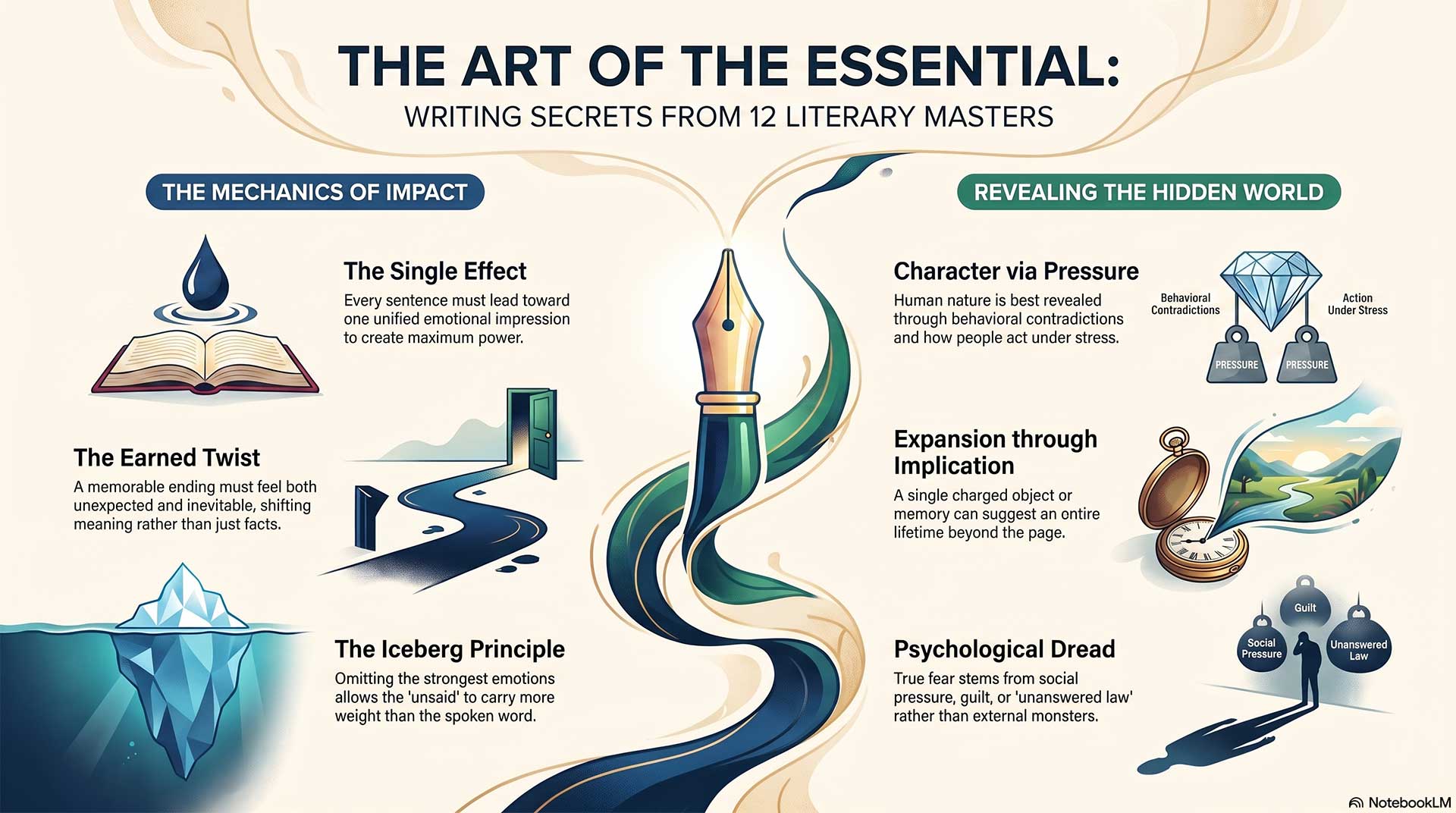
From these writers, a young storyteller can learn five lessons.
First, a memorable ending must feel earned. O. Henry, Maupassant, Saki, Akutagawa, and Poe remind us that a strong ending is not a trick placed at the end. It is planted from the beginning. The reader may be surprised, but the deeper feeling must be recognition.
Second, human nature is best revealed under pressure. Maugham, Chekhov, Munro, Mansfield, and Hemingway show that people are rarely simple. They are generous and selfish, brave and afraid, loyal and resentful, honest and self-protective. A short story becomes alive when it catches contradiction before it disappears.
Third, silence can be stronger than speech. Hemingway, Chekhov, Mansfield, Munro, and Kafka teach that what people cannot say may matter most. The writer must know the hidden wound, then decide how much to reveal. A story becomes powerful when the unsaid has weight.
Fourth, fear does not need spectacle. Poe, Kafka, Borges, Akutagawa, and Maupassant show that terror can come from guilt, society, authority, the self, or the thought that reality itself may not be stable. A door, a letter, a sound, a memory, or a polite lie can frighten more than a monster.
Fifth, a short story feels large when it suggests a life beyond the page. Borges, Munro, Maugham, Chekhov, and O. Henry teach that a small story can contain consequence. A single object can become love. A single memory can become a lifetime. A single decision can echo across years.
The common lesson is simple but demanding:
Do not write more.
Choose better.
A short story should not explain life completely. It should open one window, light one room, reveal one wound, and leave the reader feeling that a much larger world continues beyond the final sentence.
The page ends.
The story remains.
Short Bios:
O. Henry
O. Henry was an American short story writer best known for his witty plots, warm humor, and twist endings. His stories often begin in ordinary life, then turn in the final moments to reveal sacrifice, irony, or hidden tenderness. His work is especially useful for studying setup, reversal, and emotional payoff.
Somerset Maugham
Somerset Maugham was a British writer known for his clear style, worldly observation, and sharp understanding of human weakness. His short stories often explore desire, hypocrisy, social masks, and moral compromise. He is valuable for writers who want to reveal character through motive and irony.
Anton Chekhov
Anton Chekhov was a Russian playwright and short story master who changed the form by moving away from neat endings and moral lessons. His stories often focus on ordinary people, quiet disappointment, and unresolved emotion. He teaches writers how to create depth through restraint, compassion, and life-like incompleteness.
Guy de Maupassant
Guy de Maupassant was a French short story writer famous for realism, irony, and bitter endings. His stories often expose vanity, greed, social pressure, and the cruelty hidden inside ordinary life. He is especially helpful for learning how a final revelation can change the meaning of an entire story.
Edgar Allan Poe
Edgar Allan Poe was an American writer whose short stories shaped horror, mystery, and psychological fiction. He believed a short story should create one unified emotional effect. His work teaches structure, atmosphere, suspense, guilt, obsession, and the force of a carefully prepared final impression.
Jorge Luis Borges
Jorge Luis Borges was an Argentine writer known for short stories filled with mirrors, dreams, libraries, labyrinths, time, infinity, and imagined books. His fiction turns brief stories into philosophical puzzles. He is useful for writers who want a small story to suggest vast ideas.
Franz Kafka
Franz Kafka was a German-language writer from Prague whose stories explore fear, alienation, guilt, and unexplained authority. His work often begins with strange events that are treated as normal, creating a deep sense of unease. He teaches how uncertainty and silence can become forms of terror.
Ernest Hemingway
Ernest Hemingway was an American writer known for spare prose, emotional restraint, and the “iceberg” approach to storytelling. His stories often leave the deepest feelings beneath the surface. He teaches writers how dialogue, silence, and omission can carry powerful emotion.
Katherine Mansfield
Katherine Mansfield was a New Zealand-born modernist writer known for subtle emotional shifts, social tension, and delicate psychological insight. Her stories often focus on small moments that reveal loneliness, class, desire, or awakening. She is valuable for writers who want to capture feeling through atmosphere and gesture.
Saki
Saki was the pen name of British writer H. H. Munro. He is known for dark humor, social satire, and sharp final twists. His stories often begin in polite society, then end with mischief, cruelty, or comic shock. He teaches the force of wit, timing, and the final line.
Ryūnosuke Akutagawa
Ryūnosuke Akutagawa was a Japanese short story writer known for psychological depth, moral ambiguity, and elegant structure. His stories often question truth, pride, guilt, and self-deception. He is especially important for writers who want endings that disturb certainty rather than simply solve the plot.
Alice Munro
Alice Munro was a Canadian writer and Nobel Prize winner known for stories that contain the emotional depth of novels. Her fiction often explores memory, regret, family, love, aging, and the long consequences of small choices. She teaches how time can make a short story feel expansive and lasting.
Leave a Reply