

What if the greatest fathers in literature and film could speak with their children about courage, sacrifice, grief, protection, and letting go?
What makes a father beloved in story?
It is not perfection. It is not control. It is not the ability to protect a child from every wound.
The fathers in these five conversations are loved because each one faces a different test of love. Atticus Finch must teach courage in a town shaped by fear. Jean Valjean must prove that chosen love can become sacred. Mufasa must leave a son with a voice strong enough to survive death. Guido Orefice must guard his child’s soul in a place built to destroy innocence. Marlin must learn that protection can become a cage if fear takes over the heart.
Each father carries love differently.
One stands in court.
One keeps a promise.
One speaks from memory.
One turns terror into play.
One crosses the ocean.
Together, they show that fatherhood is not a single kind of strength. It can be moral courage, daily devotion, spiritual memory, sacrificial imagination, or the painful grace of letting a child grow.
In these imaginary conversations, fathers and children speak across literature and film about what love costs, what it teaches, and what remains inside a child long after the father’s hand is no longer holding theirs.
(Note: This is an imaginary conversation, a creative exploration of an idea, and not a real speech or event.)
Topic 1: Atticus Finch — Can a Father Teach Courage Without Teaching Hatred?
Opening
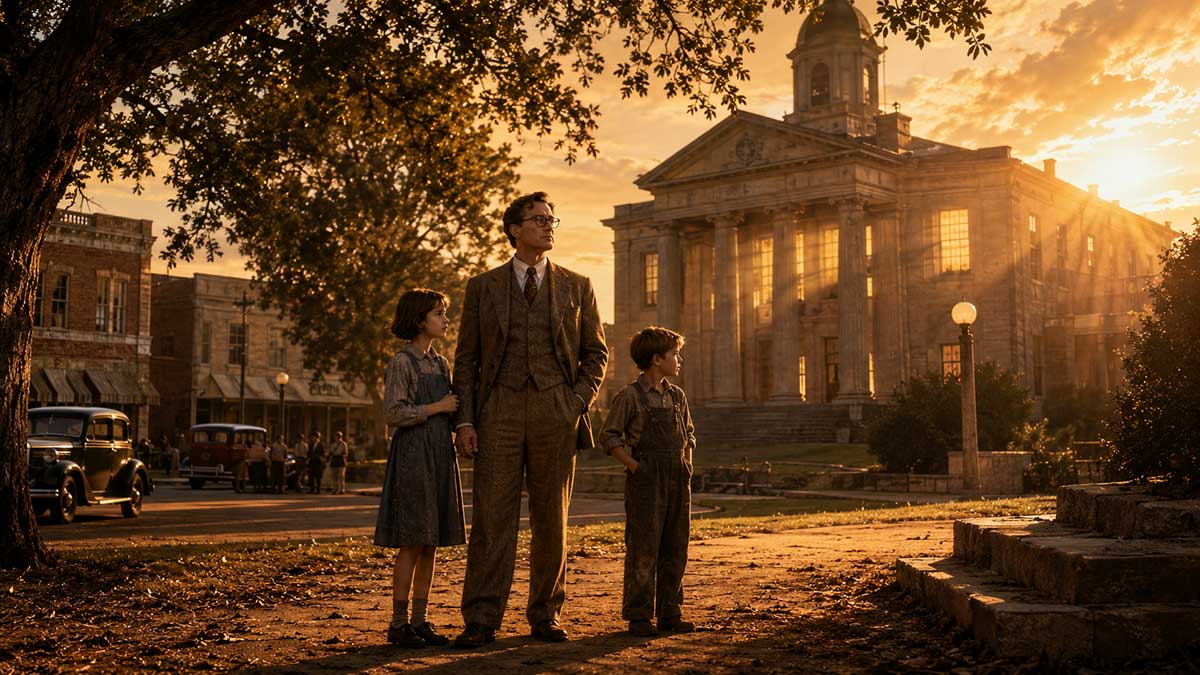
Atticus Finch does not teach fatherhood through force, fear, or grand speeches. He teaches it by letting Scout and Jem see the kind of man he chooses to be when the town turns against him.
In Maycomb, children grow up inside rules they did not create. Some rules are spoken. Some are hidden in silence, habit, and fear. Atticus knows he cannot make the town fair overnight. He cannot shield his children from every cruel word. He cannot make truth win simply by naming it.
Yet he can show them how to stand without hatred. He can teach them that courage is not the absence of fear, but the refusal to let fear choose your soul.
In this imaginary conversation, Atticus, Scout, Jem, Calpurnia, and Tom Robinson speak about fatherhood, justice, childhood innocence, and the heavy cost of raising children to see clearly.
Guests: Atticus Finch, Scout, Jem, Calpurnia, Tom Robinson
Question 1: What does a child learn when they watch their father stand alone against the whole town?
Scout:
I learned that grown-ups can be wrong, even when they all agree. That scared me more than anything. A town can look normal in the morning and turn cruel by night.
Tom Robinson:
Mr. Finch looked alone to many folks, but he did not look alone to me. A man standing with truth has company, even when no one sits beside him.
Atticus Finch:
I never wanted my children to admire loneliness. I wanted them to see that conscience sometimes asks a person to stand where comfort will not follow.
Calpurnia:
Children see more than adults think. They see who gets respect, who gets ignored, who gets defended, and who gets left behind. Atticus taught with every step he took.
Jem:
I learned that right does not always win the way I thought it should. That was the hard part. I thought if Atticus told the truth clearly enough, the town would have to listen.
Question 2: Can a father protect his children from evil without hiding the truth from them?
Jem:
I wish I had not seen some things. But I think seeing them changed me. It hurt, but it made me stop believing that peace and goodness were the same thing.
Calpurnia:
You cannot raise children by closing every curtain. They will hear the storm anyway. Better to sit with them and give the thunder a name.
Scout:
Atticus did not explain everything to me. He let me grow into some of it. But I knew when people were being mean. Children may not know the law, but they know unfairness.
Atticus Finch:
A father must protect a child’s heart, but not at the price of truth. A gentle lie may feel kind for a day, yet it can leave a child unprepared for life.
Tom Robinson:
Truth can hurt a child. Silence can teach a worse lesson. It can teach them that pain belongs in the dark, and injustice is something decent people should not mention.
Question 3: Did Atticus give Scout and Jem strength, or did he place a burden on them too early?
Calpurnia:
The burden did not come from Atticus. It came from the town. It came from hate. A father should not be blamed for teaching children how to carry what the town already placed on them.
Scout:
I was still a child. I climbed trees. I fought boys. I did not ask to understand a courtroom or a mob. But Atticus was there when childhood got smaller.
Tom Robinson:
Maybe strength and burden sometimes arrive together. The difference is whether someone loves you enough to help you carry it.
Jem:
At first, I felt broken by what happened. Then I began to see that Atticus had given us a way to stay human when people disappointed us.
Atticus Finch:
No father wants his children to lose innocence. Yet innocence built on blindness is weak. I hoped to give them courage without cruelty, mercy without fear, and judgment without hatred.
Closing
Atticus Finch shows that fatherhood is not always rescue. Sometimes a father cannot stop the courtroom from failing, the town from judging, or the child from seeing pain too early.
What he can do is stand where truth asks him to stand.
He can let his children see that decency has a cost. He can teach them that courage does not need to become anger. He can show them that justice may lose in public and still matter in the private formation of a child’s soul.
Scout and Jem do not inherit an easy answer from Atticus. They inherit a way to look at people, a way to suffer without becoming cruel, and a way to remember their father when their own conscience begins to speak.
That may be one of the deepest gifts a father can leave behind.
Topic 2: Jean Valjean — Is Love Stronger When It Is Chosen, Not Born?

Opening
Jean Valjean enters fatherhood through mercy, not blood. He is a hunted man, a former prisoner, and a soul trying to rebuild itself after years of shame. Then Cosette enters his life, and love gives him a new name.
Fantine gives him a promise. Cosette gives him a reason to live. Marius forces him to face the hardest truth of fatherhood: a child you save is still not yours to keep forever.
In this imaginary conversation, Jean Valjean, Cosette, Fantine, Javert, and Marius speak about chosen love, sacrifice, forgiveness, and the pain of letting go.
Guests: Jean Valjean, Cosette, Fantine, Javert, Marius
Question 1: What makes someone a real father: blood, sacrifice, or daily devotion?
Cosette:
A real father is the one whose footsteps you recognize before he enters the room. I did not know him by blood. I knew him by safety. I knew him by bread, warmth, patience, and the hand that never struck me.
Jean Valjean:
I did not become her father in one grand moment. I became her father each morning I chose her life above my own. A child does not ask for speeches. A child asks if you will still be there tomorrow.
Fantine:
I gave Cosette life, but I could not give her protection. That grief never left me. Yet if a dying mother may bless one thing, I bless the man who kept the promise I could no longer keep.
Javert:
Words such as father should not be made loose. Law names blood, duty, guardianship, obligation. Sentiment is dangerous when it gives men permission to rewrite order.
Marius:
Then order is too small. I saw Valjean carry love like a wound and a vow together. If fatherhood is only blood, then many children are orphans in houses full of relatives.
Question 2: Did Valjean save Cosette, or did Cosette save Valjean?
Javert:
A criminal does not become pure by caring for a child. Good deeds do not erase judgment. If society lets feeling overrule guilt, the line between justice and weakness disappears.
Cosette:
He saved me first. That is true. He took me from fear and gave me childhood. Yet I think I saved him in a way he did not expect. I gave his love somewhere to rest.
Marius:
Valjean lived under shadows. Cosette became the lamp in his house. Her presence did not erase his past, but it gave him a future that was not built from running.
Jean Valjean:
I thought I was rescuing a child. I did not know God was placing my own life back into my hands. Cosette taught me that a man can be remade through tenderness.
Fantine:
A mother understands this. A child can be helpless and still save you. She can need everything from you, and still give you a reason to breathe.
Question 3: Can a father love a child so deeply that he must let her go?
Fantine:
Yes. I had to let Cosette go long before I was ready. Love is not always holding. Sometimes love is placing your child into hands that can carry what yours no longer can.
Jean Valjean:
Letting Cosette love Marius felt like losing the one light I had been given. Yet a father who turns love into possession has made an idol of his own pain. I had to learn that her happiness was not betrayal.
Marius:
I did not understand Valjean at first. I saw mystery, silence, and danger. Later I saw a man trying to disappear so Cosette could live freely. That kind of love is almost too heavy to receive.
Cosette:
I never wanted him to vanish from my life. Fathers sometimes think letting go means leaving. It does not. A daughter can become a wife and still remain someone’s child.
Javert:
Attachment clouds judgment. Yet I admit this: Valjean’s love did what punishment could not. It changed him from within. Law can restrain a man. Love can remake him.
Closing
Jean Valjean shows that fatherhood can begin after failure, shame, and exile. He does not give Cosette his bloodline. He gives her his protection, his labor, his silence, his prayers, and years of hidden sacrifice.
His love is not perfect. It is fearful at times. It clings. It hides. It suffers. Yet it keeps choosing the child.
And in the end, Valjean’s deepest lesson is this: a father’s love is proven not when the child needs him most, but when the child no longer needs him in the same way.
He saves Cosette by holding her.
Then he loves her more deeply by learning to let her live.
Topic 3: Mufasa — What Does a Father Leave Behind When He Dies Too Soon?

Opening
Mufasa’s fatherhood is remembered through presence, loss, and voice. He teaches Simba about responsibility, courage, and the circle of life, yet his deepest lesson comes after he is gone.
For Simba, losing Mufasa is not only grief. It becomes shame, confusion, exile, and fear of becoming who he was born to be. A father’s death can leave a child with memories that guide him, but it can leave questions that haunt him too.
Sarabi carries the pain of a kingdom without its king. Nala carries the hope that Simba can still return. Rafiki sees what Simba cannot see: that a father’s love may remain alive inside the child long after the father’s footsteps disappear.
In this imaginary conversation, Mufasa, Simba, Sarabi, Rafiki, and Nala speak about fatherhood, memory, grief, leadership, and the hard work of becoming yourself after loss.
Guests: Mufasa, Simba, Sarabi, Rafiki, Nala
Question 1: Can a father’s voice still guide a child after death?
Rafiki:
A father’s voice does not vanish when the body is gone. It hides inside the child, waiting for the day the child is quiet enough to hear it. Simba thought Mufasa was far away. He was closer than Simba’s own fear.
Simba:
For a long time, his voice hurt too much to remember. I ran from it. Every lesson sounded like an accusation. I thought if I forgot who I was, I could forget what I had lost.
Mufasa:
A father’s voice should not trap a son in guilt. It should call him back to life. My hope was never that Simba would carry my shadow. My hope was that he would remember his own light.
Nala:
I saw Simba alive, but not whole. He laughed. He survived. Yet something in him stayed frozen at the moment he lost his father. Sometimes the people who love us must remind us of the voice we buried.
Sarabi:
A child remembers more than words. He remembers how his father stood, how he looked at him, how safe the air felt beside him. Death takes the face from the room, but it does not take every trace of love.
Question 2: What is the difference between preparing a son for leadership and placing too much expectation on him?
Sarabi:
A son is not a crown. He is a child first. Mufasa prepared Simba for the throne, yes, but I think Simba needed more time to simply be young, to make mistakes without believing every mistake could destroy him.
Mufasa:
That is the pain of kingship. I wanted Simba to understand that life is connected, that leadership means care, not control. Yet a father must be careful. A lesson meant to strengthen can become a weight if fear enters the child’s heart.
Simba:
I wanted to be brave like him, but I also wanted to be free of being measured against him. After he died, every memory of him felt too large. I could not tell if I was grieving my father or failing my king.
Rafiki:
A good father points, but he does not push forever. The son must walk. If he falls, he learns the ground. If he rises, he learns his legs. Mufasa gave Simba direction. Life gave Simba the test.
Nala:
Leadership is not proving you are your father. It is serving what your father loved. Simba did not need to become Mufasa again. Pride Rock needed Simba to become Simba at last.
Question 3: Does Simba need to become Mufasa, or become himself?
Nala:
He needs to become himself. The kingdom does not need a copy of the past. It needs someone who has known fear, exile, friendship, guilt, and return. Simba’s wounds can make him a different kind of king.
Simba:
For years, I thought becoming myself meant leaving my father behind. Then I learned the opposite. I could carry him without disappearing into him. I could honor him without pretending I was him.
Mufasa:
No father should ask his child to become his echo. A child is not a monument. He is a living soul. If Simba remembers my love and then walks in his own courage, then I have not lost him. I have raised him.
Sarabi:
A mother sees the difference. Mufasa’s strength was steady and royal. Simba’s strength had to be rebuilt from brokenness. That does not make it weaker. It makes it dearly earned.
Rafiki:
The past is not a cage unless you sit inside it. Mufasa is in Simba, yes. But Simba must roar with his own breath. That is how the father lives, and that is how the son becomes free.
Closing
Mufasa shows that fatherhood does not end at death. A father can leave behind memory, teaching, tenderness, warning, and a voice that returns at the moment a child feels most lost.
Yet Simba’s story reminds us that grief can distort love. A child may mistake memory for pressure, loss for guilt, and inheritance for prison. The father who once gave safety can become, in the child’s wounded heart, a standard too high to reach.
The healing begins when Simba learns that honoring Mufasa does not mean repeating him. It means carrying what was good, facing what was feared, and returning with a courage shaped by his own pain.
Mufasa leaves Simba a kingdom, but more than that, he leaves him a question:
Will you remember who you are?
And when Simba finally answers, he does not become a shadow of his father.
He becomes a son who has learned how to stand.
Topic 4: Guido Orefice — Can a Father Protect a Child’s Soul When He Cannot Protect His World?
Opening
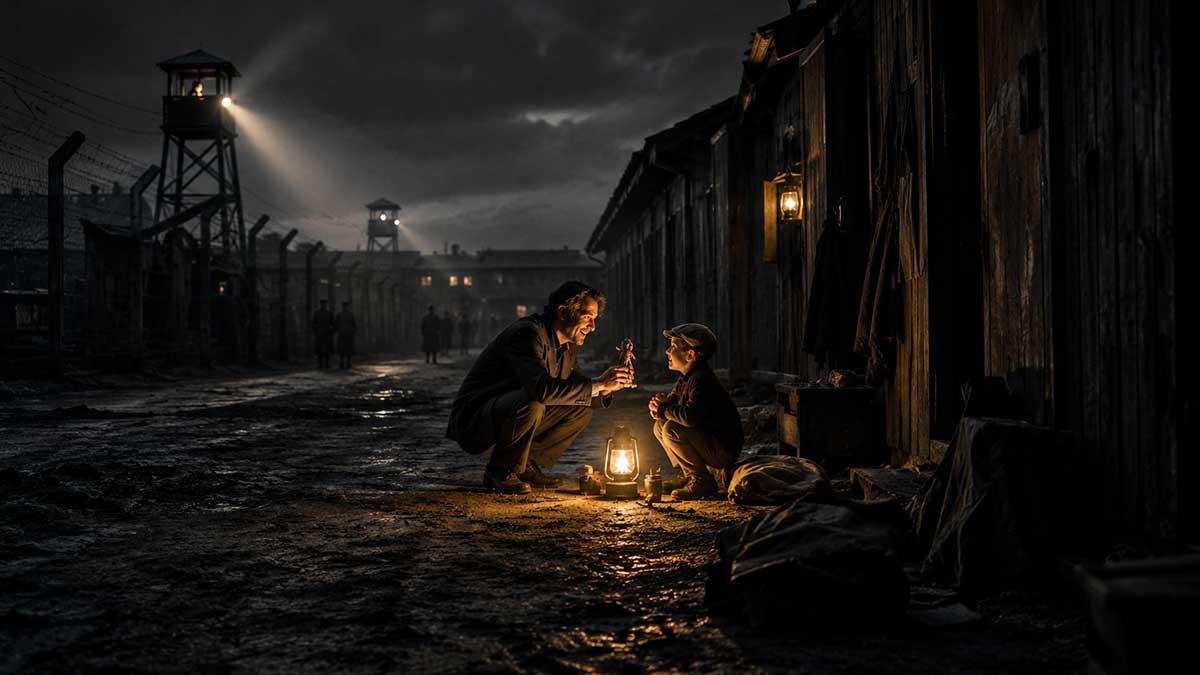
Guido Orefice is not a powerful man in the ordinary sense. He has no army, no wealth, no way to stop the horror closing around his family. What he has is imagination, humor, courage, and a father’s desperate love.
When his son Giosuè is placed inside a nightmare too large for a child to understand, Guido does something almost impossible. He turns terror into a game. He hides fear behind play. He gives his son rules, points, whispers, and hope, hoping that a child’s inner life can be guarded when the outer world cannot be saved.
Dora follows love into danger. Uncle Eliseo carries dignity into suffering. Ferruccio remembers Guido before the darkness, when words, dreams, and laughter still felt light.
In this imaginary conversation, Guido, Giosuè, Dora, Uncle Eliseo, and Ferruccio speak about fatherhood, innocence, imagination, sacrifice, and the question of whether joy can survive in a place built to destroy it.
Guests: Guido Orefice, Giosuè, Dora, Uncle Eliseo, Ferruccio
Question 1: Is imagination a form of protection, or a beautiful lie?
Dora:
It was both, and that is what breaks my heart. Guido was hiding the truth from Giosuè, yes. But he was not hiding love. He was giving our son a small room of safety inside a place where safety had been stolen.
Guido Orefice:
A lie takes something from a child. Imagination gives something back. I did not tell Giosuè the game was real to make myself feel brave. I told him so his eyes would not have to carry what no child should see.
Ferruccio:
Guido always lived as if reality had secret doors. He could turn a street into a stage, a problem into a joke, a mistake into a miracle. In the camp, that gift became his last weapon.
Giosuè:
I believed him. I believed the points. I believed the tank. I believed that if I followed the rules, we would win. Later, when I understood more, I saw that the game was my father’s way of holding my hand when he could not always touch me.
Uncle Eliseo:
Imagination cannot erase evil. But it can keep evil from naming the child. Guido gave Giosuè a story where he was still a boy, not a victim.
Question 2: How much fear should a father hide from his child?
Uncle Eliseo:
A child does not need the full weight of adult terror. Fear must be measured. Too little truth can confuse him. Too much can crush him. Guido chose the only measure he had: love.
Giosuè:
I remember my father smiling when things were not funny. I remember him whispering rules. I remember him making me quiet without making me feel alone. Maybe he was afraid every moment. But he did not hand me his fear.
Guido Orefice:
A father may tremble inside and still make his voice gentle. My fear belonged to me. My son’s childhood belonged to him. I wanted him to keep at least one piece of it.
Dora:
I knew Guido was afraid. I could see it beneath the playfulness. But I loved him more for trying. He was not fearless. He was full of fear and still thinking of our son first.
Ferruccio:
There is a kind of courage that looks foolish to people who do not understand love. Guido’s jokes were not denial. They were resistance with a smile painted over pain.
Question 3: Can a father’s final gift be joy, even in the darkest place?
Giosuè:
His final gift was not just joy. It was the memory of being loved completely. I did not understand the price then. Maybe no child could. But I carried the gift before I knew the cost.
Dora:
A mother wants to hold the child, save the child, reach the child. Guido gave Giosuè something I could not give from where I was. He stayed close to our son’s heart.
Guido Orefice:
If I could not give him a safe world, I could give him a father who never stopped trying to make one. If I could not give him tomorrow, I could give him hope until tomorrow came.
Uncle Eliseo:
Joy in such a place is not small. It is defiance. To laugh there, to comfort there, to love there — these are ways of saying that cruelty does not own the soul.
Ferruccio:
Guido’s gift was not that he made suffering disappear. He made sure suffering was not the only thing his son remembered. That may be the highest art of fatherhood.
Closing
Guido Orefice shows a kind of fatherhood that feels almost impossible to measure. He cannot change the machinery of hatred around him. He cannot promise Dora safety. He cannot explain the truth to Giosuè without stealing what remains of his childhood.
So he chooses the one battlefield still left to him: his son’s imagination.
He turns fear into rules, danger into a game, silence into strategy, and love into performance. His humor is not weakness. It is courage wearing a mask so a child does not have to see the terror underneath.
Guido’s story asks whether a father can save a child without saving himself.
The answer is painful.
He saves what he can.
He saves Giosuè’s innocence long enough for life to reach him. He saves joy from being fully conquered. He leaves his son with a memory that will one day hurt, but will also shine.
And in that light, Guido becomes one of cinema’s most heartbreaking fathers: a man who had almost nothing left to give, yet gave his son a world small enough to survive inside.
Topic 5: Marlin — When Does Protecting Your Child Become Holding Them Back?

Opening
Marlin begins fatherhood with loss. Before Nemo is even born, Marlin loses Coral, their home, and nearly every dream he had for his family. From that day on, love and fear become tangled inside him.
Nemo grows up under that fear. He is loved deeply, but he is guarded tightly. Marlin wants to keep him safe from the ocean, from danger, from chance, from pain. Yet a child cannot grow inside a wall forever.
Dory teaches Marlin trust through chaos. Crush shows him a freer kind of parenting. Coral, in this imaginary conversation, represents the love Marlin lost and the question he has carried ever since: how do you keep loving after terror has taught you to expect the worst?
In this imaginary conversation, Marlin, Nemo, Dory, Crush, and Coral speak about fear, freedom, grief, trust, and the difference between protecting a child and letting a child live.
Guests: Marlin, Nemo, Dory, Crush, Coral
Question 1: How does a father love again after fear has taken over his heart?
Marlin:
I thought fear was love. I thought if I worried enough, watched closely enough, warned loudly enough, I could stop the ocean from taking anything else from me. I did not see how small I was making Nemo’s life.
Coral:
Fear came from love, Marlin. But fear cannot raise a child by itself. I know why you held on so tightly. I know what you lost. Yet Nemo needed more than survival. He needed wonder.
Dory:
Sometimes you love someone by swimming beside them, not in front of them every second. Marlin had to learn that the ocean is scary, yes, but it is not made only of scary things.
Nemo:
I knew Dad loved me. I never doubted that. But sometimes his love felt like a cage made from worry. I wanted him to see that I was small, but I was not helpless.
Crush:
Little ones need room to test the current. You stay near. You watch. You guide. But if you never let them feel the water for themselves, they never learn their own fins.
Question 2: Can a child become brave if the parent never lets them risk anything?
Crush:
Bravery needs practice, dude. A young one learns by moving, bumping, turning, trying again. You cannot explain the current from the shore and expect the kid to know how to ride it.
Nemo:
I did not want danger. I wanted trust. I wanted Dad to believe I could do something hard. When he always expected the worst, I started feeling like he did not see the best in me.
Marlin:
I was trying to save him from pain. But I see now that pain is not the only danger. A child can be hurt by never being trusted. A father can protect the body and still wound the spirit.
Dory:
Nemo was braver than Marlin knew. Marlin was braver than Marlin knew too. They both had to get lost a little to find that out.
Coral:
A parent cannot remove every risk from a child’s life. Love has to prepare the child, not freeze the child. There is a difference between holding a hand and never letting go.
Question 3: What does Marlin need to learn from Nemo, not just teach him?
Coral:
He needs to learn that Nemo is not only the child who survived loss. Nemo is his own living soul. A father must not turn a child into a memorial for what was taken.
Marlin:
Nemo taught me that love has to breathe. I thought my job was to keep him close. Then I learned my deeper job was to help him become strong enough to swim where I could not follow.
Dory:
Nemo taught Marlin trust. Marlin taught Nemo devotion. That is a good trade. Families are not just grown-ups teaching kids. Sometimes kids bring the grown-ups back to life.
Crush:
The kid had heart. Marlin had heart too. They just needed the ocean to show them that heart gets stronger when it moves, not when it hides.
Nemo:
I needed Dad. I still need him. But I needed him to believe that needing him did not mean I was weak. I wanted to come home as myself, not as the little kid he was afraid to lose.
Closing
Marlin shows one of the most familiar forms of fatherhood: love shaped by fear. He is not cold. He is not careless. He is devoted, brave, and willing to cross the ocean for his child.
Yet devotion can become control when grief is left unhealed.
Nemo does not need a father who loves him less. He needs a father who trusts him more. Marlin’s journey is not learning to stop protecting Nemo. It is learning that protection must grow as the child grows.
At first, Marlin sees the ocean as a threat.
By the end, he begins to see it as the place where Nemo must learn courage, friendship, judgment, and freedom.
That is the tender lesson of Marlin’s fatherhood: a child may need your shelter at first, but one day love must become the courage to watch them swim.
Final Thoughts
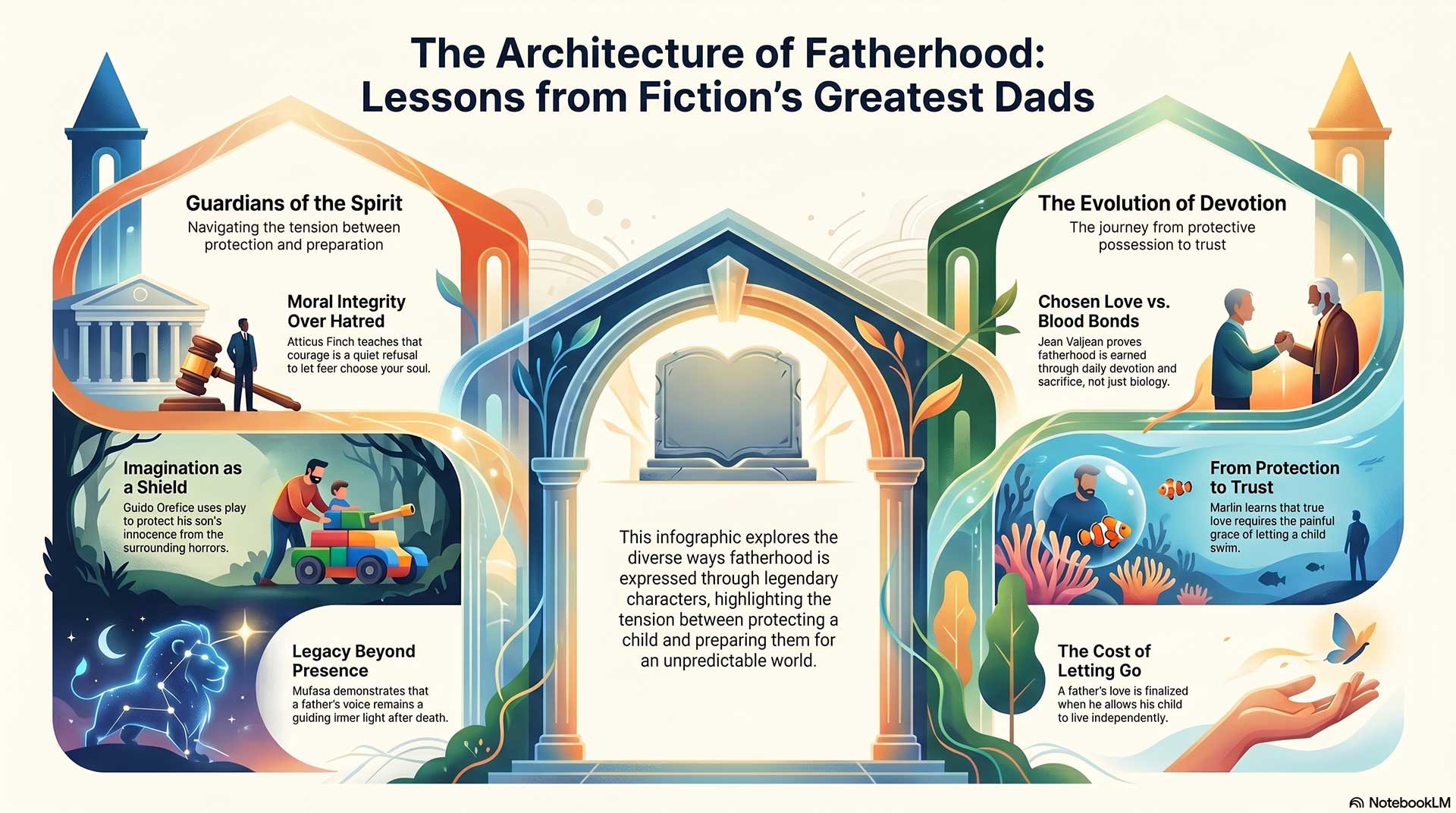
The most beloved fathers in literature and film stay with us because they do more than care for children. They reveal what love looks like under pressure.
Atticus Finch shows that a father can teach justice without teaching hatred. Jean Valjean shows that fatherhood can be chosen, earned, and redeemed. Mufasa shows that a father’s voice can live inside a child after death. Guido Orefice shows that imagination can become a final shelter when the outer world collapses. Marlin shows that love must grow from protection into trust.
Each story asks a painful question.
Can a father prepare a child for a broken world without breaking the child?
Can love heal shame?
Can memory guide the grieving?
Can joy survive horror?
Can fear release its grip before it becomes control?
The answer is never easy.
Yet these fathers remain beloved because they keep choosing love at the moment love becomes costly. They stand, carry, speak, perform, search, and release. They are flawed, frightened, wounded, and unfinished, yet their children are changed by them.
That may be why father stories move us so deeply.
A father’s greatest gift is not always rescue.
Sometimes it is a moral example.
Sometimes it is a promise kept.
Sometimes it is a voice in the sky.
Sometimes it is a game invented in darkness.
Sometimes it is the courage to let a child swim.
And sometimes, long after the story ends, the child still hears the father saying:
You are loved.
You are stronger than fear.
Now become who you are.
Short Bios:
Atticus Finch
The principled father from To Kill a Mockingbird. Atticus raises Scout and Jem with quiet moral courage, teaching them to stand for justice without surrendering to hatred.
Scout Finch
Atticus’s young daughter. Scout sees Maycomb with innocence, confusion, and sharp honesty, slowly learning that grown-up society can be unfair and cruel.
Jem Finch
Atticus’s son. Jem begins with a child’s faith in fairness, then struggles when the trial reveals how deeply injustice can wound the heart.
Calpurnia
The Finch family’s housekeeper and moral presence. She helps raise Scout and Jem with discipline, warmth, and a clear view of both Black and white Maycomb.
Tom Robinson
The falsely accused man Atticus defends. Tom’s presence gives the conversation its deepest moral weight, showing the human cost of injustice.
Jean Valjean
The redeemed former prisoner from Les Misérables. Valjean becomes a father through sacrifice, keeping his promise to Fantine by raising Cosette as his own.
Cosette
The child Valjean rescues and raises. Cosette represents the healing force of chosen love and the difficult transition from daughterhood into adult freedom.
Fantine
Cosette’s mother. Her love is marked by suffering, sacrifice, and the desperate hope that someone will protect the daughter she cannot raise.
Javert
The relentless inspector who pursues Valjean. Javert brings the voice of law, order, and judgment into a conversation about mercy and transformation.
Marius
Cosette’s beloved. Marius forces Valjean to face the painful truth that a father’s love must eventually make room for a child’s new life.
Mufasa
The noble father from The Lion King. Mufasa teaches Simba about responsibility, identity, and the circle of life, leaving behind a voice that guides his son after death.
Simba
Mufasa’s son. Simba carries grief, guilt, and fear before learning that honoring his father means becoming himself.
Sarabi
Mufasa’s mate and Simba’s mother. Sarabi carries dignity through loss and reminds the group that a child is more than an heir to a throne.
Rafiki
The wise guide who helps Simba hear what he has buried. Rafiki brings spiritual insight, humor, and the belief that the past can heal rather than imprison.
Nala
Simba’s childhood friend and future queen. Nala challenges Simba to return, not as a copy of Mufasa, but as the king he must become.
Guido Orefice
The father from Life Is Beautiful. Guido uses humor, imagination, and sacrifice to protect his son’s inner life during unimaginable horror.
Giosuè
Guido’s young son. Giosuè experiences terror through the protective story his father creates, later carrying both the gift and the grief of that love.
Dora
Guido’s wife and Giosuè’s mother. Dora’s love is brave, loyal, and fierce, choosing danger over separation from her family.
Uncle Eliseo
Guido’s uncle. Eliseo brings dignity, gentleness, and moral clarity into a story where cruelty tries to strip people of their humanity.
Ferruccio
Guido’s friend. Ferruccio remembers Guido’s playful spirit before the darkness, helping show how imagination became Guido’s deepest form of resistance.
Marlin
The anxious father from Finding Nemo. Marlin loves Nemo deeply, yet must learn that fear can turn protection into control.
Nemo
Marlin’s son. Nemo wants trust, freedom, and the chance to prove that his small fin does not make him helpless.
Dory
Marlin’s forgetful but faithful companion. Dory teaches trust, hope, and openness, helping Marlin loosen fear’s grip.
Crush
The relaxed sea turtle. Crush offers a freer model of parenting, showing Marlin that children need room to test the current.
Coral
Marlin’s lost mate and Nemo’s mother. Coral represents love, grief, and the life Marlin once dreamed of before fear reshaped his fatherhood.
Leave a Reply