
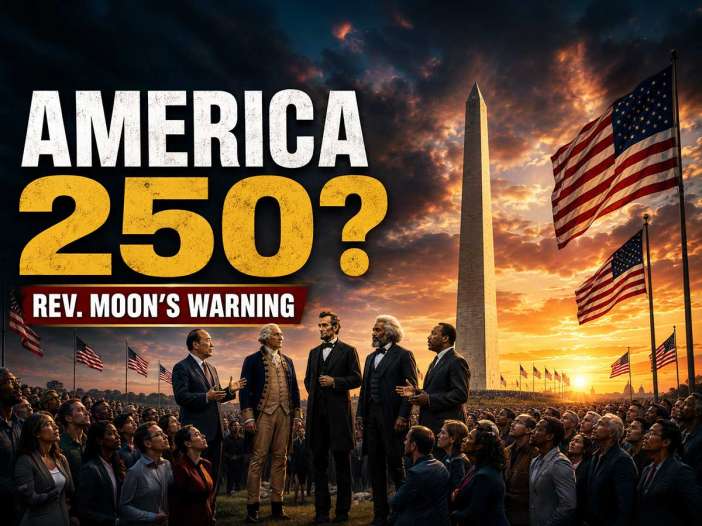
What if America’s 250th birthday is not just a celebration, but a spiritual test?
Introduction Rev. Sun Myung Moon
In 1976, America celebrated 200 years since its founding. Many people saw that Bicentennial as a national birthday. I saw it as a spiritual hour of decision.
At Yankee Stadium, I spoke of God’s hope for America. At the Washington Monument, I spoke of America and God’s will. My message was simple: America was blessed by Heaven, but blessing is never for the self alone. Blessing carries responsibility. Freedom carries mission. Prosperity carries duty. A chosen nation is chosen to serve.
Now America approaches 250 years. This anniversary must not become only a celebration of history. It must become a moment of reflection. Has America lived for God and humanity? Has America used its freedom to heal the world? Has America become one family among its many races, religions, and peoples? Has America remembered why it was blessed?
For this conversation, I welcome George Washington, Abraham Lincoln, Frederick Douglass, and Martin Luther King Jr. Each of them represents a deep part of America’s soul.
Washington represents the founding spirit, sacrifice, and self-government. Lincoln represents union, judgment, humility, and national repentance. Douglass represents conscience, truth, and the unfinished promise of liberty. King represents beloved community, racial healing, and redemptive love.
Together, we ask five questions: Was America chosen for blessing or responsibility? Does freedom still have a moral center? Can America become a model of one human family? Is America 250 testing the nation’s spirit? Can “One Nation Under God” lead to “One World Under God”?
America must ask not only, “How long have we existed?” but, “For what purpose do we exist?”
If America lives only for itself, it will lose the source of its blessing. If America lives for God, for justice, for families, for the poor, for all races, and for the world, then America can become hope again.
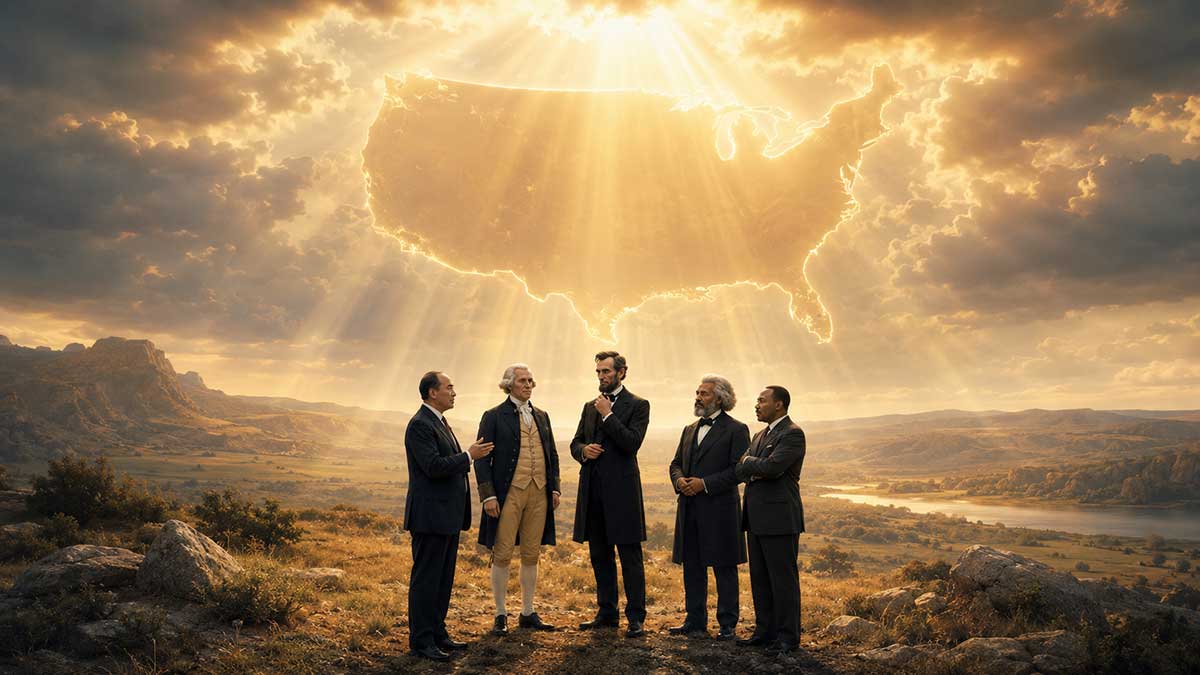
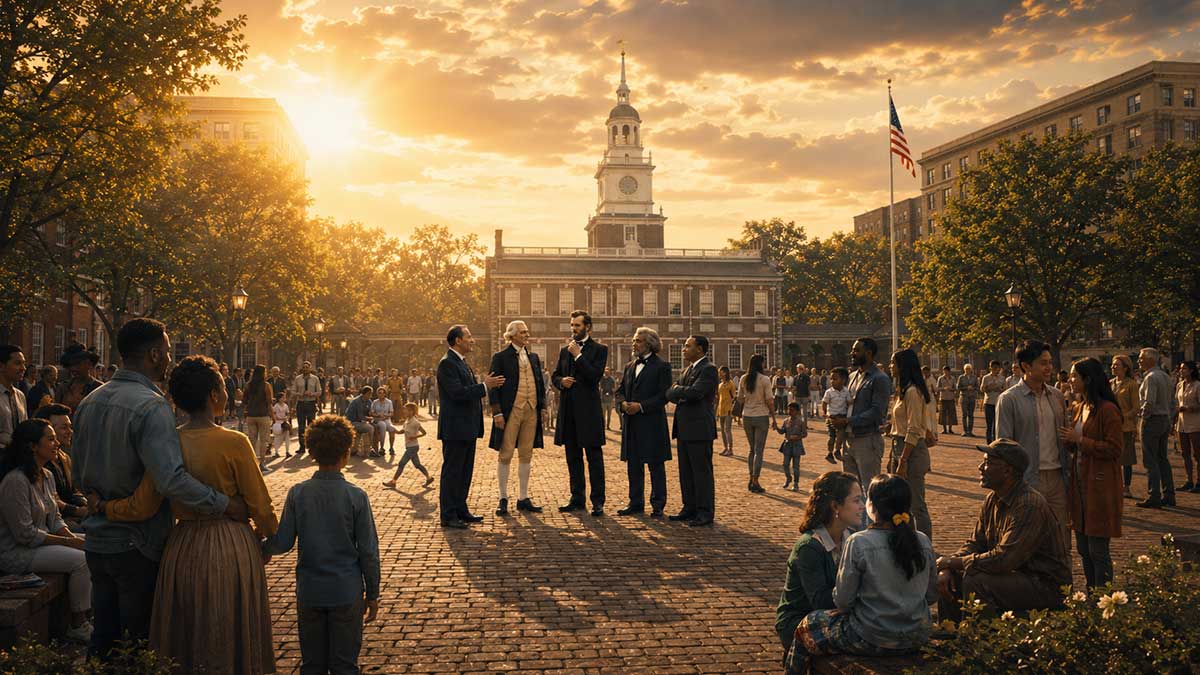
(Note: This is an imaginary conversation, a creative exploration of an idea, and not a real speech or event.)
Topic 1: Was America Chosen for Blessing or Responsibility?
Opening
Rev. Sun Myung Moon:
At America’s Bicentennial, I did not come only to praise America. I came with a warning and a hope. A nation is blessed by Heaven for a reason. Blessing is not ownership. Blessing is mission. If America receives freedom, wealth, land, and influence, then America must ask, “For whom was this given?” If the answer is only “for ourselves,” then the blessing begins to decay. If the answer is “for God and humanity,” then America can still become a light to the world.
Question 1: If America was blessed by God, what does that blessing require from Americans today?
George Washington:
A republic cannot survive by victory alone. We won independence, but liberty without virtue is fragile. If Providence smiled upon the American cause, then gratitude must become discipline. Citizens must govern themselves before they can govern a nation.
Frederick Douglass:
I would add that blessing must be judged by the treatment of the least protected. America spoke beautifully of liberty, yet millions were enslaved. If God blessed America, then that blessing demanded truth, repentance, and justice. A nation cannot call itself chosen and ignore the cries beneath its own flag.
Rev. Sun Myung Moon:
Yes. A chosen nation is not chosen for privilege. It is chosen to serve. America’s blessing requires sacrifice. The individual must live for the family, the family for the nation, the nation for the world, and the world for God. That is the order of Heaven.
Martin Luther King Jr.:
Blessing requires America to become what it has promised. The dream is not private comfort. It is beloved community. It is the joining of justice, mercy, and moral courage. A blessed nation must heal wounds, not hide them.
Abraham Lincoln:
The Almighty has His own purposes. I learned that no nation can claim God too easily. America’s task is not to declare itself righteous, but to submit its pride to judgment. Blessing requires humility.
Question 2: Can a nation remain blessed after it forgets the reason it was blessed?
Abraham Lincoln:
Forgetting is dangerous. The Union nearly perished when liberty was separated from equality. A nation may prosper for a time after forgetting its moral purpose, but prosperity can become a veil over decay.
Rev. Sun Myung Moon:
When America forgets God, it loses its center. Wealth cannot hold people together. Military strength cannot heal the family. Technology cannot give meaning to the soul. If America forgets why God blessed it, confusion enters the home, the church, the school, and the nation.
Frederick Douglass:
A forgotten mission becomes hypocrisy. America cannot ask other nations to honor freedom if it excuses injustice at home. The test is not whether America speaks of liberty. The test is whether America protects it for those with the weakest voice.
George Washington:
Public virtue must be renewed in each generation. The founders could not preserve the republic forever by their own sacrifice. The living must guard it. If citizens forget responsibility, institutions become empty forms.
Martin Luther King Jr.:
A nation can still return. That is the hope. Forgetfulness is not the final word. America has a strange gift: it can be called back by its own best ideals. The Declaration, the Constitution, the spiritual songs of the oppressed — all can summon America to conscience again.
Question 3: Is America’s greatness measured by prosperity, military strength, or service to humanity?
Martin Luther King Jr.:
Greatness is service. A nation that spends more on weapons than on healing its people has lost its moral balance. True greatness is not domination. It is compassion organized into public life.
George Washington:
Strength has its place. A nation must defend its independence. Yet strength without restraint becomes danger. The highest use of strength is to protect liberty, not to feed ambition.
Rev. Sun Myung Moon:
America was not created only for Americans. It was created as a model for the world. Many races, nations, and religions came together here. This is America’s special calling: to show that humanity can become one family under God.
Abraham Lincoln:
Service is the measure that survives history. The Civil War tested whether a nation conceived in liberty could endure. The next test is whether such a nation can use its blessings for healing, not self-exaltation.
Frederick Douglass:
America’s greatness must be measured by moral courage. Prosperity is pleasant. Strength is impressive. Yet justice is the evidence. If America serves humanity, it must begin by making liberty real for every person under its care.
Closing
Rev. Sun Myung Moon:
America 250 should not be only a celebration of age. It should be a renewal of purpose. The question is not merely, “How long has America lasted?” The deeper question is, “For what has America lasted?” If America lives for itself, it will become smaller, no matter how wealthy it appears. If America lives for God and the world, its blessing can become hope again.
Topic 2: The Founding Spirit — Freedom for Self or Freedom for God?
Opening
George Washington:
America began with a declaration of liberty, but liberty was never meant to become mere appetite. A nation may cast off a king and still be ruled by pride, greed, and disorder. The deeper question is whether freedom has a moral center. If freedom serves only the self, it weakens the republic. If freedom serves conscience, family, neighbor, and God, then liberty becomes a sacred trust.
Question 1: What kind of freedom did America originally promise: personal freedom, religious freedom, or moral freedom?
Rev. Sun Myung Moon:
America’s beginning had two streams. Some came seeking wealth. Others came seeking God and religious freedom. Heaven worked through the second stream. True freedom is not doing whatever the individual desires. True freedom means living in harmony with God’s purpose. America’s founding promise was great when it opened the way for people to worship God, build families, and serve a public mission.
Frederick Douglass:
I must speak plainly. America promised liberty before it practiced liberty. The words were noble, yet the slave heard them through chains. That does not make the promise worthless. It makes the promise a judgment. Personal freedom, religious freedom, moral freedom — all are bound together. If one man’s freedom rests on another man’s oppression, it is not freedom. It is theft dressed in patriotic language.
Abraham Lincoln:
The Declaration gave America a standard higher than its conduct. That standard did not solve every wrong at once, but it gave later generations something by which to condemn wrong. The promise of freedom was personal, yes, but it was never merely private. It carried a moral claim: that no person should be denied the fruit of his own labor.
Martin Luther King Jr.:
Freedom is more than the absence of chains. It is the presence of dignity. It is the right to vote, to work, to worship, to live without fear, and to be judged by character. America’s original promise was incomplete, but the spiritual genius of that promise was that oppressed people could use it to call the nation higher.
George Washington:
Religious liberty was among the finest achievements of the founding. Yet religious liberty does not mean moral emptiness. The republic depended on virtue. Without character, freedom turns into faction. Without conscience, rights become weapons.
Question 2: Can freedom survive without self-discipline and shared spiritual values?
Martin Luther King Jr.:
Freedom without love can become selfishness. Freedom without justice can become cruelty. Freedom without discipline can become chaos. The beloved community requires more than legal rights. It requires a transformed heart. People must see each other as children of God, not rivals for advantage.
George Washington:
Self-government begins with self-command. A people who cannot govern their passions will eventually ask government to govern everything for them. Public liberty depends on private restraint. That is why virtue is not ornamental. It is the foundation.
Rev. Sun Myung Moon:
Satanic freedom says, “Live for yourself.” God-centered freedom says, “Live for others.” When the individual lives only for the individual, the family breaks. When the family breaks, the nation loses its root. America’s freedom must return to God-centered love, or it will become lonely, divided, and weak.
Abraham Lincoln:
A house divided against itself cannot stand. That was true in my time, and it remains true in any age. Shared values do not require identical opinions, but they do require a common moral ground. If citizens no longer believe truth matters, law matters, or human dignity matters, freedom cannot long endure.
Frederick Douglass:
Self-discipline must never be preached only to the powerless. The master needed discipline. The politician needed discipline. The church that blessed slavery needed discipline. Shared spiritual values must include justice, or they become a shield for comfortable people. True discipline means holding oneself accountable before God and neighbor.
Question 3: At America 250, has freedom become a sacred responsibility or a private preference?
Frederick Douglass:
Much depends on whether America still hears the cry of those left out of its promises. Freedom becomes a private preference when people use it only to protect comfort. Freedom becomes sacred responsibility when people use it to defend the dignity of others. The test is simple: Who benefits from our liberty besides ourselves?
Rev. Sun Myung Moon:
America 250 must ask whether freedom is still connected to God. If freedom becomes only personal desire, it will not create unity. It will create isolation. Sacred freedom means the individual chooses goodness, the family chooses love, the nation chooses service, and America chooses the world.
George Washington:
The republic was not built for spectators. Citizens must carry duties, not merely claim rights. Voting, service, sacrifice, honesty, respect for law, reverence for conscience — these are not old-fashioned burdens. They are the price of liberty.
Martin Luther King Jr.:
I see both danger and hope. Many use freedom as a wall around the self. Yet many still march, serve, teach, forgive, and build. Sacred responsibility is alive wherever freedom is joined to compassion. America 250 should not ask only, “Am I free?” It should ask, “Whom does my freedom help set free?”
Abraham Lincoln:
Freedom is tested most when sacrifice is required. A nation may speak of liberty in peaceful times, but the question becomes clearer in crisis. Will Americans endure inconvenience for truth? Will they bear costs for justice? Will they preserve union without abandoning conscience? If so, freedom remains a sacred responsibility.
Closing
George Washington:
America’s first freedom was not meant to end in self-rule alone. It was meant to form a people capable of moral self-rule. At 250 years, the danger is not that America lacks liberty. The danger is that liberty may lose its soul. Freedom must be more than permission. It must be purpose. It must teach citizens to live not only for themselves, but for God, neighbor, country, and generations yet unborn.
Topic 3: America as a Model of One Human Family
Opening
Martin Luther King Jr.:
America has always carried two stories at once. One story is division: race against race, class against class, region against region, party against party. The other story is a dream: that people from many backgrounds can sit at one table and recognize one another as brothers and sisters. The question before America 250 is whether this dream can become more than a speech, more than a holiday, more than a memory. Can America become a living sign that humanity belongs to one family?
Question 1: Can America still become a model of “one family of man” in a time of racial, cultural, and political division?
Rev. Sun Myung Moon:
America is unique in Heaven’s providence. People from many nations came here, and many races live under one flag. This is not an accident. America is like a training ground for the world. If black, white, Asian, Latino, Jew, Christian, Muslim, and people of every background can learn to love one another here, then America can show the world a path to peace. But unity cannot come from politics alone. It must come from God-centered love.
Abraham Lincoln:
Division is not new to America. The nation once divided so deeply that brother fought against brother. Yet the Union survived through suffering, sacrifice, and a painful enlargement of its moral purpose. A family can be broken by pride, but it can be restored through truth. America can still become one family if it faces its wounds honestly.
Frederick Douglass:
I would not use the word family too easily. A nation cannot call the oppressed “family” and treat them as strangers. The language of brotherhood must be tested by law, opportunity, protection, and respect. Yet I believe America still has a rare calling. Its promise gives every generation a weapon against injustice. The nation’s ideals can still rebuke the nation’s sins.
George Washington:
A republic made of many peoples must be bound by more than interest. Common citizenship requires shared loyalty to principles. If factions become stronger than the nation, unity weakens. Yet if citizens honor liberty, law, faith, and duty, many origins can become one civic family.
Martin Luther King Jr.:
The beloved community is not sentimental unity. It is justice made visible. It is reconciliation with repair. It is love with courage. America can still become a model, but it must reject the false peace that asks the wounded to be silent. Real family listens before it heals.
Question 2: What would true unity look like without forcing everyone to become the same?
Frederick Douglass:
True unity does not demand sameness. It demands equal dignity. I did not seek freedom so that every man would speak alike, worship alike, or think alike. I sought a nation where no man could own another, silence another, or deny another’s humanity. Unity without liberty is oppression. Liberty without justice is disorder.
Martin Luther King Jr.:
The beloved community is not uniformity. It is harmony of purpose. People can keep their songs, languages, histories, and traditions, yet still share a commitment to justice. The goal is not to erase difference. The goal is to redeem relationship. We must learn to disagree without destroying one another.
George Washington:
A nation may hold many customs, yet it must preserve common principles. The danger comes when private loyalties overthrow public duty. True unity allows difference under a higher commitment: the Constitution, the rule of law, religious liberty, and the welfare of the republic.
Rev. Sun Myung Moon:
God created many nations, races, and cultures, but God is one Parent. Children in one family are different, yet they share one source of love. America should not erase difference. America should teach difference to serve love. When people live for one another, variety becomes beauty.
Abraham Lincoln:
The Union was not built on sameness. It was built on a proposition: that all are created equal. That proposition is large enough to include many lives, yet firm enough to judge injustice. True unity means holding fast to that moral center, especially when passion tempts people to abandon it.
Question 3: Has America learned the spiritual meaning of equality, or only the legal language of equality?
Abraham Lincoln:
Law can announce equality, but law alone cannot make the heart humble. The nation paid dearly to learn that a contradiction cannot stand forever. Yet every generation must learn again. Equality must move from parchment to practice, from courtroom to conscience.
Rev. Sun Myung Moon:
Equality comes from God. If God is the Parent of all humanity, then every person has sacred value. The spiritual meaning of equality is deeper than rights. It means we belong to one another. It means the pain of another race, another nation, another family, is not separate from me.
Martin Luther King Jr.:
America has often known the words before it knew the music of the spirit. It wrote equality into law, yet fear remained in streets, schools, churches, and hearts. The spiritual meaning of equality is love that refuses humiliation. It is the ability to see the image of God in the person society has taught you to distrust.
George Washington:
Legal equality gives order to public life. Yet public order cannot endure if private character collapses. A people must cultivate respect, restraint, and reverence. Equality should not lead to contempt for virtue. It should call each citizen to honor the dignity of every other citizen.
Frederick Douglass:
The legal language of equality matters. Without law, the powerful turn morality into a speech and keep injustice in practice. But law must be joined to conscience. America has learned some lessons in ink. It must learn them in blood, bread, schools, wages, neighborhoods, and memory.
Closing
Martin Luther King Jr.:
America’s diversity is not a problem to be managed. It is a calling to be fulfilled. Yet diversity alone cannot save a nation. Without justice, diversity becomes competition. Without love, difference becomes suspicion. Without truth, unity becomes theater. If America 250 is to mean something deep, it must ask whether this nation can still become a house where many peoples do not merely live side by side, but learn to carry one another’s burdens. That question leads us into the next test of America’s soul.
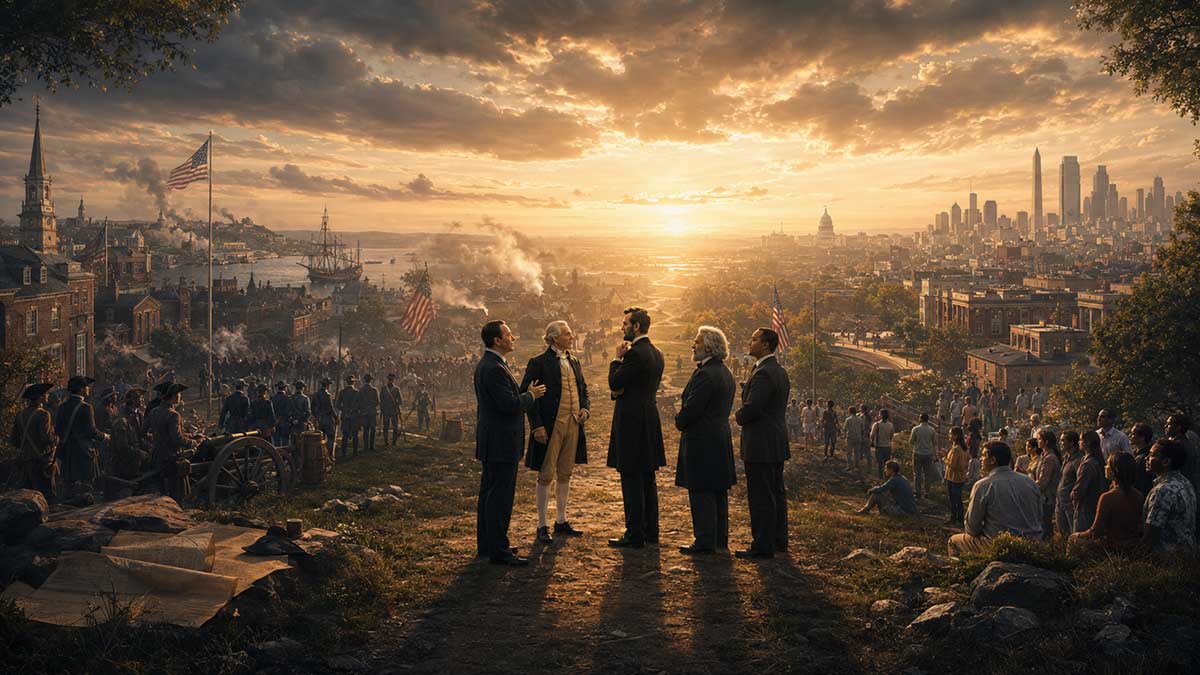
Topic 4: America’s Three Tests — Land, People, and Spirit
Opening
Abraham Lincoln:
Every nation has moments when its deepest claim is tested. America’s first great test was whether it could become independent and hold the land entrusted to it. The second was whether it could remain one nation and face the sin of slavery. The next test is harder to see, yet no less serious. It is a test of spirit. Can a free people keep liberty without losing conscience? Can a divided people recover purpose without hatred? Can America remember that its survival was never meant to serve pride, but a higher calling?
Question 1: If the Revolution tested America’s courage and the Civil War tested America’s conscience, what is America 250 testing now?
Rev. Sun Myung Moon:
America 250 is testing whether America still has God at the center. The Revolution gave America land. The Civil War forced America to face the question of people. Now America must face the question of spirit. A nation may have land, wealth, and influence, yet still lose its soul. The test now is whether America will live for itself or live for God and humanity.
George Washington:
The Revolution required sacrifice. Men risked fortune, reputation, and life. Yet sacrifice cannot belong only to the founding generation. Each age must give something back to liberty. America 250 tests whether citizens still possess public virtue, or whether comfort has made duty feel strange.
Frederick Douglass:
The Civil War exposed a lie at the center of the republic. America could not claim liberty and hold slaves. The test now may be whether America can recognize new contradictions before they tear the nation apart. Where are freedom’s words spoken, yet dignity denied? That is where the test lives.
Martin Luther King Jr.:
America 250 is testing love under pressure. It is easier to love the nation as an idea than to love the neighbor who votes differently, prays differently, looks different, or remembers history differently. The test is whether America can build beloved community in an age of suspicion.
Abraham Lincoln:
The present test may be whether Americans can disagree without ceasing to see one another as countrymen. A republic can survive heated debate. It cannot survive permanent contempt. If every opponent becomes an enemy, union becomes a shell.
Question 2: Is today’s crisis mainly political, economic, racial, or spiritual?
Frederick Douglass:
It is all of these, yet the deepest root is moral. Politics reveals what people value. Economics reveals whom society protects. Race reveals whether equality is real. But a nation’s spirit is seen in how it answers pain. If America grows skilled at explanation and poor at compassion, then the crisis is spiritual.
Abraham Lincoln:
Political crisis is visible. Spiritual crisis is often hidden until it erupts. In my time, slavery became a political question, a legal question, an economic question, and a sectional question. Yet beneath all of that was a moral wound. The same may be true now.
Rev. Sun Myung Moon:
The root is spiritual. When the family weakens, the nation weakens. When churches lose fire, young people lose direction. When people live only for themselves, trust disappears. Politics cannot heal what begins in the heart. America must restore God-centered love, beginning in the individual and family.
Martin Luther King Jr.:
I would call it a crisis of the soul expressed through systems. Racism is spiritual blindness made public. Poverty is social neglect made normal. Violence is fear made visible. The answer must be moral and structural together: changed hearts, just laws, and courageous action.
George Washington:
A republic requires both sound institutions and virtuous citizens. If either fails, the whole system strains. Economic distress can inflame politics. Political faction can damage trust. Yet without character, no arrangement will hold for long.
Question 3: What would national repentance look like in a modern democratic society?
Martin Luther King Jr.:
National repentance would not mean endless shame. It would mean truthful memory joined to repair. It would mean a nation mature enough to confess its wounds without losing hope. Repentance is not hatred of country. It is love of country purified by justice.
George Washington:
In a republic, repentance must become conduct. Citizens must recover honesty, restraint, service, and respect for law. Leaders must seek the public good above personal ambition. The people must demand virtue, not merely victory.
Abraham Lincoln:
Repentance begins with humility before God. No party, region, or leader can claim perfect innocence. A nation under judgment must speak less boastfully and act more mercifully. The proper spirit is not vengeance, but repair.
Frederick Douglass:
Repentance must reach the ground. Speeches are not enough. If a nation admits wrong, it must change schools, courts, wages, voting rights, policing, housing, and opportunity. A repentant democracy does not ask the injured to forget. It asks the whole nation to remember honestly and rebuild.
Rev. Sun Myung Moon:
America’s repentance must become a new pledge: to live for God and for the world. Families must teach love. Churches must unite. Races must reconcile. America must serve beyond its own borders. Then repentance becomes rebirth.
Closing
Abraham Lincoln:
America’s third test may not arrive with armies on a field. It may arrive quietly, through resentment, loneliness, cynicism, and the loss of shared purpose. Yet a nation that once passed through revolution and civil war need not surrender to despair. The question is whether America can humble itself before truth, bind wounds without denying them, and renew liberty with a clean conscience. If it can, America 250 may become more than an anniversary. It may become a turning point.
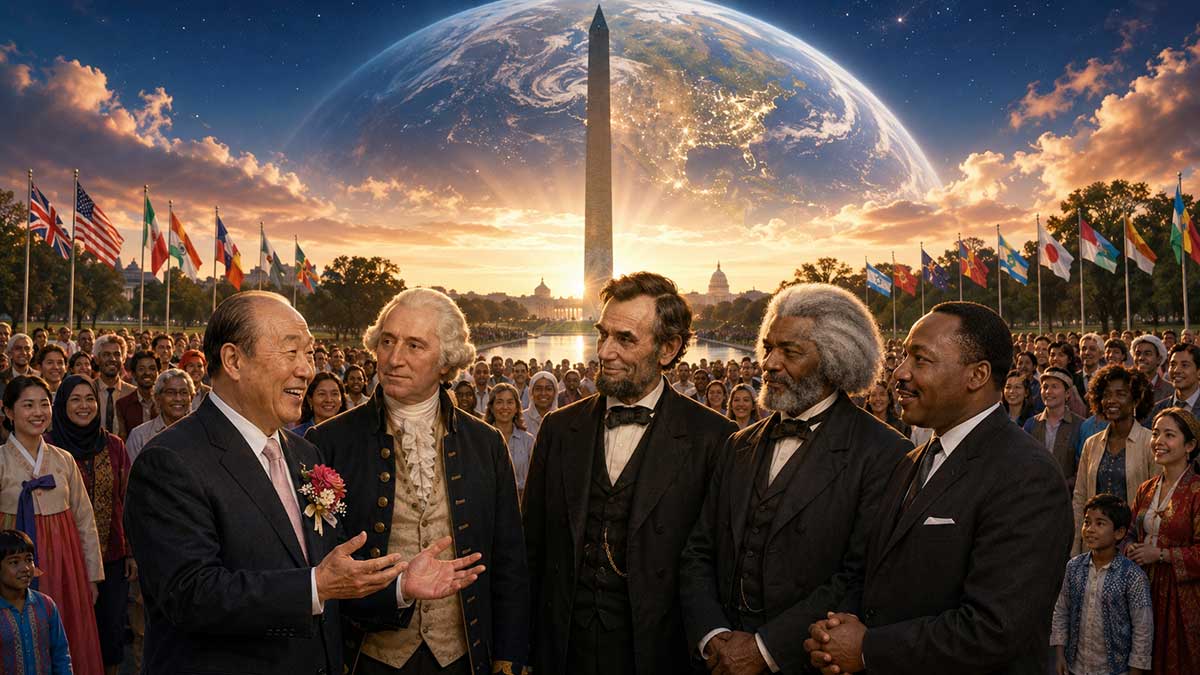
Topic 5: From “One Nation Under God” to “One World Under God”
Opening
Rev. Sun Myung Moon:
America’s mission cannot end at its own border. If America says, “One Nation Under God,” then it must ask what God desires for all nations. God is not the God of one race, one flag, or one continent. God is the Parent of all humanity. America was blessed so that it could serve beyond itself. The next question is whether America can love its own nation deeply, yet still live for the healing of the whole world.
Question 1: Can America love its own nation deeply without becoming selfish toward the rest of the world?
George Washington:
A nation must love its own people and preserve its independence. No country can serve others well if it loses its own stability. Yet patriotism becomes dangerous when it forgets justice. Love of country should train citizens in duty, not vanity.
Martin Luther King Jr.:
True patriotism is not blind praise. It is redemptive love. I can love America and still call it to repent. I can love my people and still refuse hatred of another people. A nation’s greatness is found in how widely its compassion reaches.
Rev. Sun Myung Moon:
America must become Abel to the world, not Cain. Abel lives for others. Cain lives for himself. If America uses its blessing only for its own comfort, it loses Heaven’s support. If America sacrifices for the world, its own soul will be renewed.
Frederick Douglass:
A nation that speaks of freedom abroad must practice freedom at home. If America wishes to serve humanity, let it prove that liberty is not a slogan. Let it protect the poor, welcome the stranger with wisdom, guard the rights of the weak, and confess its own wrongs without fear.
Abraham Lincoln:
National love must be purified by humility. No nation sees the whole counsel of God. The danger is not patriotism itself, but pride that mistakes one’s own will for God’s will. America can serve the world only if it remains teachable.
Question 2: Is “One World Under God” a spiritual ideal, a political danger, or both?
Frederick Douglass:
It depends on who speaks the phrase and how it is used. If it means one human family under divine justice, it is noble. If it means one system forced upon many peoples, it becomes tyranny. The test is freedom. Does the idea protect conscience, or does it command obedience?
Rev. Sun Myung Moon:
“One World Under God” does not mean one empire. It means one family. God does not want nations erased. God wants nations reconciled. Each culture has value. Each people has beauty. The problem is not difference. The problem is self-centeredness. When nations live for one another, peace becomes possible.
George Washington:
I would counsel caution. High ideals must be guarded from ambition. Alliances and institutions may serve peace, yet no arrangement should destroy lawful liberty. A universal vision must respect local self-government, conscience, and national responsibility.
Martin Luther King Jr.:
The beloved community is not domination. It is reconciliation. “One World Under God” must mean justice across borders, care for the poor, peace among nations, and dignity for every child of God. Any vision that crushes freedom has already betrayed God.
Abraham Lincoln:
The phrase must stand under judgment. Men often attach sacred words to earthly ambition. Yet the hope itself is not false. If all people are created by God, then humanity has a bond deeper than nation. The task is to honor that bond without surrendering conscience to force.
Question 3: At America 250, should America lead the world by example, repentance, sacrifice, or strength?
Abraham Lincoln:
America must lead first by repentance. Strength without humility is perilous. Example without sacrifice is thin. Repentance gives strength a moral direction. The nation that knows its own sin may become more merciful in its dealings with others.
Martin Luther King Jr.:
America should lead by moral example and sacrificial love. The world does not need America merely to display wealth or weapons. It needs America to show that democracy can still protect dignity, that enemies can become neighbors, and that justice can be pursued without hatred.
George Washington:
Strength has a necessary place. A weak nation cannot defend its liberty or fulfill its duties. Yet strength must be disciplined by principle. America should lead by steadiness: faithful to treaties, honest in commerce, restrained in force, generous in service.
Frederick Douglass:
America should lead by becoming honest. Let it stop pretending that its ideals and its actions always match. Let it close the gap. A nation that admits its failures and still rises toward justice gives hope to others struggling with their own contradictions.
Rev. Sun Myung Moon:
America must lead by sacrifice. The highest nation is the nation that lives for the world. God blessed America with many peoples, resources, and freedom so it could serve. At America 250, the question is not whether America can be first. The question is whether America can be parental: giving, guiding, forgiving, and uniting.
Closing
Rev. Sun Myung Moon:
The dream of “One World Under God” begins with one person who lives for others. It grows into families, churches, communities, nations, and finally the world. America cannot command this dream into existence. It must embody it. If America lives only for America, it will shrink in spirit. If America lives for God and humanity, its 250th year can become a new beginning. The world is waiting to see whether America’s blessing will become service, and whether its service will become hope.
Final Thoughts by Rev. Sun Myung Moon
America 250 must be more than fireworks, flags, and speeches. It must be a time of national awakening.
God did not bless America so Americans could live only for comfort. God blessed America so it could become a servant nation. America received freedom, land, wealth, churches, many races, and great influence. These gifts were not given for pride. They were given for a mission.
George Washington reminds us that freedom cannot survive without virtue. Abraham Lincoln reminds us that a nation must bow before God’s judgment. Frederick Douglass reminds us that liberty must reach every person, not only those with power. Martin Luther King Jr. reminds us that justice must become love, and love must become beloved community.
I say this: America must return to God-centered purpose.
The individual must live for the family. The family must live for the nation. The nation must live for the world. The world must return to God. This is the heavenly order.
America’s strength is not only in its army, economy, or technology. America’s true strength is its ability to bring many peoples together under God. Black and white, East and West, rich and poor, immigrant and native-born, Christian, Jew, Muslim, and people of every background must learn to see one another as brothers and sisters.
If America 250 becomes only a celebration of national pride, it will pass quickly. If America 250 becomes a new pledge to serve God and humanity, it can become a turning point.
The question is not, “Can America be first?”
The question is, “Can America live for others?”
If America lives for itself, its blessing will fade. If America lives for God and the world, its future can shine again. Then “One Nation Under God” can become the beginning of “One World Under God.”
Short Bios:
Leave a Reply