
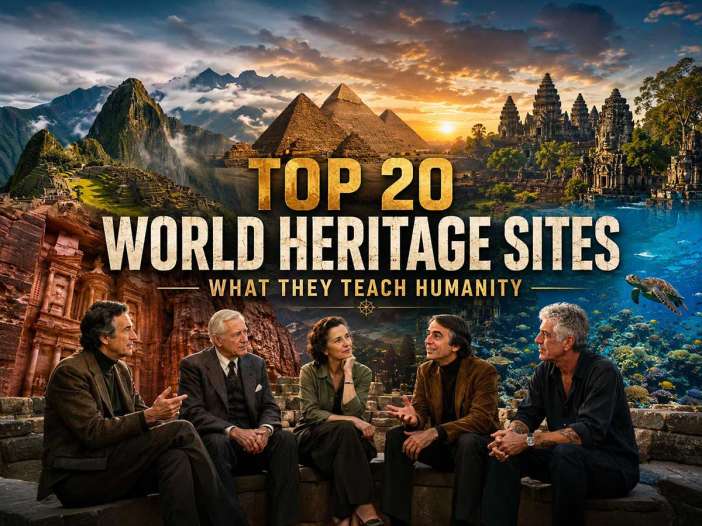
What if World Heritage Sites are not just places to visit, but messages from humanity’s past and future?
Introduction by Carl Sagan
A World Heritage Site is more than a famous place.
It is a signal across time.
A mountain city above the clouds.
A pyramid under the desert sun.
A temple swallowed by jungle.
A city carved into rose-red cliffs.
A reef glowing beneath the sea.
A canyon cut through ages of stone.
An island where giant faces stand in silence.
Each one tells us something about being human on Earth.
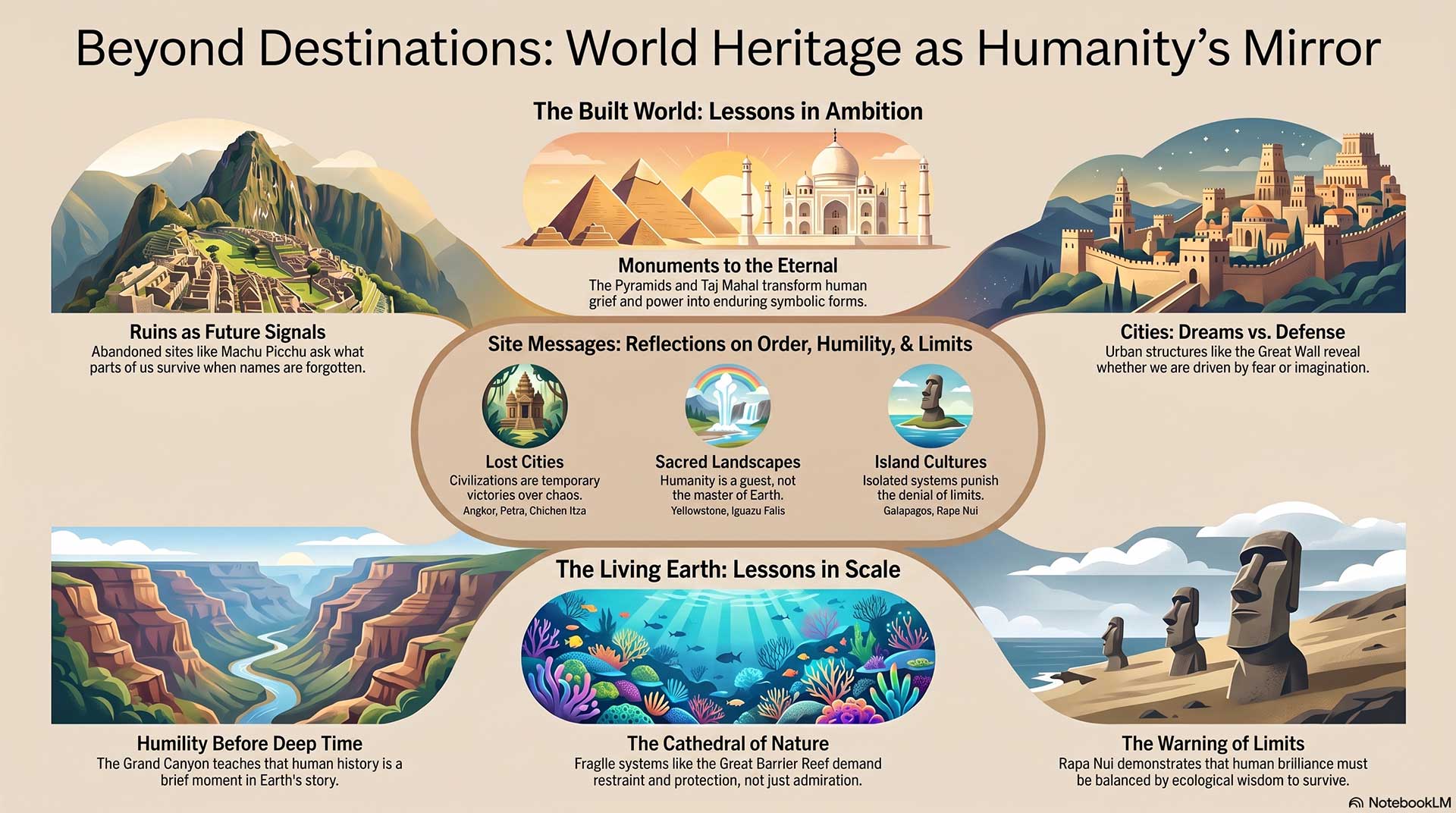
Machu Picchu, Angkor, Petra, and Chichen Itza remind us that civilizations can vanish and still keep speaking.
The Pyramids of Giza, the Taj Mahal, the Acropolis, and Historic Rome reveal our longing for eternity, beauty, order, and memory.
The Great Wall, Venice, Kyoto, and Mont-Saint-Michel show how cities can become expressions of fear, faith, adaptation, and soul.
The Grand Canyon, Yellowstone, Iguazu Falls, and the Great Barrier Reef return us to the scale of the planet itself.
The Galapagos Islands, Serengeti, Ngorongoro, and Rapa Nui remind us that life is older, stranger, and larger than human ambition.
To visit these places is to enter a deeper conversation.
What does civilization leave behind?
What does nature teach when we stop speaking?
What does beauty ask of us?
What does memory demand?
What kind of species are we becoming?
In this Imaginary Conversation, five voices gather to explore those questions.
Joseph Campbell reads the symbols.
Will Durant studies the rise and fall of civilizations.
Rachel Carson listens for the living Earth.
Anthony Bourdain brings the traveler back to food, streets, labor, and ordinary human presence.
And I will try to hold the wider frame: one planet, one species, one fragile inheritance.
World Heritage is often presented as a list of places to see.
But perhaps it is really a list of lessons.
Some are written in stone.
Some in water.
Some in coral.
Some in silence.
Some in the eyes of animals moving across open grassland.
Together, they ask us to become better witnesses.
Not owners of Earth.
Not conquerors of time.
Not tourists collecting proof that we were there.
Witnesses.
Grateful, awake, and responsible.
(Note: This is an imaginary conversation, a creative exploration of an idea, and not a real speech or event.)
Topic 1: Why Do Lost Civilizations Still Call to Us?
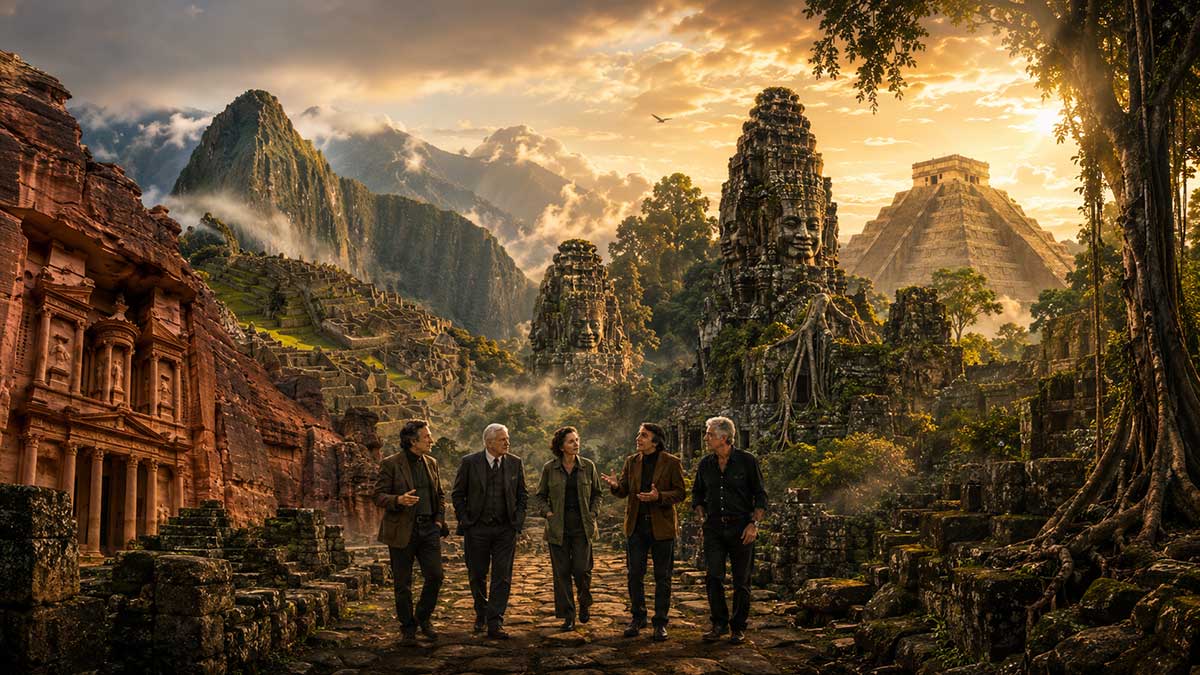
Guests
Joseph Campbell
Will Durant
Rachel Carson
Carl Sagan
Anthony Bourdain
World Heritage Sites:
Machu Picchu, Angkor, Petra, Chichen Itza
Opening
Joseph Campbell:
There is a strange pull in a ruined city.
A living city speaks loudly.
It sells, argues, builds, eats, prays, and moves.
But a lost city speaks through silence.
Machu Picchu rises above the clouds like a question left on a mountain.
Angkor rests in the jungle, where stone faces stare through roots and shadow.
Petra hides in rose-red cliffs, as if the desert itself once dreamed of a city.
Chichen Itza stands beneath the sky, where stone, time, and the stars once met.
These places are called ruins.
Yet they do not feel empty.
They feel charged.
They ask us what civilization really means.
They ask why humans build so high, carve so deep, pray so fiercely, and disappear so completely.
A lost civilization does not call to us from the past alone.
It calls from our own future.
It says, “One day, others may look at you this way. What will they see?”
Question 1: Why do abandoned cities sometimes feel more alive than modern ones?
Anthony Bourdain:
A modern city can overwhelm you. Traffic, menus, phones, screens, noise. Everybody rushing somewhere, everybody selling something.
Then you walk into a place like Petra or Angkor, and there is no one trying to sell you the meaning of it. The place just sits there and lets you feel small.
That is rare.
In a ruined city, you start thinking about the people who cooked there, argued there, fell in love there, buried their dead there. You wonder what the food smelled like. You wonder what jokes they told. You wonder what they thought would last forever.
That makes the place feel alive. Not in a tourist brochure way. In a human way.
Will Durant:
Civilization is a temporary victory over chaos.
A city is built from confidence. People believe tomorrow will come. They cut stone, raise walls, organize labor, feed workers, worship gods, count seasons, teach children.
When such a city falls silent, the confidence remains in the stone.
That is why abandoned cities move us. They show us ambition without its original owners. They show us achievement separated from applause.
Machu Picchu has no emperor speaking from its heights now. Angkor has no royal ceremony filling its courts. Yet their forms remain, and the forms speak.
They say: “Here, human beings once believed deeply enough to build.”
Rachel Carson:
Ruined cities often feel alive in part through nature’s return.
At Angkor, roots embrace stone. At Machu Picchu, clouds and mountains hold the terraces. Petra is shaped by desert light and wind. Chichen Itza stands under a sky that still measures days and seasons.
Nature does not erase these places in a single act. It enters slowly.
A vine, a shadow, a bird call, a change in light. Little by little, the built and the living meet.
Perhaps that is why they feel alive. Human intention remains, but nature has come back into the conversation.
Carl Sagan:
A lost city gives us a wider view of time.
Most of us live inside a very narrow frame. Today’s problems, this year’s worries, this generation’s assumptions.
Then we stand before a place like Chichen Itza and realize that people long before us were watching the heavens, building calendars, trying to connect human life to cosmic order.
They were not primitive versions of us. They were fully human beings asking large questions with the tools available to them.
An abandoned city feels alive when it reminds us that intelligence, wonder, fear, and hope are ancient.
Joseph Campbell:
The lost city is one of humanity’s great mythic images.
It is the kingdom after the king is gone.
The temple after the priests are gone.
The road after the travelers are gone.
In myth, the hero often enters such a place to discover a buried truth. The ruin is never merely dead stone. It is a threshold.
We enter Machu Picchu, Angkor, Petra, or Chichen Itza, and we are really entering the old question:
What part of us survives when our names are forgotten?
Question 2
Were places like Machu Picchu and Petra built as cities, temples, or messages to the future?
Carl Sagan:
They were built for their own time, but they reach beyond it.
No builder at Machu Picchu was thinking of the modern tourist with a camera. No mason at Petra was carving for our documentaries. They built from the needs and beliefs of their own moment.
Yet human works can outgrow their original purpose.
A structure can begin as a city, a tomb, a shrine, or a seat of power. Centuries later, it becomes a message.
The message is not written in our language. It is written in placement, geometry, effort, and survival.
Will Durant:
Great civilizations rarely separate religion, politics, economy, and art as neatly as modern minds do.
Petra was a city of trade, but it was more than commerce.
Chichen Itza was a ceremonial center, but it was more than ritual.
Machu Picchu may have served royal, sacred, agricultural, and astronomical functions together.
Civilization is woven from many human needs: bread, power, beauty, death, order, fear, hope.
So were these places cities or temples?
Yes.
The categories are ours. The stones belonged to societies where life, belief, and rule were often joined.
Rachel Carson:
Machu Picchu feels less like an object placed on a mountain and more like a human answer to the mountain.
The terraces, walls, and paths do not simply occupy the land. They respond to it. They show attention to slope, water, stone, and sky.
That matters.
A place like that is not a message to the future in the simple sense. It is a record of relationship.
It tells us how one society saw its place in the living earth.
Perhaps the deeper message is this: human greatness does not always mean conquering nature. Sometimes it means learning how to belong.
Anthony Bourdain:
I like the idea that these places were messy in real life.
We turn them into symbols now, but people lived in and around them. Somebody had sore feet. Somebody burned dinner. Somebody got cheated. Somebody prayed for rain. Somebody complained about work.
That is what makes them powerful to me.
Petra was not just a postcard carved in stone. It was a place where traders, workers, families, and travelers moved through heat and dust.
Machu Picchu was not just mystical. It was built by hands. Real hands. Hungry hands, tired hands, skilled hands.
If these places send us a message, it may be this:
Do not turn the past into decoration. The past was lived.
Joseph Campbell:
Every sacred place is both local and universal.
It belongs to a people, a language, a ritual, a history.
Yet it also speaks to something wider in human nature.
The mountain city, the hidden valley, the desert sanctuary, the pyramid aligned with the sky—these are forms that return in different cultures.
They express the human desire to place life inside a larger order.
Were they cities? Yes.
Were they temples? Yes.
Were they messages? They became so once time stripped away their original voices.
What remains is symbol.
Question 3
What would our own civilization look like if future travelers found it in ruins?
Rachel Carson:
I think future travelers would ask what we knew and what we did with what we knew.
They might see our roads, towers, airports, dams, data centers, and landfills. They might ask how a species with such knowledge could still damage the living systems that sustained it.
They would see our brilliance. They would see our blindness.
Every civilization leaves traces of its values. Ours may leave traces of speed, consumption, extraction, and invention.
The question is whether we will leave traces of care.
Joseph Campbell:
Future travelers may ask what our gods were.
They may not call them gods, but they will look for what we served.
Did we serve truth?
Did we serve money?
Did we serve comfort?
Did we serve endless growth?
Did we serve the machine?
Every civilization builds altars. Some are made of stone. Some are made of screens. Some are made of markets.
If our civilization becomes a ruin, the central question will be spiritual:
What did these people worship without admitting it?
Anthony Bourdain:
I hope they find more than shopping malls and parking lots.
I hope they find kitchens. Neighborhoods. Markets. Places where people sat together and ate something made with love. Places where immigrants changed a city for the better. Places where families brought recipes across oceans.
That stuff matters.
The big monuments get remembered, but real civilization is also in the meal, the street corner, the bar, the small act of welcome.
If future travelers judge us only by our tallest buildings, they will miss us.
If they find how we ate together, maybe they will know we were human.
Carl Sagan:
From a cosmic perspective, our civilization is very young.
We have split the atom, left footprints on the Moon, mapped genomes, listened for signals among the stars, and photographed our own planet from space.
That is extraordinary.
Yet we are still learning how to become wise.
If future travelers find our remains, they may see a species that discovered its planet was fragile at the very moment it gained the tools to harm it on a global scale.
The question is open.
Will they find the ruins of a species that failed to grow up?
Or the early structures of one that learned humility in time?
Will Durant:
History teaches that civilizations do not usually perish from one cause.
They weaken through many wounds: inequality, exhaustion, loss of purpose, environmental strain, political decay, moral confusion, forgetfulness.
Our ruins, if they come, will tell a complex story.
But the task of history is not to predict doom. It is to widen judgment.
Machu Picchu, Angkor, Petra, and Chichen Itza remind us that greatness is possible. They remind us that loss is possible. They remind us that memory is possible.
A civilization becomes mature when it can admire the past without assuming immunity from its fate.
Closing
Joseph Campbell:
Lost civilizations call to us because they are unfinished conversations.
Machu Picchu asks whether human beings can live with the mountain rather than merely stand upon it.
Angkor asks what happens when divine ambition meets the jungle’s long patience.
Petra asks what kind of city can be carved from hardship, trade, and desert stone.
Chichen Itza asks how deeply human beings once watched the sky for meaning.
These places are not silent.
We are the ones who must learn how to listen.
They do not say, “Return to the past.”
They say, “Look at the pattern.”
Human beings dream.
Human beings build.
Human beings worship.
Human beings forget.
Human beings vanish.
Something remains.
The question is not whether our civilization will last forever. No civilization has earned that promise.
The question is what kind of memory we are creating now.
One day, someone may stand among our remains and wonder who we were.
May they find more than pride.
May they find more than noise.
May they find signs that we learned, before it was too late, how to belong to the earth, to one another, and to the vast mystery that holds us all.
Topic 2: Why Did Humans Build Monuments to Touch the Eternal?
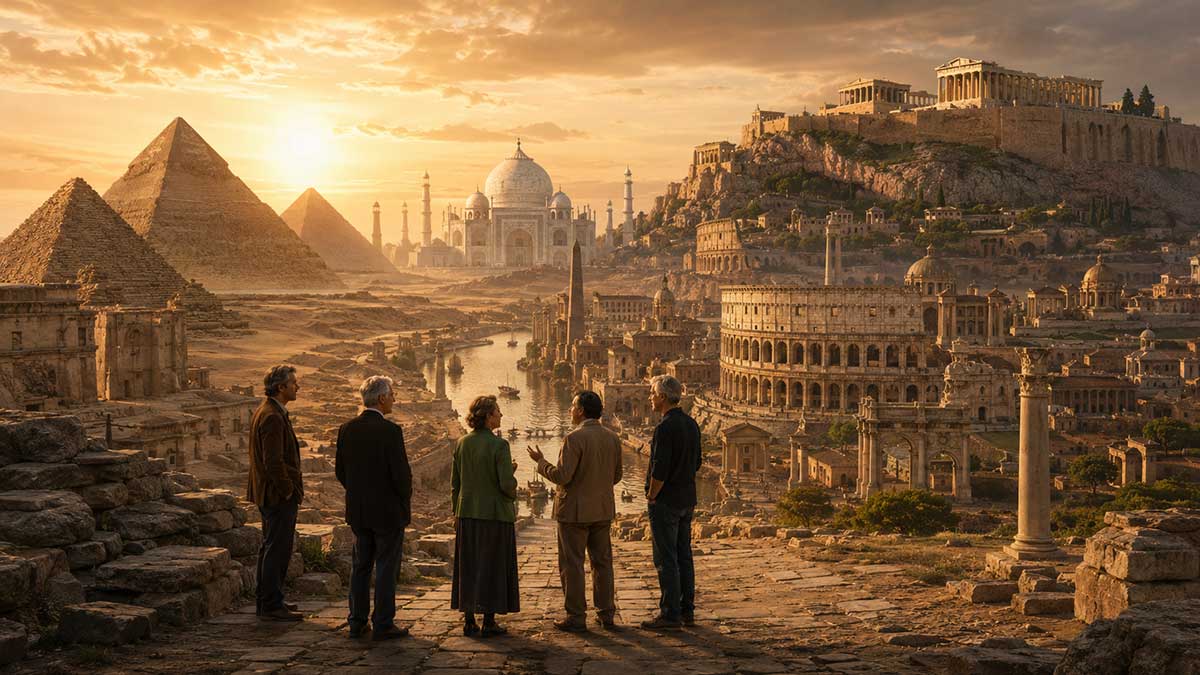
Guests
Joseph Campbell
Will Durant
Rachel Carson
Carl Sagan
Anthony Bourdain
World Heritage Sites:
Pyramids of Giza, Taj Mahal, Acropolis, Historic Rome
Opening
Will Durant:
Human beings build houses for the living.
But monuments are often built for something larger.
A king fears death, and a pyramid rises from the desert.
An emperor loses the woman he loves, and white marble becomes memory.
A city worships its gods, and a temple climbs above Athens.
An empire believes it can order the earth, and Rome turns stone, law, road, and arch into a language of power.
The Pyramids of Giza, the Taj Mahal, the Acropolis, and Historic Rome are not simply great sites.
They are human ambition made visible.
They tell us that people have always wanted to outlast the body, outlast grief, outlast chaos, and outlast time.
Yet every monument carries a warning.
What we build may reveal our highest hopes.
It may reveal our deepest fears.
It may reveal the distance between beauty and pride.
So we ask:
Did humans build these monuments to touch eternity, or to convince themselves they could?
Question 1: Are the pyramids and the Taj Mahal symbols of power, love, grief, or fear of death?
Joseph Campbell:
The pyramid is a mountain made by human hands.
In myth, the mountain often joins earth and sky. It is the place where mortals look upward and ask to be received into a greater order.
The Egyptian pyramid was not only a tomb. It was a passage, a sacred structure, a symbolic ascent. It gave form to the belief that death could be crossed.
The Taj Mahal works through another emotional door.
It is grief transformed into beauty. Love, loss, and longing turn into symmetry, garden, water, and marble.
Power made both possible.
But power alone does not explain why they still move us.
They endure because they turned fear and sorrow into form.
Rachel Carson:
I am struck by how both monuments depend on landscape.
The pyramids need the desert. Their silence grows from the surrounding emptiness. The Taj Mahal needs light, water, garden, and sky. Its white surface changes with the day.
Human beings may build monuments, but nature completes them.
Without sand, sun, river, reflection, dawn, dusk, and weather, these structures lose part of their meaning.
That should humble us.
Human art reaches its deepest beauty when it does not pretend to stand apart from the earth.
Anthony Bourdain:
People love to talk about kings and emperors. Fine. They paid for the thing, ordered the thing, got their names attached to the thing.
But somebody cut the stone.
Somebody carried it. Somebody carved it. Somebody sweated through the heat, fed a family, hurt his back, went home tired.
That is the part I cannot ignore.
The Taj Mahal is love, yes. The pyramids are death, yes. But they are labor too. Human bodies, human skill, human cost.
The danger with monuments is that they can make us forget the people who made them.
The beauty is real.
So is the price.
Carl Sagan:
The fear of death is one of the great engines of culture.
We are conscious beings who know we will die. That knowledge is both a wound and a source of creativity.
The pyramids and the Taj Mahal show two responses to mortality.
One says, “The king must continue.”
The other says, “Love must not disappear.”
From a cosmic perspective, stone itself is temporary. Stars are temporary. Planets are temporary. Yet the human impulse to preserve meaning is profound.
These monuments do not defeat death.
They reveal how intensely we resist meaninglessness.
Will Durant:
Power, love, grief, and fear are not separate chambers. In history, they often share the same room.
The pyramids were political, religious, economic, and spiritual. They required organization, command, belief, labor, and wealth.
The Taj Mahal was personal grief made imperial. A private loss became public architecture.
Civilization is often born from such mixtures.
Pure motives are rare in history.
Great works rise from human beings as they are: tender, proud, afraid, brilliant, cruel, devoted, and restless.
That is why these places still hold us. They are not simple.
Question 2: What did Athens and Rome give to humanity, and what did they fail to learn?
Carl Sagan:
Athens gave humanity an enduring image of reason in public life.
The Acropolis stands for more than marble and columns. It represents a civilization that tried to think about beauty, mathematics, politics, drama, philosophy, and citizenship in ways that still shape the modern mind.
Rome gave scale.
Law, engineering, administration, roads, aqueducts, urban form. Rome showed that human beings could coordinate life across vast distances.
But both Athens and Rome were limited by exclusions.
They spoke of freedom, yet many were not free.
They built order, yet conquest stood beneath much of that order.
Their greatness is real. So is the moral gap.
Will Durant:
Athens taught us the dignity of thought. Rome taught us the discipline of organization.
Athens asked: What is justice? What is beauty? What is the good life?
Rome asked: How can law, road, army, and institution hold a society together?
The modern West still lives in the shadow of those questions.
Yet Athens did not fully solve democracy. Rome did not fully solve power.
Athens could be brilliant and narrow.
Rome could be practical and brutal.
History’s lesson is not that we should worship ancient civilizations. It is that we should learn from their achievements and their failures with equal honesty.
Rachel Carson:
I would add that every great city rests on the land around it.
Athens needed hills, harbors, stone, wood, olive groves, and trade. Rome needed water systems, farmland, roads, animals, forests, and labor across its territories.
Cities can make people forget the sources that sustain them.
That remains true today.
A marble temple may look independent. An imperial forum may look permanent. Yet every civilization depends on soil, water, climate, food, and human bodies.
Athens and Rome gave us lasting forms.
They did not fully teach us how to live within limits.
Anthony Bourdain:
Rome is seductive. You walk through it and feel layers under your feet. Empire, church, street food, ruins, scooters, wine, saints, tourists, locals just trying to get through the day.
That is what I love about it.
The city never stayed one thing. It absorbed, borrowed, conquered, adapted, survived.
But empire always has a bill.
Somebody pays. Someone at the edge of the map, someone whose story does not get carved into the arch.
Athens and Rome gave us a lot. They gave us language for politics, beauty, law, citizenship, city life.
They failed when they forgot that the people outside the marble story were people too.
Joseph Campbell:
Athens and Rome became symbols larger than themselves.
Athens became the dream of the thinking city.
Rome became the dream of the ordered city.
Every civilization needs dreams. But dreams become dangerous when they harden into certainty.
The Acropolis can inspire reverence for beauty and wisdom. It can also become an idol of cultural superiority.
Rome can inspire admiration for law and structure. It can also tempt later empires to imitate domination and call it destiny.
What they gave us is precious.
What they failed to learn is still our assignment.
Power must serve life.
Beauty must not blind us.
Order must not crush the soul.
Question 3: Does great architecture make humans humble, or does it tempt them toward pride?
Rachel Carson:
Great architecture can humble us when it teaches proportion.
The pyramids under the desert sky, the Taj Mahal beside water, the Acropolis above the city, Rome beneath centuries of weather and change—each becomes more powerful when seen with earth, light, and time.
Human beings made them.
But time has entered them.
Stone cracks. Marble stains. Plants grow. Wind moves across columns. Light changes every hour.
Architecture becomes humbling when it reminds us that human creation is never separate from the living planet.
Anthony Bourdain:
It depends how you look.
If you show up, grab the photo, brag that you were there, and move on, the monument just feeds your ego.
If you sit for a minute, watch people, listen, think about who built it, who suffered for it, who loved it, who prayed there, who got left out of the story—then it can humble you.
Great architecture does not automatically make anyone better.
It offers you a chance.
You can consume it.
Or you can let it slow you down.
Will Durant:
Architecture is civilization’s autobiography in stone.
It records what a society admired and what it could command. Temples, tombs, arches, forums, palaces, walls—each says something about collective desire.
Pride is always near such achievements.
A people who can build greatly may conclude that they are great in all things. That conclusion has ruined many civilizations.
Yet architecture can still educate the soul.
It can remind us that we inherit more than we create, and that our own age will be judged by what it builds, preserves, and destroys.
Carl Sagan:
From the viewpoint of the cosmos, even the largest human monument is tiny.
The Great Pyramid is small on the scale of Earth. Earth is small on the scale of the solar system. The solar system is small on the scale of the galaxy.
That fact does not make human works meaningless.
It makes them tender.
The Taj Mahal matters not because it is physically immense, but because it represents conscious beings trying to give form to love and loss on a small planet circling an ordinary star.
Humility and meaning can exist together.
We are small.
Our feelings are not small to us.
Joseph Campbell:
A monument is a mirror.
If the viewer comes with pride, the monument reflects pride.
If the viewer comes with wonder, it reflects wonder.
If the viewer comes with reverence, it becomes a doorway.
The sacred function of architecture is to move the mind from the ordinary to the eternal.
A temple, a tomb, a dome, a column, an arch—these are not only structures. They are invitations to shift consciousness.
Yet the same form can be captured by ego.
That is the ancient tension.
Human beings build upward to touch the eternal, but they must bow inward to receive it.
Closing
Will Durant:
The Pyramids of Giza, the Taj Mahal, the Acropolis, and Historic Rome reveal one of history’s most enduring truths:
Human beings cannot live by survival alone.
They bury their dead with ceremony.
They turn grief into marble.
They place temples above cities.
They build roads and arches to hold a vision of order.
These monuments show human greatness.
They show human longing.
They show human pride.
The pyramids ask whether death can be crossed.
The Taj Mahal asks whether love can remain visible after loss.
The Acropolis asks whether beauty and reason can guide a city.
Rome asks whether law and order can hold the chaos of history at bay.
No monument answers perfectly.
Each gives us a fragment.
To stand before them is to feel the height of human aspiration and the shadow behind it.
We have always wanted to touch the eternal.
The wiser question may be this:
Can we seek eternity without forgetting the human beings, the living earth, and the moral limits beneath our stones?
Topic 3: Are Cities the Dream of Humanity, or the Proof of Our Fear?
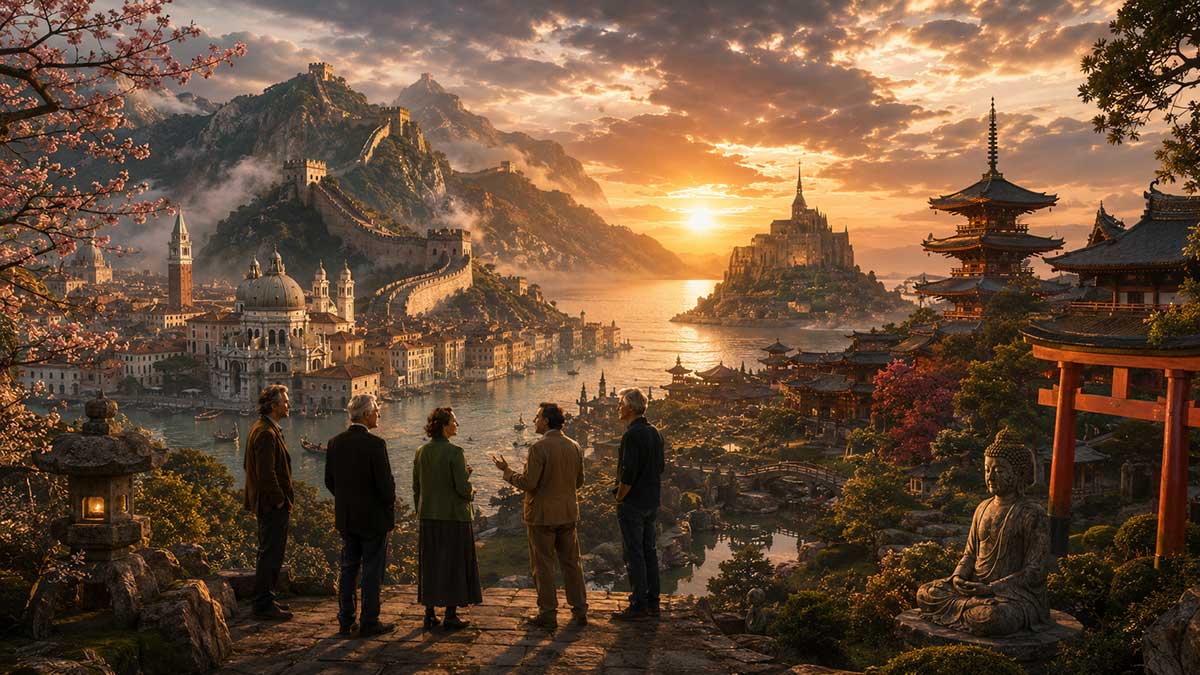
Guests
Joseph Campbell
Will Durant
Rachel Carson
Carl Sagan
Anthony Bourdain
World Heritage Sites:
Great Wall of China, Venice and its Lagoon, Historic Monuments of Ancient Kyoto, Mont-Saint-Michel and its Bay
Opening
Anthony Bourdain:
Cities are strange things.
We build them to survive.
Then we ask them to mean something.
We need walls, roads, markets, wells, bridges, kitchens, rooms, roofs.
But sooner or later, humans want more.
We want beauty.
We want memory.
We want a place where the dead still matter, where the living can gather, where strangers can meet, where prayer has a shape, where fear has a border, where desire has a street.
The Great Wall of China runs over mountains like a wound and a warning.
Venice floats on water like a dare.
Kyoto breathes through temples, gardens, seasons, and silence.
Mont-Saint-Michel rises from the tide like a vision you might see before you wake.
These places are not just cities or monuments.
They are human psychology made visible.
A wall says, “We are afraid.”
A canal says, “We can adapt.”
A garden says, “We need stillness.”
A monastery in the sea says, “We are reaching for something beyond ourselves.”
So the question is not only what humans built.
The question is what the buildings reveal.
Are cities the dream of humanity?
Or are they proof that we never stopped being afraid?
Question 1: Did the Great Wall protect civilization, or reveal how afraid civilization was?
Will Durant:
The Great Wall is one of history’s most dramatic admissions.
A civilization builds a wall when it has something to protect and something to fear.
It represents organization, endurance, labor, engineering, and state power. To build at that scale, a society must command resources, workers, soldiers, and belief in a common purpose.
Yet the wall speaks of anxiety too.
It divides the known from the unknown. It marks the edge of security. It turns fear into architecture.
The Great Wall protected, but protection is never a simple thing. It can defend a culture. It can narrow a culture. It can preserve life. It can preserve suspicion.
That is what makes it such a powerful human symbol.
Joseph Campbell:
In mythology, the wall is one of the oldest images of separation.
Inside the wall lies order. Outside the wall lies wilderness.
Inside is home. Outside is danger.
Inside is the named. Outside is the unknown.
But the hero’s journey often begins when someone crosses the boundary.
The wall is needed. Then the wall must be questioned.
A culture with no boundary may dissolve.
A culture with only boundary may suffocate.
The Great Wall reveals a central human tension: we need shelter, yet we are transformed by what lies beyond shelter.
Rachel Carson:
From nature’s point of view, a wall is a human line placed across a living earth.
Wind does not stop at it. Birds do not understand it. Seeds may cross it. Weather ignores it. Mountains carry it for a time, then frost, rain, roots, and erosion begin their slow work.
This does not make the wall meaningless. It makes it humbling.
Human beings draw borders. Nature reminds us that borders are not absolute.
The Great Wall shows human determination. It also shows the limits of human control.
No wall can make a civilization safe if the deeper relationship between land, people, and power is breaking.
Carl Sagan:
Viewed from space, the political and emotional meaning of walls changes.
Earth has no visible labels from that distance. No empire’s boundary glows in the dark. No ancient fear marks the planet in a cosmic sense.
Yet on the ground, boundaries feel urgent. People defend them, die for them, inherit them, question them.
The Great Wall shows how seriously humans take belonging.
From a cosmic perspective, all humans live on the same small planet. From a historical perspective, we have spent much of our time dividing that planet into “us” and “them.”
The wall protects. The wall warns. The wall exposes our unfinished moral imagination.
Anthony Bourdain:
Walls are easy to romanticize from a distance.
You see the Great Wall snaking over mountains and think, “Incredible.” And it is. It is one of the most staggering things humans ever built.
But then you think of the people stationed there. Cold nights. Hunger. Boredom. Fear. Orders. Dust. Loneliness. Men looking out at the horizon, wondering who was coming.
That is where the wall becomes real.
It is not just a symbol. It was a workplace. A military line. A life sentence for some.
Every great monument has human fingerprints on it. Some are proud. Some are tired. Some are invisible.
Question 2: Why do Venice, Kyoto, and Mont-Saint-Michel feel more soulful than ordinary cities?
Joseph Campbell:
They feel soulful because each one is built around a mythic image.
Venice is the city on water.
Kyoto is the city of seasons and sacred quiet.
Mont-Saint-Michel is the holy mountain rising from the sea.
These are not ordinary images.
Water suggests mystery, change, danger, and reflection.
The garden suggests inner order.
The mountain suggests ascent from earth to heaven.
A soulful city gives the inner life an outer form.
We do not merely walk through such places. We recognize something in ourselves.
Rachel Carson:
They feel soulful because they are not cut off from natural rhythm.
Venice lives with water. Its beauty and danger come from the same source.
Kyoto draws power from seasonal change: blossoms, rain, moss, autumn leaves, winter quiet.
Mont-Saint-Michel changes with the tide. At one hour it feels reachable. At another, set apart.
These places teach that beauty is not fixed.
It moves with light, weather, water, and time.
Modern cities often try to control every variable. These places remind us that wonder enters through change.
Will Durant:
A city becomes soulful when generations leave meaning behind.
Venice is not only canals and palaces. It is trade, risk, wealth, art, plague, music, decline, survival.
Kyoto is not only temples and gardens. It is court culture, ritual, craftsmanship, faith, destruction, restoration, and restraint.
Mont-Saint-Michel is not only a striking silhouette. It is pilgrimage, isolation, devotion, architecture, tide, and endurance.
A city with soul has layers.
It refuses to be consumed in one glance.
It asks the visitor to notice time.
Anthony Bourdain:
A soulful place is one where you can feel that people actually lived, ate, prayed, worked, failed, and kept going.
Venice has the tourist version, sure. But get away from the obvious spots and you feel damp stone, small bars, old kitchens, boats doing daily work, people trying to preserve a life under pressure.
Kyoto can be treated like a checklist. Temple, photo, next temple, next photo. That misses the point. The point is slower. A bowl of noodles. A quiet lane. A garden where nobody needs to explain anything.
Mont-Saint-Michel has that same pull. Part fortress, part prayer, part dream.
Soul is what remains when a place has lived longer than our attention span.
Carl Sagan:
There is a scientific side to this feeling.
Human beings respond deeply to patterns: symmetry, water, height, enclosure, path, horizon, changing light.
Venice, Kyoto, and Mont-Saint-Michel use these patterns in powerful ways.
But the feeling goes beyond geometry.
We sense time there. We sense human continuity. We sense our own briefness against something that has lasted.
A place becomes soulful when it expands our sense of time and shrinks our self-importance without crushing our wonder.
Question 3: Can modern cities still have beauty, memory, and soul, or are they becoming machines?
Carl Sagan:
Modern cities are extraordinary achievements.
They concentrate millions of minds, languages, skills, stories, cuisines, laboratories, hospitals, schools, art forms, and possibilities.
A city can be a magnificent instrument of human cooperation.
But the danger is real.
When a city is measured only by speed, productivity, consumption, and growth, it begins to treat human beings like units in a system.
A city with soul must make room for wonder. It must give people sky, memory, trees, public space, beauty, and the dignity of unhurried life.
Efficiency is useful. It is not enough.
Rachel Carson:
A city without nature wounds the human spirit.
People need shade, birds, water, soil, gardens, and the visible change of seasons. This is not decoration. It is part of mental and physical life.
Modern cities can have soul if they remember that humans are living creatures.
A river should not be hidden as a drainage problem. A tree should not be treated as an accessory. A park should not be viewed as leftover land.
The city of the future must be more than a machine for movement and commerce.
It must become a habitat for human beings and the rest of life.
Will Durant:
Memory is the soul of a city.
A city with no memory becomes interchangeable. It may be large, rich, and convenient, yet still feel empty.
Modern cities must resist the temptation to erase everything old in the name of improvement.
Old streets, local markets, public squares, libraries, houses of worship, neighborhood restaurants, monuments, and even ordinary worn buildings carry civic memory.
A city cannot remain alive by preserving every stone. Change is necessary.
But change without memory becomes amnesia.
Joseph Campbell:
Modern cities need sacred space.
I do not mean only religious buildings. I mean places where people can step out of ordinary utility and feel connected to something larger.
A plaza can be sacred.
A library can be sacred.
A memorial can be sacred.
A riverside path can be sacred.
A small garden can be sacred.
The machine city asks, “How fast can you move?”
The soulful city asks, “What kind of person are you becoming here?”
That is the deeper urban question.
Anthony Bourdain:
A city loses its soul when regular people can no longer live in it.
You can have beautiful buildings, luxury hotels, clean streets, restaurants with perfect lighting, and still end up with a dead place if the cooks, teachers, artists, old families, immigrants, workers, and weirdos get pushed out.
A real city needs friction.
It needs cheap places, late-night places, imperfect places, old places, local places. It needs people who are not performing for visitors.
Venice, Kyoto, Mont-Saint-Michel—each faces pressure from being loved too much.
Modern cities should learn from that.
If a city becomes only a product, it stops being a home.
Closing
Anthony Bourdain:
The Great Wall, Venice, Kyoto, and Mont-Saint-Michel are not just places to admire.
They are confessions.
The Great Wall confesses fear.
Venice confesses imagination.
Kyoto confesses the need for stillness.
Mont-Saint-Michel confesses the human hunger for the sacred.
That is what great places do. They tell the truth about us without asking permission.
A city can be a shelter, a weapon, a marketplace, a shrine, a memory, a stage, a trap, a home.
The best ones make us feel more human.
The worst ones make us forget we are human.
So when we ask whether cities are the dream of humanity or proof of our fear, the answer is not one or the other.
They are both.
We build walls because we are afraid.
We build gardens because we need peace.
We build canals because we adapt.
We build holy places because bread alone is not enough.
A city is never only stone, water, wood, and street.
It is the shape of a civilization’s inner life.
And if we want future cities to have soul, we have to stop asking only how much they can hold, how fast they can move, or how much they can sell.
We have to ask what kind of human beings they are helping us become.
Topic 4: If the Earth Itself Is a Cathedral, How Should We Live?
Guests
Joseph Campbell
Will Durant
Rachel Carson
Carl Sagan
Anthony Bourdain
World Heritage Sites:
Grand Canyon National Park, Yellowstone National Park, Iguazu National Park / Iguazu Falls, Great Barrier Reef
Opening
Rachel Carson:
Human beings build cathedrals to feel awe.
We raise ceilings.
We carve stone.
We shape windows so light arrives like grace.
We make sacred rooms where the voice becomes softer and the soul becomes more awake.
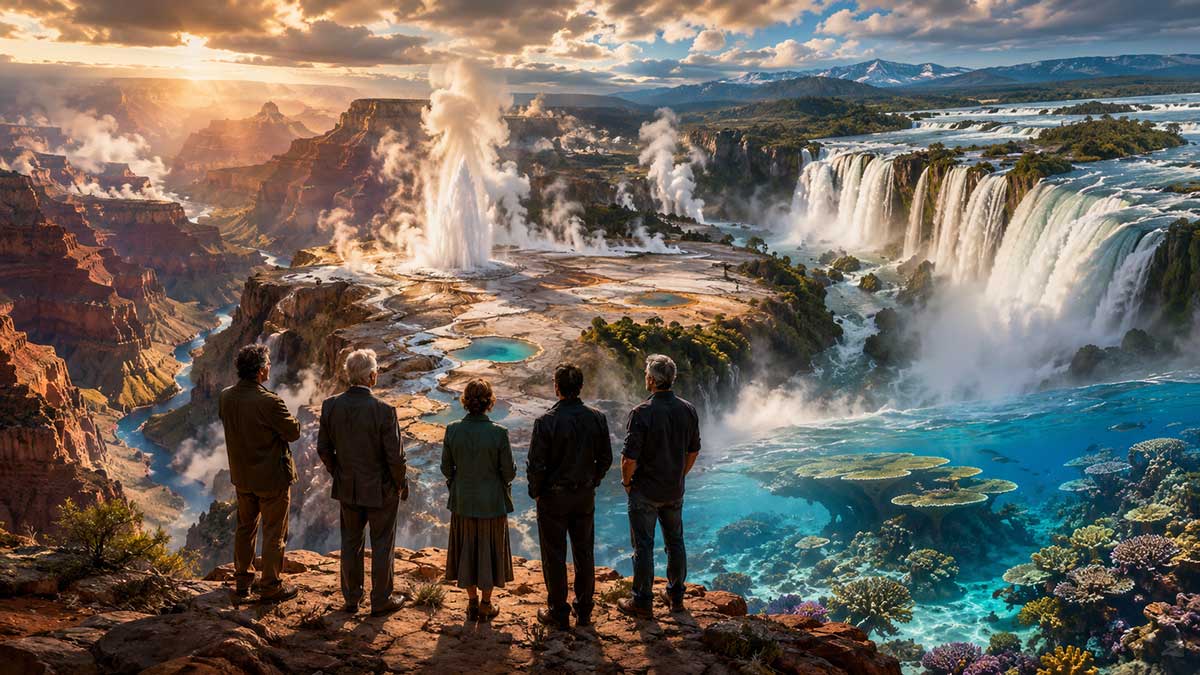
Yet Earth had its own cathedrals long before us.
The Grand Canyon opens the ground and reveals time in layers of stone.
Yellowstone breathes heat, steam, water, and fire from beneath the surface.
Iguazu Falls thunders with a voice no human choir could match.
The Great Barrier Reef glows beneath the sea, a living city made by countless small lives.
In these places, we are not the architects.
We are guests.
We arrive with cameras, names, maps, and explanations.
But the canyon, the geyser, the waterfall, and the reef do not exist for our convenience.
They invite wonder.
They demand humility.
They ask whether we can admire beauty without possessing it.
If Earth itself is a cathedral, then the question is simple and severe:
How should a guest behave inside something sacred?
Question 1: What does the Grand Canyon teach us about time that human history cannot?
Carl Sagan:
Human history feels vast to us.
Empires, migrations, wars, languages, revolutions, religions, inventions. We are moved by the rise and fall of civilizations, and rightly so.
Then we stand at the edge of the Grand Canyon.
Suddenly, human history becomes very recent.
The canyon opens a page much older than our kings, books, temples, cities, and machines. Its layers were formed across lengths of time that the human mind can measure but can barely feel.
That is the lesson.
We know dates.
The canyon gives us depth.
It teaches that our age is not the center of time. We are a brief, bright moment in a story far older than memory.
Will Durant:
Historians usually speak in centuries.
The Grand Canyon speaks in ages.
It reminds us that every civilization is young. Egypt, Rome, China, Europe, America—all of them belong to the surface of recent time when placed beside the earth’s older record.
This knowledge can wound human pride.
It can free us too.
If our own age is brief, then arrogance is foolish. If our choices leave marks on the earth, then our briefness does not excuse carelessness.
The canyon tells us that time is patient.
Human beings are not.
That is why we need such places.
Joseph Campbell:
The descent into a canyon is a mythic image.
In old stories, the hero often moves downward into the hidden place: the cave, the underworld, the dark valley, the belly of the whale.
There, the hero meets truth that cannot be found on the surface.
The Grand Canyon is such a place in visible form. It reveals what is normally concealed: layers, erosion, ancient seas, vanished conditions, the long labor of water and stone.
To look into it is to look into the depth beneath ordinary life.
It asks us to leave the shallow mind behind.
Anthony Bourdain:
The Grand Canyon is one of those places that makes people shut up.
That sounds simple, but it is rare.
We spend so much of life explaining, reviewing, rating, posting, comparing. Then you get to the rim, and the usual chatter starts to feel ridiculous.
You look out and realize the place does not need your opinion.
It was doing just fine before you arrived. It will keep going after you leave.
That kind of silence is healthy. It puts you back in scale.
Not small in a worthless way. Small in a clean way.
Rachel Carson:
The canyon teaches that change can be slow and still be transformative.
Water, wind, uplift, stone, weather—none of them needed haste.
Modern life trains us to admire speed. The canyon shows another form of greatness: persistence.
This matters for the human spirit.
We are impatient with healing, impatient with learning, impatient with nature, impatient with one another.
The Grand Canyon asks us to respect the long work.
It says that depth is not made quickly.
Question 2: When we stand before Yellowstone or Iguazu Falls, are we masters of nature or temporary guests?
Rachel Carson:
Yellowstone makes it difficult to pretend that Earth is passive.
The ground steams. Water erupts. Heat rises. Bison move according to rhythms older than our schedules. The land feels alive in ways that challenge the language of ownership.
Iguazu Falls teaches the same truth through water.
No human voice can compete with that roar. No human plan can make the falls obedient.
We may study these places.
We may protect them.
We may walk through them carefully.
But mastery is the wrong word.
The right word is relationship.
Carl Sagan:
Science gives us a more accurate picture of nature, but accuracy must not become arrogance.
We can explain geysers, geothermal systems, erosion, weather, hydrology, and ecosystems. That is a triumph of human curiosity.
Yet to explain a thing is not to own it.
A star can be understood without being possessed. A river can be studied without being reduced to a resource. A planet can be mapped without being mastered.
Yellowstone and Iguazu invite knowledge joined with reverence.
That union is one of the signs of maturity.
Will Durant:
Civilizations often imagine that control is the same as wisdom.
They build canals, roads, dams, terraces, walls, and cities. These works can be magnificent. They can save lives and feed populations.
Yet history shows the danger of assuming that nature is merely a servant.
Floods, droughts, fires, eruptions, disease, soil exhaustion, climate shifts—again and again, nature enters the historical record.
Yellowstone and Iguazu remind us that human authority has boundaries.
A wise civilization does not deny those boundaries. It learns how to live within them.
Anthony Bourdain:
At a place like Iguazu, you do not feel like the boss.
You get wet. You shout and cannot hear yourself. You walk along the platform and the spray hits your face, and suddenly your plans feel small.
That is a good thing.
A lot of travel is built around control: itinerary, ticket, room, view, meal, photo. Nature breaks that control in the best way.
It says, “You are here, but this is not yours.”
If more people learned that lesson, we might travel better. We might live better too.
Joseph Campbell:
In ancient traditions, rivers, springs, mountains, and forests often had sacred presence.
Modern people may not speak in that language now, but the psychological truth remains.
When we stand before a great natural force, something in us bows.
This bowing is not superstition.
It is recognition.
We meet a reality larger than our will. We meet a force that does not flatter us.
A guest knows how to enter.
A master forgets how to kneel.
Question 3: Can humanity protect fragile beauty like the Great Barrier Reef before it becomes a memory?
Carl Sagan:
The Great Barrier Reef is a living wonder on a small planet.
From space, Earth is blue and white, delicate and alone in the dark. From beneath the water, the reef shows another kind of planetary beauty: color, motion, interdependence, fragile life.
The tragedy is that we know enough to understand the danger.
Ignorance is no longer our defense.
Future generations may ask whether we recognized what was happening, and whether recognition led to action.
The answer is not settled.
That is both frightening and hopeful.
Rachel Carson:
The reef is made by small lives working together across time.
This should move us deeply.
Its beauty is not a decoration on the ocean. It is habitat, shelter, nursery, food, community.
When the reef suffers, the loss is not only visual. It is ecological. It is moral.
To protect it, admiration must become responsibility.
We cannot love the reef only as an image. We must love it as a living system connected to climate, water, coastlines, industry, fishing, tourism, and daily choices far from the sea.
Care at that scale is difficult.
But difficulty is not an excuse.
Will Durant:
History judges civilizations by what they preserve, not merely by what they produce.
A society may build wealth, technology, and comfort, then lose the conditions that made life rich in the first place.
That would not be progress. It would be a failure of judgment.
The Great Barrier Reef tests the moral intelligence of modern civilization.
We are the first generations with a planetary picture of our actions. We see connections across oceans and decades. We know that local habits can have global effects.
To know and fail to act would be one of history’s gravest indictments.
Anthony Bourdain:
I have always hated the kind of travel that treats places like trophies.
Go there. Get the shot. Say you did it. Move on.
The reef deserves better than that.
So does every place that is being loved to death, marketed to death, warmed to death, trampled to death.
Travel should make you more responsible, not less.
If you see something beautiful and fragile, and all you take away is a photo, you missed the point.
The real souvenir should be a changed sense of duty.
Joseph Campbell:
The reef is a modern sacred image.
It is the hidden garden beneath the water. The jeweled city of life. The fragile kingdom guarded by no walls.
In myth, the hero receives a treasure and must return with it for the good of the community.
Our treasure is knowledge.
We know the reef is precious. We know it is vulnerable. We know human action shapes its fate.
The heroic task now is not conquest.
It is restraint.
It is renewal.
It is protection.
A civilization that can protect beauty it cannot own has learned something sacred.
Closing
Rachel Carson:
The Grand Canyon teaches depth.
Yellowstone teaches that Earth is alive beneath our feet.
Iguazu teaches humility before force and flow.
The Great Barrier Reef teaches that the most delicate beauty may depend on lives almost too small to see.
These places are not scenery.
They are teachers.
They teach that time is longer than our ambition.
They teach that Earth is more active than our maps suggest.
They teach that beauty is not always gentle.
They teach that fragility can exist on a breathtaking scale.
If Earth is a cathedral, then our task is not to stand at the altar and praise ourselves.
Our task is to enter with reverence.
To see without taking.
To study without reducing.
To visit without consuming.
To protect without pretending we own.
The future will not ask whether we admired the Grand Canyon, Yellowstone, Iguazu, and the Great Barrier Reef.
Admiration is easy.
The future will ask whether awe changed us.
Did wonder make us wiser?
Did beauty make us careful?
Did the living Earth teach us how to live?
That is the question waiting in every canyon, geyser, waterfall, and reef.
Topic 5: What Do Islands and Wildlife Teach Us About Being Human?
Guests
Joseph Campbell
Will Durant
Rachel Carson
Carl Sagan
Anthony Bourdain
World Heritage Sites:
Galapagos Islands, Serengeti National Park, Ngorongoro Conservation Area, Rapa Nui National Park
Opening
Carl Sagan:
There are places on Earth that remove us from the center of the story.
The Galapagos Islands remind us that life does not stand still.
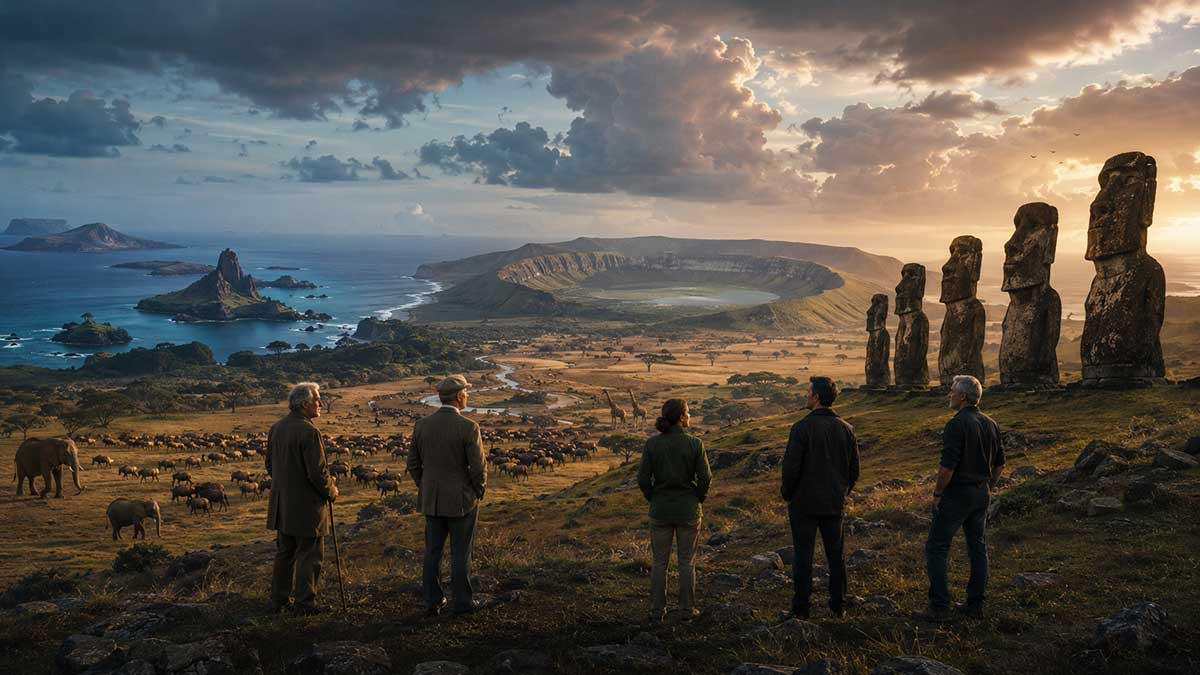
Serengeti shows life in motion, crossing grasslands in hunger, danger, birth, and survival.
Ngorongoro holds a living theater inside an ancient volcanic bowl.
Rapa Nui, with its moai facing wind, sea, and time, reminds us that human civilization can be both magnificent and fragile.
These places ask us to think beyond monuments, kings, empires, and cities.
They ask us to look at life itself.
A finch on an island.
A wildebeest in migration.
A lion in the grass.
A stone face on a remote island.
A small planet in a dark universe.
At first, these seem like separate images.
But they belong to one question:
What does it mean to be human on a planet that was never ours alone?
Question 1: Do Galapagos and Serengeti remind us that humans are part of life, not above it?
Rachel Carson:
Galapagos teaches through difference.
One island, then another. One beak, then another. One shell, then another. Life adjusts, experiments, responds, and survives.
There is humility in that.
Life is not a ladder with human beings at the top. It is a branching, living web. Each creature belongs to a set of relationships: food, climate, shelter, danger, reproduction, chance.
Serengeti teaches through movement.
The herds travel. Predators follow. Grass returns. Rain changes the path. Calves are born. Some live. Some do not.
It is not sentimental.
It is life without disguise.
Human beings are part of that truth, no matter how many walls, laws, screens, and cities we build around ourselves.
Anthony Bourdain:
There is something healthy about being in a place where nobody cares about your résumé.
A zebra does not care who you are.
A tortoise is not impressed by your plans.
A lion is not moved by your self-image.
That is good medicine.
We spend so much time making ourselves important. Then a place like Serengeti or Galapagos knocks all that nonsense out of your head.
You are not the main character there.
You are a visitor. You are meat, memory, breath, curiosity, appetite, fear, and wonder.
That is not an insult.
That is freedom.
Joseph Campbell:
Many old stories begin with a human being meeting an animal.
The animal may be a guide, a warning, a guardian, a trickster, or a hidden form of wisdom.
Modern people often think they have left that world behind.
Yet Galapagos and Serengeti bring us back to it.
The animal is not merely “wildlife.” It is a messenger from a larger order. It tells us that human consciousness arose from life, not outside life.
To see animals rightly is to remember our own roots.
The human being is the creature who can ask, “What is my place in this living pattern?”
That question is the beginning of wisdom.
Will Durant:
History has often been written as if humanity alone mattered.
Dynasties, wars, religions, inventions, constitutions, revolutions—these have filled our books.
Yet all human history rests on conditions older than history: soil, water, animals, climate, disease, food chains, birth rates, migration patterns.
Galapagos and Serengeti remind us that civilization is not separate from biology.
A culture may produce philosophy and art, but it still depends on rain. A nation may build armies, but it still depends on crops. A city may rise, but it still depends on living systems it did not create.
The human story is real.
It is not the only story.
Carl Sagan:
From the perspective of science, the kinship is literal.
We share ancestry with every living thing on Earth. The differences matter, but the connection is deeper still.
Galapagos helped humanity understand that life changes across time. Serengeti lets us witness the drama of life across space.
Both places correct a dangerous illusion: that human beings hover above nature as observers only.
We are nature becoming conscious of itself.
That is a glorious idea, but it comes with responsibility.
A conscious species can destroy without meaning to. It can protect with intention.
That may be our test.
Question 2: Are the moai of Rapa Nui symbols of human greatness, or warnings from a small planet?
Will Durant:
Rapa Nui is one of the great historical symbols of human dignity under constraint.
On a remote island, people created community, ritual, art, memory, and monument. The moai are not crude stones. They are cultural statements. They speak of ancestry, authority, continuity, and identity.
That is greatness.
Yet islands teach limits with severity.
There is only so much land. Only so much forest. Only so much soil. Only so many paths available when a society is surrounded by ocean.
So the moai stand in two lights.
They honor human aspiration.
They warn of human overreach.
A wise viewer must see both.
Rachel Carson:
Rapa Nui matters so deeply because every island is a lesson in limits.
Modern humanity often lives as if there is always another forest, another ocean, another source, another frontier.
But the Earth itself is an island in space.
Its atmosphere is thin. Its oceans are connected. Its living systems can be wounded. Its abundance is not infinite.
The moai are beautiful. They are powerful. They are haunting.
For me, their silence asks: What happens when a people forget the limits of the place that holds them?
That question belongs to all of us now.
Anthony Bourdain:
I would hate to reduce Rapa Nui to a warning label.
That is too easy. Too neat. Too condescending.
People lived there. They had ancestors, rivalries, skill, jokes, food, grief, pride, ceremony, heartbreak. They made something extraordinary under conditions most of us cannot imagine.
So yes, learn the warning.
But do not turn the people into props for our modern guilt.
The moai should make us curious first. Respectful first.
Then maybe they can make us honest.
Joseph Campbell:
The moai are ancestral presences.
They are not only statues. They are faces of memory.
Every culture needs ways to stand before its dead and say, “We have not forgotten you.”
In that sense, Rapa Nui is not strange at all. It is deeply human.
What makes it mythic is the setting: a small island, the vast sea, the giant faces, the mystery of effort, the silence of time.
The symbol has become planetary.
The island is the world.
The ancestors are watching.
The question is whether the living will honor the gift they received.
Carl Sagan:
A photograph of Earth from space changes how we understand islands.
Rapa Nui appears isolated in the Pacific. Earth appears isolated in the cosmos.
The scale changes. The lesson does not.
A small world requires foresight. A closed system punishes denial. A society that cannot see limits may turn its own brilliance against itself.
The moai testify that human beings can create meaning under difficult conditions.
They may warn that meaning is not enough if ecological wisdom fails.
The challenge is not to choose greatness or warning.
The challenge is to learn from both before our own island suffers more than it must.
Question 3: Is protecting World Heritage really about saving the past, or saving our future humanity?
Carl Sagan:
Protecting World Heritage is an act of memory, but memory is not only about yesterday.
Memory gives a species continuity. It lets us ask what has been tried, what has failed, what has endured, and what deserves care.
The Galapagos Islands protect a living record of evolution.
Serengeti protects one of the great movements of life on Earth.
Ngorongoro protects a rare meeting of geology, wildlife, and human history.
Rapa Nui protects a cultural achievement that still speaks across oceans and centuries.
To protect these places is to protect human perspective.
Without perspective, a technological civilization can become very powerful and very foolish.
Will Durant:
The past is not dead material.
It is a treasury of warnings, achievements, errors, recoveries, and possibilities.
When we preserve World Heritage, we do more than protect old stones or famous views. We preserve the range of human experience.
A civilization that loses memory becomes childish. It repeats old mistakes with new machines.
A civilization that keeps memory has at least a chance to mature.
World Heritage teaches that we are not the first to dream, build, fear, worship, migrate, adapt, damage, and regret.
That knowledge is a form of moral education.
Rachel Carson:
For natural World Heritage, the future is not an abstraction.
It has feathers, shells, hooves, coral, grass, soil, water, larvae, nests, and young.
Saving these places means allowing life to continue its own work.
It means future children can still see animals moving across open land. It means they can still learn that islands shaped life in astonishing ways. It means they can stand before a living world, not merely read about one that vanished.
Humanity needs these encounters.
A child who never feels wonder before nature may grow into an adult who finds destruction easier.
Protecting these places protects the capacity for wonder.
Joseph Campbell:
World Heritage sites are thresholds.
At such places, ordinary time opens.
We meet ancestors. We meet animals. We meet Earth. We meet death. We meet endurance. We meet beauty that does not belong to us.
A culture that protects thresholds protects the soul’s ability to awaken.
If every place becomes a product, if every view becomes content, if every memory becomes a market, then something in us closes.
Protecting World Heritage is not nostalgia.
It is a defense of depth.
Anthony Bourdain:
I think saving these places is about saving the possibility of being changed.
You go to a place thinking you are there to see it.
Then, on a good day, it sees you.
Galapagos can strip away your arrogance. Serengeti can make your problems feel smaller. Ngorongoro can remind you that life is crowded, beautiful, violent, and miraculous. Rapa Nui can stare straight through your excuses.
That is worth protecting.
Not just for scientists. Not just for tourists. Not just for governments.
For anyone who still needs to be shaken awake.
Closing
Carl Sagan:
The Galapagos Islands teach that life is creative beyond our expectations.
Serengeti teaches that life moves in patterns older than our maps.
Ngorongoro teaches that geology and biology can meet in a single bowl of astonishing abundance.
Rapa Nui teaches that human beings can create meaning at the edge of isolation, yet still face the hard mathematics of limits.
Together, these places return us to scale.
We are animals, yet we are reflective animals.
We are part of Earth, yet able to see Earth as one world.
We inherit life, yet can damage the conditions that make life flourish.
We remember the dead, yet are responsible to the unborn.
That is the strange burden of being human.
World Heritage is not merely about preserving places.
It is about preserving the parts of ourselves that such places awaken: humility, wonder, restraint, gratitude, memory, courage, and care.
On a small planet, there is no “elsewhere” in the deepest sense.
The island is all of us.
The migration is all of us.
The crater is all of us.
The stone faces are looking at all of us.
The question is no longer whether these places matter.
The question is whether we will become the kind of species that can receive their lessons in time.
Final Thoughts by Carl Sagan
From far away, Earth is a small blue world suspended in darkness.
No border is visible from that distance.
No empire is permanent from that distance.
No monument is large from that distance.
And yet, from the surface, these places matter deeply.
The pyramids matter.
The reefs matter.
The old cities matter.
The wild migrations matter.
The islands matter.
The ruins matter.
They matter because they enlarge the human mind.
A lost city reminds us that our own age is temporary.
A great monument reminds us that love, grief, and fear of death have shaped civilization.
A soulful city reminds us that human beings need beauty and memory, not just speed and commerce.
A canyon, geyser, waterfall, or reef reminds us that Earth is not a backdrop for human activity. It is the living condition of every breath we take.
An island or wild plain reminds us that humanity is part of life, not above life.
World Heritage is often described as something handed down from the past.
That is true.
But it may be more honest to say that these places are borrowed from the future.
We borrow Machu Picchu from future travelers who deserve to feel wonder.
We borrow the Great Barrier Reef from future children who deserve more than photographs of lost color.
We borrow Rapa Nui from future generations who will need its warning.
We borrow the Serengeti from future eyes that should still see life moving across the earth.
We borrow Kyoto, Venice, Petra, Angkor, and the Grand Canyon from people not yet born, who will ask what kind of ancestors we were.
That is the moral weight of heritage.
To preserve it is not merely to protect old stones, rare animals, or beautiful views.
It is to protect human depth.
The capacity to stand before something ancient and feel humbled.
The capacity to see another culture and feel respect.
The capacity to watch wildlife and feel kinship.
The capacity to look at Earth and feel responsibility.
A civilization that loses those capacities may still be wealthy.
It may still be powerful.
It may still be technically impressive.
But it will be poorer in spirit.
The greatest World Heritage Sites do not flatter us.
They correct us.
They return us to scale.
They remind us that time is long, life is interconnected, beauty is fragile, and memory is sacred.
The question they leave us with is not, “How many have you seen?”
The real question is:
After seeing them, how will you live?
Short Bios:
Joseph Campbell:
A mythologist known for exploring the shared patterns found in myths, rituals, and heroic stories across cultures. In this conversation, he reads World Heritage Sites as symbolic thresholds: mountains, temples, walls, ruins, islands, and sacred places where humanity reveals its deepest fears and hopes.
Will Durant:
A historian and philosopher best known for writing about the rise and fall of civilizations. In this conversation, he brings historical memory, moral judgment, and a long view of culture, power, empire, beauty, and decline.
Rachel Carson:
A writer, marine biologist, and environmental thinker whose work helped shape modern ecological awareness. In this conversation, she speaks for the living Earth, reminding us that reefs, forests, animals, rivers, and climate are not scenery. They are the conditions of life.
Carl Sagan:
An astronomer, science communicator, and cosmic thinker who helped millions see Earth as a rare and fragile home in the universe. In this conversation, he frames World Heritage as part of a planetary story: one species learning whether it can become wise in time.
Anthony Bourdain:
A writer, traveler, and storyteller known for seeing culture through food, streets, labor, humor, and ordinary human life. In this conversation, he keeps the discussion grounded, reminding us that behind every monument and destination are real people, real meals, real work, and real stories.
Leave a Reply