
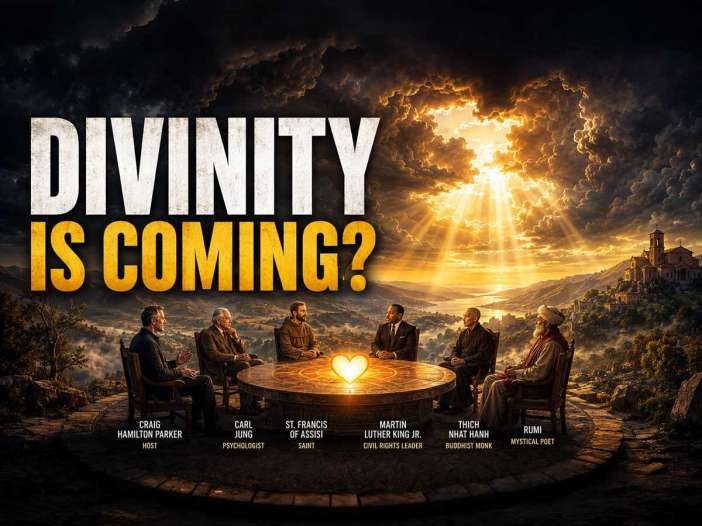
What if the darkness we see around us is not the end of the story?
What if the fear, division, corruption, war, confusion, and spiritual exhaustion of our time are not signs that humanity has been abandoned, but signs that something hidden is being forced into the light?
Craig Hamilton Parker’s message begins in that tension.
He does not deny the darkness. He sees it clearly. He speaks of broken trust, social unrest, moral confusion, false leaders, spiritual fatigue, and a deep anxiety about the future our children and grandchildren may inherit.
Yet he refuses to give darkness the final word.
For Parker, the great question is not simply, “What is happening to the world?”
The deeper question is, “What is awakening inside humanity?”
Across five conversations, that question unfolds.
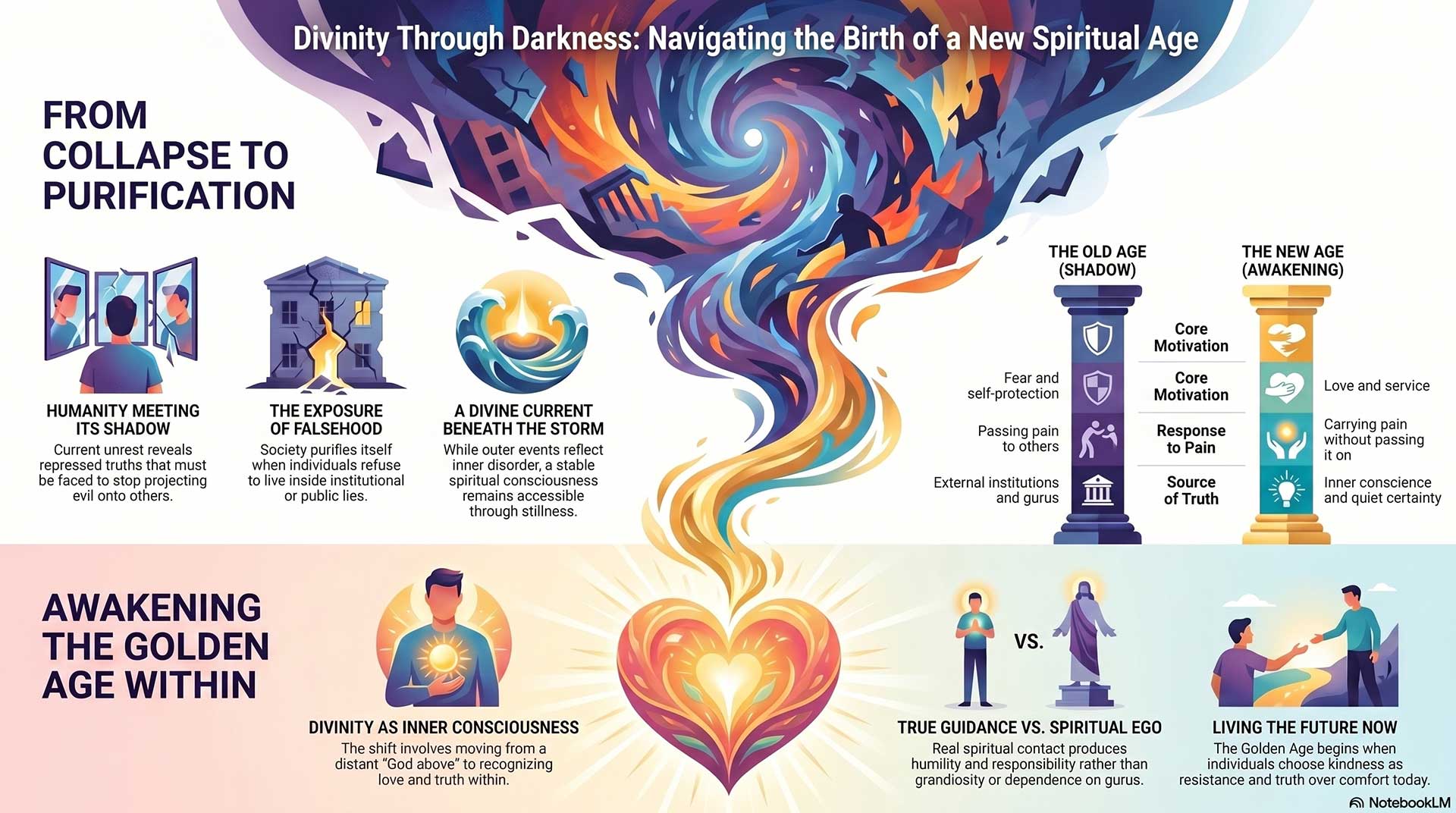
In the first conversation, Craig Hamilton Parker, Carl Jung, Václav Havel, St. Francis of Assisi, and Paramahansa Yogananda ask whether the darkness around us is collapse or purification. Jung sees humanity facing its shadow. Havel sees truth breaking through public lies. Francis sees the humble work of love. Yogananda sees a divine current moving beneath the storm. Parker sees a painful but meaningful transition from one spiritual age into another.
In the second conversation, Parker sits with Jesus, the Buddha, Rumi, and Sri Ramana Maharshi to ask whether God is far above humanity or awakening within it. The answer is not simple. God is not reduced to ego. Inner divinity does not mean self-worship. It means prayer, silence, compassion, surrender, and the discovery that the sacred may be nearer than breath.
The third conversation turns to danger. If the divine can speak within, how do we know the voice is true? Parker, Socrates, Teresa of Ávila, C.S. Lewis, and Miyamoto Musashi examine false spiritual ego. True guidance makes a person humble, loving, truthful, and responsible. False guidance inflates the self, demands attention, and turns sacred experience into personal status.
The fourth conversation asks whether prophets and avatars are still needed. Parker, Sathya Sai Baba, Maitreya, St. Paul, and Rabindranath Tagore consider whether the coming golden age depends on one divine teacher or the awakening of many hearts. A teacher may come. A messenger may appear. Yet the purpose of the teacher is not to create dependence. The purpose is to awaken love.
The fifth conversation brings the whole vision back to daily life. Parker joins Martin Luther King Jr., Mother Teresa, Nelson Mandela, and Thich Nhat Hanh to ask whether we can live now as if the golden age has already begun. Their answer is direct: yes, through truth, kindness, service, courage, forgiveness, and peace practiced in ordinary moments.
Together, these conversations form one central claim:
The golden age does not begin only in prophecy.
It begins in the human heart.
It begins when fear does not rule us.
It begins when truth is chosen over comfort.
It begins when kindness becomes resistance.
It begins when spiritual experience produces humility rather than pride.
It begins when love becomes more than an idea.
It begins when humanity stops waiting only for rescue and starts becoming ready for divine love to live through us.
(Note: This is an imaginary conversation, a creative exploration of an idea, and not a real speech or event.)
Topic 1: Is the Darkness the End—or the Birth Pain of a New Age?
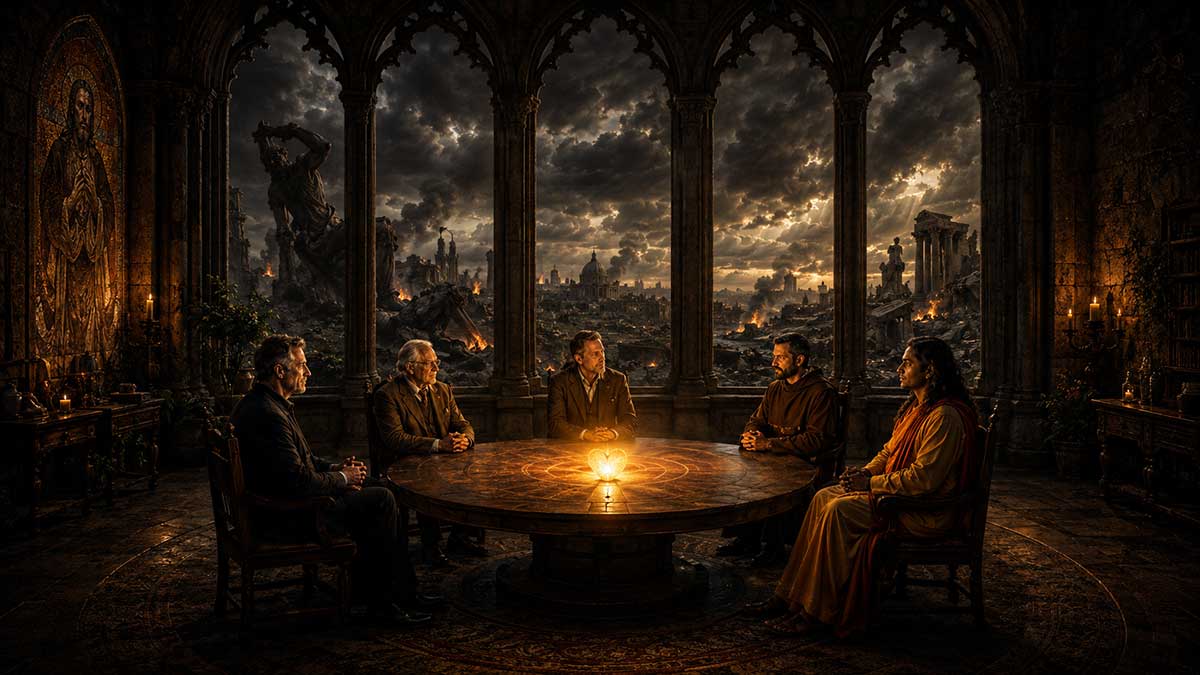
Guests:
Craig Hamilton Parker
Carl Jung
Václav Havel
St. Francis of Assisi
Paramahansa Yogananda
Opening
The room is quiet, almost chapel-like.
Outside the window, the world feels troubled: war, distrust, social unrest, broken leadership, and a strange exhaustion in the human spirit.
Craig Hamilton Parker sits at the center of the table, carrying the question that shaped his talk: What if the darkness is real, but not final? What if the shaking of the world is not only collapse, but the beginning of purification? Parker’s message was that hidden behind the darkness, something loving and divine may already be moving.
Around him sit Carl Jung, Václav Havel, St. Francis of Assisi, and Paramahansa Yogananda.
Tonight, they ask whether humanity is ending an age—or preparing to be born again.
Question 1
When society feels morally exhausted, how do we tell the difference between collapse and purification?
Craig Hamilton Parker:
When people look at the world now, they see madness. They see war, corruption, confusion, and people calling madness progress. I understand why people feel afraid.
But I don’t think fear tells the whole story.
Sometimes darkness becomes visible right before it begins to break. Falsehood does not disappear politely. It screams. It fights. It tries to convince people that it is reality itself.
So when we ask whether this is collapse or purification, I would say: look at what is being exposed. The lies are no longer hidden. The corruption is no longer secret. The spiritual emptiness is no longer easy to ignore.
That exposure is painful, but it can be sacred.
Carl Jung:
A civilization, like a person, has a shadow. It contains what has been denied, repressed, mocked, or forced underground.
When the shadow rises, people often believe the world has become worse. Yet much of what appears is what was already present, only now revealed.
This is why the present age feels unbearable. Humanity is meeting itself.
Purification begins when projection stops. People must stop saying, “The evil is only out there.” Nations must stop saying, “The corruption belongs only to our enemies.” The soul must say, “This belongs to me too.”
Then darkness is no longer merely destruction. It becomes knowledge.
Václav Havel:
A society collapses when people agree to live inside lies.
A society begins to purify itself when one person, then another, refuses to repeat those lies.
That refusal does not need to begin with grand speeches. It can begin with a shopkeeper who removes a false sign from his window. It can begin with a teacher who tells the truth to one student. It can begin with a citizen who says, “I will not pretend anymore.”
Moral exhaustion means people are tired of lies. That tiredness can become despair, or it can become courage.
The difference is responsibility.
St. Francis of Assisi:
When the house is burning, people ask, “Where is God?”
But often God is already present in the small hands carrying water.
Purification does not always look glorious. It may look like a person forgiving someone. It may look like bread shared with a stranger. It may look like a proud man kneeling for the first time.
The world is purified when the heart becomes simple again.
If society is exhausted, maybe it has been carrying too many idols: wealth, status, revenge, certainty, pride.
Let the idols fall. The soul is lighter without them.
Paramahansa Yogananda:
Every age has vibrations. When human thought becomes clouded by greed, fear, and selfishness, outer events reflect inner disorder.
Yet the divine current never disappears. It may be hidden beneath storms, but it still flows.
Collapse is when people cling to the storm.
Purification is when people remember the current beneath it.
To know the difference, ask: Is this suffering making us harder, or is it calling us inward? Is it making us cruel, or is it awakening compassion? Is it making us worship fear, or is it pushing us back to God?
Pain alone does not purify. Love responding to pain purifies.
Question 2
Are war, corruption, and social unrest signs that humanity is failing, or signs that hidden truth is forcing itself into view?
Václav Havel:
They are both.
Humanity is failing when it accepts corruption as normal. It is failing when language becomes propaganda. It is failing when leaders no longer serve truth, but only power.
Yet these failures can force truth into view.
A lie can rule for a long time, but it has one weakness: it must be protected constantly. Truth has patience. It waits. Then a crack appears.
When people finally see the lie, they may feel despair. But this despair can become the first honest emotion they have felt in years.
Truth often arrives first as disillusionment.
St. Francis of Assisi:
War is a wound in the body of humanity.
Corruption is a sickness in the soul.
Unrest is the cry of children who do not know where home is.
But God can speak through wounds. Not to praise the wound, never that. But to call the wounded back to love.
When I looked at a leper, I first saw fear. Then I saw Christ. The world must learn this again. It must look at what it fears and find the face of God hidden there.
The truth forcing itself into view is this: we belong to one another.
Craig Hamilton Parker:
That’s what I feel is happening now. Things are being shaken up. People are losing faith in the old institutions. They don’t trust governments. They don’t trust the media. They don’t trust the stories they were given.
That can become dangerous, yes. People can lose themselves in anger. They can follow false teachers.
But it can also wake people up.
If the outer world no longer gives us truth, we begin searching within. That is where the divine speaks. Not as ego. Not as fantasy. But as conscience, intuition, love, and spiritual knowing.
The old world is breaking. But maybe what is breaking is not life itself. Maybe it is only the shell.
Paramahansa Yogananda:
When the ocean is stirred, mud rises from the bottom. A person may look at the water and say, “The ocean has become dirty.”
But the mud was already there.
This is true of nations, religions, institutions, and minds.
The present unrest reveals the sediment of human consciousness. Anger, hatred, greed, pride, and fear have risen to the surface. This is painful, but now humanity can see what must be healed.
Spiritual evolution is not escape from the world. It is right action with divine awareness.
Meditate deeply. Then serve bravely.
Carl Jung:
Hidden truth does not always appear as comfort.
Sometimes it appears as neurosis. Sometimes as collective madness. Sometimes as political extremism. Sometimes as spiritual hunger.
A society that has lost symbolic life becomes dangerous. People need meaning. If they cannot find living symbols, they will worship dead ones. Ideology becomes religion. The state becomes father. The enemy becomes devil.
So yes, hidden truth is forcing itself into view. But it comes mixed with distortion.
Humanity must learn to interpret the signs of its own soul.
Question 3
What does hope look like when the outer world gives people almost no reason to hope?
St. Francis of Assisi:
Hope looks like a candle lit in a poor room.
It is small, but it changes everything.
Hope does not need to prove that tomorrow will be easy. Hope says, “I can love today.”
Feed one hungry person. Comfort one grieving person. Speak gently to one angry person. Pray when no one applauds. Serve when no one records it.
Then hope has already entered the world.
Do not wait for kings to become kind before you become kind.
Paramahansa Yogananda:
Hope is not optimism. Optimism depends on events. Hope depends on the soul’s contact with God.
When outer life is unstable, go inward. There you will find a stillness untouched by history.
From that stillness, act.
The person who knows inner peace becomes a healing force. Such a person may not command armies or lead nations, yet their vibration blesses the earth.
Hope looks like inner union with the Divine, expressed as calm courage.
Carl Jung:
Hope must not be childish.
A childish hope says, “Everything will be fine.” A mature hope says, “I will face reality, yet I will not surrender my soul to despair.”
Modern people often want hope without descent. But the soul does not mature that way. One must pass through darkness without becoming possessed by it.
Hope is the symbol that appears in the night. It may be a dream, a prayer, a work of art, a child, a friendship, or a sudden act of mercy.
The psyche sends images of renewal when consciousness is ready to receive them.
Craig Hamilton Parker:
I think hope looks like people beginning to feel the light before they can explain it.
Many people are tired of lies. They’re tired of hatred. They’re tired of materialism. They want something pure again.
That yearning itself is evidence that the light has already touched them.
The golden age doesn’t begin only when some grand event happens. It begins when people choose truth over convenience, kindness over bitterness, service over selfishness, courage over fear.
We prepare the birthplace of the new age inside our own hearts.
Václav Havel:
Hope is not the belief that things will turn out well.
Hope is the certainty that something makes sense, regardless of how it turns out.
A person with hope does not say, “I will act only if victory is guaranteed.” He says, “I will act since truth is worth serving.”
The outer world may give no reason for hope. That is precisely when hope becomes most necessary.
Hope is not prediction.
Hope is fidelity.
Closing
The five guests sit in silence.
No one has denied the darkness. No one has softened the pain of war, corruption, fear, or exhaustion.
Yet the conversation has changed the question.
Maybe the issue is not whether the world is dark. It is.
The question is whether darkness gets the final word.
Craig sees a divine movement hidden behind the crisis. Jung sees the shadow rising so it can finally be faced. Havel sees truth breaking through public lies. Francis sees love beginning in humble acts. Yogananda sees the divine current still flowing beneath the storm.
The answer is not passive waiting.
The answer is to live now as if the new age has already begun in the heart.
Topic 2: Is God Above Us—or Awakening Within Us?
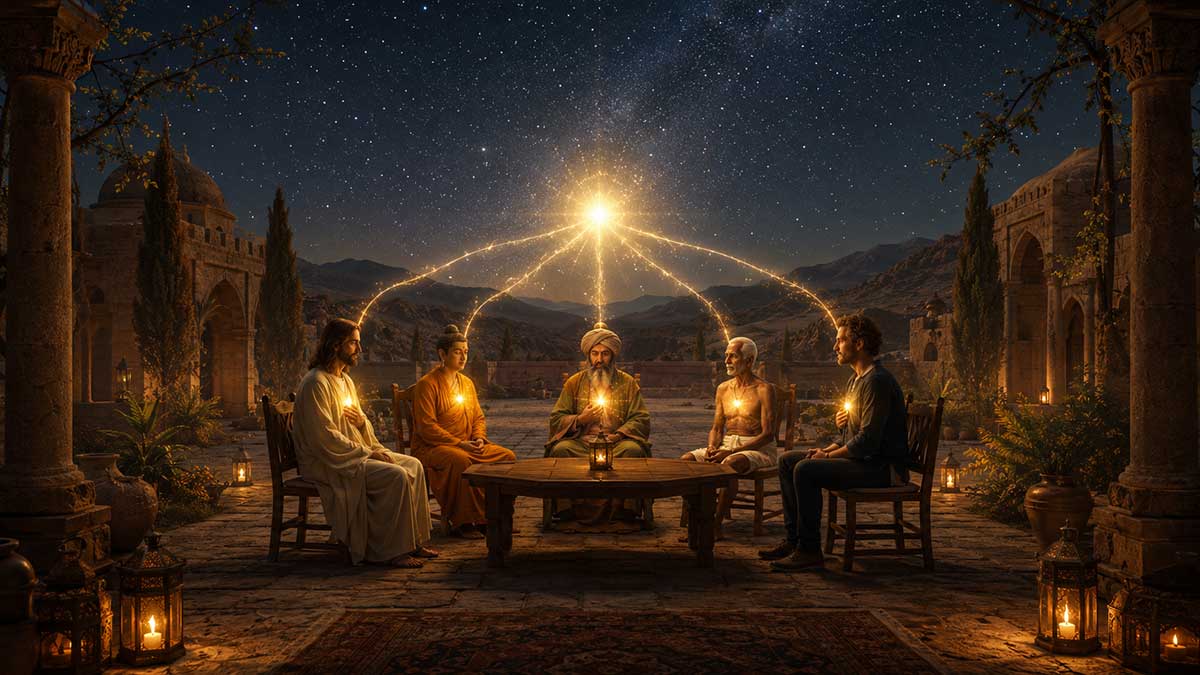
Guests:
Craig Hamilton Parker
Jesus
The Buddha
Rumi
Sri Ramana Maharshi
Opening
The room feels different tonight.
There is no thunder, no throne, no golden gate in the clouds. Only a quiet table, five chairs, and a question that has troubled humanity for centuries:
Is God somewhere above us, watching from a distance?
Or is the divine presence awakening from within the human heart?
Craig Hamilton Parker brings the thought that shaped his talk: divinity is not simply a person in the sky. It is consciousness, love, truth, intelligence, and the sacred force moving through life.
Jesus sits with the tenderness of one who spoke of the kingdom within. The Buddha sits in stillness. Rumi carries fire in his eyes. Sri Ramana Maharshi rests in silence so complete that even the room seems to listen.
Tonight, they ask whether humanity’s next age begins by looking upward, inward, or both.
Question 1
If divinity is consciousness, love, truth, and being itself, does that change how humans should pray?
Jesus:
Prayer is not begging a distant ruler to notice you.
Prayer is the return of the child to the Father.
Many pray as if God must be persuaded to love them. But love is already nearer than breath. The problem is not that God is absent. The problem is that the heart is crowded.
People fill the heart with fear, judgment, pride, injury, and desire. Then they ask why they cannot hear God.
Prayer is not a performance. It is opening.
When you pray, do not only speak. Listen.
When you listen, do not only listen for words. Listen for mercy rising in you.
If prayer does not make you more loving, then it has not yet reached its deepest place.
Craig Hamilton Parker:
That’s very much how I feel about it.
A lot of people think prayer means speaking to something outside themselves. And there may be truth in that. But I think the divine works within us, through us, and around us.
So prayer changes when we begin to see divinity as consciousness itself.
We stop thinking, “How do I get God to fix everything for me?” And we begin to ask, “How do I become clear enough for divine guidance to move through me?”
That doesn’t make us God in an ego sense. It makes us responsible. It means we can’t just sit back and say, “Somebody else will bring the light.” We have to become part of that light.
The Buddha:
If one prays, let the prayer reduce craving.
If one meditates, let the meditation reduce delusion.
If one speaks of divinity, let the speech reduce suffering.
Words can be useful. Silence can be useful. Ritual can be useful. None of these are sacred by themselves.
The mind clings. It clings to form, name, identity, fear, hope, doctrine, and self.
When the clinging softens, compassion appears naturally.
So the question is not merely, “To whom do I pray?” The question is, “What does prayer do to the mind and heart?”
If prayer leads to compassion, clarity, and freedom from self-centered grasping, then it is a good prayer.
Rumi:
People knock on heaven’s door, then discover the sound came from inside their own chest.
Prayer is the lover remembering the Beloved.
Some pray with lips. Some pray with tears. Some pray by feeding the hungry. Some pray by forgiving the wound they carried for twenty years.
But the secret is this: the One you seek has been seeking you.
Do not make prayer small. Do not make it only words. Let your whole life become a reed flute. Let love breathe through you.
Then prayer is no longer something you do.
Prayer becomes what you are.
Sri Ramana Maharshi:
The highest prayer is silence.
Not the silence of the mouth, but the silence of the ego.
Ask, “Who is praying?”
If the one who prays is examined deeply, the separate self begins to fade. What remains is pure awareness.
This awareness is not personal. It is not owned by any body or any religion. It is the Self.
To pray truly is to rest in that Self.
Then God is not far. God is not near. God alone is.
Question 2
What does it mean to say “God is within” without turning the ego into God?
Sri Ramana Maharshi:
When one says, “God is within,” the ego may seize the sentence.
It may say, “I am special. I am chosen. I am higher than others.”
That is not truth. That is bondage.
The real meaning is the opposite. The false “I” must be questioned.
Who is special? Who is chosen? Who wishes to be higher?
Find this “I.” Look for it. It cannot stand under inquiry.
When the ego disappears, what remains is not pride. It is peace.
So do not say, “I am God,” as the ego. Know the Self, and the ego will no longer claim anything.
Rumi:
The drop says, “I am the ocean,” and becomes ridiculous.
Then the drop falls into the ocean and becomes true.
That is the difference.
The ego steals divine language. It wears holy clothes and calls itself light. But love burns costumes.
If a person says, “God is within me,” and becomes softer, kinder, freer, more tender, then the scent is true.
If a person says it and becomes proud, sharp, greedy, or demanding, then the garden has weeds.
The rose does not shout, “Look at my holiness.”
It simply gives fragrance.
Jesus:
A tree is known by its fruit.
If a person says, “God is within me,” and then despises his brother, he has not found God. He has found a mirror and worshiped his own face.
The Father within does not lead to pride. The Father within leads to love.
The humble heart knows this: the light is gift.
You do not possess God as property. You receive life from God, moment by moment.
The more deeply God lives in you, the less you need to exalt yourself.
The Son of Man washed feet.
That is what inner divinity looks like.
Craig Hamilton Parker:
That’s the danger I was trying to warn about.
Spiritual people can be very vulnerable to ego. Someone has a dream or an inner voice or a psychic impression, and suddenly they think they’re the great messenger of the age.
But real contact with the divine should humble you. It should make you more truthful, more loving, more careful.
I’ve seen this in mediumship. The sacred can easily be turned into entertainment or self-importance. That’s why discernment matters so much.
If “God is within” makes you grandiose, you’ve gone wrong.
If it makes you kinder, more honest, and more responsible, you may be getting closer.
The Buddha:
The thought “God is within” can be skillful for some.
The thought “I am divine” can be poison for others.
The mind must be watched.
Does the thought reduce suffering? Does it reduce hatred? Does it reduce delusion? Does it reduce greed?
The ego can turn any teaching into a chain.
A pure teaching in an impure mind becomes impure.
So train the mind. See clearly. Act with compassion.
Then words matter less.
Question 3
Can every religion be a doorway to the same sacred center, or do their differences matter too much?
The Buddha:
A raft is used to cross a river.
The wise person does not carry the raft on his head after crossing.
Teachings are rafts. Practices are rafts. Names and forms are rafts.
Some people need devotion. Some need inquiry. Some need discipline. Some need compassion. Some need silence.
Paths differ since minds differ.
The danger begins when the raft becomes identity.
Then people fight over wood, rope, and shape, forgetting the crossing.
Do not despise the raft. Do not worship the raft.
Cross.
Jesus:
Truth is not made false by the language of another people.
Love your neighbor. Love your enemy. Forgive. Feed the hungry. Care for the least. Become like a child. Lose your life to find it.
If a path leads a person into this kind of love, you will know the Father’s breath has touched it.
Yet love does not mean confusion.
A doorway has shape. A path has discipline. A commandment has weight.
Do not use unity as an excuse to avoid obedience to love.
The sacred center is not vague. It is living love.
Craig Hamilton Parker:
I think all the great religions have something sincere at their core.
The trouble is that institutions often build walls around the core. Then people begin defending the wall and forget the light inside it.
What I sense coming is not a new religion that destroys the old ones. It’s more like a shaking of religion back to essence.
Christians may experience it through Christ. Hindus may experience it through divine love. Buddhists may experience it through compassion and awakening. Spiritualists may feel it through spirit.
The form may differ. The love will be recognizable.
Sri Ramana Maharshi:
All paths ask the seeker to turn away from false identity.
Some say, “Surrender to God.”
Some say, “Know thyself.”
Some say, “Be still.”
These are not enemies.
If the ego remains, religion becomes division.
If the ego subsides, religion becomes silence.
The sacred center is the Self. It is not Hindu, Christian, Buddhist, Muslim, or any other name.
Names arise in the mind.
The Self is prior to the mind.
Rumi:
The lamps are many. The flame is one.
One person sings in a church. One bows on a prayer rug. One sits beneath a tree. One dances in longing. One serves soup to the poor.
Do not mock the lamp that helped another soul see.
But do not mistake the lamp for the sun.
Religion is a cup. Love is the wine.
Some cups are clay. Some are gold. Some are cracked. Some are ancient.
Drink the wine.
Then you will stop arguing about cups.
Closing
The room grows quiet again.
No one has made God smaller.
No one has reduced divinity to ego.
Craig sees the divine as consciousness, love, truth, and inner guidance. Jesus brings prayer back to mercy. The Buddha tests every teaching by whether it reduces suffering. Rumi turns religion into longing. Ramana points past the ego to the Self.
The question remains open, but not empty.
Maybe God is above us.
Maybe God is within us.
Maybe the mistake is thinking those two must be enemies.
For the heart that awakens, heaven is no longer only a faraway place.
It becomes a living fire in the center of being.
Topic 3: How Do We Recognize True Guidance from False Spiritual Ego?
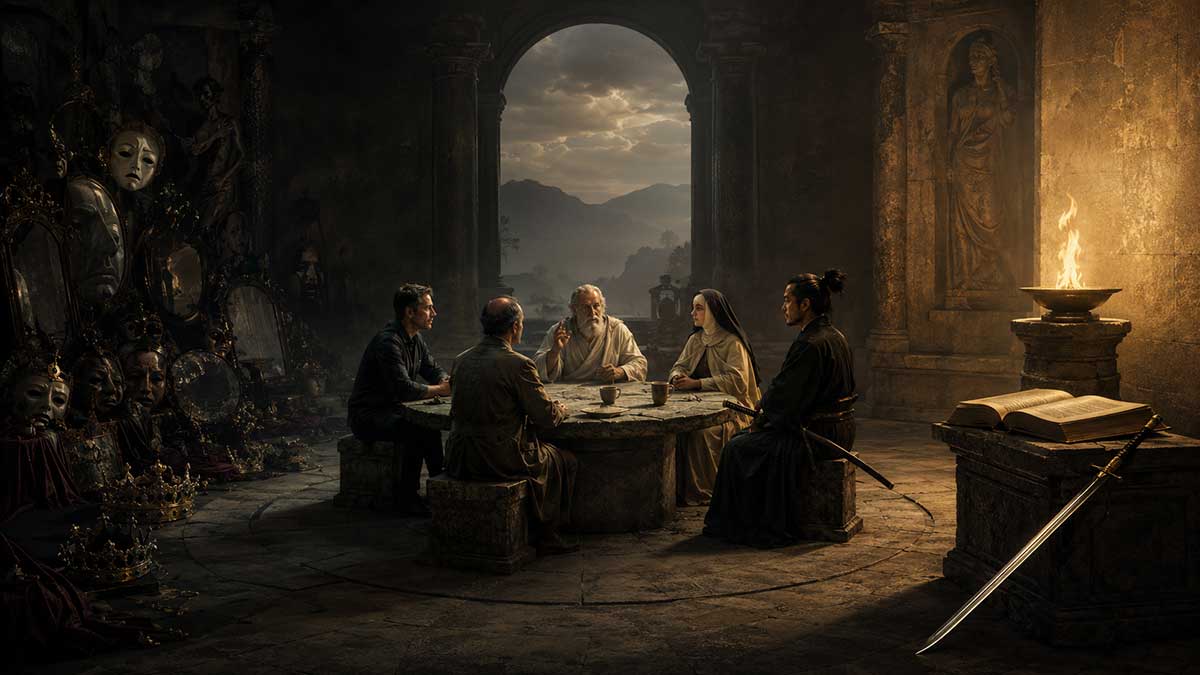
Guests:
Craig Hamilton Parker
Socrates
Teresa of Ávila
C.S. Lewis
Miyamoto Musashi
Opening
The room tonight feels sharper.
There is less candlelight, more examination. The question is no longer whether the divine can speak within. The question is whether human beings can hear without twisting the message.
Craig Hamilton Parker has warned that sacred experience can be confused with fantasy, performance, or ego. He has seen people claim spiritual authority too quickly, turn visions into status, and mistake self-importance for revelation.
Socrates arrives with questions that strip away pride.
Teresa of Ávila brings the discipline of prayer and the danger of illusion.
C.S. Lewis watches the soul’s vanity with painful honesty.
Miyamoto Musashi brings the warrior’s eye for self-deception.
Tonight, they ask how seekers can recognize true guidance from false spiritual ego.
Question 1
Why does true spiritual contact make a person humble, but false contact often makes a person grandiose?
Teresa of Ávila:
The soul touched by God does not grow proud. It trembles.
True contact with the divine shows a person both mercy and smallness. The soul sees that it is loved beyond measure, yet it sees that this love is pure gift.
False contact flatters. It tells the soul, “You are chosen over others. You are above correction. Your feelings are revelation.”
That is a dangerous sweetness.
When God draws near, the soul becomes more obedient to love, more patient with weakness, more willing to serve in hidden ways.
If a vision makes someone thirsty for attention, let that person be cautious.
God does not need vanity to carry His light.
Socrates:
Let us ask first: what does this person claim to know?
Many people say they are guided by the divine. Yet when questioned, they become angry. That is already evidence.
The person who knows little but thinks he knows much is dangerous. The person who has glimpsed something beyond himself becomes aware of how little he knows.
True contact humbles since it reveals a greater order than the private opinion of one mind.
False contact inflates since it confirms what the person already wanted to believe.
So I would ask the seer: has your revelation made you more willing to be questioned?
If not, perhaps it was not revelation, but appetite.
Craig Hamilton Parker:
I’ve seen both sides of this.
In mediumship, when something genuine comes through, it can be deeply moving. You feel grateful. You feel almost surprised that spirit would work through you at all.
But the danger is that the person starts thinking, “I am special. I am the source.” That’s when it goes wrong.
I’ve always felt that the sacred should make us careful. We have to test what comes through. We have to look for evidence, truth, kindness, and humility.
Real guidance does not make you strut.
It makes you listen.
Miyamoto Musashi:
In swordsmanship, a false master loves display.
He moves for the crowd. He wants admiration. He wants his name spoken.
A true master does not waste movement.
The same is true in spirit.
A person with real contact does not need to decorate it. His life cuts cleanly. His words match his actions. His presence does not demand worship.
Grandiosity is extra movement.
Humility is correct form.
If the spirit has trained you, your ego should become smaller, like a blade sharpened until nothing unnecessary remains.
C.S. Lewis:
Pride is the spiritual cancer. It feeds on almost anything, including religion.
A man may begin by believing God has spoken to him. Soon he believes God has chosen him in a way that makes correction unnecessary. Then he begins to enjoy himself as a holy person.
That enjoyment is the trap.
The devil is quite willing for us to have spiritual experiences, provided we use them to become more impressed with ourselves.
True holiness forgets itself.
The saint is not thinking, “How saintly I am.” He is thinking of God and neighbor.
False spirituality keeps glancing in the mirror.
Question 2
How can seekers test dreams, visions, intuitions, and inner voices without killing the sacred mystery?
Socrates:
Testing does not kill truth. It kills illusion.
If an inner voice speaks, ask: what does it command? Does it lead to justice? Does it survive questioning? Does it contradict the good?
A true thing need not fear examination.
Yet one must examine gently. Not with contempt, but with love of truth.
The unexamined vision may become tyranny.
The examined vision may become wisdom.
C.S. Lewis:
There are two errors here.
One is to believe every inner impression. The other is to sneer at all inner life as nonsense.
The human soul is not simple. It contains memory, desire, fear, temptation, imagination, and grace. Any inner message may pass through all of these before it reaches the tongue.
So test it.
Does it make you more charitable? Does it make you more truthful? Does it make you more obedient to the good when no one is watching?
If it does, receive it with gratitude.
If it makes you dramatic, superior, or reckless, be wary.
Teresa of Ávila:
The safest test is fruit.
After the vision, what remains?
Peace? Humility? Service? Greater love for God and neighbor?
Or agitation? Vanity? Hunger for control? Desire to be seen as extraordinary?
God’s visits may be intense, but they leave the soul cleaner.
The devil may appear bright, but his brightness leaves the soul restless.
Seek counsel. Pray. Wait. Do not rush to announce every inner experience.
Many flowers die when pulled up too early.
Craig Hamilton Parker:
I think we have to keep both openness and skepticism.
If I get something through mediumship, I want verification. A name. A fact. A detail. Something that shows it isn’t just imagination.
But in spiritual life, not everything comes with evidence like that. Sometimes it comes as a feeling, a dream, a nudge, a quiet certainty.
So I ask: does this guidance make me better? Does it make me kinder? Does it help others? Does it stand up over time?
The sacred mystery is not weakened by testing.
It becomes stronger when it survives.
Miyamoto Musashi:
Test by practice.
A warrior can talk about courage. Battle reveals him.
A spiritual person can talk about guidance. Daily life reveals him.
Does the vision help you act rightly under pressure? Does intuition remain clear when insulted? Does the inner voice lead you to discipline, or does it excuse laziness?
The Way is not proven by words.
It is proven by conduct.
If your dream cannot survive the marketplace, the family table, the insult, the temptation, then it has not yet become wisdom.
Question 3
When does a teacher guide people inward, and when does a teacher quietly make people dependent?
Miyamoto Musashi:
A true teacher trains you to stand.
A false teacher trains you to kneel forever.
In martial practice, the student must learn to see with his own eyes. If he must always ask the master where to place his feet, he has not learned the Way.
The teacher who needs followers is weak.
The teacher who creates free people is strong.
Watch what happens to the student over time.
Does he become clearer, steadier, braver?
Or does he become more afraid to think without permission?
That is the test.
Craig Hamilton Parker:
That is exactly the danger I worry about.
Some teachers turn the sacred into a personal kingdom. They make people feel that truth only comes through them.
But the true teacher points you back inside. They help you recognize your own conscience, your own contact with spirit, your own responsibility.
I don’t think the golden age is about everyone chasing a guru. I think it’s about people waking up to the divine within themselves.
A teacher may help open the door.
But they should not stand in the doorway forever.
Socrates:
A teacher who gives answers too quickly may be feeding dependency.
I did not teach by handing people conclusions. I asked questions. I disturbed certainty.
The true teacher does not replace the student’s soul. He awakens it.
Beware the teacher who cannot tolerate independent thought. Beware the teacher who treats doubt as betrayal. Beware the teacher who profits from confusion.
A good teacher wants the student to become more truthful, not more loyal to the teacher’s image.
C.S. Lewis:
Spiritual dependency often disguises itself as humility.
A person says, “I am nothing. My teacher knows everything.” That may sound modest, but it can become an escape from responsibility.
God does not desire childishness forever. Childlikeness, yes. Infantilism, no.
A true guide helps the soul grow in courage, repentance, charity, and discernment.
A false guide enjoys being necessary.
That enjoyment is poison.
Where a teacher secretly needs admiration, the students will slowly lose freedom.
Teresa of Ávila:
A true spiritual director helps the soul belong more fully to God.
A false one makes the soul belong more fully to himself.
This can happen subtly. The teacher may use holy language. He may speak of obedience, surrender, and trust. Yet beneath the words, he gathers souls around his own importance.
The soul must remain free for God.
No teacher owns the inner castle.
A good guide says, “Go deeper into prayer. Love more. Serve more. Listen for God.”
A false guide says, “Return to me. Depend on me. Fear leaving me.”
The difference is life or captivity.
Closing
The room has become quiet, but not soft.
Everyone at the table knows that spiritual deception is dangerous precisely since it can wear sacred clothing.
Craig asks for discernment. Socrates asks questions. Teresa tests the fruit of the soul. Lewis exposes pride. Musashi watches conduct under pressure.
Their shared answer is clear.
True guidance does not inflate the self.
It purifies it.
It does not make the seeker dependent.
It makes the seeker responsible.
It does not shout, “Look at me.”
It points inward, toward truth, love, humility, and the quiet place where the soul can meet God without performance.
Topic 4: Are Prophets and Avatars Still Needed in the Age of the Inner Heart?

Guests:
Craig Hamilton Parker
Sathya Sai Baba
Maitreya
St. Paul
Rabindranath Tagore
Opening
The room tonight feels expectant.
No one speaks at first. The silence itself seems to ask the question.
For thousands of years, humanity has waited for messengers: prophets, avatars, Buddhas, saints, saviors, and world teachers. In dark times, people look upward and ask, “Who will come? Who will guide us? Who will bring the light?”
Craig Hamilton Parker has spoken of a coming golden age, a future awakening of divine love, and the possibility that humanity may recognize the sacred through many forms.
Sathya Sai Baba sits with the memory of service, worship, controversy, and devotion surrounding his name.
Maitreya carries the promise of future compassion.
St. Paul brings the fire of transformation.
Rabindranath Tagore brings poetry, freedom, and the music of the soul.
Tonight, they ask whether the world still needs a great teacher—or whether the true teacher is awakening inside everyone.
Question 1
If a divine teacher appeared now, would humanity recognize love—or demand proof, spectacle, and fame?
Sathya Sai Baba:
Love does not need advertisement.
The sun does not announce itself to the flower. The flower opens.
If a divine teacher appears, many will ask for miracles. Some will ask for signs. Some will ask for victory over their enemies. Some will ask for wealth, healing, attention, or proof.
But love comes to change the heart, not entertain the mind.
The true sign is not ash in the hand, nor vision in the sky.
The true sign is transformation.
If anger becomes compassion, if selfishness becomes service, if pride becomes surrender, then the teacher has come.
Craig Hamilton Parker:
That’s where I think many people may get confused.
If the divine comes in a way people don’t expect, they might miss it. Some will demand online proof. Some will want a video. Some will ask, “Where are the miracles?” Others may chase anyone who looks mystical enough.
But I feel the real recognition will happen inside.
When something true comes, it won’t need hype. It will speak directly to the heart. People may feel it before they can explain it.
The danger is that false teachers know how to perform spirituality.
Real love doesn’t perform.
It changes you.
Rabindranath Tagore:
Humanity often crowns noise and ignores song.
A divine teacher may come quietly, like dawn entering a closed room.
The world may ask, “Where is the trumpet? Where is the throne? Where is the proof?” Yet the proof may be that a frightened heart becomes brave, a bitter heart becomes tender, and a divided people begin to remember the same sky.
Fame is a poor lamp. It burns smoky.
Love is clearer.
If the teacher comes as love, the pure heart will know.
The proud heart may ask for credentials.
St. Paul:
The signs of God are not always the signs men seek.
Some seek power. Some seek wisdom. Some seek wonders. Yet the cross looked like weakness to the world.
A true messenger may offend expectation.
He may not flatter the religious. He may not honor the proud. He may not belong to the camp people prefer.
The question is not whether he dazzles the eyes.
The question is whether he bears the fruit of the Spirit: love, joy, peace, patience, kindness, goodness, faithfulness, gentleness, self-control.
There is your test.
Maitreya:
When compassion appears, it is often unrecognized.
People expect majesty, but compassion kneels.
People expect judgment, but compassion listens.
People expect a banner, but compassion becomes bread.
A future teacher is not sent to increase fascination. He comes to reduce suffering.
If humanity demands spectacle, it may receive spectacle. If humanity seeks mercy, it may recognize mercy.
The teacher appears according to the readiness of the heart.
Question 2
Is the coming “golden age” the arrival of one teacher, or the awakening of millions of hearts?
Maitreya:
A teacher may appear as a lamp.
But the purpose of the lamp is not that all people stare at the lamp forever.
The purpose is that many lamps are lit.
The age of compassion cannot be carried by one body alone. It must become food in the hands of mothers, courage in the speech of children, patience in the actions of leaders, forgiveness in the memory of enemies.
One teacher may awaken the call.
Millions must become the answer.
The golden age is compassion made ordinary.
St. Paul:
The body has many members.
One hand cannot say to the foot, “I have no need of you.” One eye cannot become the whole body.
If the Spirit moves, it will not make one person glorious and all others passive. It will distribute gifts. Some will teach. Some will heal. Some will comfort. Some will serve quietly.
The divine life is not meant to remain distant.
It is meant to dwell in the people.
So yes, a messenger may come.
But the deeper mystery is this: the people themselves become the living temple.
Craig Hamilton Parker:
That matches what I feel.
I don’t think the golden age is just everyone waiting for one teacher to fix things. That would leave us passive.
The inner change is the main thing.
We may see a great being, a great teacher, a great sign, but the real shift happens when ordinary people awaken. When they choose truth over convenience. Kindness over bitterness. Service over selfishness. Courage over fear.
That’s when the golden age becomes real.
Not as a political system.
As a change in consciousness.
Sathya Sai Baba:
The teacher comes to remind you of what you are.
You are not weak. You are not separate. You are not born only to eat, earn, fear, and die.
You are love taking human form.
But do not say this with pride. Say it through service.
If you wish to know whether love has awakened in you, ask: whom did I help today? Whom did I forgive? Whom did I feed? Whom did I comfort?
The golden age is not a date.
It is love practiced.
Rabindranath Tagore:
A single bird may announce the morning, but morning does not belong to the bird.
The golden age cannot be owned by one prophet, one temple, one scripture, one nation, or one name.
It comes when the human soul grows spacious enough for the infinite.
A poet may sing it. A saint may bless it. A child may reveal it. A stranger may carry it in a simple act of kindness.
The future is not built by waiting.
It is born when the heart consents to light.
Question 3
What danger appears when people chase gurus instead of becoming responsible for their own spiritual life?
St. Paul:
Immaturity looks for someone else to carry the soul.
A teacher may plant. Another may water. But God gives the growth.
When people chase teachers without discernment, they become vulnerable to every wind of doctrine. They may confuse charm with truth, confidence with holiness, and control with wisdom.
Do not give your conscience away.
Test the spirits.
Hold fast to love.
If a teacher leads you away from truth, away from humility, away from charity, then he is no shepherd.
Rabindranath Tagore:
The cage may be golden and still be a cage.
Some seekers fear freedom. They ask the guru to think for them, choose for them, bless them, excuse them, and name their path.
Then devotion becomes sleep.
True devotion should awaken the soul, not replace it.
A teacher may open a window.
But the student must breathe.
The divine song cannot be sung by borrowed lungs.
Sathya Sai Baba:
Do not chase forms.
See the divine in all.
The master is not here to collect dependence. The master is here to awaken love.
If you serve the poor, you serve God. If you comfort the grieving, you worship God. If you speak truth with kindness, you honor God.
Do not ask, “How close am I to the guru?”
Ask, “How close am I to love?”
A false devotee worships the picture and wounds the person beside him.
A true devotee sees God in that person.
Maitreya:
Dependence can wear holy clothing.
A seeker may say, “I surrender,” when he means, “I do not want responsibility.”
Compassion does not remove responsibility. It deepens it.
A teacher may point to the path, but no teacher can walk with your feet. No teacher can forgive with your heart. No teacher can purify your intention in your place.
To chase gurus is to move from shadow to shadow.
To awaken is to become a source of refuge for others.
Craig Hamilton Parker:
This is one of the biggest dangers in spiritual life.
People want certainty. They want someone to tell them exactly what to believe, what will happen, who is chosen, who is false, what date everything will change.
But the true awakening, I think, asks more from us.
It asks us to listen within. To test what we hear. To take personal responsibility. To stop turning the sacred into entertainment or personality worship.
A real teacher points you back to God within.
A false teacher points you back to himself.
That may be the simplest test of all.
Closing
The question remains alive in the room.
Does humanity still need prophets and avatars?
Perhaps yes.
In dark times, a messenger can remind people of what they forgot. A teacher can become a lamp. A holy life can awaken courage in millions.
But the table agrees on one thing: the teacher is not the destination.
The true teacher does not build a prison of devotion.
The true teacher opens the heart.
Craig sees the golden age as an inner awakening. Sai Baba points to love practiced through service. Maitreya speaks of compassion made ordinary. Paul calls the people themselves a living temple. Tagore sees the future born when the heart consents to light.
So the answer may be this:
A prophet may come.
An avatar may come.
But the golden age begins when humanity stops waiting to be rescued and begins to live as if divine love has already entered the heart.
Topic 5: Can We Live as If the Golden Age Has Already Begun?
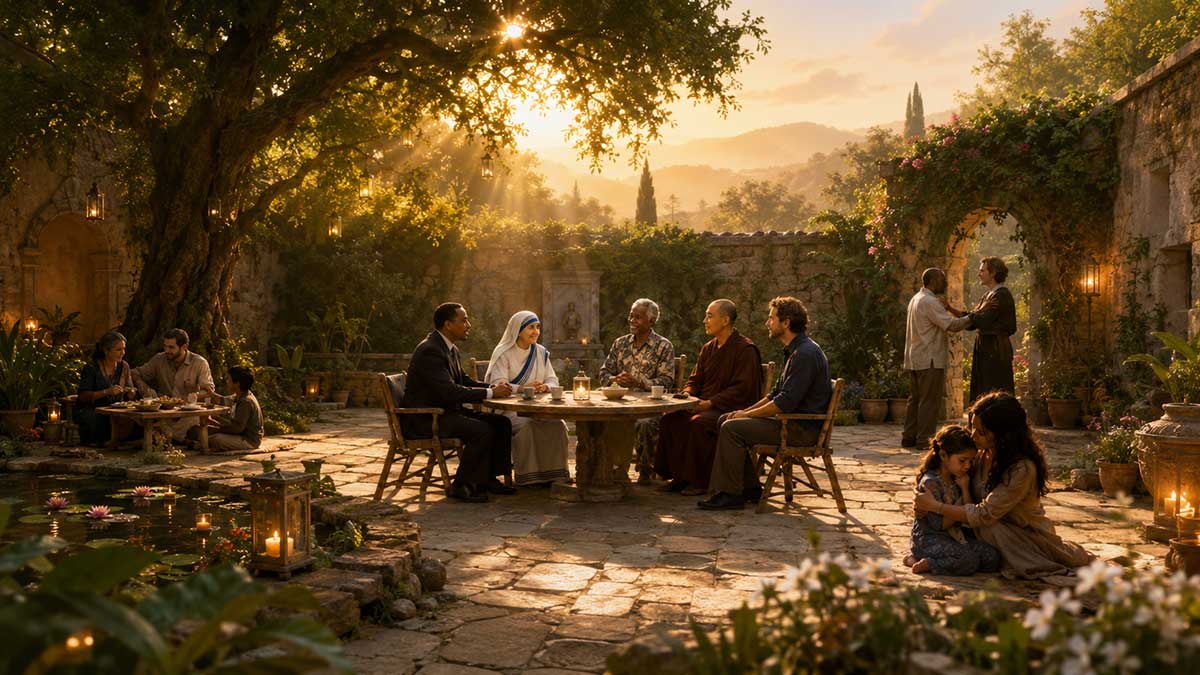
Guests:
Craig Hamilton Parker
Martin Luther King Jr.
Mother Teresa
Nelson Mandela
Thich Nhat Hanh
Opening
The room tonight feels human.
No one is waiting for lightning.
No one is asking for a date, a sign, or a final proof.
The question has become more personal: If a golden age is coming, how should we live before it arrives? If love is the future, can we practice it now? If divine awakening begins in the heart, can ordinary choices become part of that awakening?
Craig Hamilton Parker has said that people do not need to wait passively for a better age. They can live as if it has already begun: choosing truth over convenience, kindness over bitterness, service over selfishness, courage over fear, and spiritual clarity over confusion.
Martin Luther King Jr. enters with moral courage.
Mother Teresa brings the holiness of small acts.
Nelson Mandela carries forgiveness forged through suffering.
Thich Nhat Hanh brings peace into the breath.
Tonight, they ask whether the golden age begins far away in history, or quietly in the way one person treats another.
Question 1
What daily choices make the golden age real before the world can see it?
Martin Luther King Jr.:
The golden age begins when love becomes public action.
It is not enough to dream of justice in private. Love must walk into the street. Love must face hatred without becoming hatred. Love must refuse despair, even when despair looks reasonable.
Every day, a person chooses what kind of future they serve.
A dishonest word serves the old age.
A courageous truth serves the new one.
A bitter reaction serves fear.
A disciplined act of love serves freedom.
The golden age is not proven first by speeches. It is proven by conduct.
When one person refuses to treat another as an enemy of the soul, history has already begun to bend.
Mother Teresa:
Begin with the person nearest to you.
People often want to love humanity, but they do not want to love the difficult person at the table.
The golden age begins in the home. It begins in the kitchen, in the hospital room, in the tired face, in the lonely neighbor, in the child who needs attention.
Do small things with great love.
Smile when it is easier to be cold.
Listen when it is easier to walk away.
Feed one person. Comfort one person. Forgive one person.
God hides in the small.
If we cannot love the person before us, the golden age will remain a beautiful idea.
Craig Hamilton Parker:
That is what I was trying to get at.
People keep asking, “When will things change? When will the divine come? When will the golden age begin?”
But the answer may be: it begins every time we act from love instead of fear.
We create the conditions inside ourselves.
If I choose truth today, I have made a small space for the new age. If I choose kindness, I have laid one stone on the road. If I choose courage, I have refused to let darkness own my mind.
We are not powerless.
The divine works through human hearts.
Thich Nhat Hanh:
The golden age begins with one mindful breath.
Breathing in, I know I am alive.
Breathing out, I smile to life.
A peaceful world cannot be made by unpeaceful people. Peace must begin in the way we walk, speak, eat, listen, and touch the earth.
When you wash a cup, wash the cup with full presence.
When you speak to a child, speak as if the future is listening.
When anger comes, hold it like a crying baby.
Small acts are not small when they contain awareness.
The kingdom of peace is made from moments.
Nelson Mandela:
The daily choice is whether we let suffering make us smaller or larger.
Prison can teach hatred. It can teach patience. It depends on what one does with pain.
The golden age begins when a person refuses to become the mirror image of his oppressor.
This is not weakness. It is discipline.
Each day asks us: will you be ruled by resentment, or will you build something worthy of those who come after you?
The future is made by people who carry pain without passing it on.
Question 2
Can kindness, courage, and truth become spiritual resistance against fear and corruption?
Nelson Mandela:
Yes.
Corruption survives when people believe nothing better is possible.
Fear survives when people surrender their imagination.
Kindness is resistance since it denies the lie that cruelty is strength.
Courage is resistance since it teaches the fearful that they are not alone.
Truth is resistance since false power depends on silence.
But resistance must be disciplined. Anger can awaken a person, but it cannot guide a nation by itself.
The spiritual task is to fight injustice without surrendering the soul.
Craig Hamilton Parker:
That feels very connected to the age we are in.
There is so much fear. People are spiritually exhausted. They don’t trust leaders. They feel common sense has collapsed. They see corruption everywhere.
But if we let fear shape us, then fear has won.
Kindness is not soft. It is a force. Courage is not loud. It can be quiet and steady. Truth is not fashionable. It is often lonely.
These things become spiritual resistance when we practice them without waiting for permission.
The golden age is not imposed from outside.
It is born when people begin acting from awakened hearts.
Martin Luther King Jr.:
Love without courage becomes sentiment.
Courage without love becomes violence.
Truth without love becomes a weapon.
The spiritual resistance we need must hold all three together.
Kindness does not mean accepting injustice. It means refusing to dehumanize anyone, even the one who does wrong.
Courage does not mean absence of fear. It means obedience to conscience in the presence of fear.
Truth does not mean shouting facts. It means living in a way that exposes lies.
When these are joined, the soul becomes free before the system changes.
Mother Teresa:
Fear says, “Protect yourself.”
Love says, “Give yourself.”
Corruption says, “Use people.”
Love says, “Serve people.”
A person may not be able to change a government today. But that person can refuse to become corrupt in the heart.
Do not wait to become powerful before doing good.
The poor need you now.
The lonely need you now.
The wounded need you now.
Each act of love says no to the darkness.
That is resistance.
Thich Nhat Hanh:
When we practice kindness, we remove fear from the body.
When we practice courage, we remove fear from action.
When we practice truth, we remove fear from speech.
This is resistance, but it must be peaceful inside.
If we fight corruption with hatred, corruption has entered us.
If we speak truth with contempt, truth loses its fragrance.
Mindfulness helps us see that the one we oppose is still a human being. This does not mean we allow harm. It means we stop watering the seed of hatred.
Peace is not passivity.
Peace is the deepest form of strength.
Question 3
If every act of love becomes part of the coming world, how should we treat ordinary moments?
Thich Nhat Hanh:
There are no ordinary moments.
A cup of tea can contain the whole earth.
A step can contain freedom.
A word can contain healing.
When you look deeply, you see that each moment carries seeds. One seed may become anger. One seed may become compassion. One seed may become understanding.
The coming world is planted in the present moment.
If you want a peaceful future, drink your tea peacefully. Walk peacefully. Speak peacefully. Work peacefully.
This is not escape.
This is creation.
Nelson Mandela:
Ordinary moments reveal the truth of a person.
It is easier to speak of forgiveness before a crowd than to practice patience with one difficult human being.
It is easier to praise justice than to share credit.
It is easier to condemn cruelty than to remove cruelty from your own tone.
The coming world is built in these hidden places.
A nation is shaped by laws, yes, but it is shaped even more deeply by habits of the heart.
Treat ordinary moments as training for freedom.
Mother Teresa:
Love begins where you are.
Do not look for a great stage.
The person beside you is enough.
A glass of water given with love matters. A wound cleaned with tenderness matters. A hand held in silence matters.
We may think these things disappear, but love never disappears.
God receives it.
The world is changed by hidden faithfulness.
If every act of love becomes part of the coming world, then no moment is wasted.
Craig Hamilton Parker:
That is one of the most reassuring things for me.
People feel powerless. They look at war, politics, corruption, and they think, “What can I do?”
But no sincere prayer is wasted. No act of love is lost. The divine remembers all of it.
The ordinary moments may be where the real golden age begins.
Not in parliament. Not in temples. Not in churches.
In the human heart.
In the way we speak today.
In the way we forgive today.
In the way we choose light today.
Martin Luther King Jr.:
History is made by public marches and private decisions.
The public act may be remembered. The private decision may be known only to God.
But both matter.
A person who tells the truth in a small room is preparing to tell the truth in a larger one.
A person who loves one neighbor is preparing to heal a divided nation.
A person who refuses bitterness today is helping build beloved community tomorrow.
Do not despise the ordinary.
The moral arc is moved by hands that may never be named.
Closing
The room does not end with prediction.
It ends with responsibility.
Craig says the golden age begins in the heart. King says love must become public action. Mother Teresa says God hides in small acts. Mandela says pain must not be passed on. Thich Nhat Hanh says peace begins in one mindful breath.
No one at the table asks humanity to wait passively.
No one says the future will arrive without us.
The golden age may come as a great spiritual awakening, but its first signs are simple:
A truthful word.
A courageous choice.
A meal shared.
A wound forgiven.
A breath taken in peace.
If the divine is coming, then the heart must become ready.
And if the heart becomes ready, perhaps the divine has already begun.
Final Thoughts
The five conversations do not end with certainty.
They end with responsibility.
Craig Hamilton Parker’s vision of the coming golden age is hopeful, but not passive. It does not invite people to sit back and wait for a miracle. It asks them to prepare the place where the miracle may appear.
That place is the heart.
If the world is dark, the answer is not denial.
If institutions are failing, the answer is not despair.
If false teachers rise, the answer is not cynicism.
If humanity is spiritually tired, the answer is not surrender.
The answer is discernment.
The answer is courage.
The answer is love made visible.
Jung reminds us that darkness must be faced, not projected onto others.
Havel reminds us that truth begins when ordinary people stop living inside lies.
Francis reminds us that the smallest act of mercy can carry the presence of God.
Yogananda reminds us that storms do not erase the divine current.
Jesus reminds us that prayer must become mercy.
The Buddha reminds us that any teaching must reduce suffering.
Rumi reminds us that the flame matters more than the lamp.
Ramana Maharshi reminds us that the ego cannot own the divine.
Socrates reminds us to test every claim.
Teresa reminds us to examine the fruit of the soul.
Lewis reminds us that pride can turn even religion into poison.
Musashi reminds us that conduct reveals truth.
Sai Baba reminds us that love must become service.
Maitreya reminds us that compassion is the mark of the future.
Paul reminds us that the people themselves can become a living temple.
Tagore reminds us that the future is born when the heart consents to light.
King reminds us that love must become public action.
Mother Teresa reminds us that the person nearest to us is enough.
Mandela reminds us not to pass our pain to the next generation.
Thich Nhat Hanh reminds us that peace begins in one breath.
So the final question is not only whether divinity is coming.
The final question is whether we are becoming ready.
Ready to tell the truth.
Ready to forgive.
Ready to serve.
Ready to resist fear.
Ready to test spiritual claims.
Ready to stop worshiping personalities.
Ready to find God not only above us, but within the love we practice.
The golden age may arrive as prophecy.
It may arrive as awakening.
It may arrive through a teacher.
It may arrive through millions of ordinary people choosing light in small, hidden ways.
Yet one thing is clear:
A better age cannot be built by hearts that still belong to the old one.
So the work begins now.
Not in parliament.
Not only in temples.
Not only in churches.
Not only in visions.
But in the next word we speak.
The next person we forgive.
The next fear we refuse.
The next act of kindness we choose.
If divinity is coming, then love is already knocking.
And the human heart must open the door.
Short Bios:
Craig Hamilton Parker
A British psychic medium, spiritual teacher, and commentator known for discussing prophecy, world events, mediumship, and spiritual awakening. In this series, he brings the core vision that the darkness of the age may be part of a larger movement toward divine love and inner transformation.
Carl Jung
A Swiss psychiatrist and founder of analytical psychology. Jung explored the shadow, archetypes, dreams, symbols, and the collective unconscious. In this series, he helps interpret the darkness of the age as humanity’s confrontation with its hidden inner life.
Václav Havel
A Czech playwright, dissident, and statesman who became president after resisting communist rule. Havel’s work centered on truth, conscience, and “living in truth.” In this series, he speaks for moral courage in public life.
St. Francis of Assisi
A Christian saint known for humility, poverty, service, love of creation, and compassion for the poor and forgotten. In this series, he reminds us that renewal often begins through small acts of mercy.
Paramahansa Yogananda
An Indian yogi and spiritual teacher who brought Kriya Yoga to the West and wrote Autobiography of a Yogi. In this series, he speaks of inner stillness, divine energy, and the spiritual current beneath outward chaos.
Jesus
The central figure of Christianity, teacher of love, forgiveness, mercy, and the kingdom of God. In this series, he presents inner divinity not as ego, but as love, prayer, humility, and union with the Father.
The Buddha
Siddhartha Gautama, founder of Buddhism, taught the path beyond suffering through awakening, compassion, mindfulness, and freedom from attachment. In this series, he tests every spiritual claim by whether it reduces suffering.
Rumi
A 13th-century Persian poet and Sufi mystic whose writings center on divine love, longing, surrender, and union with the Beloved. In this series, he speaks through the language of love, flame, and the heart’s return to God.
Sri Ramana Maharshi
An Indian sage known for the teaching of self-inquiry, especially the question “Who am I?” In this series, he warns that the ego cannot claim God and points seekers toward silence, awareness, and the Self.
Socrates
An ancient Greek philosopher known for questioning assumptions and exposing false certainty. In this series, he tests spiritual claims through inquiry, humility, and the refusal to accept unexamined visions.
Teresa of Ávila
A Spanish Christian mystic, reformer, and writer of The Interior Castle. She brings deep insight into prayer, humility, discernment, and the difference between true spiritual experience and illusion.
C.S. Lewis
A British writer, Christian thinker, and author of Mere Christianity and The Screwtape Letters. In this series, he examines pride, temptation, false holiness, and the danger of spiritual vanity.
Miyamoto Musashi
A legendary Japanese swordsman and author of The Book of Five Rings. In this series, he brings the discipline of practice, conduct, clarity, and the warrior’s test of truth under pressure.
Sathya Sai Baba
An Indian spiritual teacher associated with teachings on love, service, unity of faiths, and devotion. In this series, he represents the idea that the true sign of divinity is transformation through love and service.
Maitreya
In Buddhist tradition, the future Buddha associated with compassion and a future age of renewal. In this series, Maitreya speaks for compassion made ordinary and the awakening of many hearts.
St. Paul
An early Christian apostle whose letters shaped much of Christian theology. In this series, he speaks of spiritual gifts, testing the spirits, love, transformation, and the people becoming a living temple.
Rabindranath Tagore
A Bengali poet, philosopher, Nobel laureate, and spiritual humanist. In this series, he brings a poetic vision of freedom, light, beauty, and the soul’s openness to the infinite.
Martin Luther King Jr.
An American civil rights leader and Christian minister who taught nonviolence, justice, and beloved community. In this series, he shows how love becomes public action and moral courage.
Mother Teresa
A Catholic nun and missionary known for serving the poor, sick, and dying in Kolkata. In this series, she teaches that the golden age begins through small acts of love for the person nearest to us.
Nelson Mandela
A South African anti-apartheid leader and president who became a global symbol of endurance, forgiveness, and reconciliation. In this series, he speaks of carrying pain without passing it on.
Thich Nhat Hanh
A Vietnamese Zen monk, peace activist, and teacher of mindfulness. In this series, he shows how peace begins in the breath, the step, the word, and the present moment.
Leave a Reply